“HOW TO GENERATE REVENUE
FROM YOUR INVENTION”
FREE training
given by Sam Jalloul
CEO of IDML Products
My goal for you today
To equip you with everything you need to:
Turn your idea into a real revenue generating business
… Even if you are not an expert in the industry, using your idea and passion along
with my knowledge of a proven to work method, you can turn your idea into a real
business.
What I am going to show you today are the EXACT
same strategies that I used to grow my business to
$4m / year in just 4 years
Who is this training for:
• Inventors who have great ideas for new products or services but do not know
how to go about it
• Entrepreneurs with existing businesses looking to expand their products through
innovation
• Employees who are looking to eventually quit their 9-5 jobs and start a business
of their own
• Or seasoned inventors who have inventions and would like to know how to best
turn them into revenue
House rules:
• This is NOT a “Get Rich Quick” method
• This is NOT a “Do nothing but click a button and make money”
• Neither my results or my clients results are typical. Successful inventors and
entrepreneurs are hard working and put in the effort.
THE RESULTS YOU GET ARE ENTIRELY UP TO YOU!
We are experiencing one of the most phenomenal
growths in the world
INNOVATION
Types of innovations:
• Completely new products never seen or heard of before
• Improvement on existing products that have been around for decades
Regardless of whether the invention is new or an improvements on an old one,
they all have one thing in common:
They all are there to SOLVE A PROBLEM
RIGHT now is the PERFECT time to start your own
business derived from an invention you created
QUICK STORY…
Sam Jalloul
• Consultant from London, UK
• Previous corporate slave
• Inventor, entrepreneur leading to growing my
business from nothing to over $4m / year
• Sold my business and now focused to help
other entrepreneurs do the same
Imagine yourself 3 years from now…
You now You in 3 Years
Misconceptions People have about inventors
• To be an inventor you need to have a college degree
• To be an inventor you have to be an engineer or a mad scientist
• Inventors are people who are often locked up in their basement
• Inventors need huge sums of money to invent
Misconceptions People have about inventors
• To be an inventor you need to have a college degree
• To be an inventor you have to be an engineer or a mad scientist
• Inventors are people who are often locked up in their basement
• Inventors need huge sums of money to invent
The biggest mistakes inventors make:
The biggest mistake you could make as an inventor is
DOING NOTHING!
Other risky mistakes would include divulging you idea to someone
without an NDA, sharing it on a public forum, launching it without a
patent, among others…
The only 4 things that you need to
generate revenue from your invention
The only 4 things that you need to
generate revenue from your invention
A viable
invention
Protect
your
invention
Develop
idea into a
Product
Go to
Market
strategy
1 2 3 4
Step 1
A viable
invention
Why a viable invention?
• An invention must a have a viable need
• An invention must solve a genuine problem
• An invention must be novel i.e. not just a copy of something else
• An invention must be industrially applicable i.e. can be manufactured
using today’s technology
• An invention must be inventive i.e. should not be obvious or easily
conceived for a person skilled in the art
• The whole objective is to ensure it is viable before spending further
money on it or risk legal issues if a similar product exists and no
homework was done
So how do inventors know if their invention is
viable or not?
• The easiest way and most expensive way is to contact a patent
attorney who will be happy to charge several thousand dollars for this
service
• Search engines are always a good source to give a feel of what is out
there but they do leave a lot of uncovered territory
• Patent search firms also exist and they can do a cheaper search for a
few hundred dollars
When I started my business, I did a combination of all 3 of the above
and it cost me almost $10,000 just for this phase
The end result of Step 1 is a risk reduction
factor for you and your potential investor
from launching the product
Step 2
Protect
your
invention
What can you do to protect your invention?
• File provisional utility patents
• File non-provisional utility patents
• File design patents
Patents are licenses granted by government authorities to allow the
inventor or its assignees to have exclusive and the sole right to make,
use or sell the invention for a set period of time usually 20 years
Additional protection can include trademark and copyright for other
elements that are not patent related
Why should I protect my Invention?
• Exclusive and sole right to make, use or sell the invention for a
period of 15-20 years from the date of first filing
• Ability to create a monopoly for that niche segment for the same
period of time
• Ability to license the invention to others to make or use it in
return for fixed % royalty on sales
• Ability to bring suite to anyone who tries to launch a product
which violates the claims approved in the granted patent
How expensive are patents?
• Patents can get quite expensive in some cases depending on how straight
forward the invention is
• A typical patent can cost between $3,000 - $5,000 for each country
• You can file International patents under the PCT which does not give you one
filing for all but allows you to use the original filing date of the first filing
country to claim priority
• The strategy you set can minimise the amount needed to spend on patent
filings
• Knowing what I know now about international patents, I could have saved
myself upwards of $30,000-$50,000 on my invention
The end result of Step 2 is a further risk
reduction factor for you and your potential
investor from launching the product
Step 3
Develop
idea into a
Product
Turning your invention into a product is
one of the most complex steps and can
be quite intimidating
I provide you with 4 phases to turn the
idea into a physical product
I provide you with 4 easy phases to turn
the idea into a physical product
Basic
sketches
3D
technical
drawings
Physical
prototype
Final
product
sample
1 2 3 4
Step 3
Develop
idea into a
Product
Phase 1
Basic
sketches
What are basic sketches?
• These are simple drawings done by you or a professional
• The sketches show the general gist of the product in terms of key
elements and features
• They will often contain annotations and text to explain certain
features
Step 3
Develop
idea into a
Product
Phase 2
3D
technical
drawings
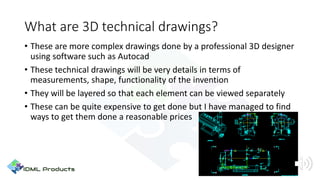
What are 3D technical drawings?
• These are more complex drawings done by a professional 3D designer
using software such as Autocad
• These technical drawings will be very details in terms of
measurements, shape, functionality of the invention
• They will be layered so that each element can be viewed separately
• These can be quite expensive to get done but I have managed to find
ways to get them done a reasonable prices
Step 3
Develop
idea into a
Product
Phase 3
Physical
prototype
What is a physical prototype?
• This is a physical model replica of the technical drawings
• The prototype can be a non-functional one done in methods such as 3D
printing or a functional prototype with expert manufacturers
• It is important to ensure NDAs are signed with all of these to protect the
confidentiality of the product
• This will be the most costly part with prototypes costing between $300
up to several thousands depending on the technical complexity and
material requirements for it
• The end result will in fact be a basic working model of you product
which you can test and adjust as required
Step 3
Develop
idea into a
Product
Phase 4
Final
product
sample
What is a final product sample?
• This is a physical model of your improved first prototype and may
include at this stage any design elements sich as colour, logo and
materials
• It is as close to what the final product that a consumer will use
• It will involve further prototyping costs to ensure it is done properly and
may include other costs such as designer fees for the logo and overall
design.
If you have reached this stage of the process
you have not only proved to yourself that
your product works but also to any
potential investors you are talking to
Step 4
Go to
Market
strategy
What is a go to market strategy?
• This can be confusing and daunting for certain people but if you have
made it this far then do not let this discourage you
• Every product and business will have a different go to market strategies
based on the goals of the inventor and the industry
• In the most simple terms is “How do you take you product from sample
to availability in stores and online for consumers to purchase?”
• If you can answer this question then you have your go to market strategy
Before going to market:
How do you plan to fund the go to market plan?:
• Private investment from yourself
• Private funding from investors or venture capital
• Crowd funding on reliable platforms such as Kickstarter
• License agreements in exchange for Royalty
The end result of Step 4 is a further risk
reduction factor for you and your potential
investor from launching the product
So to recap the training…
Our process from start to finish
A viable
invention
Protect
your
invention
Develop
idea into a
Product
Go to
Market
strategy
1 2 3 4
Would you like to learn more?:
If you would like to learn more schedule today your FREE 30-40 minutes
consultation call
Simply click the link on the page containing the video and book your free
session now
Learn how I can make your invention into a viable business generating you
income.
THANK YOU…

IDML Training Jan 2017

  • 1.
    “HOW TO GENERATEREVENUE FROM YOUR INVENTION” FREE training given by Sam Jalloul CEO of IDML Products
  • 2.
    My goal foryou today To equip you with everything you need to: Turn your idea into a real revenue generating business … Even if you are not an expert in the industry, using your idea and passion along with my knowledge of a proven to work method, you can turn your idea into a real business.
  • 3.
    What I amgoing to show you today are the EXACT same strategies that I used to grow my business to $4m / year in just 4 years
  • 4.
    Who is thistraining for: • Inventors who have great ideas for new products or services but do not know how to go about it • Entrepreneurs with existing businesses looking to expand their products through innovation • Employees who are looking to eventually quit their 9-5 jobs and start a business of their own • Or seasoned inventors who have inventions and would like to know how to best turn them into revenue
  • 5.
    House rules: • Thisis NOT a “Get Rich Quick” method • This is NOT a “Do nothing but click a button and make money” • Neither my results or my clients results are typical. Successful inventors and entrepreneurs are hard working and put in the effort. THE RESULTS YOU GET ARE ENTIRELY UP TO YOU!
  • 6.
    We are experiencingone of the most phenomenal growths in the world INNOVATION
  • 7.
    Types of innovations: •Completely new products never seen or heard of before • Improvement on existing products that have been around for decades Regardless of whether the invention is new or an improvements on an old one, they all have one thing in common: They all are there to SOLVE A PROBLEM
  • 8.
    RIGHT now isthe PERFECT time to start your own business derived from an invention you created
  • 9.
  • 10.
    Sam Jalloul • Consultantfrom London, UK • Previous corporate slave • Inventor, entrepreneur leading to growing my business from nothing to over $4m / year • Sold my business and now focused to help other entrepreneurs do the same
  • 12.
    Imagine yourself 3years from now… You now You in 3 Years
  • 13.
    Misconceptions People haveabout inventors • To be an inventor you need to have a college degree • To be an inventor you have to be an engineer or a mad scientist • Inventors are people who are often locked up in their basement • Inventors need huge sums of money to invent
  • 14.
    Misconceptions People haveabout inventors • To be an inventor you need to have a college degree • To be an inventor you have to be an engineer or a mad scientist • Inventors are people who are often locked up in their basement • Inventors need huge sums of money to invent
  • 15.
    The biggest mistakesinventors make: The biggest mistake you could make as an inventor is DOING NOTHING! Other risky mistakes would include divulging you idea to someone without an NDA, sharing it on a public forum, launching it without a patent, among others…
  • 16.
    The only 4things that you need to generate revenue from your invention
  • 17.
    The only 4things that you need to generate revenue from your invention A viable invention Protect your invention Develop idea into a Product Go to Market strategy 1 2 3 4
  • 18.
  • 19.
    Why a viableinvention? • An invention must a have a viable need • An invention must solve a genuine problem • An invention must be novel i.e. not just a copy of something else • An invention must be industrially applicable i.e. can be manufactured using today’s technology • An invention must be inventive i.e. should not be obvious or easily conceived for a person skilled in the art • The whole objective is to ensure it is viable before spending further money on it or risk legal issues if a similar product exists and no homework was done
  • 20.
    So how doinventors know if their invention is viable or not? • The easiest way and most expensive way is to contact a patent attorney who will be happy to charge several thousand dollars for this service • Search engines are always a good source to give a feel of what is out there but they do leave a lot of uncovered territory • Patent search firms also exist and they can do a cheaper search for a few hundred dollars When I started my business, I did a combination of all 3 of the above and it cost me almost $10,000 just for this phase
  • 21.
    The end resultof Step 1 is a risk reduction factor for you and your potential investor from launching the product
  • 22.
  • 23.
    What can youdo to protect your invention? • File provisional utility patents • File non-provisional utility patents • File design patents Patents are licenses granted by government authorities to allow the inventor or its assignees to have exclusive and the sole right to make, use or sell the invention for a set period of time usually 20 years Additional protection can include trademark and copyright for other elements that are not patent related
  • 24.
    Why should Iprotect my Invention? • Exclusive and sole right to make, use or sell the invention for a period of 15-20 years from the date of first filing • Ability to create a monopoly for that niche segment for the same period of time • Ability to license the invention to others to make or use it in return for fixed % royalty on sales • Ability to bring suite to anyone who tries to launch a product which violates the claims approved in the granted patent
  • 25.
    How expensive arepatents? • Patents can get quite expensive in some cases depending on how straight forward the invention is • A typical patent can cost between $3,000 - $5,000 for each country • You can file International patents under the PCT which does not give you one filing for all but allows you to use the original filing date of the first filing country to claim priority • The strategy you set can minimise the amount needed to spend on patent filings • Knowing what I know now about international patents, I could have saved myself upwards of $30,000-$50,000 on my invention
  • 26.
    The end resultof Step 2 is a further risk reduction factor for you and your potential investor from launching the product
  • 27.
  • 28.
    Turning your inventioninto a product is one of the most complex steps and can be quite intimidating
  • 29.
    I provide youwith 4 phases to turn the idea into a physical product
  • 30.
    I provide youwith 4 easy phases to turn the idea into a physical product Basic sketches 3D technical drawings Physical prototype Final product sample 1 2 3 4
  • 31.
    Step 3 Develop idea intoa Product Phase 1 Basic sketches
  • 32.
    What are basicsketches? • These are simple drawings done by you or a professional • The sketches show the general gist of the product in terms of key elements and features • They will often contain annotations and text to explain certain features
  • 33.
    Step 3 Develop idea intoa Product Phase 2 3D technical drawings
  • 34.
    What are 3Dtechnical drawings? • These are more complex drawings done by a professional 3D designer using software such as Autocad • These technical drawings will be very details in terms of measurements, shape, functionality of the invention • They will be layered so that each element can be viewed separately • These can be quite expensive to get done but I have managed to find ways to get them done a reasonable prices
  • 35.
    Step 3 Develop idea intoa Product Phase 3 Physical prototype
  • 36.
    What is aphysical prototype? • This is a physical model replica of the technical drawings • The prototype can be a non-functional one done in methods such as 3D printing or a functional prototype with expert manufacturers • It is important to ensure NDAs are signed with all of these to protect the confidentiality of the product • This will be the most costly part with prototypes costing between $300 up to several thousands depending on the technical complexity and material requirements for it • The end result will in fact be a basic working model of you product which you can test and adjust as required
  • 37.
    Step 3 Develop idea intoa Product Phase 4 Final product sample
  • 38.
    What is afinal product sample? • This is a physical model of your improved first prototype and may include at this stage any design elements sich as colour, logo and materials • It is as close to what the final product that a consumer will use • It will involve further prototyping costs to ensure it is done properly and may include other costs such as designer fees for the logo and overall design.
  • 39.
    If you havereached this stage of the process you have not only proved to yourself that your product works but also to any potential investors you are talking to
  • 40.
  • 41.
    What is ago to market strategy? • This can be confusing and daunting for certain people but if you have made it this far then do not let this discourage you • Every product and business will have a different go to market strategies based on the goals of the inventor and the industry • In the most simple terms is “How do you take you product from sample to availability in stores and online for consumers to purchase?” • If you can answer this question then you have your go to market strategy
  • 42.
    Before going tomarket: How do you plan to fund the go to market plan?: • Private investment from yourself • Private funding from investors or venture capital • Crowd funding on reliable platforms such as Kickstarter • License agreements in exchange for Royalty
  • 43.
    The end resultof Step 4 is a further risk reduction factor for you and your potential investor from launching the product
  • 44.
    So to recapthe training…
  • 45.
    Our process fromstart to finish A viable invention Protect your invention Develop idea into a Product Go to Market strategy 1 2 3 4
  • 46.
    Would you liketo learn more?: If you would like to learn more schedule today your FREE 30-40 minutes consultation call Simply click the link on the page containing the video and book your free session now Learn how I can make your invention into a viable business generating you income.
  • 47.