Identify Right
Process for
Automation
Aniruddha Gupta
2
Agenda
• RPA Delivery Lifecycle
• What should we look to Automate?
• Process characteristics & Qualification Metrics
• Process Complexity factors
• Aligning Process Complexity with Estimated delivery time
• Process Identification the new way
3
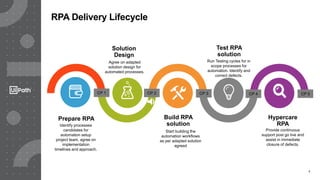
RPA Delivery Lifecycle
Start building the
automation workflows
as per adapted solution
agreed
Build RPA
solution
Provide continuous
support post go live and
assist in immediate
closure of defects.
Hypercare
RPA
Run Testing cycles for in
scope processes for
automation. Identify and
correct defects.
Test RPA
solution
CP 1 CP 2 CP 4
Identify processes
candidates for
automation setup
project team, agree on
implementation
timelines and approach.
Prepare RPA
Agree on adapted
solution design for
automated processes.
Solution
Design
CP 5CP 3
4
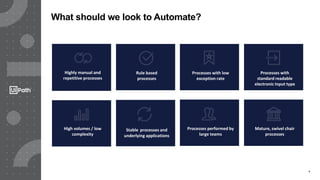
What should we look to Automate?
Mature, swivel chair
processes
Rule based
processes
Processes with low
exception rate
Processes with
standard readable
electronic Input type
High volumes / low
complexity
Stable processes and
underlying applications
Processes performed by
large teams
Highly manual and
repetitive processes
5
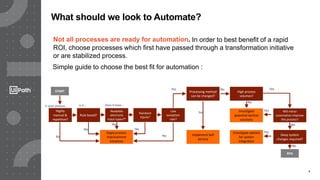
What should we look to Automate?
Deep system
changes required?
Will minor
automation improve
the process?
No
No
RPA
Investigate options
for system
integration
Implement Self
Service
Investigate
potential tactical
solutions
High process
volumes?
Processing method
can be changed?
Highly
manual &
repetitive?
Rule based?
Readable
electronic
input types?*
Standard
inputs?
Low
exception
rate?
Apply process
improvement
initiatives
START
Is your process… Is it … Does it have …
No
No
No
No
No
Yes
Yes
Yes
Yes
Yes
No
No
Not all processes are ready for automation. In order to best benefit of a rapid
ROI, choose processes which first have passed through a transformation initiative
or are stabilized process.
Simple guide to choose the best fit for automation :
Not all processes are ready for automation.
6
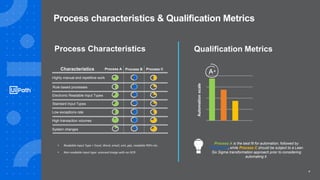
Process Characteristics Qualification Metrics
Highly manual and repetitive work
Rule based processes
Electronic Readable Input Types
Standard Input Types
Low exceptions rate
Process A Process B Process CCharacteristics
High transaction volumes
System changes
• Readable Input Type = Excel, Word, email, xml, ppt, readable PDFs etc.
• Non readable input type: scanned image with no OCR
Automationscale
Process A is the best fit for automation, followed by
Process B, while Process C should be subject to a Lean
Six Sigma transformation approach prior to considering
automating it.
Process characteristics & Qualification Metrics
7
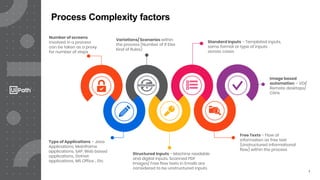
Process Complexity factors
Number of screens
involved in a process
can be taken as a proxy
for number of steps
Variations/ Scenarios within
the process (Number of If Else
kind of Rules)
Structured Inputs – Machine readable
and digital inputs. Scanned PDF
Images/ Free flow texts in Emails are
considered to be unstructured inputs
Image based
automation – VDI/
Remote desktops/
Citrix
Free Texts – Flow of
information as free text
(Unstructured informational
flow) within the process
Type of Applications – Java
Applications, Mainframe
applications, SAP, Web based
applications, Dotnet
applications, MS Office .. Etc
Standard Inputs – Templated inputs,
same format or type of inputs
across cases
8
Aligning Process Complexity with Estimated delivery time
Key Criteria Low complexity Medium complexity High complexity
Number of applications 1-2 3-4 >5
Number of screens 1-4 4-40 >40
Number of business
logic rules
<5
Without alternative flow
5-50
Incl. alternative flows
>50
Incl. nested rules
Scale of exception handling
expected
Low Medium High
Data type
Digital, structured
& standardized
Digital, structured
& standardized
Digital, Semi-Structured and
Unstructured
Data handling required Copy/paste Copy, paste, read and modify data
Copy, paste, read data,
data enrichment, PDF data
extraction
Process redesign required? No process changes required Minor process changes required
Significant process redesign
required
Systems integration All Systems integrate natively
Requires some custom integration
and/ Custom Function / Image
Recognition
Leverage existing 3rd party tools
and/ complex Custom Functions
Associated level of
operational risk
Non-core processing
Time or business
dependent processing
Business critical
BAU processing
Typical end to end delivery
duration
4-6 weeks 7-9 weeks 12-14 weeks
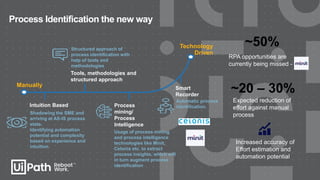
Intuition Based
Technology
Driven
Manually
Shadowing the SME and
arriving at AS-IS process
state.
Identifying automation
potential and complexity
based on experience and
intuition.
Tools, methodologies and
structured approach
Structured approach of
process identification with
help of tools and
methodologies
Process
mining/
Process
Intelligence
Usage of process mining
and process intelligence
technologies like Minit,
Celonis etc. to extract
process insights, which will
in turn augment process
identification
Smart
Recorder
Automatic process
identification.
~50%
RPA opportunities are
currently being missed -
~20 – 30%
Expected reduction of
effort against manual
process
Increased accuracy of
Effort estimation and
automation potential
Process Identification the new way
10
Makes more-detailed and accurate
Process Definition Documents
(PDD’s)
Works with Automation Hub to give
you one place for all your
documentation
Improves the relationship between
BA’s and RPA Developers (no more
PDD delays)
11
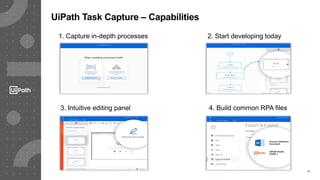
UiPath Task Capture – Capabilities
2. Start developing today1. Capture in-depth processes
4. Build common RPA files3. Intuitive editing panel
Thank You !!
Upcoming Community Events
Globally connected, locally involved
Join: https://communityevents.uipath.com/

Identify right process for automation

  • 1.
  • 2.
    2 Agenda • RPA DeliveryLifecycle • What should we look to Automate? • Process characteristics & Qualification Metrics • Process Complexity factors • Aligning Process Complexity with Estimated delivery time • Process Identification the new way
  • 3.
    3 RPA Delivery Lifecycle Startbuilding the automation workflows as per adapted solution agreed Build RPA solution Provide continuous support post go live and assist in immediate closure of defects. Hypercare RPA Run Testing cycles for in scope processes for automation. Identify and correct defects. Test RPA solution CP 1 CP 2 CP 4 Identify processes candidates for automation setup project team, agree on implementation timelines and approach. Prepare RPA Agree on adapted solution design for automated processes. Solution Design CP 5CP 3
  • 4.
    4 What should welook to Automate? Mature, swivel chair processes Rule based processes Processes with low exception rate Processes with standard readable electronic Input type High volumes / low complexity Stable processes and underlying applications Processes performed by large teams Highly manual and repetitive processes
  • 5.
    5 What should welook to Automate? Deep system changes required? Will minor automation improve the process? No No RPA Investigate options for system integration Implement Self Service Investigate potential tactical solutions High process volumes? Processing method can be changed? Highly manual & repetitive? Rule based? Readable electronic input types?* Standard inputs? Low exception rate? Apply process improvement initiatives START Is your process… Is it … Does it have … No No No No No Yes Yes Yes Yes Yes No No Not all processes are ready for automation. In order to best benefit of a rapid ROI, choose processes which first have passed through a transformation initiative or are stabilized process. Simple guide to choose the best fit for automation : Not all processes are ready for automation.
  • 6.
    6 Process Characteristics QualificationMetrics Highly manual and repetitive work Rule based processes Electronic Readable Input Types Standard Input Types Low exceptions rate Process A Process B Process CCharacteristics High transaction volumes System changes • Readable Input Type = Excel, Word, email, xml, ppt, readable PDFs etc. • Non readable input type: scanned image with no OCR Automationscale Process A is the best fit for automation, followed by Process B, while Process C should be subject to a Lean Six Sigma transformation approach prior to considering automating it. Process characteristics & Qualification Metrics
  • 7.
    7 Process Complexity factors Numberof screens involved in a process can be taken as a proxy for number of steps Variations/ Scenarios within the process (Number of If Else kind of Rules) Structured Inputs – Machine readable and digital inputs. Scanned PDF Images/ Free flow texts in Emails are considered to be unstructured inputs Image based automation – VDI/ Remote desktops/ Citrix Free Texts – Flow of information as free text (Unstructured informational flow) within the process Type of Applications – Java Applications, Mainframe applications, SAP, Web based applications, Dotnet applications, MS Office .. Etc Standard Inputs – Templated inputs, same format or type of inputs across cases
  • 8.
    8 Aligning Process Complexitywith Estimated delivery time Key Criteria Low complexity Medium complexity High complexity Number of applications 1-2 3-4 >5 Number of screens 1-4 4-40 >40 Number of business logic rules <5 Without alternative flow 5-50 Incl. alternative flows >50 Incl. nested rules Scale of exception handling expected Low Medium High Data type Digital, structured & standardized Digital, structured & standardized Digital, Semi-Structured and Unstructured Data handling required Copy/paste Copy, paste, read and modify data Copy, paste, read data, data enrichment, PDF data extraction Process redesign required? No process changes required Minor process changes required Significant process redesign required Systems integration All Systems integrate natively Requires some custom integration and/ Custom Function / Image Recognition Leverage existing 3rd party tools and/ complex Custom Functions Associated level of operational risk Non-core processing Time or business dependent processing Business critical BAU processing Typical end to end delivery duration 4-6 weeks 7-9 weeks 12-14 weeks
  • 9.
    Intuition Based Technology Driven Manually Shadowing theSME and arriving at AS-IS process state. Identifying automation potential and complexity based on experience and intuition. Tools, methodologies and structured approach Structured approach of process identification with help of tools and methodologies Process mining/ Process Intelligence Usage of process mining and process intelligence technologies like Minit, Celonis etc. to extract process insights, which will in turn augment process identification Smart Recorder Automatic process identification. ~50% RPA opportunities are currently being missed - ~20 – 30% Expected reduction of effort against manual process Increased accuracy of Effort estimation and automation potential Process Identification the new way
  • 10.
    10 Makes more-detailed andaccurate Process Definition Documents (PDD’s) Works with Automation Hub to give you one place for all your documentation Improves the relationship between BA’s and RPA Developers (no more PDD delays)
  • 11.
    11 UiPath Task Capture– Capabilities 2. Start developing today1. Capture in-depth processes 4. Build common RPA files3. Intuitive editing panel
  • 12.
    Thank You !! UpcomingCommunity Events Globally connected, locally involved Join: https://communityevents.uipath.com/