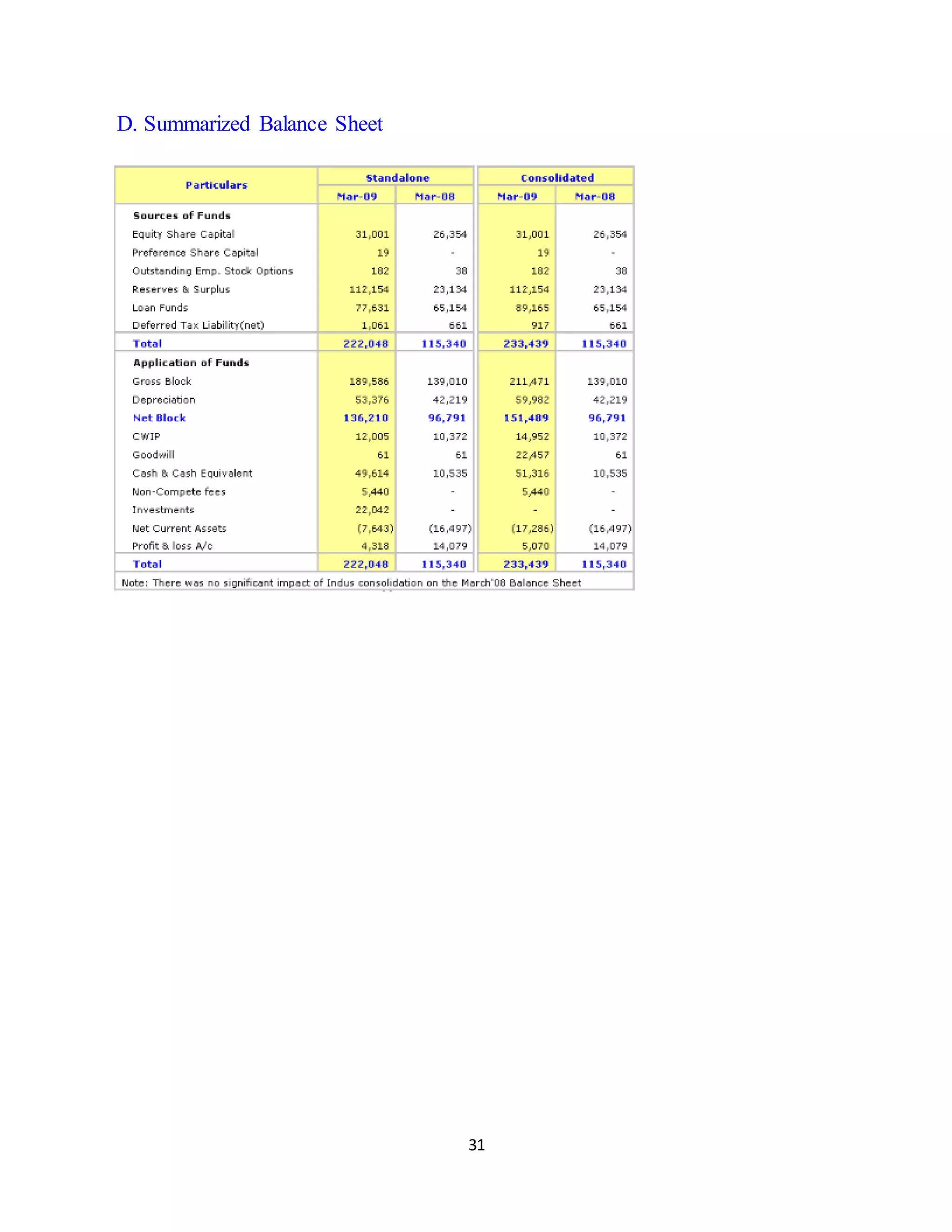
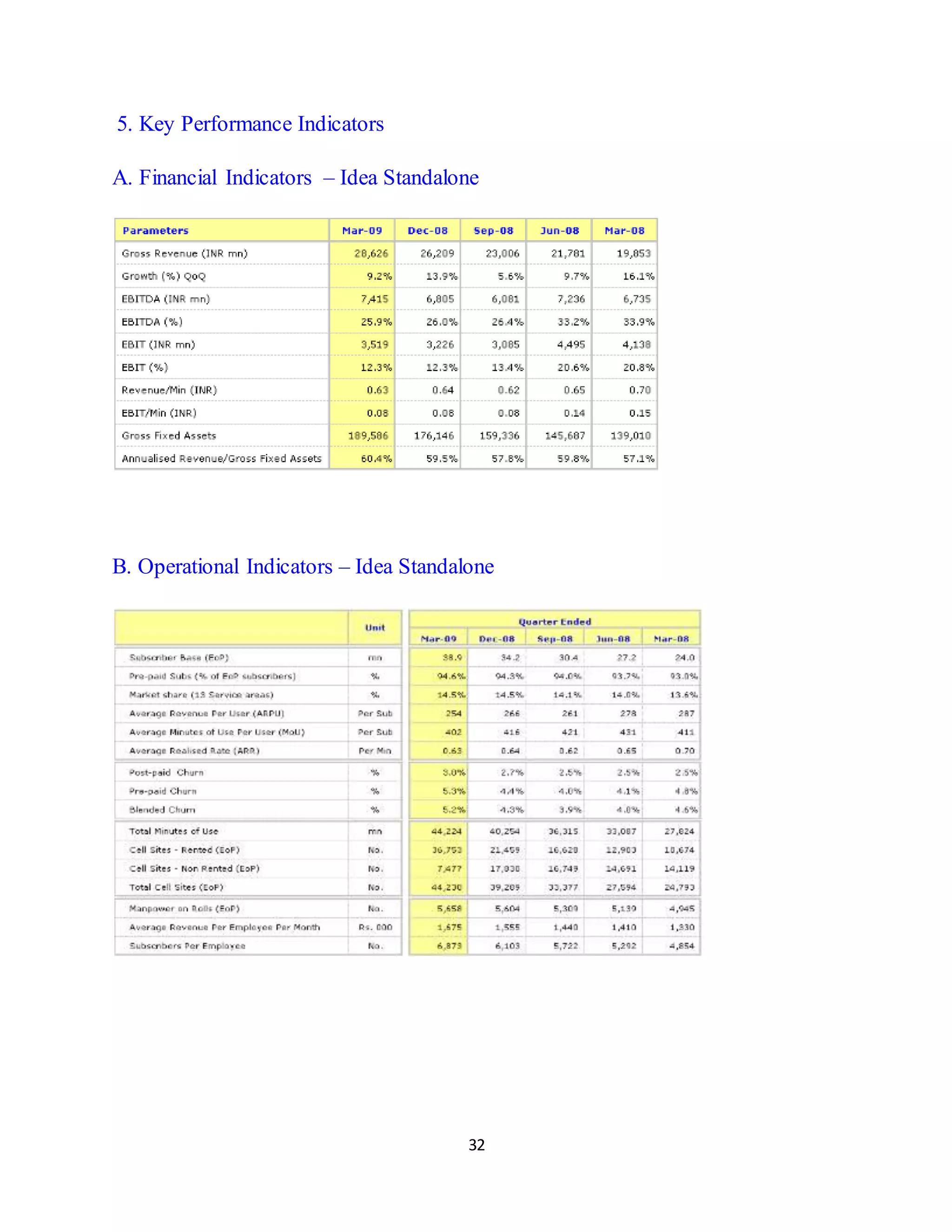
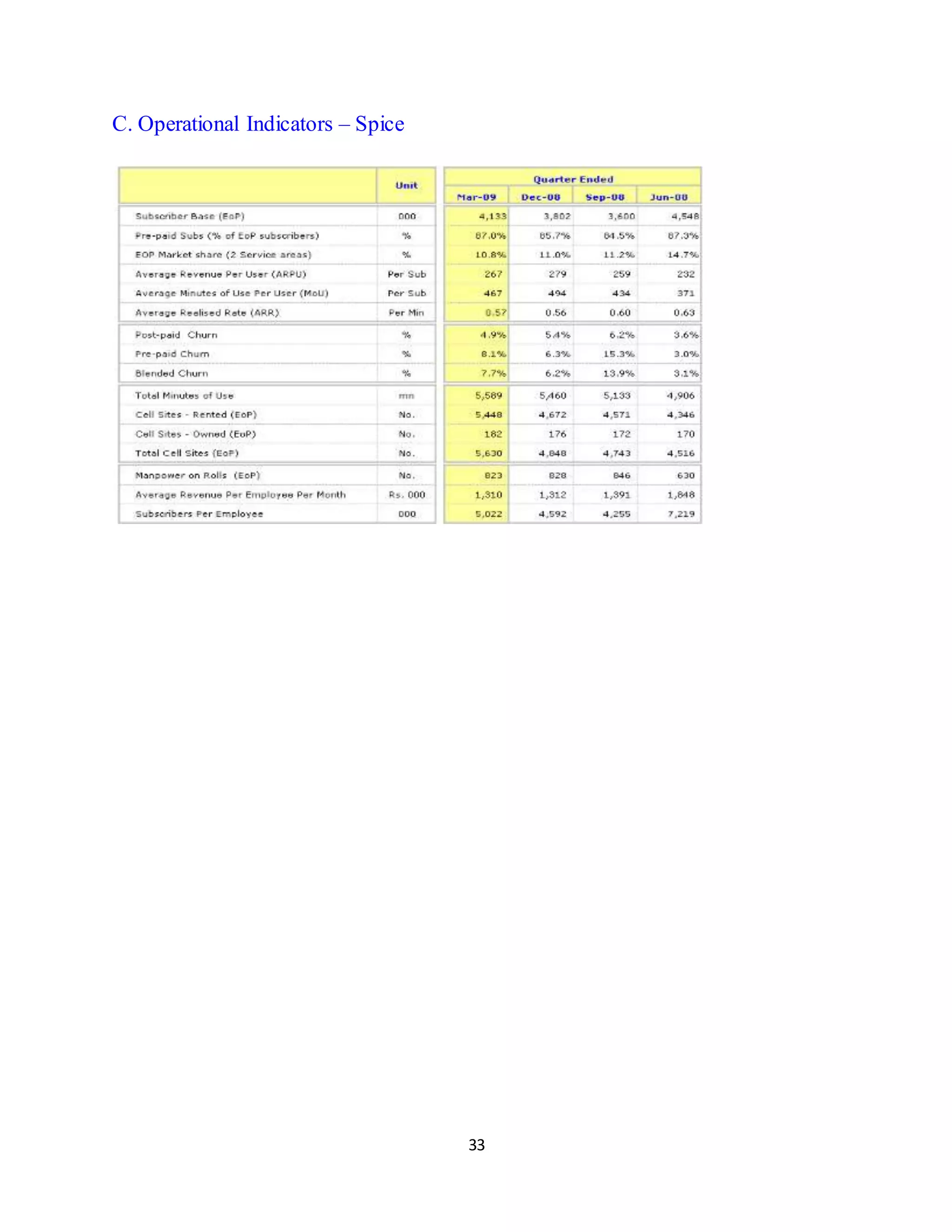
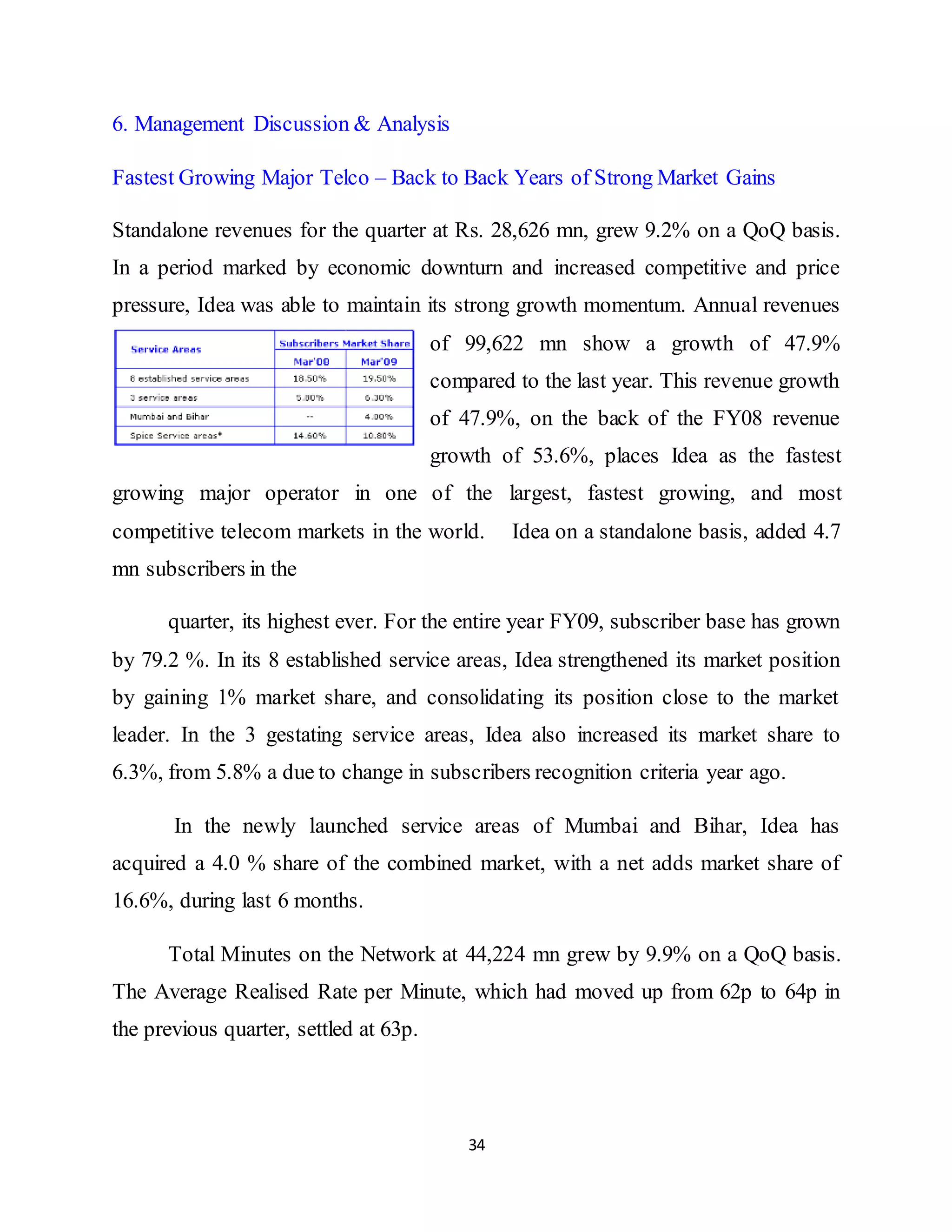
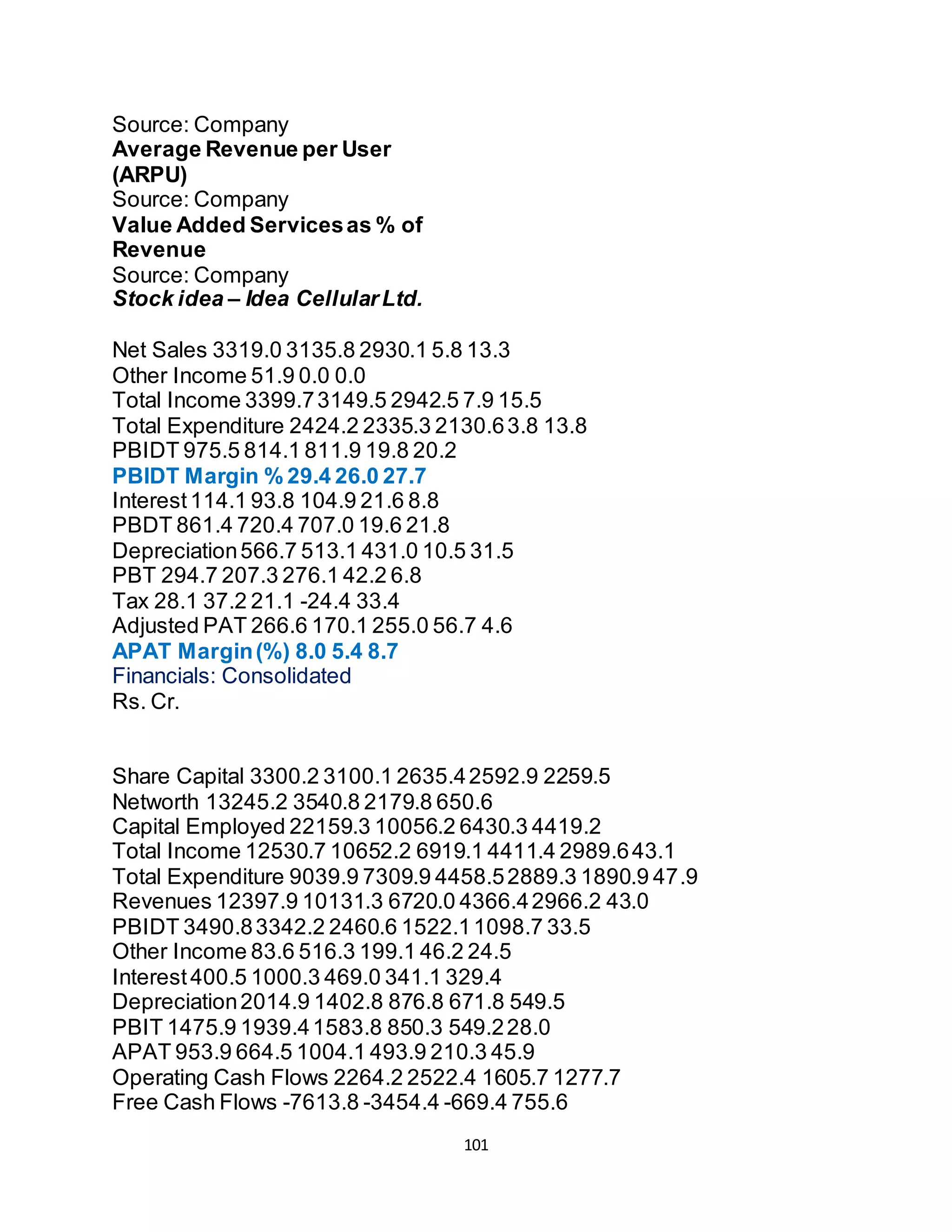
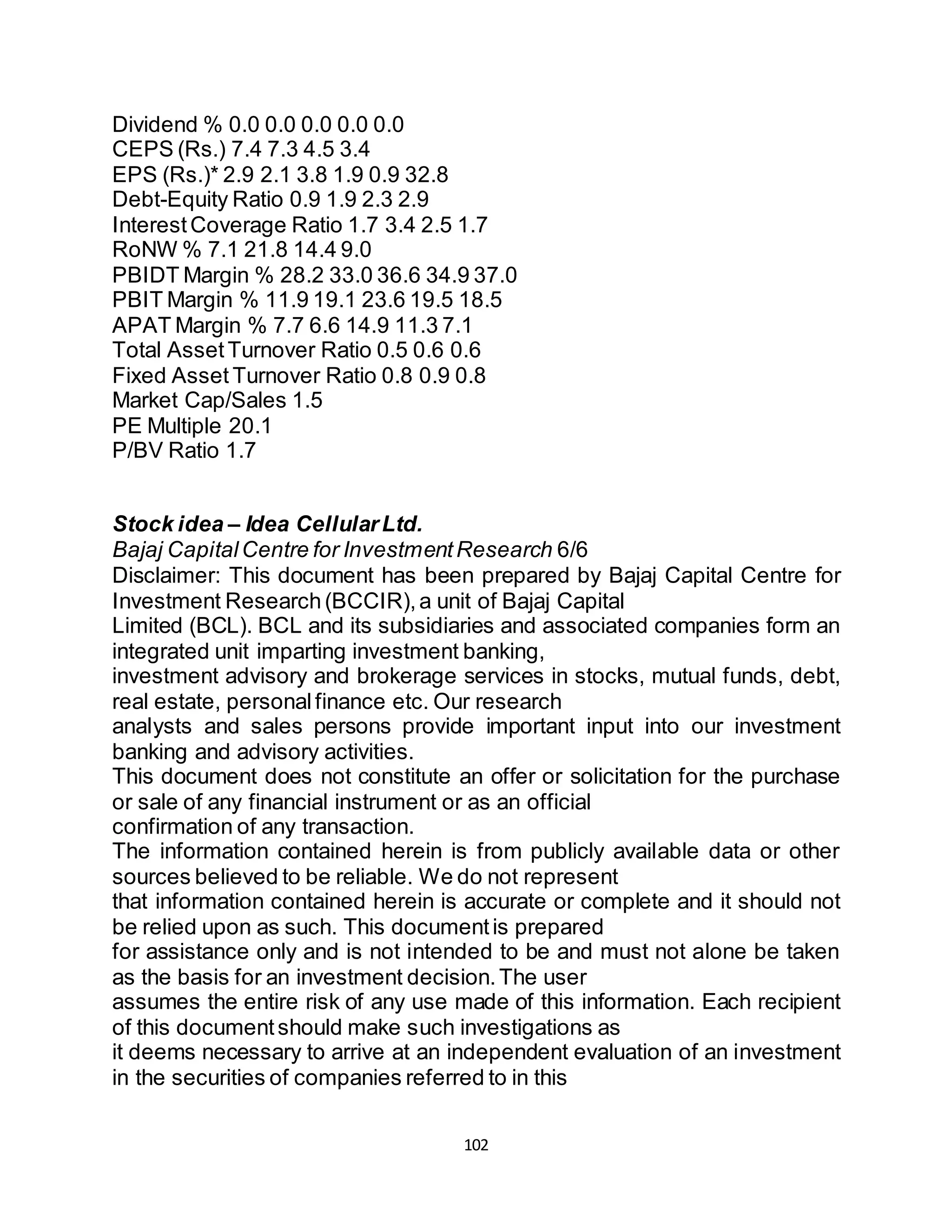
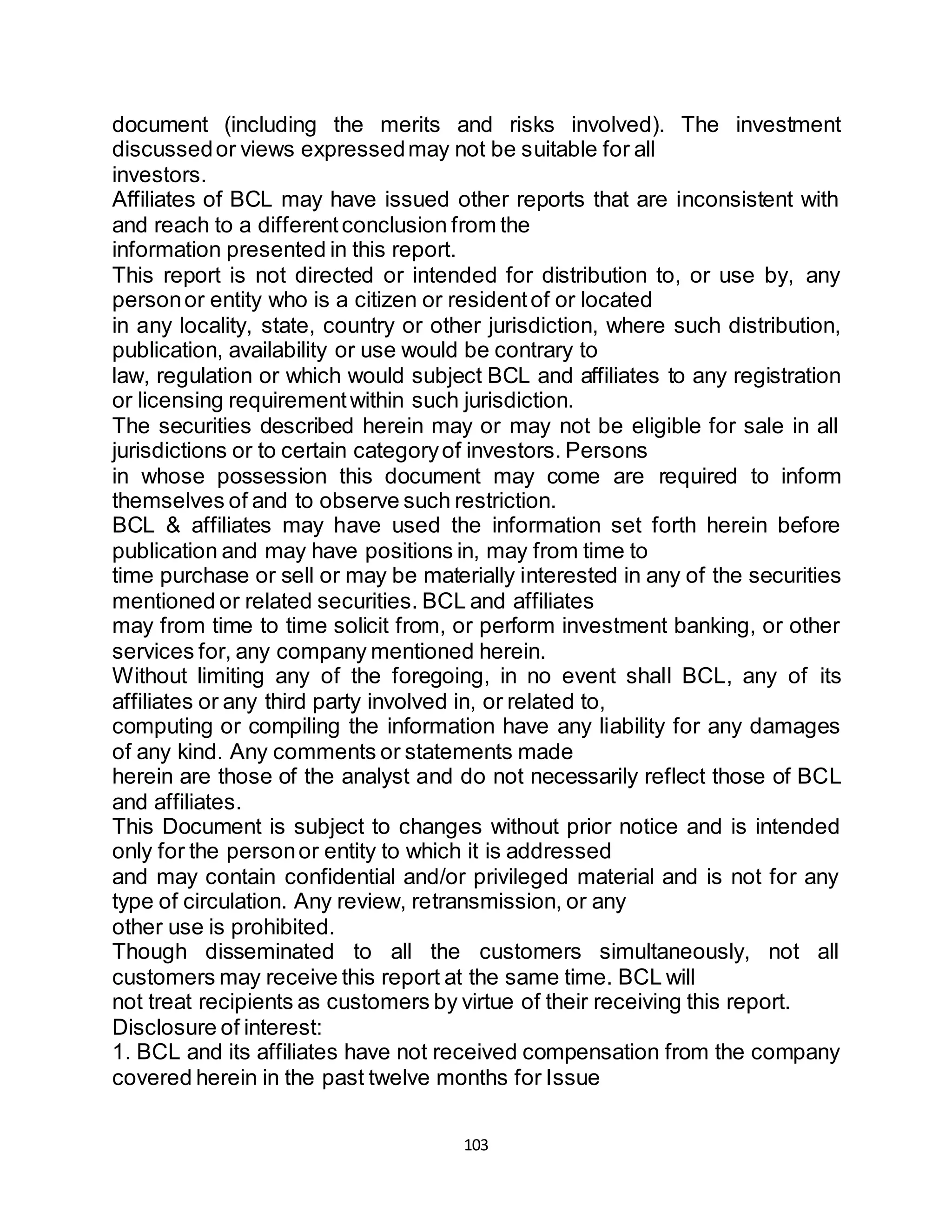
1
Summer traing report
Waysto Increase the Idea Cellular Ltd.
Submitted By :
Nuzahat Afrose
Submitted To :
C.Lal IMS (Shepa)
In partial fullfillment of the requirement of mba
degree of u.p. Technical university, lucknow
Session : 2009-10
EnrolmentNo…………….. RollNo.0918470034
INSTITUTE OF MANAGEMENT SCIENCES
SHEPA
(Nibia, Bachchaon, VRM Bypass, Varanasi-210011)
3
PREFACE
I am highlyobliged to the learners and the guider whose kind blessings energies
me to complete my report. I would specially like to thanks and great regards to
my guide Mr.Saurabh Jaisawal whose kind guidance, motivation made me to
complete this reporton time.
The project is carried out to translate the theoretical knowledge of subject into
practical field work. This project is carried out in partial fulfillment of MBA – 2nd
Semester coursefrom ISMT, Varanasi
Nuzahat Afrose
4.
4
ACKNOWLEDGEMENT
This report bearsthe imprint of many people. Right from the experienced staff of
Idea Cellular Ltd, to the staff of Atal Bihari Vajpayee – Indian Institute of
Information Technology and Management without whose support and guidance I
would have not got the unique opportunity to successfully complete my internship
in this esteemed organization.
I would like to thank Mr. Amaljeet Singh, who allow me to do this project in Idea
Cellular Ltd successfully.
I take this opportunity to express my deep gratitude to all the employees of, Idea,
Gwalior. Also I am indebted for the rich guidance, knowledge and suggestions
provided by my guide, Mr. Yugal Kishore who took sincere efforts and illustrated
the Marketing Concept and channel development in Idea Cellular Ltd, with their
vast knowledge in the field, which helped me in carrying outmy internship.
Last but not least, I also thank all those people whom I met in the industry during
my internship and helped me to accomplish my assignments in the most efficient
and effective manner.
Date: Nuzahat Afrose
Place:
6
INTRODUCTION
As India's leadingGSM Mobile Services operator, IDEA Cellular has licenses to
operate in 11 circles. With a customer base of over 17 million, IDEA Cellular has
operations in Delhi, Maharashtra, Goa, Gujarat, Andhra Pradesh, Madhya
Pradesh, Chattisgarh, Uttaranchal, Haryana, UP-West, Himachal Pradesh and
Kerala. IDEA Cellular's footprint currently covers approximately 45% of India's
population and over 50% of the potential telecom-market.
As a leader in Value Added Services, Innovation is central to IDEA's VAS Factory. It
is the first cellular company to launch music messaging with 'Cellular Jockey',
'Background Tones', 'Group Talk', a voice portal with 'Say IDEA' and a complete
suite of Mobile Email Services.
Idea Cellular is a wireless telephony company operating in various states in India.
It initially started in 1995 as a join venture between the Tatas, Aditya Birla Group
and AT&T by merging Tata Cellular and Birla AT&T Communications.
Initially having a very limited footprint in the GSM arena, the acquisition of
Escotel in 2004 gave Idea a truly pan-India presence covering Maharashtra
(excluding Mumbai), Goa, Gujarat, Andhra Pradesh, Madhya Pradesh, Chattisgarh,
Uttar Pradesh (East and West), Haryana, Kerala, Rajasthan and Delhi (inclusive of
NCR).
The company has its retail outlets under the "Idea n' U" banner. The company has
also been the first to offer flexible tariff plans for prepaid customers. It also offers
GPRS services in urban areas.
7.
7
IDEA Cellular isa publicly listed company, having listed on the
Bombay Stock Exchange (BSE) and the National Stock Exchange (NSE) in
March2007.
IIDEA Cellular is a leading GSM mobile service operator with pan India licenses.
With a customer base of over 44 million in 17 service areas, operations are soon
expected to start in Chennai Metro; Kolkata & West Bengal, North East & Assam,
and J&K.
A frontrunner in introducing revolutionary tariff plans, IDEA Cellular has the
distinction of offering the most customer friendly and competitive Pre Paid
offerings, for the first time in India, in an increasingly segmented market. From
basic voice & Short Message Service (SMS) services to high-end value added
services such as Mobile TV, Games etc - IDEA is seen as an innovative,
customerfocusedbrand.
IDEA 'Women's Card' caters to the special needs of women on
the move, and 'Youth Card' covers the emerging youth segment. IDEA 'My Gang' -
the widely popular community user group product recently bagged the
prestigious 'Golden Peacock Award 2008' under the Most Innovative Product
category at the "19th World Congress on Total Quality".
A brand known for many firsts, IDEA was the first to launch
GPRS and EDGE in India. IDEA has partnered with Research in Motion (RIM) to
offer Blackberry services on its network. IDEA 'Net Setter'- Plug & Play, EDGE
enabled USB Data Card offers affordable data connectivity with faster speed and
consistency.
8.
8
IDEA offers seamlesscoverage to roaming customers traveling to any part of
the country, as well as to international traveling customers across over 200
countries. IDEA Cellular has partnership with over 400 operators worldwide to
ensurethat customers arealways connected while on the move, across theglobe.
IDEA has received several national and international recognitions for its path-
breaking innovations in mobile telephony products & services. It won the GSM
Association Award for "Best Billing and Customer Care Solution" for 2 consecutive
years. It was awarded "Mobile Operator of the Year Award - India" for 2007 and
2008 at the Annual Asian Mobile News Awards.
9.
9
Brief hisroty ofthe organization
The chronology of key events of
the Company from incorporation
is set out below:
Calendar year Events
2009
Subscriber base as on
December 31, 2009:
57,611,872
Idea becomes a pan-India
operator
Emerging Company of the
Year - fastest growing mobile
operator in the world’s fastest
growing telecom market
2008
Subscriber base as on December
31, 2008: 40,016,153
Idea acquired 9 licences for
Punjab, Karnataka, Tamil Nadu
& Chennai, West Bengal,
Orissa, Kolkata, Assam, North
East and Jammu & Kashmir
Acquired Spice
Communications with the
operating circles of Punjab and
Karnataka
Launched services in Mumbai
metro in the largest single
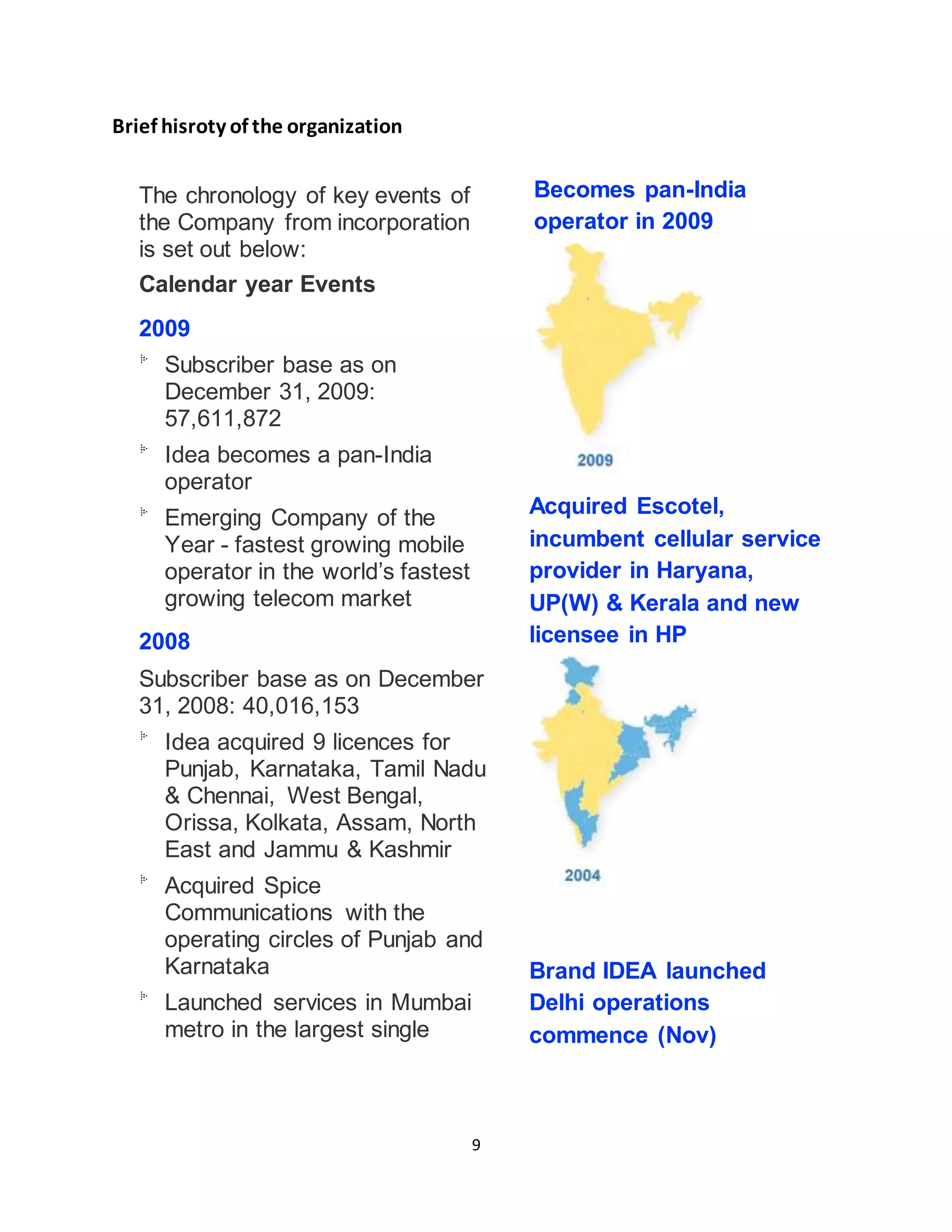
Becomes pan-India
operator in 2009
Acquired Escotel,
incumbent cellular service
provider in Haryana,
UP(W) & Kerala and new
licensee in HP
Brand IDEA launched
Delhi operations
commence (Nov)
10.
10
metro city launch,ever
Launched services in Bihar
2007
Subscriber base as on December
31, 2007: 21,054,027
Won an award for the "CARE"
service in the "Best Billing or
Customer Care Solution" at the
GSM Association Awards in
Barcelona, Spain
Initial Public Offering
aggregating to Rs. 28,187
million and Listing of Equity
Shares on the Bombay Stock
Exchange and the National
Stock Exchange
Merger of seven subsidiaries
with Idea Cellular Limited
Reached the twenty million
subscriber mark
2006
Subscriber base as on December
31, 2006: 12,442,450
Became part of the Aditya Birla
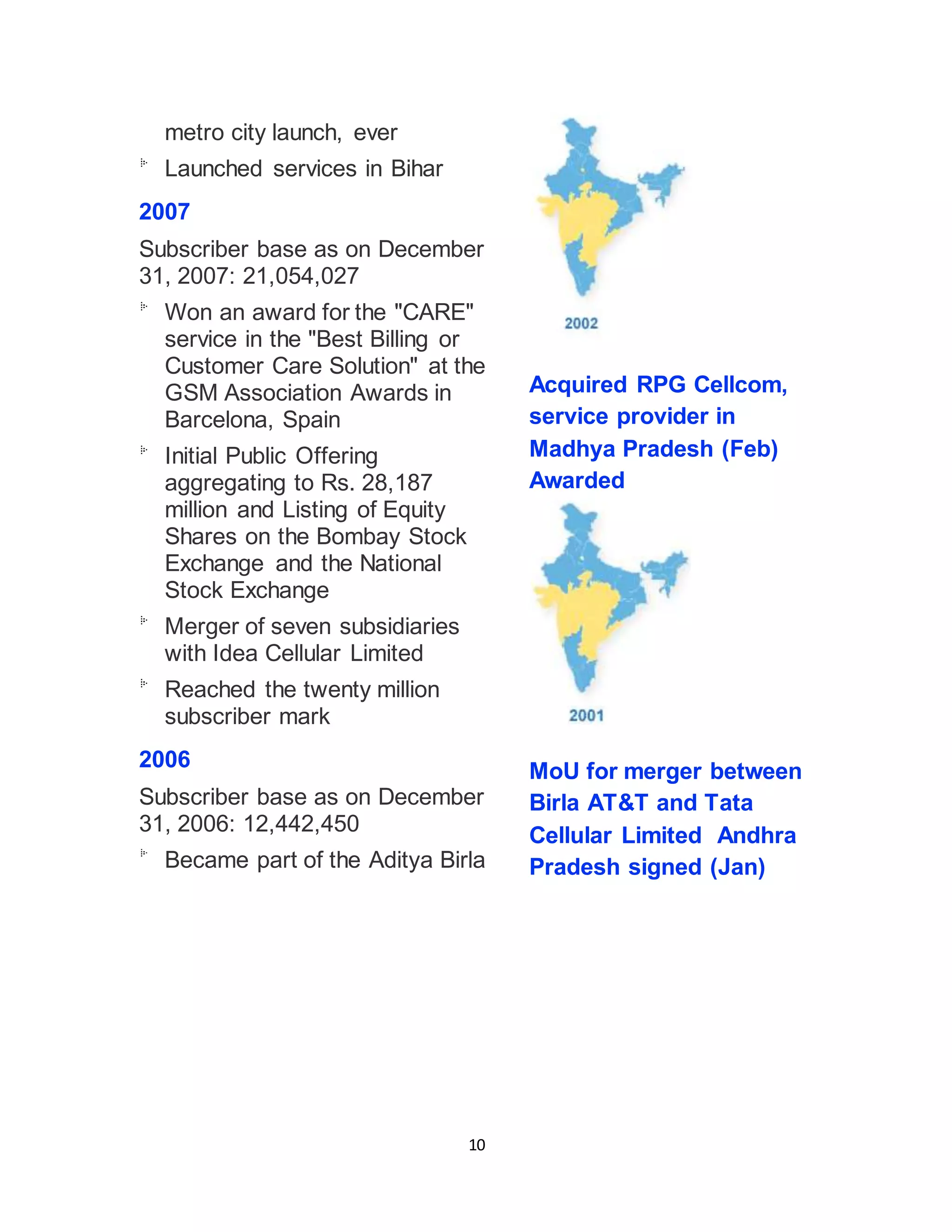
Acquired RPG Cellcom,
service provider in
Madhya Pradesh (Feb)
Awarded
MoU for merger between
Birla AT&T and Tata
Cellular Limited Andhra
Pradesh signed (Jan)
11.
11
Group subsequent tothe TATA
Group transferring its entire
shareholding in the Company
to the Aditya Birla Group
Acquired Escorts
Telecommunications Limited
(subsequently renamed as
Idea Telecommunications
Limited)
Restructuring of debt
Launch of the New Circles
Reached the 10 million
subscriber mark
Received Letter of Intent from
the DoT for a new UAS
License for the Mumbai Circle.
Received Letter of Intent from
the DoT for a new UAS
License for the Bihar Circle
through Aditya Birla Telecom
Limited. ABNL, the parent of
Aditya Birla Telecom Limited,
pursuant to a letter dated
November 22, 2006, agreed to
transfer its entire shareholding
in Aditya Birla Telecom Limited
to the Company for the
consideration of Rs. 100
million.
2005
Subscriber base as on December
31, 2005: 6,473,962
Reached the five million
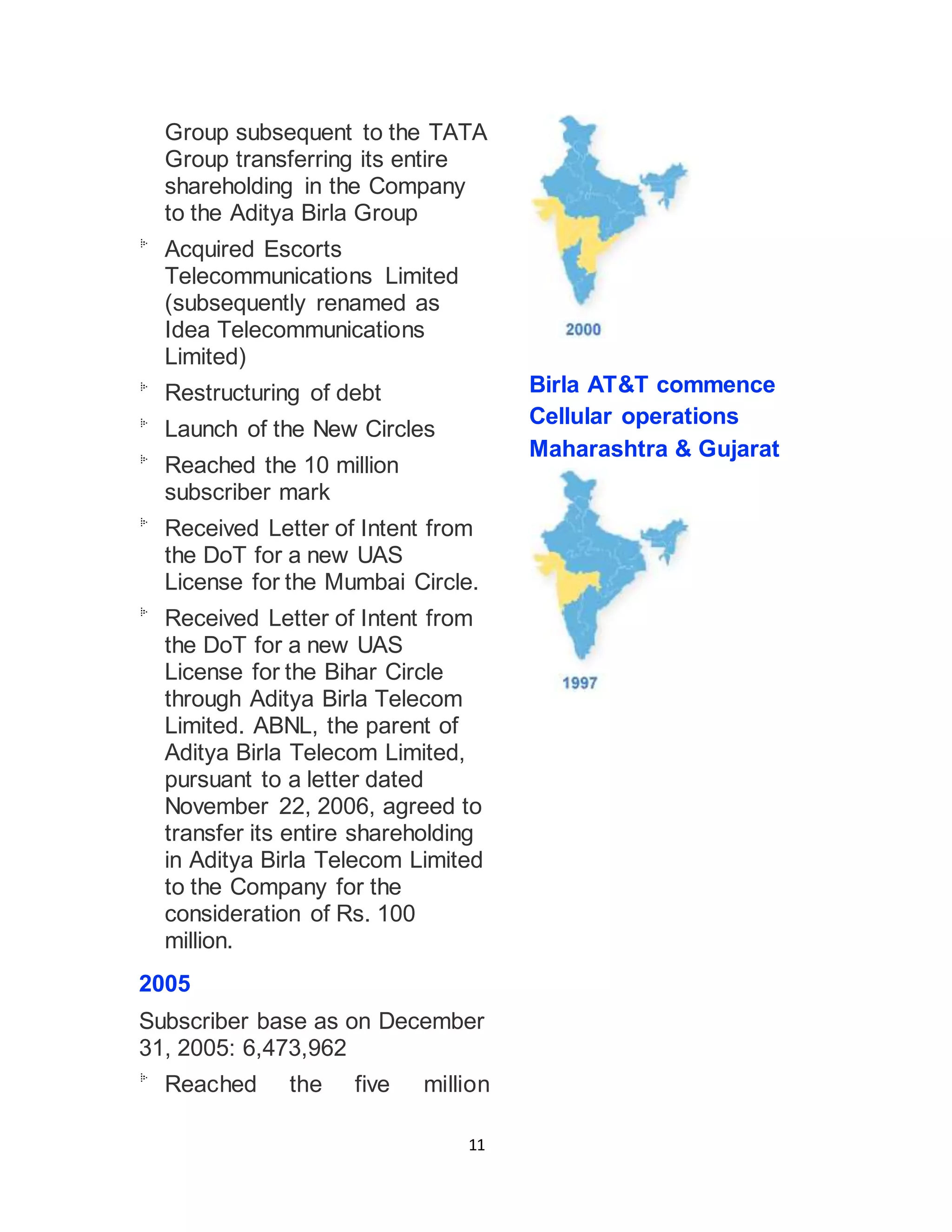
Birla AT&T commence
Cellular operations
Maharashtra & Gujarat
12.
12
subscriber mark
Turned ProfitPositive
Won an Award for the "Bill
Flash" service at GSM
Association Awards in
Barcelona, Spain
Sponsored the International
Indian Film Academy Awards
2004
Completed debt restructuring
for the then existing debt
facilities and additional funding
for the Delhi Circle.
Acquired Escotel Mobile
Communications Limited
(subsequently renamed as
Idea Mobile Communications
Limited)
Reached the four million
subscriber mark
First operator in India to
commercially launch EDGE
services 2005
2003
Reached the two million
subscriber mark
2002
Changed name to Idea Cellular
Limited and launched "Idea"
brand name
Commenced commercial
13.
13
operations in DelhiCircle
Reached the one million
subscriber mark
2001
Acquired RPG Cellular Limited
and consequently the license
for the Madhya Pradesh
(including Chattisgarh) Circle
Changed name to Birla Tata
AT&T Limited
Obtained license for providing
GSM-based services in the
Delhi Circle following the fourth
operator GSM license bidding
process
2000
Merged with Tata Cellular
Limited, thereby acquiring
original license for the Andhra
Pradesh Circle
1999
Migrated to revenues share
license fee regime under New
Telecommunications Policy
("NTP")
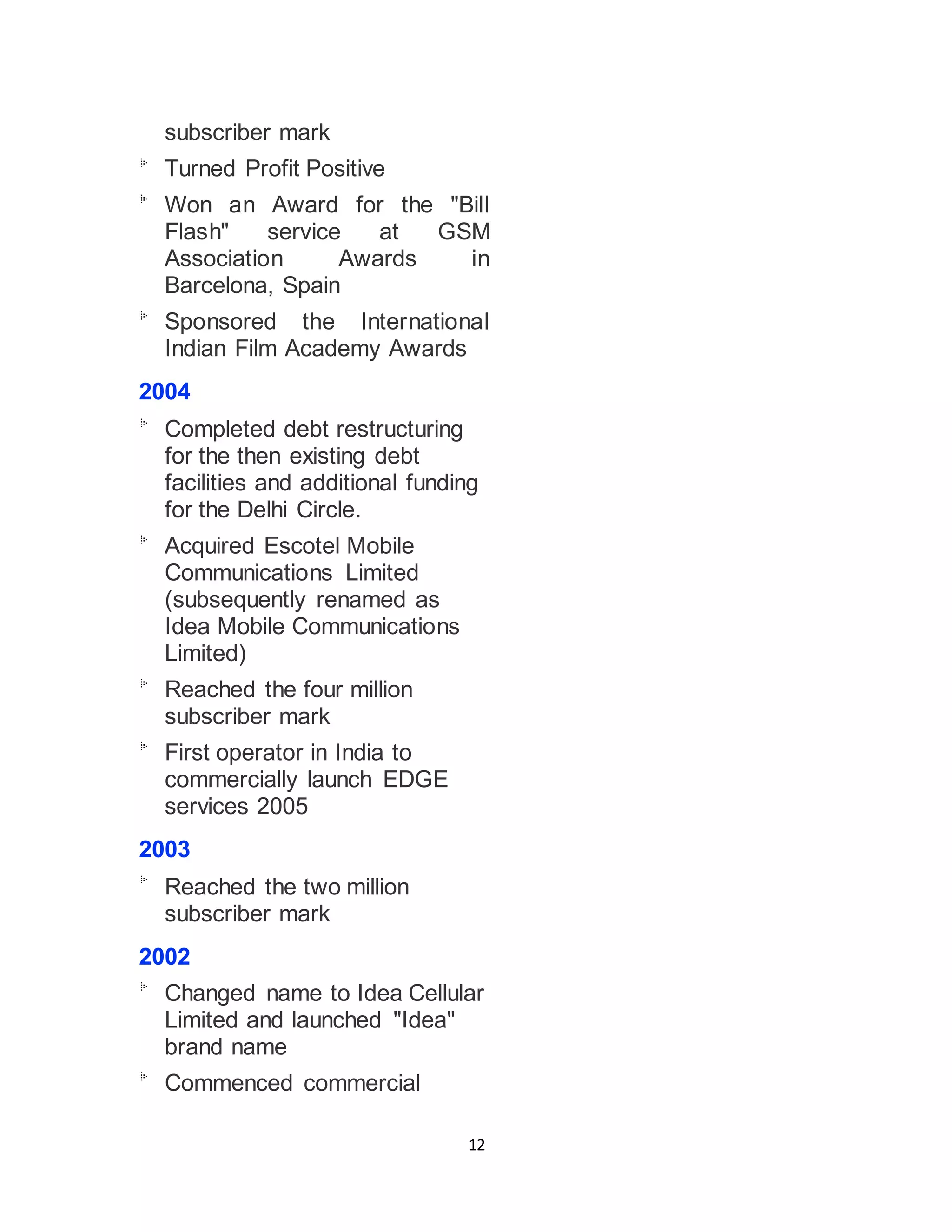
1997
Commenced operations in the
Gujarat and Maharashtra
Circles
1996
14.
14
Changed name toBirla AT&T
Communications Limited
following joint venture between
Grasim Industries and AT&T
Corporation
1995
Incorporated as Birla
Communications Limited
Obtained licenses for providing
GSM-based services in the
Gujarat and Maharashtra
Circles following the original
GSM license bidding process.
Vision
It goes without saying that the brand vision of idea mirrors the company’s vision.
The brand mission statement is...... To be the most customer-focused mobile
service brand, continuously innovating to help liberate our customers from the
shackles of time & space.
Mission
The India footprint Idea
Anywhere connectivity - bringing India closer.
The Technology Advantage Idea
Tomorrow's technology to enrich today.
The Customer Focus Idea
Make a single interaction a lasting relationship.
15.
15
The Employee FocusIdea
Nurture the roots that nurture our ideas.
Objectives
The summer internship done with Idea Cellular Objective was to find the ways of increasing the ARPU
(Average Revenue PerUser) forthe company.
The objective of the summer project was to understand the customer preferences while choosing a
telecomservice provider.
Othermainobjective of the projectwastostudythe trendsinthe International Telecommarket.
16.
16
STRATETEGYFOR IDEA CELLULAR
TheIdea Cellular Limited falls in the “question mark” quadrant of BCG matrix and
in the High attractive and Strong Competitive strength category as per the GE
Matrix. Thus they need to formulate some strategies to try capturing some market
share, growing and building their brand image as well as brand value.
Marketpenetration
The company enters where the products and the market already exists. IDEA being
a question mark that means it is competing in a high growth market but with a
relatively low share compare to its competitors. Market penetration can be done by
attracting competitor’s customers that implies increase in market share. The
strategy that IDEA can adapt under market penetration is to attract non-users and
convince to use their product more often. They are different market penetration
strategies like cutting price, increase in promotion, and creating innovative
distribution tactics. The target should be in such a way that IDEA sales volume
relative to its competitors should be high as expressed in percentage. IDEA’s
present market share is about 12%, and competitors like airtel, Vodafone, and bsnl
have a market share of about 31, 23, and 19 percent respectively. Though telecom
industry is growing rapidly every year, there is always a little increment in the
percentage of sales for IDEA. To overcome this problem and to occupy the
competitor’s position we recommend following strategies.
Increasing the mobile circles which are at present are only 11, so there is
always a need to expand its services.
Target the rural segment in India which is expected to grow by 15% every
year
17.
17
Launch differenttypes of packages as per the requirements for different
segments of the customers
Provide more high end services like GPRS, mobile internet services
Collaboration with different service providers on global basis to provide
better facility to customers on roaming.
Tracing out the search patterns which are left untapped by the competitors to
reveal new markets.
Backward Integration – In July 2008 Swedish equipment supplier entered into a
contract to provide technology “Ericsson Mobile organizer” to Idea cellular
enabling its subscribers to serve email facility on its cell phones.
Forward Integration – Company operate approximately 589 Idea” n “U and other
showrooms which supplement the distribution channels and provide customer
service.
Horizontal Integration: Idea acquired the Modi family’s stake of 40.8% in spice
which ultimately in a way increased the market share of Idea. This can be seen as
horizontal integration
Strategic Alliance
1) Product alliance
Idea should form product alliance with a company that has a strong brand
image and carry a promotion for one another. E.g. Acer in collaboration with
Ferrari launched Acer Ferrari laptops which are catering to high end niche
segment having high specifications and high price.
18.
18
2) PromotionalAlliance:
Idea shouldform promotional alliances in collaboration with big movie
houses or big retail brands to promote their products. Recently SONY Viao
had a promotional alliance with “James Bond” latest movie “Casino
Royale”.
19.
19
Organizationstructure &management
Board ofDirectors -
Mr. Kumar Mangalam Birla (Chairman)
Smt. Rajashree Birla
Mr. Sanjeev Aga (Managing Director)
Mr. Arun Thiagarajan
Ms. Tarjani Vakil
Mr. Mohan Gyani
Mr. Gian Prakash Gupta
Mr. R.C. Bhargava
Mr. P. Murari
Mr. Biswajit A. Subramanian
Dr. Rakesh Jain
Mr. Juan Villalonga Navarro
Dr. Hansa Wijayasuriya (Alternate to Mr. Juan Villalonga Navarro)
Management Team -
Corporate Leadership Team
Mr. Sanjeev Aga, Managing Director
Mr. Akshaya Moondra, Chief Financial Officer
Mr. Anil K. Tandan, Chief Technology Officer
Mr. Prakash K. Paranjape, Chief Information Officer
Mr. Pradeep Shrivastava, Chief Marketing Officer
Mr. Navanit Narayan, Chief Service Delivery Officer
Mr. Vinay K. Razdan, Chief Human Resource Officer
Mr. Rajat K. Mukarji, Chief Corporate Affairs Officer
Mr. Rajesh K. Srivastava, Chief Materials & Procurement Officer
Mr. Ambrish Jain, Director - Operations
Mr. Himanshu Kapania, Director - Operations
Circle Heads
20.
20
Mr. Iyer SubbaramanS., Chief Operating Officer, Andhra Pradesh
Mr. Rajendra Chourasia, Chief Operating Officer, Madhya
Pradesh & Chattisgarh
Mr. Virad Kaul, Chief Operating Officer, Uttar Pradesh (West),
Delhi & Haryana
Mr. T. G. B. Ramakrishna, Chief Operating Officer, Kerala
Mr. Sashi Shankar, Chief Operating Officer, Mumbai
Mr. P.Lakshminarayana, Chief Operating Officer, Maharashtra &
Goa
Mr. Naozer Firoze Aibara, Chief Operating Officer, Uttar Pradesh
(East)
Mr. Sunil Kataria, Senior Vice President - Operations, Rajasthan
Mr. Arul Bright, Senior Vice President - Operations, Gujarat
Mr. M. D. Prasad, Senior Vice President - Operations, Bihar
Mr. M. Srinivas, Senior Vice President - Operations, Tamil Nadu &
Chennai
Mr. Siva Ganapathi, Chief Operating Officer, Karnataka
Mr. Anish Roy, Chief Operating Officer, Punjab, J&K and
Himachal Pradesh
Mr. Aloke Malik, Chief Operating Officer, East (Kolkata, Rest of
Bengal, Orissa & NESA)
21.
21
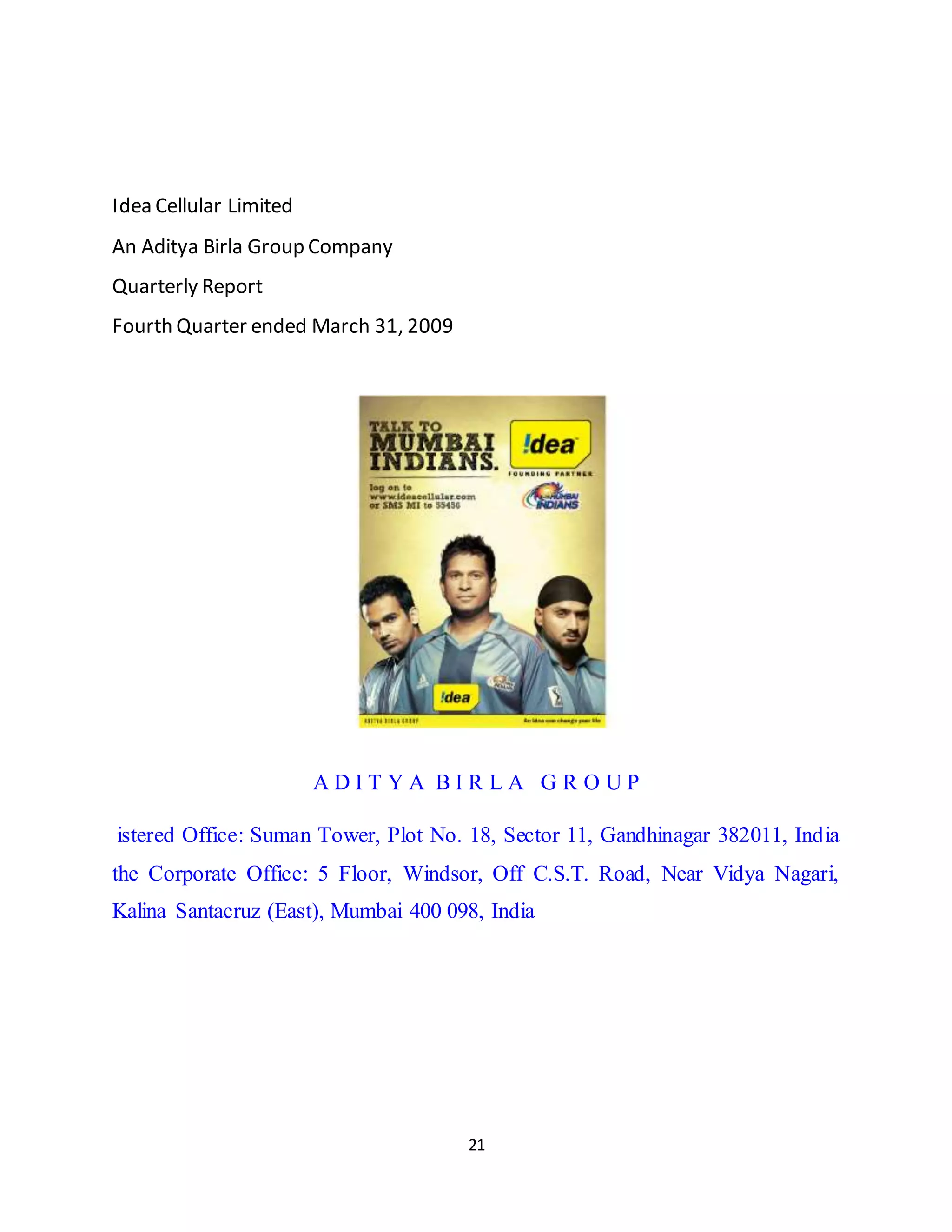
Idea Cellular Limited
AnAditya Birla Group Company
Quarterly Report
Fourth Quarter ended March 31, 2009
A D I T Y A B I R L A G R O U P
istered Office: Suman Tower, Plot No. 18, Sector 11, Gandhinagar 382011, India
the Corporate Office: 5 Floor, Windsor, Off C.S.T. Road, Near Vidya Nagari,
Kalina Santacruz (East), Mumbai 400 098, India
22.
22
Supplemental Disclosures
Unless statedotherwise, the financial data in this report is derived from our
unaudited / audited consolidated financial statements prepared in accordance with
Indian GAAP. Our financial year ends on March 31 of each year, so all references
to a particular financial year are to the twelve months ending March 31 of that
year. In this report, any discrepancies in any table between the total and the sums
of the amounts listed are due to rounding-off. There are significant differences
between Indian GAAP, IFRS, and U.S. GAAP; accordingly, the degree to which
the Indian GAAP financial statements will provide meaningful information is
dependent on the reader’s level of familiarity with Indian accounting practices.
Any reliance by persons not familiar with Indian accounting practices on the
financial information presented in this report should accordingly be limited. We
have not attempted to explain those differences or quantify their impact on the
financial data included herein.
Unless stated otherwise, industry data used throughout this report has been
obtained from industry publications. Industry publications generally state that the
information contained in those publications has been obtained from sources
believed to be reliable but that their accuracy and completeness are not guaranteed
and their reliability cannot be assured. Although we believe that industry data used
in this report is reliable, it has not been independently verified. Actual results may
differ materially from those suggested by the forward-looking statements due to
risks or uncertainties associated with our expectations with respect to, but not
limited to, our ability to successfully implement our strategy, our growth and
expansion, technological changes, our exposure to market risks, general economic
and political conditions in India which have an impact on our business activities or
investments, the monetary and interest policies of India, inflation, deflation,
23.
23
unanticipated turbulence ininterest rates, foreign exchange rates, equity prices or
other rates or prices, the performance of the financial markets in India and
globally, changes in domestic and foreign laws, regulations and taxes and changes
in competition in the industry
24.
24
2. Company Overview
IdeaCellular Limited (“Idea”) is a leading mobile services operator in India, with ~
39 mn subscribers as on March‘09. Idea has a subscriber market share of 19.5% in
its 8 established service areas, and 14.5% in its 13 operating service areas. After
inclusion of Spice Communications, Brand !dea has 43.02 mn subscribers,
corresponding to a 11.0% national market share.
A. Promoter Group
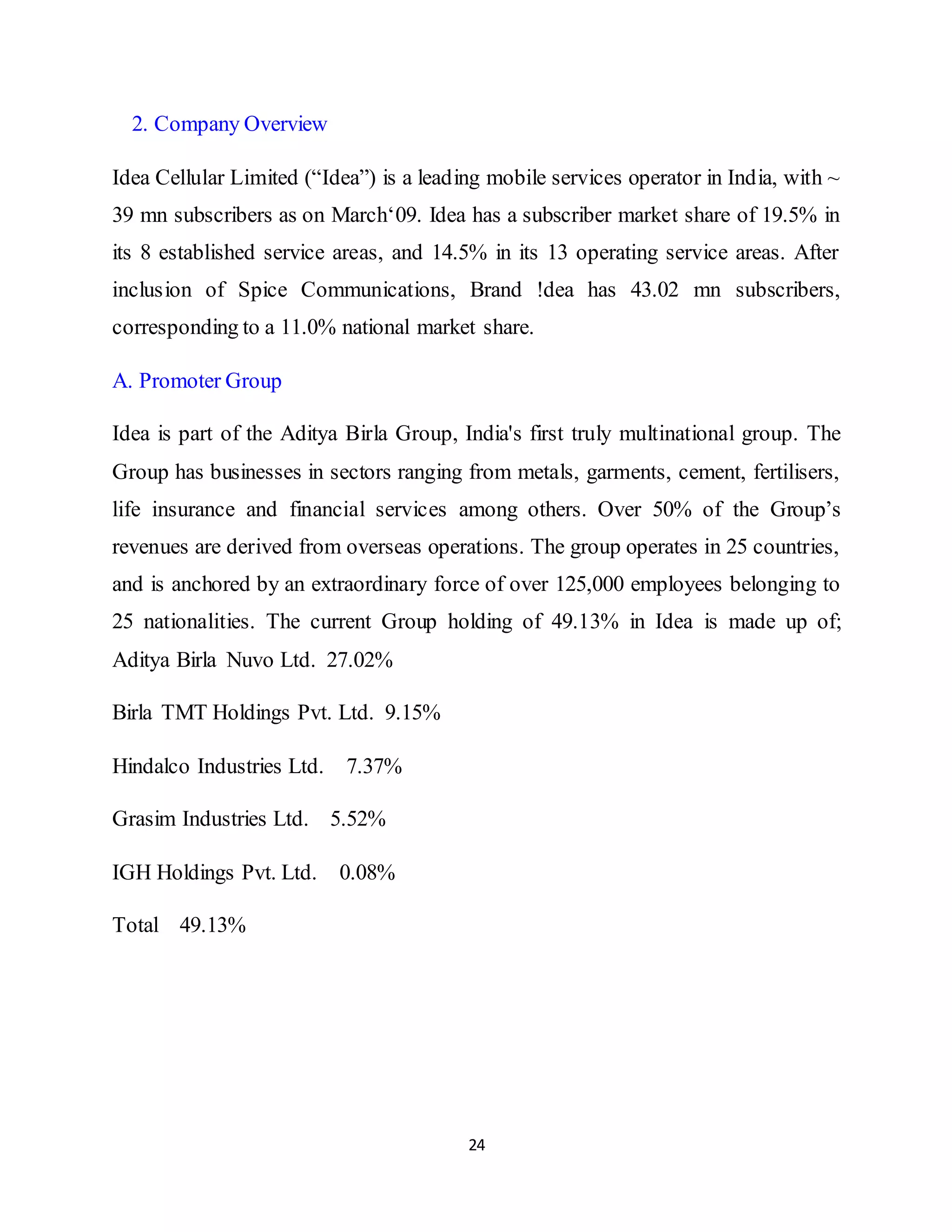
Idea is part of the Aditya Birla Group, India's first truly multinational group. The
Group has businesses in sectors ranging from metals, garments, cement, fertilisers,
life insurance and financial services among others. Over 50% of the Group’s
revenues are derived from overseas operations. The group operates in 25 countries,
and is anchored by an extraordinary force of over 125,000 employees belonging to
25 nationalities. The current Group holding of 49.13% in Idea is made up of;
Aditya Birla Nuvo Ltd. 27.02%
Birla TMT Holdings Pvt. Ltd. 9.15%
Hindalco Industries Ltd. 7.37%
Grasim Industries Ltd. 5.52%
IGH Holdings Pvt. Ltd. 0.08%
Total 49.13%
25.
25
B. Key Shareholders
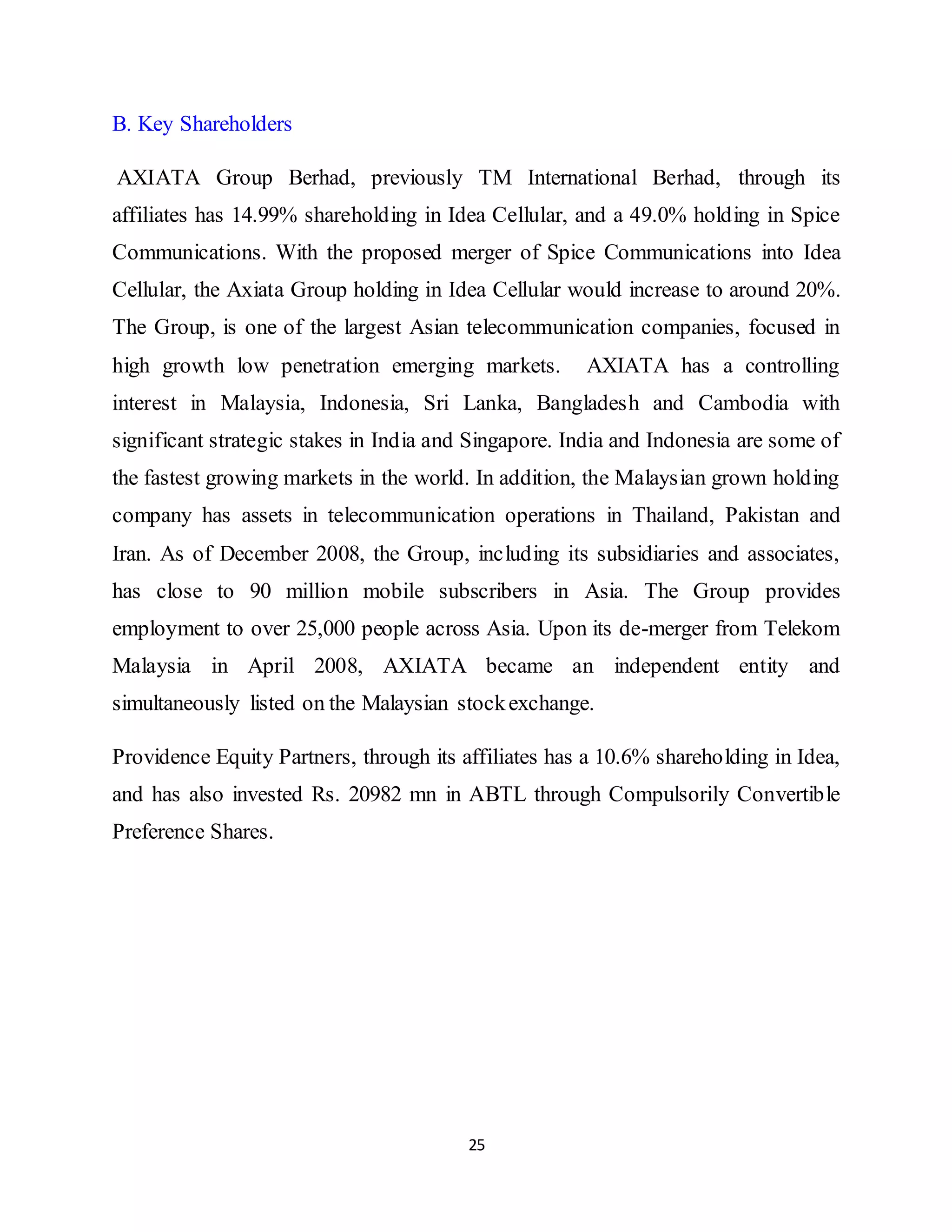
AXIATAGroup Berhad, previously TM International Berhad, through its
affiliates has 14.99% shareholding in Idea Cellular, and a 49.0% holding in Spice
Communications. With the proposed merger of Spice Communications into Idea
Cellular, the Axiata Group holding in Idea Cellular would increase to around 20%.
The Group, is one of the largest Asian telecommunication companies, focused in
high growth low penetration emerging markets. AXIATA has a controlling
interest in Malaysia, Indonesia, Sri Lanka, Bangladesh and Cambodia with
significant strategic stakes in India and Singapore. India and Indonesia are some of
the fastest growing markets in the world. In addition, the Malaysian grown holding
company has assets in telecommunication operations in Thailand, Pakistan and
Iran. As of December 2008, the Group, including its subsidiaries and associates,
has close to 90 million mobile subscribers in Asia. The Group provides
employment to over 25,000 people across Asia. Upon its de-merger from Telekom
Malaysia in April 2008, AXIATA became an independent entity and
simultaneously listed on the Malaysian stockexchange.
Providence Equity Partners, through its affiliates has a 10.6% shareholding in Idea,
and has also invested Rs. 20982 mn in ABTL through Compulsorily Convertible
Preference Shares.
26.
26
C. CorporateStructure
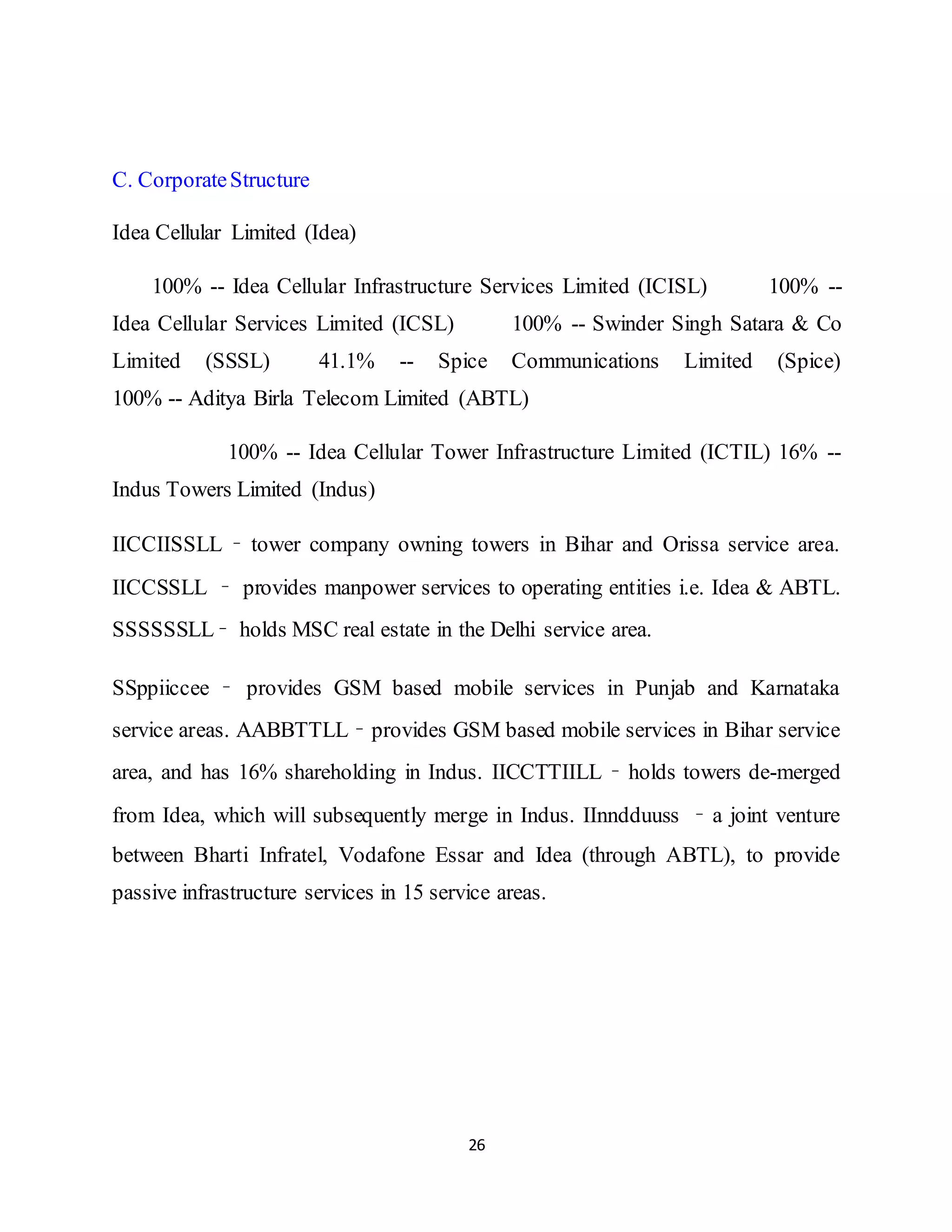
Idea CellularLimited (Idea)
100% -- Idea Cellular Infrastructure Services Limited (ICISL) 100% --
Idea Cellular Services Limited (ICSL) 100% -- Swinder Singh Satara & Co
Limited (SSSL) 41.1% -- Spice Communications Limited (Spice)
100% -- Aditya Birla Telecom Limited (ABTL)
100% -- Idea Cellular Tower Infrastructure Limited (ICTIL) 16% --
Indus Towers Limited (Indus)
IICCIISSLL – tower company owning towers in Bihar and Orissa service area.
IICCSSLL – provides manpower services to operating entities i.e. Idea & ABTL.
SSSSSSLL– holds MSC real estate in the Delhi service area.
SSppiiccee – provides GSM based mobile services in Punjab and Karnataka
service areas. AABBTTLL – provides GSM based mobile services in Bihar service
area, and has 16% shareholding in Indus. IICCTTIILL – holds towers de-merged
from Idea, which will subsequently merge in Indus. IInndduuss – a joint venture
between Bharti Infratel, Vodafone Essar and Idea (through ABTL), to provide
passive infrastructure services in 15 service areas.
27.
27
Operating Service Areas(as on April 2009))
Brand “!dea” covers 16 telecom service areas, viz, Maharashtra & Goa, Gujarat,
Andhra Pradesh, Madhya Pradesh & Chhattisgarh, Delhi, Kerala, Haryana, Uttar
Pradesh West & Uttaranchal, Rajasthan, Uttar Pradesh East, Himachal Pradesh,
Mumbai, Bihar & Jharkhand, Orissa, Punjab and Karnataka, covering ~ 80% of
the all India subscriberbase. Of these, the 3 service areas of Rajasthan, UP East
and Himachal Pradesh, were rolled out during Sep-Nov’06, while the 2 service
areas of Mumbai and Bihar became operational during Aug-Oct‘08. The service
areas of Punjab and Karnataka were added through Spice w.e.f October16,
2008.
28.
28
3. Reporting Guidelines:
Tofacilitate an analytical perspective, the results have been formatted and grouped
as under: a) Standalone – Idea, and its 100% subsidiaries, grouped together on a
standalone basis. Effectively, this encompasses all mobile operations in India,
excluding Spice and Indus.
b) Consolidated – Idea and its 100% subsidiaries, and JVs, grouped together. This
covers Idea operating service areas and the ABTL operating service area of Bihar,
the proportionate consolidation of Indus (16%), and the proportionate
consolidation of Spice (41.09% w.e.f. October16, 2008).
JV financials have been consolidated as jointly controlled entities as per “AS 27 -
Financial reporting of Interests in Joint Ventures ”. It may be noted that the
consolidation of financials of two or more entities requires elimination of inter
entity transactions. Illustratively, rentals paid by Idea to Indus, become expenses
for Idea and revenues for Indus, on a standalone basis. However, upon
consolidation, the proportionate revenue of Indus gets reduced to the extent
contributed by Idea. The rental expenses of Idea also stand correspondingly
reduced in the consolidated financials.
34
6. Management Discussion& Analysis
Fastest Growing Major Telco – Back to Back Years of Strong Market Gains
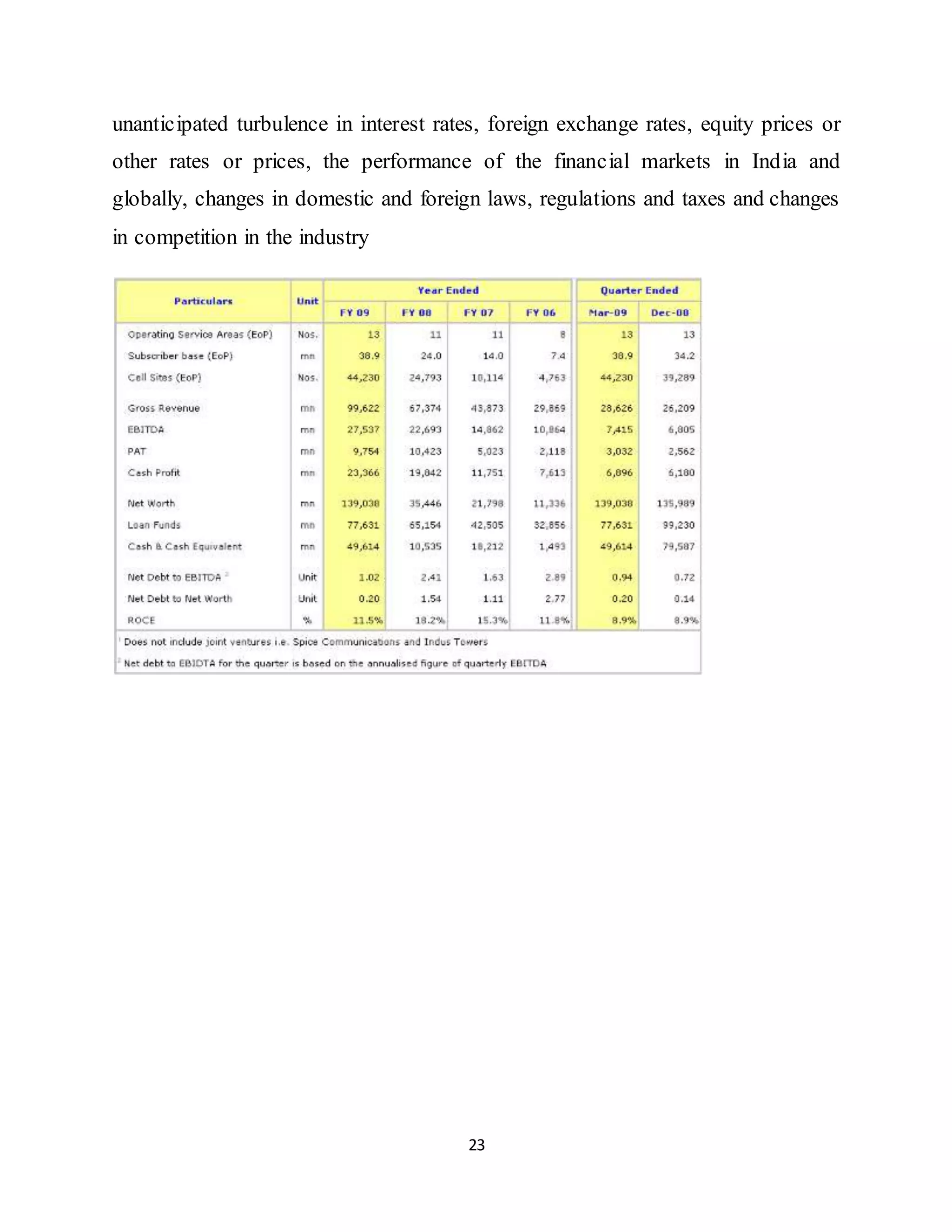
Standalone revenues for the quarter at Rs. 28,626 mn, grew 9.2% on a QoQ basis.
In a period marked by economic downturn and increased competitive and price
pressure, Idea was able to maintain its strong growth momentum. Annual revenues
of 99,622 mn show a growth of 47.9%
compared to the last year. This revenue growth
of 47.9%, on the back of the FY08 revenue
growth of 53.6%, places Idea as the fastest
growing major operator in one of the largest, fastest growing, and most
competitive telecom markets in the world. Idea on a standalone basis, added 4.7
mn subscribers in the
quarter, its highest ever. For the entire year FY09, subscriber base has grown
by 79.2 %. In its 8 established service areas, Idea strengthened its market position
by gaining 1% market share, and consolidating its position close to the market
leader. In the 3 gestating service areas, Idea also increased its market share to
6.3%, from 5.8% a due to change in subscribers recognition criteria year ago.
In the newly launched service areas of Mumbai and Bihar, Idea has
acquired a 4.0 % share of the combined market, with a net adds market share of
16.6%, during last 6 months.
Total Minutes on the Network at 44,224 mn grew by 9.9% on a QoQ basis.
The Average Realised Rate per Minute, which had moved up from 62p to 64p in
the previous quarter, settled at 63p.
35.
35
Indus IRU Impact
Idea(standalone) rent-paying cell sites jumped from 21,459 at Dec’08 quarter end
to 36,573 at Mar’09 quarter end. This increase of 15,294 cell sites includes 11,094
cell sites on Idea towers, transferred to Indus, through the IRU effective January 1,
2009. As of March’09, out of the 36,573 rent paying cell sites, 25,150 cell sites are
on Indus Towers. The accounting treatment of the IRU arrangement increased the
network operating cost for the March’09 quarter. Rental income that Idea was
deriving from guest sites also ceased w.e.f. January 1, 2009, as these would accrue
to Indus. The combined impact of these 2 factors was the equivalent of ~ 3.4 %
EBITDA contraction for the quarter ended March’09. Until the merger into Indus
is consummated, Idea will account for depreciation for the IRU towers. However,
Idea will receive an IRU income for the transferred towers until the merger, which
for the quarter ended March’09 was the equivalent of ~1.2% of the EBITDA.
Therefore, the net negative EBITDA impact for the quarter was ~2.2 %. The above
treatment does not include Idea’s pro-rata share of Indus’ profit/loss. The
financials do not also capture the notional capex cost saving derived because of
Indus, and the speed to market benefit.
Upon consolidation, Idea’s share of 16% of Indus revenues is Rs. 1,870 mn.
However, with consolidation eliminations, no revenue has been consolidated. An
equal amount has been eliminated from the Indus rentals accounted by Idea.
Further Idea has consolidated Rs. 1,196 mn as 16% share of Indus operating
expenses, after elimination of IRU income received from Indus.
36.
36
Network Capacity
Cell sites
Idearolled out 4,941 cell sites during the March’09 quarter, taking the FY09
4423050000tally to 19,437, and the EoP cell sites to 44,230. In the preceding year
FY08, 40000Idea had added 14,679 cell sites. Thus, in the last 2 fiscal years, Idea
has enhanced its cell site capacity 4.4 times, representing a massive
2479330000enhancement of capacity to build competitive strength.
2000010114The capacity already built, together with improved spectrum
availability and 47631000018433049enhanced technology features will result in
greater capex efficiency in FY10, 0and reduced capex intensity.
FY04FY05FY06FY 07FY08FY09Total capex for FY09 was Rs. 54.5 bn. For
FY10, including for new service area launches, the capex will indicatively be in the
region of Rs. 60.0 bn. This estimate does not factor the unknown impact of a
possible 3G auction. Financial Performance
At the EBITDA level the net negative impact of Indus IRU is 2.2% for the quarter.
However, EBITDA margin for Q4 at 25.9% is almost similar to the Q3 margin,
indicative of other operational efficiencies which have absorbed the negative Indus
IRU impact.
Depreciation & Amortization for FY09 at Rs.13,212 mn increased by 50.7% on a
YoY basis. Net interest and finance cost for FY09 at Rs.4,070 mn increased by
46.6% on a YoY basis.
PAT for the quarter at Rs.3,032 mn was higher by 18.3% on a QoQ basis. After
absorbing the losses of the new launches of Mumbai and Bihar, Profit after Tax for
FY09 was Rs.9,754 mn.
37.
37
New Launches
thBrand Ideahas expanded its wings to its 16 service area, with the commercial
launch of Orissa in April 2009. With this, Idea now covers ~ 80% of the national
subscriber base. Preparatory work for other roll outs is on track, with Tamil Nadu
planned for the Jun’09 quarter. Within the calendar year 2009, Idea plans to have
pan India operations. Tailored Approachfor Different Service Areas
Idea holds 900 MHz GSM spectrum in 9 service areas, which make up ~50% of
the national market. This frequency band confers capex and opex benefits. It is also
accompanied by early mover advantage. Idea is the mobility revenue market
leader in 3 of these service areas, and is overall in the second spot. Thetwin
advantages of spectrum and scale underpin Idea’s enduring competitive edge.
In some of the remaining service areas, Idea pursues a strategy of optimisation
as opposedto maximisation. It plans to achieve a pan India footprint and
leverage synergies of scale and wider presence, and calibrated capex spend
through infrastructure sharing. The focus is on operational and financial goals,
and not on league tables.
The service area tailored strategy is designed to enhance Idea’s long term
competitiveness.
38.
38
Update on SpiceCommunications
The accounts of Spice continue to be consolidated in proportion of the
shareholding of 41.09%, until its eventual merger into Idea. Finalisation of the
merger scheme is in an advanced stage and will be effective after the court order.
Update on Indus Towers
As the 3 shareholders, Bharti Infratel, Vodafone Essar Ltd and ABTL (100%
subsidiary of Idea) signed the IRU with Indus effective January 01, 2009, Indus
has started invoicing respective entities for the sites covered by the IRU. Idea has
filed the scheme for demerger of towers to ICTIL. This will be followed by the
filing of the merger scheme of ICTIL with Indus.
39.
39
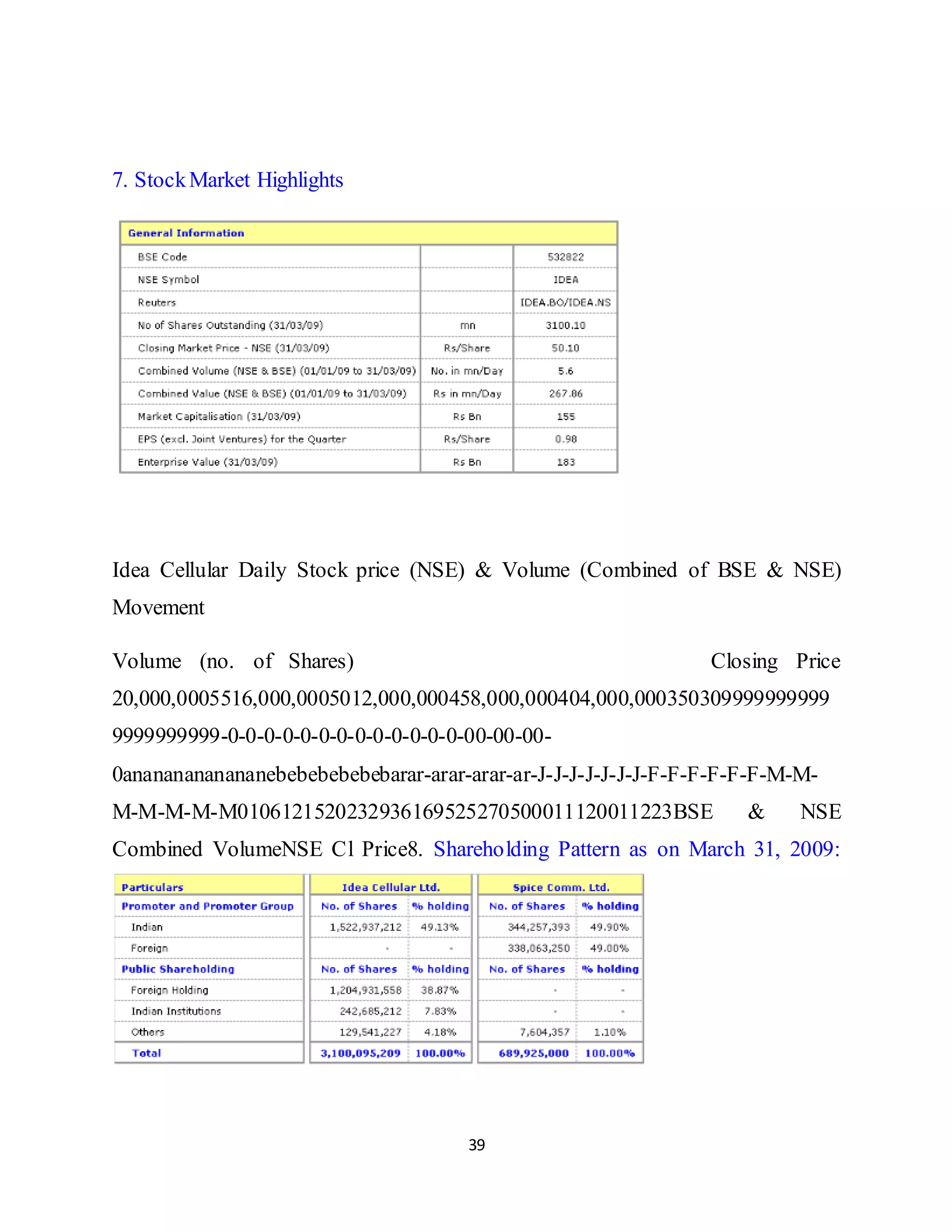
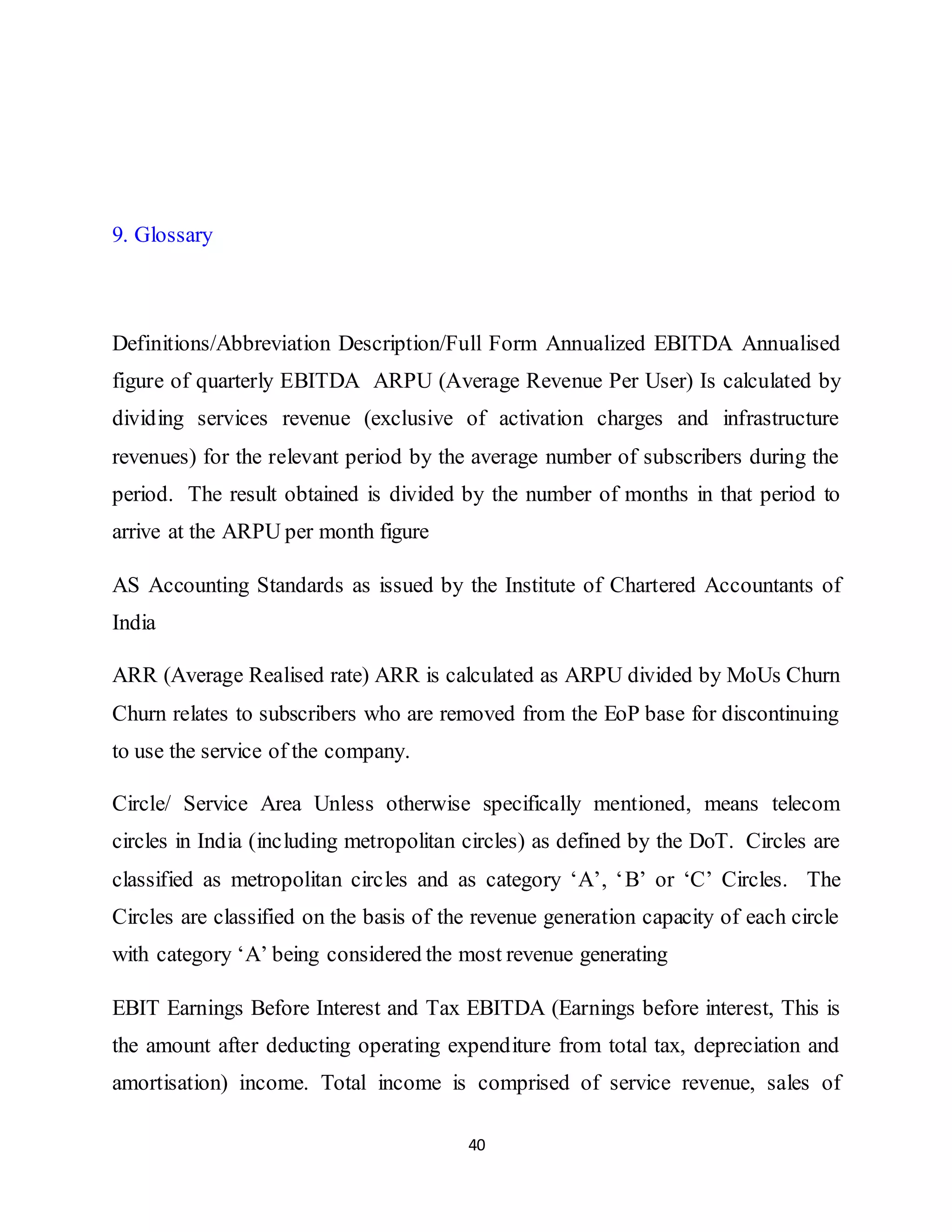
7. StockMarket Highlights
IdeaCellular Daily Stock price (NSE) & Volume (Combined of BSE & NSE)
Movement
Volume (no. of Shares) Closing Price
20,000,0005516,000,0005012,000,000458,000,000404,000,000350309999999999
9999999999-0-0-0-0-0-0-0-0-0-0-0-0-0-00-00-00-
0anananananananebebebebebebarar-arar-arar-ar-J-J-J-J-J-J-J-F-F-F-F-F-F-M-M-
M-M-M-M-M0106121520232936169525270500011120011223BSE & NSE
Combined VolumeNSE Cl Price8. Shareholding Pattern as on March 31, 2009:
40.
40
9. Glossary
Definitions/Abbreviation Description/FullForm Annualized EBITDA Annualised
figure of quarterly EBITDA ARPU (Average Revenue Per User) Is calculated by
dividing services revenue (exclusive of activation charges and infrastructure
revenues) for the relevant period by the average number of subscribers during the
period. The result obtained is divided by the number of months in that period to
arrive at the ARPU per month figure
AS Accounting Standards as issued by the Institute of Chartered Accountants of
India
ARR (Average Realised rate) ARR is calculated as ARPU divided by MoUs Churn
Churn relates to subscribers who are removed from the EoP base for discontinuing
to use the service of the company.
Circle/ Service Area Unless otherwise specifically mentioned, means telecom
circles in India (including metropolitan circles) as defined by the DoT. Circles are
classified as metropolitan circles and as category ‘A’, ‘B’ or ‘C’ Circles. The
Circles are classified on the basis of the revenue generation capacity of each circle
with category ‘A’ being considered the most revenue generating
EBIT Earnings Before Interest and Tax EBITDA (Earnings before interest, This is
the amount after deducting operating expenditure from total tax, depreciation and
amortisation) income. Total income is comprised of service revenue, sales of
41.
41
trading goods andother income. Operating expenditure is comprised of cost of
trading goods, personnel expenditure, network operating expenditure, license and
WPC charges, roaming and access charges, subscriber acquisition and servicing
expenditure, advertisement and business promotion expenditure and administration
and other expenses EoP End of period
FY /Fiscal Financial year ending March 31 GSM Global System for Mobile
communications, the most popular standard for mobile phones in the world
Indian GAAP Indian Generally Accepted Accounting Principles IRU Indefeasible
right of use MoUs/Sub (Average Minutes of We calculate the MoUs/Sub as , total
Minutes of Use in our network Usages per Subs) during the period divided by
average of subscribers during the period Net Adds Refers to net customer additions
which is calculated as the difference between the closing and the opening
customers for the period Net Debt Total loan funds reduced by cash and cash
equivalents Calculated as summation of Share Capital and Reserves & Surplus Net
Worth
reduced by debit balance of profit & loss account
PBT Profit before tax
PAT Profit after tax
ROCE ROCE is calculated as a) for the year : PAT plus gross int. & fin. cost
divided by average capital employed for the year, b) for the quarter : PAT plus
gross int. & fin. cost for the quarter is annualised and divided by capital employed
for the quarter. Capital employed is taken as average of opening and closing of
Shareholders funds and Loan Funds reduced by debit balance of P&L account, for
the respective period Subscribers Mobile telephone service customers TRAI
43
SWOT ANALYSIS ORGANIZATION
Attractiveexisting footprint–The subscriber base under brand Idea, increased from
24 million as of end March 2008 to 43.02 million as of end March 2009, a growth
of around 79%, taking its national market share to 11%.
Original licensee in seven of the Established Circles, providing incumbency
advantages-The established service areas are Delhi, Andhra Pradesh, Gujarat,
Maharashtra, Haryana, Kerala, Madhya Pradesh and Uttar Pradesh (West). The
New Service Areas are Uttar Pradesh (East), Rajasthan, Himachal Pradesh, Bihar,
Mumbai, Karnataka, Punjab, Orissa, Chennai & Tamil Nadu, Jammu & Kashmir,
Kolkata & West Bengal, and Assam & North East. leader in two of, and
established positions in the remainder of, the Established Circles.
Strong distribution channels.
High quality network structure.
Innovation –always comes out with new products.IDEA is the winner of ‘The
Emerging Company of the Year Award' at The Economic Times Corporate
Excellence Awards 2008-09. The company has received several other national and
international recognitions for its path-breaking innovations inmobile telephony
products & services. It won the GSM Association Award for “Best Billing and
Customer Care Solution” for 2 consecutive years. It was awarded “Mobile
Operator of the Year Award -India” for 2007 and 2008 at the Annual Asian Mobile
News Awards.
A national brand -The Company through its participative work
environment, skill development activities, and by championing the values of
commitment, integrity, passion, seamlessness and speed, promotes strong bonding
44.
44
with its employees.During the year, it has again undertaken sharing of value
creation by granting another tranche of employee stock options to the eligible
employees. The findings of OrganizationHealth Study (OHS) have been analyzed,
which are very encouraging, and concern areas are being suitably addressed. The
employee strength onrolls stood at 6,481 as on March 31, 2009.
Attractive growth –From 11.8 million subscribers in 2006 to 24 millionin 2008
,then to 43 million by end of March 2009 and to 51 by end of 2009 is really a great
performance from Idea.
Part of the Aditya Birla Group-IDEA Cellular is an Aditya Birla Group Company,
India's first truly multinational corporation. The group operates in 25 countries, and
is anchored by over 1, 30,000employees belonging to 30 nationalities. The Group
has been adjudged the ‘6th Top Company for Leaders in Asia Pacific Region' in
2009, in a survey conducted by Hewitt Associates, in partnership with The RBL
Group, and Fortune. The Group has also been rated ‘The Best Employer in India
and among the Top 20 in Asia' by the Hewitt-Economic Times and Wall Street
Journal Study 2007.Their promoters-1. Aditya Birla Nuvo Limited2. Grasim
Industries Limited
3. Hindalco Industries Limited
4. Birla TMT HoldingsPrivate LimitedWeaknesses -Equity Ratio: The
Company's Debt-Equity ratio is high as compared to its peers. Moreover, the
Company needs the approval of the lenders under its financing arrangements
before undertaking certain significant corporate actions. The
Company revenues are derived solely from providing mobile services and it is
dependent on four of the Established Circles for a significant proportion of its
revenues.
45.
45
The Company hadaccumulated losses amounting to Rs. 19.23 billion and Rs.
17.23 billion for financial years 2005 and 2006 respectively. The Company may
not be in a position to pay dividends until it clears its accumulated losses.
Opportunities Indian telecommunication industry is expected to continue to
enjoygrowth due to its low teledensity and increasing affordability of mobile
telephone and services. The strong growth in the sector continues, mainly due to
expansion of telecom networks to rural India, the reduced cost of entry and the
reduced cost of handsets. Low penetration, more particularly in rural India,
provides opportunity for further growth, and your company, an
incumbent GSM player with 900 MHz spectrum in about half of India, is well
positioned to tap this opportunity.
The contribution of service sector to the GDP has improved significantly from
29% in 1950 to 54% in 2005. This is primarily due to growth of information-
technology and information technology enables services. This will further
stimulate the demand for mobile telecommunication services.
The regulatory environment is improving and there is greater clarity in existing
rules and procedures. This would enable operators in improving network quality.
Also raising of funds will become easier due to greater predictability of operational
environment. from new technologies is an inherent threat. While the
planned 2100 MHz spectrum auction for 3G services will lead to additional cash
outflow, it will also open new revenue streams. The Company’s strong balance
sheet and market standing, positions it to participate effectively in such auction.
Threats There is intense competitionin the Indian telecommunication industry. Idea
Cellular faces significant competition from private companies that have a pan-
46.
46
India footprint suchas Bharti Airtel, Tata Teleservices and Reliance
Communication Ventures. Also it faces competition from government owned
companies such as BSNL and MTNL. technology is evolving very
rapidly in the telecommunications industry. For instance, “Wi-Fi”and “Wi-
Max”which allows for voice data transfer have been tested and handsets with
such technology maysoon be available in the Indian market. Moreover, satellite
communication voice data transport medium like “Skype”may become a serious
competitor in the long distance voice data transfer business.Porter’s five forces -
Analysis the external environment1.Competitive rivalry within the
Industrya.Principal competitors- industry
leader Bharti Airtel. Bharti Airtelhas 24.3% customer market share and 33.8%
revenue market share. India has 18.8% customer market share and
20.7% revenue market share.
Idea Cellular has 11.2% subscribers market share and 12.1% revenue market share
BSNL has subscriber share of 12.7% and mere 10.2% of revenue share Reliance
Communications is the worst performerwith 18.9% customer market share and
pathetic 11.5% revenue market share.
(Data mentioned are by end of August 2009)b.Salient strengths -
full advantage of its wide network and fixed line subscriber base, and has
established itself as the provider with maximum coverage over the country.
Bharti Airtel has dominated the scene with wide reach, innovative
packages, catchy ads, and has emerged the leader of the pack. Reliance
Communications also has the wide network to its advantage. Tata tele-services
banks on the Tata-trust factor to gain foothold in the market. Vodafone is hitting
the Indian market in a huge way. They have large cash reserves at their disposal to
47.
47
wipe out thecompetition in future. Weaknesses- BSNL lines are mostly marred by
congestion,bottlenecks and they have failed to capture the attention of the
customers with attractive offers. Unstable range and poor customer support are
Airtel ’ s minuses. Ambiguous schemes have reduced Reliance ’ s
popularity. Indicom has not really been able to fully capitalize its goodwill
factor. c.Their basis for competition-Vodafone and Idea are comparatively new
entrants into the market and hence the rest of the competition has anadvantage over
them. Also both these brands have undergone rebranding more than once, and
subsequently have had hiccups with people not realizing the transformation. Giants
like BSNL, Airtel and Reliance have wide networks in the nooks and crannies of
thecountry, while Idea is still to open account in several states.
2.Bargaining Power of CustomersThe bargaining power of customers determines
how much customers can impose pressure on margins and volumes. Customers
bargaining power is likely to be high because
Customersuse multiple mobile services these days and hence have a good
knowledge of the pros and cons of each service provider.
Telecommunication industry comprises a number of operators
is not related to h shave low margins and are price
sensitive
product.3.Bargaining power of suppliersIn this industry there is less number of
suppliers compared to other industries such as the manufacturing or textile
industry.
48.
48
I.Mobile handset suppliers–although there are many handset suppliers in the
country, some service providers have their own handset manufacturing units
operating inthe country like the Reliance Classic and Tata Indicom (backward
integration). Some of the telecom companies also have some collaboration with
major handset manufacturers like Samsung, L.G, and the Blackberry for their
CDMA services.II.Some other suppliers include optical fibre suppliers and
aluminium (for the construction of towers) suppliers. Here the suppliers have a
limited bargaining power.III.Another important one is the software assistance
where the suppliers have some edge. Major solution providers include TCS,
Infosys, Wipro, etc. While Reliance and Tata have their own software services
other players like Vodafone and Idea depend on the above mentioned software
service providers.
4.Threat ofnew entrantsIndian telecom sector provides unprecedented
opportunities for foreign companies in various areas such as 3G, virtual private
network, international long distance calls, value added services etc.
The market is witnessing M&A activities that are leading to consolidations in the
industry. This trend has assisted companies in expanding their reach in the Indian
telecom market to offer better services to the customers. The Indian telecom
industry has always attracted foreign investors. In fact, the cumulative FDI inflow,
from August 1991 to March 2007, in this sector amounted to $3,892.19 million.
This makes telecom the third largest sectorto attract FDI since the liberalization.
Although the entry barriers are in place like license and high fixed costs, still we
observe many new players emerging from the state-level to national-level. This
includes Aircel, Virgin, Spice and Unitech.
49.
49
5.Threat from substitutesTelecomsector offers a wide range of services in India
such as wireline, CDMA, GSM, internet, VoIP, IP etc.
Internet telephone is emerging as a best substitute for the mobile telephony
because it is cheaper and video can also be added. The increasing use and
penetration of internet in the country also augments this. Other facilities on the
internet such as Google talk, Yahoo Messenger, Rediff Bol are used at an
unprecedented level by the youngsters of this country. These are the major
substitutes for the mobile telephony. Maybe this is on of the reasons why the major
service providers also have their presence in internet service. Idea’s strategyIdea
is not the market leader in India. They were operating in a few circles earlier and
were considered a regional player. Recently Idea started operations in many states
as part of their national roll out plan and they have operations in 2200 towns in
India. Idea has been focusing on value added services (VAS) from its inception
which is reflected in its products. They have always taken extra care in providing
customer friendly and competitive Pre Paid offerings. Differentiation and
innovation can be associated with Idea right from its beginning. It’s clear from
the following:
Power', ‘2 Minutes Outgoing Free’, ‘Lifelong offer’, ‘Women'sCard’,
'Lifetime Idea'etc are some of the offerings of IDEA.
first cellular company to launch music messaging with 'Cellular
Jockey','Background Tones', 'Group Talk',a voice portal with 'Say IDEA'and a
complete suite of Mobile EmailServices.
are also providing GPRS and EDGE services for transferring data.
new product introduced by IDEA is the EDGE enabled USB Data Card which is
50.
50
named as 'NetSetter'.Initially ‘NetSetter’ was offered to post paid customers
only. Now it is available to prepaid customers in selected circles.
partnership with IIFA for 10th Anniversary Awards, its association with
Mumbai Indians in IPL and major sought after programs in television like MTV
Roadies and Idea Star singerclearly shows its marketing strategies. They always
seek something different and is always in touch with the youth of the country as
they easily switch to other services.
ad campaign showing AbhishekBachanin different settings but all clearly
showing their corporate social responsibility is great. Their approach is different
from others. was the first to provide one rupee STD calls in the country.
Now when every one else gives per second billing and also 50 paisaper minute,
Idea offers at 49 paisaper minute.
As far as Idea is concerned it should not start a price war with Vodafone and other
large players in the industry. This is because Vodafone has a lot ofmoney with
them to suffer the losses and eventually emerge as the winner and it is almost
doing that. Idea can only afford to come out with some differentiated tariff plan
that does not result in a war with the leaders like Airtel and Vodafone. Indian
telecom is already in trouble with the lowest tariff in the world. Differentiation and
innovation is the way forward for Idea in this already bleeding industry, otherwise
it will be a severe bloodshed.
51.
51
Growth in InstalledCapacity
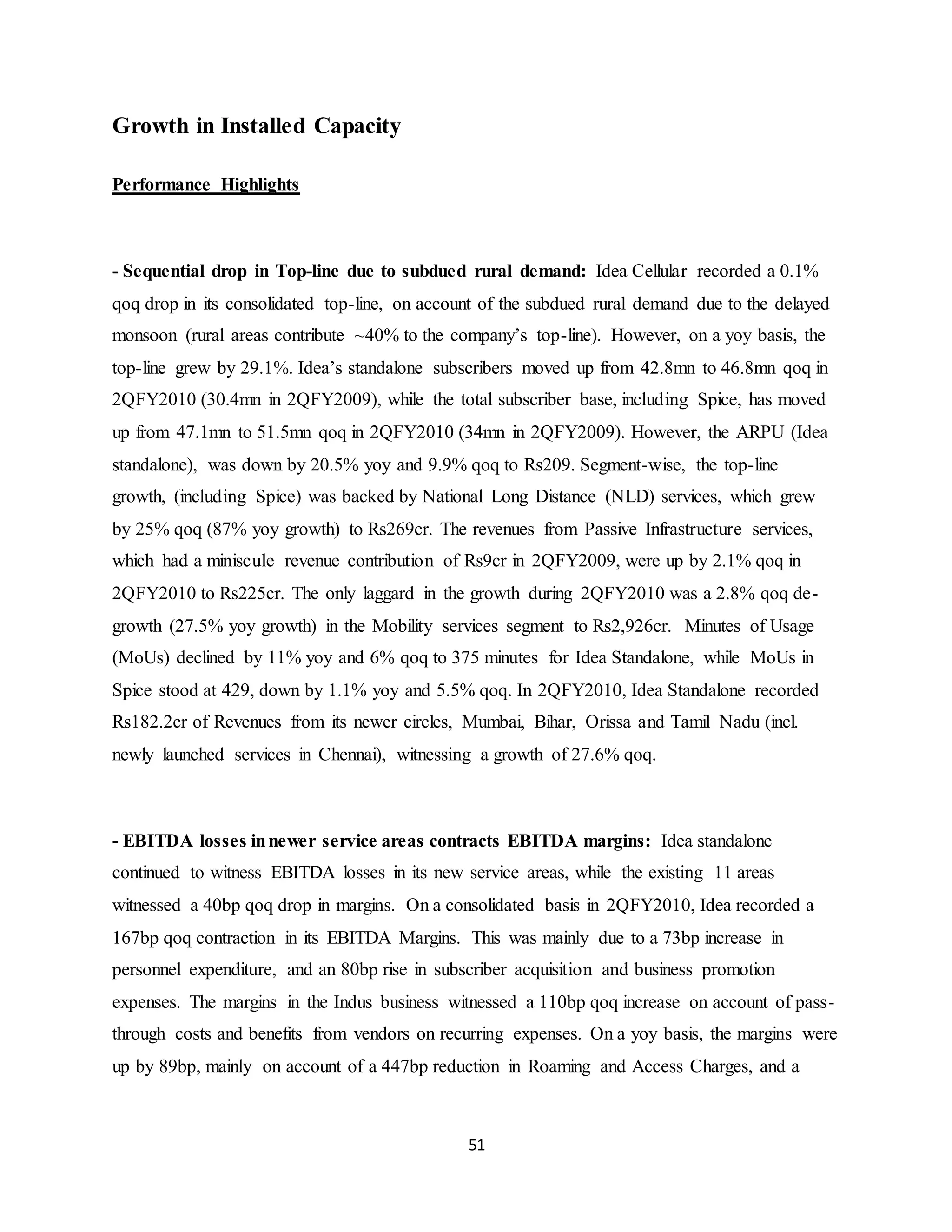
Performance Highlights
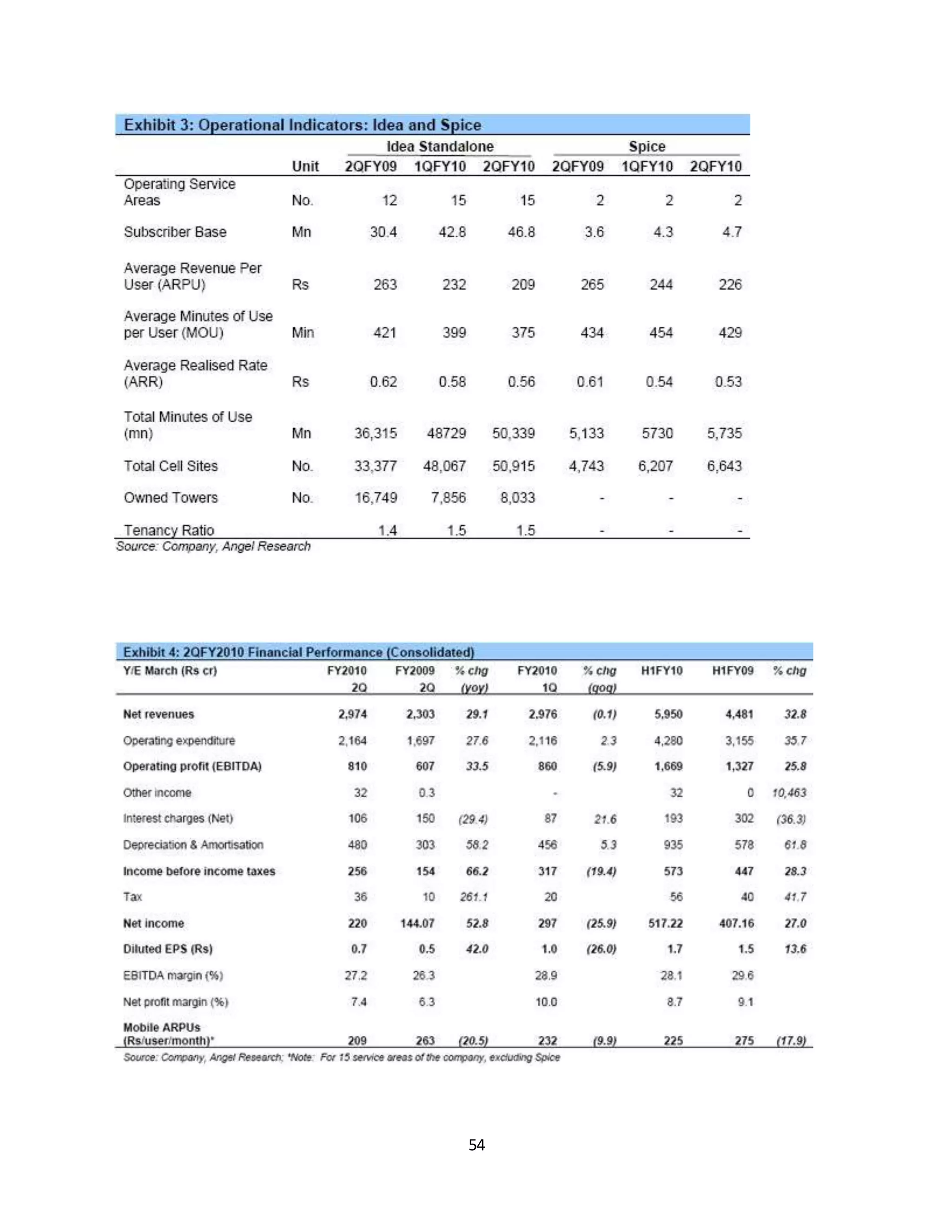
- Sequential drop in Top-line due to subdued rural demand: Idea Cellular recorded a 0.1%
qoq drop in its consolidated top-line, on account of the subdued rural demand due to the delayed
monsoon (rural areas contribute ~40% to the company’s top-line). However, on a yoy basis, the
top-line grew by 29.1%. Idea’s standalone subscribers moved up from 42.8mn to 46.8mn qoq in
2QFY2010 (30.4mn in 2QFY2009), while the total subscriber base, including Spice, has moved
up from 47.1mn to 51.5mn qoq in 2QFY2010 (34mn in 2QFY2009). However, the ARPU (Idea
standalone), was down by 20.5% yoy and 9.9% qoq to Rs209. Segment-wise, the top-line
growth, (including Spice) was backed by National Long Distance (NLD) services, which grew
by 25% qoq (87% yoy growth) to Rs269cr. The revenues from Passive Infrastructure services,
which had a miniscule revenue contribution of Rs9cr in 2QFY2009, were up by 2.1% qoq in
2QFY2010 to Rs225cr. The only laggard in the growth during 2QFY2010 was a 2.8% qoq de-
growth (27.5% yoy growth) in the Mobility services segment to Rs2,926cr. Minutes of Usage
(MoUs) declined by 11% yoy and 6% qoq to 375 minutes for Idea Standalone, while MoUs in
Spice stood at 429, down by 1.1% yoy and 5.5% qoq. In 2QFY2010, Idea Standalone recorded
Rs182.2cr of Revenues from its newer circles, Mumbai, Bihar, Orissa and Tamil Nadu (incl.
newly launched services in Chennai), witnessing a growth of 27.6% qoq.
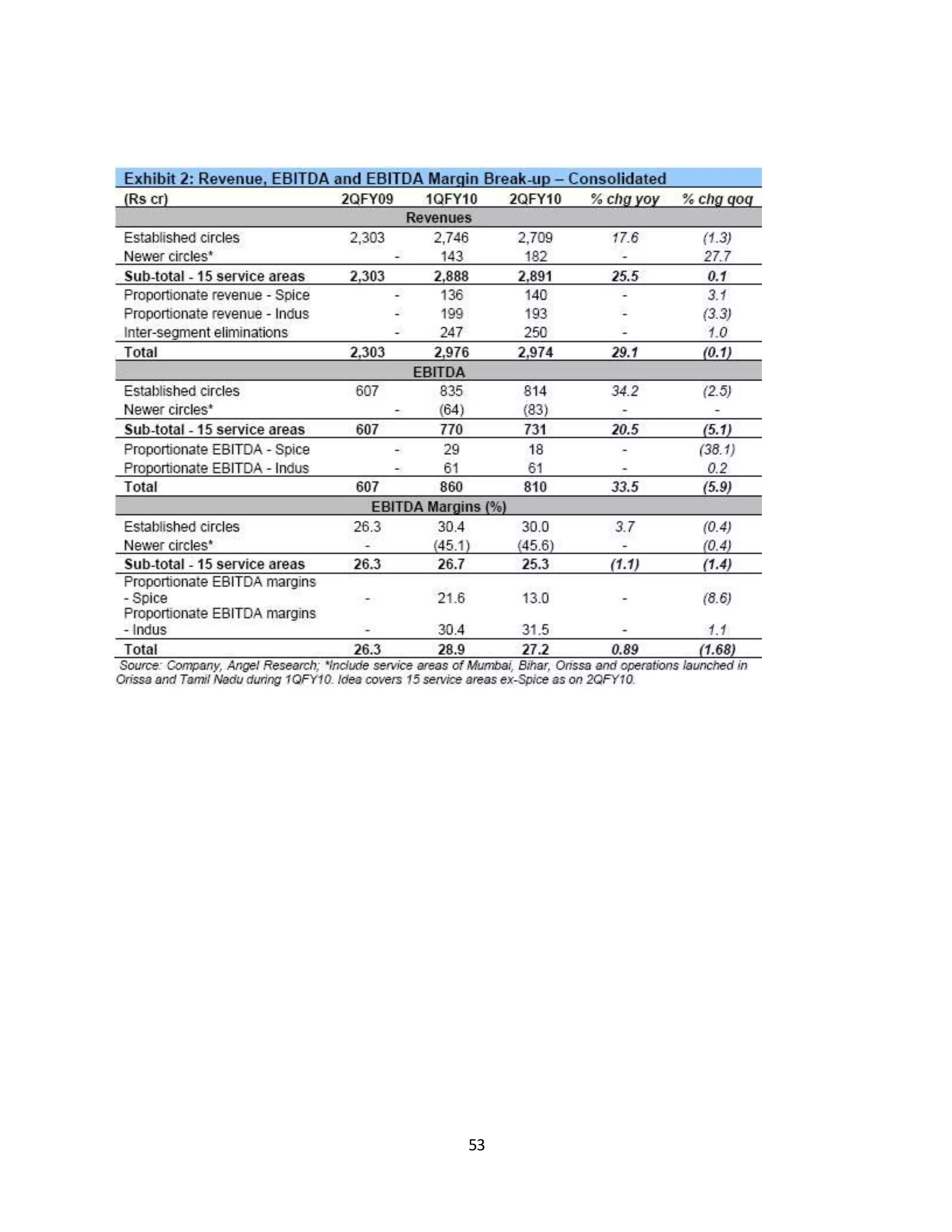
- EBITDA losses innewer service areas contracts EBITDA margins: Idea standalone
continued to witness EBITDA losses in its new service areas, while the existing 11 areas
witnessed a 40bp qoq drop in margins. On a consolidated basis in 2QFY2010, Idea recorded a
167bp qoq contraction in its EBITDA Margins. This was mainly due to a 73bp increase in
personnel expenditure, and an 80bp rise in subscriber acquisition and business promotion
expenses. The margins in the Indus business witnessed a 110bp qoq increase on account of pass-
through costs and benefits from vendors on recurring expenses. On a yoy basis, the margins were
up by 89bp, mainly on account of a 447bp reduction in Roaming and Access Charges, and a
52.
52
224bp drop insubscriber acquisition and business promotion expenses, vis-à-vis an increase of
600bp in Network Operating Expenditure.
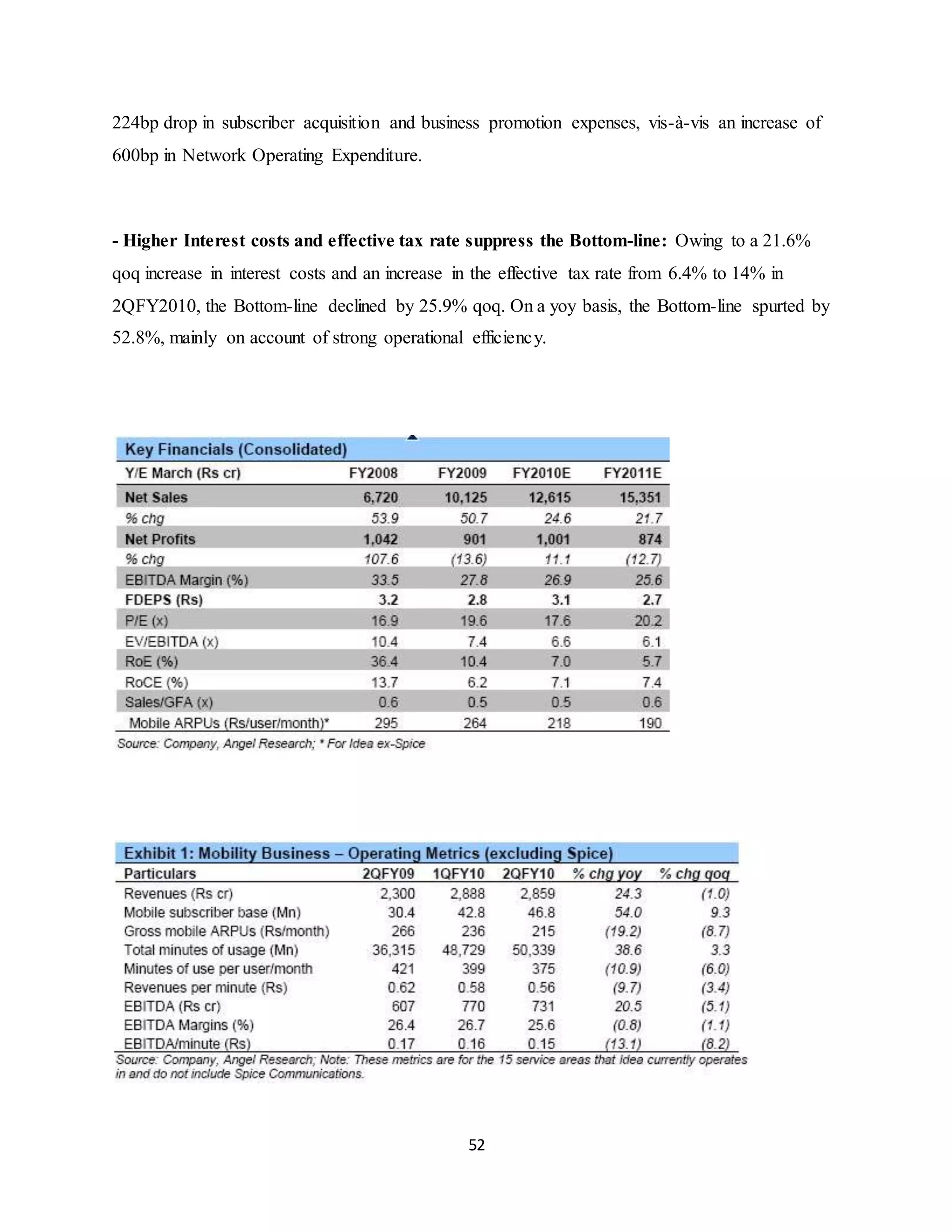
- Higher Interest costs and effective tax rate suppress the Bottom-line: Owing to a 21.6%
qoq increase in interest costs and an increase in the effective tax rate from 6.4% to 14% in
2QFY2010, the Bottom-line declined by 25.9% qoq. On a yoy basis, the Bottom-line spurted by
52.8%, mainly on account of strong operational efficiency.
55
Outlook and Valuation
Inaddition to the five newer service areas, Idea has recently expanded to the service areas of
Jammu & Kashmir, Kolkata & West Bengal, and North East & Assam. It now covers a total of
18 service areas, which will contribute to revenues from 3QFY2010 onwards. This move is in
line with the company’s expansion plan to garner a pan-India presence, for seizing upcoming
opportunities, like the demand in Broadband services, Value Added Services and the
forthcoming 3G auction, once the regulatory and pricing environment in the Indian Telecom
Sector stabilises. Hence, the company’s operational expense is expected to be on the higher side
in the coming quarters, as it focuses on brand-building and high-end technology to match up with
the growing demand, and for increasing its coverage in rural areas. For these initiatives, Idea has
planned a capex of Rs45bn in FY2010.
Going forward, we expect Idea Cellular to record a CAGR of 23% in its consolidated Top-line
over FY2009-11E, while the Bottom-line is expected to record a CAGR de-growth of 1.5% over
the same period. We estimate the company’s mobile subscriber base (excluding Spice) to post a
CAGR of 32% over FY2009-11E and to touch 67.9mn, while including Spice, the subscriber
base is estimated to post a CAGR of 31.4% to touch 74.3mn. We estimate blended ARPUs (ex-
Spice) to post a CAGR decline of 15% to Rs190.4 by FY2011E. At the CMP, the stock is trading
at a P/E of 20.2x FY2011E EPS and an EV/EBITDA of 6.1x FY2011E EBITDA.
On account of the significant headwinds being faced by the Indian Telecom Sector in general,
and little scope of an improvement in the near-term profitability of Idea in particular (with an
increase in the opex and capex), we believe that the company is currently trading at expensive
valuations. Hence, we maintain a Reduce on the stock, with a Target Price of Rs49. We have
valued Idea’s core business at Rs27 and have valued the Tower business (16% stake in Indus) at
Rs22 per share, based on our DCF estimates.
56.
56
ACCUMULATE
Performance Highlights PriceRs43 „ Top-line soars on strong subscriberadds,Spice consolidation: Idea Cellular
recorded a strong 59.6% yoy and 18.5% qoq growth in consolidated Target Price Rs48 Top-line in 3QFY2009 driven by
an increase in its mobile subscriberbase, which grew by an impressive 62.4% yoy and 12.6% qoq.At the end of
Investment Period 12months
3QFY2009, Idea had a mobile subscriber base of 34.2mn, recording net adds of 3.8mn over the quarter. Including
Spice, the company’s subscriber Stock Info
base stands at 38mn. Gross mobile average revenues per user (ARPUs, ex-Spice) rose 1.6% qoq (fall of 5.7% yoy)
to Rs271 (Rs266 in 2QFY2009, Sector Telecom
Rs287 in 3QFY2008). The sequential rise in ARPUs was due to higher Market Cap (Rs cr) 13,299 in-roaming Revenues.
Spice ARPUs rose 8% qoq to Rs279 (Rs259 in 2QFY2009). Part of the Revenue growth was due to consolidation of
Spice Beta 1.0
with effect from October 16, 2008 (proportionate basis,with 41.09% stake) and proportionate Revenues from Indus
Towers.
52 WK High / Low129 / 34
Minutes of Usage (MoUs) declined 1.7% qoq to 410 minutes per user per Avg Daily Volume 1948137
month. On a yoy basis,however, this metric grew by a decent 8.8%. Thus, Face Value (Rs) 10 the MoU fall
sequentially led to rise in realisations, with Revenues per Minute (RPMs) increasing 3.2% qoq, even as they fell by
over 13% on a yoy basis. BSE Sensex 8,674 In 3QFY2009, the company launched operations in the Bihar circle and full
impact of the Mumbai launch was also absorbed.These circles recorded Nifty 2,679
Rs48.3cr of Revenues.Top-line for the 13 service areas of the company (ex-Spice) grew by a robust 53.2% yoy and
13.9% qoq.BSE Code 532822
NSE Code IDEA „ Margins fall on expansion, higher rental sites and Access Charges: In 3QFY2009, Idea recorded a
significant 777bp yoy and 81bp qoq contraction Reuters Code IDEA.BO in EBITDA Margins. Network Expansion costs
rose, as a percentage of Sales, by 513bp yoy and by 270bp qoq.This quarter, the number of BloombergCode IDEA@IN
57.
57
rent-paying sites forIdea rose by 146% yoy to 21,459 (8,721 in 3QFY2008). ShareholdingPattern(%) This led to the
significant rise in Network Expenses. Roaming & Access Charges also rose by 148bp yoy, as a percentage of Sales
(7bp qoq). Promoters EBITDA losses of158.4% (Rs76.5cr) in the Mumbai and Bihar circles also 49.1
adversely impacted the company’s Margin profile.
MF/Banks/IndianFIs
6.7 „ Lower Margins, higher Depreciation reduce Bottom-line: Owing to FII/ NRIs/ OCBs Margin contraction and
higher Depreciation (up 72.9% yoy), Idea’s 40.1
Bottom-line for the quarter declined 7.3% yoy. However, on a qoq basis, Indian Public/Others 4.1 strong growth of
52.3% was recorded due to lower Net Interest Costs (down 42% qoq) due to Rs179.4cr of Interest Income recorded.
Abs. 3m 1yr 3yr*
Key Financials (Consolidated)
Sensex (%) (11.2) (50.7) (32.7) Y/E March (Rs cr) FY2007 FY2008 FY2009E FY2010E Net Sales 4,366 6,720 10,094
14,451 Idea Cellular (%) (3.5) (61.3) (49.9)
% chg 47.2 53.9 50.2 43.2 * Since listing on March 9, 2007
Net Profit 502 1,042 804 909
% chg 148.2 107.6 (22.8) 13.0 Harit Shah
EBITDA Margin (%) 33.6 33.5 26.7 25.1
FDEPS (Rs) 1.6 3.2 2.5 2.8 Tel: 022 – 4040 3800 Ext: 345
P/E (x) 27.6 13.3 17.2 15.3 e-mail: harit.shah@angeltrade.com
EV/EBITDA (x) 10.7 8.6 5.3 4.3 RoE (%) 30.3 36.4 10.5 7.4
RoCE (%) 18.4 19.8 12.2 17.1 Sales/GFA (x) 0.6 0.6 0.6 0.7
Mobile ARPUs (Rs/user/month)340 295 257 247
Source: Company, Angel Research
January 23, 2009 1
58.
58
Idea Cellular
Telecom
Subscriber growthdrives Top-line; first quarter of Spice consolidation
In 3QFY2009, Idea Cellular recorded a strong 59.6% yoy and an impressive 18.5% qoq
growth in consolidated Top-line primarily driven by growth in the company’s mobile subscriberbase, which grew
62.4% yoy and 12.6% qoq to 34.2mn. Over the year, Idea added 13.1mn mobile subscribers,while over the quarter
it added 3.8mn subscribers,implying monthly net adds of 1.3mn. Gross mobile ARPUs fell by 5.7% yoy but rose
1.6%
qoq to Rs271 (Rs287 in 3QFY2008 and Rs266 in 2QFY2009).
This was the first quarter of consolidation of Spice with the company. The consolidation is with effect from October
16, 2008. At the end of the quarter, Idea held 41.09% stake in Spice Communications, with the balance holding
distributed amongst Telecom Malaysia International (TMI) and Green Acre, an affiliate. Proportionate consolidation
of Indus
Towers was also done, with proportionate Revenues from joint ventures at Rs127.3cr. This
boosted Top-line. Excluding this, Revenues from its 13 service areas (including Mumbai
and Bihar) grew 53.2% yoy and 13.9% qoq.Mumbai and Bihar recorded Rs48.3cr in Top-line and ended the
quarter with 3.3 lakh and 2.7 lakh subscribers,respectively. At the end of 3QFY2009, Idea’s marketshare in its
circles of operations stood at 17.6% v/s 17.2% at the end of 2QFY2009 and 17.3% at the end of 3QFY2008.
59.
59
Exhibit 1: TotalMoUs on Idea’s network
(Mn minutes)
41,000
CQGR 17.4%34,000
27,000
20,000
13,000
6,000
1QFY072QFY073QFY074QFY071QFY082QFY083QFY084QFY081QFY092QFY093QFY09 Source: Company, Angel Research
Idea’s MoUs witnessed a fall of 1.7% qoq, even as yoy growth in this metric was decent at
8.8%. MoUs per month stood at 410 as against 417 in 2QFY2009 and 377 in 3QFY2008.
On account of this fall, realisations (RPMs) rose by 3.2% qoq to 64 paise, while on a yoy
basis,a fall of 13.5% was witnessed.The total MoUs on Idea’s network grew by an impressive 79.2% yoy and by
10.8% qoq,crossing 40bn minutes (40.25bn).
Exhibit 2: Mobility Business - Operating metrics (excluding Spice)
Particulars 3QFY08 2QFY09 3QFY09 % chg yoy % chg qoq
60.
60
Revenues (Rs cr)1,710 2,301 2,621 53.2 13.9
Mobile subscriber base (Mn) 21.1 30.4 34.2 62.4 12.6
Gross mobile ARPUs (Rs/month) 287 266 271 (5.7) 1.6 Totalminutes of usage (Mn) 22,457 36,315 40,254 79.2 10.8
Revenues per minute (Rs) 0.74 0.62 0.64 (13.5) 3.2 Minutes of use per user/month 377 417 410 8.8 (1.7) EBITDA (Rs cr) 569
608 680 19.4 11.9
EBITDA Margins (%) 33.3 26.4 25.9 (7.3) (0.5)
EBITDA/minute (Rs) 0.25 0.17 0.17 (33.4) 0.9 Source: Company, Angel Research; Note: These metrics are for the 13 service areas that Spice
currently operates in and do not include Spice Communications.
Margins fall on expansion, higher rental sites and Access Charges In 3QFY2009, Idea recorded a significant 777bp
yoy and 81bp qoq contraction in EBITDA Margins. Network Operating Expenditure rose, as a percentage of Sales,
by 513bp yoy and by 270bp qoq. This quarter, the number of rent-paying sites for Idea rose by 146% yoy to 21,459
(8,721 in 3QFY2008). This led to the significant rise in Network Expenses. Roaming
& Access Charges also rose by 148bp yoy,as a percentage of Sales (7bp qoq). EBITDA January 23, 2009 2
Idea Cellular
Telecom
losses of 158.4% in the Mumbai and Bihar circles (Rs76.5cr) also adversely impacted the
company’s Margin profile.
Exhibit 3: Consolidated Revenue break-up (Rs cr) 3QFY08 2QFY09 3QFY09 % chg yoy % chg qoq Revenues
Established circles 1,710 2,295 2,572 50.4 12.1 Newer circles - 5 48 - 828.8 Sub-total - 13 service areas 1,710 2,300 2,620 53.2
13.9
Proportionate revenue from JVs - 7 127 - 1,858.5
61.
61
Inter-segment eliminations -3 17 - 402.9
Total 1,710 2,303 2,731 59.7 18.5
EBITDA
Established circles 569 644 756 32.9 17.4 Newer circles - (37) (77) - - Sub-total - 13 service areas 569 608 680 19.4 11.9
ProportionateEBITDA from JVs - (1) 17 - - Total569 606 697 22.4 14.9 EBITDA Margins (%)
Established circles 33.3 28.1 29.4 (3.9) 1.3
Newer circles - (703.8) (158.4) - 545.5
Sub-total - 13 service areas 33.3 26.4 25.9 (7.3) (0.5)
Proportionate JV EBITDA margins - (20.0) 13.3 - 33.3
Total 33.3 26.3 25.5 (7.8) (0.8) Source: Company, Angel Research
Lower Margins, higher Depreciation reduce Bottom-line
Owing to Margin contraction and higher Depreciation (up 72.9% yoy), Idea’s Bottom-line for the quarter declined
7.3% yoy. However, qoq, strong growth of 52.3% was recorded due to lower Net Interest Costs (down 42% qoq)
due to Rs179.4cr of Interest Income earned from investment of the funds raised by the company recently.
Receives GSM spectrumfor all circles
Idea Cellular has received GSM spectrum across all the circles where it hitherto had
licences to operate but had no spectrum. Thus,the company will roll out operations in these circles over the course
of the next few months and is well on course to become a pan-India GSM-based cellular operator. However, being a
late entrant in circles like Orissa (to launch in 1QFY2010), Tamil Nadu (2QFY2010 launch scheduled)and West
Bengal, the company
could face ARPU and EBITDA pressures in these circles as it launches and gains scale.
62.
62
Issues 1.925mn CompulsorilyConvertible Preference Shares to Providence affiliate Idea Cellular on December 5,
2008 received Rs2,100cr from an affiliate of Providence Equity Partners by way of subscription to 1.925mn
Compulsorily Convertible Preference Shares, which will be converted into 16.14% of the equity capital of Aditya
Birla Telecom
(ABTL) post conversion.
Signs IRU with Indus Towers to transfer 11,100 towers; to impact Margins by 4-5% Idea Cellular has signed an
Indefeasible Right to Use (IRU) agreement with Indus Towers, the tower joint venture (JV) between itself, Bharti
and Vodafone involving the transfer of 11,100 of its towers to Indus, each of which will have one cell site for Idea.
Thus, out of the
balance of 17,830 towers that were until now non-rent paying, 11,100 will become
rent-paying on the books of Indus. The approximate book value of these towers is
Rs1,450cr.
This will lead to a significantly higher component of rent-paying towers for Idea and capex will get converted into
opex. There will be a 4-5% impact on EBITDA Margins in FY2010 on
account of this. However, lower Depreciation and Interest costs will offset the impact to an
extent on the Bottom-line. Moreover, with consolidation of 16% of Indus, the impact is likely
to be limited to around 2-2.5% at the Net Profit level.
January 23, 2009 3
63.
63
Idea Cellular
Telecom
Outlook andValuation
Going forward, we expect Idea Cellular to record a CAGR of 46.3% in Top-line over FY2008-10E, while Bottom-
line is expected to record a CAGR fall of 7.5% over the period
on account of significant Margin pressures. We estimate the company’s mobile subscriber
base (including Spice) to post a CAGR of 52.9% over FY2008-10E to 56.1mn, while ARPUs
would post a decline in CAGR of 8.4% over the period to Rs247.
At the CMP, the stock is trading at a P/E of 15.3x FY2010E EPS, EV/EBITDA of 4.3x FY2010E EBITDA and at
an EV/subscriber of US $67.5 on our FY2010E subscriber base.
We believe the company is well-positioned in terms of spectrumholdings across the
country. Strong fund infusion from recent initiatives like the stake sale in ABTL and the
Spice deal with TMI will result in a well-funded Balance Sheet and Net Debt-Equity ratio of just 0.19x. However,
the environment going forward is likely to become more difficult given intensifying competition, falling ARPUs,
cost pressures owing to rapid expansion of coverage area, leading to Margin pressures,which are likely to get
further exacerbated due
to roll outs in newer circles (higher initial EBITDA losses), which would in turn exert
significant pressure on Profitability, and regulatory risks. With RCOM’s GSM roll-out and the
upcoming GSM launches of Tata Teleservices, apart from circle expansion by Aircel (GSM) and Shyam-Sistema
(CDMA) as well as newer operator roll-outs, the competitive environment is expected to further intensify.
We downgrade our 12-month Target Price to Rs48 (Rs66), which includes Rs22 as the
64.
64
value of thecore business after downgrading the P/E multiple to 8x (10x), and Rs26 as the
value of its 16% stake in Indus Towers. We recommend an Accumulate on the stock and believe that while the
company’s recent initiatives will enable it to build a strong business in the longer-term, the increasingly difficult
environment is likely to exert significant strain on its key operating and financial parameters, thereby limiting
major upsides in the stock price.
January 23, 2009 4
Idea Cellular
Telecom
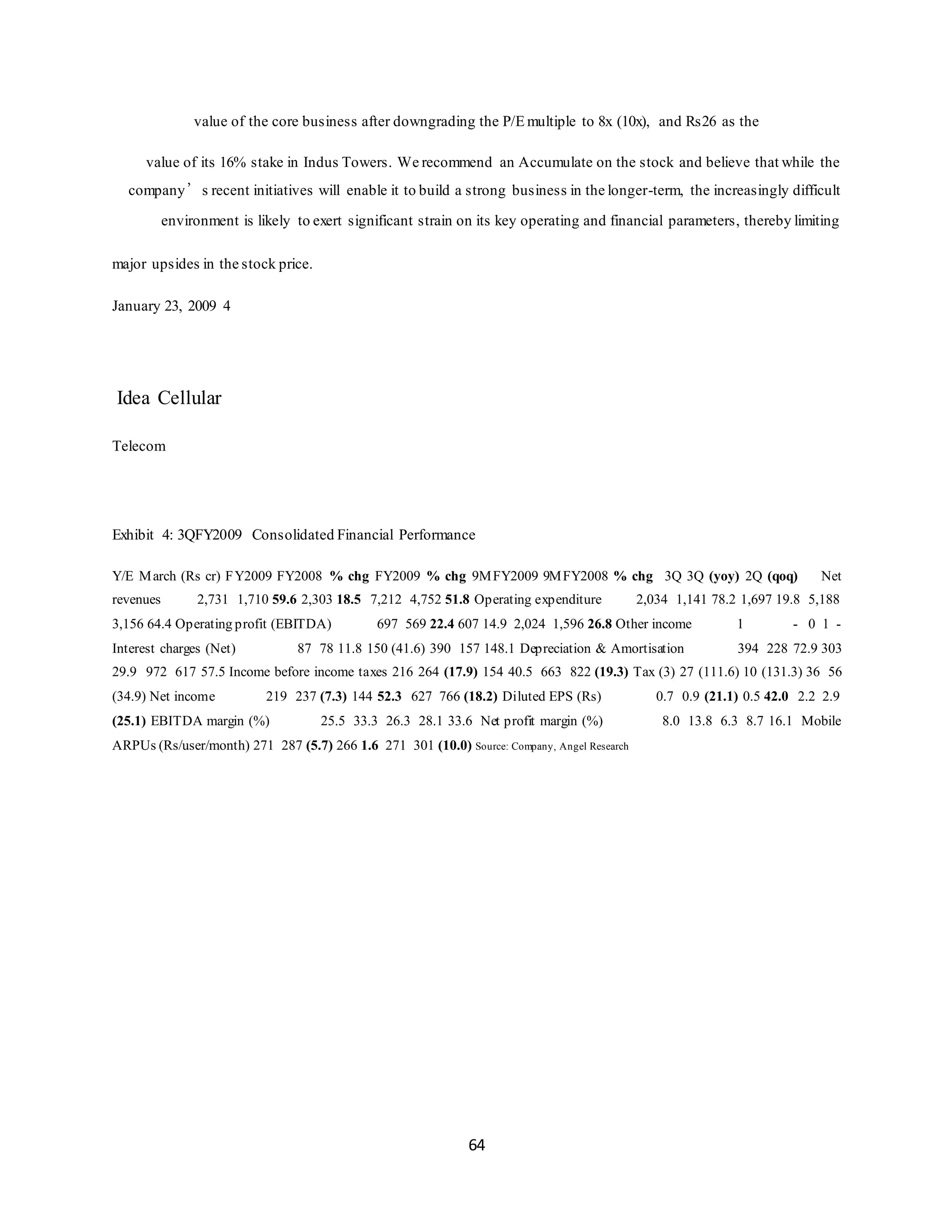
Exhibit 4: 3QFY2009 Consolidated Financial Performance
Y/E March (Rs cr) FY2009 FY2008 % chg FY2009 % chg 9MFY2009 9MFY2008 % chg 3Q 3Q (yoy) 2Q (qoq) Net
revenues 2,731 1,710 59.6 2,303 18.5 7,212 4,752 51.8 Operating expenditure 2,034 1,141 78.2 1,697 19.8 5,188
3,156 64.4 Operating profit (EBITDA) 697 569 22.4 607 14.9 2,024 1,596 26.8 Other income 1 - 0 1 -
Interest charges (Net) 87 78 11.8 150 (41.6) 390 157 148.1 Depreciation & Amortisation 394 228 72.9 303
29.9 972 617 57.5 Income before income taxes 216 264 (17.9) 154 40.5 663 822 (19.3) Tax (3) 27 (111.6) 10 (131.3) 36 56
(34.9) Net income 219 237 (7.3) 144 52.3 627 766 (18.2) Diluted EPS (Rs) 0.7 0.9 (21.1) 0.5 42.0 2.2 2.9
(25.1) EBITDA margin (%) 25.5 33.3 26.3 28.1 33.6 Net profit margin (%) 8.0 13.8 6.3 8.7 16.1 Mobile
ARPUs (Rs/user/month) 271 287 (5.7) 266 1.6 271 301 (10.0) Source: Company, Angel Research
65.
65
Growth in sales:
AdityaBirla Group
A US $28 billion corporation, the Aditya Birla Group is in the league of Fortune 500. It is a
multinational corporation based in Mumbai, India with operations in 25 countries. The group is a
major player in all the industry sectors it operates in. The Group has been adjudged the best
employer in India and among the top 20 in Asia by the Hewitt-Economic Times and Wall Street
Journal Study 2007. The origins of the group lie in the conglomerate once held by one of India's
foremost industrialists Mr. Ghanshyam Das Birla. He bequeathed most of these companies to his
grandson, Mr. Aditya Vikram Birla – the father of the current Chairman of the group, Mr. Kumar
Mangalam Birla. Mr. Kumar Mangalam Birla is the grandson of Mr. Basant Kumar Birla, who
heads his own independent business conglomerate. Several other members of the Birla Family
own and run their independent business groups.
Aditya Birla is organized into various subsidiaries that operate across different sectors. Among
these are viscose staple fibre, non-ferrous metals, cement, viscose filament yarn, branded
apparel, carbon black, chemicals, Modern retail (under the 'More' brand of supermarkets, and
also under the Trinethra, and Fabmall brands until recently), fertilizers, sponge iron, insulators,
financial services, telecom, BPO and IT services. The Group consists of four main companies,
which operate in various industry sectors through subsidiaries, joint ventures, etc. These are
Hindalco, Grasim, Aditya Birla Nuvo, and UltraTech Cement.
We have focused on the Idea Cellular SBU of Aditya Birla Group. It is One of India's leading
GSM mobile service operators; IDEA Cellular is headquartered in Mumbai and has over 30
million subscribers. Innovation is central to IDEA's Value Added Service products. It was the
first to offer 'Global SMS' in over 540 networks across all technology platforms. It has also
acquired Modi family’s Spice. But then it even faces tough competition from various major
players. The leading Mobile Networks today in India are Airtel, Vodafone (sold by Hutchinson
Essar to Vodafone), BSNL, MTNL, Orange, Aircel, Tata Indicom, Idea, BPL etc. Each of these
companies has a tough competition with one another. BSNL & MTNL being government sectors
have more advantages than other Private sector Companies.
66.
66
Strategic Business Unit-Idea Cellular Limited
Idea Cellular Limited has a share of 12% in the total GSM telecom market in India (as on
Mar’08). The Entire Telecom Industry is growing at a rate of 25% as compared to the base year
2006-07. This can be termed as a moderately growing Industry and it is expected to grow in the
coming years. We are thus putting the middle line of the vertical axis in our BCG matrix as 15%
as a division between low and high growth.
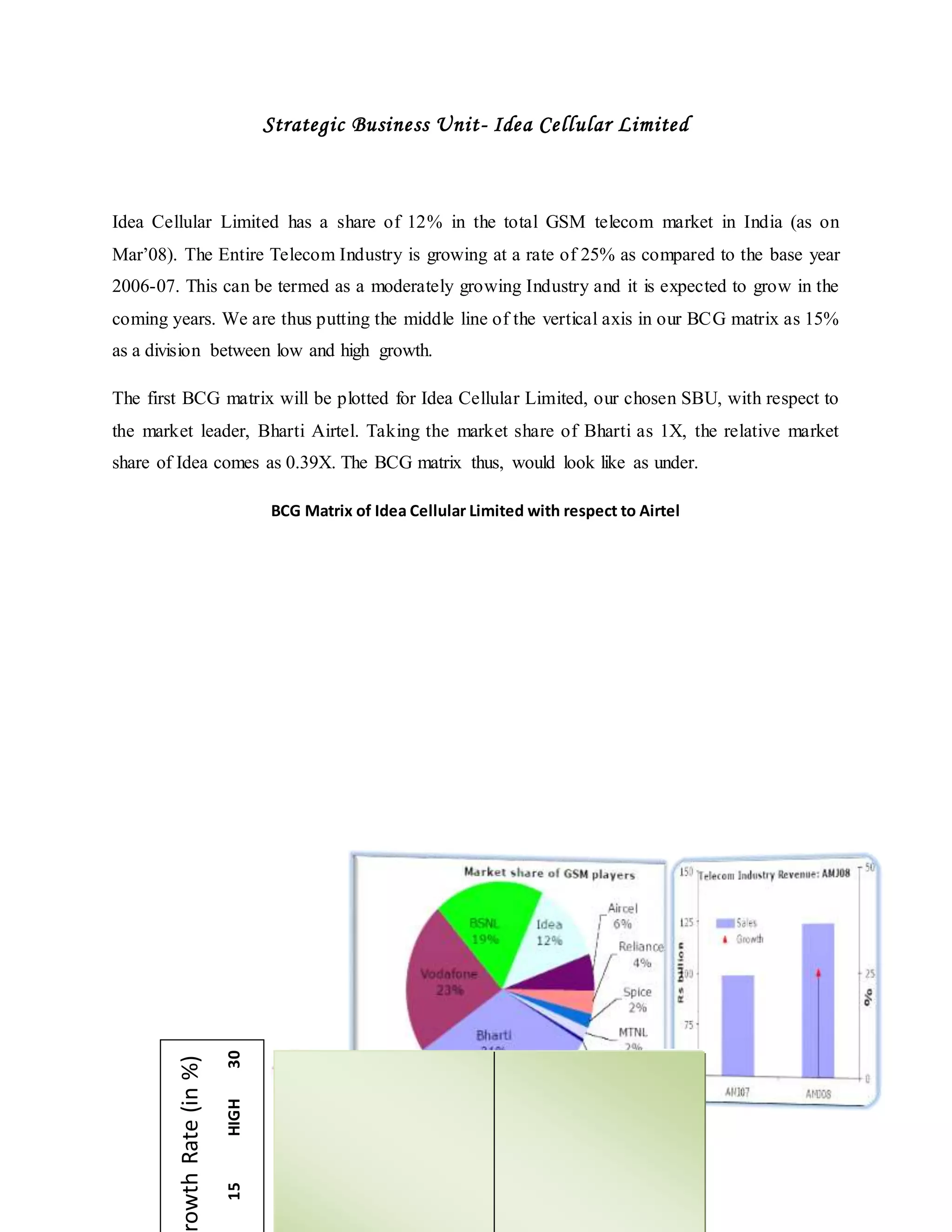
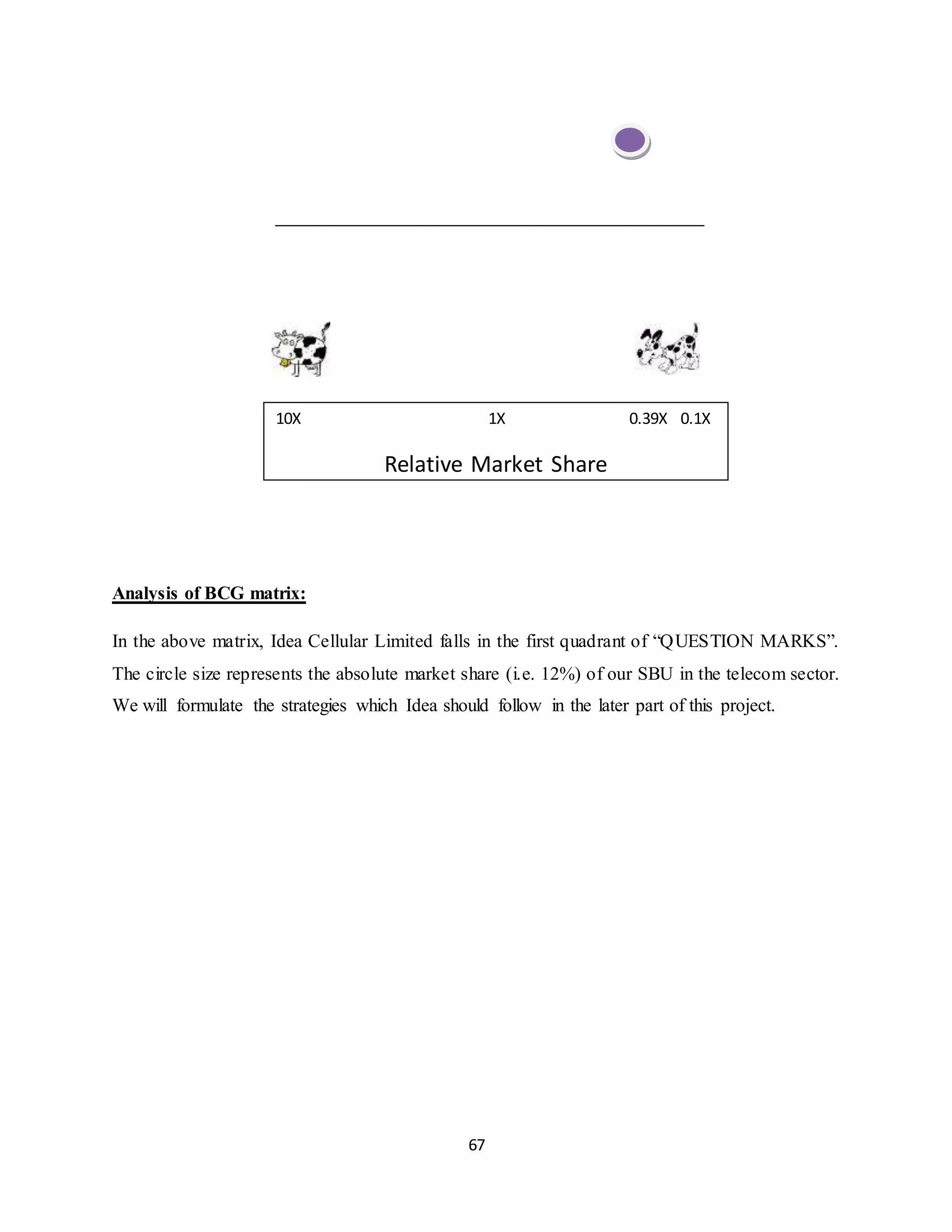
The first BCG matrix will be plotted for Idea Cellular Limited, our chosen SBU, with respect to
the market leader, Bharti Airtel. Taking the market share of Bharti as 1X, the relative market
share of Idea comes as 0.39X. The BCG matrix thus, would look like as under.
BCG Matrix of Idea Cellular Limited with respect to Airtel
owthRate(in%)
15HIGH30
67.
67
Analysis of BCGmatrix:
In the above matrix, Idea Cellular Limited falls in the first quadrant of “QUESTION MARKS”.
The circle size represents the absolute market share (i.e. 12%) of our SBU in the telecom sector.
We will formulate the strategies which Idea should follow in the later part of this project.
10X 1X 0.39X 0.1X
Relative Market Share
68.
68
Plotting the Competitors
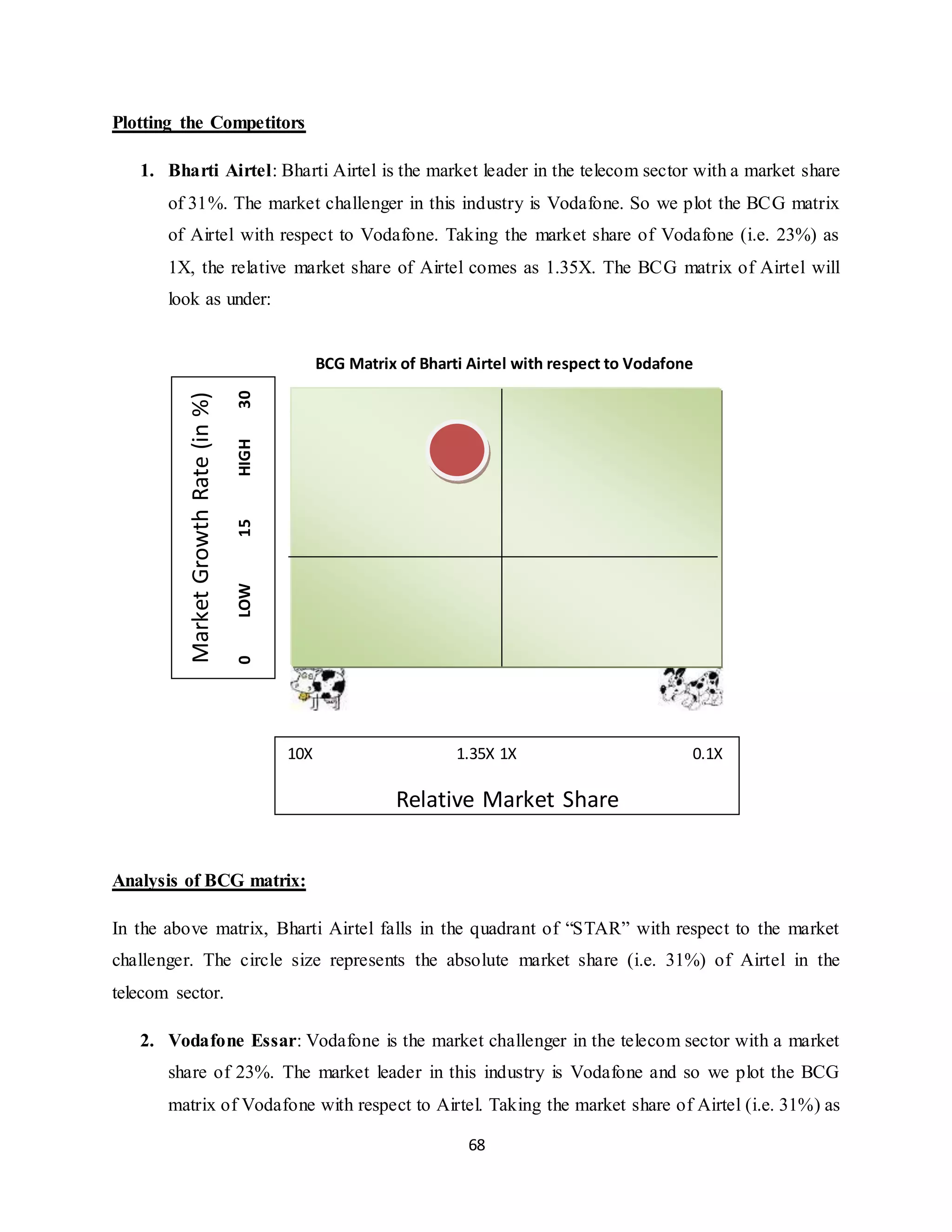
1.Bharti Airtel: Bharti Airtel is the market leader in the telecom sector with a market share
of 31%. The market challenger in this industry is Vodafone. So we plot the BCG matrix
of Airtel with respect to Vodafone. Taking the market share of Vodafone (i.e. 23%) as
1X, the relative market share of Airtel comes as 1.35X. The BCG matrix of Airtel will
look as under:
BCG Matrix of Bharti Airtel with respect to Vodafone
Analysis of BCG matrix:
In the above matrix, Bharti Airtel falls in the quadrant of “STAR” with respect to the market
challenger. The circle size represents the absolute market share (i.e. 31%) of Airtel in the
telecom sector.
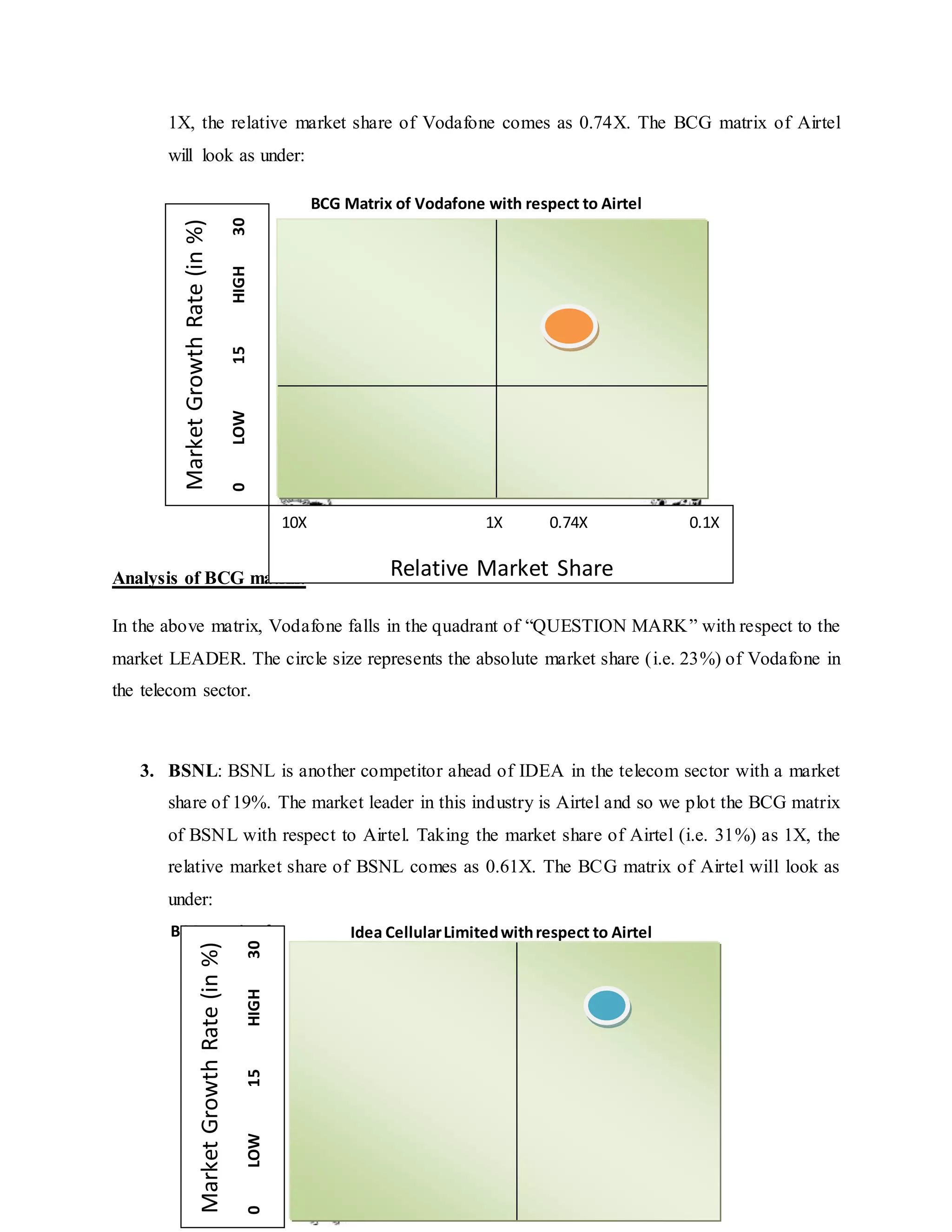
2. Vodafone Essar: Vodafone is the market challenger in the telecom sector with a market
share of 23%. The market leader in this industry is Vodafone and so we plot the BCG
matrix of Vodafone with respect to Airtel. Taking the market share of Airtel (i.e. 31%) as
MarketGrowthRate(in%)
0LOW15HIGH30
HIGH
10X 1.35X 1X 0.1X
Relative Market Share
69.
69
1X, the relativemarket share of Vodafone comes as 0.74X. The BCG matrix of Airtel
will look as under:
BCG Matrix of Vodafone with respect to Airtel
Analysis of BCG matrix:
In the above matrix, Vodafone falls in the quadrant of “QUESTION MARK” with respect to the
market LEADER. The circle size represents the absolute market share (i.e. 23%) of Vodafone in
the telecom sector.
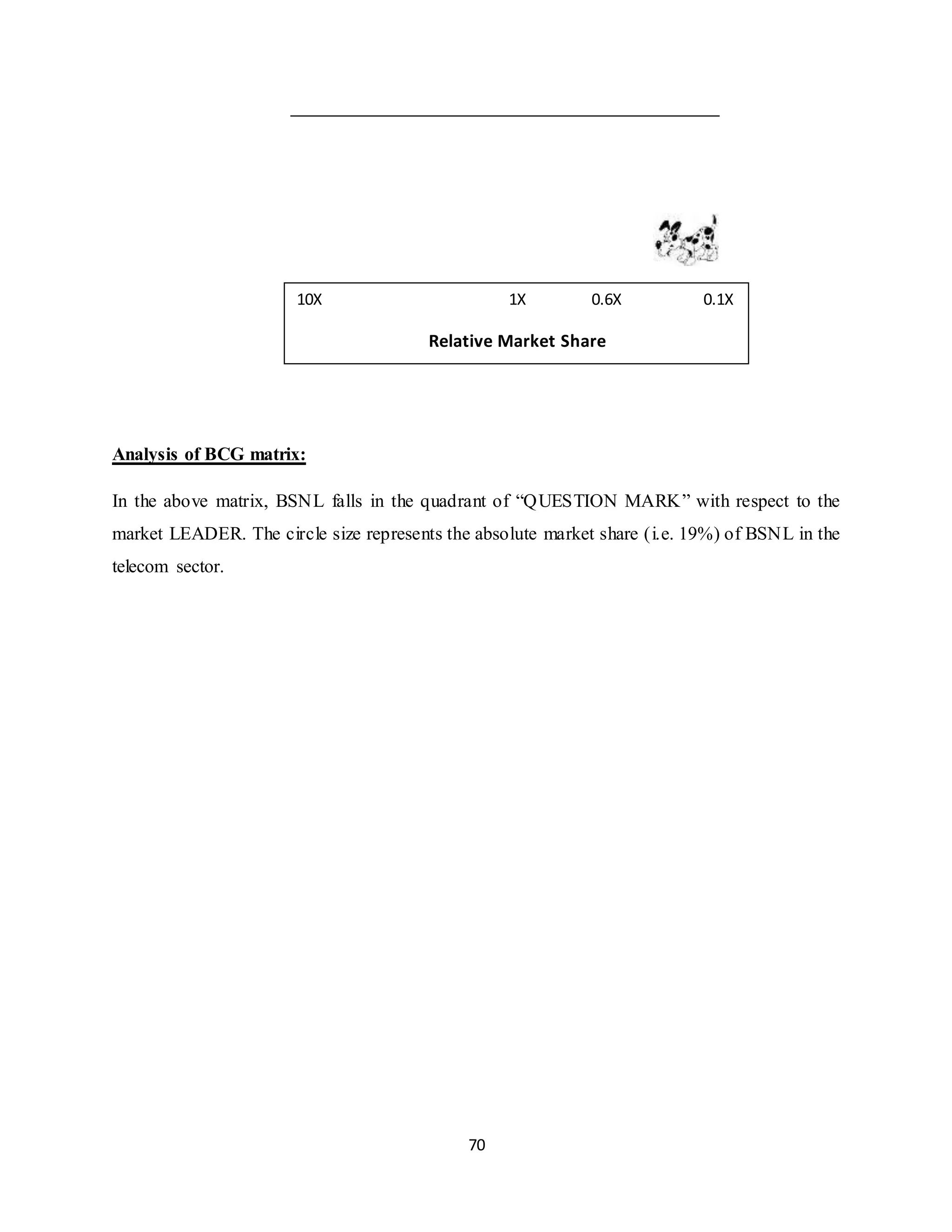
3. BSNL: BSNL is another competitor ahead of IDEA in the telecom sector with a market
share of 19%. The market leader in this industry is Airtel and so we plot the BCG matrix
of BSNL with respect to Airtel. Taking the market share of Airtel (i.e. 31%) as 1X, the
relative market share of BSNL comes as 0.61X. The BCG matrix of Airtel will look as
under:
BCG Matrix of Idea CellularLimitedwithrespect to Airtel
MarketGrowthRate(in%)
0LOW15HIGH30
HIGH
10X 1X 0.74X 0.1X
Relative Market Share
MarketGrowthRate(in%)
0LOW15HIGH30
HIGH
70.
70
Analysis of BCGmatrix:
In the above matrix, BSNL falls in the quadrant of “QUESTION MARK” with respect to the
market LEADER. The circle size represents the absolute market share (i.e. 19%) of BSNL in the
telecom sector.
10X 1X 0.6X 0.1X
Relative Market Share
71.
71
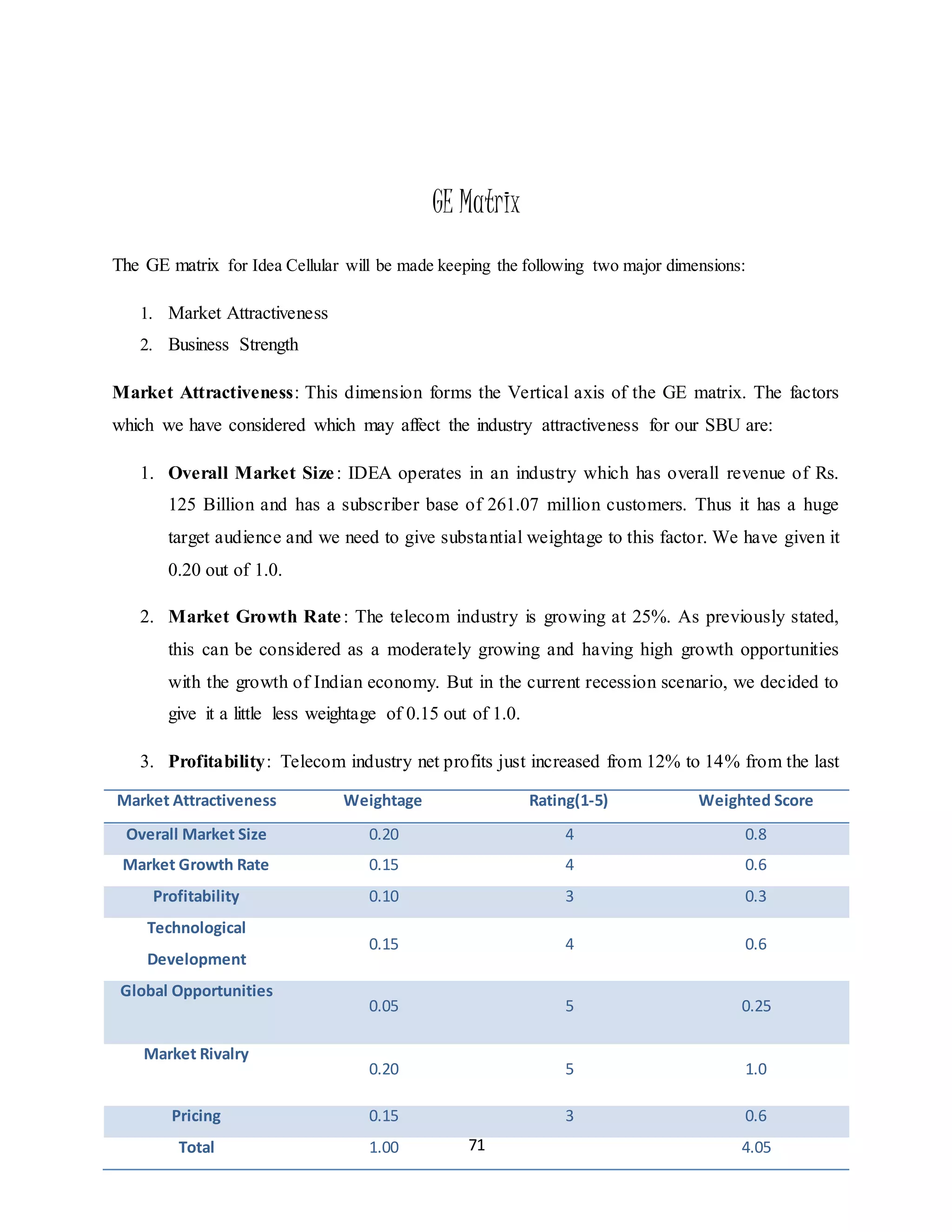
GE Matrix
The GEmatrix for Idea Cellular will be made keeping the following two major dimensions:
1. Market Attractiveness
2. Business Strength
Market Attractiveness: This dimension forms the Vertical axis of the GE matrix. The factors
which we have considered which may affect the industry attractiveness for our SBU are:
1. Overall Market Size: IDEA operates in an industry which has overall revenue of Rs.
125 Billion and has a subscriber base of 261.07 million customers. Thus it has a huge
target audience and we need to give substantial weightage to this factor. We have given it
0.20 out of 1.0.
2. Market Growth Rate: The telecom industry is growing at 25%. As previously stated,
this can be considered as a moderately growing and having high growth opportunities
with the growth of Indian economy. But in the current recession scenario, we decided to
give it a little less weightage of 0.15 out of 1.0.
3. Profitability: Telecom industry net profits just increased from 12% to 14% from the last
Market Attractiveness Weightage Rating(1-5) Weighted Score
Overall Market Size 0.20 4 0.8
Market Growth Rate 0.15 4 0.6
Profitability 0.10 3 0.3
Technological
Development
0.15 4 0.6
Global Opportunities
0.05 5 0.25
Market Rivalry
0.20 5 1.0
Pricing 0.15 3 0.6
Total 1.00 4.05
72.
72
fiscal year. Dueto no such significant increase in profitability as compared to sales, we
have given it a weightage of 0.10 out of 1.0.
4. Technological Development: With new technologies like 3G knocking at the doors of
Indian telecom sectors, technological development will be an important factor to be
considered in the business policies towards our chosen SBU. Hence a weight of 0.15.
5. Global Opportunities: Bharti has started making forays into global markets. With the
expected entry of many foreign players in the near future, this can open the door for
global opportunities for Indian players. Hence the weightage of 0.10.
6. Market Rivalry: Indian telecom sector is an Oligopoly where 80% of the market share is
picked by only 4 players. Also the future guarantees the entrance of several big global
names in this sector. Hence clearly market rivalry weighs above others at 0.20 out of 1.0.
7. Pricing: Being an Oligopoly, pricing strategies are a key for any player to make profits in
such a competitive sector. Thus we have given it equal weightage as technology and
more than even factors like profitability and growth rate.
Factors considered for Market Attractiveness
The rating is done on a scale of 1-5 where the industry attractiveness is rated associated with the
industry as a whole. Here 1 represents very unattractive and 5 represents very attractive. We can
see the difference in weightage and type of rating varying in the different factors. The market
growth rate can have a low weightage as compared to market size but has the same rating
because growth rate is attractive for the players in the market. Also pricing may have much more
weightage as compared to global opportunities but the ratings are the other way round. This is
for the reason that pricing strategies are not that attractive to the company because of strong
competition and regulations whereas global opportunities are more attractive for the industry.
Based on the above assumptions substantiated by the industry facts and growth avenues, the
weighted total score for market attractiveness in case of Idea Cellular comes to be 4.05.
73.
73
Business Strength:
1. MarketShare: The market share of Idea Cellular is 12%. Well it just acquired Spice
Communications and is among the top 4 players in GSM sector. But being a market
follower its primary motive is profitability. Thus we gave less weight to market share.
2. Market Growth Rate: Idea being a small player has ample of scope to grow but its
growth rate puts little effect to market rate as compared to other players. So it has again
been given weightage of 0.10.
3. Profit margin relative to competitors: This is the most important aspect of Idea’s
competitiveness. IDEA’s profit margin increased about 4 percent from 2006-07(11%) to
current profit margin (15%) that is 2007-08. This is an area where it would like to have a
competitive edge.
4. Technological Innovation: Idea was the first telecom operator to launch GPRS and
EDGE technology. We have given high weightage to support its innovational outlook.
Recently it formed a alliance with “high tech computers” (HTC). It also launched and
secured a position of leader in value added services like “cellular jockey”, “background
tones”, and “group talk”.
5. Brand Reputation: IDEA already has a backbone “Aditya Birla group” which has
already established as a global and truthful image. Being a part of Aditya Birla Group, it
has to carry a brand name. But now its strategy would be more of brand building than
brand reputation. So we have given a low weight.
6. Sales Distribution Effectiveness: The breadth of the distribution network has grown by
over 30% in the past year. In addition to this the company is operating additional 589
Idea ‘n U and showrooms which supplement the distribution channels and provide
customer service.
7. Advertising and Promotional Effectiveness: Idea went for aggressive promotional
techniques such as having Abhishek Bachhan as the Brand Ambassador. The tag line
“What An Idea” was very successful proving the effectiveness of the advertising and
promotional activities carried by Idea.
74.
74
8. Pricing strategiesand Customer Loyalty: By adopting different pricing strategy it
discriminates among its customers. For example it has different pricing strategies for
postpaid subscribers and prepaid subscribers.
Key Competitive
Factors
Weight Rating(1-5) Weighted Score
Market Share 0.10 4 0.4
Market Growth Rate 0.10 4 0.4
Profit Margin relative
to competitors
0.15 5 0.75
Technological
Innovation
0.15 4 0.6
Brand Reputation
0.10 4 0.4
Sales Distribution
Effectiveness 0.10 3 0.3
Advertising and
Promotional
Effectiveness
0.15 4 0.6
Pricing strategies
0.05 4 0.2
Customer Loyalty 0.10 3 0.3
Total= 3.95
76
he factor forIndustry attractiveness will remain same for market leader as well. Bur the
competitive strength will differ and so the weights and ratings. It is evident from our above
assumptions about Airtel that they will lesser rating to profit margins and more towards
advertising and promotional effectiveness and brand reputation. The GE matrix of Airtel will
look like as under:-
STRONG MEDIUM
WEAK
5
3.66
2.33
1
5 3.66 2.33 1
31%
1
77.
77
The GE matrixfor Airtel indicates that it lies in the 1st quadrant corresponding to high market
attractiveness and strong competitive strength.
GE Matrix for Vodafone
The market challenger Vodafone will again have the same Market Attractiveness dimension as
the other players but will have an entirely different competitive strength dimension. Assuming
Vodafone’s company objectives to be more focused on building a customer loyalty, we assign it
a weight of 0.15. Also its sales and distribution effectiveness is much lesser than Airtel or Idea,
so give a weight of 0.05 to it. Vodafone has a brand reputation of the world’s largest telecom
provider which it has to maintain even in the Indian Telecom Industry. For that it would
definitely look to emphasize more on advertising and promotional effectiveness. So both these
factors are given 0.15 weights.
Market Attractiveness Weightage Rating(1-5) Weighted Score
Overall Market Size 0.20 4 0.8
Market Growth Rate 0.15 4 0.6
Profitability 0.10 3 0.3
Technological
Development
0.15 4 0.6
78.
78
Vodafone may stillassign lower rates brand loyalty as compared to sales distribution
effectiveness as they would like to put a competitive front in the distribution network. Moreover
they would find advertising effectiveness and pricing strategies more attractive than a higher
profit margin. The above assumptions led us to the different dimensions and the corresponding
GE matrix. Market Attractiveness
Global Opportunities
0.05 5 0.25
Market Rivalry
0.20 5 1.0
Pricing 0.15 3 0.6
Total 1.00 4.05
Key Competitive
Factors
Weight Rating(1-5) Weighted Score
Market Share 0.10 4 0.40
Market Growth Rate 0.10 4 0.40
Profit Margin relative
to competitors
0.10 3 0.30
Technological
Innovation
0.10 4 0.40
Brand Reputation
0.15 3 0.45
Sales Distribution
Effectiveness 0.05 5 0.25
Advertising and
Promotional
Effectiveness
0.15 4 0.60
Pricing strategies 0.10 4 0.40
80
Plotting the GEmatrix for Vodafone, we found that it lies in the quadrant corresponding
to High market attractiveness but average internal evaluation, i.e. average business strength.
STRATEGIES FOR IDEA CELLULAR
The Idea Cellular Limited falls in the “question mark” quadrant of BCG matrix and in the High
attractive and Strong Competitive strength category as per the GE Matrix. Thus they need to
formulate some strategies to try capturing some market share, growing and building their brand
image as well as brand value.
Market penetration
The company enters where the products and the market already exists. IDEA being a question
mark that means it is competing in a high growth market but with a relatively low share compare
to its competitors. Market penetration can be done by attracting competitor’s customers that
implies increase in market share. The strategy that IDEA can adapt under market penetration is
to attract non-users and convince to use their product more often. They are different market
penetration strategies like cutting price, increase in promotion, and creating innovative
distribution tactics. The target should be in such a way that IDEA sales volume relative to its
competitors should be high as expressed in percentage. IDEA’s present market share is about
12%, and competitors like airtel, Vodafone, and bsnl have a market share of about 31, 23, and 19
percent respectively. Though telecom industry is growing rapidly every year, there is always a
little increment in the percentage of sales for IDEA. To overcome this problem and to occupy the
competitor’s position we recommend following strategies.
81.
81
Increasing themobile circles which are at present are only 11, so there is always a need to
expand its services.
Target the rural segment in India which is expected to grow by 15% every year
Launch different types of packages as per the requirements for different segments of the
customers
Provide more high end services like GPRS, mobile internet services
Collaboration with different service providers on global basis to provide better facility to
customers on roaming.
Tracing out the search patterns which are left untapped by the competitors to reveal new
markets.
Backward Integration – In July 2008 Swedish equipment supplier entered into a contract to
provide technology “Ericsson Mobile organizer” to Idea cellular enabling its subscribers to serve
email facility on its cell phones.
Forward Integration – Company operate approximately 589 Idea” n “U and other showrooms
which supplement the distribution channels and provide customer service.
Horizontal Integration: Idea acquired the Modi family’s stake of 40.8% in spice which
ultimately in a way increased the market share of Idea. This can be seen as horizontal integration
Strategic Alliance
3) Product alliance
Idea should form product alliance with a company that has a strong brand image and
carry a promotion for one another. E.g. Acer in collaboration with Ferrari launched Acer
Ferrari laptops which are catering to high end niche segment having high specifications
and high price.
4) Promotional Alliance:
82.
82
Idea should formpromotional alliances in collaboration with big movie houses or big
retail brands to promote their products. Recently SONY Viao had a promotional alliance
with “James Bond” latest movie “Casino Royale”.
83.
83
Growth in HumanResources –
The Company through its participative work environment, skill development activities, and by
championing the values of commitment, integrity, passion, seamlessness and speed, promotes
strong bonding with its employees. During the year, it has again undertaken sharing of value
creation by granting another tranche of employee stock options to the eligible employees. The
findings of OrganizationHealth Study (OHS) have been analyzed, which are very encouraging,
and concern areas are being suitably addressed. The employee strength onrolls stood at 6,481 as
on March 31, 2009.
84.
84
Future plane :
IdeaCellular bets big on 3G, WiMAX
Our Bureau
Plans to enter rural, neglected circles to gain subscribers
Bangalore , Jan. 11
Telecom operator Idea Cellular is betting on both 3G and WiMAX.
3G is the third generation telecom network which will bring faster data access to subscribers who
want to connect to the Internet. A WiMAX (Worldwide Interoperability for Microwave Access)
network will mean users can avail themselves of high-speed broadband Internet wirelessly over
their laptops.
The Aditya Birla owned company has 3G ready networks as it has sourced latest equipment from
global vendors. Hence upgrading to 3G will not be an issue, said sources.
The worldwide 3G subscriber base is expected to be 540 million in 2010, according to market
researcher InStat.
Trials in 3 cities
Idea is simultaneously conducting indoor WiMAX trials in three cities - Pune, Bangalore and
Kochi. The Government has freed spectrum for a limited amount of time for Idea and a few other
operators to conduct indoor and outdoor trials in various parts of the country.
Eyes rural circles
Idea also plans to enter rural and neglected circles as a strategy to gain subscribers.
85.
85
The company recentlyfiled for an IPO with SEBI and hopes to use part of the funds to roll out
network in Bihar. It has paid Rs 10 crore as licence fees to enter the state. The state suffers a tele-
penetration of just 7 per cent, compared to a national teledensity average of 14 per cent.
However, Bihar is the third most populated circle in the country, according to sources. The North
East, another circle where telecom revolution is still in its early stages, is also on Idea's radar.
The operator will begin to catch up with other players with its new backing by a single promoter
- the Birla group. It plans to `cover gaps quickly', reported sources on Thursday.
Other advancements in the telecom industry will help it cut costs - use of e-mail to send bills to
customers; sharing cell sites; smaller base transmission stations that will mean lesser
infrastructure requirements and expenses and independent tower operators. Along with its plan to
go for a national long distance licence, it will also look at international long distance in the near
future.
Idea has a net worth of Rs 600 crore while its accumulated losses are in the range of Rs 1,500
crore. It has 1.3 crore subscribers and an average revenue per user of Rs 376. The market share
owned by the operator is 8.4 per cent.
The company's IPO is expected to fetch Rs 2,500 crore. It has also opted for 15 per cent
greenshoe option, which will bring the value to Rs 2,875 crore. It plans to pay back preferential
shares worth Rs 600 crore once the IPO is out by mid-Februrary.
86.
86
FinancialAnalysis Of TheCompany For At Least Three Years
Idea Cellular seems like a good investment for the long term.
India is one of the fastest growing cellular markets in the world and this is likely to
continue for next five years at least.
PE valuation
If we look at FY 2008 Q1 results, the PAT figure stood at Rs 305.8 crore.
With 2,635,360,539 shares outstanding, the eps works out to be around Rs 1.16.
However this quarter had an investment and forex gains of Rs 78.8 crore.
Removing these as exceptional items, the profit figure stands at Rs 227 crore and
eps stands at Rs 0.86.
For FY 2008, the eps is expected to be Rs 4+. At Rs 120, the stock is trading at 30
times FY 2008 earnings.
Idea Cellular will nearly double its PAT in FY 2008 compared to FY 2007.
Considering the growth that Idea has been showing, a forward PE of 30 seems fair
valuation.
For last four finnacial years, the PAT for Idea Cellular has been
FY 2004 - Rs -200 crore (loss).
FY2005 - Rs 66.60 crore
FY 2006 - Rs 210.61 crore
FY 2007 - Rs 509.30 crore
FY 2008E - Rs 1050 crore (estimates)
As April 2008 comes closer, people will start looking at FY 2009 (April 2008 –
March 2009) earnings.
Idea Cellular's FY 2009 eps is estimated to be around Rs 5.5. At Rs 120, the
forward PE based on FY 2009 earnings works out to be 21.81.
FY 2010 eps should be surely more than Rs 7.
If we give Idea Cellular a forward PE of 22-23 in 2009, one can expect a price
of Rs 160+ in next two years (mid 2009).
Investors can accumulate the stock around Rs 110-Rs 112.
87.
87
The stock hasgone below the 50 day EMA and may see some downside in the
short term.
Currently the stock is fairly valued. There isn't much upside in the near term
and this is not a trading call.
Idea has been struggling to enter the Mumbai, Bihar and Jharkhand market because
of spectrum unavailability. This issue is expected to be resolved by end of FY
2008. Once Idea starts operating in these circles, it will get the fuel required for
growth for next 2-3 years.
Idea Cellular board has approved the formation of a separate subsidiary for its
tower business. There will surely be some cost benefits and value unlocking due to
this restructuring, but there is not enough clarity regarding it. Most probably the
gains will be marginal and will have no major impact on the actual earnings.
88.
88
My view remainsthe same right now. The margins are getting squeezed and this is
having an effect on the PAT figures. Also government's new spectrum policy will
make it difficult and expensive for existing GSM players to get fresh spectrum.
News in today's papers = Reliance Communications wants to reduce rates in the
GSM sector - this means even thinner margins for players like Idea.
The high growth time for mobile operators is now almost over.
Once CDMA players like Reliance Communications enter GSM market, the
competition will increase further.I still think the target of Rs 160 by mid 2009 is
achievable. (Actually it has already touched 160 twice in October. - 160.8 on 16th
and 160.9 on 18th).However, if you buy Idea at Rs 130, Rs 160 in 18-21 months
will not be that great a return If you wish to invest in this stock, I suggest you buy it
at a lower levels - something like Rs 115.There is less risk in this stock for the long
term, but I don't think it can give spectacular growth from now on.Personally, I
would look at other sectors like power, capital goods, financial services etc.
Telecom no longer attracts me.Not a bad move. Idea is losing its sheen.However
Reliance Communications seems fully valued at this price (going at a PE ratio of
more than 50). You should not really expect anything more than moderate returns in
next one year. It will soon enter the GSM arena and this may bring in some
additional revenue. However, the whole mobile space is now getting saturated and
margins are unlikely to improve in the next few quarters.
89.
89
Problem being facedby the organization :
On its Q1-11 financial results earnings confernece call, Idea Cellular MD Sanjeev Aga fielded quite a few
questions around 3G. While declining to share specific rollout plans, he said that the company will not
be stingy with its 3G launch, and that their 3G coverage will be much more than 25% in less than a
year.
Idea Cellular is expecting allotted of spectrum in September, expects all large companies to truly launch
services in the months of December, January and February. “You could always sneak in and launch
something earlier, but by the time you test, integrate and provision, it would be around that period.”
Idea expects to launch 3G services within the 2010-11 fiscal.
- Idea expects 3G to release voice capacity and data, with data being a function of how many people
have 3G devices and want to use data, “but inter alia the voice capacity will also be transferred from 2G
to 3G, particularly where there is congestion and where there are 3G enabled terminals.”
- Of about Rs. 58 billion for the 3G Spectrum fee, only Rs. 19 billion was short-term debt. As of 30th June
2010, Idea had a total debt of about Rs. 98
billion.
– Handset Subsidies: Aga doesn’t believe that handset subsidies will play a big role in India, and it never
has. “handset subsidies work when there are two or three operators. So one big handset guy might tie
up with someone. These things do not work when there are so many operators on a large term basis.
Current handset penetration of 3G in India is still in single digits.(Ed: we think he meant single digit
millions)
– Operating cost because of 3G will go up, replacing 2G investments. “So yes, it will open up our cost
stream but it will also open up revenue stream. It could be that the cost stream kicks in ahead of the
revenue stream.”
– Payback on 3G: it cannot be calculated because 2G flows into 3G, so the costs “flow into one another
and the revenues co-live. One way of looking at is if you paid a certain amount of money for 20 year
spectrum.”
– Data versus voice margins: worldwide, data demand has increased substantially, but margins have
been hard “and there are technical problems around actually billing data which makes it hard.”
– Data Approach: ‘In the beginning data or 3G services were not picking up in Western Europe and USA
90.
90
and there werea lot of “eat as much as you can” plans, which are now becoming problematic. So we will
do the sensible thing, we will be very careful. But it is very difficult for me to say because it is a
competitive market and it is hard to say what will happen. But we will be sensible about it.” Aga said
that they will be serving both voice and data, and doesn’t forsee a data capacity crunch, until about two
or three years
– 3G Equipment:Equipmentprocurementissuesnotfullyresolvedfor3G
Mobile Number Portability
- Idea Cellular has been ready for MNP for a long time, and has made enormous investments.
Just that “this is one of those things where the slowest camel determines the pace of the caravan,
and until everyone is ready it would not happen.”
- MNP will help consolidate stronger players, and will not be disruptive. “we do not think it is
going to be game changing at all. Given the fact that, a number of people who are looking to
retain their number, who have had their number for years, their revenue contribution to the total
national sector revenue is not very large. The nature of the Indian market has changed over the
years, so we do not think it is going to be a game changing event.
Indian Market Scenario & Tariffs
- Indian market moved from 6.6 operators per circle (on an average) on 1st January 2009 to 10.2
as of 30th June 2010. However, for the last two years, Idea’s revenue market share has gone up
from 9.8% to 12.6% between April 2008 and March 2010, whereas it would have been expected
to go down.
- In the last one year, “when we saw the bloodbath at its bloodiest, Idea increased its revenue
market share by 0.9%.”
- “In the quarter ended June 2009, that is exactly one year ago, Idea had reported a realized rate
of 58 paisa per minute and a variable cost per minute of 44 paisa. For the latest quarter, which is
the quarter that just ended, the realized rate itself is down to 44 paisa, which was the variable
cost per minute one year ago. Now, if we had stayed at the variable cost one year ago, we would
have had a nil EBITDA margin. However, in the quarter that just ended, the variable cost per
minute is down to 35 paisa…we are not the lowest in India (in terms of realised rate per minute),
but there are indeed very few companies in India or in the world who can run a quality operation
at 44 paisa per minute, keep investing in the future, support losses from nine gestating circles and
still make a cash profit of over Rs. 700 Crores per quarter. In fact, over the last six to eight
quarters, while the world around us might have changed, our cash profits have remained largely
steady.”
- Tariffs have declined by about 5.5% on a quarter-on quarter basis.
- But if you see last six months, the decline was steeper in the first three of these six months.
Since then, the decline, say, from March, April to June, has been slower. It appears that the rate
of decline is slowing. That means there is a tendency to flatten, based on pure numbers.
- “(Tariff) Bloodbaths don’t happen because anyone wants it. They happen because you have a
situation where no one is in control. You get sucked into it. But looking at the economic analysis,
if a large number of companies are burning cash, it places an inherent restriction for long term.
91.
91
In short termyou can always get some adventurous or courageous bank to lend money and they
are plenty of them in India. But at some point of time, the chickens come home to roost and I
think those days are not very far away. So I would be surprised if you have another round of
bloodbath”
Formulation of problem for the projectreport :
92.
92
Objective of theproject
The summer internship done with Idea Cellular Objective was to find the ways of increasing the ARPU
(Average Revenue PerUser) forthe company.
The objective of the summer project was to understand the customer preferences while choosing a
telecomservice provider.
Othermainobjective of the projectwastostudythe trendsinthe International Telecommarket.
93.
93
Scope of theStudy
The scope of the study was limited to Noida and Greater Noida region. This project was conducted for
Idea Cellular Limited to assess the preferences of mobile users in India. The project is limited to direct
observationsfromthe datacollected.Datacollectedwithhelpof questionnairewasputinexcel sheets.
A survey of 400 Mobile users was conducted in Noida and Greater Noida. The sample has covered the
mobile users of other service providers also as to understand the competition and their strength and
weaknesses.
The survey was limited mainly to the youth because they are the most significant part of the customer
base and theyare the trendsetters.Theyare the customerswhere revenuescome from.
Scope of the project also includes the analysis of the strengths, weaknesses and opportunities that the
company possesses and the various threats posed by the competitors like: vodafone and Airtel in the
market.
Scope of the survey includes identifying customer needs and services that they expect from a service
provider so as to take measures to increase the average revenue per user and increase the market share
of Idea.
The surveywas conductedduringJune 15 to June 30.
94.
94
Period of study
IDEACellular Limited was incorporated in 1995 and is one of the leading GSMmobile services operators.
Headquartered in Mumbai, it has licenses to operate in all 22 service areas across the country, though
commercial operations are currently in 13 services areas.
IDEA enjoys a market leadership position in many of its operational areas. It offers GPRS on all its
operating networks for all categories of subscribers, and was the first company in India to commercially
launch the next generation EDGE technology in Delhi in 2003. As a pioneer in technology deployment, it
has been in the forefront through the adoption of bio fuels to power its base stations, and by employing
satellite connectivity to reach inaccessible rural areas in Madhya Pradesh.
IDEA has been a leader in the introduction of value-added services, and there are several firsts to its
credit, including a voice portal ‘Say Idea’, Idea TV, voice chat, instant messenger, and many more. Tariff
plans have been customer friendly, catering to the unique needs of different customer segments
In 2007 IDEA was listed on the National Stock Exchange (NSE) and the Bombay Stock Exchange (BSE).
Contact us
Idea Cellular Ltd.
Corporate office
5th Floor, Windsor
CST Road, Kalina
SantaCruz (E),
Mumbai 400 098
India
Tel: 022 6682 0000 (board line)
Website: www.ideacellular.com
95.
95
Idea Cellular
Idea Cellularstarted its operations in 1995 and is under the Aditya Birla Group, which holds 98.3% stake
in the company. The Company Idea Cellular Limited is one of the telephony wireless companies that
functions in many states in India.
The Company Idea Cellular is the leading mobile services GSM operator in the country. The Company
Idea Cellular Limited is the only cellular operator in India to launch EDGE and GPRS. The chairman of the
company is Mr. Kumar Mangalam Birla and the managing director is Mr. Sanjeev Aga. Idea Cellular
Limited has the license to provide services in 11 telecom circles in the country. The telecom circles
where the Company Idea Cellular has operations are Goa, Maharashtra, Andhra- Pradesh, Chattisgarh,
Kerala, Haryana, Uttaranchal, Gujarat, Delhi, UP- West, and Madhya Pradesh. The company's footprint
at present covers around 45% of the population of India and more than 50% of the telecom market.
Idea Cellular Limited was the 1st cellular company in the country to launch the scheme of music
messaging with background tones, cellular jockey, and group talk. The company was also the 1st to
launch mobile email services and voice portal. Idea Cellular Company offers various services to its
customers that includes prepaid and post paid mobile services. The company also offers roaming, value
added services, and call management services to its customers. The Company Idea Cellular Limited has
offered revolutionary tariff plans to its customers such as Lifetime Idea, Super Power, Women's Card,
Lifelong offer, and Outdoing 2 Minutes Free.
Idea Cellular in call management services offers various services to its customers such as call conference,
CLIP, CLIR, call divert, itemized bill, and call wait facilities. The company provides roaming facility to its
customers who is very efficient for the company has a very wide network, which covers more than 530
cities in the country and also in around 80 countries across the world. The Company Idea Cellular also
provides it customers with the facility that they can pay their mobile bills on line through the company's
website. As the company provides the best services to its customers, the subscriber base of the
company has increased at a very rapid pace. The subscriber bases of Idea Cellular in various states of
India are:
• Andhra Pradesh - 1,737,116
• Haryana - 834,786
96.
96
• Rajasthan -235,330
2
• Maharashtra - 2,807,982
• Madhya Pradesh - 1,328,780
• Gujarat - 1,715,774
• Kerala - 1,482,799
The Company Idea Cellular Limited has won the GSMAssociation Award in the category of Bill Flash. The
company is the 1st cellular operator in the country who has won an award on such a big platform. Idea
Cellular Limited in order to expand even more has acquired the Company Escotel in 2004. The number
of telecom circles where the company operates has increased with this acquisition and thus it has
helped the company to have a pan India presence. The Company Idea Cellular is also planning to
upgrade its network that will ensure that the best quality of service is provided to its customers.
Idea Cellular has become the topmost company in the telecom sector in India on the basis of the quality
of its services. And so in the future also, the company must continue to provide its customers with
better facilities for this will help the company to grow and prosper.
Method of study
The study is a cross sectional study because the data were collected at a single point of time. For the
purpose of presentstudyarelatedsample of populationwasselectedonthe basisof convenience.
97.
97
Sources of Information
IdeaCellular Limited
Idea Cellular is India's fifth largest telecom wireless service operator with
~11% of the wireless subscriber base and ~13% revenue market share.
Idea is a leading GSM (Global System for Mobile Communication) mobile
services operatorwith about 66.7 million
subscribers at the end of May, 2010. The company covers all the 22 2G
telecom circles in India. It operates both in the 900 MHz & 1800 MHz
spectrum. The company bagged 11 circles in the recently concluded 3G
auction. Ideaalso has NLD and ILD operations.
Idea has acquired Spice Telecom which is a leading player in the Punjab
and Karnataka telecom markets. Aditya Birla Group is the promoter of Idea
Cellular.
KEY INVESTMENT ARGUMENTS
_ Successful3G spectrum auctionfor the company
Idea’s strategy for the 3G auction was considered the most successful
among the telecom operators who participated in it. It bagged 11 service
areas, covering 49% of all India revenue generation. They include Kerala,
Maharashtra, Andhra Pradesh,
Gujarat, Madhya Pradesh, Uttar Pradesh (West), Uttar Pradesh (East),
Haryana, Panjab, Himachal Pradesh & Jammu & Kashmir. It is a market
leader in 4 of these circles and is ranked second in other 3 circles. Its
average revenue market share in the bagged 3G markets is 21%, which
augurs well from a payback perspective. It also protects Idea’s 80%
existing 2G revenue as and when the number portability
becomes a reality. Total payment for 3G spectrum stands at Rs 5769cr.,
which is the circles it lost. The mobile penetration in the circles it won is
around 53%. The average monthly revenue per user in the circles it has
won is Rs 199 compared with Rs 146 in the circles it lost.
_ Addition of new 2G telecom circles to boostfinancials
The company launched its services in Orissa, Chennai & Tamil Nadu,
Jammu &
Kashmir, Kolkata & West Bengal and Assam & North East states in phases
during
FY 2009-10. It is now a pan India operator. The impact of the subscriber
addition in
these areas would accrue in the coming quarters.
98.
98
_ Attractive 2Gspectrum profile
Source: Company
InvestmentDetails
CMP (Rs.) 58.0
Target (Rs.) 69.0
Upside Potential (%) 19.0
Horizon (Months) 10-12 M
Shareholding
Source: BSE.Figures as on March 31, 2010.
Analyst:
Atul Kanwar
atulkanwar@bajajcapital.com
Reviewed by:
Alok Agarwala
aloka@bajajcapital.com
Profile
Industry Telecom
Market Cap (Rs cr.) 19141.3
Face Value (Rs.) 10.0
52-week high/low (Rs.) 84.8/47.8
Book Value (Rs.) 34.3
Price / Book Value 1.7
PE Ratio (TTM) 20.1
Dividend (%) 0.0
Average Daily Volume (1 Y) 6425658
Stock idea – Idea CellularLtd.
Bajaj CapitalCentre for InvestmentResearch 2/6
_ Idea is doing very well in the 900Mhz frequencyservice areas
Out of the nine 900 MHz circle under its belt, Idea is the leader in four of
them. It is
the no. 2 player in other three service areas. Overall it is the no. 2 player in
these 9
service area with a market size of 20.6%.
Telecom Service Area
(900 Mhz)
Revenue Market Share
(RMS)
Rank
Madhya Pradesh29.1% 1
99.
99
Kerala 29.0% 1
Maharashtra28.4% 1
Uttar Pradesh(West) 27.7% 1
Haryana 20.4% 2
Punjab 17.8% 2
Andhra Pradesh 16.1% 2
Gujarat 18.0% 3
Karnataka 6.4% 6
TOTAL 20.6% 2
Source: Company
_ Growth in subscriber base,Minutesof use on network & VAS
Idea closed FY09 with ~39 million subscribers. The company crossed the
~50 million subscriber mark in August 2009. The growth has been very
strong with the subscriber base touching 66.7 million by the end of May
2010. Total Minutes of Usage on the network were 44.2 billion in Q4FY09,
against 68.3 billion in Q4FY10, showing a growth of 54.5% on a YoY basis.
Value Added Services (VAS) as % of revenue has grown from 9.5% in
Q4FY09 to 12.4% in Q4FY10.
_ The Indus advantage
Indus is the largest independent tower company in the world, having about
1,03,000 towers under its management. It provides infrastructure service in
15 service areas. Indus benefits from assured tenancy from its promoters
and the other operators. Idea benefits from the reduced capital
expenditure and the embedded value of the shareholding.
Source: Company
_ Strong promoters& management
Idea cellular, belonging to the Aditya Birla group has a strong promoter
background. It also has a strong management. The management quality
was very evident in the recently concluded 3G spectrum auction where
Idea managed to bag most of the 3G service areas it aspired for, paying
the least amount among the major telecom wireless service providers.
Idea Cellular V/s NSE
2G Telecom Circles Covered
Source: Company
Subscriber Base (million)
Source: Company
Stock idea – Idea CellularLtd.
100.
100
Bajaj CapitalCentre forInvestmentResearch 3/6
_ Increase in revenue market share
Idea’s revenue market share has increased from ~10% in Q4FY08 to ~13%
in Q4FY10. Market Share – Q4 2008 Market Share – Q4 Source:
Company
KEY CONCERNS
_ Broadbandwoes
The company failed to win any broadband spectrum in the recently
concluded
Broadband Wirelessauction.
_ Hyper Competition and Overcapacity
The overcapacity in the telecom sector has led to cut throat competition
among the
service provider’s with prices dipping to all time lows.
_ Decline in Operational Indicators
Average Revenue per user (ARPU) has declined from Rs. 255 in Q4FY09
to a low
of Rs. 185 in Q4FY10. Realized Rate per minute has declined from Rs.0.63
to
Rs.0.47 for the same period.
_ TRAI may charge the company for excess 2G spectrum
TRAI may charge GSM players Rs. 10,500cr. as a one time fee for the
excess 2G
spectrum held by them. Idea’s share comes to Rs. 1100cr.
VALUATIONS
The decision of the government to increase the number of players in each
circle has led to a sharp fall in the telecom tariffs. The prices that were
already among the lowest in the world seem to have nosedived further and
may not be sustainable in the long term. We feel that the tariffs have
bottomed out and so has the Idea stock, which has priced in all the bad
news. Idea cellular, a Rs 19141.3 cr. company by market capitalization, is
currently trading at a share price of Rs 58.0. The current EPS is Rs 2.9,
which translates into a PE of 20.1. In
terms of price to book value, it is current available at 1.7. Market cap to
sales ratio is 1.5. Given the growth prospects of the company, the stock is
an attractive buy. We recommend a “BUY” on the stock with an investment
horizon of 10-12 months and target price of Rs. 69.
Cell
Sites
101.
101
Source: Company
Average Revenueper User
(ARPU)
Source: Company
Value Added Servicesas % of
Revenue
Source: Company
Stock idea – Idea CellularLtd.
(%)
Net Sales 3319.0 3135.8 2930.1 5.8 13.3
Other Income 51.9 0.0 0.0
Total Income 3399.73149.5 2942.5 7.9 15.5
Total Expenditure 2424.2 2335.3 2130.63.8 13.8
PBIDT 975.5 814.1 811.9 19.8 20.2
PBIDT Margin % 29.4 26.0 27.7
Interest114.1 93.8 104.9 21.6 8.8
PBDT 861.4 720.4 707.0 19.6 21.8
Depreciation566.7 513.1 431.0 10.5 31.5
PBT 294.7 207.3 276.1 42.2 6.8
Tax 28.1 37.2 21.1 -24.4 33.4
Adjusted PAT 266.6 170.1 255.0 56.7 4.6
APAT Margin(%) 8.0 5.4 8.7
Financials: Consolidated
Rs. Cr.0903 200803200703 200603
4 yr
CAGR %
Share Capital 3300.2 3100.1 2635.42592.9 2259.5
Networth 13245.2 3540.8 2179.8 650.6
Capital Employed 22159.3 10056.2 6430.3 4419.2
Total Income 12530.7 10652.2 6919.1 4411.4 2989.643.1
Total Expenditure 9039.9 7309.9 4458.52889.3 1890.9 47.9
Revenues 12397.9 10131.3 6720.0 4366.42966.2 43.0
PBIDT 3490.83342.2 2460.6 1522.11098.7 33.5
Other Income 83.6 516.3 199.1 46.2 24.5
Interest400.5 1000.3 469.0 341.1 329.4
Depreciation2014.9 1402.8 876.8 671.8 549.5
PBIT 1475.9 1939.41583.8 850.3 549.228.0
APAT 953.9 664.5 1004.1 493.9 210.3 45.9
Operating Cash Flows 2264.2 2522.4 1605.7 1277.7
Free Cash Flows -7613.8 -3454.4 -669.4 755.6
102.
102
Dividend % 0.00.0 0.0 0.0 0.0
CEPS (Rs.) 7.4 7.3 4.5 3.4
EPS (Rs.)* 2.9 2.1 3.8 1.9 0.9 32.8
Debt-Equity Ratio 0.9 1.9 2.3 2.9
InterestCoverage Ratio 1.7 3.4 2.5 1.7
RoNW % 7.1 21.8 14.4 9.0
PBIDT Margin % 28.2 33.0 36.6 34.9 37.0
PBIT Margin % 11.9 19.1 23.6 19.5 18.5
APAT Margin % 7.7 6.6 14.9 11.3 7.1
Total AssetTurnover Ratio 0.5 0.6 0.6
Fixed Asset Turnover Ratio 0.8 0.9 0.8
Market Cap/Sales 1.5
PE Multiple 20.1
P/BV Ratio 1.7
Stock idea – Idea CellularLtd.
Bajaj CapitalCentre for InvestmentResearch 6/6
Disclaimer: This document has been prepared by Bajaj Capital Centre for
Investment Research(BCCIR),a unit of Bajaj Capital
Limited (BCL). BCL and its subsidiaries and associated companies form an
integrated unit imparting investment banking,
investment advisory and brokerage services in stocks, mutual funds, debt,
real estate, personalfinance etc. Our research
analysts and sales persons provide important input into our investment
banking and advisory activities.
This document does not constitute an offer or solicitation for the purchase
or sale of any financial instrument or as an official
confirmation of any transaction.
The information contained herein is from publicly available data or other
sources believed to be reliable. We do not represent
that information contained herein is accurate or complete and it should not
be relied upon as such. This documentis prepared
for assistance only and is not intended to be and must not alone be taken
as the basis for an investment decision.The user
assumes the entire risk of any use made of this information. Each recipient
of this documentshould make such investigations as
it deems necessary to arrive at an independent evaluation of an investment
in the securities of companies referred to in this
103.
103
document (including themerits and risks involved). The investment
discussedor views expressedmay not be suitable for all
investors.
Affiliates of BCL may have issued other reports that are inconsistent with
and reach to a differentconclusion from the
information presented in this report.
This report is not directed or intended for distribution to, or use by, any
personor entity who is a citizen or residentof or located
in any locality, state, country or other jurisdiction, where such distribution,
publication, availability or use would be contrary to
law, regulation or which would subject BCL and affiliates to any registration
or licensing requirementwithin such jurisdiction.
The securities described herein may or may not be eligible for sale in all
jurisdictions or to certain categoryof investors. Persons
in whose possession this document may come are required to inform
themselves of and to observe such restriction.
BCL & affiliates may have used the information set forth herein before
publication and may have positions in, may from time to
time purchase or sell or may be materially interested in any of the securities
mentioned or related securities. BCL and affiliates
may from time to time solicit from, or perform investment banking, or other
services for, any company mentioned herein.
Without limiting any of the foregoing, in no event shall BCL, any of its
affiliates or any third party involved in, or related to,
computing or compiling the information have any liability for any damages
of any kind. Any comments or statements made
herein are those of the analyst and do not necessarily reflect those of BCL
and affiliates.
This Document is subject to changes without prior notice and is intended
only for the personor entity to which it is addressed
and may contain confidential and/or privileged material and is not for any
type of circulation. Any review, retransmission, or any
other use is prohibited.
Though disseminated to all the customers simultaneously, not all
customers may receive this report at the same time. BCL will
not treat recipients as customers by virtue of their receiving this report.
Disclosure of interest:
1. BCL and its affiliates have not received compensation from the company
covered herein in the past twelve months for Issue
105
Statistical tools andtechniques used
The current state of industrial application of statistics does not live up to its glorious creative past. We
have statistical methodology but not the clarity of purpose or the market image that facilitates its use.
When statistically based Quality and Reliability methods are used they are not always used correctly.
Taking stock of the current and future state of the application of statistics in quality improvement in
industry and commerce, the first question must be do the old needs for statistics still exist? Have the
questions changed? Technological change and a change of mind set have indeed clearly made their
mark. Just as for most purposes we no longer need tables of logarithms, computing power and on-line
instrumentation have converted some of the analysis, forecasting and control issues of the past into
history. Of course, change has also created new problems, as old methodologies prove inadequate and
new needs are revealed. But the problems are more complex, more complicated and more academic –
and therein lies the real problem.
From being a well-founded routine analysis process, employing relatively large numbers of statistical
assistants to carry out the laborious calculations of numbers according to an assured well-defined
unchanging enumerative framework, statistics has evolved into an elitist, remote, obtuse – and for many
in industry and commerce, unnecessary – set of approaches and people. There are two dimensions of
this change. Firstly, the work of statistics has changed: computational power together with the switch in
statistical emphasis from enumerative to analytic studies, which draw inferences about future but
currently badly defined processes, mean that statistics has become less automatic and hence less
accessible. Secondly, statisticians have not adequately tackled the consequent public relations challenge
and, by some of their more “academically interesting” work, have added to the “bad press”. For
example, O’Connor (1991), in arguing that statistical methods for quality and reliability prediction and
measurement are counter-productive and should be discarded in favour of a return to traditional
engineering and quality values, stated
“They lead to over-emphasis on expensive, bureaucratic and esoteric approaches to quality and
reliability. Many successful equipment designers and manufacturers generate highly complex yet
reliable products without recourse to these methods.”
Similar points were made by some respondentsin the recent study by the Engineering Quality Forum on
the Quality Education of Engineers (Cullen et al, 1997). The real question therefore is that, with all this
bad press, does statistics and statisticians, have a future in industry and business at all?
The gap between the potential of statistics to help quality improvement and what is actually achieved is
not a specifically British or specifically Western phenomenon. It was present also in the early days of the
introduction of statistically based quality improvement methods into Japan and for much the same
reasons (Ishikawa, 1985). There is evidence also of a similar situation in the USA and Germany
(McMunigal et al, 1990; Bendell, 1994). The subsequent success of statistically based quality
improvement methods in helping to transform the Japanese economy is evidence not just that this
106.
106
problemis solvable butthat in bringing the messages and methods of statistics to the people in business
and industry they do need to be clarified, simplified, communicated and “packaged”. The emphasis in
Ishikawa’s work of the simplification, “packaging”, mass education, team basis and consequent mass use
of statistical tools by all or many employees (eg the “seven tools of quality control”) reappears also in
the work of other Japanese quality gurus such as Taguchi and Shingo (Bendell, 1991). The emphasis is on
making statistical techniques understandable and usable by the customer and not on blaming the
customer for not understand or not using them.
It can be argued that the need is not just to re-educate others: the engineers, managers and other
professionals who just do not appreciate the importance of variation and the part that statistics has to
play. Even more importantly, the need is to re-educate the statistical community. For statistics to have a
future, now is the time for statisticians to come out of their closets, to cross the boundaries into the real
work problems, to avoid unnecessary complexity, to start their role earlier in the project and to end it
later, to become fully integrated, to lose their “statistician” stigma, to become the facilitators of large-
scale simplistic routine application of statistical methods by all workers (like Ishikawa’s seven tools of
quality control). There are few enough statisticians left in industry (eg Greenfield, 1996) and the need
and the opportunities are strong; maybe never stronger. All around we see examples of the lack of use,
misuse and abuse of statistics.
The responsibility is not only with those in industry. The role of academic statisticians, and the academic
tradition of statistics, is also in much need of attention. It is here that the greatest elitism and barriers
are created and carried on through education to future generations. And it is here that the greatest
opportunity exists for a new ethos of statistical service; of removing the jargon, complexity and elitist
barriers and of creating clarity, simplicity and focus.
To illustrate many of the points in this section, we shall now discuss three key areas of statistical
applicationinquality.
107.
107
LIMITATIONS OF THESTUDY
The researchwill be conductedina limitedarea.
The internetinformationcanbe irrelevant.
Time will be amajor constraint.
Significanceofthe study:
IDEA CELLULAR (IDEA)
Live BSE Quotes
Aug 11, 2010
9:48:00 AM
Price
(Rs)
71.50
Open (Rs)
70.70
High (Rs)
72.00
Low
(Rs)
70.45
%
Change
1.49
Volume
182,846
Value (Rs)
13,073,489
52-
Week
H/L
84.85
/
48.05
Live NSE Quotes
Aug 11, 2010
9:49:57 AM
Price
(Rs)
71.55
Open (Rs)
71.50
High (Rs)
72.00
Low
(Rs)
70.35
%
Change
1.27
Volume
1,371,980
Value (Rs)
98,096,570
52-
Week
H/L
84.80
/
109
Analysis
1. Reasonfor Choosing
Thesurvey reveals that the main reason for choosing Idea is New Good Scheme; more than 50% Idea
user who responded the survey were attracted to buy Idea Cellular because of its New Good Scheme.
Other main reason for choosing Idea was Call Rates of Idea Cellular. But if we see the General trend,
people choose anymobileservicemainlybecause of itsbetterconnectivity.
Reason for Choosingany Service Provider
5%
27%
10%
25%
5%
25%
3%
Attractive Number BetterConnectivity Brand Name
Call Rates Good CustomerService New GoodScheme
Value AddedServices
Reason for ChoosingIdea
3% 9% 0%
34%51%
3%
Attractive Number BetterConnectivity Brand Name
Call Rates NewGoodScheme Value AddedServices
110.
110
2. Duration ofUsage
The duration of usage shows the loyalty towards a brand. Here according to the survey, only around
50% of the Idea customers are using Idea for more than 6 months but if we see the general trend, the
people using a telecom service provider’s service for more than 6 months is 60%. So there is less
customerretentionincase of IdeaCellularascomparedtootherusers.
Duration of Usage by any Mobile User
32%
8%
13%
47%
Lessthan 3 Months 3-6 Months 6-12 Months More than 1 Year
Duration of Usage ofIdea
33%
15%12%
40%
Lessthan 3 Months 3-6 Months 6-12 Months More than 1 Year
111.
111
3. MonthlyBill
Monthly billfor Idea cellular is almost similar to the other service providers but if we see it closely the
portionof userspendingmore thanRs.800 islesserthanthe Industryaverage.
MonthlyBill for any Mobile User
24%
48%
19%
9%
BelowRs.300 Rs. 300-500 Rs. 500-800 Above Rs.800
MonthlyBill for Idea
20%
51%
23%
6%
BelowRs.300 Rs. 300-500 Rs. 500-800 Above Rs.800
112.
112
4. Attentionto VASmessages
There is a positive sign that 30% of the Idea users pay attention to the VAS messages sent by the
company whereas only 20% of the mobile users pay attention generally to these messages. So it’s a
positive signbecauseuntil theyknow aboutthe VAS,theywill notbuythatservice.
Pay Attention to VAS Messages by Idea Users
30%
70%
Yes No
AttentionPaid to VAS Messagesby any User
21%
79%
Yes No
113.
113
5. VASUsed
According tothe survey 55% of the mobile users do not use VAS but this figure is alarming high for Idea
Cellular i.e. 70%. Main VAS used by Idea customers is dialer tones and ring tones. And same is the case
for the whole telecom industry. So it needs to introduce new attractive VAS and make people know
aboutthem.
VAS UsedGenerally
2%1% 12%
10%
1%4%
15%
55%
BackgroundTones Contests DialerTones
GPRS Mobile Mail Picture Messages
Ringtones None
VAS Usedby Idea Users
12%
6%
3%
9%
70%
DialerTones GPRS Picture Messages Ringtones None
114.
114
6. Amount spentonVAS
The survey shows that only 27% of the Idea users spend more than Rs.15 per month and rest of them
are spending either nothing or less than Rs.15. And the general trend is not quite different; generally
around 33% of the user spends more than Rs.15. So the average revenue for Idea from VASis lower than
the Industryaverage.
Amount Spenton VAS by any Mobile User
67%
22%
8% 3%
BelowRs.15 Rs. 15-40 Rs. 40-80 Above Rs.80
Amount Spenton VAS by Idea User
73%
15%
9% 3%
BelowRs.15 Rs. 15-40 Rs. 40-80 Above Rs.80
115.
115
7. SatisfactionLevel withPrice
The survey result shows that around 24% of the Idea users are not satisfied with the price charged by
the Idea cellular. 37% of the Idea users are neutral. But if we compare it with Airtel only 17% users are
dissatisfied.Andsatisfiedportionisaround40% whereasAirtel hasaround50% of satisfiedcustomers.
Satisfaction Level withPrice (Airtel)
5% 12%
33%
40%
10%
StronglyDissatisfied Dissatisfied Neutral Satisfied StronglySatisfied
Satisfaction Level withPrice (Idea)
3%
21%
37%
27%
12%
StronglyDissatisfied Dissatisfied Neutral Satisfied StronglySatisfied
116.
116
8. SatisfactionLevel withConnectivity
Connectivity for Idea Cellular is not considered to be very good, but on this front Idea has improved. But
if we compare it with Airtel, its far behind. Idea has 61% users satisfied whereas Airtel has 88% satisfied
customers.
Satisfaction Level withConnectivity(Airtel)
0%0% 12%
55%
33%
VeryPoor Poor Neutral Good VeryGood
Satisfaction Level withConnectivity(Idea)
3% 15%
21%
46%
15%
VeryPoor Poor Neutral Good VeryGood
117.
117
9. SatisfactionLevel withVAS
The survey shows that there is a major portion who is not bothered about the VAS and that portion is
neutral. 58% of the Idea users are neutral about the VAS as compared to 48% of Airtel users. Here 9% of
the Ideacellularusersare dissatisfiedascomparedto13% of the Airtel users.
Satisfaction Level withVAS (Airtel)
2% 11%
48%
34%
5%
StronglyDisagree Disagree Neutral Agree StronglyAgree
Satisfaction Level withVAS (Idea)
0% 9%
58%
27%
6%
StronglyDisagree Disagree Neutral Agree Strongly Agree
118.
118
10. CustomerCare Services
58%of the Idea customers are satisfied as compared to 64% of Airtel. Also 15% of the Idea customers
are not satisfied as compared to 12% of the Airtel. Both of these have almost equal portion of neutral
customers.
CustomerCare Service Airtel
5% 7%
24%
52%
12%
VeryPoor Poor Neutral Good VeryGood
CustomerCare Service Idea
3% 12%
27%
52%
6%
VeryPoor Poor Neutral Good VeryGood
119.
119
11. Brand Name
Ideais not considered to be a big brand name as compared to Airtel. Only 29% of the Idea users
consider it a better brand name while 74% of Airtel users consider Airtel a better Brand name. Also only
2% of Airtel users think that Airtel is not a better brand whereas 12% of the Idea users consider Idea it a
poor brand.
Brand Airtel
0%2%
24%
53%
21%
VeryPoor Poor Neutral Good VeryGood
Brand Idea
6%
23%
42%
23%
6%
VeryPoor Poor Neutral Good VeryGood
120.
120
12. Attractive NewGoodScheme
Idea is famous for giving new schemes. 61% of the Idea users say that Idea gives attractive new schemes
as compared to Airtel’s 41%. Only 3% of the Idea users do not agree to this statement as compared to
15% of Airtel users.Soideaisfar aheadingivingnew attractive schemes.
Airtel GivesAttractive NewSchemes
5% 10%
44%
36%
5%
StronglyDisagree Disagree Neutral Agree StronglyAgree
Idea GivesAttractive NewSchemes
0%3%
36%
46%
15%
StronglyDisagree Disagree Neutral Agree Strongly Agree
121.
121
13. Promotional Offer
Accordingto the survey 65% of the Idea users believe that Idea’s promotional are good as compared to
54% of Airtel user think that its promotional offer are good. 29% of the Idea users are neutral as
comparedto Airtel’s39%.
Promotional Offerby Airtel
2% 5%
39%
47%
7%
VeryPoor Poor Neutral Good VeryGood
Promotional Offerby Idea
3% 3%
29%
50%
15%
VeryPoor Poor Neutral Good VeryGood
122.
122
FINDINGS
55% ofthe people use only mobile, and 40% of respondents use both the
services & only 5% people use the telephone service. It shows the popularity
of cellular phone services.
34% of respondents are using the idea services, which is the highest
percentage of users of cellular phone. Airtel takes 2nd place in Gwalior with
28% of users. Then comes reliance and BSNL, and tata indicom having least
customers in the Bhopal.
Prepaid service is most popular in the cellular services with 95% of
customers. The remained uses postpaid services.
In current situation 73% of respondents are using lifetime plans, where the
rest are using general plan of the cellular companies.
64% of respondents are satisfied with the call rates of the lifetime plans; it is
because telecom companies have slashed their call rates few months ago.
Still in this situation 36% of respondents did not satisfy with the call rates
which service they are using.
123.
123
In thelifetime plan of cellular companies most of the respondents are using
this service because of its validity period with 83% of answer. Where 15%
of people like this services because of its call rates.
78% of customer satisfied with the lifetime plans of cellular companies, and
which are not satisfy with the service they are mostly BSNL and TATA
indicom users.
Most of the people are using lifetime services because of money savings
with the percentage of 48. Where 29% of people like this service because of
the facilities provided by the operators. And 23% of people are using this
service becauseof incoming only.
124.
124
Questionnaire
PART A
NAME _______________________________________
AGE(a) 10-25 (b) 26-40 (c) 41 and above
SEX (a) Male (b) Female
INCOME (a) Up to 2 lakhs (b) 2-5 lakhs (c) 5 lakhsand above (d) N.A.
PROFESSION (a) Service (b) Business (c) Student (d) Anyother
PART B
1) Which company’stelecomservice youare using?
a) Airtel b) Hutch c) Idea d) Reliance e) Tata Indicom f) AnyOther___
2) How longyouhave beenusingit?
a) Lessthan 3 months b) 3-6 months c) 6-12 months d) More than 1 year
3) What was the reasonof choosingyourpresentservice provider?
a) BetterConnectivity b) NewGoodScheme c) Attractive Number
d) Brand Name e) Good CustomerService f) Call Rates
g) Value AddedServices
4) How much isyour monthlymobilebill?
a) Lessthan Rs. 300 b) Rs. 300-500 c) Rs. 500-800 d) More than Rs. 800
5) Do youpay attentiontomessagesforValue AddedServiceslike ringtones,backgroundtones,dialer
tones,contests,picture messagesetc.?
a) Yes b) No
125.
125
6) Which ValueAddedServicesyougenerallyuse?
a) Ringtones b) Dialertones c) Backgroundtones d) Contests
e) Picture messages f) Mobile mail g) GPRS h) None
7) How much youspendonValue AddedServicespermonth
a) Lessthan Rs. 15 b) Rs. 15-40 c) Rs. 40-80 d) More than Rs. 80
8) An overall service offeredbyservice providerjustifiesthe price chargedbyit.
a) StronglyAgree b) Agree c) Neutral d) Disagree e) StronglyDisagree
9) The connectivityisverygood
a) StronglyAgree b) Agree c) Neutral d) Disagree e) StronglyDisagree
10) Call ratesare reasonable
a) StronglyAgree b) Agree c) Neutral d) Disagree e) StronglyDisagree
11) Customercare service isgood
a) StronglyAgree b) Agree c) Neutral d) Disagree e) StronglyDisagree
12) It isa betterbrand thanothers
a) StronglyAgree b) Agree c) Neutral d) Disagree e) StronglyDisagree
13) It givesbetterschemes
a) StronglyAgree b) Agree c) Neutral d) Disagree e) StronglyDisagree
126.
126
14) Value AddedServicesaregood
a) StronglyAgree b) Agree c) Neutral d) Disagree e) StronglyDisagree
15) Howwouldyourank the promotional offeringbythe company?
a) VeryGood b) Good c) Average d) Poor e) VeryPoor
PART C
Mark the followingonscale of 1-7: VeryGood=7, VeryPoor=1
I. Tangibles:
The physical facilitiesatservicingoutlets are visuallyappealingandorganized(well maintained
receptionarea,computerizedbilling) ____
The paymentcountersare enoughat outlets. ____
II. Reliability:
Provide theirservicesattime theypromise todoso. ____
If a customerhasa problem,showsasincere interestinsolvingit. ____
III. Responsiveness:
Personnel givepromptservicestocustomers. ____
Anyqueriesatany pointof day convenienttocustomer. ____
IV. Assurance
Personnel atservicingoutletsare courteouswithcustomers ____
Have knowledge toanswercustomer’squestions. ____
V. Empathy:
Give individual attentionandunderstandspecificneeds ____
It keepscustomersinformedaboutservicesandschemesoffered ____
127.
127
BIBLIOGRAPHY
Books:
Philip Kotler,‘marketing management’ prentice Hall of India Pvt. Ltd. New
Dehli.
C. R. Kothari ‘Research methodology’, vishwa publication, New Delhi.
Saxena Rajan ‘marketing management’ Tata McGraw-hill publication Co. Ltd.
New Delhi.
H. V. Verma ‘marketing of services’ Global business press, New Delhi.
Business today magazine of February issue, 2008.