Alberta’s Competitiveness  and Key Industry Sectors
Enterprise Division Responsible for: Industry development Regional economic development Economic development policy Premier’s competitiveness initiative
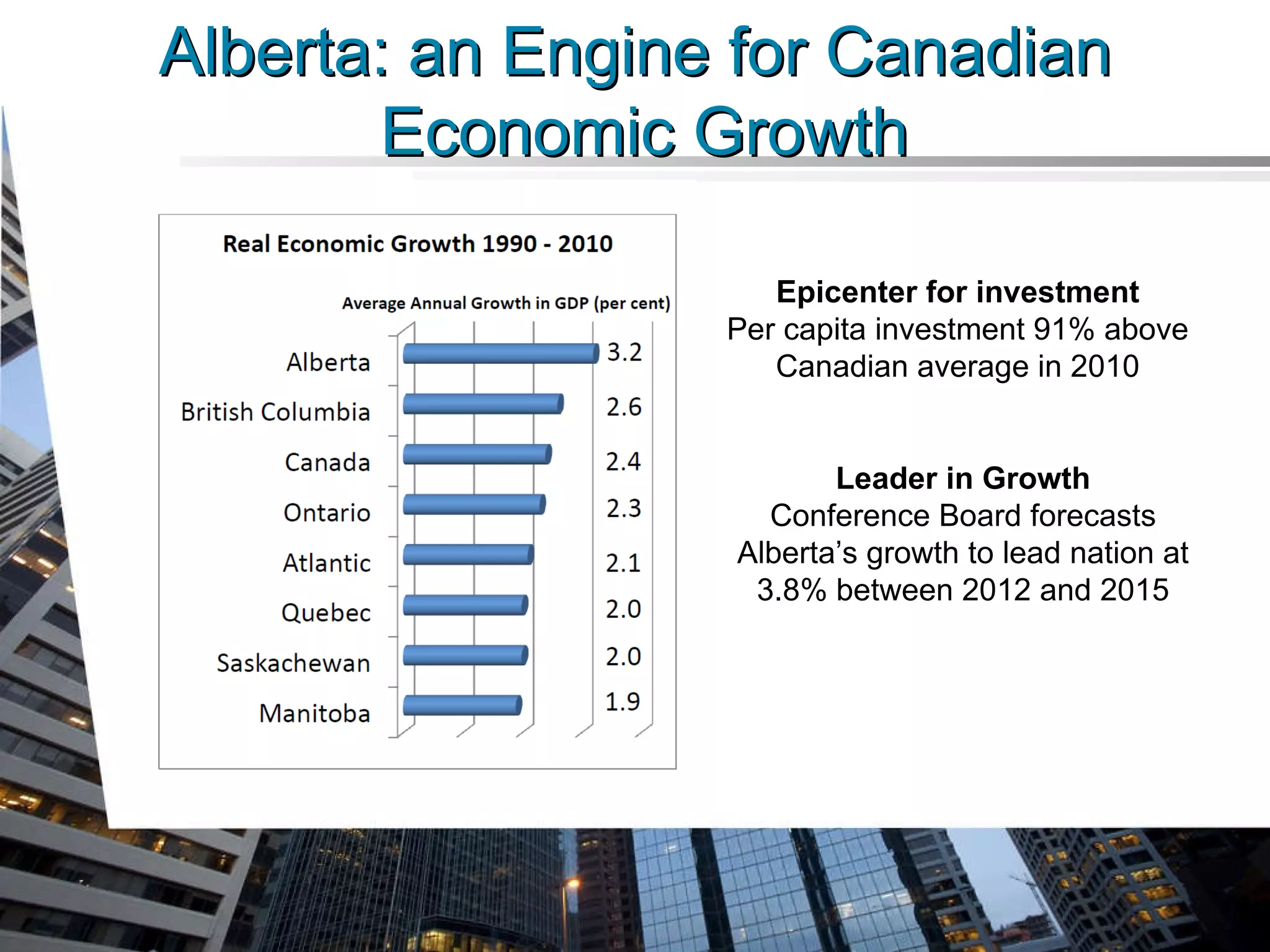
Alberta: an Engine for Canadian Economic Growth Epicenter for investment Per capita investment 91% above Canadian average in 2010 Leader in Growth Conference Board forecasts Alberta’s growth to lead nation at 3.8% between 2012 and 2015
An engine of  economic growth for Canada CERI estimates that over a 25 year period: Total GDP impact of oil sands investment and operations is estimated to be $2,106 billion for Canada, and $521 billion for the US.  The Canadian government will realize $311 billion in taxes. Key challenges that must be mitigated: labour supply, market access, and environmental management The Oil Sands
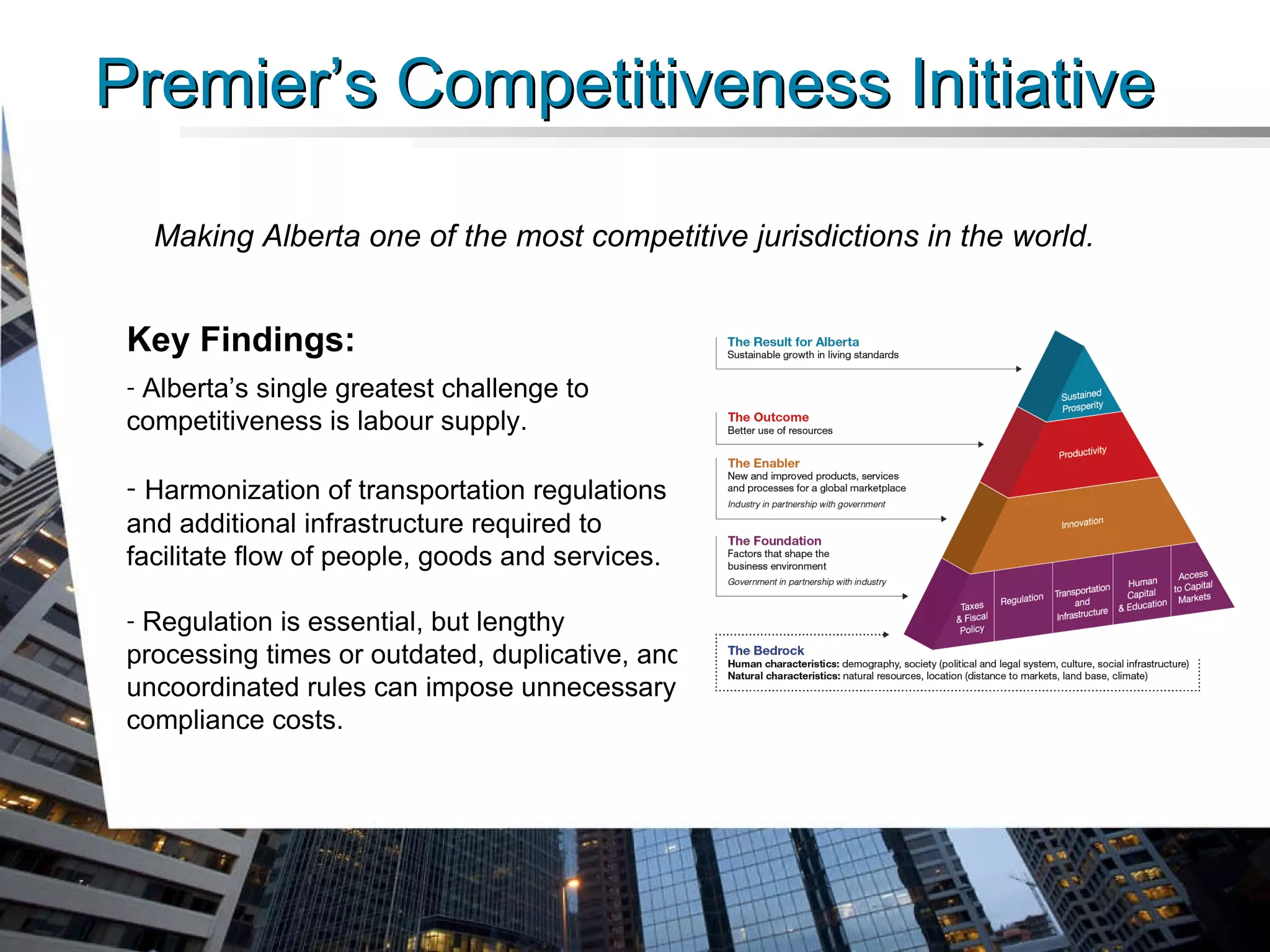
Premier’s Competitiveness Initiative Key Findings: Alberta’s single greatest challenge to  competitiveness is labour supply. Harmonization of  transportation regulations and additional infrastructure required to facilitate flow of people, goods and services. Regulation is essential, but lengthy processing times or outdated, duplicative, and uncoordinated rules can impose unnecessary compliance costs. Making Alberta one of the most competitive jurisdictions in the world.
Through a partnership approach we need to: Acquire more specific labour demand information Facilitate interprovincial/international mobility Collaborate on facilitative immigration policies (increased quotas, eligibility) Enhance foreign credential recognition Change business models (use technology to automate processes, support innovation) Improve productivity and training Labour Challenges
Productivity Alberta The Alberta government has developed and now launched this  not-for-profit corporation. Industry’s connection point to tools, resources, and services to help improve productivity and competitiveness.  Offer productivity assessment and improvement tools Work one-on-one with businesses to boost productivity through: Lean manufacturing Technology adoption Energy efficiency Best practice sharing
West Coast Petroleum Access West coast access one of the most critical industry development priorities to support market diversification in growing international markets Government intervening in support of Northern Gateway project at regulatory hearings 3 options to west coast access for petroleum products
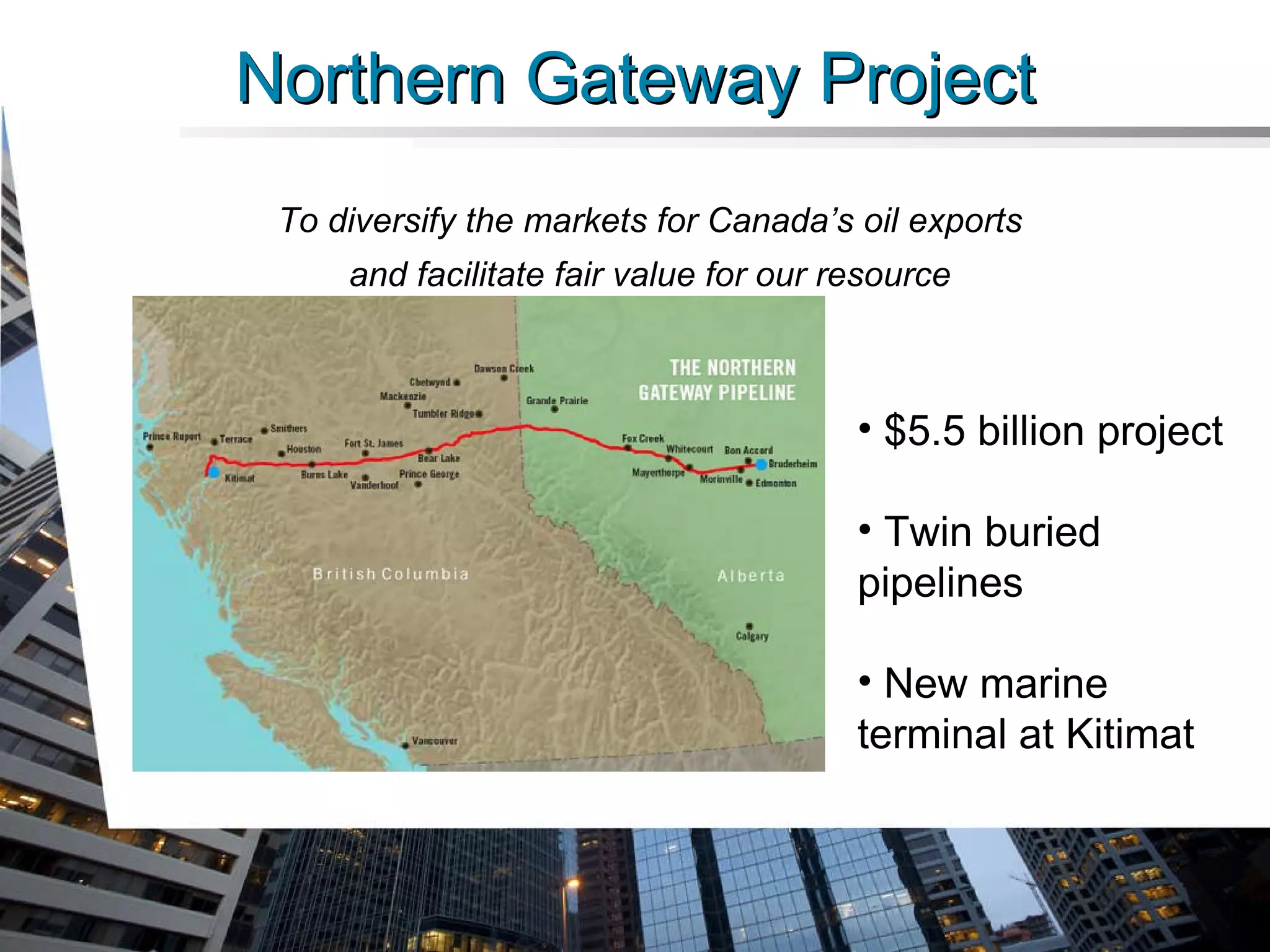
Northern Gateway Project $5.5 billion project Twin buried  pipelines New marine terminal at Kitimat To diversify the markets for Canada’s oil exports and facilitate fair value for our resource
Strategic Value of the Northern  Gateway Project to Canada Trade Export $1.3 billion per month of crude oil Import $600 million per month of condensate (to dilute the bitumen for transport) National Economic Benefits over Thirty Years $270 billion in Gross Domestic Product 558,000 person-years of employment Government revenue of $81 billion
West Coast Access Options Enbridge’s proposed Northern Gateway Project (Edmonton to Kitimat) Kinder Morgan (Edmonton to Vancouver) CN’s proposed “bitumen pipeline on rails” (Edmonton to Prince Rupert)
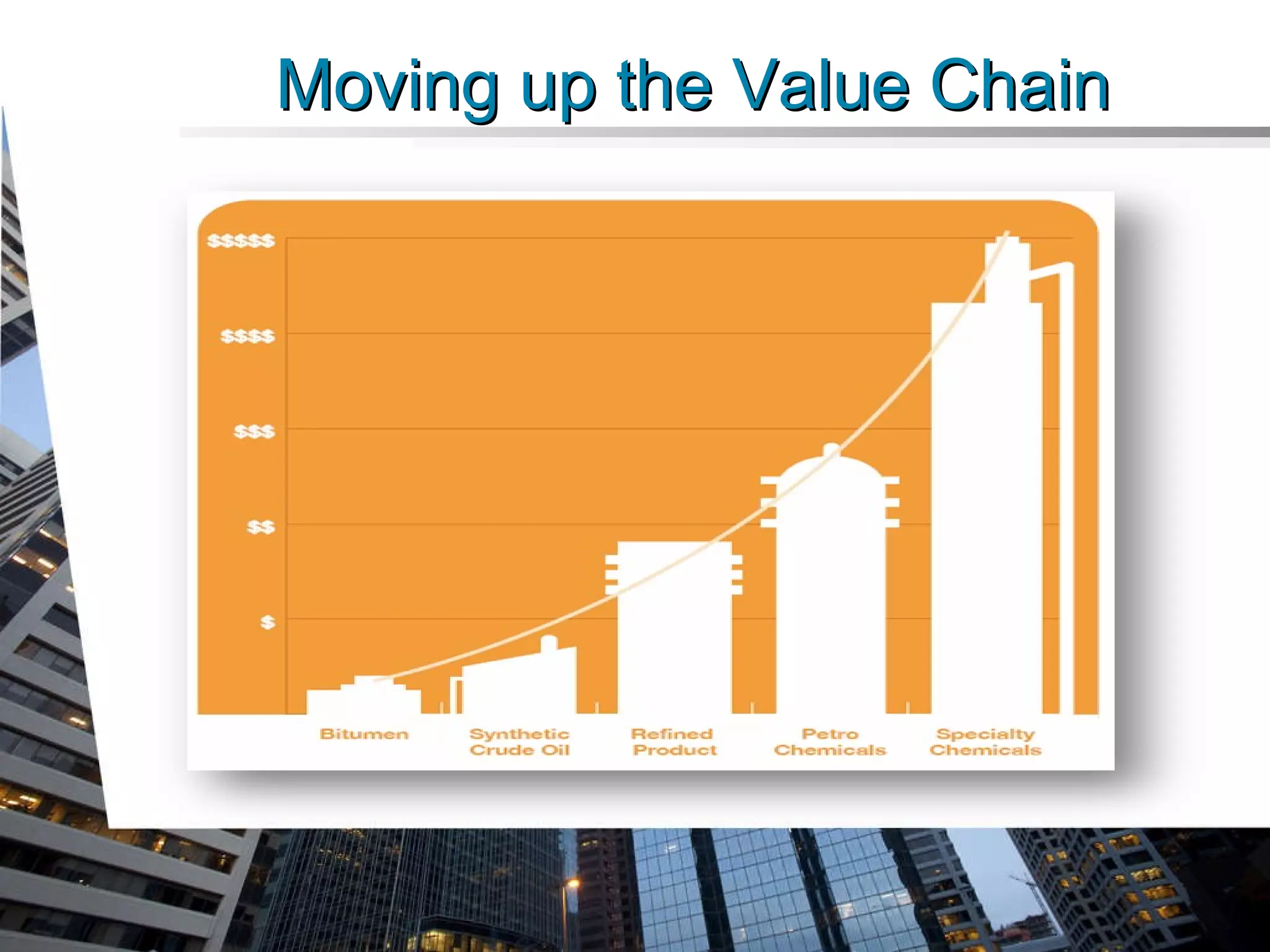
The Government of Alberta has made maximizing the value of our energy resources a priority Adding value to our resources and accessing new markets for our products creates additional wealth for the province and significant spin-off opportunities for: Alberta manufacturers  Industrial equipment and service sector  Engineering and construction industry Technology providers The benefits are not only economic, but build world-class expertise in best practices that can be marketed globally Value-add Opportunity
Moving up the Value Chain
Alberta’s products valued at over $10.2 billion in 2010 Over $10 billion invested in the industry between 1991 and 2010 Industry includes four ethane-cracking plants, including two of the worlds largest CHALLENGES Access to competitively priced feedstock Changing dynamic of Natural Gas industry in North America (Shale gas; LNG to West Coast) OPPORTUNITIES Demonstrate innovative technologies to convert hydrocarbon and renewables to higher valued products Policies and programs that provide greater certainty and drive planned investments Ensure competitive transportation through regulation (rail, pipelines) and facilitate a Western North American natural gas hub Petrochemical Value-add Potential
Government Initiatives to  Facilitate Value Added Bitumen Royalty In Kind (BRIK) Royalty credits for new ethane development Regulatory clarity intervention Western Canadian Natural Gas and NGL Market Hub Market Diversification (West Coast Access, LNG) New West Partnership (Alberta, British Columbia, Saskatchewan) Natural Gas Liquids Hub Inter-provincial Collaboration (Alberta/Ontario Partnership)
Architecture, Engineering and Construction $57 billion annual revenue $18 billion annual GDP contribution, approximately 10% of total AB economy  25,000 companies in the sector 264,000 employees   CHALLENGES  Skilled labour shortages/demographics Cycle of low to high investments drives up costs Knowledge of development and implementation of best practices  OPPORTUNITIES  Residential & commercial construction, large capital projects and a commitment by government to implement infrastructure projects will provide healthy growth for the sector in  the coming years. In the engineering field, service requirements in oil and gas, electricity, roads and bridges, pipelines, transit systems and petrochemicals are expected to be strong. The energy industry will remain one of the main driving forces of growth.
Aerospace and Defence $1.3 billion annual revenue 170 aerospace and aviation companies 6,000 employees Sector development guided by  A Vector to Diversity: Alberta’s Aerospace and Defence Strategy  Key initiatives include new market development, supply chain improvement and technology transfer  CHALLENGES Skilled labour supply, wage escalation Alberta’s lower profile as an aerospace centre OPPORTUNITIES Global Supply Chain Improvement Program: Connected to specifically improving unmanned vehicle systems and aerospace companies Space Research: Developing the industrial base to support the space science work being done in Alberta academia
Transportation and Logistics $20 billion annual revenue $9.8 billion annual GDP contribution to the Alberta economy 103,000 employees About 84% of all goods produced are shipped to the US, and 9% to Asia Pacific Pipelines are the major transportation mode accounting for approximately 65%, followed by rail at 24%, and road and air at 11% CHALLENGES Greater distances to major markets increase transportation costs Sufficient land surface, port and terminal capacity to meet Asia Pacific growth OPPORTUNITIES Heavy Module Corridor Movement: Expansion of the size of modules that Alberta manufacturers can build and ship in Alberta Asia Opportunities Report: Analyze long term potential for a number of Alberta’s key sectors in Asian markets Pipeline access to the West Coast for Alberta’s Oil Sands
Building Products $6.7 billion annual revenue and $2.6 billion annual GDP contribution 1,000 companies 30,000 employees CHALLENGES Decentralized fabrication, through BIM technology, opens the door to competitors from outside Alberta and/or Canada.  To take advantage of BIM, companies have to train their staff in this technology and make a significant investment in Computer Numerical Control (CNC) technology, which often comes at a high cost.  OPPORTUNITIES The Building Information Modeling Centre: An industry-led body that will make Alberta builders more productive through the expanded use of information technology in their construction practices.
Metal Fabrication  $10 billion annual revenue and $4 billion annual GDP contribution  1,700 metal manufacturing and fabrication firms 35,000 employees Approximately 55% of sales in Alberta, 15% in Canada, 30% international export Energy supply chains are primary customer CHALLENGES Skilled labour supply, wage escalation Low-cost jurisdictions now very active in supply chains OPPORTUNITIES Alberta Metal Fab Initiative: Programs to develop better productivity and technology practices for Alberta’s metal fabrication and manufacturing companies  Alberta Metal Manufacturers and Oil Sands Connection Initiative:  A forum for Alberta’s major metal fabrication industry associations to market their products and services to  project owners and buyers 
Financial Services $16.5 billion annual revenue $8 billion annual contribution to GDP 4,000 companies 70,000 employees $100 billion of financial assets managed annually CHALLENGES Skilled labour supply, wage escalation OPPORTUNITIES Development of the Alberta Financial Services Alliance Steering Committee Increase the sector’s global talent attraction/retention and international brand recognition
Environmental Products, Services and Alternative Energy $4.4 billion annual revenue 1,330 companies 28,000 employees CHALLENGES The environmental and alternative energy development mandate is spread over several ministries making it difficult for industry to bring forward issues and concerns to government. The perceived lack of clarity on cumulative effects and climate change management has limited industry’s investment in Alberta’s resource industries. OPPORTUNITIES Renewable Energy Strategy Development: Identification of Alberta’s competitive strengths and opportunities for further renewable energy Oil Sands Reclamation Strategies: Collaboration with industry to develop new technologies and processes 23
CONTACT INFO www.albertacanada.com

Idb review

  • 1.
    Alberta’s Competitiveness and Key Industry Sectors
  • 2.
    Enterprise Division Responsiblefor: Industry development Regional economic development Economic development policy Premier’s competitiveness initiative
  • 3.
    Alberta: an Enginefor Canadian Economic Growth Epicenter for investment Per capita investment 91% above Canadian average in 2010 Leader in Growth Conference Board forecasts Alberta’s growth to lead nation at 3.8% between 2012 and 2015
  • 4.
    An engine of economic growth for Canada CERI estimates that over a 25 year period: Total GDP impact of oil sands investment and operations is estimated to be $2,106 billion for Canada, and $521 billion for the US. The Canadian government will realize $311 billion in taxes. Key challenges that must be mitigated: labour supply, market access, and environmental management The Oil Sands
  • 5.
    Premier’s Competitiveness InitiativeKey Findings: Alberta’s single greatest challenge to competitiveness is labour supply. Harmonization of transportation regulations and additional infrastructure required to facilitate flow of people, goods and services. Regulation is essential, but lengthy processing times or outdated, duplicative, and uncoordinated rules can impose unnecessary compliance costs. Making Alberta one of the most competitive jurisdictions in the world.
  • 6.
    Through a partnershipapproach we need to: Acquire more specific labour demand information Facilitate interprovincial/international mobility Collaborate on facilitative immigration policies (increased quotas, eligibility) Enhance foreign credential recognition Change business models (use technology to automate processes, support innovation) Improve productivity and training Labour Challenges
  • 7.
    Productivity Alberta TheAlberta government has developed and now launched this not-for-profit corporation. Industry’s connection point to tools, resources, and services to help improve productivity and competitiveness. Offer productivity assessment and improvement tools Work one-on-one with businesses to boost productivity through: Lean manufacturing Technology adoption Energy efficiency Best practice sharing
  • 8.
    West Coast PetroleumAccess West coast access one of the most critical industry development priorities to support market diversification in growing international markets Government intervening in support of Northern Gateway project at regulatory hearings 3 options to west coast access for petroleum products
  • 9.
    Northern Gateway Project$5.5 billion project Twin buried pipelines New marine terminal at Kitimat To diversify the markets for Canada’s oil exports and facilitate fair value for our resource
  • 10.
    Strategic Value ofthe Northern Gateway Project to Canada Trade Export $1.3 billion per month of crude oil Import $600 million per month of condensate (to dilute the bitumen for transport) National Economic Benefits over Thirty Years $270 billion in Gross Domestic Product 558,000 person-years of employment Government revenue of $81 billion
  • 11.
    West Coast AccessOptions Enbridge’s proposed Northern Gateway Project (Edmonton to Kitimat) Kinder Morgan (Edmonton to Vancouver) CN’s proposed “bitumen pipeline on rails” (Edmonton to Prince Rupert)
  • 12.
    The Government ofAlberta has made maximizing the value of our energy resources a priority Adding value to our resources and accessing new markets for our products creates additional wealth for the province and significant spin-off opportunities for: Alberta manufacturers Industrial equipment and service sector Engineering and construction industry Technology providers The benefits are not only economic, but build world-class expertise in best practices that can be marketed globally Value-add Opportunity
  • 13.
    Moving up theValue Chain
  • 14.
    Alberta’s products valuedat over $10.2 billion in 2010 Over $10 billion invested in the industry between 1991 and 2010 Industry includes four ethane-cracking plants, including two of the worlds largest CHALLENGES Access to competitively priced feedstock Changing dynamic of Natural Gas industry in North America (Shale gas; LNG to West Coast) OPPORTUNITIES Demonstrate innovative technologies to convert hydrocarbon and renewables to higher valued products Policies and programs that provide greater certainty and drive planned investments Ensure competitive transportation through regulation (rail, pipelines) and facilitate a Western North American natural gas hub Petrochemical Value-add Potential
  • 15.
    Government Initiatives to Facilitate Value Added Bitumen Royalty In Kind (BRIK) Royalty credits for new ethane development Regulatory clarity intervention Western Canadian Natural Gas and NGL Market Hub Market Diversification (West Coast Access, LNG) New West Partnership (Alberta, British Columbia, Saskatchewan) Natural Gas Liquids Hub Inter-provincial Collaboration (Alberta/Ontario Partnership)
  • 16.
    Architecture, Engineering andConstruction $57 billion annual revenue $18 billion annual GDP contribution, approximately 10% of total AB economy 25,000 companies in the sector 264,000 employees CHALLENGES Skilled labour shortages/demographics Cycle of low to high investments drives up costs Knowledge of development and implementation of best practices OPPORTUNITIES Residential & commercial construction, large capital projects and a commitment by government to implement infrastructure projects will provide healthy growth for the sector in the coming years. In the engineering field, service requirements in oil and gas, electricity, roads and bridges, pipelines, transit systems and petrochemicals are expected to be strong. The energy industry will remain one of the main driving forces of growth.
  • 17.
    Aerospace and Defence$1.3 billion annual revenue 170 aerospace and aviation companies 6,000 employees Sector development guided by A Vector to Diversity: Alberta’s Aerospace and Defence Strategy Key initiatives include new market development, supply chain improvement and technology transfer CHALLENGES Skilled labour supply, wage escalation Alberta’s lower profile as an aerospace centre OPPORTUNITIES Global Supply Chain Improvement Program: Connected to specifically improving unmanned vehicle systems and aerospace companies Space Research: Developing the industrial base to support the space science work being done in Alberta academia
  • 18.
    Transportation and Logistics$20 billion annual revenue $9.8 billion annual GDP contribution to the Alberta economy 103,000 employees About 84% of all goods produced are shipped to the US, and 9% to Asia Pacific Pipelines are the major transportation mode accounting for approximately 65%, followed by rail at 24%, and road and air at 11% CHALLENGES Greater distances to major markets increase transportation costs Sufficient land surface, port and terminal capacity to meet Asia Pacific growth OPPORTUNITIES Heavy Module Corridor Movement: Expansion of the size of modules that Alberta manufacturers can build and ship in Alberta Asia Opportunities Report: Analyze long term potential for a number of Alberta’s key sectors in Asian markets Pipeline access to the West Coast for Alberta’s Oil Sands
  • 19.
    Building Products $6.7billion annual revenue and $2.6 billion annual GDP contribution 1,000 companies 30,000 employees CHALLENGES Decentralized fabrication, through BIM technology, opens the door to competitors from outside Alberta and/or Canada. To take advantage of BIM, companies have to train their staff in this technology and make a significant investment in Computer Numerical Control (CNC) technology, which often comes at a high cost. OPPORTUNITIES The Building Information Modeling Centre: An industry-led body that will make Alberta builders more productive through the expanded use of information technology in their construction practices.
  • 20.
    Metal Fabrication $10 billion annual revenue and $4 billion annual GDP contribution 1,700 metal manufacturing and fabrication firms 35,000 employees Approximately 55% of sales in Alberta, 15% in Canada, 30% international export Energy supply chains are primary customer CHALLENGES Skilled labour supply, wage escalation Low-cost jurisdictions now very active in supply chains OPPORTUNITIES Alberta Metal Fab Initiative: Programs to develop better productivity and technology practices for Alberta’s metal fabrication and manufacturing companies Alberta Metal Manufacturers and Oil Sands Connection Initiative: A forum for Alberta’s major metal fabrication industry associations to market their products and services to project owners and buyers 
  • 21.
    Financial Services $16.5billion annual revenue $8 billion annual contribution to GDP 4,000 companies 70,000 employees $100 billion of financial assets managed annually CHALLENGES Skilled labour supply, wage escalation OPPORTUNITIES Development of the Alberta Financial Services Alliance Steering Committee Increase the sector’s global talent attraction/retention and international brand recognition
  • 22.
    Environmental Products, Servicesand Alternative Energy $4.4 billion annual revenue 1,330 companies 28,000 employees CHALLENGES The environmental and alternative energy development mandate is spread over several ministries making it difficult for industry to bring forward issues and concerns to government. The perceived lack of clarity on cumulative effects and climate change management has limited industry’s investment in Alberta’s resource industries. OPPORTUNITIES Renewable Energy Strategy Development: Identification of Alberta’s competitive strengths and opportunities for further renewable energy Oil Sands Reclamation Strategies: Collaboration with industry to develop new technologies and processes 23
  • 23.

Editor's Notes

  • #10 Enbridge Northern Gateway Pipeline (Northern Gateway) is proposing to construct and operate a pipeline project to provide tidewater access to important new markets for Canadian crude oil. There are significant and lasting economic benefits from West Coast access for all Canadians Regulatory application submitted May 2010 Independent review process being led by the National Energy Board (NEB) and the Canadian Environmental Assessment Agency (CEAA) The Minister of the Environment and the NEB appointed three individuals to the Joint Review Panel for the Project application Information sessions will be held for the public and Aboriginal groups from June 6, 2011 to July 15, 2011 Final hearings are slated for summer 2012 The connection to the world that this pipeline provides should be part of our national vision for a prosperous future. This project will provide real long-term economic benefits to generations of Canadians. The Pipelines Oil Pipeline · 1,177 km in length · 914 mm (36 inch) diameter · Westerly flow · Transport oil from Bruderheim, Alberta to Kitimat, British Columbia · Capacity of 525,000 barrels per day Condensate Pipeline · 1,177 km in length · 508 mm (20 inch) diameter · Easterly flow · Transport imported condensate from Kitimat to Edmonton area
  • #11 The project would provide very strong strategic value to Canada. Foreign investments by Asian companies would likely increase with tide water access on Canada’s west coast. Currently __ Asian companies have invested $___ billion in the oil sands. The project will result in strong contributions to GDP and employment on a national scale over many years – decades in fact.
  • #12 The Northern Gateway Project is at a critical point to strengthen Canada’s position as a global energy producer If approval is granted in a timely manner, the project could theoretically be on stream by 2016. However, given the many barriers being erected to the project, the operational date could be pushed further into the future.
  • #15 Results of a feedstock study show that Alberta is well positioned: The largest supply will continue to be traditional gas based feedstocks, primarily ethane Off-gas supply potential is very large under scenarios where upgrading is favoured Syngas supply is constrained by cost, not feedstock availability Alberta’s gas price advantage supports methane-based projects (gas-to-liquids, methanol) that are building blocks for further downstream investments