Basic
Intensive
Care Unit
Equipment
(MT 6204)
TUTOR: ERICK KANYIKI (BMET)
MUST_2024
SUCTION
MACHINE
CONTENTS
▪ Introduction
▪ Uses of suction machine
▪ Parts of suction machine
▪ Working principle of suction machine
▪ Planned Preventive Maintenance (PPM)
▪ Troubleshooting and repair of suction machine
INTRODUCTION
▪ SUCTION
Is the production of partial vacuum by the removal of air so that the fluid
can flow into the region of partial vacuum (low pressure).
Examples of suction:
Sucking on a straw; we create a lower pressure inside our mouth, so the
water is pushed in from outside.
Vacuum cleaning; we create a lower pressure inside the vacuum cleaner,
so the air from outside rushes in to the region of lower pressure. Dust
being sucked into a vacuum cleaner is actually being pushed in by the
higher pressure air on the outside of the cleaner
NB: The higher pressure of the surrounding fluid can push matter into a
vacuum but a vacuum cannot attract matter.
▪ SUCTIONING
In medicine is a procedure that removes excess secretions from the
mouth and throat (oropharynx), from the nose and throat (nasopharnyx),
and from the windpipe (trachea) using a mechanical aspiration device
(Suction machine).
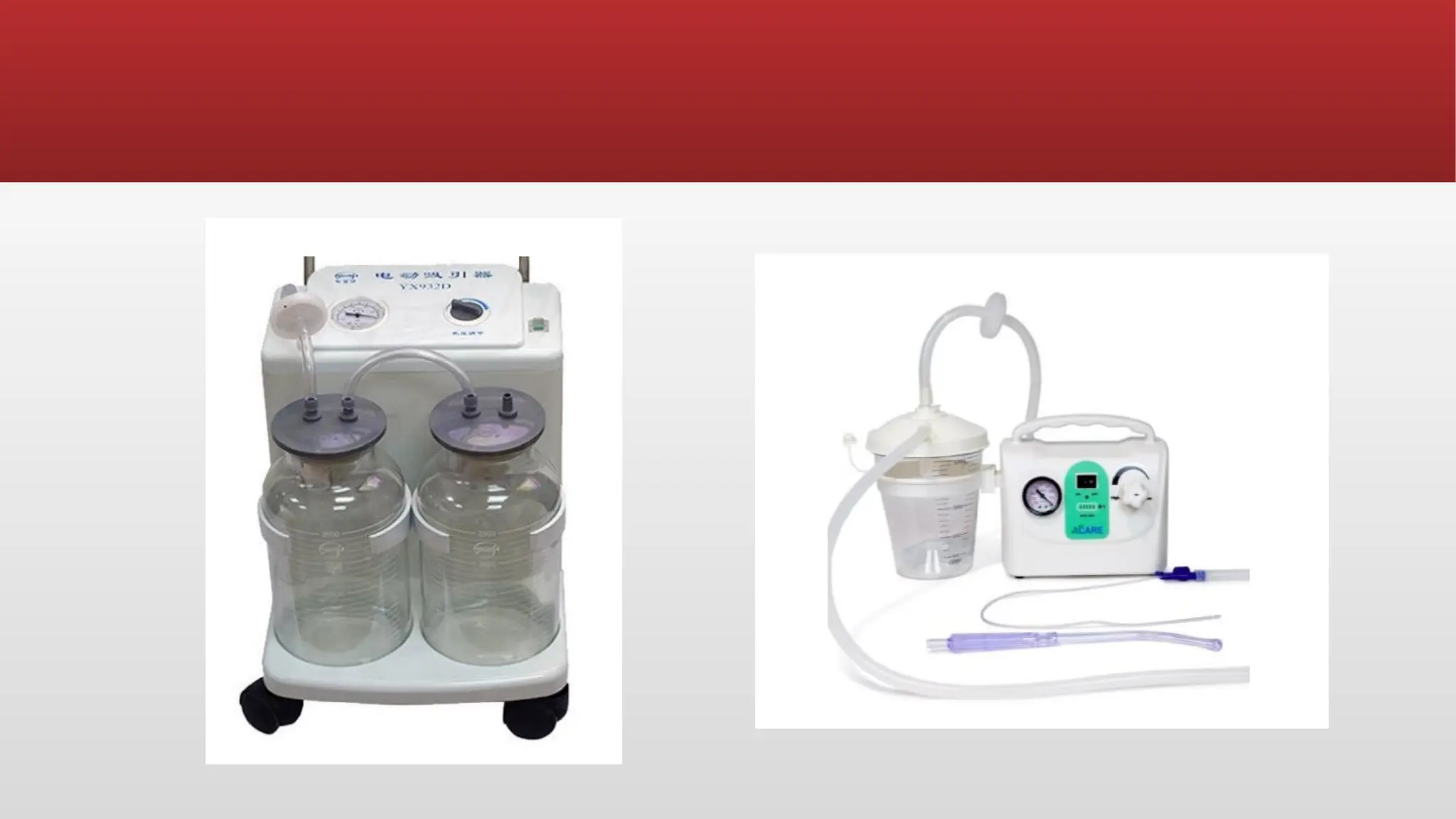
▪ SUCTION MACHINE
Is an device used to remove substances such as blood, saliva, mucus, and
vomit from a person's airway.
USES
▪ To prevent pulmonary aspiration (A condition in which foods, stomach
contents, or fluids are breathed into the lungs through the wind pipe)
▪ To assist patients with internal bleeding
▪ To remove excess fluid during dentistry
▪ To remove excess fluid during surgery
PARTS
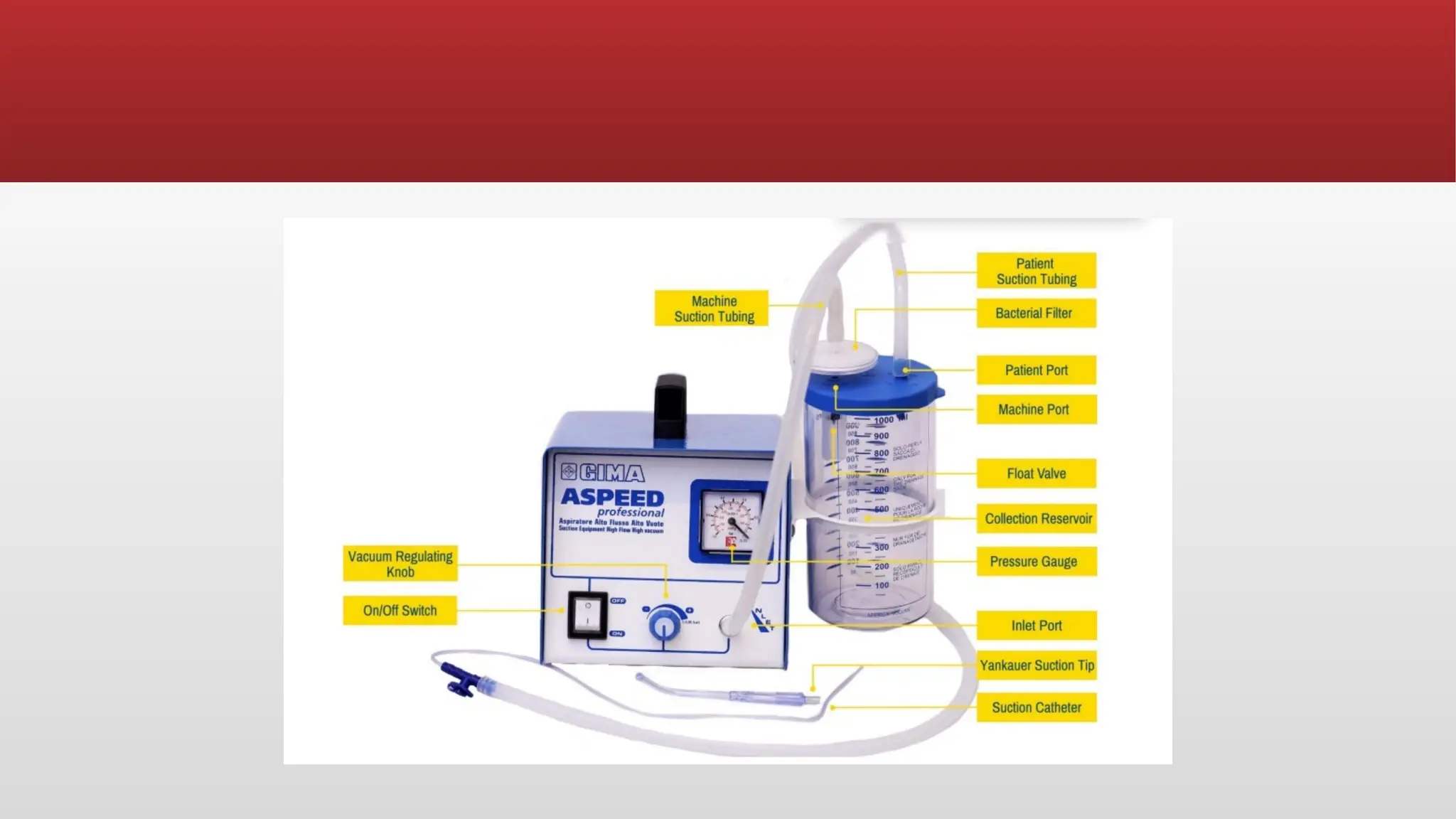
▪ BACTERIAL FILTER
Found between a collecting reservoir and the machine. It stops any bacteria or
pathogens from the suction fluids from penetrating into the pump and
eventually into the environment. Bacterial filters have a direction, which is
usually indicated on the filter. Always make sure it is fitted in the correct
orientation and location for effective filtration.
Some suction pumps have a secondary bacterial filter fitted internally in the
machine.
▪ COLLECTION RESERVOIR
Collects suctioned fluids. Its lid must be well sealed to the collection reservoir
to ensure the system retains vacuum and have an overflow float valve installed
to monitor fluid level.
▪ FLOAT VALVE
It is fitted in the collection reservoir to protect the machine and pump. Its function is to stop
suctioning when the collection reservoir is filled with fluids.
As the fluids are filling, it pushes the floater up until it closes the suction inlet port thereby
blocking vacuum at the catheter end.
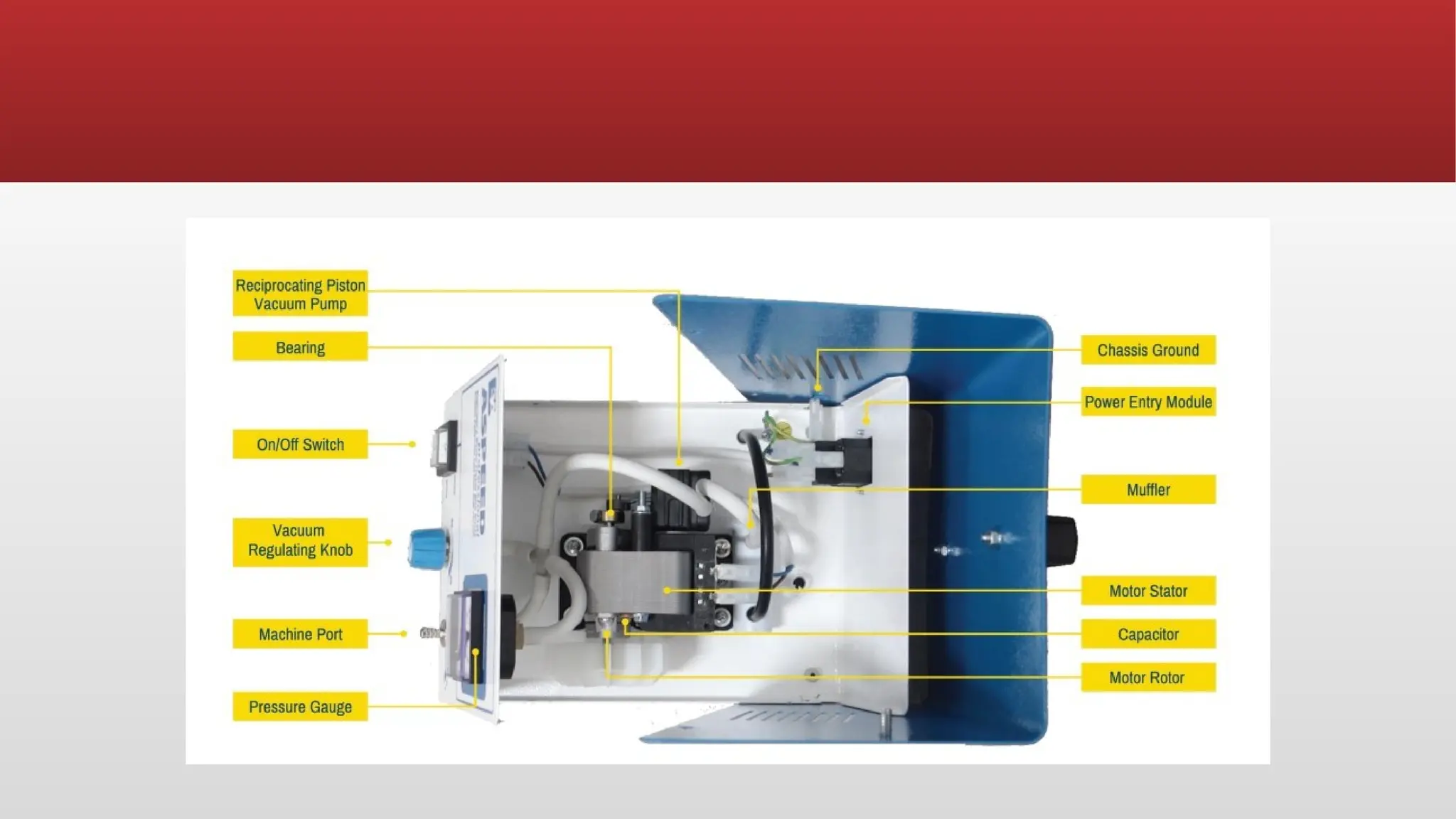
▪ VACUUM PUMP
Generates vacuum in the system. They are typically diaphragm and piston or vane pumps.
Diaphragm and piston vacuum pumps draw air through valves as the volume of the cylinder
changes continuously, creating a partial vacuum. The diaphragm or piston is driven by a
motor.
Vane vacuum pumps consist of a rotor mounted eccentrically and vanes that move radially
outwards under spring force as they rotate inside circular housing. Continuous vane rotation
creates the vacuum.
▪ VACUUM GAUGE/ PRESSURE GAUGE
Indicates the magnitude (strength) of suction set by the user using the
adjustment knob.
 VACUUM ADJUSTMENT KNOB
Regulates the amount of vacuum in the system.
NB: For neonates, the vacuum range is usually set between -60 to -100
mmHg.
▪ MUFFLER
Fitted at the exhaust side of the pump to reduce noise as the pump expels air
into the atmosphere.
▪ MOTOR
Drives the vacuum pump to generate suction. Electric motors may be
powered via AC or DC power.
DC motors are used in battery powered or rechargeable suction
machines. DC motors may pose a challenge to maintain because brushes
or commutators can wear out and they additionally require adaptors for
charging (AC mains power to DC).
AC motors are inductive and do not require brushes or a commutator.
They require a starting capacitor.
WORKING PRINCIPLE
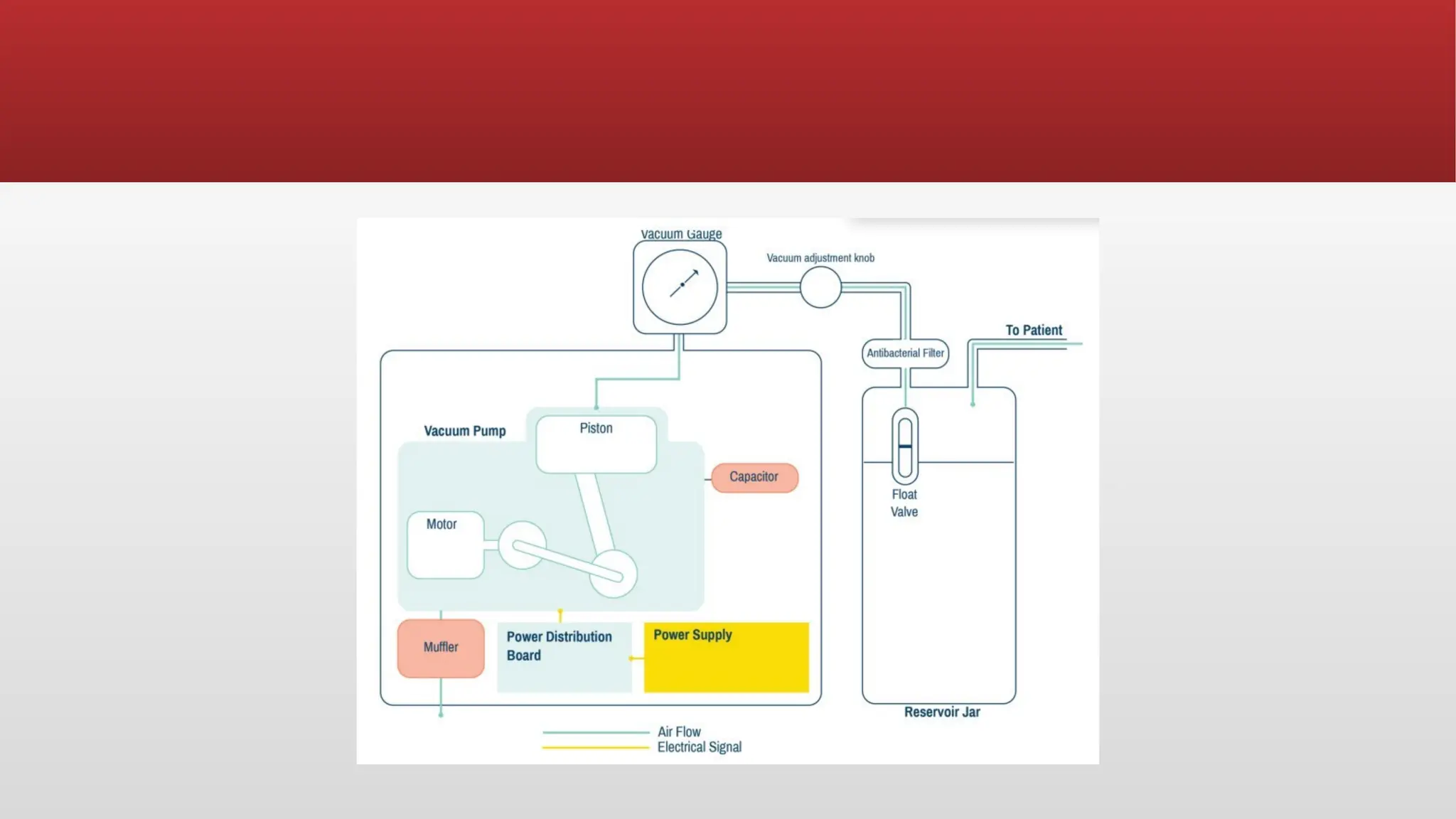
• Suction pumps use an internal pump driven by an electric motor or manually
by a foot operated pedal to create vacuum in a collection reservoir.
• Vacuum creates negative pressure inside the collection reservoir and draws
fluid from the patient via device tubing and suction catheter and into the
collection reservoir. The collection reservoir sits between the suction pump and
suction catheter.
• Inside the collection reservoir is an overflow float valve to prevent suction
fluids from entering the machine. An antibacterial filter is placed between the
collection reservoir and machine to prevent bacteria from entering into the
suction pump.
• When there is a leakage in the system, the atmospheric pressure will find a
shorter route to balance the pressure, preventing the device from suctioning
appropriately. Suction pumps can either be
PPM
▪ Turn off, unplug, empty the jar and disinfect the suction pump pressure
gauge controls and suction pump housing using gauze and 70% alcohol
after each use
▪ Check the bacterial filter for discoloration or other damage, test the
operation of the float valve. Turn on the suction pump and allow the
pump to run for 15 minutes every week.
▪ Use the suction regulator to test vacuum, observe pump’s functionality
every month
▪ Clean motor and motor brushes quarterly
▪ Confirm supply of spare bacterial filters, pump assemblies, vacuum
gauges, collection reservoirs and lids yearly.
TROUBLESHOOTING
The suction pump is not turning on.
Possible Cause:
• Faulty power supply
Components to Check:
• Power cable continuity
• Power switch physical integrity & continuity
• Power entry module fuse physical integrity & continuity
• Power supply unit continuity & voltage
The suction pump motor runs but the pump is not sucking
Possible Cause:
• Activated float valve or damaged collection reservoir
Components to Check:
• Float valve activation
• Suction regulator knob, collection reservoir and lid
• External and internal tubing physical integrity
The suction pump motor runs but the pump is not suctioning well.
Possible Cause:
• Damaged internal pump assembly or collection reservoir
Components to Check:
• Pump assembly and collection reservoir physical integrity
• External and internal tubing physical integrity
The suction pump makes noise outside of normal operational sound.
Probable Cause:
• Damaged internal pump assembly
Components to Check:
• Pump assembly and motor bearing physical integrity
• Muffler and cover/screws physical integrity
THE END
YOURS TRULLY

ICU-LECTURE 4- SUCTION MACHINE FOR KIDS SUPPORT.pptx

  • 1.
  • 2.
  • 3.
    CONTENTS ▪ Introduction ▪ Usesof suction machine ▪ Parts of suction machine ▪ Working principle of suction machine ▪ Planned Preventive Maintenance (PPM) ▪ Troubleshooting and repair of suction machine
  • 5.
  • 6.
    ▪ SUCTION Is theproduction of partial vacuum by the removal of air so that the fluid can flow into the region of partial vacuum (low pressure). Examples of suction: Sucking on a straw; we create a lower pressure inside our mouth, so the water is pushed in from outside. Vacuum cleaning; we create a lower pressure inside the vacuum cleaner, so the air from outside rushes in to the region of lower pressure. Dust being sucked into a vacuum cleaner is actually being pushed in by the higher pressure air on the outside of the cleaner
  • 7.
    NB: The higherpressure of the surrounding fluid can push matter into a vacuum but a vacuum cannot attract matter. ▪ SUCTIONING In medicine is a procedure that removes excess secretions from the mouth and throat (oropharynx), from the nose and throat (nasopharnyx), and from the windpipe (trachea) using a mechanical aspiration device (Suction machine). ▪ SUCTION MACHINE Is an device used to remove substances such as blood, saliva, mucus, and vomit from a person's airway.
  • 8.
  • 9.
    ▪ To preventpulmonary aspiration (A condition in which foods, stomach contents, or fluids are breathed into the lungs through the wind pipe) ▪ To assist patients with internal bleeding ▪ To remove excess fluid during dentistry ▪ To remove excess fluid during surgery
  • 11.
  • 15.
    ▪ BACTERIAL FILTER Foundbetween a collecting reservoir and the machine. It stops any bacteria or pathogens from the suction fluids from penetrating into the pump and eventually into the environment. Bacterial filters have a direction, which is usually indicated on the filter. Always make sure it is fitted in the correct orientation and location for effective filtration. Some suction pumps have a secondary bacterial filter fitted internally in the machine. ▪ COLLECTION RESERVOIR Collects suctioned fluids. Its lid must be well sealed to the collection reservoir to ensure the system retains vacuum and have an overflow float valve installed to monitor fluid level.
  • 16.
    ▪ FLOAT VALVE Itis fitted in the collection reservoir to protect the machine and pump. Its function is to stop suctioning when the collection reservoir is filled with fluids. As the fluids are filling, it pushes the floater up until it closes the suction inlet port thereby blocking vacuum at the catheter end. ▪ VACUUM PUMP Generates vacuum in the system. They are typically diaphragm and piston or vane pumps. Diaphragm and piston vacuum pumps draw air through valves as the volume of the cylinder changes continuously, creating a partial vacuum. The diaphragm or piston is driven by a motor. Vane vacuum pumps consist of a rotor mounted eccentrically and vanes that move radially outwards under spring force as they rotate inside circular housing. Continuous vane rotation creates the vacuum.
  • 17.
    ▪ VACUUM GAUGE/PRESSURE GAUGE Indicates the magnitude (strength) of suction set by the user using the adjustment knob.  VACUUM ADJUSTMENT KNOB Regulates the amount of vacuum in the system. NB: For neonates, the vacuum range is usually set between -60 to -100 mmHg. ▪ MUFFLER Fitted at the exhaust side of the pump to reduce noise as the pump expels air into the atmosphere.
  • 18.
    ▪ MOTOR Drives thevacuum pump to generate suction. Electric motors may be powered via AC or DC power. DC motors are used in battery powered or rechargeable suction machines. DC motors may pose a challenge to maintain because brushes or commutators can wear out and they additionally require adaptors for charging (AC mains power to DC). AC motors are inductive and do not require brushes or a commutator. They require a starting capacitor.
  • 19.
  • 20.
    • Suction pumpsuse an internal pump driven by an electric motor or manually by a foot operated pedal to create vacuum in a collection reservoir. • Vacuum creates negative pressure inside the collection reservoir and draws fluid from the patient via device tubing and suction catheter and into the collection reservoir. The collection reservoir sits between the suction pump and suction catheter. • Inside the collection reservoir is an overflow float valve to prevent suction fluids from entering the machine. An antibacterial filter is placed between the collection reservoir and machine to prevent bacteria from entering into the suction pump. • When there is a leakage in the system, the atmospheric pressure will find a shorter route to balance the pressure, preventing the device from suctioning appropriately. Suction pumps can either be

  • 21.
  • 22.
    ▪ Turn off,unplug, empty the jar and disinfect the suction pump pressure gauge controls and suction pump housing using gauze and 70% alcohol after each use ▪ Check the bacterial filter for discoloration or other damage, test the operation of the float valve. Turn on the suction pump and allow the pump to run for 15 minutes every week. ▪ Use the suction regulator to test vacuum, observe pump’s functionality every month ▪ Clean motor and motor brushes quarterly ▪ Confirm supply of spare bacterial filters, pump assemblies, vacuum gauges, collection reservoirs and lids yearly.
  • 23.
  • 24.
    The suction pumpis not turning on. Possible Cause: • Faulty power supply Components to Check: • Power cable continuity • Power switch physical integrity & continuity • Power entry module fuse physical integrity & continuity • Power supply unit continuity & voltage
  • 25.
    The suction pumpmotor runs but the pump is not sucking Possible Cause: • Activated float valve or damaged collection reservoir Components to Check: • Float valve activation • Suction regulator knob, collection reservoir and lid • External and internal tubing physical integrity
  • 26.
    The suction pumpmotor runs but the pump is not suctioning well. Possible Cause: • Damaged internal pump assembly or collection reservoir Components to Check: • Pump assembly and collection reservoir physical integrity • External and internal tubing physical integrity
  • 27.
    The suction pumpmakes noise outside of normal operational sound. Probable Cause: • Damaged internal pump assembly Components to Check: • Pump assembly and motor bearing physical integrity • Muffler and cover/screws physical integrity
  • 28.