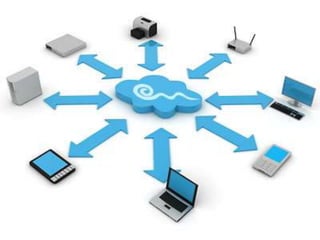
ICT is short for "Information and Communication
Technologies." It is similar to IT (Information
Technology), but focuses more
on telecommunications mediums, such as the Internet,
cell phone networks, and satellite technology. Modern
forms of ICT have made it possible for users across the
world to communicate with each other in real-time on a
regular basis. Examples include instant messaging,
video-conferencing, online multiplayer gaming,
and social networking websites.
WHAT IS ICT ?
Impact of ICT on Society:
Jobs
Education
Crime and policing
Retailing
Health
Money and banking
Communication
Business
More jobs:
Computer
manufacturers, delivery
drivers, call centre
employees, etc.
Skills:
Constant retraining
needed
More flexibility:
No longer jobs for
life
Working patterns:
More flexible
employment/working,
more part time
working
Telecommuting:
Working from
home
Jobs
New jobs:
Programmers, web
designers, ICT
teachers, etc.
Fewer jobs:
Filing clerks, shop
workers, postal
workers;
manual/repetitive jobs
replaced
Education
Teaching:
Interactive
whiteboards,
internet,
projectors
Records:
Details of all pupils
held on file,
reduces
administration
Reports:
Produced
electronically, e.g.
mail merge
Registration:
OMR registers,
scanned to update
central database,
produce absence
lists
Computer Aided
Learning:
On-screen
learning materials,
computer aided
assessment
Timetables:
Generated by
computer
Letters:
Mail merge not
typed on a
typewriter
Crime
and
Policing
Credit card:
Cloning – theft of
card details
Electronic fraud:
Stealing money
electronically
Hacking:
Unauthorised
access into
computers –
possibly to steal
money or data
Software Piracy:
Stealing software,
not paying for
licences
Viruses:
Programs designed
to corrupt a
computer system
Other:
Automatic number
plate recognition,
communication
systems
Police National
Computer:
Databases –
criminals, vehicles,
fingerprints, DNA,
stolen property,
HOLMES
National High
Tech Crime Unit:
NHTCU –
investigate
hacking, electronic
fraud, etc.
Retailing
Barcodes:
Unique identification
of all items, check
digit, used to search
the stock control
system
Loyalty Cards:
Identify customers
details, track
spending habits, offer
discounts, collected
data used for data
mining and targetting
customers
Internet Shopping:
Credit card payment,
buy from anywhere,
anytime. Issues –
p&p, returns,
security, trust, etc.
Stock Control:
Details of stock
quantities, prices,
restock limits
EFTPOS:
Credit/Debit card
details sent for
authorisation
EPOS:
Electronic Point Of
Sale – read barcode,
communicate with
stock control system,
total price, print
receipt, calculate
change
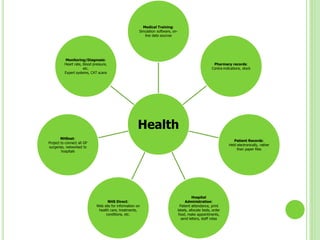
Health
Medical Training:
Simulation software, on-
line data sources
Pharmacy records:
Contra-indications, stock
Patient Records:
Held electronically, rather
than paper files
Hospital
Administration:
Patient attendance, print
labels, allocate beds, order
food, make appointments,
send letters, staff rotas
NHS Direct:
Web site for information on
health care, treatments,
conditions, etc.
NHSnet:
Project to connect all GP
surgeries, networked to
hospitals
Monitoring/Diagnosis:
Heart rate, blood pressure,
etc.
Expert systems, CAT scans
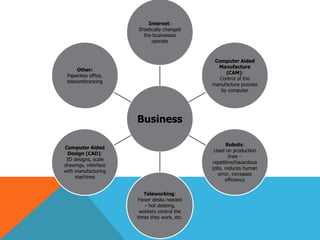
Business
Internet:
Drastically changed
the businesses
operate
Computer Aided
Manufacture
(CAM):
Control of the
manufacture process
by computer
Robots:
Used on production
lines –
repetitive/hazardous
jobs, reduces human
error, increases
efficiency
Teleworking:
Fewer desks needed
– hot desking,
workers control the
times they work, etc.
Computer Aided
Design (CAD):
3D designs, scale
drawings, interface
with manufacturing
machines
Other:
Paperless office,
teleconferencing
Money
and
Banking
Smart Cards:
Chip and Pin – data held
on a small silicon chip
rather than magnetic
stripe, customer enters
a pin rather than signs
receipt
Automated
Payments:
Bankers Automated
Clearing House (BACS) –
Credits, e.g. salary
payments, etc.; Debits,
e.g. direct debits, loan
payments, etc.
Cash Machines:
Automated Teller
Machine (ATM) – “hole
in the wall” access to
bank accounts
Credit/Debit Cards:
Magnetic stripe holds
the card details which
are read when swiped
EFT:
Credit/Debit card details
sent for authorisation,
from retailers or ATMs
Cheque Processing:
Cheques are scanned,
account numbers read
(MICR) to identify the
account
Home Banking:
Customers use the
internet or telephone to
administer their account
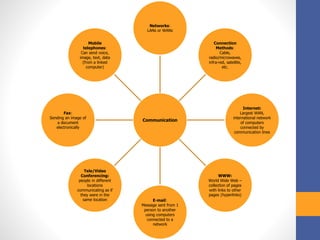
Communication
Networks:
LANs or WANs
Connection
Methods:
Cable,
radio/microwaves,
infra-red, satellite,
etc.
Internet:
Largest WAN,
international network
of computers
connected by
communication lines
WWW:
World Wide Web –
collection of pages
with links to other
pages (hyperlinks)
E-mail:
Message sent from 1
person to another
using computers
connected to a
network
Tele/Video
Conferencing:
people in different
locations
communicating as if
they were in the
same location
Fax:
Sending an image of
a document
electronically
Mobile
telephones:
Can send voice,
image, text, data
(from a linked
computer)
MADE BY :
Rimsha Iqbal
Naima Ashraf
Ict

Ict

  • 2.
    ICT is shortfor "Information and Communication Technologies." It is similar to IT (Information Technology), but focuses more on telecommunications mediums, such as the Internet, cell phone networks, and satellite technology. Modern forms of ICT have made it possible for users across the world to communicate with each other in real-time on a regular basis. Examples include instant messaging, video-conferencing, online multiplayer gaming, and social networking websites. WHAT IS ICT ?
  • 5.
    Impact of ICTon Society: Jobs Education Crime and policing Retailing Health Money and banking Communication Business
  • 6.
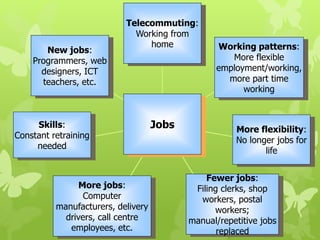
    More jobs: Computer manufacturers, delivery drivers,call centre employees, etc. Skills: Constant retraining needed More flexibility: No longer jobs for life Working patterns: More flexible employment/working, more part time working Telecommuting: Working from home Jobs New jobs: Programmers, web designers, ICT teachers, etc. Fewer jobs: Filing clerks, shop workers, postal workers; manual/repetitive jobs replaced
  • 7.
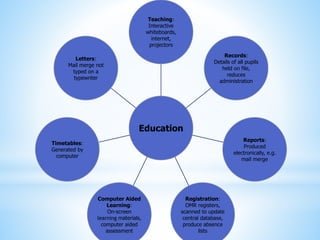
    Education Teaching: Interactive whiteboards, internet, projectors Records: Details of allpupils held on file, reduces administration Reports: Produced electronically, e.g. mail merge Registration: OMR registers, scanned to update central database, produce absence lists Computer Aided Learning: On-screen learning materials, computer aided assessment Timetables: Generated by computer Letters: Mail merge not typed on a typewriter
  • 8.
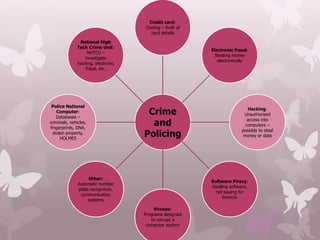
    Crime and Policing Credit card: Cloning –theft of card details Electronic fraud: Stealing money electronically Hacking: Unauthorised access into computers – possibly to steal money or data Software Piracy: Stealing software, not paying for licences Viruses: Programs designed to corrupt a computer system Other: Automatic number plate recognition, communication systems Police National Computer: Databases – criminals, vehicles, fingerprints, DNA, stolen property, HOLMES National High Tech Crime Unit: NHTCU – investigate hacking, electronic fraud, etc.
  • 9.
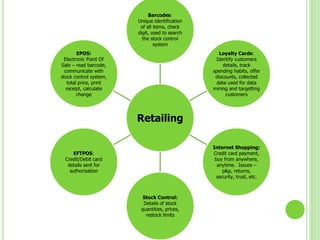
    Retailing Barcodes: Unique identification of allitems, check digit, used to search the stock control system Loyalty Cards: Identify customers details, track spending habits, offer discounts, collected data used for data mining and targetting customers Internet Shopping: Credit card payment, buy from anywhere, anytime. Issues – p&p, returns, security, trust, etc. Stock Control: Details of stock quantities, prices, restock limits EFTPOS: Credit/Debit card details sent for authorisation EPOS: Electronic Point Of Sale – read barcode, communicate with stock control system, total price, print receipt, calculate change
  • 10.
    Health Medical Training: Simulation software,on- line data sources Pharmacy records: Contra-indications, stock Patient Records: Held electronically, rather than paper files Hospital Administration: Patient attendance, print labels, allocate beds, order food, make appointments, send letters, staff rotas NHS Direct: Web site for information on health care, treatments, conditions, etc. NHSnet: Project to connect all GP surgeries, networked to hospitals Monitoring/Diagnosis: Heart rate, blood pressure, etc. Expert systems, CAT scans
  • 11.
    Business Internet: Drastically changed the businesses operate ComputerAided Manufacture (CAM): Control of the manufacture process by computer Robots: Used on production lines – repetitive/hazardous jobs, reduces human error, increases efficiency Teleworking: Fewer desks needed – hot desking, workers control the times they work, etc. Computer Aided Design (CAD): 3D designs, scale drawings, interface with manufacturing machines Other: Paperless office, teleconferencing
  • 12.
    Money and Banking Smart Cards: Chip andPin – data held on a small silicon chip rather than magnetic stripe, customer enters a pin rather than signs receipt Automated Payments: Bankers Automated Clearing House (BACS) – Credits, e.g. salary payments, etc.; Debits, e.g. direct debits, loan payments, etc. Cash Machines: Automated Teller Machine (ATM) – “hole in the wall” access to bank accounts Credit/Debit Cards: Magnetic stripe holds the card details which are read when swiped EFT: Credit/Debit card details sent for authorisation, from retailers or ATMs Cheque Processing: Cheques are scanned, account numbers read (MICR) to identify the account Home Banking: Customers use the internet or telephone to administer their account
  • 13.
    Communication Networks: LANs or WANs Connection Methods: Cable, radio/microwaves, infra-red,satellite, etc. Internet: Largest WAN, international network of computers connected by communication lines WWW: World Wide Web – collection of pages with links to other pages (hyperlinks) E-mail: Message sent from 1 person to another using computers connected to a network Tele/Video Conferencing: people in different locations communicating as if they were in the same location Fax: Sending an image of a document electronically Mobile telephones: Can send voice, image, text, data (from a linked computer)
  • 14.
    MADE BY : RimshaIqbal Naima Ashraf