

Willem G. Lagemaat
AI and its use in patent
drafting and searching
CONTENTS
• So what is Artificial Intelligence….?
• How the world is changing, examples of Hurricane Sandy
• AI and patents
• How about patent drafting?
• Legal questions
• AI in patent searching
• How will AI impact the life of the patent professional?
SO WHAT IS ARTIFICIAL INTELLIGENCE
Some definitions:
“Artificial Intelligence is the theory and development of computer systems able to
perform tasks normally requiring human intelligence, such as visual perception,
speech recognition, decision-making, and translation between languages”
“Artificial intelligence (AI, also machine intelligence, MI) is apparently intelligent
behaviour by machines, rather than the natural intelligence (NI) of humans and
other animals. In computer science AI research is defined as the study of "intelligent
agents": any device that perceives its environment and takes actions that maximize
its chance of success at some goal. Colloquially, the term "artificial intelligence" is
applied when a machine mimics "cognitive" functions that humans associate with
other human minds, such as "learning" and "problem solving".”
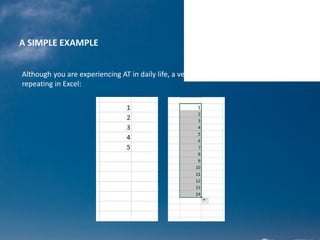
A SIMPLE EXAMPLE
Although you are experiencing AT in daily life, a very basis principle of learning and
repeating in Excel:
HOW THE WORLD IS CHANGING – Examples of hurricane Sandy
When hurricane Sandy hit New York, resulting into a major disruption of
infrastructure a number of large datacenters at the East Coast of the United States
were affected.
Example of IBM and Amazon
- Self awareness
- Decisions
- Consequences
AI AND PATENTS
The theory that could follow would be that AI would be able
Example of Google Patents
However, is this then still Intellectual Property? Or it this Intelligent Property?
HOW ABOUT PATENTDRAFTING
Over the recent years a number of new companies have come up that provide technology to
assist in patent drafting. Known solutions include the ability to validate claims, their
relationship and their coverage. However, new developments are appearing rapidly.
Recently TurboPatent introduced a product that analyses draft patent applications. This claims
that reviewing and proofreading patent drafts can be done much more efficient and that the
tool in its analyses provides comments in the sideline and proposes suggestions on how to
improve the document.
Another interesting development is made by Specifio. This startup claims it greatly reduces
drafting time by automating the process of writing the application. There the idea is that there
is still human creativity needed to draft the proper claims, but when the claims have been
created the creation of the matching application can be done largely automatically. Although
still human validation is required at the end, Specifio claims that 90% of the work can be done
by machines.
HOW ABOUT PATENTDRAFTING
Other applications are those available already today in the market place where one can apply
the text of a claim into a patent search product to identify other patent claims that might be
conflicting.
HOW ABOUT PATENTDRAFTING
AI can assist in assessment of comprehensive patentability
AI can identify potential existing patents (claims) that may conflict
AI can assist in creating better claim definition
THE LEGAL MARKET
A short side note on the legal market:
The legal market will be changed dramatically by AI
• Contracts (especially standard)
• Deeds
• Legal reviews
Resulting in reduction of fees and quicker turnaround times. However, that will require the
legal market for reinventing itself as the fee structures and current market acceptance will
change significantly.
LEGAL QUESTIONS
Who owns the patent?
• The software
• The machine
• The operator
• The owner of the machine
As such will the examination of patents have to change?
Will patent offices apply AI in examining patents?
Is Intellectual Property law applicable to automated (non human) inventions?
AI IN PATENT SEARCHING
• Many problems in AI can be solved in theory by intelligently searching through
many possible solutions: Reasoning can be reduced to performing a search. For
example, logical proof can be viewed as searching for a path that leads from
premises to conclusions, where each step is the application of an inference rule
Planning algorithms search through trees of goals and subgoals, attempting to
find a path to a target goal, a process called means-ends analysis. Robotics
algorithms for moving limbs and grasping objects use local searches in
configuration space. Many learning algorithms use search algorithms based on
optimization.
• Helping analysing of large volume datasets
• Clustering large quantities of unstructured records in “buckets”
• True semantic searching allows broader scope searching (bike, pedal etc)
• Language limitations potentially easier to conquer
• Use of AI in invalidation targeting
AI IN PATENT SEARCHING
• One of those wonderful statements:
– 30% of all patents worldwide are invalid due to existing prior art
– Example of US and JP examiners
• Use of AI in invalidation targeting
• Textual analyses of claims (Enlyton, PatSnap, Anaqua, Innography) and
identifying their landscape
HOW WILL AI IMPACT LIFE FOR THE PATENT PROFESSIONAL
Stepwise impact
Already happening today
Tipping point where human control changes into machine control
A LAST NOTE…
We always overestimate the change that will occur in the next
two years and underestimate the change that will occur in the
next ten. Don’t let yourself be lulled into inaction.
Bill Gates
QUESTIONS
?

ICIC 2017:

  • 1.
    Willem G. Lagemaat AIand its use in patent drafting and searching
  • 2.
    CONTENTS • So whatis Artificial Intelligence….? • How the world is changing, examples of Hurricane Sandy • AI and patents • How about patent drafting? • Legal questions • AI in patent searching • How will AI impact the life of the patent professional?
  • 3.
    SO WHAT ISARTIFICIAL INTELLIGENCE Some definitions: “Artificial Intelligence is the theory and development of computer systems able to perform tasks normally requiring human intelligence, such as visual perception, speech recognition, decision-making, and translation between languages” “Artificial intelligence (AI, also machine intelligence, MI) is apparently intelligent behaviour by machines, rather than the natural intelligence (NI) of humans and other animals. In computer science AI research is defined as the study of "intelligent agents": any device that perceives its environment and takes actions that maximize its chance of success at some goal. Colloquially, the term "artificial intelligence" is applied when a machine mimics "cognitive" functions that humans associate with other human minds, such as "learning" and "problem solving".”
  • 4.
    A SIMPLE EXAMPLE Althoughyou are experiencing AT in daily life, a very basis principle of learning and repeating in Excel:
  • 5.
    HOW THE WORLDIS CHANGING – Examples of hurricane Sandy When hurricane Sandy hit New York, resulting into a major disruption of infrastructure a number of large datacenters at the East Coast of the United States were affected. Example of IBM and Amazon - Self awareness - Decisions - Consequences
  • 6.
    AI AND PATENTS Thetheory that could follow would be that AI would be able Example of Google Patents However, is this then still Intellectual Property? Or it this Intelligent Property?
  • 7.
    HOW ABOUT PATENTDRAFTING Overthe recent years a number of new companies have come up that provide technology to assist in patent drafting. Known solutions include the ability to validate claims, their relationship and their coverage. However, new developments are appearing rapidly. Recently TurboPatent introduced a product that analyses draft patent applications. This claims that reviewing and proofreading patent drafts can be done much more efficient and that the tool in its analyses provides comments in the sideline and proposes suggestions on how to improve the document. Another interesting development is made by Specifio. This startup claims it greatly reduces drafting time by automating the process of writing the application. There the idea is that there is still human creativity needed to draft the proper claims, but when the claims have been created the creation of the matching application can be done largely automatically. Although still human validation is required at the end, Specifio claims that 90% of the work can be done by machines.
  • 8.
    HOW ABOUT PATENTDRAFTING Otherapplications are those available already today in the market place where one can apply the text of a claim into a patent search product to identify other patent claims that might be conflicting.
  • 9.
    HOW ABOUT PATENTDRAFTING AIcan assist in assessment of comprehensive patentability AI can identify potential existing patents (claims) that may conflict AI can assist in creating better claim definition
  • 10.
    THE LEGAL MARKET Ashort side note on the legal market: The legal market will be changed dramatically by AI • Contracts (especially standard) • Deeds • Legal reviews Resulting in reduction of fees and quicker turnaround times. However, that will require the legal market for reinventing itself as the fee structures and current market acceptance will change significantly.
  • 11.
    LEGAL QUESTIONS Who ownsthe patent? • The software • The machine • The operator • The owner of the machine As such will the examination of patents have to change? Will patent offices apply AI in examining patents? Is Intellectual Property law applicable to automated (non human) inventions?
  • 12.
    AI IN PATENTSEARCHING • Many problems in AI can be solved in theory by intelligently searching through many possible solutions: Reasoning can be reduced to performing a search. For example, logical proof can be viewed as searching for a path that leads from premises to conclusions, where each step is the application of an inference rule Planning algorithms search through trees of goals and subgoals, attempting to find a path to a target goal, a process called means-ends analysis. Robotics algorithms for moving limbs and grasping objects use local searches in configuration space. Many learning algorithms use search algorithms based on optimization. • Helping analysing of large volume datasets • Clustering large quantities of unstructured records in “buckets” • True semantic searching allows broader scope searching (bike, pedal etc) • Language limitations potentially easier to conquer • Use of AI in invalidation targeting
  • 13.
    AI IN PATENTSEARCHING • One of those wonderful statements: – 30% of all patents worldwide are invalid due to existing prior art – Example of US and JP examiners • Use of AI in invalidation targeting • Textual analyses of claims (Enlyton, PatSnap, Anaqua, Innography) and identifying their landscape
  • 14.
    HOW WILL AIIMPACT LIFE FOR THE PATENT PROFESSIONAL Stepwise impact Already happening today Tipping point where human control changes into machine control
  • 15.
    A LAST NOTE… Wealways overestimate the change that will occur in the next two years and underestimate the change that will occur in the next ten. Don’t let yourself be lulled into inaction. Bill Gates
  • 16.