General Data Protection
Regulation (GDPR)
Abdulla Fatiya
Learning objectives
 What is personal data?
 What are the consequences?
 Data protection principles and rights
 Our company’s data protection policy
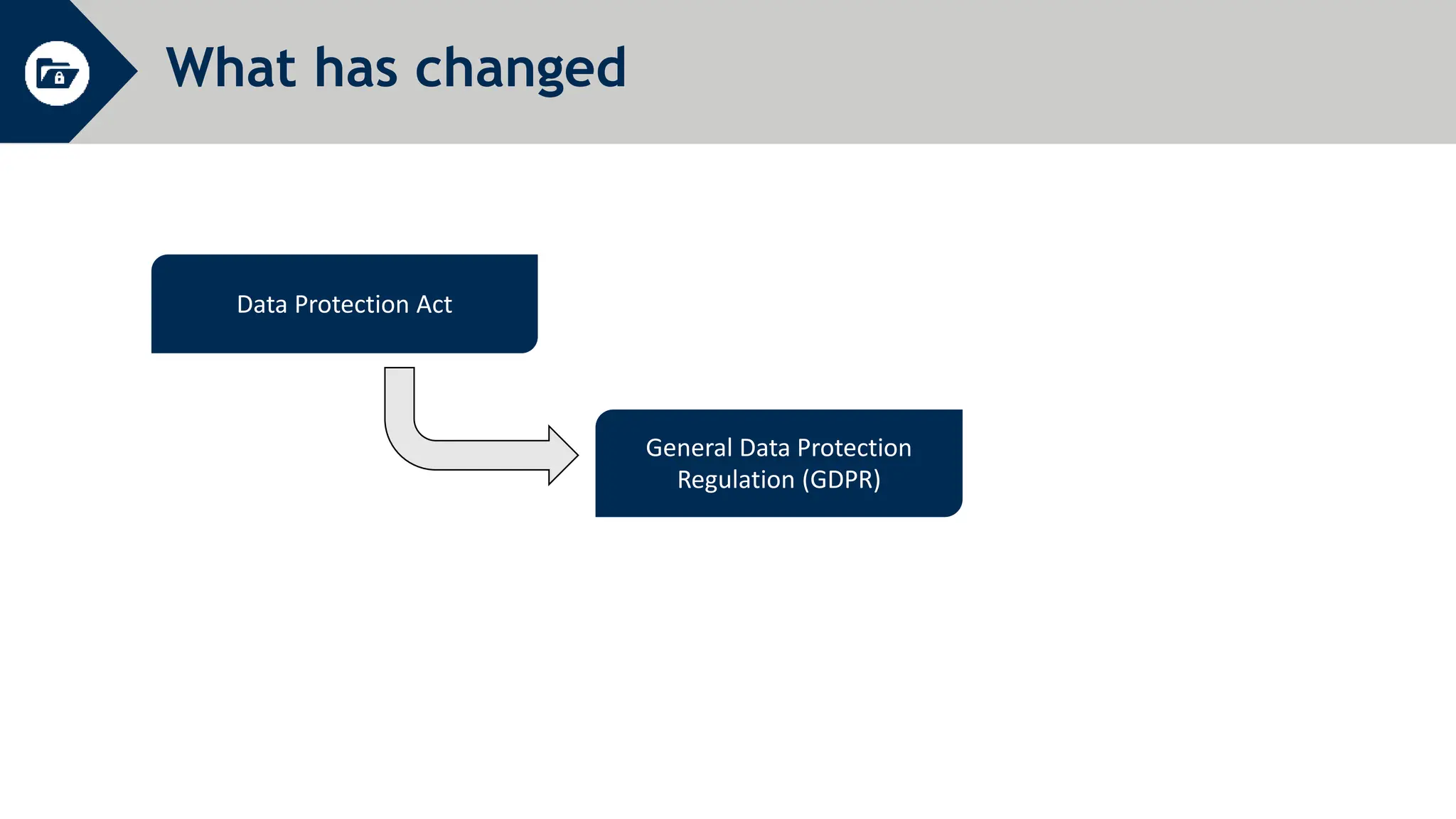
What has changed
Data Protection Act
General Data Protection
Regulation (GDPR)
What is personal data?
 “... information relating to a living individual who can be
identified from that data...”
 “…it may include expressions of opinion…”
 “…held in manual or electronic systems…”
 ICO guidance
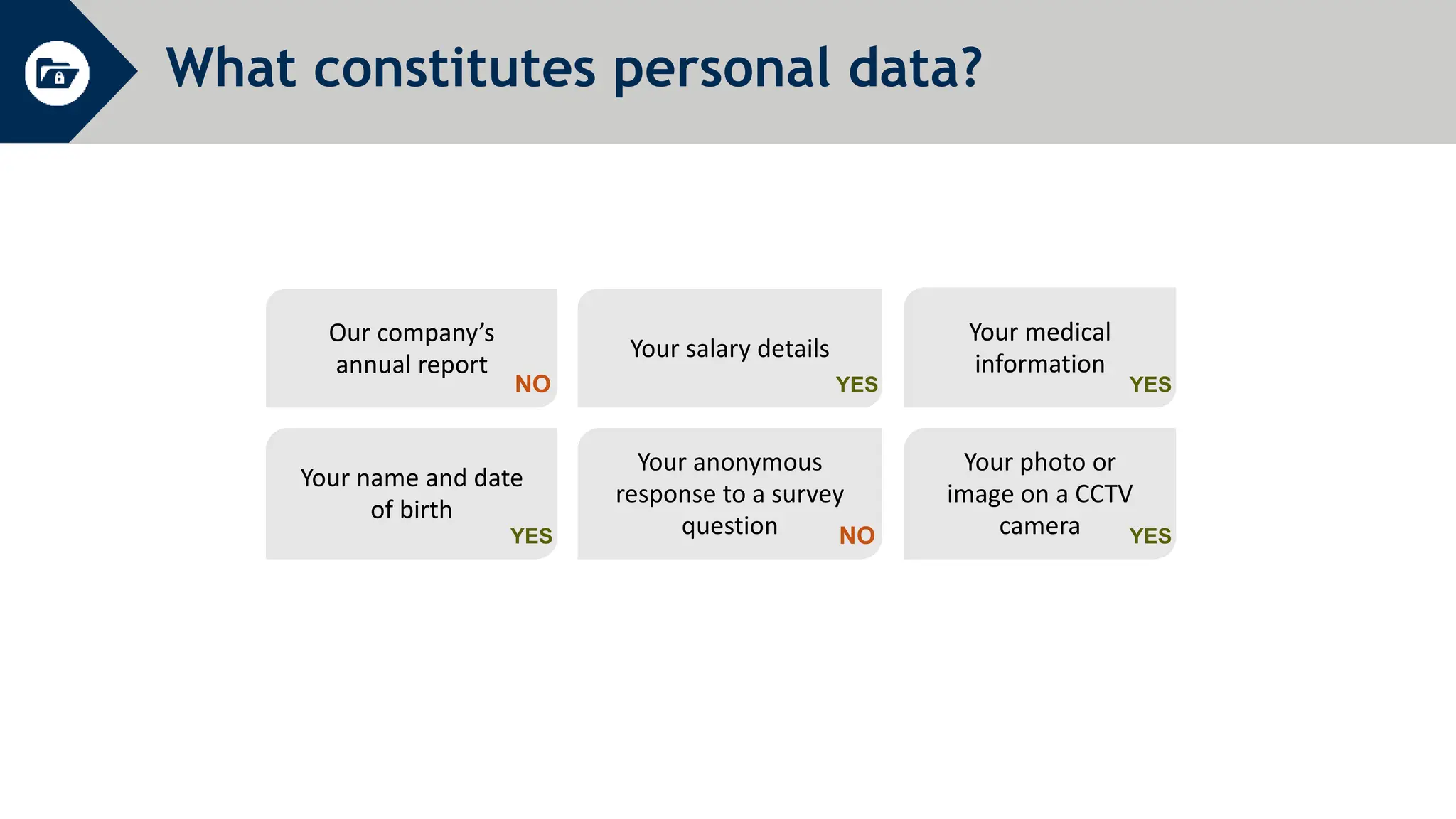
What constitutes personal data?
Our company’s
annual report
Your salary details
Your medical
information
Your name and date
of birth
Your anonymous
response to a survey
question
Your photo or
image on a CCTV
camera
NO YES YES
YES NO YES
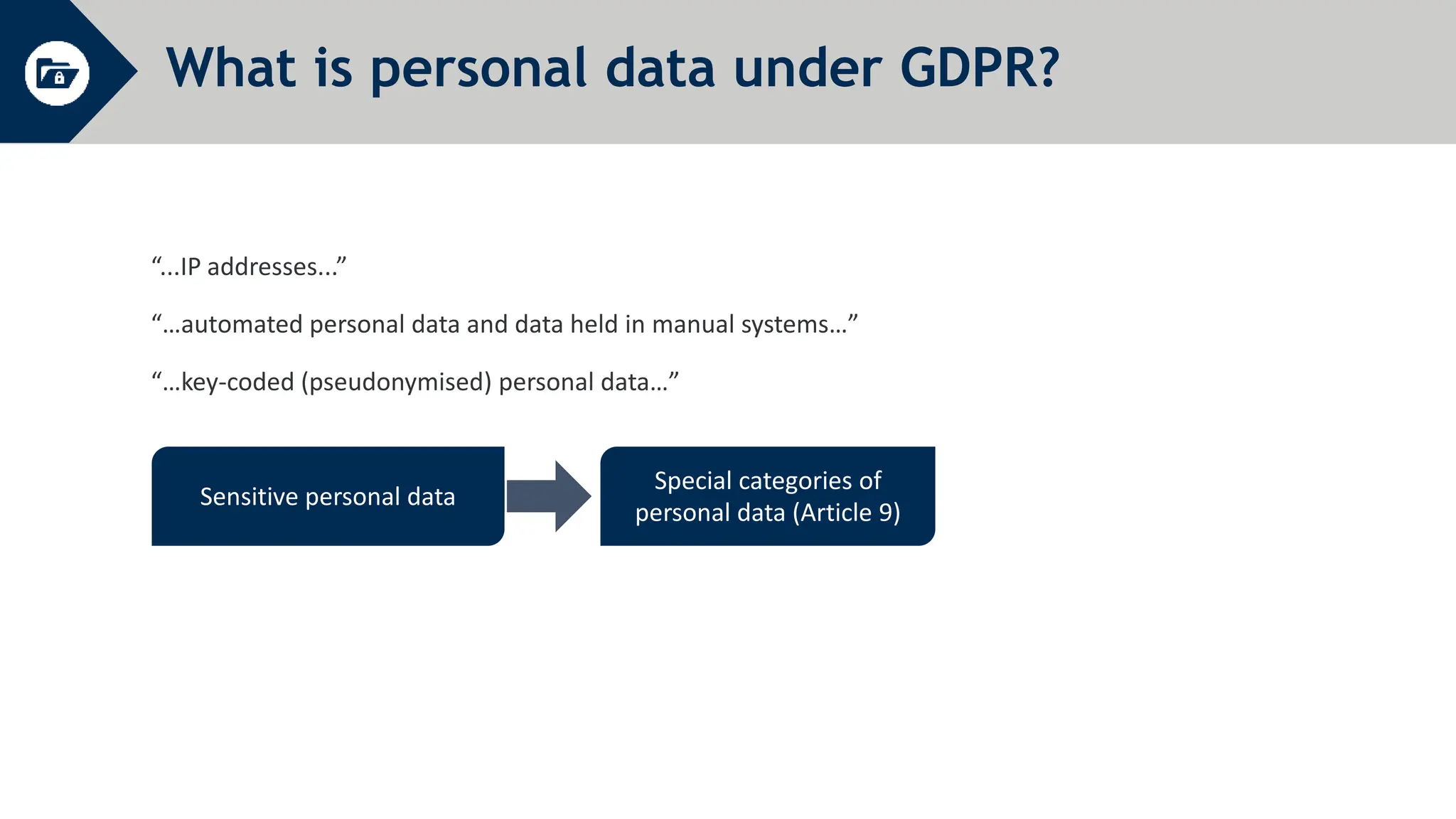
What is personal data under GDPR?
“...IP addresses...”
“…automated personal data and data held in manual systems…”
“…key-coded (pseudonymised) personal data…”
Sensitive personal data
Special categories of
personal data (Article 9)
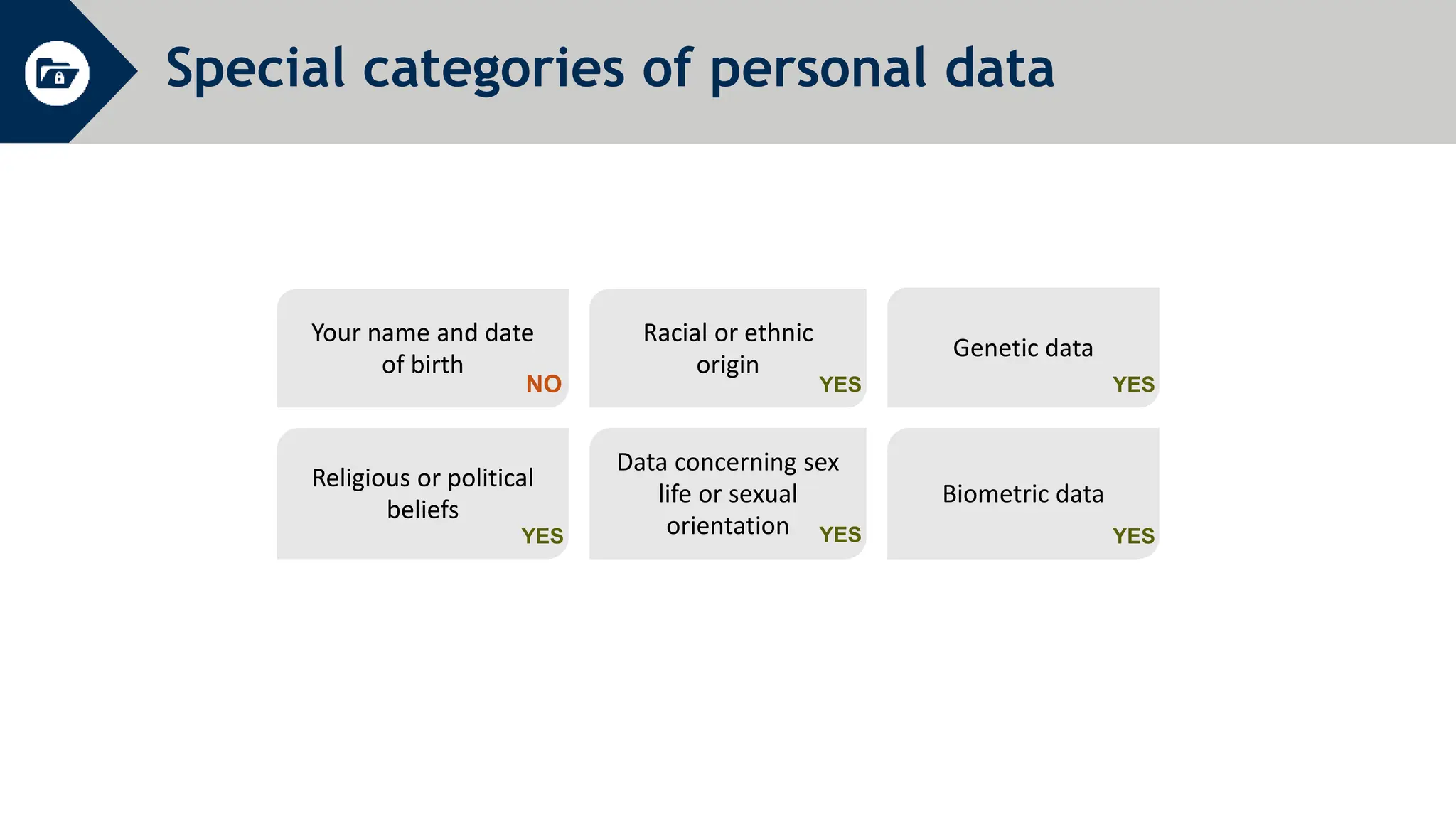
Special categories of personal data
Your name and date
of birth
Racial or ethnic
origin
Genetic data
Religious or political
beliefs
Data concerning sex
life or sexual
orientation
Biometric data
NO YES YES
YES YES
YES
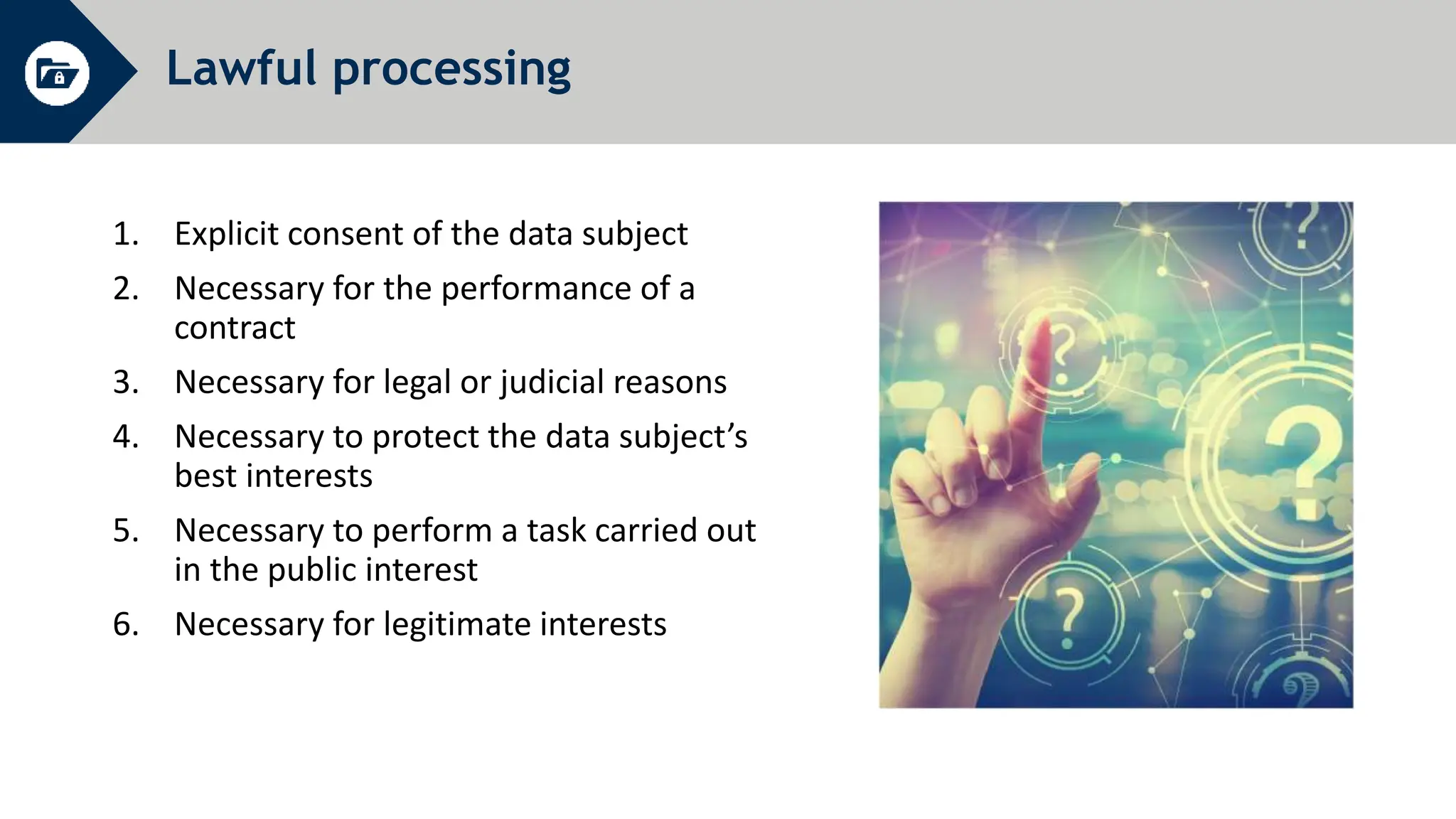
Lawful processing
1. Explicit consent of the data subject
2. Necessary for the performance of a
contract
3. Necessary for legal or judicial reasons
4. Necessary to protect the data subject’s
best interests
5. Necessary to perform a task carried out
in the public interest
6. Necessary for legitimate interests
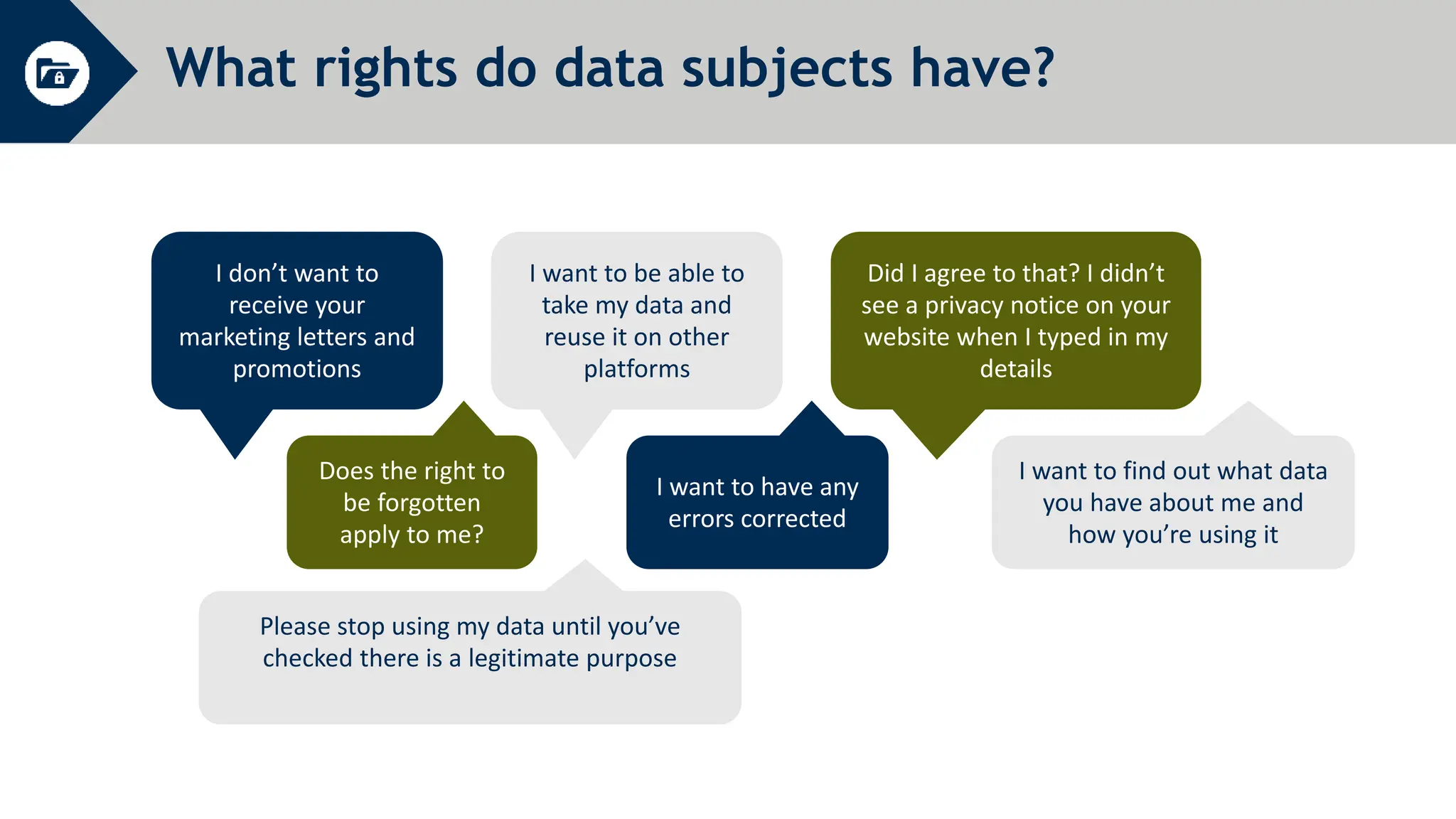
What rights do data subjects have?
I don’t want to
receive your
marketing letters and
promotions
I want to be able to
take my data and
reuse it on other
platforms
Did I agree to that? I didn’t
see a privacy notice on your
website when I typed in my
details
Does the right to
be forgotten
apply to me?
I want to have any
errors corrected
I want to find out what data
you have about me and
how you’re using it
Please stop using my data until you’ve
checked there is a legitimate purpose
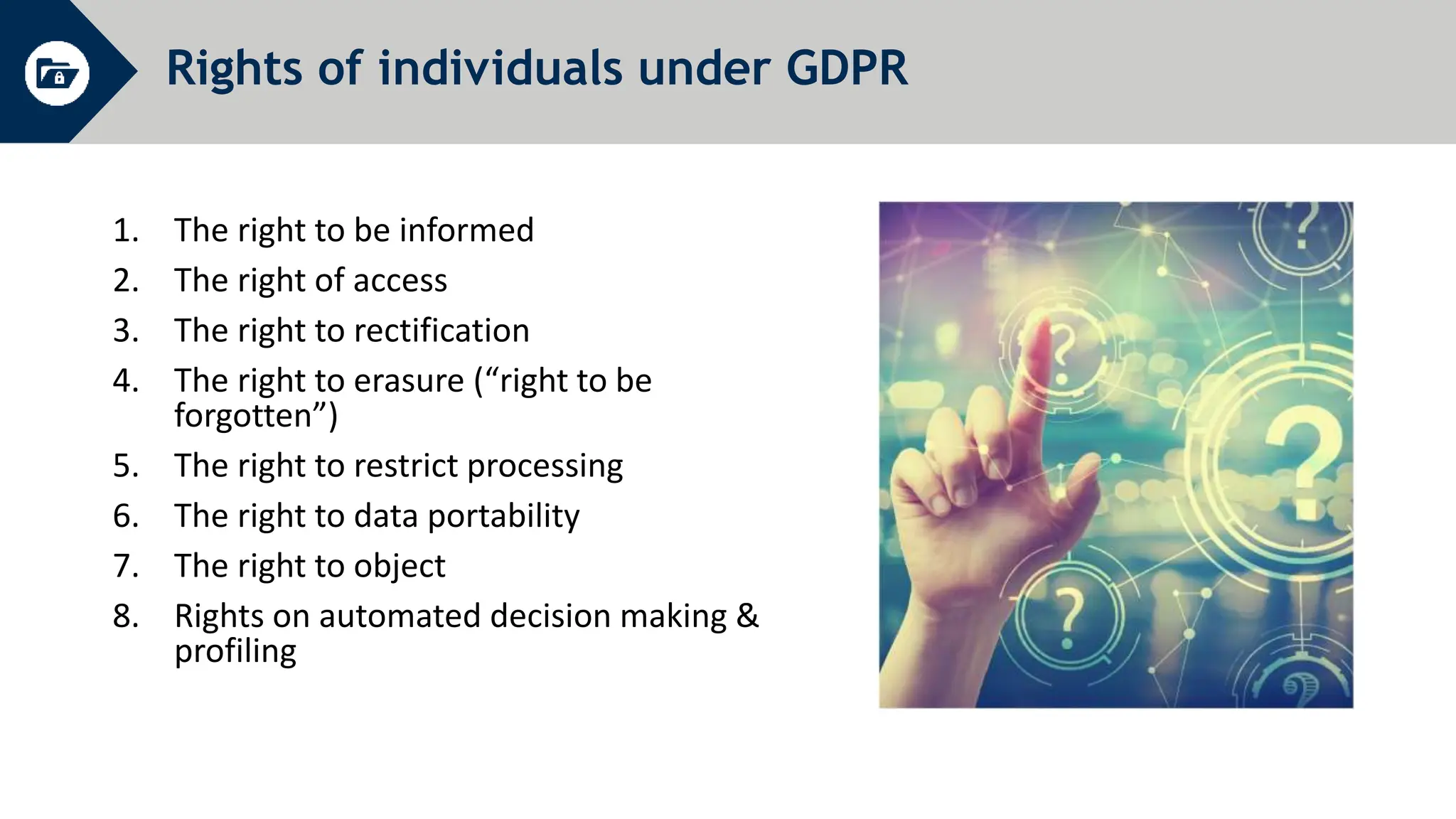
Rights of individuals under GDPR
1. The right to be informed
2. The right of access
3. The right to rectification
4. The right to erasure (“right to be
forgotten”)
5. The right to restrict processing
6. The right to data portability
7. The right to object
8. Rights on automated decision making &
profiling
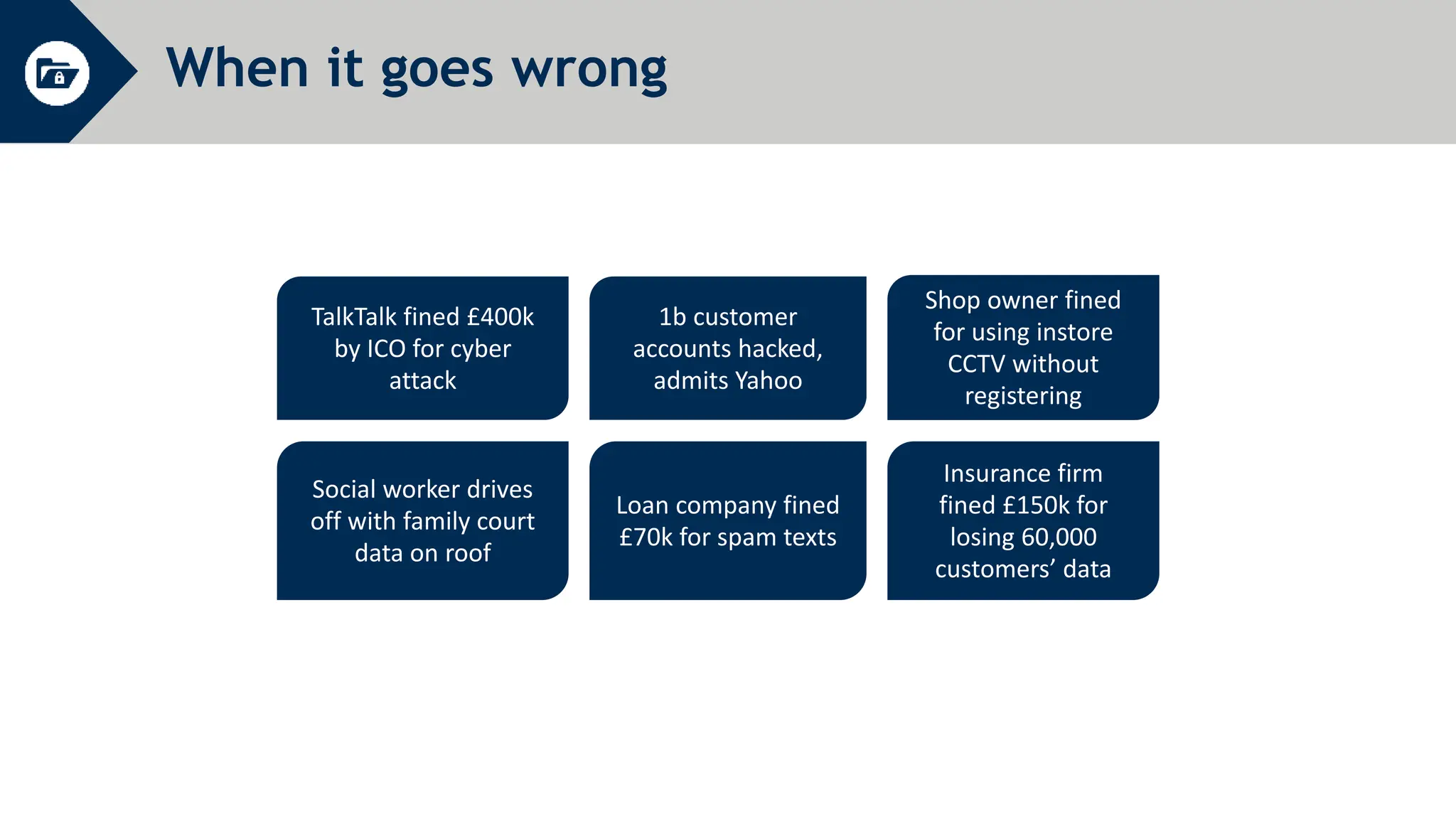
When it goes wrong
TalkTalk fined £400k
by ICO for cyber
attack
1b customer
accounts hacked,
admits Yahoo
Shop owner fined
for using instore
CCTV without
registering
Social worker drives
off with family court
data on roof
Loan company fined
£70k for spam texts
Insurance firm
fined £150k for
losing 60,000
customers’ data
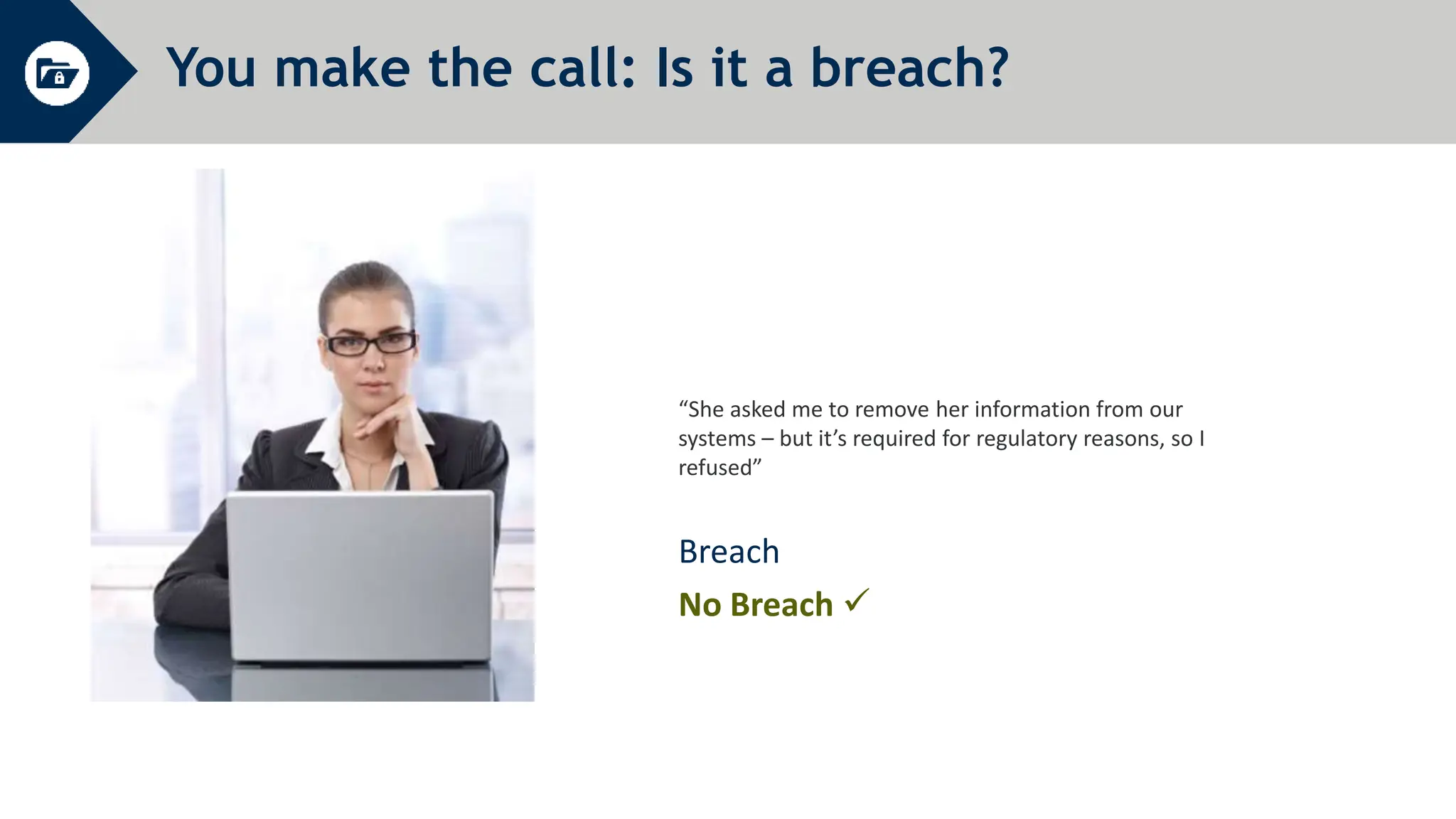
You make the call: Is it a breach?
“She asked me to remove her information from our
systems – but it’s required for regulatory reasons, so I
refused”
Breach
No Breach 
You make the call: Is it a breach?
“At first, he gave us his consent to use his data but then he
changed his mind – I told him that it wasn’t allowed”
Breach 
No Breach
You make the call: Is it a breach?
“We assumed she gave us her consent because she placed an
order with us and friended us on social media”
Breach 
No Breach
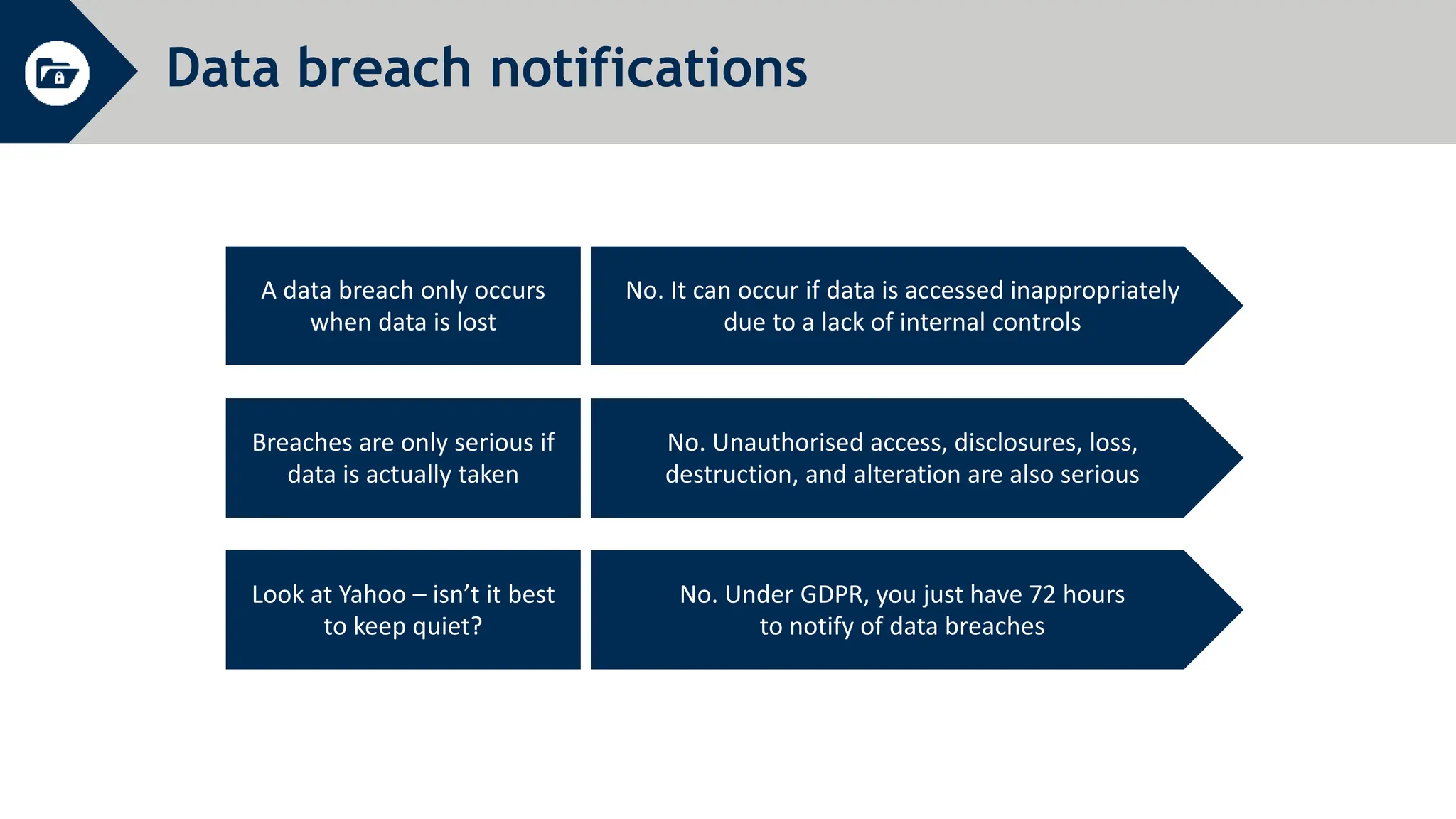
Data breach notifications
A data breach only occurs
when data is lost
No. It can occur if data is accessed inappropriately
due to a lack of internal controls
Breaches are only serious if
data is actually taken
Look at Yahoo – isn’t it best
to keep quiet?
No. Unauthorised access, disclosures, loss,
destruction, and alteration are also serious
No. Under GDPR, you just have 72 hours
to notify of data breaches
Fines under GDPR
 Infringements of rights, basic principles and
rules on international transfers:
 4% of worldwide turnover or €20 million
 Failure to notify of data breaches:
 2% of worldwide turnover or €10 million
Scenario 1
There’s a pre-checked box
when customers place
their order. It gives us
consent for future
marketing.
What do you think?
a) Great – it looks like Jayne is on top of GDPR already
b) Not bad – but Jayne can get consent verbally from
customers too
c) Poor – Jayne must ensure that consent is active
d) Poor – consent is only required for children under 13
years

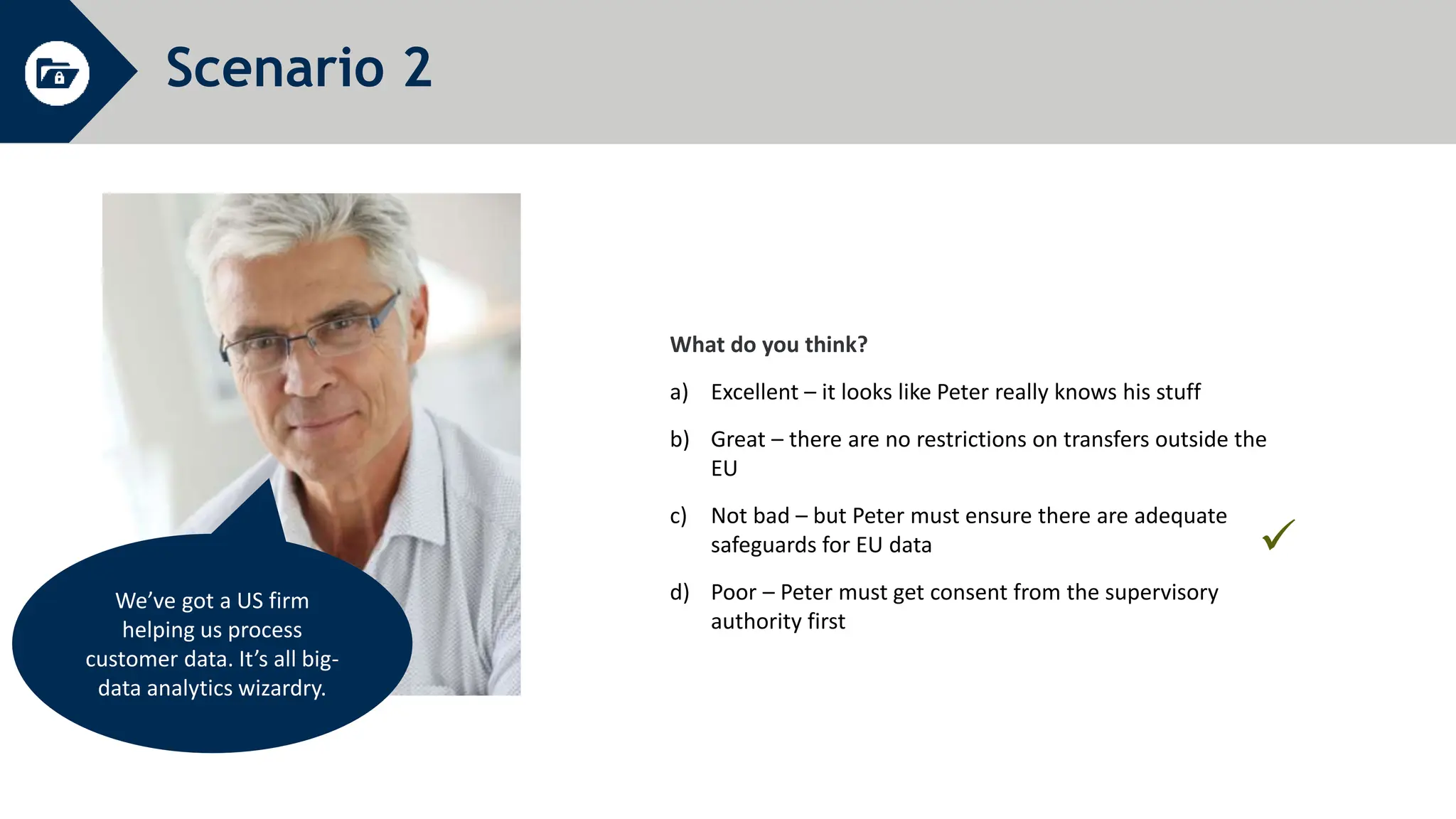
Scenario 2
What do you think?
a) Excellent – it looks like Peter really knows his stuff
b) Great – there are no restrictions on transfers outside the
EU
c) Not bad – but Peter must ensure there are adequate
safeguards for EU data
d) Poor – Peter must get consent from the supervisory
authority first

We’ve got a US firm
helping us process
customer data. It’s all big-
data analytics wizardry.
Our Data Protection Policy
1. What personal data we use and how
2. Our rules and procedures – creating, storing, sharing and disposing of personal data safely
3. Identifying our Data Protection Officer and how to contact them
4. Requiring everyone to read and implement our Data Protection Policy
Do
 Read our Company's Data Protection Policy – make sure you understand the rules and why
they're important
 Follow our policies and rules whenever you use personal data – taking particular care to
prevent unauthorised access, loss, theft or alteration
 Speak out promptly if you accidentally lose, delete or transfer personal data to someone else
– our firm has just 72 hours to report it
 Talk to your manager or our Data Protection Officer if you have any questions or concerns
Don’t
x Keep using customers’ personal data for marketing if they ask you to stop
x Transfer personal data outside the EU without ensuring there are adequate
protections in place
x Leave personal data lying around on a desk or unattended onscreen
x Collect or use children’s personal data without getting parental consent first
Questions, comments
or concerns?

GDPR General Awarness for employees and personal data types

  • 1.
  • 2.
    Learning objectives  Whatis personal data?  What are the consequences?  Data protection principles and rights  Our company’s data protection policy
  • 3.
    What has changed DataProtection Act General Data Protection Regulation (GDPR)
  • 4.
    What is personaldata?  “... information relating to a living individual who can be identified from that data...”  “…it may include expressions of opinion…”  “…held in manual or electronic systems…”  ICO guidance
  • 5.
    What constitutes personaldata? Our company’s annual report Your salary details Your medical information Your name and date of birth Your anonymous response to a survey question Your photo or image on a CCTV camera NO YES YES YES NO YES
  • 6.
    What is personaldata under GDPR? “...IP addresses...” “…automated personal data and data held in manual systems…” “…key-coded (pseudonymised) personal data…” Sensitive personal data Special categories of personal data (Article 9)
  • 7.
    Special categories ofpersonal data Your name and date of birth Racial or ethnic origin Genetic data Religious or political beliefs Data concerning sex life or sexual orientation Biometric data NO YES YES YES YES YES
  • 8.
    Lawful processing 1. Explicitconsent of the data subject 2. Necessary for the performance of a contract 3. Necessary for legal or judicial reasons 4. Necessary to protect the data subject’s best interests 5. Necessary to perform a task carried out in the public interest 6. Necessary for legitimate interests
  • 9.
    What rights dodata subjects have? I don’t want to receive your marketing letters and promotions I want to be able to take my data and reuse it on other platforms Did I agree to that? I didn’t see a privacy notice on your website when I typed in my details Does the right to be forgotten apply to me? I want to have any errors corrected I want to find out what data you have about me and how you’re using it Please stop using my data until you’ve checked there is a legitimate purpose
  • 10.
    Rights of individualsunder GDPR 1. The right to be informed 2. The right of access 3. The right to rectification 4. The right to erasure (“right to be forgotten”) 5. The right to restrict processing 6. The right to data portability 7. The right to object 8. Rights on automated decision making & profiling
  • 11.
    When it goeswrong TalkTalk fined £400k by ICO for cyber attack 1b customer accounts hacked, admits Yahoo Shop owner fined for using instore CCTV without registering Social worker drives off with family court data on roof Loan company fined £70k for spam texts Insurance firm fined £150k for losing 60,000 customers’ data
  • 12.
    You make thecall: Is it a breach? “She asked me to remove her information from our systems – but it’s required for regulatory reasons, so I refused” Breach No Breach 
  • 13.
    You make thecall: Is it a breach? “At first, he gave us his consent to use his data but then he changed his mind – I told him that it wasn’t allowed” Breach  No Breach
  • 14.
    You make thecall: Is it a breach? “We assumed she gave us her consent because she placed an order with us and friended us on social media” Breach  No Breach
  • 15.
    Data breach notifications Adata breach only occurs when data is lost No. It can occur if data is accessed inappropriately due to a lack of internal controls Breaches are only serious if data is actually taken Look at Yahoo – isn’t it best to keep quiet? No. Unauthorised access, disclosures, loss, destruction, and alteration are also serious No. Under GDPR, you just have 72 hours to notify of data breaches
  • 16.
    Fines under GDPR Infringements of rights, basic principles and rules on international transfers:  4% of worldwide turnover or €20 million  Failure to notify of data breaches:  2% of worldwide turnover or €10 million
  • 17.
    Scenario 1 There’s apre-checked box when customers place their order. It gives us consent for future marketing. What do you think? a) Great – it looks like Jayne is on top of GDPR already b) Not bad – but Jayne can get consent verbally from customers too c) Poor – Jayne must ensure that consent is active d) Poor – consent is only required for children under 13 years 
  • 18.
    Scenario 2 What doyou think? a) Excellent – it looks like Peter really knows his stuff b) Great – there are no restrictions on transfers outside the EU c) Not bad – but Peter must ensure there are adequate safeguards for EU data d) Poor – Peter must get consent from the supervisory authority first  We’ve got a US firm helping us process customer data. It’s all big- data analytics wizardry.
  • 19.
    Our Data ProtectionPolicy 1. What personal data we use and how 2. Our rules and procedures – creating, storing, sharing and disposing of personal data safely 3. Identifying our Data Protection Officer and how to contact them 4. Requiring everyone to read and implement our Data Protection Policy
  • 20.
    Do  Read ourCompany's Data Protection Policy – make sure you understand the rules and why they're important  Follow our policies and rules whenever you use personal data – taking particular care to prevent unauthorised access, loss, theft or alteration  Speak out promptly if you accidentally lose, delete or transfer personal data to someone else – our firm has just 72 hours to report it  Talk to your manager or our Data Protection Officer if you have any questions or concerns
  • 21.
    Don’t x Keep usingcustomers’ personal data for marketing if they ask you to stop x Transfer personal data outside the EU without ensuring there are adequate protections in place x Leave personal data lying around on a desk or unattended onscreen x Collect or use children’s personal data without getting parental consent first
  • 22.

Editor's Notes

  • #2 Welcome to this session on the General Data Protection Regulation (GDPR). Thank you for attending. This session should take us around 20 mins.
  • #3 In this session we’ll look at: What is personal data – we’ll establish what data is covered by the data protection laws What are the consequences of failing to safeguard personal data – for our customers and for our Company What are the data protection principles and what rights do individuals have in respect of their personal data? Our Company’s data protection policy
  • #4 The Data Protection Act was first introduced back in 1984 to safeguard individuals’ personal data. Since then, it has been updated a number of times – to keep pace with technological advances and reflect how our use of personal data has changed – i.e. more and more information moving online. The General Data Protection Regulation (or GDPR) was implemented in May 2018. It affects every organisation that processes the personal identifiable information (PII) of EU residents. It also applies to organisations from outside the EU who process personal information about EU residents or provide services to them.
  • #5 [Ask delegates] What is personal data? [Brainstorm ideas, making a note on the flipchart of any that match the definition below.] According to the Information Commissioner’s Office (ICO), personal data is: “... information relating to a living individual who can be identified from the data or who the data is about...” “…it may include expressions of opinion…” “…held in manual or electronic systems…”
  • #6 Let’s think about what kind of information may constitute personal data.
  • #7 [Ask delegates] What is personal data under GDPR? [Brainstorm ideas, making a note on the flipchart of any that match the definition below.] Although the same personal data (as previously) is still covered under GDPR, it goes much further. Personal data also includes: “...IP addresses...” “…automated personal data and data held in manual systems…” “…key-coded (pseudonymised) personal data…” [Highlight any other examples specific to the sector, if required]
  • #8 Let’s also have a look at what kind of information may constitute special categories of personal data. (This was known as sensitive personal data under DPA.) [Point out that criminal convictions are not classed as special categories of personal data – but certain conditions still apply under Article 10.]
  • #9 Certain conditions must be met before processing special categories of personal data (sensitive personal data). (Article 6 of the GDPR)
  • #10 [Discuss with delegates] What rights do data subjects have? Here are some examples. [Give delegates time to review and discuss]
  • #11 GDPR builds on many of the fundamental rights that data subjects had under the DPA, but there are some new ones too. Individuals have: The right to be informed The right of access The right to rectification The right to erasure (also known as “the right to be forgotten”) The right to restrict processing The right to data portability The right to object Rights in relation to automated decision making and profiling [More information on the right to be forgotten is available at: http://ec.europa.eu/justice/data-protection/files/factsheets/factsheet_data_protection_en.pdf]
  • #12 Any data breach is serious. There are serious consequences for our customers if we lose their information or it’s seen by other people without their permission. For example, it can lead to identity theft and financial loss. There are also serious consequences for our company. The negative publicity can damage our brand and our reputation, and of course customer trust. We may face heavy fines (set to increase under GDPR) and other sanctions. Here are some examples of cases that have hit the headlines. [As an add-on, discuss any recent cases making the headlines currently. Check the ICO website for new cases before delivering this session]
  • #13 Take a look at this example and decide whether it is a breach of data protection rules or not. [Allow for thinking time before clicking next]
  • #14 Take a look at this example and decide whether it is a breach of data protection rules or not. [Allow for thinking time before clicking next]
  • #15 Take a look at this example and decide whether it is a breach of data protection rules or not. [Allow for thinking time before clicking next]
  • #16 Learn more about data breaches by checking out these myths.
  • #17 Companies who fail to comply with GDPR will face hefty fines for any infringements. There are two thresholds (tiers): 4% of worldwide turnover or €20 million (whichever is the highest) – for infringements of rights, the basic principles and rules on international transfers 2% of worldwide turnover or €10 million (whichever is the highest) – for a failure to notify of data breaches, to maintain written records, to obtain consent for processing children’s data, to implement technical and organisational measures, etc Companies may face insolvency if they don’t get this right. [Under DPA, the maximum fine imposed was £400k – maximum fine possible was £500,000.]
  • #18 This is Jayne. She’s explaining how her company gets consent for marketing activities. What do you think? Does it comply with GDPR? [Click to see the options and then allow for thinking time before clicking next again] To summarise: Pre-ticked boxes, silence or inactivity should not be taken as a sign of a customer’s consent. Consent must always be explicit, clear and unambiguous under the GDPR. Specific rules also apply to children in respect of consent.
  • #19 Peter’s transferring our customers’ personal data to a third party. Is this allowed? What rules apply? [Click to see the options and then allow for thinking time before clicking next again] To summarise: GDPR places restrictions on the transfer of any personal data outside the European Union. EU citizens must have the same protections regardless of where data is transferred. Transfers can only be made where: The Commission agrees that a third country offers an adequate level of protection Individual rights are enforceable Adequate remedies are available in the event of a breach
  • #20 Our Data Protection policy outlines our rules and what we expect of you to comply with data protection laws. You can help us comply by: Knowing what personal data is in scope Being clear about our rules – creating, storing, sharing and disposing of personal data safely Finding out who our Data Protection Officer is and how to contact them Reading and implementing our Data Protection Policy
  • #21 Here's what you should do: Read our Company's Data Protection Policy – make sure you understand the rules and why they're important Follow our policies and rules whenever you use personal data – taking particular care to prevent unauthorised access, loss, theft or alteration Speak out promptly if you accidentally lose, delete or transfer personal data to someone else – our firm has just 72 hours to report it Talk to your manager or our Data Protection Officer if you have any questions or concerns
  • #22 Don't: Keep using customers’ personal data for marketing if they ask you to stop Transfer personal data outside the EU without ensuring there are adequate protections in place Leave personal data lying around on a desk or unattended onscreen Collect or use children’s personal data without getting parental consent first
  • #23 Do you have any questions?