Case Examples
ICD-10-PCS
Pertaining specifically to
Chapter 9 Circulatory System
Case Examples
• Coronary Artery Bypass Graft (CABG) x4
• Left Cardiac Catheterization with PTCA
• Dual Chamber Cardiac Pacemaker and Leads
Coronary Artery Bypass Graft (CABG) x4
Coronary artery bypass is done from the left internal mammary artery
(LIMA) to the left anterior descending artery, the diagonal artery, and the
ramus artery. Greater saphenous vein graft is done to the obtuse marginal
artery. A portion of the left greater saphenous vein was harvested using an
open approach. The procedure was completed utilizing cardiopulmonary
bypass.
Coronary Artery Bypass Graft (CABG) x4
Coronary artery bypass is done from the left internal mammary artery
(LIMA) to the left anterior descending artery, the diagonal artery, and the
ramus artery. Greater saphenous vein graft is done to the obtuse marginal
artery. A portion of the left greater saphenous vein was harvested using an
open approach. The procedure was completed utilizing cardiopulmonary
bypass.
Coronary Artery Bypass Graft (CABG) x4
The ICD-10-PCS code assignment for this case example is:
• Bypass, artery, coronary, Three sites
• Bypass, artery, coronary, One site
• Excision, vein, greater saphenous, left
• Bypass, cardiopulmonary
Coronary Artery Bypass Graft (CABG) x4
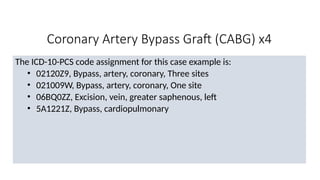
The ICD-10-PCS code assignment for this case example is:
• 02120Z9, Bypass, artery, coronary, Three sites
• 021009W, Bypass, artery, coronary, One site
• 06BQ0ZZ, Excision, vein, greater saphenous, left
• 5A1221Z, Bypass, cardiopulmonary
Coronary Artery Bypass Graft (CABG) x4
Two codes are necessary to fully explain the CABG x4 with three vessels
being bypassed with the LIMA and one vessel treated using the saphenous
vein graft. The excision of the saphenous vein is coded separately and the
documentation needs to indicate both laterality and greater or lesser
saphenous vein. This is a documentation opportunity, which can be
addressed with the provider.
Left Cardiac Catheterization with PTCA
A 64-year-old man is admitted for a left heart catheterization, coronary
angiography of multiple coronary arteries and left ventriculography, using
low osmolar contrast. Findings from these procedures resulted in the
decision to perform a percutaneous transluminal coronary angioplasty
(PTCA) of two separate lesions in the left anterior descending artery. One
lesion was treated with a drug-eluting stent and the other lesion treated
with PTCA only.
Left Cardiac Catheterization with PTCA
A 64-year-old man is admitted for a left heart catheterization, coronary
angiography of multiple coronary arteries and left ventriculography, using
low osmolar contrast. Findings from these procedures resulted in the
decision to perform a percutaneous transluminal coronary angioplasty
(PTCA) of two separate lesions in the left anterior descending artery. One
lesion was treated with a drug-eluting stent and the other lesion treated
with PTCA only.
Left Cardiac Catheterization with PTCA
The ICD-10-PCS code assignment for this case example is:
• Catheterization, Heart
• Fluoroscopy, Heart, Left
• Fluoroscopy, Artery, Coronary, Multiple
• Angioplasty, Stent
• Angioplasty
Left Cardiac Catheterization with PTCA
The ICD-10-PCS code assignment for this case example is:
• 4A023NZ, Catheterization, Heart
• B2151ZZ, Fluoroscopy, Heart, Left
• B2111ZZ, Fluoroscopy, Artery, Coronary, Multiple
• 027034Z, Angioplasty, Stent
• 02703ZZ, Angioplasty
Left Cardiac Catheterization with PTCA
The angiography and ventriculography procedures are completed using
fluoroscopy, which can be found on table B21. Cardiac catheterizations and
PTCA are done percutaneously using fluoroscopy for visualization. Two
codes are necessary to correctly code the PTCA, as one lesion was treated
with a stent and one without. Note that there were two lesions in one
coronary artery; however, the guideline specifies the number of sites
treated rather than the name or number of coronary arteries.
Dual Chamber Cardiac Pacemaker & Leads
To manage the patient’s sick sinus syndrome, a permanent dual chamber
pacemaker with atrial and ventricular leads was implanted. An incision was
made into the left chest wall with the dual chamber pacemaker being
placed in the subcutaneous pocket. Next, a small incision was made into the
skin and the leads were percutaneously passed into the right ventricle and
right atrium.
Dual Chamber Cardiac Pacemaker & Leads
To manage the patient’s sick sinus syndrome, a permanent dual chamber
pacemaker with atrial and ventricular leads was implanted. An incision was
made into the left chest wall with the dual chamber pacemaker being
placed in the subcutaneous pocket. Next, a small incision was made into the
skin and the leads were percutaneously passed into the right ventricle and
right atrium.
Dual Chamber Cardiac Pacemaker & Leads
The ICD-10-PCS code assignment for this case example is:
• Insertion of pacemaker generator
• Insertion of device in atrium
• Insertion of device in ventricle
Dual Chamber Cardiac Pacemaker & Leads
The ICD-10-PCS code assignment for this case example is:
• 0JH606Z, Insertion of pacemaker generator
• 02H63JZ, Insertion of device in atrium
• 02HK3JZ, Insertion of device in ventricle
Dual Chamber Cardiac Pacemaker & Leads
It is important to note that the pacemaker generator is placed in the
subcutaneous tissue of the chest. The correct body system is subcutaneous
tissue and fascia. A common error occurs when using the Alphabetic Index,
under Insertion, Chest Wall. This index entry directs the coder to table
OWH8, which may appear to be correct until character 6, device. On this
table, there is no device character to identify the dual chamber pacemaker.
When using the tables in ICD-10-PCS, if a code seems “almost right,” review
the table to ensure the row of the table—or even the table itself—is
correct.
Source
• http://bok.ahima.org/doc?oid=107739#.XIaR7aB7lhF

ICD -10 PCS coding 1 Cardiovascular.pptx

  • 1.
    Case Examples ICD-10-PCS Pertaining specificallyto Chapter 9 Circulatory System
  • 2.
    Case Examples • CoronaryArtery Bypass Graft (CABG) x4 • Left Cardiac Catheterization with PTCA • Dual Chamber Cardiac Pacemaker and Leads
  • 3.
    Coronary Artery BypassGraft (CABG) x4 Coronary artery bypass is done from the left internal mammary artery (LIMA) to the left anterior descending artery, the diagonal artery, and the ramus artery. Greater saphenous vein graft is done to the obtuse marginal artery. A portion of the left greater saphenous vein was harvested using an open approach. The procedure was completed utilizing cardiopulmonary bypass.
  • 4.
    Coronary Artery BypassGraft (CABG) x4 Coronary artery bypass is done from the left internal mammary artery (LIMA) to the left anterior descending artery, the diagonal artery, and the ramus artery. Greater saphenous vein graft is done to the obtuse marginal artery. A portion of the left greater saphenous vein was harvested using an open approach. The procedure was completed utilizing cardiopulmonary bypass.
  • 5.
    Coronary Artery BypassGraft (CABG) x4 The ICD-10-PCS code assignment for this case example is: • Bypass, artery, coronary, Three sites • Bypass, artery, coronary, One site • Excision, vein, greater saphenous, left • Bypass, cardiopulmonary
  • 6.
    Coronary Artery BypassGraft (CABG) x4 The ICD-10-PCS code assignment for this case example is: • 02120Z9, Bypass, artery, coronary, Three sites • 021009W, Bypass, artery, coronary, One site • 06BQ0ZZ, Excision, vein, greater saphenous, left • 5A1221Z, Bypass, cardiopulmonary
  • 7.
    Coronary Artery BypassGraft (CABG) x4 Two codes are necessary to fully explain the CABG x4 with three vessels being bypassed with the LIMA and one vessel treated using the saphenous vein graft. The excision of the saphenous vein is coded separately and the documentation needs to indicate both laterality and greater or lesser saphenous vein. This is a documentation opportunity, which can be addressed with the provider.
  • 8.
    Left Cardiac Catheterizationwith PTCA A 64-year-old man is admitted for a left heart catheterization, coronary angiography of multiple coronary arteries and left ventriculography, using low osmolar contrast. Findings from these procedures resulted in the decision to perform a percutaneous transluminal coronary angioplasty (PTCA) of two separate lesions in the left anterior descending artery. One lesion was treated with a drug-eluting stent and the other lesion treated with PTCA only.
  • 9.
    Left Cardiac Catheterizationwith PTCA A 64-year-old man is admitted for a left heart catheterization, coronary angiography of multiple coronary arteries and left ventriculography, using low osmolar contrast. Findings from these procedures resulted in the decision to perform a percutaneous transluminal coronary angioplasty (PTCA) of two separate lesions in the left anterior descending artery. One lesion was treated with a drug-eluting stent and the other lesion treated with PTCA only.
  • 10.
    Left Cardiac Catheterizationwith PTCA The ICD-10-PCS code assignment for this case example is: • Catheterization, Heart • Fluoroscopy, Heart, Left • Fluoroscopy, Artery, Coronary, Multiple • Angioplasty, Stent • Angioplasty
  • 11.
    Left Cardiac Catheterizationwith PTCA The ICD-10-PCS code assignment for this case example is: • 4A023NZ, Catheterization, Heart • B2151ZZ, Fluoroscopy, Heart, Left • B2111ZZ, Fluoroscopy, Artery, Coronary, Multiple • 027034Z, Angioplasty, Stent • 02703ZZ, Angioplasty
  • 12.
    Left Cardiac Catheterizationwith PTCA The angiography and ventriculography procedures are completed using fluoroscopy, which can be found on table B21. Cardiac catheterizations and PTCA are done percutaneously using fluoroscopy for visualization. Two codes are necessary to correctly code the PTCA, as one lesion was treated with a stent and one without. Note that there were two lesions in one coronary artery; however, the guideline specifies the number of sites treated rather than the name or number of coronary arteries.
  • 13.
    Dual Chamber CardiacPacemaker & Leads To manage the patient’s sick sinus syndrome, a permanent dual chamber pacemaker with atrial and ventricular leads was implanted. An incision was made into the left chest wall with the dual chamber pacemaker being placed in the subcutaneous pocket. Next, a small incision was made into the skin and the leads were percutaneously passed into the right ventricle and right atrium.
  • 14.
    Dual Chamber CardiacPacemaker & Leads To manage the patient’s sick sinus syndrome, a permanent dual chamber pacemaker with atrial and ventricular leads was implanted. An incision was made into the left chest wall with the dual chamber pacemaker being placed in the subcutaneous pocket. Next, a small incision was made into the skin and the leads were percutaneously passed into the right ventricle and right atrium.
  • 15.
    Dual Chamber CardiacPacemaker & Leads The ICD-10-PCS code assignment for this case example is: • Insertion of pacemaker generator • Insertion of device in atrium • Insertion of device in ventricle
  • 16.
    Dual Chamber CardiacPacemaker & Leads The ICD-10-PCS code assignment for this case example is: • 0JH606Z, Insertion of pacemaker generator • 02H63JZ, Insertion of device in atrium • 02HK3JZ, Insertion of device in ventricle
  • 17.
    Dual Chamber CardiacPacemaker & Leads It is important to note that the pacemaker generator is placed in the subcutaneous tissue of the chest. The correct body system is subcutaneous tissue and fascia. A common error occurs when using the Alphabetic Index, under Insertion, Chest Wall. This index entry directs the coder to table OWH8, which may appear to be correct until character 6, device. On this table, there is no device character to identify the dual chamber pacemaker. When using the tables in ICD-10-PCS, if a code seems “almost right,” review the table to ensure the row of the table—or even the table itself—is correct.
  • 18.