1
http://www.research.ibm.com/5-in-5/
Pietro Leo
Executive Architect - Artificial Intelligence thought Leader
Chief Scientist for IBM Italy Research & Business
IBM Academy of Technology Leadership
Member of ISO/SC42 Artificial Intelligence Standardization Committee
2019
IBM Research 5 in 5
2019 Edition
3
Seed
Harvest
Shelf
Plate
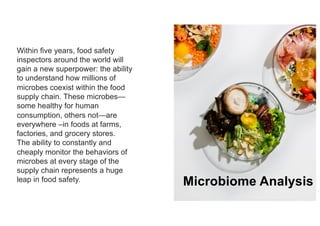
Trash
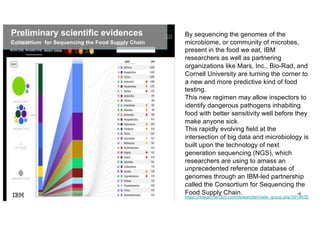
FOOD
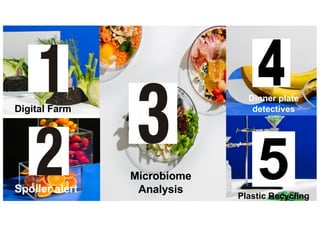
4
Plastic Recycling
Dinner plate
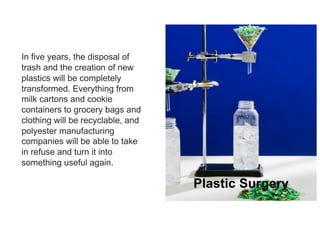
detectives
Spoiler alert
Digital Farm
Microbiome
Analysis
5
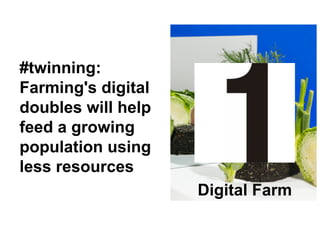
#twinning:
Farming's digital
doubles will help
feed a growing
population using
less resources
Digital Farm
6
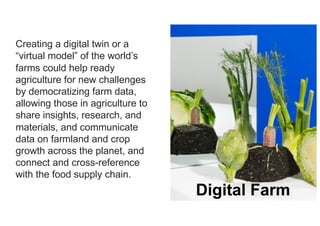
Creating a digital twin or a
“virtual model” of the world’s
farms could help ready
agriculture for new challenges
by democratizing farm data,
allowing those in agriculture to
share insights, research, and
materials, and communicate
data on farmland and crop
growth across the planet, and
connect and cross-reference
with the food supply chain.
Digital Farm
7
Preliminary scientific evidences
https://ibmpairs.mybluemix.net/
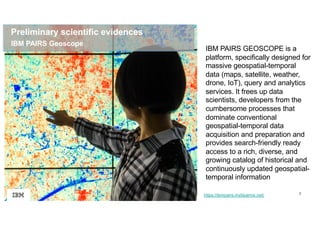
IBM PAIRS Geoscope
IBM PAIRS GEOSCOPE is a
platform, specifically designed for
massive geospatial-temporal
data (maps, satellite, weather,
drone, IoT), query and analytics
services. It frees up data
scientists, developers from the
cumbersome processes that
dominate conventional
geospatial-temporal data
acquisition and preparation and
provides search-friendly ready
access to a rich, diverse, and
growing catalog of historical and
continuously updated geospatial-
temporal information
8
Preliminary scientific evidences
https://www.ibm.com/blogs/research/2018/08/safe-water-kenya/
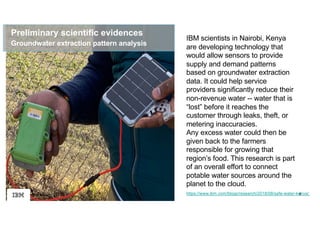
Groundwater extraction pattern analysis
IBM scientists in Nairobi, Kenya
are developing technology that
would allow sensors to provide
supply and demand patterns
based on groundwater extraction
data. It could help service
providers significantly reduce their
non-revenue water -- water that is
“lost” before it reaches the
customer through leaks, theft, or
metering inaccuracies.
Any excess water could then be
given back to the farmers
responsible for growing that
region’s food. This research is part
of an overall effort to connect
potable water sources around the
planet to the cloud.
9https://www.ibm.com/blogs/research/2018/12/hello-tractor/
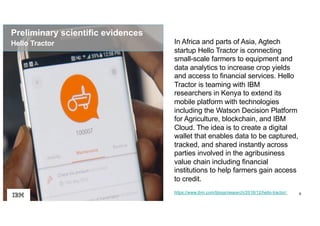
In Africa and parts of Asia, Agtech
startup Hello Tractor is connecting
small-scale farmers to equipment and
data analytics to increase crop yields
and access to financial services. Hello
Tractor is teaming with IBM
researchers in Kenya to extend its
mobile platform with technologies
including the Watson Decision Platform
for Agriculture, blockchain, and IBM
Cloud. The idea is to create a digital
wallet that enables data to be captured,
tracked, and shared instantly across
parties involved in the agribusiness
value chain including financial
institutions to help farmers gain access
to credit.
Hello Tractor
Preliminary scientific evidences
10
https://www.ibm.com/blogs/research/2018/09/smarter-farms-agriculture/
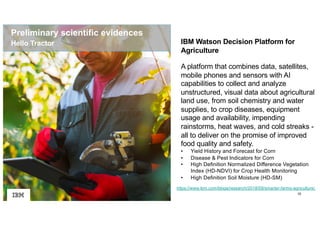
IBM Watson Decision Platform for
Agriculture
A platform that combines data, satellites,
mobile phones and sensors with AI
capabilities to collect and analyze
unstructured, visual data about agricultural
land use, from soil chemistry and water
supplies, to crop diseases, equipment
usage and availability, impending
rainstorms, heat waves, and cold streaks -
all to deliver on the promise of improved
food quality and safety.
• Yield History and Forecast for Corn
• Disease & Pest Indicators for Corn
• High Definition Normalized Difference Vegetation
Index (HD-NDVI) for Crop Health Monitoring
• High Definition Soil Moisture (HD-SM)
Hello Tractor
Preliminary scientific evidences
11
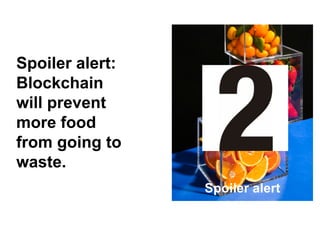
Spoiler alert:
Blockchain
will prevent
more food
from going to
waste.
Spoiler alert
12
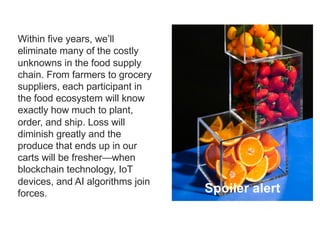
Within five years, we’ll
eliminate many of the costly
unknowns in the food supply
chain. From farmers to grocery
suppliers, each participant in
the food ecosystem will know
exactly how much to plant,
order, and ship. Loss will
diminish greatly and the
produce that ends up in our
carts will be fresher—when
blockchain technology, IoT
devices, and AI algorithms join
forces. Spoiler alert
13
https://www.ibm.com/blockchain/solutions/food-trust
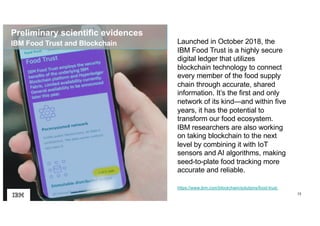
Launched in October 2018, the
IBM Food Trust is a highly secure
digital ledger that utilizes
blockchain technology to connect
every member of the food supply
chain through accurate, shared
information. It’s the first and only
network of its kind—and within five
years, it has the potential to
transform our food ecosystem.
IBM researchers are also working
on taking blockchain to the next
level by combining it with IoT
sensors and AI algorithms, making
seed-to-plate food tracking more
accurate and reliable.
IBM Food Trust and Blockchain
Preliminary scientific evidences
14
Mapping the
microbiome
will protect
us from bad
bacteria.
Microbiome Analysis
15
Within five years, food safety
inspectors around the world will
gain a new superpower: the ability
to understand how millions of
microbes coexist within the food
supply chain. These microbes—
some healthy for human
consumption, others not—are
everywhere –in foods at farms,
factories, and grocery stores.
The ability to constantly and
cheaply monitor the behaviors of
microbes at every stage of the
supply chain represents a huge
leap in food safety. Microbiome Analysis
16
Preliminary scientific evidences
https://researcher.ibm.com/researcher/view_group.php?id=9635
By sequencing the genomes of the
microbiome, or community of microbes,
present in the food we eat, IBM
researchers as well as partnering
organizations like Mars, Inc., Bio-Rad, and
Cornell University are turning the corner to
a new and more predictive kind of food
testing.
This new regimen may allow inspectors to
identify dangerous pathogens inhabiting
food with better sensitivity well before they
make anyone sick.
This rapidly evolving field at the
intersection of big data and microbiology is
built upon the technology of next
generation sequencing (NGS), which
researchers are using to amass an
unprecedented reference database of
genomes through an IBM-led partnership
called the Consortium for Sequencing the
Food Supply Chain.
Consortium for Sequencing the Food Supply Chain
Preliminary scientific evidences
17
Dinner plate
detectives: AI
sensors will
detect
foodborne
pathogens at
home. Dinner plate
detectives
18
Within five years, the world’s
farmers, food processors,
and grocers—along with its
billions of home cooks—will
be able to detect dangerous
contaminants effortlessly in
their food. All they’ll need is a
cell phone or a countertop
with AI sensors.
Dinner plate
detectives
19
https://www.ibm.com/blogs/research/2018/05/ai-authentication-verifier/
IBM Research is currently creating
bacteria-detecting sensors that would be
a next-generation extension of IBM’s
Crypto Anchor Verifier. This optical
device, which is currently being tested by
businesses from drug stores to
construction companies, uses AI and
machine learning techniques to analyze
microscopic features and “read” the
wavelengths emitted by different
substances and objects.
After scanning a material, a verifier
records its unique wavelength and
microscopic details on the blockchain,
comparing its fingerprint to that of other
identical substances. Soon, we’ll be able
to stop them in sub-seconds
IBM's Next-generation Crypto Anchor Verifier
Preliminary scientific evidences
20
A radical new
recycling
process will
breathe new
life into old
plastic.
Plastic Recycling
21
In five years, the disposal of
trash and the creation of new
plastics will be completely
transformed. Everything from
milk cartons and cookie
containers to grocery bags and
clothing will be recyclable, and
polyester manufacturing
companies will be able to take
in refuse and turn it into
something useful again.
Plastic Surgery
22
Preliminary scientific evidences
http://www.research.ibm.com/5-in-5/trash/
IBM researchers have discovered a a
catalytic chemical process that digests
certain plastics (called polyesters) into a
substance which can be fed directly back
into plastic manufacturing machines in
order to make new products. VolCat
begins by heating PET and ethylene
glycol in a reactor with the catalyst. After
depolymerization is complete, the
catalyst is recovered by distillation from
the reactor using the heat of reaction.
The solution is filtered, purified, and then
cooled, and the solid monomer product is
recovered by filtration. The recovered
liquid, along with the catalyst, is then
reintroduced into the depolymerization
reactor in an energy-efficient cycle.
Volatile Catalyst (VolCat)
Preliminary scientific evidences
IBM Research: A global research capability
Australia
China
Almaden
Haifa
Zurich
Africa
Ireland
Brazil
Watson
Austin
India
Tokyo
3000 Researchers
6 Nobel Laureates
25 Years of Patent Leadership
10 National Medals of Technology
5 National Medals of Science
3 Kavli Prizes
6 Turing Awards
69 NAE Members
123 IEEE Fellows
28 ACM Fellows
99 IBM Fellows
Cambridge
Singapore
24
http://www.research.ibm.com/5-in-5/
Pietro Leo
Executive Architect - Artificial Intelligence thought Leader
Chief Scientist for IBM Italy Research & Business
IBM Academy of Technology Leadership
Member of ISO/SC42 Artificial Intelligence Standardization Committee
@pieroleo
www.pieroleo.com

Ibm research 5in5_2019

  • 1.
    1 http://www.research.ibm.com/5-in-5/ Pietro Leo Executive Architect- Artificial Intelligence thought Leader Chief Scientist for IBM Italy Research & Business IBM Academy of Technology Leadership Member of ISO/SC42 Artificial Intelligence Standardization Committee 2019
  • 2.
    IBM Research 5in 5 2019 Edition
  • 3.
  • 4.
    4 Plastic Recycling Dinner plate detectives Spoileralert Digital Farm Microbiome Analysis
  • 5.
    5 #twinning: Farming's digital doubles willhelp feed a growing population using less resources Digital Farm
  • 6.
    6 Creating a digitaltwin or a “virtual model” of the world’s farms could help ready agriculture for new challenges by democratizing farm data, allowing those in agriculture to share insights, research, and materials, and communicate data on farmland and crop growth across the planet, and connect and cross-reference with the food supply chain. Digital Farm
  • 7.
    7 Preliminary scientific evidences https://ibmpairs.mybluemix.net/ IBMPAIRS Geoscope IBM PAIRS GEOSCOPE is a platform, specifically designed for massive geospatial-temporal data (maps, satellite, weather, drone, IoT), query and analytics services. It frees up data scientists, developers from the cumbersome processes that dominate conventional geospatial-temporal data acquisition and preparation and provides search-friendly ready access to a rich, diverse, and growing catalog of historical and continuously updated geospatial- temporal information
  • 8.
    8 Preliminary scientific evidences https://www.ibm.com/blogs/research/2018/08/safe-water-kenya/ Groundwaterextraction pattern analysis IBM scientists in Nairobi, Kenya are developing technology that would allow sensors to provide supply and demand patterns based on groundwater extraction data. It could help service providers significantly reduce their non-revenue water -- water that is “lost” before it reaches the customer through leaks, theft, or metering inaccuracies. Any excess water could then be given back to the farmers responsible for growing that region’s food. This research is part of an overall effort to connect potable water sources around the planet to the cloud.
  • 9.
    9https://www.ibm.com/blogs/research/2018/12/hello-tractor/ In Africa andparts of Asia, Agtech startup Hello Tractor is connecting small-scale farmers to equipment and data analytics to increase crop yields and access to financial services. Hello Tractor is teaming with IBM researchers in Kenya to extend its mobile platform with technologies including the Watson Decision Platform for Agriculture, blockchain, and IBM Cloud. The idea is to create a digital wallet that enables data to be captured, tracked, and shared instantly across parties involved in the agribusiness value chain including financial institutions to help farmers gain access to credit. Hello Tractor Preliminary scientific evidences
  • 10.
    10 https://www.ibm.com/blogs/research/2018/09/smarter-farms-agriculture/ IBM Watson DecisionPlatform for Agriculture A platform that combines data, satellites, mobile phones and sensors with AI capabilities to collect and analyze unstructured, visual data about agricultural land use, from soil chemistry and water supplies, to crop diseases, equipment usage and availability, impending rainstorms, heat waves, and cold streaks - all to deliver on the promise of improved food quality and safety. • Yield History and Forecast for Corn • Disease & Pest Indicators for Corn • High Definition Normalized Difference Vegetation Index (HD-NDVI) for Crop Health Monitoring • High Definition Soil Moisture (HD-SM) Hello Tractor Preliminary scientific evidences
  • 11.
    11 Spoiler alert: Blockchain will prevent morefood from going to waste. Spoiler alert
  • 12.
    12 Within five years,we’ll eliminate many of the costly unknowns in the food supply chain. From farmers to grocery suppliers, each participant in the food ecosystem will know exactly how much to plant, order, and ship. Loss will diminish greatly and the produce that ends up in our carts will be fresher—when blockchain technology, IoT devices, and AI algorithms join forces. Spoiler alert
  • 13.
    13 https://www.ibm.com/blockchain/solutions/food-trust Launched in October2018, the IBM Food Trust is a highly secure digital ledger that utilizes blockchain technology to connect every member of the food supply chain through accurate, shared information. It’s the first and only network of its kind—and within five years, it has the potential to transform our food ecosystem. IBM researchers are also working on taking blockchain to the next level by combining it with IoT sensors and AI algorithms, making seed-to-plate food tracking more accurate and reliable. IBM Food Trust and Blockchain Preliminary scientific evidences
  • 14.
    14 Mapping the microbiome will protect usfrom bad bacteria. Microbiome Analysis
  • 15.
    15 Within five years,food safety inspectors around the world will gain a new superpower: the ability to understand how millions of microbes coexist within the food supply chain. These microbes— some healthy for human consumption, others not—are everywhere –in foods at farms, factories, and grocery stores. The ability to constantly and cheaply monitor the behaviors of microbes at every stage of the supply chain represents a huge leap in food safety. Microbiome Analysis
  • 16.
    16 Preliminary scientific evidences https://researcher.ibm.com/researcher/view_group.php?id=9635 Bysequencing the genomes of the microbiome, or community of microbes, present in the food we eat, IBM researchers as well as partnering organizations like Mars, Inc., Bio-Rad, and Cornell University are turning the corner to a new and more predictive kind of food testing. This new regimen may allow inspectors to identify dangerous pathogens inhabiting food with better sensitivity well before they make anyone sick. This rapidly evolving field at the intersection of big data and microbiology is built upon the technology of next generation sequencing (NGS), which researchers are using to amass an unprecedented reference database of genomes through an IBM-led partnership called the Consortium for Sequencing the Food Supply Chain. Consortium for Sequencing the Food Supply Chain Preliminary scientific evidences
  • 17.
    17 Dinner plate detectives: AI sensorswill detect foodborne pathogens at home. Dinner plate detectives
  • 18.
    18 Within five years,the world’s farmers, food processors, and grocers—along with its billions of home cooks—will be able to detect dangerous contaminants effortlessly in their food. All they’ll need is a cell phone or a countertop with AI sensors. Dinner plate detectives
  • 19.
    19 https://www.ibm.com/blogs/research/2018/05/ai-authentication-verifier/ IBM Research iscurrently creating bacteria-detecting sensors that would be a next-generation extension of IBM’s Crypto Anchor Verifier. This optical device, which is currently being tested by businesses from drug stores to construction companies, uses AI and machine learning techniques to analyze microscopic features and “read” the wavelengths emitted by different substances and objects. After scanning a material, a verifier records its unique wavelength and microscopic details on the blockchain, comparing its fingerprint to that of other identical substances. Soon, we’ll be able to stop them in sub-seconds IBM's Next-generation Crypto Anchor Verifier Preliminary scientific evidences
  • 20.
    20 A radical new recycling processwill breathe new life into old plastic. Plastic Recycling
  • 21.
    21 In five years,the disposal of trash and the creation of new plastics will be completely transformed. Everything from milk cartons and cookie containers to grocery bags and clothing will be recyclable, and polyester manufacturing companies will be able to take in refuse and turn it into something useful again. Plastic Surgery
  • 22.
    22 Preliminary scientific evidences http://www.research.ibm.com/5-in-5/trash/ IBMresearchers have discovered a a catalytic chemical process that digests certain plastics (called polyesters) into a substance which can be fed directly back into plastic manufacturing machines in order to make new products. VolCat begins by heating PET and ethylene glycol in a reactor with the catalyst. After depolymerization is complete, the catalyst is recovered by distillation from the reactor using the heat of reaction. The solution is filtered, purified, and then cooled, and the solid monomer product is recovered by filtration. The recovered liquid, along with the catalyst, is then reintroduced into the depolymerization reactor in an energy-efficient cycle. Volatile Catalyst (VolCat) Preliminary scientific evidences
  • 23.
    IBM Research: Aglobal research capability Australia China Almaden Haifa Zurich Africa Ireland Brazil Watson Austin India Tokyo 3000 Researchers 6 Nobel Laureates 25 Years of Patent Leadership 10 National Medals of Technology 5 National Medals of Science 3 Kavli Prizes 6 Turing Awards 69 NAE Members 123 IEEE Fellows 28 ACM Fellows 99 IBM Fellows Cambridge Singapore
  • 24.
    24 http://www.research.ibm.com/5-in-5/ Pietro Leo Executive Architect- Artificial Intelligence thought Leader Chief Scientist for IBM Italy Research & Business IBM Academy of Technology Leadership Member of ISO/SC42 Artificial Intelligence Standardization Committee @pieroleo www.pieroleo.com