© 2015 IBM Corporation
An Introduction to Cloud in Life Sciences
IBM Institute for Business Value
12 January 2015
© 2015 IBM CorporationIBM Institute for Business Value2
Cloud in Life Sciences – an overview
ď‚§ Cloud computing offers a powerful service delivery and consumption model that
organizations can use to drive business model innovation, enhance revenues and
operational efficiency
ď‚§ Strict regulatory control in the life sciences industry has slowed many organizations from
adopting cloud; however this is changing fast as with sufficient safeguards implemented,
concerns and challenges can be addressed
ď‚§ The life sciences industry is adopting cloud to realize many benefits
• Transform its business operations
• Enhance efficiency and cost control
• Collaborate with different entities across the healthcare ecosystem
• Extend its ecosystem from drug discovery to ongoing patient care
ď‚§ IBM believe a well planned cloud strategy focusing on how business can be cloud-enabled
will provide life sciences organizations with long term benefits
© 2015 IBM CorporationIBM Institute for Business Value3
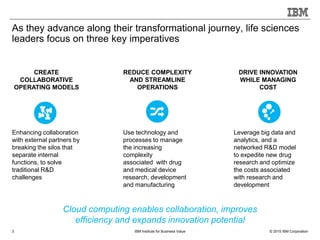
As they advance along their transformational journey, life sciences
leaders focus on three key imperatives
CREATE
COLLABORATIVE
OPERATING MODELS
REDUCE COMPLEXITY
AND STREAMLINE
OPERATIONS
DRIVE INNOVATION
WHILE MANAGING
COST
Cloud computing enables collaboration, improves
efficiency and expands innovation potential
Enhancing collaboration
with external partners by
breaking the silos that
separate internal
functions, to solve
traditional R&D
challenges
Use technology and
processes to manage
the increasing
complexity
associated with drug
and medical device
research, development
and manufacturing
Leverage big data and
analytics, and a
networked R&D model
to expedite new drug
research and optimize
the costs associated
with research and
development
© 2015 IBM CorporationIBM Institute for Business Value4
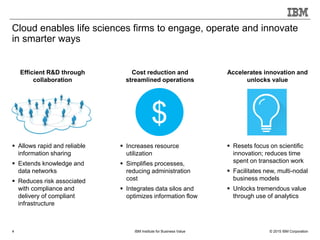
Cloud enables life sciences firms to engage, operate and innovate
in smarter ways
ď‚§ Resets focus on scientific
innovation; reduces time
spent on transaction work
ď‚§ Facilitates new, multi-nodal
business models
ď‚§ Unlocks tremendous value
through use of analytics
ď‚§ Allows rapid and reliable
information sharing
ď‚§ Extends knowledge and
data networks
ď‚§ Reduces risk associated
with compliance and
delivery of compliant
infrastructure
Accelerates innovation and
unlocks value
Efficient R&D through
collaboration
Cost reduction and
streamlined operations
$
ď‚§ Increases resource
utilization
ď‚§ Simplifies processes,
reducing administration
cost
ď‚§ Integrates data silos and
optimizes information flow
© 2015 IBM CorporationIBM Institute for Business Value5
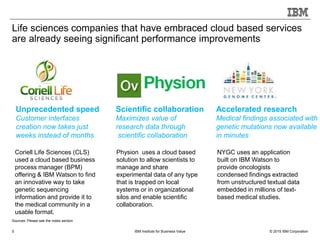
Coriell Life Sciences (CLS)
used a cloud based business
process manager (BPM)
offering & IBM Watson to find
an innovative way to take
genetic sequencing
information and provide it to
the medical community in a
usable format.
Sources: Please see the notes section
Life sciences companies that have embraced cloud based services
are already seeing significant performance improvements
Unprecedented speed
Customer interfaces
creation now takes just
weeks instead of months
NYGC uses an application
built on IBM Watson to
provide oncologists
condensed findings extracted
from unstructured textual data
embedded in millions of text-
based medical studies.
Accelerated research
Medical findings associated with
genetic mutations now available
in minutes
Physion uses a cloud based
solution to allow scientists to
manage and share
experimental data of any type
that is trapped on local
systems or in organizational
silos and enable scientific
collaboration.
Scientific collaboration
Maximizes value of
research data through
scientific collaboration
© 2015 IBM CorporationIBM Institute for Business Value6
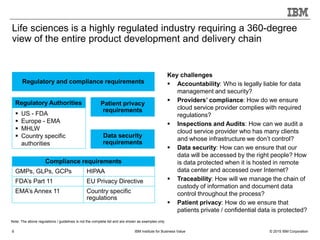
Life sciences is a highly regulated industry requiring a 360-degree
view of the entire product development and delivery chain
Regulatory and compliance requirements
Patient privacy
requirements
Data security
requirements
Compliance requirements
GMPs, GLPs, GCPs HIPAA
FDA’s Part 11 EU Privacy Directive
EMA’s Annex 11 Country specific
regulations
Key challenges
ď‚§ Accountability: Who is legally liable for data
management and security?
 Providers’ compliance: How do we ensure
cloud service provider complies with required
regulations?
ď‚§ Inspections and Audits: How can we audit a
cloud service provider who has many clients
and whose infrastructure we don’t control?
ď‚§ Data security: How can we ensure that our
data will be accessed by the right people? How
is data protected when it is hosted in remote
data center and accessed over Internet?
ď‚§ Traceability: How will we manage the chain of
custody of information and document data
control throughout the process?
ď‚§ Patient privacy: How do we ensure that
patients private / confidential data is protected?
Regulatory Authorities
ď‚§ US - FDA
ď‚§ Europe - EMA
ď‚§ MHLW
ď‚§ Country specific
authorities
Note: The above regulations / guidelines is not the complete list and are shown as examples only
© 2015 IBM CorporationIBM Institute for Business Value7
Heather Fraser
HFRASER@uk.ibm.com
44-7734-325459
Christopher Hines
christopher.hines@us.ibm.com
1-908-963-7237
James McCormack
mccormac@us.ibm.com
1-304-942-9172
To find out more about IBM Institute for Business Value’s point-of-
view on Cloud in Life Sciences please contact…
IBM LIFE SCIENCES INDUSTRY CONTACTSIBM LIFE SCIENCES INDUSTRY CONTACTS
Sandip V Patel
sandip.patel@us.ibm.com
1-781-472-8200 (T/L: 779-8200)
Lauren O’Donnell
lhodonne@us.ibm.com
1-310-245-1375
Karen Parrish
kaparris@us.ibm.com
1-914-766-1030
[FACE
PIC]
[FACE
PIC]
[FACE
PIC]
[FACE
PIC]
[FACE
PIC]
[FACE
PIC]
© 2015 IBM CorporationIBM Institute for Business Value8
IBM Institute For Business
For more details, please visit http://www-935.ibm.com/services/us/gbs/thoughtleadership/

An IBM Perspective: Life Sciences in the Cloud

  • 1.
    © 2015 IBMCorporation An Introduction to Cloud in Life Sciences IBM Institute for Business Value 12 January 2015
  • 2.
    © 2015 IBMCorporationIBM Institute for Business Value2 Cloud in Life Sciences – an overview  Cloud computing offers a powerful service delivery and consumption model that organizations can use to drive business model innovation, enhance revenues and operational efficiency  Strict regulatory control in the life sciences industry has slowed many organizations from adopting cloud; however this is changing fast as with sufficient safeguards implemented, concerns and challenges can be addressed  The life sciences industry is adopting cloud to realize many benefits • Transform its business operations • Enhance efficiency and cost control • Collaborate with different entities across the healthcare ecosystem • Extend its ecosystem from drug discovery to ongoing patient care  IBM believe a well planned cloud strategy focusing on how business can be cloud-enabled will provide life sciences organizations with long term benefits
  • 3.
    © 2015 IBMCorporationIBM Institute for Business Value3 As they advance along their transformational journey, life sciences leaders focus on three key imperatives CREATE COLLABORATIVE OPERATING MODELS REDUCE COMPLEXITY AND STREAMLINE OPERATIONS DRIVE INNOVATION WHILE MANAGING COST Cloud computing enables collaboration, improves efficiency and expands innovation potential Enhancing collaboration with external partners by breaking the silos that separate internal functions, to solve traditional R&D challenges Use technology and processes to manage the increasing complexity associated with drug and medical device research, development and manufacturing Leverage big data and analytics, and a networked R&D model to expedite new drug research and optimize the costs associated with research and development
  • 4.
    © 2015 IBMCorporationIBM Institute for Business Value4 Cloud enables life sciences firms to engage, operate and innovate in smarter ways  Resets focus on scientific innovation; reduces time spent on transaction work  Facilitates new, multi-nodal business models  Unlocks tremendous value through use of analytics  Allows rapid and reliable information sharing  Extends knowledge and data networks  Reduces risk associated with compliance and delivery of compliant infrastructure Accelerates innovation and unlocks value Efficient R&D through collaboration Cost reduction and streamlined operations $  Increases resource utilization  Simplifies processes, reducing administration cost  Integrates data silos and optimizes information flow
  • 5.
    © 2015 IBMCorporationIBM Institute for Business Value5 Coriell Life Sciences (CLS) used a cloud based business process manager (BPM) offering & IBM Watson to find an innovative way to take genetic sequencing information and provide it to the medical community in a usable format. Sources: Please see the notes section Life sciences companies that have embraced cloud based services are already seeing significant performance improvements Unprecedented speed Customer interfaces creation now takes just weeks instead of months NYGC uses an application built on IBM Watson to provide oncologists condensed findings extracted from unstructured textual data embedded in millions of text- based medical studies. Accelerated research Medical findings associated with genetic mutations now available in minutes Physion uses a cloud based solution to allow scientists to manage and share experimental data of any type that is trapped on local systems or in organizational silos and enable scientific collaboration. Scientific collaboration Maximizes value of research data through scientific collaboration
  • 6.
    © 2015 IBMCorporationIBM Institute for Business Value6 Life sciences is a highly regulated industry requiring a 360-degree view of the entire product development and delivery chain Regulatory and compliance requirements Patient privacy requirements Data security requirements Compliance requirements GMPs, GLPs, GCPs HIPAA FDA’s Part 11 EU Privacy Directive EMA’s Annex 11 Country specific regulations Key challenges  Accountability: Who is legally liable for data management and security?  Providers’ compliance: How do we ensure cloud service provider complies with required regulations?  Inspections and Audits: How can we audit a cloud service provider who has many clients and whose infrastructure we don’t control?  Data security: How can we ensure that our data will be accessed by the right people? How is data protected when it is hosted in remote data center and accessed over Internet?  Traceability: How will we manage the chain of custody of information and document data control throughout the process?  Patient privacy: How do we ensure that patients private / confidential data is protected? Regulatory Authorities  US - FDA  Europe - EMA  MHLW  Country specific authorities Note: The above regulations / guidelines is not the complete list and are shown as examples only
  • 7.
    © 2015 IBMCorporationIBM Institute for Business Value7 Heather Fraser HFRASER@uk.ibm.com 44-7734-325459 Christopher Hines christopher.hines@us.ibm.com 1-908-963-7237 James McCormack mccormac@us.ibm.com 1-304-942-9172 To find out more about IBM Institute for Business Value’s point-of- view on Cloud in Life Sciences please contact… IBM LIFE SCIENCES INDUSTRY CONTACTSIBM LIFE SCIENCES INDUSTRY CONTACTS Sandip V Patel sandip.patel@us.ibm.com 1-781-472-8200 (T/L: 779-8200) Lauren O’Donnell lhodonne@us.ibm.com 1-310-245-1375 Karen Parrish kaparris@us.ibm.com 1-914-766-1030 [FACE PIC] [FACE PIC] [FACE PIC] [FACE PIC] [FACE PIC] [FACE PIC]
  • 8.
    © 2015 IBMCorporationIBM Institute for Business Value8 IBM Institute For Business For more details, please visit http://www-935.ibm.com/services/us/gbs/thoughtleadership/