While cloud computing offers clinical laboratories the advantage of lowers costs of
infrastructure and better storage, among others, it also poses challenges of data integrity and
security. IP-driven automated testing frameworks such as Indium’s iSafe provide the labs with a
quick, accurate and comprehensive assessment of the health and performance of their services
on the cloud platform.
AUTOMATED TESTING OF LAB MANAGEMENT
SERVICES ON CLOUD
WHITEPAPER
1 ON A CLOUD
Cloud computing, referring to delivery
of hosted services over the internet, has
greatly facilitated organisations to consume
compute power on demand, like electricity,
thereby enabling them to focus their
investments and resources on their core
business rather than on IT infrastructure.
Cloud can be deployed on private,
public or hybrid models, and accessed as
Infrastructure as a Service (IaaS), Software
as a Service (SaaS) or Platform as a Service
(PaaS).
Cloud technology, primarily consisting
of virtual machine (VMs), storage and
applications accessed through the Internet,
provides organisations with benefit on
several counts:
Self-service provisioning: Compute
resources for almost any type
of workload can be accessed
on demand. This eliminates the
traditional need for a dedicated
IT team to manage compute
resources.
Cost reduction: Organisations need
not invest in expensive infrastructure
or IT resources, using it better to
improve their core business.
Elasticity: They can scale up or scale
down infrastructure based on the
demand.
© Indium Software | www.indiumsoft.com
Pay per use: They pay only for the
resources and workloads they use.
Backup & Recovery: Most cloud
service providers have backup and
recovery solutions, making it easier
than when companies have to invest
in their own recovery solutions
Software Integration: In the
cloud, software integration and
customization with great ease, and
many a times, automatically.
Information at Fingertips: Accessing
information from anywhere, any
time, becomes easier when your
organisation is on the cloud.
Time effective: Key to adopting
cloud today is the advantage of
quick deployment that it offers.
Considering the pace at which new
products are released and updated,
cloud can ensure that you are
functional within minutes.
2.1 The Cloud Shift
Given the benefits of cloud,
Cloud Security Alliance’s finding
is hardly surprising –33 per cent
of organizations are eager to and
86 per cent spend at least part of
their IT budget on cloud services.
Nearly 79 per cent of companies
get requests from end users
periodically each to expand their
cloud investments. File sharing and
collaboration, communication,
social media, and content sharing
are some of the most common
reasons for requesting cloud
services.
According to a Gartner study, by
2020 “Cloud Shift” will affect more
than $1 Trillion IT Spending in the
next five years, making it one of the
most disruptive IT solutions in the
digital age.
Forrester research suggests that
cloud “middleware”, which includes
online database management,
integration, file management and
communications, will touch $14
billion by 2020, up from $4 billion
2016, and will account for 6 per
cent of the total.
© Indium Software | www.indiumsoft.com
2 CLOUD MARKET SIZE
2.2 Healthcare
Healthcare industry is one of the
early adopters of cloud and is
expected to be worth $9.48 billion
by 2020, up from $3.73 billion in
2015, growing at a CAGR of 20.5
per cent, according to a Markets
and Markets report.
A Global News Wire report suggests
that Healthcare cloud computing
market will be worth $6.8 billion by
2018, with private cloud likely to
contribute to highest.
2.3 Lab Information Sys-
tems
The laboratory information system
in the healthcare industry is a critical
component and its market revenue
is expected to increase at a CAGR
of 9.0 per cent between 2015
and 2025, when it will touch US$
2,745.3 million.
A Grand View Research study values
this segment to touch $ 3.83 billion
by 2025, up from $ 2.15 billion in
2015.
Another study by Markets and
Markets indicates that the laboratory
information market will reach $
901.6 Million by 2021, growing
from $ 634.0 Million in 2016, at a
CAGR of 7.3 per cent.
2.4 Growth Factors
Some of the key reasons for the
growth of the LIMS (Lab Information
Management Systems) have been
the improved per capita healthcare
expenditure across developed and
developing countries. This has led
to better quality of patient care and
treatment options, supported by
information technology solutions
that facilitate process-oriented
approach to healthcare operations
and maintenance of information.
Regulatory harmonization and
formation of structured risk-based
regulatory framework for healthcare
IT initiatives is expected to further
encourage secure exchange
of data between clinicians and
systems while ensuring patient data
security and cost-efficient workflow
management systems.
© Indium Software | www.indiumsoft.com
3.1 Cloud in Healthcare
The healthcare industry is
undergoing a transformation.
On the one hand, better medical
technology has improved the
understanding about health
issues. Treatment options have
grown by leaps and bounds. Non-
intrusive methods are becoming
popular. Collection of patient
data, interlinking of records and
interfacing between different
systems for documenting medical
history enable accurate treatment.
On the other hand, patients are
better informed and demand a
right to know. Wearable technology
has also enabled them to remain
connected to their physicians, and
constant monitoring and timely
delivery of healthcare solutions has
become a reality.
At the heart of this transformation
is cloud, which facilitates better
collaborations between the various
stakeholders at lower costs of
investments. Healthcare industry’s
shift to an information-centric care
delivery model is enabled in part
by open standards that facilitate
better collaboration and information
sharing.
Cloud computing provides the
various stakeholders such as
3 THE CLOUD FACTOR
hospitals, insurance companies,
diagnostics to:
•	 leverage better computing
capabilities at lower costs
•	 focus on innovation due to lower
technology barriers
•	 collaborate better due to
improved information sharing,
knowledge management and
predictive analytics
•	 manage digital data effectively
3.2 Diagnostics Manage-
ment
Clinical Laboratory Services Market
size is expected to grow at a CAGR
of 6.4 per cent from $196.9 billion
in 2015 to 2024 and contributes
around 80 per cent to healthcare
diagnostics industry, according to
Global Markets Insights research.
Apart from diagnostics in the
hospital, the healthcare industry has
several leading diagnostic chains
as well as small players. The larger
players have their own centres in
different parts of the country, as
well as manage the centres in the
hospitals.
To manage the chains better, nearly
30 per cent of the laboratories in
developed countries such as North
America, Europe and Japan have
opted for laboratory automation
and technologically advanced
processes for data management
to facilitate rapid and seamless
operations for greater efficiency and
accuracy of clinical processes and
results.
Some of the key trends in
Diagnostics segment are:
•	 Home collection of samples
•	 Outreach programs in
remote locations and rural
areas for servicing them
better
•	 Centralised diagnostic
services
•	 Need for better logistics and
information management
systems
•	 Dissemination of results on
multiple media – on the
mobile, by email, etc.
•	 Interfacing with the physician
to help provide treatment
remotely
Being on cloud helps the labs
leverage its speed and scalability for
faster delivery cycles.
But, it is not without its challenges.
© Indium Software | www.indiumsoft.com
Being in a public or hybrid cloud and interfacing with multiple systems raise certain concerns:
1.	 Data integrity and prevention of data loss
2.	 Security of sensitive data
3.	 Timely availability of patient health data
4.	 Timely synchronization of patient health data
Some of the causes for these concerns include:
•	 Network availability
•	 Conformance to security requirements
•	 Proper implementation of regulatory, compliance and internal security and privacy controls
4 CLOUD CHALLENGES
5 TESTING FOR CLOUD
For the diagnostic services to function effectively on cloud, it is important to
test before release as well as for updates.
5.1 Strategy
The Testing Strategy will depend on
three factors:
1.	 Whether it is tested at the time
of migrating into the cloud
2.	 Whether it is already installed in
cloud and
3.	 Whether it is built on the cloud
itself
Once that has been established, the
next stage is to take account of the
components:
•	 the virtualized infrastructure
•	 network
•	 application business logic
•	 end-user experience
•	 data security and integrity
Applications needing testing
include business workflow testing,
exceptions mechanisms, simulating
failure scenarios and disaster
recovery scenarios. In case of
enterprise application integration
on cloud, then testing would include
comprehensive integration testing,
API testing and billing mechanism
testing.
Moreover, web services automation,
capacity testing, release manage-
ment, integration of the solution on/
off premise systems also become
critical and need to be tested
extensively for the laboratory man-
agement service on cloud to function
efficiently.
5.2 Comprehensive Testing
An ideal testing partner will test the
cloud deployment comprehensively
in the following areas:
5.2.1 Functional testing
These would include:
•	 System Verification Testing
to ensure modules function
correctly and interact as
expected with one another.
•	 Acceptance Testing to ensure it
meets user expectations.
•	 Interoperability Testing to not
only check its functioning
smoothly on all platforms,
but also so that it moves from
cloud infrastructure to another
smoothly.
•	
5.2.2 Performance Testing
Apart from functionality, the cloud-
based solution needs to be tested
© Indium Software | www.indiumsoft.com
for performance. This includes:
•	 Response time regardless of the
number requests to the system at
any given time
•	 Latency testing
•	 Workload balancing and stress
testing regardless of increase/
decrease in load and stress
.
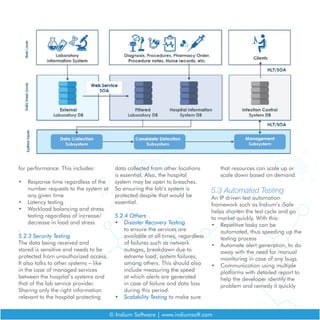
5.2.3 Security Testing
The data being received and
stored is sensitive and needs to be
protected from unauthorized access.
It also talks to other systems – like
in the case of managed services
between the hospital’s systems and
that of the lab service provider.
Sharing only the right information
relevant to the hospital protecting
data collected from other locations
is essential. Also, the hospital
system may be open to breaches.
So ensuring the lab’s system is
protected despite that would be
essential.
5.2.4 Others
•	 Disaster Recovery Testing
to ensure the services are
available at all times, regardless
of failures such as network
outages, breakdown due to
extreme load, system failures,
among others. This should also
include measuring the speed
at which alerts are generated
in case of failure and data loss
during this period.
•	 Scalability Testing to make sure
that resources can scale up or
scale down based on demand.
5.3 Automated Testing
An IP driven test automation
framework such as Indium’s iSafe
helps shorten the test cycle and go
to market quickly. With this:
•	 Repetitive tasks can be
automated, thus speeding up the
testing process
•	 Automate alert generation, to do
away with the need for manual
monitoring in case of any bugs
•	 Communication using multiple
platforms with detailed report to
help the developer identify the
problem and remedy it quickly
6 CONCLUSION
Clinical laboratory industry is undergoing tremendous changes triggered
by the digital revolution, and especially as cloud provides access to the best
of technologies at affordable costs. But it comes with its own challenges.
Automated testing enables identifying and fixing any hurdles to smooth
functioning of the apps that are mission critical, considering the personal
medical data and history they carry of the patients. This needs data integrity
and security, two other factors that are vulnerable on the cloud and need to
be part of a comprehensive testing strategy.
A test automation framework provides a fast, reliable and robust QA testing
solution that can be customised to suit the needs of the lab while assuring
them of the scalability and security of the cloud.
© Indium Software | www.indiumsoft.com
CONTACT US
USA
United Kingdom
MALAYSIA SALES INQUIRIES GENERAL ENQUIRIES
INDIA
SUNNYVALE
Suite 210, 1250 Oakmead Parkway
Sunnyvale, CA – 94085.
Phone: +1(408) 501-8844
Fax: +1(408) 501-8808
LONDON
Indium Software
71-75 Shelton Street
London, WC2H 9JQ.
KAULA LUMPUR
Suite 8-1 & 8-2, Level 8, Menara
CIMB
No.1, Jalan Stesen Sentral 2
Kuala Lumpur – 50470.
Phone: +60 (3) 2298 8465
Fax: +60 (3) 2298 8201
americas.sales@indiumsoft.com
apac.sales@indiumsoft.com
emea.sales@indiumsoft.com
india.sales@indiumsoft.com
sales@indiumsoft.com
careers@indiumsoft.com
info@indiumsoft.com
CHENNAI
VDS House
41, 2nd Floor, Cathedral Road
Chennai – 600 086.
Phone: +91-44-2811 6330
Fax: +91-44-4210 4033
BENGALURU
Salarpuria Adonis, 2nd Floor
Binnamangala
3/1, Old Madras Road
Kadiranapalya, Indira Nagar
Bengaluru – 560 038.
Phone: +91-80-6784 7500
ATLANTA
Crown Office Suites
1870 The Exchange
Suite 100
Atlanta, GA – 30339.
Phone: +1 (770) 989-7302
PRINCETON
Carnegie Center
Suite 150, 300 Carnegie Center
Princeton, NJ – 08540.
Phone: +1 (609) 786-2423
© Indium Software | www.indiumsoft.com

AUTOMATED TESTING OF LAB MANAGEMENT SERVICES ON CLOUD

  • 1.
    While cloud computingoffers clinical laboratories the advantage of lowers costs of infrastructure and better storage, among others, it also poses challenges of data integrity and security. IP-driven automated testing frameworks such as Indium’s iSafe provide the labs with a quick, accurate and comprehensive assessment of the health and performance of their services on the cloud platform. AUTOMATED TESTING OF LAB MANAGEMENT SERVICES ON CLOUD WHITEPAPER
  • 2.
    1 ON ACLOUD Cloud computing, referring to delivery of hosted services over the internet, has greatly facilitated organisations to consume compute power on demand, like electricity, thereby enabling them to focus their investments and resources on their core business rather than on IT infrastructure. Cloud can be deployed on private, public or hybrid models, and accessed as Infrastructure as a Service (IaaS), Software as a Service (SaaS) or Platform as a Service (PaaS). Cloud technology, primarily consisting of virtual machine (VMs), storage and applications accessed through the Internet, provides organisations with benefit on several counts: Self-service provisioning: Compute resources for almost any type of workload can be accessed on demand. This eliminates the traditional need for a dedicated IT team to manage compute resources. Cost reduction: Organisations need not invest in expensive infrastructure or IT resources, using it better to improve their core business. Elasticity: They can scale up or scale down infrastructure based on the demand. © Indium Software | www.indiumsoft.com Pay per use: They pay only for the resources and workloads they use. Backup & Recovery: Most cloud service providers have backup and recovery solutions, making it easier than when companies have to invest in their own recovery solutions Software Integration: In the cloud, software integration and customization with great ease, and many a times, automatically. Information at Fingertips: Accessing information from anywhere, any time, becomes easier when your organisation is on the cloud. Time effective: Key to adopting cloud today is the advantage of quick deployment that it offers. Considering the pace at which new products are released and updated, cloud can ensure that you are functional within minutes.
  • 3.
    2.1 The CloudShift Given the benefits of cloud, Cloud Security Alliance’s finding is hardly surprising –33 per cent of organizations are eager to and 86 per cent spend at least part of their IT budget on cloud services. Nearly 79 per cent of companies get requests from end users periodically each to expand their cloud investments. File sharing and collaboration, communication, social media, and content sharing are some of the most common reasons for requesting cloud services. According to a Gartner study, by 2020 “Cloud Shift” will affect more than $1 Trillion IT Spending in the next five years, making it one of the most disruptive IT solutions in the digital age. Forrester research suggests that cloud “middleware”, which includes online database management, integration, file management and communications, will touch $14 billion by 2020, up from $4 billion 2016, and will account for 6 per cent of the total. © Indium Software | www.indiumsoft.com 2 CLOUD MARKET SIZE 2.2 Healthcare Healthcare industry is one of the early adopters of cloud and is expected to be worth $9.48 billion by 2020, up from $3.73 billion in 2015, growing at a CAGR of 20.5 per cent, according to a Markets and Markets report. A Global News Wire report suggests that Healthcare cloud computing market will be worth $6.8 billion by 2018, with private cloud likely to contribute to highest. 2.3 Lab Information Sys- tems The laboratory information system in the healthcare industry is a critical component and its market revenue is expected to increase at a CAGR of 9.0 per cent between 2015 and 2025, when it will touch US$ 2,745.3 million. A Grand View Research study values this segment to touch $ 3.83 billion by 2025, up from $ 2.15 billion in 2015. Another study by Markets and Markets indicates that the laboratory information market will reach $ 901.6 Million by 2021, growing from $ 634.0 Million in 2016, at a CAGR of 7.3 per cent. 2.4 Growth Factors Some of the key reasons for the growth of the LIMS (Lab Information Management Systems) have been the improved per capita healthcare expenditure across developed and developing countries. This has led to better quality of patient care and treatment options, supported by information technology solutions that facilitate process-oriented approach to healthcare operations and maintenance of information. Regulatory harmonization and formation of structured risk-based regulatory framework for healthcare IT initiatives is expected to further encourage secure exchange of data between clinicians and systems while ensuring patient data security and cost-efficient workflow management systems.
  • 4.
    © Indium Software| www.indiumsoft.com 3.1 Cloud in Healthcare The healthcare industry is undergoing a transformation. On the one hand, better medical technology has improved the understanding about health issues. Treatment options have grown by leaps and bounds. Non- intrusive methods are becoming popular. Collection of patient data, interlinking of records and interfacing between different systems for documenting medical history enable accurate treatment. On the other hand, patients are better informed and demand a right to know. Wearable technology has also enabled them to remain connected to their physicians, and constant monitoring and timely delivery of healthcare solutions has become a reality. At the heart of this transformation is cloud, which facilitates better collaborations between the various stakeholders at lower costs of investments. Healthcare industry’s shift to an information-centric care delivery model is enabled in part by open standards that facilitate better collaboration and information sharing. Cloud computing provides the various stakeholders such as 3 THE CLOUD FACTOR hospitals, insurance companies, diagnostics to: • leverage better computing capabilities at lower costs • focus on innovation due to lower technology barriers • collaborate better due to improved information sharing, knowledge management and predictive analytics • manage digital data effectively 3.2 Diagnostics Manage- ment Clinical Laboratory Services Market size is expected to grow at a CAGR of 6.4 per cent from $196.9 billion in 2015 to 2024 and contributes around 80 per cent to healthcare diagnostics industry, according to Global Markets Insights research. Apart from diagnostics in the hospital, the healthcare industry has several leading diagnostic chains as well as small players. The larger players have their own centres in different parts of the country, as well as manage the centres in the hospitals. To manage the chains better, nearly 30 per cent of the laboratories in developed countries such as North America, Europe and Japan have opted for laboratory automation and technologically advanced processes for data management to facilitate rapid and seamless operations for greater efficiency and accuracy of clinical processes and results. Some of the key trends in Diagnostics segment are: • Home collection of samples • Outreach programs in remote locations and rural areas for servicing them better • Centralised diagnostic services • Need for better logistics and information management systems • Dissemination of results on multiple media – on the mobile, by email, etc. • Interfacing with the physician to help provide treatment remotely Being on cloud helps the labs leverage its speed and scalability for faster delivery cycles. But, it is not without its challenges.
  • 5.
    © Indium Software| www.indiumsoft.com Being in a public or hybrid cloud and interfacing with multiple systems raise certain concerns: 1. Data integrity and prevention of data loss 2. Security of sensitive data 3. Timely availability of patient health data 4. Timely synchronization of patient health data Some of the causes for these concerns include: • Network availability • Conformance to security requirements • Proper implementation of regulatory, compliance and internal security and privacy controls 4 CLOUD CHALLENGES 5 TESTING FOR CLOUD For the diagnostic services to function effectively on cloud, it is important to test before release as well as for updates. 5.1 Strategy The Testing Strategy will depend on three factors: 1. Whether it is tested at the time of migrating into the cloud 2. Whether it is already installed in cloud and 3. Whether it is built on the cloud itself Once that has been established, the next stage is to take account of the components: • the virtualized infrastructure • network • application business logic • end-user experience • data security and integrity Applications needing testing include business workflow testing, exceptions mechanisms, simulating failure scenarios and disaster recovery scenarios. In case of enterprise application integration on cloud, then testing would include comprehensive integration testing, API testing and billing mechanism testing. Moreover, web services automation, capacity testing, release manage- ment, integration of the solution on/ off premise systems also become critical and need to be tested extensively for the laboratory man- agement service on cloud to function efficiently. 5.2 Comprehensive Testing An ideal testing partner will test the cloud deployment comprehensively in the following areas: 5.2.1 Functional testing These would include: • System Verification Testing to ensure modules function correctly and interact as expected with one another. • Acceptance Testing to ensure it meets user expectations. • Interoperability Testing to not only check its functioning smoothly on all platforms, but also so that it moves from cloud infrastructure to another smoothly. • 5.2.2 Performance Testing Apart from functionality, the cloud- based solution needs to be tested
  • 6.
    © Indium Software| www.indiumsoft.com for performance. This includes: • Response time regardless of the number requests to the system at any given time • Latency testing • Workload balancing and stress testing regardless of increase/ decrease in load and stress . 5.2.3 Security Testing The data being received and stored is sensitive and needs to be protected from unauthorized access. It also talks to other systems – like in the case of managed services between the hospital’s systems and that of the lab service provider. Sharing only the right information relevant to the hospital protecting data collected from other locations is essential. Also, the hospital system may be open to breaches. So ensuring the lab’s system is protected despite that would be essential. 5.2.4 Others • Disaster Recovery Testing to ensure the services are available at all times, regardless of failures such as network outages, breakdown due to extreme load, system failures, among others. This should also include measuring the speed at which alerts are generated in case of failure and data loss during this period. • Scalability Testing to make sure that resources can scale up or scale down based on demand. 5.3 Automated Testing An IP driven test automation framework such as Indium’s iSafe helps shorten the test cycle and go to market quickly. With this: • Repetitive tasks can be automated, thus speeding up the testing process • Automate alert generation, to do away with the need for manual monitoring in case of any bugs • Communication using multiple platforms with detailed report to help the developer identify the problem and remedy it quickly
  • 7.
    6 CONCLUSION Clinical laboratoryindustry is undergoing tremendous changes triggered by the digital revolution, and especially as cloud provides access to the best of technologies at affordable costs. But it comes with its own challenges. Automated testing enables identifying and fixing any hurdles to smooth functioning of the apps that are mission critical, considering the personal medical data and history they carry of the patients. This needs data integrity and security, two other factors that are vulnerable on the cloud and need to be part of a comprehensive testing strategy. A test automation framework provides a fast, reliable and robust QA testing solution that can be customised to suit the needs of the lab while assuring them of the scalability and security of the cloud. © Indium Software | www.indiumsoft.com
  • 8.
    CONTACT US USA United Kingdom MALAYSIASALES INQUIRIES GENERAL ENQUIRIES INDIA SUNNYVALE Suite 210, 1250 Oakmead Parkway Sunnyvale, CA – 94085. Phone: +1(408) 501-8844 Fax: +1(408) 501-8808 LONDON Indium Software 71-75 Shelton Street London, WC2H 9JQ. KAULA LUMPUR Suite 8-1 & 8-2, Level 8, Menara CIMB No.1, Jalan Stesen Sentral 2 Kuala Lumpur – 50470. Phone: +60 (3) 2298 8465 Fax: +60 (3) 2298 8201 americas.sales@indiumsoft.com apac.sales@indiumsoft.com emea.sales@indiumsoft.com india.sales@indiumsoft.com sales@indiumsoft.com careers@indiumsoft.com info@indiumsoft.com CHENNAI VDS House 41, 2nd Floor, Cathedral Road Chennai – 600 086. Phone: +91-44-2811 6330 Fax: +91-44-4210 4033 BENGALURU Salarpuria Adonis, 2nd Floor Binnamangala 3/1, Old Madras Road Kadiranapalya, Indira Nagar Bengaluru – 560 038. Phone: +91-80-6784 7500 ATLANTA Crown Office Suites 1870 The Exchange Suite 100 Atlanta, GA – 30339. Phone: +1 (770) 989-7302 PRINCETON Carnegie Center Suite 150, 300 Carnegie Center Princeton, NJ – 08540. Phone: +1 (609) 786-2423 © Indium Software | www.indiumsoft.com