CHAPTER 10
IMMEDIATE ACTION DRILLS
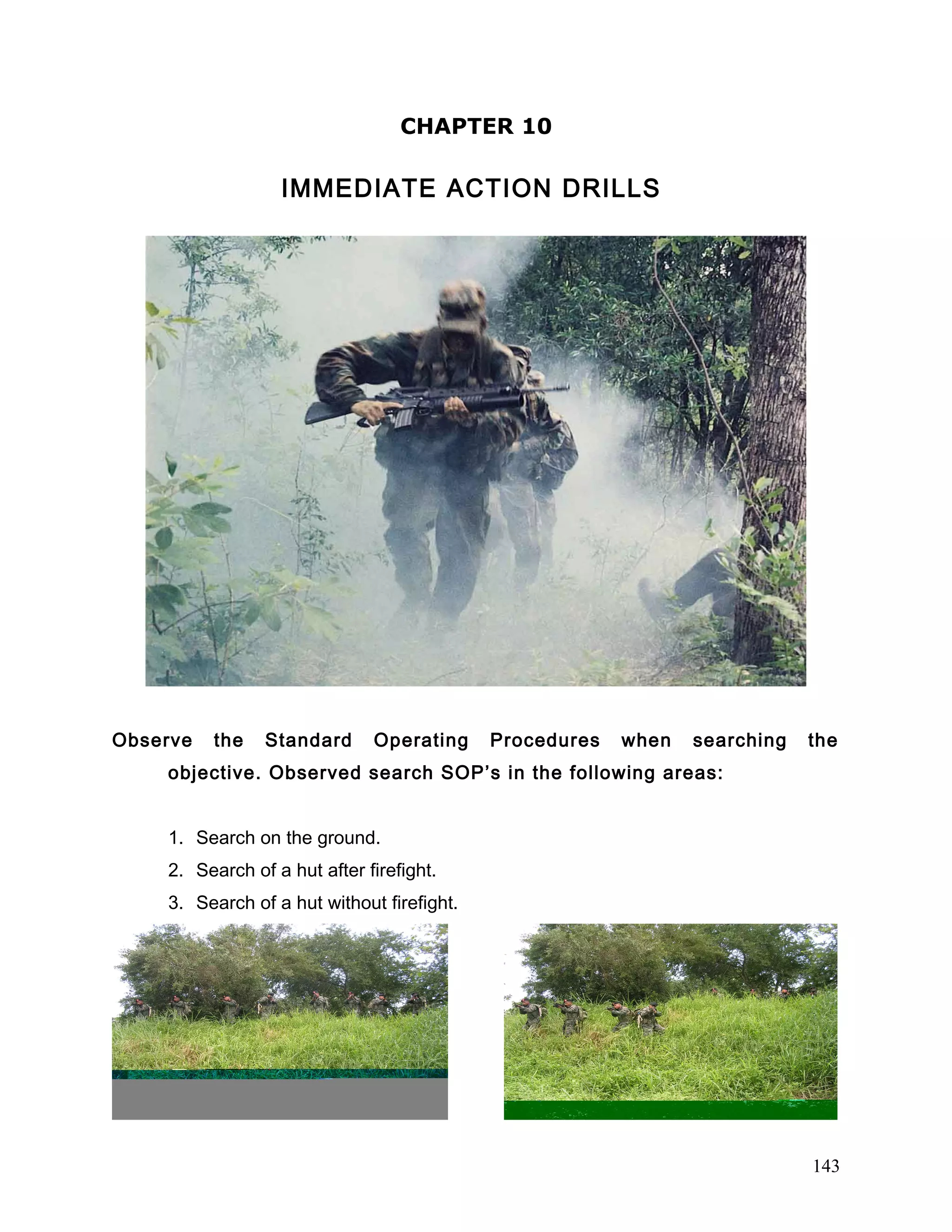
Observe the Standard Operating Procedures when searching the
objective. Observed search SOP’s in the following areas:
1. Search on the ground.
2. Search of a hut after firefight.
3. Search of a hut without firefight.
143
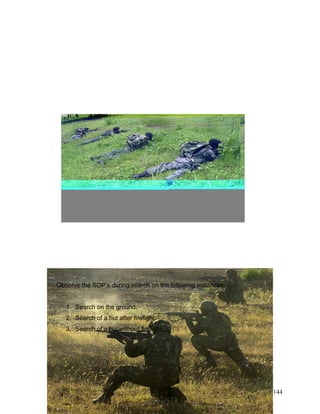
Observe the SOP’s during search on the following instances:
1. Search on the ground.
2. Search of a hut after firefight.
3. Search of a hut without firefight.
144
145
PERFORMANCE STEPS
1. Search on the Ground-
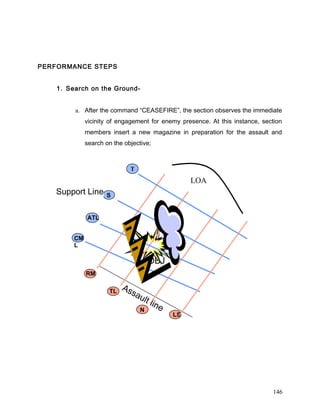
a. After the command “CEASEFIRE”, the section observes the immediate
vicinity of engagement for enemy presence. At this instance, section
members insert a new magazine in preparation for the assault and
search on the objective;
146
OBJ
Assault line
RM
LS
ATL
CM
L
N
TL
S
T
LOA
Support Line
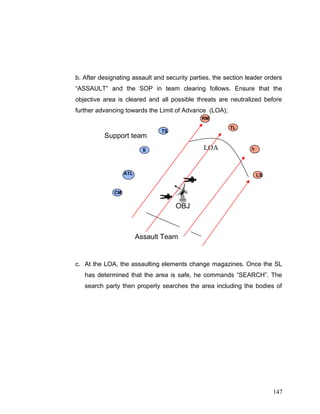
b. After designating assault and security parties, the section leader orders
“ASSAULT” and the SOP in team clearing follows. Ensure that the
objective area is cleared and all possible threats are neutralized before
further advancing towards the Limit of Advance (LOA);
c. At the LOA, the assaulting elements change magazines. Once the SL
has determined that the area is safe, he commands “SEARCH”. The
search party then properly searches the area including the bodies of
147
OBJ
ATL
S
RM
TL
TS
CM
LS
N
Assault Team
Support team
LOA
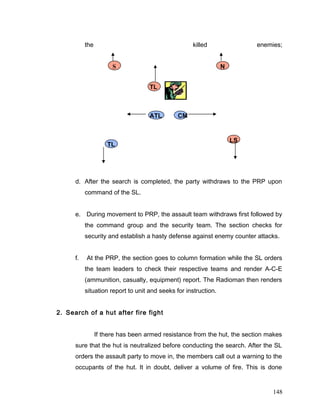
the killed enemies;
d. After the search is completed, the party withdraws to the PRP upon
command of the SL.
e. During movement to PRP, the assault team withdraws first followed by
the command group and the security team. The section checks for
security and establish a hasty defense against enemy counter attacks.
f. At the PRP, the section goes to column formation while the SL orders
the team leaders to check their respective teams and render A-C-E
(ammunition, casualty, equipment) report. The Radioman then renders
situation report to unit and seeks for instruction.
2. Search of a hut after fire fight
If there has been armed resistance from the hut, the section makes
sure that the hut is neutralized before conducting the search. After the SL
orders the assault party to move in, the members call out a warning to the
occupants of the hut. It in doubt, deliver a volume of fire. This is done
148
ATL CM
TL
TL
SL
NS
LS
repeatedly until the hut is cleared using grenades if possible then proceed
as in situation 1.
3. Search of a hut without firefight
a. Before closing in at the hut, members of the section will call out a
warning to the occupants. If there is no response, assault elements
continuously and stealthily approach the hut. SOP on team clearing
follows.
b. In case somebody responds, the SL orders the occupant to come out
and walk towards the position of the nearest team for inspection and
questioning. The team ensures that all other occupants are called out
before conducting search then proceed as in situation 1.
Observe the Standard Operating Procedures on Special Situations.
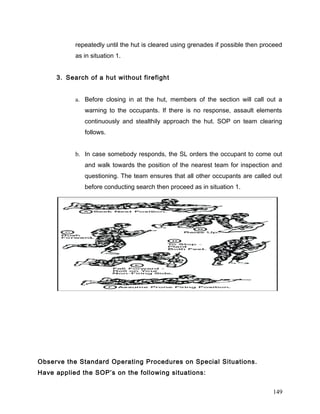
Have applied the SOP’s on the following situations:
149
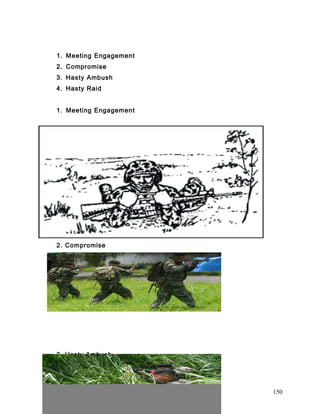
1. Meeting Engagement
2. Compromise
3. Hasty Ambush
4. Hasty Raid
1. Meeting Engagement
2. Compromise
3. Hasty Ambush
150
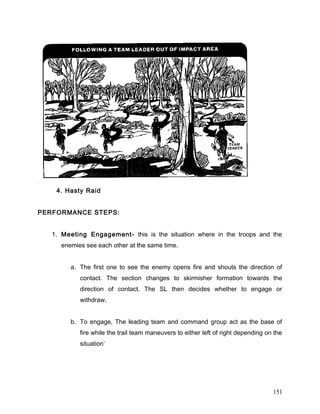
4. Hasty Raid
PERFORMANCE STEPS:
1. Meeting Engagement- this is the situation where in the troops and the
enemies see each other at the same time.
a. The first one to see the enemy opens fire and shouts the direction of
contact. The section changes to skirmisher formation towards the
direction of contact. The SL then decides whether to engage or
withdraw.
b. To engage, The leading team and command group act as the base of
fire while the trail team maneuvers to either left of right depending on the
situation’
151
c. To withdraw, the section disengages by bounds from skirmisher position
to ensure an orderly withdrawal combined with supporting fires.
2. Compromise- the SOP’s to be used by the section when compromised is
applied.
a. The command group provides support by positioning immediately the
gunner and assistant gunner at the possible enemy approach.
b. The trail team searches and clears the surrounding while the lead team
establishes all around security’
c. Once the area has been cleared, the section goes to column formation.
d. The SL distributes the captives to each team.
e. Team leader and contact man of each team interrogate while the rest
provides security.
f. The teams will alternately interrogate the captives and exchange
information obtained.
3. Hasty Ambush- the same principles as in team ambush are applied.
a. The section automatically detracts and occupy a vantage position.
b. The SL assesses whether to engage or not.
c. To engage, the SOP’s on fire distribution and control must be observed:
c.1. Fire Distribution
152
- Whenever possible, the enemy is always numbered
consecutively from lead to tail for linear targets. Otherwise, each
man covers his sector of fire in case the enemy strength could
not be determined.
- Each member picks his own target/s within his sector of fire and
shifts fire when there are no targets within his sector. Sectors
must be interlocking to achieve maximum coverage.
- The SL in most cases shoots the most dangerously armed
and/or the most ranking enemy if the same could be identified.
c.2. Control
- the team engages the enemy no farther that 25 meters unless
forced to fire by any circumstances
- unless otherwise prearranged or during unavoidable situation,
the SL always initiates fire.
4. Hasty Raid- when a section encounters a temporarily halted enemy unit.
a. Lead scout of lead team signals halt upon seeing he enemy and calls for
the TL.
b. The TL signals for the SL to approach upon confirming the target.
c. The SL calls for the other TL and then plans and coordinates a specific
action to be disseminated to each member. The section may opt to
conduct a hasty raid or to disengage.
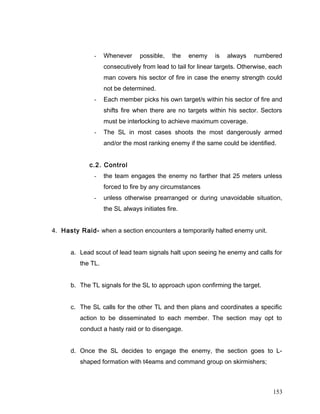
d. Once the SL decides to engage the enemy, the section goes to L-
shaped formation with t4eams and command group on skirmishers;
153
e. SL designates assault and security teams. From the ORP, he designates
a release point where the teams will separate. SL makes sure that LOA’s
are clear in order to avoid crossfires.
f. The section closes in and, upon signal, opens fire on the target. Assault
and search SOP’s follow.
Respond to the different types of Ambush. Have responded accordingly to
the following:
1. Foot Ambush (Near)
2. Foot Ambush (Far)
3. Vehicular Ambush
154
PERFORMANCE STEPS:
1. Foot Ambush (Near)
a. If all the members of the section are caught in the killing zone, they
should immediately return fire and get out of the Killing Zone. SL
reorganizes team members not critically wounded and counter attack
by fire and maneuver if situation permits;
b. If the entire section is not caught in the KZ, the elements in the KZ
drop and return fire and try to move out while the ones not caught fire
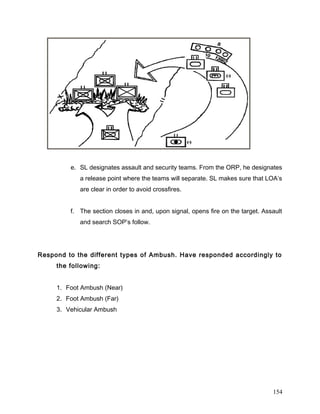
at the enemy’s position and maneuver to gain initiative. Use the M60
for suppressive fire during the maneuver.
2. Foot Ambush (Far)
155
a. The section moves out of the KZ swiftly and reorganizes for a counter
attack. If SL decides to disengage, the section moves out by bounds;
b. The team fired upon, followed by the command group, moves out by
bounds while the other team acts as base of fire;
c. When the SL sees that they are far enough, the section reorganizes
into column formation and move away from enemy fire and
observation.
3. Vehicular Ambush
a. When mounted, each team occupies a side. The command group
positions at the center and back of the driver while the SL may also
seat in front of the truck or beside the driver;
b. Once ambushed, the first to notice will shout the direction of contact. If
driver is alive, let the vehicle continue moving out of the KZ;
c. The team on the near side of the ambush immediately returns fire
while the other, together with the command group, moves out of the
vehicle. Once the team is out of the KZ, it provides the base of fire for
the other team to dismount and extricate from the KZ;
d. If possible, the section maneuvers to launch a counter ambush. The
same principles and SOP’s are applied.
156
157

Iad lecture

  • 1.
    CHAPTER 10 IMMEDIATE ACTIONDRILLS Observe the Standard Operating Procedures when searching the objective. Observed search SOP’s in the following areas: 1. Search on the ground. 2. Search of a hut after firefight. 3. Search of a hut without firefight. 143
  • 2.
    Observe the SOP’sduring search on the following instances: 1. Search on the ground. 2. Search of a hut after firefight. 3. Search of a hut without firefight. 144
  • 3.
  • 4.
    PERFORMANCE STEPS 1. Searchon the Ground- a. After the command “CEASEFIRE”, the section observes the immediate vicinity of engagement for enemy presence. At this instance, section members insert a new magazine in preparation for the assault and search on the objective; 146 OBJ Assault line RM LS ATL CM L N TL S T LOA Support Line
  • 5.
    b. After designatingassault and security parties, the section leader orders “ASSAULT” and the SOP in team clearing follows. Ensure that the objective area is cleared and all possible threats are neutralized before further advancing towards the Limit of Advance (LOA); c. At the LOA, the assaulting elements change magazines. Once the SL has determined that the area is safe, he commands “SEARCH”. The search party then properly searches the area including the bodies of 147 OBJ ATL S RM TL TS CM LS N Assault Team Support team LOA
  • 6.
    the killed enemies; d.After the search is completed, the party withdraws to the PRP upon command of the SL. e. During movement to PRP, the assault team withdraws first followed by the command group and the security team. The section checks for security and establish a hasty defense against enemy counter attacks. f. At the PRP, the section goes to column formation while the SL orders the team leaders to check their respective teams and render A-C-E (ammunition, casualty, equipment) report. The Radioman then renders situation report to unit and seeks for instruction. 2. Search of a hut after fire fight If there has been armed resistance from the hut, the section makes sure that the hut is neutralized before conducting the search. After the SL orders the assault party to move in, the members call out a warning to the occupants of the hut. It in doubt, deliver a volume of fire. This is done 148 ATL CM TL TL SL NS LS
  • 7.
    repeatedly until thehut is cleared using grenades if possible then proceed as in situation 1. 3. Search of a hut without firefight a. Before closing in at the hut, members of the section will call out a warning to the occupants. If there is no response, assault elements continuously and stealthily approach the hut. SOP on team clearing follows. b. In case somebody responds, the SL orders the occupant to come out and walk towards the position of the nearest team for inspection and questioning. The team ensures that all other occupants are called out before conducting search then proceed as in situation 1. Observe the Standard Operating Procedures on Special Situations. Have applied the SOP’s on the following situations: 149
  • 8.
    1. Meeting Engagement 2.Compromise 3. Hasty Ambush 4. Hasty Raid 1. Meeting Engagement 2. Compromise 3. Hasty Ambush 150
  • 9.
    4. Hasty Raid PERFORMANCESTEPS: 1. Meeting Engagement- this is the situation where in the troops and the enemies see each other at the same time. a. The first one to see the enemy opens fire and shouts the direction of contact. The section changes to skirmisher formation towards the direction of contact. The SL then decides whether to engage or withdraw. b. To engage, The leading team and command group act as the base of fire while the trail team maneuvers to either left of right depending on the situation’ 151
  • 10.
    c. To withdraw,the section disengages by bounds from skirmisher position to ensure an orderly withdrawal combined with supporting fires. 2. Compromise- the SOP’s to be used by the section when compromised is applied. a. The command group provides support by positioning immediately the gunner and assistant gunner at the possible enemy approach. b. The trail team searches and clears the surrounding while the lead team establishes all around security’ c. Once the area has been cleared, the section goes to column formation. d. The SL distributes the captives to each team. e. Team leader and contact man of each team interrogate while the rest provides security. f. The teams will alternately interrogate the captives and exchange information obtained. 3. Hasty Ambush- the same principles as in team ambush are applied. a. The section automatically detracts and occupy a vantage position. b. The SL assesses whether to engage or not. c. To engage, the SOP’s on fire distribution and control must be observed: c.1. Fire Distribution 152
  • 11.
    - Whenever possible,the enemy is always numbered consecutively from lead to tail for linear targets. Otherwise, each man covers his sector of fire in case the enemy strength could not be determined. - Each member picks his own target/s within his sector of fire and shifts fire when there are no targets within his sector. Sectors must be interlocking to achieve maximum coverage. - The SL in most cases shoots the most dangerously armed and/or the most ranking enemy if the same could be identified. c.2. Control - the team engages the enemy no farther that 25 meters unless forced to fire by any circumstances - unless otherwise prearranged or during unavoidable situation, the SL always initiates fire. 4. Hasty Raid- when a section encounters a temporarily halted enemy unit. a. Lead scout of lead team signals halt upon seeing he enemy and calls for the TL. b. The TL signals for the SL to approach upon confirming the target. c. The SL calls for the other TL and then plans and coordinates a specific action to be disseminated to each member. The section may opt to conduct a hasty raid or to disengage. d. Once the SL decides to engage the enemy, the section goes to L- shaped formation with t4eams and command group on skirmishers; 153
  • 12.
    e. SL designatesassault and security teams. From the ORP, he designates a release point where the teams will separate. SL makes sure that LOA’s are clear in order to avoid crossfires. f. The section closes in and, upon signal, opens fire on the target. Assault and search SOP’s follow. Respond to the different types of Ambush. Have responded accordingly to the following: 1. Foot Ambush (Near) 2. Foot Ambush (Far) 3. Vehicular Ambush 154
  • 13.
    PERFORMANCE STEPS: 1. FootAmbush (Near) a. If all the members of the section are caught in the killing zone, they should immediately return fire and get out of the Killing Zone. SL reorganizes team members not critically wounded and counter attack by fire and maneuver if situation permits; b. If the entire section is not caught in the KZ, the elements in the KZ drop and return fire and try to move out while the ones not caught fire at the enemy’s position and maneuver to gain initiative. Use the M60 for suppressive fire during the maneuver. 2. Foot Ambush (Far) 155
  • 14.
    a. The sectionmoves out of the KZ swiftly and reorganizes for a counter attack. If SL decides to disengage, the section moves out by bounds; b. The team fired upon, followed by the command group, moves out by bounds while the other team acts as base of fire; c. When the SL sees that they are far enough, the section reorganizes into column formation and move away from enemy fire and observation. 3. Vehicular Ambush a. When mounted, each team occupies a side. The command group positions at the center and back of the driver while the SL may also seat in front of the truck or beside the driver; b. Once ambushed, the first to notice will shout the direction of contact. If driver is alive, let the vehicle continue moving out of the KZ; c. The team on the near side of the ambush immediately returns fire while the other, together with the command group, moves out of the vehicle. Once the team is out of the KZ, it provides the base of fire for the other team to dismount and extricate from the KZ; d. If possible, the section maneuvers to launch a counter ambush. The same principles and SOP’s are applied. 156
  • 15.