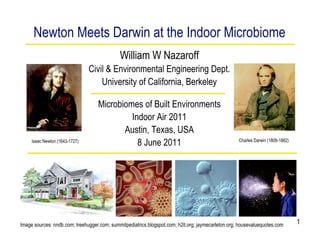
Newton Meets Darwin at the Indoor Microbiome
                                             William W Nazaroff
                                Civil & Environmental Engineering Dept.
                                    University of California, Berkeley

                                   Microbiomes of Built Environments
                                            Indoor Air 2011
                                          Austin, Texas, USA
     Isaac Newton (1643-1727)
                                              8 June 2011                                           Charles Darwin (1809-1882)


Image sources: nndb.com; treehugger.com; summitpediatrics.blogspot.com; h2it.org; jaymecarleton.org; housevaluequotes.com        1
Scope

• Observations about collaborative research
• Attributes of successful joint efforts
• Collaborating on indoor microbiome:
  Opportunities and challenges


• My background (mostly Newtonian!):
   – Physics (BA), EECS (MEng), environmental engineering science (PhD)
   – Civil & Environmental Engineering faculty since 1989
   – Involved in many collaborative projects & programs (small teams and large)
   – Chaired Energy & Resources Group at Berkeley for 4 y

                                                                                  2
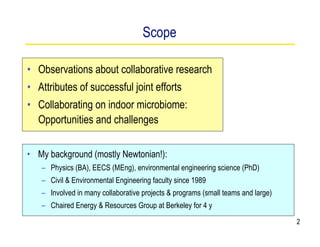
The inspiration behind the talk’s title …


    Physicists and ecologists approach their crafts from different intellectual traditions, as
    exemplified by the differing values they attach to the search for simplification and
    universality. As a particle theorist by training, currently engaged in the study of ecology
    and global change, I have witnessed dysfunctional consequences of this bimodal
    legacy. I argue here for a synthesis of what I call the Newtonian and Darwinian
    approaches to science.


Source: John Harte, Physics Today (October 2002).                                                 3
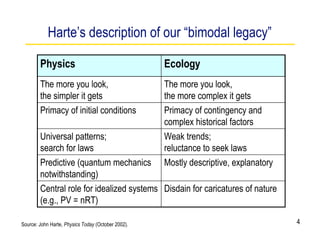
Harte’s description of our “bimodal legacy”

        Physics                                     Ecology
        The more you look,                          The more you look,
        the simpler it gets                         the more complex it gets
        Primacy of initial conditions               Primacy of contingency and
                                                    complex historical factors
        Universal patterns;                         Weak trends;
        search for laws                             reluctance to seek laws
        Predictive (quantum mechanics               Mostly descriptive, explanatory
        notwithstanding)
        Central role for idealized systems Disdain for caricatures of nature
        (e.g., PV = nRT)

Source: John Harte, Physics Today (October 2002).                                     4
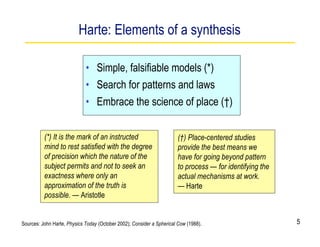
Harte: Elements of a synthesis

                             • Simple, falsifiable models (*)
                             • Search for patterns and laws
                             • Embrace the science of place (†)


          (*) It is the mark of an instructed                           (†) Place-centered studies
          mind to rest satisfied with the degree                        provide the best means we
          of precision which the nature of the                          have for going beyond pattern
          subject permits and not to seek an                            to process — for identifying the
          exactness where only an                                       actual mechanisms at work.
          approximation of the truth is                                 — Harte
          possible. — Aristotle


Sources: John Harte, Physics Today (October 2002); Consider a Spherical Cow (1988).                        5
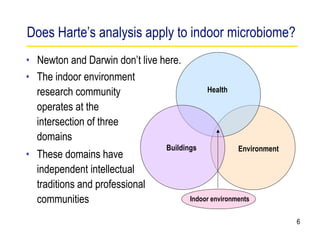
Does Harte’s analysis apply to indoor microbiome?
• Newton and Darwin don’t live here.
• The indoor environment
  research community                        Health

  operates at the
  intersection of three
  domains
                                Buildings             Environment
• These domains have
  independent intellectual
  traditions and professional
  communities                          Indoor environments


                                                                    6
Observations about collaborative research
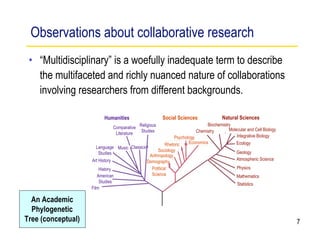
 • “Multidisciplinary” is a woefully inadequate term to describe
   the multifaceted and richly nuanced nature of collaborations
   involving researchers from different backgrounds.

                          Humanities                    Social Sciences                Natural Sciences
                                                                              Biochemistry
                               Comparative Religious                                     Molecular and Cell Biology
                                Literature  Studies                      Chemistry
                                                              Psychology                     Integrative Biology
                                                         Rhetoric    Economics               Ecology
                       Language Music Classics
                                                    Sociology                                Geology
                        Studies                 Anthropology
                    Art History                Demography                                    Atmospheric Science

                        History                  Political                                   Physics
                       American                  Science                                     Mathematics
                        Studies                                                              Statistics
                    Film

  An Academic
  Phylogenetic
Tree (conceptual)                                                                                                     7
Observations about collaborative research
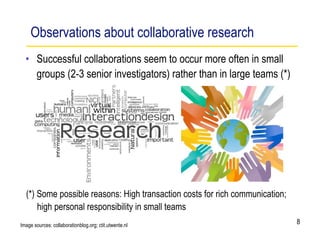
  • Successful collaborations seem to occur more often in small
    groups (2-3 senior investigators) rather than in large teams (*)


  (*) Some possible reasons: High transaction costs for rich communication;
      high personal responsibility in small teams
Image sources: collaborationblog.org; ctit.utwente.nl
                                                                              8
Some key ingredients of successful collaborations
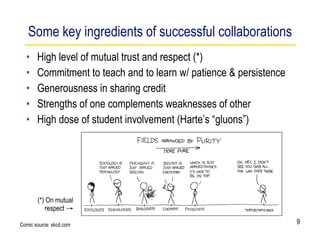
  •    High level of mutual trust and respect (*)
  •    Commitment to teach and to learn w/ patience & persistence
  •    Generousness in sharing credit
  •    Strengths of one complements weaknesses of other
  •    High dose of student involvement (Harte’s “gluons”)


       (*) On mutual
          respect →

Comic source: xkcd.com                                              9
Indoor microbiome: Opportunities
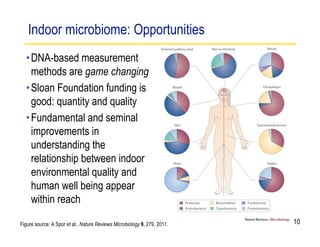
  • DNA-based measurement
    methods are game changing
  • Sloan Foundation funding is
    good: quantity and quality
  • Fundamental and seminal
    improvements in
    understanding the
    relationship between indoor
    environmental quality and
    human well being appear
    within reach

Figure source: A Spor et al., Nature Reviews Microbiology 9, 279, 2011.   10
Indoor microbiome: Some challenges
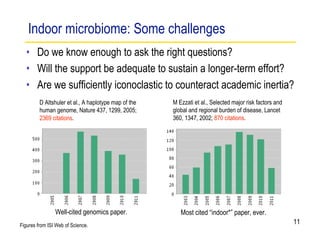
   • Do we know enough to ask the right questions?
   • Will the support be adequate to sustain a longer-term effort?
   • Are we sufficiently iconoclastic to counteract academic inertia?
         D Altshuler et al., A haplotype map of the   M Ezzati et al., Selected major risk factors and
         human genome, Nature 437, 1299, 2005;        global and regional burden of disease, Lancet
         2369 citations.                              360, 1347, 2002; 870 citations.


                Well-cited genomics paper.               Most cited “indoor*” paper, ever.
Figures from ISI Web of Science.
                                                                                                         11
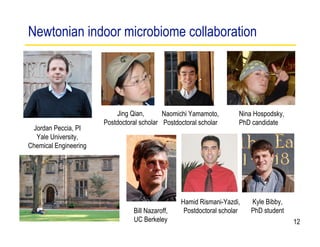
Newtonian indoor microbiome collaboration


                           Jing Qian,       Naomichi Yamamoto,        Nina Hospodsky,
                       Postdoctoral scholar Postdoctoral scholar      PhD candidate
 Jordan Peccia, PI
  Yale University,
Chemical Engineering


                                                  Hamid Rismani-Yazdi,    Kyle Bibby,
                                 Bill Nazaroff,    Postdoctoral scholar   PhD student
                                 UC Berkeley                                            12
Collaboration is producing fruit, after 3 y…
• Research team synthesizes relevant expertise:
   — Modern, DNA-based analytical methods applied to
     bioaerosols (Peccia lab)
   — Aerosol dynamics, especially in indoor environments
     (Nazaroff)

• Research articles in late stages of preparation prior
  to journal submission:
   — J Qian et al., Size distributed emission rates of airborne
     bacteria and fungi in indoor air due to occupancy.
   — D Hospodsky et al., Dense human occupancy as a source
     of indoor airborne bacteria.
   — N Yamamoto et al., Particle size distributions and
     seasonal concentrations of selected airborne fungi in the
     northeastern United States.                                  13
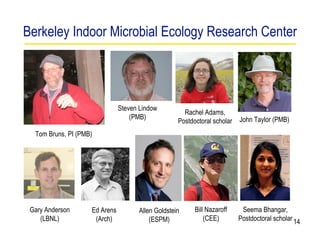
Berkeley Indoor Microbial Ecology Research Center


                               Steven Lindow
                                                      Rachel Adams,
                                   (PMB)                                   John Taylor (PMB)
                                                    Postdoctoral scholar
  Tom Bruns, PI (PMB)


 Gary Anderson      Ed Arens          Allen Goldstein     Bill Nazaroff     Seema Bhangar,
    (LBNL)           (Arch)               (ESPM)              (CEE)        Postdoctoral scholar 14
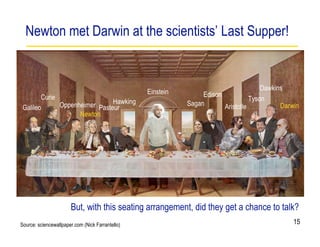
Newton met Darwin at the scientists’ Last Supper!


                                                                                       Dawkins
                                                  Einstein        Edison
        Curie                                                                      Tyson
                               Hawking
              Oppenheimer Pasteur                            Sagan
 Galileo                                                                 Aristotle           Darwin
                    Newton


                       But, with this seating arrangement, did they get a chance to talk?
Source: sciencewallpaper.com (Nick Farrantello)                                                  15

Ia2011 microbiome nazaroff postable

  • 1.
    Newton Meets Darwinat the Indoor Microbiome William W Nazaroff Civil & Environmental Engineering Dept. University of California, Berkeley Microbiomes of Built Environments Indoor Air 2011 Austin, Texas, USA Isaac Newton (1643-1727) 8 June 2011 Charles Darwin (1809-1882) Image sources: nndb.com; treehugger.com; summitpediatrics.blogspot.com; h2it.org; jaymecarleton.org; housevaluequotes.com 1
  • 2.
    Scope • Observations aboutcollaborative research • Attributes of successful joint efforts • Collaborating on indoor microbiome: Opportunities and challenges • My background (mostly Newtonian!): – Physics (BA), EECS (MEng), environmental engineering science (PhD) – Civil & Environmental Engineering faculty since 1989 – Involved in many collaborative projects & programs (small teams and large) – Chaired Energy & Resources Group at Berkeley for 4 y 2
  • 3.
    The inspiration behindthe talk’s title … Physicists and ecologists approach their crafts from different intellectual traditions, as exemplified by the differing values they attach to the search for simplification and universality. As a particle theorist by training, currently engaged in the study of ecology and global change, I have witnessed dysfunctional consequences of this bimodal legacy. I argue here for a synthesis of what I call the Newtonian and Darwinian approaches to science. Source: John Harte, Physics Today (October 2002). 3
  • 4.
    Harte’s description ofour “bimodal legacy” Physics Ecology The more you look, The more you look, the simpler it gets the more complex it gets Primacy of initial conditions Primacy of contingency and complex historical factors Universal patterns; Weak trends; search for laws reluctance to seek laws Predictive (quantum mechanics Mostly descriptive, explanatory notwithstanding) Central role for idealized systems Disdain for caricatures of nature (e.g., PV = nRT) Source: John Harte, Physics Today (October 2002). 4
  • 5.
    Harte: Elements ofa synthesis • Simple, falsifiable models (*) • Search for patterns and laws • Embrace the science of place (†) (*) It is the mark of an instructed (†) Place-centered studies mind to rest satisfied with the degree provide the best means we of precision which the nature of the have for going beyond pattern subject permits and not to seek an to process — for identifying the exactness where only an actual mechanisms at work. approximation of the truth is — Harte possible. — Aristotle Sources: John Harte, Physics Today (October 2002); Consider a Spherical Cow (1988). 5
  • 6.
    Does Harte’s analysisapply to indoor microbiome? • Newton and Darwin don’t live here. • The indoor environment research community Health operates at the intersection of three domains Buildings Environment • These domains have independent intellectual traditions and professional communities Indoor environments 6
  • 7.
    Observations about collaborativeresearch • “Multidisciplinary” is a woefully inadequate term to describe the multifaceted and richly nuanced nature of collaborations involving researchers from different backgrounds. Humanities Social Sciences Natural Sciences Biochemistry Comparative Religious Molecular and Cell Biology Literature Studies Chemistry Psychology Integrative Biology Rhetoric Economics Ecology Language Music Classics Sociology Geology Studies Anthropology Art History Demography Atmospheric Science History Political Physics American Science Mathematics Studies Statistics Film An Academic Phylogenetic Tree (conceptual) 7
  • 8.
    Observations about collaborativeresearch • Successful collaborations seem to occur more often in small groups (2-3 senior investigators) rather than in large teams (*) (*) Some possible reasons: High transaction costs for rich communication; high personal responsibility in small teams Image sources: collaborationblog.org; ctit.utwente.nl 8
  • 9.
    Some key ingredientsof successful collaborations • High level of mutual trust and respect (*) • Commitment to teach and to learn w/ patience & persistence • Generousness in sharing credit • Strengths of one complements weaknesses of other • High dose of student involvement (Harte’s “gluons”) (*) On mutual respect → Comic source: xkcd.com 9
  • 10.
    Indoor microbiome: Opportunities • DNA-based measurement methods are game changing • Sloan Foundation funding is good: quantity and quality • Fundamental and seminal improvements in understanding the relationship between indoor environmental quality and human well being appear within reach Figure source: A Spor et al., Nature Reviews Microbiology 9, 279, 2011. 10
  • 11.
    Indoor microbiome: Somechallenges • Do we know enough to ask the right questions? • Will the support be adequate to sustain a longer-term effort? • Are we sufficiently iconoclastic to counteract academic inertia? D Altshuler et al., A haplotype map of the M Ezzati et al., Selected major risk factors and human genome, Nature 437, 1299, 2005; global and regional burden of disease, Lancet 2369 citations. 360, 1347, 2002; 870 citations. Well-cited genomics paper. Most cited “indoor*” paper, ever. Figures from ISI Web of Science. 11
  • 12.
    Newtonian indoor microbiomecollaboration Jing Qian, Naomichi Yamamoto, Nina Hospodsky, Postdoctoral scholar Postdoctoral scholar PhD candidate Jordan Peccia, PI Yale University, Chemical Engineering Hamid Rismani-Yazdi, Kyle Bibby, Bill Nazaroff, Postdoctoral scholar PhD student UC Berkeley 12
  • 13.
    Collaboration is producingfruit, after 3 y… • Research team synthesizes relevant expertise: — Modern, DNA-based analytical methods applied to bioaerosols (Peccia lab) — Aerosol dynamics, especially in indoor environments (Nazaroff) • Research articles in late stages of preparation prior to journal submission: — J Qian et al., Size distributed emission rates of airborne bacteria and fungi in indoor air due to occupancy. — D Hospodsky et al., Dense human occupancy as a source of indoor airborne bacteria. — N Yamamoto et al., Particle size distributions and seasonal concentrations of selected airborne fungi in the northeastern United States. 13
  • 14.
    Berkeley Indoor MicrobialEcology Research Center Steven Lindow Rachel Adams, (PMB) John Taylor (PMB) Postdoctoral scholar Tom Bruns, PI (PMB) Gary Anderson Ed Arens Allen Goldstein Bill Nazaroff Seema Bhangar, (LBNL) (Arch) (ESPM) (CEE) Postdoctoral scholar 14
  • 15.
    Newton met Darwinat the scientists’ Last Supper! Dawkins Einstein Edison Curie Tyson Hawking Oppenheimer Pasteur Sagan Galileo Aristotle Darwin Newton But, with this seating arrangement, did they get a chance to talk? Source: sciencewallpaper.com (Nick Farrantello) 15