The Wetlands Reserve Program (WRP) is a
voluntary nationwide program administered by the
Natural Resources Conservation Service (NRCS) to
protect, restore and enhance wetlands—contributing
positively to flood control, aquifer recharge, wildlife
habitat and more. Nevertheless, lack of personnel
for implementation often limits participation and
successful outcomes.
In Iowa, things leapt forward when the state
conservationist mandated the use of third-party
vendors to speed the process and improve results.
Subsequently, AES was hired to implement WRP
projects in the eastern half of the state, providing
construction administration and oversight on
more than 60 sites and 3,000 acres within just the first two years of
the rejuvenated program. In 2013, the IA NRCS awarded additional
territories throughout the state to AES.
AES brings to the process its nationwide expertise in wetland science
and wetland construction. In addition, AES scientists worked closely
with the NRCS at the outset to establish protocols that ensure
buildable projects with achievable metrics of restoration. With one of
the largest native plant nurseries in the nation, AES is well poised to
source appropriate and cost-effective materials that meet the rigorous
IA NRCS standards calling for seed mixtures of 30-50 species. Our
knowledgeable nursery and contracting staff make modifications in plant
mixtures as needed (depending on the site) to further ensure success.
AES acts as construction manager for most tasks to make sure
restorations are done right, timed for the appropriate season and
completed on schedule. AES’ Construction Manager visits the site,
consults with the landowner and evaluates restoration potentials to
develop a plan consistent with the NRCS’ plans and goals and compliant
with budgetary constraints. Local contractors do the work, which lowers
costs and keeps money in the state.
Wetlands Reserve Program
Building Better Wetlands in Iowa
www.appliedeco.com
	 APPLIED ECOLOGICAL SERVICES	
	 Specialists in Ecological Science, Restoration, Management and Research	
	
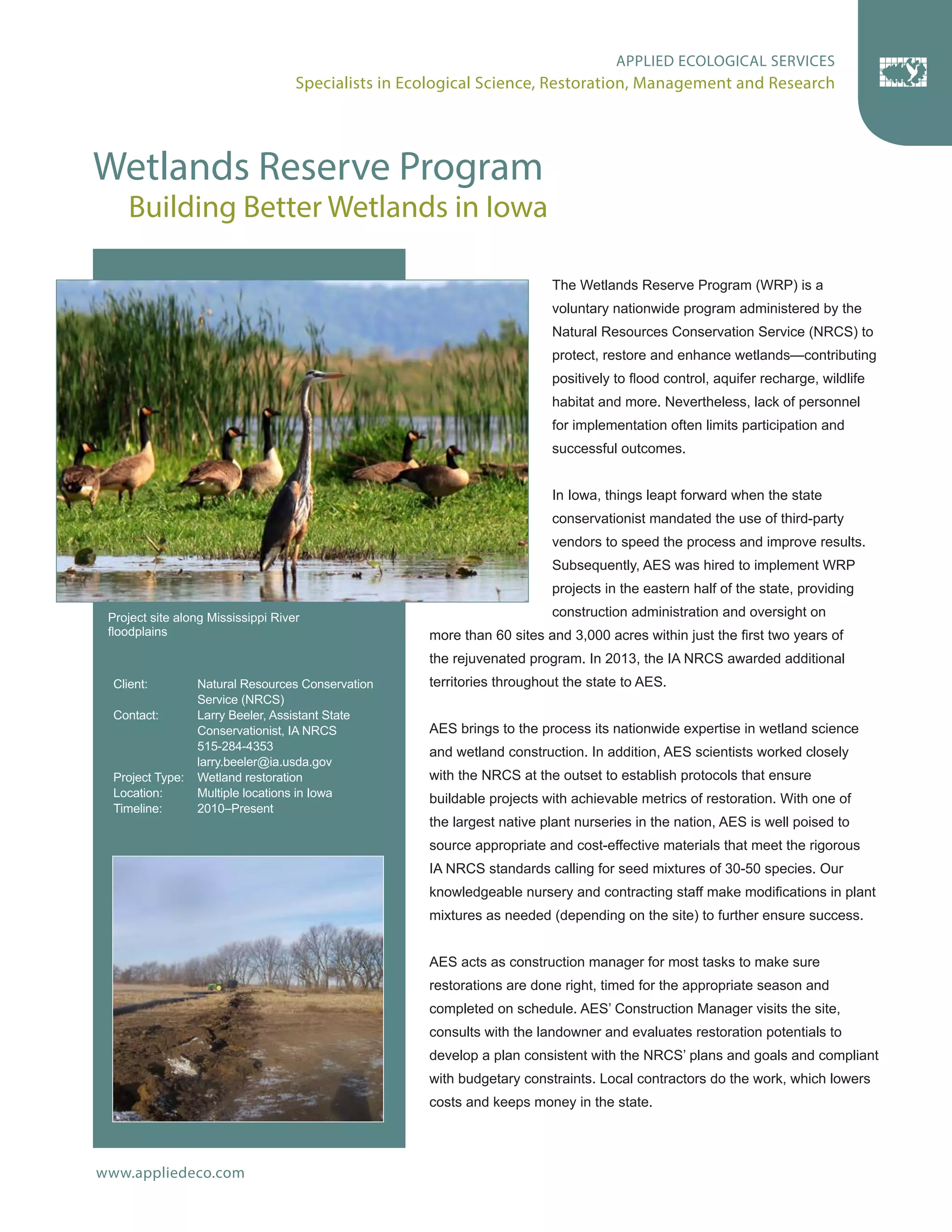
Project site along Mississippi River
floodplains
Client:	 Natural Resources Conservation
Service (NRCS)
Contact:	 Larry Beeler, Assistant State
Conservationist, IA NRCS
	 515-284-4353
	larry.beeler@ia.usda.gov
Project Type:	 Wetland restoration
Location:	 Multiple locations in Iowa
Timeline:	 2010–Present
Riparian buffer zones are created or enhanced,
oxbow wetlands restored, dikes removed (or
sometimes constructed for water control), drainage
tiles disabled to re-flood former wetlands, rich
wetland flora is re-established—the list, long and
creative, always keeps hydrological restoration as its
focus. And, finally, the ecological landscape is seen
as the ultimate client. AES builds wetlands to last
and function as nature intended.
The Role of AES’Restoration Nurseries
When it comes to quality, IA has gone well beyond
the minimum requirements of the WRP. While most
agencies require only five species in a native seed
mix, the IA NRCS normally seeks about 30-50
different species in each mix. Since a major part of the WRP program is
aimed at achieving optimum wildlife habitat on every acre enrolled, AES
helps modify seed mixes to restore wildlife habitat while also offering
NRCS a product that is cost-effective and commercially available.
One of the main reasons the partnership between AES and IA NRCS
works so well is the ability to source high-quality materials on an as-
needed basis. AES is able to turn projects around quickly by responding
with appropriate, cost-effective materials that meet all the necessary
guidelines and standards.
The idea is to do it right the first time. Installing a healthy plant palette
at the onset increases the likelihood of the restoration remaining free
of invasive species, which ultimately saves maintenance time and
money in the end. These restorations are meant to take hold and stand
on their own after two years of management, though after this early
establishment period, AES will make management recommendations
for future years. The projects are low-maintenance, but they are never
no-maintenance.
www.appliedeco.com
	 APPLIED ECOLOGICAL SERVICES	
	 Specialists in Ecological Science, Restoration, Management and Research	
	
Wetlands Reserve Program
Building Better Wetlands in Iowa (continued)
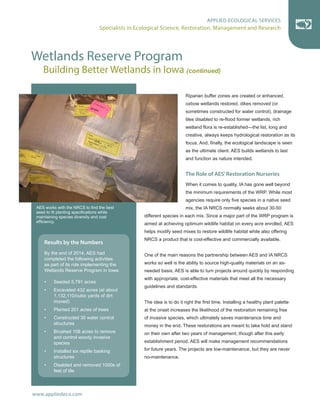
AES works with the NRCS to find the best
seed to fit planting specifications while
maintaining species diversity and cost
efficiency.
Results by the Numbers
By the end of 2014, AES had
completed the following activities
as part of its role implementing the
Wetlands Reserve Program in Iowa:
•	 Seeded 5,791 acres
•	 Excavated 432 acres (at about
1,132,110/cubic yards of dirt
moved)
•	 Planted 201 acres of trees
•	 Constructed 30 water control
structures
•	 Brushed 158 acres to remove
and control woody invasive
species
•	 Installed six reptile basking
structures
•	 Disabled and removed 1000s of
feet of tile

IA NRCS WRP IMPLEMENTATION

  • 1.
    The Wetlands ReserveProgram (WRP) is a voluntary nationwide program administered by the Natural Resources Conservation Service (NRCS) to protect, restore and enhance wetlands—contributing positively to flood control, aquifer recharge, wildlife habitat and more. Nevertheless, lack of personnel for implementation often limits participation and successful outcomes. In Iowa, things leapt forward when the state conservationist mandated the use of third-party vendors to speed the process and improve results. Subsequently, AES was hired to implement WRP projects in the eastern half of the state, providing construction administration and oversight on more than 60 sites and 3,000 acres within just the first two years of the rejuvenated program. In 2013, the IA NRCS awarded additional territories throughout the state to AES. AES brings to the process its nationwide expertise in wetland science and wetland construction. In addition, AES scientists worked closely with the NRCS at the outset to establish protocols that ensure buildable projects with achievable metrics of restoration. With one of the largest native plant nurseries in the nation, AES is well poised to source appropriate and cost-effective materials that meet the rigorous IA NRCS standards calling for seed mixtures of 30-50 species. Our knowledgeable nursery and contracting staff make modifications in plant mixtures as needed (depending on the site) to further ensure success. AES acts as construction manager for most tasks to make sure restorations are done right, timed for the appropriate season and completed on schedule. AES’ Construction Manager visits the site, consults with the landowner and evaluates restoration potentials to develop a plan consistent with the NRCS’ plans and goals and compliant with budgetary constraints. Local contractors do the work, which lowers costs and keeps money in the state. Wetlands Reserve Program Building Better Wetlands in Iowa www.appliedeco.com APPLIED ECOLOGICAL SERVICES Specialists in Ecological Science, Restoration, Management and Research Project site along Mississippi River floodplains Client: Natural Resources Conservation Service (NRCS) Contact: Larry Beeler, Assistant State Conservationist, IA NRCS 515-284-4353 larry.beeler@ia.usda.gov Project Type: Wetland restoration Location: Multiple locations in Iowa Timeline: 2010–Present
  • 2.
    Riparian buffer zonesare created or enhanced, oxbow wetlands restored, dikes removed (or sometimes constructed for water control), drainage tiles disabled to re-flood former wetlands, rich wetland flora is re-established—the list, long and creative, always keeps hydrological restoration as its focus. And, finally, the ecological landscape is seen as the ultimate client. AES builds wetlands to last and function as nature intended. The Role of AES’Restoration Nurseries When it comes to quality, IA has gone well beyond the minimum requirements of the WRP. While most agencies require only five species in a native seed mix, the IA NRCS normally seeks about 30-50 different species in each mix. Since a major part of the WRP program is aimed at achieving optimum wildlife habitat on every acre enrolled, AES helps modify seed mixes to restore wildlife habitat while also offering NRCS a product that is cost-effective and commercially available. One of the main reasons the partnership between AES and IA NRCS works so well is the ability to source high-quality materials on an as- needed basis. AES is able to turn projects around quickly by responding with appropriate, cost-effective materials that meet all the necessary guidelines and standards. The idea is to do it right the first time. Installing a healthy plant palette at the onset increases the likelihood of the restoration remaining free of invasive species, which ultimately saves maintenance time and money in the end. These restorations are meant to take hold and stand on their own after two years of management, though after this early establishment period, AES will make management recommendations for future years. The projects are low-maintenance, but they are never no-maintenance. www.appliedeco.com APPLIED ECOLOGICAL SERVICES Specialists in Ecological Science, Restoration, Management and Research Wetlands Reserve Program Building Better Wetlands in Iowa (continued) AES works with the NRCS to find the best seed to fit planting specifications while maintaining species diversity and cost efficiency. Results by the Numbers By the end of 2014, AES had completed the following activities as part of its role implementing the Wetlands Reserve Program in Iowa: • Seeded 5,791 acres • Excavated 432 acres (at about 1,132,110/cubic yards of dirt moved) • Planted 201 acres of trees • Constructed 30 water control structures • Brushed 158 acres to remove and control woody invasive species • Installed six reptile basking structures • Disabled and removed 1000s of feet of tile