Secondary Two
Meet-the-Parents
    Session
    15 March 2013


      Where learning is vibrant and teaching is dynamic
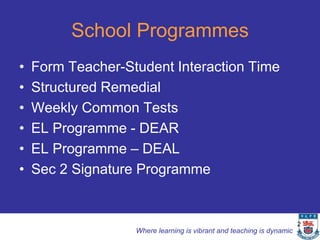
School Programmes
•   Form Teacher-Student Interaction Time
•   Structured Remedial
•   Weekly Common Tests
•   EL Programme - DEAR
•   EL Programme – DEAL
•   Sec 2 Signature Programme


                                                                       2
                   Where learning is vibrant and teaching is dynamic
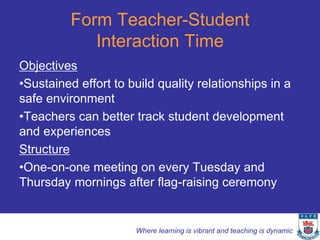
Form Teacher-Student
             Interaction Time
Objectives
•Sustained effort to build quality relationships in a
safe environment
•Teachers can better track student development
and experiences
Structure
•One-on-one meeting on every Tuesday and
Thursday mornings after flag-raising ceremony


                      Where learning is vibrant and teaching is dynamic
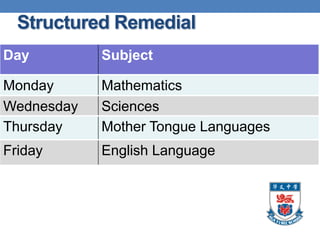
Structured Remedial
Day         Subject

Monday      Mathematics
Wednesday   Sciences
Thursday    Mother Tongue Languages
Friday      English Language
Weekly Common Tests
Objectives
• Structured assessment to help students
  build momentum in their work and to
  reinforce the culture of learning
• Fewer disruptions to classroom teaching


                 Where learning is vibrant and teaching is dynamic
Weekly Common Tests
Structure
• Takes place every Wednesday morning,
with a different subject each week
•Common Test Schedule can be found on
the class noticeboard and the school
website


                Where learning is vibrant and teaching is dynamic
Sec 2 Signature Programme
Sec 2 Adventure cum Leadership Camp
Date: 3 to 5 June 2013
Objectives:
 Provides opportunities for leadership and
       impart good leadership skills
 Imparts team building skills and life
  skills during play
 Builds team spirit and good discipline

                  Where learning is vibrant and teaching is dynamic
Secondary Two Streaming
       Exercise


         Where learning is vibrant and teaching is dynamic
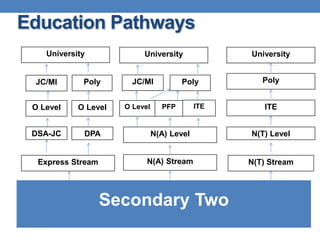
Education Pathways
    University             University              University


 JC/MI       Poly       JC/MI           Poly          Poly


 O Level    O Level   O Level     PFP        ITE      ITE


 DSA-JC      DPA                N(A) Level         N(T) Level


  Express Stream            N(A) Stream            N(T) Stream


                   Secondary Two
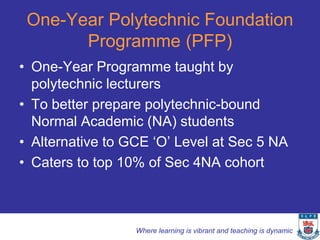
One-Year Polytechnic Foundation
       Programme (PFP)
• One-Year Programme taught by
  polytechnic lecturers
• To better prepare polytechnic-bound
  Normal Academic (NA) students
• Alternative to GCE ‘O’ Level at Sec 5 NA
• Caters to top 10% of Sec 4NA cohort


                  Where learning is vibrant and teaching is dynamic
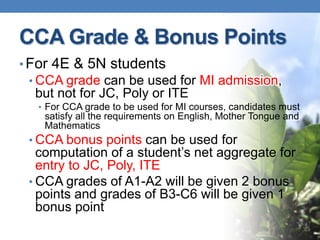
CCA Grade & Bonus Points
• For 4E & 5N students
 • CCA grade can be used for MI admission,
  but not for JC, Poly or ITE
  • For CCA grade to be used for MI courses, candidates must
   satisfy all the requirements on English, Mother Tongue and
   Mathematics
 • CCA bonus points can be used for
   computation of a student’s net aggregate for
   entry to JC, Poly, ITE
 • CCA grades of A1-A2 will be given 2 bonus
   points and grades of B3-C6 will be given 1
   bonus point
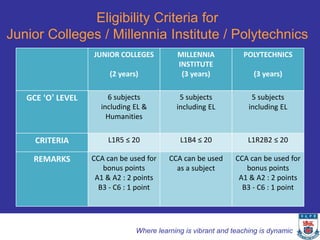
Eligibility Criteria for
Junior Colleges / Millennia Institute / Polytechnics
                   JUNIOR COLLEGES          MILLENNIA            POLYTECHNICS
                                            INSTITUTE
                        (2 years)            (3 years)              (3 years)


   GCE ‘O’ LEVEL       6 subjects            5 subjects             5 subjects
                     including EL &         including EL           including EL
                       Humanities


     CRITERIA          L1R5 ≤ 20             L1B4 ≤ 20             L1R2B2 ≤ 20

    REMARKS        CCA can be used for    CCA can be used      CCA can be used for
                      bonus points          as a subject          bonus points
                    A1 & A2 : 2 points                          A1 & A2 : 2 points
                     B3 - C6 : 1 point                           B3 - C6 : 1 point


                                Where learning is vibrant and teaching is dynamic
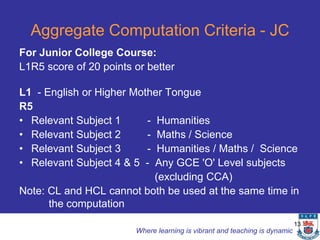
Aggregate Computation Criteria - JC
For Junior College Course:
L1R5 score of 20 points or better

L1 - English or Higher Mother Tongue
R5
• Relevant Subject 1      - Humanities
• Relevant Subject 2      - Maths / Science
• Relevant Subject 3      - Humanities / Maths / Science
• Relevant Subject 4 & 5 - Any GCE 'O' Level subjects
                            (excluding CCA)
Note: CL and HCL cannot both be used at the same time in
      the computation
                                                                            13
                        Where learning is vibrant and teaching is dynamic
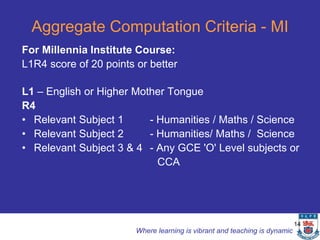
Aggregate Computation Criteria - MI
For Millennia Institute Course:
L1R4 score of 20 points or better

L1 – English or Higher Mother Tongue
R4
• Relevant Subject 1      - Humanities / Maths / Science
• Relevant Subject 2      - Humanities/ Maths / Science
• Relevant Subject 3 & 4 - Any GCE 'O' Level subjects or
                            CCA


                                                                            14
                        Where learning is vibrant and teaching is dynamic
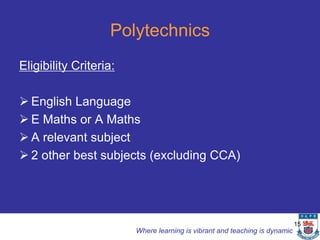
Polytechnics
Eligibility Criteria:

 English Language
 E Maths or A Maths
 A relevant subject
 2 other best subjects (excluding CCA)


                                                                            15
                        Where learning is vibrant and teaching is dynamic
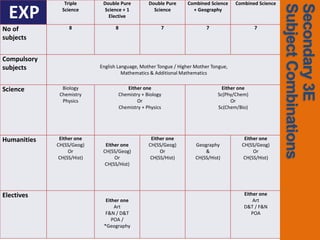
Subject Combinations for 2014


                                                               16
           Where learning is vibrant and teaching is dynamic
Triple       Double Pure         Double Pure     Combined Science     Combined Science


                                                                                                         Subject Combinations
                                                                                                         Secondary 3EExpress
  EXP          Science       Science + 1
                               Elective
                                                   Science         + Geography


                                                                                                           Subject Combinations
                                                                                                           Secondary 3
No of             8               8                   7                  7                   7
subjects


Compulsory
subjects                    English Language, Mother Tongue / Higher Mother Tongue,
                                      Mathematics & Additional Mathematics


Science        Biology                Either one                                Either one
              Chemistry            Chemistry + Biology                        Sc(Phy/Chem)
               Physics                     Or                                       Or
                                   Chemistry + Physics                        Sc(Chem/Bio)


Humanities    Either one                          Either one                             Either one
             CH(SS/Geog)      Either one         CH(SS/Geog)         Geography          CH(SS/Geog)
                  Or         CH(SS/Geog)              Or                 &                   Or
              CH(SS/Hist)         Or              CH(SS/Hist)        CH(SS/Hist)         CH(SS/Hist)
                              CH(SS/Hist)


Electives                                                                                Either one
                              Either one                                                     Art
                                  Art                                                    D&T / F&N
                              F&N / D&T                                                     POA
                                 POA /
                             *Geography
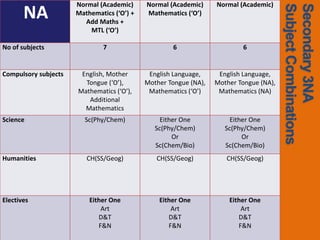
Normal (Academic)     Normal (Academic)     Normal (Academic)


                                                                                        Subject Combinations
                                                                                        Secondary 3NA
       NA             Mathematics (‘O’) +
                        Add Maths +
                                            Mathematics (‘O’)

                          MTL (‘O’)

No of subjects                7                     6                     6


Compulsory subjects    English, Mother       English Language,     English Language,
                        Tongue (‘O’),       Mother Tongue (NA),   Mother Tongue (NA),
                      Mathematics (‘O’),     Mathematics (‘O’)     Mathematics (NA)
                         Additional
                        Mathematics
Science                 Sc(Phy/Chem)             Either One            Either One
                                               Sc(Phy/Chem)          Sc(Phy/Chem)
                                                     Or                    Or
                                               Sc(Chem/Bio)          Sc(Chem/Bio)
Humanities               CH(SS/Geog)           CH(SS/Geog)           CH(SS/Geog)


Electives                 Either One            Either One            Either One
                              Art                   Art                   Art
                             D&T                   D&T                   D&T
                             F&N                   F&N                   F&N
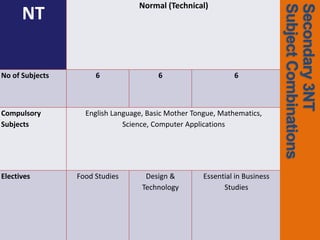
Normal (Technical)


                                                                             Subject Combinations
                                                                             Secondary 3NT
      NT


                                                                              Subject Combinations
                                                                              Secondary 3 NT
No of Subjects        6                 6                     6


Compulsory         English Language, Basic Mother Tongue, Mathematics,
Subjects                      Science, Computer Applications


Electives        Food Studies       Design &         Essential in Business
                                   Technology              Studies
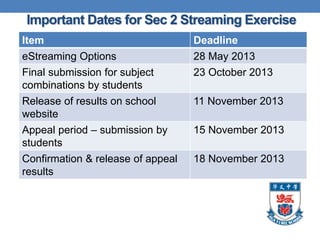
Important Dates for Sec 2 Streaming Exercise
Item                               Deadline
eStreaming Options                 28 May 2013
Final submission for subject       23 October 2013
combinations by students
Release of results on school       11 November 2013
website
Appeal period – submission by      15 November 2013
students
Confirmation & release of appeal   18 November 2013
results
Streaming Criteria
   How is a student’s final subject
      combination decided?
• Merit
  • Overall performance + Performance in
    specific subject/s
• Specific subject requirements
• Student’s choice
• Availability of places for each subject
  combination
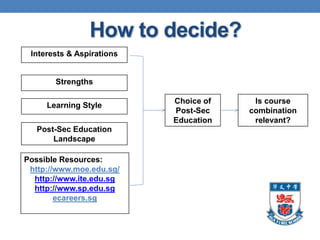
How to decide?
 Interests & Aspirations


       Strengths

                           Choice of    Is course
     Learning Style
                           Post-Sec    combination
                           Education    relevant?
   Post-Sec Education
       Landscape

Possible Resources:
 http://www.moe.edu.sg/
  http://www.ite.edu.sg
  http://www.sp.edu.sg
        ecareers.sg
Ways to improve English
1. Read English newspapers and books to
   improve vocabulary, reading and writing
   skills
2. Keep a notebook of new words. Use
   them in speaking and writing
3. Practise the four core skills to improve
   the language: reading, writing, speaking
   and listening

                  Where learning is vibrant and teaching is dynamic
Ways to improve Mother
       Tongue Languages
• Read and analyse good essays
• Learn essay writing techniques
• Practise an array of comprehension
• Understand and review newspaper articles
• Practise communication skills
• Ask questions when do not understand
  during/after class
• Seek help/Share your difficulties/problems with
  your CL/ML teachers
• Always believe that you can make it. Build
  confidence in yourself!

                     Where learning is vibrant and teaching is dynamic
Ways to improve
           Humanities
• Revise regularly
• Read widely especially the newspapers
• Prepare for the lesson by reading the text
  ahead of time
• Keep materials, notes and resources in an
  organised manner


                   Where learning is vibrant and teaching is dynamic
Ways to improve
       Craft & Technology
• Students must observe coursework
  deadlines given by their teachers
• Students must be focused on both
  coursework and written paper
• Ask when in doubt


                 Where learning is vibrant and teaching is dynamic
THE END.


 Where learning is vibrant and teaching is dynamic

Hyss 2013 15_mar_sec 2 mtp_for school website

  • 1.
    Secondary Two Meet-the-Parents Session 15 March 2013 Where learning is vibrant and teaching is dynamic
  • 2.
    School Programmes • Form Teacher-Student Interaction Time • Structured Remedial • Weekly Common Tests • EL Programme - DEAR • EL Programme – DEAL • Sec 2 Signature Programme 2 Where learning is vibrant and teaching is dynamic
  • 3.
    Form Teacher-Student Interaction Time Objectives •Sustained effort to build quality relationships in a safe environment •Teachers can better track student development and experiences Structure •One-on-one meeting on every Tuesday and Thursday mornings after flag-raising ceremony Where learning is vibrant and teaching is dynamic
  • 4.
    Structured Remedial Day Subject Monday Mathematics Wednesday Sciences Thursday Mother Tongue Languages Friday English Language
  • 5.
    Weekly Common Tests Objectives •Structured assessment to help students build momentum in their work and to reinforce the culture of learning • Fewer disruptions to classroom teaching Where learning is vibrant and teaching is dynamic
  • 6.
    Weekly Common Tests Structure •Takes place every Wednesday morning, with a different subject each week •Common Test Schedule can be found on the class noticeboard and the school website Where learning is vibrant and teaching is dynamic
  • 7.
    Sec 2 SignatureProgramme Sec 2 Adventure cum Leadership Camp Date: 3 to 5 June 2013 Objectives:  Provides opportunities for leadership and impart good leadership skills  Imparts team building skills and life skills during play  Builds team spirit and good discipline Where learning is vibrant and teaching is dynamic
  • 8.
    Secondary Two Streaming Exercise Where learning is vibrant and teaching is dynamic
  • 9.
    Education Pathways University University University JC/MI Poly JC/MI Poly Poly O Level O Level O Level PFP ITE ITE DSA-JC DPA N(A) Level N(T) Level Express Stream N(A) Stream N(T) Stream Secondary Two
  • 10.
    One-Year Polytechnic Foundation Programme (PFP) • One-Year Programme taught by polytechnic lecturers • To better prepare polytechnic-bound Normal Academic (NA) students • Alternative to GCE ‘O’ Level at Sec 5 NA • Caters to top 10% of Sec 4NA cohort Where learning is vibrant and teaching is dynamic
  • 11.
    CCA Grade &Bonus Points • For 4E & 5N students • CCA grade can be used for MI admission, but not for JC, Poly or ITE • For CCA grade to be used for MI courses, candidates must satisfy all the requirements on English, Mother Tongue and Mathematics • CCA bonus points can be used for computation of a student’s net aggregate for entry to JC, Poly, ITE • CCA grades of A1-A2 will be given 2 bonus points and grades of B3-C6 will be given 1 bonus point
  • 12.
    Eligibility Criteria for JuniorColleges / Millennia Institute / Polytechnics JUNIOR COLLEGES MILLENNIA POLYTECHNICS INSTITUTE (2 years) (3 years) (3 years) GCE ‘O’ LEVEL 6 subjects 5 subjects 5 subjects including EL & including EL including EL Humanities CRITERIA L1R5 ≤ 20 L1B4 ≤ 20 L1R2B2 ≤ 20 REMARKS CCA can be used for CCA can be used CCA can be used for bonus points as a subject bonus points A1 & A2 : 2 points A1 & A2 : 2 points B3 - C6 : 1 point B3 - C6 : 1 point Where learning is vibrant and teaching is dynamic
  • 13.
    Aggregate Computation Criteria- JC For Junior College Course: L1R5 score of 20 points or better L1 - English or Higher Mother Tongue R5 • Relevant Subject 1 - Humanities • Relevant Subject 2 - Maths / Science • Relevant Subject 3 - Humanities / Maths / Science • Relevant Subject 4 & 5 - Any GCE 'O' Level subjects (excluding CCA) Note: CL and HCL cannot both be used at the same time in the computation 13 Where learning is vibrant and teaching is dynamic
  • 14.
    Aggregate Computation Criteria- MI For Millennia Institute Course: L1R4 score of 20 points or better L1 – English or Higher Mother Tongue R4 • Relevant Subject 1 - Humanities / Maths / Science • Relevant Subject 2 - Humanities/ Maths / Science • Relevant Subject 3 & 4 - Any GCE 'O' Level subjects or CCA 14 Where learning is vibrant and teaching is dynamic
  • 15.
    Polytechnics Eligibility Criteria:  EnglishLanguage  E Maths or A Maths  A relevant subject  2 other best subjects (excluding CCA) 15 Where learning is vibrant and teaching is dynamic
  • 16.
    Subject Combinations for2014 16 Where learning is vibrant and teaching is dynamic
  • 17.
    Triple Double Pure Double Pure Combined Science Combined Science Subject Combinations Secondary 3EExpress EXP Science Science + 1 Elective Science + Geography Subject Combinations Secondary 3 No of 8 8 7 7 7 subjects Compulsory subjects English Language, Mother Tongue / Higher Mother Tongue, Mathematics & Additional Mathematics Science Biology Either one Either one Chemistry Chemistry + Biology Sc(Phy/Chem) Physics Or Or Chemistry + Physics Sc(Chem/Bio) Humanities Either one Either one Either one CH(SS/Geog) Either one CH(SS/Geog) Geography CH(SS/Geog) Or CH(SS/Geog) Or & Or CH(SS/Hist) Or CH(SS/Hist) CH(SS/Hist) CH(SS/Hist) CH(SS/Hist) Electives Either one Either one Art Art D&T / F&N F&N / D&T POA POA / *Geography
  • 18.
    Normal (Academic) Normal (Academic) Normal (Academic) Subject Combinations Secondary 3NA NA Mathematics (‘O’) + Add Maths + Mathematics (‘O’) MTL (‘O’) No of subjects 7 6 6 Compulsory subjects English, Mother English Language, English Language, Tongue (‘O’), Mother Tongue (NA), Mother Tongue (NA), Mathematics (‘O’), Mathematics (‘O’) Mathematics (NA) Additional Mathematics Science Sc(Phy/Chem) Either One Either One Sc(Phy/Chem) Sc(Phy/Chem) Or Or Sc(Chem/Bio) Sc(Chem/Bio) Humanities CH(SS/Geog) CH(SS/Geog) CH(SS/Geog) Electives Either One Either One Either One Art Art Art D&T D&T D&T F&N F&N F&N
  • 19.
    Normal (Technical) Subject Combinations Secondary 3NT NT Subject Combinations Secondary 3 NT No of Subjects 6 6 6 Compulsory English Language, Basic Mother Tongue, Mathematics, Subjects Science, Computer Applications Electives Food Studies Design & Essential in Business Technology Studies
  • 20.
    Important Dates forSec 2 Streaming Exercise Item Deadline eStreaming Options 28 May 2013 Final submission for subject 23 October 2013 combinations by students Release of results on school 11 November 2013 website Appeal period – submission by 15 November 2013 students Confirmation & release of appeal 18 November 2013 results
  • 21.
    Streaming Criteria How is a student’s final subject combination decided? • Merit • Overall performance + Performance in specific subject/s • Specific subject requirements • Student’s choice • Availability of places for each subject combination
  • 22.
    How to decide? Interests & Aspirations Strengths Choice of Is course Learning Style Post-Sec combination Education relevant? Post-Sec Education Landscape Possible Resources: http://www.moe.edu.sg/ http://www.ite.edu.sg http://www.sp.edu.sg ecareers.sg
  • 23.
    Ways to improveEnglish 1. Read English newspapers and books to improve vocabulary, reading and writing skills 2. Keep a notebook of new words. Use them in speaking and writing 3. Practise the four core skills to improve the language: reading, writing, speaking and listening Where learning is vibrant and teaching is dynamic
  • 24.
    Ways to improveMother Tongue Languages • Read and analyse good essays • Learn essay writing techniques • Practise an array of comprehension • Understand and review newspaper articles • Practise communication skills • Ask questions when do not understand during/after class • Seek help/Share your difficulties/problems with your CL/ML teachers • Always believe that you can make it. Build confidence in yourself! Where learning is vibrant and teaching is dynamic
  • 25.
    Ways to improve Humanities • Revise regularly • Read widely especially the newspapers • Prepare for the lesson by reading the text ahead of time • Keep materials, notes and resources in an organised manner Where learning is vibrant and teaching is dynamic
  • 26.
    Ways to improve Craft & Technology • Students must observe coursework deadlines given by their teachers • Students must be focused on both coursework and written paper • Ask when in doubt Where learning is vibrant and teaching is dynamic
  • 27.
    THE END. Wherelearning is vibrant and teaching is dynamic