Hyre Weekly Commentary
                                              November 7, 2011
The Markets
This Europe problem just won’t go away and it’s keeping the financial markets on edge.

Despite an October 27 agreement that strengthened the bailout of Greece, the “Greek Tragedy”
continues as the country’s government is a mess, Prime Minister George Papandreou is
reportedly stepping down and the populace is protesting. And, with each day of delay, Greece is
running out of money and European leaders are running out of patience.

Meanwhile, across the Ionian Sea from Greece, Italy is quickly becoming the next problem. Its
10-year government bond yield rose to a euro-era record of 6.4 percent last Friday. The Wall
Street Journal says, “The 6% mark on the 10-year bond is seen as crucial because a breach of
that level in the past has portended a sharp rise in bond yields of other fiscally frail countries.”

When bond yields rise dramatically, it increases a country’s borrowing costs and suggests
investors are losing faith in that country’s ability to pay its bills.

Even though Greece is grabbing most of the headlines, Italy is much more crucial to world
markets than Greece because Italy’s government bond market is the third largest in the eurozone
behind Germany and France. If Italy goes the way of Greece, that would elevate the European
crisis to a whole new level.

Ultimately, there’s just too much debt in the worldwide monetary system. Until it gets cut to a
manageable level, the markets may behave erratically.

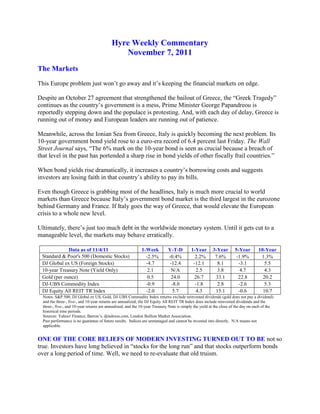
             Data as of 11/4/11                              1-Week          Y-T-D         1-Year       3-Year       5-Year         10-Year
 Standard & Poor's 500 (Domestic Stocks)                       -2.5%         -0.4%           2.2%        7.6%         -1.9%          1.3%
 DJ Global ex US (Foreign Stocks)                              -4.7           -12.4         -12.1         8.1          -3.1            5.5
 10-year Treasury Note (Yield Only)                             2.1            N/A            2.5         3.8           4.7            4.3
 Gold (per ounce)                                               0.5            24.0          26.7        33.1          22.8           20.2
 DJ-UBS Commodity Index                                        -0.9            -8.0          -1.8         2.8          -2.6            5.3
 DJ Equity All REIT TR Index                                   -2.0             5.7           4.3        15.1          -0.6           10.7
  Notes: S&P 500, DJ Global ex US, Gold, DJ-UBS Commodity Index returns exclude reinvested dividends (gold does not pay a dividend)
  and the three-, five-, and 10-year returns are annualized; the DJ Equity All REIT TR Index does include reinvested dividends and the
  three-, five-, and 10-year returns are annualized; and the 10-year Treasury Note is simply the yield at the close of the day on each of the
  historical time periods.
  Sources: Yahoo! Finance, Barron’s, djindexes.com, London Bullion Market Association.
  Past performance is no guarantee of future results. Indices are unmanaged and cannot be invested into directly. N/A means not
  applicable.


ONE OF THE CORE BELIEFS OF MODERN INVESTING TURNED OUT TO BE not so
true. Investors have long believed in “stocks for the long run” and that stocks outperform bonds
over a long period of time. Well, we need to re-evaluate that old truism.
New data shows that for the 30 years ending September 30, 2011, long-term government bonds
outperformed stocks. During that period, bonds rose by 11.5 percent a year on average, beating
the 10.8 percent increase in the S&P 500, according to Jim Bianco, president of Bianco Research
in Chicago, as reported by Bloomberg. That’s the first time bonds beat stocks over a 30-year
period since the Civil War!

Here’s some long-term historical data on how stocks and bonds have performed relative to each
other:

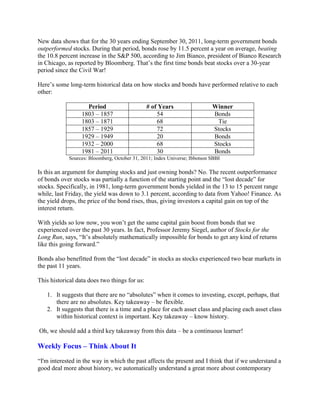
                    Period                     # of Years                  Winner
                  1803 – 1857                      54                      Bonds
                  1803 – 1871                      68                       Tie
                  1857 – 1929                      72                      Stocks
                  1929 – 1949                      20                      Bonds
                  1932 – 2000                      68                      Stocks
                  1981 – 2011                      30                      Bonds
            Sources: Bloomberg, October 31, 2011; Index Universe; Ibbotson SBBI

Is this an argument for dumping stocks and just owning bonds? No. The recent outperformance
of bonds over stocks was partially a function of the starting point and the “lost decade” for
stocks. Specifically, in 1981, long-term government bonds yielded in the 13 to 15 percent range
while, last Friday, the yield was down to 3.1 percent, according to data from Yahoo! Finance. As
the yield drops, the price of the bond rises, thus, giving investors a capital gain on top of the
interest return.

With yields so low now, you won’t get the same capital gain boost from bonds that we
experienced over the past 30 years. In fact, Professor Jeremy Siegel, author of Stocks for the
Long Run, says, “It’s absolutely mathematically impossible for bonds to get any kind of returns
like this going forward.”

Bonds also benefitted from the “lost decade” in stocks as stocks experienced two bear markets in
the past 11 years.

This historical data does two things for us:

   1. It suggests that there are no “absolutes” when it comes to investing, except, perhaps, that
      there are no absolutes. Key takeaway – be flexible.
   2. It suggests that there is a time and a place for each asset class and placing each asset class
      within historical context is important. Key takeaway – know history.

Oh, we should add a third key takeaway from this data – be a continuous learner!

Weekly Focus – Think About It
“I'm interested in the way in which the past affects the present and I think that if we understand a
good deal more about history, we automatically understand a great more about contemporary
life.” --Toni Morrison, Nobel Prize and Pulitzer Prize-winning American novelist, editor, and
professor

Best regards,


Jim Hyre, CFP®
Registered Principal

P.S. Please feel free to forward this commentary to family, friends, or colleagues. If you would
like us to add them to the list, please reply to this e-mail with their e-mail address and we will
ask for their permission to be added.

Securities offered through Raymond James Financial Services, Inc., Member FINRA/SIPC.

* The Standard & Poor's 500 (S&P 500) is an unmanaged group of securities considered to be representative of the stock market in
general.
* The Dow Jones Industrial Average is a price-weighted index of 30 actively traded blue-chip stocks.
* The NASDAQ Composite Index is an unmanaged, market-weighted index of all over-the-counter common stocks traded on the
National Association of Securities Dealers Automated Quotation System.
* Gold represents the London afternoon gold price fix as reported by www.usagold.com.
* The DJ/AIG Commodity Index is designed to be a highly liquid and diversified benchmark for the commodity futures market. The
Index is composed of futures contracts on 19 physical commodities and was launched on July 14, 1998.
* The 10-year Treasury Note represents debt owed by the United States Treasury to the public. Since the U.S. Government is seen
as a risk-free borrower, investors use the 10-year Treasury Note as a benchmark for the long-term bond market.
* The DJ Equity All REIT TR Index measures the total return performance of the equity subcategory of the Real Estate Investment
Trust (REIT) industry as calculated by Dow Jones
* Yahoo! Finance is the source for any reference to the performance of an index between two specific periods.
* Opinions expressed are subject to change without notice and are not intended as investment advice or to predict future
performance.
* Consult your financial professional before making any investment decision.
* You cannot invest directly in an index.
* Past performance does not guarantee future results. mc101507
* This newsletter was prepared by PEAK for use by James Hyre, CFP®, registered principal
* If you would prefer not to receive this Weekly Newsletter, please contact our office via e-mail or mail your request to 2074 Arlington
Ave, Upper Arlington, OH 43221.
* The information contained in this report does not purport to be a complete description of the securities, markets, or developments
referred to in this material. The information has been obtained from sources considered to be reliable, but we do not guarantee that
the forgoing material is accurate or complete. Any opinions are those of Jim Hyre and not necessary those of RJFS or Raymond
James. Expressions of opinion are as of this date and are subject to change without notice. This information is not intended as a
solicitation or an offer to buy or sell any security to herein. Tax or legal matters should be discussed with the appropriate
professional.


Jim Hyre, CFP®
Registered Principal
Raymond James Financial Services, Inc.
Member FINRA/SIPC
2074 Arlington Ave.
Upper Arlington, OH 43221
614.225.9400
614.225.9400 Fax
877.228.9515 Toll Free

www.hyreandassociates.com
Hyre Weekly Commentary

Hyre Weekly Commentary

  • 1.
    Hyre Weekly Commentary November 7, 2011 The Markets This Europe problem just won’t go away and it’s keeping the financial markets on edge. Despite an October 27 agreement that strengthened the bailout of Greece, the “Greek Tragedy” continues as the country’s government is a mess, Prime Minister George Papandreou is reportedly stepping down and the populace is protesting. And, with each day of delay, Greece is running out of money and European leaders are running out of patience. Meanwhile, across the Ionian Sea from Greece, Italy is quickly becoming the next problem. Its 10-year government bond yield rose to a euro-era record of 6.4 percent last Friday. The Wall Street Journal says, “The 6% mark on the 10-year bond is seen as crucial because a breach of that level in the past has portended a sharp rise in bond yields of other fiscally frail countries.” When bond yields rise dramatically, it increases a country’s borrowing costs and suggests investors are losing faith in that country’s ability to pay its bills. Even though Greece is grabbing most of the headlines, Italy is much more crucial to world markets than Greece because Italy’s government bond market is the third largest in the eurozone behind Germany and France. If Italy goes the way of Greece, that would elevate the European crisis to a whole new level. Ultimately, there’s just too much debt in the worldwide monetary system. Until it gets cut to a manageable level, the markets may behave erratically. Data as of 11/4/11 1-Week Y-T-D 1-Year 3-Year 5-Year 10-Year Standard & Poor's 500 (Domestic Stocks) -2.5% -0.4% 2.2% 7.6% -1.9% 1.3% DJ Global ex US (Foreign Stocks) -4.7 -12.4 -12.1 8.1 -3.1 5.5 10-year Treasury Note (Yield Only) 2.1 N/A 2.5 3.8 4.7 4.3 Gold (per ounce) 0.5 24.0 26.7 33.1 22.8 20.2 DJ-UBS Commodity Index -0.9 -8.0 -1.8 2.8 -2.6 5.3 DJ Equity All REIT TR Index -2.0 5.7 4.3 15.1 -0.6 10.7 Notes: S&P 500, DJ Global ex US, Gold, DJ-UBS Commodity Index returns exclude reinvested dividends (gold does not pay a dividend) and the three-, five-, and 10-year returns are annualized; the DJ Equity All REIT TR Index does include reinvested dividends and the three-, five-, and 10-year returns are annualized; and the 10-year Treasury Note is simply the yield at the close of the day on each of the historical time periods. Sources: Yahoo! Finance, Barron’s, djindexes.com, London Bullion Market Association. Past performance is no guarantee of future results. Indices are unmanaged and cannot be invested into directly. N/A means not applicable. ONE OF THE CORE BELIEFS OF MODERN INVESTING TURNED OUT TO BE not so true. Investors have long believed in “stocks for the long run” and that stocks outperform bonds over a long period of time. Well, we need to re-evaluate that old truism.
  • 2.
    New data showsthat for the 30 years ending September 30, 2011, long-term government bonds outperformed stocks. During that period, bonds rose by 11.5 percent a year on average, beating the 10.8 percent increase in the S&P 500, according to Jim Bianco, president of Bianco Research in Chicago, as reported by Bloomberg. That’s the first time bonds beat stocks over a 30-year period since the Civil War! Here’s some long-term historical data on how stocks and bonds have performed relative to each other: Period # of Years Winner 1803 – 1857 54 Bonds 1803 – 1871 68 Tie 1857 – 1929 72 Stocks 1929 – 1949 20 Bonds 1932 – 2000 68 Stocks 1981 – 2011 30 Bonds Sources: Bloomberg, October 31, 2011; Index Universe; Ibbotson SBBI Is this an argument for dumping stocks and just owning bonds? No. The recent outperformance of bonds over stocks was partially a function of the starting point and the “lost decade” for stocks. Specifically, in 1981, long-term government bonds yielded in the 13 to 15 percent range while, last Friday, the yield was down to 3.1 percent, according to data from Yahoo! Finance. As the yield drops, the price of the bond rises, thus, giving investors a capital gain on top of the interest return. With yields so low now, you won’t get the same capital gain boost from bonds that we experienced over the past 30 years. In fact, Professor Jeremy Siegel, author of Stocks for the Long Run, says, “It’s absolutely mathematically impossible for bonds to get any kind of returns like this going forward.” Bonds also benefitted from the “lost decade” in stocks as stocks experienced two bear markets in the past 11 years. This historical data does two things for us: 1. It suggests that there are no “absolutes” when it comes to investing, except, perhaps, that there are no absolutes. Key takeaway – be flexible. 2. It suggests that there is a time and a place for each asset class and placing each asset class within historical context is important. Key takeaway – know history. Oh, we should add a third key takeaway from this data – be a continuous learner! Weekly Focus – Think About It “I'm interested in the way in which the past affects the present and I think that if we understand a good deal more about history, we automatically understand a great more about contemporary
  • 3.
    life.” --Toni Morrison,Nobel Prize and Pulitzer Prize-winning American novelist, editor, and professor Best regards, Jim Hyre, CFP® Registered Principal P.S. Please feel free to forward this commentary to family, friends, or colleagues. If you would like us to add them to the list, please reply to this e-mail with their e-mail address and we will ask for their permission to be added. Securities offered through Raymond James Financial Services, Inc., Member FINRA/SIPC. * The Standard & Poor's 500 (S&P 500) is an unmanaged group of securities considered to be representative of the stock market in general. * The Dow Jones Industrial Average is a price-weighted index of 30 actively traded blue-chip stocks. * The NASDAQ Composite Index is an unmanaged, market-weighted index of all over-the-counter common stocks traded on the National Association of Securities Dealers Automated Quotation System. * Gold represents the London afternoon gold price fix as reported by www.usagold.com. * The DJ/AIG Commodity Index is designed to be a highly liquid and diversified benchmark for the commodity futures market. The Index is composed of futures contracts on 19 physical commodities and was launched on July 14, 1998. * The 10-year Treasury Note represents debt owed by the United States Treasury to the public. Since the U.S. Government is seen as a risk-free borrower, investors use the 10-year Treasury Note as a benchmark for the long-term bond market. * The DJ Equity All REIT TR Index measures the total return performance of the equity subcategory of the Real Estate Investment Trust (REIT) industry as calculated by Dow Jones * Yahoo! Finance is the source for any reference to the performance of an index between two specific periods. * Opinions expressed are subject to change without notice and are not intended as investment advice or to predict future performance. * Consult your financial professional before making any investment decision. * You cannot invest directly in an index. * Past performance does not guarantee future results. mc101507 * This newsletter was prepared by PEAK for use by James Hyre, CFP®, registered principal * If you would prefer not to receive this Weekly Newsletter, please contact our office via e-mail or mail your request to 2074 Arlington Ave, Upper Arlington, OH 43221. * The information contained in this report does not purport to be a complete description of the securities, markets, or developments referred to in this material. The information has been obtained from sources considered to be reliable, but we do not guarantee that the forgoing material is accurate or complete. Any opinions are those of Jim Hyre and not necessary those of RJFS or Raymond James. Expressions of opinion are as of this date and are subject to change without notice. This information is not intended as a solicitation or an offer to buy or sell any security to herein. Tax or legal matters should be discussed with the appropriate professional. Jim Hyre, CFP® Registered Principal Raymond James Financial Services, Inc. Member FINRA/SIPC 2074 Arlington Ave. Upper Arlington, OH 43221 614.225.9400 614.225.9400 Fax 877.228.9515 Toll Free www.hyreandassociates.com