HYPO-PITUITARISM
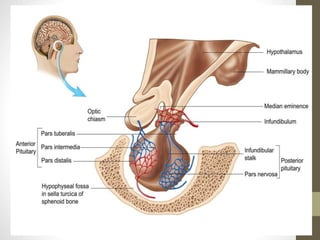
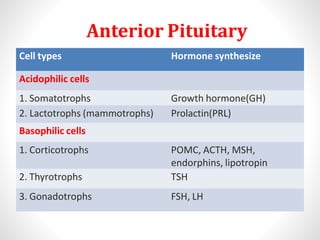
Anterior Pituitary
Cell types Hormone synthesize
Acidophilic cells
1. Somatotrophs Growth hormone(GH)
2. Lactotrophs (mammotrophs) Prolactin(PRL)
Basophilic cells
1. Corticotrophs POMC, ACTH, MSH,
endorphins, lipotropin
2. Thyrotrophs TSH
3. Gonadotrophs FSH, LH
Aetiology - Hypopituitarism
1.Developmental/Structural
a) Pituitary dysplasia/Aplasia
b) Encephalocele, congenital empty sella
c) Congenital hypothalamus disorder
i) Septo- optic dysplasia
ii) Prader- willi syndrome
iii) Kallmann syndrome
iv) Laurence-moon-beidl syndrome
2. Neoplastic
a) Pituitary adenoma
b) Parasellar mass( eg: germinoma, glioma, ependymoma)
c) Craniopharyngioma
d) Rathke’s cyst
e) Others:- Mets, lymphoma, Leukemia, Meningioma
3. Vascular
a)Pituitary apoplexy
b)Seehan’s syndrome(Postpartum necrosis)
c)Sickle cell disease
d)Arteritis
4. Traumatic
Injury, surgical resection, Radiation damage
5. Inflammatory
a) Hypophisitis:- Lymphocytic & granulomatous hypophisitis
b)Others:- Hemochromatosis,Sarcoidosis, Histiocytosis,
Amyloidosis
6. Infections
a) Fungal(Histoplasmosis)
b) Parasitis(Toxoplasma)
c) Tuberculosis
d) Pneumocystis carinii
CLINICAL FEATURES
Hormone Features of deficiency
GH Children: Growth retardation
Adults: Decrease in muscle bulk
Hypoglycemic tendency
ACTH Weight loss, hypotension, hypoglycemia, decrease skin
pigmentation, hyponatremia, nausea, vomiting
Prolactin Lactation failure
Gonadotropins Children: delayed puberty
Female: oligomenorrhoea, infertility, atrophy of breast &
genitalia, loss of libido
Male: Impotence, azoospermia, testicular atrophy, loss of
libido
Both sexes : loss of libido, loss of body hair
TSH Weight gain, cold intolerance, fatique, hair loss, constipation,
dry skin, hoarseness, bradycardia, fatigue
ADH Thirst, polyuria
SYNDROME CLUSTERS
Septo-Optic Dysplasia
Hypothalamic dysfunction and hypopituitarism
■may result from dysgenesis of the septum pellucidum or corpus
callosum
Affected children have mutations in the HESX1 gene
These children exhibit variable combinations of:
■cleft palate
■syndactyly
■ear deformities
■optic atrophy
■micropenis
■anosmia
Pituitary dysfunction
■Diabetes insipidus
■GH deficiency and short stature
■Occasionally TSH deficiency
Prader Willi Syndrome
• Result from deletion of patternal copy of SRNPN and
NECDIN gene (chr 15q).
• Clinical feature:- Hypogonadotropic Hypogonadism,
Hyperphagia, obesity, muscle hypotonia , mental
retardation, T2DM.
Kallman Syndrome
• Defective hypothalamic gonadotropin-releasing hormone
(GnRH) synthesis
• Associated with anosmia or hyposmia due to olfactory bulb
agenesis or hypoplasia
• May also be associated with: color blindness,optic atrophy,
nerve deafness, cleft palate, renal abnormalities,
cryptorchidism
• GnRH deficiency prevents progression
through puberty
• Characterized by
✓low LH and FSH levels
✓low concentrations of sex steroids
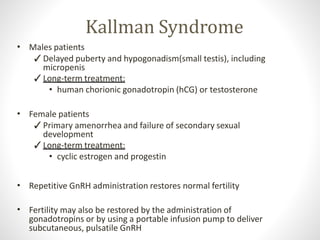
Kallman Syndrome
• Males patients
✓Delayed puberty and hypogonadism(small testis), including
micropenis
✓Long-term treatment:
• human chorionic gonadotropin (hCG) or testosterone
• Female patients
✓Primary amenorrhea and failure of secondary sexual
development
✓Long-term treatment:
• cyclic estrogen and progestin
• Repetitive GnRH administration restores normal fertility
• Fertility may also be restored by the administration of
gonadotropins or by using a portable infusion pump to deliver
subcutaneous, pulsatile GnRH
Laurence-Moon-Bardet-Biedl Syndrome
• Rare autosomal recessive disorder
• Clinical feature:- Retinal degenration, Renal
abnormality, Retardation(Mental), obesity
other: hexadactyly/ brachydactyly/ syndactyly
• Central diabetes insipidus may or may not be associated
• GnRH deficiency occurs in 75% of males and half of
affected females
• Retinal degeneration begins in early childhood
– most patients are blind by age 30
Pituitary adenoma(Non functioning)
• Consist of 10% of all intracranial
neoplasm.
• 25-35% are nonfunctioning .
• Most of them arise from gonadotropin cells &
monoclonal in origin.
• Most of them are macroadenoma.
• Usually discovered because of space-
occupying effects, or inadvertently.
Management of nonfunctioning pituitary adenoma
Non functioning pit. adenoma
MRI differential diagnosis
Assess pituitary function
Nonfunctioning
pituitary
adenoma
Macroadenoma
Transspenoidal surgery
Follow up: MRI at 1,2,5 year
Reassess if symptomatic
Microadenoma
Observe
MRI and hormone testing
every 6 month for 2yr,
annually thereafter, hormone
replacement if required
Pituitary Apoplexy
• Symptoms may occur immediately or may develop over 1-2
days
Pituitary Apoplexy
• Risk factors:
✓DM, HTN
✓Sickle cell anemia
✓Anticoagulant use:- Warfarin, Heprin
• Usually resolve completely
• Transient or permanent hypopituitarism is possible
✓undiagnosed acute adrenal insufficiency
• Diagnose with CT/MRI
• Differentiate from leaking aneurysm
• Treatment:
✓If visual defects and altered consciousness then Surgical –
Transsphenoidal decompression
• Medical therapy – if symptoms are mild
✓Corticosteroids
Sheehan’s Syndrome
• Infarction of pituitary after substantial blood loss
during childbirth.
• Incidence: 3.6%
• No correlation between severity of hemorrhage and
symptoms
• Severe: recognized month to years postpartum
period
• Lethargy, anorexia, weight loss, unable to breast
feeding
Sheehan’s Syndrome
• Typically long interval between obstetric event and
diagnosis( months to years)
• Of total patients:
✓50% permanent amenorrhea
✓The rest had scanty-rare menses
✓Mostly lactation was poor to absent
•
•
Dx: MRI empty sella turcica
T/t: Hormone replacement &
Corticosteroids
Lymphocytic Hypophysitis
• Deficiency of one or more anterior pituitary hormones (Diabetes
Insipidus): ACTH deficiency is the most common.
Diagnosis:
MRI - may be indistinguishable from pituitary adenoma
Treatment:
✓Non compressive symptoms→ Hormone support + Steroid
✓Compressive symptoms→ Surgery(TSS)
Pituitary Trauma
•The pituitary may be partially or totally damaged by birth
trauma, cranial hemorrhage, fetal asphyxia, or breech
delivery.
• Head trauma can lead to direct pituitary damage by
1) Sella turcica fracture,
2) Pituitary stalk section
3) Trauma-induced vasospasm, or ischemic infarction
The most common traumatic cause of compromised
pituitary function in the adult is iatrogenic neurosurgical
trauma.
• Hypopituitarism following head trauma usually
appears within a year after the insult.
• Virtually all patients with subsequent
pituitary failure have a history of loss of
consciousness following trauma.
• 50% has documented skull fracture.
• 30% of these patients have demonstrable signs
of hypothalamic or post pituitary hemorrhage
(or both) or ant lobe infarction on MRI.
• Diabetes insipidus is the most common endocrine
disorder, encountered in about 30% of these
patients, later on other hormone deficiency may
also occurs.
• 75% of patients have evidence of hypopituitarism, and
the degree of pituitary failure correlates with severity
of head trauma.
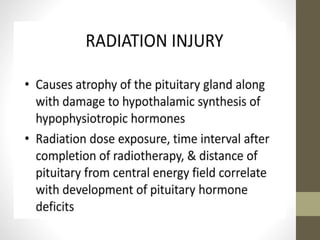
Radiation Injury (Cranial Irradiation)
• Children and adolescents, are more susceptible.
• Up to two-thirds of patients ultimately develop
hormone insufficiency after a median dose of 50
Gy (5000 rad) .
• The development of hypopituitarism occurs over 5–
15 years and usually reflects hypothalamic damage
rather than primary destruction of pituitary cells.
• GH deficiency is most common, followed by
gonadotropin and ACTH deficiency.
• Replacement therapy to be instituted when
appropriate .
Empty Sella Syndrome
• An empty sellacan developas a consequenceof a primary
congenitalweaknessof the diaphragm.
• Damageto the sellardiaphragmcan lead to arachnoid
herniationintothe sella.
• Oftenan incidental MRIfinding.
Empty Sella Syndrome
• Usually have normal pituitary function implying that
the surrounding rim of pituitary tissue is fully
functional
• Hypopituitarism may develop insidiously when > 90% of
tissue is compressed.
• Rarely, functional pituitary adenomas may arise within
the rim of pituitary tissue, and these are not always
visible on MRI.
• Aetiology:-
1.Congenital
2.Primary hypophysitis
3.Pituitary Adenoma (silent infarction)
4.Other: Trauma, Surgery, Radiation
Empty Sella Syndrome
MRI brain(sagittal section) Specimen showing empty pit
fossa
Clinical Presentation
• Can present with features of deficiency of one or more
anterior pituitary hormones.
• Up to 50% of patients with primary empty sella have
associated benign intracranial hypertension
• Clinical presentation depends on:
✓Age at onset
✓Hormone affected, extent
✓Speed of onset
✓Duration of the deficiency
Diagnosis of GH Deficiency
Test Blood sample timing Interpretation
Insulin tolerance test: -30,0,30,60,120 min for Glu˂40mg/dl
Regular insulin(.05-.15U/kg glucose & GH GH˃3µg/L-Normal
I.V.)
Clonidine stimulation test: 0,30,60,90,120,150,180 min GH >7µg/L- Normal
Clonidine 150 µg/m2 orally
GHRH test: 1µg/kg I.V. 0,15,30,45,60,120 min GH˃3µg/L-Normal
L-Arginine test:30gm I.V. over 0,30,60,120 min GH˃3µg/L-Normal
30min
L-Dopa test:500mg PO 0,30,60,120 min GH˃3µg/L-Normal
Diagnosis of Hypocortisolism
• Basal ACTH secretion
✓Cortisol < 3 μg/dL, cortisol deficiency
✓Cortisol > 18μg/dL, sufficient ACTH
✓Cortisol > 3 μd/dL but < 18 μg/dL - test ACTH reserve
Test Time of Sample collection Result(normal response)
ITT: regular insulin
(0.05-0.15U/Kg I.V.)
-30,0,30,60,90 min for
glucose and cortisol
1. Glucose<40mg/dl
2. Cortisol↑ by >7ug/dl or
to>20ug/dl
CRH Test: 1ug/kg CRH I.V. at
8am
0,15,30,60,90,120 min for
ACTH and Cortisol
1. ACTH↑ 2 to 4 fold
2. Cortisol level>20-25 ug/dl
Metyrapone test:
Metyrapone
30mg/kg at midnight
Plasma 11-deoxycortisol,
ACTH, cortisol at 8 am
1. Cortisol< 4g/dl
2. 11-deoxycortisol>7.5ug/dl
3. ACTH> 75pg/ml
Std ACTH stimulation test :
ACTH(1-24 cosyntropin)
0.25mg IM or IV
0,30,60min for cortisol and
aldosterone
1. Cortisol >21g/dl
2.Aldosterone >4ng/dl above
baseline
Low dose ACTH test:
ACTH 1ug IV
0,30,60 min for cortisol Cortisol >21g/dl
3 day ACTH stimulation test:
0.25mg ACTH I.V. 8 hrly
Cortisol >21g/dl
•ACTH Reserve
Hormone Replacement
THANK YOU

HYPOPITUITARISM.pptx

  • 1.
  • 5.
    Anterior Pituitary Cell typesHormone synthesize Acidophilic cells 1. Somatotrophs Growth hormone(GH) 2. Lactotrophs (mammotrophs) Prolactin(PRL) Basophilic cells 1. Corticotrophs POMC, ACTH, MSH, endorphins, lipotropin 2. Thyrotrophs TSH 3. Gonadotrophs FSH, LH
  • 6.
    Aetiology - Hypopituitarism 1.Developmental/Structural a)Pituitary dysplasia/Aplasia b) Encephalocele, congenital empty sella c) Congenital hypothalamus disorder i) Septo- optic dysplasia ii) Prader- willi syndrome iii) Kallmann syndrome iv) Laurence-moon-beidl syndrome 2. Neoplastic a) Pituitary adenoma b) Parasellar mass( eg: germinoma, glioma, ependymoma) c) Craniopharyngioma d) Rathke’s cyst e) Others:- Mets, lymphoma, Leukemia, Meningioma
  • 7.
    3. Vascular a)Pituitary apoplexy b)Seehan’ssyndrome(Postpartum necrosis) c)Sickle cell disease d)Arteritis 4. Traumatic Injury, surgical resection, Radiation damage
  • 8.
    5. Inflammatory a) Hypophisitis:-Lymphocytic & granulomatous hypophisitis b)Others:- Hemochromatosis,Sarcoidosis, Histiocytosis, Amyloidosis 6. Infections a) Fungal(Histoplasmosis) b) Parasitis(Toxoplasma) c) Tuberculosis d) Pneumocystis carinii
  • 9.
  • 10.
    Hormone Features ofdeficiency GH Children: Growth retardation Adults: Decrease in muscle bulk Hypoglycemic tendency ACTH Weight loss, hypotension, hypoglycemia, decrease skin pigmentation, hyponatremia, nausea, vomiting Prolactin Lactation failure Gonadotropins Children: delayed puberty Female: oligomenorrhoea, infertility, atrophy of breast & genitalia, loss of libido Male: Impotence, azoospermia, testicular atrophy, loss of libido Both sexes : loss of libido, loss of body hair TSH Weight gain, cold intolerance, fatique, hair loss, constipation, dry skin, hoarseness, bradycardia, fatigue ADH Thirst, polyuria
  • 12.
  • 13.
    Septo-Optic Dysplasia Hypothalamic dysfunctionand hypopituitarism ■may result from dysgenesis of the septum pellucidum or corpus callosum Affected children have mutations in the HESX1 gene These children exhibit variable combinations of: ■cleft palate ■syndactyly ■ear deformities ■optic atrophy ■micropenis ■anosmia Pituitary dysfunction ■Diabetes insipidus ■GH deficiency and short stature ■Occasionally TSH deficiency
  • 14.
    Prader Willi Syndrome •Result from deletion of patternal copy of SRNPN and NECDIN gene (chr 15q). • Clinical feature:- Hypogonadotropic Hypogonadism, Hyperphagia, obesity, muscle hypotonia , mental retardation, T2DM.
  • 15.
    Kallman Syndrome • Defectivehypothalamic gonadotropin-releasing hormone (GnRH) synthesis • Associated with anosmia or hyposmia due to olfactory bulb agenesis or hypoplasia • May also be associated with: color blindness,optic atrophy, nerve deafness, cleft palate, renal abnormalities, cryptorchidism • GnRH deficiency prevents progression through puberty • Characterized by ✓low LH and FSH levels ✓low concentrations of sex steroids
  • 16.
    Kallman Syndrome • Malespatients ✓Delayed puberty and hypogonadism(small testis), including micropenis ✓Long-term treatment: • human chorionic gonadotropin (hCG) or testosterone • Female patients ✓Primary amenorrhea and failure of secondary sexual development ✓Long-term treatment: • cyclic estrogen and progestin • Repetitive GnRH administration restores normal fertility • Fertility may also be restored by the administration of gonadotropins or by using a portable infusion pump to deliver subcutaneous, pulsatile GnRH
  • 17.
    Laurence-Moon-Bardet-Biedl Syndrome • Rareautosomal recessive disorder • Clinical feature:- Retinal degenration, Renal abnormality, Retardation(Mental), obesity other: hexadactyly/ brachydactyly/ syndactyly • Central diabetes insipidus may or may not be associated • GnRH deficiency occurs in 75% of males and half of affected females • Retinal degeneration begins in early childhood – most patients are blind by age 30
  • 18.
    Pituitary adenoma(Non functioning) •Consist of 10% of all intracranial neoplasm. • 25-35% are nonfunctioning . • Most of them arise from gonadotropin cells & monoclonal in origin. • Most of them are macroadenoma. • Usually discovered because of space- occupying effects, or inadvertently.
  • 19.
    Management of nonfunctioningpituitary adenoma Non functioning pit. adenoma MRI differential diagnosis Assess pituitary function Nonfunctioning pituitary adenoma Macroadenoma Transspenoidal surgery Follow up: MRI at 1,2,5 year Reassess if symptomatic Microadenoma Observe MRI and hormone testing every 6 month for 2yr, annually thereafter, hormone replacement if required
  • 20.
    Pituitary Apoplexy • Symptomsmay occur immediately or may develop over 1-2 days
  • 21.
    Pituitary Apoplexy • Riskfactors: ✓DM, HTN ✓Sickle cell anemia ✓Anticoagulant use:- Warfarin, Heprin • Usually resolve completely • Transient or permanent hypopituitarism is possible ✓undiagnosed acute adrenal insufficiency • Diagnose with CT/MRI • Differentiate from leaking aneurysm • Treatment: ✓If visual defects and altered consciousness then Surgical – Transsphenoidal decompression • Medical therapy – if symptoms are mild ✓Corticosteroids
  • 22.
    Sheehan’s Syndrome • Infarctionof pituitary after substantial blood loss during childbirth. • Incidence: 3.6% • No correlation between severity of hemorrhage and symptoms • Severe: recognized month to years postpartum period • Lethargy, anorexia, weight loss, unable to breast feeding
  • 23.
    Sheehan’s Syndrome • Typicallylong interval between obstetric event and diagnosis( months to years) • Of total patients: ✓50% permanent amenorrhea ✓The rest had scanty-rare menses ✓Mostly lactation was poor to absent • • Dx: MRI empty sella turcica T/t: Hormone replacement & Corticosteroids
  • 24.
    Lymphocytic Hypophysitis • Deficiencyof one or more anterior pituitary hormones (Diabetes Insipidus): ACTH deficiency is the most common. Diagnosis: MRI - may be indistinguishable from pituitary adenoma Treatment: ✓Non compressive symptoms→ Hormone support + Steroid ✓Compressive symptoms→ Surgery(TSS)
  • 25.
    Pituitary Trauma •The pituitarymay be partially or totally damaged by birth trauma, cranial hemorrhage, fetal asphyxia, or breech delivery. • Head trauma can lead to direct pituitary damage by 1) Sella turcica fracture, 2) Pituitary stalk section 3) Trauma-induced vasospasm, or ischemic infarction The most common traumatic cause of compromised pituitary function in the adult is iatrogenic neurosurgical trauma.
  • 26.
    • Hypopituitarism followinghead trauma usually appears within a year after the insult. • Virtually all patients with subsequent pituitary failure have a history of loss of consciousness following trauma. • 50% has documented skull fracture. • 30% of these patients have demonstrable signs of hypothalamic or post pituitary hemorrhage (or both) or ant lobe infarction on MRI.
  • 27.
    • Diabetes insipidusis the most common endocrine disorder, encountered in about 30% of these patients, later on other hormone deficiency may also occurs. • 75% of patients have evidence of hypopituitarism, and the degree of pituitary failure correlates with severity of head trauma.
  • 29.
    Radiation Injury (CranialIrradiation) • Children and adolescents, are more susceptible. • Up to two-thirds of patients ultimately develop hormone insufficiency after a median dose of 50 Gy (5000 rad) . • The development of hypopituitarism occurs over 5– 15 years and usually reflects hypothalamic damage rather than primary destruction of pituitary cells. • GH deficiency is most common, followed by gonadotropin and ACTH deficiency. • Replacement therapy to be instituted when appropriate .
  • 30.
    Empty Sella Syndrome •An empty sellacan developas a consequenceof a primary congenitalweaknessof the diaphragm. • Damageto the sellardiaphragmcan lead to arachnoid herniationintothe sella. • Oftenan incidental MRIfinding.
  • 31.
    Empty Sella Syndrome •Usually have normal pituitary function implying that the surrounding rim of pituitary tissue is fully functional • Hypopituitarism may develop insidiously when > 90% of tissue is compressed. • Rarely, functional pituitary adenomas may arise within the rim of pituitary tissue, and these are not always visible on MRI. • Aetiology:- 1.Congenital 2.Primary hypophysitis 3.Pituitary Adenoma (silent infarction) 4.Other: Trauma, Surgery, Radiation
  • 33.
    Empty Sella Syndrome MRIbrain(sagittal section) Specimen showing empty pit fossa
  • 34.
    Clinical Presentation • Canpresent with features of deficiency of one or more anterior pituitary hormones. • Up to 50% of patients with primary empty sella have associated benign intracranial hypertension • Clinical presentation depends on: ✓Age at onset ✓Hormone affected, extent ✓Speed of onset ✓Duration of the deficiency
  • 36.
    Diagnosis of GHDeficiency Test Blood sample timing Interpretation Insulin tolerance test: -30,0,30,60,120 min for Glu˂40mg/dl Regular insulin(.05-.15U/kg glucose & GH GH˃3µg/L-Normal I.V.) Clonidine stimulation test: 0,30,60,90,120,150,180 min GH >7µg/L- Normal Clonidine 150 µg/m2 orally GHRH test: 1µg/kg I.V. 0,15,30,45,60,120 min GH˃3µg/L-Normal L-Arginine test:30gm I.V. over 0,30,60,120 min GH˃3µg/L-Normal 30min L-Dopa test:500mg PO 0,30,60,120 min GH˃3µg/L-Normal
  • 37.
    Diagnosis of Hypocortisolism •Basal ACTH secretion ✓Cortisol < 3 μg/dL, cortisol deficiency ✓Cortisol > 18μg/dL, sufficient ACTH ✓Cortisol > 3 μd/dL but < 18 μg/dL - test ACTH reserve
  • 38.
    Test Time ofSample collection Result(normal response) ITT: regular insulin (0.05-0.15U/Kg I.V.) -30,0,30,60,90 min for glucose and cortisol 1. Glucose<40mg/dl 2. Cortisol↑ by >7ug/dl or to>20ug/dl CRH Test: 1ug/kg CRH I.V. at 8am 0,15,30,60,90,120 min for ACTH and Cortisol 1. ACTH↑ 2 to 4 fold 2. Cortisol level>20-25 ug/dl Metyrapone test: Metyrapone 30mg/kg at midnight Plasma 11-deoxycortisol, ACTH, cortisol at 8 am 1. Cortisol< 4g/dl 2. 11-deoxycortisol>7.5ug/dl 3. ACTH> 75pg/ml Std ACTH stimulation test : ACTH(1-24 cosyntropin) 0.25mg IM or IV 0,30,60min for cortisol and aldosterone 1. Cortisol >21g/dl 2.Aldosterone >4ng/dl above baseline Low dose ACTH test: ACTH 1ug IV 0,30,60 min for cortisol Cortisol >21g/dl 3 day ACTH stimulation test: 0.25mg ACTH I.V. 8 hrly Cortisol >21g/dl •ACTH Reserve
  • 39.
  • 40.