Fledermaus
ArcGIS®trademark provided underlicensefrom Esri
Rand LeBouvier,
Bluefin Robotics
Corporation. USA
Donald
Steinbrecher,
Naval Undersea
Warfare Center.
Newpon, RI, USA
Sharing the Wealth
Towards an Ocean Sensing Network
Autonomous Underwater Vehicles (AUVs) and associated undersea technologies have demonstrated exceptional current
utility and great growth potential for military,governmental and commercial maritime agencies as well as for ocean
research institutions. While sustained and aggressive research, development, testing and evaluation is still in order,the
technology is available nowto benefit potential consumers with the incredible range of data these systems can already
provide.Although unmanned systems in other domains (air,ground, and space) have experienced rapid growth resulting
from wartime necessities,there remains aprevalent 'wait and see' mindset about unmanned undersea systems among
those who work in and depend on the oceans.
The drive for 'bigger,better,faster, cheaper' systems is understandable,but AUV manufacturing and operational expertise
are niche commodities that require constant and consistent cultivation to maintain. Rather than continuing to impose the
cost of development on government and military organisations, as isthe traditional practice,or of imposing the cost of
ownership on agencies that cannot afford the initial expense,existing systems can be employed across the world today to
offset those costs by the creation of apay-for-access network to share the wealth of data that is already available.
Evolving global realities prove that
there is a real and present demand
for information about the ocean envi-
ronment to allow response to chang-
ing economic and climatic conditions
and to provide security for ports, har-
bours and shipping lanes in a world
that is increasinglydependent on the
uninterrupted flow of maritime com-
merce. Myriad unmanned systems
deployed worldyide and connected
via an overarching data network
can provide persistent presence and
access to information fora wide audi-
ence ofusers.There is a possible prac-
tical and cost-effective approach to
creating sucha network. There is
no intent, however, in this short dis-
cussionto address treaty obligations
such as those that might be imposed
by UNCLOS III or legal and insur-
ance issues, which must eventuallybe
addressed.
As background,AUVs offer significant
advantages in comparison to manned
or towed systems. Due to theirinher-
ent stabiJity offlight and ability to
maintain precise altitude above the
sea bottom,AUVs are better able to
provide higher quaHty imagery. 'fheir
stability offlight also contributes
to the high degree ofaccmacy that
can be achieved in AUV navigation,
which in turn enables the repeat-
ability ofsurveys; the AUV is quite
adept at returning to previous survey
waypoints and at re-creating previ-
ous tracks. AUVs consistently dem-
onstrate a highercoverage rate and
attendant shortersurvey time.
Obviously, there are significant man-
power and resource savings to be
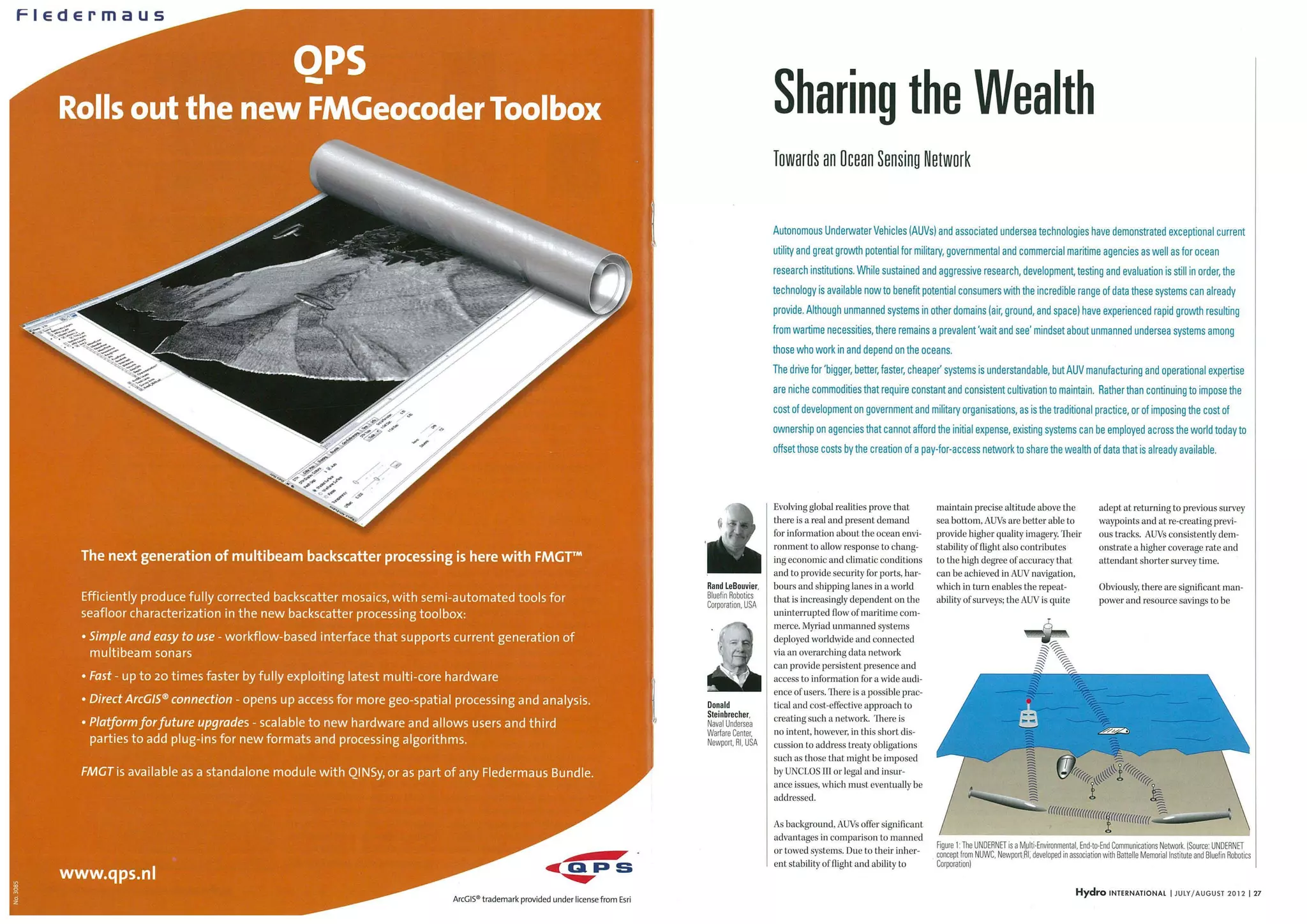
Figure 1: The UNDERNET is aMulti·Environmental. End-to-End Communications Network_ (Source: UNDERNET
concept from NUWC, Newport RI. developed in association with Battelle Memorial Institute and Bluefin Robotics
Corporation)
Hydro INTERNATIONAL I JULY / AUGUST 201 2 127
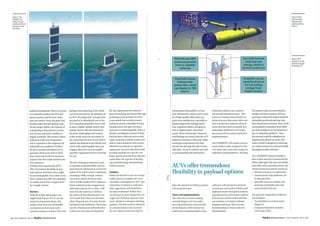
Figure 2: 'Sea
Satellites' use
multipleenergy
sources and reduce
exposure in high
sea states.
realised immediately.'lllere is no need
to constantly monitor the AUV dur-
ing its mission, and the host vessel
does not need to 'mow the grass' and
thereby waste fuel and human capi-
tal any longer. Rather, the expense of
maintaining a ship and crew on sta-
tion, in unco-operative weather, is
largelyavoidable. 'nlis means a direct
reduction in the cost ofoperation
and in exposure to the exigencies of
unfriendly sea conditions. Further.
for port security and inland sLu'vey
purposes, there is no need to close
busy waterways (with the immense
expense that this could entail) to per-
form missions.
Perhaps most importantly. AUVs
offer tremendous flexibility in pay-
load options. and these often might
be interchangeable. even whlle at sea.
Most vehicles also offer the capability
to employ more than a single sensor
for a single mission.
Barriers
With aUofthese advantages, one
might think that an AUV is an easy
choice for interested clients. The
reality is that there are still ponder-
ous barriers to their more wide-
spread acceptance and use. First, and
28 I JULY/ AUGUST 20 12 I Hydro INTERNATIONAL
perhaps most daunting, is the initial
cost of investment for the purchase of
an AUY.11le adage that, 'you get what
you pay for; is abundantly true in the
AUV manufacturing field. Ifyou wish
to have a highJy capable system that
reUably returns after its missions in
the most challenging environment
in the world. then you can expect to
pay a premium fo r that. If you wish to
e).."plore the deepest ocean depths and
return with superb quality data and
imagery. then you want an equally
superblyengineered system to do that
for you.
The fear oflosing an expensive asset
is certainly comprehensible, and this
issue must be addressed at every level
before AUVs will be used to maximum
advantage. Oddlyenough, military
crews have shown the most reluc-
tance to fully employ AUVs, while aca-
demic institutions have logged more
miles than anyone else to date. I will
leave it to the audience to deduce
the source ofthat phenomenon, but
AUVs work best when you use them
often. Frequent use, ofcourse, breeds
familiarity and confidence. 'nlose who
use the vehicles most will be the first
to discover new ways of using them.
Yet, the requirement for undersea
data is increasing and shows little sign
ofabating as the promise ofaccess
to previously inaccessible oceanic
resources and the criticality of main-
taining secure and open sea lanes
and ports is realised globally. 'nlere is
already a prodigious amount ofdata
that has been collected and severely
under-used that could be made avail-
able to wider audiences who can not
afford the investment in expensive
equipment. Access to this data could
be made available on a pay-for-use
basis, and the proceeds from that use
could offset the expense ofdevelop-
ing, manufacturing, and operating
vehicle systems.
Enablers
While the barriers to use are consid-
erable, there are enablers ror more
insatiable consumption ofAUV- pro-
vided data. Consumers really have
little regard from which platform
the data is obtained. Rather they
are focused on three things that one
might call 'freshness, ripeness, and
taste; si milar to a shopper selecting
produce. The data must be obtained
in a timely manner (not necessar-
ily 'new' data), it must be ready for
•
:/h1.
~,1'....
I I IRIDIUM and GPS
antennas provide
links to satellite
networks
Keel buIb stores
transponder
sensor kite, which
can deploy to 100
meters.
consumption (accessible via com-
mon information nodes), and it must
be ofhigh quality. Older data can
prove very satisfactory, especially in
discovering trends (change detec-
tion, migratory habits, reefgenera-
tion or degeneration, and much
more).Those with proper resources
and funding can ensure that the AUV
industry continues to flourish, while
receiving compensation for their
investment through the sale ofvalu-
able data. As more vehicles are built
to accommodate the demand for
.rr- Two sails harvest
wind and sun
energy, which is
stored in batteries.
tT
Propeller can be
used for drive or
for harvesting
energy from
kinetic motion
collection, military use, commer-
cial use and individual users: 11lis
vision is certainly more inclusive in
terms ofaccess than some other cur-
rent concepts for undersea observa-
tories that have been proposed. It is
undeniably ambitious in its scope,
but as you will see, quite practical in
implementation.
The UNDERNET will employ autono·
mous surface nodes designed to har-
vest wind. wave, and solar energy for
endurance and persistence. The data
The surface nodes are networked by
satellite and have constant CPScon-
nectivity, so that each surface node has
immediate positional and near real~
time situational awareness. TIleY can be
commanded to reposition from either
an earth satellite or an W1manned sur-
face or subsurface platform. Thus.
the network could be redeployed as
requirements dictate or evolve. The
nodes would be designed to submerge
as a safety measure to avoid potentially
damaging weather and seas.
AUVs offer tremendous
flexibility in payload options
'nle UNDERNET business model is
akin to that used for Commercial Sat-
ellites. although a bit more accessible.
tailorable, and reasonably priced. The
whole system accounts for means to:
allocate resources to collect data
communicate with platforms col-
lecting that data
data, the unit prices ofthese systems
will surely decrease.
Visionand Implementation
The vision for an ocean sensing
network (Figure 1) is: 'An under-
sea communications network with
all the features of the Internet for
underwater commun ications, data
collectors will consist ofa network
of undersea and surface vehicles and
deployed sensors that glean position-
ing information and mission updates
from known surface nodes and that
can continue on mission without
frequent surfacing. They can also
download data to those nodes for
dissemination.
assemble, process, evaluate, dis-
seminate and display data and
control levels ofaccess
The physical composition of the sys-
tem includes:
'Sea SatelUtes' or surface nodes
(Figure 2)
Unmanned Maritime Systems
(AUVs and USVs)
Figure 3: AUVs
could be widely
deployed using
undersea docking
stations.
Figure 4: MIT
concept for aLong-
Endurance, Energy-
HaNesting ASV.
Hydro INTERNATIONAL J JULY/ AUGUST 2012129
Undersea Docking Stations
(Figure 3)
Deployed sensors
cnle virtual components would
include:
Network
Interfaces and
Functionality
Sea Satellite Concept
One particular concept for the
actual surface node is the MIT Sea-
Grant Autonomous Surface Vehi-
cle (ASV) design that comprises a
composite vertical fin having a bot-
tom-mounted bulb ballast, a surface
body fitted with hvo solid-wing-
design folding sails that double as
solar panels, a GPS and satellite-
communications antenna, and a
water-propulsion system compris-
ing a motor-driven propeller and two
actuator-positioned rudders. When
outfitted with a full complement of
batteries, the vehicle is about 8ft tall
and weighs about !OOlbs.
enjoy the added benefit of being able
to task the platforms and sensors to
conduct surveys. Persons requiring
certain data could post their require-
ments on the site, and equipment
owners/operators could offer thei r
services via private bid. It stands to
reason that if the response is strong,
additional systems will be manufac-
tured and additional sen rice provid-
ers will enter the market.
Although there are quite a few obvi-
ous appl ications that could benefit
from the creation of UNDERIJET, the
'Killer Applications' are predicted to
be Port and Harbour Security, Oil and
Gas survey and pipeline inspection,
and Anti-Submarine Warfare (ASW)
/ Anti-Surface Warfare (ASUW)
operations.
rnle great promise ofan Ocean Net-
work lies in its accessibility to a wide
audience. 11le physical equipment
used in the system is important, but
the technology read iness level of
that equipment is quite well-estab-
According to preliminary estimates, Iished with few exceptions. Rather,
the ASV can maintain its position in it is the organisation of the network
moderate seas within 250m ofa fixed and its admi nistration that will pro-
location while using, on average, 1.5 vide the challenges; maintaini ng
The great promise ofan Ocean
Network lies in its accessibility
to a wide audience
Watts ofenergy. Energy harvested
from solar panels and wind is stored
in batteries to provide energy for
communications and fo r other on-
board systems.
The UNDERNET concept directly
addresses the cost ofownership
ofcurrently expensive unmanned
maritime systems. Through a fee-
fo r-service arrangement, it is con-
ceivable that the investment made
by veh icle manufacturers and survey
service providers could be recovered
within the first year ofoperation.
l110se fees could include direct lease
ofthe nodes, vehicles. and sensors,
or simply access to data arch ived on
the network. Direct lessees would
connectivity, allowing scalable lev-
els ofaccess, enabling tailoring and
tasking ofdata requirements, and
creating a standing, expandable
database will generate immediate
value and will add new users on an
unprecedented scale.
Acknowledgements
lhis article wade made possible
th rough the work performed under a
Cooperative Research find Develop-
mentAgreement (CRADA) between
Battelle Memorial Institute and the
Naval Undersea vVarfare Center
(NU'VC) in Newport, Rhode Island to
jointly address an undersea commu-
nications system with independent
power and broad coverage with the
following contributors in lhese roles:
NU'VC Newport HI (End to End
Communications, Large Networked
Undersea Systems)
Battelle Memorial Institute (System
Integrator, Hardware Development,
Hardware Builder, System Opera-
tor). Dr. Lynn Faulkner. Ph.D. Bat-
telle Program Manager
Bluefin Hobotics Corpora-
tion (Technical Support, Oper-
ations, ProofofConcept, and
Manufactu ring)
Massachusetts Institute ofTech no1-
ogy(Naval Architect)
University of l'vlichigan (Efficient
Propeller Supplier). r~
The Authors
Dr.Rand leBouvier.aretired Navy Captain, is
in charge of government and military business
development at Bluefin Robotics, and was the
commissioning CommandingOfficer of the USS
Carter Hall LSD-50 and the first head, Unmanned
AerialVehicles (UAV) Section in the AirWarfare
directorate in theOffice of the Chief of Naval
Operations in Washington D.C.He is a1978
graduate of the United States Naval Academy.
the United States Marine Corps Command and
Staff College, the UniverSityof Rhode Island
(Mastersin MarineAffairs). the Naval War
College (Masters inNationalSecurity and
StrategicStudies and first prize inthe AFCEA
C41 category for paper Extending Operational
Reach With Unmanned Systems)' and Salve
ReginaUniversity(PhD thesison the significance
of embodiment to the development of Artificial
Intelligence).
Dr. Donald H.Steinbrecher Dr. Steinbrecher
received aBSEE degree. with highest honours.
from the Universityof Florida inJune 1960
He entered the Massachusetts Institute of
Technology graduate studies programme in
Electrical Engineering andComputer Science
and received aMaster of Science in 1963
and completed thePhD degree in June 1966.
Dr.Steinbrecherestablished afundamental
performance limit for the dynamic range of
frequency converters in 1975, which resulted
intwo patents defining the ParamixerTM
frequency translator. The Paramixer became
the core technology forthe development of
numerous broadband software-defined signals
acquisition systems. Dr.Steinbrecher was
named awinnerof the2007 Department of
the Navy Top Scientists and Engineers of the
Year Award for his innovative work in thefield
of high-performance digitalsignals acquisition
systems. He is also awinner of the2007 Chief of
NavalResearch Million-DollarChallenge.
Dr. Steinbrecher founded Steinbrecher
Corporation which became aleading supplier of
software-defined signals acquisition systems.
Dr. DonaldH. Steinbrecher currently holds the
position of chief scientist inthe Electromagnetic
Systems Division of theNavy Undersea Warfare
Center in Newport. RI where he has been
employed for the past 10 years
Hydro INTERNATI ONAL I JULY/ AUGUST 2012 I 31

Hydro Article

  • 1.
    Fledermaus ArcGIS®trademark provided underlicensefromEsri Rand LeBouvier, Bluefin Robotics Corporation. USA Donald Steinbrecher, Naval Undersea Warfare Center. Newpon, RI, USA Sharing the Wealth Towards an Ocean Sensing Network Autonomous Underwater Vehicles (AUVs) and associated undersea technologies have demonstrated exceptional current utility and great growth potential for military,governmental and commercial maritime agencies as well as for ocean research institutions. While sustained and aggressive research, development, testing and evaluation is still in order,the technology is available nowto benefit potential consumers with the incredible range of data these systems can already provide.Although unmanned systems in other domains (air,ground, and space) have experienced rapid growth resulting from wartime necessities,there remains aprevalent 'wait and see' mindset about unmanned undersea systems among those who work in and depend on the oceans. The drive for 'bigger,better,faster, cheaper' systems is understandable,but AUV manufacturing and operational expertise are niche commodities that require constant and consistent cultivation to maintain. Rather than continuing to impose the cost of development on government and military organisations, as isthe traditional practice,or of imposing the cost of ownership on agencies that cannot afford the initial expense,existing systems can be employed across the world today to offset those costs by the creation of apay-for-access network to share the wealth of data that is already available. Evolving global realities prove that there is a real and present demand for information about the ocean envi- ronment to allow response to chang- ing economic and climatic conditions and to provide security for ports, har- bours and shipping lanes in a world that is increasinglydependent on the uninterrupted flow of maritime com- merce. Myriad unmanned systems deployed worldyide and connected via an overarching data network can provide persistent presence and access to information fora wide audi- ence ofusers.There is a possible prac- tical and cost-effective approach to creating sucha network. There is no intent, however, in this short dis- cussionto address treaty obligations such as those that might be imposed by UNCLOS III or legal and insur- ance issues, which must eventuallybe addressed. As background,AUVs offer significant advantages in comparison to manned or towed systems. Due to theirinher- ent stabiJity offlight and ability to maintain precise altitude above the sea bottom,AUVs are better able to provide higher quaHty imagery. 'fheir stability offlight also contributes to the high degree ofaccmacy that can be achieved in AUV navigation, which in turn enables the repeat- ability ofsurveys; the AUV is quite adept at returning to previous survey waypoints and at re-creating previ- ous tracks. AUVs consistently dem- onstrate a highercoverage rate and attendant shortersurvey time. Obviously, there are significant man- power and resource savings to be Figure 1: The UNDERNET is aMulti·Environmental. End-to-End Communications Network_ (Source: UNDERNET concept from NUWC, Newport RI. developed in association with Battelle Memorial Institute and Bluefin Robotics Corporation) Hydro INTERNATIONAL I JULY / AUGUST 201 2 127
  • 2.
    Figure 2: 'Sea Satellites'use multipleenergy sources and reduce exposure in high sea states. realised immediately.'lllere is no need to constantly monitor the AUV dur- ing its mission, and the host vessel does not need to 'mow the grass' and thereby waste fuel and human capi- tal any longer. Rather, the expense of maintaining a ship and crew on sta- tion, in unco-operative weather, is largelyavoidable. 'nlis means a direct reduction in the cost ofoperation and in exposure to the exigencies of unfriendly sea conditions. Further. for port security and inland sLu'vey purposes, there is no need to close busy waterways (with the immense expense that this could entail) to per- form missions. Perhaps most importantly. AUVs offer tremendous flexibility in pay- load options. and these often might be interchangeable. even whlle at sea. Most vehicles also offer the capability to employ more than a single sensor for a single mission. Barriers With aUofthese advantages, one might think that an AUV is an easy choice for interested clients. The reality is that there are still ponder- ous barriers to their more wide- spread acceptance and use. First, and 28 I JULY/ AUGUST 20 12 I Hydro INTERNATIONAL perhaps most daunting, is the initial cost of investment for the purchase of an AUY.11le adage that, 'you get what you pay for; is abundantly true in the AUV manufacturing field. Ifyou wish to have a highJy capable system that reUably returns after its missions in the most challenging environment in the world. then you can expect to pay a premium fo r that. If you wish to e).."plore the deepest ocean depths and return with superb quality data and imagery. then you want an equally superblyengineered system to do that for you. The fear oflosing an expensive asset is certainly comprehensible, and this issue must be addressed at every level before AUVs will be used to maximum advantage. Oddlyenough, military crews have shown the most reluc- tance to fully employ AUVs, while aca- demic institutions have logged more miles than anyone else to date. I will leave it to the audience to deduce the source ofthat phenomenon, but AUVs work best when you use them often. Frequent use, ofcourse, breeds familiarity and confidence. 'nlose who use the vehicles most will be the first to discover new ways of using them. Yet, the requirement for undersea data is increasing and shows little sign ofabating as the promise ofaccess to previously inaccessible oceanic resources and the criticality of main- taining secure and open sea lanes and ports is realised globally. 'nlere is already a prodigious amount ofdata that has been collected and severely under-used that could be made avail- able to wider audiences who can not afford the investment in expensive equipment. Access to this data could be made available on a pay-for-use basis, and the proceeds from that use could offset the expense ofdevelop- ing, manufacturing, and operating vehicle systems. Enablers While the barriers to use are consid- erable, there are enablers ror more insatiable consumption ofAUV- pro- vided data. Consumers really have little regard from which platform the data is obtained. Rather they are focused on three things that one might call 'freshness, ripeness, and taste; si milar to a shopper selecting produce. The data must be obtained in a timely manner (not necessar- ily 'new' data), it must be ready for • :/h1. ~,1'.... I I IRIDIUM and GPS antennas provide links to satellite networks Keel buIb stores transponder sensor kite, which can deploy to 100 meters. consumption (accessible via com- mon information nodes), and it must be ofhigh quality. Older data can prove very satisfactory, especially in discovering trends (change detec- tion, migratory habits, reefgenera- tion or degeneration, and much more).Those with proper resources and funding can ensure that the AUV industry continues to flourish, while receiving compensation for their investment through the sale ofvalu- able data. As more vehicles are built to accommodate the demand for .rr- Two sails harvest wind and sun energy, which is stored in batteries. tT Propeller can be used for drive or for harvesting energy from kinetic motion collection, military use, commer- cial use and individual users: 11lis vision is certainly more inclusive in terms ofaccess than some other cur- rent concepts for undersea observa- tories that have been proposed. It is undeniably ambitious in its scope, but as you will see, quite practical in implementation. The UNDERNET will employ autono· mous surface nodes designed to har- vest wind. wave, and solar energy for endurance and persistence. The data The surface nodes are networked by satellite and have constant CPScon- nectivity, so that each surface node has immediate positional and near real~ time situational awareness. TIleY can be commanded to reposition from either an earth satellite or an W1manned sur- face or subsurface platform. Thus. the network could be redeployed as requirements dictate or evolve. The nodes would be designed to submerge as a safety measure to avoid potentially damaging weather and seas. AUVs offer tremendous flexibility in payload options 'nle UNDERNET business model is akin to that used for Commercial Sat- ellites. although a bit more accessible. tailorable, and reasonably priced. The whole system accounts for means to: allocate resources to collect data communicate with platforms col- lecting that data data, the unit prices ofthese systems will surely decrease. Visionand Implementation The vision for an ocean sensing network (Figure 1) is: 'An under- sea communications network with all the features of the Internet for underwater commun ications, data collectors will consist ofa network of undersea and surface vehicles and deployed sensors that glean position- ing information and mission updates from known surface nodes and that can continue on mission without frequent surfacing. They can also download data to those nodes for dissemination. assemble, process, evaluate, dis- seminate and display data and control levels ofaccess The physical composition of the sys- tem includes: 'Sea SatelUtes' or surface nodes (Figure 2) Unmanned Maritime Systems (AUVs and USVs) Figure 3: AUVs could be widely deployed using undersea docking stations. Figure 4: MIT concept for aLong- Endurance, Energy- HaNesting ASV. Hydro INTERNATIONAL J JULY/ AUGUST 2012129
  • 3.
    Undersea Docking Stations (Figure3) Deployed sensors cnle virtual components would include: Network Interfaces and Functionality Sea Satellite Concept One particular concept for the actual surface node is the MIT Sea- Grant Autonomous Surface Vehi- cle (ASV) design that comprises a composite vertical fin having a bot- tom-mounted bulb ballast, a surface body fitted with hvo solid-wing- design folding sails that double as solar panels, a GPS and satellite- communications antenna, and a water-propulsion system compris- ing a motor-driven propeller and two actuator-positioned rudders. When outfitted with a full complement of batteries, the vehicle is about 8ft tall and weighs about !OOlbs. enjoy the added benefit of being able to task the platforms and sensors to conduct surveys. Persons requiring certain data could post their require- ments on the site, and equipment owners/operators could offer thei r services via private bid. It stands to reason that if the response is strong, additional systems will be manufac- tured and additional sen rice provid- ers will enter the market. Although there are quite a few obvi- ous appl ications that could benefit from the creation of UNDERIJET, the 'Killer Applications' are predicted to be Port and Harbour Security, Oil and Gas survey and pipeline inspection, and Anti-Submarine Warfare (ASW) / Anti-Surface Warfare (ASUW) operations. rnle great promise ofan Ocean Net- work lies in its accessibility to a wide audience. 11le physical equipment used in the system is important, but the technology read iness level of that equipment is quite well-estab- According to preliminary estimates, Iished with few exceptions. Rather, the ASV can maintain its position in it is the organisation of the network moderate seas within 250m ofa fixed and its admi nistration that will pro- location while using, on average, 1.5 vide the challenges; maintaini ng The great promise ofan Ocean Network lies in its accessibility to a wide audience Watts ofenergy. Energy harvested from solar panels and wind is stored in batteries to provide energy for communications and fo r other on- board systems. The UNDERNET concept directly addresses the cost ofownership ofcurrently expensive unmanned maritime systems. Through a fee- fo r-service arrangement, it is con- ceivable that the investment made by veh icle manufacturers and survey service providers could be recovered within the first year ofoperation. l110se fees could include direct lease ofthe nodes, vehicles. and sensors, or simply access to data arch ived on the network. Direct lessees would connectivity, allowing scalable lev- els ofaccess, enabling tailoring and tasking ofdata requirements, and creating a standing, expandable database will generate immediate value and will add new users on an unprecedented scale. Acknowledgements lhis article wade made possible th rough the work performed under a Cooperative Research find Develop- mentAgreement (CRADA) between Battelle Memorial Institute and the Naval Undersea vVarfare Center (NU'VC) in Newport, Rhode Island to jointly address an undersea commu- nications system with independent power and broad coverage with the following contributors in lhese roles: NU'VC Newport HI (End to End Communications, Large Networked Undersea Systems) Battelle Memorial Institute (System Integrator, Hardware Development, Hardware Builder, System Opera- tor). Dr. Lynn Faulkner. Ph.D. Bat- telle Program Manager Bluefin Hobotics Corpora- tion (Technical Support, Oper- ations, ProofofConcept, and Manufactu ring) Massachusetts Institute ofTech no1- ogy(Naval Architect) University of l'vlichigan (Efficient Propeller Supplier). r~ The Authors Dr.Rand leBouvier.aretired Navy Captain, is in charge of government and military business development at Bluefin Robotics, and was the commissioning CommandingOfficer of the USS Carter Hall LSD-50 and the first head, Unmanned AerialVehicles (UAV) Section in the AirWarfare directorate in theOffice of the Chief of Naval Operations in Washington D.C.He is a1978 graduate of the United States Naval Academy. the United States Marine Corps Command and Staff College, the UniverSityof Rhode Island (Mastersin MarineAffairs). the Naval War College (Masters inNationalSecurity and StrategicStudies and first prize inthe AFCEA C41 category for paper Extending Operational Reach With Unmanned Systems)' and Salve ReginaUniversity(PhD thesison the significance of embodiment to the development of Artificial Intelligence). Dr. Donald H.Steinbrecher Dr. Steinbrecher received aBSEE degree. with highest honours. from the Universityof Florida inJune 1960 He entered the Massachusetts Institute of Technology graduate studies programme in Electrical Engineering andComputer Science and received aMaster of Science in 1963 and completed thePhD degree in June 1966. Dr.Steinbrecherestablished afundamental performance limit for the dynamic range of frequency converters in 1975, which resulted intwo patents defining the ParamixerTM frequency translator. The Paramixer became the core technology forthe development of numerous broadband software-defined signals acquisition systems. Dr.Steinbrecher was named awinnerof the2007 Department of the Navy Top Scientists and Engineers of the Year Award for his innovative work in thefield of high-performance digitalsignals acquisition systems. He is also awinner of the2007 Chief of NavalResearch Million-DollarChallenge. Dr. Steinbrecher founded Steinbrecher Corporation which became aleading supplier of software-defined signals acquisition systems. Dr. DonaldH. Steinbrecher currently holds the position of chief scientist inthe Electromagnetic Systems Division of theNavy Undersea Warfare Center in Newport. RI where he has been employed for the past 10 years Hydro INTERNATI ONAL I JULY/ AUGUST 2012 I 31