AUTONOMOUS
UNDERWATER VEHICLE
GUIDE
Dr. Sam Kollannore U
PRESENTATED BY
KM Akhil
Reg no: 2000210469955
OVERVIEW
Mobile robots have the capability to move around in their environment
and are not fixed to one physical location.
• Land or home robots are usually referred to as Unmanned Ground
Vehicle (UGVs).
• Aerial robots are usually referred to as Unmanned Aerial
Vehicle (UAVs)
• Underwater robots are usually called Autonomous Underwater
Vehicle (AUVs)
• Polar robots, designed to navigate icy, Crevasse filled
environments
INTRODUCTION TO AUV
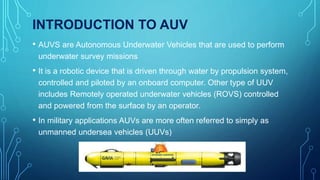
• AUVS are Autonomous Underwater Vehicles that are used to perform
underwater survey missions
• It is a robotic device that is driven through water by propulsion system,
controlled and piloted by an onboard computer. Other type of UUV
includes Remotely operated underwater vehicles (ROVS) controlled
and powered from the surface by an operator.
• In military applications AUVs are more often referred to simply as
unmanned undersea vehicles (UUVs)
HISTORY OF AUV
• The first AUV was developed at the Applied Physics Laboratory at the
University of Washington as early as 1957 by Stan Murphy, Bob
Francis
• The origin of AUV's should probably be linked to the Whitehead
Automobile "Fish" Torpedo. Robert Whitehead is credited with
designing, building, and demonstrating the first Torpedo in Austria in
1866.
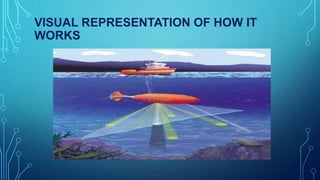
VISUAL REPRESENTATION OF HOW IT
WORKS
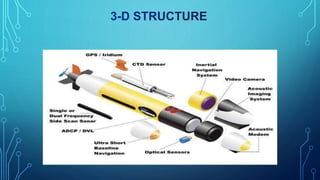
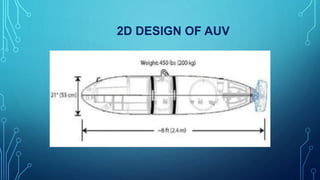
2D DESIGN OF AUV
PARAMETERS OF THE AUV’S
1. SENSORS
2. NAVIGATORS
3. PROPULSION
4. POWER
1. SENSORS
An AUV is simply a platform on which to mount sensors and sensing systems. Initial
efforts to develop AUV technology was more concerned about the basic
technologies required to allow reliable vehicle operation. As that reliability was
achieved, sensors were added to the vehicle system to acquire data from the ocean
environment
Typically sensors include:
• Compasses
• Depth sensors
• Side scan sonars
• Magnetometers
• Thermistors
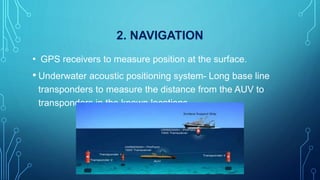
2. NAVIGATION
• GPS receivers to measure position at the surface.
• Underwater acoustic positioning system- Long base line
transponders to measure the distance from the AUV to
transponders in the known locations.
3. PROPULSION
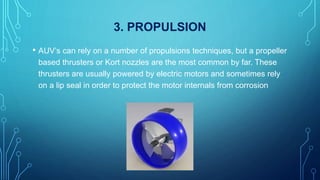
• AUV’s can rely on a number of propulsions techniques, but a propeller
based thrusters or Kort nozzles are the most common by far. These
thrusters are usually powered by electric motors and sometimes rely
on a lip seal in order to protect the motor internals from corrosion
4. POWER
• Most AUV’s in use today are powered by rechargeable batteries (lithium ion, lithium
polymer, nickel metal hydride etc...) and are implemented with some form of Battery
Management System.
• Some vehicle use primary batteries which provides perhaps twice the endurance-at
a substantial extra cost per mission.
• A few of the larger vehicles are powered by aluminium based semi fuel Cell, but
these requires substantial maintanence, requires expensive refills and produce
waste product that must be handled safely.
• An emergin trend is to combine different battery and power system with Ultra
capacitors.
FACTORS TO CONSIDER
1. Added Mass
• When a body moves underwater, the immediate surrounding fluid is accelerated along with
the body. This affects the dynamics of the vehicle in such a way that the force required to
accelerate the water
2. Environmental Forces
• Environmental disturbances can affect the motion and stability of a vehicle. This is particularly
true for an underwater vehicle where waves, currents and even wind can perturb the vehicle.
3. Pressure
• As with air, underwater pressure is caused by the weight of the medium, in this case water,
acting upon a surface
ADVANTAGES
• Long term economic benefits owing to dramatic
improvement of data quality
• Operate free of any tether cables
• Deployed in missions that pose a risk to human life
• Able to harbour multiple system at the same time
APPLICATIONS OF AUV
• COMMERCIAL USES.
The oil and gas industry uses AUV’s to make detailed map of the seafloor before they
start building subsea infrastructure, pipelines and subsea compleations can be installed
in the most cost effective manner with minimum disruption to the environment. The AUV
allow survey companies to conduct precise surveys of areas where traditional
bathymetric surveys would be less effective or too costly.
• MILITARY USES.
A typicall military use for an AUV is to map an area to determine if there are any mines or
to monitor a protected area for unidentified objects. AUV’s are also employed in anti
sumbmarine warfare, to aid in the detection of manned submarine.
• RESEARCH USES
Scientists use AUVs to study lakes, the ocean, and the ocean floor. A
variety of sensors can be affixed to AUVS to measure the concentration of
various elements or compounds, the absorption or reflection of light, and
the presence of microscopic life. Additionally, AUVS can be configured as
tow-vehicles to deliver customized sensor packages to specific locations
• Investigation Applications
Autonomous underwater vehicles, for example AUV ABYSS, have been
used to find wreckages of missing airplanes, e.g. Air France Flight 447
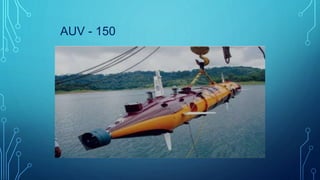
AUV - 150
• AUV (Autonomous Underwater Vehicle) - 150 is an unmanned underwater
vehicle (UUV) being developed by Central Mechanical Engineering Research
Institute (CMERI) scientists in Durgapur in the Indian state of West Bengal.
• The vehicle was built with the intent of coastal security like mine counter-
measures, coastal monitoring and reconnaissance.
• AUV 150 can be used to study aquatic life, for mapping of sea-floor and
minerals along with monitoring of environmental parameters, such as current,
temperature, depth and salinity.
• It can also be useful in cable and pipeline surveys. It is built tooperate 150
metres under the sea and have cruising speed of up tofour knots.
AUV - 150
CONCLUSION
• In the last 15 years, AUVs have rapidly emerged as a vital tool for
marine geoscientists, especially those involved in seafloor mapping and
monitoring
• AUVS are now at an early stage of acceptance. As they work their way
into the phase of operational acceptance on a commercial level, their
numbers will grow.
• Academia is not only using AUVS but also spinning off firms to supply
commercial versions. And the US Navy is gearing up to push the
technology, ensuring that cost-effective systems are available for use
by the fleet in the future.
REFERENCE
1. Stefan Ericson et.al, “Autonomous underwater vehicles” Bluefin Robotics,Cambridge,
U.S.A.
2.
2. Dr. Uwe R. Zimmer, “Individual and swarm style AUVS” Australian National University –
Canberra, Australia
3.
3. Dr. Steve Tetlow, “Underwater imaging, AUVS” Cranfield University – Cranfield,U.K.
4.
4. Morten Lind, “Sonar for underwater inspection” Technical University of Denmark –Lyngby,
Denmark
THANK YOU

AkhilAUV36995.pptx

  • 1.
    AUTONOMOUS UNDERWATER VEHICLE GUIDE Dr. SamKollannore U PRESENTATED BY KM Akhil Reg no: 2000210469955
  • 2.
    OVERVIEW Mobile robots havethe capability to move around in their environment and are not fixed to one physical location. • Land or home robots are usually referred to as Unmanned Ground Vehicle (UGVs). • Aerial robots are usually referred to as Unmanned Aerial Vehicle (UAVs) • Underwater robots are usually called Autonomous Underwater Vehicle (AUVs) • Polar robots, designed to navigate icy, Crevasse filled environments
  • 3.
    INTRODUCTION TO AUV •AUVS are Autonomous Underwater Vehicles that are used to perform underwater survey missions • It is a robotic device that is driven through water by propulsion system, controlled and piloted by an onboard computer. Other type of UUV includes Remotely operated underwater vehicles (ROVS) controlled and powered from the surface by an operator. • In military applications AUVs are more often referred to simply as unmanned undersea vehicles (UUVs)
  • 4.
    HISTORY OF AUV •The first AUV was developed at the Applied Physics Laboratory at the University of Washington as early as 1957 by Stan Murphy, Bob Francis • The origin of AUV's should probably be linked to the Whitehead Automobile "Fish" Torpedo. Robert Whitehead is credited with designing, building, and demonstrating the first Torpedo in Austria in 1866.
  • 5.
  • 7.
  • 8.
    PARAMETERS OF THEAUV’S 1. SENSORS 2. NAVIGATORS 3. PROPULSION 4. POWER
  • 9.
    1. SENSORS An AUVis simply a platform on which to mount sensors and sensing systems. Initial efforts to develop AUV technology was more concerned about the basic technologies required to allow reliable vehicle operation. As that reliability was achieved, sensors were added to the vehicle system to acquire data from the ocean environment Typically sensors include: • Compasses • Depth sensors • Side scan sonars • Magnetometers • Thermistors
  • 11.
    2. NAVIGATION • GPSreceivers to measure position at the surface. • Underwater acoustic positioning system- Long base line transponders to measure the distance from the AUV to transponders in the known locations.
  • 12.
    3. PROPULSION • AUV’scan rely on a number of propulsions techniques, but a propeller based thrusters or Kort nozzles are the most common by far. These thrusters are usually powered by electric motors and sometimes rely on a lip seal in order to protect the motor internals from corrosion
  • 13.
    4. POWER • MostAUV’s in use today are powered by rechargeable batteries (lithium ion, lithium polymer, nickel metal hydride etc...) and are implemented with some form of Battery Management System. • Some vehicle use primary batteries which provides perhaps twice the endurance-at a substantial extra cost per mission. • A few of the larger vehicles are powered by aluminium based semi fuel Cell, but these requires substantial maintanence, requires expensive refills and produce waste product that must be handled safely. • An emergin trend is to combine different battery and power system with Ultra capacitors.
  • 14.
    FACTORS TO CONSIDER 1.Added Mass • When a body moves underwater, the immediate surrounding fluid is accelerated along with the body. This affects the dynamics of the vehicle in such a way that the force required to accelerate the water 2. Environmental Forces • Environmental disturbances can affect the motion and stability of a vehicle. This is particularly true for an underwater vehicle where waves, currents and even wind can perturb the vehicle. 3. Pressure • As with air, underwater pressure is caused by the weight of the medium, in this case water, acting upon a surface
  • 15.
    ADVANTAGES • Long termeconomic benefits owing to dramatic improvement of data quality • Operate free of any tether cables • Deployed in missions that pose a risk to human life • Able to harbour multiple system at the same time
  • 16.
    APPLICATIONS OF AUV •COMMERCIAL USES. The oil and gas industry uses AUV’s to make detailed map of the seafloor before they start building subsea infrastructure, pipelines and subsea compleations can be installed in the most cost effective manner with minimum disruption to the environment. The AUV allow survey companies to conduct precise surveys of areas where traditional bathymetric surveys would be less effective or too costly. • MILITARY USES. A typicall military use for an AUV is to map an area to determine if there are any mines or to monitor a protected area for unidentified objects. AUV’s are also employed in anti sumbmarine warfare, to aid in the detection of manned submarine.
  • 17.
    • RESEARCH USES Scientistsuse AUVs to study lakes, the ocean, and the ocean floor. A variety of sensors can be affixed to AUVS to measure the concentration of various elements or compounds, the absorption or reflection of light, and the presence of microscopic life. Additionally, AUVS can be configured as tow-vehicles to deliver customized sensor packages to specific locations • Investigation Applications Autonomous underwater vehicles, for example AUV ABYSS, have been used to find wreckages of missing airplanes, e.g. Air France Flight 447
  • 18.
    AUV - 150 •AUV (Autonomous Underwater Vehicle) - 150 is an unmanned underwater vehicle (UUV) being developed by Central Mechanical Engineering Research Institute (CMERI) scientists in Durgapur in the Indian state of West Bengal. • The vehicle was built with the intent of coastal security like mine counter- measures, coastal monitoring and reconnaissance. • AUV 150 can be used to study aquatic life, for mapping of sea-floor and minerals along with monitoring of environmental parameters, such as current, temperature, depth and salinity. • It can also be useful in cable and pipeline surveys. It is built tooperate 150 metres under the sea and have cruising speed of up tofour knots.
  • 19.
  • 20.
    CONCLUSION • In thelast 15 years, AUVs have rapidly emerged as a vital tool for marine geoscientists, especially those involved in seafloor mapping and monitoring • AUVS are now at an early stage of acceptance. As they work their way into the phase of operational acceptance on a commercial level, their numbers will grow. • Academia is not only using AUVS but also spinning off firms to supply commercial versions. And the US Navy is gearing up to push the technology, ensuring that cost-effective systems are available for use by the fleet in the future.
  • 21.
    REFERENCE 1. Stefan Ericsonet.al, “Autonomous underwater vehicles” Bluefin Robotics,Cambridge, U.S.A. 2. 2. Dr. Uwe R. Zimmer, “Individual and swarm style AUVS” Australian National University – Canberra, Australia 3. 3. Dr. Steve Tetlow, “Underwater imaging, AUVS” Cranfield University – Cranfield,U.K. 4. 4. Morten Lind, “Sonar for underwater inspection” Technical University of Denmark –Lyngby, Denmark
  • 22.