Chapter 9.3:
Hunger
Prepared by: Kimberly B. Magadia
Learning Outcome
o Described the physiological factors that
influence hunger and satiety.
Digestion
and
Food Selection
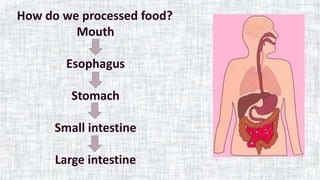
How do we processed food?
Mouth
Esophagus
Stomach
Small intestine
Large intestine
Consumption
of
Dairy Products
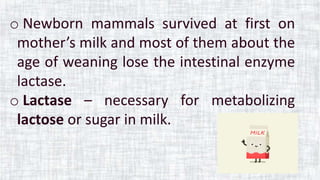
o Newborn mammals survived at first on
mother’s milk and most of them about the
age of weaning lose the intestinal enzyme
lactase.
o Lactase – necessary for metabolizing
lactose or sugar in milk.
o Many adults have enough lactase levels to
consume milk and other dairy products.
However, the prevalence of the necessary
genes varies.
o Most Southeast Asian adults lack the genes
that help digest lactose, the main sugar in
milk.
Food Selection
and
Behavior
Fact or Bluff
Eating sugar makes
children hyperactive.
Eating turkey causes
sleepiness.
Fish is a brain food.
Short- and
Long- Term Regulation
(Physiological Factors that
InfluenceHunger and Satiety)
Oral Factors
f
o People cannot become satiated
without tasting their food.
o Taste contributes to satiety.
The Stomach and Intestine
oThe main signal to end meal is distension of
the stomach.
oVagus nerve conveys info to the brain about
the stretching of the stomach walls.
oDuodenum – part of small intestine. Its
distention releases hormone cholecystokinin
(CCK) which produces satiety.
Leptin
o Leptin is a hormone that signals your brain
about your fat reserve.
o The more fat cells, the more leptin.
o If you release more leptin, you tend to eat
less and be more active.
o If you lacked leptin, you tend to eat more
and be less active.
Brain Mechanisms
The Arcuate Nucleus and Paraventricular
Hypothalamus
o Hormones that increases satiety.
-insulin, CCK and Leptin
o Hormones that increases hunger
-Ghrelin
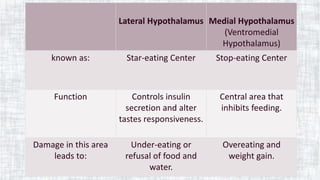
Lateral Hypothalamus and Medial
Hypothalamus
Lateral Hypothalamus Medial Hypothalamus
(Ventromedial
Hypothalamus)
known as: Star-eating Center Stop-eating Center
Function Controls insulin
secretion and alter
tastes responsiveness.
Central area that
inhibits feeding.
Damage in this area
leads to:
Under-eating or
refusal of food and
water.
Overeating and
weight gain.
Eating Disorder
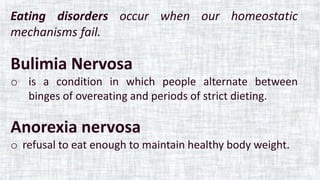
Eating disorders occur when our homeostatic
mechanisms fail.
Bulimia Nervosa
o is a condition in which people alternate between
binges of overeating and periods of strict dieting.
Anorexia nervosa
o refusal to eat enough to maintain healthy body weight.
Thanks!

Hunger

  • 1.
  • 2.
    Learning Outcome o Describedthe physiological factors that influence hunger and satiety.
  • 4.
  • 5.
    How do weprocessed food? Mouth Esophagus Stomach Small intestine Large intestine
  • 6.
  • 7.
    o Newborn mammalssurvived at first on mother’s milk and most of them about the age of weaning lose the intestinal enzyme lactase. o Lactase – necessary for metabolizing lactose or sugar in milk.
  • 8.
    o Many adultshave enough lactase levels to consume milk and other dairy products. However, the prevalence of the necessary genes varies. o Most Southeast Asian adults lack the genes that help digest lactose, the main sugar in milk.
  • 9.
  • 10.
  • 11.
  • 13.
  • 15.
    Fish is abrain food.
  • 17.
    Short- and Long- TermRegulation (Physiological Factors that InfluenceHunger and Satiety)
  • 18.
    Oral Factors f o Peoplecannot become satiated without tasting their food. o Taste contributes to satiety.
  • 19.
    The Stomach andIntestine oThe main signal to end meal is distension of the stomach. oVagus nerve conveys info to the brain about the stretching of the stomach walls. oDuodenum – part of small intestine. Its distention releases hormone cholecystokinin (CCK) which produces satiety.
  • 20.
    Leptin o Leptin isa hormone that signals your brain about your fat reserve. o The more fat cells, the more leptin. o If you release more leptin, you tend to eat less and be more active. o If you lacked leptin, you tend to eat more and be less active.
  • 21.
  • 22.
    The Arcuate Nucleusand Paraventricular Hypothalamus o Hormones that increases satiety. -insulin, CCK and Leptin o Hormones that increases hunger -Ghrelin
  • 23.
    Lateral Hypothalamus andMedial Hypothalamus
  • 24.
    Lateral Hypothalamus MedialHypothalamus (Ventromedial Hypothalamus) known as: Star-eating Center Stop-eating Center Function Controls insulin secretion and alter tastes responsiveness. Central area that inhibits feeding. Damage in this area leads to: Under-eating or refusal of food and water. Overeating and weight gain.
  • 25.
  • 26.
    Eating disorders occurwhen our homeostatic mechanisms fail. Bulimia Nervosa o is a condition in which people alternate between binges of overeating and periods of strict dieting. Anorexia nervosa o refusal to eat enough to maintain healthy body weight.
  • 27.