1
Humorous Literary Genres
by Don L. F. Nilsen and
Alleen Pace Nilsen
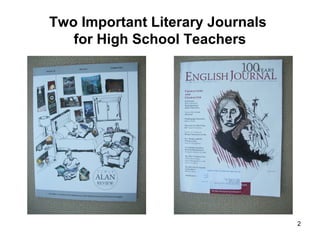
Two Important Literary Journals
for High School Teachers
2
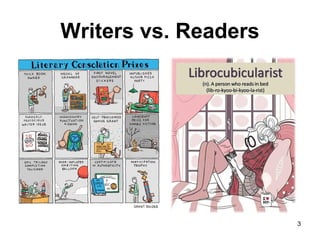
Writers vs. Readers
3
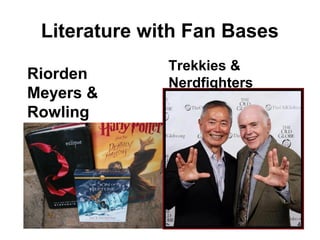
Literature with Fan Bases
4
Trekkies &
Nerdfighters
Riorden
Meyers &
Rowling
Nerdfighters and DFTBA:
“Don’t Forget To Be Awesome”
http://www.youtube.com/watch?v=FyQi79aYfxU
5
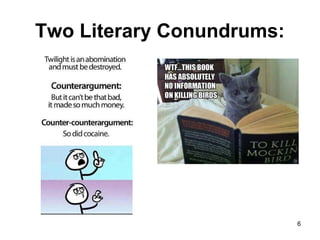
Two Literary Conundrums:
6
FOUR MODES OF LITERATURE
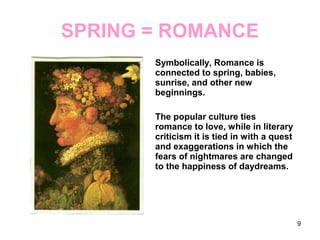
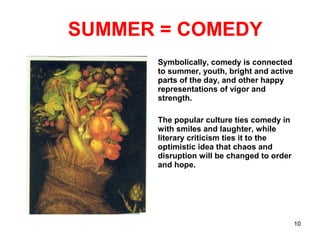
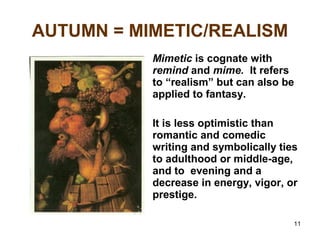
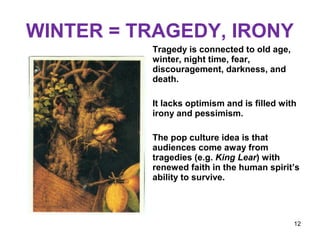
Modes can be communicated through all kinds of
symbols as illustrated by the Giuseppe Archimboldo
paintings from the 1500s where he used plants to
represent the four seasons of the year.
Even though weather patterns differ around the world,
the four seasons (Spring, Summer, Fall, and Winter) are
recognized and celebrated as universal symbols of our
overall life experiences.
This inspired Northrup Frye to divide different kinds of
literary works into four modes symbolized by the four
seasons.
7
Northrup Frye’s Anatomy of Criticism
8
SPRING = ROMANCE
Symbolically, Romance is
connected to spring, babies,
sunrise, and other new
beginnings.
The popular culture ties
romance to love, while in literary
criticism it is tied in with a quest
and exaggerations in which the
fears of nightmares are changed
to the happiness of daydreams.
9
SUMMER = COMEDY
Symbolically, comedy is connected
to summer, youth, bright and active
parts of the day, and other happy
representations of vigor and
strength.
The popular culture ties comedy in
with smiles and laughter, while
literary criticism ties it to the
optimistic idea that chaos and
disruption will be changed to order
and hope.
10
AUTUMN = MIMETIC/REALISM
Mimetic is cognate with
remind and mime. It refers
to “realism” but can also be
applied to fantasy.
It is less optimistic than
romantic and comedic
writing and symbolically ties
to adulthood or middle-age,
and to evening and a
decrease in energy, vigor, or
prestige.
11
WINTER = TRAGEDY, IRONY
Tragedy is connected to old age,
winter, night time, fear,
discouragement, darkness, and
death.
It lacks optimism and is filled with
irony and pessimism.
The pop culture idea is that
audiences come away from
tragedies (e.g. King Lear) with
renewed faith in the human spirit’s
ability to survive.
12
Antonio Vivaldi’s The Four Seasons
Spring:
https://www.youtube.com/watch?v=6LAPFM3dgag
Summer--Presto:
https://www.youtube.com/watch?v=nJTfG1MmMwQ
Autumn:
https://www.youtube.com/watch?v=Q8AN0jWNrJA
Winter:
https://www.youtube.com/watch?v=p1qNOfdMyGA
13
So What Does This Mean to
Humor?
Let’s brainstorm and see if we can figure out what kinds of
animals, weather, food, or geological formations an author would
likely use if he or she wanted to establish one of these four
modes.
Try thinking of examples from television, film, or literature that
clearly fit into one of the four categories.
Then let’s look a little deeper and think of examples that move
from one mode to the other.
The phrase “A Happy Ending,” shows that readers expect modes
to change. See the next slide for a more dramatic example.
14
A Mode Change from Comedy to
Tragedy
A good example occurs in Shakespeare’s
Romeo and Juliet, when Mercutio is wounded
in a sword fight and Romeo says, “Courage,
man, the hurt cannot be much.”
Mercutio responds, “No, ‘tis not so deep as a
well, nor so wide as a chuch-door, but ‘tis
enough, ‘twill serve. Ask for me tomorrow, and
you shall find me a grave man.”
15
Another Mode Change from Comedy
to Tragedy
Dr. Seuss’s The Lorax begins with beautiful, pastel-
colored illustrations of a pleasant village and
surrounding meadow.
But as the story progresses, and people get greedier
and greedier about harvesting what the trees produce,
the pictures get darker and darker, and so does the
future of the city.
It’s enough to just thumb through the pictures to
document the change in mode.
16
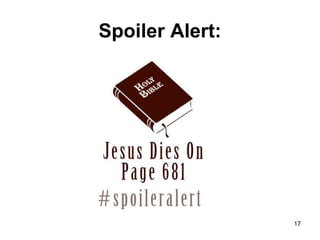
Spoiler Alert:
17
The Harry Potter Guide to the U.K. :
http://www.buzzfeed.com/tabathaleggett/t
he-harry-potter-guide-to-the-u-k
18
THE VALUE OF HUMOR FOR THE
FOUR DIFFERENT MODES
ROMANCE (SPRING): Romances present idealized
and exaggerated worlds with plots focusing around
what Joseph Campbell called “The Journey.”
•The journey does not have to be literal, but it does
have to incorporate some psychological distancing
from family or authority figures.
•Archetypal figures who play a role in journey stories
include a Hero on a Quest, a Villain or a Trickster, a
Challenge, a Prohibition, a Sacrifice, a Sage, and at last
some kind of an Accomplishment or Success.
19
Why A Journey?
When author Richard Peck spoke to one of our classes, he said
that in his novels he always includes some kind of a journey
because:
The characters can meet and interact with new people, which
offers opportunities for new experiences and new humor.
On almost any trip there are bound to be complications which
adds excitement to the plot.
Because he writes for teenagers, who are looking forward to
“leaving” their families as they go off to college or “move out,”
young people “relate” to the idea of a journey.
20
ROMANCE continued
The accomplishment might be symbolically shown through a physical
accomplishment, but the reward is really an emotional or intellectual
epiphany.
Well-known examples include The Divine Comedy, The Lion, the Witch
and the Wardrobe, Lord of the Rings, and Paradise Lost.
One of the symbolic expectations in basic stories is that the epiphany
connects Heaven and Earth, which is why epiphanies often come to
characters on a mountain top, a tower, a lighthouse, a ladder, or a
staircase.
Examples in famously humorous stories include Jack’s beanstalk,
Rapunzel’s tower, and Yertle’s stack of turtles in the Dr. Seuss book.
Famous characters who go on journeys include Dorothy in The Wizard of
Oz, Alice in Wonderland, Charlotte and Wilber in Charlotte’s Web, and
most recently Harry Potter in J. K. Rowling’s books.
21
COMEDY (summer)
In the classical sense, “comedy” isn’t necessarily funny, but in contrast
to “tragedy” it has a happy ending.
High comedy (what we now call ‘smart comedy’ or ‘literary comedy’)
relies for its humor on wit and sophistication, while low comedy relies on
burlesque, crude jokes, and buffoonery.
Jessica Milner Davies says that “whether it be English, medieval Dutch,
Spanish, French, Viennese, Russian, improvised “commedia dell-arte,” or
even Japanese kyògen or nò theater, farce is both the most violent and
physically shocking of dramatic forms of comedy…,
but it is almost the most innocent in that unlike satire or burlesque it
does not offend either individuals or society.
22
There are Two Main Types of
Comedies, 1. Comedy of Manners
In these stories characters work to outwit the establishment or
the upper class. The traditional Comedy of Manners was based
on an unfair law, which the common person had to defeat.
For example, in Beaumarchais’s The Marriage of Figaro, the
unjust law was that the Lord of the Manor had the right to take the
virginity of any woman marrying one of the Lord’s serfs.
In Shakespeare’s The Merchant of Venice, the unjust “law” was
that Shylock was approved to take a pound of flesh.
But Portia, the smart (woman) lawyer, outwitted the situation by
proving that Shylock had not been approved to take a drop of
blood; therefore he could not take the flesh.
23
Comedy of Manners (CONTINUED)
In Oscar Wilde’s The Importance of Being Earnest Jack (who
represents the common man) responds affirmatively to Lady
Bracknell’s question of whether he smokes.
Her response is, “I am glad to hear it. A man should have an
occupation of some kind.”
Later, Jack answers one of her questions by saying he “doesn’t
know,” to which she cheerfully responds,
“I am pleased to hear it. I do not approve anything that tampers
with natural ignorance. Ignorance is like a delicate exotic fruit;
touch it and the bloom is gone.”
24
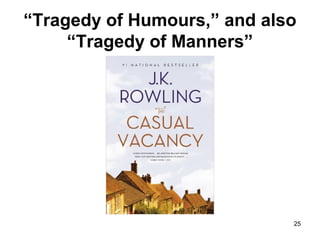
“Tragedy of Humours,” and also
“Tragedy of Manners”
25
PICARESQUE NOVELS ARE ALSO
Comedies of Manner
A Picaresque Novel is a mock quest done by someone who
does not have money, power, or prestige. The Picaro lives
by his wits as he encounters various powerful eccentrics in
his episodic adventures. Examples include Don Quixote,
Huckleberry Finn, and Pickwick Papers.
Here are six characteristics associated with the picaresque
novel:
1.The first person account tells a part or the whole life of a
rogue or picaro.
2.Rogues and picaros come from a lower social level, are of
loose character, and if employed, do menial labor and live
by their wit and playful language.
26
Picaresque Novels (CONTINUED)
3. Picaresque novels are episodic in nature.
4. Picaresque characters do not mature or develop.
5. The story is realistic. The language is plain (vernacular)
and is filled with vivid detail.
6. Picaresque characters serve other higher class
characters and learn their foibles and frailties, thus
providing opportunities to satirize social castes, national
types, and/or racial peculiarities.
27
Type 2: Comedy of Humors
This second type of Comedy goes back to the belief of
medieval physiology that human dispositions are based on
the balance of the four basic fluids: phlegm, blood, black
bile, and yellow bile.
If the balance is not right a person might be phlegmatic,
sanguine, melancholy, or bilious. Characters whose
humors are out of balance, are eccentrics or grotesques.
Chaucer’s Canterbury Tales is filled with humors
characters, although they are not quite as funny as is
Sheldon in TV’s The Big Bang.
28
Alazons and Eirons as Humors
Characters
Alazons and Eirons are stock humors characters going
back to Greek drama. Alazons are overly confident
braggarts getting their way by blustering and bullying.
At the other extreme, are the eirons, who are sly
rogues getting their way through feigned ignorance or
dumb luck.
The term “eiron” is related to the term “irony,” because
the Eirons say one thing, but mean another.
In Japanese culture, the Samurai are the Alazons, and
the Ninja are the Eirons.
29
Quotes from Famous Authors:
http://www.goodreads.com/quotes/tag/literature
30
Mimetic or “Realistic” Humor (Fall)
This is the largest part of people’s lives and includes all kinds of
humor making use of a variety of techniques.
“Realistic” humor demonstrates an interesting crossover between
literature and real-life because in a way it is measuring the care
and the skill with which authors observe and record people’s
actions and thoughts.
The concept of metamorphosis, as developed in Faust, The
Metamorphosis, Pinnochio, Pygmalion and My Fair Lady, shows
tremendous changes that encourage us to become more aware of
changes occuring in our own lives.
31
Mimetic or “Realistic” Humor (CONTINUED)
When comedians don masks and borrow voices, the interplay of
conflicting masks and voices results in an awareness of open or subtle
incongruities.
French scholar Daniel Royot says that without the interplay, the result is
parody and grotesque humor— “too much like Jerry Lewis’s stuff.” He
contrasts the visual humor of Mel Brooks with the satirical humor of
Woody Allen.
Here also, we are encouraged to take a new look at aspects of our lives
that have been overlooked. The titles of Regina Barreca’s books invite
reflections on real life:
They Used to Call Me Snow White, But I Drifted.
Perfect Husbands: and Other Fairy Tales.
Untamed and Unabashed: Essays on Women and Humor in British
Literature.
32
Mimetic or “Realistic” Humor (CONTINUED)
Barreca says that “Women’s lives have always been filled
with humor.” It emerged “as a tool for survival in the social
and professional jungles” and works as a “weapon against
the absurdities of injustice.”
Women did not suddenly get funny in the 1990s any more
than women suddenly got ambitious in the 1970s or
sexually aware in the 1960s or intelligent in the 1980s.
Wendy Wassserstein adds, “When I speak up, it’s not
because I have any particular answers; rather, I have a
desire to puncture the pretentiousness of those who seem
so certain they do.”
33
Personification
A 240-Year-Old Swiss Automaton:
http://www.chonday.com/Videos/the-writer-automaton
34
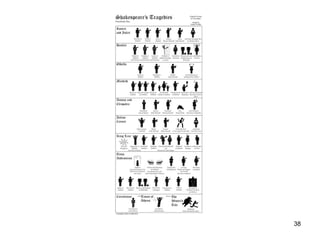
TRAGIC, IRONIC, and SATIRICAL
HUMOR (winter)
Tragedy is the opposite of comedy in that the happiness
appears at the beginning or the middle. Somebody is
privileged, but with a fatal flaw (such as hubris or an
obsession) which causes the downfall. Well-known
examples include The Great Gatsby, Hamlet, King Lear,
Macbeth, Othello, Romeo and Juliet.
Gothic Humor also fits into this dark side of life. It typically
occurs in haunted houses, deep forests, or mysterious
caves. The weather is dark and stormy and the supernatural
characters are mysterious as shown in such books as
Dracula, Frankenstein, The House of Usher, Northanger
Abbey, The Langoliers, and Wuthering Heights.
35
People tend to create ironic humor when they feel that all is lost
so there is nothing left to do but laugh at one’s own predicament.
The dark humor that became popular in the mid- 20th
century was
created in response to fears induced by the atomic bomb and
feelings of helplessness .
The creators of satire, on the other hand, are purposely exposing
some kind of a problem and pointing toward a solution. French
scholar, Daniel Royot, says that while utopias and dystopias
might be token fantasies that are grotesque, they still contain “an
implicit moral standard.”
Benign Humor is a mild type of satire with much word play.
Examples include Alice in Wonderland, the Bertie Wooster and
Jeeves novels, Peter Rabbit, Through the Looking Glass, The
Wind and the Willows, and Winnie the Pooh.
36
37
38
Scientific Study of Literature:
https://benjamins.com/#catalog/journals/ssol/main
39
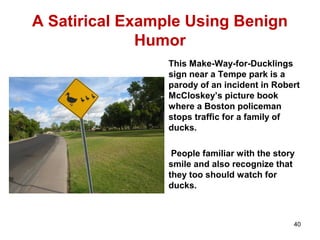
A Satirical Example Using Benign
Humor
This Make-Way-for-Ducklings
sign near a Tempe park is a
parody of an incident in Robert
McCloskey’s picture book
where a Boston policeman
stops traffic for a family of
ducks.
People familiar with the story
smile and also recognize that
they too should watch for
ducks.
40
Tragedy, Irony, and Satire (CONTINUED)
Three types of humor that contribute to a tragic mode.
•Gallows humor includes Catch 22, Catcher in the Rye, Fargo, The
Loved One, One Flew Over the Cuckoo’s Nest, Portnoy’s
Complaint, Pulp Fiction, Slaughterhouse 5, and The World
According to Garp.
•Horatian Satire is mild and amusing. It is named for Horace, the
Roman poet and writer who lived 65-08 BCE. Contemporary
examples include Animal Farm, Brave New World, Gulliver’s
Travels, Little Big Man, Lysistrata, and The Screwtape Letters
•Juvenalian Satire is harsh and bitter. It is named for the Latin
author Juvenal, who lived in the 1st
and early 2nd
Centuries A.D.
Contemporary examples include 1984, Clockwork Orange,
Fahrenheit 451, Lord of the Flies, and A Modest Proposal
41
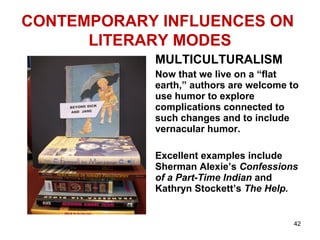
CONTEMPORARY INFLUENCES ON
LITERARY MODES
MULTICULTURALISM
Now that we live on a “flat
earth,” authors are welcome to
use humor to explore
complications connected to
such changes and to include
vernacular humor.
Excellent examples include
Sherman Alexie’s Confessions
of a Part-Time Indian and
Kathryn Stockett’s The Help.
42
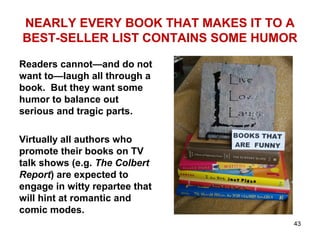
NEARLY EVERY BOOK THAT MAKES IT TO A
BEST-SELLER LIST CONTAINS SOME HUMOR
Readers cannot—and do not
want to—laugh all through a
book. But they want some
humor to balance out
serious and tragic parts.
Virtually all authors who
promote their books on TV
talk shows (e.g. The Colbert
Report) are expected to
engage in witty repartee that
will hint at romantic and
comic modes.
43
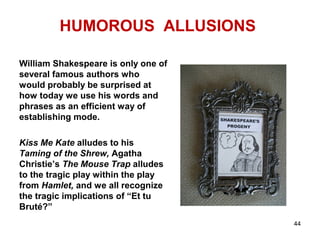
HUMOROUS ALLUSIONS
William Shakespeare is only one of
several famous authors who
would probably be surprised at
how today we use his words and
phrases as an efficient way of
establishing mode.
Kiss Me Kate alludes to his
Taming of the Shrew, Agatha
Christie’s The Mouse Trap alludes
to the tragic play within the play
from Hamlet, and we all recognize
the tragic implications of “Et tu
Bruté?”
44
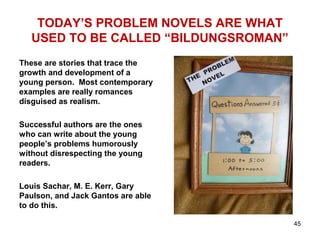
TODAY’S PROBLEM NOVELS ARE WHAT
USED TO BE CALLED “BILDUNGSROMAN”
These are stories that trace the
growth and development of a
young person. Most contemporary
examples are really romances
disguised as realism.
Successful authors are the ones
who can write about the young
people’s problems humorously
without disrespecting the young
readers.
Louis Sachar, M. E. Kerr, Gary
Paulson, and Jack Gantos are able
to do this.
45
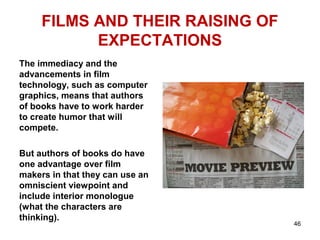
FILMS AND THEIR RAISING OF
EXPECTATIONS
The immediacy and the
advancements in film
technology, such as computer
graphics, means that authors
of books have to work harder
to create humor that will
compete.
But authors of books do have
one advantage over film
makers in that they can use an
omniscient viewpoint and
include interior monologue
(what the characters are
thinking).
46
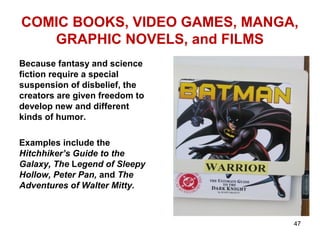
COMIC BOOKS, VIDEO GAMES, MANGA,
GRAPHIC NOVELS, and FILMS
Because fantasy and science
fiction require a special
suspension of disbelief, the
creators are given freedom to
develop new and different
kinds of humor.
Examples include the
Hitchhiker’s Guide to the
Galaxy, The Legend of Sleepy
Hollow, Peter Pan, and The
Adventures of Walter Mitty.
47
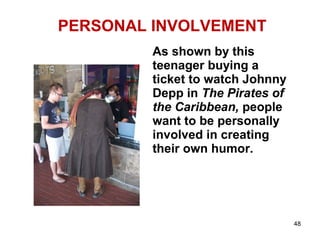
PERSONAL INVOLVEMENT
As shown by this
teenager buying a
ticket to watch Johnny
Depp in The Pirates of
the Caribbean, people
want to be personally
involved in creating
their own humor.
48
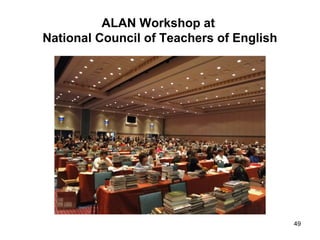
ALAN Workshop at
National Council of Teachers of English
49
50
How It Should Have Ended:
http://www.youtube.com/user/HISHEdotcom

Humorous Literary Genres

  • 1.
    1 Humorous Literary Genres byDon L. F. Nilsen and Alleen Pace Nilsen
  • 2.
    Two Important LiteraryJournals for High School Teachers 2
  • 3.
  • 4.
    Literature with FanBases 4 Trekkies & Nerdfighters Riorden Meyers & Rowling
  • 5.
    Nerdfighters and DFTBA: “Don’tForget To Be Awesome” http://www.youtube.com/watch?v=FyQi79aYfxU 5
  • 6.
  • 7.
    FOUR MODES OFLITERATURE Modes can be communicated through all kinds of symbols as illustrated by the Giuseppe Archimboldo paintings from the 1500s where he used plants to represent the four seasons of the year. Even though weather patterns differ around the world, the four seasons (Spring, Summer, Fall, and Winter) are recognized and celebrated as universal symbols of our overall life experiences. This inspired Northrup Frye to divide different kinds of literary works into four modes symbolized by the four seasons. 7
  • 8.
  • 9.
    SPRING = ROMANCE Symbolically,Romance is connected to spring, babies, sunrise, and other new beginnings. The popular culture ties romance to love, while in literary criticism it is tied in with a quest and exaggerations in which the fears of nightmares are changed to the happiness of daydreams. 9
  • 10.
    SUMMER = COMEDY Symbolically,comedy is connected to summer, youth, bright and active parts of the day, and other happy representations of vigor and strength. The popular culture ties comedy in with smiles and laughter, while literary criticism ties it to the optimistic idea that chaos and disruption will be changed to order and hope. 10
  • 11.
    AUTUMN = MIMETIC/REALISM Mimeticis cognate with remind and mime. It refers to “realism” but can also be applied to fantasy. It is less optimistic than romantic and comedic writing and symbolically ties to adulthood or middle-age, and to evening and a decrease in energy, vigor, or prestige. 11
  • 12.
    WINTER = TRAGEDY,IRONY Tragedy is connected to old age, winter, night time, fear, discouragement, darkness, and death. It lacks optimism and is filled with irony and pessimism. The pop culture idea is that audiences come away from tragedies (e.g. King Lear) with renewed faith in the human spirit’s ability to survive. 12
  • 13.
    Antonio Vivaldi’s TheFour Seasons Spring: https://www.youtube.com/watch?v=6LAPFM3dgag Summer--Presto: https://www.youtube.com/watch?v=nJTfG1MmMwQ Autumn: https://www.youtube.com/watch?v=Q8AN0jWNrJA Winter: https://www.youtube.com/watch?v=p1qNOfdMyGA 13
  • 14.
    So What DoesThis Mean to Humor? Let’s brainstorm and see if we can figure out what kinds of animals, weather, food, or geological formations an author would likely use if he or she wanted to establish one of these four modes. Try thinking of examples from television, film, or literature that clearly fit into one of the four categories. Then let’s look a little deeper and think of examples that move from one mode to the other. The phrase “A Happy Ending,” shows that readers expect modes to change. See the next slide for a more dramatic example. 14
  • 15.
    A Mode Changefrom Comedy to Tragedy A good example occurs in Shakespeare’s Romeo and Juliet, when Mercutio is wounded in a sword fight and Romeo says, “Courage, man, the hurt cannot be much.” Mercutio responds, “No, ‘tis not so deep as a well, nor so wide as a chuch-door, but ‘tis enough, ‘twill serve. Ask for me tomorrow, and you shall find me a grave man.” 15
  • 16.
    Another Mode Changefrom Comedy to Tragedy Dr. Seuss’s The Lorax begins with beautiful, pastel- colored illustrations of a pleasant village and surrounding meadow. But as the story progresses, and people get greedier and greedier about harvesting what the trees produce, the pictures get darker and darker, and so does the future of the city. It’s enough to just thumb through the pictures to document the change in mode. 16
  • 17.
  • 18.
    The Harry PotterGuide to the U.K. : http://www.buzzfeed.com/tabathaleggett/t he-harry-potter-guide-to-the-u-k 18
  • 19.
    THE VALUE OFHUMOR FOR THE FOUR DIFFERENT MODES ROMANCE (SPRING): Romances present idealized and exaggerated worlds with plots focusing around what Joseph Campbell called “The Journey.” •The journey does not have to be literal, but it does have to incorporate some psychological distancing from family or authority figures. •Archetypal figures who play a role in journey stories include a Hero on a Quest, a Villain or a Trickster, a Challenge, a Prohibition, a Sacrifice, a Sage, and at last some kind of an Accomplishment or Success. 19
  • 20.
    Why A Journey? Whenauthor Richard Peck spoke to one of our classes, he said that in his novels he always includes some kind of a journey because: The characters can meet and interact with new people, which offers opportunities for new experiences and new humor. On almost any trip there are bound to be complications which adds excitement to the plot. Because he writes for teenagers, who are looking forward to “leaving” their families as they go off to college or “move out,” young people “relate” to the idea of a journey. 20
  • 21.
    ROMANCE continued The accomplishmentmight be symbolically shown through a physical accomplishment, but the reward is really an emotional or intellectual epiphany. Well-known examples include The Divine Comedy, The Lion, the Witch and the Wardrobe, Lord of the Rings, and Paradise Lost. One of the symbolic expectations in basic stories is that the epiphany connects Heaven and Earth, which is why epiphanies often come to characters on a mountain top, a tower, a lighthouse, a ladder, or a staircase. Examples in famously humorous stories include Jack’s beanstalk, Rapunzel’s tower, and Yertle’s stack of turtles in the Dr. Seuss book. Famous characters who go on journeys include Dorothy in The Wizard of Oz, Alice in Wonderland, Charlotte and Wilber in Charlotte’s Web, and most recently Harry Potter in J. K. Rowling’s books. 21
  • 22.
    COMEDY (summer) In theclassical sense, “comedy” isn’t necessarily funny, but in contrast to “tragedy” it has a happy ending. High comedy (what we now call ‘smart comedy’ or ‘literary comedy’) relies for its humor on wit and sophistication, while low comedy relies on burlesque, crude jokes, and buffoonery. Jessica Milner Davies says that “whether it be English, medieval Dutch, Spanish, French, Viennese, Russian, improvised “commedia dell-arte,” or even Japanese kyògen or nò theater, farce is both the most violent and physically shocking of dramatic forms of comedy…, but it is almost the most innocent in that unlike satire or burlesque it does not offend either individuals or society. 22
  • 23.
    There are TwoMain Types of Comedies, 1. Comedy of Manners In these stories characters work to outwit the establishment or the upper class. The traditional Comedy of Manners was based on an unfair law, which the common person had to defeat. For example, in Beaumarchais’s The Marriage of Figaro, the unjust law was that the Lord of the Manor had the right to take the virginity of any woman marrying one of the Lord’s serfs. In Shakespeare’s The Merchant of Venice, the unjust “law” was that Shylock was approved to take a pound of flesh. But Portia, the smart (woman) lawyer, outwitted the situation by proving that Shylock had not been approved to take a drop of blood; therefore he could not take the flesh. 23
  • 24.
    Comedy of Manners(CONTINUED) In Oscar Wilde’s The Importance of Being Earnest Jack (who represents the common man) responds affirmatively to Lady Bracknell’s question of whether he smokes. Her response is, “I am glad to hear it. A man should have an occupation of some kind.” Later, Jack answers one of her questions by saying he “doesn’t know,” to which she cheerfully responds, “I am pleased to hear it. I do not approve anything that tampers with natural ignorance. Ignorance is like a delicate exotic fruit; touch it and the bloom is gone.” 24
  • 25.
    “Tragedy of Humours,”and also “Tragedy of Manners” 25
  • 26.
    PICARESQUE NOVELS AREALSO Comedies of Manner A Picaresque Novel is a mock quest done by someone who does not have money, power, or prestige. The Picaro lives by his wits as he encounters various powerful eccentrics in his episodic adventures. Examples include Don Quixote, Huckleberry Finn, and Pickwick Papers. Here are six characteristics associated with the picaresque novel: 1.The first person account tells a part or the whole life of a rogue or picaro. 2.Rogues and picaros come from a lower social level, are of loose character, and if employed, do menial labor and live by their wit and playful language. 26
  • 27.
    Picaresque Novels (CONTINUED) 3.Picaresque novels are episodic in nature. 4. Picaresque characters do not mature or develop. 5. The story is realistic. The language is plain (vernacular) and is filled with vivid detail. 6. Picaresque characters serve other higher class characters and learn their foibles and frailties, thus providing opportunities to satirize social castes, national types, and/or racial peculiarities. 27
  • 28.
    Type 2: Comedyof Humors This second type of Comedy goes back to the belief of medieval physiology that human dispositions are based on the balance of the four basic fluids: phlegm, blood, black bile, and yellow bile. If the balance is not right a person might be phlegmatic, sanguine, melancholy, or bilious. Characters whose humors are out of balance, are eccentrics or grotesques. Chaucer’s Canterbury Tales is filled with humors characters, although they are not quite as funny as is Sheldon in TV’s The Big Bang. 28
  • 29.
    Alazons and Eironsas Humors Characters Alazons and Eirons are stock humors characters going back to Greek drama. Alazons are overly confident braggarts getting their way by blustering and bullying. At the other extreme, are the eirons, who are sly rogues getting their way through feigned ignorance or dumb luck. The term “eiron” is related to the term “irony,” because the Eirons say one thing, but mean another. In Japanese culture, the Samurai are the Alazons, and the Ninja are the Eirons. 29
  • 30.
    Quotes from FamousAuthors: http://www.goodreads.com/quotes/tag/literature 30
  • 31.
    Mimetic or “Realistic”Humor (Fall) This is the largest part of people’s lives and includes all kinds of humor making use of a variety of techniques. “Realistic” humor demonstrates an interesting crossover between literature and real-life because in a way it is measuring the care and the skill with which authors observe and record people’s actions and thoughts. The concept of metamorphosis, as developed in Faust, The Metamorphosis, Pinnochio, Pygmalion and My Fair Lady, shows tremendous changes that encourage us to become more aware of changes occuring in our own lives. 31
  • 32.
    Mimetic or “Realistic”Humor (CONTINUED) When comedians don masks and borrow voices, the interplay of conflicting masks and voices results in an awareness of open or subtle incongruities. French scholar Daniel Royot says that without the interplay, the result is parody and grotesque humor— “too much like Jerry Lewis’s stuff.” He contrasts the visual humor of Mel Brooks with the satirical humor of Woody Allen. Here also, we are encouraged to take a new look at aspects of our lives that have been overlooked. The titles of Regina Barreca’s books invite reflections on real life: They Used to Call Me Snow White, But I Drifted. Perfect Husbands: and Other Fairy Tales. Untamed and Unabashed: Essays on Women and Humor in British Literature. 32
  • 33.
    Mimetic or “Realistic”Humor (CONTINUED) Barreca says that “Women’s lives have always been filled with humor.” It emerged “as a tool for survival in the social and professional jungles” and works as a “weapon against the absurdities of injustice.” Women did not suddenly get funny in the 1990s any more than women suddenly got ambitious in the 1970s or sexually aware in the 1960s or intelligent in the 1980s. Wendy Wassserstein adds, “When I speak up, it’s not because I have any particular answers; rather, I have a desire to puncture the pretentiousness of those who seem so certain they do.” 33
  • 34.
    Personification A 240-Year-Old SwissAutomaton: http://www.chonday.com/Videos/the-writer-automaton 34
  • 35.
    TRAGIC, IRONIC, andSATIRICAL HUMOR (winter) Tragedy is the opposite of comedy in that the happiness appears at the beginning or the middle. Somebody is privileged, but with a fatal flaw (such as hubris or an obsession) which causes the downfall. Well-known examples include The Great Gatsby, Hamlet, King Lear, Macbeth, Othello, Romeo and Juliet. Gothic Humor also fits into this dark side of life. It typically occurs in haunted houses, deep forests, or mysterious caves. The weather is dark and stormy and the supernatural characters are mysterious as shown in such books as Dracula, Frankenstein, The House of Usher, Northanger Abbey, The Langoliers, and Wuthering Heights. 35
  • 36.
    People tend tocreate ironic humor when they feel that all is lost so there is nothing left to do but laugh at one’s own predicament. The dark humor that became popular in the mid- 20th century was created in response to fears induced by the atomic bomb and feelings of helplessness . The creators of satire, on the other hand, are purposely exposing some kind of a problem and pointing toward a solution. French scholar, Daniel Royot, says that while utopias and dystopias might be token fantasies that are grotesque, they still contain “an implicit moral standard.” Benign Humor is a mild type of satire with much word play. Examples include Alice in Wonderland, the Bertie Wooster and Jeeves novels, Peter Rabbit, Through the Looking Glass, The Wind and the Willows, and Winnie the Pooh. 36
  • 37.
  • 38.
  • 39.
    Scientific Study ofLiterature: https://benjamins.com/#catalog/journals/ssol/main 39
  • 40.
    A Satirical ExampleUsing Benign Humor This Make-Way-for-Ducklings sign near a Tempe park is a parody of an incident in Robert McCloskey’s picture book where a Boston policeman stops traffic for a family of ducks. People familiar with the story smile and also recognize that they too should watch for ducks. 40
  • 41.
    Tragedy, Irony, andSatire (CONTINUED) Three types of humor that contribute to a tragic mode. •Gallows humor includes Catch 22, Catcher in the Rye, Fargo, The Loved One, One Flew Over the Cuckoo’s Nest, Portnoy’s Complaint, Pulp Fiction, Slaughterhouse 5, and The World According to Garp. •Horatian Satire is mild and amusing. It is named for Horace, the Roman poet and writer who lived 65-08 BCE. Contemporary examples include Animal Farm, Brave New World, Gulliver’s Travels, Little Big Man, Lysistrata, and The Screwtape Letters •Juvenalian Satire is harsh and bitter. It is named for the Latin author Juvenal, who lived in the 1st and early 2nd Centuries A.D. Contemporary examples include 1984, Clockwork Orange, Fahrenheit 451, Lord of the Flies, and A Modest Proposal 41
  • 42.
    CONTEMPORARY INFLUENCES ON LITERARYMODES MULTICULTURALISM Now that we live on a “flat earth,” authors are welcome to use humor to explore complications connected to such changes and to include vernacular humor. Excellent examples include Sherman Alexie’s Confessions of a Part-Time Indian and Kathryn Stockett’s The Help. 42
  • 43.
    NEARLY EVERY BOOKTHAT MAKES IT TO A BEST-SELLER LIST CONTAINS SOME HUMOR Readers cannot—and do not want to—laugh all through a book. But they want some humor to balance out serious and tragic parts. Virtually all authors who promote their books on TV talk shows (e.g. The Colbert Report) are expected to engage in witty repartee that will hint at romantic and comic modes. 43
  • 44.
    HUMOROUS ALLUSIONS William Shakespeareis only one of several famous authors who would probably be surprised at how today we use his words and phrases as an efficient way of establishing mode. Kiss Me Kate alludes to his Taming of the Shrew, Agatha Christie’s The Mouse Trap alludes to the tragic play within the play from Hamlet, and we all recognize the tragic implications of “Et tu Bruté?” 44
  • 45.
    TODAY’S PROBLEM NOVELSARE WHAT USED TO BE CALLED “BILDUNGSROMAN” These are stories that trace the growth and development of a young person. Most contemporary examples are really romances disguised as realism. Successful authors are the ones who can write about the young people’s problems humorously without disrespecting the young readers. Louis Sachar, M. E. Kerr, Gary Paulson, and Jack Gantos are able to do this. 45
  • 46.
    FILMS AND THEIRRAISING OF EXPECTATIONS The immediacy and the advancements in film technology, such as computer graphics, means that authors of books have to work harder to create humor that will compete. But authors of books do have one advantage over film makers in that they can use an omniscient viewpoint and include interior monologue (what the characters are thinking). 46
  • 47.
    COMIC BOOKS, VIDEOGAMES, MANGA, GRAPHIC NOVELS, and FILMS Because fantasy and science fiction require a special suspension of disbelief, the creators are given freedom to develop new and different kinds of humor. Examples include the Hitchhiker’s Guide to the Galaxy, The Legend of Sleepy Hollow, Peter Pan, and The Adventures of Walter Mitty. 47
  • 48.
    PERSONAL INVOLVEMENT As shownby this teenager buying a ticket to watch Johnny Depp in The Pirates of the Caribbean, people want to be personally involved in creating their own humor. 48
  • 49.
    ALAN Workshop at NationalCouncil of Teachers of English 49
  • 50.
    50 How It ShouldHave Ended: http://www.youtube.com/user/HISHEdotcom