1
Humorous English Texts as Useful Language Input: Views of
English Majors at Mu’tah University
Abstract
By
Juma Salim Njadat
Department of English
Mu’tah University
E-mail Address: juma_njadat@yahoo.com
This paper explores the outcomes of introducing and of exploiting a
variety of English humorous texts in a reading-translation credit
course for mixed-ability Arabic-speaking English majors at Mu’tah
University in Jordan. The data used to achieve the purpose of this
study were collected through a likert-type questionnaire from a
purposeful sample consisting of sixty English majors at Mu'tah
University. The results of the study show positive outcomes for the
use of this type of language content in several areas, particularly in
the areas of students’ involvement in in-class, and out-of-class
activities, as well as in the level of their interest in reading and
translating this type of texts. The paper provides recommendations
for making a better use of this often-neglected type of linguistic and
cultural input in translation and in reading courses by English
instructors at Mu'tah University and in similar educational contexts
as well.
Key Words: humorous texts, English majors, Mu’tah University,
Jordan
‫اإلنجليزي‬ ‫اللغة‬ ‫في‬ ‫الفكاهية‬ ‫النصوص‬
‫ة‬
‫لغوية‬ ‫كمدخالت‬
‫مفيدة‬
:
‫أراء‬
‫تخص‬ ‫طلبة‬
‫ص‬
‫مؤته‬ ‫جامعة‬ ‫في‬ ‫اإلنجليزية‬ ‫اللغة‬
‫ال‬
‫م‬
‫ستخل‬
‫ص‬
‫تب‬
‫في‬ ‫الدراسة‬ ‫هذه‬ ‫حث‬
‫ال‬
‫فوائد‬
‫من‬ ‫المكتسبة‬
‫تعريف‬
‫طلبة‬
‫اإلنجليزية‬ ‫اللغة‬ ‫تخصص‬
‫ب‬
‫من‬ ‫متنوعة‬ ‫مختارات‬
‫الفكاهية‬ ‫النصوص‬
‫اإلنجليزية‬ ‫اللغة‬ ‫في‬
‫واست‬
‫كمدخالت‬ ‫ثمارها‬
‫لغوية‬
‫مساق‬ ‫في‬
‫ات‬
‫والقراءة‬ ‫الترجمة‬
‫الناطقين‬ ‫اإلنجليزية‬ ‫اللغة‬ ‫تخصص‬ ‫طلبة‬ ‫من‬ ‫لمجموعة‬
‫بالعربية‬
‫في‬ ‫مؤته‬ ‫جامعة‬ ‫في‬ ‫اإلنجليزية‬ ‫اللغة‬ ‫في‬ ‫المختلفة‬ ‫والمستويات‬ ‫القدرات‬ ‫ذوي‬ ‫من‬
‫األردن‬
.
‫الدر‬ ‫أهداف‬ ‫تحقيق‬ ‫في‬ ‫المستخدمة‬ ‫البيانات‬ ‫جمعت‬ ‫وقد‬
‫على‬ ‫استبانة‬ ‫خالل‬ ‫من‬ ‫اسة‬
‫اللغة‬ ‫تخصص‬ ‫من‬ ‫وطالبة‬ ‫طالب‬ ‫ستين‬ ‫من‬ ‫مكونة‬ ‫مستهدفة‬ ‫عينة‬ ‫قبل‬ ‫من‬ ‫اليكرت‬ ‫نمط‬
‫وتظه‬ .‫مؤته‬ ‫جامعة‬ ‫في‬ ‫اإلنجليزية‬
‫ر‬
‫من‬ ‫العديد‬ ‫في‬ ‫الطلبة‬ ‫لدى‬ ‫تحسن‬ ‫حصول‬ ‫الدراسة‬ ‫نتائج‬
‫نتيجة‬ ‫الجوانب‬
‫لقراءتهم‬
‫من‬ ‫النوع‬ ‫لهذا‬ ‫وتحليلهم‬
‫النصوص‬
‫وخصوصا‬
‫مجال‬ ‫في‬
‫ازدياد‬
‫الرغبة‬
‫لديهم‬ ‫واالهتمام‬
‫النشاطات‬ ‫بكافة‬ ‫المشاركة‬ ‫في‬
‫المتعلقة‬
‫هذه‬ ‫وتحليل‬ ‫وترجمة‬ ‫بقراءة‬
‫النصوص‬
‫الصف‬ ‫داخل‬
‫وخارجه‬
‫توصيات‬ ‫الدراسة‬ ‫وتقدم‬ .
‫اإلنجليزية‬ ‫اللغة‬ ‫لمدرسي‬
‫في‬
‫البيئات‬ ‫وفي‬ ‫مؤته‬ ‫جامعة‬
‫التعليمية‬
‫المشابهة‬
‫على‬ ‫الحث‬ ‫في‬ ‫تتلخص‬
‫من‬ ‫النوع‬ ‫هذا‬ ‫استغالل‬
2
‫اللغوي‬ ‫المحتوى‬
‫والثقافي‬
‫ما‬ ‫عادة‬ ‫الذي‬
‫يهمل‬
‫ويستثنى‬
‫الترجمة‬ ‫مساقات‬ ‫محتوى‬ ‫من‬
.‫والقراءة‬
:‫المفتاحية‬ ‫الكلمات‬
‫جام‬ ،‫اإلنجليزية‬ ‫اللغة‬ ‫تخصص‬ ‫طلبة‬ ،‫الفكاهية‬ ‫النصوص‬
،‫مؤته‬ ‫عة‬
.‫األردن‬
I. Introduction:
For a variety of reasons, humorous English texts have not been
properly utilized in the teaching of reading and translation for
English majors at Mu'tah University. These reasons include shortage
of time, lack of freedom to assign humorous texts by the instructors,
and fear of violating acceptable cultural and religious norms and
teachings in Arab-Muslim societies. The reasons also include the
fact that instructors of reading and translation are often under
tremendous pressure for covering specific topics and/or language
items within the limits of typically tight academic calendars. Some
instructors may also underestimate the positive effects and the
positive results that this type of texts may achieve for their students.
Moreover, in some cases instructors will find that the course
textbook and the topics to be covered in it have already been
carefully chosen and specified by individuals in administrative
positions, whose main concern is to have the course material
delivered as soon as possible in order to meet the deadlines for
examinations on the course material covered. Instructors with
reasonable experience in the field will most likely agree that some
of the administrators and head of English departments may often
lack the needed sensitivity and attentiveness to the real needs of the
diverse students’ intake into English departments. Within the
context of the English Department at Mu'tah University, this is
particularly true with respect to the numerous substandard students
who are annually admitted through the current defective unified
admission system, which relies on the student's grade average
achieved on The General Secondary Study Certificate Exam as the
sole criterion for admission.
Moreover, a careful examination of the most frequently used
course books for teaching translation and reading in public
universities in Jordan will show that humor, particularly jokes in
English, have little or no place in these course books. Most authors
are inclined towards topics of general and serious nature such as
business, science, law, advertising, education, and so forth. Besides,
study plans and course descriptions of English departments at most
3
public universities in Jordan generally reflect a tendency towards
emphasizing what has been called bland and matter-of-fact
linguistic content, and generally avoid humorous content, either
deliberately or simply because those who design these study plans
are unaware, or are not sufficiently convinced of its value for the
students. Nevertheless, while it should be acknowledged that no
course book will ever cover all the topics that need to be covered, or
all the topics that students will find interesting, the nearly complete
absence of humor in translation and reading textbooks despite its
value for the learners cannot be justified.
At the same time, humor, which is expressed in language, has
always constituted an extremely important part of the English
language and the English culture. This can easily be exemplified by
the numerous comedy shows which take much of the prime time
television on the various television channels in the English-speaking
countries, which are also shown to viewers in non-English speaking
countries around the world. It also goes without saying that humor
does not only make people laugh, but it also reveals a great deal
about the language and the culture that produces it, particularly in
terms of such variables as the thought, the values, the beliefs, the
fears, and the prejudices of the people who represent the language
and its culture. Therefore, if humor is of such an importance for
languages and cultures, it cannot then be dispensed with in language
courses. Learners who do not understand the jokes in the target
language will naturally be limited in their linguistic resources and if
we ignore humor i.e. jokes in our teaching plans, and if we totally
overlook it and exclude it from the linguistic input that we provide
to our students, we ignore an integral part of the language.
In this context, the study reported in this paper was conducted
to explore key issues pertaining to the exploitability and the
usefulness of humorous texts to Jordanian English majors at Mu’tah
University, particularly with respect to the following issues:
a. appropriacy and appeal for students,
b. effects on students' performance in various areas of language
and culture.
To understand the potential value and usefulness of humorous
texts for English majors at Mu’tah University, and possibly in
the rest of the Jordanian universities, the following conditions
should be taken into consideration:
1. By virtue of the geographical location of their country in a
turbulent region, Jordanian students are becoming more and
more accustomed to grim scenes of death, misery, injustice,
4
and atrocities that all have become a fact of life, and have
inevitably shaped the mood and the character of the people in
this part of the world. Fear, anxiety, uncertainty, and
frustration are all conditions that abound among people living
in conflict-ridden regions and countries such as Jordan, which
all have to be faced and can potentially retard academic
achievement.
2. The student intake into the degree programmes at English
department vary in terms of English language proficiency and
academic preparation.
3. The current political atmosphere in Jordan is characterized by
a lot of uncertainty and anxiety about the present and about
the future. The whole region, particularly the neighboring
Arab countries, are currently witnessing big revolutions and
tremendous upheavals accompanied with large-scale
bloodshed, and unprecedented and grisly scenes of killings.
These have inevitably led to substantial frustration, fear, and a
sense of worthlessness among many of the citizens in Arab
countries, including Jordan. This situation has recently been
depicted by Black et. al. (2015) in their article on the state of
humor and satire in several Arab and Muslim countries:
It’s a sweeping generalisation, of course, but Arabs
and Muslims really don’t have much to laugh about
these days: mayhem and death, war and
repression, dictatorship and terrorism are daily
fare across the region. Yet satire and humour,
much of it fairly black, are alive and kicking, from
Iraqis poking fun at the Islamic State (Isis) to Saudi
standup comics, and Palestinians grinning and
bearing life under a corrupt government and Israeli
occupation.
4. Chronic and skyrocketing budget deficits and high
unemployment rates among the youth, particularly among
university graduates, can result in gloominess and loss of
hope. Because of losing the hope to find a decent job
opportunity after graduation, it is possible to find many
students who are careless towards their academic standing.
5
It is also true to say that despite this wide recognition of
the value of humor in foreign language teaching, there are
foreign language instructors, who for a number of reasons, do
not sufficiently exploit humor in their classes. These reasons
include among many things, disbelief or underestimation of
its value as an aid to learning on the part of some instructors,
shortage of time, pressure to meet certain deadlines imposed
by administrators, and fear of violating religious and/or
cultural norms.
II. Previous research:
The value and the exploitability of humor in foreign language
teaching and learning have recently received increased attention in
applied linguistics research. Several benefits of humor in
second/foreign language learning have been recognised. Among
several things, these benefits include improving the learning
environment as well as helping the learning of specific language
skills. In this context, Bell (2009: 241) writes:
Humor is presented as socially and psychologically
beneficial to learners, helping to relax them, to create a
comfortable classroom atmosphere, to create bonds among
classmates, to raise student interest, and simply to make
learning more enjoyable. In addition, humor has been touted
as an excellent way for students to learn the vocabulary,
syntax, semantics, and discourse conventions of the target
language, as well as to gain insight into the culture of those
who speak that language.
Forman (2011) shares this view on the usefulness of humor,
particularly its usefulness for language learning: "it may also be said
that such humor is a form of verbal art which emerges from
creativity, and shades into wit, into intelligence, all of which are
dimensions of daily language use; and so the experiences afforded
by humor may indeed represent a valuable resource for second
language classrooms.” A positive effect for humor on students’
achievement and performance in a variety of fields including
foreign language has also been noted by Hackathorn et. al.
(2011:116) who found that “using humor to teach material
significantly increased students' overall performance on exams,
particularly on knowledge and comprehension level quiz items …
Moreover, learning a construct through the use of humor was most
effective for comprehension level quiz items." These writers i.e.
Hackathorn et. al. (ibid) add that their work “provides some of the
6
first ecologically valid evidence that humor may maximize learning
outcomes in college classrooms.” The usefulness of humorous
materials in EFL/ESL classes has also been recognised by other
authors including Hodson (forthcoming), Pham (2014), Ali and
Vijay (2014), Ravichand (2013), Stroud (2013), Azizifard and Jalali
(2012), Bell (2009), Pomerantz and Bell (2011: 148), Forman
(2011), Neumann, et. al. (2009), Pomerantz and Bell (2007),
Pomerantz and Bell (2005), and Senior (2001). These authors report
numerous pedagogical, psychological, and practical benefits as well
as tips and guidelines for using humor in teaching English in a
foreign/second language context and in teaching other subjects as
well.
Humorous and language play input is of special importance
because of the element of interest which is a highly crucial factor for
foreign language acquisition and particularly for lowering the
affective filter as argued by the proponents of the Natural Approach
for language acquisition, also known as Krashen’s language
acquisition theory. Richards and Rogers (2001: 183) describe one of
the key implications of the input hypothesis and the affective filter
hypothesis which constitute two of the five hypotheses comprising
this acquisition theory. “In order to lower the affective filter, student
work should center on meaningful communication rather than on
form; input should be interesting and so contribute to a relaxed
classroom atmosphere.” (ibid).The importance of providing students
with interesting materials for EFL reading in particular, has also
been alluded to by Williams (1986: 42) who lists interest as one of
the “top ten principles” in teaching reading:
In the absence of interesting texts{in reading
classes}1
, very little is possible ...Interesting to
whom? First and foremost to the learner, but
preferably interesting also to the teacher. How do we
know what our learners are interested in reading in
English? Ask them what they like reading in their own
language, peer over their shoulders in the library.
Furthermore, the ability to comprehend humorous language
content is considered one of the essential criteria of being a
competent nonnative speaker of English as Bell (2007:28) notes:
The construction and comprehension of verbal humor in
an L2 constitutes a great challenge even to advanced L2
learners, as it often requires sophisticated linguistic,
social and cultural competence …It has also been
posited that an inability to create or understand jokes
7
might contribute to NNSs being accorded a lower status
simply on the basis of their L2 abilities. Harder (1980)
called this the ‘‘reduced personality’’ of the L2 learner.
Research on humour within the Jordanian context may at best be
considered scanty, particularly in comparison to the amount of
research which has been conducted in the English-speaking world.
Nevertheless, a number of studies have tackled several issues
relating to the Jordanian context in particular. Among the topics
related to humor in Jordan which have recurred in published works
in this context is the serious and the reserved nature which is
believed to characterise most Jordanians. In this regard, Banikalaf
(2014: 305-306) alludes to this common belief about the Jordanian's
lack of humor:
It is widely assumed that Jordanians are less humorous
compared to other nationalities as reflected in some
newspaper articles, cartoons, Facebook groups or pages,
and academic writing. This is probably due to the fact
that Jordanians frown a lot, even in the public places
(Freij, 2012). In an effort to substantiate empirically
whether Jordanians are less or more humorous than
others, it would be appropriate and relevant to examine
Nastri et al.‘s (2006) findings with regards to the
Jordanian context.
Finally, Al-Zoubi (2006: iii) conducted a comparative study
between Humour in Jordanian Arabic and British English jokes, in
which she provides a "classification of the general linguistic,
situation, and character categories that are applicable to the sources
of jokes, all based on bending or breaking violation of natural,
social, moral, ethical, or logical rules, and patterns of behavior."
To conclude this review of the related literature, it may be
necessary to note that the effects and the benefits of exploiting
humorous English in reading and in translation courses for English
majors at Mu'tah University, where the student population consists
of Arabic-speaking Jordanian students, is an issue that has not been
adequately addressed.
III.Significance of the Study:
This study is an attempt to highlight the exploitability and the
usefulness of humorous and playful language input, which
typically is either neglected or is at best underused in language
classes for the reasons that have already been pointed out.
Besides dealing with a neglected or an underexploited language
input, this study is an attempt to demonstrate that, contrary to the
negative image and the negative stereotypes of Arabs and
8
Muslims, which have been created by hostile media, particularly
in the West, Arab and/or Muslim learners of English are as
capable of comprehending and of enjoying this type of English
language content as any other group in the world. This is of
significant importance to point out here because of instances of
misunderstanding students and of underestimating their abilities
to digest this type of materials which are common among some
expatriate native-English speaking instructors. In some cases,
this misunderstanding and underestimation have unfortunately
led to prejudices and negative attitudes by some of these
instructors towards their students. In this context, the author
recalls a paradoxical, though painful case of a Canadian native-
speaking teacher of English in 2001 who used to describe her
English class of Omani students in an Omani university as a zoo
by repeating the phrase “time to go to the zoo” whenever it was
time for her to go and teach that class. In other words, she did
not have a problem in publicly comparing her Omani students to
animals in a zoo. The sad part of this story is that when this
native English-speaking teacher resigned from her job in that
university, many of those very students whom she repeatedly
called animals in a zoo cried because of her departure from the
university. It could be argued that the teacher’s derogatory
statement towards Omani students was not motivated by any ill
purposes or bad intentions towards those students. Nevertheless,
it goes without saying that no person in his/her mind would
accept to be referred to as an animal in zoo when s/he is paying
his/her dear money to learn English. The point from this story is
that though this teacher might have been a competent English
teacher, her description of her students as animals in a zoo
represents a tendency to misjudge, misunderstand, and/or
underestimate Arab-Muslim students’ abilities by some native
English-speaking expatriate teachers.
It is thus for fear of underestimating and of belittling our
students’ intellectual and cultural abilities to understand, to
enjoy, and to learn from humorous language content that this
study was partly envisaged. Another point of relevance is the
false image, and the wrong impression propagated in some
Western media about Muslims and/or Arabs as people who do
not have any sense of humor, and whose ability to understand,
and to enjoy humorous language are therefore questionable.
In connection with this, Khan (2007) writes “Muslims are often
depicted as people who can't take a joke.” It would also be useful to
read Mouttaki’s six “assumptions people make” about Arabs, and
9
her observation about the “negativity” that American media in
particular have spread about the Arabs. Furthermore, this false
image and impression about Muslims as people who are at odds
with humor, which some in the west have been trying to propagate
about Islam and Muslims are evident from the American
government’s commission of comedian Albert Brooks in 2005 to
find out what makes Muslims laugh. Brook’s mission did not
apparently go in vain because he collected enough information to
enable him to produce his famous movie in 2005 titled Looking for
Comedy in the Muslim World.
This is of special importance to point out here because of the
scarcity of literature on humour in Jordan as noted by Banikalef
(2014:308). The importance of this study finally derives from its
contribution to the literature on humour within a specific
educational context in Jordan i.e. Mu'tah University.
IV. Method
Sample: The sample consisted of sixty students who enrolled in a
translation course designed for students whose level of English
proficiency is between the intermediate and upper-intermediate. All
the members of this sample were English majors, and all were
Arabic speakers. Their ages were between nineteen and twenty-two.
Materials and Procedures:
Materials: The materials used to achieve the purpose of this study
consisted of a collection of English jokes, funny riddles, and funny
passages which were all downloaded from the following websites:
1. Jokes in English for the ESL/EFL Classroom - Riddles
iteslj.org/c/jokes.html
2. Jokes in English for the ESL/EFL Classroom - Short Jokes
iteslj.org/c/jokes-short.html
3. Sara: http://funnyfunnyjokes.org/
A copy of these materials is provided as Part A of the appendix.
Additional jokes and other humorous texts that could be appealing
to Arab English majors in general are also listed as Part B of the
appendix. To explore students’ views and reactions to the use of this
type of texts in the course, a Likert-type questionnaire was used.
The questionnaire consisted of eight parts. A copy of this
questionnaire is provided as Part C of the appendix.
Procedures: Copies of the collection of jokes and funny riddles
were given to the students who participated in this study during the
sixth week of the second semester of the academic year 2013-2014.
The students were asked to read and to translate the jokes and the
10
riddles individually at home and in groups in class over a period of
two weeks. They were also told to be prepared for translating
similar texts on the second progress test on the course material. The
collection of jokes and funny riddles was introduced after students
had practiced reading and translating texts of various types and on
various topics. To help the reader grasp the rationale behind
including this type of language input in the reading-translation
course, it may be necessary to list some of the texts and topics that
the students worked on before and after they were asked to work on
the jokes and the funny language riddles. Those texts and topics
included the following:
1. News stories from newspapers and magazines
2. Advertisements
3. Formal and informal letters
4. Agriculture, sports, health, death across cultures
5. Legal documents
6. Speeches by political leaders
7. Religious texts including the following:
a. Chapter from The Qur’an
b. The Farewell Speech by Prophet Muhammad
c. The Book of Genesis from The Bible
d. The Ten Commandments from The Bible
8. Selections from English and Arabic poetry
The course material as can be seen here consisted mostly of texts on
serious topics. And with this dominance of serious texts and topics
in the course material, the question that should be raised here is: can
we as instructors afford to limit the course materials to serious texts
and topics and possibly weaken our students’ interest in the course
material?
V. Research Questions: This study aimed at answering the
following questions:
1. To what extent were the respondents able to comprehend
the humorous texts that they read? In other words, what
was the level of comprehension of the content of the
humorous texts by the respondents?
2. To what extent were the respondents able to recall the
content of the texts?
3. What percentage of the respondents found the texts
useful?
11
4. What percentage of the respondents found the texts
enjoyable?
5. What percentage of the respondents recommends
assigning this type of humorous texts in future courses?
6. What do the respondents generally think of introducing
humorous texts in translation-reading courses i.e. what
comments (positive or negative) do they have about the
texts, and what do these comments imply?
7. Which of the humorous texts were particularly favored by
the respondents, and what could their preference for
certain humorous texts mean?
VI. Results:
The responses provided by the respondents enabled the researcher to
answer the research questions and the answers are outlined here for
each of the questions respectively. In response to the first research
question about the level of comprehension of the humorous texts,
and as shown in table one, an overwhelming majority of the
respondents found the texts comprehensible to them. This is clear
from the percentages shown where (62.5%) of respondents reported
a high level of comprehension, 19.6 % reported a very high level of
comprehension, and (17.9%) reported a medium level of
comprehension.
Table 1: comprehension level of the humorous texts by the
respondents.
Comprehension level
Level of
comprehension
Frequen
cy
Percent Valid
Percent
Cumulative
Percent
medium 10 17.9 17.9 17.9
high 35 62.5 62.5 80.4
very high 11 19.6 19.6 100.0
Total 56 100.0 100.0
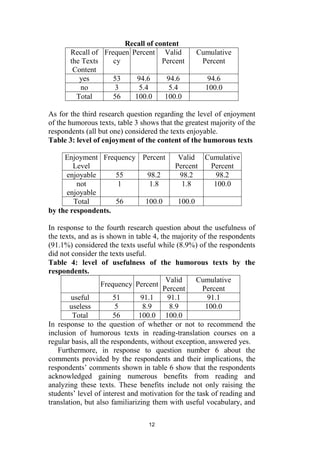
The responses to the second research question about the level of
recall of the contents of the humorous texts as shown in Table 2
indicate a strong level of comprehension where 94% of the
respondents reported that they did recall the content of the texts
versus 5.4% of the respondents who did not recall the content of the
texts.
Table 2: level of recall of the content of the humorous texts by
the respondents.
12
Recall of content
Recall of
the Texts
Content
Frequen
cy
Percent Valid
Percent
Cumulative
Percent
yes 53 94.6 94.6 94.6
no 3 5.4 5.4 100.0
Total 56 100.0 100.0
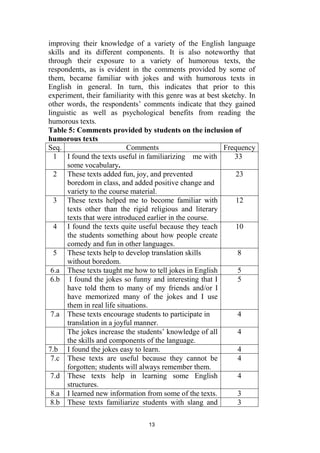
As for the third research question regarding the level of enjoyment
of the humorous texts, table 3 shows that the greatest majority of the
respondents (all but one) considered the texts enjoyable.
Table 3: level of enjoyment of the content of the humorous texts
by the respondents.
In response to the fourth research question about the usefulness of
the texts, and as is shown in table 4, the majority of the respondents
(91.1%) considered the texts useful while (8.9%) of the respondents
did not consider the texts useful.
Table 4: level of usefulness of the humorous texts by the
respondents.
In response to the question of whether or not to recommend the
inclusion of humorous texts in reading-translation courses on a
regular basis, all the respondents, without exception, answered yes.
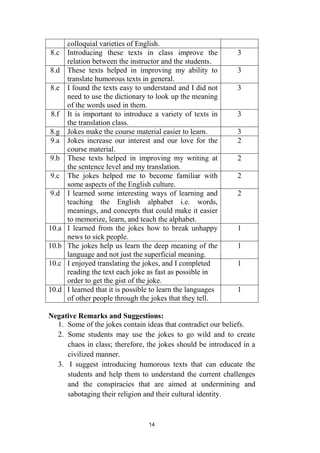
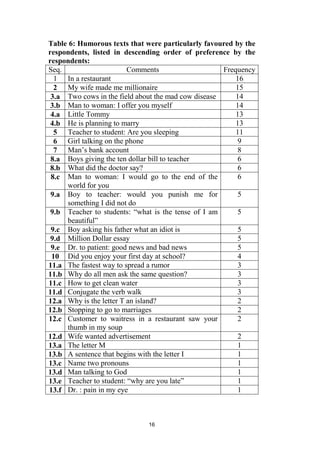
Furthermore, in response to question number 6 about the
comments provided by the respondents and their implications, the
respondents’ comments shown in table 6 show that the respondents
acknowledged gaining numerous benefits from reading and
analyzing these texts. These benefits include not only raising the
students’ level of interest and motivation for the task of reading and
translation, but also familiarizing them with useful vocabulary, and
Enjoyment
Level
Frequency Percent Valid
Percent
Cumulative
Percent
enjoyable 55 98.2 98.2 98.2
not
enjoyable
1 1.8 1.8 100.0
Total 56 100.0 100.0
Frequency Percent
Valid
Percent
Cumulative
Percent
useful 51 91.1 91.1 91.1
useless 5 8.9 8.9 100.0
Total 56 100.0 100.0
13
improving their knowledge of a variety of the English language
skills and its different components. It is also noteworthy that
through their exposure to a variety of humorous texts, the
respondents, as is evident in the comments provided by some of
them, became familiar with jokes and with humorous texts in
English in general. In turn, this indicates that prior to this
experiment, their familiarity with this genre was at best sketchy. In
other words, the respondents’ comments indicate that they gained
linguistic as well as psychological benefits from reading the
humorous texts.
Table 5: Comments provided by students on the inclusion of
humorous texts
Seq. Comments Frequency
1 I found the texts useful in familiarizing me with
some vocabulary.
33
2 These texts added fun, joy, and prevented
boredom in class, and added positive change and
variety to the course material.
23
3 These texts helped me to become familiar with
texts other than the rigid religious and literary
texts that were introduced earlier in the course.
12
4 I found the texts quite useful because they teach
the students something about how people create
comedy and fun in other languages.
10
5 These texts help to develop translation skills
without boredom.
8
6.a These texts taught me how to tell jokes in English 5
6.b I found the jokes so funny and interesting that I
have told them to many of my friends and/or I
have memorized many of the jokes and I use
them in real life situations.
5
7.a These texts encourage students to participate in
translation in a joyful manner.
4
The jokes increase the students’ knowledge of all
the skills and components of the language.
4
7.b I found the jokes easy to learn. 4
7.c These texts are useful because they cannot be
forgotten; students will always remember them.
4
7.d These texts help in learning some English
structures.
4
8.a I learned new information from some of the texts. 3
8.b These texts familiarize students with slang and 3
14
colloquial varieties of English.
8.c Introducing these texts in class improve the
relation between the instructor and the students.
3
8.d These texts helped in improving my ability to
translate humorous texts in general.
3
8.e I found the texts easy to understand and I did not
need to use the dictionary to look up the meaning
of the words used in them.
3
8.f It is important to introduce a variety of texts in
the translation class.
3
8.g Jokes make the course material easier to learn. 3
9.a Jokes increase our interest and our love for the
course material.
2
9.b These texts helped in improving my writing at
the sentence level and my translation.
2
9.c The jokes helped me to become familiar with
some aspects of the English culture.
2
9.d I learned some interesting ways of learning and
teaching the English alphabet i.e. words,
meanings, and concepts that could make it easier
to memorize, learn, and teach the alphabet.
2
10.a I learned from the jokes how to break unhappy
news to sick people.
1
10.b The jokes help us learn the deep meaning of the
language and not just the superficial meaning.
1
10.c I enjoyed translating the jokes, and I completed
reading the text each joke as fast as possible in
order to get the gist of the joke.
1
10.d I learned that it is possible to learn the languages
of other people through the jokes that they tell.
1
Negative Remarks and Suggestions:
1. Some of the jokes contain ideas that contradict our beliefs.
2. Some students may use the jokes to go wild and to create
chaos in class; therefore, the jokes should be introduced in a
civilized manner.
3. I suggest introducing humorous texts that can educate the
students and help them to understand the current challenges
and the conspiracies that are aimed at undermining and
sabotaging their religion and their cultural identity.
15
4. It would be useful if all the jokes were included in the
translation course book because the jokes are not just for
laughter but also for learning the language.
16
Table 6: Humorous texts that were particularly favoured by the
respondents, listed in descending order of preference by the
respondents:
Seq. Comments Frequency
1 In a restaurant 16
2 My wife made me millionaire 15
3.a Two cows in the field about the mad cow disease 14
3.b Man to woman: I offer you myself 14
4.a Little Tommy 13
4.b He is planning to marry 13
5 Teacher to student: Are you sleeping 11
6 Girl talking on the phone 9
7 Man’s bank account 8
8.a Boys giving the ten dollar bill to teacher 6
8.b What did the doctor say? 6
8.c Man to woman: I would go to the end of the
world for you
6
9.a Boy to teacher: would you punish me for
something I did not do
5
9.b Teacher to students: “what is the tense of I am
beautiful”
5
9.c Boy asking his father what an idiot is 5
9.d Million Dollar essay 5
9.e Dr. to patient: good news and bad news 5
10 Did you enjoy your first day at school? 4
11.a The fastest way to spread a rumor 3
11.b Why do all men ask the same question? 3
11.c How to get clean water 3
11.d Conjugate the verb walk 3
12.a Why is the letter T an island? 2
12.b Stopping to go to marriages 2
12.c Customer to waitress in a restaurant saw your
thumb in my soup
2
12.d Wife wanted advertisement 2
13.a The letter M 1
13.b A sentence that begins with the letter I 1
13.c Name two pronouns 1
13.d Man talking to God 1
13.e Teacher to student: “why are you late” 1
13.f Dr. : pain in my eye 1
17
VII: Discussion:
Overall, the results of this study show that the inclusion of
humorous texts in the translation-reading class described in this
study did yield positive results for students in a variety of ways as
their responses indicate. These positive outcomes are evident from
the high levels of comprehension, recall, enjoyment, and usefulness
of the texts that the respondents reported. In this context, it may be
necessary to observe that the fact that the respondents were able to
recall the content of specific jokes, and to express their particular
interest and enjoyment of their content is a strong indication of their
close reading, proper understanding, and high interest in these jokes.
Even the negative remarks provided by some of the respondents
reveal that, to a significant extent, the respondents in general were
closely involved in the process of reading and analyzing the content
of the humorous texts. Additionally, the enthusiasm and wide
acceptance which can be read in the high ratings given by the
respondents in all of these categories is also an indication of an
impoverished knowledge about on the part of the students about
humorous texts, and a significant lack of exposure to this type of
texts among the participants prior to this experiment. In brief, the
high percentages of comprehension, recall, enjoyment, and
usefulness imply that the humorous texts were well received by the
students who participated in this study, which in turn supports the
observations made in the research works already reviewed in this
paper.
VIII: Recommendations:
The obvious enthusiasm and the high interest shown by the
respondents to the inclusion of humorous texts in the translation-
reading course which served as the source of data in this study offer
several recommendations. First, the high appreciation and marked
interest can be used by English language instructors of translation-
reading courses to exploit carefully selected humorous texts to help
students acquire various forms of language that are normally
difficult to teach and learn through explications that consume much
of class time. Humorous texts can also be used to reduce stress and
anxiety which have been referred to as the “affective filter” by
Stephen Krashen. The affective filter as most language instructors
would possibly agree does have a crucial role in controlling the flow
of language acquisition. Humorous texts can also be used to
familiarize Muslim-Arab students with the cultures of its native
speakers, especially since what constitutes humor is often culturally
defined, and what makes people laugh may be different from
18
culture to culture. Judicious and careful selection of appropriate
humorous texts can be of great value to the learner and to the
teacher in many ways. Topics to be avoided in this regard include
sex, religion, politics, and the like.
IX. Conclusions and Suggestions for Future Research:
This study has attempted to explore the effects and the benefits of
introducing a variety of humorous English texts for Arabic-speaking
English majors at Mu'tah University in Jordan, where humorous
texts and materials are typically ignored, and often considered
irrelevant to language teaching for a variety of reasons. The results
of the study have shown that contrary to these perceptions and
malpractices, English humorous texts represent an extremely useful
language input, and can, therefore, help the language learner and the
language instructor in a variety of ways. It must therefore be
concluded that English instructors of translation and reading at
Mu'tah University, and in other similar contexts, cannot afford to
exclude this type of language input from the content of these
courses. Finally, the effects, and the benefits of humorous texts, as
well as the types of humorous materials that are appropriate for
Arab and for Muslim students in particular countries and regions are
issues that are still in need of further investigations, particularly
within the current political and religious turmoil in these countries.
Notes:
1. The words in brackets in the quoted passage from Williams
(1986:42) were added by the author.
Bibliography
Al-Zoubi, Elham I. (2006). Humour in Jordanian Arabic and
British English: A socio-pragmatic perspective. Unpublished
master’s thesis, Yarmouk University, Irbid, Jordan.
Askildson, Lance . (2005). The Effects of humour in the language
classroom. Arizona Working Papers in SLAT. 12, 45-61.
Azizifard, Fereshteh, Jalali, Sara. (2012). Context and Humor in
Teaching Language Functions. Theory and Practice in
Language Studies. 2 (6),1191-1198.
Banikalef, Ala’Eddin Abdullah Ahmed, Maros, Marlyna, Aladdin,
Ashinida. (2014). Linguistic analysis of humor in Jordanian
Arabic among young Jordanians Facebookers. Arab World
English Journal. 5 (3), 304-318
19
Bell, Nancy D. (2009). Learning about and through humor in the
second language classroom. Language Teaching Research
13(3), 241–258.
Bell, Nancy. (2007). How native and non-native English speakers
adapt to humor in intercultural interaction Humor 20 (1),1
27–48.
Bell, Nancy D. (2005). Exploring L2 language play as an aid to
SLL: A case study of humor in NS–NNS interaction. Applied
Linguistics 26 (2), 192–218.
Black, Ian, Kingsley, Patrick, Abdo, Manu, Letsch, Constanze,
Chulov, Martin, Mohsin, Moni, Dehghan, Saeed Kamali.
(2015). Laughing in the face of danger: the state of satire in
the Muslim world. The Guardian.
http://www.theguardian.com/profile/martin-chulov (accessed
15 August, 2015).
Blyth, Andrew, & Ohyama, Takako. (2011). Using humor in EFL
classes. In A. Stewart (Ed.), JALT 2010 conference
proceedings. (pp.735-745). Tokyo: JALT.
Brooks, Albert. (2005). Looking for comedy in the Muslim World:
film starring and directed by Albert Brooks.
Forman, Ross. (2011). Humorous Language play in a Thai EFL
classroom. Applied Linguistics 32, 541–565.
Freij, Muath. (2012, ). New comedians show Jordanians can
appreciate a good joke‘. The Jordan Times.
http://m.jordantimes.com/new-comedians-show-jordanians-
can-appreciate-a-good-joke (accessded 15 August 2015).
Harder, Peter. (1980). Discourse as self-expression: On the reduced
personality of the second language learner. Applied Linguistics
1 (3), 262–270.
Hackathorn, Jana, Garczynski, Amy M., Blankmeyer, Katheryn,
Tennial, Rachel D. and Solomon, Erin D. (2011). All kidding
aside: Humor increases learning at knowledge and
comprehension levels. Journal of the Scholarship of Teaching
and Learning, 11(4), 116 – 123.
Hodson, R. (2008, forthcoming). Challenges for EFL learners in
understanding English humor: a pilot study. Journal of the
faculty of Global Communication, University of Nagasaki, Si.
Khan, Yasmeen. (2007). Does Islam have a sense of humor?
Retrieved July 12, 2014, from BBC NEWS Web site:
http://news.bbc.co.uk/go/pr/fr//2/hi/uk_news/magazine/71025
19.stm
20
Khoshman, Afaf. (2014). Local satirists reflect on Jordanians’ sense
of humour. The Jordan Times.
www.jordantimes.com/.../local/local-satirists-reflect-
jordanians’-sense-hu. (accessded 15 August 2015).
Mouttaki, Amanda. (2013). 6 Assumptions People Make When They
Hear Your Husband is Arab. Retrieved July 12, 2014, from
marocmama Web site: http://marocmama.com
Nastri, J., Pena, J., & Hancock, J.T. (2006). The construction of
away messages: A speech act analysis. Journal of Computer
Mediated Communication, 11(4), 1025-1045.
Neumann, David L.,Hood, Michelle, Neumann. (2009). Statistics?
You Must be Joking: The Application and Evaluation of
Humor when Teaching Statistics. Journal of Statistics
Education Volume 17, Number 2 (2009). 1-16.
Pham, Hoang Nguyen. (2014). The use of humour in EFL teaching:
A case study of Vietnamese university teachers’ and students’
perceptions and practices. Unpublished doctoral dissertation,
University of Canberra, Australia August.
Pomerantz, Anne, and Bell, Nancy. (2011). Humor as safe house in
foreign language classroom. The Modern language Journal,
95, 148-161.
Pomerantz, Anne, and Bell, Nancy. (2007). Learning to play,
playing to learn: FL learners as multicompetent language
users. Applied Linguistics 28, 556-578.
Ravichand, M. (2013). Humor – An Aid to Learning and
Instruction. IOSR Journal Of Humanities And Social Science
(IOSR-JHSS) Volume 11 (1), 18-21.
Richards, Jack, and Rodgers, Theodore S. (2001). Approaches and
methods in language teaching. Cambridge: Cambridge
University Press.
Senior, Rose. (2001). The role of humour in the development and
maintenance of class cohesion. Prospect.16(2), 45-54.
Stroud, Robert. (2013). The Laughing EFL Classroom: Potential
Benefits and Barriers. English Language Teaching. 6, (10),
72-85.
Williams, Ray. (1986). Top Ten Principles for Teaching Reading.
English Language Teaching Journal. 40(1), 42-45.
Ziyaeemehr, Ali and Kumar,Vijay. (2014). The role of verbal humor
in second language education. International Journal of
Research Studies in Education 3 ( 2), 3-13
21
Appendix
A. Humorous texts that were assigned to the students who
provided data of the study
1. Husband and wife conversation through sms.
Husband (in office): “Hello Dear, what are you doing?” Wife (at
home): “I am dyeing {understood as dying} …!” Husband jumps
with happiness but types: “Oh no! My darling, how can I live
without you?” Wife: “You idiot! I am dyeing my hair” Husband:
“Damn the English Language”
2. Signboard: A college student was told to make a signboard
and put it near the college campus to control the traffic: The
signboard read: “Please Drive Carefully, Don’t kill the
Students, Wait for the Teachers…!”
3. Wife is the Boss: A very soft spoken husband was fed up
with his bossy wife; so he went to a marriage counselor. The
marriage counselor said he needed to build his confidence, and
so gave him some lessons on confidence and self-esteem.
When he was done with the lessons he came back to his house.
The man stormed into the house and walked up to his wife.
Pointing a finger in her face, he said, “From now on, I want
you to know that, I am the boss of this house, and my word is
final! I want you to prepare me a delicious meal tonight, and
when I’m finished eating my meal, I expect some tasty sweets
afterwards. Then, after dinner, you’re going to prepare for my
bath so I can relax. And when I’m finished with my bath,
guess who’s going to dress me and comb my hair ….” “The
funeral attender,” said his wife!!!
4. Are You Planning to Marry? “Darling,” said the husband to
his wife, “I have invited my friend home for lunch.” “What?
Have you gone crazy? The house is totally messy, I didn’t get
any grocery, all the dishes are dirty, and I don’t feel like
cooking any meal!” “I know all that.” “Then, why did you
invite your friend?” “Because the poor fellow is thinking
about getting married.”
5. My wife made me a Millionaire: John says to his friend,
Fred that his wife is responsible for making him a millionaire.
“Wow, so nice to have such a good wife. But how on earth did
22
she do it” asked Fred. John replied “Before marriage I was a
Billionaire”!!
6. Are You Sleeping: Teacher fell asleep in class and a little
naughty boy walked up to him: Boy: “Teacher Are You
Sleeping In Class?” Teacher: “No I Am Not Sleeping In
Class.”
Boy: “What Were You Doing Sir?”
Teacher: “I Was Talking To Principal.” The Next Day: The
naughty boy fell asleep in class and the same teacher walks
up to him. Teacher: “Young Man, You Are Sleeping In My
Class.” Boy: “No Not Me Sir, I Am Not Sleeping.” Angry
Teacher: “What Were You Doing?” Boy: “I Was Talking To
Principal.” Angry Teacher: “What Did He Say??” Boy:
“Principal Said He Never Spoke To You Yesterday…”
7. The ABC of Marriage: After being married for 25 years a
wife asked her husband to describe her. He looked at her
slowly…then said, “You’re A, B, C, D, E, F, G, H…. I, J, K.”
She asks… “What does that mean?” He said, “Admirable,
Beautiful, Cute, Delightful, Elegant, Fashionable, Gorgeous,
Honey. She smiled happily and said….”Oh, that’s so
lovely...What about I, J, K?” He said, “I’m Just Kidding!” His
eye is still swollen….but it will get better….
8. The wrong man: At dinner party, one woman said to another,
“Aren’t you wearing your wedding ring on the wrong finger?
The other replied, “Yes I am, I married the wrong man.”
9. Most Wives Give Their Husbands Sound Advice. “99%
Sound, 1% Advice!
10. Teenage Girl: A teenage girl had been talking on the phone
for about half an hour, and then she hung up. “Wow!,” said
her father, “That was short. You usually talk for two hours.
What happened?” "Wrong number," replied the girl"
11. Poem written by WIFE and HUSBAND
WIFE:
I wrote your name on sand it got washed.
I wrote your name in air, it was blown away.
Then I wrote your name on my heart & I got Heart Attack.
HUSBAND:
23
God saw me hungry, he created pizza.
He saw me thirsty, he created Pepsi.
He saw me in dark, he created light.
He saw me without problems, he created YOU.
WIFE:
Twinkle twinkle little star
You should know what you are
And once you know what you are
Mental hospital is not so far.
HUSBAND:
The rain makes all things beautiful.
The grass and flowers too.
If rain makes all things beautiful
Why doesn’t it rain on you?
WIFE:
Roses are red; Violets are blue
Monkeys like u should be kept in zoo.
Don’t feel so angry you will find me there too
Not in cage but laughing at you
12. In a restaurant: Customer: Waiter, waiter! There is a frog in
my soup!!! Waiter: Sorry, sir. The fly is on vacation.
13. Man: I offer you myself. Woman: I am sorry I never accept
cheap gifts.
14. Mother: "Did you enjoy your first day at school?"
Girl: "First day? Do you mean I have to go back tomorrow?
15. Teacher: "Nick, what is the past participle of the verb to
ring?" Nick: "What do you think it is, Sir?"
Teacher:"I don't think, I KNOW!" Nick: "I don't think I know
either, Sir!"
16. PUPIL: "Would you punish me for something I didn't do?"
TEACHER:"Of course not." PUPIL: "Good, because I haven't
done my homework."
17. Son: Dad, what is an idiot? Dad: An idiot is a person who
tries to explain his ideas in such a strange and long way that
another person who is listening to him can't understand him.
Do you understand me? Son: No.
24
18. Man: I could go to the end of the world for you.
Woman: Yes, but would you stay there?
19. Two boys were arguing when the teacher entered the room.
The teacher says, "Why are you arguing?"One boy answers,
"We found a ten dollar bill and decided to give it to whoever
tells the biggest lie." "You should be ashamed of yourselves,"
said the teacher, "When I was your age I didn't even know
what a lie was."The boys gave the ten dollars to the teacher.
20. Man: I want to share everything with you.
Woman: Let's start from your bank account.
21. Teacher: Why are you late? Student: There was a man who
lost a hundred dollar bill. Teacher: That's nice. Were you
helping him look for it? Student: No. I was standing on it.
22. Customer: Excuse me, but I saw your thumb in my soup when
you were carrying it. Waitress: Oh, that's okay. The soup isn't
hot.
23. The real estate agent says, "I have a good, cheap apartment
for you." The man replies, "By the week or by the month?"
The agent answers, "By the garbage dump.."
24. Bank Teller: How do you like the money?
English Student: I like it very much.
25. "Why do you take baths in milk?" "I can't find a cow tall
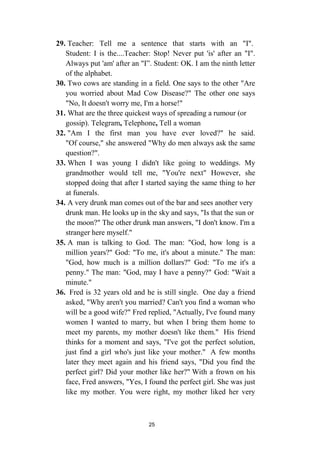
enough for a shower."
26. The teacher to a student: Conjugate the verb "to walk" in
simple present. The student: I walk. You walk....
The teacher interrupts him: Quicker please. The student: I run.
You run ...
27. Patient: Doctor, I have a pain in my eye whenever I drink
tea. Doctor: Take the spoon out of the mug before you drink.
28. A man receives a phone call from his doctor.
The doctor says, "I have some good news and some bad
news." The man says, "OK, give me the good news first."
The doctor says, "The good news is, you have 24 hours to
live." The man replies, " Oh no! If that's the good news, then
what's the bad news?" The doctor says, "The bad news is, I
forgot to call you yesterday."
25
29. Teacher: Tell me a sentence that starts with an "I".
Student: I is the....Teacher: Stop! Never put 'is' after an "I".
Always put 'am' after an "I”. Student: OK. I am the ninth letter
of the alphabet.
30. Two cows are standing in a field. One says to the other "Are
you worried about Mad Cow Disease?" The other one says
"No, It doesn't worry me, I'm a horse!"
31. What are the three quickest ways of spreading a rumour (or
gossip). Telegram, Telephone, Tell a woman
32. "Am I the first man you have ever loved?" he said.
"Of course," she answered "Why do men always ask the same
question?".
33. When I was young I didn't like going to weddings. My
grandmother would tell me, "You're next" However, she
stopped doing that after I started saying the same thing to her
at funerals.
34. A very drunk man comes out of the bar and sees another very
drunk man. He looks up in the sky and says, "Is that the sun or
the moon?" The other drunk man answers, "I don't know. I'm a
stranger here myself."
35. A man is talking to God. The man: "God, how long is a
million years?" God: "To me, it's about a minute." The man:
"God, how much is a million dollars?" God: "To me it's a
penny." The man: "God, may I have a penny?" God: "Wait a
minute."
36. Fred is 32 years old and he is still single. One day a friend
asked, "Why aren't you married? Can't you find a woman who
will be a good wife?" Fred replied, "Actually, I've found many
women I wanted to marry, but when I bring them home to
meet my parents, my mother doesn't like them." His friend
thinks for a moment and says, "I've got the perfect solution,
just find a girl who's just like your mother." A few months
later they meet again and his friend says, "Did you find the
perfect girl? Did your mother like her?" With a frown on his
face, Fred answers, "Yes, I found the perfect girl. She was just
like my mother. You were right, my mother liked her very
26
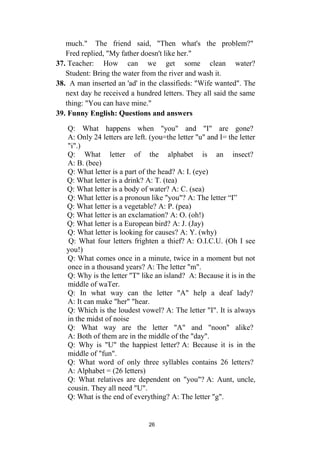
much." The friend said, "Then what's the problem?"
Fred replied, "My father doesn't like her."
37. Teacher: How can we get some clean water?
Student: Bring the water from the river and wash it.
38. A man inserted an 'ad' in the classifieds: "Wife wanted". The
next day he received a hundred letters. They all said the same
thing: "You can have mine."
39. Funny English: Questions and answers
Q: What happens when "you" and "I" are gone?
A: Only 24 letters are left. (you=the letter "u" and I= the letter
"i".)
Q: What letter of the alphabet is an insect?
A: B. (bee)
Q: What letter is a part of the head? A: I. (eye)
Q: What letter is a drink? A: T. (tea)
Q: What letter is a body of water? A: C. (sea)
Q: What letter is a pronoun like "you"? A: The letter “I”
Q: What letter is a vegetable? A: P. (pea)
Q: What letter is an exclamation? A: O. (oh!)
Q: What letter is a European bird? A: J. (Jay)
Q: What letter is looking for causes? A: Y. (why)
Q: What four letters frighten a thief? A: O.I.C.U. (Oh I see
you!)
Q: What comes once in a minute, twice in a moment but not
once in a thousand years? A: The letter "m".
Q: Why is the letter "T" like an island? A: Because it is in the
middle of waTer.
Q: In what way can the letter "A" help a deaf lady?
A: It can make "her" "hear.
Q: Which is the loudest vowel? A: The letter "I". It is always
in the midst of noise
Q: What way are the letter "A" and "noon" alike?
A: Both of them are in the middle of the "day".
Q: Why is "U" the happiest letter? A: Because it is in the
middle of "fun".
Q: What word of only three syllables contains 26 letters?
A: Alphabet = (26 letters)
Q: What relatives are dependent on "you"? A: Aunt, uncle,
cousin. They all need "U".
Q: What is the end of everything? A: The letter "g".
27
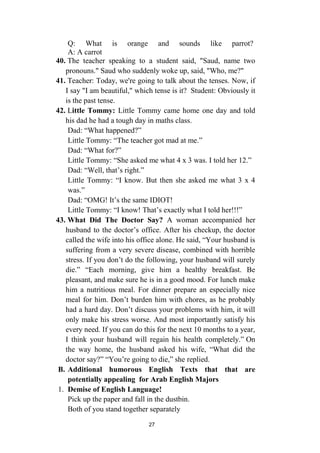
Q: What is orange and sounds like parrot?
A: A carrot
40. The teacher speaking to a student said, "Saud, name two
pronouns." Saud who suddenly woke up, said, "Who, me?"
41. Teacher: Today, we're going to talk about the tenses. Now, if
I say "I am beautiful," which tense is it? Student: Obviously it
is the past tense.
42. Little Tommy: Little Tommy came home one day and told
his dad he had a tough day in maths class.
Dad: “What happened?”
Little Tommy: “The teacher got mad at me.”
Dad: “What for?”
Little Tommy: “She asked me what 4 x 3 was. I told her 12.”
Dad: “Well, that’s right.”
Little Tommy: “I know. But then she asked me what 3 x 4
was.”
Dad: “OMG! It’s the same IDIOT!
Little Tommy: “I know! That’s exactly what I told her!!!”
43. What Did The Doctor Say? A woman accompanied her
husband to the doctor’s office. After his checkup, the doctor
called the wife into his office alone. He said, “Your husband is
suffering from a very severe disease, combined with horrible
stress. If you don’t do the following, your husband will surely
die.” “Each morning, give him a healthy breakfast. Be
pleasant, and make sure he is in a good mood. For lunch make
him a nutritious meal. For dinner prepare an especially nice
meal for him. Don’t burden him with chores, as he probably
had a hard day. Don’t discuss your problems with him, it will
only make his stress worse. And most importantly satisfy his
every need. If you can do this for the next 10 months to a year,
I think your husband will regain his health completely.” On
the way home, the husband asked his wife, “What did the
doctor say?” “You’re going to die,” she replied.
B. Additional humorous English Texts that that are
potentially appealing for Arab English Majors
1. Demise of English Language!
Pick up the paper and fall in the dustbin.
Both of you stand together separately
28
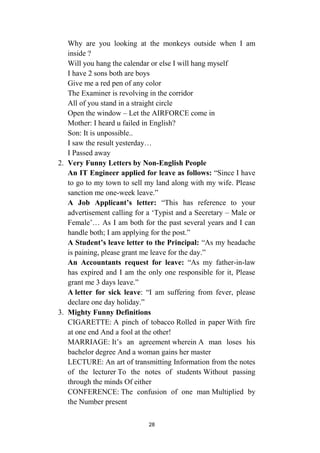
Why are you looking at the monkeys outside when I am
inside ?
Will you hang the calendar or else I will hang myself
I have 2 sons both are boys
Give me a red pen of any color
The Examiner is revolving in the corridor
All of you stand in a straight circle
Open the window – Let the AIRFORCE come in
Mother: I heard u failed in English?
Son: It is unpossible..
I saw the result yesterday…
I Passed away
2. Very Funny Letters by Non-English People
An IT Engineer applied for leave as follows: “Since I have
to go to my town to sell my land along with my wife. Please
sanction me one-week leave.”
A Job Applicant’s letter: “This has reference to your
advertisement calling for a ‘Typist and a Secretary – Male or
Female’… As I am both for the past several years and I can
handle both; I am applying for the post.”
A Student’s leave letter to the Principal: “As my headache
is paining, please grant me leave for the day.”
An Accountants request for leave: “As my father-in-law
has expired and I am the only one responsible for it, Please
grant me 3 days leave.”
A letter for sick leave: “I am suffering from fever, please
declare one day holiday.”
3. Mighty Funny Definitions
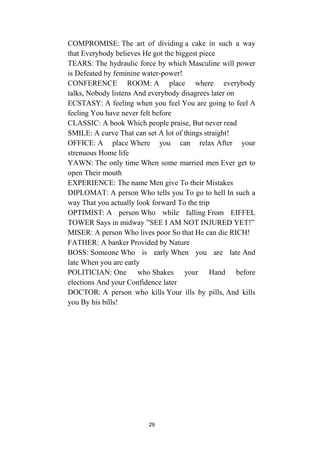
CIGARETTE: A pinch of tobacco Rolled in paper With fire
at one end And a fool at the other!
MARRIAGE: It’s an agreement wherein A man loses his
bachelor degree And a woman gains her master
LECTURE: An art of transmitting Information from the notes
of the lecturer To the notes of students Without passing
through the minds Of either
CONFERENCE: The confusion of one man Multiplied by
the Number present
29
COMPROMISE: The art of dividing a cake in such a way
that Everybody believes He got the biggest piece
TEARS: The hydraulic force by which Masculine will power
is Defeated by feminine water-power!
CONFERENCE ROOM: A place where everybody
talks, Nobody listens And everybody disagrees later on
ECSTASY: A feeling when you feel You are going to feel A
feeling You have never felt before
CLASSIC: A book Which people praise, But never read
SMILE: A curve That can set A lot of things straight!
OFFICE: A place Where you can relax After your
strenuous Home life
YAWN: The only time When some married men Ever get to
open Their mouth
EXPERIENCE: The name Men give To their Mistakes
DIPLOMAT: A person Who tells you To go to hell In such a
way That you actually look forward To the trip
OPTIMIST: A person Who while falling From EIFFEL
TOWER Says in midway ”SEE I AM NOT INJURED YET!”
MISER: A person Who lives poor So that He can die RICH!
FATHER: A banker Provided by Nature
BOSS: Someone Who is early When you are late And
late When you are early
POLITICIAN: One who Shakes your Hand before
elections And your Confidence later
DOCTOR: A person who kills Your ills by pills, And kills
you By his bills!
30
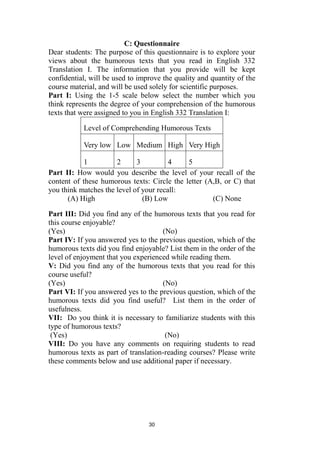
C: Questionnaire
Dear students: The purpose of this questionnaire is to explore your
views about the humorous texts that you read in English 332
Translation I. The information that you provide will be kept
confidential, will be used to improve the quality and quantity of the
course material, and will be used solely for scientific purposes.
Part I: Using the 1-5 scale below select the number which you
think represents the degree of your comprehension of the humorous
texts that were assigned to you in English 332 Translation I:
Level of Comprehending Humorous Texts
Very low Low Medium High Very High
1 2 3 4 5
Part II: How would you describe the level of your recall of the
content of these humorous texts: Circle the letter (A,B, or C) that
you think matches the level of your recall:
(A) High (B) Low (C) None
Part III: Did you find any of the humorous texts that you read for
this course enjoyable?
(Yes) (No)
Part IV: If you answered yes to the previous question, which of the
humorous texts did you find enjoyable? List them in the order of the
level of enjoyment that you experienced while reading them.
V: Did you find any of the humorous texts that you read for this
course useful?
(Yes) (No)
Part VI: If you answered yes to the previous question, which of the
humorous texts did you find useful? List them in the order of
usefulness.
VII: Do you think it is necessary to familiarize students with this
type of humorous texts?
(Yes) (No)
VIII: Do you have any comments on requiring students to read
humorous texts as part of translation-reading courses? Please write
these comments below and use additional paper if necessary.

Humorous English Texts as a Useful Language Input.docx

  • 1.
    1 Humorous English Textsas Useful Language Input: Views of English Majors at Mu’tah University Abstract By Juma Salim Njadat Department of English Mu’tah University E-mail Address: juma_njadat@yahoo.com This paper explores the outcomes of introducing and of exploiting a variety of English humorous texts in a reading-translation credit course for mixed-ability Arabic-speaking English majors at Mu’tah University in Jordan. The data used to achieve the purpose of this study were collected through a likert-type questionnaire from a purposeful sample consisting of sixty English majors at Mu'tah University. The results of the study show positive outcomes for the use of this type of language content in several areas, particularly in the areas of students’ involvement in in-class, and out-of-class activities, as well as in the level of their interest in reading and translating this type of texts. The paper provides recommendations for making a better use of this often-neglected type of linguistic and cultural input in translation and in reading courses by English instructors at Mu'tah University and in similar educational contexts as well. Key Words: humorous texts, English majors, Mu’tah University, Jordan ‫اإلنجليزي‬ ‫اللغة‬ ‫في‬ ‫الفكاهية‬ ‫النصوص‬ ‫ة‬ ‫لغوية‬ ‫كمدخالت‬ ‫مفيدة‬ : ‫أراء‬ ‫تخص‬ ‫طلبة‬ ‫ص‬ ‫مؤته‬ ‫جامعة‬ ‫في‬ ‫اإلنجليزية‬ ‫اللغة‬ ‫ال‬ ‫م‬ ‫ستخل‬ ‫ص‬ ‫تب‬ ‫في‬ ‫الدراسة‬ ‫هذه‬ ‫حث‬ ‫ال‬ ‫فوائد‬ ‫من‬ ‫المكتسبة‬ ‫تعريف‬ ‫طلبة‬ ‫اإلنجليزية‬ ‫اللغة‬ ‫تخصص‬ ‫ب‬ ‫من‬ ‫متنوعة‬ ‫مختارات‬ ‫الفكاهية‬ ‫النصوص‬ ‫اإلنجليزية‬ ‫اللغة‬ ‫في‬ ‫واست‬ ‫كمدخالت‬ ‫ثمارها‬ ‫لغوية‬ ‫مساق‬ ‫في‬ ‫ات‬ ‫والقراءة‬ ‫الترجمة‬ ‫الناطقين‬ ‫اإلنجليزية‬ ‫اللغة‬ ‫تخصص‬ ‫طلبة‬ ‫من‬ ‫لمجموعة‬ ‫بالعربية‬ ‫في‬ ‫مؤته‬ ‫جامعة‬ ‫في‬ ‫اإلنجليزية‬ ‫اللغة‬ ‫في‬ ‫المختلفة‬ ‫والمستويات‬ ‫القدرات‬ ‫ذوي‬ ‫من‬ ‫األردن‬ . ‫الدر‬ ‫أهداف‬ ‫تحقيق‬ ‫في‬ ‫المستخدمة‬ ‫البيانات‬ ‫جمعت‬ ‫وقد‬ ‫على‬ ‫استبانة‬ ‫خالل‬ ‫من‬ ‫اسة‬ ‫اللغة‬ ‫تخصص‬ ‫من‬ ‫وطالبة‬ ‫طالب‬ ‫ستين‬ ‫من‬ ‫مكونة‬ ‫مستهدفة‬ ‫عينة‬ ‫قبل‬ ‫من‬ ‫اليكرت‬ ‫نمط‬ ‫وتظه‬ .‫مؤته‬ ‫جامعة‬ ‫في‬ ‫اإلنجليزية‬ ‫ر‬ ‫من‬ ‫العديد‬ ‫في‬ ‫الطلبة‬ ‫لدى‬ ‫تحسن‬ ‫حصول‬ ‫الدراسة‬ ‫نتائج‬ ‫نتيجة‬ ‫الجوانب‬ ‫لقراءتهم‬ ‫من‬ ‫النوع‬ ‫لهذا‬ ‫وتحليلهم‬ ‫النصوص‬ ‫وخصوصا‬ ‫مجال‬ ‫في‬ ‫ازدياد‬ ‫الرغبة‬ ‫لديهم‬ ‫واالهتمام‬ ‫النشاطات‬ ‫بكافة‬ ‫المشاركة‬ ‫في‬ ‫المتعلقة‬ ‫هذه‬ ‫وتحليل‬ ‫وترجمة‬ ‫بقراءة‬ ‫النصوص‬ ‫الصف‬ ‫داخل‬ ‫وخارجه‬ ‫توصيات‬ ‫الدراسة‬ ‫وتقدم‬ . ‫اإلنجليزية‬ ‫اللغة‬ ‫لمدرسي‬ ‫في‬ ‫البيئات‬ ‫وفي‬ ‫مؤته‬ ‫جامعة‬ ‫التعليمية‬ ‫المشابهة‬ ‫على‬ ‫الحث‬ ‫في‬ ‫تتلخص‬ ‫من‬ ‫النوع‬ ‫هذا‬ ‫استغالل‬
  • 2.
    2 ‫اللغوي‬ ‫المحتوى‬ ‫والثقافي‬ ‫ما‬ ‫عادة‬‫الذي‬ ‫يهمل‬ ‫ويستثنى‬ ‫الترجمة‬ ‫مساقات‬ ‫محتوى‬ ‫من‬ .‫والقراءة‬ :‫المفتاحية‬ ‫الكلمات‬ ‫جام‬ ،‫اإلنجليزية‬ ‫اللغة‬ ‫تخصص‬ ‫طلبة‬ ،‫الفكاهية‬ ‫النصوص‬ ،‫مؤته‬ ‫عة‬ .‫األردن‬ I. Introduction: For a variety of reasons, humorous English texts have not been properly utilized in the teaching of reading and translation for English majors at Mu'tah University. These reasons include shortage of time, lack of freedom to assign humorous texts by the instructors, and fear of violating acceptable cultural and religious norms and teachings in Arab-Muslim societies. The reasons also include the fact that instructors of reading and translation are often under tremendous pressure for covering specific topics and/or language items within the limits of typically tight academic calendars. Some instructors may also underestimate the positive effects and the positive results that this type of texts may achieve for their students. Moreover, in some cases instructors will find that the course textbook and the topics to be covered in it have already been carefully chosen and specified by individuals in administrative positions, whose main concern is to have the course material delivered as soon as possible in order to meet the deadlines for examinations on the course material covered. Instructors with reasonable experience in the field will most likely agree that some of the administrators and head of English departments may often lack the needed sensitivity and attentiveness to the real needs of the diverse students’ intake into English departments. Within the context of the English Department at Mu'tah University, this is particularly true with respect to the numerous substandard students who are annually admitted through the current defective unified admission system, which relies on the student's grade average achieved on The General Secondary Study Certificate Exam as the sole criterion for admission. Moreover, a careful examination of the most frequently used course books for teaching translation and reading in public universities in Jordan will show that humor, particularly jokes in English, have little or no place in these course books. Most authors are inclined towards topics of general and serious nature such as business, science, law, advertising, education, and so forth. Besides, study plans and course descriptions of English departments at most
  • 3.
    3 public universities inJordan generally reflect a tendency towards emphasizing what has been called bland and matter-of-fact linguistic content, and generally avoid humorous content, either deliberately or simply because those who design these study plans are unaware, or are not sufficiently convinced of its value for the students. Nevertheless, while it should be acknowledged that no course book will ever cover all the topics that need to be covered, or all the topics that students will find interesting, the nearly complete absence of humor in translation and reading textbooks despite its value for the learners cannot be justified. At the same time, humor, which is expressed in language, has always constituted an extremely important part of the English language and the English culture. This can easily be exemplified by the numerous comedy shows which take much of the prime time television on the various television channels in the English-speaking countries, which are also shown to viewers in non-English speaking countries around the world. It also goes without saying that humor does not only make people laugh, but it also reveals a great deal about the language and the culture that produces it, particularly in terms of such variables as the thought, the values, the beliefs, the fears, and the prejudices of the people who represent the language and its culture. Therefore, if humor is of such an importance for languages and cultures, it cannot then be dispensed with in language courses. Learners who do not understand the jokes in the target language will naturally be limited in their linguistic resources and if we ignore humor i.e. jokes in our teaching plans, and if we totally overlook it and exclude it from the linguistic input that we provide to our students, we ignore an integral part of the language. In this context, the study reported in this paper was conducted to explore key issues pertaining to the exploitability and the usefulness of humorous texts to Jordanian English majors at Mu’tah University, particularly with respect to the following issues: a. appropriacy and appeal for students, b. effects on students' performance in various areas of language and culture. To understand the potential value and usefulness of humorous texts for English majors at Mu’tah University, and possibly in the rest of the Jordanian universities, the following conditions should be taken into consideration: 1. By virtue of the geographical location of their country in a turbulent region, Jordanian students are becoming more and more accustomed to grim scenes of death, misery, injustice,
  • 4.
    4 and atrocities thatall have become a fact of life, and have inevitably shaped the mood and the character of the people in this part of the world. Fear, anxiety, uncertainty, and frustration are all conditions that abound among people living in conflict-ridden regions and countries such as Jordan, which all have to be faced and can potentially retard academic achievement. 2. The student intake into the degree programmes at English department vary in terms of English language proficiency and academic preparation. 3. The current political atmosphere in Jordan is characterized by a lot of uncertainty and anxiety about the present and about the future. The whole region, particularly the neighboring Arab countries, are currently witnessing big revolutions and tremendous upheavals accompanied with large-scale bloodshed, and unprecedented and grisly scenes of killings. These have inevitably led to substantial frustration, fear, and a sense of worthlessness among many of the citizens in Arab countries, including Jordan. This situation has recently been depicted by Black et. al. (2015) in their article on the state of humor and satire in several Arab and Muslim countries: It’s a sweeping generalisation, of course, but Arabs and Muslims really don’t have much to laugh about these days: mayhem and death, war and repression, dictatorship and terrorism are daily fare across the region. Yet satire and humour, much of it fairly black, are alive and kicking, from Iraqis poking fun at the Islamic State (Isis) to Saudi standup comics, and Palestinians grinning and bearing life under a corrupt government and Israeli occupation. 4. Chronic and skyrocketing budget deficits and high unemployment rates among the youth, particularly among university graduates, can result in gloominess and loss of hope. Because of losing the hope to find a decent job opportunity after graduation, it is possible to find many students who are careless towards their academic standing.
  • 5.
    5 It is alsotrue to say that despite this wide recognition of the value of humor in foreign language teaching, there are foreign language instructors, who for a number of reasons, do not sufficiently exploit humor in their classes. These reasons include among many things, disbelief or underestimation of its value as an aid to learning on the part of some instructors, shortage of time, pressure to meet certain deadlines imposed by administrators, and fear of violating religious and/or cultural norms. II. Previous research: The value and the exploitability of humor in foreign language teaching and learning have recently received increased attention in applied linguistics research. Several benefits of humor in second/foreign language learning have been recognised. Among several things, these benefits include improving the learning environment as well as helping the learning of specific language skills. In this context, Bell (2009: 241) writes: Humor is presented as socially and psychologically beneficial to learners, helping to relax them, to create a comfortable classroom atmosphere, to create bonds among classmates, to raise student interest, and simply to make learning more enjoyable. In addition, humor has been touted as an excellent way for students to learn the vocabulary, syntax, semantics, and discourse conventions of the target language, as well as to gain insight into the culture of those who speak that language. Forman (2011) shares this view on the usefulness of humor, particularly its usefulness for language learning: "it may also be said that such humor is a form of verbal art which emerges from creativity, and shades into wit, into intelligence, all of which are dimensions of daily language use; and so the experiences afforded by humor may indeed represent a valuable resource for second language classrooms.” A positive effect for humor on students’ achievement and performance in a variety of fields including foreign language has also been noted by Hackathorn et. al. (2011:116) who found that “using humor to teach material significantly increased students' overall performance on exams, particularly on knowledge and comprehension level quiz items … Moreover, learning a construct through the use of humor was most effective for comprehension level quiz items." These writers i.e. Hackathorn et. al. (ibid) add that their work “provides some of the
  • 6.
    6 first ecologically validevidence that humor may maximize learning outcomes in college classrooms.” The usefulness of humorous materials in EFL/ESL classes has also been recognised by other authors including Hodson (forthcoming), Pham (2014), Ali and Vijay (2014), Ravichand (2013), Stroud (2013), Azizifard and Jalali (2012), Bell (2009), Pomerantz and Bell (2011: 148), Forman (2011), Neumann, et. al. (2009), Pomerantz and Bell (2007), Pomerantz and Bell (2005), and Senior (2001). These authors report numerous pedagogical, psychological, and practical benefits as well as tips and guidelines for using humor in teaching English in a foreign/second language context and in teaching other subjects as well. Humorous and language play input is of special importance because of the element of interest which is a highly crucial factor for foreign language acquisition and particularly for lowering the affective filter as argued by the proponents of the Natural Approach for language acquisition, also known as Krashen’s language acquisition theory. Richards and Rogers (2001: 183) describe one of the key implications of the input hypothesis and the affective filter hypothesis which constitute two of the five hypotheses comprising this acquisition theory. “In order to lower the affective filter, student work should center on meaningful communication rather than on form; input should be interesting and so contribute to a relaxed classroom atmosphere.” (ibid).The importance of providing students with interesting materials for EFL reading in particular, has also been alluded to by Williams (1986: 42) who lists interest as one of the “top ten principles” in teaching reading: In the absence of interesting texts{in reading classes}1 , very little is possible ...Interesting to whom? First and foremost to the learner, but preferably interesting also to the teacher. How do we know what our learners are interested in reading in English? Ask them what they like reading in their own language, peer over their shoulders in the library. Furthermore, the ability to comprehend humorous language content is considered one of the essential criteria of being a competent nonnative speaker of English as Bell (2007:28) notes: The construction and comprehension of verbal humor in an L2 constitutes a great challenge even to advanced L2 learners, as it often requires sophisticated linguistic, social and cultural competence …It has also been posited that an inability to create or understand jokes
  • 7.
    7 might contribute toNNSs being accorded a lower status simply on the basis of their L2 abilities. Harder (1980) called this the ‘‘reduced personality’’ of the L2 learner. Research on humour within the Jordanian context may at best be considered scanty, particularly in comparison to the amount of research which has been conducted in the English-speaking world. Nevertheless, a number of studies have tackled several issues relating to the Jordanian context in particular. Among the topics related to humor in Jordan which have recurred in published works in this context is the serious and the reserved nature which is believed to characterise most Jordanians. In this regard, Banikalaf (2014: 305-306) alludes to this common belief about the Jordanian's lack of humor: It is widely assumed that Jordanians are less humorous compared to other nationalities as reflected in some newspaper articles, cartoons, Facebook groups or pages, and academic writing. This is probably due to the fact that Jordanians frown a lot, even in the public places (Freij, 2012). In an effort to substantiate empirically whether Jordanians are less or more humorous than others, it would be appropriate and relevant to examine Nastri et al.‘s (2006) findings with regards to the Jordanian context. Finally, Al-Zoubi (2006: iii) conducted a comparative study between Humour in Jordanian Arabic and British English jokes, in which she provides a "classification of the general linguistic, situation, and character categories that are applicable to the sources of jokes, all based on bending or breaking violation of natural, social, moral, ethical, or logical rules, and patterns of behavior." To conclude this review of the related literature, it may be necessary to note that the effects and the benefits of exploiting humorous English in reading and in translation courses for English majors at Mu'tah University, where the student population consists of Arabic-speaking Jordanian students, is an issue that has not been adequately addressed. III.Significance of the Study: This study is an attempt to highlight the exploitability and the usefulness of humorous and playful language input, which typically is either neglected or is at best underused in language classes for the reasons that have already been pointed out. Besides dealing with a neglected or an underexploited language input, this study is an attempt to demonstrate that, contrary to the negative image and the negative stereotypes of Arabs and
  • 8.
    8 Muslims, which havebeen created by hostile media, particularly in the West, Arab and/or Muslim learners of English are as capable of comprehending and of enjoying this type of English language content as any other group in the world. This is of significant importance to point out here because of instances of misunderstanding students and of underestimating their abilities to digest this type of materials which are common among some expatriate native-English speaking instructors. In some cases, this misunderstanding and underestimation have unfortunately led to prejudices and negative attitudes by some of these instructors towards their students. In this context, the author recalls a paradoxical, though painful case of a Canadian native- speaking teacher of English in 2001 who used to describe her English class of Omani students in an Omani university as a zoo by repeating the phrase “time to go to the zoo” whenever it was time for her to go and teach that class. In other words, she did not have a problem in publicly comparing her Omani students to animals in a zoo. The sad part of this story is that when this native English-speaking teacher resigned from her job in that university, many of those very students whom she repeatedly called animals in a zoo cried because of her departure from the university. It could be argued that the teacher’s derogatory statement towards Omani students was not motivated by any ill purposes or bad intentions towards those students. Nevertheless, it goes without saying that no person in his/her mind would accept to be referred to as an animal in zoo when s/he is paying his/her dear money to learn English. The point from this story is that though this teacher might have been a competent English teacher, her description of her students as animals in a zoo represents a tendency to misjudge, misunderstand, and/or underestimate Arab-Muslim students’ abilities by some native English-speaking expatriate teachers. It is thus for fear of underestimating and of belittling our students’ intellectual and cultural abilities to understand, to enjoy, and to learn from humorous language content that this study was partly envisaged. Another point of relevance is the false image, and the wrong impression propagated in some Western media about Muslims and/or Arabs as people who do not have any sense of humor, and whose ability to understand, and to enjoy humorous language are therefore questionable. In connection with this, Khan (2007) writes “Muslims are often depicted as people who can't take a joke.” It would also be useful to read Mouttaki’s six “assumptions people make” about Arabs, and
  • 9.
    9 her observation aboutthe “negativity” that American media in particular have spread about the Arabs. Furthermore, this false image and impression about Muslims as people who are at odds with humor, which some in the west have been trying to propagate about Islam and Muslims are evident from the American government’s commission of comedian Albert Brooks in 2005 to find out what makes Muslims laugh. Brook’s mission did not apparently go in vain because he collected enough information to enable him to produce his famous movie in 2005 titled Looking for Comedy in the Muslim World. This is of special importance to point out here because of the scarcity of literature on humour in Jordan as noted by Banikalef (2014:308). The importance of this study finally derives from its contribution to the literature on humour within a specific educational context in Jordan i.e. Mu'tah University. IV. Method Sample: The sample consisted of sixty students who enrolled in a translation course designed for students whose level of English proficiency is between the intermediate and upper-intermediate. All the members of this sample were English majors, and all were Arabic speakers. Their ages were between nineteen and twenty-two. Materials and Procedures: Materials: The materials used to achieve the purpose of this study consisted of a collection of English jokes, funny riddles, and funny passages which were all downloaded from the following websites: 1. Jokes in English for the ESL/EFL Classroom - Riddles iteslj.org/c/jokes.html 2. Jokes in English for the ESL/EFL Classroom - Short Jokes iteslj.org/c/jokes-short.html 3. Sara: http://funnyfunnyjokes.org/ A copy of these materials is provided as Part A of the appendix. Additional jokes and other humorous texts that could be appealing to Arab English majors in general are also listed as Part B of the appendix. To explore students’ views and reactions to the use of this type of texts in the course, a Likert-type questionnaire was used. The questionnaire consisted of eight parts. A copy of this questionnaire is provided as Part C of the appendix. Procedures: Copies of the collection of jokes and funny riddles were given to the students who participated in this study during the sixth week of the second semester of the academic year 2013-2014. The students were asked to read and to translate the jokes and the
  • 10.
    10 riddles individually athome and in groups in class over a period of two weeks. They were also told to be prepared for translating similar texts on the second progress test on the course material. The collection of jokes and funny riddles was introduced after students had practiced reading and translating texts of various types and on various topics. To help the reader grasp the rationale behind including this type of language input in the reading-translation course, it may be necessary to list some of the texts and topics that the students worked on before and after they were asked to work on the jokes and the funny language riddles. Those texts and topics included the following: 1. News stories from newspapers and magazines 2. Advertisements 3. Formal and informal letters 4. Agriculture, sports, health, death across cultures 5. Legal documents 6. Speeches by political leaders 7. Religious texts including the following: a. Chapter from The Qur’an b. The Farewell Speech by Prophet Muhammad c. The Book of Genesis from The Bible d. The Ten Commandments from The Bible 8. Selections from English and Arabic poetry The course material as can be seen here consisted mostly of texts on serious topics. And with this dominance of serious texts and topics in the course material, the question that should be raised here is: can we as instructors afford to limit the course materials to serious texts and topics and possibly weaken our students’ interest in the course material? V. Research Questions: This study aimed at answering the following questions: 1. To what extent were the respondents able to comprehend the humorous texts that they read? In other words, what was the level of comprehension of the content of the humorous texts by the respondents? 2. To what extent were the respondents able to recall the content of the texts? 3. What percentage of the respondents found the texts useful?
  • 11.
    11 4. What percentageof the respondents found the texts enjoyable? 5. What percentage of the respondents recommends assigning this type of humorous texts in future courses? 6. What do the respondents generally think of introducing humorous texts in translation-reading courses i.e. what comments (positive or negative) do they have about the texts, and what do these comments imply? 7. Which of the humorous texts were particularly favored by the respondents, and what could their preference for certain humorous texts mean? VI. Results: The responses provided by the respondents enabled the researcher to answer the research questions and the answers are outlined here for each of the questions respectively. In response to the first research question about the level of comprehension of the humorous texts, and as shown in table one, an overwhelming majority of the respondents found the texts comprehensible to them. This is clear from the percentages shown where (62.5%) of respondents reported a high level of comprehension, 19.6 % reported a very high level of comprehension, and (17.9%) reported a medium level of comprehension. Table 1: comprehension level of the humorous texts by the respondents. Comprehension level Level of comprehension Frequen cy Percent Valid Percent Cumulative Percent medium 10 17.9 17.9 17.9 high 35 62.5 62.5 80.4 very high 11 19.6 19.6 100.0 Total 56 100.0 100.0 The responses to the second research question about the level of recall of the contents of the humorous texts as shown in Table 2 indicate a strong level of comprehension where 94% of the respondents reported that they did recall the content of the texts versus 5.4% of the respondents who did not recall the content of the texts. Table 2: level of recall of the content of the humorous texts by the respondents.
  • 12.
    12 Recall of content Recallof the Texts Content Frequen cy Percent Valid Percent Cumulative Percent yes 53 94.6 94.6 94.6 no 3 5.4 5.4 100.0 Total 56 100.0 100.0 As for the third research question regarding the level of enjoyment of the humorous texts, table 3 shows that the greatest majority of the respondents (all but one) considered the texts enjoyable. Table 3: level of enjoyment of the content of the humorous texts by the respondents. In response to the fourth research question about the usefulness of the texts, and as is shown in table 4, the majority of the respondents (91.1%) considered the texts useful while (8.9%) of the respondents did not consider the texts useful. Table 4: level of usefulness of the humorous texts by the respondents. In response to the question of whether or not to recommend the inclusion of humorous texts in reading-translation courses on a regular basis, all the respondents, without exception, answered yes. Furthermore, in response to question number 6 about the comments provided by the respondents and their implications, the respondents’ comments shown in table 6 show that the respondents acknowledged gaining numerous benefits from reading and analyzing these texts. These benefits include not only raising the students’ level of interest and motivation for the task of reading and translation, but also familiarizing them with useful vocabulary, and Enjoyment Level Frequency Percent Valid Percent Cumulative Percent enjoyable 55 98.2 98.2 98.2 not enjoyable 1 1.8 1.8 100.0 Total 56 100.0 100.0 Frequency Percent Valid Percent Cumulative Percent useful 51 91.1 91.1 91.1 useless 5 8.9 8.9 100.0 Total 56 100.0 100.0
  • 13.
    13 improving their knowledgeof a variety of the English language skills and its different components. It is also noteworthy that through their exposure to a variety of humorous texts, the respondents, as is evident in the comments provided by some of them, became familiar with jokes and with humorous texts in English in general. In turn, this indicates that prior to this experiment, their familiarity with this genre was at best sketchy. In other words, the respondents’ comments indicate that they gained linguistic as well as psychological benefits from reading the humorous texts. Table 5: Comments provided by students on the inclusion of humorous texts Seq. Comments Frequency 1 I found the texts useful in familiarizing me with some vocabulary. 33 2 These texts added fun, joy, and prevented boredom in class, and added positive change and variety to the course material. 23 3 These texts helped me to become familiar with texts other than the rigid religious and literary texts that were introduced earlier in the course. 12 4 I found the texts quite useful because they teach the students something about how people create comedy and fun in other languages. 10 5 These texts help to develop translation skills without boredom. 8 6.a These texts taught me how to tell jokes in English 5 6.b I found the jokes so funny and interesting that I have told them to many of my friends and/or I have memorized many of the jokes and I use them in real life situations. 5 7.a These texts encourage students to participate in translation in a joyful manner. 4 The jokes increase the students’ knowledge of all the skills and components of the language. 4 7.b I found the jokes easy to learn. 4 7.c These texts are useful because they cannot be forgotten; students will always remember them. 4 7.d These texts help in learning some English structures. 4 8.a I learned new information from some of the texts. 3 8.b These texts familiarize students with slang and 3
  • 14.
    14 colloquial varieties ofEnglish. 8.c Introducing these texts in class improve the relation between the instructor and the students. 3 8.d These texts helped in improving my ability to translate humorous texts in general. 3 8.e I found the texts easy to understand and I did not need to use the dictionary to look up the meaning of the words used in them. 3 8.f It is important to introduce a variety of texts in the translation class. 3 8.g Jokes make the course material easier to learn. 3 9.a Jokes increase our interest and our love for the course material. 2 9.b These texts helped in improving my writing at the sentence level and my translation. 2 9.c The jokes helped me to become familiar with some aspects of the English culture. 2 9.d I learned some interesting ways of learning and teaching the English alphabet i.e. words, meanings, and concepts that could make it easier to memorize, learn, and teach the alphabet. 2 10.a I learned from the jokes how to break unhappy news to sick people. 1 10.b The jokes help us learn the deep meaning of the language and not just the superficial meaning. 1 10.c I enjoyed translating the jokes, and I completed reading the text each joke as fast as possible in order to get the gist of the joke. 1 10.d I learned that it is possible to learn the languages of other people through the jokes that they tell. 1 Negative Remarks and Suggestions: 1. Some of the jokes contain ideas that contradict our beliefs. 2. Some students may use the jokes to go wild and to create chaos in class; therefore, the jokes should be introduced in a civilized manner. 3. I suggest introducing humorous texts that can educate the students and help them to understand the current challenges and the conspiracies that are aimed at undermining and sabotaging their religion and their cultural identity.
  • 15.
    15 4. It wouldbe useful if all the jokes were included in the translation course book because the jokes are not just for laughter but also for learning the language.
  • 16.
    16 Table 6: Humoroustexts that were particularly favoured by the respondents, listed in descending order of preference by the respondents: Seq. Comments Frequency 1 In a restaurant 16 2 My wife made me millionaire 15 3.a Two cows in the field about the mad cow disease 14 3.b Man to woman: I offer you myself 14 4.a Little Tommy 13 4.b He is planning to marry 13 5 Teacher to student: Are you sleeping 11 6 Girl talking on the phone 9 7 Man’s bank account 8 8.a Boys giving the ten dollar bill to teacher 6 8.b What did the doctor say? 6 8.c Man to woman: I would go to the end of the world for you 6 9.a Boy to teacher: would you punish me for something I did not do 5 9.b Teacher to students: “what is the tense of I am beautiful” 5 9.c Boy asking his father what an idiot is 5 9.d Million Dollar essay 5 9.e Dr. to patient: good news and bad news 5 10 Did you enjoy your first day at school? 4 11.a The fastest way to spread a rumor 3 11.b Why do all men ask the same question? 3 11.c How to get clean water 3 11.d Conjugate the verb walk 3 12.a Why is the letter T an island? 2 12.b Stopping to go to marriages 2 12.c Customer to waitress in a restaurant saw your thumb in my soup 2 12.d Wife wanted advertisement 2 13.a The letter M 1 13.b A sentence that begins with the letter I 1 13.c Name two pronouns 1 13.d Man talking to God 1 13.e Teacher to student: “why are you late” 1 13.f Dr. : pain in my eye 1
  • 17.
    17 VII: Discussion: Overall, theresults of this study show that the inclusion of humorous texts in the translation-reading class described in this study did yield positive results for students in a variety of ways as their responses indicate. These positive outcomes are evident from the high levels of comprehension, recall, enjoyment, and usefulness of the texts that the respondents reported. In this context, it may be necessary to observe that the fact that the respondents were able to recall the content of specific jokes, and to express their particular interest and enjoyment of their content is a strong indication of their close reading, proper understanding, and high interest in these jokes. Even the negative remarks provided by some of the respondents reveal that, to a significant extent, the respondents in general were closely involved in the process of reading and analyzing the content of the humorous texts. Additionally, the enthusiasm and wide acceptance which can be read in the high ratings given by the respondents in all of these categories is also an indication of an impoverished knowledge about on the part of the students about humorous texts, and a significant lack of exposure to this type of texts among the participants prior to this experiment. In brief, the high percentages of comprehension, recall, enjoyment, and usefulness imply that the humorous texts were well received by the students who participated in this study, which in turn supports the observations made in the research works already reviewed in this paper. VIII: Recommendations: The obvious enthusiasm and the high interest shown by the respondents to the inclusion of humorous texts in the translation- reading course which served as the source of data in this study offer several recommendations. First, the high appreciation and marked interest can be used by English language instructors of translation- reading courses to exploit carefully selected humorous texts to help students acquire various forms of language that are normally difficult to teach and learn through explications that consume much of class time. Humorous texts can also be used to reduce stress and anxiety which have been referred to as the “affective filter” by Stephen Krashen. The affective filter as most language instructors would possibly agree does have a crucial role in controlling the flow of language acquisition. Humorous texts can also be used to familiarize Muslim-Arab students with the cultures of its native speakers, especially since what constitutes humor is often culturally defined, and what makes people laugh may be different from
  • 18.
    18 culture to culture.Judicious and careful selection of appropriate humorous texts can be of great value to the learner and to the teacher in many ways. Topics to be avoided in this regard include sex, religion, politics, and the like. IX. Conclusions and Suggestions for Future Research: This study has attempted to explore the effects and the benefits of introducing a variety of humorous English texts for Arabic-speaking English majors at Mu'tah University in Jordan, where humorous texts and materials are typically ignored, and often considered irrelevant to language teaching for a variety of reasons. The results of the study have shown that contrary to these perceptions and malpractices, English humorous texts represent an extremely useful language input, and can, therefore, help the language learner and the language instructor in a variety of ways. It must therefore be concluded that English instructors of translation and reading at Mu'tah University, and in other similar contexts, cannot afford to exclude this type of language input from the content of these courses. Finally, the effects, and the benefits of humorous texts, as well as the types of humorous materials that are appropriate for Arab and for Muslim students in particular countries and regions are issues that are still in need of further investigations, particularly within the current political and religious turmoil in these countries. Notes: 1. The words in brackets in the quoted passage from Williams (1986:42) were added by the author. Bibliography Al-Zoubi, Elham I. (2006). Humour in Jordanian Arabic and British English: A socio-pragmatic perspective. Unpublished master’s thesis, Yarmouk University, Irbid, Jordan. Askildson, Lance . (2005). The Effects of humour in the language classroom. Arizona Working Papers in SLAT. 12, 45-61. Azizifard, Fereshteh, Jalali, Sara. (2012). Context and Humor in Teaching Language Functions. Theory and Practice in Language Studies. 2 (6),1191-1198. Banikalef, Ala’Eddin Abdullah Ahmed, Maros, Marlyna, Aladdin, Ashinida. (2014). Linguistic analysis of humor in Jordanian Arabic among young Jordanians Facebookers. Arab World English Journal. 5 (3), 304-318
  • 19.
    19 Bell, Nancy D.(2009). Learning about and through humor in the second language classroom. Language Teaching Research 13(3), 241–258. Bell, Nancy. (2007). How native and non-native English speakers adapt to humor in intercultural interaction Humor 20 (1),1 27–48. Bell, Nancy D. (2005). Exploring L2 language play as an aid to SLL: A case study of humor in NS–NNS interaction. Applied Linguistics 26 (2), 192–218. Black, Ian, Kingsley, Patrick, Abdo, Manu, Letsch, Constanze, Chulov, Martin, Mohsin, Moni, Dehghan, Saeed Kamali. (2015). Laughing in the face of danger: the state of satire in the Muslim world. The Guardian. http://www.theguardian.com/profile/martin-chulov (accessed 15 August, 2015). Blyth, Andrew, & Ohyama, Takako. (2011). Using humor in EFL classes. In A. Stewart (Ed.), JALT 2010 conference proceedings. (pp.735-745). Tokyo: JALT. Brooks, Albert. (2005). Looking for comedy in the Muslim World: film starring and directed by Albert Brooks. Forman, Ross. (2011). Humorous Language play in a Thai EFL classroom. Applied Linguistics 32, 541–565. Freij, Muath. (2012, ). New comedians show Jordanians can appreciate a good joke‘. The Jordan Times. http://m.jordantimes.com/new-comedians-show-jordanians- can-appreciate-a-good-joke (accessded 15 August 2015). Harder, Peter. (1980). Discourse as self-expression: On the reduced personality of the second language learner. Applied Linguistics 1 (3), 262–270. Hackathorn, Jana, Garczynski, Amy M., Blankmeyer, Katheryn, Tennial, Rachel D. and Solomon, Erin D. (2011). All kidding aside: Humor increases learning at knowledge and comprehension levels. Journal of the Scholarship of Teaching and Learning, 11(4), 116 – 123. Hodson, R. (2008, forthcoming). Challenges for EFL learners in understanding English humor: a pilot study. Journal of the faculty of Global Communication, University of Nagasaki, Si. Khan, Yasmeen. (2007). Does Islam have a sense of humor? Retrieved July 12, 2014, from BBC NEWS Web site: http://news.bbc.co.uk/go/pr/fr//2/hi/uk_news/magazine/71025 19.stm
  • 20.
    20 Khoshman, Afaf. (2014).Local satirists reflect on Jordanians’ sense of humour. The Jordan Times. www.jordantimes.com/.../local/local-satirists-reflect- jordanians’-sense-hu. (accessded 15 August 2015). Mouttaki, Amanda. (2013). 6 Assumptions People Make When They Hear Your Husband is Arab. Retrieved July 12, 2014, from marocmama Web site: http://marocmama.com Nastri, J., Pena, J., & Hancock, J.T. (2006). The construction of away messages: A speech act analysis. Journal of Computer Mediated Communication, 11(4), 1025-1045. Neumann, David L.,Hood, Michelle, Neumann. (2009). Statistics? You Must be Joking: The Application and Evaluation of Humor when Teaching Statistics. Journal of Statistics Education Volume 17, Number 2 (2009). 1-16. Pham, Hoang Nguyen. (2014). The use of humour in EFL teaching: A case study of Vietnamese university teachers’ and students’ perceptions and practices. Unpublished doctoral dissertation, University of Canberra, Australia August. Pomerantz, Anne, and Bell, Nancy. (2011). Humor as safe house in foreign language classroom. The Modern language Journal, 95, 148-161. Pomerantz, Anne, and Bell, Nancy. (2007). Learning to play, playing to learn: FL learners as multicompetent language users. Applied Linguistics 28, 556-578. Ravichand, M. (2013). Humor – An Aid to Learning and Instruction. IOSR Journal Of Humanities And Social Science (IOSR-JHSS) Volume 11 (1), 18-21. Richards, Jack, and Rodgers, Theodore S. (2001). Approaches and methods in language teaching. Cambridge: Cambridge University Press. Senior, Rose. (2001). The role of humour in the development and maintenance of class cohesion. Prospect.16(2), 45-54. Stroud, Robert. (2013). The Laughing EFL Classroom: Potential Benefits and Barriers. English Language Teaching. 6, (10), 72-85. Williams, Ray. (1986). Top Ten Principles for Teaching Reading. English Language Teaching Journal. 40(1), 42-45. Ziyaeemehr, Ali and Kumar,Vijay. (2014). The role of verbal humor in second language education. International Journal of Research Studies in Education 3 ( 2), 3-13
  • 21.
    21 Appendix A. Humorous textsthat were assigned to the students who provided data of the study 1. Husband and wife conversation through sms. Husband (in office): “Hello Dear, what are you doing?” Wife (at home): “I am dyeing {understood as dying} …!” Husband jumps with happiness but types: “Oh no! My darling, how can I live without you?” Wife: “You idiot! I am dyeing my hair” Husband: “Damn the English Language” 2. Signboard: A college student was told to make a signboard and put it near the college campus to control the traffic: The signboard read: “Please Drive Carefully, Don’t kill the Students, Wait for the Teachers…!” 3. Wife is the Boss: A very soft spoken husband was fed up with his bossy wife; so he went to a marriage counselor. The marriage counselor said he needed to build his confidence, and so gave him some lessons on confidence and self-esteem. When he was done with the lessons he came back to his house. The man stormed into the house and walked up to his wife. Pointing a finger in her face, he said, “From now on, I want you to know that, I am the boss of this house, and my word is final! I want you to prepare me a delicious meal tonight, and when I’m finished eating my meal, I expect some tasty sweets afterwards. Then, after dinner, you’re going to prepare for my bath so I can relax. And when I’m finished with my bath, guess who’s going to dress me and comb my hair ….” “The funeral attender,” said his wife!!! 4. Are You Planning to Marry? “Darling,” said the husband to his wife, “I have invited my friend home for lunch.” “What? Have you gone crazy? The house is totally messy, I didn’t get any grocery, all the dishes are dirty, and I don’t feel like cooking any meal!” “I know all that.” “Then, why did you invite your friend?” “Because the poor fellow is thinking about getting married.” 5. My wife made me a Millionaire: John says to his friend, Fred that his wife is responsible for making him a millionaire. “Wow, so nice to have such a good wife. But how on earth did
  • 22.
    22 she do it”asked Fred. John replied “Before marriage I was a Billionaire”!! 6. Are You Sleeping: Teacher fell asleep in class and a little naughty boy walked up to him: Boy: “Teacher Are You Sleeping In Class?” Teacher: “No I Am Not Sleeping In Class.” Boy: “What Were You Doing Sir?” Teacher: “I Was Talking To Principal.” The Next Day: The naughty boy fell asleep in class and the same teacher walks up to him. Teacher: “Young Man, You Are Sleeping In My Class.” Boy: “No Not Me Sir, I Am Not Sleeping.” Angry Teacher: “What Were You Doing?” Boy: “I Was Talking To Principal.” Angry Teacher: “What Did He Say??” Boy: “Principal Said He Never Spoke To You Yesterday…” 7. The ABC of Marriage: After being married for 25 years a wife asked her husband to describe her. He looked at her slowly…then said, “You’re A, B, C, D, E, F, G, H…. I, J, K.” She asks… “What does that mean?” He said, “Admirable, Beautiful, Cute, Delightful, Elegant, Fashionable, Gorgeous, Honey. She smiled happily and said….”Oh, that’s so lovely...What about I, J, K?” He said, “I’m Just Kidding!” His eye is still swollen….but it will get better…. 8. The wrong man: At dinner party, one woman said to another, “Aren’t you wearing your wedding ring on the wrong finger? The other replied, “Yes I am, I married the wrong man.” 9. Most Wives Give Their Husbands Sound Advice. “99% Sound, 1% Advice! 10. Teenage Girl: A teenage girl had been talking on the phone for about half an hour, and then she hung up. “Wow!,” said her father, “That was short. You usually talk for two hours. What happened?” "Wrong number," replied the girl" 11. Poem written by WIFE and HUSBAND WIFE: I wrote your name on sand it got washed. I wrote your name in air, it was blown away. Then I wrote your name on my heart & I got Heart Attack. HUSBAND:
  • 23.
    23 God saw mehungry, he created pizza. He saw me thirsty, he created Pepsi. He saw me in dark, he created light. He saw me without problems, he created YOU. WIFE: Twinkle twinkle little star You should know what you are And once you know what you are Mental hospital is not so far. HUSBAND: The rain makes all things beautiful. The grass and flowers too. If rain makes all things beautiful Why doesn’t it rain on you? WIFE: Roses are red; Violets are blue Monkeys like u should be kept in zoo. Don’t feel so angry you will find me there too Not in cage but laughing at you 12. In a restaurant: Customer: Waiter, waiter! There is a frog in my soup!!! Waiter: Sorry, sir. The fly is on vacation. 13. Man: I offer you myself. Woman: I am sorry I never accept cheap gifts. 14. Mother: "Did you enjoy your first day at school?" Girl: "First day? Do you mean I have to go back tomorrow? 15. Teacher: "Nick, what is the past participle of the verb to ring?" Nick: "What do you think it is, Sir?" Teacher:"I don't think, I KNOW!" Nick: "I don't think I know either, Sir!" 16. PUPIL: "Would you punish me for something I didn't do?" TEACHER:"Of course not." PUPIL: "Good, because I haven't done my homework." 17. Son: Dad, what is an idiot? Dad: An idiot is a person who tries to explain his ideas in such a strange and long way that another person who is listening to him can't understand him. Do you understand me? Son: No.
  • 24.
    24 18. Man: Icould go to the end of the world for you. Woman: Yes, but would you stay there? 19. Two boys were arguing when the teacher entered the room. The teacher says, "Why are you arguing?"One boy answers, "We found a ten dollar bill and decided to give it to whoever tells the biggest lie." "You should be ashamed of yourselves," said the teacher, "When I was your age I didn't even know what a lie was."The boys gave the ten dollars to the teacher. 20. Man: I want to share everything with you. Woman: Let's start from your bank account. 21. Teacher: Why are you late? Student: There was a man who lost a hundred dollar bill. Teacher: That's nice. Were you helping him look for it? Student: No. I was standing on it. 22. Customer: Excuse me, but I saw your thumb in my soup when you were carrying it. Waitress: Oh, that's okay. The soup isn't hot. 23. The real estate agent says, "I have a good, cheap apartment for you." The man replies, "By the week or by the month?" The agent answers, "By the garbage dump.." 24. Bank Teller: How do you like the money? English Student: I like it very much. 25. "Why do you take baths in milk?" "I can't find a cow tall enough for a shower." 26. The teacher to a student: Conjugate the verb "to walk" in simple present. The student: I walk. You walk.... The teacher interrupts him: Quicker please. The student: I run. You run ... 27. Patient: Doctor, I have a pain in my eye whenever I drink tea. Doctor: Take the spoon out of the mug before you drink. 28. A man receives a phone call from his doctor. The doctor says, "I have some good news and some bad news." The man says, "OK, give me the good news first." The doctor says, "The good news is, you have 24 hours to live." The man replies, " Oh no! If that's the good news, then what's the bad news?" The doctor says, "The bad news is, I forgot to call you yesterday."
  • 25.
    25 29. Teacher: Tellme a sentence that starts with an "I". Student: I is the....Teacher: Stop! Never put 'is' after an "I". Always put 'am' after an "I”. Student: OK. I am the ninth letter of the alphabet. 30. Two cows are standing in a field. One says to the other "Are you worried about Mad Cow Disease?" The other one says "No, It doesn't worry me, I'm a horse!" 31. What are the three quickest ways of spreading a rumour (or gossip). Telegram, Telephone, Tell a woman 32. "Am I the first man you have ever loved?" he said. "Of course," she answered "Why do men always ask the same question?". 33. When I was young I didn't like going to weddings. My grandmother would tell me, "You're next" However, she stopped doing that after I started saying the same thing to her at funerals. 34. A very drunk man comes out of the bar and sees another very drunk man. He looks up in the sky and says, "Is that the sun or the moon?" The other drunk man answers, "I don't know. I'm a stranger here myself." 35. A man is talking to God. The man: "God, how long is a million years?" God: "To me, it's about a minute." The man: "God, how much is a million dollars?" God: "To me it's a penny." The man: "God, may I have a penny?" God: "Wait a minute." 36. Fred is 32 years old and he is still single. One day a friend asked, "Why aren't you married? Can't you find a woman who will be a good wife?" Fred replied, "Actually, I've found many women I wanted to marry, but when I bring them home to meet my parents, my mother doesn't like them." His friend thinks for a moment and says, "I've got the perfect solution, just find a girl who's just like your mother." A few months later they meet again and his friend says, "Did you find the perfect girl? Did your mother like her?" With a frown on his face, Fred answers, "Yes, I found the perfect girl. She was just like my mother. You were right, my mother liked her very
  • 26.
    26 much." The friendsaid, "Then what's the problem?" Fred replied, "My father doesn't like her." 37. Teacher: How can we get some clean water? Student: Bring the water from the river and wash it. 38. A man inserted an 'ad' in the classifieds: "Wife wanted". The next day he received a hundred letters. They all said the same thing: "You can have mine." 39. Funny English: Questions and answers Q: What happens when "you" and "I" are gone? A: Only 24 letters are left. (you=the letter "u" and I= the letter "i".) Q: What letter of the alphabet is an insect? A: B. (bee) Q: What letter is a part of the head? A: I. (eye) Q: What letter is a drink? A: T. (tea) Q: What letter is a body of water? A: C. (sea) Q: What letter is a pronoun like "you"? A: The letter “I” Q: What letter is a vegetable? A: P. (pea) Q: What letter is an exclamation? A: O. (oh!) Q: What letter is a European bird? A: J. (Jay) Q: What letter is looking for causes? A: Y. (why) Q: What four letters frighten a thief? A: O.I.C.U. (Oh I see you!) Q: What comes once in a minute, twice in a moment but not once in a thousand years? A: The letter "m". Q: Why is the letter "T" like an island? A: Because it is in the middle of waTer. Q: In what way can the letter "A" help a deaf lady? A: It can make "her" "hear. Q: Which is the loudest vowel? A: The letter "I". It is always in the midst of noise Q: What way are the letter "A" and "noon" alike? A: Both of them are in the middle of the "day". Q: Why is "U" the happiest letter? A: Because it is in the middle of "fun". Q: What word of only three syllables contains 26 letters? A: Alphabet = (26 letters) Q: What relatives are dependent on "you"? A: Aunt, uncle, cousin. They all need "U". Q: What is the end of everything? A: The letter "g".
  • 27.
    27 Q: What isorange and sounds like parrot? A: A carrot 40. The teacher speaking to a student said, "Saud, name two pronouns." Saud who suddenly woke up, said, "Who, me?" 41. Teacher: Today, we're going to talk about the tenses. Now, if I say "I am beautiful," which tense is it? Student: Obviously it is the past tense. 42. Little Tommy: Little Tommy came home one day and told his dad he had a tough day in maths class. Dad: “What happened?” Little Tommy: “The teacher got mad at me.” Dad: “What for?” Little Tommy: “She asked me what 4 x 3 was. I told her 12.” Dad: “Well, that’s right.” Little Tommy: “I know. But then she asked me what 3 x 4 was.” Dad: “OMG! It’s the same IDIOT! Little Tommy: “I know! That’s exactly what I told her!!!” 43. What Did The Doctor Say? A woman accompanied her husband to the doctor’s office. After his checkup, the doctor called the wife into his office alone. He said, “Your husband is suffering from a very severe disease, combined with horrible stress. If you don’t do the following, your husband will surely die.” “Each morning, give him a healthy breakfast. Be pleasant, and make sure he is in a good mood. For lunch make him a nutritious meal. For dinner prepare an especially nice meal for him. Don’t burden him with chores, as he probably had a hard day. Don’t discuss your problems with him, it will only make his stress worse. And most importantly satisfy his every need. If you can do this for the next 10 months to a year, I think your husband will regain his health completely.” On the way home, the husband asked his wife, “What did the doctor say?” “You’re going to die,” she replied. B. Additional humorous English Texts that that are potentially appealing for Arab English Majors 1. Demise of English Language! Pick up the paper and fall in the dustbin. Both of you stand together separately
  • 28.
    28 Why are youlooking at the monkeys outside when I am inside ? Will you hang the calendar or else I will hang myself I have 2 sons both are boys Give me a red pen of any color The Examiner is revolving in the corridor All of you stand in a straight circle Open the window – Let the AIRFORCE come in Mother: I heard u failed in English? Son: It is unpossible.. I saw the result yesterday… I Passed away 2. Very Funny Letters by Non-English People An IT Engineer applied for leave as follows: “Since I have to go to my town to sell my land along with my wife. Please sanction me one-week leave.” A Job Applicant’s letter: “This has reference to your advertisement calling for a ‘Typist and a Secretary – Male or Female’… As I am both for the past several years and I can handle both; I am applying for the post.” A Student’s leave letter to the Principal: “As my headache is paining, please grant me leave for the day.” An Accountants request for leave: “As my father-in-law has expired and I am the only one responsible for it, Please grant me 3 days leave.” A letter for sick leave: “I am suffering from fever, please declare one day holiday.” 3. Mighty Funny Definitions CIGARETTE: A pinch of tobacco Rolled in paper With fire at one end And a fool at the other! MARRIAGE: It’s an agreement wherein A man loses his bachelor degree And a woman gains her master LECTURE: An art of transmitting Information from the notes of the lecturer To the notes of students Without passing through the minds Of either CONFERENCE: The confusion of one man Multiplied by the Number present
  • 29.
    29 COMPROMISE: The artof dividing a cake in such a way that Everybody believes He got the biggest piece TEARS: The hydraulic force by which Masculine will power is Defeated by feminine water-power! CONFERENCE ROOM: A place where everybody talks, Nobody listens And everybody disagrees later on ECSTASY: A feeling when you feel You are going to feel A feeling You have never felt before CLASSIC: A book Which people praise, But never read SMILE: A curve That can set A lot of things straight! OFFICE: A place Where you can relax After your strenuous Home life YAWN: The only time When some married men Ever get to open Their mouth EXPERIENCE: The name Men give To their Mistakes DIPLOMAT: A person Who tells you To go to hell In such a way That you actually look forward To the trip OPTIMIST: A person Who while falling From EIFFEL TOWER Says in midway ”SEE I AM NOT INJURED YET!” MISER: A person Who lives poor So that He can die RICH! FATHER: A banker Provided by Nature BOSS: Someone Who is early When you are late And late When you are early POLITICIAN: One who Shakes your Hand before elections And your Confidence later DOCTOR: A person who kills Your ills by pills, And kills you By his bills!
  • 30.
    30 C: Questionnaire Dear students:The purpose of this questionnaire is to explore your views about the humorous texts that you read in English 332 Translation I. The information that you provide will be kept confidential, will be used to improve the quality and quantity of the course material, and will be used solely for scientific purposes. Part I: Using the 1-5 scale below select the number which you think represents the degree of your comprehension of the humorous texts that were assigned to you in English 332 Translation I: Level of Comprehending Humorous Texts Very low Low Medium High Very High 1 2 3 4 5 Part II: How would you describe the level of your recall of the content of these humorous texts: Circle the letter (A,B, or C) that you think matches the level of your recall: (A) High (B) Low (C) None Part III: Did you find any of the humorous texts that you read for this course enjoyable? (Yes) (No) Part IV: If you answered yes to the previous question, which of the humorous texts did you find enjoyable? List them in the order of the level of enjoyment that you experienced while reading them. V: Did you find any of the humorous texts that you read for this course useful? (Yes) (No) Part VI: If you answered yes to the previous question, which of the humorous texts did you find useful? List them in the order of usefulness. VII: Do you think it is necessary to familiarize students with this type of humorous texts? (Yes) (No) VIII: Do you have any comments on requiring students to read humorous texts as part of translation-reading courses? Please write these comments below and use additional paper if necessary.