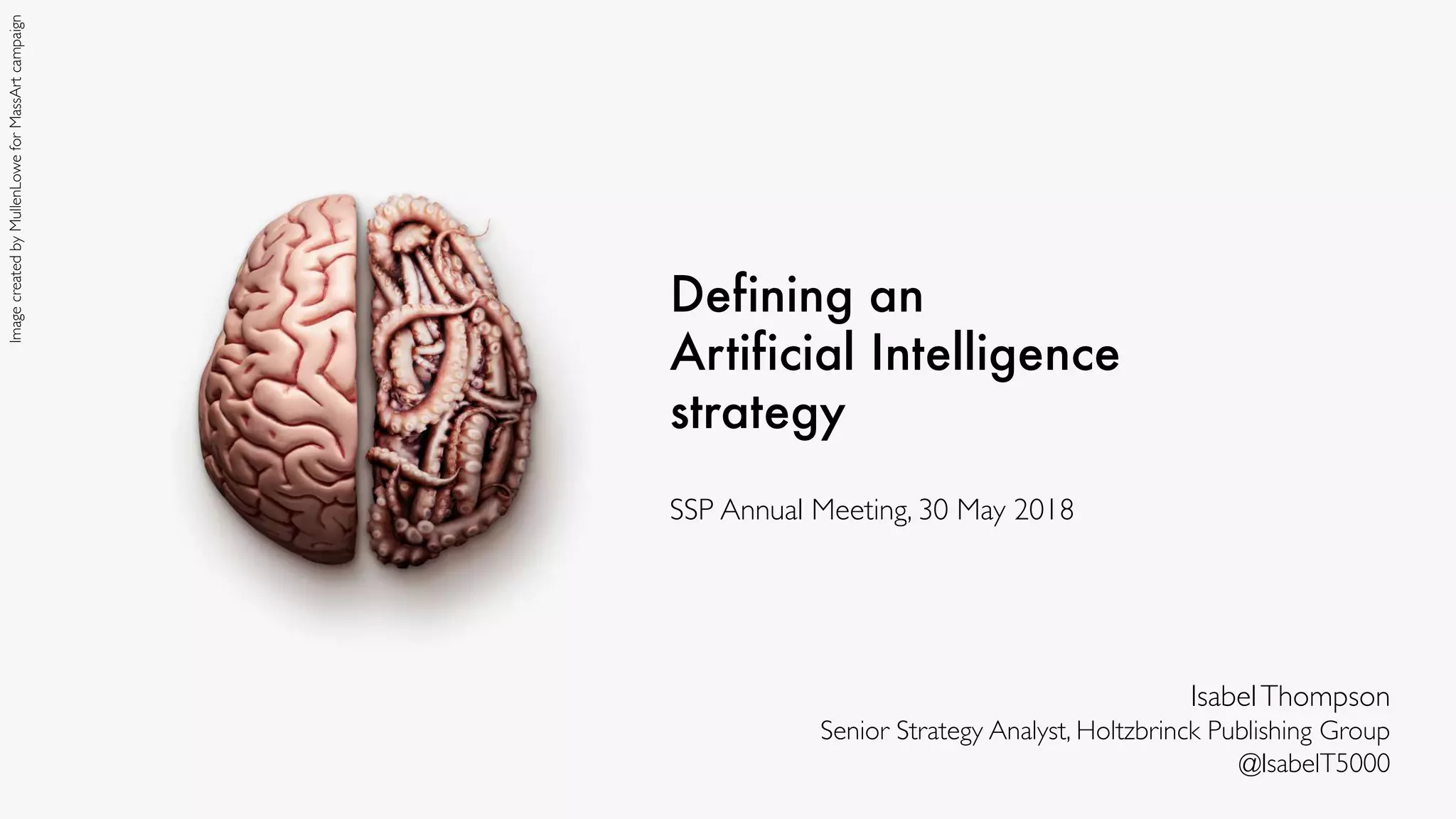
Defining an
Artificial Intelligence
strategy
IsabelThompson
Senior Strategy Analyst, Holtzbrinck Publishing Group
@IsabelT5000
SSP Annual Meeting, 30 May 2018
ImagecreatedbyMullenLoweforMassArtcampaign
@IsabelT5000
Scholarly Communication
doesn’t have an AI problem
@IsabelT5000
Scholarly Communication
doesn’t have an AI problem
It has a strategy problem
@IsabelT5000
Problems
@IsabelT5000
Problems
• Competing investment priorities
@IsabelT5000
Problems
• Competing investment priorities
• Unclear use cases
@IsabelT5000
Problems
• Competing investment priorities
• Unclear use cases
• Unknown ROI
@IsabelT5000
Problems
• Competing investment priorities
• Unclear use cases
• Unknown ROI
• Not enough data
@IsabelT5000
Problems
• Competing investment priorities
• Unclear use cases
• Unknown ROI
• Not enough data
• Poor quality or siloed data
@IsabelT5000
Problems
• Competing investment priorities
• Unclear use cases
• Unknown ROI
• Not enough data
• Poor quality or siloed data
• Un-agile organizational set-ups
@IsabelT5000
Problems
• Competing investment priorities
• Unclear use cases
• Unknown ROI
• Not enough data
• Poor quality or siloed data
• Un-agile organizational set-ups
• A lack of data scientists and tech talent
@IsabelT5000
Outline
@IsabelT5000
Outline
1. What is AI?
@IsabelT5000
Outline
1. What is AI?
2. What can it do?
@IsabelT5000
Outline
1. What is AI?
2. What can it do?
3. What should I do?
@IsabelT5000
1. What is AI?
@IsabelT5000
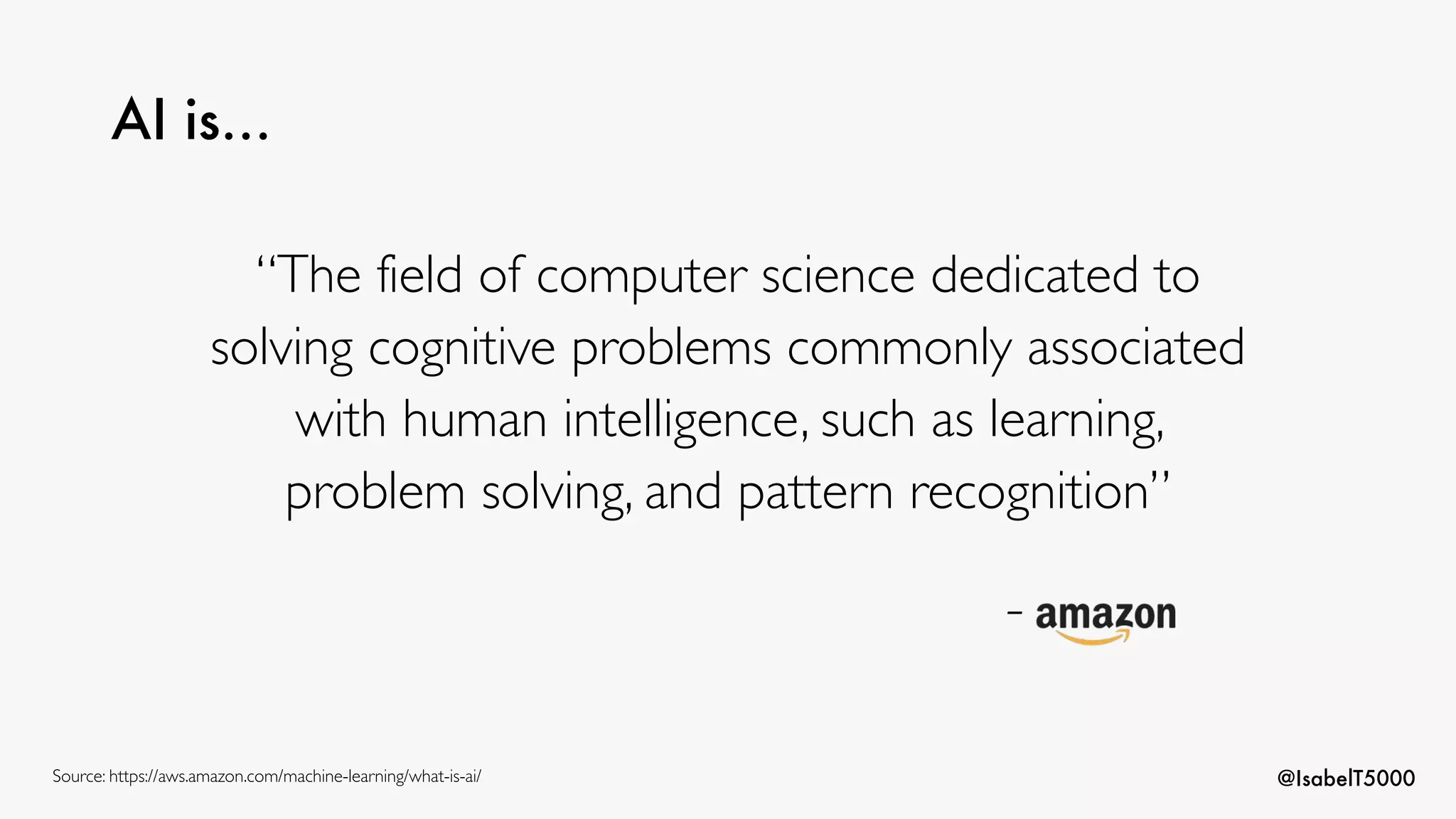
AI is…
“The field of computer science dedicated to
solving cognitive problems commonly associated
with human intelligence, such as learning,
problem solving, and pattern recognition”
-
Source: https://aws.amazon.com/machine-learning/what-is-ai/
@IsabelT5000
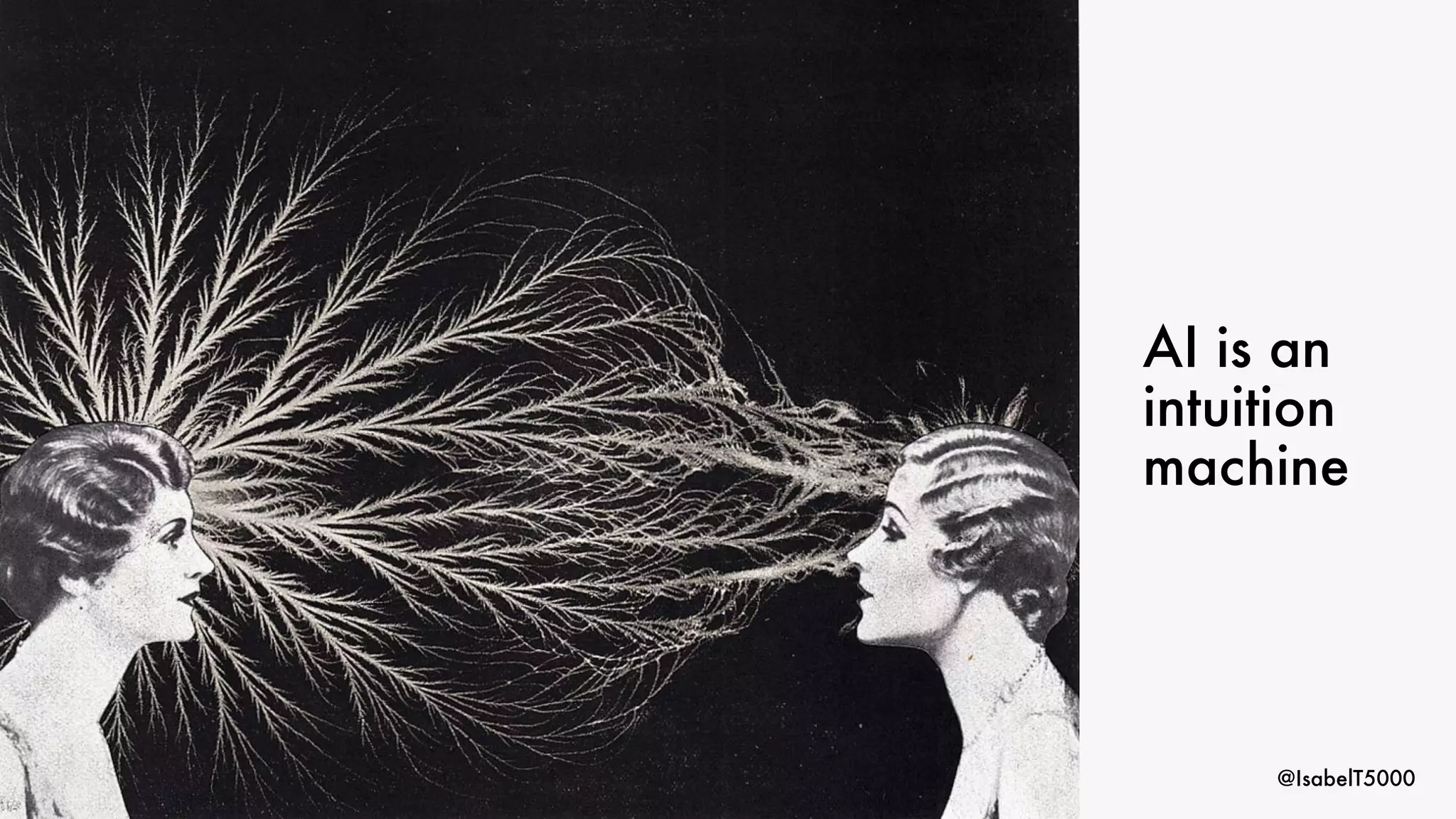
AI is an
intuition
machine
@IsabelT5000
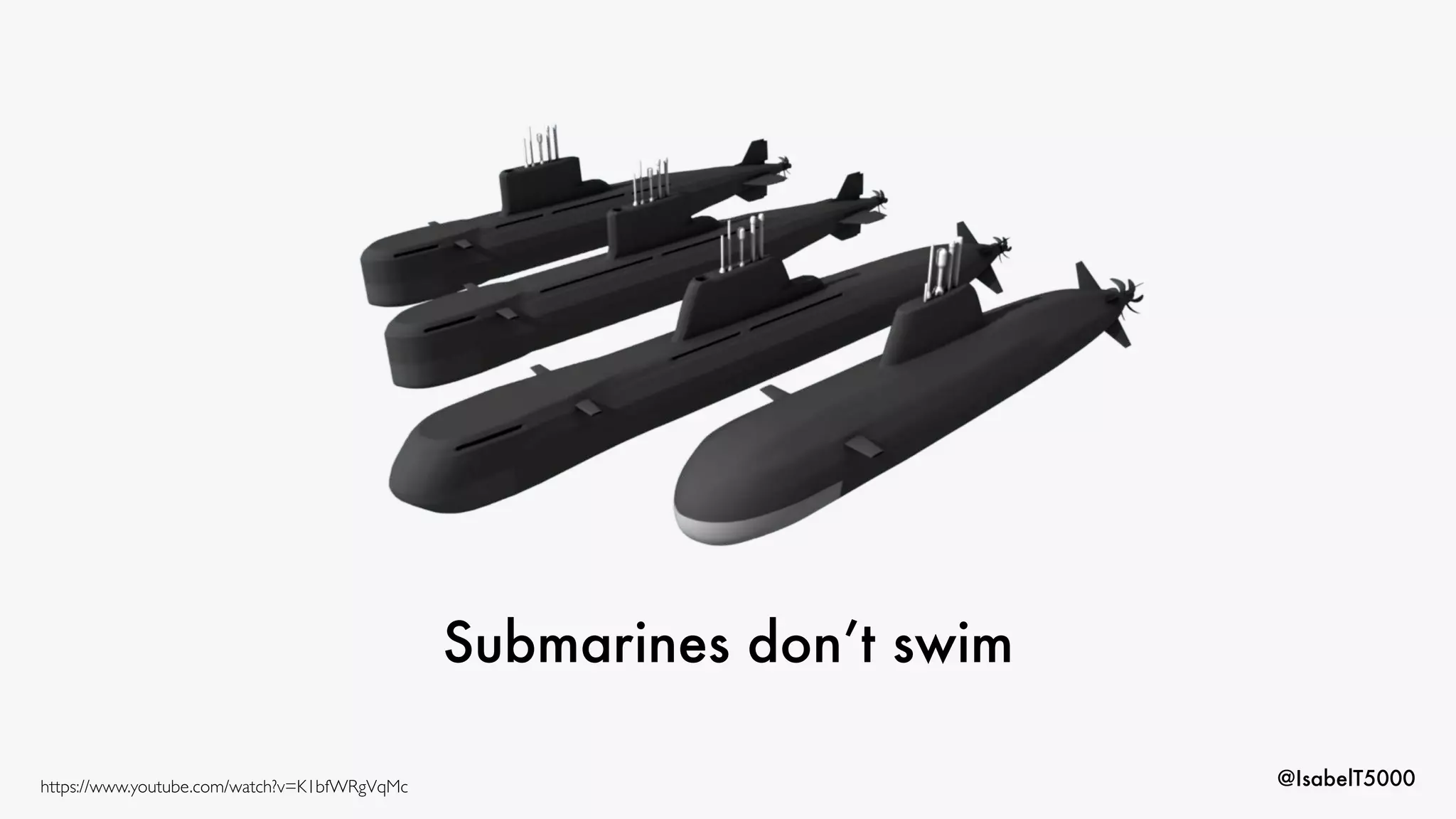
Submarines don’t swim
https://www.youtube.com/watch?v=K1bfWRgVqMc
@IsabelT5000
2. What can it do?
@IsabelT5000
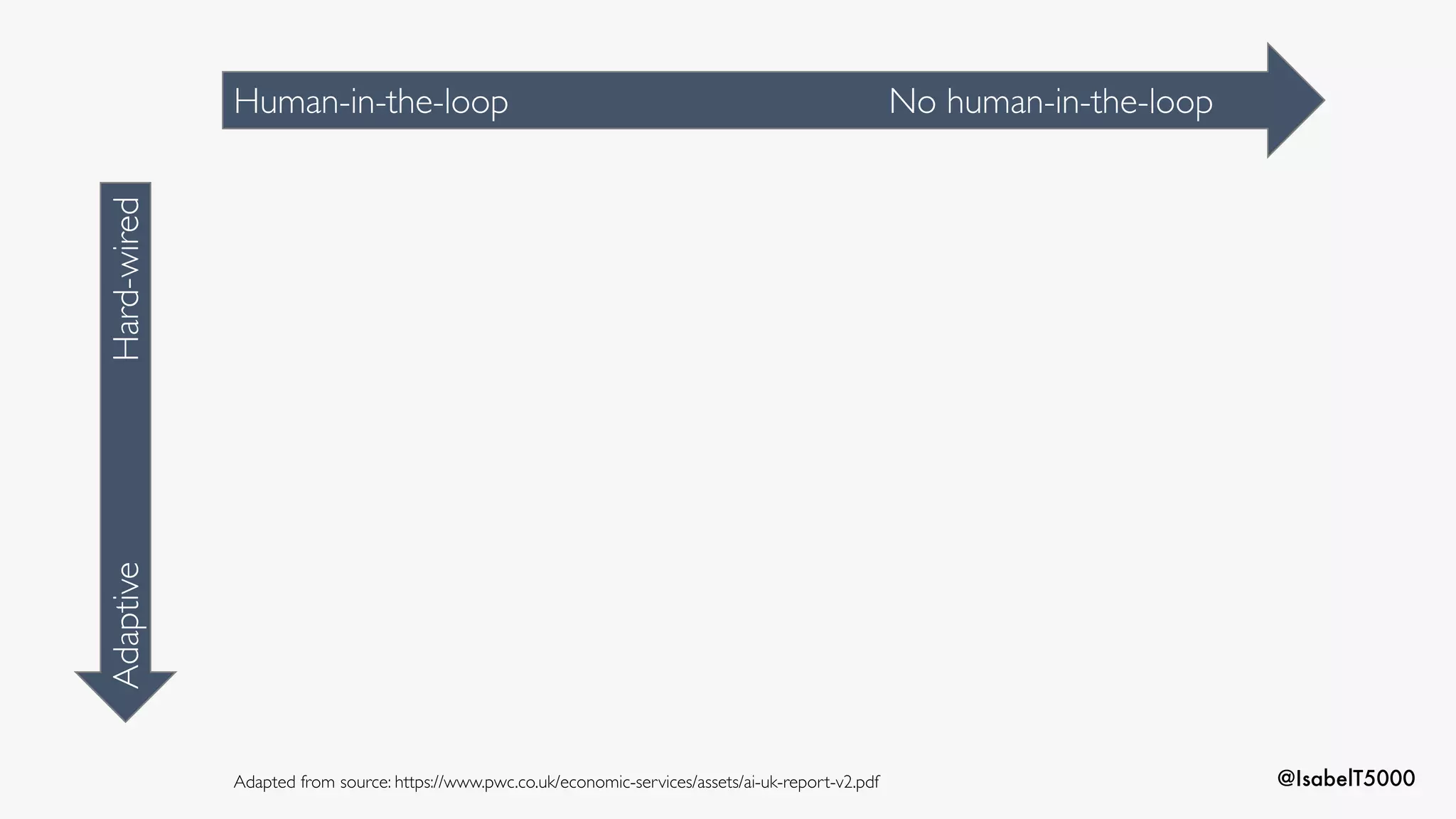
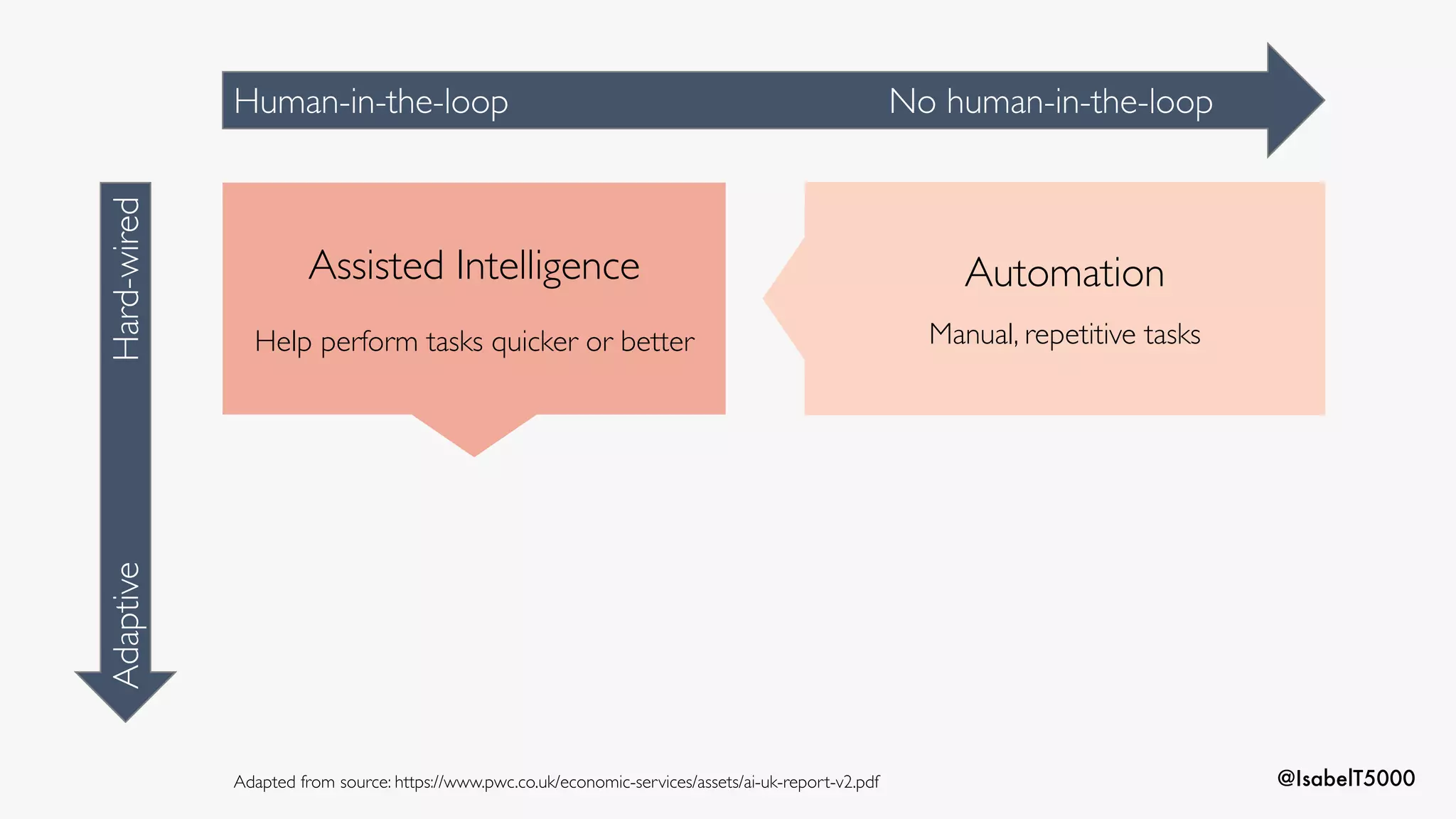
Human-in-the-loop No human-in-the-loop
AdaptiveHard-wired
Adapted from source: https://www.pwc.co.uk/economic-services/assets/ai-uk-report-v2.pdf
@IsabelT5000
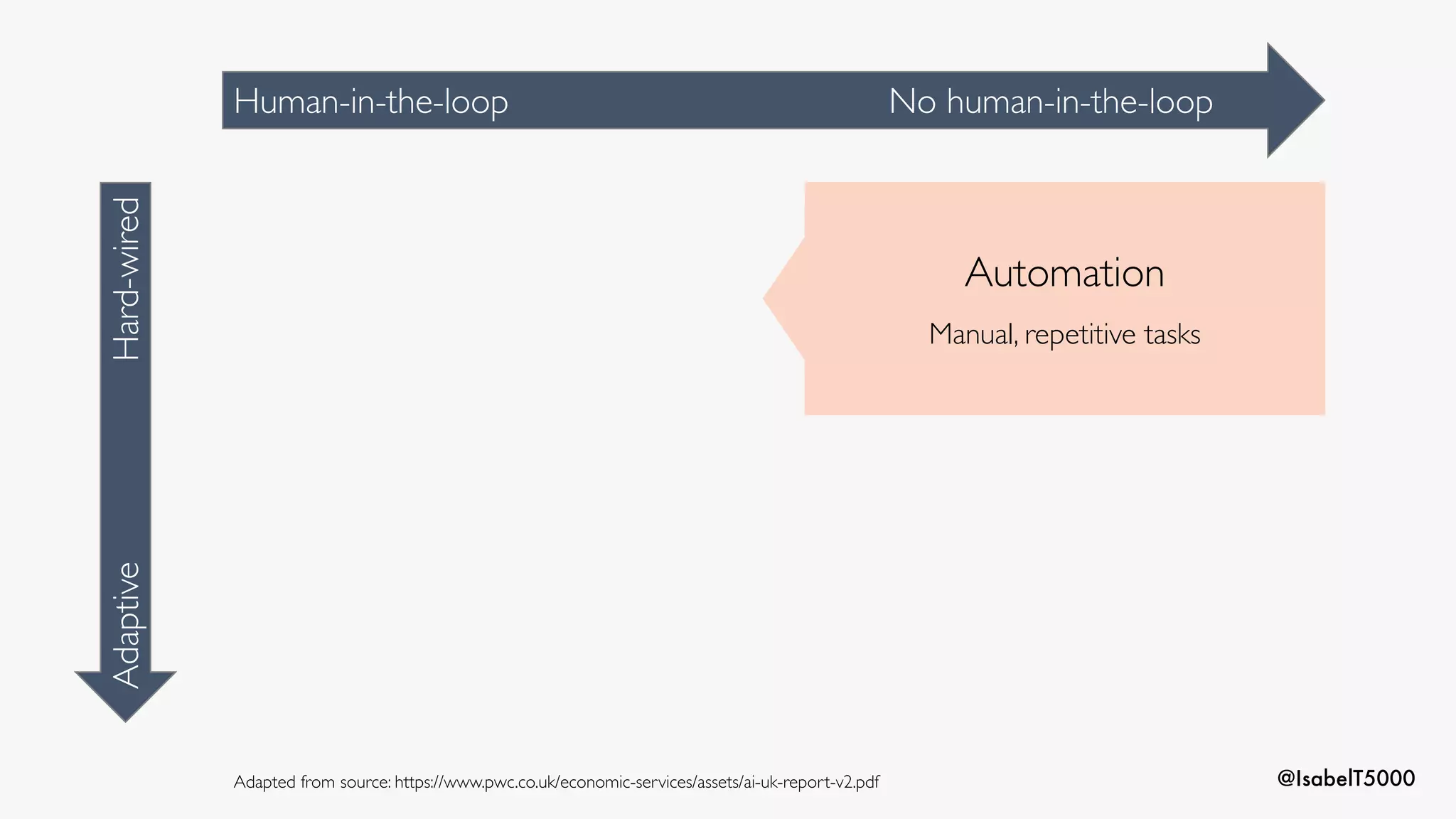
Automation
Manual, repetitive tasks
Human-in-the-loop No human-in-the-loop
AdaptiveHard-wired
Adapted from source: https://www.pwc.co.uk/economic-services/assets/ai-uk-report-v2.pdf
@IsabelT5000
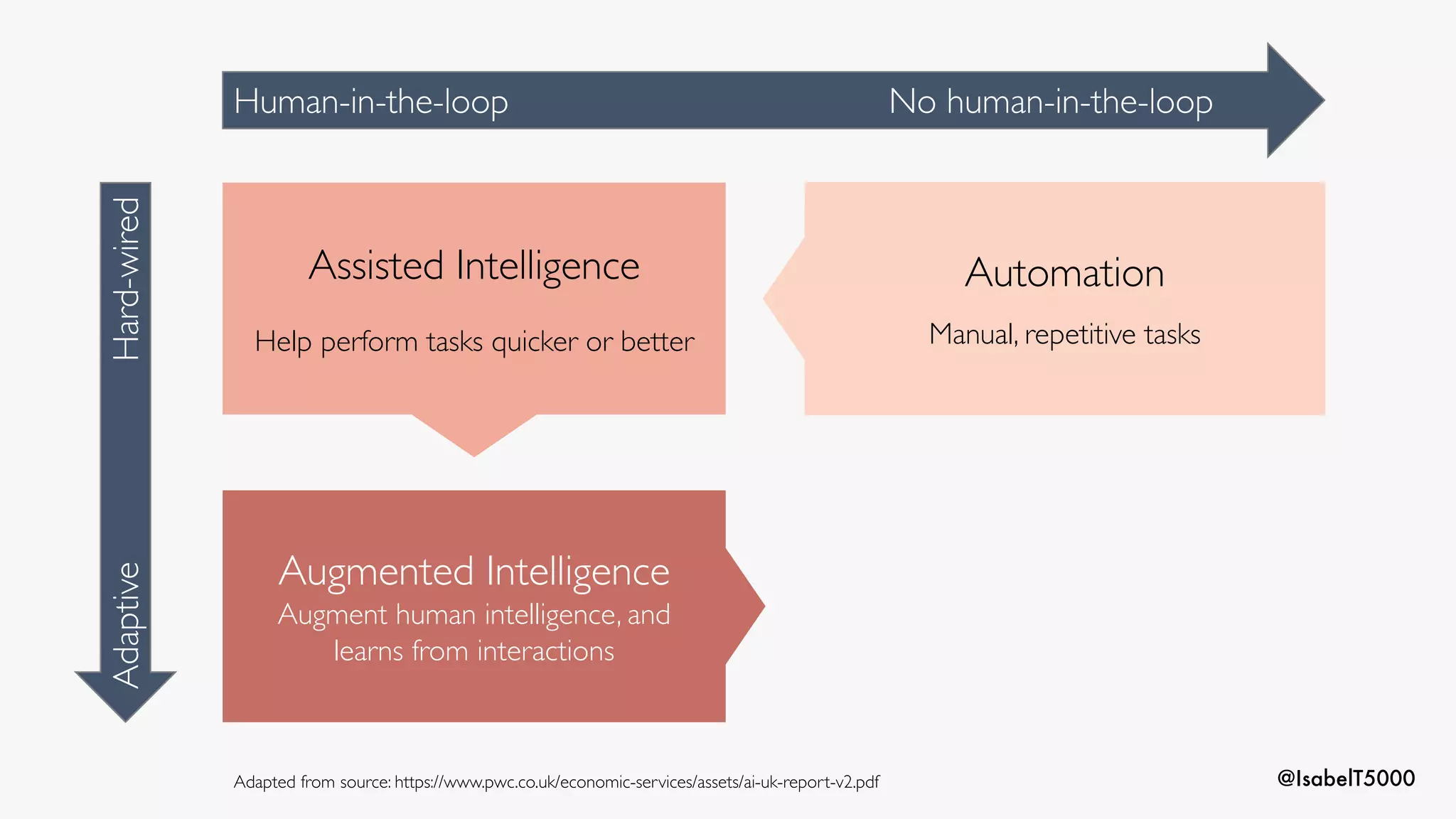
Assisted Intelligence
Help perform tasks quicker or better
Automation
Manual, repetitive tasks
Human-in-the-loop No human-in-the-loop
AdaptiveHard-wired
Adapted from source: https://www.pwc.co.uk/economic-services/assets/ai-uk-report-v2.pdf
@IsabelT5000
Assisted Intelligence
Help perform tasks quicker or better
Augmented Intelligence
Augment human intelligence, and
learns from interactions
Automation
Manual, repetitive tasks
Human-in-the-loop No human-in-the-loop
AdaptiveHard-wired
Adapted from source: https://www.pwc.co.uk/economic-services/assets/ai-uk-report-v2.pdf
@IsabelT5000
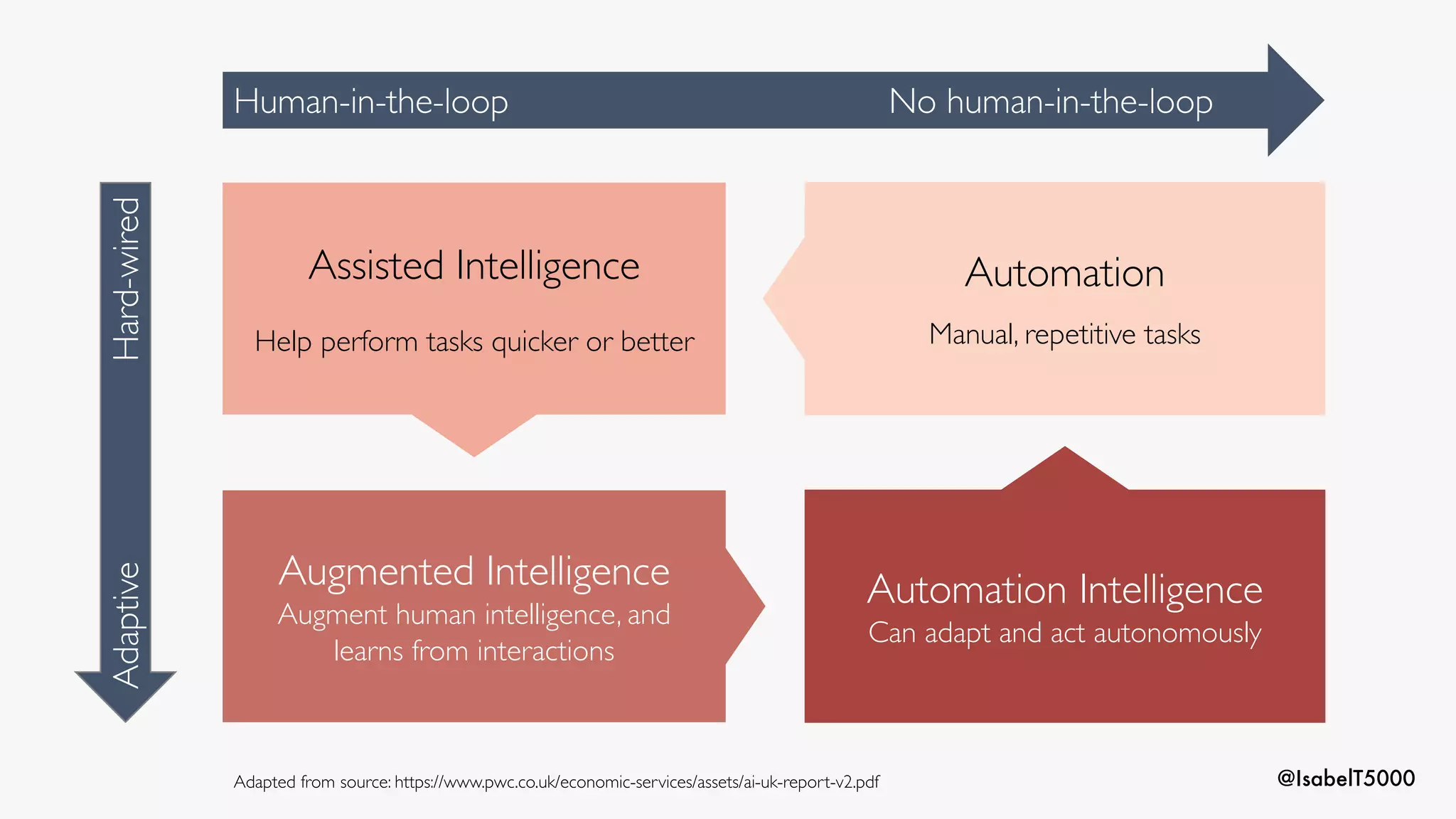
Assisted Intelligence
Help perform tasks quicker or better
Automation Intelligence
Can adapt and act autonomously
Augmented Intelligence
Augment human intelligence, and
learns from interactions
Automation
Manual, repetitive tasks
Human-in-the-loop No human-in-the-loop
AdaptiveHard-wired
Adapted from source: https://www.pwc.co.uk/economic-services/assets/ai-uk-report-v2.pdf
@IsabelT5000
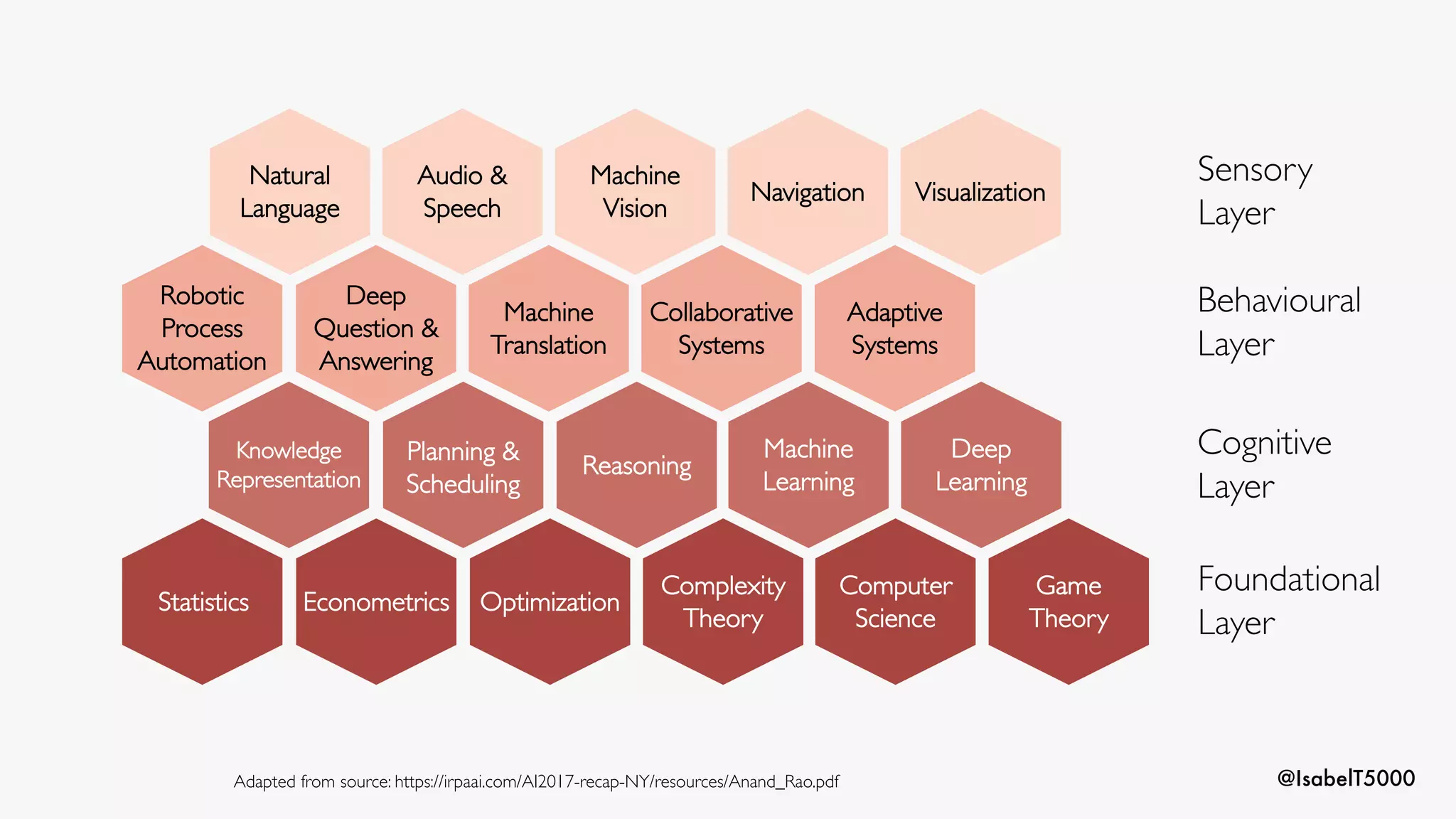
Complexity
Theory
Computer
Science
OptimizationEconometricsStatistics
Deep
Learning
Knowledge
Representation
Robotic
Process
Automation
Deep
Question &
Answering
Machine
Translation
Collaborative
Systems
Adaptive
Systems
VisualizationNavigation
Machine
Vision
Audio &
Speech
Natural
Language
Game
Theory
Planning &
Scheduling
Reasoning
Machine
Learning
Sensory
Layer
Behavioural
Layer
Cognitive
Layer
Foundational
Layer
Adapted from source: https://irpaai.com/AI2017-recap-NY/resources/Anand_Rao.pdf
@IsabelT5000
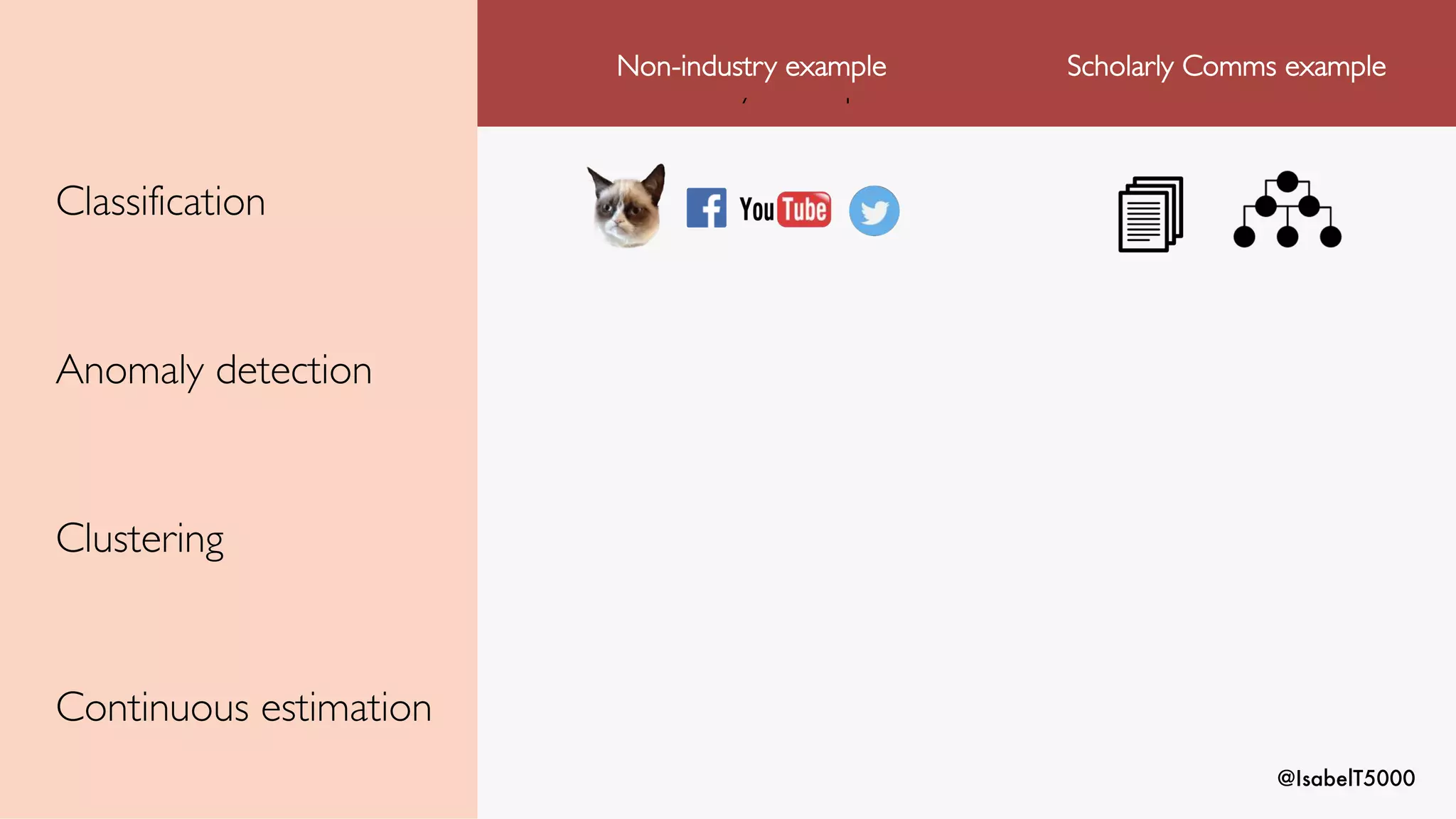
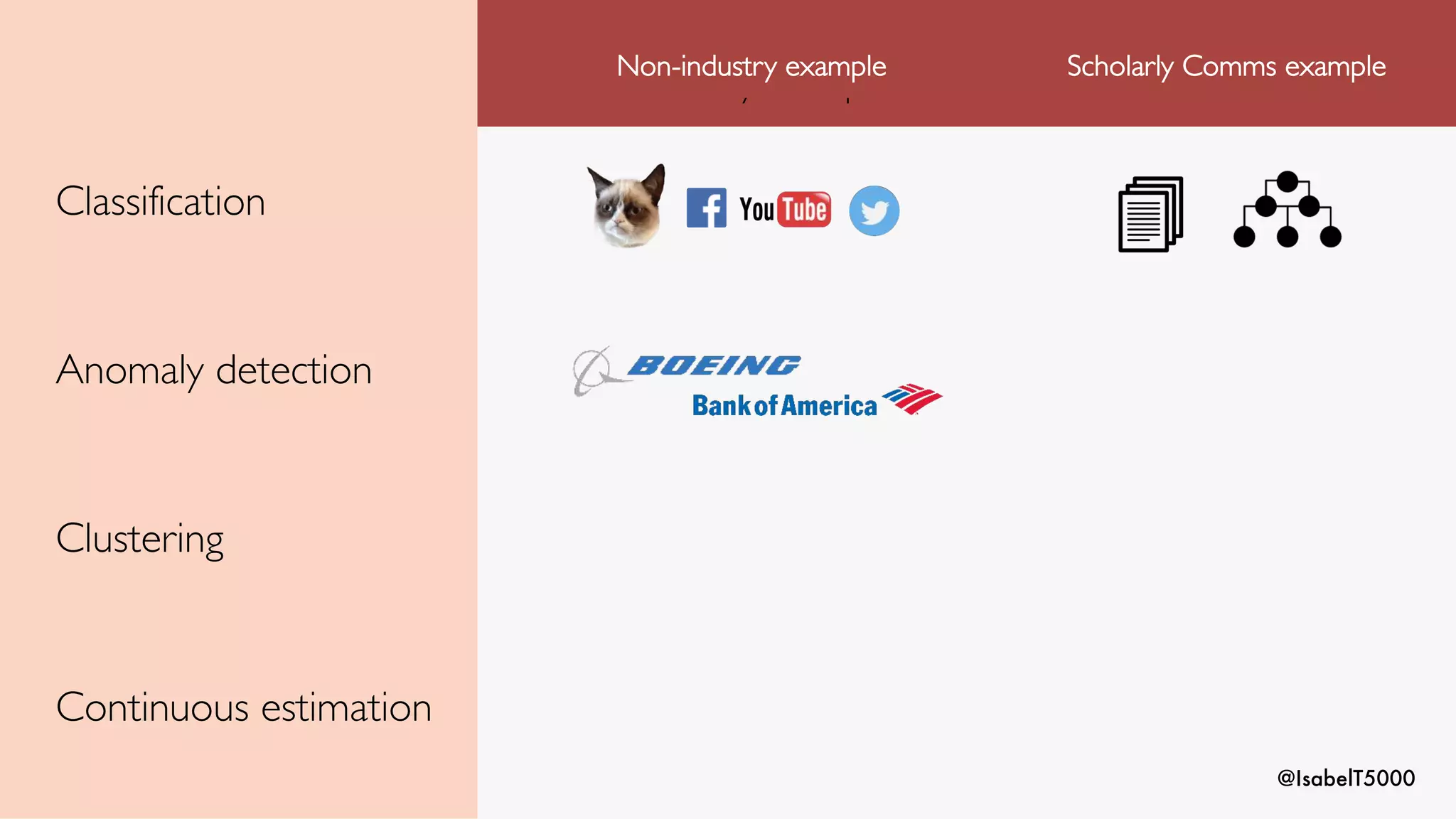
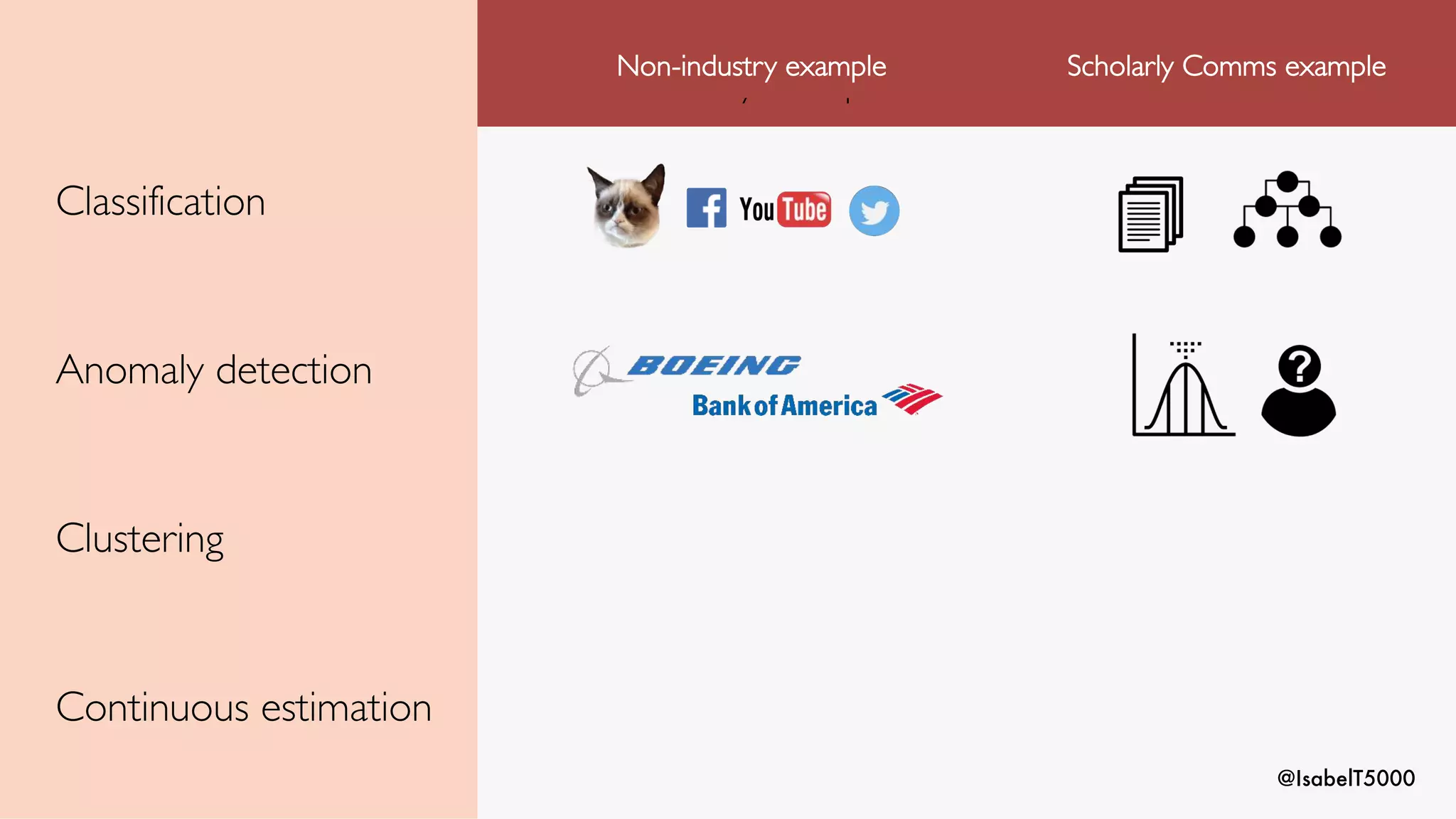
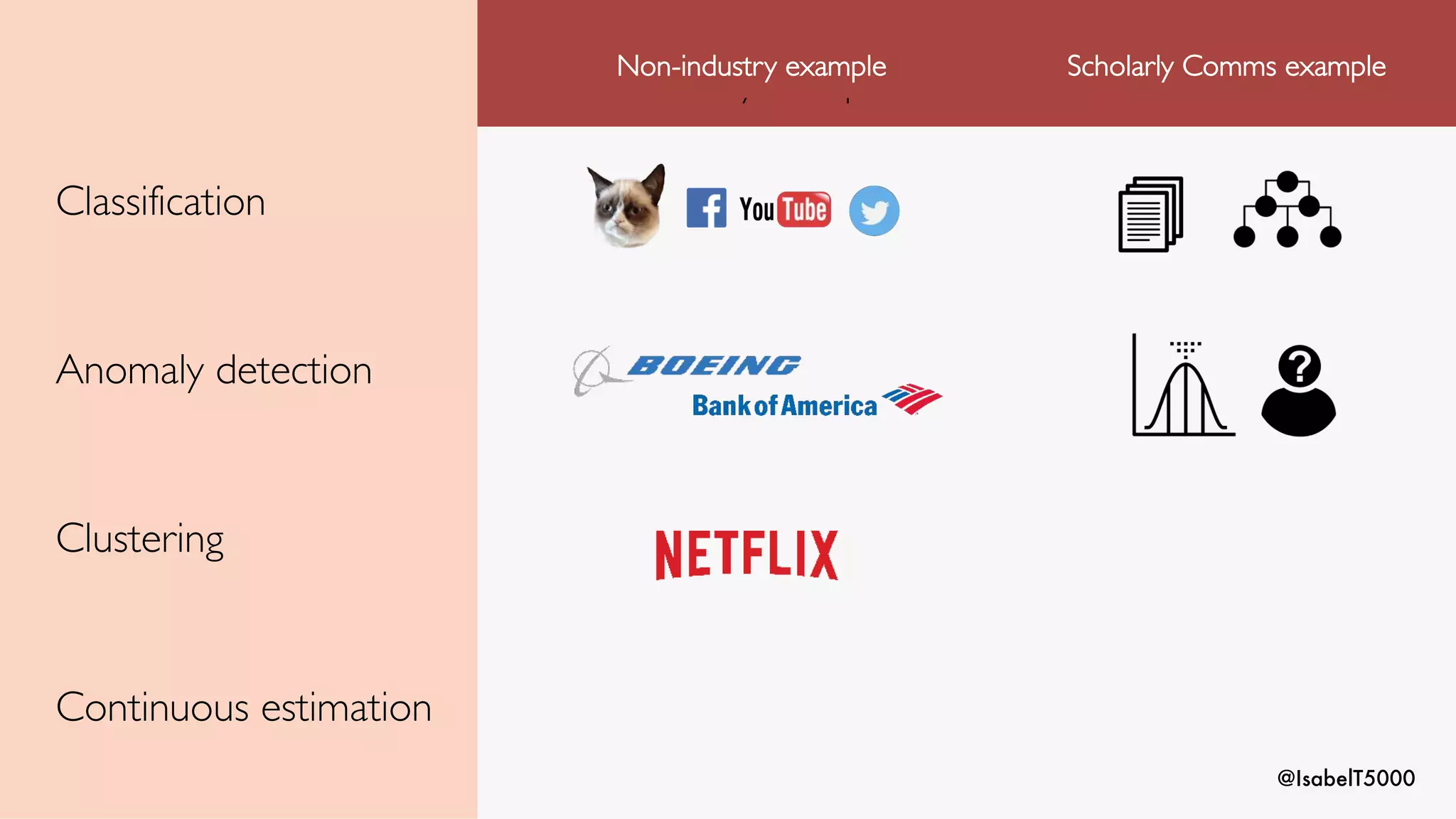
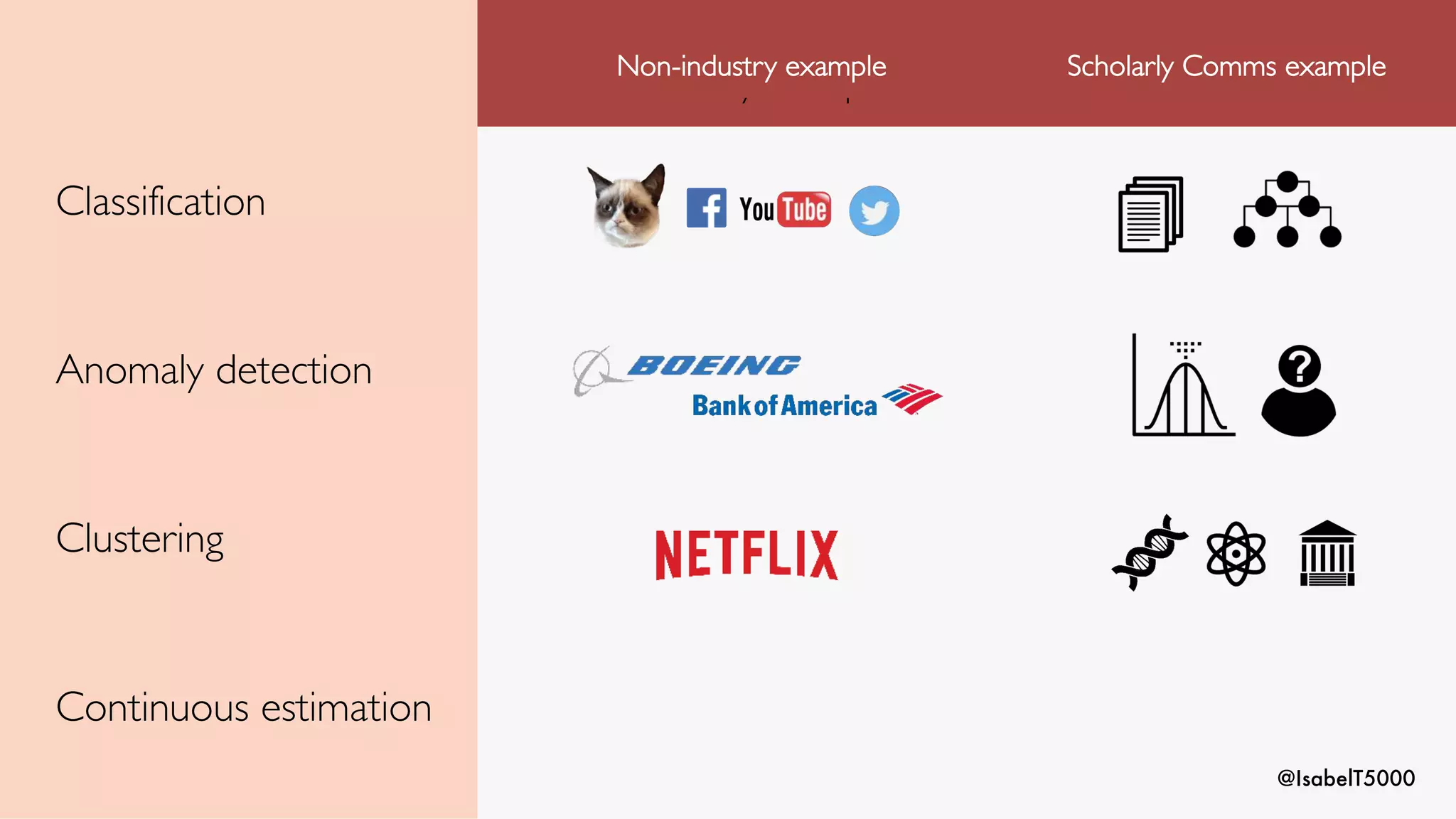
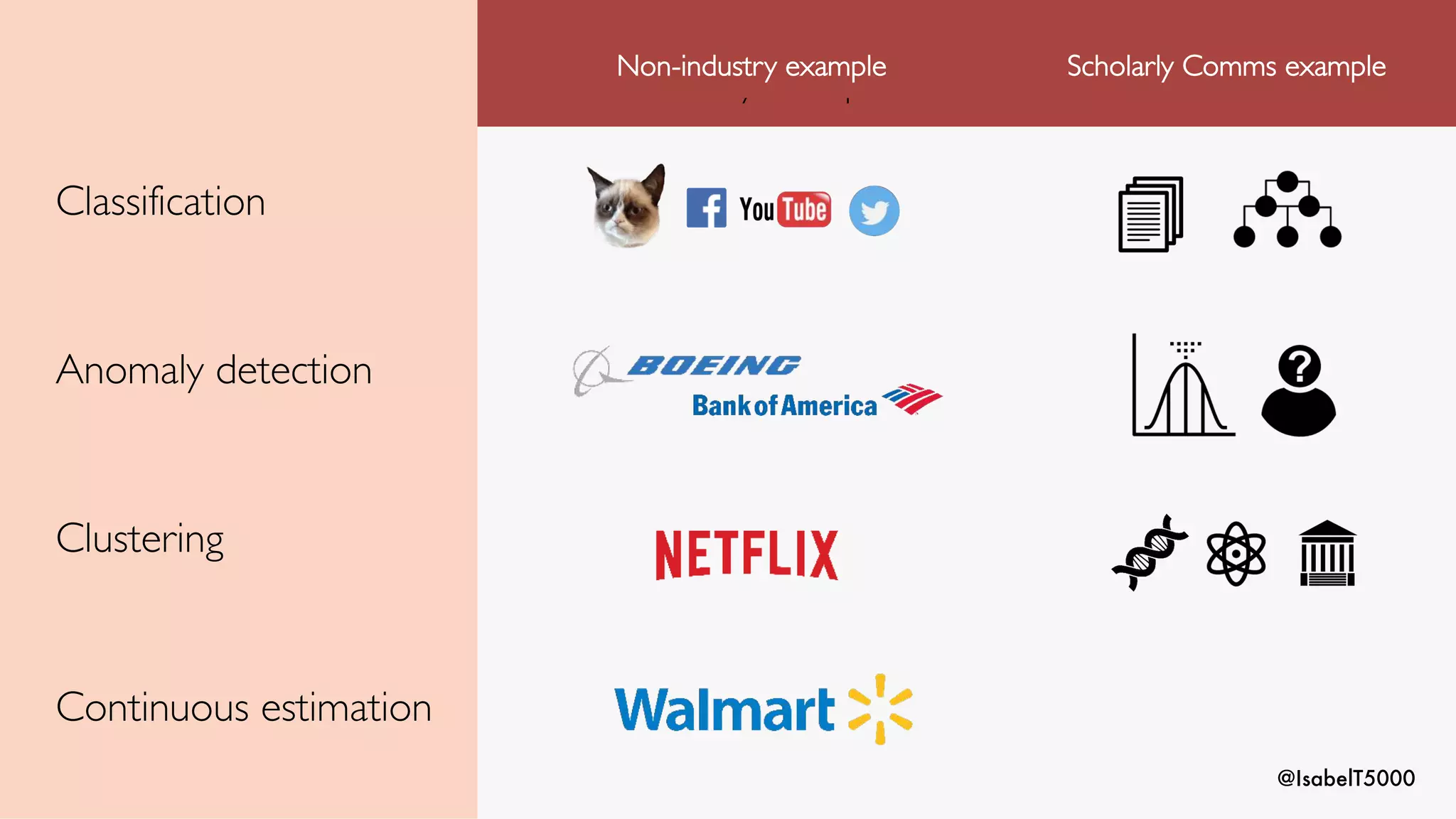
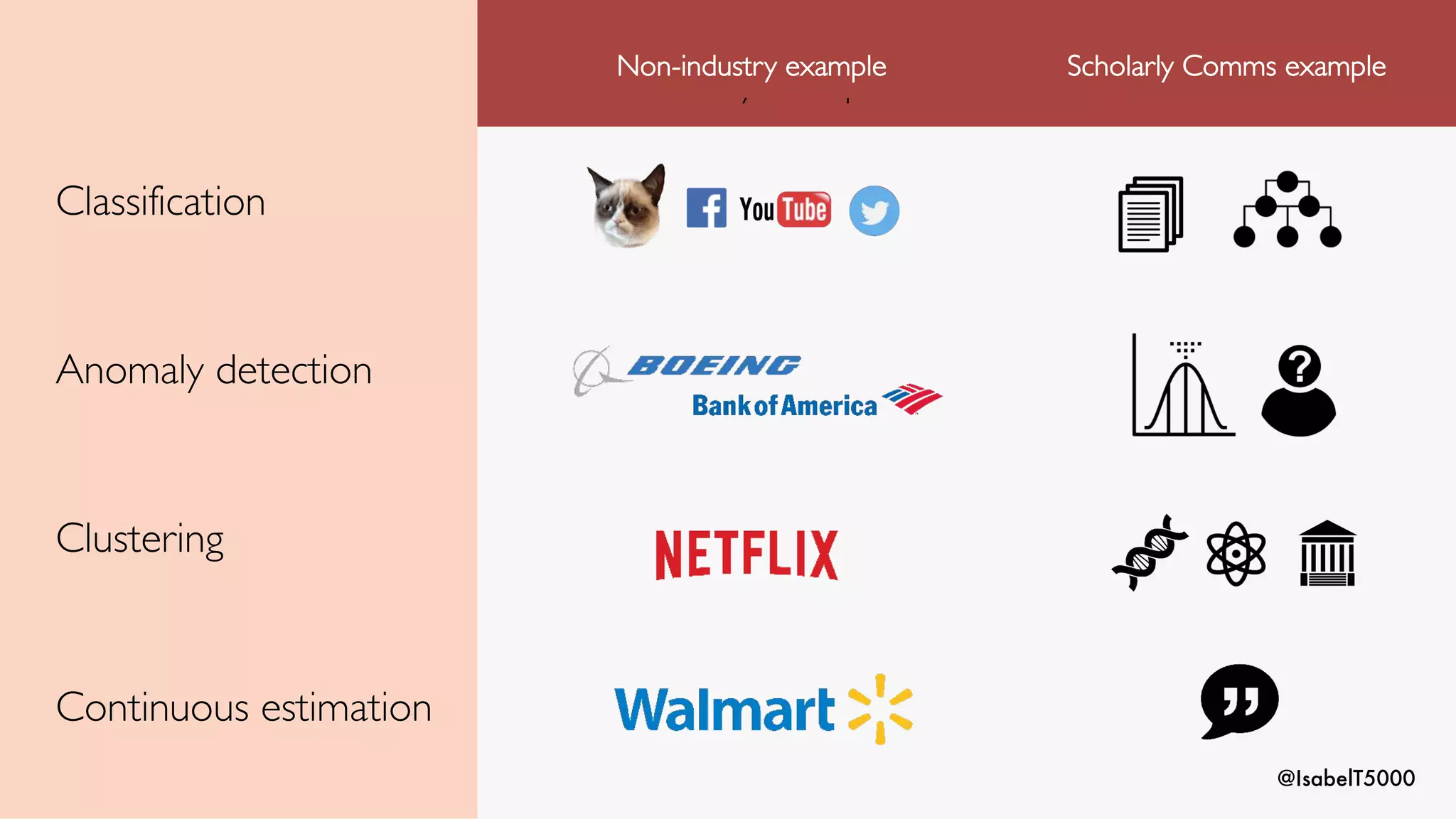
Classification
Anomaly detection
Clustering
Continuous estimation
Non-industry example
Non-industry example Scholarly Comms example
@IsabelT5000
Classification
Anomaly detection
Clustering
Continuous estimation
Non-industry example
Non-industry example Scholarly Comms example
@IsabelT5000
Classification
Anomaly detection
Clustering
Continuous estimation
Non-industry example
Non-industry example Scholarly Comms example
@IsabelT5000
Classification
Anomaly detection
Clustering
Continuous estimation
Non-industry example
Non-industry example Scholarly Comms example
@IsabelT5000
Classification
Anomaly detection
Clustering
Continuous estimation
Non-industry example
Non-industry example Scholarly Comms example
@IsabelT5000
Classification
Anomaly detection
Clustering
Continuous estimation
Non-industry example
Non-industry example Scholarly Comms example
@IsabelT5000
Classification
Anomaly detection
Clustering
Continuous estimation
Non-industry example
Non-industry example Scholarly Comms example
@IsabelT5000
Classification
Anomaly detection
Clustering
Continuous estimation
Non-industry example
Non-industry example Scholarly Comms example
@IsabelT5000
Classification
Anomaly detection
Clustering
Continuous estimation
Non-industry example
Non-industry example Scholarly Comms example
@IsabelT5000
Classification
Anomaly detection
Clustering
Continuous estimation
Non-industry example
Non-industry example Scholarly Comms example
@IsabelT5000
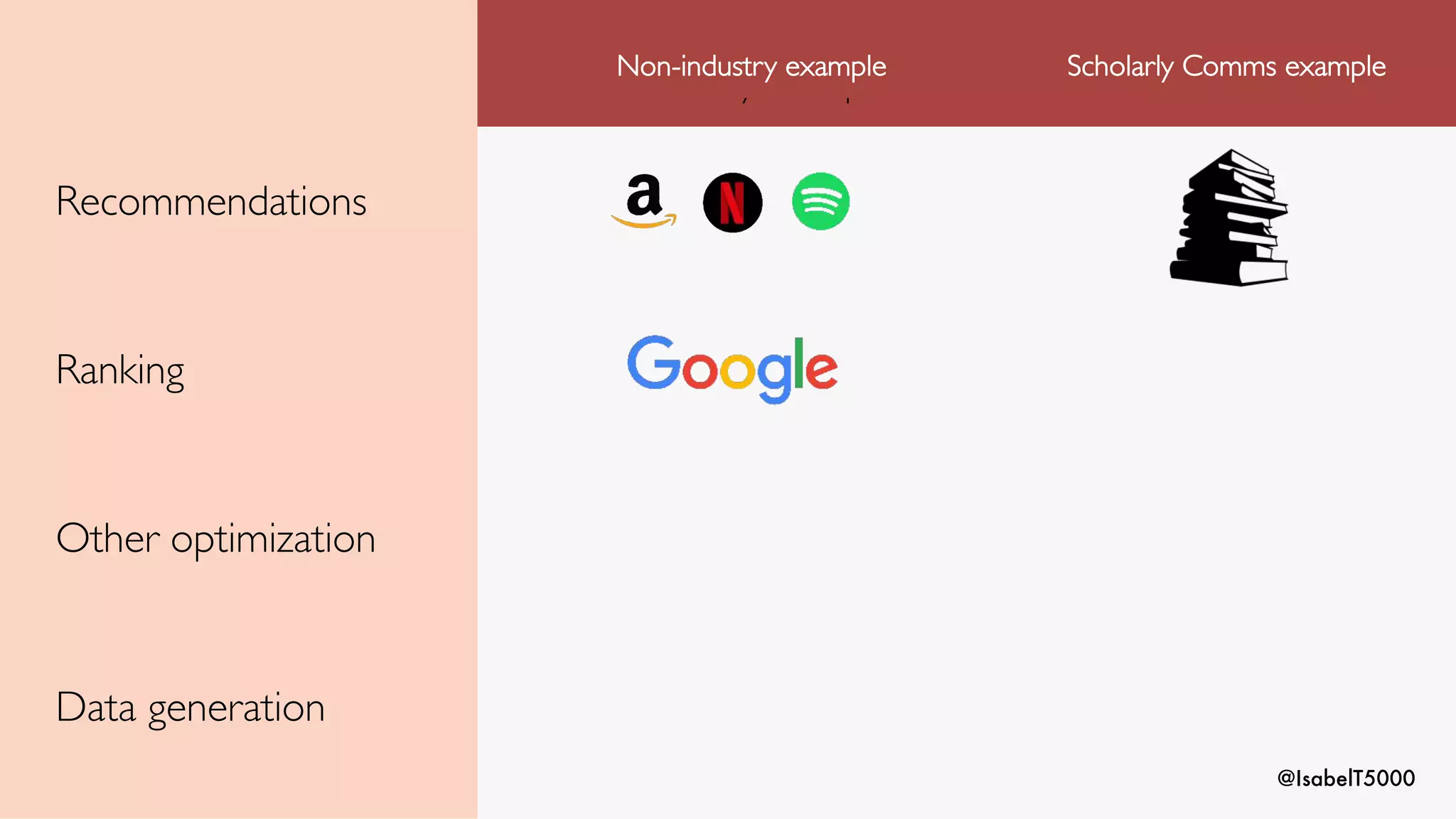
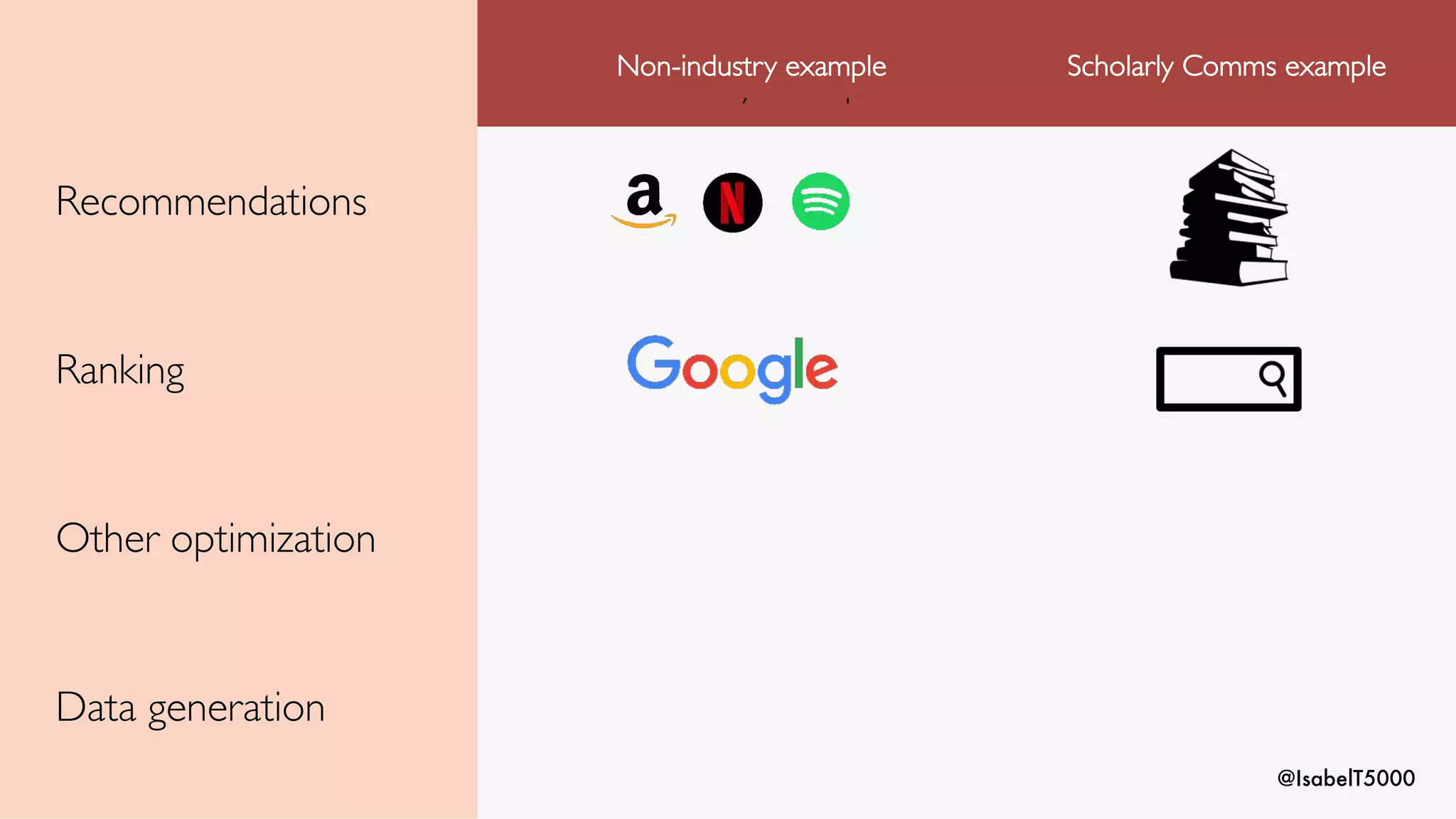
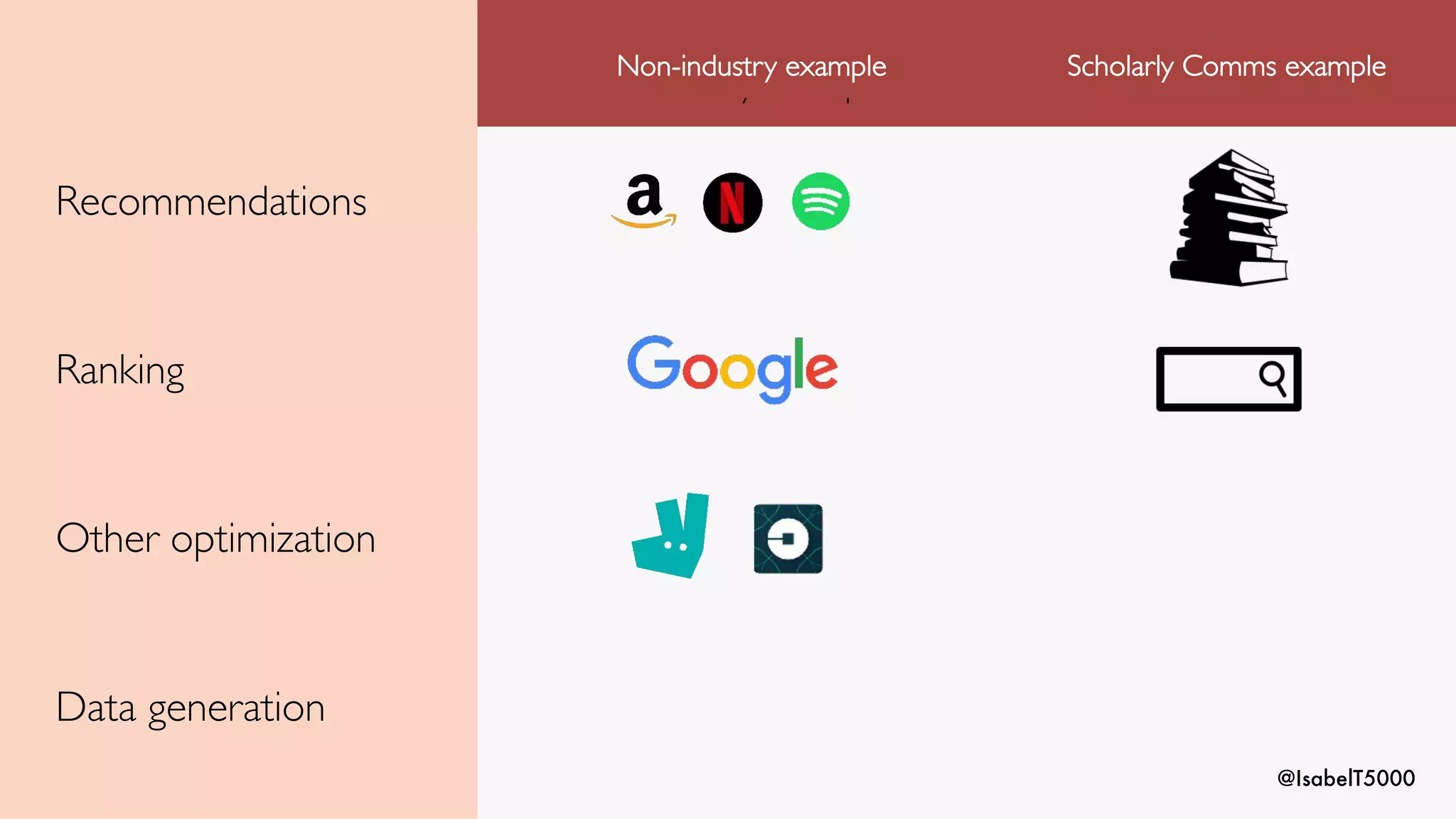
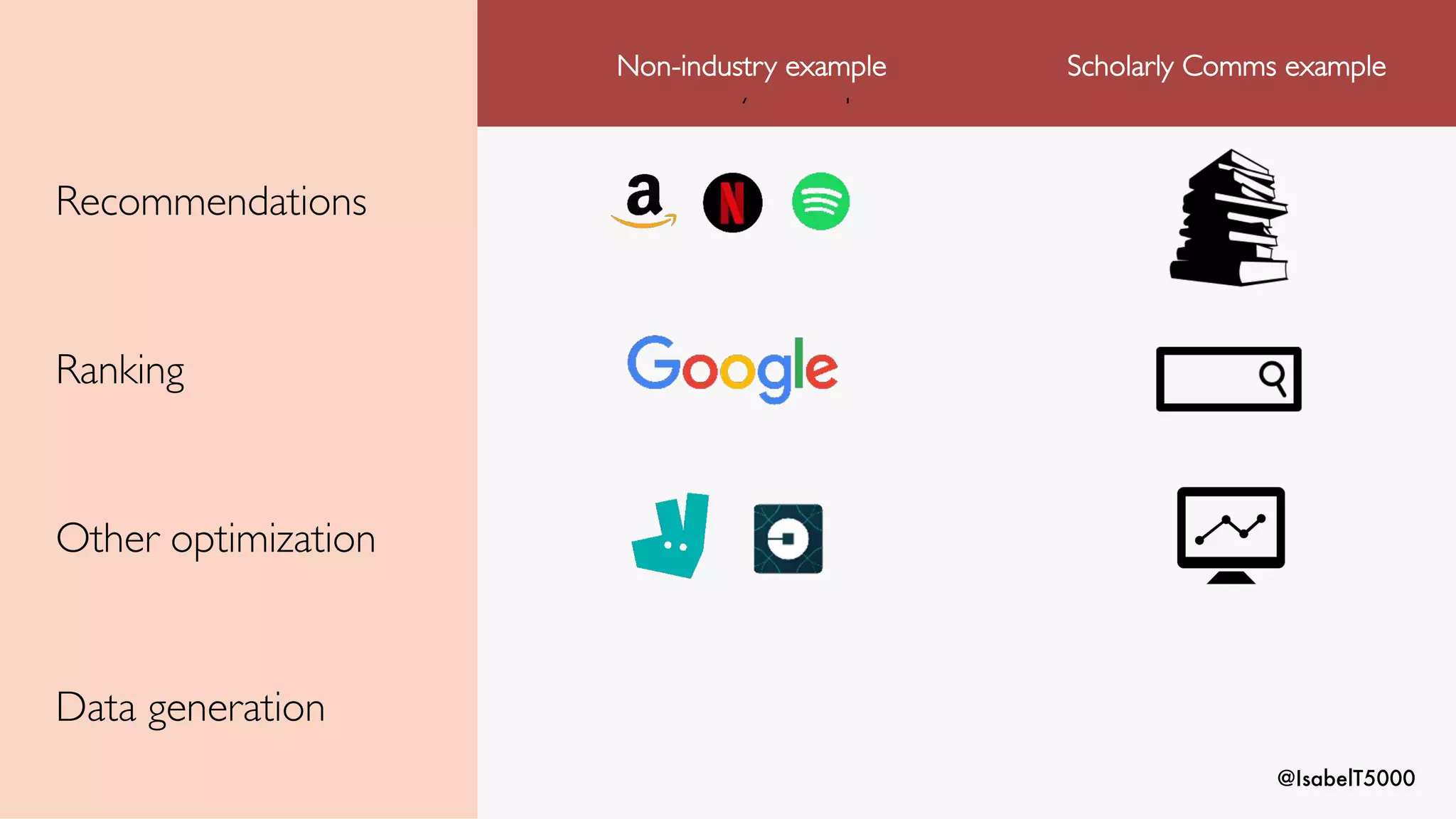
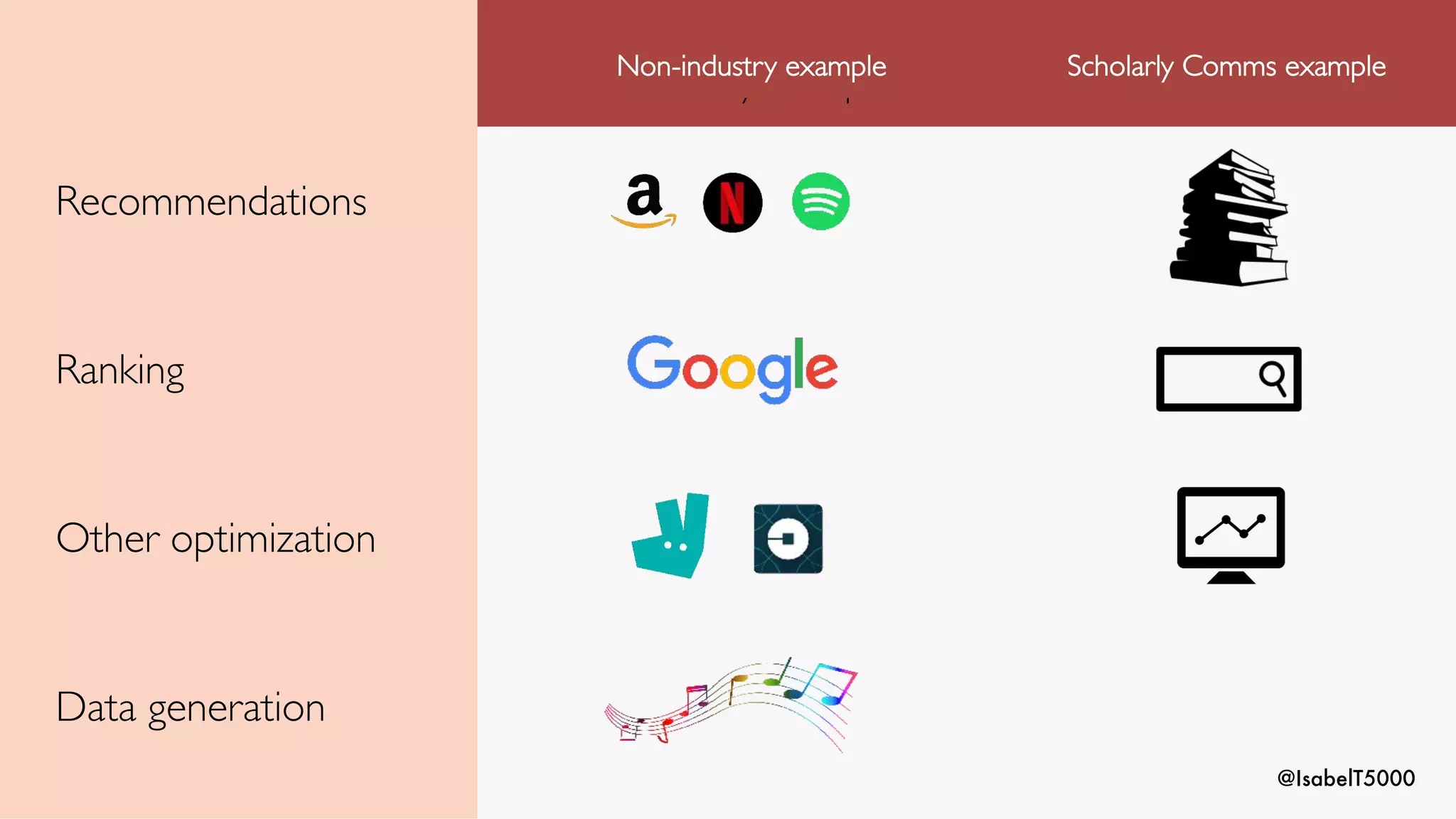
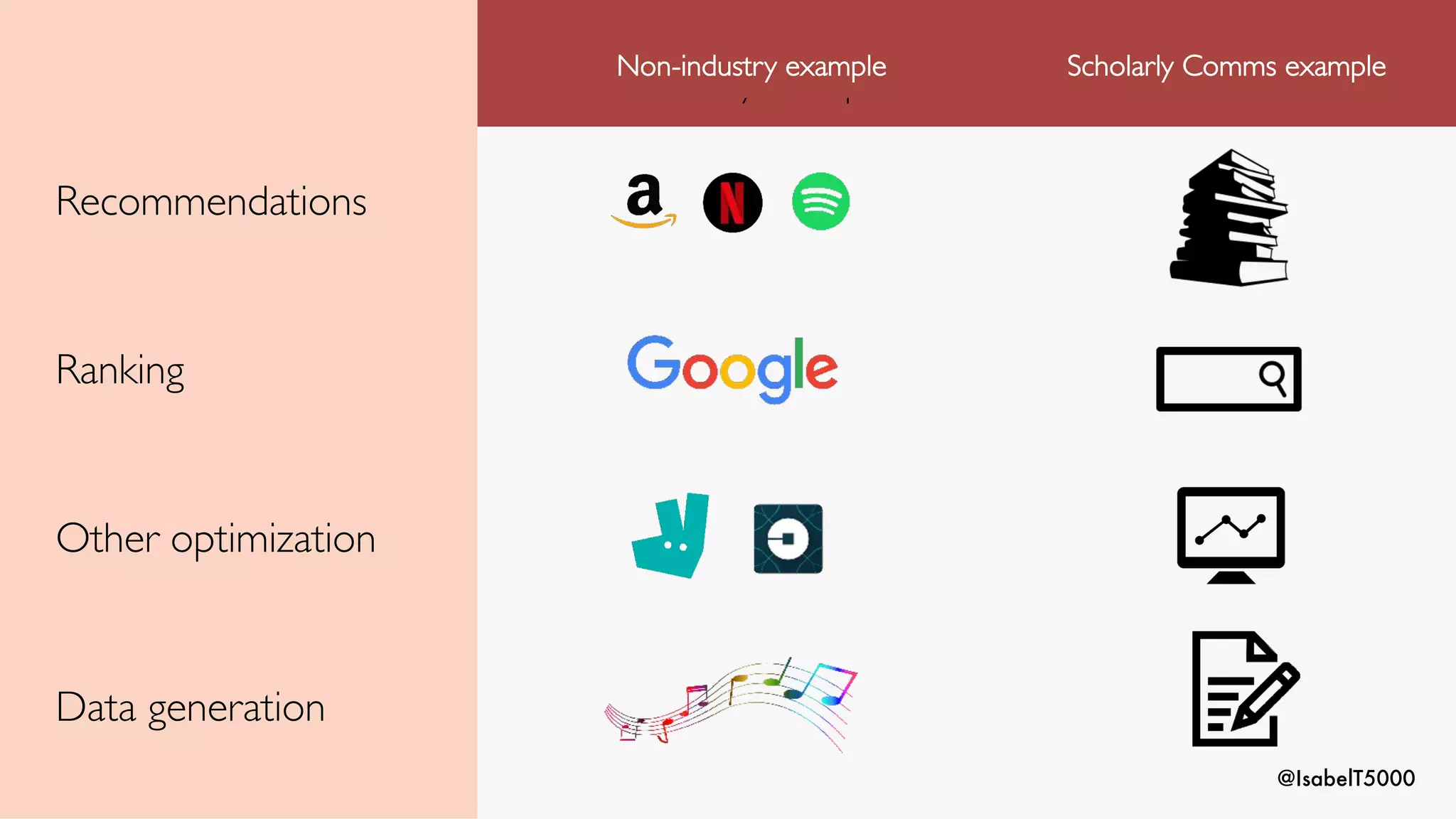
Non-industry example
Non-industry example Scholarly Comms example
Recommendations
Ranking
Other optimization
Data generation
@IsabelT5000
Non-industry example
Non-industry example Scholarly Comms example
Recommendations
Ranking
Other optimization
Data generation
@IsabelT5000
Non-industry example
Non-industry example Scholarly Comms example
Recommendations
Ranking
Other optimization
Data generation
@IsabelT5000
Non-industry example
Non-industry example Scholarly Comms example
Recommendations
Ranking
Other optimization
Data generation
@IsabelT5000
Non-industry example
Non-industry example Scholarly Comms example
Recommendations
Ranking
Other optimization
Data generation
@IsabelT5000
Non-industry example
Non-industry example Scholarly Comms example
Recommendations
Ranking
Other optimization
Data generation
@IsabelT5000
Non-industry example
Non-industry example Scholarly Comms example
Recommendations
Ranking
Other optimization
Data generation
@IsabelT5000
Non-industry example
Non-industry example Scholarly Comms example
Recommendations
Ranking
Other optimization
Data generation
@IsabelT5000
Non-industry example
Non-industry example Scholarly Comms example
Recommendations
Ranking
Other optimization
Data generation
@IsabelT5000
3. What should I do?
@IsabelT5000
Don’t invest in AI!
@IsabelT5000
Don’t invest in AI!
Invest in a business problem
@IsabelT5000
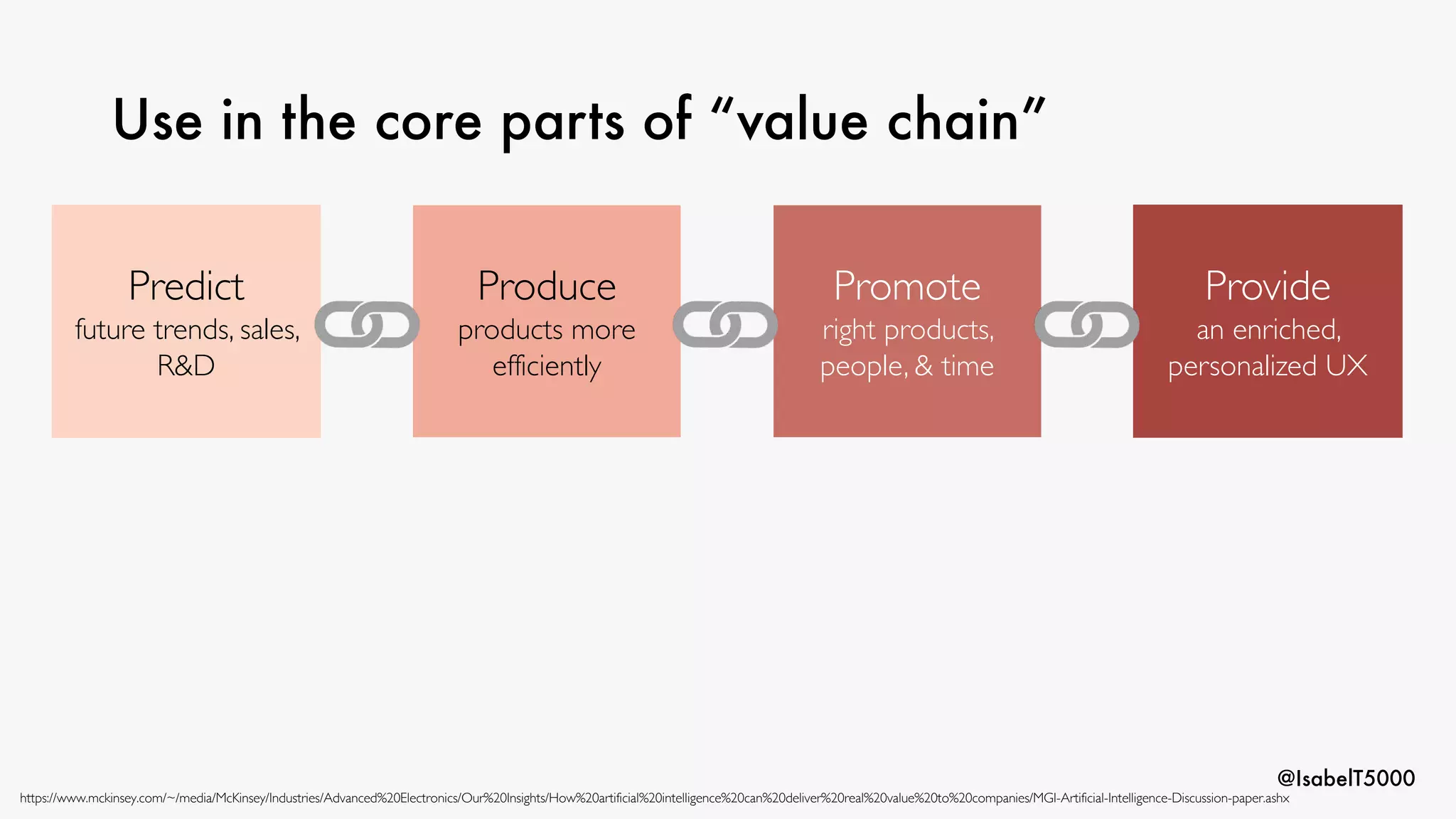
Use in the core parts of “value chain”
@IsabelT5000
Use in the core parts of “value chain”
Produce
products more
efficiently
Provide
an enriched,
personalized UX
Promote
right products,
people, & time
Predict
future trends, sales,
R&D
https://www.mckinsey.com/~/media/McKinsey/Industries/Advanced%20Electronics/Our%20Insights/How%20artificial%20intelligence%20can%20deliver%20real%20value%20to%20companies/MGI-Artificial-Intelligence-Discussion-paper.ashx
@IsabelT5000
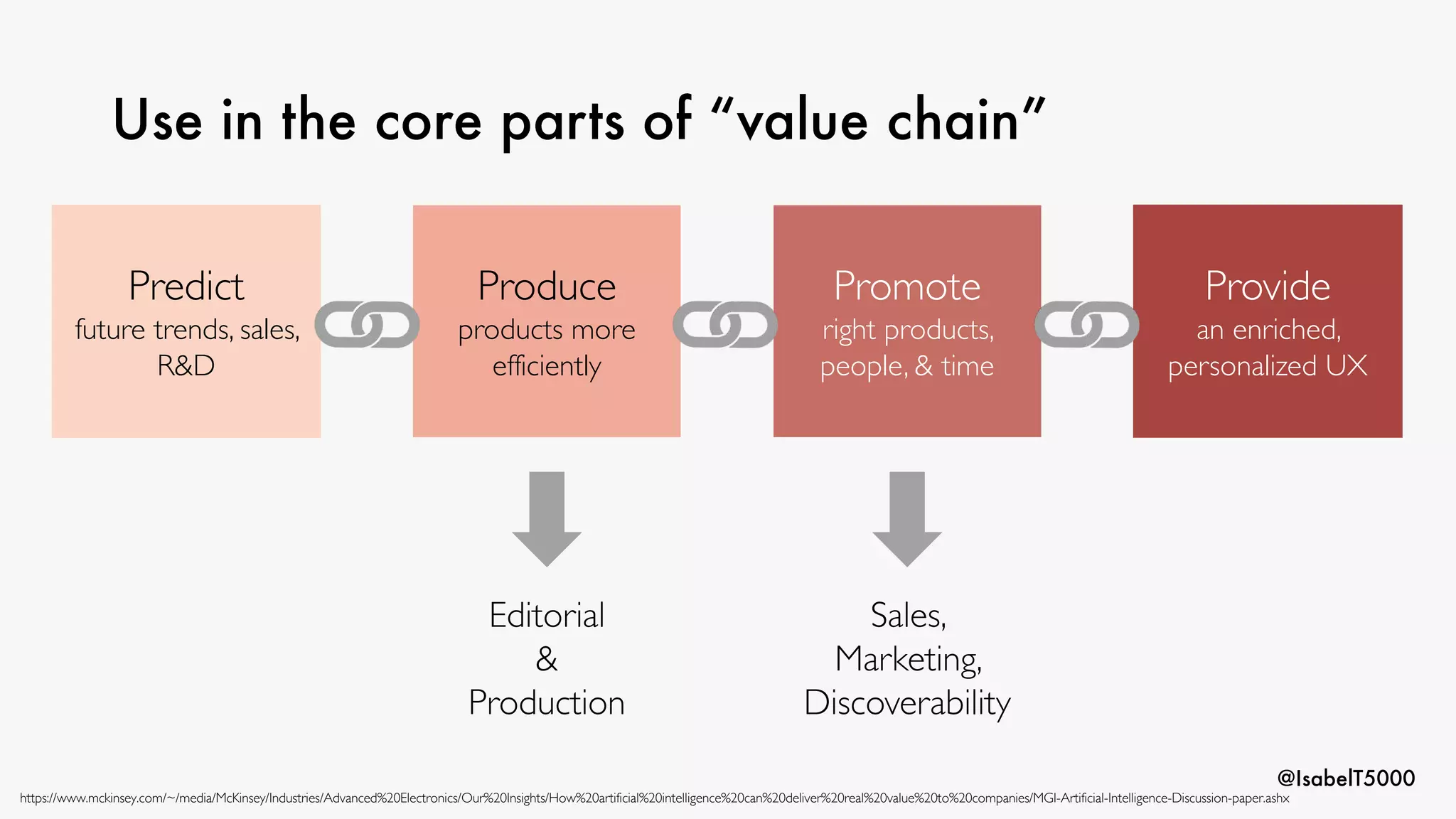
Use in the core parts of “value chain”
Produce
products more
efficiently
Provide
an enriched,
personalized UX
Promote
right products,
people, & time
Predict
future trends, sales,
R&D
Editorial
&
Production
Sales,
Marketing,
Discoverability
https://www.mckinsey.com/~/media/McKinsey/Industries/Advanced%20Electronics/Our%20Insights/How%20artificial%20intelligence%20can%20deliver%20real%20value%20to%20companies/MGI-Artificial-Intelligence-Discussion-paper.ashx
@IsabelT5000
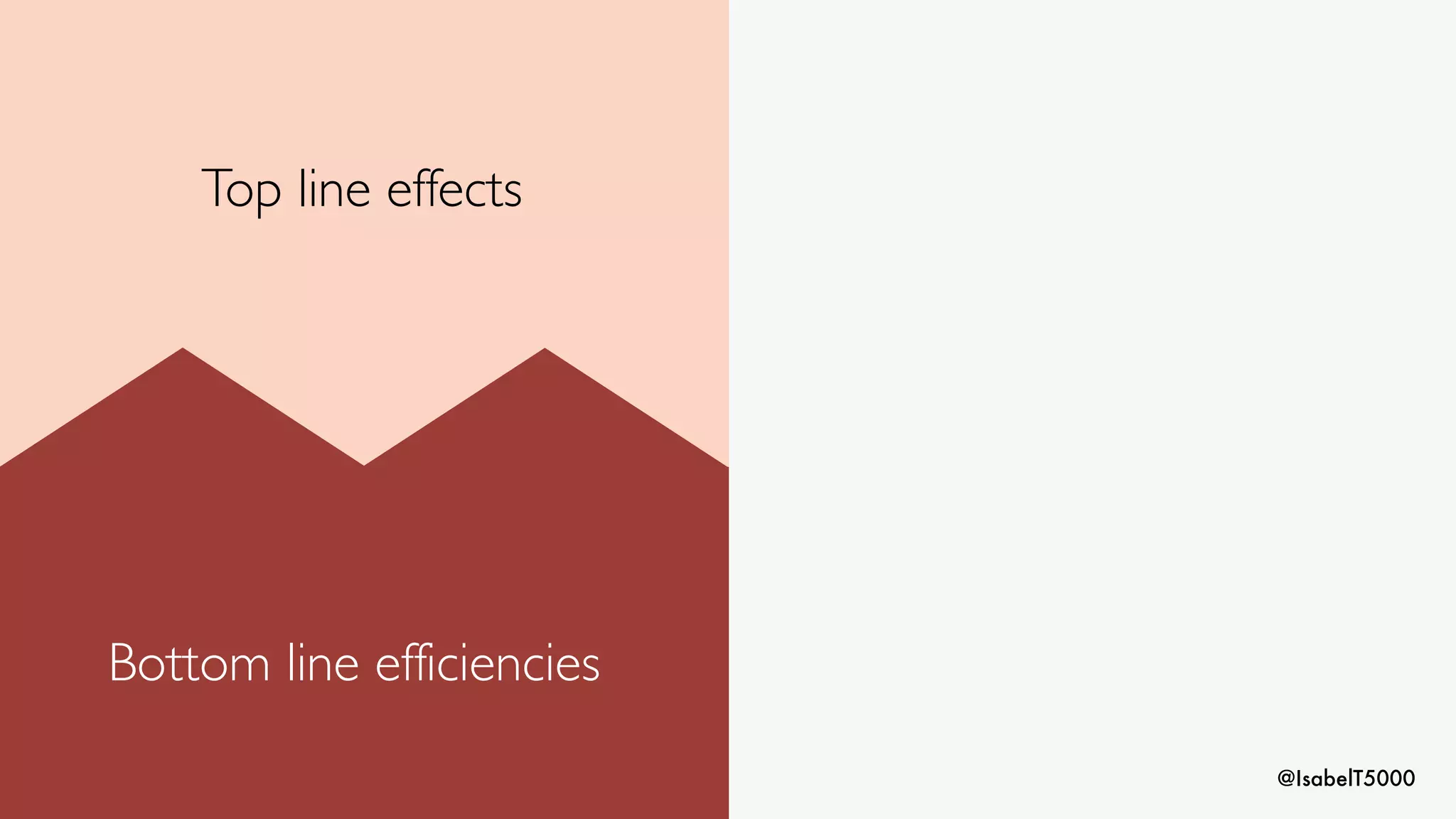
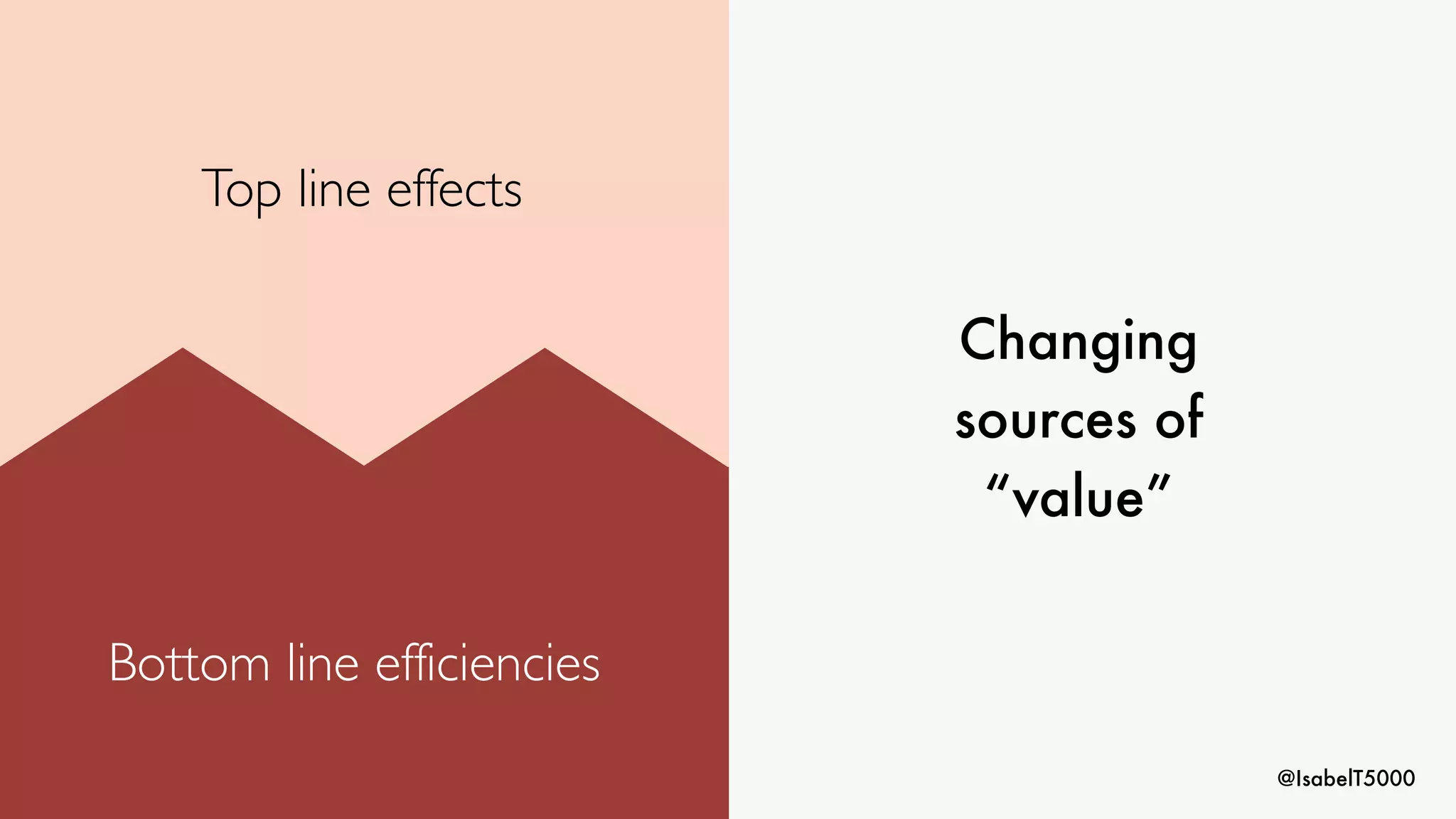
Top line effects
Bottom line efficiencies
@IsabelT5000
Top line effects
Bottom line efficiencies
Changing
sources of
“value”
@IsabelT5000
Competitive advantage
@IsabelT5000
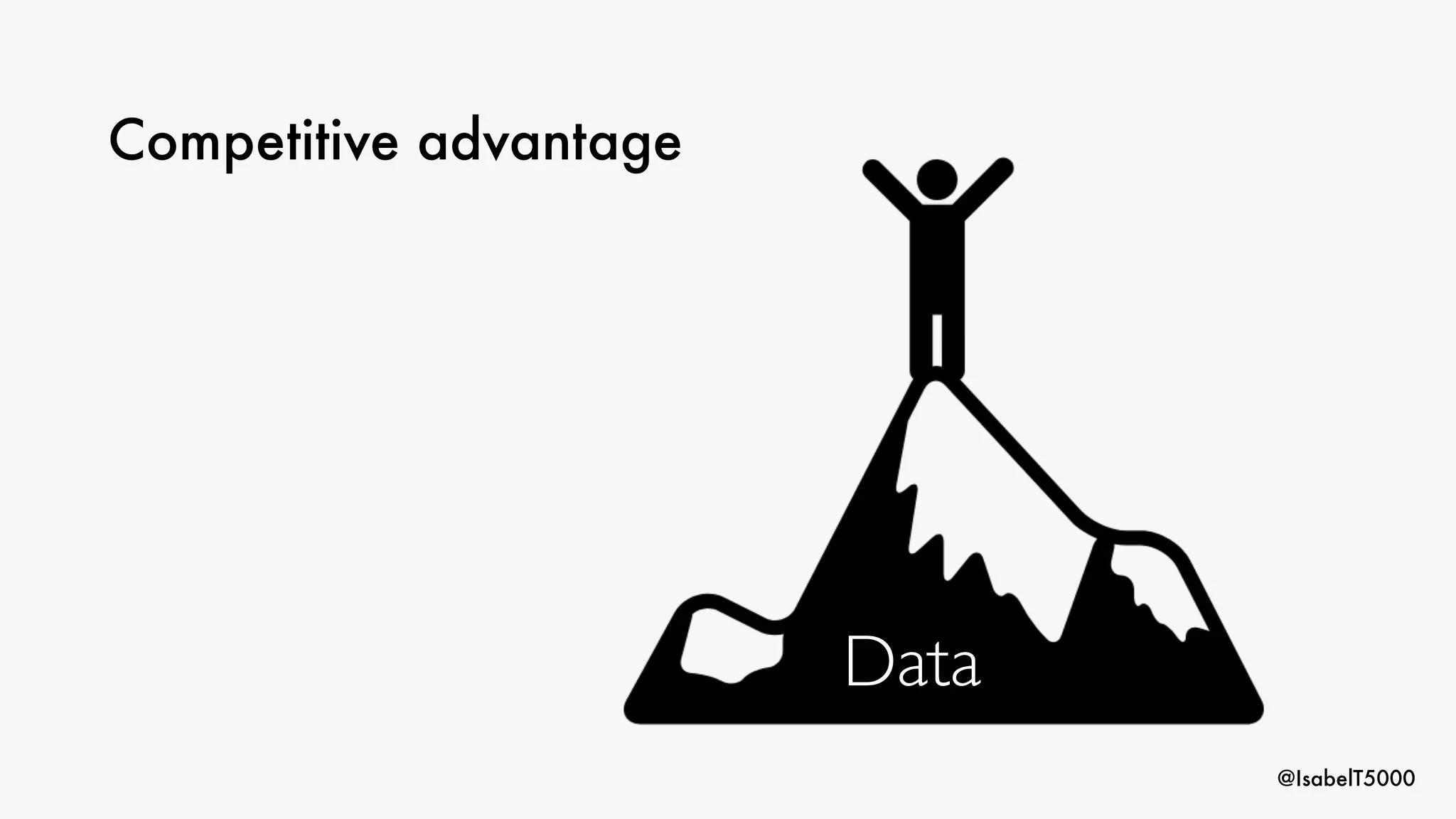
Competitive advantage
Data
@IsabelT5000
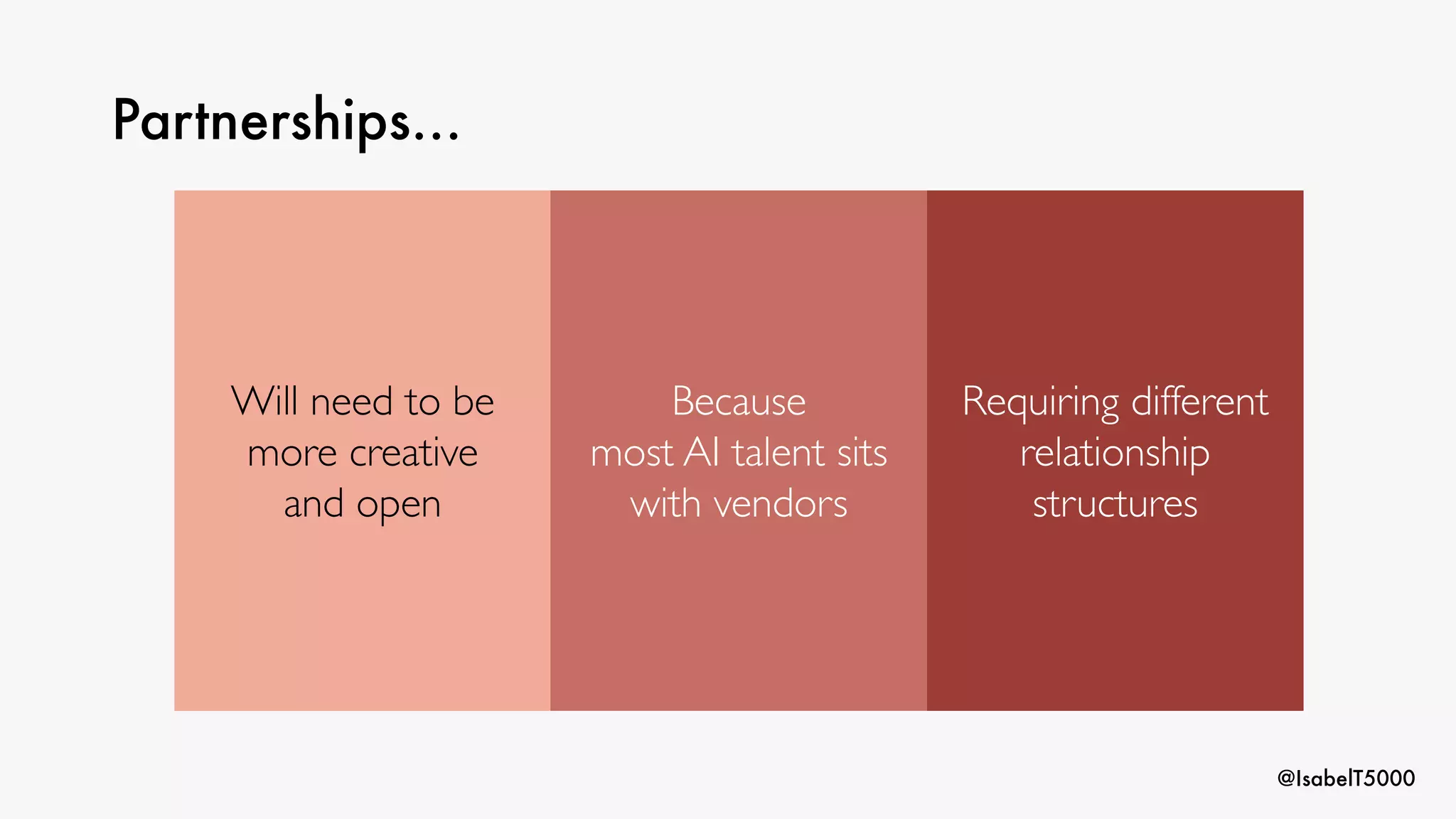
Partnerships…
@IsabelT5000
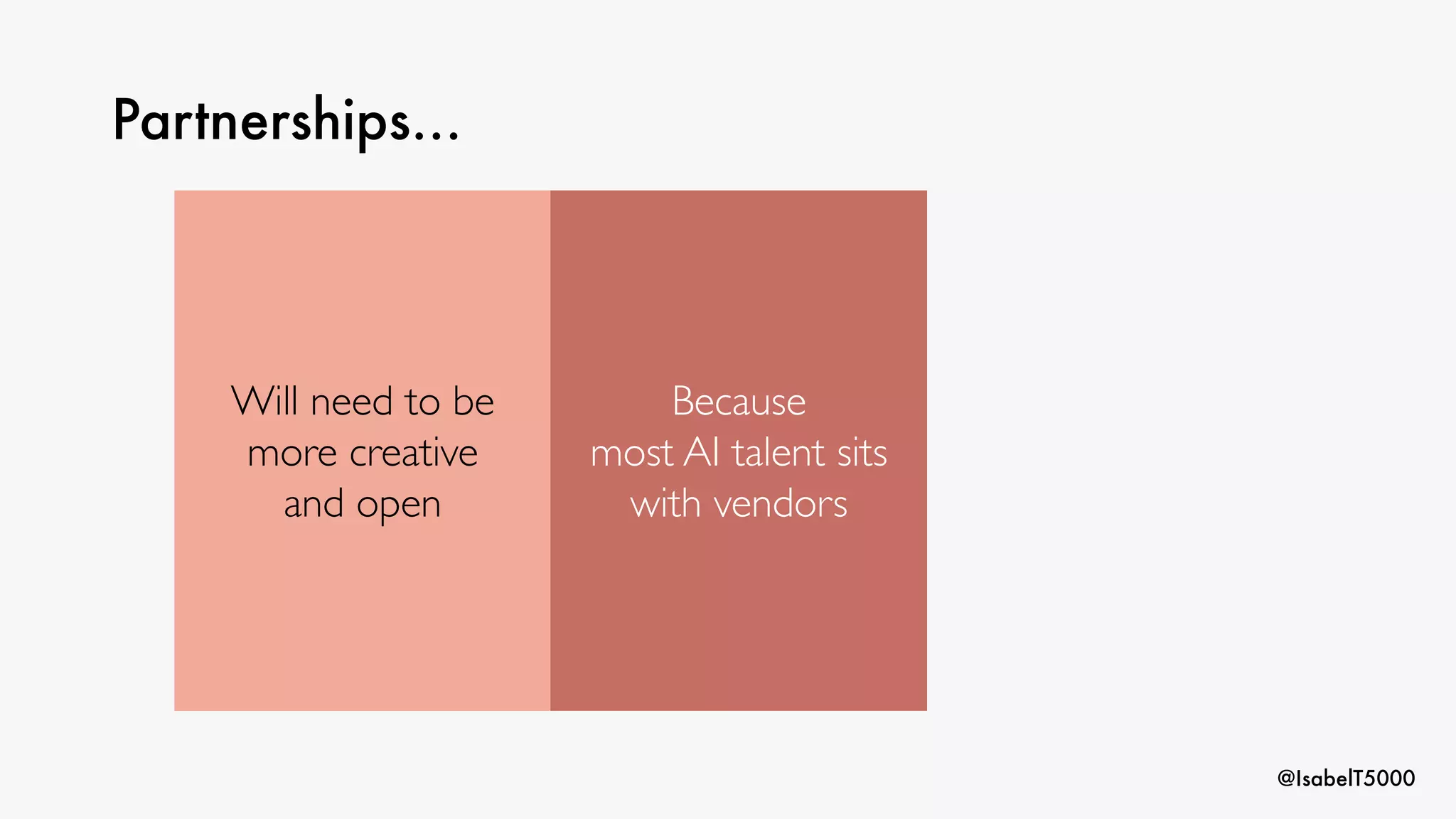
Partnerships…
Will need to be
more creative
and open
@IsabelT5000
Partnerships…
Will need to be
more creative
and open
Because
most AI talent sits
with vendors
@IsabelT5000
Partnerships…
Will need to be
more creative
and open
Requiring different
relationship
structures
Because
most AI talent sits
with vendors
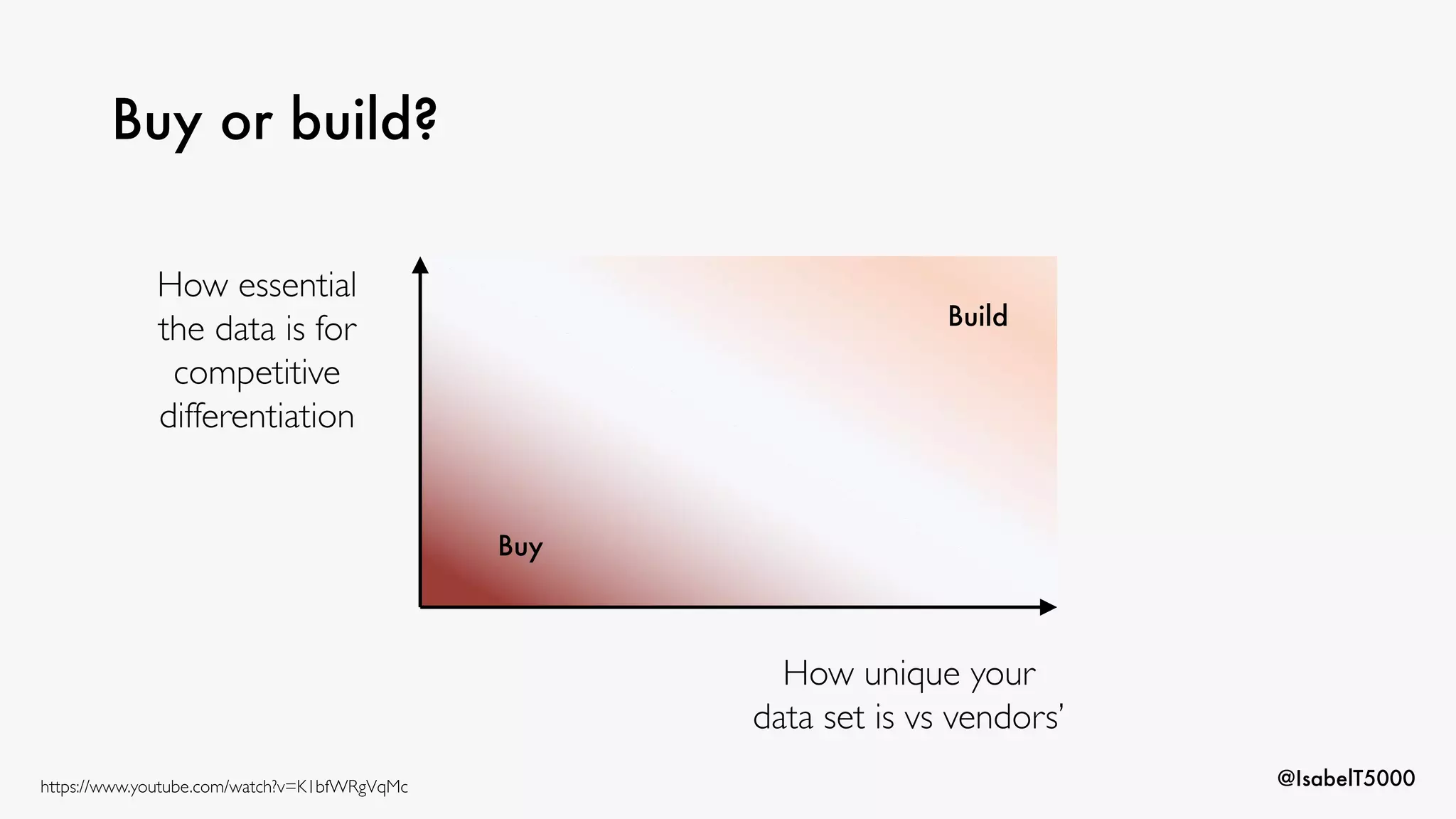
@IsabelT5000
Buy or build?
How essential
the data is for
competitive
differentiation
How unique your
data set is vs vendors’
Build
Buy
https://www.youtube.com/watch?v=K1bfWRgVqMc
@IsabelT5000
McKinsey’s 5 aspects of a successful AI transformation
https://www.mckinsey.com/~/media/McKinsey/Industries/Advanced%20Electronics/Our%20Insights/How%20artificial%20intelligence%20can%20deliver%20real%20value%20to%20companies/MGI-Artificial-Intelligence-Discussion-paper.ashx
@IsabelT5000
McKinsey’s 5 aspects of a successful AI transformation
https://www.mckinsey.com/~/media/McKinsey/Industries/Advanced%20Electronics/Our%20Insights/How%20artificial%20intelligence%20can%20deliver%20real%20value%20to%20companies/MGI-Artificial-Intelligence-Discussion-paper.ashx
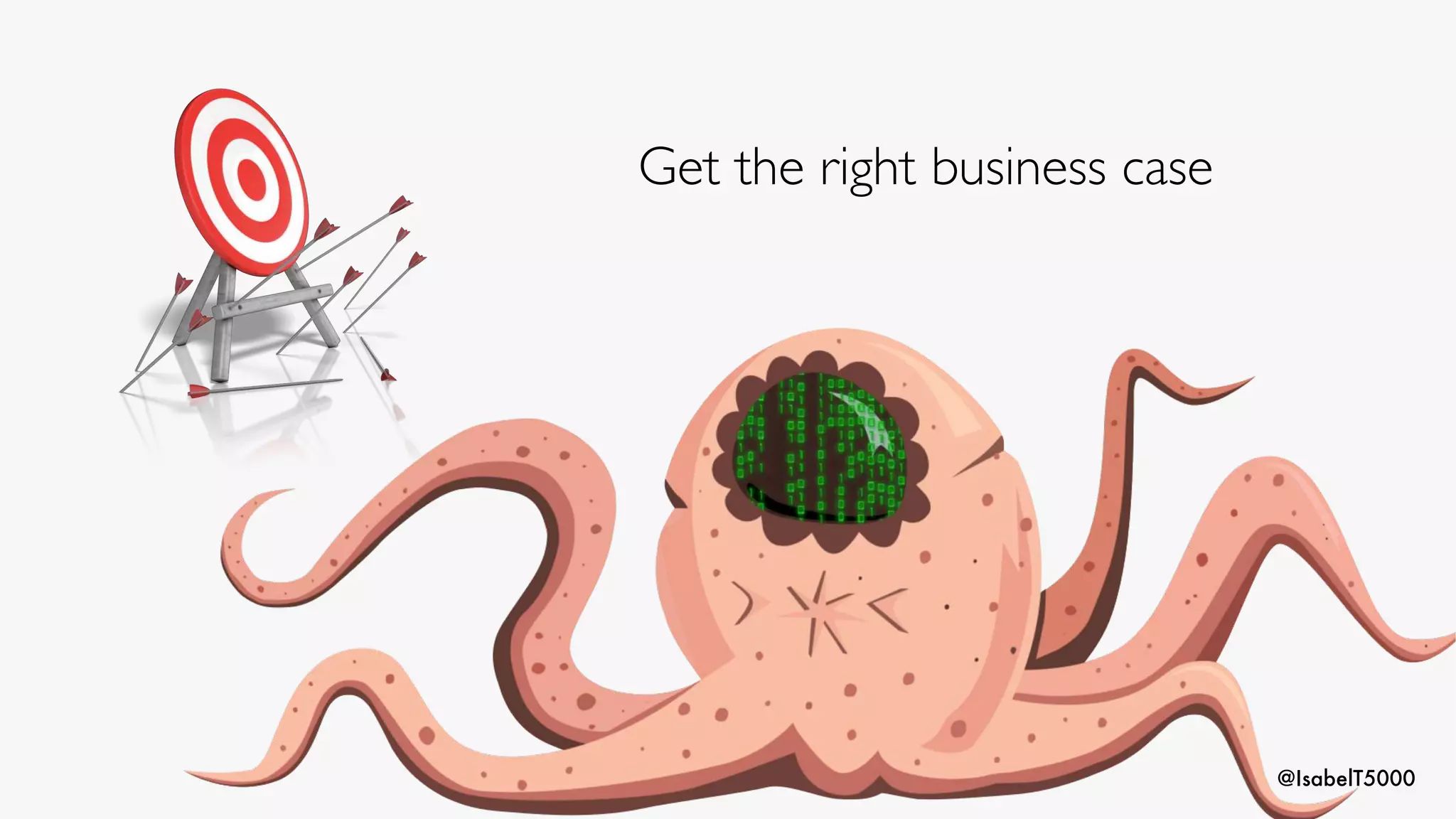
1. Have a business case
@IsabelT5000
McKinsey’s 5 aspects of a successful AI transformation
https://www.mckinsey.com/~/media/McKinsey/Industries/Advanced%20Electronics/Our%20Insights/How%20artificial%20intelligence%20can%20deliver%20real%20value%20to%20companies/MGI-Artificial-Intelligence-Discussion-paper.ashx
1. Have a business case
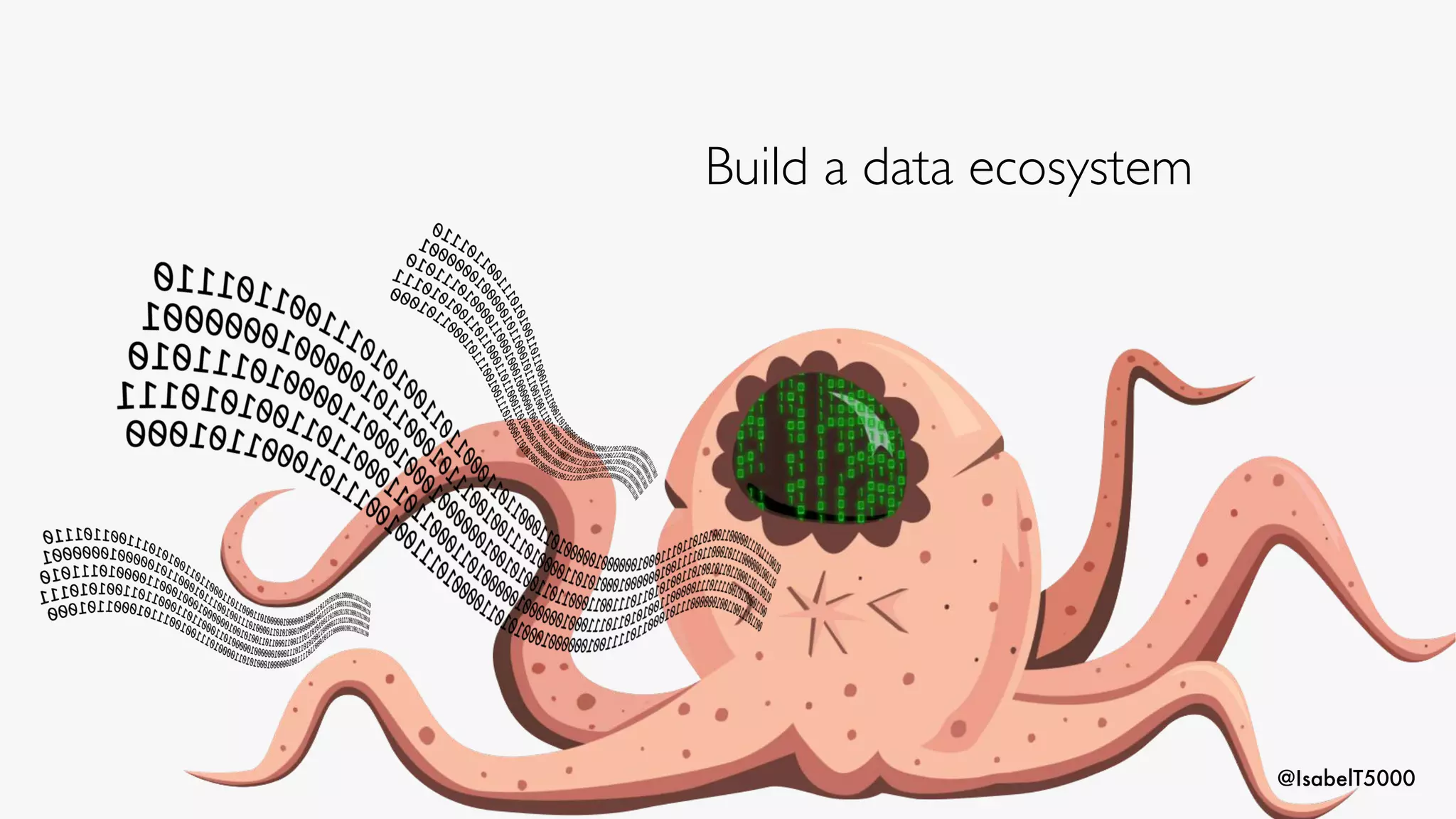
2. Build a data ecosystem
@IsabelT5000
McKinsey’s 5 aspects of a successful AI transformation
https://www.mckinsey.com/~/media/McKinsey/Industries/Advanced%20Electronics/Our%20Insights/How%20artificial%20intelligence%20can%20deliver%20real%20value%20to%20companies/MGI-Artificial-Intelligence-Discussion-paper.ashx
1. Have a business case
2. Build a data ecosystem
3. Get the right tools and techniques
@IsabelT5000
McKinsey’s 5 aspects of a successful AI transformation
https://www.mckinsey.com/~/media/McKinsey/Industries/Advanced%20Electronics/Our%20Insights/How%20artificial%20intelligence%20can%20deliver%20real%20value%20to%20companies/MGI-Artificial-Intelligence-Discussion-paper.ashx
1. Have a business case
2. Build a data ecosystem
3. Get the right tools and techniques
4. Integrate throughout your workflows
@IsabelT5000
McKinsey’s 5 aspects of a successful AI transformation
https://www.mckinsey.com/~/media/McKinsey/Industries/Advanced%20Electronics/Our%20Insights/How%20artificial%20intelligence%20can%20deliver%20real%20value%20to%20companies/MGI-Artificial-Intelligence-Discussion-paper.ashx
1. Have a business case
2. Build a data ecosystem
3. Get the right tools and techniques
4. Integrate throughout your workflows
5. Adopt an open culture and reskill the workforce
@IsabelT5000
What if we think of AI as…
@IsabelT5000
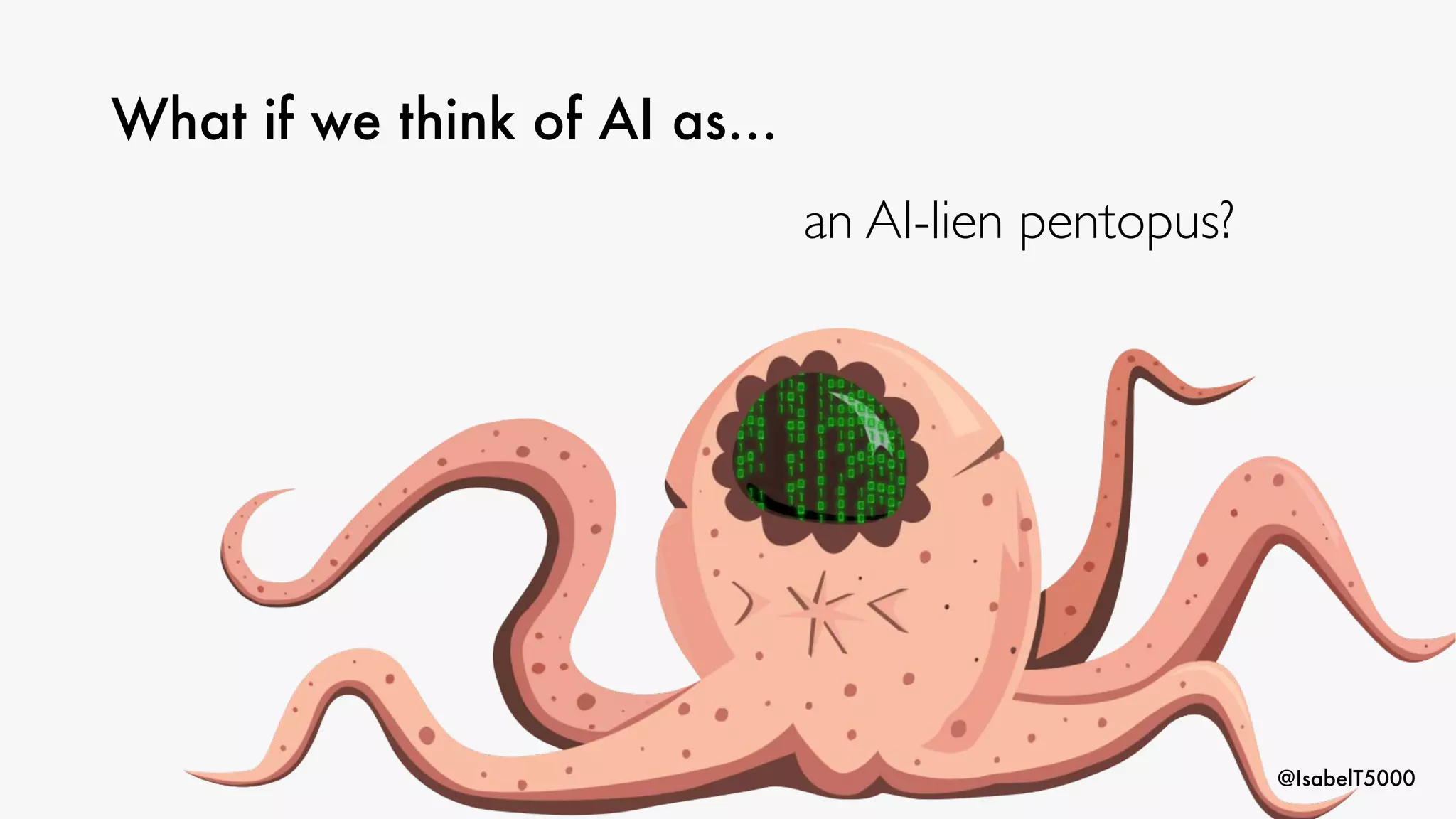
What if we think of AI as…
an AI-lien pentopus?
@IsabelT5000
Get the right business case
@IsabelT5000
Build a data ecosystem
@IsabelT5000
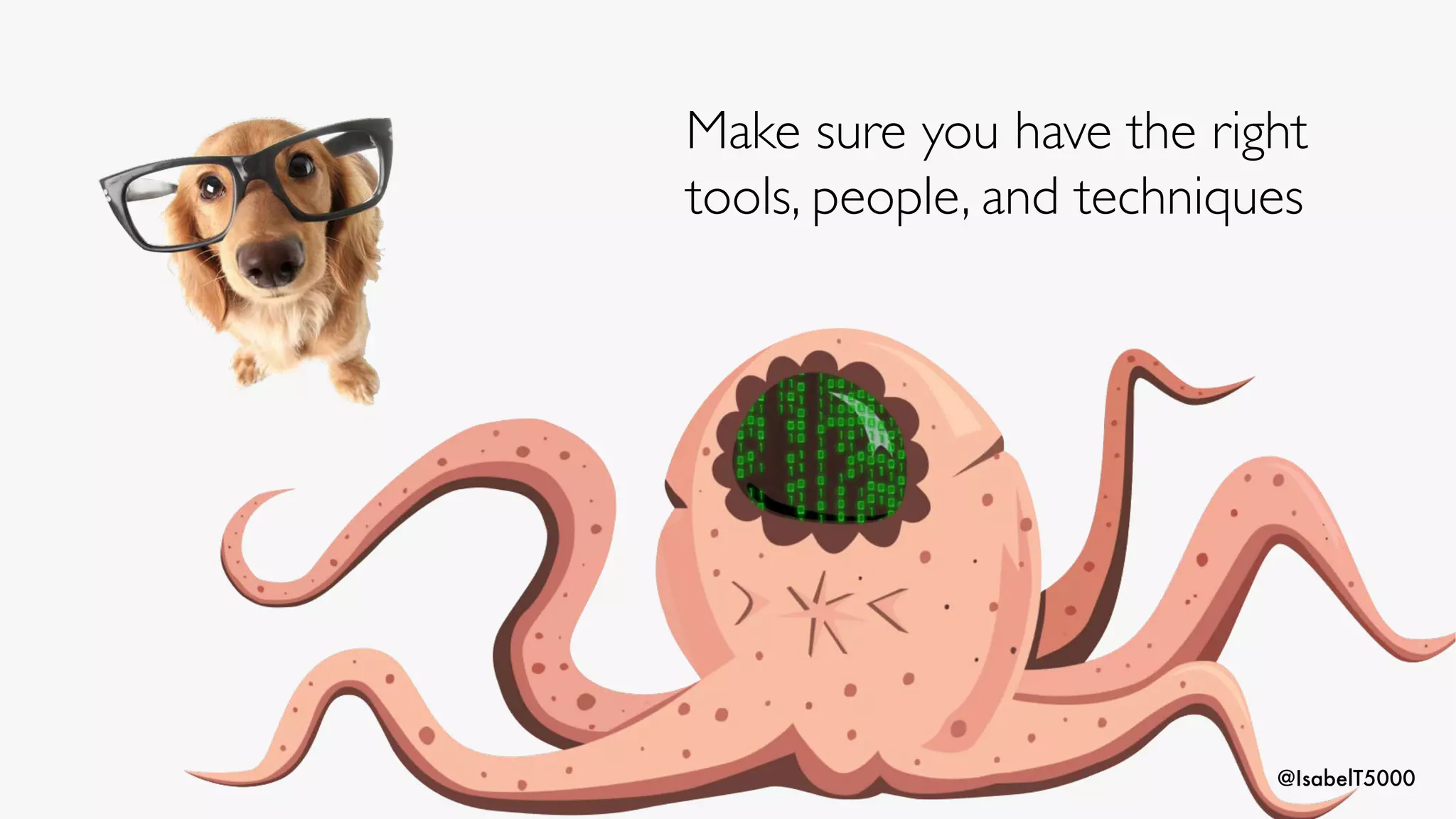
Make sure you have the right
tools, people, and techniques
@IsabelT5000
Integrate throughout your workflows
@IsabelT5000
Adopt an open culture and
reskill the workforce
@IsabelT5000
Summary
@IsabelT5000
Summary
1. AI can do a lot of stuff
@IsabelT5000
Summary
1. AI can do a lot of stuff
2. But you need a business case, and AI is not always the answer
@IsabelT5000
Summary
1. AI can do a lot of stuff
2. But you need a business case, and AI is not always the answer
3. We need to think differently about competitive advantage, partnerships & vendors
@IsabelT5000
Summary
1. AI can do a lot of stuff
2. But you need a business case, and AI is not always the answer
3. We need to think differently about competitive advantage, partnerships & vendors
4. And change our organizations – structure, people, processes, data
@IsabelT5000
Summary
1. AI can do a lot of stuff
2. But you need a business case, and AI is not always the answer
3. We need to think differently about competitive advantage, partnerships & vendors
4. And change our organizations – structure, people, processes, data
5. Because the way businesses and research work is going to look very different
@IsabelT5000
@IsabelT5000
@IsabelT5000
Thank you!
IsabelThompson
isabel.thompson@holtzbrinck.com
@IsabelT5000

Humans, AI and Decisions Making - 2 - Defining and Artificial Intelligence Strategy - Isabel Thompson #SSP2018 8