Administrative Human Resources with Catherine Mattice 1 of 9
Administrative Human Resources
with Catherine Mattice
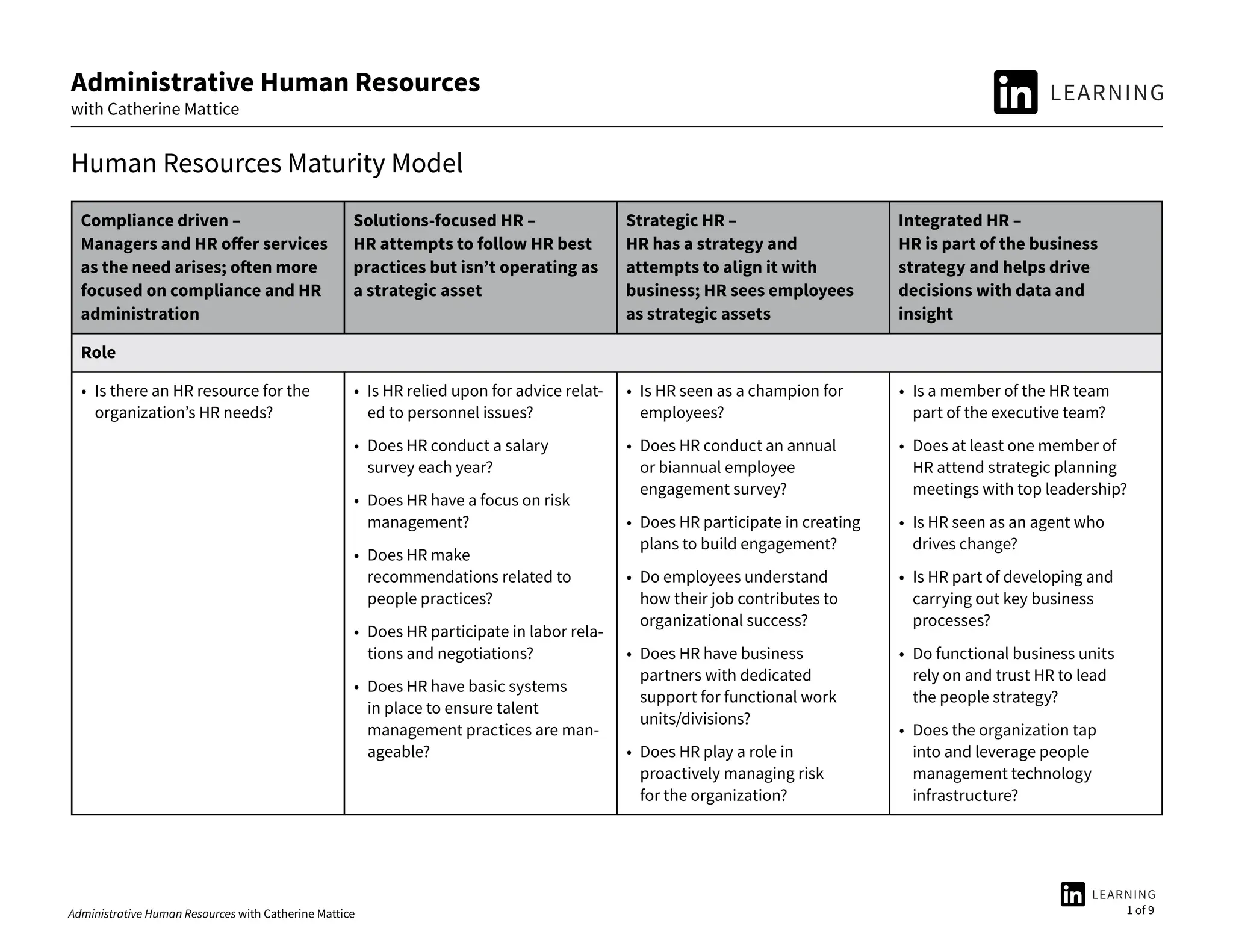
Human Resources Maturity Model
Compliance driven –
Managers and HR offer services
as the need arises; often more
focused on compliance and HR
administration
Solutions-focused HR –
HR attempts to follow HR best
practices but isn’t operating as
a strategic asset
Strategic HR –
HR has a strategy and
attempts to align it with
business; HR sees employees
as strategic assets
Integrated HR –
HR is part of the business
strategy and helps drive
decisions with data and
insight
Role
• Is there an HR resource for the
organization’s HR needs?
• Is HR relied upon for advice relat-
ed to personnel issues?
• Does HR conduct a salary
survey each year?
• Does HR have a focus on risk
management?
• Does HR make
recommendations related to
people practices?
• Does HR participate in labor rela-
tions and negotiations?
• Does HR have basic systems
in place to ensure talent
management practices are man-
ageable?
• Is HR seen as a champion for
employees?
• Does HR conduct an annual
or biannual employee
engagement survey?
• Does HR participate in creating
plans to build engagement?
• Do employees understand
how their job contributes to
organizational success?
• Does HR have business
partners with dedicated
support for functional work
units/divisions?
• Does HR play a role in
proactively managing risk
for the organization?
• Is a member of the HR team
part of the executive team?
• Does at least one member of
HR attend strategic planning
meetings with top leadership?
• Is HR seen as an agent who
drives change?
• Is HR part of developing and
carrying out key business
processes?
• Do functional business units
rely on and trust HR to lead
the people strategy?
• Does the organization tap
into and leverage people
management technology
infrastructure?
Administrative Human Resources with Catherine Mattice 2 of 9
• Does HR actively provide
leadership for labor relations
and negotiations?
• Does HR follow industry trends
in HR, as well as in specific
industry?
• Does HR have an integrated
technology infrastructure?
• Does the organization focus
on and give HR resources to
be an “employer of choice”
or a great place to work?
• Are talent management
practices well integrated
(hiring, onboarding,
developing, retaining,
promoting, retiring) into
functional work units/divisions?
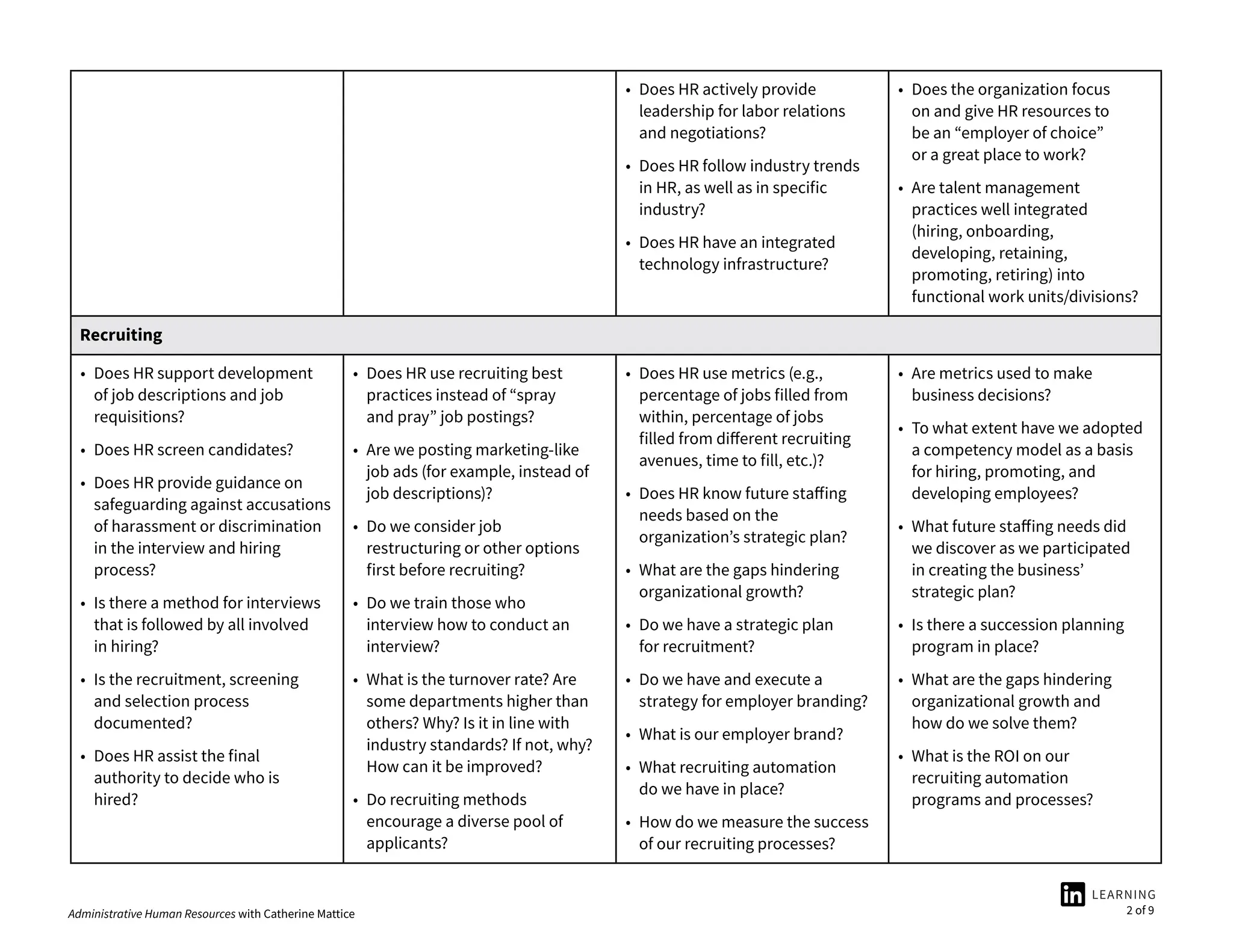
Recruiting
• Does HR support development
of job descriptions and job
requisitions?
• Does HR screen candidates?
• Does HR provide guidance on
safeguarding against accusations
of harassment or discrimination
in the interview and hiring
process?
• Is there a method for interviews
that is followed by all involved
in hiring?
• Is the recruitment, screening
and selection process
documented?
• Does HR assist the final
authority to decide who is
hired?
• Does HR use recruiting best
practices instead of “spray
and pray” job postings?
• Are we posting marketing-like
job ads (for example, instead of
job descriptions)?
• Do we consider job
restructuring or other options
first before recruiting?
• Do we train those who
interview how to conduct an
interview?
• What is the turnover rate? Are
some departments higher than
others? Why? Is it in line with
industry standards? If not, why?
How can it be improved?
• Do recruiting methods
encourage a diverse pool of
applicants?
• Does HR use metrics (e.g.,
percentage of jobs filled from
within, percentage of jobs
filled from different recruiting
avenues, time to fill, etc.)?
• Does HR know future staffing
needs based on the
organization’s strategic plan?
• What are the gaps hindering
organizational growth?
• Do we have a strategic plan
for recruitment?
• Do we have and execute a
strategy for employer branding?
• What is our employer brand?
• What recruiting automation
do we have in place?
• How do we measure the success
of our recruiting processes?
• Are metrics used to make
business decisions?
• To what extent have we adopted
a competency model as a basis
for hiring, promoting, and
developing employees?
• What future staffing needs did
we discover as we participated
in creating the business’
strategic plan?
• Is there a succession planning
program in place?
• What are the gaps hindering
organizational growth and
how do we solve them?
• What is the ROI on our
recruiting automation
programs and processes?
Administrative Human Resources with Catherine Mattice 3 of 9
• Is pay fair and consistent, and
is it on par with industry
standards?
• Are references checked?
• Are conversations documented?
• Once the decision for hiring is
made, does HR contact the
candidate and how?
• Do we ask interview questions
that address culture fit?
• Do we offer career pathing in
order to promote from within?
• Do core competencies include
core values, and do we ask
questions about those
competencies turned values
in interviews?
• Do we have an employer
branding program in place,
and do we measure ROI in
terms of turnover and
employee satisfaction?
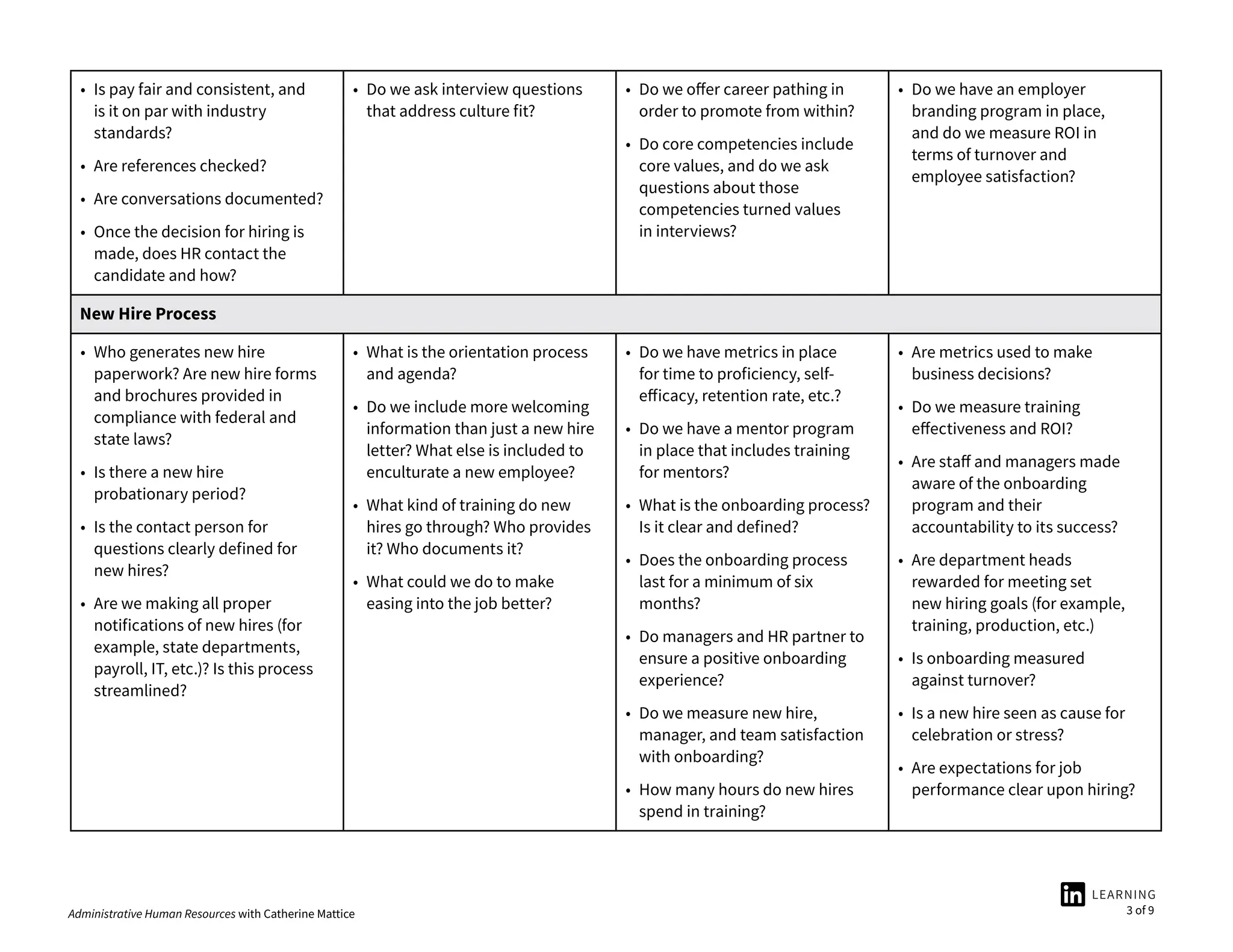
New Hire Process
• Who generates new hire
paperwork? Are new hire forms
and brochures provided in
compliance with federal and
state laws?
• Is there a new hire
probationary period?
• Is the contact person for
questions clearly defined for
new hires?
• Are we making all proper
notifications of new hires (for
example, state departments,
payroll, IT, etc.)? Is this process
streamlined?
• What is the orientation process
and agenda?
• Do we include more welcoming
information than just a new hire
letter? What else is included to
enculturate a new employee?
• What kind of training do new
hires go through? Who provides
it? Who documents it?
• What could we do to make
easing into the job better?
• Do we have metrics in place
for time to proficiency, self-
efficacy, retention rate, etc.?
• Do we have a mentor program
in place that includes training
for mentors?
• What is the onboarding process?
Is it clear and defined?
• Does the onboarding process
last for a minimum of six
months?
• Do managers and HR partner to
ensure a positive onboarding
experience?
• Do we measure new hire,
manager, and team satisfaction
with onboarding?
• How many hours do new hires
spend in training?
• Are metrics used to make
business decisions?
• Do we measure training
effectiveness and ROI?
• Are staff and managers made
aware of the onboarding
program and their
accountability to its success?
• Are department heads
rewarded for meeting set
new hiring goals (for example,
training, production, etc.)
• Is onboarding measured
against turnover?
• Is a new hire seen as cause for
celebration or stress?
• Are expectations for job
performance clear upon hiring?
Administrative Human Resources with Catherine Mattice 4 of 9
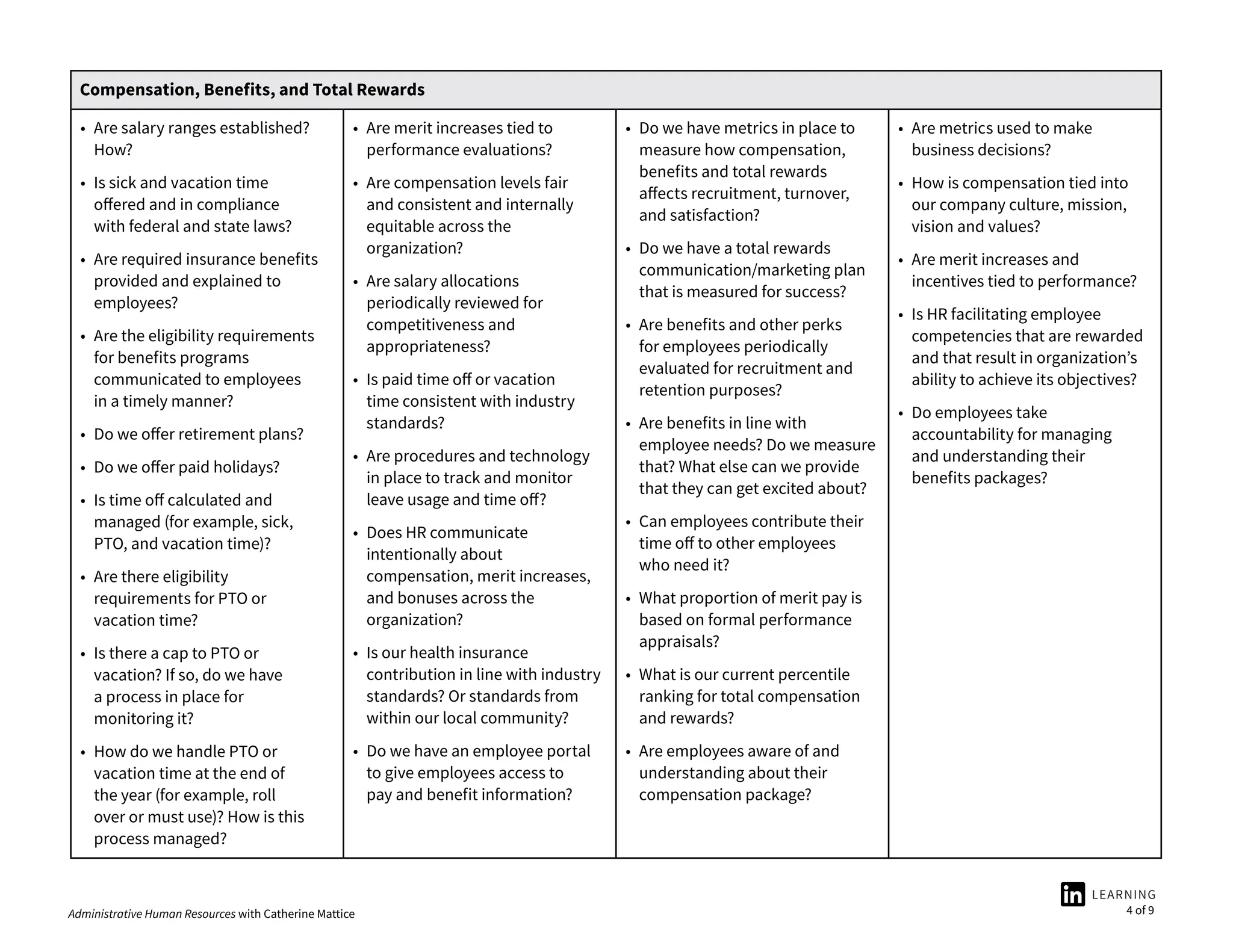
Compensation, Benefits, and Total Rewards
• Are salary ranges established?
How?
• Is sick and vacation time
offered and in compliance
with federal and state laws?
• Are required insurance benefits
provided and explained to
employees?
• Are the eligibility requirements
for benefits programs
communicated to employees
in a timely manner?
• Do we offer retirement plans?
• Do we offer paid holidays?
• Is time off calculated and
managed (for example, sick,
PTO, and vacation time)?
• Are there eligibility
requirements for PTO or
vacation time?
• Is there a cap to PTO or
vacation? If so, do we have
a process in place for
monitoring it?
• How do we handle PTO or
vacation time at the end of
the year (for example, roll
over or must use)? How is this
process managed?
• Are merit increases tied to
performance evaluations?
• Are compensation levels fair
and consistent and internally
equitable across the
organization?
• Are salary allocations
periodically reviewed for
competitiveness and
appropriateness?
• Is paid time off or vacation
time consistent with industry
standards?
• Are procedures and technology
in place to track and monitor
leave usage and time off?
• Does HR communicate
intentionally about
compensation, merit increases,
and bonuses across the
organization?
• Is our health insurance
contribution in line with industry
standards? Or standards from
within our local community?
• Do we have an employee portal
to give employees access to
pay and benefit information?
• Do we have metrics in place to
measure how compensation,
benefits and total rewards
affects recruitment, turnover,
and satisfaction?
• Do we have a total rewards
communication/marketing plan
that is measured for success?
• Are benefits and other perks
for employees periodically
evaluated for recruitment and
retention purposes?
• Are benefits in line with
employee needs? Do we measure
that? What else can we provide
that they can get excited about?
• Can employees contribute their
time off to other employees
who need it?
• What proportion of merit pay is
based on formal performance
appraisals?
• What is our current percentile
ranking for total compensation
and rewards?
• Are employees aware of and
understanding about their
compensation package?
• Are metrics used to make
business decisions?
• How is compensation tied into
our company culture, mission,
vision and values?
• Are merit increases and
incentives tied to performance?
• Is HR facilitating employee
competencies that are rewarded
and that result in organization’s
ability to achieve its objectives?
• Do employees take
accountability for managing
and understanding their
benefits packages?
Administrative Human Resources with Catherine Mattice 5 of 9
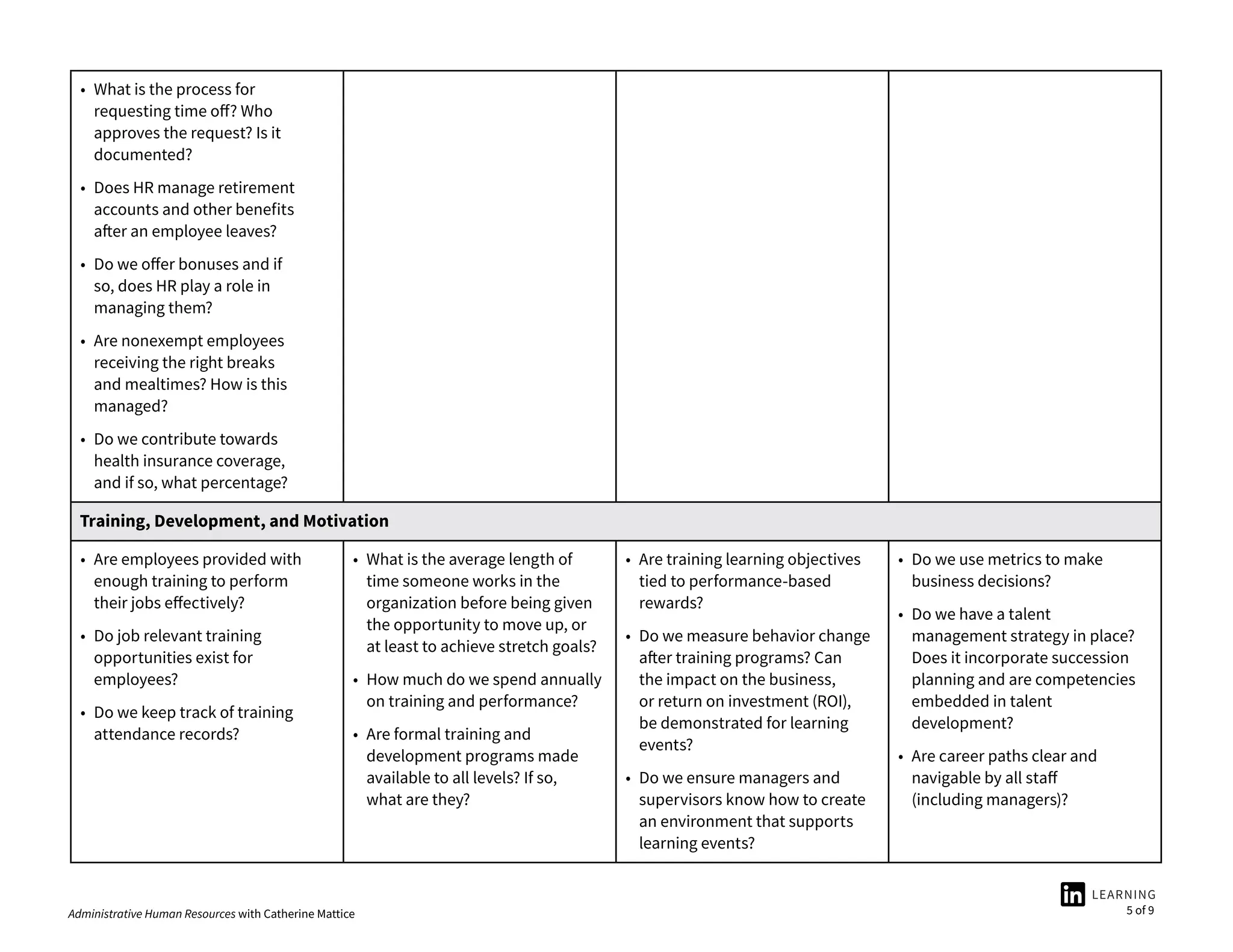
• What is the process for
requesting time off? Who
approves the request? Is it
documented?
• Does HR manage retirement
accounts and other benefits
after an employee leaves?
• Do we offer bonuses and if
so, does HR play a role in
managing them?
• Are nonexempt employees
receiving the right breaks
and mealtimes? How is this
managed?
• Do we contribute towards
health insurance coverage,
and if so, what percentage?
Training, Development, and Motivation
• Are employees provided with
enough training to perform
their jobs effectively?
• Do job relevant training
opportunities exist for
employees?
• Do we keep track of training
attendance records?
• What is the average length of
time someone works in the
organization before being given
the opportunity to move up, or
at least to achieve stretch goals?
• How much do we spend annually
on training and performance?
• Are formal training and
development programs made
available to all levels? If so,
what are they?
• Are training learning objectives
tied to performance-based
rewards?
• Do we measure behavior change
after training programs? Can
the impact on the business,
or return on investment (ROI),
be demonstrated for learning
events?
• Do we ensure managers and
supervisors know how to create
an environment that supports
learning events?
• Do we use metrics to make
business decisions?
• Do we have a talent
management strategy in place?
Does it incorporate succession
planning and are competencies
embedded in talent
development?
• Are career paths clear and
navigable by all staff
(including managers)?
Administrative Human Resources with Catherine Mattice 6 of 9
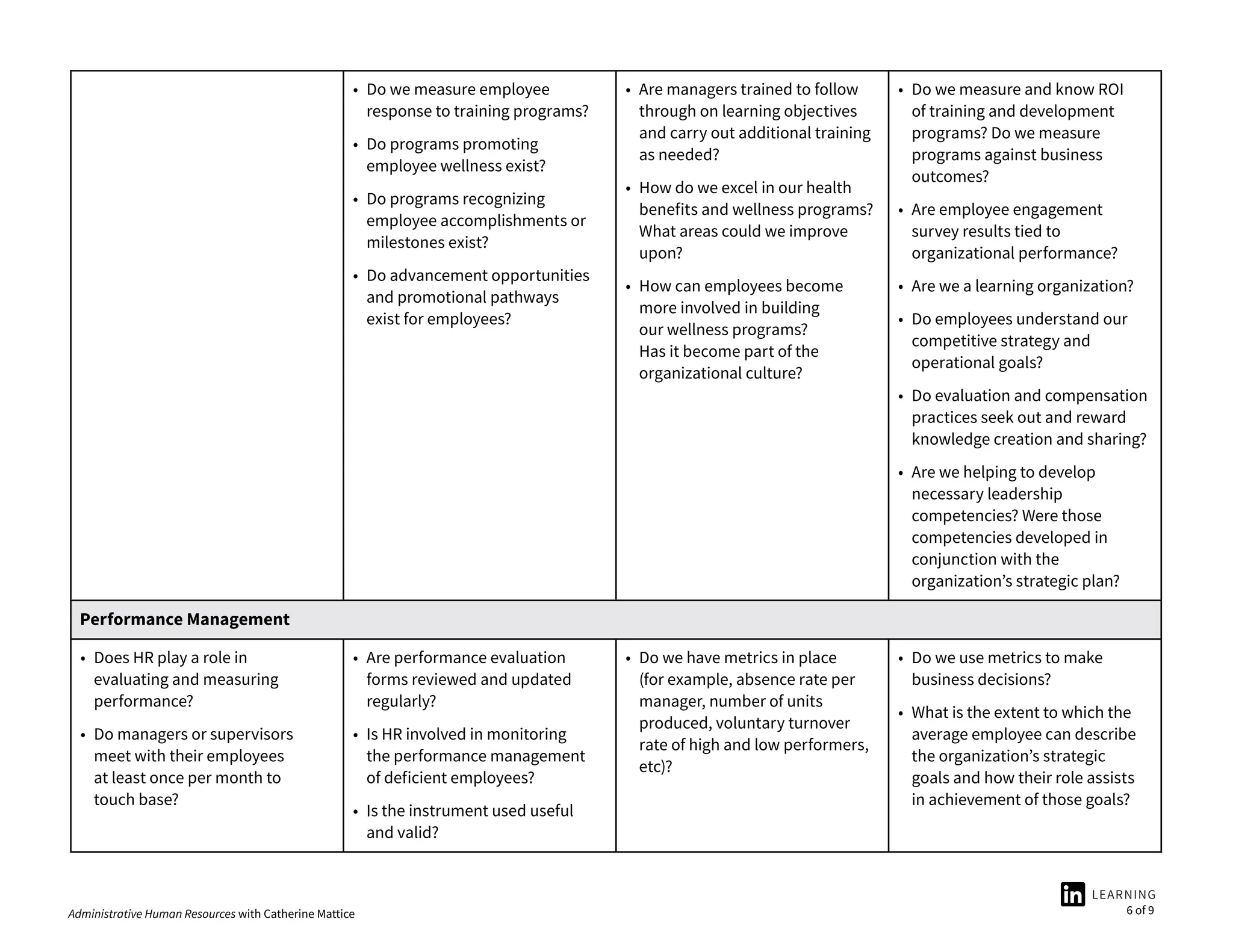
• Do we measure employee
response to training programs?
• Do programs promoting
employee wellness exist?
• Do programs recognizing
employee accomplishments or
milestones exist?
• Do advancement opportunities
and promotional pathways
exist for employees?
• Are managers trained to follow
through on learning objectives
and carry out additional training
as needed?
• How do we excel in our health
benefits and wellness programs?
What areas could we improve
upon?
• How can employees become
more involved in building
our wellness programs?
Has it become part of the
organizational culture?
• Do we measure and know ROI
of training and development
programs? Do we measure
programs against business
outcomes?
• Are employee engagement
survey results tied to
organizational performance?
• Are we a learning organization?
• Do employees understand our
competitive strategy and
operational goals?
• Do evaluation and compensation
practices seek out and reward
knowledge creation and sharing?
• Are we helping to develop
necessary leadership
competencies? Were those
competencies developed in
conjunction with the
organization’s strategic plan?
Performance Management
• Does HR play a role in
evaluating and measuring
performance?
• Do managers or supervisors
meet with their employees
at least once per month to
touch base?
• Are performance evaluation
forms reviewed and updated
regularly?
• Is HR involved in monitoring
the performance management
of deficient employees?
• Is the instrument used useful
and valid?
• Do we have metrics in place
(for example, absence rate per
manager, number of units
produced, voluntary turnover
rate of high and low performers,
etc)?
• Do we use metrics to make
business decisions?
• What is the extent to which the
average employee can describe
the organization’s strategic
goals and how their role assists
in achievement of those goals?
Administrative Human Resources with Catherine Mattice 7 of 9
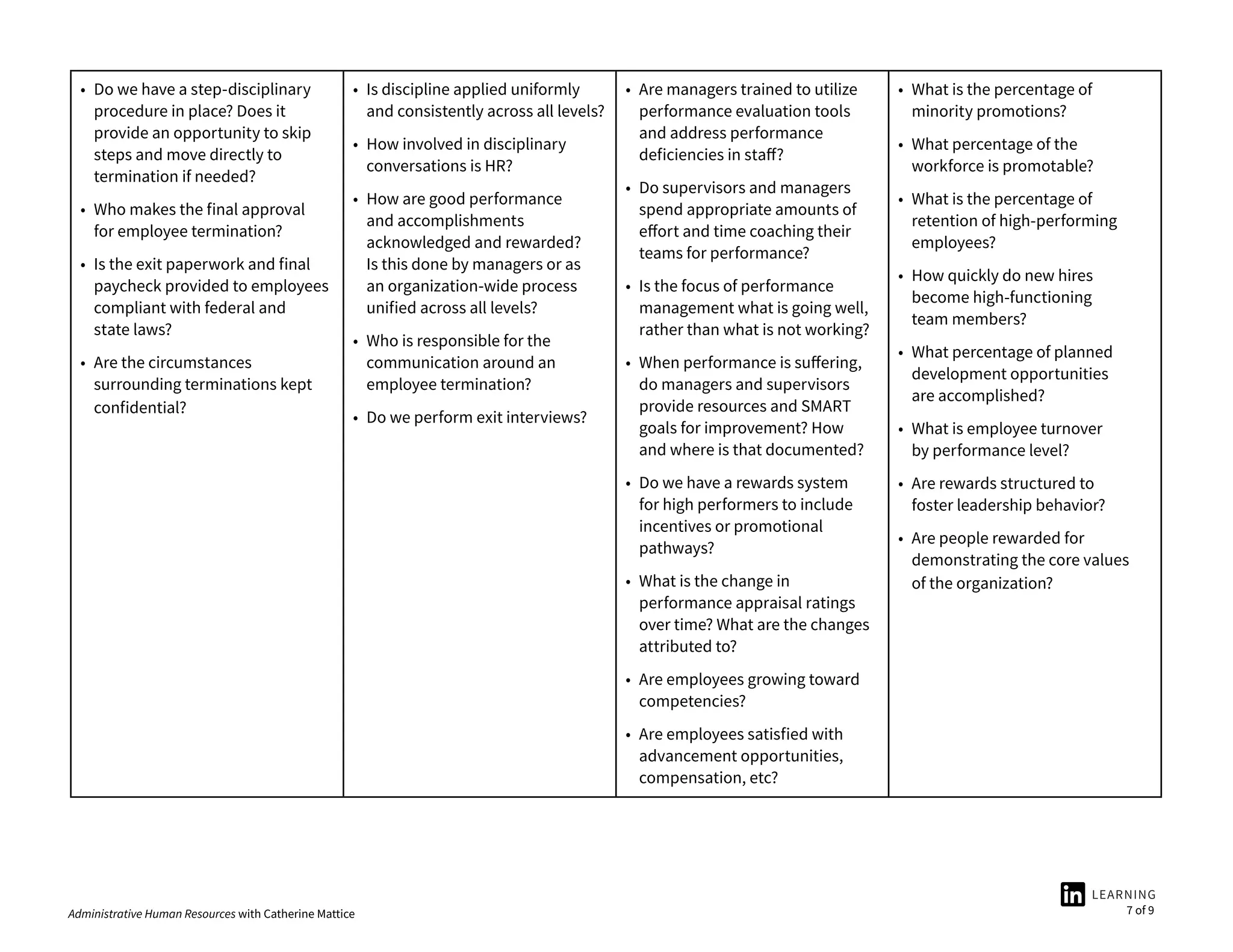
• Do we have a step-disciplinary
procedure in place? Does it
provide an opportunity to skip
steps and move directly to
termination if needed?
• Who makes the final approval
for employee termination?
• Is the exit paperwork and final
paycheck provided to employees
compliant with federal and
state laws?
• Are the circumstances
surrounding terminations kept
confidential?
• Is discipline applied uniformly
and consistently across all levels?
• How involved in disciplinary
conversations is HR?
• How are good performance
and accomplishments
acknowledged and rewarded?
Is this done by managers or as
an organization-wide process
unified across all levels?
• Who is responsible for the
communication around an
employee termination?
• Do we perform exit interviews?
• Are managers trained to utilize
performance evaluation tools
and address performance
deficiencies in staff?
• Do supervisors and managers
spend appropriate amounts of
effort and time coaching their
teams for performance?
• Is the focus of performance
management what is going well,
rather than what is not working?
• When performance is suffering,
do managers and supervisors
provide resources and SMART
goals for improvement? How
and where is that documented?
• Do we have a rewards system
for high performers to include
incentives or promotional
pathways?
• What is the change in
performance appraisal ratings
over time? What are the changes
attributed to?
• Are employees growing toward
competencies?
• Are employees satisfied with
advancement opportunities,
compensation, etc?
• What is the percentage of
minority promotions?
• What percentage of the
workforce is promotable?
• What is the percentage of
retention of high-performing
employees?
• How quickly do new hires
become high-functioning
team members?
• What percentage of planned
development opportunities
are accomplished?
• What is employee turnover
by performance level?
• Are rewards structured to
foster leadership behavior?
• Are people rewarded for
demonstrating the core values
of the organization?
Administrative Human Resources with Catherine Mattice 8 of 9
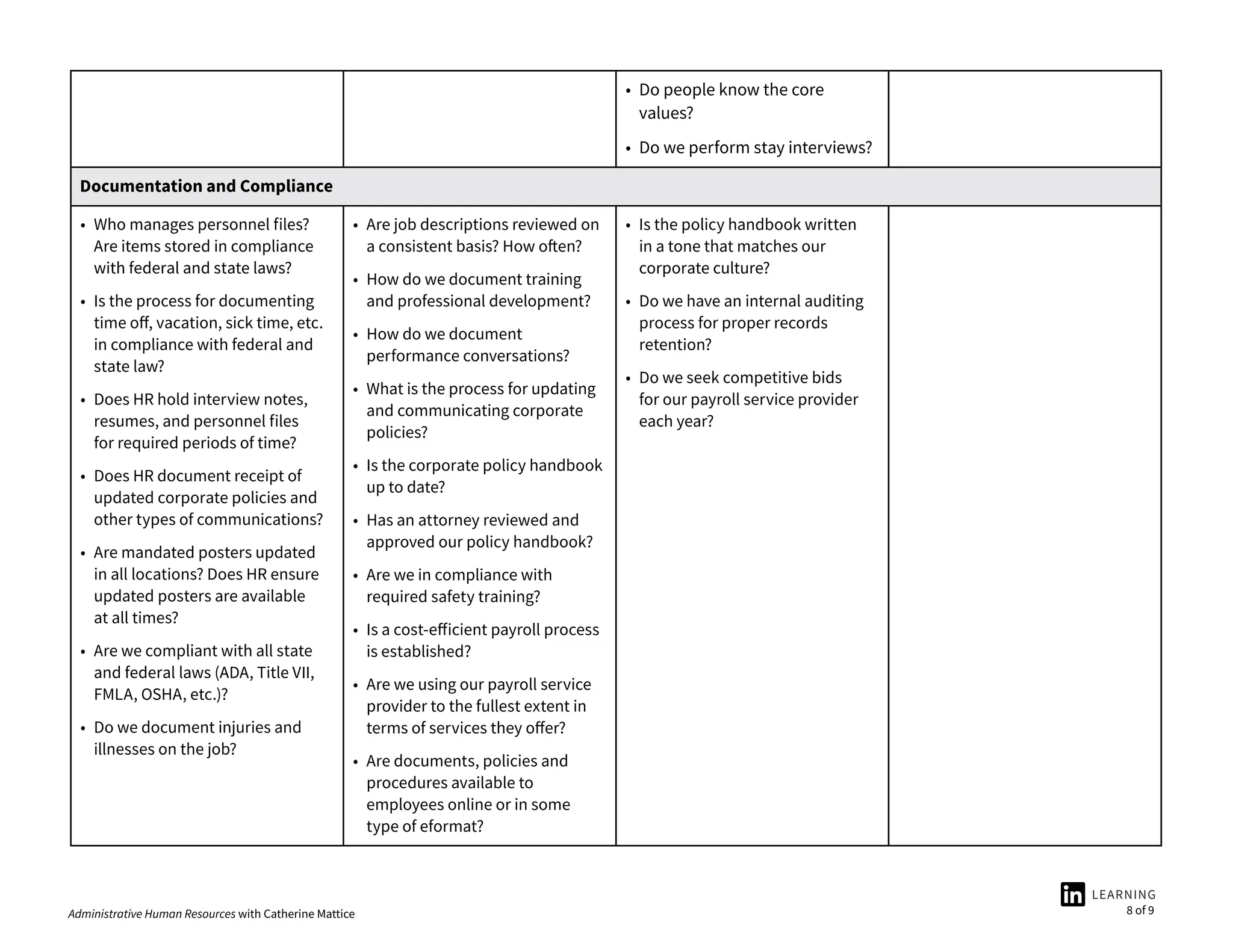
• Do people know the core
values?
• Do we perform stay interviews?
Documentation and Compliance
• Who manages personnel files?
Are items stored in compliance
with federal and state laws?
• Is the process for documenting
time off, vacation, sick time, etc.
in compliance with federal and
state law?
• Does HR hold interview notes,
resumes, and personnel files
for required periods of time?
• Does HR document receipt of
updated corporate policies and
other types of communications?
• Are mandated posters updated
in all locations? Does HR ensure
updated posters are available
at all times?
• Are we compliant with all state
and federal laws (ADA, Title VII,
FMLA, OSHA, etc.)?
• Do we document injuries and
illnesses on the job?
• Are job descriptions reviewed on
a consistent basis? How often?
• How do we document training
and professional development?
• How do we document
performance conversations?
• What is the process for updating
and communicating corporate
policies?
• Is the corporate policy handbook
up to date?
• Has an attorney reviewed and
approved our policy handbook?
• Are we in compliance with
required safety training?
• Is a cost-efficient payroll process
is established?
• Are we using our payroll service
provider to the fullest extent in
terms of services they offer?
• Are documents, policies and
procedures available to
employees online or in some
type of eformat?
• Is the policy handbook written
in a tone that matches our
corporate culture?
• Do we have an internal auditing
process for proper records
retention?
• Do we seek competitive bids
for our payroll service provider
each year?
Administrative Human Resources with Catherine Mattice 9 of 9
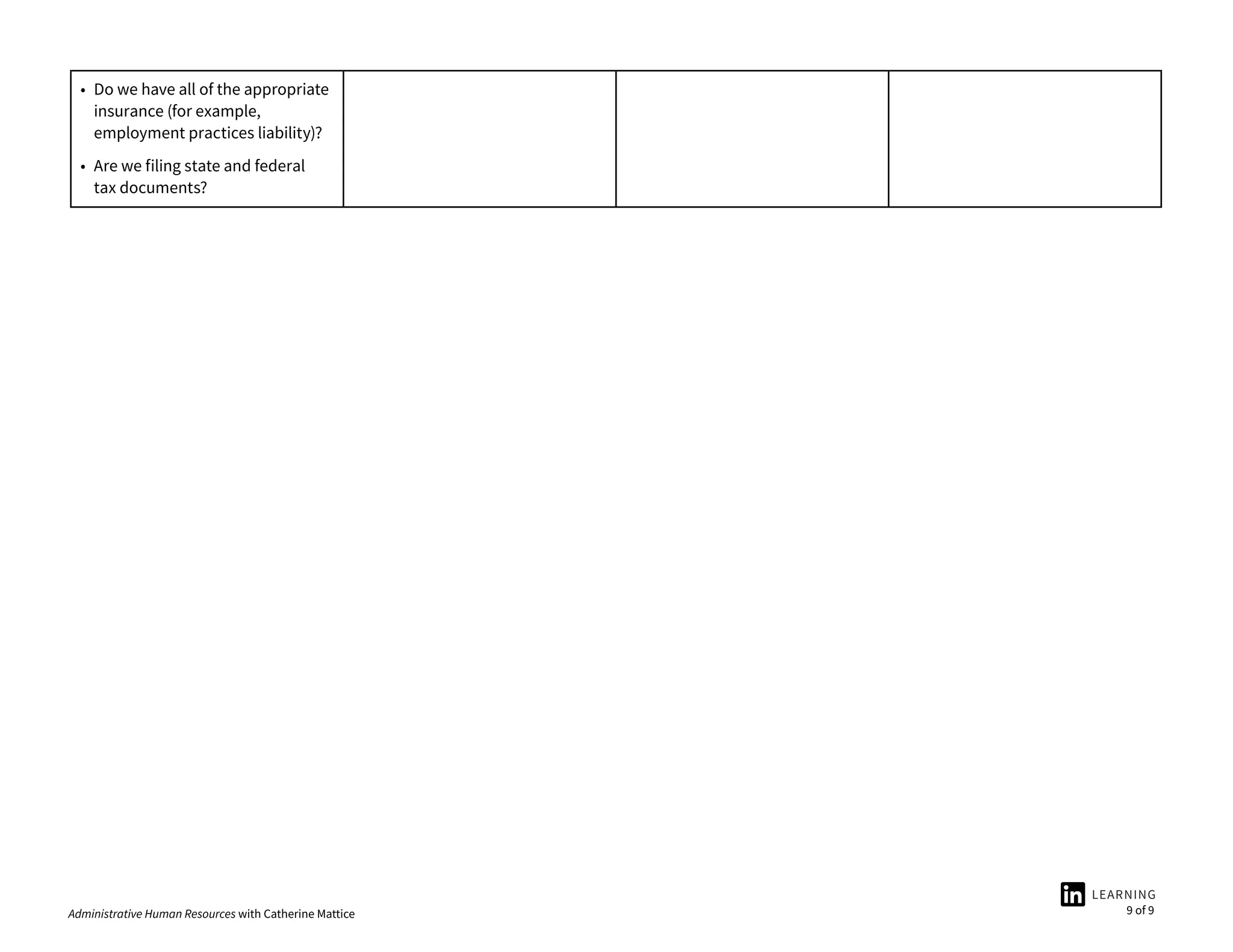
• Do we have all of the appropriate
insurance (for example,
employment practices liability)?
• Are we filing state and federal
tax documents?

Human Resources Maturity Model linke.pdf

  • 1.
    Administrative Human Resourceswith Catherine Mattice 1 of 9 Administrative Human Resources with Catherine Mattice Human Resources Maturity Model Compliance driven – Managers and HR offer services as the need arises; often more focused on compliance and HR administration Solutions-focused HR – HR attempts to follow HR best practices but isn’t operating as a strategic asset Strategic HR – HR has a strategy and attempts to align it with business; HR sees employees as strategic assets Integrated HR – HR is part of the business strategy and helps drive decisions with data and insight Role • Is there an HR resource for the organization’s HR needs? • Is HR relied upon for advice relat- ed to personnel issues? • Does HR conduct a salary survey each year? • Does HR have a focus on risk management? • Does HR make recommendations related to people practices? • Does HR participate in labor rela- tions and negotiations? • Does HR have basic systems in place to ensure talent management practices are man- ageable? • Is HR seen as a champion for employees? • Does HR conduct an annual or biannual employee engagement survey? • Does HR participate in creating plans to build engagement? • Do employees understand how their job contributes to organizational success? • Does HR have business partners with dedicated support for functional work units/divisions? • Does HR play a role in proactively managing risk for the organization? • Is a member of the HR team part of the executive team? • Does at least one member of HR attend strategic planning meetings with top leadership? • Is HR seen as an agent who drives change? • Is HR part of developing and carrying out key business processes? • Do functional business units rely on and trust HR to lead the people strategy? • Does the organization tap into and leverage people management technology infrastructure?
  • 2.
    Administrative Human Resourceswith Catherine Mattice 2 of 9 • Does HR actively provide leadership for labor relations and negotiations? • Does HR follow industry trends in HR, as well as in specific industry? • Does HR have an integrated technology infrastructure? • Does the organization focus on and give HR resources to be an “employer of choice” or a great place to work? • Are talent management practices well integrated (hiring, onboarding, developing, retaining, promoting, retiring) into functional work units/divisions? Recruiting • Does HR support development of job descriptions and job requisitions? • Does HR screen candidates? • Does HR provide guidance on safeguarding against accusations of harassment or discrimination in the interview and hiring process? • Is there a method for interviews that is followed by all involved in hiring? • Is the recruitment, screening and selection process documented? • Does HR assist the final authority to decide who is hired? • Does HR use recruiting best practices instead of “spray and pray” job postings? • Are we posting marketing-like job ads (for example, instead of job descriptions)? • Do we consider job restructuring or other options first before recruiting? • Do we train those who interview how to conduct an interview? • What is the turnover rate? Are some departments higher than others? Why? Is it in line with industry standards? If not, why? How can it be improved? • Do recruiting methods encourage a diverse pool of applicants? • Does HR use metrics (e.g., percentage of jobs filled from within, percentage of jobs filled from different recruiting avenues, time to fill, etc.)? • Does HR know future staffing needs based on the organization’s strategic plan? • What are the gaps hindering organizational growth? • Do we have a strategic plan for recruitment? • Do we have and execute a strategy for employer branding? • What is our employer brand? • What recruiting automation do we have in place? • How do we measure the success of our recruiting processes? • Are metrics used to make business decisions? • To what extent have we adopted a competency model as a basis for hiring, promoting, and developing employees? • What future staffing needs did we discover as we participated in creating the business’ strategic plan? • Is there a succession planning program in place? • What are the gaps hindering organizational growth and how do we solve them? • What is the ROI on our recruiting automation programs and processes?
  • 3.
    Administrative Human Resourceswith Catherine Mattice 3 of 9 • Is pay fair and consistent, and is it on par with industry standards? • Are references checked? • Are conversations documented? • Once the decision for hiring is made, does HR contact the candidate and how? • Do we ask interview questions that address culture fit? • Do we offer career pathing in order to promote from within? • Do core competencies include core values, and do we ask questions about those competencies turned values in interviews? • Do we have an employer branding program in place, and do we measure ROI in terms of turnover and employee satisfaction? New Hire Process • Who generates new hire paperwork? Are new hire forms and brochures provided in compliance with federal and state laws? • Is there a new hire probationary period? • Is the contact person for questions clearly defined for new hires? • Are we making all proper notifications of new hires (for example, state departments, payroll, IT, etc.)? Is this process streamlined? • What is the orientation process and agenda? • Do we include more welcoming information than just a new hire letter? What else is included to enculturate a new employee? • What kind of training do new hires go through? Who provides it? Who documents it? • What could we do to make easing into the job better? • Do we have metrics in place for time to proficiency, self- efficacy, retention rate, etc.? • Do we have a mentor program in place that includes training for mentors? • What is the onboarding process? Is it clear and defined? • Does the onboarding process last for a minimum of six months? • Do managers and HR partner to ensure a positive onboarding experience? • Do we measure new hire, manager, and team satisfaction with onboarding? • How many hours do new hires spend in training? • Are metrics used to make business decisions? • Do we measure training effectiveness and ROI? • Are staff and managers made aware of the onboarding program and their accountability to its success? • Are department heads rewarded for meeting set new hiring goals (for example, training, production, etc.) • Is onboarding measured against turnover? • Is a new hire seen as cause for celebration or stress? • Are expectations for job performance clear upon hiring?
  • 4.
    Administrative Human Resourceswith Catherine Mattice 4 of 9 Compensation, Benefits, and Total Rewards • Are salary ranges established? How? • Is sick and vacation time offered and in compliance with federal and state laws? • Are required insurance benefits provided and explained to employees? • Are the eligibility requirements for benefits programs communicated to employees in a timely manner? • Do we offer retirement plans? • Do we offer paid holidays? • Is time off calculated and managed (for example, sick, PTO, and vacation time)? • Are there eligibility requirements for PTO or vacation time? • Is there a cap to PTO or vacation? If so, do we have a process in place for monitoring it? • How do we handle PTO or vacation time at the end of the year (for example, roll over or must use)? How is this process managed? • Are merit increases tied to performance evaluations? • Are compensation levels fair and consistent and internally equitable across the organization? • Are salary allocations periodically reviewed for competitiveness and appropriateness? • Is paid time off or vacation time consistent with industry standards? • Are procedures and technology in place to track and monitor leave usage and time off? • Does HR communicate intentionally about compensation, merit increases, and bonuses across the organization? • Is our health insurance contribution in line with industry standards? Or standards from within our local community? • Do we have an employee portal to give employees access to pay and benefit information? • Do we have metrics in place to measure how compensation, benefits and total rewards affects recruitment, turnover, and satisfaction? • Do we have a total rewards communication/marketing plan that is measured for success? • Are benefits and other perks for employees periodically evaluated for recruitment and retention purposes? • Are benefits in line with employee needs? Do we measure that? What else can we provide that they can get excited about? • Can employees contribute their time off to other employees who need it? • What proportion of merit pay is based on formal performance appraisals? • What is our current percentile ranking for total compensation and rewards? • Are employees aware of and understanding about their compensation package? • Are metrics used to make business decisions? • How is compensation tied into our company culture, mission, vision and values? • Are merit increases and incentives tied to performance? • Is HR facilitating employee competencies that are rewarded and that result in organization’s ability to achieve its objectives? • Do employees take accountability for managing and understanding their benefits packages?
  • 5.
    Administrative Human Resourceswith Catherine Mattice 5 of 9 • What is the process for requesting time off? Who approves the request? Is it documented? • Does HR manage retirement accounts and other benefits after an employee leaves? • Do we offer bonuses and if so, does HR play a role in managing them? • Are nonexempt employees receiving the right breaks and mealtimes? How is this managed? • Do we contribute towards health insurance coverage, and if so, what percentage? Training, Development, and Motivation • Are employees provided with enough training to perform their jobs effectively? • Do job relevant training opportunities exist for employees? • Do we keep track of training attendance records? • What is the average length of time someone works in the organization before being given the opportunity to move up, or at least to achieve stretch goals? • How much do we spend annually on training and performance? • Are formal training and development programs made available to all levels? If so, what are they? • Are training learning objectives tied to performance-based rewards? • Do we measure behavior change after training programs? Can the impact on the business, or return on investment (ROI), be demonstrated for learning events? • Do we ensure managers and supervisors know how to create an environment that supports learning events? • Do we use metrics to make business decisions? • Do we have a talent management strategy in place? Does it incorporate succession planning and are competencies embedded in talent development? • Are career paths clear and navigable by all staff (including managers)?
  • 6.
    Administrative Human Resourceswith Catherine Mattice 6 of 9 • Do we measure employee response to training programs? • Do programs promoting employee wellness exist? • Do programs recognizing employee accomplishments or milestones exist? • Do advancement opportunities and promotional pathways exist for employees? • Are managers trained to follow through on learning objectives and carry out additional training as needed? • How do we excel in our health benefits and wellness programs? What areas could we improve upon? • How can employees become more involved in building our wellness programs? Has it become part of the organizational culture? • Do we measure and know ROI of training and development programs? Do we measure programs against business outcomes? • Are employee engagement survey results tied to organizational performance? • Are we a learning organization? • Do employees understand our competitive strategy and operational goals? • Do evaluation and compensation practices seek out and reward knowledge creation and sharing? • Are we helping to develop necessary leadership competencies? Were those competencies developed in conjunction with the organization’s strategic plan? Performance Management • Does HR play a role in evaluating and measuring performance? • Do managers or supervisors meet with their employees at least once per month to touch base? • Are performance evaluation forms reviewed and updated regularly? • Is HR involved in monitoring the performance management of deficient employees? • Is the instrument used useful and valid? • Do we have metrics in place (for example, absence rate per manager, number of units produced, voluntary turnover rate of high and low performers, etc)? • Do we use metrics to make business decisions? • What is the extent to which the average employee can describe the organization’s strategic goals and how their role assists in achievement of those goals?
  • 7.
    Administrative Human Resourceswith Catherine Mattice 7 of 9 • Do we have a step-disciplinary procedure in place? Does it provide an opportunity to skip steps and move directly to termination if needed? • Who makes the final approval for employee termination? • Is the exit paperwork and final paycheck provided to employees compliant with federal and state laws? • Are the circumstances surrounding terminations kept confidential? • Is discipline applied uniformly and consistently across all levels? • How involved in disciplinary conversations is HR? • How are good performance and accomplishments acknowledged and rewarded? Is this done by managers or as an organization-wide process unified across all levels? • Who is responsible for the communication around an employee termination? • Do we perform exit interviews? • Are managers trained to utilize performance evaluation tools and address performance deficiencies in staff? • Do supervisors and managers spend appropriate amounts of effort and time coaching their teams for performance? • Is the focus of performance management what is going well, rather than what is not working? • When performance is suffering, do managers and supervisors provide resources and SMART goals for improvement? How and where is that documented? • Do we have a rewards system for high performers to include incentives or promotional pathways? • What is the change in performance appraisal ratings over time? What are the changes attributed to? • Are employees growing toward competencies? • Are employees satisfied with advancement opportunities, compensation, etc? • What is the percentage of minority promotions? • What percentage of the workforce is promotable? • What is the percentage of retention of high-performing employees? • How quickly do new hires become high-functioning team members? • What percentage of planned development opportunities are accomplished? • What is employee turnover by performance level? • Are rewards structured to foster leadership behavior? • Are people rewarded for demonstrating the core values of the organization?
  • 8.
    Administrative Human Resourceswith Catherine Mattice 8 of 9 • Do people know the core values? • Do we perform stay interviews? Documentation and Compliance • Who manages personnel files? Are items stored in compliance with federal and state laws? • Is the process for documenting time off, vacation, sick time, etc. in compliance with federal and state law? • Does HR hold interview notes, resumes, and personnel files for required periods of time? • Does HR document receipt of updated corporate policies and other types of communications? • Are mandated posters updated in all locations? Does HR ensure updated posters are available at all times? • Are we compliant with all state and federal laws (ADA, Title VII, FMLA, OSHA, etc.)? • Do we document injuries and illnesses on the job? • Are job descriptions reviewed on a consistent basis? How often? • How do we document training and professional development? • How do we document performance conversations? • What is the process for updating and communicating corporate policies? • Is the corporate policy handbook up to date? • Has an attorney reviewed and approved our policy handbook? • Are we in compliance with required safety training? • Is a cost-efficient payroll process is established? • Are we using our payroll service provider to the fullest extent in terms of services they offer? • Are documents, policies and procedures available to employees online or in some type of eformat? • Is the policy handbook written in a tone that matches our corporate culture? • Do we have an internal auditing process for proper records retention? • Do we seek competitive bids for our payroll service provider each year?
  • 9.
    Administrative Human Resourceswith Catherine Mattice 9 of 9 • Do we have all of the appropriate insurance (for example, employment practices liability)? • Are we filing state and federal tax documents?