HUMAN RESOURCES
MANAGEMENT
Hisham Sharawy
CourseAgenda
Introduction about HR…………..…………L.1
HR strategic Concepts………………………L.2
Job Analysis……………………………………L.3
Recruitment……………………………………L.4
Selecting andTesting……………………….L.5
Interviewing……………………………..……L.6
Hiring and Orientation……………………..L.7
Training and
Development………………..............….L.8-9
3/9/2024 2
Hisham Sharawy
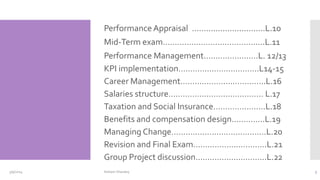
Performance Appraisal …….........................L.10
Mid-Term exam…………………………………….L.11
Performance Management….................…L. 12/13
KPI implementation………………….…………L14-15
Career Management………………….…………..L.16
Salaries structure…………………………………. L.17
Taxation and Social Insurance………………….L.18
Benefits and compensation design………..…L.19
Managing Change…………………………...…….L.20
Revision and Final Exam………………………….L.21
Group Project discussion…………………………L.22
3/9/2024 3
Hisham Sharawy
Salary vs
Wage
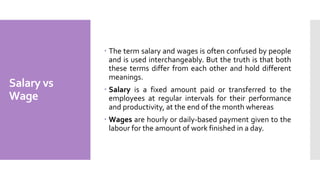
 The term salary and wages is often confused by people
and is used interchangeably. But the truth is that both
these terms differ from each other and hold different
meanings.
 Salary is a fixed amount paid or transferred to the
employees at regular intervals for their performance
and productivity, at the end of the month whereas
 Wages are hourly or daily-based payment given to the
labour for the amount of work finished in a day.
Introduction to Wages and
Compensation Regulations
What pay and
compensation
schemes?
Pay and compensation regulations:
All financial returns (e.g. wages, salaries,
incentives)
Non-financial returns (e.g. employee benefits,
moral benefits)
They get as part of their relationship with the
organization they work on.
Compensation: (it is financial or non-financial
return for the person vs job, performance or for
anything related to the work of the organization).
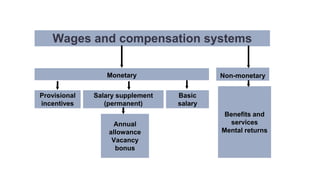
Wages and compensation systems
Monetary Non-monetary
Provisional
incentives
Salary supplement
(permanent)
Annual
allowance
Vacancy
bonus
Benefits and
services
Mental returns
Basic
salary
Importance of
pay and
compensation
systems
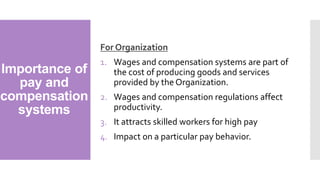
For Organization
1. Wages and compensation systems are part of
the cost of producing goods and services
provided by the Organization.
2. Wages and compensation regulations affect
productivity.
3. It attracts skilled workers for high pay
4. Impact on a particular pay behavior.
Importance of
pay and
compensation
systems
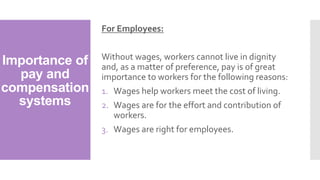
For Employees:
Without wages, workers cannot live in dignity
and, as a matter of preference, pay is of great
importance to workers for the following reasons:
1. Wages help workers meet the cost of living.
2. Wages are for the effort and contribution of
workers.
3. Wages are right for employees.
Importance of
pay and
compensation
systems
Wages are particularly important for the
Organization's owners and capitalists, and there
are views on this as follows:
1. Wages are generated/ extracted from profit.
2. Wages are a burden on the profits.
3. Ownership can be built with pay.
Components of
pay and
compensation
systems
 Salaries and pay supplement:
 Salary and salary supplementation is permanent
when it is added to the salary and becomes part of
the pay and salary and consists of:
1. Annual increment
2. Cost of living allowance
 Incentives:
 It is paid for distinct performance, which is temporary
and variable and not permanent and is divided into:
1. Individual incentives
2. Collective incentives
3. Incentives at the Organization-wide level
Problems of pay
and
compensation
regulations
 I: Problems with pay systems:
1.Salary is below the value of the job or above it.
2.Salary is not enough to cope with the burden of life.
3.Less pay than in the market.
4.Lack of clarity in post salary increments.
5.Salaries and wages are tied to the aims and strategies of
the Organization.
6.Employees on different payrolls amounts are assigned
the same job.
7.Promotion policies are unclear.
8.Managers' authority to grant increments and increases is
unclear.
9.The payroll's secret, which means the employees don't
know what's going on with their colleagues?
Problems with
wages and
compensation
systems
Third: Problems with benefits systems and
employee services:
1.It does not help to feel job security
2.Don't cover what the workers hope for.
3.It does not cover health services
4.The procedures for obtaining services and
benefits are not clear
5.Senior management is not satisfied with granting
benefits and services
Types of incentives
Types of
incentives
If the wage or salary is the consideration that the
individual receives as the value of the job he
occupies! The incentive is the return that he
obtains as a result of excellence in performance.
As for the advantages, it is the return that the
individual obtains as a member of the
organization in which he works, and as you see
that each of these parts has a different meaning
and an important role in the organization .
Why are
the
incentives?
A good incentive system achieves beneficial results, the
most important of which are :
1. Raising the motivation and enthusiasm of workers to
perform the work .
2. Notice of justice workers .
3. The increase of work outputs in the form of production
quantities, production quality, sales, and profits .
4. Reducing work losses Such as reducing costs,
reducing quantities of raw materials, reducing waste in
human resources and any other resources .
5. Satisfying the workers' needs of all kinds, especially
appreciation, respect and a sense of status.
6- Notifying employees of the spirit of justice within the
organization.
7- Attracting employees to the organization and raising
the spirit of loyalty and belonging .
8 -Developing the spirit of cooperation among workers
and developing team spirit and solidarity .
9 -Improving the project's image in front of the
community .
Why are the
incentives?
Different
types of
incentives
Incentives at the individual level .
Incentives at the workgroup level .
Incentives across the organization as a whole .
Incentives can also be divided into the following
base:
*Workers incentives
* Incentives at the level of specialists and admin-
staff
By combining these two classifications, the following
classification can be reached, which we explain in
detail :
Worker
incentives
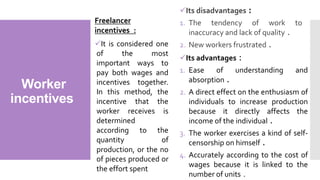
Freelancer
incentives :
It is considered one
of the most
important ways to
pay both wages and
incentives together.
In this method, the
incentive that the
worker receives is
determined
according to the
quantity of
production, or the no
of pieces produced or
the effort spent
Its advantages :
1. Ease of understanding and
absorption .
2. A direct effect on the enthusiasm of
individuals to increase production
because it directly affects the
income of the individual .
3. The worker exercises a kind of self-
censorship on himself .
4. Accurately according to the cost of
wages because it is linked to the
number of units .
Its disadvantages :
1. The tendency of work to
inaccuracy and lack of quality .
2. New workers frustrated .
Worker
incentives
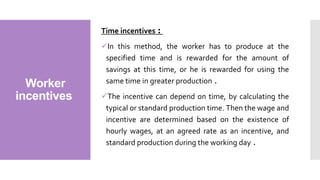
Time incentives :
In this method, the worker has to produce at the
specified time and is rewarded for the amount of
savings at this time, or he is rewarded for using the
same time in greater production .
The incentive can depend on time, by calculating the
typical or standard production time. Then the wage and
incentive are determined based on the existence of
hourly wages, at an agreed rate as an incentive, and
standard production during the working day .
Incentives for
specialists and
administrators
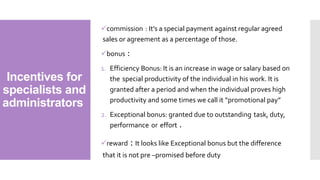
commission : It’s a special payment against regular agreed
sales or agreement as a percentage of those.
bonus :
1. Efficiency Bonus: It is an increase in wage or salary based on
the special productivity of the individual in his work. It is
granted after a period and when the individual proves high
productivity and some times we call it “promotional pay”
2. Exceptional bonus: granted due to outstanding task, duty,
performance or effort .
reward : It looks like Exceptional bonus but the difference
that it is not pre –promised before duty
Incentives
across the
organization as
a whole
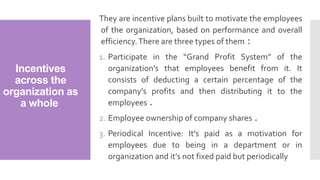
They are incentive plans built to motivate the employees
of the organization, based on performance and overall
efficiency.There are three types of them :
1. Participate in the “Grand Profit System” of the
organization's that employees benefit from it. It
consists of deducting a certain percentage of the
company's profits and then distributing it to the
employees .
2. Employee ownership of company shares .
3. Periodical Incentive: It’s paid as a motivation for
employees due to being in a department or in
organization and it’s not fixed paid but periodically
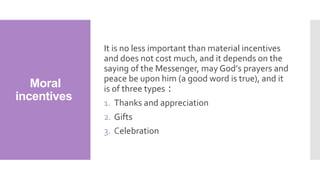
Moral
incentives
It is no less important than material incentives
and does not cost much, and it depends on the
saying of the Messenger, may God’s prayers and
peace be upon him (a good word is true), and it
is of three types :
1. Thanks and appreciation
2. Gifts
3. Celebration
Factors affecting wage and compensation
systems
Introduction
Wage and compensation systems do not come out of nowhere. There are many
factors that influence the shape and size of these systems. Some of these factors
are internal and some are internal.
What is meant by external factors: What is beyond the scope of the
organization's control, or is outside the geographical boundaries of the
organization, or is a societal factor. They include: (laws and legislation, the
impact of competition and competitors, supply and demand...)
The internal factors: It means the factors and forces that exist within the
organization, and in which the organization has a fundamental role in shaping it.
Internal Impacts
First: the objectives of the organization:
The objectives of the organization have a direct impact on the form and size of the
salaries and compensations that it pays. These goals include:
1.Improving performance: as the organization seeks to link wages to productivity
through systems various incentives, and this is done through:
Incentives are designed at the individual level by examining the efficiency of
individual performance, such as examining the result of the annual performance
appraisal of employees.
Incentives are linked to the collective performance of employees at the level of
department, department or production line.
Possession is linked to desired performance behavior such as discipline at work.
2.Raise the added value
Internal Impacts
3. Enhancement the organization's culture
4. Empowering employees
5. Attract the best skills
6. Develop loyalty and belonging
7. Encouraging teamwork
8. Achieving internal and external justice
External factors
First: Laws and legislation:
1. Minimum wage laws.
2. Pay non-discrimination laws.
3. Social insurance laws.
4. Laws of material compensation for work injuries.
5. Payroll tax laws.
6. Laws affecting employee services and benefits.
7. Taxation Law
Pay and compensation strategies
Refer to the appropriate mix of wages and compensation that is compatible with
the conditions of the organization. The wages and compensation systems consist of
salaries, incentives, employee benefits and services, and the ideal combination
means which of these components will be used? And in what size ?
The organization must determine which of the three components will be used, is it
only one, two or all of them? And if all are used, what are the usage rates? For
example, it can be said that100% of what the workers get will be distributed as
follows60% basic salary and 30
% incentives and 10
% employee benefits and
services. It is noted that if these percentages are compatible with the organization,
it may not be compatible with other organizations, as each organization has its own
circumstances and strategies.
Pay and compensation strategies
Levels
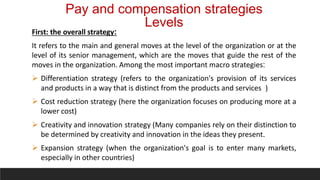
First: the overall strategy:
It refers to the main and general moves at the level of the organization or at the
level of its senior management, which are the moves that guide the rest of the
moves in the organization. Among the most important macro strategies:
 Differentiation strategy (refers to the organization's provision of its services
and products in a way that is distinct from the products and services )
 Cost reduction strategy (here the organization focuses on producing more at a
lower cost)
 Creativity and innovation strategy (Many companies rely on their distinction to
be determined by creativity and innovation in the ideas they present.
 Expansion strategy (when the organization's goal is to enter many markets,
especially in other countries)
Pay and compensation strategies
Second: Human Resources Strategy:
 Staff recruitment and selection strategy.
 performance appraisal strategy.
 Training strategy.
 The paternalistic strategy in human resources.
Pay and compensation strategies
Third: Wages and Compensation Strategy:
Types of wages and compensation:
 Types of salaries.
 Types of incentives.
 Types of benefits and services.
 Its size (estimated in money).
 their ratio to each other.)%(
Pay and compensation strategies
Fourth :The wage and compensation strategy’s implementation:
The wage and compensation strategy must take its time in implementation
before it is evaluated and reviewed. One of the most important methods of
evaluating the wages and compensation strategy is to measure its impact on:
•The behavior of workers, where we follow up here the impact of the wages
and compensation strategy on the behavior of workers, for example:
1.The performance of workers in quantity and quality
2.employee turnover rate
3.Improve employee satisfaction
Module (3)
Job evaluation and internal
fairness in salaries
Job
evaluation
Internal
justice in
salary
 Definition of Job Evaluation:
The job evaluation process is defined as the
process by which the relative importance of
each of the establishment's jobs is determined
compared to other jobs in terms of
characteristics, duties, responsibilities, tasks,
working conditions, necessary qualifications
and results.
This process is used in many human resource
activities, the most important of which is
determining the fair wage for each job and
setting a structure for salaries and wages at the
enterprise level..
Design a job
evaluation
system
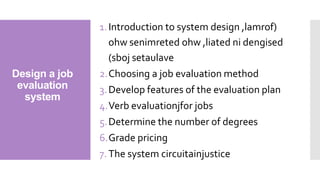
1.Introduction to system design ,lamrof(
ohw senimreted ohw ,liated ni dengised
)sboj setaulave
2.Choosing a job evaluation method
3.Develop features of the evaluation plan
4.Verb evaluationjfor jobs
5.Determine the number of degrees
6.Grade pricing
7. The system circuitainjustice
Methods of
job
evaluation
There are actually two groups of methods used in
job evaluation:
The first group: the sum of non-quantitative
descriptive methods, including:
1. arrangement method.
2. The double comparison method.
3. grading method.
The 2nd group:Total modern quantitative
methods, including:
1. points method.
2. Factor comparison method.
Methods of job
evaluation
1st method (non quantitative –Descriptive method)
-Which One of the simplest and oldest methods, and is
suitable for small companies that the number of jobs in
it a little.
- According to this method, jobs are arranged from
highest to lowest without regard to the individual
incumbent, and without regard to wage paid for their
work.
-The arrangement is made at the level of each
department of the company, and then at the level of
the company as a whole.
- Practically: We choose the job that comes on top in
terms of importance.
-Then:We choose the job that comes last in terms of
importance.
- Finally:We choose the job that comes in the middle in
terms of importance.
Methods of
job
evaluation
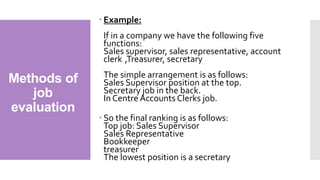
 Example:
If in a company we have the following five
functions:
Sales supervisor, sales representative, account
clerk ,Treasurer, secretary
The simple arrangement is as follows:
Sales Supervisor position at the top.
Secretary job in the back.
In Centre Accounts Clerks job.
 So the final ranking is as follows:
Top job: Sales Supervisor
Sales Representative
Bookkeeper
treasurer
The lowest position is a secretary
Methods of
job
evaluation
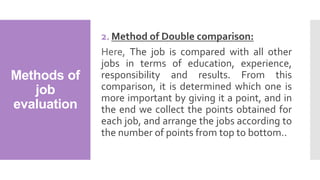
2. Method of Double comparison:
Here, The job is compared with all other
jobs in terms of education, experience,
responsibility and results. From this
comparison, it is determined which one is
more important by giving it a point, and in
the end we collect the points obtained for
each job, and arrange the jobs according to
the number of points from top to bottom..
Methods of
job
evaluation
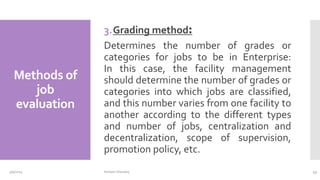
3.Grading method:
Determines the number of grades or
categories for jobs to be in Enterprise:
In this case, the facility management
should determine the number of grades or
categories into which jobs are classified,
and this number varies from one facility to
another according to the different types
and number of jobs, centralization and
decentralization, scope of supervision,
promotion policy, etc.
3/9/2024 Hisham Sharawy 43
Methods of
job
evaluation
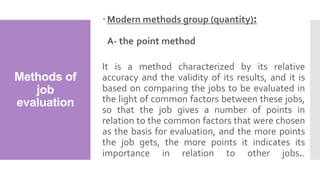
Modern methods group (quantity):
A- the point method
It is a method characterized by its relative
accuracy and the validity of its results, and it is
based on comparing the jobs to be evaluated in
the light of common factors between these jobs,
so that the job gives a number of points in
relation to the common factors that were chosen
as the basis for evaluation, and the more points
the job gets, the more points it indicates its
importance in relation to other jobs..
Methods of
job
evaluation
 Steps to apply the point method:
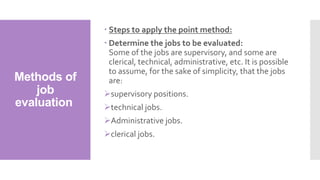
 Determine the jobs to be evaluated:
Some of the jobs are supervisory, and some are
clerical, technical, administrative, etc. It is possible
to assume, for the sake of simplicity, that the jobs
are:
supervisory positions.
technical jobs.
Administrative jobs.
clerical jobs.
Methods of
job
evaluation
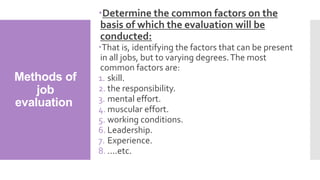
Determine the common factors on the
basis of which the evaluation will be
conducted:
That is, identifying the factors that can be present
in all jobs, but to varying degrees.The most
common factors are:
1. skill.
2. the responsibility.
3. mental effort.
4. muscular effort.
5. working conditions.
6. Leadership.
7. Experience.
8. ....etc.
Methods of job
evaluation
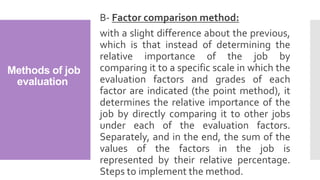
B- Factor comparison method:
with a slight difference about the previous,
which is that instead of determining the
relative importance of the job by
comparing it to a specific scale in which the
evaluation factors and grades of each
factor are indicated (the point method), it
determines the relative importance of the
job by directly comparing it to other jobs
under each of the evaluation factors.
Separately, and in the end, the sum of the
values of the factors in the job is
represented by their relative percentage.
Steps to implement the method.
Evaluation
factors
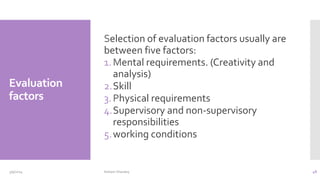
Selection of evaluation factors usually are
between five factors:
1.Mental requirements. (Creativity and
analysis)
2.Skill
3.Physical requirements
4.Supervisory and non-supervisory
responsibilities
5.working conditions
3/9/2024 Hisham Sharawy 48
Experience
the
responsibilit
y
mental
effort
muscular
effort
working
conditions
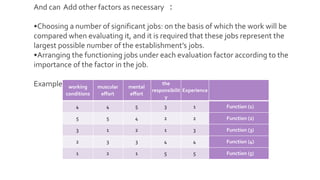
Function (1)
1
3
5
4
4
Function (2)
2
2
4
5
5
Function (3)
3
1
2
1
3
Function (4)
4
4
3
3
2
Function (5)
5
5
1
2
1
And can Add other factors as necessary :
•Choosing a number of significant jobs: on the basis of which the work will be
compared when evaluating it, and it is required that these jobs represent the
largest possible number of the establishment’s jobs.
•Arranging the functioning jobs under each evaluation factor according to the
importance of the factor in the job.
Example
Module 5 Merit Matrix
Merit Matrix
A merit matrix, also known as a merit
increase matrix or salary increase matrix,
is a mathematical grid that compensation
professionals provide to help company
managers accurately and efficiently
administer salary increases to an
organization’s employees.
Before you
create your
salary increase
matrix
Consider the following as you determine your budget:
What is the goal of your merit increase program?
Does your organization pay below market, at market or
above market?
If you are below market, do you want to make your
organization’s compensation program more competitive?
If you are at market, do you want to continue the status
quo?
If you are above market, are you trying to hold down
salary growth?
What is your organizational philosophy toward
excellent performers?What about your substandard
performers?
Before you
create your
salary
increase
matrix
 Let’s have a look on the salary structure types.There
are three main types of salary structure businesses
use:
Traditional
Broadband
Market-based
According to one survey, the majority of
businesses use market-based structures. And, the
least common salary structure is broadband. The
type of structure you use may depend on your
industry, business size, business location, and
employee classification (i.e., exempt vs.
nonexempt).
Keep in mind that you can change the salary
structure you use. You don’t have to stick with the
same type of structure, especially as your venture
grows. Understand the types of salary structure
to choose the one that works best for your small
business.
Traditional
structure
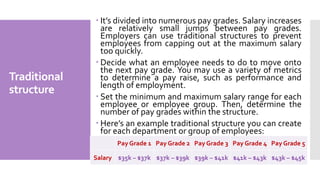
 It’s divided into numerous pay grades. Salary increases
are relatively small jumps between pay grades.
Employers can use traditional structures to prevent
employees from capping out at the maximum salary
too quickly.
 Decide what an employee needs to do to move onto
the next pay grade. You may use a variety of metrics
to determine a pay raise, such as performance and
length of employment.
 Set the minimum and maximum salary range for each
employee or employee group. Then, determine the
number of pay grades within the structure.
 Here’s an example traditional structure you can create
for each department or group of employees:
Pay Grade 1 Pay Grade 2 Pay Grade 3 Pay Grade 4 Pay Grade 5
Salary $35k – $37k $37k – $39k $39k – $41k $41k – $43k $43k – $45k
Broadband
structure
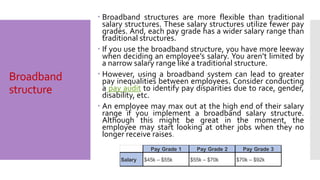
 Broadband structures are more flexible than traditional
salary structures. These salary structures utilize fewer pay
grades. And, each pay grade has a wider salary range than
traditional structures.
 If you use the broadband structure, you have more leeway
when deciding an employee’s salary. You aren’t limited by
a narrow salary range like a traditional structure.
 However, using a broadband system can lead to greater
pay inequalities between employees. Consider conducting
a pay audit to identify pay disparities due to race, gender,
disability, etc.
 An employee may max out at the high end of their salary
range if you implement a broadband salary structure.
Although this might be great in the moment, the
employee may start looking at other jobs when they no
longer receive raises.
Pay Grade 1 Pay Grade 2 Pay Grade 3
Salary $45k – $55k $55k – $70k $70k – $92k
Market-based structure
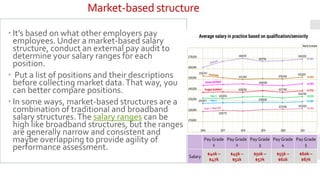
 It’s based on what other employers pay
employees. Under a market-based salary
structure, conduct an external pay audit to
determine your salary ranges for each
position.
 Put a list of positions and their descriptions
before collecting market data.That way, you
can better compare positions.
 In some ways, market-based structures are a
combination of traditional and broadband
salary structures.The salary ranges can be
high like broadband structures, but the ranges
are generally narrow and consistent and
maybe overlapping to provide agility of
performance assessment.
Pay Grade
1
Pay Grade
2
Pay Grade
3
Pay Grade
4
Pay Grade
5
Salary
$40k –
$47k
$45k –
$52k
$50k –
$57k
$55k –
$62k
$60k –
$67k
Merit Matrix
Approaches
 There are Three common approaches when it
comes to designing a merit increase grid:
• Basic Broadband approach
• Standard merit matrix – based on performance
rating alone
• Two-variable merit matrix – based on performance
rating and an employee’s position within their pay
range
Broadband
approach
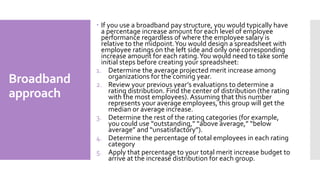
 If you use a broadband pay structure, you would typically have
a percentage increase amount for each level of employee
performance regardless of where the employee salary is
relative to the midpoint.You would design a spreadsheet with
employee ratings on the left side and only one corresponding
increase amount for each rating.You would need to take some
initial steps before creating your spreadsheet:
1. Determine the average projected merit increase among
organizations for the coming year.
2. Review your previous year’s evaluations to determine a
rating distribution. Find the center of distribution (the rating
with the most employees). Assuming that this number
represents your average employees, this group will get the
median or average increase.
3. Determine the rest of the rating categories (for example,
you could use “outstanding,” “above average,” “below
average” and “unsatisfactory”).
4. Determine the percentage of total employees in each rating
category
5. Apply that percentage to your total merit increase budget to
arrive at the increase distribution for each group.
Broadband
approach
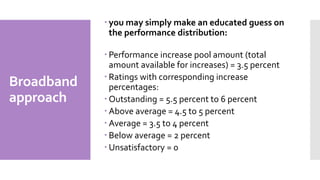
 you may simply make an educated guess on
the performance distribution:
 Performance increase pool amount (total
amount available for increases) = 3.5 percent
 Ratings with corresponding increase
percentages:
 Outstanding = 5.5 percent to 6 percent
 Above average = 4.5 to 5 percent
 Average = 3.5 to 4 percent
 Below average = 2 percent
 Unsatisfactory = 0
WhatAre
Merit Raises
BasedOn?
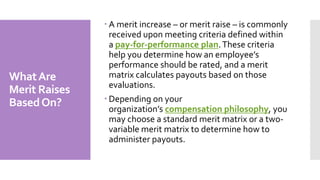
 A merit increase – or merit raise – is commonly
received upon meeting criteria defined within
a pay-for-performance plan.These criteria
help you determine how an employee’s
performance should be rated, and a merit
matrix calculates payouts based on those
evaluations.
 Depending on your
organization’s compensation philosophy, you
may choose a standard merit matrix or a two-
variable merit matrix to determine how to
administer payouts.
Standard
Merit Matrix
Example:
Performance
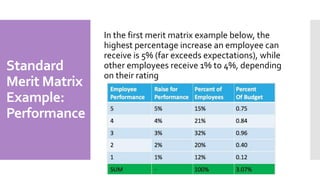
In the first merit matrix example below, the
highest percentage increase an employee can
receive is 5% (far exceeds expectations), while
other employees receive 1% to 4%, depending
on their rating
 Consider your total payroll budget is
$1,000,000, and you do not want to exceed
$33,000 within your merit increase pool. That
gives you 3.3% to play with. If you multiply
“Raise for Performance” by “Percent of
Employees” you will get the total percent of
budget for that performance level. In this
example, across all five performance
categories, the sum total to payout employees
is 3.07% of total payroll (i.e., $1,000,000 x
3.07% = $30,700).We are within budget!
Standard
Merit Matrix
Example:
Performance
Standard Merit Matrix Example II: Performance with Higher Payouts
HR professionals know that the merit matrix offers flexibility. Salary
increase percentages can be adjusted by performance categories and
employee distributions to meet budgetary restrictions. Ideally, your
organization is able to grant a significantly higher payout to its top
performers. Under this philosophy, the merit matrix would involve
steeper increases per performance level, maxing out closer to 10%. For
instance, individuals with an “Employee Performance” rating of “5”
might get paid out at 9%, whereas your “4” employees are at 6%, “3”
employees are at 3%, “2” employees are at 1%, and “1” employees are
at 0.5%. This more staggered merit increase scale will help you
distribute salary increases to reward strong employees, and send a
strong message to lesser performing employees, in an impactful way.
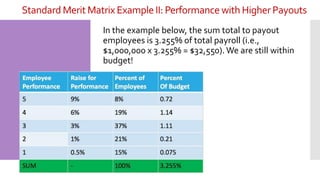
In the example below, the sum total to payout
employees is 3.255% of total payroll (i.e.,
$1,000,000 x 3.255% = $32,550). We are still within
budget!
Standard Merit Matrix Example II: Performance with Higher Payouts
Two-Variable Merit
Matrix Example:
Performance &
Range Position
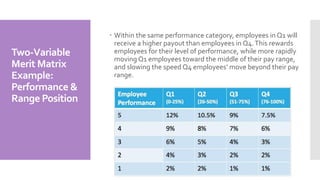
Using a more complex merit matrix, you can
take into account performance, as well as where
employees fall within their pay range.This can
be an effective compensation strategy to fully
optimize your merit matrix budget.This
approach ensures you are not perpetuating
salary range outliers, i.e., employees well above
or below the 50th percentile that could result in
an inequitable salary structure.This can be
problematic when increases are distributed
based on performance alone.
 In this example, employees are divided into
four quartiles, from the bottom fourth of their
salary range (Q1) to the top fourth of their
salary range (Q4.).You can calculate where an
employee falls in their salary range by using
the compa-ratio or range penetration
formulas.
 compa-ratio: (base salary / midpoint of salary
range)
 range penetration:
 ([base salary – range minimum] / [range
maximum – range minimum])
Two-Variable
Merit Matrix
Example:
Performance &
Range Position
 Within the same performance category, employees in Q1 will
receive a higher payout than employees in Q4.This rewards
employees for their level of performance, while more rapidly
moving Q1 employees toward the middle of their pay range,
and slowing the speed Q4 employees’ move beyond their pay
range.
Two-Variable
Merit Matrix
Example:
Performance &
Range Position
Module (6)
Salary taxes and insurance
IncomeTax
(EGYPT)
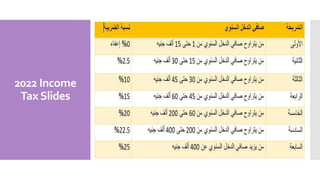
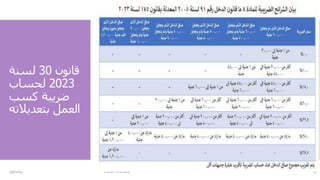
One of the many sources of national income, which
is imposed at different rates on the groups of people
according to their annual income level, and this tax
is imposed on individuals who work in government
entities or commercial professions, and companies
with capital that achieve an annual return, and an
annual declaration is submitted to the tax authority
to clarify the payment of all tax liabilities; to prevent
legal accountability.
2022 Income
TaxSlides
‫قانون‬
30
‫لسنة‬
2023
‫لحساب‬
‫كسب‬ ‫ضريبة‬
‫بتعديالت‬ ‫العمل‬
‫ه‬

‫مادة‬
(
٨
)
:

‫اآلتي‬ ‫النحو‬ ‫على‬ ‫الضريبة‬ ‫سعر‬ ‫يكون‬
:

٠.٠٠
‫من‬ ٪
١
‫جنيه‬
‫إلى‬
21000
‫جنيه‬
–
–
–
–

٢.٥
‫من‬ ‫أكثر‬ ٪
٢١.٠٠٠
‫إلى‬ ‫جنيه‬
٣٠.٠٠٠
‫من‬ ‫جنيه‬
١
‫إلى‬ ‫جنيه‬
٣٠.٠٠٠
‫جنيه‬

١٠
‫من‬ ‫أكثر‬ ٪
٣٠.٠٠٠
‫إلى‬ ‫جنيه‬
٤٥.٠٠٠
‫من‬ ‫أكثر‬ ‫جنيه‬
٣٠.٠٠٠
‫إلى‬ ‫جنيه‬
٤٥.٠٠٠
‫من‬ ‫جنيه‬
١
‫إلى‬ ‫جنيه‬
٤٥.٠٠٠
‫جنيه‬
–
–

١٥
‫من‬ ‫أكثر‬ ٪
٤٥.٠٠٠
‫إلى‬ ‫جنيه‬
٦٠.٠٠٠
‫من‬ ‫أكثر‬ ‫جنيه‬
٤٥.٠٠٠
‫إلى‬ ‫جنيه‬
٦٠.٠٠٠
‫من‬ ‫أكثر‬ ‫جنيه‬
٤٥.٠٠٠
‫إلى‬ ‫جنيه‬
٦٠.٠٠٠
‫من‬ ‫جنيه‬
١
‫إلى‬ ‫جنيه‬
٦٠.٠٠٠

٢٠
‫من‬ ‫أكثر‬ ٪
٦٠.٠٠٠
‫إلى‬ ‫جنيه‬
٢٠٠.٠٠٠
‫من‬ ‫أكثر‬ ‫جنيه‬
٦٠.٠٠٠
‫إلى‬ ‫جنيه‬
٢٠٠.٠٠٠
‫من‬ ‫أكثر‬ ‫جنيه‬
٦٠.٠٠٠
‫إلى‬ ‫جنيه‬
٢٠٠.٠٠٠
‫من‬ ‫أكثر‬ ‫جنيه‬
٦٠.٠٠٠
‫جنيه‬
‫إلى‬
٢٠٠.٠٠٠
‫من‬ ‫جنيه‬
١
‫إلى‬ ‫جنيه‬
٢٠٠.٠٠٠
‫جنيه‬

٢٢.٥
‫من‬ ‫أكثر‬ ٪
٢٠٠.٠٠٠
‫إلى‬ ‫جنيه‬
٤٠٠.٠٠٠
‫من‬ ‫أكثر‬ ‫جنيه‬
٢٠٠.٠٠٠
‫إلى‬ ‫جنيه‬
٤٠٠.٠٠٠
‫من‬ ‫أكثر‬ ‫جنيه‬
٢٠٠.٠٠٠
‫إلى‬ ‫جنيه‬
٤٠٠.٠٠٠
‫من‬ ‫أكثر‬ ‫جنيه‬
٢٠٠.٠٠٠
‫إلى‬ ‫جنيه‬
٤٠٠.٠٠٠
‫من‬ ‫أكثر‬ ‫جنيه‬
٢٠٠.٠٠٠
‫إلى‬ ‫جنيه‬
٤٠٠.٠٠٠
‫جنيه‬

٢٥
‫على‬ ‫زاد‬ ‫ما‬ ٪
٤٠٠.٠٠٠
‫على‬ ‫زاد‬ ‫ما‬ ‫جنيه‬
٤٠٠.٠٠٠
‫على‬ ‫زاد‬ ‫ما‬ ‫جنيه‬
٤٠٠.٠٠٠
‫على‬ ‫زاد‬ ‫ما‬ ‫جنيه‬
٤٠٠.٠٠٠
‫على‬ ‫زاد‬ ‫ما‬ ‫جنيه‬
٤٠٠.٠٠٠
‫من‬ ‫جنيه‬
١
‫إلى‬ ‫جنيه‬
٢٠٠.٠٠٠
‫جنيه‬

٢٧.٥
٪
–
–
–
–
–
‫على‬ ‫زاد‬ ‫ما‬
١.٢٠٠.٠٠٠
‫جنيه‬

‫عشرة‬ ‫ألقرب‬ ‫الضريبة‬ ‫حساب‬ ‫عند‬ ‫السنوى‬ ‫الدخل‬ ‫صافي‬ ‫مجموع‬ ‫تقريب‬ ‫ويتم‬
‫أقل‬ ‫جنيهات‬
.

‫مادة‬
(
١٣
/
‫بند‬
١
)
:

١
-
‫مبلغ‬
١٥.٠٠٠
‫للممول‬ ‫ا‬ً‫ي‬‫سنو‬ ‫ا‬ً‫ي‬‫شخص‬ ً‫ء‬‫إعفا‬ ‫جنيه‬
.
3/9/2024 Hisham Sharawy 71
How to
calculate
income tax
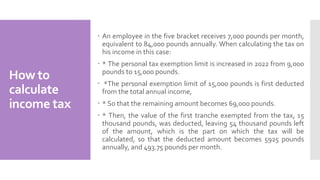
 An employee in the five bracket receives 7,000 pounds per month,
equivalent to 84,000 pounds annually. When calculating the tax on
his income in this case:
 * The personal tax exemption limit is increased in 2022 from 9,000
pounds to 15,000 pounds.
 *The personal exemption limit of 15,000 pounds is first deducted
from the total annual income,
 * So that the remaining amount becomes 69,000 pounds.
 * Then, the value of the first tranche exempted from the tax, 15
thousand pounds, was deducted, leaving 54 thousand pounds left
of the amount, which is the part on which the tax will be
calculated, so that the deducted amount becomes 5925 pounds
annually, and 493.75 pounds per month.
Social
Insurance
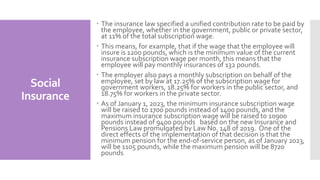
 The insurance law specified a unified contribution rate to be paid by
the employee, whether in the government, public or private sector,
at 11% of the total subscription wage.
 This means, for example, that if the wage that the employee will
insure is 1200 pounds, which is the minimum value of the current
insurance subscription wage per month, this means that the
employee will pay monthly insurances of 132 pounds.
 The employer also pays a monthly subscription on behalf of the
employee, set by law at 17.25% of the subscription wage for
government workers, 18.25% for workers in the public sector, and
18.75% for workers in the private sector.
 As of January 1, 2023, the minimum insurance subscription wage
will be raised to 1700 pounds instead of 1400 pounds, and the
maximum insurance subscription wage will be raised to 10900
pounds instead of 9400 pounds based on the new Insurance and
Pensions Law promulgated by Law No. 148 of 2019. One of the
direct effects of the implementation of that decision is that the
minimum pension for the end-of-service person, as of January 2023,
will be 1105 pounds, while the maximum pension will be 8720
pounds
Social
Insurance
 Social security contributions
 Employee contributions
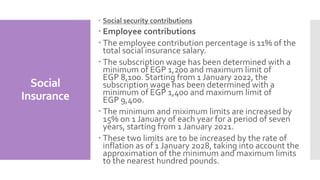
 The employee contribution percentage is 11% of the
total social insurance salary.
 The subscription wage has been determined with a
minimum of EGP 1,200 and maximum limit of
EGP 8,100. Starting from 1 January 2022, the
subscription wage has been determined with a
minimum of EGP 1,400 and maximum limit of
EGP 9,400.
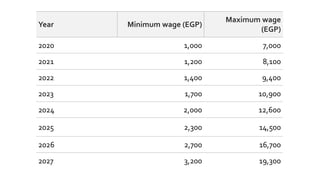
 The minimum and miximum limits are increased by
15% on 1 January of each year for a period of seven
years, starting from 1 January 2021.
 These two limits are to be increased by the rate of
inflation as of 1 January 2028, taking into account the
approximation of the minimum and maximum limits
to the nearest hundred pounds.
Year Minimum wage (EGP)
Maximum wage
(EGP)
2020 1,000 7,000
2021 1,200 8,100
2022 1,400 9,400
2023 1,700 10,900
2024 2,000 12,600
2025 2,300 14,500
2026 2,700 16,700
2027 3,200 19,300
Social
Insurance
Employer contributions
 The employer contribution percentage is
18.75% of the total social insurance salary.
 In addition to the above, any
managers/board of directors whose names are
included in the commercial register of the
company will be socially insured as employers
and would be subject to social insurance at a
flat rate of 21% of the total maximum wage
(i.e. EGP 8,100).
Module (7) Vacations and Leaves
3/9/2024 Hisham Sharawy 78
3/9/2024 Hisham Sharawy 79
3/9/2024 Hisham Sharawy 80
3/9/2024 Hisham Sharawy 81

‫يحـدد‬
‫صاحب‬
‫العمل‬
‫مواعيد‬
‫األجازة‬
‫السنوية‬
‫حسب‬
‫مقتضيات‬
‫العمل‬
،‫وظروفه‬
‫و‬
‫ال‬
‫يجوز‬
‫قطعها‬
‫إال‬
‫ألسب‬
‫اب‬
‫قوية‬
‫تقتضيها‬
‫مصلحة‬
‫العمل‬
.

‫ويلتزم‬
‫العامل‬
‫بالقيام‬
‫باألجازة‬
‫فى‬
‫التاريخ‬
‫و‬
‫للمد‬
‫ة‬
‫التى‬
‫حددها‬
‫صاحب‬
‫العمل‬
‫وإذا‬
‫رفض‬
‫العامل‬
‫كتابة‬
‫القيام‬
‫باألجازة‬
‫سقط‬
‫حقه‬
‫فى‬
‫اقتضاء‬
‫مقابلها‬
.

‫وفى‬
‫جميع‬
‫األحوال‬
‫يجب‬
‫أن‬
‫يحصل‬
‫العامل‬
‫على‬
‫إجازة‬
‫سنوية‬
‫مدتها‬
‫خمسة‬
‫عشر‬
،‫يوما‬
‫منها‬
‫ستة‬
‫أيام‬
‫متصلة‬
‫ع‬
‫لى‬
‫األقل‬
‫ويلتزم‬
‫صاحب‬
‫العمل‬
‫بتسوية‬
‫رصيد‬
‫األجازات‬
‫أو‬
‫األجر‬
‫المقابل‬
‫له‬
‫كل‬
‫ثالث‬
‫سنوات‬
‫فإذا‬
‫انتهت‬
‫عالقة‬
‫ا‬
‫لعمل‬
‫قبل‬
‫استنفاد‬
‫العامل‬
‫رصيد‬
‫أجازته‬
‫السنوية‬
‫استحق‬
‫األجر‬
‫المقابل‬
‫لهذا‬
‫الرصيد‬
.

‫وال‬
‫يجوز‬
‫تجزئة‬
‫اإلجازة‬
‫أو‬
‫ضمها‬
‫أو‬
‫تأجيلها‬
‫بالنسبة‬
‫لألطفال‬
.
3/9/2024 Hisham Sharawy 82
3/9/2024 Hisham Sharawy 83

‫على‬
‫العامل‬
‫أن‬
‫يتقدم‬
‫بطلب‬
‫الحصول‬
‫على‬
‫إجازته‬
‫االعتيادية‬
‫في‬
،‫موعدها‬
‫فإما‬
‫أن‬
‫يقبلها‬
‫صاحب‬
‫العمل‬
‫أو‬
‫يتم‬
‫ترحيلها‬
‫للعام‬
‫التالي‬
‫ف‬
‫إذا‬
‫انقضت‬
3
‫سنوات‬
‫كان‬
‫على‬
‫صاحب‬
‫العمل‬
‫التزام‬
‫بتسوية‬
‫المقابل‬
‫النقدي‬
‫لرصيد‬
‫األجازات‬
‫وصرفه‬
‫للعامل‬
‫فإذا‬
‫انتهت‬
‫خدمة‬
‫العامل‬
‫دون‬
‫الحصول‬
‫على‬
‫رصيد‬
‫اإلجازات‬
‫االعتيادية‬
‫صرف‬
‫له‬
‫المقابل‬
‫النقدي‬
‫ل‬
‫ذلك‬
‫الرصيد‬
‫بدون‬
‫حد‬
‫أقصى‬
.

‫فإذا‬
‫كان‬
‫هناك‬
‫تقصير‬
‫من‬
‫العامل‬
‫بقصد‬
‫الحصول‬
‫على‬
‫المقابل‬
‫النق‬
‫دي‬
‫لهذا‬
‫الرصيد‬
‫يصرف‬
‫له‬
‫المقابل‬
‫النقدي‬
‫لرصيد‬
‫األجازات‬
‫بحد‬
‫أقصى‬
‫ثالث‬
‫شهور‬
.

‫فإذا‬
‫كان‬
‫ترحيل‬
‫أجازة‬
‫العامل‬
ً‫راجعا‬
‫لظروف‬
‫العمل‬
‫ولم‬
‫يلتزم‬
‫صاحب‬
‫العمل‬
‫بتسوية‬
‫المقابل‬
‫النقدي‬
‫لرصيد‬
‫اإلجازات‬
‫للعامل‬
‫كل‬
3
‫سنوات‬
‫فإذا‬
‫انتهت‬
‫مدة‬
‫خدمة‬
‫العامل‬
‫فال‬
‫يجوز‬
‫حرمانه‬
‫من‬
‫الحصول‬
‫على‬
‫المقابل‬
‫النقدي‬
‫لرصيد‬
‫األجازات‬
‫مهما‬
‫كانت‬
‫مدته‬
‫فإذا‬
‫امتنع‬
‫صاحب‬
‫العمل‬
‫كان‬
‫ذلك‬
ً‫إخالال‬
‫منه‬
‫بالتزاماته‬
‫وهو‬
‫ما‬
‫يرتب‬
‫للعامل‬
‫الحق‬
‫في‬
‫التعويض‬
‫عن‬
‫هذا‬
‫الرصيد‬
.
Module (7)
Salary andWage payment Deduction
‫الخصم‬ ‫قواعد‬
‫راتب‬ ‫من‬
‫العامل‬
‫والموظف‬

‫مادة‬
43

-
‫أجر‬ ‫من‬ ‫يقتطع‬ ‫أن‬ ‫العمل‬ ‫لصاحب‬ ‫يجوز‬ ‫ال‬
‫من‬ ‫أكثر‬ ‫العامل‬
(
10
)%
‫أقرضه‬ ‫قد‬ ‫يكون‬ ‫لما‬ ‫وفاء‬
‫أثناء‬ ‫مال‬ ‫من‬
‫سريان‬
‫العقد‬
‫ع‬ ‫فائدة‬ ‫أية‬ ‫يتقاضى‬ ‫أن‬ ‫أو‬
‫ن‬
‫األجور‬ ‫على‬ ‫الحكم‬ ‫ذلك‬ ‫ويسرى‬ ، ‫القروض‬ ‫هذه‬
‫مقدما‬ ‫المدفوعة‬
.
‫الخصم‬ ‫قواعد‬
‫راتب‬ ‫من‬
‫العامل‬
‫والموظف‬

‫مادة‬
44

-
‫مع‬
‫المواد‬ ‫أحكام‬ ‫مراعاة‬
75
,
76
,
77
‫أوضاع‬ ‫بعض‬ ‫تنظيم‬ ‫قانون‬ ‫من‬
‫رقم‬ ‫بالقانون‬ ‫الصادر‬ ‫األحوااللشخصية‬ ‫مسائل‬ ‫في‬ ‫التقاضي‬ ‫وإجراءات‬
1
‫لسنة‬
2000
‫عن‬ ‫النزول‬ ‫أو‬ ‫الحجز‬ ‫أو‬ ‫االستقطاع‬ ‫األحوال‬ ‫جميع‬ ‫في‬ ‫يجوز‬ ‫ال‬ ،
‫حدود‬ ‫في‬ ‫إال‬ ‫دين‬ ‫أي‬ ‫ألداء‬ ‫للعامل‬ ‫األجرالمستحق‬
(
25
)%
، ‫األجر‬ ‫هذا‬ ‫من‬
‫إلى‬ ‫الخصم‬ ‫نسبة‬ ‫رفع‬ ‫ويجوز‬
50
%
‫حالة‬ ‫في‬
‫دين‬
‫النفقة‬
.

-
‫وعند‬
‫بس‬ ‫العمل‬ ‫لصاحب‬ ‫مطلوبا‬ ‫يكون‬ ‫ما‬ ‫ثم‬ ، ‫النفقة‬ ‫دين‬ ‫يقدم‬ ‫التزاحم‬
‫ما‬ ‫بب‬
‫أ‬ ، ‫حق‬ ‫وجه‬ ‫بغير‬ ‫إليه‬ ‫صرف‬ ‫لما‬ ‫أواستردادا‬ ، ‫مهمات‬ ‫أو‬ ‫أدوات‬ ‫من‬ ‫العامل‬ ‫أتلفه‬
‫و‬
‫جزاءات‬ ‫من‬ ‫العامل‬ ‫على‬ ‫وقع‬ ‫ما‬
.

-
‫ويشترط‬
‫أ‬ ‫المادة‬ ‫بهذه‬ ‫المقررة‬ ‫النسبة‬ ‫حدود‬ ‫في‬ ‫األجر‬ ‫عن‬ ‫النزول‬ ‫لصحة‬
‫ن‬
‫العامل‬ ‫من‬ ‫مكتوبة‬ ‫موافقة‬ ‫به‬ ‫تصدر‬
.

-
‫وتحسب‬
‫استق‬ ‫بعد‬ ‫المادة‬ ‫هذه‬ ‫من‬ ‫األولى‬ ‫الفقرة‬ ‫في‬ ‫إليها‬ ‫المشار‬ ‫النسبة‬
‫طاع‬
‫التأمي‬ ‫لقوانين‬ ‫وفقا‬ ‫المبالغالمستحقة‬ ‫وقيمة‬ ، ‫األجر‬ ‫على‬ ‫الدخل‬ ‫ضريبة‬
‫االجتماعي‬ ‫ن‬
‫عل‬ ‫المنصوص‬ ‫النسبة‬ ‫حدود‬ ‫في‬ ‫للعامل‬ ‫أقرضه‬ ‫قد‬ ‫العمل‬ ‫صاحب‬ ‫يكون‬ ‫وما‬ ،
‫يهافي‬
‫السابقة‬ ‫المادة‬
.
‫الخصم‬ ‫قواعد‬
‫راتب‬ ‫من‬
‫العامل‬
‫والموظف‬

‫مادة‬
61

-
‫ال‬
‫عن‬ ‫العامل‬ ‫على‬ ‫الخصم‬ ‫جزاء‬ ‫يوقع‬ ‫أن‬ ‫العمل‬ ‫لصاحب‬ ‫يجوز‬
‫أن‬ ‫واليجوز‬ ، ‫أيام‬ ‫خمسة‬ ‫أجر‬ ‫على‬ ‫يزيد‬ ‫بما‬ ‫الواحدة‬ ‫المخالفة‬
‫أ‬ ‫من‬ ‫أكثر‬ ‫يوقعها‬ ‫التي‬ ‫للجزاءات‬ ‫وفاء‬ ‫العامل‬ ‫أجر‬ ‫من‬ ‫يقتطع‬
‫جر‬
‫الواحد‬ ‫الشهر‬ ‫فى‬ ‫أيام‬ ‫خمسة‬
.

-
‫وإذا‬
‫المقصود‬ ‫أن‬ ‫اعتبر‬ ‫األجر‬ ‫من‬ ‫محددة‬ ‫بنسبة‬ ‫الخصم‬ ‫حدد‬
‫للعامل‬ ‫اليومي‬ ‫األساسي‬ ‫األجر‬ ‫هو‬ ‫بذلك‬
.
‫الخصم‬ ‫قواعد‬
‫راتب‬ ‫من‬
‫العامل‬
‫والموظف‬

‫مادة‬
73

‫إذا‬
‫تسبب‬
‫العامل‬
‫بخطئه‬
‫وبمناسبة‬
‫عمله‬
‫في‬
‫فقد‬
‫أو‬
‫إتالف‬
‫مهما‬
‫ت‬
‫أو‬
‫آالت‬
‫أو‬
‫خامات‬
‫أو‬
‫منتجات‬
‫يملكها‬
‫صاحبالعمل‬
‫أو‬
‫كانت‬
‫في‬
‫عهدته‬
‫التزم‬
‫بأداء‬
‫قيمة‬
‫ما‬
‫فقد‬
‫أو‬
‫أتلف‬
.

‫ولصاحب‬
‫العمل‬
‫بعد‬
‫إجراء‬
‫التحقيق‬
‫وإخطار‬
‫العامل‬
‫أن‬
‫يبدأ‬
‫باقتطاع‬
‫الم‬
‫بلغ‬
‫المذكور‬
‫من‬
‫أجره‬
‫على‬
‫أال‬
‫يزيد‬
‫ما‬
‫يقتطعلهذا‬
‫الغرض‬
‫على‬
‫أجر‬
‫خم‬
‫سة‬
‫أيام‬
‫في‬
‫الشهر‬
‫الواحد‬
.

‫ويجوز‬
‫للعامل‬
‫أن‬
‫يتظلم‬
‫من‬
‫تقدير‬
‫صاحب‬
‫العمل‬
‫أمام‬
‫اللجنة‬
‫المش‬
‫ار‬
‫إ‬
‫ليها‬
‫في‬
‫المادة‬
(
71
)
‫من‬
‫هذا‬
‫القانون‬
‫ووفقاللمدد‬
‫واإلجراءات‬
‫الواردة‬
‫بها‬
.

‫فإذا‬
‫لم‬
‫يقض‬
‫لصاحب‬
‫العمل‬
‫بالمبلغ‬
‫الذى‬
‫قدره‬
‫لإلتالف‬
‫أو‬
‫قضى‬
‫له‬
‫ب‬
‫أقل‬
‫منه‬
‫وجب‬
‫عليه‬
‫رد‬
‫ما‬
‫اقتطع‬
‫دون‬
‫وجه‬
‫حق‬
‫خالل‬
‫سبعة‬
‫أيام‬
‫من‬
‫تاريخ‬
‫صدور‬
‫قرار‬
‫اللجنة‬
.

‫وال‬
‫يجوز‬
‫لصاحب‬
‫العمل‬
‫أن‬
‫يستوفى‬
‫مستحقاته‬
‫بطريق‬
‫االقتطا‬
‫ع‬
‫وفق‬
‫حكم‬
‫هذه‬
‫المادة‬
‫إذا‬
‫بلغ‬
‫مجموعها‬
‫أجر‬
‫شهرين‬
.
‫ملخص‬
‫االستقطاع‬

‫اوال‬
:
‫المواد‬ ‫ي‬
‫ف‬ ‫باآلجر‬ ‫المقصود‬
‫السابقة‬

‫للعامل‬ ‫الشامل‬ ‫ي‬
‫الفعل‬ ‫االجر‬ ‫هو‬
,
‫الم‬ ‫المبالغ‬ ‫كافة‬‫أي‬
‫ستحقة‬
‫قانون‬ ‫بموجب‬ ‫للعامل‬
‫العمل‬

‫ثانيا‬
:
‫االستقطاعات‬ ‫اوجه‬
(
‫والت‬ ‫يبة‬‫الض‬ ‫خصم‬ ‫بعد‬
‫أمينات‬
‫االجتماعية‬

·
‫العمل‬ ‫لصاحب‬ ‫دين‬
(
‫سلفة‬
)

·
‫معدات‬ ‫او‬ ‫االت‬ ‫تلف‬
‫العمل‬

·
‫اءات‬‫ز‬‫الج‬

·
‫دين‬
‫ي‬
‫خارج‬

·
‫النفقة‬ ‫دين‬
‫ثالثا‬
:
‫طرق‬
‫واولوية‬
‫االستقطاعات‬

1
–
‫دين‬
‫وط‬ ‫ر‬
‫الش‬ ‫النفقة‬
:
‫حد‬ ‫ي‬
‫ف‬ ‫العامل‬ ‫عل‬ ‫الخصم‬ ‫يجوز‬
‫ود‬
50
%
‫االخرى‬ ‫والديون‬ ‫النفقة‬ ‫دين‬ ‫حالة‬ ‫ي‬
‫ف‬ ‫االجر‬ ‫من‬
(
‫سلفه‬
–
‫اتالف‬
‫االت‬
–
‫اءات‬‫ز‬‫ج‬
–
‫دين‬
‫ي‬
‫خارج‬
)
‫ويقدم‬
‫حالة‬ ‫ي‬
‫ف‬ ‫اوال‬ ‫النفقة‬ ‫دين‬
‫العمل‬ ‫لصاحب‬ ‫مستحقا‬ ‫يكون‬ ‫ما‬ ‫ويليه‬ ‫وجوده‬
(
‫سلفه‬
–
‫اتال‬
‫االت‬ ‫ف‬
–
‫اءات‬‫ز‬‫ج‬
–
‫ي‬
‫خارج‬ ‫دين‬

2
–
‫لدين‬ ‫العمل‬ ‫لصاحب‬ ‫يستحق‬ ‫ما‬
(
‫سلفه‬
)
‫وط‬ ‫ر‬
‫الش‬
:
‫ت‬ ‫ال‬
‫زيد‬
‫عن‬ ‫خصمه‬ ‫يتم‬ ‫ما‬ ‫نسبة‬
10
%
‫الشهر‬ ‫ي‬
‫ف‬ ‫الشامل‬ ‫العامل‬ ‫اجر‬ ‫من‬
‫الواحد‬

3
–
‫معدات‬ ‫او‬ ‫االت‬ ‫اتالف‬
‫العمل‬
‫وط‬ ‫ر‬
‫الش‬
:
‫الخص‬ ‫نسبة‬ ‫تزيد‬ ‫ال‬
‫م‬
‫عن‬
5
‫الواحد‬ ‫الشهر‬ ‫ي‬
‫ف‬ ‫الشامل‬ ‫العامل‬ ‫اجر‬ ‫من‬ ‫ايام‬
,
‫ان‬ ‫يجوز‬ ‫وال‬
‫اجر‬ ‫عن‬ ‫خصمه‬ ‫يتم‬ ‫ما‬ ‫ي‬
‫إجمال‬ ‫مبلغ‬ ‫يزيد‬
‫شهرين‬

4
–
‫وط‬ ‫ر‬
‫الش‬ ‫اءات‬‫ز‬‫الج‬
:
‫عن‬ ‫الخصم‬ ‫نسبة‬ ‫تزيد‬ ‫ال‬
5
‫اجر‬ ‫من‬ ‫ايام‬
‫الشهر‬ ‫ي‬
‫ف‬ ‫الشامل‬ ‫العامل‬
‫الواحد‬

5
–
‫دين‬
‫وط‬ ‫ر‬
‫الش‬ ‫ي‬
‫خارج‬
:
‫من‬ ‫الخصم‬ ‫نسبة‬ ‫تزيد‬ ‫ان‬ ‫يجوز‬ ‫ال‬
‫اجر‬
‫االخرى‬ ‫الديون‬ ‫ي‬
‫باف‬ ‫ال‬ ‫باإلضافة‬ ‫ي‬
‫خارج‬ ‫دين‬ ‫ألى‬ ‫العامل‬
(
‫س‬
‫لفه‬
–
‫االت‬ ‫اتالف‬
–
‫اءات‬‫ز‬‫ج‬
–
‫ي‬
‫خارج‬ ‫دين‬
)
‫حدود‬ ‫ي‬
‫ف‬ ‫اال‬
25
%
‫االجر‬ ‫من‬

HUMAN RESOURCES MANAGEMENT outlines and presentation5.pdf

  • 1.
  • 2.
    CourseAgenda Introduction about HR…………..…………L.1 HRstrategic Concepts………………………L.2 Job Analysis……………………………………L.3 Recruitment……………………………………L.4 Selecting andTesting……………………….L.5 Interviewing……………………………..……L.6 Hiring and Orientation……………………..L.7 Training and Development………………..............….L.8-9 3/9/2024 2 Hisham Sharawy
  • 3.
    Performance Appraisal …….........................L.10 Mid-Termexam…………………………………….L.11 Performance Management….................…L. 12/13 KPI implementation………………….…………L14-15 Career Management………………….…………..L.16 Salaries structure…………………………………. L.17 Taxation and Social Insurance………………….L.18 Benefits and compensation design………..…L.19 Managing Change…………………………...…….L.20 Revision and Final Exam………………………….L.21 Group Project discussion…………………………L.22 3/9/2024 3 Hisham Sharawy
  • 5.
    Salary vs Wage  Theterm salary and wages is often confused by people and is used interchangeably. But the truth is that both these terms differ from each other and hold different meanings.  Salary is a fixed amount paid or transferred to the employees at regular intervals for their performance and productivity, at the end of the month whereas  Wages are hourly or daily-based payment given to the labour for the amount of work finished in a day.
  • 7.
    Introduction to Wagesand Compensation Regulations
  • 8.
    What pay and compensation schemes? Payand compensation regulations: All financial returns (e.g. wages, salaries, incentives) Non-financial returns (e.g. employee benefits, moral benefits) They get as part of their relationship with the organization they work on. Compensation: (it is financial or non-financial return for the person vs job, performance or for anything related to the work of the organization).
  • 9.
    Wages and compensationsystems Monetary Non-monetary Provisional incentives Salary supplement (permanent) Annual allowance Vacancy bonus Benefits and services Mental returns Basic salary
  • 10.
    Importance of pay and compensation systems ForOrganization 1. Wages and compensation systems are part of the cost of producing goods and services provided by the Organization. 2. Wages and compensation regulations affect productivity. 3. It attracts skilled workers for high pay 4. Impact on a particular pay behavior.
  • 11.
    Importance of pay and compensation systems ForEmployees: Without wages, workers cannot live in dignity and, as a matter of preference, pay is of great importance to workers for the following reasons: 1. Wages help workers meet the cost of living. 2. Wages are for the effort and contribution of workers. 3. Wages are right for employees.
  • 12.
    Importance of pay and compensation systems Wagesare particularly important for the Organization's owners and capitalists, and there are views on this as follows: 1. Wages are generated/ extracted from profit. 2. Wages are a burden on the profits. 3. Ownership can be built with pay.
  • 13.
    Components of pay and compensation systems Salaries and pay supplement:  Salary and salary supplementation is permanent when it is added to the salary and becomes part of the pay and salary and consists of: 1. Annual increment 2. Cost of living allowance  Incentives:  It is paid for distinct performance, which is temporary and variable and not permanent and is divided into: 1. Individual incentives 2. Collective incentives 3. Incentives at the Organization-wide level
  • 14.
    Problems of pay and compensation regulations I: Problems with pay systems: 1.Salary is below the value of the job or above it. 2.Salary is not enough to cope with the burden of life. 3.Less pay than in the market. 4.Lack of clarity in post salary increments. 5.Salaries and wages are tied to the aims and strategies of the Organization. 6.Employees on different payrolls amounts are assigned the same job. 7.Promotion policies are unclear. 8.Managers' authority to grant increments and increases is unclear. 9.The payroll's secret, which means the employees don't know what's going on with their colleagues?
  • 15.
    Problems with wages and compensation systems Third:Problems with benefits systems and employee services: 1.It does not help to feel job security 2.Don't cover what the workers hope for. 3.It does not cover health services 4.The procedures for obtaining services and benefits are not clear 5.Senior management is not satisfied with granting benefits and services
  • 16.
  • 17.
    Types of incentives If thewage or salary is the consideration that the individual receives as the value of the job he occupies! The incentive is the return that he obtains as a result of excellence in performance. As for the advantages, it is the return that the individual obtains as a member of the organization in which he works, and as you see that each of these parts has a different meaning and an important role in the organization .
  • 18.
    Why are the incentives? A goodincentive system achieves beneficial results, the most important of which are : 1. Raising the motivation and enthusiasm of workers to perform the work . 2. Notice of justice workers . 3. The increase of work outputs in the form of production quantities, production quality, sales, and profits . 4. Reducing work losses Such as reducing costs, reducing quantities of raw materials, reducing waste in human resources and any other resources . 5. Satisfying the workers' needs of all kinds, especially appreciation, respect and a sense of status.
  • 19.
    6- Notifying employeesof the spirit of justice within the organization. 7- Attracting employees to the organization and raising the spirit of loyalty and belonging . 8 -Developing the spirit of cooperation among workers and developing team spirit and solidarity . 9 -Improving the project's image in front of the community . Why are the incentives?
  • 20.
    Different types of incentives Incentives atthe individual level . Incentives at the workgroup level . Incentives across the organization as a whole . Incentives can also be divided into the following base: *Workers incentives * Incentives at the level of specialists and admin- staff By combining these two classifications, the following classification can be reached, which we explain in detail :
  • 21.
    Worker incentives Freelancer incentives : It isconsidered one of the most important ways to pay both wages and incentives together. In this method, the incentive that the worker receives is determined according to the quantity of production, or the no of pieces produced or the effort spent Its advantages : 1. Ease of understanding and absorption . 2. A direct effect on the enthusiasm of individuals to increase production because it directly affects the income of the individual . 3. The worker exercises a kind of self- censorship on himself . 4. Accurately according to the cost of wages because it is linked to the number of units . Its disadvantages : 1. The tendency of work to inaccuracy and lack of quality . 2. New workers frustrated .
  • 22.
    Worker incentives Time incentives : Inthis method, the worker has to produce at the specified time and is rewarded for the amount of savings at this time, or he is rewarded for using the same time in greater production . The incentive can depend on time, by calculating the typical or standard production time. Then the wage and incentive are determined based on the existence of hourly wages, at an agreed rate as an incentive, and standard production during the working day .
  • 23.
    Incentives for specialists and administrators commission: It’s a special payment against regular agreed sales or agreement as a percentage of those. bonus : 1. Efficiency Bonus: It is an increase in wage or salary based on the special productivity of the individual in his work. It is granted after a period and when the individual proves high productivity and some times we call it “promotional pay” 2. Exceptional bonus: granted due to outstanding task, duty, performance or effort . reward : It looks like Exceptional bonus but the difference that it is not pre –promised before duty
  • 24.
    Incentives across the organization as awhole They are incentive plans built to motivate the employees of the organization, based on performance and overall efficiency.There are three types of them : 1. Participate in the “Grand Profit System” of the organization's that employees benefit from it. It consists of deducting a certain percentage of the company's profits and then distributing it to the employees . 2. Employee ownership of company shares . 3. Periodical Incentive: It’s paid as a motivation for employees due to being in a department or in organization and it’s not fixed paid but periodically
  • 25.
    Moral incentives It is noless important than material incentives and does not cost much, and it depends on the saying of the Messenger, may God’s prayers and peace be upon him (a good word is true), and it is of three types : 1. Thanks and appreciation 2. Gifts 3. Celebration
  • 26.
    Factors affecting wageand compensation systems
  • 27.
    Introduction Wage and compensationsystems do not come out of nowhere. There are many factors that influence the shape and size of these systems. Some of these factors are internal and some are internal. What is meant by external factors: What is beyond the scope of the organization's control, or is outside the geographical boundaries of the organization, or is a societal factor. They include: (laws and legislation, the impact of competition and competitors, supply and demand...) The internal factors: It means the factors and forces that exist within the organization, and in which the organization has a fundamental role in shaping it.
  • 28.
    Internal Impacts First: theobjectives of the organization: The objectives of the organization have a direct impact on the form and size of the salaries and compensations that it pays. These goals include: 1.Improving performance: as the organization seeks to link wages to productivity through systems various incentives, and this is done through: Incentives are designed at the individual level by examining the efficiency of individual performance, such as examining the result of the annual performance appraisal of employees. Incentives are linked to the collective performance of employees at the level of department, department or production line. Possession is linked to desired performance behavior such as discipline at work. 2.Raise the added value
  • 29.
    Internal Impacts 3. Enhancementthe organization's culture 4. Empowering employees 5. Attract the best skills 6. Develop loyalty and belonging 7. Encouraging teamwork 8. Achieving internal and external justice
  • 30.
    External factors First: Lawsand legislation: 1. Minimum wage laws. 2. Pay non-discrimination laws. 3. Social insurance laws. 4. Laws of material compensation for work injuries. 5. Payroll tax laws. 6. Laws affecting employee services and benefits. 7. Taxation Law
  • 31.
    Pay and compensationstrategies Refer to the appropriate mix of wages and compensation that is compatible with the conditions of the organization. The wages and compensation systems consist of salaries, incentives, employee benefits and services, and the ideal combination means which of these components will be used? And in what size ? The organization must determine which of the three components will be used, is it only one, two or all of them? And if all are used, what are the usage rates? For example, it can be said that100% of what the workers get will be distributed as follows60% basic salary and 30 % incentives and 10 % employee benefits and services. It is noted that if these percentages are compatible with the organization, it may not be compatible with other organizations, as each organization has its own circumstances and strategies.
  • 32.
    Pay and compensationstrategies Levels First: the overall strategy: It refers to the main and general moves at the level of the organization or at the level of its senior management, which are the moves that guide the rest of the moves in the organization. Among the most important macro strategies:  Differentiation strategy (refers to the organization's provision of its services and products in a way that is distinct from the products and services )  Cost reduction strategy (here the organization focuses on producing more at a lower cost)  Creativity and innovation strategy (Many companies rely on their distinction to be determined by creativity and innovation in the ideas they present.  Expansion strategy (when the organization's goal is to enter many markets, especially in other countries)
  • 33.
    Pay and compensationstrategies Second: Human Resources Strategy:  Staff recruitment and selection strategy.  performance appraisal strategy.  Training strategy.  The paternalistic strategy in human resources.
  • 34.
    Pay and compensationstrategies Third: Wages and Compensation Strategy: Types of wages and compensation:  Types of salaries.  Types of incentives.  Types of benefits and services.  Its size (estimated in money).  their ratio to each other.)%(
  • 35.
    Pay and compensationstrategies Fourth :The wage and compensation strategy’s implementation: The wage and compensation strategy must take its time in implementation before it is evaluated and reviewed. One of the most important methods of evaluating the wages and compensation strategy is to measure its impact on: •The behavior of workers, where we follow up here the impact of the wages and compensation strategy on the behavior of workers, for example: 1.The performance of workers in quantity and quality 2.employee turnover rate 3.Improve employee satisfaction
  • 36.
    Module (3) Job evaluationand internal fairness in salaries
  • 37.
    Job evaluation Internal justice in salary  Definitionof Job Evaluation: The job evaluation process is defined as the process by which the relative importance of each of the establishment's jobs is determined compared to other jobs in terms of characteristics, duties, responsibilities, tasks, working conditions, necessary qualifications and results. This process is used in many human resource activities, the most important of which is determining the fair wage for each job and setting a structure for salaries and wages at the enterprise level..
  • 38.
    Design a job evaluation system 1.Introductionto system design ,lamrof( ohw senimreted ohw ,liated ni dengised )sboj setaulave 2.Choosing a job evaluation method 3.Develop features of the evaluation plan 4.Verb evaluationjfor jobs 5.Determine the number of degrees 6.Grade pricing 7. The system circuitainjustice
  • 39.
    Methods of job evaluation There areactually two groups of methods used in job evaluation: The first group: the sum of non-quantitative descriptive methods, including: 1. arrangement method. 2. The double comparison method. 3. grading method. The 2nd group:Total modern quantitative methods, including: 1. points method. 2. Factor comparison method.
  • 40.
    Methods of job evaluation 1stmethod (non quantitative –Descriptive method) -Which One of the simplest and oldest methods, and is suitable for small companies that the number of jobs in it a little. - According to this method, jobs are arranged from highest to lowest without regard to the individual incumbent, and without regard to wage paid for their work. -The arrangement is made at the level of each department of the company, and then at the level of the company as a whole. - Practically: We choose the job that comes on top in terms of importance. -Then:We choose the job that comes last in terms of importance. - Finally:We choose the job that comes in the middle in terms of importance.
  • 41.
    Methods of job evaluation  Example: Ifin a company we have the following five functions: Sales supervisor, sales representative, account clerk ,Treasurer, secretary The simple arrangement is as follows: Sales Supervisor position at the top. Secretary job in the back. In Centre Accounts Clerks job.  So the final ranking is as follows: Top job: Sales Supervisor Sales Representative Bookkeeper treasurer The lowest position is a secretary
  • 42.
    Methods of job evaluation 2. Methodof Double comparison: Here, The job is compared with all other jobs in terms of education, experience, responsibility and results. From this comparison, it is determined which one is more important by giving it a point, and in the end we collect the points obtained for each job, and arrange the jobs according to the number of points from top to bottom..
  • 43.
    Methods of job evaluation 3.Grading method: Determinesthe number of grades or categories for jobs to be in Enterprise: In this case, the facility management should determine the number of grades or categories into which jobs are classified, and this number varies from one facility to another according to the different types and number of jobs, centralization and decentralization, scope of supervision, promotion policy, etc. 3/9/2024 Hisham Sharawy 43
  • 44.
    Methods of job evaluation Modern methodsgroup (quantity): A- the point method It is a method characterized by its relative accuracy and the validity of its results, and it is based on comparing the jobs to be evaluated in the light of common factors between these jobs, so that the job gives a number of points in relation to the common factors that were chosen as the basis for evaluation, and the more points the job gets, the more points it indicates its importance in relation to other jobs..
  • 45.
    Methods of job evaluation  Stepsto apply the point method:  Determine the jobs to be evaluated: Some of the jobs are supervisory, and some are clerical, technical, administrative, etc. It is possible to assume, for the sake of simplicity, that the jobs are: supervisory positions. technical jobs. Administrative jobs. clerical jobs.
  • 46.
    Methods of job evaluation Determine thecommon factors on the basis of which the evaluation will be conducted: That is, identifying the factors that can be present in all jobs, but to varying degrees.The most common factors are: 1. skill. 2. the responsibility. 3. mental effort. 4. muscular effort. 5. working conditions. 6. Leadership. 7. Experience. 8. ....etc.
  • 47.
    Methods of job evaluation B-Factor comparison method: with a slight difference about the previous, which is that instead of determining the relative importance of the job by comparing it to a specific scale in which the evaluation factors and grades of each factor are indicated (the point method), it determines the relative importance of the job by directly comparing it to other jobs under each of the evaluation factors. Separately, and in the end, the sum of the values of the factors in the job is represented by their relative percentage. Steps to implement the method.
  • 48.
    Evaluation factors Selection of evaluationfactors usually are between five factors: 1.Mental requirements. (Creativity and analysis) 2.Skill 3.Physical requirements 4.Supervisory and non-supervisory responsibilities 5.working conditions 3/9/2024 Hisham Sharawy 48
  • 49.
    Experience the responsibilit y mental effort muscular effort working conditions Function (1) 1 3 5 4 4 Function (2) 2 2 4 5 5 Function(3) 3 1 2 1 3 Function (4) 4 4 3 3 2 Function (5) 5 5 1 2 1 And can Add other factors as necessary : •Choosing a number of significant jobs: on the basis of which the work will be compared when evaluating it, and it is required that these jobs represent the largest possible number of the establishment’s jobs. •Arranging the functioning jobs under each evaluation factor according to the importance of the factor in the job. Example
  • 50.
  • 51.
    Merit Matrix A meritmatrix, also known as a merit increase matrix or salary increase matrix, is a mathematical grid that compensation professionals provide to help company managers accurately and efficiently administer salary increases to an organization’s employees.
  • 52.
    Before you create your salaryincrease matrix Consider the following as you determine your budget: What is the goal of your merit increase program? Does your organization pay below market, at market or above market? If you are below market, do you want to make your organization’s compensation program more competitive? If you are at market, do you want to continue the status quo? If you are above market, are you trying to hold down salary growth? What is your organizational philosophy toward excellent performers?What about your substandard performers?
  • 53.
    Before you create your salary increase matrix Let’s have a look on the salary structure types.There are three main types of salary structure businesses use: Traditional Broadband Market-based According to one survey, the majority of businesses use market-based structures. And, the least common salary structure is broadband. The type of structure you use may depend on your industry, business size, business location, and employee classification (i.e., exempt vs. nonexempt). Keep in mind that you can change the salary structure you use. You don’t have to stick with the same type of structure, especially as your venture grows. Understand the types of salary structure to choose the one that works best for your small business.
  • 54.
    Traditional structure  It’s dividedinto numerous pay grades. Salary increases are relatively small jumps between pay grades. Employers can use traditional structures to prevent employees from capping out at the maximum salary too quickly.  Decide what an employee needs to do to move onto the next pay grade. You may use a variety of metrics to determine a pay raise, such as performance and length of employment.  Set the minimum and maximum salary range for each employee or employee group. Then, determine the number of pay grades within the structure.  Here’s an example traditional structure you can create for each department or group of employees: Pay Grade 1 Pay Grade 2 Pay Grade 3 Pay Grade 4 Pay Grade 5 Salary $35k – $37k $37k – $39k $39k – $41k $41k – $43k $43k – $45k
  • 55.
    Broadband structure  Broadband structuresare more flexible than traditional salary structures. These salary structures utilize fewer pay grades. And, each pay grade has a wider salary range than traditional structures.  If you use the broadband structure, you have more leeway when deciding an employee’s salary. You aren’t limited by a narrow salary range like a traditional structure.  However, using a broadband system can lead to greater pay inequalities between employees. Consider conducting a pay audit to identify pay disparities due to race, gender, disability, etc.  An employee may max out at the high end of their salary range if you implement a broadband salary structure. Although this might be great in the moment, the employee may start looking at other jobs when they no longer receive raises. Pay Grade 1 Pay Grade 2 Pay Grade 3 Salary $45k – $55k $55k – $70k $70k – $92k
  • 56.
    Market-based structure  It’sbased on what other employers pay employees. Under a market-based salary structure, conduct an external pay audit to determine your salary ranges for each position.  Put a list of positions and their descriptions before collecting market data.That way, you can better compare positions.  In some ways, market-based structures are a combination of traditional and broadband salary structures.The salary ranges can be high like broadband structures, but the ranges are generally narrow and consistent and maybe overlapping to provide agility of performance assessment. Pay Grade 1 Pay Grade 2 Pay Grade 3 Pay Grade 4 Pay Grade 5 Salary $40k – $47k $45k – $52k $50k – $57k $55k – $62k $60k – $67k
  • 57.
    Merit Matrix Approaches  Thereare Three common approaches when it comes to designing a merit increase grid: • Basic Broadband approach • Standard merit matrix – based on performance rating alone • Two-variable merit matrix – based on performance rating and an employee’s position within their pay range
  • 58.
    Broadband approach  If youuse a broadband pay structure, you would typically have a percentage increase amount for each level of employee performance regardless of where the employee salary is relative to the midpoint.You would design a spreadsheet with employee ratings on the left side and only one corresponding increase amount for each rating.You would need to take some initial steps before creating your spreadsheet: 1. Determine the average projected merit increase among organizations for the coming year. 2. Review your previous year’s evaluations to determine a rating distribution. Find the center of distribution (the rating with the most employees). Assuming that this number represents your average employees, this group will get the median or average increase. 3. Determine the rest of the rating categories (for example, you could use “outstanding,” “above average,” “below average” and “unsatisfactory”). 4. Determine the percentage of total employees in each rating category 5. Apply that percentage to your total merit increase budget to arrive at the increase distribution for each group.
  • 59.
    Broadband approach  you maysimply make an educated guess on the performance distribution:  Performance increase pool amount (total amount available for increases) = 3.5 percent  Ratings with corresponding increase percentages:  Outstanding = 5.5 percent to 6 percent  Above average = 4.5 to 5 percent  Average = 3.5 to 4 percent  Below average = 2 percent  Unsatisfactory = 0
  • 60.
    WhatAre Merit Raises BasedOn?  Amerit increase – or merit raise – is commonly received upon meeting criteria defined within a pay-for-performance plan.These criteria help you determine how an employee’s performance should be rated, and a merit matrix calculates payouts based on those evaluations.  Depending on your organization’s compensation philosophy, you may choose a standard merit matrix or a two- variable merit matrix to determine how to administer payouts.
  • 61.
    Standard Merit Matrix Example: Performance In thefirst merit matrix example below, the highest percentage increase an employee can receive is 5% (far exceeds expectations), while other employees receive 1% to 4%, depending on their rating
  • 62.
     Consider yourtotal payroll budget is $1,000,000, and you do not want to exceed $33,000 within your merit increase pool. That gives you 3.3% to play with. If you multiply “Raise for Performance” by “Percent of Employees” you will get the total percent of budget for that performance level. In this example, across all five performance categories, the sum total to payout employees is 3.07% of total payroll (i.e., $1,000,000 x 3.07% = $30,700).We are within budget! Standard Merit Matrix Example: Performance
  • 63.
    Standard Merit MatrixExample II: Performance with Higher Payouts HR professionals know that the merit matrix offers flexibility. Salary increase percentages can be adjusted by performance categories and employee distributions to meet budgetary restrictions. Ideally, your organization is able to grant a significantly higher payout to its top performers. Under this philosophy, the merit matrix would involve steeper increases per performance level, maxing out closer to 10%. For instance, individuals with an “Employee Performance” rating of “5” might get paid out at 9%, whereas your “4” employees are at 6%, “3” employees are at 3%, “2” employees are at 1%, and “1” employees are at 0.5%. This more staggered merit increase scale will help you distribute salary increases to reward strong employees, and send a strong message to lesser performing employees, in an impactful way.
  • 64.
    In the examplebelow, the sum total to payout employees is 3.255% of total payroll (i.e., $1,000,000 x 3.255% = $32,550). We are still within budget! Standard Merit Matrix Example II: Performance with Higher Payouts
  • 65.
    Two-Variable Merit Matrix Example: Performance& Range Position Using a more complex merit matrix, you can take into account performance, as well as where employees fall within their pay range.This can be an effective compensation strategy to fully optimize your merit matrix budget.This approach ensures you are not perpetuating salary range outliers, i.e., employees well above or below the 50th percentile that could result in an inequitable salary structure.This can be problematic when increases are distributed based on performance alone.
  • 66.
     In thisexample, employees are divided into four quartiles, from the bottom fourth of their salary range (Q1) to the top fourth of their salary range (Q4.).You can calculate where an employee falls in their salary range by using the compa-ratio or range penetration formulas.  compa-ratio: (base salary / midpoint of salary range)  range penetration:  ([base salary – range minimum] / [range maximum – range minimum]) Two-Variable Merit Matrix Example: Performance & Range Position
  • 67.
     Within thesame performance category, employees in Q1 will receive a higher payout than employees in Q4.This rewards employees for their level of performance, while more rapidly moving Q1 employees toward the middle of their pay range, and slowing the speed Q4 employees’ move beyond their pay range. Two-Variable Merit Matrix Example: Performance & Range Position
  • 68.
  • 69.
    IncomeTax (EGYPT) One of themany sources of national income, which is imposed at different rates on the groups of people according to their annual income level, and this tax is imposed on individuals who work in government entities or commercial professions, and companies with capital that achieve an annual return, and an annual declaration is submitted to the tax authority to clarify the payment of all tax liabilities; to prevent legal accountability.
  • 70.
  • 71.
    ‫قانون‬ 30 ‫لسنة‬ 2023 ‫لحساب‬ ‫كسب‬ ‫ضريبة‬ ‫بتعديالت‬ ‫العمل‬ ‫ه‬  ‫مادة‬ ( ٨ ) :  ‫اآلتي‬‫النحو‬ ‫على‬ ‫الضريبة‬ ‫سعر‬ ‫يكون‬ :  ٠.٠٠ ‫من‬ ٪ ١ ‫جنيه‬ ‫إلى‬ 21000 ‫جنيه‬ – – – –  ٢.٥ ‫من‬ ‫أكثر‬ ٪ ٢١.٠٠٠ ‫إلى‬ ‫جنيه‬ ٣٠.٠٠٠ ‫من‬ ‫جنيه‬ ١ ‫إلى‬ ‫جنيه‬ ٣٠.٠٠٠ ‫جنيه‬  ١٠ ‫من‬ ‫أكثر‬ ٪ ٣٠.٠٠٠ ‫إلى‬ ‫جنيه‬ ٤٥.٠٠٠ ‫من‬ ‫أكثر‬ ‫جنيه‬ ٣٠.٠٠٠ ‫إلى‬ ‫جنيه‬ ٤٥.٠٠٠ ‫من‬ ‫جنيه‬ ١ ‫إلى‬ ‫جنيه‬ ٤٥.٠٠٠ ‫جنيه‬ – –  ١٥ ‫من‬ ‫أكثر‬ ٪ ٤٥.٠٠٠ ‫إلى‬ ‫جنيه‬ ٦٠.٠٠٠ ‫من‬ ‫أكثر‬ ‫جنيه‬ ٤٥.٠٠٠ ‫إلى‬ ‫جنيه‬ ٦٠.٠٠٠ ‫من‬ ‫أكثر‬ ‫جنيه‬ ٤٥.٠٠٠ ‫إلى‬ ‫جنيه‬ ٦٠.٠٠٠ ‫من‬ ‫جنيه‬ ١ ‫إلى‬ ‫جنيه‬ ٦٠.٠٠٠  ٢٠ ‫من‬ ‫أكثر‬ ٪ ٦٠.٠٠٠ ‫إلى‬ ‫جنيه‬ ٢٠٠.٠٠٠ ‫من‬ ‫أكثر‬ ‫جنيه‬ ٦٠.٠٠٠ ‫إلى‬ ‫جنيه‬ ٢٠٠.٠٠٠ ‫من‬ ‫أكثر‬ ‫جنيه‬ ٦٠.٠٠٠ ‫إلى‬ ‫جنيه‬ ٢٠٠.٠٠٠ ‫من‬ ‫أكثر‬ ‫جنيه‬ ٦٠.٠٠٠ ‫جنيه‬ ‫إلى‬ ٢٠٠.٠٠٠ ‫من‬ ‫جنيه‬ ١ ‫إلى‬ ‫جنيه‬ ٢٠٠.٠٠٠ ‫جنيه‬  ٢٢.٥ ‫من‬ ‫أكثر‬ ٪ ٢٠٠.٠٠٠ ‫إلى‬ ‫جنيه‬ ٤٠٠.٠٠٠ ‫من‬ ‫أكثر‬ ‫جنيه‬ ٢٠٠.٠٠٠ ‫إلى‬ ‫جنيه‬ ٤٠٠.٠٠٠ ‫من‬ ‫أكثر‬ ‫جنيه‬ ٢٠٠.٠٠٠ ‫إلى‬ ‫جنيه‬ ٤٠٠.٠٠٠ ‫من‬ ‫أكثر‬ ‫جنيه‬ ٢٠٠.٠٠٠ ‫إلى‬ ‫جنيه‬ ٤٠٠.٠٠٠ ‫من‬ ‫أكثر‬ ‫جنيه‬ ٢٠٠.٠٠٠ ‫إلى‬ ‫جنيه‬ ٤٠٠.٠٠٠ ‫جنيه‬  ٢٥ ‫على‬ ‫زاد‬ ‫ما‬ ٪ ٤٠٠.٠٠٠ ‫على‬ ‫زاد‬ ‫ما‬ ‫جنيه‬ ٤٠٠.٠٠٠ ‫على‬ ‫زاد‬ ‫ما‬ ‫جنيه‬ ٤٠٠.٠٠٠ ‫على‬ ‫زاد‬ ‫ما‬ ‫جنيه‬ ٤٠٠.٠٠٠ ‫على‬ ‫زاد‬ ‫ما‬ ‫جنيه‬ ٤٠٠.٠٠٠ ‫من‬ ‫جنيه‬ ١ ‫إلى‬ ‫جنيه‬ ٢٠٠.٠٠٠ ‫جنيه‬  ٢٧.٥ ٪ – – – – – ‫على‬ ‫زاد‬ ‫ما‬ ١.٢٠٠.٠٠٠ ‫جنيه‬  ‫عشرة‬ ‫ألقرب‬ ‫الضريبة‬ ‫حساب‬ ‫عند‬ ‫السنوى‬ ‫الدخل‬ ‫صافي‬ ‫مجموع‬ ‫تقريب‬ ‫ويتم‬ ‫أقل‬ ‫جنيهات‬ .  ‫مادة‬ ( ١٣ / ‫بند‬ ١ ) :  ١ - ‫مبلغ‬ ١٥.٠٠٠ ‫للممول‬ ‫ا‬ً‫ي‬‫سنو‬ ‫ا‬ً‫ي‬‫شخص‬ ً‫ء‬‫إعفا‬ ‫جنيه‬ . 3/9/2024 Hisham Sharawy 71
  • 72.
    How to calculate income tax An employee in the five bracket receives 7,000 pounds per month, equivalent to 84,000 pounds annually. When calculating the tax on his income in this case:  * The personal tax exemption limit is increased in 2022 from 9,000 pounds to 15,000 pounds.  *The personal exemption limit of 15,000 pounds is first deducted from the total annual income,  * So that the remaining amount becomes 69,000 pounds.  * Then, the value of the first tranche exempted from the tax, 15 thousand pounds, was deducted, leaving 54 thousand pounds left of the amount, which is the part on which the tax will be calculated, so that the deducted amount becomes 5925 pounds annually, and 493.75 pounds per month.
  • 73.
    Social Insurance  The insurancelaw specified a unified contribution rate to be paid by the employee, whether in the government, public or private sector, at 11% of the total subscription wage.  This means, for example, that if the wage that the employee will insure is 1200 pounds, which is the minimum value of the current insurance subscription wage per month, this means that the employee will pay monthly insurances of 132 pounds.  The employer also pays a monthly subscription on behalf of the employee, set by law at 17.25% of the subscription wage for government workers, 18.25% for workers in the public sector, and 18.75% for workers in the private sector.  As of January 1, 2023, the minimum insurance subscription wage will be raised to 1700 pounds instead of 1400 pounds, and the maximum insurance subscription wage will be raised to 10900 pounds instead of 9400 pounds based on the new Insurance and Pensions Law promulgated by Law No. 148 of 2019. One of the direct effects of the implementation of that decision is that the minimum pension for the end-of-service person, as of January 2023, will be 1105 pounds, while the maximum pension will be 8720 pounds
  • 74.
    Social Insurance  Social securitycontributions  Employee contributions  The employee contribution percentage is 11% of the total social insurance salary.  The subscription wage has been determined with a minimum of EGP 1,200 and maximum limit of EGP 8,100. Starting from 1 January 2022, the subscription wage has been determined with a minimum of EGP 1,400 and maximum limit of EGP 9,400.  The minimum and miximum limits are increased by 15% on 1 January of each year for a period of seven years, starting from 1 January 2021.  These two limits are to be increased by the rate of inflation as of 1 January 2028, taking into account the approximation of the minimum and maximum limits to the nearest hundred pounds.
  • 75.
    Year Minimum wage(EGP) Maximum wage (EGP) 2020 1,000 7,000 2021 1,200 8,100 2022 1,400 9,400 2023 1,700 10,900 2024 2,000 12,600 2025 2,300 14,500 2026 2,700 16,700 2027 3,200 19,300
  • 76.
    Social Insurance Employer contributions  Theemployer contribution percentage is 18.75% of the total social insurance salary.  In addition to the above, any managers/board of directors whose names are included in the commercial register of the company will be socially insured as employers and would be subject to social insurance at a flat rate of 21% of the total maximum wage (i.e. EGP 8,100).
  • 77.
  • 78.
  • 79.
  • 80.
  • 81.
  • 82.
     ‫يحـدد‬ ‫صاحب‬ ‫العمل‬ ‫مواعيد‬ ‫األجازة‬ ‫السنوية‬ ‫حسب‬ ‫مقتضيات‬ ‫العمل‬ ،‫وظروفه‬ ‫و‬ ‫ال‬ ‫يجوز‬ ‫قطعها‬ ‫إال‬ ‫ألسب‬ ‫اب‬ ‫قوية‬ ‫تقتضيها‬ ‫مصلحة‬ ‫العمل‬ .  ‫ويلتزم‬ ‫العامل‬ ‫بالقيام‬ ‫باألجازة‬ ‫فى‬ ‫التاريخ‬ ‫و‬ ‫للمد‬ ‫ة‬ ‫التى‬ ‫حددها‬ ‫صاحب‬ ‫العمل‬ ‫وإذا‬ ‫رفض‬ ‫العامل‬ ‫كتابة‬ ‫القيام‬ ‫باألجازة‬ ‫سقط‬ ‫حقه‬ ‫فى‬ ‫اقتضاء‬ ‫مقابلها‬ .  ‫وفى‬ ‫جميع‬ ‫األحوال‬ ‫يجب‬ ‫أن‬ ‫يحصل‬ ‫العامل‬ ‫على‬ ‫إجازة‬ ‫سنوية‬ ‫مدتها‬ ‫خمسة‬ ‫عشر‬ ،‫يوما‬ ‫منها‬ ‫ستة‬ ‫أيام‬ ‫متصلة‬ ‫ع‬ ‫لى‬ ‫األقل‬ ‫ويلتزم‬ ‫صاحب‬ ‫العمل‬ ‫بتسوية‬ ‫رصيد‬ ‫األجازات‬ ‫أو‬ ‫األجر‬ ‫المقابل‬ ‫له‬ ‫كل‬ ‫ثالث‬ ‫سنوات‬ ‫فإذا‬ ‫انتهت‬ ‫عالقة‬ ‫ا‬ ‫لعمل‬ ‫قبل‬ ‫استنفاد‬ ‫العامل‬ ‫رصيد‬ ‫أجازته‬ ‫السنوية‬ ‫استحق‬ ‫األجر‬ ‫المقابل‬ ‫لهذا‬ ‫الرصيد‬ .  ‫وال‬ ‫يجوز‬ ‫تجزئة‬ ‫اإلجازة‬ ‫أو‬ ‫ضمها‬ ‫أو‬ ‫تأجيلها‬ ‫بالنسبة‬ ‫لألطفال‬ . 3/9/2024 Hisham Sharawy82
  • 83.
    3/9/2024 Hisham Sharawy83  ‫على‬ ‫العامل‬ ‫أن‬ ‫يتقدم‬ ‫بطلب‬ ‫الحصول‬ ‫على‬ ‫إجازته‬ ‫االعتيادية‬ ‫في‬ ،‫موعدها‬ ‫فإما‬ ‫أن‬ ‫يقبلها‬ ‫صاحب‬ ‫العمل‬ ‫أو‬ ‫يتم‬ ‫ترحيلها‬ ‫للعام‬ ‫التالي‬ ‫ف‬ ‫إذا‬ ‫انقضت‬ 3 ‫سنوات‬ ‫كان‬ ‫على‬ ‫صاحب‬ ‫العمل‬ ‫التزام‬ ‫بتسوية‬ ‫المقابل‬ ‫النقدي‬ ‫لرصيد‬ ‫األجازات‬ ‫وصرفه‬ ‫للعامل‬ ‫فإذا‬ ‫انتهت‬ ‫خدمة‬ ‫العامل‬ ‫دون‬ ‫الحصول‬ ‫على‬ ‫رصيد‬ ‫اإلجازات‬ ‫االعتيادية‬ ‫صرف‬ ‫له‬ ‫المقابل‬ ‫النقدي‬ ‫ل‬ ‫ذلك‬ ‫الرصيد‬ ‫بدون‬ ‫حد‬ ‫أقصى‬ .  ‫فإذا‬ ‫كان‬ ‫هناك‬ ‫تقصير‬ ‫من‬ ‫العامل‬ ‫بقصد‬ ‫الحصول‬ ‫على‬ ‫المقابل‬ ‫النق‬ ‫دي‬ ‫لهذا‬ ‫الرصيد‬ ‫يصرف‬ ‫له‬ ‫المقابل‬ ‫النقدي‬ ‫لرصيد‬ ‫األجازات‬ ‫بحد‬ ‫أقصى‬ ‫ثالث‬ ‫شهور‬ .  ‫فإذا‬ ‫كان‬ ‫ترحيل‬ ‫أجازة‬ ‫العامل‬ ً‫راجعا‬ ‫لظروف‬ ‫العمل‬ ‫ولم‬ ‫يلتزم‬ ‫صاحب‬ ‫العمل‬ ‫بتسوية‬ ‫المقابل‬ ‫النقدي‬ ‫لرصيد‬ ‫اإلجازات‬ ‫للعامل‬ ‫كل‬ 3 ‫سنوات‬ ‫فإذا‬ ‫انتهت‬ ‫مدة‬ ‫خدمة‬ ‫العامل‬ ‫فال‬ ‫يجوز‬ ‫حرمانه‬ ‫من‬ ‫الحصول‬ ‫على‬ ‫المقابل‬ ‫النقدي‬ ‫لرصيد‬ ‫األجازات‬ ‫مهما‬ ‫كانت‬ ‫مدته‬ ‫فإذا‬ ‫امتنع‬ ‫صاحب‬ ‫العمل‬ ‫كان‬ ‫ذلك‬ ً‫إخالال‬ ‫منه‬ ‫بالتزاماته‬ ‫وهو‬ ‫ما‬ ‫يرتب‬ ‫للعامل‬ ‫الحق‬ ‫في‬ ‫التعويض‬ ‫عن‬ ‫هذا‬ ‫الرصيد‬ .
  • 84.
    Module (7) Salary andWagepayment Deduction
  • 85.
    ‫الخصم‬ ‫قواعد‬ ‫راتب‬ ‫من‬ ‫العامل‬ ‫والموظف‬  ‫مادة‬ 43  - ‫أجر‬‫من‬ ‫يقتطع‬ ‫أن‬ ‫العمل‬ ‫لصاحب‬ ‫يجوز‬ ‫ال‬ ‫من‬ ‫أكثر‬ ‫العامل‬ ( 10 )% ‫أقرضه‬ ‫قد‬ ‫يكون‬ ‫لما‬ ‫وفاء‬ ‫أثناء‬ ‫مال‬ ‫من‬ ‫سريان‬ ‫العقد‬ ‫ع‬ ‫فائدة‬ ‫أية‬ ‫يتقاضى‬ ‫أن‬ ‫أو‬ ‫ن‬ ‫األجور‬ ‫على‬ ‫الحكم‬ ‫ذلك‬ ‫ويسرى‬ ، ‫القروض‬ ‫هذه‬ ‫مقدما‬ ‫المدفوعة‬ .
  • 86.
    ‫الخصم‬ ‫قواعد‬ ‫راتب‬ ‫من‬ ‫العامل‬ ‫والموظف‬  ‫مادة‬ 44  - ‫مع‬ ‫المواد‬‫أحكام‬ ‫مراعاة‬ 75 , 76 , 77 ‫أوضاع‬ ‫بعض‬ ‫تنظيم‬ ‫قانون‬ ‫من‬ ‫رقم‬ ‫بالقانون‬ ‫الصادر‬ ‫األحوااللشخصية‬ ‫مسائل‬ ‫في‬ ‫التقاضي‬ ‫وإجراءات‬ 1 ‫لسنة‬ 2000 ‫عن‬ ‫النزول‬ ‫أو‬ ‫الحجز‬ ‫أو‬ ‫االستقطاع‬ ‫األحوال‬ ‫جميع‬ ‫في‬ ‫يجوز‬ ‫ال‬ ، ‫حدود‬ ‫في‬ ‫إال‬ ‫دين‬ ‫أي‬ ‫ألداء‬ ‫للعامل‬ ‫األجرالمستحق‬ ( 25 )% ، ‫األجر‬ ‫هذا‬ ‫من‬ ‫إلى‬ ‫الخصم‬ ‫نسبة‬ ‫رفع‬ ‫ويجوز‬ 50 % ‫حالة‬ ‫في‬ ‫دين‬ ‫النفقة‬ .  - ‫وعند‬ ‫بس‬ ‫العمل‬ ‫لصاحب‬ ‫مطلوبا‬ ‫يكون‬ ‫ما‬ ‫ثم‬ ، ‫النفقة‬ ‫دين‬ ‫يقدم‬ ‫التزاحم‬ ‫ما‬ ‫بب‬ ‫أ‬ ، ‫حق‬ ‫وجه‬ ‫بغير‬ ‫إليه‬ ‫صرف‬ ‫لما‬ ‫أواستردادا‬ ، ‫مهمات‬ ‫أو‬ ‫أدوات‬ ‫من‬ ‫العامل‬ ‫أتلفه‬ ‫و‬ ‫جزاءات‬ ‫من‬ ‫العامل‬ ‫على‬ ‫وقع‬ ‫ما‬ .  - ‫ويشترط‬ ‫أ‬ ‫المادة‬ ‫بهذه‬ ‫المقررة‬ ‫النسبة‬ ‫حدود‬ ‫في‬ ‫األجر‬ ‫عن‬ ‫النزول‬ ‫لصحة‬ ‫ن‬ ‫العامل‬ ‫من‬ ‫مكتوبة‬ ‫موافقة‬ ‫به‬ ‫تصدر‬ .  - ‫وتحسب‬ ‫استق‬ ‫بعد‬ ‫المادة‬ ‫هذه‬ ‫من‬ ‫األولى‬ ‫الفقرة‬ ‫في‬ ‫إليها‬ ‫المشار‬ ‫النسبة‬ ‫طاع‬ ‫التأمي‬ ‫لقوانين‬ ‫وفقا‬ ‫المبالغالمستحقة‬ ‫وقيمة‬ ، ‫األجر‬ ‫على‬ ‫الدخل‬ ‫ضريبة‬ ‫االجتماعي‬ ‫ن‬ ‫عل‬ ‫المنصوص‬ ‫النسبة‬ ‫حدود‬ ‫في‬ ‫للعامل‬ ‫أقرضه‬ ‫قد‬ ‫العمل‬ ‫صاحب‬ ‫يكون‬ ‫وما‬ ، ‫يهافي‬ ‫السابقة‬ ‫المادة‬ .
  • 87.
    ‫الخصم‬ ‫قواعد‬ ‫راتب‬ ‫من‬ ‫العامل‬ ‫والموظف‬  ‫مادة‬ 61  - ‫ال‬ ‫عن‬‫العامل‬ ‫على‬ ‫الخصم‬ ‫جزاء‬ ‫يوقع‬ ‫أن‬ ‫العمل‬ ‫لصاحب‬ ‫يجوز‬ ‫أن‬ ‫واليجوز‬ ، ‫أيام‬ ‫خمسة‬ ‫أجر‬ ‫على‬ ‫يزيد‬ ‫بما‬ ‫الواحدة‬ ‫المخالفة‬ ‫أ‬ ‫من‬ ‫أكثر‬ ‫يوقعها‬ ‫التي‬ ‫للجزاءات‬ ‫وفاء‬ ‫العامل‬ ‫أجر‬ ‫من‬ ‫يقتطع‬ ‫جر‬ ‫الواحد‬ ‫الشهر‬ ‫فى‬ ‫أيام‬ ‫خمسة‬ .  - ‫وإذا‬ ‫المقصود‬ ‫أن‬ ‫اعتبر‬ ‫األجر‬ ‫من‬ ‫محددة‬ ‫بنسبة‬ ‫الخصم‬ ‫حدد‬ ‫للعامل‬ ‫اليومي‬ ‫األساسي‬ ‫األجر‬ ‫هو‬ ‫بذلك‬ .
  • 88.
    ‫الخصم‬ ‫قواعد‬ ‫راتب‬ ‫من‬ ‫العامل‬ ‫والموظف‬  ‫مادة‬ 73  ‫إذا‬ ‫تسبب‬ ‫العامل‬ ‫بخطئه‬ ‫وبمناسبة‬ ‫عمله‬ ‫في‬ ‫فقد‬ ‫أو‬ ‫إتالف‬ ‫مهما‬ ‫ت‬ ‫أو‬ ‫آالت‬ ‫أو‬ ‫خامات‬ ‫أو‬ ‫منتجات‬ ‫يملكها‬ ‫صاحبالعمل‬ ‫أو‬ ‫كانت‬ ‫في‬ ‫عهدته‬ ‫التزم‬ ‫بأداء‬ ‫قيمة‬ ‫ما‬ ‫فقد‬ ‫أو‬ ‫أتلف‬ .  ‫ولصاحب‬ ‫العمل‬ ‫بعد‬ ‫إجراء‬ ‫التحقيق‬ ‫وإخطار‬ ‫العامل‬ ‫أن‬ ‫يبدأ‬ ‫باقتطاع‬ ‫الم‬ ‫بلغ‬ ‫المذكور‬ ‫من‬ ‫أجره‬ ‫على‬ ‫أال‬ ‫يزيد‬ ‫ما‬ ‫يقتطعلهذا‬ ‫الغرض‬ ‫على‬ ‫أجر‬ ‫خم‬ ‫سة‬ ‫أيام‬ ‫في‬ ‫الشهر‬ ‫الواحد‬ .  ‫ويجوز‬ ‫للعامل‬ ‫أن‬ ‫يتظلم‬ ‫من‬ ‫تقدير‬ ‫صاحب‬ ‫العمل‬ ‫أمام‬ ‫اللجنة‬ ‫المش‬ ‫ار‬ ‫إ‬ ‫ليها‬ ‫في‬ ‫المادة‬ ( 71 ) ‫من‬ ‫هذا‬ ‫القانون‬ ‫ووفقاللمدد‬ ‫واإلجراءات‬ ‫الواردة‬ ‫بها‬ .  ‫فإذا‬ ‫لم‬ ‫يقض‬ ‫لصاحب‬ ‫العمل‬ ‫بالمبلغ‬ ‫الذى‬ ‫قدره‬ ‫لإلتالف‬ ‫أو‬ ‫قضى‬ ‫له‬ ‫ب‬ ‫أقل‬ ‫منه‬ ‫وجب‬ ‫عليه‬ ‫رد‬ ‫ما‬ ‫اقتطع‬ ‫دون‬ ‫وجه‬ ‫حق‬ ‫خالل‬ ‫سبعة‬ ‫أيام‬ ‫من‬ ‫تاريخ‬ ‫صدور‬ ‫قرار‬ ‫اللجنة‬ .  ‫وال‬ ‫يجوز‬ ‫لصاحب‬ ‫العمل‬ ‫أن‬ ‫يستوفى‬ ‫مستحقاته‬ ‫بطريق‬ ‫االقتطا‬ ‫ع‬ ‫وفق‬ ‫حكم‬ ‫هذه‬ ‫المادة‬ ‫إذا‬ ‫بلغ‬ ‫مجموعها‬ ‫أجر‬ ‫شهرين‬ .
  • 89.
    ‫ملخص‬ ‫االستقطاع‬  ‫اوال‬ : ‫المواد‬ ‫ي‬ ‫ف‬ ‫باآلجر‬‫المقصود‬ ‫السابقة‬  ‫للعامل‬ ‫الشامل‬ ‫ي‬ ‫الفعل‬ ‫االجر‬ ‫هو‬ , ‫الم‬ ‫المبالغ‬ ‫كافة‬‫أي‬ ‫ستحقة‬ ‫قانون‬ ‫بموجب‬ ‫للعامل‬ ‫العمل‬  ‫ثانيا‬ : ‫االستقطاعات‬ ‫اوجه‬ ( ‫والت‬ ‫يبة‬‫الض‬ ‫خصم‬ ‫بعد‬ ‫أمينات‬ ‫االجتماعية‬  · ‫العمل‬ ‫لصاحب‬ ‫دين‬ ( ‫سلفة‬ )  · ‫معدات‬ ‫او‬ ‫االت‬ ‫تلف‬ ‫العمل‬  · ‫اءات‬‫ز‬‫الج‬  · ‫دين‬ ‫ي‬ ‫خارج‬  · ‫النفقة‬ ‫دين‬
  • 90.
    ‫ثالثا‬ : ‫طرق‬ ‫واولوية‬ ‫االستقطاعات‬  1 – ‫دين‬ ‫وط‬ ‫ر‬ ‫الش‬ ‫النفقة‬ : ‫حد‬‫ي‬ ‫ف‬ ‫العامل‬ ‫عل‬ ‫الخصم‬ ‫يجوز‬ ‫ود‬ 50 % ‫االخرى‬ ‫والديون‬ ‫النفقة‬ ‫دين‬ ‫حالة‬ ‫ي‬ ‫ف‬ ‫االجر‬ ‫من‬ ( ‫سلفه‬ – ‫اتالف‬ ‫االت‬ – ‫اءات‬‫ز‬‫ج‬ – ‫دين‬ ‫ي‬ ‫خارج‬ ) ‫ويقدم‬ ‫حالة‬ ‫ي‬ ‫ف‬ ‫اوال‬ ‫النفقة‬ ‫دين‬ ‫العمل‬ ‫لصاحب‬ ‫مستحقا‬ ‫يكون‬ ‫ما‬ ‫ويليه‬ ‫وجوده‬ ( ‫سلفه‬ – ‫اتال‬ ‫االت‬ ‫ف‬ – ‫اءات‬‫ز‬‫ج‬ – ‫ي‬ ‫خارج‬ ‫دين‬  2 – ‫لدين‬ ‫العمل‬ ‫لصاحب‬ ‫يستحق‬ ‫ما‬ ( ‫سلفه‬ ) ‫وط‬ ‫ر‬ ‫الش‬ : ‫ت‬ ‫ال‬ ‫زيد‬ ‫عن‬ ‫خصمه‬ ‫يتم‬ ‫ما‬ ‫نسبة‬ 10 % ‫الشهر‬ ‫ي‬ ‫ف‬ ‫الشامل‬ ‫العامل‬ ‫اجر‬ ‫من‬ ‫الواحد‬  3 – ‫معدات‬ ‫او‬ ‫االت‬ ‫اتالف‬ ‫العمل‬ ‫وط‬ ‫ر‬ ‫الش‬ : ‫الخص‬ ‫نسبة‬ ‫تزيد‬ ‫ال‬ ‫م‬ ‫عن‬ 5 ‫الواحد‬ ‫الشهر‬ ‫ي‬ ‫ف‬ ‫الشامل‬ ‫العامل‬ ‫اجر‬ ‫من‬ ‫ايام‬ , ‫ان‬ ‫يجوز‬ ‫وال‬ ‫اجر‬ ‫عن‬ ‫خصمه‬ ‫يتم‬ ‫ما‬ ‫ي‬ ‫إجمال‬ ‫مبلغ‬ ‫يزيد‬ ‫شهرين‬  4 – ‫وط‬ ‫ر‬ ‫الش‬ ‫اءات‬‫ز‬‫الج‬ : ‫عن‬ ‫الخصم‬ ‫نسبة‬ ‫تزيد‬ ‫ال‬ 5 ‫اجر‬ ‫من‬ ‫ايام‬ ‫الشهر‬ ‫ي‬ ‫ف‬ ‫الشامل‬ ‫العامل‬ ‫الواحد‬  5 – ‫دين‬ ‫وط‬ ‫ر‬ ‫الش‬ ‫ي‬ ‫خارج‬ : ‫من‬ ‫الخصم‬ ‫نسبة‬ ‫تزيد‬ ‫ان‬ ‫يجوز‬ ‫ال‬ ‫اجر‬ ‫االخرى‬ ‫الديون‬ ‫ي‬ ‫باف‬ ‫ال‬ ‫باإلضافة‬ ‫ي‬ ‫خارج‬ ‫دين‬ ‫ألى‬ ‫العامل‬ ( ‫س‬ ‫لفه‬ – ‫االت‬ ‫اتالف‬ – ‫اءات‬‫ز‬‫ج‬ – ‫ي‬ ‫خارج‬ ‫دين‬ ) ‫حدود‬ ‫ي‬ ‫ف‬ ‫اال‬ 25 % ‫االجر‬ ‫من‬