What are
the three
Actors of IR
System?
PRESEN TEE - POOJA SARODE
'Industry' can be viewed as an
economic activity (i.e.,
manufacturing, producing or
processing of goods or
services) which is performed
by a group of individuals.
'Relations' here refers to the
connection and
communication which pertains
between theemployer and the
employees within a workplace.
Industrial
Relations
M
A
I
N
PA
R
T
I
E
S
I
N
V
O
LV
E
D
I
N
I
N
D
U
S
T
R
I
A
L
R
E
A
LT
I
O
N
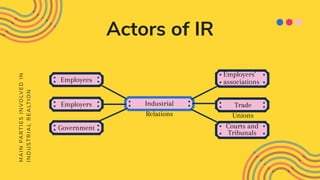
Employees
Employers
Government
Employers'
associations
Trade
Unions
Courts and
Tribunals
Actors of IR
Industrial
Relations
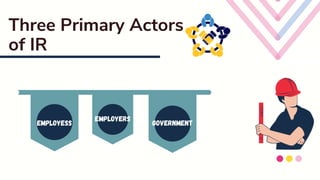
Three Primary Actors
of IR
• Employees
• Employers
• Governamen
Employess
Employers
Government
EMPLOYEES
•
•
•
Following are the different ways in which managers can benefit from
sound industrial relations in the organization:
• Motivating the employees to give their best and gaining their trust and
commitment;
• Improving the overall efficiency and ensuring effective communication
among the employees and the management;
• Dealing with problems of trade union along with negotiation of
employment terms and conditions with such employee representative.
W
H
A
T
A
R
E
T
H
E
T
H
R
E
E
A
C
T
O
R
S
O
F
I
N
D
U
S
T
R
I
A
L
R
E
A
L
T
I
O
N
EMPLOYER
GOVERNEMNT
W
H
A
T
A
R
E
T
H
E
T
H
R
E
E
A
C
T
O
R
S
O
F
I
N
D
U
S
T
R
I
A
L
R
E
A
L
T
I
O
N
•
•
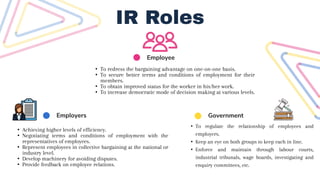
Employee
Employers Government
IR Roles
• Achieving higher levels of efficiency.
• Negotiating terms and conditions of employment with the
representatives of employees.
• Represent employees in collective bargaining at the national or
industry level.
• Develop machinery for avoiding disputes.
• Provide feedback on employee relations.
• To regulate the relationship of employees and
employers.
• Keep an eye on both groups to keep each in line.
• Enforce and maintain through labour courts,
industrial tribunals, wage boards, investigating and
enquiry committees, etc.
• To redress the bargaining advantage on one-on-one basis.
• To secure better terms and conditions of employment for their
members.
• To obtain improved status for the worker in his/her work.
• To increase democratic mode of decision making at various levels.
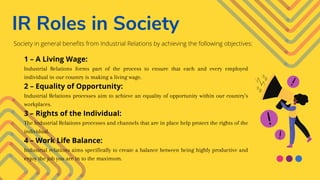
1 – A Living Wage:
Industrial Relations forms part of the process to ensure that each and every employed
individual in our country is making a living wage.
2 – Equality of Opportunity:
Industrial Relations processes aim to achieve an equality of opportunity within our country’s
workplaces.
3 – Rights of the Individual:
The Industrial Relations processes and channels that are in place help protect the rights of the
individual.
4 – Work Life Balance:
Industrial relations aims specifically to create a balance between being highly productive and
enjoy the job you are in to the maximum.
IR Roles in Society
Society in general benefits from Industrial Relations by achieving the following objectives:
Human resource IR System

Human resource IR System

  • 1.
    What are the three Actorsof IR System? PRESEN TEE - POOJA SARODE
  • 2.
    'Industry' can beviewed as an economic activity (i.e., manufacturing, producing or processing of goods or services) which is performed by a group of individuals. 'Relations' here refers to the connection and communication which pertains between theemployer and the employees within a workplace.
  • 3.
  • 4.
  • 5.
    Three Primary Actors ofIR • Employees • Employers • Governamen Employess Employers Government
  • 6.
  • 7.
    Following are thedifferent ways in which managers can benefit from sound industrial relations in the organization: • Motivating the employees to give their best and gaining their trust and commitment; • Improving the overall efficiency and ensuring effective communication among the employees and the management; • Dealing with problems of trade union along with negotiation of employment terms and conditions with such employee representative. W H A T A R E T H E T H R E E A C T O R S O F I N D U S T R I A L R E A L T I O N EMPLOYER
  • 8.
  • 9.
    Employee Employers Government IR Roles •Achieving higher levels of efficiency. • Negotiating terms and conditions of employment with the representatives of employees. • Represent employees in collective bargaining at the national or industry level. • Develop machinery for avoiding disputes. • Provide feedback on employee relations. • To regulate the relationship of employees and employers. • Keep an eye on both groups to keep each in line. • Enforce and maintain through labour courts, industrial tribunals, wage boards, investigating and enquiry committees, etc. • To redress the bargaining advantage on one-on-one basis. • To secure better terms and conditions of employment for their members. • To obtain improved status for the worker in his/her work. • To increase democratic mode of decision making at various levels.
  • 10.
    1 – ALiving Wage: Industrial Relations forms part of the process to ensure that each and every employed individual in our country is making a living wage. 2 – Equality of Opportunity: Industrial Relations processes aim to achieve an equality of opportunity within our country’s workplaces. 3 – Rights of the Individual: The Industrial Relations processes and channels that are in place help protect the rights of the individual. 4 – Work Life Balance: Industrial relations aims specifically to create a balance between being highly productive and enjoy the job you are in to the maximum. IR Roles in Society Society in general benefits from Industrial Relations by achieving the following objectives: