HR CONSULTING –
PROFESSION & PRACTICE
A Handbook on
S N I T A D O O R B U S I N E S S S C H O O L
Handbook on
HUMAN RESOURCE CONSULTING –
PROFESSION AND PRACTICE (HRCPP)
Prepared by,
Ms. Jaya Shankar
ME Computer Science, MBA
Assistant Professor
SNIT Adoor Business School
Ms. Rizaet A. Rahim
MBA, PG-DHHM
Assistant Professor
SNIT Adoor Business School
&
Ms. Vishnupriya M.G.
T6 MBA (2017-2019),
SNIT Adoor Business School
About the Book
The book has been designed to serve as an essential insight
necessary to understand Human Resource Consulting that
especially meets the requirements of T6 MBA students of
KTU specializing in Human Resource Management.
MODULE SYLLABUS
PAGE
NO.
I
Consulting- Firms and Professions: Business consulting; The
changing consulting industry, global trends and acceptance of
Consultants; Consultants - Types, competencies and Values;
Consulting as a profession; HR consultancy – scope, application,
effectiveness; Top Consulting Firms in the world – services
offered, future of consulting companies; The new business
consulting ecosystem – model, drawbacks.
1-32
II
The Consulting Process: Consulting Models - models used by
consulting firms to analyze clients; The client market -
Understanding buyer values, Advertising PR; Client relationship -
relationship management, repeated assignments, retainer
contracts; Generating and winning consulting assignments –
services offering, marketing pitch, consulting services
presentations; Proposals - Writing Successful Proposals.
33-47
III
Managing consulting projects: Process - From diagnosis to
discovery – Diagnostic review; Dealing with internal Resistance;
Whole-system discovery; Meetings to understand the complete
picture; Workflow and Business process – Business Process
definition, Mapping workflow techniques, bottlenecks
identification, discovering Gifts, Capacities and possibilities;
Findings – presentation of findings and recommendations; Project
Management – tools, techniques.
48-75
IV
Delivering results and disengagement: Analyzing and framing
problems - applying business process reengineering, smoothening
the bottlenecks; Preparation of Deliverables, standards and
compliance with law of the land, benchmarking; Review of
Deliverables – standardization; Meeting for ‘buy-ins’ –
presentation of solutions; Implementation of deliverables –
training, coaching and mentoring; Interim review and feedback;
Knowledge transfer and disengagement.
76-95
V
Human Resources in Organization Consulting: Specialty areas of
HR consulting; Outsourcing and HR – areas for outsourcing,
readiness for outsourcing; HR Consulting firms in India and its
future in India; HR Consultant Career graph.
96-102
HUMAN RESOURCE CONSULTING – PROFESSION AND PRACTICE
1
SNIT ADOOR BUSINESS SCHOOL
"What is unique to management is that from the very beginning the consultant played a
key role in the development of the practice, the knowledge and the profession of
management."
Peter Drucker
1. CONSULTING
Consultancy is the act of consulting and is the process of seeking the advice of a consultant.
According to New Webster’s Collegiate Dictionary ‘to consult’ means ‘to ask advice of’ or ‘to
seek the opinion of’ and ‘consultant’ means ‘one who consults or give expert advice’.
A consultant is a qualified and independent person who provides professional service to
individuals, organisations or business organisations. Consultancy services are the services
provided by consultants to identify and investigate the problems concerned with policy,
organisation, procedures and methods; recommending appropriate action and helping to
implement these recommendations.
Even though there are different areas of consultancy, in practice, all these practically originate
from management consultancy. Hence it is appropriate to discuss the concept of management
consultancy.
The Management Consultancy Association of India defines management consulting as "an
advisory service contracted for and provided to business, public and other undertakings by
specially trained and qualified persons. It is a process of interaction wherein the consultant in an
objective and independent manner diagnoses and investigates problems and issues concerned
MODULE
I
Consulting- Firms and Professions: Business consulting; The changing consulting industry,
global trends and acceptance of Consultants; Consultants - Types, competencies and Values;
Consulting as a profession; HR consultancy – scope, application, effectiveness; Top Consulting
Firms in the world – services offered, future of consulting companies; The new business consulting
ecosystem – model, drawbacks.
HUMAN RESOURCE CONSULTING – PROFESSION AND PRACTICE
2
SNIT ADOOR BUSINESS SCHOOL
with management practices, analyses these, recommends appropriate action and provides
assistance when requested in implementation of recommended solutions"
1.1 BUSINESS CONSULTING
Business consulting refers to the practice of, helping organizations to improve their performance,
primarily through the analysis of existing business problems and development of plans for
improvement. They provide management consulting to help organizations to improve
performance and its efficiency. Consultancies may also provide organizational change
management assistance, development of coaching skills, technology implementation, strategy
development, or operational improvement services.
A business consultant is a ‘hired gun’ who has both the expertise and experience to advise you
what to do and execute your plan into action saving your money, time and grievance.Strategic
planning is one of the key services provided by business consultants. Business consultants help
clients through analysis, statistics, and strategy and bring in the requisite knowledge and
expertise for a business which may be beyond the current expertise of the existing skill of the
business. Hence,Business owners should consider hiring business consultants when they need
help or perspective on their chosen path or need a catalyst for change in their companies.
Business consulting is becoming important in non-business related fields as well. A small
business consultant works with clients on strategy, and helps clients develop business skills and
knowledge. These topics range from designing abusiness model or marketing plan, to
determining which marketing techniques to use and how to use them.
Two general categories:
 Internal consultant - someone who operates within an organization but is available to be
consulted on areas of specialism by other departments or individuals (acting as clients); or
 External consultant - someone who is employed externally (either by a firm or some other
agency) whose expertise is provided on a temporary basis, usually for a fee.
HUMAN RESOURCE CONSULTING – PROFESSION AND PRACTICE
3
SNIT ADOOR BUSINESS SCHOOL
Fig. Consulting Purposes
Business Consulting is a five pronged strategic approach:
1. Corporate Strategy - Create and implement strategies to respond effectively to a constantly
evolving corporate scenario. They include: Business Enterprise Transformation, Strategic
Planning, Growth Strategy.
2. Customer Strategy - Identify and align organization’s customers to their business and
manage them efficiently.
3. Operational Strategy - Improvement of day-to-day operations, Benchmarking operational
levels, Standardization of operational processes.
4. HR Strategy - HR functions are quickly becoming the key strategic point for every
organization irrespective of its size, areas of operations, verticals, whether a startup or an
established organization. They include: Aligning HR to Business, Leadership Development,
Compensation benchmarking, Rewards and Recognition Strategy, HR Policy framework
benchmarking, Competency Mapping and Management.
5. Organizational Strategy–This is an extension to HR strategy. They include: Succession
Planning, Organizational structure, Role objectives and responsibilities, Organization
Development Interventions, Effective Change Management.
HUMAN RESOURCE CONSULTING – PROFESSION AND PRACTICE
4
SNIT ADOOR BUSINESS SCHOOL
7C’s of Consulting:
1. Client: Understanding the client’s real and perceived view of what is required from the
assignment.
2. Clarify: Understanding the nature of the problem being addressed and the scope of the
change being attempted.
3. Create: This helps the consultant needs to develop the plan of action needed.
4. Change: The consultant must try to understand the drivers of the change.
5. Confirm: Once the actions taken, the consultant should follow-up and confirm the change
that has taken place.
6. Continue: The consultant ensures that the changes made to continue.
7. Close: They should ensure that the client is fully aware of the final outcomes, added value,
the new learning and what may be required in the future.
10 principal ways of consulting
Consultants can take part in many different ways. Most of the consulting assistance to
management can be done in one or more of the following 10 ways.
 Providing information
 Providing specialist resources
 Establishing business contacts and linkages
 Providing expert opinion
 Doing diagnostic work
 Developing action proposals
 Improving system and methods
 Planning and managing organizational changes
 Training and developing management and staff
 Providing personal counselling
Business consultant vs Management consultant
Business consultants and management consultants are both professional individuals who come
along to co-pilot and partner your business with you.
HUMAN RESOURCE CONSULTING – PROFESSION AND PRACTICE
5
SNIT ADOOR BUSINESS SCHOOL
Business consultancy
Business managers work within an organization and decide how to use resources and employees
to best meet their aims and objectives. Every business, big or small, needs managers and your
skills will be useful across many sectors. The level of responsibility depends on your seniority
and experience. Starting your career in a management role could progress you to be a senior
manager in the company, perhaps even make it to board and director level.
Management Consultancy
The role of management consultants is to work through international consultancies or strategy
sections of financial organizations such as accountants. They are approached and contracted by
organizations seeking help and advice about management problems. Typical employers include
international management consultancy firms; major financial organizations and large accountants
and banks; smaller consultancies; but you could be called upon to work anywhere and that
includes the clients' own offices for extended periods, possibly overseas. Management
consultants need to be bright, flexible, hard-working and able to get on well with other people in
different environments. They also need power, practical intelligence, project management and
specific skills to suit the context in which they are working.
Criteria for selection of a business consultancy
 Integrity and professional ethics of the consulting company
 Professional competence
 Problem solving approach
 Capacity to deliver on time
 Ability to deploy resources
 Consultant’s image and reputation
1.2 CONSULTANTS - TYPES, CHARACTERISTICS, COMPETENCIES AND VALUES
Types of consultants
 Management and Strategy Consultants: Qualified consultants should have a deep
understanding of your particular market and bring the best practices from your industry or
HUMAN RESOURCE CONSULTING – PROFESSION AND PRACTICE
6
SNIT ADOOR BUSINESS SCHOOL
other industries to your company. If you're looking to expand your markets geographically,
extend your product portfolio, reorganize your middle market company to promote efficiency
and cost-effectiveness, buy out a smaller competitor, or increase your overall capabilities,
then hiring an experienced management consultant can make perfect sense. Firms such as
McKinsey & Company are famous for helping clients develop and execute better strategies.
 Operations Consultants: Want to improve the quality and efficiency of your production
processes? An operations consultant such as Accenture can help you create and implement a
new way of doing that. Some consultants specialize in business process re-engineering,
meaning that they come in and map out your existing processes, analyze opportunities for
reducing the number of steps in that process while maintaining quality, and re-engineer your
processes in a way that reduces steps and costs. Other consultants are experts in quality
control systems and can help you make changes that will reduce defects.
 IT Consultants: IT Consultants job is to recommend Computer Hardware, Software and
Networks to build high performing systems and workflow. This also provides technical
expertise in areas of information systems design, software programming and development.
Technology consultants are having specialization in different areas and are also called as
information system consultant, system applications consultant, data management consultants
and network consultants.
As the demands of new technology are impacting middle market companies every day, this is
a fast-growing area for consulting. An IT consultant can help whether you need to develop a
new system or integrate your old systems so that they work together. IT consultants such as
IBM will enhance your capabilities and also make your IT more flexible in meeting the
dynamic needs of customers.
 Human Resources or HR Consultants: Most of the companies outsource the job of
attraction, selection, training, assessment, and rewarding of employees, while also overseeing
organizational leadership and culture, and also help for ensuring compliance with
employment and labor laws. You need to co-ordinate between candidate and the companies.
There are many models in which you can work out with the client. HR nowadays also
focuses on strategic initiatives like talent management, mergers and acquisitions, succession
planning, industrial and labor relations, diversity and inclusion.
HUMAN RESOURCE CONSULTING – PROFESSION AND PRACTICE
7
SNIT ADOOR BUSINESS SCHOOL
HR consultants help to improve the overall satisfaction of your employees, recruit top talent,
and retain your top performers. HR consultants such as Hay Group specialize in developing
compensation strategies that align with your overall business goals, training, and developing
your people in areas such as business communication and leadership. They can also help you
improve performance-related feedback and evaluation to your team, making your employees
work smarter.
 Marketing Consultants: Marketing Consultants job is to focus on developing strategies in
order to successfully promote, sell and distribute goods and services to targeted consumers.
On a larger scale, marketing serves as a viable means of getting a new brand name, service or
product into the public and transforming it into a lucrative business. Companies, therefore,
seek expertise of marketing consultants in order to discover creative techniques for launching
and for sustaining their business.
Marketing consultants can help if you need a new logo for your company, a new market
position for one of your brands, or a new social media strategy to interact with your
customers. Consultants such as The Boston Consulting Group can offer you a creative spark
when your own people have run out of ideas, helps you see what other companies have done
to attract more customers.
 Strategy Consultants: Helping organizations figure out any problem in their operations and
work strategy and to improve their performance, primarily through the analysis of existing
organizational problems and development of plans for improvement. Otherwise known as
management consultative for the company where in you can play a key role in technology
implementation and workflow management.
 Technology Consultants: Delivering software solutions that improve business performance
of the clients and Turning the initiatives into reality – in other words, the strategic know-how
and understanding of key technology drivers to plan the adoption, development and
integration of advanced technology into client’s business. This helps by providing a scalable
architecture and enable the client business to gain competitive advantage over the others.
 Public Relations or PR Consultants: Public relations (PR) is the practice of managing the
flow of information between an individual or an organization and the public. Your role will
be to build reputation or a point of view about the company which you serving in front of
HUMAN RESOURCE CONSULTING – PROFESSION AND PRACTICE
8
SNIT ADOOR BUSINESS SCHOOL
investors, partners, public and employees. In other words, you control what other thinks
about company’s leadership, products, or of political decisions
 Legal Consultants: This identifies, prevents and solves legal issues facing a company or a
client. Its specialization includes legal consultation in employment, banking, contract,
corporate, intellectual property, tax, real estate, information technology or trust.
 Social Media Consultant: Role of Internet marketing agency or a Social Media Consultant is
to help companies to increase traffic to their websites by methods of search engine
optimization and content and by social media marketing. Your role will be to build strong
online presence of the client and build a brand online, by using various social media
platforms like social networks and social media. Keep yourself up to date with new and
changed capabilities offered by the web
 Financial/Investment Consultants: Financial consultants, also known as financial advisers
or financial analysts, are licensed professionals who are trained to help individuals or
organizations make intelligent financial decisions. These professionals typically helps to
know information about market trends, stock values, taxes and other economic factors to help
a client decide if an investment is appropriate or not.
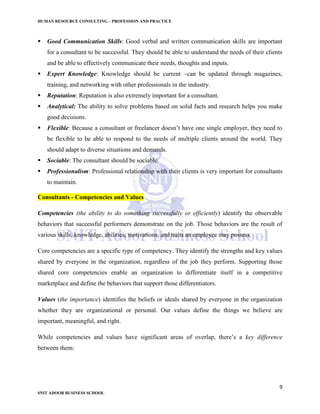
Fig: Types of Consultancy Services
Characteristics of a good business consultant
 Honesty: Honesty works on “do not lie” principle.
HUMAN RESOURCE CONSULTING – PROFESSION AND PRACTICE
9
SNIT ADOOR BUSINESS SCHOOL
 Good Communication Skills: Good verbal and written communication skills are important
for a consultant to be successful. They should be able to understand the needs of their clients
and be able to effectively communicate their needs, thoughts and inputs.
 Expert Knowledge: Knowledge should be current –can be updated through magazines,
training, and networking with other professionals in the industry.
 Reputation: Reputation is also extremely important for a consultant.
 Analytical: The ability to solve problems based on solid facts and research helps you make
good decisions.
 Flexible: Because a consultant or freelancer doesn’t have one single employer, they need to
be flexible to be able to respond to the needs of multiple clients around the world. They
should adapt to diverse situations and demands.
 Sociable: The consultant should be sociable.
 Professionalism: Professional relationship with their clients is very important for consultants
to maintain.
Consultants - Competencies and Values
Competencies (the ability to do something successfully or efficiently) identify the observable
behaviors that successful performers demonstrate on the job. Those behaviors are the result of
various skills, knowledge, abilities, motivations, and traits an employee may possess.
Core competencies are a specific type of competency. They identify the strengths and key values
shared by everyone in the organization, regardless of the job they perform. Supporting those
shared core competencies enable an organization to differentiate itself in a competitive
marketplace and define the behaviors that support those differentiators.
Values (the importance) identifies the beliefs or ideals shared by everyone in the organization
whether they are organizational or personal. Our values define the things we believe are
important, meaningful, and right.
While competencies and values have significant areas of overlap, there’s a key difference
between them:
HUMAN RESOURCE CONSULTING – PROFESSION AND PRACTICE
10
SNIT ADOOR BUSINESS SCHOOL
Values are intangible. They are based on feelings, preferences, perceptions, and priorities - an
internal code that influences how we interpret and experience the world.
Competencies are tangible (real, existing). They are based on on-the-job behaviors that can be
objectively observed and measured by the people around us.
HRSG competency consultant Christine Lamothe explains it this way:
“Values are what are important to the organization, and competencies are the tools that support
that. Maybe a continuous learning environment is critical for the organization. Maybe it’s client
satisfaction or quality of service. Whatever it is, you would look at core competencies to support
that. It’s a marriage of the ‘what’ and the ‘how.’, how do your employees demonstrate those
values day to day.”
Consulting Competencies:
 Communication: Verbal
 Critical Thinking
 Interpersonal skills
 Adaptability
 Ethical Behavior
 Customer Service
 Project Management
 Decision Making
 Tolerance for Ambiguity
 Collaboration
 Integrity
 Problem Solving
 Flexibility
Consulting Values:
 Personal and Professional Integrity - Hold to principles; deliver outstanding work that meets
personal and firm standards.
 Seek, Accept, and Encourage Responsibility - Be proactive, be a leader; discourage passivity.
 Meritocracy (a society governed by people selected according to merit.)
 Openness and Cooperation.
HUMAN RESOURCE CONSULTING – PROFESSION AND PRACTICE
11
SNIT ADOOR BUSINESS SCHOOL
 Continuous Improvement.
1.3 CONSULTING AS A PROFESSION
Management consulting is an independent, professional advisory service which assists managers
and organizations to achieve organizational purposes and objectives by solving management and
business problems, identifying and seizing new opportunities, enhancing learning, and
implementing changes.
Professional management consultants are contracted by organizations to get objective and
independent advice. Advisory services of consulting may include identification and analysis of
management problems, developing solutions, and the implementation of proposed solutions.
Consulting as a profession
Consulting is a profession just like banking or accounting or plant operations with its own set of
training, expectations and business models. It can be a very fulfilling profession for those that
pursue it. Furthermore, a consultant is usually an expert or an experienced professional in a
specific field and has a wide knowledge of the subject matter, the who provides professional or
expert advice in a particular field of business or science to either an individual or organization.
Firstly, a consultant provides expertise advice that a client lacks or support that a client is unable
to fulfill. The consultant charges a fee in return of their professional services. Secondly, a
consultant operates independently from the client, implying that, from the respective consultant,
there is no conflict of interests between the client's issue and the services. Thirdly, a consultant
operates in a professional manner, which ranges from having the right qualifications which
ensures high quality service delivery.
Why do clients hire consultants?
One of the defining features of a consultant suggests that clients hire consultants because they
need a knowledge advantage. In the overlarge majority of cases this is the main reason; a client
hires a consulting firm to provide expert advice that should lead to the resolution of an issue
within the client's organisation.
HUMAN RESOURCE CONSULTING – PROFESSION AND PRACTICE
12
SNIT ADOOR BUSINESS SCHOOL
o There are however more reasons why consultants are hired:
o Consultants are independent and provide an objective view on dilemma's and solutions.
o External consultants are less susceptible to internal politics and/or sensitive situations.
o Hiring consultants may in certain areas be cheaper than retaining the expertise in-house.
o When firms find themselves short in capacity for projects/positions consultants can backfill.
o Consultants can easier do the 'dirty work', i.e. Take the decisions no one internally wants to
make.
Where do consultants work?
Consultants can work at a consultancy firm, operate as independent consultant (freelance), or
else work as consultant within the company they work for (‘internal consultant’).
A good consultant has seen many ways of solving challenges from different clients in different
industries. Good consultants take these experiences together with leading practices to truly assist
end clients with great business solutions. Good consultants leverage the experiences of their
colleagues and the firm by employing past examples of project plans, techniques and
deliverables to produce quick, effective and outstanding results for their clients. Finally, good
consultants understand the business model with their profession and the firm. They realize that
people are the economic engine just like raw material is to a manufacturing company or a
network is to a communications company. Many authors and books are available that cover
consulting.
Business consultants’ job description
The business consultant is constantly aligning and evaluating four key business areas: People,
Sales, Profit, and Self. They’re also dedicated to preserving the culture, innovation and
entrepreneurial spirit that gives your company momentum while maintaining balance and
instilling structure for new horizons.
The following three points says how a business consultant can help you with and be able to
speak to past results:
HUMAN RESOURCE CONSULTING – PROFESSION AND PRACTICE
13
SNIT ADOOR BUSINESS SCHOOL
 Help You Gain Knowledge: In addition to learning about your industry and understanding
more about being a leader, a business consultant helps you learn about your strengths and
weaknesses and the strengths and weaknesses of the people you work with.
 Help You Reach Out to Others: In addition to investing yourself in your team, a business
consultant also helps you look for sharpening relationships where everyone can benefit from
hearing each other’s journey.
 Help You Open Your World: In addition to helping you venture outside of your own bubble
to understand the company as a whole, a business consultant will help you look for
opportunities to lead outside of work. Practice is everything.
Qualities that sets apart successful business consultants from others
 They understand their client
A good business consultant understands from where the business is coming from, its mission
and objectives in relation to his/her assignment. It is also important for the consultant to
understand any important information regarding to the stakeholders and competitors as well.
The consultant must see himself as an important part of the business and this helps for a
greater understanding of the business for successful execution of every plan.
 They are keen listeners
If the consultants have to successfully assess, counsel and execute their skills and gained
discovery for the client’s benefit, they should be keen listeners. They should not push their
ideas down their client’s throat and instead should be seen to consider the client’s ideas and
see how they can incorporate the same in their advice.
 They have proper connections
Business success is all about right connections and this is something that every successful
business consultant should be able to bring to the table. In every decision making, the
consultants should be able to factor in the important elements of the organizations while
explaining the inner workings of the business properly. This will help them to pro-actively
connect and engage with the right people who will help them achieve the business
objectives.
 They know how to deliver
HUMAN RESOURCE CONSULTING – PROFESSION AND PRACTICE
14
SNIT ADOOR BUSINESS SCHOOL
They not only promise to deliver but have previous successes that show of their expertise.
They have good skills that will deliver to your satisfaction and this should not be mistaken
with flashy resumes and referrals and rightly crafted proposals. Everything should bring good
results.
 They know how to customize
Good business consultants do not adopt a “one size fits all” attitude. Instead, consultants
know how to customize processes, communication, solutions and strategies depending with
the business they are dealing with.
 They create value
They must be able to not only lead the people and the process but must rise up to the
occasion by demonstrating expertise to create value. They proactively understand the needs
of the clients while at the same time acting as trusted advisors who offer the right solutions in
a cost-effective and useful way thus succeeding in their deliverables.
 They should align properly with the business
This is one of the most important factors to consider as not all business advisors will be cross
functional. Despite any other qualification, the consultant must be able to fit into the
organization quickly and not only so but also be able to work smoothly with the business
owner for success. Anything else will only spell doom for the business and the consultant
will not be able to carry out their business plans no matter how good they might seem.
Six Tools Every Business Consultant Should Know
 Benchmarking
The process of comparing your company metrics to the metrics of your industry competitors
or to those of innovative companies outside the industry is Benchmarking.
Common metrics for benchmarking include:
 Revenues
 Production costs
 Employee turnover
 Process cycle time
 Balanced Scorecard
HUMAN RESOURCE CONSULTING – PROFESSION AND PRACTICE
15
SNIT ADOOR BUSINESS SCHOOL
The balanced scorecard is a framework for tracking important aspects of strategy of company
and for facilitating organizational improvement. It measures metrics beyond typical financial
metrics to help companies to keep long-term strategic goals in focus and to spot trouble
before it appears in the financial statements.
The scorecard is a quantitative and comprehensive set of objectives that can be measured
over time. Common components include:
 Revenues
 Earnings
 Market share
 Quality
 Employee morale
 Customer satisfaction metrics
 Porter’s Five Forces
Developed by Michael E. Porter, Bishop William Lawrence University Professor at Harvard
Business School, Porter’s five forces is a framework for industry analysis that is used as an
input to a strategic plan.
The five competitive forces that influence profitability in any industry are outlined in Porter’s
model:
 Competitor rivalry
 The bargaining power of buyers
 The bargaining power of suppliers
 The threat of new entrants
 The threat of substitute offerings
 The GE-McKinsey Nine-Box Matrix
This matrix was developed by McKinsey & Company in the 1970s to help General Electric
prioritize its investments in its business units. It’s widely used to help companies assess the
relative merits of various opportunities.
HUMAN RESOURCE CONSULTING – PROFESSION AND PRACTICE
16
SNIT ADOOR BUSINESS SCHOOL
Business units or opportunities are categorized as “high,” “medium,” or “low” within the two
axes of the matrix, which are “industry attractiveness” and “competitive strength of the
business unit.”
 The BCG Growth-Share Matrix
This quadrant matrix, developed by Boston Consulting Group (BCG), is a tool companies
use to assess the relative strength of product lines within their portfolios.
Product lines are assigned to one of four quadrants:
 Cash cows
 Stars
 Question marks
 Dogs
 Core Competencies
The process of identifying your company’s core competencies helps you define your
company’s positioning and competitive advantage. A core competency is a proficiency in an
area that is not easily followed by competitors. It allows your company to deliver unique
value to customers, thus giving the company a “leg up” on the competition. One example is
how the employees and unique culture of Southwest Airlines allows them to provide faster
turnaround times for planes and better customer service.
Finding a consultant
Finding the right business consultant may be the most difficult part for the management or
owner. The consultant should have a passion for their work, a drive for excellence, and an eye
for organization and its details. It's important to find a consultant with expertise in your industry
or with the kind of problems that your business faces. When hiring a consultant, make sure that
they have solid referrals and offer these skills.
1.4 CHANGING CONSULTING INDUSTRY
The word is very appropriate for Consultants Industries today, the way they have played an
important role in the development of the Indian business sector. In the past several years, the
HUMAN RESOURCE CONSULTING – PROFESSION AND PRACTICE
17
SNIT ADOOR BUSINESS SCHOOL
Consultants Industry has not only grown in size, stature and global reach, but it has also gone
through several cycles of professionalization, making it one of the most developed fields within
the professional services industry. Consultants are more than giving advice; it’s such a highly
extensive, multi-sourcing growing field with experts having wide knowledge of a particular
subject, which play a crucial role in helping organizations to embark on the path of success.
Consultants render services spanning from recommendations for impractical data and poorly
implemented processes in the Finance sector to Healthcare consultancy to deliver better value for
patients, fuel innovation and reduce the cost and complexity of operating systems.
It was in the 90s, that McKinsey first brought the consulting strategy in India, setting up an
office in Delhi. The growth was initially quite slow and in a decade, they were only able to bring
in 100 odd consultants. However, that escalated very quickly in the next decade and today, in
India, Consulting companies are offering services in Strategy/Management, Information
Technology, and Process & Operations sectors. Other sectors include, Human Resource
Consultants, Public Relations Consultants, Marketing Consultants, Legal Consultants, Financial
Consultants, Social Media Consultants, and so on. Today, major players in Consultants Industry
in India are McKinsey & Company, The Boston Consulting Group, A.T. Kearney, BAIN
&Company. Some home grown big names are Tata Consultancy Services, Oracle Financial
Services Software, Wipro Technologies, HCL, etc.
Today, Modern era organizations now face intense competition, demanding customers, product
proliferation and greater exposure to the volatility of the globally changing economy. In this
changing situation, business leaders have to constantly look for new sources of competitive
advantage to win in their markets. This change in the market puts tremendous pressure on
consultants to bring the best of their field.
The need to move ahead in the competitive structure and gain optimum market share in today’s
highly competitive markets, has made companies across the world opt for third-party consulting
and advisory services. This is making consulting an essential function for companies these days.
The success for most companies lies in the fact that, each company provides a differentiating
factor in order to achieve a competitive edge over their rivals/competitors. In the Indian market,
without the proper knowledge of market trends and behavior, this cannot be attained. Also, this
success can be achieved only by implementing the right strategies from time to time and by
HUMAN RESOURCE CONSULTING – PROFESSION AND PRACTICE
18
SNIT ADOOR BUSINESS SCHOOL
taking pertinent decisions considering the market scenarios they cater to have prompted
companies to subscribe to the products and services offered by consulting firms. The primary
reason behind this need is because consulting firms interact or are involved with all the market
participants or industry participants on a regular basis and are very well informed about the
market happenings in each of the sectors.
1.5 GLOBAL TRENDS AND ACCEPTANCE OF CONSULTANTS
Over the past decades, the global consulting market has grown to become a multi-billion
industries. The industry has not only grown in size, stature and international reach, it has also
navigated its way through cycles of professionalisation, today making it one of the more
developed segments within the professional services industry.
An analysis of the past five decades shows that the development of the consultancy industry is
closely tied to that of the global economy. In times of flourishing economic conditions,
organisations enjoy higher budgets and revenues, a setting which paves the way for higher
spending on consultants. Vice versa, economic downturns typically see organisations shrink their
spending behaviour, which leads to budget cuts of, among, others, consulting expenditures.
Between the 1970s up the 1990s the global consulting market grew every single year, despite the
two recession periods (early 1970s and 1973-1975), fueled by high demand for operational
management and strategic services.
Trends in Consultants Industries
 Multi-Sourcing
Companies today, are not limited to a single consultant firm. There is a growing trend
amongst clients to switch away from the mega-deal with one consultant, and pressure to get
multiple firms to collaborate on projects. Clients may feel that, no one firm can handle either
the scale or complexity of their large projects, and they may require a partnership with five or
six firms. Clients may cut projects into small pieces, which they gave to specialist firms.
Clients want consultants to work together. They don’t expect one firm to supply everything.
Multi-Sourcing intensifies competitiveness among consultancies, which makes consultancies
to offer better services.
HUMAN RESOURCE CONSULTING – PROFESSION AND PRACTICE
19
SNIT ADOOR BUSINESS SCHOOL
 Fast Growth
The business world is desperate for consulting help. With excess staff being cut down, most
organizations lack in the strategic, technical and project management skills to handle the
benumbing rate of technological and market change. The consulting industry is trying its
level best to accommodate the demand. Big consulting firms are inhaling new employees,
consuming smaller firms and merging with peers.
 Offshoring
In addition to a boom in the number of consulting firms, the size of individual firms is
growing in response to the other industry trend: one-stop shopping. Providers that can’t
compete on size will still try to offer one-stop shopping by outsourcing a chunk of a client’s
project to another firm, while maintaining responsibility for the overall project.
 Premium Hiring
Top consulting firms such as Bain, BCG and Ernst & Young are hiring fresh engineer
graduates like never before, and most of these have almost doubled the number of offers they
made in this campus placement season in the country’s top institutes. Lately, many of the
consulting firms are getting a lot of work in the engineering space and this is pushing the
demand for the engineers at colleges such as IIT’s and NIT’s.
1.6 HR CONSULTANCY –SCOPE & BENEFITS
A human resources consultant may hold credentials in the specific area of HR. For the
recruitment industry to be effective, HR consultant helps to provide potential staff need to be
available in the first place.
HR consulting can:
 Help in structural reduction of the Human Resource Managing (HRM) cost base, by
identifying the non-value adding activities and eliminate the hidden HR operations costs.
 Help in identifying the inefficient Human Resources (HR) Administration processes and HR
practices.
 Help organizations to focus on human resource performance.
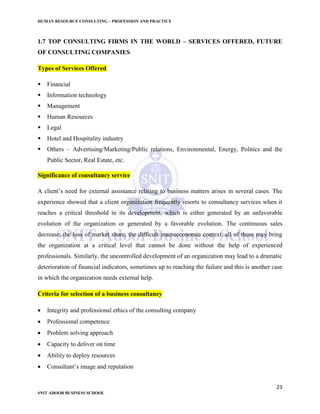
 Help organizations to serve their employees better, as the people come first.
 Help organizations to improve efficiency, productivity, communication & employee morale.
HUMAN RESOURCE CONSULTING – PROFESSION AND PRACTICE
20
SNIT ADOOR BUSINESS SCHOOL
HR Consulting capabilities include:
 HR operations improvement
 Identify problem areas in HR operations and provide appropriate solutions
 Improve existing policies by benchmarking them against industry standards
 HR Policies and Procedures Framework
 Gather requirements from the client
 Understand the specific HR areas to be covered under the framework
 Effectively chart out HR Processes and Systems
 Benchmark it with the industry
 Implement the new framework
 Effective Change Management
 Anticipate the effect of any new systems and process implementation
 Analyze the required strategic shifts for a smooth change management
 Effective Talent Management
 Conduct surveys to benchmark the employee satisfaction index
 Publish Root-Cause-Analysis with recommended action points
 Strategize Employee Motivation and Retention program linked to Business
 Employee Assessment
 Assessment of employees to help identify performers / under-performers
 Bring out customized tools for Assessment – Make / Facilitate / Implement Competency
Mapping and Skill Benchmarking
 Performance & Rewards Management
 Defining the performance management and appraisal process
 Institutionalizing goal setting and performance feedback
 Defining career and succession planning
 Developing a reward & recognition strategy linked performance
 Training solutions
 Identify training needs; develop training strategy and course content
 Imparting the training as per the clients’ customized need
 Evaluation and reporting of the effectiveness of the training imparted
 Exit Analysis
HUMAN RESOURCE CONSULTING – PROFESSION AND PRACTICE
21
SNIT ADOOR BUSINESS SCHOOL
 Do a thorough study on employee exit.
 Recommend pre-emptive steps linked to retention strategy
 Value Adds
 Human Resource Strategy
 Our firm belief that Human Resource function becomes very key in enabling a business
to succeed
 Organizational strategy and values which will drive people practices
Job duties/responsibilities of HR consultants.
 Advising management on the administration of human resources policies and procedures
 Serving as internal consultants by analyzing a company’s current HR programs and
recommending solutions
 Developing, revising, and implementing HR policies and procedures
 Ensuring HR programs and services are in compliance with established policies and
procedures and state/federal laws and regulations
 Preparing and maintaining reports related to specific HR projects
 Assisting with the development and coordination of recommended changes regarding
workflow
 Developing methods for compiling and analyzing data for reports and special projects
 Conducting audits of HR activities to ensure compliance
 Presenting training sessions related to specific HR programs
Scope
Professional management consultants may be asked to provide objective advice that will help an
organization plan, solve business problems or manage change, including business start-up,
growth or expansion, renewal, reorganization, diversification, downsizing, disposal of assets,
planning, review of operations, launching new corporate initiatives or projects, and/or acquiring
and implementing technology
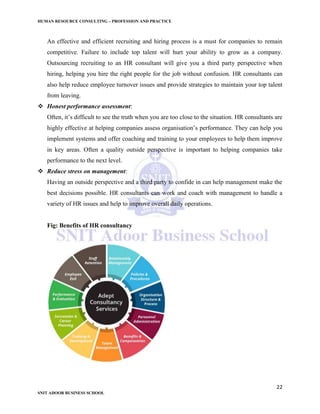
Benefits of HR consultancy
 Recruitment:
HUMAN RESOURCE CONSULTING – PROFESSION AND PRACTICE
22
SNIT ADOOR BUSINESS SCHOOL
An effective and efficient recruiting and hiring process is a must for companies to remain
competitive. Failure to include top talent will hurt your ability to grow as a company.
Outsourcing recruiting to an HR consultant will give you a third party perspective when
hiring, helping you hire the right people for the job without confusion. HR consultants can
also help reduce employee turnover issues and provide strategies to maintain your top talent
from leaving.
 Honest performance assessment:
Often, it’s difficult to see the truth when you are too close to the situation. HR consultants are
highly effective at helping companies assess organisation’s performance. They can help you
implement systems and offer coaching and training to your employees to help them improve
in key areas. Often a quality outside perspective is important to helping companies take
performance to the next level.
 Reduce stress on management:
Having an outside perspective and a third party to confide in can help management make the
best decisions possible. HR consultants can work and coach with management to handle a
variety of HR issues and help to improve overall daily operations.
Fig: Benefits of HR consultancy
HUMAN RESOURCE CONSULTING – PROFESSION AND PRACTICE
23
SNIT ADOOR BUSINESS SCHOOL
1.7 TOP CONSULTING FIRMS IN THE WORLD – SERVICES OFFERED, FUTURE
OF CONSULTING COMPANIES
Types of Services Offered
 Financial
 Information technology
 Management
 Human Resources
 Legal
 Hotel and Hospitality industry
 Others – Advertising/Marketing/Public relations, Environmental, Energy, Politics and the
Public Sector, Real Estate, etc.
Significance of consultancy service
A client’s need for external assistance relating to business matters arises in several cases. The
experience showed that a client organization frequently resorts to consultancy services when it
reaches a critical threshold in its development, which is either generated by an unfavorable
evolution of the organization or generated by a favorable evolution. The continuous sales
decrease, the loss of market share, the difficult macroeconomic context, all of these may bring
the organization at a critical level that cannot be done without the help of experienced
professionals. Similarly, the uncontrolled development of an organization may lead to a dramatic
deterioration of financial indicators, sometimes up to reaching the failure and this is another case
in which the organization needs external help.
Criteria for selection of a business consultancy
 Integrity and professional ethics of the consulting company
 Professional competence
 Problem solving approach
 Capacity to deliver on time
 Ability to deploy resources
 Consultant’s image and reputation
HUMAN RESOURCE CONSULTING – PROFESSION AND PRACTICE
24
SNIT ADOOR BUSINESS SCHOOL
The Consulting Process
 Provide and analyseinformation
 Analyse the client’s problems and take on the responsibility of decision making
 Solve all the problems and recommend in putting certain solutions into practice
 Contribute to establishing co-operation and commitment among the staff in the firm
 Faster, as a teacher, the learning process of the client and his/her employees
 Improve the efficiency of the organization, rewarding correct actions and discouraging
incorrect actions
 Listen, offer support and advice to the clients in difficult moments looking after his/her
interests at all times.
Top Consulting Firms in the World
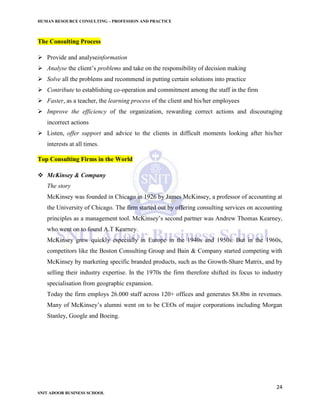
 McKinsey & Company
The story
McKinsey was founded in Chicago in 1926 by James McKinsey, a professor of accounting at
the University of Chicago. The firm started out by offering consulting services on accounting
principles as a management tool. McKinsey’s second partner was Andrew Thomas Kearney,
who went on to found A.T Kearney.
McKinsey grew quickly especially in Europe in the 1940s and 1950s. But in the 1960s,
competitors like the Boston Consulting Group and Bain & Company started competing with
McKinsey by marketing specific branded products, such as the Growth-Share Matrix, and by
selling their industry expertise. In the 1970s the firm therefore shifted its focus to industry
specialisation from geographic expansion.
Today the firm employs 26.000 staff across 120+ offices and generates $8.8bn in revenues.
Many of McKinsey’s alumni went on to be CEOs of major corporations including Morgan
Stanley, Google and Boeing.
HUMAN RESOURCE CONSULTING – PROFESSION AND PRACTICE
25
SNIT ADOOR BUSINESS SCHOOL
 Boston Consulting Group
The story
Bruce Henderson founded the Boston Consulting Group (BCG) in 1963 after working 18
years for the manufacturing company Westinghouse Corporation. Initially, BCG was a
subsidiary of the Boston Company, before becoming independent in 1975.
When BCG started, the traditional consulting approach was to look at a company's specific
internal issues. But Henderson decided to take another approach and decided to focus on
external factors such as markets and competition instead. This approach led to new important
business concepts still used today such as the "cash cow," the "experience curve," and “time-
based consumption.”
Throughout the 1960s, BCG grew and develop overseas. It suffered a slight setback in 1973
when BCG vice-president Bill Bain left the company to found his own consulting firm, Bain
& Co. During the 80s it continued to expand, with a radical boost in the mid-90s in growth.
The early 2000s because of the economic crisis and rise in technology put BCG under threat.
The firm remains one of the most prestigious strategy houses in the world with $5.6bn in
revenues and offices all over the world .
HUMAN RESOURCE CONSULTING – PROFESSION AND PRACTICE
26
SNIT ADOOR BUSINESS SCHOOL
 Bain & Company
The story
Bain & Company was formed in 1973 when Bruce Henderson's protégé Bill Bain left BCG
to form his own consulting firm.
Bain & Company revolutionised the consulting industry by taking a different approach to
client relationship management. When it started, it decided to take only one client per
industry and to focus on developing long-term relationships with these clients.
This helped Bain to win multiple projects from the clients, it focused on and to maximise
value per client. Before then, consulting work was mostly done by project basis on a project,
and trying to win multiple projects from single clients was not a common strategy.
The company's CEO Bob Beckek has a 99% approval rating on Glassdoor, reflecting how
well employees are taken care of. In fact, Bain has won several "Best Employer" awards and
has a strong reputation for taking care of its people's work-life balance.
HUMAN RESOURCE CONSULTING – PROFESSION AND PRACTICE
27
SNIT ADOOR BUSINESS SCHOOL
 Oliver Wyman
The story
In 2007, three global consultancies (Mercer Delta, Mercer Management Consulting and
Mercer Oliver Wyman) combined to form Oliver Wyman.
Mercer Oliver Wyman was the oldest of these firms. It was founded as Oliver, Wyman &
Company in 1984, and was then acquired by Marsh & McLennan Companies (MMC). MMC
also acquired Temple, Barker & Sloane in 1987 and Strategic Planning Associates in 1989.
These two companies merged in 1990, becoming Mercer Management Consulting in 1992.
MMC also acquired Delta Consulting in 2000. In 2007, MMC merged its subsidiaries under
the name Oliver Wyman.
Recently, Oliver Wyman has been growing at a rapid rate, largely thanks to a series of
acquisitions made in 2008. It also managed to build a very strong reputation for itself in the
financial services sector as well as in digital strategy. Currently, the firm holds over 60
offices in 27 countries and boasts 4,500 employees.
HUMAN RESOURCE CONSULTING – PROFESSION AND PRACTICE
28
SNIT ADOOR BUSINESS SCHOOL
Other Examples of Consultancies
 Deloitte Consulting LLP
 PriceWaterhouseCoopers
 Accenture
 Capgemini
 KPMG
 Tata Consultancy Services
Future of Consulting Industry in India
Increased demand for consulting services by domestic and foreign firms sector in India is
consistently growing. Today, nearly all industries are undergoing massive change. Rising
opportunities due to booming economy and growing demand for consultancy services are main
factors for growth. The total market growth might slow down a little, but there will be
considerable shifts amongst the market segments.
Other changes will occur through new entrants. Attracted by the impressive market growth,
many non-consultancies established consultancy-divisions. An entry of sole practitioners and
small consultancies is expected. This wave of new entries will have dual effects. An increase in
the competition would be evident, leading to mergers and acquisitions or breakdowns. And, since
there are no legal regulations as to who can call himself a consultant; in some cases there will be
quality problems which could damage the reputation of the whole industry.
HUMAN RESOURCE CONSULTING – PROFESSION AND PRACTICE
29
SNIT ADOOR BUSINESS SCHOOL
Future trends
 Framing the new global practices that focused on the public and social sector signaled ling
term commitment to help leaders drive change beyond corporate boundaries.
 Focus on high profile risk on climate change, healthcare, education and economic
development.
 Emphasis more on new areas of specialization such as;
 Machine Learning
 Artificial Intelligence
 Sharing Economy
 Block chain
1.8 THE NEW BUSINESS CONSULTING ECOSYSTEM – MODEL & DRAWBACKS.
The most effective and valuable consulting takes place when clients and consultants work
together in teams, sharing skills and expertise and focusing on common goals. Clients need to
look at how their actions, in procurement, project management and governance, change the way
consultants behave. Consultants, on the other hand, must understand the way in which they do
(or do not) transfer knowledge to their clients, deliver advice and implementation, and initiate
cultural change. In other words, the collaboration that happens in the most successful consulting
projects should not just be the standard for all projects, but should become the benchmark for the
consulting industry as a whole, dictating the behaviour of firms as well as people.
Two trends are becoming increasingly clear:
 Individual clients (especially in the public sector, but increasingly elsewhere) are adopting a
more rational approach to consulting and exchanging information with each other.
 Consulting firms are beginning to take on the characteristics of a maturing and responsible
industry after a period of intense structural change.
Clients, consultants and their respective industries are part of the same internally dependent
system. At the simplest level, consultants exist because there is a demand for their services,
driven by pressure in the external marketplace, regulation, the emergence of new technology and
HUMAN RESOURCE CONSULTING – PROFESSION AND PRACTICE
30
SNIT ADOOR BUSINESS SCHOOL
management ideas. But the relationship is a symbiotic one: consultants help to create demand by
promoting new technology and by helping to disseminate new ideas.
As needs increase in scale and complexity, the classic model of the client–consultant relationship
begins to break down: results come from interdependency and diversity; more players become
involved; third parties, such as technology vendors and outsourcers, become important. Six key
components interact in a systematic way. On the demand side, there are client markets,
individual client organisations and client projects; on the supply side, there is the consulting
industry, consulting firms and individual consultants. These components and their interplay form
a new system, the business consulting ecosystem.
This is a system in early formation and turmoil, with great imbalances and shifts of power in
very short periods. Widespread mergers, radical rethinking of client procurement methods, the
increased role of third parties and huge changes in the human resources market for consultants
demonstrate that much more is at stake than changes to the traditional client–consultant
relationship.
These seven “interaction” themes map out the way the business consulting ecosystem works:
 Reputation: Whether consulting firms like it or not, their industryhas a reputation. Many
firms choose to believe they are insulated from any problems that may ensue from this. Well-
known firms believe their brands will differentiate them; smaller ones think their client
relationships and the quality of their work will protect them. In reality, no organisation can
entirely escape the way clients view the collective industry.
 Isolation: Clients buy consulting in an imperfect market. Although clients believe they are
responsible for their choice and use of consultants, they also think their responsibility is
compromised where they do not have access to sufficiently reliable information. It is a case
of buyer beware, but only if you know what to be wary of. Yet clients rarely share views on
consulting performance with each other. This seems ironic in an environment in which
consulting firms are falling over each other to publish books, articles and papers on every
conceivable client issue. Yet quantity of information is of course no guarantee of quality.
Little of the “thought leadership” or “industry practice” material offered helps clients make
informed choices.
HUMAN RESOURCE CONSULTING – PROFESSION AND PRACTICE
31
SNIT ADOOR BUSINESS SCHOOL
 Metamorphosis: Consulting is not a profession: there is no governing body which sets
standards and certifies qualified consultants. Qualifications exist, as do trade associations, but
participation is entirely voluntary. Would you go to an unqualified doctor? Would you ask an
untrained lawyer for his or her opinion? At the moment, clients rely on the brand of
aconsulting firm to provide them with the confidence that they are buying a high-quality
product, but this focus on individual firms, at the expense of the industry as a whole, is
unsustainable.
 Relationship: Clients are accustomed to treating consulting projects as discrete and self-
contained. But there are three reasons why this is changing: the remit of central procurement
departments has, for the first time, been extended to cover professional services; clients are
increasingly using several suppliers for projects where before they might have used only one;
and new governance rules are being established that seek to make consulting firms keep the
promises they make of working “in partnership”.
 Portfolio: A corollary to complexity is that clients need to manage their consulting projects
not in isolation, but as part of a portfolio. They need to balance costly projects against
cheaper ones, and difficult ones focused on long-term benefits against simpler ones designed
to produce immediate results. A big component of success in using outsiders is getting things
lined up internally too.
 Career: Consulting used to be a career. However, as a result of the downturn in the early
2000s, many consultants left their firms, some to join clients, others to become freelance or to
find non-consulting jobs. In common with many other industries, consulting never really
offered a job for life. Nevertheless, good consulting relies on good experienced consultants.
 Life cycle: When it comes to actual consulting projects, clients invest too much time in the
preparatory stages and too little in adapting to changes during the course of a project. Time,
budgets and quality standards are typically set from the outset and ignore the way in which
projects change during the course of their life: governance, management style and mindset
need to be adaptable over time, not set in stone.
The idea of a client–consultant, mutually dependent ecosystem makes it possible to focus on how
the elements of the two worlds of demand and supply interact with each other. It also highlights
the interactions as the things that are easiest to change so as to achieve better results.
Psychologists will tell you that it is much simpler to change people’s behaviour than their
HUMAN RESOURCE CONSULTING – PROFESSION AND PRACTICE
32
SNIT ADOOR BUSINESS SCHOOL
underlying personalities, and this applies just as much to an industry like consulting. Institutions
– consulting firms, client procurement departments, and so on – have processes, people, systems
and cultures which make them inflexible. But an interaction is a fulcrum: the point where small
changes have disproportional effects, where a little effort can make a big difference.
Fig. The business consulting ecosystem
HUMAN RESOURCE CONSULTING – PROFESSION AND PRACTICE
33
SNIT ADOOR BUSINESS SCHOOL
MODULE
II
“Good counselors lack no clients”
Shakespeare
“Management consulting is an independent professional advisory service assisting managers and
organizations in achieving organizational purposes and objectives by solving management and
business problems, identifying and seizing new opportunities, enhancing learning and
implementing changes.” – Philip A. Wickham
2. THE CONSULTING PROCESS
The consultant and the client undertake a set of activities required for achieving the desired
purposes and changes during a typical consulting intervention and the activities are normally
known as “the consulting process”. The consulting process has a clear beginning and end. The
process can be subdivided into several phases between these points, and which helps the
consultant and client to be systematic and methodical, proceeding from phase to phase and from
operation to operation.
The consulting process can be subdivided in many different ways. Various authors suggest
models which includes three to ten phases. From these we have chosen a simple five phase
model, which includes entry, diagnosis, action planning, implementation and termination.
1. Entry and Contracting: This phase says about the initial contract with the client about the
project.
2. Diagnosis: In this phase the consultant needs to know who is going to be involved in
defining the problem, what methods will be used, what kind of data should be collected, and
how long will it take.
The Consulting Process: Consulting Models – models used by consulting firms to analyze
clients; The client market - Understanding buyer values, Advertising PR; Client
relationship – relationship management, repeated assignments, retainer contracts;
Generating and winning consulting assignments – service offering, marketing pitch,
consulting services presentations; Proposals – Writing successful proposals.
HUMAN RESOURCE CONSULTING – PROFESSION AND PRACTICE
34
SNIT ADOOR BUSINESS SCHOOL
3. Action Planning: The action should be planned in this phase. The job here is to take the set
of collected information and to reduce it so that it can be managed and understood. This
phase is also known as planning phase and includes setting the goals for the project and
selecting the best action steps. A consultant must also decide how the client is involved in the
process of analyzing the information.
4. Implementation: This step helps in taking everything that has been decided previously and
implementing the solution decided upon.
5. Termination: In this phase a decision can be taken whether to extend the process to a larger
segment of the organization. But in some cases the process recycles and a new contract needs
to be discussed.
Fig. Phases of the consulting process
1. Entry
2. Diagnosis
3. Action Planning
4. Implementation
5. Termination  Evaluation
 Final report
 Settling commitments
 Plans and follow – up
 Withdrawal
 Free contacts with clients
 Preliminary problem diagnosis
 Assignment planning
 Assignment proposals to client
 Consulting contract
 Purpose analysis
 Problem analysis
 Fact finding
 Fact analysis and synthesis
 Feedback to client
 Developing solutions
 Evaluating alternatives
 Proposals to client
 Planning for implementation
 Assigning with implementation
 Adjusting proposals
 Training
HUMAN RESOURCE CONSULTING – PROFESSION AND PRACTICE
35
SNIT ADOOR BUSINESS SCHOOL
2.1 CONSULTING MODELS – MODELS USED BY CONSULTING FIRMS TO
ANALYZE CLIENTS
Bloomberg’s Data – Based Consulting Model
Digitization rotates first and foremost around data. Bloomberg has entered the consulting market
by communications, brand consulting advice and marketing strategy. Their model is the coupling
of a number of business models including advertising spending, media and consulting.
McKinsey’s Productized Approach
This approach says about whether the firm was getting the most out of their intellectual property.
This solution offers a range of software and technology based tools for data analytics. This also
helps for data driven decision-making in various functions and industries. This offers a process
which is independent of the individual consultants and is structured, repeatable and standard.
This model helps for close and long term relationships with the customers with the help of
business development team. Key activities are recruiting, business development and client
projects.
Eden McCallum’s Consulting meets the Gig Economy
This is a European based management consultancy which does not hire any consultants, but has
built a network of highly experienced independent senior consultants. This model helps to find
the best match between client and consultant. In this consultants can focus on delivering
successful projects and are not pressured to sell new projects. In this a good consultant
relationship is managed through a consultant management team and helps to maintain a long
standing and close relationships with both clients and consultants. Key activities include business
development, customer relationship management, project management and consultant selection
and management. This model allows support at a much lower rate. Consultants can deliver
successful results by working more closely with clients.
GLG Introduces the As-A-Service
Rather than large scale projects as-a-service model might involve long-term smaller volume
projects for consultants. We have not seen many top consulting firms doing as-a-service model,
some more niche firms are exploring these possibilities. Gerson Lehrman Group (GLG) a
professional services company offers one example. On-demand professional learning services to
HUMAN RESOURCE CONSULTING – PROFESSION AND PRACTICE
36
SNIT ADOOR BUSINESS SCHOOL
clients in a wide variety of industry sectors are provided by GLG. The subscription based service
grants clients access to experts through GLG’s network of independent professionals and thought
– leaders.
2.2 ADVERTISING PR
The two important tools for promoting products and services offered by the company are
Advertising and Public Relations.
Advertising suggests to a form of communication, which a firm uses to initiate prospective
customers to choose the product offered by the company, over other products. A public relation
can help your business extremely and it doesn’t have to be expensive. Two choices are there for
a PR campaign: you can either do it yourself or hire a public relations agency.
There are a number of benefits from getting PR consulting from a well – respected PR agency.
A PR consultant is the one who works as an intermediary between public and an organization or
business and hence is a communication specialist. PR consultants write press releases about
issues of a company and events and put them into the hands of the media professionals to publish
or broadcast. These include:
 Credibility (the quality of being trusted and believed in): In a communication suite, PR
holds a powerful position. Media relations, which assists in achieving editorial coverage
is one of the main impacts of PR.
 Cost Effectiveness: Even if an organization hires an external PR agency it is less
expensive.
 Exposure: PR specialists know which media to target for which message, what content
the media want , when to pitch them which story and what is the best way to deliver your
message. Media coverage with the help of PR consulting is likely to be more extensive
than that which one would achieve through advertising, for a similar budget.
 Flexibility: PR has the benefits of being flexible in message content and being
responsive to news.
HUMAN RESOURCE CONSULTING – PROFESSION AND PRACTICE
37
SNIT ADOOR BUSINESS SCHOOL
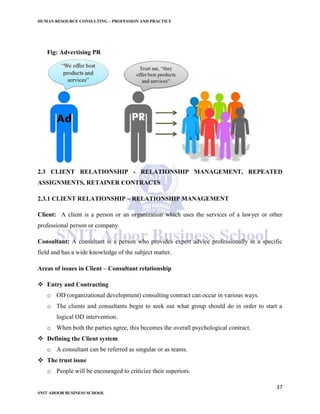
Fig: Advertising PR
2.3 CLIENT RELATIONSHIP - RELATIONSHIP MANAGEMENT, REPEATED
ASSIGNMENTS, RETAINER CONTRACTS
2.3.1 CLIENT RELATIONSHIP – RELATIONSHIP MANAGEMENT
Client: A client is a person or an organization which uses the services of a lawyer or other
professional person or company.
Consultant: A consultant is a person who provides expert advice professionally in a specific
field and has a wide knowledge of the subject matter.
Areas of issues in Client – Consultant relationship
 Entry and Contracting
o OD (organizational development) consulting contract can occur in various ways.
o The clients and consultants begin to seek out what group should do in order to start a
logical OD intervention.
o When both the parties agree, this becomes the overall psychological contract.
 Defining the Client system
o A consultant can be referred as singular or as teams.
 The trust issue
o People will be encouraged to criticize their superiors.
HUMAN RESOURCE CONSULTING – PROFESSION AND PRACTICE
38
SNIT ADOOR BUSINESS SCHOOL
o Subordinates may be concerned that they will be manipulated toward their superiors
goals with little attention given to their own.
 The nature of consultant expertise
o It is possible and desirable for the OD consultant to be an expert.
o OD consultant should be prepared to describe in broad outline what the organization
might look like.
o The OD consultant also needs to resist the temptation of playing the content expert.
 Diagnosis and appropriate interventions
o Temptation to apply a particular intervention technique.
o Appropriate interventions with intensive look at the data.
 On being absorbed by the culture
o Consultant let himself indulge into joining the culture of the client organization.
 The consultant as a model
o Consultant should give out clear messages.
o Consultant should practice what he/she preaches.
 Consultant team as a microcosm
o Team should have an effective interpersonal relationship.
o Consultants should also focus on continuous growth and process renewal.
o Team must set an example of an effective unit to enhance its credibility.
 OD process and action research
o For the research and process simple questionnaires or interviews could be helpful.
 Client dependency and terminating the relationship
Relationship between client and consultants depends on:
o Consultant competence: The relationship will last longer if the consultant is able to
provide innovative and productive intervention.
o Client resourcefulness and capabilities in OD.
 Ethical standards in OD
LouisWhite & KevinWooten says about the following five categories of ethical dilemmas.
These are:
 Misrepresentation and collusion
 Misuse of data
HUMAN RESOURCE CONSULTING – PROFESSION AND PRACTICE
39
SNIT ADOOR BUSINESS SCHOOL
 Manipulation and coercion
 Value and goal conflicts
 Technical ineptness
Values lying Ethical OD practices
 Honesty
 Openness
 Voluntarism
 Integrity
 Confidentiality
 The development of people
 The development of consultant expertise
 High standards & self - awareness
 Implication of OD for the client
o To enlarge the database for making management decisions
o To expand the influence process
o To capitalize the strengths of formal system
o To become more responsive
o To legitimize conflicts
o To examine its own leadership style
o To encourage collaborative management
Recommendations for Consultant Client relationship
 Be transparent
 Under commit-over deliver
 Don’t be afraid to tell the client that you have a difference of opinion
 Socialize
 Offer knowledge transfer in the form of coaching and mentoring
All good relationships are based on trust. Consultants need to understand what are the
client’s expectations and then they have to understand how best to work with the client to
meet those expectations. A best consultant should know that the client is not one individual,
but can include many people within the organization. Clients should help the consultants to
HUMAN RESOURCE CONSULTING – PROFESSION AND PRACTICE
40
SNIT ADOOR BUSINESS SCHOOL
understand the working environment, but many are too busy and don’t take enough time
during the early stages of an assignment to discuss these issues. The client consultant
relationships are built on an individual level and there are two factors: the cognitive and the
emotional. The cognitive says How good the consultant is and What is their reputation in the
market. The emotional says whether the relationship is emotional or not.
Another strength of an effective relationship is the ability to deliver bad news. As a business
leader, it’s important to engage with the consultant consistently.
2.3.2 REPEATED ASSIGNMENTS
The assignment process is split up logically into several stages from consultation to successful
placement.
 Consultation: The success of an assignment depends on an informative discussion with
the client at the outset ideally face to face. It is important that the consultant should gain
the full understanding of client background and history, business offering, culture and
vacancy background.
 Candidate and Talent sourcing: For search assignments we undertake careful research
into the appropriate market sector, identify appropriate market organizations and identify
suitable potential talent. Research manager of an organization supervises this part of the
process under the guidance of the consultant and will make the initial approach,
discreetly, to the individual to access suitability and interest in the role. We draft
advertising copy based on the brief and utilize appropriate generalist and/or specific
industry specific print and online media channels in the relevant regional, national,
international media to attract suitable applicants for advertised assignments. We
interrogate our extensive in house database, established over a number of years for
database assignments.
For all assignments we utilize social media channels and online networking to source suitable
candidates as well calling upon the extensive personal business networks of our consultants.
 Assessment and Initial interview: Suitable candidates are then formally interviewed by the
consultant face to face, by video conference or telephone as appropriate depending on
HUMAN RESOURCE CONSULTING – PROFESSION AND PRACTICE
41
SNIT ADOOR BUSINESS SCHOOL
location and availability. This happens after initial email exchanges and telephone calls to
clarify questions on both sides.
 Long and short Listing: We usually provide clients with a long list of candidates a within a
four week period and aim to shortlist and present three to six relevant candidates between
four and six weeks following the initial briefing. We provide the client with a shortlist of
candidates including original, not standardized or amended CV’s, together with interview
notes and appraisal including key strengths and any development needs against agreed key
competencies for each candidate.
Repeat Clients Keeps Your Career Going
Many writers are so busy supporting new clients that they forget to be friend their previous ones.
Forward thinking tells that new clients can become repeat clients in time.
#1: Identify the people who can give you repeat business
Record past clients and editors who had hired you for assignments and projects or list them down
by name, contact information, and type of project so that they can be easily identified.
#2: Send them an e-mail or voice mail
The next step is to initiate communication. Instead of sending random messages saying you’re
just dropping by to say hello, say something more definite.
#3: Leave your new contact information, too
Because changes happen, contact information gets lost and people lose touch. Thus, it’s practical
to inform clients if your contact information has changed or if it is still the same.
#4: Re-establish communication
It’s easy to reconnect whenever you extend your regards on special occasions and yearly
holidays. Call or email to let them know you’re out there, still writing for a living and keep the
relationships going.
#5: Inquire about a repeat assignment or a reference
If they can’t be your repeat business, they can possibly be your reference.
HUMAN RESOURCE CONSULTING – PROFESSION AND PRACTICE
42
SNIT ADOOR BUSINESS SCHOOL
#6: Utilize search engines and optimize on websites
This generates more clients, particularly new clients. Launching a new website also helps.
#7: Market your skills actively!
Continue to advertise your skills through good quality works.
#8: Resell your services!
Update clients on new services that you are offering.
#9: Schedule your tasks
To Use scheduling software like Microsoft Outlook or mobile gadgets like organizers and
calendars. These tools will help you to manage your schedule and attend to all your clients.
#10: Always follow up
Do follow up on your message and do follow through on alternate means of communication like
phone or email.
2.3.3 RETAINER CONTRACTS
Retainer contracts are written agreements that exist between an organization and a consultant or
an independent contractor. Normally, work is paid for after the completion of a project.
However, when a retainer is in place, an organization pays the contractor before the work goes
ahead. This is beneficial for organizations, as it allows them to work with a specific consultant or
freelancer for a long period of time. A retainer agreement is a task for hire contract. It may be
full-time or part-time process.
Before pitching a retainer agreement to clients, understand that some people have a negative
association with it. Some clients may not have had good experiences with consultants in the past
who did not work the hours agreed upon and cost them money. That is why it is so important to
work on long-term agreements exclusively with clients you have worked for before. That helps
to build a level of trust in your abilities, integrity, and productivity and will make them more
likely to approve a retainer agreement with you rather than someone new. Many clients will
HUMAN RESOURCE CONSULTING – PROFESSION AND PRACTICE
43
SNIT ADOOR BUSINESS SCHOOL
assume there will be a discount for signing a retainer agreement upfront, but as a consultant, that
isn't fair to you. You still deserve to be compensated for the hours worked, so it's recommended
that you don't offer a discount but offer a package of hours at your normal rate. Instead, focus on
the benefit to the client.
 Advantages of a Retainer Contract
 Retainer contracts are also beneficial for individual contractors, because they receive
payment prior to starting the work. This makes it easier to allocate finances and time for
the duration of that project.
 A retainer contract is a pay which is guaranteed and is something that consultants and
freelancers should strive to achieve.
 Well-planned retainer agreements with important clients will enable you to organize your
work.
 Retainers also reduce the unpredictability surrounding income and will allow you to work
with other clients as you fit.
 Signing a retainer contract is highly beneficial, and you can begin by working with your
current clients. Select the clients that you like and clients with businesses that have
remained stable.
 A retainer is an important step to financial freedom.
 Your overall aim should to work with a client for income stability and to provide security
for your client.
2.4 GENERATING AND WINNING CONSULTING ASSIGNMENTS - SERVICES
OFFERING, MARKETING PITCH, CONSULTING SERVICES PRESENTATIONS
2.4.1 SERVICES OFFERING
 Customer experience enhancement
 Business operations transformation
 Business analysis
 Business analytics
 Revenue assurance consulting
HUMAN RESOURCE CONSULTING – PROFESSION AND PRACTICE
44
SNIT ADOOR BUSINESS SCHOOL
 Program management
 Social media consulting
 Business improvement diagnostics
2.4.2 MARKETING PITCH
In selling technique, a sales pitch or sales presentation attempts to motivate someone or
something, with a planned sales presentation strategy of a product or service designed to initiate
and close a sale of the product or service. Here the product is consulting service.
The different ways of marketing consulting services are:
 Direct mail
Direct mail is a powerful way to drum up new business because it's targeted to exactly the
audience you want to reach.
Here are some tips for creating attention-getting direct mail:
 Personalize your sales message. Use mail merge method and address each envelope to the
recipient by name. In the same way, your sales letter inside the envelope should be
directed by name to that recipient.
 Put a compelling message on the outside of the envelope. "Free," "Limited time offer,"
and "Act now" are all powerful attention-getters that can induce the recipient to open the
envelope.
 Stress the benefits of your offer, and give all the pertinent details in your sales letter.
Then make it easy to respond or request information. Give your phone number, e-mail
address and website URL and include a postage-paid postcard or envelope, too, so it's
impossible not to get back to you if the interest is there.
 Cold calls
Another way to reach out to prospective clients is through cold calling. This is the process of
contacting prospects who weren't expecting a sales call from you and trying to sell them on
your services.
 Advertising
Because traditional advertising can be expensive, it's important to spend your advertising
dollars wisely. Depending on the type of services you offer, it may be necessary to advertise
in specialized trade magazines or journals. In addition to placing ads in the full print run of a
HUMAN RESOURCE CONSULTING – PROFESSION AND PRACTICE
45
SNIT ADOOR BUSINESS SCHOOL
publication, you also should consider advertising in any specialty sections that might include
a "Consultants Directory" or "Directory of Consulting Services."
 Newsletters
Newsletters can be an effective tool when it comes to rounding up clients for your consulting
business. Through newsletters, you can present news of interest to potential clients and
remind former clients that you're still alive and kicking and available if they need help again.
A typical newsletter published by a consultant will include:
o News of importance to the industry.
o Editorials and opinions.
o Tips for success.
 Referrals
This often-overlooked method of finding new clients is an easy marketing activity. All you
have to do is wait until you've finished your consulting assignment, confirm that your client
is completely satisfied, then ask for a referral. Rather than putting your client on the spot,
send a short letter or note thanking them for their business and asking for the names of any
colleagues, friends or business associates who might be good prospects for your services.
2.4.3 CONSULTING SERVICES PRESENTATIONS
 Presentations are important for many reasons
 Simplified way to show complex things
 Forces you to put your thoughts in order
 Makes easier to find gaps in your approach
 Widely recognized and accepted way of conveying ideas
 Concrete tangible products
 Can be re-used
 They build slowly but surely your knowledge base
HUMAN RESOURCE CONSULTING – PROFESSION AND PRACTICE
46
SNIT ADOOR BUSINESS SCHOOL
Fig. Phases of presentation
2.5 PROPOSALS - WRITING SUCCESSFUL PROPOSALS
A consulting proposal is a document sent from a consultant to a prospective client describing a
job they wish to take on and the conditions under which they will do so.
 Don’t Count on Your Proposal
The proposal isn’t meant to win the business but should have already been won before
sending the proposal.
 Focus on the Buyer, Not on Your Business
The proposal needs to be focused on your buyer and their business, not yours. Don’t tell them
how long you’ve been in business and that you have this and that. Instead, use the opening of
your proposal to re-establish the challenge and opportunity that you previously discussed
with the buyer.
 Don’t Include New Information
You don’t want to introduce any new information in the proposal. Keep the content focus on
the discussion that you had with the buyer.
HUMAN RESOURCE CONSULTING – PROFESSION AND PRACTICE
47
SNIT ADOOR BUSINESS SCHOOL
 Structure it for Success
Structure should include:
o Summary
o Goals
o Project Details
o Responsibilities
o Investment
o Terms
 Keep Your Proposal Short
If your proposals are going over three pages you need to take a close look at what you’re
including in them.
 Include the ROI at the Front
Show the clients how their investment will provide them with a significant return.
 In vs Out: Show What They’ll Get, Not What You’ll Do
Clearly establish what your client is going to get. What can they expect, How will it benefit
their business and so on.
HUMAN RESOURCE CONSULTING – PROFESSION AND PRACTICE
48
SNIT ADOOR BUSINESS SCHOOL
“The greatest trust between man and man is the trust of giving counsel”
Francis Bacon
Management consultancy is the creation of value for organizations, through the application of
techniques, knowledge, and assets, for performance improvement. This is achieved through
providing objective advice and/or the implementation of business solutions. Many factors may
affect the success of management consulting projects. These factors are composed of three major
sets of variables: characteristics of the client organization such as top management support for
consulting, the commitment of client team members, and the presence of a client/sponsor; the
competence of a consultant; and the consultation mode such as clearly defined goals,
methodological compatibility, standardization of procedures, and clients' participation.
Consulting Process can be summarized as follows:
 Discovery meeting
 Investment plan meeting
 Manual commitment meeting
 The 45 day follow up meeting
 Client portal
 Regular Progress meetings
MODULE
III
Managing consulting projects: Process - From diagnosis to discovery – Diagnostic review;
Dealing with internal Resistance; Whole-system discovery; Meetings to understand the complete
picture; Workflow and Business process – Business Process definition, Mapping workflow
techniques, bottlenecks identification, discovering Gifts, Capacities and possibilities; Findings -
presentation of findings and recommendations; Project Management – tools, techniques.
HUMAN RESOURCE CONSULTING – PROFESSION AND PRACTICE
49
SNIT ADOOR BUSINESS SCHOOL
3.1 DEALING WITH INTERNAL RESISTANCE
People use the phrase “overcoming resistance” as though resistance or defensiveness were an
adversary to be wrestled to the ground and subdued. “Overcoming resistance” would have you
get clever and logical to win the point and convince the client. But there is no way you can talk
clients out of their resistance because resistance is an emotional process. Behind the resistance
are certain feelings, and you cannot discuss about how they are feeling.
There are some specific steps a consultant can take to help a client get past the resistance and get
on with solving the problem. The basic strategy is to help the resistance blow itself out, like a
storm. Feelings pass and change when they are expressed directly. The skill for the consultant is
to ask clients to put directly into words what the client is experiencing and to ask the client to be
authentic.
An important skill for you to have as an organizational consultant is to effectively recognize and
address the resistance from clients. This is true for both external or internal
consultant. Resistance in a consulting project is when a person or a group in the organization
reacts against recommendations from you or against changes in the organization that seem
threatening to them. Resistance is common in consulting projects that focus on changing a
significant part or process in the organization.
Three steps for handling resistance
 Pick Up the Cues
Developing skill in dealing with resistance requires knowing what form the resistance is
taking, but the first step is simply to notice what is happening. Here are some ways to pick up
the cues.
o Trust What You See More Than What You Hear
o Listen to Yourself
o Listen for Repetition and Telltale Phrases
 Name the Resistance
When you become aware of resistance, the next step is to name it using neutral, everyday
language. The skill is to describe the form of the resistance in a way that encourages the
client to make a more direct statement of the reservation he or she is experiencing.
HUMAN RESOURCE CONSULTING – PROFESSION AND PRACTICE
50
SNIT ADOOR BUSINESS SCHOOL
Here are some examples of resistance and neutral language describing the form of resistance:
When the Resistance Takes This Form Name It by Making This Statement
 Client is avoiding responsibility for
the problem or the solution
 Flooding you with detail
 One-word answers
 Changing the subject
 “You don’t see yourself as part of the
problem.”
 “You are giving me more detail than I need.”
 You are giving me very short answers.”
 “The subject keeps shifting.”
Some examples of naming statements for some other forms of resistance:
 Methodology: “You are asking a lot of questions about my methods. Do you have any
doubts about the credibility of the results?”
 Intellectualizing: “Each time we get close to deciding what to do, you go back to
developing theories to understand what is happening.”
 Confusion: “You seem very confused about what we are discussing. Are you confused
about the problem or just not sure what to do about it?”
 Low energy or inattention: “You look as if you have other things on your mind and have
low energy for this project.”
 Be quiet.
After naming the resistance, we have a tendency to keep talking. We keep talking to reduce
the tension we feel when we confront the client. Don’t keep talking. Live with the tension.
Make the statement about resistance and remain silent.
Resistance can be Conscious or Unconscious.
Conscious Resistance - There are a number of general reasons why people do not like the idea of
change:
 They don’t like what’s happening
 They don’t like the way it’s being done
 They don’t like the fact that they are not the ones doing it
 They are afraid of the outcome
 They side with the vast gray army of those who don’t see why anything should change
HUMAN RESOURCE CONSULTING – PROFESSION AND PRACTICE
51
SNIT ADOOR BUSINESS SCHOOL
Unconscious Resistance
 Denial: the belief or hope that there is no real intent to change. Information about the change
is ignored or rejected. No steps are taken to prepare for the change.
 Anger: frustration that no one seems to be listening to the other side of the argument. This
can lead to irrational blocking actions.
 Pessimism: feeling of losing control. This can lead to disengagement from current activities.
 Despair: recognition that the change will happen. Paradoxically, although this is at the lowest
point of the curve, it can mark the beginning of the recovery.
 Testing: bargaining to get something positive out of the change. This leads to a more
optimistic view and re-engagement.
 Acceptance: a realistic view of the change. Although the negative feelings remain, people
start to “get on with it.”
 Informed optimism: looking to the future. People start to experience the benefits.
3.2 FROM DIAGNOSIS TO DISCOVERY
When the contract is clear and you are ready to deal with resistance, attention turns to the
discovery phase. There are two primary purposes for discovery phase: to develop a fresh and
independent way of looking at what is going on and to create a process that leads to client
commitment, action and ownership. This means that the goal of discovery is not to be right but to
be powerful and effective.
There are two distinct ways of thinking about this part of the work. The traditional way is to
consider it a diagnosis, following the medical model of diagnosing the problem, coming up with
a prognosis, and then offering a prescription. This is the expectation of most clients. They have a
problem, want a solution, and want you to give it to them. As common as this expectation is, it
has the limitations of being strictly problem focused, and it has the consultant doing the bulk of
the discovery.
In recent years, a way of thinking different from diagnosis has emerged - one that focuses more
on possibilities than problems. Instead of looking at what is wrong, at deficiencies, we look at
what is working, what the strengths and gifts are, and seek to deepen and take advantage of those
assets. This is variously called an asset-based approach or a strength-based approach.
HUMAN RESOURCE CONSULTING – PROFESSION AND PRACTICE
52
SNIT ADOOR BUSINESS SCHOOL
Diagnosis is to be done before contracting and after.
 Preliminary Problem diagnosis(PPD):
o Why do you think the organisation needs my help?
o What ideas have been suggested already but not supported?
o Who should I see or what questions should I ask?
o What would you recommend in my position (dangerous!!!)
The PPD is a proposal and the content demonstrates:
 Understanding of the problem and its importance?
 How the proposed approach addresses this problem?
 How the unique characteristics of your consultancy can deliver the solution?
 How the work will be done: staff, skills timescales and outline plan?
 How the assignment will be financed?
 What additional opportunities or benefits brought by the proposal?
 Diagnosis after Contract
o Data Diagnosis
Fig: Diagnosis
Diagnosis is to be done in
 Material
 Machines
 Methods
 People
HUMAN RESOURCE CONSULTING – PROFESSION AND PRACTICE
53
SNIT ADOOR BUSINESS SCHOOL
Diagnosis is to be done in Casual relationships too
 The relationship between problems and symptoms
 The relationship between symptoms and outcomes
 Watch for options posed as problems
Fig. Example
Following things are to be done in discovery phase:
 Ask questions about the client’s personal role in causing or maintaining the presenting or
target problem.
 Ask questions about what others in the organization are doing to cause or maintain the
presenting or target problem.
 Involve your client in interpreting the data collected.
 Recognize the similarity between how the client manages you and how they manage their
own organization.
 Condense the data into a limited number of issues.
 Use language that people outside your area of expertise will understand.
 Distinguish between the presenting problem and the underlying problem.
 Elicit and describe both the technical problem and how it is being managed
3.3 WHOLE-SYSTEM DISCOVERY
Most of the discussion on discovery so far has been written from the perspective of a third-party
approach. The third party being the engineer, consultant, IT specialist, or support person who is
doing the data collection, data analysis, and feedback. Although this is the most typical
HUMAN RESOURCE CONSULTING – PROFESSION AND PRACTICE
54
SNIT ADOOR BUSINESS SCHOOL
expectation clients have when using support people, and is also the way we have traditionally
seen the consultant role, there is an alternative.
This approach involves the whole client system much more directly in redefining the problem,
naming a desired future, outlining alternative actions, and deciding how to proceed. This is a
first-party or whole-system strategy, and the methodology has come a long way in the past two
decades.
Many consultants and support people have adopted the whole-system approach and redefined
their role to be one of convening people to collectively develop a change strategy. What is
significant about this is that the people doing the discovery and making the recommendations are
the same people who will implement the change. In other words, people from the whole system
are involved early in the process and are active at every step.
A Whole-System Approach is that it looks at the entire system, not its parts. It means that at least
a large sample of those who will be acting on the recommendations is going to play a major part
in creating them. This makes the change effort more self-managing than a third-party approach.
It can involve a cross-section of people that approximates a whole system much more directly
and earlier than a third-party approach.
Strengths of Whole system approach:
 No need to sell actions to anyone
 Involvement of the entire organization
 Greater local knowledge
 Collective knowledge, purpose and commitment
Weaknesses of Whole system approach:
 Complicated process
 Time constraints
 Technical issues are easily solved using the third party stance.
 Solutions does not have an “outsiders viewpoint”.
HUMAN RESOURCE CONSULTING – PROFESSION AND PRACTICE
55
SNIT ADOOR BUSINESS SCHOOL
Third-Party Consulting
The most traditional third-party process involves the lone consultant who studies the situation
and makes recommendations for improvement. The consultant may come from inside the
organization or be an outsider. Sometimes the third party is a team of people from inside the
organization that is given the charge of coming up with recommendations. Often called design
teams, these groups may number ten to fifty people, and they have six months, more or less, to
work on the project, after which they are expected to return with recommended actions that
management can endorse and implement.
Although the design team involves more people than the traditional lone consultant arrangement
and members are taken from the organization itself, it still represents a third-party strategy:
 Whenever some individual or group develops a solution for another, it is taking a third-party
stance.
 The rationale for employing a third-party approach is that consultants, and design teams,
have special expertise and are positioned outside the specific system in question, even if only
temporarily. This is supposed to lead to a certain objectivity and a willingness to confront
difficult issues that people inside the system may be unable or unwilling to face.
In addition, third parties may be aware of possibilities that people closer to the problem may
miss. The idea of combining a design team with an outside consultant has the added advantage of
applying local, intimate knowledge of the problem. The belief is that given adequate time for
analysis and reflection, the partnership of consultant and design team, composed of organization
members who know the work well, can make more practical and actionable recommendations
than a consultant alone might offer.
Third Party Consulting Vs Whole System Consulting
Third Party Consulting
 Neutral observer. No stake in the answer
 Broader view.
 Has seen many organizations and ways to approach the problem.
 Has specialized expertise that does not reside in the unit.
HUMAN RESOURCE CONSULTING – PROFESSION AND PRACTICE
56
SNIT ADOOR BUSINESS SCHOOL
 Simple decision-making process.
 More manager control of decision.
 Has outsider credibility
Whole System Consulting
 Decision-making process creates higher commitment to implement.
 People deciding are the ones who have to make it work.
 Greater local knowledge. People are intimate with the situation.
 More realism. People know what is doable and what will work.
 The learning stays with the organization.
3.4 MEETINGS TO UNDERSTAND THE COMPLETE PICTURE
In the event that an objection is received, a consultation meeting may be held. Consultation
meetings are an opportunity for everyone involved in, or affected by, a planning permit
application to discuss issues in an open forum.
These meetings are also an opportunity for the town planner to explain the next steps in the
planning permit process.
Meetings should follow:
 Prepare
When you have a meeting set up with a client, it is because they need your expertise in
solving a problem, creating a company, handling a business transaction, or representing them
in litigation; all for which you need to prepare. Preparation starts from your first
correspondence with the client or from the moment they were referred to you by a senior
attorney or partner. Remember to manage your preparation in correlation with the issue at
hand.
 Do Due Diligence
The due diligence step goes hand-in-hand with your meeting preparation.
There are two types of due diligence:
HUMAN RESOURCE CONSULTING – PROFESSION AND PRACTICE
57
SNIT ADOOR BUSINESS SCHOOL
First, study the client. Specifically, find out who the client is. Depending on the case or issue
at hand, you might want to know about what type of business they operate or own, how long
the client has been CEO of company X, etc.
Secondly, conduct research regarding the main questions and issues the client has. Normally,
before meeting face-to-face with them you’ve had some type of communication with the
client, either by email or telephone. In this first communication, highlight the key points and
take notes of the conversation. Analyze each point critically with your lawyer hat on and put
yourself in the client’s shoes; come up with questions they might have overlooked and be
prepared to talk generally about the legal issues they are facing.
 The First Impression: Look and Act Professionally
First impressions count.
Lydia Ramsey, in her online article “First Impressions: How Seven Seconds Can Make a
Deal,” says you only have about seven seconds to make a good or bad first impression. In
those first seven seconds, says Dr. Carol Kinsey Goman, the other person determines if you
are “competent, confident, and trustworthy”. Maintaining a professional appearance and
sends a signal that you can perform your job effectively.
Also, besides looking professionally, act professionally and engaging. Shake the client’s
hand, make eye contact, and listen to them actively. This allows the client to assess your
openness and trustworthiness.
 Have an Agenda of Key Points: Keep the Client on Track
Time is money, and by now you know how much your time costs the client. The client will
appreciate the efficiency with which you handle this first meeting and all subsequent
engagements, communications, and projects. Hence, draft a mini- agenda that serves as a
map of the key points the client had previously touched on; write next to them all possible
answers, alternatives, and opportunities you have identified. Keeping yourself on track keeps
the client on track.
HUMAN RESOURCE CONSULTING – PROFESSION AND PRACTICE
58
SNIT ADOOR BUSINESS SCHOOL
Generally, clients tend to sit down and start telling you their life story. Of course, the more
information you get, maintains control of what is important and what is not. You don’t need
to cut your client’s story short, but when you see them drifting away from the main subject
you need to get them back on track.
 Manage a Client’s Expectations
Managing the client’s expectations is critical. First, you can take care of potential outlooks if
you prepare and study the possible outcomes of the issues at hand. Keep in mind, however,
that you are not bulletproof and certain things might be completely out of your control; you
need to identify those too. When you prepare for the meeting, review all main subjects to be
discussed with the client. Identify the areas where potential risks or troubles might arise.
Second, set appropriate boundaries of what your client expects from your services. Your
preparation before the meeting allows you to offer a rough estimate of what it might cost the
client to engage your services. When you manage the client’s expectations there is a greater
likelihood that when things don’t come out completely in his or her favor, the client will not
be surprised. This will strengthen and preserve the bond of confidence between you and the
client.
 Give the Client Action Items and Follow-Up
Through the course of the meeting it is very likely that you’ll identify other issues and
discover other documents in the client’s possession that you need. Make a list of the
documents and hand it to the client. Give a rough deadline for when you need these
documents. After your meeting, write an email or letter to the client summarizing the key
subjects touched upon in the meeting. Within a week or so of your letter, follow up with the
client regarding any other information you have gathered and remind them of the documents
they need to send you if you have not received them or if deadlines are approaching. It is
essential you keep the client up-to-date regarding any progress or issues you find along the
way.
 At the End of the Meeting
Once the meeting is winding down, go over any final subjects and ask the client if they have
any questions or doubts. This will assure the client that you have their best interest at heart.
HUMAN RESOURCE CONSULTING – PROFESSION AND PRACTICE
59
SNIT ADOOR BUSINESS SCHOOL
In addition, thank the client for taking the time to meet you and reassure them you will be in
touch if any issues or alternatives come up; encourage two way communications.
Accompany the client to the reception area and shake their hand one more time. Leave them
with the feeling that their case is in the right hands.
 Trust Yourself and What You Know
“True, trust necessarily carries with it uncertainties, but we must force ourselves to think
about these uncertainties as possibilities and opportunities, not as liabilities.”
3.5 WORKFLOW AND BUSINESS PROCESS
A business process is a collection of linked tasks which find their end in the delivery of a product
or service to a client. A business process has also been defined as a set of tasks and activities
that, once completed, will accomplish an organizational goal. The process must include clearly
defined inputs and a single output. These inputs are made up of all of the factors which
contribute either directly or indirectly to the added value of a product or service. These factors
can be categorized into operational processes, management processes and supporting business
processes.
3.5.1 MAPPING WORKFLOW TECHNIQUES
Improving Business Efficiency with Process Mapping Techniques
Every business has lot of processes, from filing paperwork to manufacturing products. However,
the vast majority of these processes are undocumented. New hires learn processes from tenured
employees. Any adjustments to workflow are passed along by word of mouth and this method of
managing processes may appear effective, there is an opportunity cost. It is not possible to
objectively review unrecorded process steps. After all, this limits an organization’s ability to
improve efficiency.
Business process mapping is a visual representation of work processes, defining precisely what a
company does, how it is done, and who is responsible for each and every task in the process.
Maps define quality metrics, and they articulate measures of success. For example, business
HUMAN RESOURCE CONSULTING – PROFESSION AND PRACTICE
60
SNIT ADOOR BUSINESS SCHOOL
process mapping lists expected output, along with the characteristics of work product that meets
quality expectations.
Many organizations begin with an overview map that defines business processes on a high level.
Users document sub-processes in their own maps, breaking down larger processes into greater
detail. Ultimately, the goal is to create step-by-step guides for each activity which the company
performs.
Process mapping clearly lists which roles within the company are responsible for each step,
smoothing hand-offs and preventing bottlenecks as tasks pile up on the wrong desk.
The visual nature of business process mapping simplifies efficiency initiatives and allows leaders
to recognize steps that need streamlining. Through illustration, redundancies and rework are
easier to detect. Managers can point the exact areas of the process responsible for quality issues.
Finally, process improvements are put in place to prevent errors, and the consistent changes are
ensured by maps.
 Process Mapping Techniques
The best choice for your project depends on what type of process you will illustrate with your
map. Here we highlight some of the more popular techniques:
 SIPOC Diagrams
Many organizations elect to begin their process mapping with SIPOC diagrams, SIPOC
(suppliers, inputs, process, outputs, and customers) is a visual tool for documenting a
business process from beginning to end, which organize initial brainstorming into categories:
suppliers, customers, input, process and output.
 BPMN Process Maps
Process Professionals tend to prefer to use BPMN, Business Process Model and Notations it
is closely related to flow charts. BPMN process maps are ideal for breaking down processes
for handling errors and exceptions, as they offer opportunities for drilling down to get more
information.
 UML Diagrams
Specialized industries require specialized mapping tools, such as UML (Unified Modeling
Language) diagrams. This technique is good for mapping out the building of software.
HUMAN RESOURCE CONSULTING – PROFESSION AND PRACTICE
61
SNIT ADOOR BUSINESS SCHOOL
There are 14 types of UML diagrams to suit specific needs:
 Activity Diagram
 Class Diagram
 Communication Diagram
 Component Diagram
 Composite Structure Diagram
 Deployment Diagram
 Interaction Overview Diagram
 Object Diagram
 Package Diagram
 Profile Diagram
 Sequence Diagram
 State Machine Diagram
 Timing Diagram
 Use Case Diagram
These diagrams fall into two main categories: structure diagrams and behavioral diagrams.
 VSM (Value Stream Mapping)
When your goal is to streamline an inefficient process, the VSM (value stream map)
technique is an excellent choice. With the support of those currently working a given process,
you create a step-by-step map that shows how things are done today. Once you have visual
representation of the current process, you can identify bottlenecks, delays and other
inefficiencies.
 IPO (Input-Process-Output) Model
Creating process maps for systems analysis and software engineering typically uses the IPO
technique, which essentially divides processes into three steps:
 Inputs - Information or data from the environment
 Process - Tasks performed on inputs to produce outputs
 Outputs - Data and materials resulting from the process
 GUT Priority Matrix
HUMAN RESOURCE CONSULTING – PROFESSION AND PRACTICE
62
SNIT ADOOR BUSINESS SCHOOL
Another common business issue is devoting resources to solving the wrong problems. Often,
low-impact concerns receive more time and money compared to high-impact concerns.
The GUT (Gravity, Urgency, Trend) Priority Matrix provides clear direction on which issues
to tackle first:
 Gravity - What damage will occur if they do not resolve the problem?
 Urgency - How soon will the damage occur?
 Trend - What is the worst-case scenario if they delay a solution?
3.5.2 BOTTLENECKS IDENTIFICATION
Identifying (and solving) process bottlenecks:
 Map and analyse your processes
 Identify the problems and their causes
Business process bottlenecks occur when demand outweighs production capacity. Bottlenecks
exist at a place where the process is slowed due to an obstraction. This could be from out-of-date
equipment, inefficient labor, or scarce resources. Maximum capacity is limited to the capacity of
the bottleneck.
To find and eliminate a bottleneck, we use process analysis. Process analysis looks at the entire
business process. Most often, this analysis begins with an identification of all of the business
process steps. Then, a flow chart is developed to show these steps. Once we have the steps, we
can determine the capacity of each step. Then, when we find the step with the lowest capacity in
the process, we have located the bottleneck.
The Process Bottleneck
A bottleneck is any resource whose capacity is equal to or less than the demand placed upon it. A
non-bottleneck is any resource whose capacity is more than the demand placed upon it. It is
important to balance the flow, and not capacity in relation to demand. If bottleneck capacity is
kept equal to demand, and demand drops, costs will go up which results in loss of money. The
goal is to maintain capacity at slightly less than demand. Total plant capacity should be equal to
the bottleneck capacity. Bottlenecks should be optimized by eliminating time wasted through
HUMAN RESOURCE CONSULTING – PROFESSION AND PRACTICE
63
SNIT ADOOR BUSINESS SCHOOL
idle bottleneck time, producing parts which do not contribute to throughput or processing
defective parts.
Process Analysis
The best way to improve the process is to analyze it. This allows a better understanding of the
activities involved, their relationships and the values of relevant measurements. Process analysis
usually involves the following tasks:
 Process identification of all the steps involved from entry point of the process inputs to exit
points of the process outputs;
 Construct a process flowchart that illustrates the various process activities and their
interrelationships
 Determine the capacity of each step in the process. Calculate other measures of interest;
 Identify the step having the lowest capacity (bottleneck) and evaluate further limitations in
order to quantify the impact of the bottleneck;
 Use approaches and tools to make the process run more effectively and efficiently.
Process Improvement
Process improvement is successful only when the underlying problem is addressed. Use of a lean
manufacturing technique known as Value Stream Mapping (VSM) is a useful way of improving
processes successfully. It originated at car manufacturer Toyota, where they called it 'material
and information flow mapping. As a way of identifying improvement projects VSM is now
widely used in a variety of industries.
The basic idea behind Value Stream Mapping is this: The outcome will be reliable if the
underlying process is right. To get the process right, you have to understand the set of activities
that provide value to your customers.
3.5.3 DISCOVERING GIFTS, CAPACITIES AND POSSIBILITIES
The most interesting new development in discovery is the growing interest in looking at a
system’s gifts, possibilities and capacities. As soon as you call something a problem, you signal
that something is wrong and it needs fixing.
HUMAN RESOURCE CONSULTING – PROFESSION AND PRACTICE
64
SNIT ADOOR BUSINESS SCHOOL
This approach goes under many names:
 Asset-based community development
 Positive deviance
 Positive psychology
 Appreciative inquiry
 Future search, and more
 When all else fails
 The most obvious condition calling for a possibility and strength-based approach is when
the traditional model of problem solving has been tried and has not worked.
 This is usually the case with intractable problems - for example, poor market
performance, long-term low morale, or quality issues that will not go away.
 The power of positive deviance
 Second, we can choose to focus on the solutions that already exist in the community, even
though they are not accepted and rare as common knowledge.
 Positive deviance (PD) is an approach to social and behavioral change based on the
observation that in any community there are people whose uncommon but successful
behaviors or strategies enable them to find better solutions to a problem, despite facing
similar challenges and having no extra resources or knowledge than their peers. These
individuals are referred to as positive deviants.
 This honors the gifts and capacities of organization members, which are what the Sternins
call “Invisible in plain sight.”
 As consultants or support people, we can decide to contract for discovering what is working
and who in the client system has figured something out. It is our choice to proceed this way,
even when the client or community is problem focused, which is most often the case.
 Also, the gift-based strategies almost always have to work through invitation. Even with the
support of senior management or leadership and their ability to mandate a process, it is better
to work with a smaller group that shows interest than with strategically placed and leveraged
people who are not acting so much out of interest as out of obligation.
HUMAN RESOURCE CONSULTING – PROFESSION AND PRACTICE
65
SNIT ADOOR BUSINESS SCHOOL
 Finally, what is appealing about the positive deviance thinking is that the Sternins, have
made a commitment to work in a true partnership with those they are intending to be of
service to.
 They listen carefully and endlessly as a practice. They offers no solution other than some
principles of approach. They are teachers as well as equal learners at every stage and in every
project.
Appreciative Inquiry
 The cooperative search for the best in people, their organizations, and the world which is
around them.
 It involves systematic discovery of what gives a system “life” when it is most effective and
capable in ecological, economic and human terms.
 AI involves the practice and art of asking questions that strengthen a system’s capacity to
heighten positive potential. It mobilizes inquiry through crafting an “unconditional positive
question” often involving hundreds or sometimes thousands of people.
3.6 FINDINGS – PRESENTATION OF FINDINGS AND RECOMMENDATIONS
General Outline for Business Consulting Reports
I. Cover Page
Covers are usually printed on heavy, flexible pieces of paper called “Cover stock.” The main
reason that “cover stock” is used is so that it can protect the document. The cover should include
the title of the report along with some extra information that will help people who may want to
file it for later use.
II. Disclaimer Page
 A disclaimer is a statement that the organization or company will limit its liability for the
product or service it provides (as your instructors, we certainly do not want to be held
responsible for any bad advice or research you provide your clients).
HUMAN RESOURCE CONSULTING – PROFESSION AND PRACTICE
66
SNIT ADOOR BUSINESS SCHOOL
 The disclaimer statement is fairly typical in consulting projects, and if nothing else reflects
the seriousness of writing at a professional level. There is often a great deal of support, so
make sure that your writing and research processes mirror this seriousness.
 The disclaimer is intended for general guidance and information purposes only.
III. Title Page
 The title page of a formal report works in collaboration with the cover page to provide a solid
introduction about the consulting report. A team’s report will certainly have a sense of
permanence; it will likely be filed and periodically reviewed and consulted. Therefore, it
should include specific information regarding the report:
 Names of the authors or other contributors, including contact information and the name of
the organization you’re working within (Marietta College)
 A very good and specific title that reflects, as much as possible
 The name of the business or organization that your team is consulting
IV. Table of Contents
 A table of contents serves three purposes. Obviously, it helps readers who do not want to
read the whole report but want to quickly locate particular parts of it. In addition, it assists
readers who want an overview of the report’s scope and contents before they begin reading it
in its entirety.
 Also, the table of contents serves as a tool for writers of the report by outlining specific
aspects that need to be address
V. Executive Summary
An executive summary is designed primarily to serve the person who initially, does not intend to
read the entire report. It usually states the main points of each section and emphasizes
conclusions, results and recommendations, usually in around three pages. Executive summaries
are ideally suited to the needs of readers who are seeking advice about a decision or an action.
These summaries are called executive summaries because some decision makers depend wholly
upon their advisors to read and evaluate the rest of the report.
HUMAN RESOURCE CONSULTING – PROFESSION AND PRACTICE
67
SNIT ADOOR BUSINESS SCHOOL
VI. Introduction to the Report
 What is the problem or the opportunity?
 Be specific and positive.
 Describe the opportunity or problem in monetary terms, because the proposal itself will
include a budget of some sort and you want to convince your readers that spending
money on what you propose is smart.
 What is the purpose of the proposal?
Even though it might seem obvious to you, the purpose of the proposal is to describe an
opportunity or problem and propose a course of action.
 What is the background of the problem or the opportunity?
Your goal here is to show them that you understand the problem or opportunity, as well as
the events or relationships that will affect the problem and its solution
 What are your sources of information?
Review the relevant literature, including memos, internal reports, external public articles, or
books, so that your readers will understand the context of your work.
 What is the scope of your proposal?
If appropriate, indicate what you are proposing to do and what you are not proposing to do.
 What is the organization of the proposal?
Indicate the organizational pattern you will use in the proposal.
 What are the key terms that will be used in the proposal?
If you will use any new, unusual or specialized terms, the introduction is an appropriate place
to define them.
In addition, you will want to include the following information in your introduction
VII. Background
 All clients will necessarily be competent in your field; the background section needs to
clearly articulate the context behind your research.
 The Background Sections require you to conduct comprehensive research. Your suggestions
need to be based on the research that your team has conducted, and this research needs to be
demonstrated to your client.
HUMAN RESOURCE CONSULTING – PROFESSION AND PRACTICE
68
SNIT ADOOR BUSINESS SCHOOL
VII. A. Client Profile
The purpose of the Client Profile is to both “bring the client to life” and to tie the information
together by explaining how it helps portray your client as a member of the business community.
Some things that you will want to include in the Client Profile:
 Places of residence
 Educational and training background
 Career experience
 Civic interests and activities
 How and why your client became interested in this business
 Your client’s business philosophy and/or attitude towards business
 Any other information that contributes to a portrait of your client as a person who has
 Chosen to become the operator of a small business
VII. B. Nature and History of the Firm
 The nature of the firm is a brief description of what it does in the way of production or
service.
 The history of the firm traces the process and patterns of the firm’s development. This might
include a listing of:
 The firm’s previous owners
 The firm’s location(s)
 The firm’s facilities, and how they have changed
 The firm’s diversification over the years
 The firm’s financial history
 The firm’s staffing, and how it has changed
VII. C. The Firm Today
 The meaning of the word “today” is variable, and differs from firm to firm (last calendar
year, last fiscal year, last quarter, span of time since they moved to current location, etc.)
 This section will include a description of:
 Current facilities (external and internal design and appearance)
HUMAN RESOURCE CONSULTING – PROFESSION AND PRACTICE
69
SNIT ADOOR BUSINESS SCHOOL
 Its immediate locale and setting
 Organizational structure and personnel
 Current financial status
VII. D. The Business and Market Environment
 This section describes the business and market climate of the local community and / region.
 The focus here should be on the business and economic conditions that affect the firm’s
operation. For instance, a craft shop or a bed-and-breakfast would tie into the larger picture
of the area’s tourism; a concrete supplier would be affected by trends in new houses and
commercial building starts.
 There should also be consideration of the state, national, and global prospects and trends that
could affect the local and regional business climate and / or your client’s business prospects.
 Your client’s firm is, in varying degrees, part of these macro and micro environments. Seeing
the firm in these contexts can be crucial in understanding and perceiving its prospects and
problems.
This is yet another section where thoughtful, careful, and thorough research is important.
VII. E. The Competition
This section will profile regional, local and perhaps even global competitors.
VII. F. Defining the Firm’s Objectives
This section should include:
 A description of the firm’s short-term and long-term objectives
 Prioritization of primary and secondary objectives
VIII. G. Defining the Team’s Tasks
First, this section should clearly describe the tasks that the consulting team has agreed to carry
out and explain how the team and client chose those tasks. Normally, these tasks can be
identified concisely (for example, “Task One: Developing a Market Plan. Task Two: Selecting a
New Location”). This section should also identify any tasks that the team originally agreed to
perform but which, for whatever reason, was unable to complete.
HUMAN RESOURCE CONSULTING – PROFESSION AND PRACTICE
70
SNIT ADOOR BUSINESS SCHOOL
IX. Carrying out the Team’s Tasks: Problem, Methodology, Conclusions, and
Recommendations.
 This is a rather lengthy section that is organized around the team’s basic tasks. A “Table of
Contents” might list as follows:
 Task One: Developing a Marketing Plan
 Task Two: Selecting a New Location
 Task Three: Securing an SBA Loan
Each task section should be organized to:
 Describe the current situation (in effect, the “problem and /or opportunity”) and the needs
/ opportunities it creates
 Narrate and explain the procedure the team followed in addressing the needs created by
the market situation
 Draw conclusions and make recommendations
The following example illustrates such an organization, using “Task Two” from the sample
above:
 Task Two: Selecting a New Location
 Evaluating the Current Location
 This is a headed section that describes any advantages but more significantly the
disadvantages of the current business location. This section explains the problem and
the needs it creates.
 Identifying and Evaluating Alternative Locations
This is a headed section that describes alternative locations and compares them to the current
location and to each other. This section narrates and explains the team’s method of operation
that addresses the needs created by the problem; it shows the team in action.
 Conclusion and Recommendations
This is a headed section that pulls the evaluations together, states the solution, and justifies
one or more recommendations.
HUMAN RESOURCE CONSULTING – PROFESSION AND PRACTICE
71
SNIT ADOOR BUSINESS SCHOOL
X. Summary Conclusion
This final section pulls the report together, offers some words of assurance to the client, and
states the team’s (we hope) pleasure in having undertaken this consulting project. In pulling the
report together, carefully summarize your findings and what you see as the prospects for your
client’s business.
XI. Bibliography
“Bibliography” or “Works Cited” – call this section what you want. Whatever the case, you must
list all resources that you used in this report. Therefore, it is imperative that you keep track of all
the sources that your team used in the report.
XII. Appendices
Appendices will be more or less useful to the client. Among the kinds of material which might be
included in appendices would be complete copies of surveys, statistical readouts and
Questionnaires, reprints of helpful articles, or excerpts from book length resources, brochures,
copies of letters, etc.
XIII. Visuals
If used properly, visuals can effectively reinforce the main points of the written text.
Furthermore, effectively positioned visuals provide a strong image for your readers to remember.
XIV. Headings
Use headings and sub-headings generously. Not only do they make it easier for your client to
read and understand the report, but headings also help you to reinforce the organization of the
report.
3.7 PROJECT MANAGEMENT – TOOLS, TECHNIQUES
Project management is the practice of initiating, planning, executing, controlling, and closing the
work of a team to achieve specific goals and success criteria at the specified time.
HUMAN RESOURCE CONSULTING – PROFESSION AND PRACTICE
72
SNIT ADOOR BUSINESS SCHOOL
A project is a temporary attempt designed to produce a unique product, service or result with a
defined beginning and end (usually time-constrained, and often constrained by staffing or
funding) undertaken to meet unique objectives and goals, typically to bring about added value or
beneficial change.
3.7.1 TOOLS AND TECHNIQUES
 SWOT - Strengths, Weaknesses, Opportunities, Threats
 A SWOT analysis can be used to draw out the threats and opportunities facing a program
or project. It has the advantage of being quick to implement and is readily understood.
 Analysis of the strengths, weaknesses, opportunities and threats brings together the
results of internal business analysis and external environmental analysis.
 Common and beneficial applications of SWOT are gaining a greater understanding and
insight into competitors and market position.
 RACI - Responsible, Accountable, Consulted, Informed
 A RACI diagram is used to describe the roles and responsibilities of the participants in a
business or project activity in terms of producing predetermined deliverables.
 RACI is an acronym formed from the four participatory roles which are:
 Responsible - those who undertake the activity or the resources
 Accountable - those who take the credit for accountability or success for failure or the
activity manager; and there must be at least one for each activity
 Consulted - those whose opinions are achieved
HUMAN RESOURCE CONSULTING – PROFESSION AND PRACTICE
73
SNIT ADOOR BUSINESS SCHOOL
 Informed - those who are kept advised of progress
 Stakeholder matrix
A stakeholder matrix is used to map stakeholders in terms of their importance and potential
impact on program or project activity. Stakeholders are the individuals or groups who will be
affected by an activity, program or project.
They could include:
 Senior managers whose business areas are directly or indirectly involved
 End-users including customers outside the organization
 Suppliers and partners
 Cause and effect diagram
Also known as fish-bone diagram, a cause and effect diagram can be used to represent event
causes and potential impacts. It is a pictorial representation of the causes of various events
that lead to one or more impacts. Each diagram may possess several start points (A points)
and one or more end points (B points).
Construction of the diagram may begin from an A point and work towards a B point or
extrapolate backwards from a B point to A point. This is largely a matter of preference.
HUMAN RESOURCE CONSULTING – PROFESSION AND PRACTICE
74
SNIT ADOOR BUSINESS SCHOOL
 Decision tree
A decision tree is a useful tool for enabling choice between several courses of action. It
provides a highly effective structure within which options can be explored and possible
outcomes can be found. It also helps to form a balanced picture of the rewards and risks
associated with each possible course of action.
A decision tree is particularly useful when choosing between different strategies, investment
opportunities or projects - particularly when resources are less.
 Radar chart
Also known as a spider chart is used to show the number of risks that different projects are
exposed to. Initially, the data is placed in a table that is subsequently converted into a chart.
In a radar chart, a point close to the centre on any axis indicates a low value and a point near
the edge is a high value.
HUMAN RESOURCE CONSULTING – PROFESSION AND PRACTICE
75
SNIT ADOOR BUSINESS SCHOOL
HUMAN RESOURCE CONSULTING – PROFESSION AND PRACTICE
76
SNIT ADOOR BUSINESS SCHOOL
"Harsh counsels have no effect; they are like hammers which are always repulsed by the
anvil."
Helvetius
4.1 APPLYING BUSINESS PROCESS RE-ENGINEERING (BPR)
BPR is a business management strategy, originally pioneered in the early 1990s, focusing on the
design and analysis of workflows and business processes within an organization. Process means
a specific ordering of work activities across space and time, with a beginning, an end, and clearly
identified inputs and outputs; a structure for action. Business process means a group of logically
related tasks that use the firm's resources to provide customer-oriented results in support of the
organization’s objectives.
The keywords for BPR are `fundamental’, `radical’, `dramatic’, `change’ and `process’. A
business process has to undergo fundamental changes to improve productivity and quality.
Radical changes, as opposed to incremental changes, are made to create dramatic improvements.
Reengineering is not about ®ne-tuning or marginal changes. It is for ambitious companies that
are willing to make substantial changes to achieve significant performance improvements.
Reengineering is the fundamental rethinking and redesign of business processes to achieve
dramatic improvements in critical, contemporary measures of performance, such as cost, quality
and speed (Hammer and Champy in 1993).
Business Process Reengineering involves the radical redesign of core business processes to
achieve dramatic improvements in quality, productivity and cycle times. In Business Process
MODULE
IV
Delivering results and disengagement: Analyzing and framing problems - applying business
process reengineering, smoothening the bottlenecks; Preparation of Deliverables, standards and
compliance with law of the land, benchmarking; Review of Deliverables – standardization; Meeting
for ‘buy-ins’ – presentation of solutions; Implementation of deliverables – training, coaching and
mentoring; Interim review and feedback; Knowledge transfer and disengagement.
HUMAN RESOURCE CONSULTING – PROFESSION AND PRACTICE
77
SNIT ADOOR BUSINESS SCHOOL
Reengineering, companies start with a blank sheet of paper and rethink existing processes to
deliver more values to the customer. They typically adopt a new value system that places
increased value on customer needs. Companies reduce organizational layers and eliminate
unproductive activities in two main areas. First, they redesign functional organizations into
cross-functional teams. Second, they use technology to improve decision making and data
distribution.
How Business Process Reengineering works:
Business Process Reengineering is a dramatic change initiative that contains five major steps that
managers should take:
 Refocus company values on customer needs
 Redesign core processes, often using information technology to enable improvements
 Reorganize a business into cross-functional teams with end-to-end responsibility for a
process
 Rethink basic organizational and people issues
 Improve business processes across the organization
Companies use Business Process Reengineering to:
 Reduce costs and cycle times: Business Process Reengineering reduces cycle times and costs
by eliminating unproductive activities and the employees who perform them. Reorganization
by teams decreases the need for management layers, accelerates information flows and
removes the errors and rework caused by multiple handoffs.
 Improve quality: Business Process Reengineering improves quality by reducing the
fragmentation of work and establishing clear ownership of processes. Workers gain
responsibility for their output and can measure their performance based on exact feedback.
HUMAN RESOURCE CONSULTING – PROFESSION AND PRACTICE
78
SNIT ADOOR BUSINESS SCHOOL
Fig. Business Process Re-Engineering cycle
There could be bottlenecks such as - why change if isn't broken, why spend more money, the
existing process are good enough, lets refine the existing process (hence why a clean slate
approach), resources are not allotted for reengineering project, not now let’s do it later etc. Any
external team (i.e. consultants) can facilitate the process, but it has to be led by the internal team,
as its people who have the knowledge at the ground are best suited to design and implement its
plans. BPR is only a method to an end and cannot be an end in itself.
A business process consultant is an external consultant who helps businesses by analyzing and
researching the processes and systems that a business implements. Once this has been done, he
or she will make recommendations to improve these processes and practices with an eye to
improving overall efficiency. The consultant may also be included in designing simulations to
test proposed process improvements. A business process consultant would generally report to top
management.
BPR requires organizational restructuring (include the facility location, capacity, types of
products, technology, people) and changes in employees’ behaviour (training, education, job
enrichment, job enlargement, and employee empowerment) with a view to facilitating and
accommodating radical changes for achieving dramatic improvements in business performance.
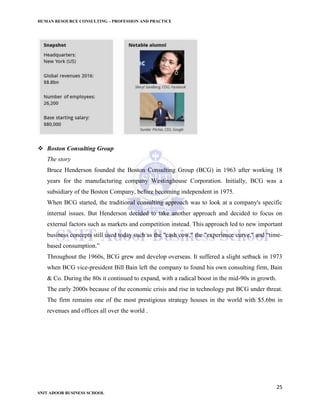
IT, such as the Internet, E-Commerce, CAD/CAM, CIM, MRP, Multimedia, ERP and WWW,
HUMAN RESOURCE CONSULTING – PROFESSION AND PRACTICE
79
SNIT ADOOR BUSINESS SCHOOL
EDI and EFT, would help to restructure an organization and promote changes with acceptance
from employees on any radical changes in the company. The reengineering of a business process
will result in improved process delivery systems and hence an improved customer service level.
In order to reengineer a business process, both internal and external process capabilities, such as
product development, production, distribution, suppliers and markets, and inter-organizational
relationships, especially in a global manufacturing environment, need to be integrated. Through
the integration of production activities into self-contained units reengineering helps to achieve
lean production. IT is an important element in such integration. Wyatt and Kletke (1997)
presented a descriptive model on BPR to illustrate the impact of telecommunication technology.
BPR is a process-driven top-down approach managed by senior executives, which aims to
improve the performance by radical changes in the system over the short term (Ardhaldjian and
Fahner 1994).
Fig: Conceptual model for BPR
Companies usually have to meet three important goals to achieve effectiveness:
 a process, not product perspective,
 cross-functional coordination or integration, and
HUMAN RESOURCE CONSULTING – PROFESSION AND PRACTICE
80
SNIT ADOOR BUSINESS SCHOOL
 consistency between goals and improvement plans (Wickens 1995, Jones et al. 1997,
Lockamy and Smith 1997).
IT is an enabler to the reengineered process, and any reengineering programme must consider the
tremendous advantage offered by the technologies such as expert systems and document image
processing (Childe et al. 1994, Morris and Brandon 1993).
4.2 SMOOTHENING THE BOTTLENECKS
The common bottlenecks in a consulting company are typically in one of three places.
 Lead generation (the constant grind of hunting down new clients)
 Client services (expanding scope creep killing the project's profit margin)
 Referrals and recurring revenue (no strategy for how to turn one project into many projects)
BOTTLENECK #1: Your Target Audience Is Too Broad
 It doesn't matter if you are a marketing consultant, technology consultant, strategy consulting
firm, or HR Consulting Firm...it's so hard to clearly explain ALL of the issues that come
together inside your expertise. It's certainly hard to communicate each of the benefits
specifically.
 Trying to talk to each of "sub elements" every time you engage someone is confusing,
overwhelming, and darn near impossible.
BOTTLENECK #2: Your Consulting Engagements Are Too Custom
Your engagements are too custom. Your scope of services is already broad, then you try to offer
custom solutions for each of those services.
BOTTLENECK #3: You've Taken On Too Much Responsibility as The Leader
 Specific role as the leader is too heavy. Lead the prospecting efforts, referral efforts and
client services efforts.
 You are involved in every single part of the client's engagement...and it weighs you down.
You aren't able to think about how to really scale your company, because you are involved
with too much.
HUMAN RESOURCE CONSULTING – PROFESSION AND PRACTICE
81
SNIT ADOOR BUSINESS SCHOOL
 You should stop. Develop a proprietary system for how your company does business and
delegate the parts that don't fit your highest and best use.
Take a look at the grid below. Let's assume you've got three core solutions your offer: solution
one, solution two, solution three. Then let's look at the actual business model. What has to be
done so that you can deliver on each solution well?
There are three main elements. They
 Lead generation - getting new leads in.
 There is a productized service - your specific method for solving the problem.
 There is recurring and referrals - what generates consistent revenue for your business.
Fig. Three common Bottlenecks of a consulting company
4.3 PREPARATION OF DELIVERABLES
A deliverable is a tangible or intangible good or service produced as a result of a project that is
intended to be delivered to a customer who is either internal or external. A deliverable could be a
document, a software product, a report, a server upgrade or any other building block of an
overall project. A deliverable may be composed of multiple smaller deliverables. It may be either
an outcome to be achieved or an output to be provided.
There are four main reasons why specifying the deliverables is a very good idea:
 It is a great way to set expectations and agree with the client beforehand what is to be
delivered and when.
 It is easier, especially for new clients, to accept a proposal with specific deliverables.
HUMAN RESOURCE CONSULTING – PROFESSION AND PRACTICE
82
SNIT ADOOR BUSINESS SCHOOL
 Payments are normally associated with deliveries. It is an opportunity for you to agree with
the client up front when payments will be released.
 It prevents you from engaging in projects, which turn out to be open-ended. You use too
many hours and the client is unsatisfied. The situation becomes “lose-lose”.
Tangible outputs
 PowerPoint decks describing approach, methods, outputs, results, inferences, plan ahead etc
(Basically a deck is always there which lists everything done, measured and delivered)
 Implementation plan documents - These could be detailed Word or Excel documents listing
steps for a implementation process etc
 Implementation trackers - detailed step by step excel sheets to track progress of
implementation of new process etc
 Dashboards - to measure change in key business metrics affected during and after a project.
Even if the consulting team leaves, the clients teams are enabled to measure / update the
metrics
 Process maps / process documents - these could be for any and every new process design
done - banks transactions process, IT sales process could be examples
 Prototypes / Tools - These are technology based tools or prototypes built for the project and
are given to the client teams
Intangible Output
 More often than not, presence of a consulting team also helps to create intangible outputs /
effects for the client organization.
 Primarily it’s a change in attitude for the client teams working closely with the consulting
teams.
 At times, the client teams are working with a lot more confidence seeing the outcomes /
improvements.
 There are also feelings of resentment in case jobs are cut to optimize costs (Though
significant measures are taken to minimize the ill effects of job cuts by designing appropriate
compensation measures etc.)
HUMAN RESOURCE CONSULTING – PROFESSION AND PRACTICE
83
SNIT ADOOR BUSINESS SCHOOL
Deliverables should be the focal point of a project or a project phase. All planned activities
should be directly tied to the production of a deliverable. Any project activity that does not
directly contribute to the production of a high-quality deliverable should be removed or
restructured from the project plan.
4.4 STANDARDS AND COMPLIANCE WITH LAW OF THE LAND
To ensure efficient and timely statutory compliance in your organisation, the following aspects
must be in place:
 Unrestricted access to local and regional expertise
 Expert support during all audits and inspections
 Following ethical practices
 Knowledge of timelines for adherence to the many laws and regulations
 Updated documents and data in a centralised location, and which are readily available
As you can imagine, this takes a lot of investement and effort in terms of both manpower and
money. Not every organisation can want to or afford to spend so many resources in ensuring
compliance.
Comprehensive coverage of Labor laws
 Shops and Commercial Establishments Act (S&E)
 The Employees Provident Funds and Miscellaneous Provision Act - 1952 (EPF)
 The Employees State Insurance Corporation Act - 1948 (ESIC)
 The Professional Tax Act (PT)
 The Labour Welfare Fund Act (LWF)
 The Contract Labour (Regulation & Abolition) Act - 1970 (CLRA)
 The Minimum Wages Act-1948
 The Payment of Wages Act-1936
 The Payment of Bonus Act-1965
 The Maternity Benefit Act-1961
 The Payment of Gratuity Act-1972
 The Equal Remuneration Act-1976
HUMAN RESOURCE CONSULTING – PROFESSION AND PRACTICE
84
SNIT ADOOR BUSINESS SCHOOL
 The Industrial Establishment (N&FH) ACT
 The Employment Exchange (Compulsory Notification of Vacancies) ACT-1959
 Sexual Harassment of Women at Workplace (Prevention, Prohibition & Redressal) ACT,
2013
 Employees Compensation ACT-1923
 The Industrial Employment (Standing Orders) ACT 1946 - Model Standing Order Only
 The Industrial Disputes ACT 1947
 The Apprentice ACT, 1961
 The Interstate Migrant Workmen (Regulation of Employment and Conditions of Services)
ACT, 1979
 Factories ACT, 1948
4.5 BENCHMARKING
Benchmarking analysis is an crucial tool for today’s management consultants. Benchmarking
includes comparing a current data set to historical data sets or data from industry peers. It can
help consultants determine where clients are ahead of competition, identify areas for client
improvement, boost the quality of the firm’s IP, and increase the firm’s competitive value.
Many well-known firms have developed successful benchmarking analysis offerings.
Consultants must collect data, often from multiple sources, reformat and clean it, and load it into
whatever tool they use. The complexity of benchmark analysis is perhaps why few firms are
making use it today. Complex, manual processes can be dangerous to consultants as they are
time consuming and error prone, making them susceptible to faulty conclusions.
The answer for today’s consultants is to automate the benchmarking process and map the data to
specific models. By automating, consultants can reach conclusions faster and ensure the one with
no errors. By using data models, consultants can make sure that data will be collected
consistently over time.
HUMAN RESOURCE CONSULTING – PROFESSION AND PRACTICE
85
SNIT ADOOR BUSINESS SCHOOL
The benefits of automating benchmark analysis are:
 Add A New Paid Offering
Benchmarking services provide consultants another offering for their portfolio, granting them
a competitive edge. Benchmarking is a proven practice and highly attractive to clients who
want to understand where they stand competitively. It can provide a level of historical
certainty which other methods cannot. Some firms are even exploring “Benchmarking As-A-
Service.”
 Define Gap Analyses with Data
Benchmarking data can inform consultants as to clients’ overall status in their industries
better than any other method. By identifying specific performance indicators and comparing
a client’s data to competitor data, consultants can draw accurate conclusions about where
their clients can improve. Their guidance is then based on the data with clearly measurable
opportunities for improvement.
 Create a Winning Pitch
By storing and automating the access of historical data, consultants can build a much better
understanding of what a company needs to be successful. By using this knowledge which
helps to lead sales conversations, consultants can create a winning sales pitch. Moreover,
they can begin providing insights right at the beginning of an engagement.
 Become a Thought Leader
In addition to informing sales pitches, the insights that benchmark data provide can help
consultants become better thought leaders. They can use the knowledge they gain over time
to prove their expertise in specific fields via speaking engagements, publications etc.
 Improve Intellectual Property
Consultants can also use benchmarking analysis to improve their own internal operations.
Firms can benchmark against their own historical data, including the performance of their
assessments or frameworks and key metrics of each engagement. By analyzing their own
data over time, consultants can test the accuracy of their models and the success of their
projects. On a more micro level, it can even allow them to test the success of their client
interview questions.
HUMAN RESOURCE CONSULTING – PROFESSION AND PRACTICE
86
SNIT ADOOR BUSINESS SCHOOL
How Benchmarking works:
 Select a product, service or process to benchmark
 Identify the key performance metrics
 Choose companies or internal areas to benchmark
 Collect data on performance and practices
 Analyze the data and identify opportunities for improvement
 Adapt and implement the best practices, setting reasonable goals and ensuring companywide
acceptance
Companies use Benchmarking to:
 Improve performance: Benchmarking identifies methods of improving operational efficiency
and product design.
 Understand relative cost position: Benchmarking reveals a company’s relative cost position
and identifies opportunities for improvement.
 Gain strategic advantage: Benchmarking helps companies focus on capabilities that are
critical to building strategic advantage.
 Increase the rate of organizational learning: Benchmarking brings new ideas into the
company and facilitates experience sharing.
4.6 STANDARDIZATION OF DELIVERABLES
A deliverable is the final product of a project or consulting phase. It comes in many forms, but
for consultants it’s normally PowerPoint. It is the thing the client is paying for, is thinking and is
the product.
o PowerPoint presentations are deliverables.
o Presentations are mandatory.
Raising the standards from the start with consistent project templates and planning tools ensures
that a standard set of tasks are created for each project, giving you the confidence that all the
important details and issues are covered. This also saves time for project managers, makes
planning more consistent and faster, and means that teams are briefed consistently – so they
understand exactly what’s required of them from day one. It leads to more consistent and
HUMAN RESOURCE CONSULTING – PROFESSION AND PRACTICE
87
SNIT ADOOR BUSINESS SCHOOL
accurate and consistent cost estimation too, which naturally increases your likelihood of
delivering on budget.
Once a project has been completed according to client’s requirements, we generate a uniform set
of documents to support the stated accuracies of the measured Ground Control Points. Because
we standardize our deliverables, Compass Data materials are easily ingested into your current
workflow and immediately usable.
Why PowerPoint?
 It shows logic.
 It is very visual.
 If done well, it is backed up with data.
 It’s often process-oriented, showing inputs and outputs.
 It makes assumptions explicit.
 It focuses your attention on the key takeaways.
 It’s made to communicate.
Examples of industry-specific deliverables
Industry-specific deliverables are typically being developed during the ‘execution’ phase of a
project. Examples of industry-specific deliverables include:
 Advertising/Marketing: Brand Strategy Report, Collateral (physical or digital),
Website/Social Media Copy, Campaign Definition/Metrics, Sales Literature
 Technology/Software: Requirement Documents, Technical/Functional Specifications,
Wireframes/Mockups, User Journeys, Executable Code, Test Scripts, Test Results
 Construction/Engineering: Blueprints, Design Drawings, Completed Projects/Products (i.e.,
commercial/residential building), Engineering Report, Site Survey
 Strategy & Operations: Business Cases, Business Plans, Competitor Analysis, Process Flow
Documentation, Future State Recommendations
HUMAN RESOURCE CONSULTING – PROFESSION AND PRACTICE
88
SNIT ADOOR BUSINESS SCHOOL
Example deliverables by project phase
 Initiation: Project Charter, Project Kickoff Deck
 Planning: Key Stakeholder List, Project Plan, Risk Log, Communication Plan, Key
Performance Indicator Definitions, Work Breakdown Structure
 Execution: Work Products (will vary by industry)
 Performance/Monitoring: Status Report(s), Change Requests, Project Plan Updates, Risk
Identification/Mitigation
 Closure: Project Overview Presentation, Transition Plan, Project Retrospective
4.7 MEETING FOR ‘BUY-INS’ – PRESENTATION OF SOLUTIONS
 Communicate Clearly Up-Front
 Understand the Organization
 Build Rapport
 First Impressions Last
 Demonstrate The Benefits
 Finish Well
 Follow Through
4.8 IMPLEMENTATION OF DELIVERABLES - TRAINING, COACHING AND
MENTORING; INTERIM REVIEW AND FEEDBACK
4.8.1 TRAINING, COACHING AND MENTORING
Definitions
 Coaching: According to the International Coach Federation coaching is defined as
“partnering with clients in a thought-provoking and creative process that inspires them to
maximize their personal and professional potential.” It is about skills and knowledge
acquisition. A method by which an individual is supervised by manager to improve his
competencies and capabilities. Coaching has defined outlines and timeliness for completion.
 Mentoring: A mentor is a wise and trusted guide and advisor. The mentor is the teacher that
shares their experience while bringing the “mentee” up the ranks. A coach is not necessarily
the subject matter expert to help develop the client. A relationship in which more
HUMAN RESOURCE CONSULTING – PROFESSION AND PRACTICE
89
SNIT ADOOR BUSINESS SCHOOL
experienced and a more knowledgeable person(mentor) helps to guide a less knowledgeable
person(mentee). Mentoring is more transformational.
 Training: Dale S. Beach defines training as ‘the organized procedure by which people learn
knowledge and/or skill for a definite purpose’. Training refers to the learning and teaching
activities carried on for the primary purpose of helping members of an organization acquire
and apply the knowledge, skills, abilities, and attitudes needed by a particular job and
organization. Training has the specific goals of improving one’s capability, capacity,
productivity and performance.
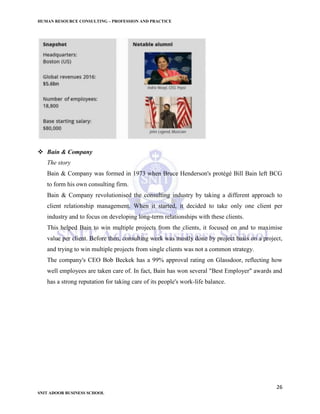
Benefits
The importance of coaching and mentoring extends broadly from the organization as a whole and
coach / mentor to the learner.
Benefits to the Coach or Mentor
The coach / mentor play a very important role in transferring knowledge to the individual and
helps the person in enhancing his personal and professional growth. The following reasons
explain the importance of coaching and mentoring to the people who are conducting it:
 Increased job satisfaction
 Further enhancement of their own skill level
 Advantage of their own professional development
 Enhanced skill in problem analysis and strategic thinking
 Develops self-esteem
Benefits to the Organization
 Higher employee retention
 Competitive advantage with more skilled and well-performing employees
 Increased skill set and knowledge levels of the people
 Greater chances of attaining goals
 Strengthening of company culture and ethics and Succession planning
 Enhancement of communication within the organization
HUMAN RESOURCE CONSULTING – PROFESSION AND PRACTICE
90
SNIT ADOOR BUSINESS SCHOOL
Fig. Comparison – Coaching, Mentoring, Training
HUMAN RESOURCE CONSULTING – PROFESSION AND PRACTICE
91
SNIT ADOOR BUSINESS SCHOOL
Effectiveness of Coaching and Mentoring
The impact of mentoring and coaching sessions to the individuals working in an organization is
greater with these things:
 There is a good and smooth in the workplace wherein professional learning is productive and
individuals have the commitment and willingness to develop and improve themselves.
 The management acknowledges the needs of the employees for professional learning that
must be attained in order to raise organizational standards.
 There are standard processes and sets of procedures for coaching and mentoring programs
based on best practice.
 The work roles of employees are redefined to incorporate coaching and mentoring sessions.
 The designated coaches and mentors have the appropriate personal and professional
attributes and skills required to conduct effective coaching. These experts are also able to
provide continuous training and development necessary for employees progress.
 The employees recognize the need and responsibility to attain professional development.
 There is an evaluation about the impact of coaching and mentoring on the individuals and the
organization.
The advantages of Coaching and Mentoring
It is already a great advantage to the organization that mentoring and coaching benefits both the
coach/mentor and the individuals.
o Good working relationships are also developed since the supervisor usually takes the role of
a coach to the staff.
o At the same time, the employees also see their superiors as their mentors who are willing to
guide and help them develop their full potentials. It touches both the professional and
personal aspects of the individuals.
o When the focus is on improving performance, the person will realize that there are personal
issues that need to be addressed.
o The implementation of coaching and mentoring in the workplace is a great contribution to the
overall development of the individual and organizational level.
HUMAN RESOURCE CONSULTING – PROFESSION AND PRACTICE
92
SNIT ADOOR BUSINESS SCHOOL
o That is why these programs are incorporated as a regular practice in the organizational
system.
4.8.2 INTERIM REVIEW AND FEEDBACK
 Provide a brief, informal checkpoint for the supervisor and employee at set times in the
performance evaluation cycle
 Determine if anything significant has changed since the Performance Planning and Goal
Setting meeting
 Discuss the progress and status of Performance and Development Goals
 Adjust, add or clarify performance expectations
 Discuss specific issues - either the employee’s, the supervisor’s, or both
 Provide value-added feedback
 Provide coaching and identify any support needed
 Identify performance problems so they can be corrected as soon as possible
Why are Interim Reviews important?
 Regular one-on-one meetings will continue to be the most effective forum for
communication from supervisor to employee, as well as from employee to supervisor.
 Interim reviews are an additional, and more focused, opportunity for the supervisor and
employee to share feedback to be sure performance continues to remain on track with the
required job duties, and agreed upon goals and expectations.
 Along with ongoing value-added feedback, Interim Reviews help minimize surprises and
provide documentation in preparation for the cycle-end performance evaluation.
 If significant corrections need to be made, a more formal and timely Performance
Improvement Plan can be put in place.
 The Interim Review meetings also provide the employee with an opportunity to discuss
significant accomplishments or identify issues or obstacles related to his or her performance
that require attention from the supervisor.
 This is a coaching opportunity in which the supervisor can reinforce how he or she can help
the employee, in words and in actions.
HUMAN RESOURCE CONSULTING – PROFESSION AND PRACTICE
93
SNIT ADOOR BUSINESS SCHOOL
How often should Interim Reviews be held?
Interim Reviews should take place twice during the annual cycle, about every four months.
What is the best length for Interim Review meetings?
Most Interim Review meetings should typically last about half an hour. A good rule of thumb is
10 minutes for supervisor messages, 10 minutes for employee messages, and 10 minutes for
sharing information
How should the supervisor prepare for Interim Reviews?
The supervisor should plan a meeting with the employee at least one week in advance. The
supervisor should encourage the employee to update goal status and bring to the meeting
documentation of accomplishments and how well the Performance Factor expectations are being
met.
How should the employee prepare for Interim Review meetings?
The supervisor should encourage employees to gather important documents and consider some
focused questions prior to the meeting. These questions should be given to the employee in
advance.
 What has gone well so far this year and is continuing to go well?
 What are your most important areas for improvement?
 What suggestions do you have for any revisions to your performance or development goals,
position description elements, or performance expectations?
 What additional support or resources are needed?
What topics should be covered during the Interim Review meeting?
The following topics are to be covered during the meeting. Provide positive and/or negative
value-added feedback as needed to reinforce successful performance and/or correct performance
that needs improvement.
 Performance Goals
 What is the status? On track? If not, why not?
HUMAN RESOURCE CONSULTING – PROFESSION AND PRACTICE
94
SNIT ADOOR BUSINESS SCHOOL
 What are the successes? Challenges?
 Are there any changes to the goals? (i.e. new priorities, revised timelines, etc.)
 Development Goals
 What is the status? On track? If not, why not?
 What are the successes? Challenges?
 Are there any changes to the goals? (i.e. revised timelines, new priorities etc.)
 Performance Factors
 What are the areas where the employee is performing well?
 What areas show recent improvement?
 What areas still need improvement?
 What expectations need to be clarified?
 Support/Resources
 What additional support is needed? (From whom? By when?)
 Key Messages
 What key messages about the employee’s performance does he or she need to understand
and leave with at the end of the meeting?
 Agreements/Next Steps
 Who is expected to do what, by when?
4.8.3 IMPLEMENTATION PHASE
Project implementation (or project execution) is the phase where visions and plans become
reality. This is the logical conclusion, after deciding, evaluating, visioning, planning, applying
for funds and finding the financial resources of a project. Implementation phase means carrying
out the activities described in your work plan.
Objectives of the Implementation Phase
 Putting the action plan into operation
 Achieving tangible change and improvements
 Ensuring that new infrastructure, new institutions and new resources are sustainable in
every aspect
 Ensuring that any unforeseen conflicts that might arise during this stage are resolved
HUMAN RESOURCE CONSULTING – PROFESSION AND PRACTICE
95
SNIT ADOOR BUSINESS SCHOOL
 Ensuring transparency with regard to finances
4.9 DISENGAGING
 Those working internally are good at establishing effective working relationships with their
clients.
 Clients need to feel they can trust the consultant and the consultant needs to be accessible
when needed
 However, being too available and accessible can create client dependency.
 Withdrawal and disengagement increases the risk of clients feeling vulnerable, particularly if
they do not feel well prepared for their continuing role in implementing and supporting
change.
 It is also the case that the client can often perceive the consultant as integral to the system,
and therefore not needing to leave.
 Being clear about the boundaries of the piece of work and the time to withdraw will be
essential if the internal consultant is to be able to manage the many conflicting priorities with
which they will be presented.
 Disengaging becomes much easier and clearer when the contracting process has been
effective.
 Whether this is done formally or informally if the consultant’s role and the client’s
expectations about the outcomes for the piece of work have been clarified, the ending should
feel both appropriate and timely.
HUMAN RESOURCE CONSULTING – PROFESSION AND PRACTICE
96
SNIT ADOOR BUSINESS SCHOOL
Specialty areas of HR Consulting
The idea of HR consulting services is widely accepted all across the globe because of numerous
benefits it provides to an organization. By choosing the right people for the organization, the
company can focus more on their core roles. But, hiring the right people eats a lot of time, and
that might distract you from your core motive. Here the HR consulting services comes into use.
The HR consulting services understand your company’s motive, goals and objectives, and hire
the right people according to your company culture. The business world has proudly accepted
this idea and a majority of the companies now outsource the matters of human resource.
Consulting Areas in HRM
 Human Resource Planning – The purpose of HRP is is to make sure that the
organization has the right number of people of the right profile at the right time.
An HR consulting firm can provide the organization with a comprehensive HR
assessment and planning to meet its future requirements in the most cost-effective and
timely manner.
HR planning process
 Current HR Supply
 Future HR Demand
 Demand Forecast
 HR sourcing strategy and implementation
 Recruitment and Selection – Recruitment is the process of attracting applicants for jobs
within the organization.
Role of Consultant
 Job description and the person required
MODULE
V
Human Resources in Organization Consulting: Specialty areas of HR consulting;
Outsourcing and HR – areas for outsourcing, readiness for outsourcing; HR Consulting
firms in India and its future in India; HR Consultant Career graph.
HUMAN RESOURCE CONSULTING – PROFESSION AND PRACTICE
97
SNIT ADOOR BUSINESS SCHOOL
 Methods of advertising the vacancy
 Executive search
Selection is the process of choosing the right person to the right job.
 Remuneration – Consultants develops a salary system that works efficiently and fairly
from the point of view of both the organization’s employees and management. This can
be done by Job analysis, evaluation and building of a job structure. The consultant cannot
see wage and salary problems as purely technical ones.
 Motivation – Every organization aims to motivate its personal. This depends upon their
achieved range of goals, which may include Societal, group, individual and
organizational goal.
An HRM consultant may be requested to assist in determining what motivational tools
and strategies are to be used.
They may include:
 The enrichment of job content.
 The improvement of overall organizational climate.
 Reward Systems
 HRD – Its main purpose is to help people in organizations to face the challenges created
by technological and other changes, to adapt to new requirements, to develop skills, and
to achieve the levels of performance needed to stay competitive.
The HRD specialists makes the client aware of the complexity of human side of the
enterprise, and of the need to consider all factors affecting motivation, behavior,
interpersonal relations and performance of people in organizations.
Other Areas Includes:
 Retention
 Termination
 HR Audit
 Human Capital Accounting
 HRM
 HRIS
HUMAN RESOURCE CONSULTING – PROFESSION AND PRACTICE
98
SNIT ADOOR BUSINESS SCHOOL
Outsourcing and HR - Areas of outsourcing
Outsourcing is a business practice in which a company hires an individual or another company to
perform tasks, handle operations or provide services that are either usually executed or had
previously been done by the company's own employees.
Companies often outsource as a way to improve efficiencies, lower costs and gain speed.
Other benefits include:
 Cost Savings
 Payroll and Accounting
 Global Talent
 Risk Management
 Efficiency
 Employee Development
 Help with Compliance
 Reduce employment related expenses
 Health insurance benefits
HR Outsourcing
HR outsourcing services are highly customized based on the client’s need.
According to Lisa Fleming, PR Manager at Paychex, "The cost for fully outsourced HR services
varies greatly and is typically customized based on the individual needs of the client.
HR outsourcing gives businesses the option of delegating human resource related assignments
such as benefits payroll, administration, training, recruiting and other employee management
task to a team of smart HR professionals, instead of hiring internal staff.
HR outsourcing is the most sustainable method to manage costs and to facilitate the organization
to focus on core operations and strategic initiatives instead of wasting time in the routine
transactional activities of HR management.
HUMAN RESOURCE CONSULTING – PROFESSION AND PRACTICE
99
SNIT ADOOR BUSINESS SCHOOL
Advantages
 Impact Good or Bad – HR consultancy can have an important effect on your company, so
always make sure that you choose someone whose impact is a positive one.
 Cost Effective
 Save Time
Disadvantages
 Morale – The consultant with low morale can often lead to less productivity.
 Confidentiality – The deal should be strictly confidential.
 Loss of Human Factor – When an organization takes the assistance of consulting firm
loss of human factors normally happens.
READINESS FOR OUTSOURCING
 For employees Outsourcing is always a sensitive topic, hemce it should always get the
support of employees.
 It’s vital that you find the right company or individual to outsource to. Before you make a
long term commitment, always do a trial run to make sure there is cohesiveness.
 Expand what you outsource slowly. Always try to take a step by step approach before
implementing a large scale strategy to outsource. This approach allows you to make
adjustments, and scale up or back as required as your company evolves.
 In order for outsourcing to work effectively, always be an active partner. You need to
provide the outsourcing service provider with the resources and information to do the job
correctly, you need to be responsive to their requests, and you need to help them help
you.
 Always be an open communicator. Always make sure to provide feedback and solicit
feedback from your outsource partner. Keeping an open line of communication is vital to
ensure everyone is on the same page and expectations are being met on both sides.
HUMAN RESOURCE CONSULTING – PROFESSION AND PRACTICE
100
SNIT ADOOR BUSINESS SCHOOL
HR Consulting firms in India and its future in India
• Human resources consultants work to make sure that the company effectively uses its
resources to achieve greater goals and improved efficiency. HR consultants are
generally outsourced to help companies on a wide range of issues involving its
workforce. HR consultants operate independently or through a consulting firm.
Top HR consulting firms in India
• ABC Consultants Pvt Ltd.
• Quess Corp Ltd. ...
• Career Net Technologies Pvt Ltd. ...
• Innovsource Pvt Ltd. ...
• IKYA General Staffing. ...
• Kelly Services India Pvt Ltd.
• Manpower Group Services India Pvt Ltd
• Randstad India Pvt. Ltd
• Team lease Services Ltd
• Rites Ltd.
 The Indian consulting began in the 1990s when C. K. Birla requested McKinsey to devise
a turnaround project for Hindustan Motors. Soon, McKinsey opened an office, employing
about 100 consultants in Delhi. According to an estimate, there are now over 10,000
small and big consulting firms in India, 6,000 of them in the four metros of Delhi,
Mumbai, Kolkata and Chennai.
 According to the Associated Chambers of Commerce and Industry, the Indian consulting
industry is expected to record revenues of Rs. 27,000 crore by 2020. One estimate says
that between 500 and 600 high-value consulting contracts, worth $250 million to $300
million, are awarded every year by Indian companies, including 30 or 40 projects worth
over $2 million each.
 As in many other sectors, low cost was the first major initial advantage of Indian
consulting companies and consultants. But their major clients and their partners abroad
have found that Indian consultants have other advantages, such as industriousness,
HUMAN RESOURCE CONSULTING – PROFESSION AND PRACTICE
101
SNIT ADOOR BUSINESS SCHOOL
willingness to learn, professionalism, and adaptability to technology. Their competitors
have started to view them as worthy equals.
 However, they suffer from shortcomings, too. Among them are poor brand equity,
experience in foreign markets, ability to maintain quality, and low level of R&D. But
they can overcome these difficulties and emerge more powerful in the global scenario if
they adopt the best practices in the industry and improve their knowledge resources and
data warehousing.
Future of human resource consultancy firms
1. Cloud:
• According to a 2016 KPMG survey, 42% of the companies are thinking about shifting to
Cloud HR System. After a year of that news, many companies must have taken a step
forward. The reason why such a huge amount of companies are changing the way their
human resources works is because of the endless benefits cloud services. HR consulting
firms would surely move towards cloud as entire HR industry is expected to grab this change.
2. A better level of recruitment:
• As the job profiles are becoming more and more focused, the recruitment will be more
centered towards skills. By far, companies have realized the exact nature of each and every
job profile, hence the hr consulting firms can find the right candidates for the businesses.
• With increasing use of Applicant Tracking System, the human resource consulting industry is
more focused on better user experience. Not just for the applicants, but also for the HR
consultants.
3. Outsourcing:
• Sure, the human resource management is one of the most important parts of any business.
But, maintaining & managing people, and activities of HR services can be tedious. That is
the reason why HR consulting firms were born. The prime motive behind these top hr
consulting firms is to load off some weight from your company, so they can focus more on
your business.
HUMAN RESOURCE CONSULTING – PROFESSION AND PRACTICE
102
SNIT ADOOR BUSINESS SCHOOL
Impact of technology on HR services:
1. Remote working:
• As the cloud has covered almost every company in one or another way, there is a fair
chance of a majority of people working from home. In the future, we could see a
possibility of employees working from remote locations, and running a business. The
whole idea of virtual business is already widely accepted, and cloud technology has given
it the needed wings.
2. Artificial Intelligence:
• Giant companies are investing more in artificial intelligence or machine learning technology,
these days. The prime goal is to reduce human efforts. But, as this technology will grow,
there will be lesser people required, because machines will replace people with many
repetitive jobs. With the intelligence growing in machines, there will be very few roles left
for humans.
HR Consultant Career graph
Career: The sequence of employee related positions, activities, roles and experiences
encountered by person over time. (Arnold, 1997)
Career graph of the consultant refers to the growth of the employee in his organization. Career
graph basically means the various positions an employee moves on one by one as he grows in an
organization. The employee may move vertically most of the time but also move laterally or
cross functionally to move to a different type of job role.
HUMAN RESOURCE CONSULTING – PROFESSION AND PRACTICE
103
SNIT ADOOR BUSINESS SCHOOL
Figure: Career Graph – an example
HUMAN RESOURCE CONSULTING – PROFESSION AND PRACTICE
104
SNIT ADOOR BUSINESS SCHOOL
REFERENCES
 Kubr, M (ed.) (2002), Management consulting: A guide to the profession (fourth edition),
Geneva, International Labour Office
 Gilbert Toppin and Fiona Czerniawska (2005), Business Consulting: A Guide to How it
Works and How to Make it Work, The Economist Newspaper Ltd.
 Peter Block (2011), Flawless Consulting
 smallbusiness.chron.com/advantages-outsourcing-hr-functions-21169
 www.google.com
 www.hrinasia.com/general/5-key-areas-wherein-hr-outsourcing-can-help-improve-bottom-
lines
 www.inc.com/hr-outsourcing/best-hr-outsourcing-for-small-business-in-2017
 www.peocompare.com/human-resources-hr-outsourcing
 www.peocompare.com/human-resources-hr-outsourcingwww.priorityhr.com/blog/entry/9-
benefits-to-outsourcing-hr
 www.renaissancewealth.net/overview-of-consulting-process

Human Resource Consulting – Profession and Practice

  • 1.
    HR CONSULTING – PROFESSION& PRACTICE A Handbook on S N I T A D O O R B U S I N E S S S C H O O L
  • 2.
    Handbook on HUMAN RESOURCECONSULTING – PROFESSION AND PRACTICE (HRCPP) Prepared by, Ms. Jaya Shankar ME Computer Science, MBA Assistant Professor SNIT Adoor Business School Ms. Rizaet A. Rahim MBA, PG-DHHM Assistant Professor SNIT Adoor Business School & Ms. Vishnupriya M.G. T6 MBA (2017-2019), SNIT Adoor Business School
  • 3.
    About the Book Thebook has been designed to serve as an essential insight necessary to understand Human Resource Consulting that especially meets the requirements of T6 MBA students of KTU specializing in Human Resource Management.
  • 4.
    MODULE SYLLABUS PAGE NO. I Consulting- Firmsand Professions: Business consulting; The changing consulting industry, global trends and acceptance of Consultants; Consultants - Types, competencies and Values; Consulting as a profession; HR consultancy – scope, application, effectiveness; Top Consulting Firms in the world – services offered, future of consulting companies; The new business consulting ecosystem – model, drawbacks. 1-32 II The Consulting Process: Consulting Models - models used by consulting firms to analyze clients; The client market - Understanding buyer values, Advertising PR; Client relationship - relationship management, repeated assignments, retainer contracts; Generating and winning consulting assignments – services offering, marketing pitch, consulting services presentations; Proposals - Writing Successful Proposals. 33-47 III Managing consulting projects: Process - From diagnosis to discovery – Diagnostic review; Dealing with internal Resistance; Whole-system discovery; Meetings to understand the complete picture; Workflow and Business process – Business Process definition, Mapping workflow techniques, bottlenecks identification, discovering Gifts, Capacities and possibilities; Findings – presentation of findings and recommendations; Project Management – tools, techniques. 48-75 IV Delivering results and disengagement: Analyzing and framing problems - applying business process reengineering, smoothening the bottlenecks; Preparation of Deliverables, standards and compliance with law of the land, benchmarking; Review of Deliverables – standardization; Meeting for ‘buy-ins’ – presentation of solutions; Implementation of deliverables – training, coaching and mentoring; Interim review and feedback; Knowledge transfer and disengagement. 76-95 V Human Resources in Organization Consulting: Specialty areas of HR consulting; Outsourcing and HR – areas for outsourcing, readiness for outsourcing; HR Consulting firms in India and its future in India; HR Consultant Career graph. 96-102
  • 5.
    HUMAN RESOURCE CONSULTING– PROFESSION AND PRACTICE 1 SNIT ADOOR BUSINESS SCHOOL "What is unique to management is that from the very beginning the consultant played a key role in the development of the practice, the knowledge and the profession of management." Peter Drucker 1. CONSULTING Consultancy is the act of consulting and is the process of seeking the advice of a consultant. According to New Webster’s Collegiate Dictionary ‘to consult’ means ‘to ask advice of’ or ‘to seek the opinion of’ and ‘consultant’ means ‘one who consults or give expert advice’. A consultant is a qualified and independent person who provides professional service to individuals, organisations or business organisations. Consultancy services are the services provided by consultants to identify and investigate the problems concerned with policy, organisation, procedures and methods; recommending appropriate action and helping to implement these recommendations. Even though there are different areas of consultancy, in practice, all these practically originate from management consultancy. Hence it is appropriate to discuss the concept of management consultancy. The Management Consultancy Association of India defines management consulting as "an advisory service contracted for and provided to business, public and other undertakings by specially trained and qualified persons. It is a process of interaction wherein the consultant in an objective and independent manner diagnoses and investigates problems and issues concerned MODULE I Consulting- Firms and Professions: Business consulting; The changing consulting industry, global trends and acceptance of Consultants; Consultants - Types, competencies and Values; Consulting as a profession; HR consultancy – scope, application, effectiveness; Top Consulting Firms in the world – services offered, future of consulting companies; The new business consulting ecosystem – model, drawbacks.
  • 6.
    HUMAN RESOURCE CONSULTING– PROFESSION AND PRACTICE 2 SNIT ADOOR BUSINESS SCHOOL with management practices, analyses these, recommends appropriate action and provides assistance when requested in implementation of recommended solutions" 1.1 BUSINESS CONSULTING Business consulting refers to the practice of, helping organizations to improve their performance, primarily through the analysis of existing business problems and development of plans for improvement. They provide management consulting to help organizations to improve performance and its efficiency. Consultancies may also provide organizational change management assistance, development of coaching skills, technology implementation, strategy development, or operational improvement services. A business consultant is a ‘hired gun’ who has both the expertise and experience to advise you what to do and execute your plan into action saving your money, time and grievance.Strategic planning is one of the key services provided by business consultants. Business consultants help clients through analysis, statistics, and strategy and bring in the requisite knowledge and expertise for a business which may be beyond the current expertise of the existing skill of the business. Hence,Business owners should consider hiring business consultants when they need help or perspective on their chosen path or need a catalyst for change in their companies. Business consulting is becoming important in non-business related fields as well. A small business consultant works with clients on strategy, and helps clients develop business skills and knowledge. These topics range from designing abusiness model or marketing plan, to determining which marketing techniques to use and how to use them. Two general categories:  Internal consultant - someone who operates within an organization but is available to be consulted on areas of specialism by other departments or individuals (acting as clients); or  External consultant - someone who is employed externally (either by a firm or some other agency) whose expertise is provided on a temporary basis, usually for a fee.
  • 7.
    HUMAN RESOURCE CONSULTING– PROFESSION AND PRACTICE 3 SNIT ADOOR BUSINESS SCHOOL Fig. Consulting Purposes Business Consulting is a five pronged strategic approach: 1. Corporate Strategy - Create and implement strategies to respond effectively to a constantly evolving corporate scenario. They include: Business Enterprise Transformation, Strategic Planning, Growth Strategy. 2. Customer Strategy - Identify and align organization’s customers to their business and manage them efficiently. 3. Operational Strategy - Improvement of day-to-day operations, Benchmarking operational levels, Standardization of operational processes. 4. HR Strategy - HR functions are quickly becoming the key strategic point for every organization irrespective of its size, areas of operations, verticals, whether a startup or an established organization. They include: Aligning HR to Business, Leadership Development, Compensation benchmarking, Rewards and Recognition Strategy, HR Policy framework benchmarking, Competency Mapping and Management. 5. Organizational Strategy–This is an extension to HR strategy. They include: Succession Planning, Organizational structure, Role objectives and responsibilities, Organization Development Interventions, Effective Change Management.
  • 8.
    HUMAN RESOURCE CONSULTING– PROFESSION AND PRACTICE 4 SNIT ADOOR BUSINESS SCHOOL 7C’s of Consulting: 1. Client: Understanding the client’s real and perceived view of what is required from the assignment. 2. Clarify: Understanding the nature of the problem being addressed and the scope of the change being attempted. 3. Create: This helps the consultant needs to develop the plan of action needed. 4. Change: The consultant must try to understand the drivers of the change. 5. Confirm: Once the actions taken, the consultant should follow-up and confirm the change that has taken place. 6. Continue: The consultant ensures that the changes made to continue. 7. Close: They should ensure that the client is fully aware of the final outcomes, added value, the new learning and what may be required in the future. 10 principal ways of consulting Consultants can take part in many different ways. Most of the consulting assistance to management can be done in one or more of the following 10 ways.  Providing information  Providing specialist resources  Establishing business contacts and linkages  Providing expert opinion  Doing diagnostic work  Developing action proposals  Improving system and methods  Planning and managing organizational changes  Training and developing management and staff  Providing personal counselling Business consultant vs Management consultant Business consultants and management consultants are both professional individuals who come along to co-pilot and partner your business with you.
  • 9.
    HUMAN RESOURCE CONSULTING– PROFESSION AND PRACTICE 5 SNIT ADOOR BUSINESS SCHOOL Business consultancy Business managers work within an organization and decide how to use resources and employees to best meet their aims and objectives. Every business, big or small, needs managers and your skills will be useful across many sectors. The level of responsibility depends on your seniority and experience. Starting your career in a management role could progress you to be a senior manager in the company, perhaps even make it to board and director level. Management Consultancy The role of management consultants is to work through international consultancies or strategy sections of financial organizations such as accountants. They are approached and contracted by organizations seeking help and advice about management problems. Typical employers include international management consultancy firms; major financial organizations and large accountants and banks; smaller consultancies; but you could be called upon to work anywhere and that includes the clients' own offices for extended periods, possibly overseas. Management consultants need to be bright, flexible, hard-working and able to get on well with other people in different environments. They also need power, practical intelligence, project management and specific skills to suit the context in which they are working. Criteria for selection of a business consultancy  Integrity and professional ethics of the consulting company  Professional competence  Problem solving approach  Capacity to deliver on time  Ability to deploy resources  Consultant’s image and reputation 1.2 CONSULTANTS - TYPES, CHARACTERISTICS, COMPETENCIES AND VALUES Types of consultants  Management and Strategy Consultants: Qualified consultants should have a deep understanding of your particular market and bring the best practices from your industry or
  • 10.
    HUMAN RESOURCE CONSULTING– PROFESSION AND PRACTICE 6 SNIT ADOOR BUSINESS SCHOOL other industries to your company. If you're looking to expand your markets geographically, extend your product portfolio, reorganize your middle market company to promote efficiency and cost-effectiveness, buy out a smaller competitor, or increase your overall capabilities, then hiring an experienced management consultant can make perfect sense. Firms such as McKinsey & Company are famous for helping clients develop and execute better strategies.  Operations Consultants: Want to improve the quality and efficiency of your production processes? An operations consultant such as Accenture can help you create and implement a new way of doing that. Some consultants specialize in business process re-engineering, meaning that they come in and map out your existing processes, analyze opportunities for reducing the number of steps in that process while maintaining quality, and re-engineer your processes in a way that reduces steps and costs. Other consultants are experts in quality control systems and can help you make changes that will reduce defects.  IT Consultants: IT Consultants job is to recommend Computer Hardware, Software and Networks to build high performing systems and workflow. This also provides technical expertise in areas of information systems design, software programming and development. Technology consultants are having specialization in different areas and are also called as information system consultant, system applications consultant, data management consultants and network consultants. As the demands of new technology are impacting middle market companies every day, this is a fast-growing area for consulting. An IT consultant can help whether you need to develop a new system or integrate your old systems so that they work together. IT consultants such as IBM will enhance your capabilities and also make your IT more flexible in meeting the dynamic needs of customers.  Human Resources or HR Consultants: Most of the companies outsource the job of attraction, selection, training, assessment, and rewarding of employees, while also overseeing organizational leadership and culture, and also help for ensuring compliance with employment and labor laws. You need to co-ordinate between candidate and the companies. There are many models in which you can work out with the client. HR nowadays also focuses on strategic initiatives like talent management, mergers and acquisitions, succession planning, industrial and labor relations, diversity and inclusion.
  • 11.
    HUMAN RESOURCE CONSULTING– PROFESSION AND PRACTICE 7 SNIT ADOOR BUSINESS SCHOOL HR consultants help to improve the overall satisfaction of your employees, recruit top talent, and retain your top performers. HR consultants such as Hay Group specialize in developing compensation strategies that align with your overall business goals, training, and developing your people in areas such as business communication and leadership. They can also help you improve performance-related feedback and evaluation to your team, making your employees work smarter.  Marketing Consultants: Marketing Consultants job is to focus on developing strategies in order to successfully promote, sell and distribute goods and services to targeted consumers. On a larger scale, marketing serves as a viable means of getting a new brand name, service or product into the public and transforming it into a lucrative business. Companies, therefore, seek expertise of marketing consultants in order to discover creative techniques for launching and for sustaining their business. Marketing consultants can help if you need a new logo for your company, a new market position for one of your brands, or a new social media strategy to interact with your customers. Consultants such as The Boston Consulting Group can offer you a creative spark when your own people have run out of ideas, helps you see what other companies have done to attract more customers.  Strategy Consultants: Helping organizations figure out any problem in their operations and work strategy and to improve their performance, primarily through the analysis of existing organizational problems and development of plans for improvement. Otherwise known as management consultative for the company where in you can play a key role in technology implementation and workflow management.  Technology Consultants: Delivering software solutions that improve business performance of the clients and Turning the initiatives into reality – in other words, the strategic know-how and understanding of key technology drivers to plan the adoption, development and integration of advanced technology into client’s business. This helps by providing a scalable architecture and enable the client business to gain competitive advantage over the others.  Public Relations or PR Consultants: Public relations (PR) is the practice of managing the flow of information between an individual or an organization and the public. Your role will be to build reputation or a point of view about the company which you serving in front of
  • 12.
    HUMAN RESOURCE CONSULTING– PROFESSION AND PRACTICE 8 SNIT ADOOR BUSINESS SCHOOL investors, partners, public and employees. In other words, you control what other thinks about company’s leadership, products, or of political decisions  Legal Consultants: This identifies, prevents and solves legal issues facing a company or a client. Its specialization includes legal consultation in employment, banking, contract, corporate, intellectual property, tax, real estate, information technology or trust.  Social Media Consultant: Role of Internet marketing agency or a Social Media Consultant is to help companies to increase traffic to their websites by methods of search engine optimization and content and by social media marketing. Your role will be to build strong online presence of the client and build a brand online, by using various social media platforms like social networks and social media. Keep yourself up to date with new and changed capabilities offered by the web  Financial/Investment Consultants: Financial consultants, also known as financial advisers or financial analysts, are licensed professionals who are trained to help individuals or organizations make intelligent financial decisions. These professionals typically helps to know information about market trends, stock values, taxes and other economic factors to help a client decide if an investment is appropriate or not. Fig: Types of Consultancy Services Characteristics of a good business consultant  Honesty: Honesty works on “do not lie” principle.
  • 13.
    HUMAN RESOURCE CONSULTING– PROFESSION AND PRACTICE 9 SNIT ADOOR BUSINESS SCHOOL  Good Communication Skills: Good verbal and written communication skills are important for a consultant to be successful. They should be able to understand the needs of their clients and be able to effectively communicate their needs, thoughts and inputs.  Expert Knowledge: Knowledge should be current –can be updated through magazines, training, and networking with other professionals in the industry.  Reputation: Reputation is also extremely important for a consultant.  Analytical: The ability to solve problems based on solid facts and research helps you make good decisions.  Flexible: Because a consultant or freelancer doesn’t have one single employer, they need to be flexible to be able to respond to the needs of multiple clients around the world. They should adapt to diverse situations and demands.  Sociable: The consultant should be sociable.  Professionalism: Professional relationship with their clients is very important for consultants to maintain. Consultants - Competencies and Values Competencies (the ability to do something successfully or efficiently) identify the observable behaviors that successful performers demonstrate on the job. Those behaviors are the result of various skills, knowledge, abilities, motivations, and traits an employee may possess. Core competencies are a specific type of competency. They identify the strengths and key values shared by everyone in the organization, regardless of the job they perform. Supporting those shared core competencies enable an organization to differentiate itself in a competitive marketplace and define the behaviors that support those differentiators. Values (the importance) identifies the beliefs or ideals shared by everyone in the organization whether they are organizational or personal. Our values define the things we believe are important, meaningful, and right. While competencies and values have significant areas of overlap, there’s a key difference between them:
  • 14.
    HUMAN RESOURCE CONSULTING– PROFESSION AND PRACTICE 10 SNIT ADOOR BUSINESS SCHOOL Values are intangible. They are based on feelings, preferences, perceptions, and priorities - an internal code that influences how we interpret and experience the world. Competencies are tangible (real, existing). They are based on on-the-job behaviors that can be objectively observed and measured by the people around us. HRSG competency consultant Christine Lamothe explains it this way: “Values are what are important to the organization, and competencies are the tools that support that. Maybe a continuous learning environment is critical for the organization. Maybe it’s client satisfaction or quality of service. Whatever it is, you would look at core competencies to support that. It’s a marriage of the ‘what’ and the ‘how.’, how do your employees demonstrate those values day to day.” Consulting Competencies:  Communication: Verbal  Critical Thinking  Interpersonal skills  Adaptability  Ethical Behavior  Customer Service  Project Management  Decision Making  Tolerance for Ambiguity  Collaboration  Integrity  Problem Solving  Flexibility Consulting Values:  Personal and Professional Integrity - Hold to principles; deliver outstanding work that meets personal and firm standards.  Seek, Accept, and Encourage Responsibility - Be proactive, be a leader; discourage passivity.  Meritocracy (a society governed by people selected according to merit.)  Openness and Cooperation.
  • 15.
    HUMAN RESOURCE CONSULTING– PROFESSION AND PRACTICE 11 SNIT ADOOR BUSINESS SCHOOL  Continuous Improvement. 1.3 CONSULTING AS A PROFESSION Management consulting is an independent, professional advisory service which assists managers and organizations to achieve organizational purposes and objectives by solving management and business problems, identifying and seizing new opportunities, enhancing learning, and implementing changes. Professional management consultants are contracted by organizations to get objective and independent advice. Advisory services of consulting may include identification and analysis of management problems, developing solutions, and the implementation of proposed solutions. Consulting as a profession Consulting is a profession just like banking or accounting or plant operations with its own set of training, expectations and business models. It can be a very fulfilling profession for those that pursue it. Furthermore, a consultant is usually an expert or an experienced professional in a specific field and has a wide knowledge of the subject matter, the who provides professional or expert advice in a particular field of business or science to either an individual or organization. Firstly, a consultant provides expertise advice that a client lacks or support that a client is unable to fulfill. The consultant charges a fee in return of their professional services. Secondly, a consultant operates independently from the client, implying that, from the respective consultant, there is no conflict of interests between the client's issue and the services. Thirdly, a consultant operates in a professional manner, which ranges from having the right qualifications which ensures high quality service delivery. Why do clients hire consultants? One of the defining features of a consultant suggests that clients hire consultants because they need a knowledge advantage. In the overlarge majority of cases this is the main reason; a client hires a consulting firm to provide expert advice that should lead to the resolution of an issue within the client's organisation.
  • 16.
    HUMAN RESOURCE CONSULTING– PROFESSION AND PRACTICE 12 SNIT ADOOR BUSINESS SCHOOL o There are however more reasons why consultants are hired: o Consultants are independent and provide an objective view on dilemma's and solutions. o External consultants are less susceptible to internal politics and/or sensitive situations. o Hiring consultants may in certain areas be cheaper than retaining the expertise in-house. o When firms find themselves short in capacity for projects/positions consultants can backfill. o Consultants can easier do the 'dirty work', i.e. Take the decisions no one internally wants to make. Where do consultants work? Consultants can work at a consultancy firm, operate as independent consultant (freelance), or else work as consultant within the company they work for (‘internal consultant’). A good consultant has seen many ways of solving challenges from different clients in different industries. Good consultants take these experiences together with leading practices to truly assist end clients with great business solutions. Good consultants leverage the experiences of their colleagues and the firm by employing past examples of project plans, techniques and deliverables to produce quick, effective and outstanding results for their clients. Finally, good consultants understand the business model with their profession and the firm. They realize that people are the economic engine just like raw material is to a manufacturing company or a network is to a communications company. Many authors and books are available that cover consulting. Business consultants’ job description The business consultant is constantly aligning and evaluating four key business areas: People, Sales, Profit, and Self. They’re also dedicated to preserving the culture, innovation and entrepreneurial spirit that gives your company momentum while maintaining balance and instilling structure for new horizons. The following three points says how a business consultant can help you with and be able to speak to past results:
  • 17.
    HUMAN RESOURCE CONSULTING– PROFESSION AND PRACTICE 13 SNIT ADOOR BUSINESS SCHOOL  Help You Gain Knowledge: In addition to learning about your industry and understanding more about being a leader, a business consultant helps you learn about your strengths and weaknesses and the strengths and weaknesses of the people you work with.  Help You Reach Out to Others: In addition to investing yourself in your team, a business consultant also helps you look for sharpening relationships where everyone can benefit from hearing each other’s journey.  Help You Open Your World: In addition to helping you venture outside of your own bubble to understand the company as a whole, a business consultant will help you look for opportunities to lead outside of work. Practice is everything. Qualities that sets apart successful business consultants from others  They understand their client A good business consultant understands from where the business is coming from, its mission and objectives in relation to his/her assignment. It is also important for the consultant to understand any important information regarding to the stakeholders and competitors as well. The consultant must see himself as an important part of the business and this helps for a greater understanding of the business for successful execution of every plan.  They are keen listeners If the consultants have to successfully assess, counsel and execute their skills and gained discovery for the client’s benefit, they should be keen listeners. They should not push their ideas down their client’s throat and instead should be seen to consider the client’s ideas and see how they can incorporate the same in their advice.  They have proper connections Business success is all about right connections and this is something that every successful business consultant should be able to bring to the table. In every decision making, the consultants should be able to factor in the important elements of the organizations while explaining the inner workings of the business properly. This will help them to pro-actively connect and engage with the right people who will help them achieve the business objectives.  They know how to deliver
  • 18.
    HUMAN RESOURCE CONSULTING– PROFESSION AND PRACTICE 14 SNIT ADOOR BUSINESS SCHOOL They not only promise to deliver but have previous successes that show of their expertise. They have good skills that will deliver to your satisfaction and this should not be mistaken with flashy resumes and referrals and rightly crafted proposals. Everything should bring good results.  They know how to customize Good business consultants do not adopt a “one size fits all” attitude. Instead, consultants know how to customize processes, communication, solutions and strategies depending with the business they are dealing with.  They create value They must be able to not only lead the people and the process but must rise up to the occasion by demonstrating expertise to create value. They proactively understand the needs of the clients while at the same time acting as trusted advisors who offer the right solutions in a cost-effective and useful way thus succeeding in their deliverables.  They should align properly with the business This is one of the most important factors to consider as not all business advisors will be cross functional. Despite any other qualification, the consultant must be able to fit into the organization quickly and not only so but also be able to work smoothly with the business owner for success. Anything else will only spell doom for the business and the consultant will not be able to carry out their business plans no matter how good they might seem. Six Tools Every Business Consultant Should Know  Benchmarking The process of comparing your company metrics to the metrics of your industry competitors or to those of innovative companies outside the industry is Benchmarking. Common metrics for benchmarking include:  Revenues  Production costs  Employee turnover  Process cycle time  Balanced Scorecard
  • 19.
    HUMAN RESOURCE CONSULTING– PROFESSION AND PRACTICE 15 SNIT ADOOR BUSINESS SCHOOL The balanced scorecard is a framework for tracking important aspects of strategy of company and for facilitating organizational improvement. It measures metrics beyond typical financial metrics to help companies to keep long-term strategic goals in focus and to spot trouble before it appears in the financial statements. The scorecard is a quantitative and comprehensive set of objectives that can be measured over time. Common components include:  Revenues  Earnings  Market share  Quality  Employee morale  Customer satisfaction metrics  Porter’s Five Forces Developed by Michael E. Porter, Bishop William Lawrence University Professor at Harvard Business School, Porter’s five forces is a framework for industry analysis that is used as an input to a strategic plan. The five competitive forces that influence profitability in any industry are outlined in Porter’s model:  Competitor rivalry  The bargaining power of buyers  The bargaining power of suppliers  The threat of new entrants  The threat of substitute offerings  The GE-McKinsey Nine-Box Matrix This matrix was developed by McKinsey & Company in the 1970s to help General Electric prioritize its investments in its business units. It’s widely used to help companies assess the relative merits of various opportunities.
  • 20.
    HUMAN RESOURCE CONSULTING– PROFESSION AND PRACTICE 16 SNIT ADOOR BUSINESS SCHOOL Business units or opportunities are categorized as “high,” “medium,” or “low” within the two axes of the matrix, which are “industry attractiveness” and “competitive strength of the business unit.”  The BCG Growth-Share Matrix This quadrant matrix, developed by Boston Consulting Group (BCG), is a tool companies use to assess the relative strength of product lines within their portfolios. Product lines are assigned to one of four quadrants:  Cash cows  Stars  Question marks  Dogs  Core Competencies The process of identifying your company’s core competencies helps you define your company’s positioning and competitive advantage. A core competency is a proficiency in an area that is not easily followed by competitors. It allows your company to deliver unique value to customers, thus giving the company a “leg up” on the competition. One example is how the employees and unique culture of Southwest Airlines allows them to provide faster turnaround times for planes and better customer service. Finding a consultant Finding the right business consultant may be the most difficult part for the management or owner. The consultant should have a passion for their work, a drive for excellence, and an eye for organization and its details. It's important to find a consultant with expertise in your industry or with the kind of problems that your business faces. When hiring a consultant, make sure that they have solid referrals and offer these skills. 1.4 CHANGING CONSULTING INDUSTRY The word is very appropriate for Consultants Industries today, the way they have played an important role in the development of the Indian business sector. In the past several years, the
  • 21.
    HUMAN RESOURCE CONSULTING– PROFESSION AND PRACTICE 17 SNIT ADOOR BUSINESS SCHOOL Consultants Industry has not only grown in size, stature and global reach, but it has also gone through several cycles of professionalization, making it one of the most developed fields within the professional services industry. Consultants are more than giving advice; it’s such a highly extensive, multi-sourcing growing field with experts having wide knowledge of a particular subject, which play a crucial role in helping organizations to embark on the path of success. Consultants render services spanning from recommendations for impractical data and poorly implemented processes in the Finance sector to Healthcare consultancy to deliver better value for patients, fuel innovation and reduce the cost and complexity of operating systems. It was in the 90s, that McKinsey first brought the consulting strategy in India, setting up an office in Delhi. The growth was initially quite slow and in a decade, they were only able to bring in 100 odd consultants. However, that escalated very quickly in the next decade and today, in India, Consulting companies are offering services in Strategy/Management, Information Technology, and Process & Operations sectors. Other sectors include, Human Resource Consultants, Public Relations Consultants, Marketing Consultants, Legal Consultants, Financial Consultants, Social Media Consultants, and so on. Today, major players in Consultants Industry in India are McKinsey & Company, The Boston Consulting Group, A.T. Kearney, BAIN &Company. Some home grown big names are Tata Consultancy Services, Oracle Financial Services Software, Wipro Technologies, HCL, etc. Today, Modern era organizations now face intense competition, demanding customers, product proliferation and greater exposure to the volatility of the globally changing economy. In this changing situation, business leaders have to constantly look for new sources of competitive advantage to win in their markets. This change in the market puts tremendous pressure on consultants to bring the best of their field. The need to move ahead in the competitive structure and gain optimum market share in today’s highly competitive markets, has made companies across the world opt for third-party consulting and advisory services. This is making consulting an essential function for companies these days. The success for most companies lies in the fact that, each company provides a differentiating factor in order to achieve a competitive edge over their rivals/competitors. In the Indian market, without the proper knowledge of market trends and behavior, this cannot be attained. Also, this success can be achieved only by implementing the right strategies from time to time and by
  • 22.
    HUMAN RESOURCE CONSULTING– PROFESSION AND PRACTICE 18 SNIT ADOOR BUSINESS SCHOOL taking pertinent decisions considering the market scenarios they cater to have prompted companies to subscribe to the products and services offered by consulting firms. The primary reason behind this need is because consulting firms interact or are involved with all the market participants or industry participants on a regular basis and are very well informed about the market happenings in each of the sectors. 1.5 GLOBAL TRENDS AND ACCEPTANCE OF CONSULTANTS Over the past decades, the global consulting market has grown to become a multi-billion industries. The industry has not only grown in size, stature and international reach, it has also navigated its way through cycles of professionalisation, today making it one of the more developed segments within the professional services industry. An analysis of the past five decades shows that the development of the consultancy industry is closely tied to that of the global economy. In times of flourishing economic conditions, organisations enjoy higher budgets and revenues, a setting which paves the way for higher spending on consultants. Vice versa, economic downturns typically see organisations shrink their spending behaviour, which leads to budget cuts of, among, others, consulting expenditures. Between the 1970s up the 1990s the global consulting market grew every single year, despite the two recession periods (early 1970s and 1973-1975), fueled by high demand for operational management and strategic services. Trends in Consultants Industries  Multi-Sourcing Companies today, are not limited to a single consultant firm. There is a growing trend amongst clients to switch away from the mega-deal with one consultant, and pressure to get multiple firms to collaborate on projects. Clients may feel that, no one firm can handle either the scale or complexity of their large projects, and they may require a partnership with five or six firms. Clients may cut projects into small pieces, which they gave to specialist firms. Clients want consultants to work together. They don’t expect one firm to supply everything. Multi-Sourcing intensifies competitiveness among consultancies, which makes consultancies to offer better services.
  • 23.
    HUMAN RESOURCE CONSULTING– PROFESSION AND PRACTICE 19 SNIT ADOOR BUSINESS SCHOOL  Fast Growth The business world is desperate for consulting help. With excess staff being cut down, most organizations lack in the strategic, technical and project management skills to handle the benumbing rate of technological and market change. The consulting industry is trying its level best to accommodate the demand. Big consulting firms are inhaling new employees, consuming smaller firms and merging with peers.  Offshoring In addition to a boom in the number of consulting firms, the size of individual firms is growing in response to the other industry trend: one-stop shopping. Providers that can’t compete on size will still try to offer one-stop shopping by outsourcing a chunk of a client’s project to another firm, while maintaining responsibility for the overall project.  Premium Hiring Top consulting firms such as Bain, BCG and Ernst & Young are hiring fresh engineer graduates like never before, and most of these have almost doubled the number of offers they made in this campus placement season in the country’s top institutes. Lately, many of the consulting firms are getting a lot of work in the engineering space and this is pushing the demand for the engineers at colleges such as IIT’s and NIT’s. 1.6 HR CONSULTANCY –SCOPE & BENEFITS A human resources consultant may hold credentials in the specific area of HR. For the recruitment industry to be effective, HR consultant helps to provide potential staff need to be available in the first place. HR consulting can:  Help in structural reduction of the Human Resource Managing (HRM) cost base, by identifying the non-value adding activities and eliminate the hidden HR operations costs.  Help in identifying the inefficient Human Resources (HR) Administration processes and HR practices.  Help organizations to focus on human resource performance.  Help organizations to serve their employees better, as the people come first.  Help organizations to improve efficiency, productivity, communication & employee morale.
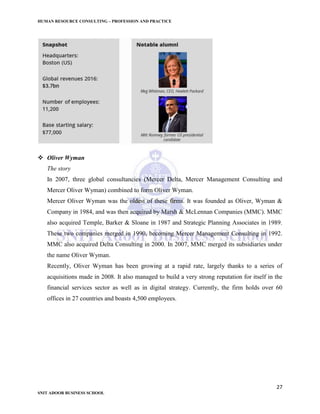
  • 24.
    HUMAN RESOURCE CONSULTING– PROFESSION AND PRACTICE 20 SNIT ADOOR BUSINESS SCHOOL HR Consulting capabilities include:  HR operations improvement  Identify problem areas in HR operations and provide appropriate solutions  Improve existing policies by benchmarking them against industry standards  HR Policies and Procedures Framework  Gather requirements from the client  Understand the specific HR areas to be covered under the framework  Effectively chart out HR Processes and Systems  Benchmark it with the industry  Implement the new framework  Effective Change Management  Anticipate the effect of any new systems and process implementation  Analyze the required strategic shifts for a smooth change management  Effective Talent Management  Conduct surveys to benchmark the employee satisfaction index  Publish Root-Cause-Analysis with recommended action points  Strategize Employee Motivation and Retention program linked to Business  Employee Assessment  Assessment of employees to help identify performers / under-performers  Bring out customized tools for Assessment – Make / Facilitate / Implement Competency Mapping and Skill Benchmarking  Performance & Rewards Management  Defining the performance management and appraisal process  Institutionalizing goal setting and performance feedback  Defining career and succession planning  Developing a reward & recognition strategy linked performance  Training solutions  Identify training needs; develop training strategy and course content  Imparting the training as per the clients’ customized need  Evaluation and reporting of the effectiveness of the training imparted  Exit Analysis
  • 25.
    HUMAN RESOURCE CONSULTING– PROFESSION AND PRACTICE 21 SNIT ADOOR BUSINESS SCHOOL  Do a thorough study on employee exit.  Recommend pre-emptive steps linked to retention strategy  Value Adds  Human Resource Strategy  Our firm belief that Human Resource function becomes very key in enabling a business to succeed  Organizational strategy and values which will drive people practices Job duties/responsibilities of HR consultants.  Advising management on the administration of human resources policies and procedures  Serving as internal consultants by analyzing a company’s current HR programs and recommending solutions  Developing, revising, and implementing HR policies and procedures  Ensuring HR programs and services are in compliance with established policies and procedures and state/federal laws and regulations  Preparing and maintaining reports related to specific HR projects  Assisting with the development and coordination of recommended changes regarding workflow  Developing methods for compiling and analyzing data for reports and special projects  Conducting audits of HR activities to ensure compliance  Presenting training sessions related to specific HR programs Scope Professional management consultants may be asked to provide objective advice that will help an organization plan, solve business problems or manage change, including business start-up, growth or expansion, renewal, reorganization, diversification, downsizing, disposal of assets, planning, review of operations, launching new corporate initiatives or projects, and/or acquiring and implementing technology Benefits of HR consultancy  Recruitment:
  • 26.
    HUMAN RESOURCE CONSULTING– PROFESSION AND PRACTICE 22 SNIT ADOOR BUSINESS SCHOOL An effective and efficient recruiting and hiring process is a must for companies to remain competitive. Failure to include top talent will hurt your ability to grow as a company. Outsourcing recruiting to an HR consultant will give you a third party perspective when hiring, helping you hire the right people for the job without confusion. HR consultants can also help reduce employee turnover issues and provide strategies to maintain your top talent from leaving.  Honest performance assessment: Often, it’s difficult to see the truth when you are too close to the situation. HR consultants are highly effective at helping companies assess organisation’s performance. They can help you implement systems and offer coaching and training to your employees to help them improve in key areas. Often a quality outside perspective is important to helping companies take performance to the next level.  Reduce stress on management: Having an outside perspective and a third party to confide in can help management make the best decisions possible. HR consultants can work and coach with management to handle a variety of HR issues and help to improve overall daily operations. Fig: Benefits of HR consultancy
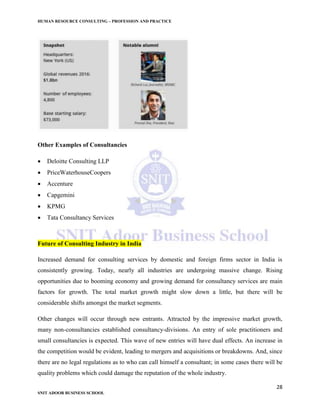
  • 27.
    HUMAN RESOURCE CONSULTING– PROFESSION AND PRACTICE 23 SNIT ADOOR BUSINESS SCHOOL 1.7 TOP CONSULTING FIRMS IN THE WORLD – SERVICES OFFERED, FUTURE OF CONSULTING COMPANIES Types of Services Offered  Financial  Information technology  Management  Human Resources  Legal  Hotel and Hospitality industry  Others – Advertising/Marketing/Public relations, Environmental, Energy, Politics and the Public Sector, Real Estate, etc. Significance of consultancy service A client’s need for external assistance relating to business matters arises in several cases. The experience showed that a client organization frequently resorts to consultancy services when it reaches a critical threshold in its development, which is either generated by an unfavorable evolution of the organization or generated by a favorable evolution. The continuous sales decrease, the loss of market share, the difficult macroeconomic context, all of these may bring the organization at a critical level that cannot be done without the help of experienced professionals. Similarly, the uncontrolled development of an organization may lead to a dramatic deterioration of financial indicators, sometimes up to reaching the failure and this is another case in which the organization needs external help. Criteria for selection of a business consultancy  Integrity and professional ethics of the consulting company  Professional competence  Problem solving approach  Capacity to deliver on time  Ability to deploy resources  Consultant’s image and reputation
  • 28.
    HUMAN RESOURCE CONSULTING– PROFESSION AND PRACTICE 24 SNIT ADOOR BUSINESS SCHOOL The Consulting Process  Provide and analyseinformation  Analyse the client’s problems and take on the responsibility of decision making  Solve all the problems and recommend in putting certain solutions into practice  Contribute to establishing co-operation and commitment among the staff in the firm  Faster, as a teacher, the learning process of the client and his/her employees  Improve the efficiency of the organization, rewarding correct actions and discouraging incorrect actions  Listen, offer support and advice to the clients in difficult moments looking after his/her interests at all times. Top Consulting Firms in the World  McKinsey & Company The story McKinsey was founded in Chicago in 1926 by James McKinsey, a professor of accounting at the University of Chicago. The firm started out by offering consulting services on accounting principles as a management tool. McKinsey’s second partner was Andrew Thomas Kearney, who went on to found A.T Kearney. McKinsey grew quickly especially in Europe in the 1940s and 1950s. But in the 1960s, competitors like the Boston Consulting Group and Bain & Company started competing with McKinsey by marketing specific branded products, such as the Growth-Share Matrix, and by selling their industry expertise. In the 1970s the firm therefore shifted its focus to industry specialisation from geographic expansion. Today the firm employs 26.000 staff across 120+ offices and generates $8.8bn in revenues. Many of McKinsey’s alumni went on to be CEOs of major corporations including Morgan Stanley, Google and Boeing.
  • 29.
    HUMAN RESOURCE CONSULTING– PROFESSION AND PRACTICE 25 SNIT ADOOR BUSINESS SCHOOL  Boston Consulting Group The story Bruce Henderson founded the Boston Consulting Group (BCG) in 1963 after working 18 years for the manufacturing company Westinghouse Corporation. Initially, BCG was a subsidiary of the Boston Company, before becoming independent in 1975. When BCG started, the traditional consulting approach was to look at a company's specific internal issues. But Henderson decided to take another approach and decided to focus on external factors such as markets and competition instead. This approach led to new important business concepts still used today such as the "cash cow," the "experience curve," and “time- based consumption.” Throughout the 1960s, BCG grew and develop overseas. It suffered a slight setback in 1973 when BCG vice-president Bill Bain left the company to found his own consulting firm, Bain & Co. During the 80s it continued to expand, with a radical boost in the mid-90s in growth. The early 2000s because of the economic crisis and rise in technology put BCG under threat. The firm remains one of the most prestigious strategy houses in the world with $5.6bn in revenues and offices all over the world .
  • 30.
    HUMAN RESOURCE CONSULTING– PROFESSION AND PRACTICE 26 SNIT ADOOR BUSINESS SCHOOL  Bain & Company The story Bain & Company was formed in 1973 when Bruce Henderson's protégé Bill Bain left BCG to form his own consulting firm. Bain & Company revolutionised the consulting industry by taking a different approach to client relationship management. When it started, it decided to take only one client per industry and to focus on developing long-term relationships with these clients. This helped Bain to win multiple projects from the clients, it focused on and to maximise value per client. Before then, consulting work was mostly done by project basis on a project, and trying to win multiple projects from single clients was not a common strategy. The company's CEO Bob Beckek has a 99% approval rating on Glassdoor, reflecting how well employees are taken care of. In fact, Bain has won several "Best Employer" awards and has a strong reputation for taking care of its people's work-life balance.
  • 31.
    HUMAN RESOURCE CONSULTING– PROFESSION AND PRACTICE 27 SNIT ADOOR BUSINESS SCHOOL  Oliver Wyman The story In 2007, three global consultancies (Mercer Delta, Mercer Management Consulting and Mercer Oliver Wyman) combined to form Oliver Wyman. Mercer Oliver Wyman was the oldest of these firms. It was founded as Oliver, Wyman & Company in 1984, and was then acquired by Marsh & McLennan Companies (MMC). MMC also acquired Temple, Barker & Sloane in 1987 and Strategic Planning Associates in 1989. These two companies merged in 1990, becoming Mercer Management Consulting in 1992. MMC also acquired Delta Consulting in 2000. In 2007, MMC merged its subsidiaries under the name Oliver Wyman. Recently, Oliver Wyman has been growing at a rapid rate, largely thanks to a series of acquisitions made in 2008. It also managed to build a very strong reputation for itself in the financial services sector as well as in digital strategy. Currently, the firm holds over 60 offices in 27 countries and boasts 4,500 employees.
  • 32.
    HUMAN RESOURCE CONSULTING– PROFESSION AND PRACTICE 28 SNIT ADOOR BUSINESS SCHOOL Other Examples of Consultancies  Deloitte Consulting LLP  PriceWaterhouseCoopers  Accenture  Capgemini  KPMG  Tata Consultancy Services Future of Consulting Industry in India Increased demand for consulting services by domestic and foreign firms sector in India is consistently growing. Today, nearly all industries are undergoing massive change. Rising opportunities due to booming economy and growing demand for consultancy services are main factors for growth. The total market growth might slow down a little, but there will be considerable shifts amongst the market segments. Other changes will occur through new entrants. Attracted by the impressive market growth, many non-consultancies established consultancy-divisions. An entry of sole practitioners and small consultancies is expected. This wave of new entries will have dual effects. An increase in the competition would be evident, leading to mergers and acquisitions or breakdowns. And, since there are no legal regulations as to who can call himself a consultant; in some cases there will be quality problems which could damage the reputation of the whole industry.
  • 33.
    HUMAN RESOURCE CONSULTING– PROFESSION AND PRACTICE 29 SNIT ADOOR BUSINESS SCHOOL Future trends  Framing the new global practices that focused on the public and social sector signaled ling term commitment to help leaders drive change beyond corporate boundaries.  Focus on high profile risk on climate change, healthcare, education and economic development.  Emphasis more on new areas of specialization such as;  Machine Learning  Artificial Intelligence  Sharing Economy  Block chain 1.8 THE NEW BUSINESS CONSULTING ECOSYSTEM – MODEL & DRAWBACKS. The most effective and valuable consulting takes place when clients and consultants work together in teams, sharing skills and expertise and focusing on common goals. Clients need to look at how their actions, in procurement, project management and governance, change the way consultants behave. Consultants, on the other hand, must understand the way in which they do (or do not) transfer knowledge to their clients, deliver advice and implementation, and initiate cultural change. In other words, the collaboration that happens in the most successful consulting projects should not just be the standard for all projects, but should become the benchmark for the consulting industry as a whole, dictating the behaviour of firms as well as people. Two trends are becoming increasingly clear:  Individual clients (especially in the public sector, but increasingly elsewhere) are adopting a more rational approach to consulting and exchanging information with each other.  Consulting firms are beginning to take on the characteristics of a maturing and responsible industry after a period of intense structural change. Clients, consultants and their respective industries are part of the same internally dependent system. At the simplest level, consultants exist because there is a demand for their services, driven by pressure in the external marketplace, regulation, the emergence of new technology and
  • 34.
    HUMAN RESOURCE CONSULTING– PROFESSION AND PRACTICE 30 SNIT ADOOR BUSINESS SCHOOL management ideas. But the relationship is a symbiotic one: consultants help to create demand by promoting new technology and by helping to disseminate new ideas. As needs increase in scale and complexity, the classic model of the client–consultant relationship begins to break down: results come from interdependency and diversity; more players become involved; third parties, such as technology vendors and outsourcers, become important. Six key components interact in a systematic way. On the demand side, there are client markets, individual client organisations and client projects; on the supply side, there is the consulting industry, consulting firms and individual consultants. These components and their interplay form a new system, the business consulting ecosystem. This is a system in early formation and turmoil, with great imbalances and shifts of power in very short periods. Widespread mergers, radical rethinking of client procurement methods, the increased role of third parties and huge changes in the human resources market for consultants demonstrate that much more is at stake than changes to the traditional client–consultant relationship. These seven “interaction” themes map out the way the business consulting ecosystem works:  Reputation: Whether consulting firms like it or not, their industryhas a reputation. Many firms choose to believe they are insulated from any problems that may ensue from this. Well- known firms believe their brands will differentiate them; smaller ones think their client relationships and the quality of their work will protect them. In reality, no organisation can entirely escape the way clients view the collective industry.  Isolation: Clients buy consulting in an imperfect market. Although clients believe they are responsible for their choice and use of consultants, they also think their responsibility is compromised where they do not have access to sufficiently reliable information. It is a case of buyer beware, but only if you know what to be wary of. Yet clients rarely share views on consulting performance with each other. This seems ironic in an environment in which consulting firms are falling over each other to publish books, articles and papers on every conceivable client issue. Yet quantity of information is of course no guarantee of quality. Little of the “thought leadership” or “industry practice” material offered helps clients make informed choices.
  • 35.
    HUMAN RESOURCE CONSULTING– PROFESSION AND PRACTICE 31 SNIT ADOOR BUSINESS SCHOOL  Metamorphosis: Consulting is not a profession: there is no governing body which sets standards and certifies qualified consultants. Qualifications exist, as do trade associations, but participation is entirely voluntary. Would you go to an unqualified doctor? Would you ask an untrained lawyer for his or her opinion? At the moment, clients rely on the brand of aconsulting firm to provide them with the confidence that they are buying a high-quality product, but this focus on individual firms, at the expense of the industry as a whole, is unsustainable.  Relationship: Clients are accustomed to treating consulting projects as discrete and self- contained. But there are three reasons why this is changing: the remit of central procurement departments has, for the first time, been extended to cover professional services; clients are increasingly using several suppliers for projects where before they might have used only one; and new governance rules are being established that seek to make consulting firms keep the promises they make of working “in partnership”.  Portfolio: A corollary to complexity is that clients need to manage their consulting projects not in isolation, but as part of a portfolio. They need to balance costly projects against cheaper ones, and difficult ones focused on long-term benefits against simpler ones designed to produce immediate results. A big component of success in using outsiders is getting things lined up internally too.  Career: Consulting used to be a career. However, as a result of the downturn in the early 2000s, many consultants left their firms, some to join clients, others to become freelance or to find non-consulting jobs. In common with many other industries, consulting never really offered a job for life. Nevertheless, good consulting relies on good experienced consultants.  Life cycle: When it comes to actual consulting projects, clients invest too much time in the preparatory stages and too little in adapting to changes during the course of a project. Time, budgets and quality standards are typically set from the outset and ignore the way in which projects change during the course of their life: governance, management style and mindset need to be adaptable over time, not set in stone. The idea of a client–consultant, mutually dependent ecosystem makes it possible to focus on how the elements of the two worlds of demand and supply interact with each other. It also highlights the interactions as the things that are easiest to change so as to achieve better results. Psychologists will tell you that it is much simpler to change people’s behaviour than their
  • 36.
    HUMAN RESOURCE CONSULTING– PROFESSION AND PRACTICE 32 SNIT ADOOR BUSINESS SCHOOL underlying personalities, and this applies just as much to an industry like consulting. Institutions – consulting firms, client procurement departments, and so on – have processes, people, systems and cultures which make them inflexible. But an interaction is a fulcrum: the point where small changes have disproportional effects, where a little effort can make a big difference. Fig. The business consulting ecosystem
  • 37.
    HUMAN RESOURCE CONSULTING– PROFESSION AND PRACTICE 33 SNIT ADOOR BUSINESS SCHOOL MODULE II “Good counselors lack no clients” Shakespeare “Management consulting is an independent professional advisory service assisting managers and organizations in achieving organizational purposes and objectives by solving management and business problems, identifying and seizing new opportunities, enhancing learning and implementing changes.” – Philip A. Wickham 2. THE CONSULTING PROCESS The consultant and the client undertake a set of activities required for achieving the desired purposes and changes during a typical consulting intervention and the activities are normally known as “the consulting process”. The consulting process has a clear beginning and end. The process can be subdivided into several phases between these points, and which helps the consultant and client to be systematic and methodical, proceeding from phase to phase and from operation to operation. The consulting process can be subdivided in many different ways. Various authors suggest models which includes three to ten phases. From these we have chosen a simple five phase model, which includes entry, diagnosis, action planning, implementation and termination. 1. Entry and Contracting: This phase says about the initial contract with the client about the project. 2. Diagnosis: In this phase the consultant needs to know who is going to be involved in defining the problem, what methods will be used, what kind of data should be collected, and how long will it take. The Consulting Process: Consulting Models – models used by consulting firms to analyze clients; The client market - Understanding buyer values, Advertising PR; Client relationship – relationship management, repeated assignments, retainer contracts; Generating and winning consulting assignments – service offering, marketing pitch, consulting services presentations; Proposals – Writing successful proposals.
  • 38.
    HUMAN RESOURCE CONSULTING– PROFESSION AND PRACTICE 34 SNIT ADOOR BUSINESS SCHOOL 3. Action Planning: The action should be planned in this phase. The job here is to take the set of collected information and to reduce it so that it can be managed and understood. This phase is also known as planning phase and includes setting the goals for the project and selecting the best action steps. A consultant must also decide how the client is involved in the process of analyzing the information. 4. Implementation: This step helps in taking everything that has been decided previously and implementing the solution decided upon. 5. Termination: In this phase a decision can be taken whether to extend the process to a larger segment of the organization. But in some cases the process recycles and a new contract needs to be discussed. Fig. Phases of the consulting process 1. Entry 2. Diagnosis 3. Action Planning 4. Implementation 5. Termination  Evaluation  Final report  Settling commitments  Plans and follow – up  Withdrawal  Free contacts with clients  Preliminary problem diagnosis  Assignment planning  Assignment proposals to client  Consulting contract  Purpose analysis  Problem analysis  Fact finding  Fact analysis and synthesis  Feedback to client  Developing solutions  Evaluating alternatives  Proposals to client  Planning for implementation  Assigning with implementation  Adjusting proposals  Training
  • 39.
    HUMAN RESOURCE CONSULTING– PROFESSION AND PRACTICE 35 SNIT ADOOR BUSINESS SCHOOL 2.1 CONSULTING MODELS – MODELS USED BY CONSULTING FIRMS TO ANALYZE CLIENTS Bloomberg’s Data – Based Consulting Model Digitization rotates first and foremost around data. Bloomberg has entered the consulting market by communications, brand consulting advice and marketing strategy. Their model is the coupling of a number of business models including advertising spending, media and consulting. McKinsey’s Productized Approach This approach says about whether the firm was getting the most out of their intellectual property. This solution offers a range of software and technology based tools for data analytics. This also helps for data driven decision-making in various functions and industries. This offers a process which is independent of the individual consultants and is structured, repeatable and standard. This model helps for close and long term relationships with the customers with the help of business development team. Key activities are recruiting, business development and client projects. Eden McCallum’s Consulting meets the Gig Economy This is a European based management consultancy which does not hire any consultants, but has built a network of highly experienced independent senior consultants. This model helps to find the best match between client and consultant. In this consultants can focus on delivering successful projects and are not pressured to sell new projects. In this a good consultant relationship is managed through a consultant management team and helps to maintain a long standing and close relationships with both clients and consultants. Key activities include business development, customer relationship management, project management and consultant selection and management. This model allows support at a much lower rate. Consultants can deliver successful results by working more closely with clients. GLG Introduces the As-A-Service Rather than large scale projects as-a-service model might involve long-term smaller volume projects for consultants. We have not seen many top consulting firms doing as-a-service model, some more niche firms are exploring these possibilities. Gerson Lehrman Group (GLG) a professional services company offers one example. On-demand professional learning services to
  • 40.
    HUMAN RESOURCE CONSULTING– PROFESSION AND PRACTICE 36 SNIT ADOOR BUSINESS SCHOOL clients in a wide variety of industry sectors are provided by GLG. The subscription based service grants clients access to experts through GLG’s network of independent professionals and thought – leaders. 2.2 ADVERTISING PR The two important tools for promoting products and services offered by the company are Advertising and Public Relations. Advertising suggests to a form of communication, which a firm uses to initiate prospective customers to choose the product offered by the company, over other products. A public relation can help your business extremely and it doesn’t have to be expensive. Two choices are there for a PR campaign: you can either do it yourself or hire a public relations agency. There are a number of benefits from getting PR consulting from a well – respected PR agency. A PR consultant is the one who works as an intermediary between public and an organization or business and hence is a communication specialist. PR consultants write press releases about issues of a company and events and put them into the hands of the media professionals to publish or broadcast. These include:  Credibility (the quality of being trusted and believed in): In a communication suite, PR holds a powerful position. Media relations, which assists in achieving editorial coverage is one of the main impacts of PR.  Cost Effectiveness: Even if an organization hires an external PR agency it is less expensive.  Exposure: PR specialists know which media to target for which message, what content the media want , when to pitch them which story and what is the best way to deliver your message. Media coverage with the help of PR consulting is likely to be more extensive than that which one would achieve through advertising, for a similar budget.  Flexibility: PR has the benefits of being flexible in message content and being responsive to news.
  • 41.
    HUMAN RESOURCE CONSULTING– PROFESSION AND PRACTICE 37 SNIT ADOOR BUSINESS SCHOOL Fig: Advertising PR 2.3 CLIENT RELATIONSHIP - RELATIONSHIP MANAGEMENT, REPEATED ASSIGNMENTS, RETAINER CONTRACTS 2.3.1 CLIENT RELATIONSHIP – RELATIONSHIP MANAGEMENT Client: A client is a person or an organization which uses the services of a lawyer or other professional person or company. Consultant: A consultant is a person who provides expert advice professionally in a specific field and has a wide knowledge of the subject matter. Areas of issues in Client – Consultant relationship  Entry and Contracting o OD (organizational development) consulting contract can occur in various ways. o The clients and consultants begin to seek out what group should do in order to start a logical OD intervention. o When both the parties agree, this becomes the overall psychological contract.  Defining the Client system o A consultant can be referred as singular or as teams.  The trust issue o People will be encouraged to criticize their superiors.
  • 42.
    HUMAN RESOURCE CONSULTING– PROFESSION AND PRACTICE 38 SNIT ADOOR BUSINESS SCHOOL o Subordinates may be concerned that they will be manipulated toward their superiors goals with little attention given to their own.  The nature of consultant expertise o It is possible and desirable for the OD consultant to be an expert. o OD consultant should be prepared to describe in broad outline what the organization might look like. o The OD consultant also needs to resist the temptation of playing the content expert.  Diagnosis and appropriate interventions o Temptation to apply a particular intervention technique. o Appropriate interventions with intensive look at the data.  On being absorbed by the culture o Consultant let himself indulge into joining the culture of the client organization.  The consultant as a model o Consultant should give out clear messages. o Consultant should practice what he/she preaches.  Consultant team as a microcosm o Team should have an effective interpersonal relationship. o Consultants should also focus on continuous growth and process renewal. o Team must set an example of an effective unit to enhance its credibility.  OD process and action research o For the research and process simple questionnaires or interviews could be helpful.  Client dependency and terminating the relationship Relationship between client and consultants depends on: o Consultant competence: The relationship will last longer if the consultant is able to provide innovative and productive intervention. o Client resourcefulness and capabilities in OD.  Ethical standards in OD LouisWhite & KevinWooten says about the following five categories of ethical dilemmas. These are:  Misrepresentation and collusion  Misuse of data
  • 43.
    HUMAN RESOURCE CONSULTING– PROFESSION AND PRACTICE 39 SNIT ADOOR BUSINESS SCHOOL  Manipulation and coercion  Value and goal conflicts  Technical ineptness Values lying Ethical OD practices  Honesty  Openness  Voluntarism  Integrity  Confidentiality  The development of people  The development of consultant expertise  High standards & self - awareness  Implication of OD for the client o To enlarge the database for making management decisions o To expand the influence process o To capitalize the strengths of formal system o To become more responsive o To legitimize conflicts o To examine its own leadership style o To encourage collaborative management Recommendations for Consultant Client relationship  Be transparent  Under commit-over deliver  Don’t be afraid to tell the client that you have a difference of opinion  Socialize  Offer knowledge transfer in the form of coaching and mentoring All good relationships are based on trust. Consultants need to understand what are the client’s expectations and then they have to understand how best to work with the client to meet those expectations. A best consultant should know that the client is not one individual, but can include many people within the organization. Clients should help the consultants to
  • 44.
    HUMAN RESOURCE CONSULTING– PROFESSION AND PRACTICE 40 SNIT ADOOR BUSINESS SCHOOL understand the working environment, but many are too busy and don’t take enough time during the early stages of an assignment to discuss these issues. The client consultant relationships are built on an individual level and there are two factors: the cognitive and the emotional. The cognitive says How good the consultant is and What is their reputation in the market. The emotional says whether the relationship is emotional or not. Another strength of an effective relationship is the ability to deliver bad news. As a business leader, it’s important to engage with the consultant consistently. 2.3.2 REPEATED ASSIGNMENTS The assignment process is split up logically into several stages from consultation to successful placement.  Consultation: The success of an assignment depends on an informative discussion with the client at the outset ideally face to face. It is important that the consultant should gain the full understanding of client background and history, business offering, culture and vacancy background.  Candidate and Talent sourcing: For search assignments we undertake careful research into the appropriate market sector, identify appropriate market organizations and identify suitable potential talent. Research manager of an organization supervises this part of the process under the guidance of the consultant and will make the initial approach, discreetly, to the individual to access suitability and interest in the role. We draft advertising copy based on the brief and utilize appropriate generalist and/or specific industry specific print and online media channels in the relevant regional, national, international media to attract suitable applicants for advertised assignments. We interrogate our extensive in house database, established over a number of years for database assignments. For all assignments we utilize social media channels and online networking to source suitable candidates as well calling upon the extensive personal business networks of our consultants.  Assessment and Initial interview: Suitable candidates are then formally interviewed by the consultant face to face, by video conference or telephone as appropriate depending on
  • 45.
    HUMAN RESOURCE CONSULTING– PROFESSION AND PRACTICE 41 SNIT ADOOR BUSINESS SCHOOL location and availability. This happens after initial email exchanges and telephone calls to clarify questions on both sides.  Long and short Listing: We usually provide clients with a long list of candidates a within a four week period and aim to shortlist and present three to six relevant candidates between four and six weeks following the initial briefing. We provide the client with a shortlist of candidates including original, not standardized or amended CV’s, together with interview notes and appraisal including key strengths and any development needs against agreed key competencies for each candidate. Repeat Clients Keeps Your Career Going Many writers are so busy supporting new clients that they forget to be friend their previous ones. Forward thinking tells that new clients can become repeat clients in time. #1: Identify the people who can give you repeat business Record past clients and editors who had hired you for assignments and projects or list them down by name, contact information, and type of project so that they can be easily identified. #2: Send them an e-mail or voice mail The next step is to initiate communication. Instead of sending random messages saying you’re just dropping by to say hello, say something more definite. #3: Leave your new contact information, too Because changes happen, contact information gets lost and people lose touch. Thus, it’s practical to inform clients if your contact information has changed or if it is still the same. #4: Re-establish communication It’s easy to reconnect whenever you extend your regards on special occasions and yearly holidays. Call or email to let them know you’re out there, still writing for a living and keep the relationships going. #5: Inquire about a repeat assignment or a reference If they can’t be your repeat business, they can possibly be your reference.
  • 46.
    HUMAN RESOURCE CONSULTING– PROFESSION AND PRACTICE 42 SNIT ADOOR BUSINESS SCHOOL #6: Utilize search engines and optimize on websites This generates more clients, particularly new clients. Launching a new website also helps. #7: Market your skills actively! Continue to advertise your skills through good quality works. #8: Resell your services! Update clients on new services that you are offering. #9: Schedule your tasks To Use scheduling software like Microsoft Outlook or mobile gadgets like organizers and calendars. These tools will help you to manage your schedule and attend to all your clients. #10: Always follow up Do follow up on your message and do follow through on alternate means of communication like phone or email. 2.3.3 RETAINER CONTRACTS Retainer contracts are written agreements that exist between an organization and a consultant or an independent contractor. Normally, work is paid for after the completion of a project. However, when a retainer is in place, an organization pays the contractor before the work goes ahead. This is beneficial for organizations, as it allows them to work with a specific consultant or freelancer for a long period of time. A retainer agreement is a task for hire contract. It may be full-time or part-time process. Before pitching a retainer agreement to clients, understand that some people have a negative association with it. Some clients may not have had good experiences with consultants in the past who did not work the hours agreed upon and cost them money. That is why it is so important to work on long-term agreements exclusively with clients you have worked for before. That helps to build a level of trust in your abilities, integrity, and productivity and will make them more likely to approve a retainer agreement with you rather than someone new. Many clients will
  • 47.
    HUMAN RESOURCE CONSULTING– PROFESSION AND PRACTICE 43 SNIT ADOOR BUSINESS SCHOOL assume there will be a discount for signing a retainer agreement upfront, but as a consultant, that isn't fair to you. You still deserve to be compensated for the hours worked, so it's recommended that you don't offer a discount but offer a package of hours at your normal rate. Instead, focus on the benefit to the client.  Advantages of a Retainer Contract  Retainer contracts are also beneficial for individual contractors, because they receive payment prior to starting the work. This makes it easier to allocate finances and time for the duration of that project.  A retainer contract is a pay which is guaranteed and is something that consultants and freelancers should strive to achieve.  Well-planned retainer agreements with important clients will enable you to organize your work.  Retainers also reduce the unpredictability surrounding income and will allow you to work with other clients as you fit.  Signing a retainer contract is highly beneficial, and you can begin by working with your current clients. Select the clients that you like and clients with businesses that have remained stable.  A retainer is an important step to financial freedom.  Your overall aim should to work with a client for income stability and to provide security for your client. 2.4 GENERATING AND WINNING CONSULTING ASSIGNMENTS - SERVICES OFFERING, MARKETING PITCH, CONSULTING SERVICES PRESENTATIONS 2.4.1 SERVICES OFFERING  Customer experience enhancement  Business operations transformation  Business analysis  Business analytics  Revenue assurance consulting
  • 48.
    HUMAN RESOURCE CONSULTING– PROFESSION AND PRACTICE 44 SNIT ADOOR BUSINESS SCHOOL  Program management  Social media consulting  Business improvement diagnostics 2.4.2 MARKETING PITCH In selling technique, a sales pitch or sales presentation attempts to motivate someone or something, with a planned sales presentation strategy of a product or service designed to initiate and close a sale of the product or service. Here the product is consulting service. The different ways of marketing consulting services are:  Direct mail Direct mail is a powerful way to drum up new business because it's targeted to exactly the audience you want to reach. Here are some tips for creating attention-getting direct mail:  Personalize your sales message. Use mail merge method and address each envelope to the recipient by name. In the same way, your sales letter inside the envelope should be directed by name to that recipient.  Put a compelling message on the outside of the envelope. "Free," "Limited time offer," and "Act now" are all powerful attention-getters that can induce the recipient to open the envelope.  Stress the benefits of your offer, and give all the pertinent details in your sales letter. Then make it easy to respond or request information. Give your phone number, e-mail address and website URL and include a postage-paid postcard or envelope, too, so it's impossible not to get back to you if the interest is there.  Cold calls Another way to reach out to prospective clients is through cold calling. This is the process of contacting prospects who weren't expecting a sales call from you and trying to sell them on your services.  Advertising Because traditional advertising can be expensive, it's important to spend your advertising dollars wisely. Depending on the type of services you offer, it may be necessary to advertise in specialized trade magazines or journals. In addition to placing ads in the full print run of a
  • 49.
    HUMAN RESOURCE CONSULTING– PROFESSION AND PRACTICE 45 SNIT ADOOR BUSINESS SCHOOL publication, you also should consider advertising in any specialty sections that might include a "Consultants Directory" or "Directory of Consulting Services."  Newsletters Newsletters can be an effective tool when it comes to rounding up clients for your consulting business. Through newsletters, you can present news of interest to potential clients and remind former clients that you're still alive and kicking and available if they need help again. A typical newsletter published by a consultant will include: o News of importance to the industry. o Editorials and opinions. o Tips for success.  Referrals This often-overlooked method of finding new clients is an easy marketing activity. All you have to do is wait until you've finished your consulting assignment, confirm that your client is completely satisfied, then ask for a referral. Rather than putting your client on the spot, send a short letter or note thanking them for their business and asking for the names of any colleagues, friends or business associates who might be good prospects for your services. 2.4.3 CONSULTING SERVICES PRESENTATIONS  Presentations are important for many reasons  Simplified way to show complex things  Forces you to put your thoughts in order  Makes easier to find gaps in your approach  Widely recognized and accepted way of conveying ideas  Concrete tangible products  Can be re-used  They build slowly but surely your knowledge base
  • 50.
    HUMAN RESOURCE CONSULTING– PROFESSION AND PRACTICE 46 SNIT ADOOR BUSINESS SCHOOL Fig. Phases of presentation 2.5 PROPOSALS - WRITING SUCCESSFUL PROPOSALS A consulting proposal is a document sent from a consultant to a prospective client describing a job they wish to take on and the conditions under which they will do so.  Don’t Count on Your Proposal The proposal isn’t meant to win the business but should have already been won before sending the proposal.  Focus on the Buyer, Not on Your Business The proposal needs to be focused on your buyer and their business, not yours. Don’t tell them how long you’ve been in business and that you have this and that. Instead, use the opening of your proposal to re-establish the challenge and opportunity that you previously discussed with the buyer.  Don’t Include New Information You don’t want to introduce any new information in the proposal. Keep the content focus on the discussion that you had with the buyer.
  • 51.
    HUMAN RESOURCE CONSULTING– PROFESSION AND PRACTICE 47 SNIT ADOOR BUSINESS SCHOOL  Structure it for Success Structure should include: o Summary o Goals o Project Details o Responsibilities o Investment o Terms  Keep Your Proposal Short If your proposals are going over three pages you need to take a close look at what you’re including in them.  Include the ROI at the Front Show the clients how their investment will provide them with a significant return.  In vs Out: Show What They’ll Get, Not What You’ll Do Clearly establish what your client is going to get. What can they expect, How will it benefit their business and so on.
  • 52.
    HUMAN RESOURCE CONSULTING– PROFESSION AND PRACTICE 48 SNIT ADOOR BUSINESS SCHOOL “The greatest trust between man and man is the trust of giving counsel” Francis Bacon Management consultancy is the creation of value for organizations, through the application of techniques, knowledge, and assets, for performance improvement. This is achieved through providing objective advice and/or the implementation of business solutions. Many factors may affect the success of management consulting projects. These factors are composed of three major sets of variables: characteristics of the client organization such as top management support for consulting, the commitment of client team members, and the presence of a client/sponsor; the competence of a consultant; and the consultation mode such as clearly defined goals, methodological compatibility, standardization of procedures, and clients' participation. Consulting Process can be summarized as follows:  Discovery meeting  Investment plan meeting  Manual commitment meeting  The 45 day follow up meeting  Client portal  Regular Progress meetings MODULE III Managing consulting projects: Process - From diagnosis to discovery – Diagnostic review; Dealing with internal Resistance; Whole-system discovery; Meetings to understand the complete picture; Workflow and Business process – Business Process definition, Mapping workflow techniques, bottlenecks identification, discovering Gifts, Capacities and possibilities; Findings - presentation of findings and recommendations; Project Management – tools, techniques.
  • 53.
    HUMAN RESOURCE CONSULTING– PROFESSION AND PRACTICE 49 SNIT ADOOR BUSINESS SCHOOL 3.1 DEALING WITH INTERNAL RESISTANCE People use the phrase “overcoming resistance” as though resistance or defensiveness were an adversary to be wrestled to the ground and subdued. “Overcoming resistance” would have you get clever and logical to win the point and convince the client. But there is no way you can talk clients out of their resistance because resistance is an emotional process. Behind the resistance are certain feelings, and you cannot discuss about how they are feeling. There are some specific steps a consultant can take to help a client get past the resistance and get on with solving the problem. The basic strategy is to help the resistance blow itself out, like a storm. Feelings pass and change when they are expressed directly. The skill for the consultant is to ask clients to put directly into words what the client is experiencing and to ask the client to be authentic. An important skill for you to have as an organizational consultant is to effectively recognize and address the resistance from clients. This is true for both external or internal consultant. Resistance in a consulting project is when a person or a group in the organization reacts against recommendations from you or against changes in the organization that seem threatening to them. Resistance is common in consulting projects that focus on changing a significant part or process in the organization. Three steps for handling resistance  Pick Up the Cues Developing skill in dealing with resistance requires knowing what form the resistance is taking, but the first step is simply to notice what is happening. Here are some ways to pick up the cues. o Trust What You See More Than What You Hear o Listen to Yourself o Listen for Repetition and Telltale Phrases  Name the Resistance When you become aware of resistance, the next step is to name it using neutral, everyday language. The skill is to describe the form of the resistance in a way that encourages the client to make a more direct statement of the reservation he or she is experiencing.
  • 54.
    HUMAN RESOURCE CONSULTING– PROFESSION AND PRACTICE 50 SNIT ADOOR BUSINESS SCHOOL Here are some examples of resistance and neutral language describing the form of resistance: When the Resistance Takes This Form Name It by Making This Statement  Client is avoiding responsibility for the problem or the solution  Flooding you with detail  One-word answers  Changing the subject  “You don’t see yourself as part of the problem.”  “You are giving me more detail than I need.”  You are giving me very short answers.”  “The subject keeps shifting.” Some examples of naming statements for some other forms of resistance:  Methodology: “You are asking a lot of questions about my methods. Do you have any doubts about the credibility of the results?”  Intellectualizing: “Each time we get close to deciding what to do, you go back to developing theories to understand what is happening.”  Confusion: “You seem very confused about what we are discussing. Are you confused about the problem or just not sure what to do about it?”  Low energy or inattention: “You look as if you have other things on your mind and have low energy for this project.”  Be quiet. After naming the resistance, we have a tendency to keep talking. We keep talking to reduce the tension we feel when we confront the client. Don’t keep talking. Live with the tension. Make the statement about resistance and remain silent. Resistance can be Conscious or Unconscious. Conscious Resistance - There are a number of general reasons why people do not like the idea of change:  They don’t like what’s happening  They don’t like the way it’s being done  They don’t like the fact that they are not the ones doing it  They are afraid of the outcome  They side with the vast gray army of those who don’t see why anything should change
  • 55.
    HUMAN RESOURCE CONSULTING– PROFESSION AND PRACTICE 51 SNIT ADOOR BUSINESS SCHOOL Unconscious Resistance  Denial: the belief or hope that there is no real intent to change. Information about the change is ignored or rejected. No steps are taken to prepare for the change.  Anger: frustration that no one seems to be listening to the other side of the argument. This can lead to irrational blocking actions.  Pessimism: feeling of losing control. This can lead to disengagement from current activities.  Despair: recognition that the change will happen. Paradoxically, although this is at the lowest point of the curve, it can mark the beginning of the recovery.  Testing: bargaining to get something positive out of the change. This leads to a more optimistic view and re-engagement.  Acceptance: a realistic view of the change. Although the negative feelings remain, people start to “get on with it.”  Informed optimism: looking to the future. People start to experience the benefits. 3.2 FROM DIAGNOSIS TO DISCOVERY When the contract is clear and you are ready to deal with resistance, attention turns to the discovery phase. There are two primary purposes for discovery phase: to develop a fresh and independent way of looking at what is going on and to create a process that leads to client commitment, action and ownership. This means that the goal of discovery is not to be right but to be powerful and effective. There are two distinct ways of thinking about this part of the work. The traditional way is to consider it a diagnosis, following the medical model of diagnosing the problem, coming up with a prognosis, and then offering a prescription. This is the expectation of most clients. They have a problem, want a solution, and want you to give it to them. As common as this expectation is, it has the limitations of being strictly problem focused, and it has the consultant doing the bulk of the discovery. In recent years, a way of thinking different from diagnosis has emerged - one that focuses more on possibilities than problems. Instead of looking at what is wrong, at deficiencies, we look at what is working, what the strengths and gifts are, and seek to deepen and take advantage of those assets. This is variously called an asset-based approach or a strength-based approach.
  • 56.
    HUMAN RESOURCE CONSULTING– PROFESSION AND PRACTICE 52 SNIT ADOOR BUSINESS SCHOOL Diagnosis is to be done before contracting and after.  Preliminary Problem diagnosis(PPD): o Why do you think the organisation needs my help? o What ideas have been suggested already but not supported? o Who should I see or what questions should I ask? o What would you recommend in my position (dangerous!!!) The PPD is a proposal and the content demonstrates:  Understanding of the problem and its importance?  How the proposed approach addresses this problem?  How the unique characteristics of your consultancy can deliver the solution?  How the work will be done: staff, skills timescales and outline plan?  How the assignment will be financed?  What additional opportunities or benefits brought by the proposal?  Diagnosis after Contract o Data Diagnosis Fig: Diagnosis Diagnosis is to be done in  Material  Machines  Methods  People
  • 57.
    HUMAN RESOURCE CONSULTING– PROFESSION AND PRACTICE 53 SNIT ADOOR BUSINESS SCHOOL Diagnosis is to be done in Casual relationships too  The relationship between problems and symptoms  The relationship between symptoms and outcomes  Watch for options posed as problems Fig. Example Following things are to be done in discovery phase:  Ask questions about the client’s personal role in causing or maintaining the presenting or target problem.  Ask questions about what others in the organization are doing to cause or maintain the presenting or target problem.  Involve your client in interpreting the data collected.  Recognize the similarity between how the client manages you and how they manage their own organization.  Condense the data into a limited number of issues.  Use language that people outside your area of expertise will understand.  Distinguish between the presenting problem and the underlying problem.  Elicit and describe both the technical problem and how it is being managed 3.3 WHOLE-SYSTEM DISCOVERY Most of the discussion on discovery so far has been written from the perspective of a third-party approach. The third party being the engineer, consultant, IT specialist, or support person who is doing the data collection, data analysis, and feedback. Although this is the most typical
  • 58.
    HUMAN RESOURCE CONSULTING– PROFESSION AND PRACTICE 54 SNIT ADOOR BUSINESS SCHOOL expectation clients have when using support people, and is also the way we have traditionally seen the consultant role, there is an alternative. This approach involves the whole client system much more directly in redefining the problem, naming a desired future, outlining alternative actions, and deciding how to proceed. This is a first-party or whole-system strategy, and the methodology has come a long way in the past two decades. Many consultants and support people have adopted the whole-system approach and redefined their role to be one of convening people to collectively develop a change strategy. What is significant about this is that the people doing the discovery and making the recommendations are the same people who will implement the change. In other words, people from the whole system are involved early in the process and are active at every step. A Whole-System Approach is that it looks at the entire system, not its parts. It means that at least a large sample of those who will be acting on the recommendations is going to play a major part in creating them. This makes the change effort more self-managing than a third-party approach. It can involve a cross-section of people that approximates a whole system much more directly and earlier than a third-party approach. Strengths of Whole system approach:  No need to sell actions to anyone  Involvement of the entire organization  Greater local knowledge  Collective knowledge, purpose and commitment Weaknesses of Whole system approach:  Complicated process  Time constraints  Technical issues are easily solved using the third party stance.  Solutions does not have an “outsiders viewpoint”.
  • 59.
    HUMAN RESOURCE CONSULTING– PROFESSION AND PRACTICE 55 SNIT ADOOR BUSINESS SCHOOL Third-Party Consulting The most traditional third-party process involves the lone consultant who studies the situation and makes recommendations for improvement. The consultant may come from inside the organization or be an outsider. Sometimes the third party is a team of people from inside the organization that is given the charge of coming up with recommendations. Often called design teams, these groups may number ten to fifty people, and they have six months, more or less, to work on the project, after which they are expected to return with recommended actions that management can endorse and implement. Although the design team involves more people than the traditional lone consultant arrangement and members are taken from the organization itself, it still represents a third-party strategy:  Whenever some individual or group develops a solution for another, it is taking a third-party stance.  The rationale for employing a third-party approach is that consultants, and design teams, have special expertise and are positioned outside the specific system in question, even if only temporarily. This is supposed to lead to a certain objectivity and a willingness to confront difficult issues that people inside the system may be unable or unwilling to face. In addition, third parties may be aware of possibilities that people closer to the problem may miss. The idea of combining a design team with an outside consultant has the added advantage of applying local, intimate knowledge of the problem. The belief is that given adequate time for analysis and reflection, the partnership of consultant and design team, composed of organization members who know the work well, can make more practical and actionable recommendations than a consultant alone might offer. Third Party Consulting Vs Whole System Consulting Third Party Consulting  Neutral observer. No stake in the answer  Broader view.  Has seen many organizations and ways to approach the problem.  Has specialized expertise that does not reside in the unit.
  • 60.
    HUMAN RESOURCE CONSULTING– PROFESSION AND PRACTICE 56 SNIT ADOOR BUSINESS SCHOOL  Simple decision-making process.  More manager control of decision.  Has outsider credibility Whole System Consulting  Decision-making process creates higher commitment to implement.  People deciding are the ones who have to make it work.  Greater local knowledge. People are intimate with the situation.  More realism. People know what is doable and what will work.  The learning stays with the organization. 3.4 MEETINGS TO UNDERSTAND THE COMPLETE PICTURE In the event that an objection is received, a consultation meeting may be held. Consultation meetings are an opportunity for everyone involved in, or affected by, a planning permit application to discuss issues in an open forum. These meetings are also an opportunity for the town planner to explain the next steps in the planning permit process. Meetings should follow:  Prepare When you have a meeting set up with a client, it is because they need your expertise in solving a problem, creating a company, handling a business transaction, or representing them in litigation; all for which you need to prepare. Preparation starts from your first correspondence with the client or from the moment they were referred to you by a senior attorney or partner. Remember to manage your preparation in correlation with the issue at hand.  Do Due Diligence The due diligence step goes hand-in-hand with your meeting preparation. There are two types of due diligence:
  • 61.
    HUMAN RESOURCE CONSULTING– PROFESSION AND PRACTICE 57 SNIT ADOOR BUSINESS SCHOOL First, study the client. Specifically, find out who the client is. Depending on the case or issue at hand, you might want to know about what type of business they operate or own, how long the client has been CEO of company X, etc. Secondly, conduct research regarding the main questions and issues the client has. Normally, before meeting face-to-face with them you’ve had some type of communication with the client, either by email or telephone. In this first communication, highlight the key points and take notes of the conversation. Analyze each point critically with your lawyer hat on and put yourself in the client’s shoes; come up with questions they might have overlooked and be prepared to talk generally about the legal issues they are facing.  The First Impression: Look and Act Professionally First impressions count. Lydia Ramsey, in her online article “First Impressions: How Seven Seconds Can Make a Deal,” says you only have about seven seconds to make a good or bad first impression. In those first seven seconds, says Dr. Carol Kinsey Goman, the other person determines if you are “competent, confident, and trustworthy”. Maintaining a professional appearance and sends a signal that you can perform your job effectively. Also, besides looking professionally, act professionally and engaging. Shake the client’s hand, make eye contact, and listen to them actively. This allows the client to assess your openness and trustworthiness.  Have an Agenda of Key Points: Keep the Client on Track Time is money, and by now you know how much your time costs the client. The client will appreciate the efficiency with which you handle this first meeting and all subsequent engagements, communications, and projects. Hence, draft a mini- agenda that serves as a map of the key points the client had previously touched on; write next to them all possible answers, alternatives, and opportunities you have identified. Keeping yourself on track keeps the client on track.
  • 62.
    HUMAN RESOURCE CONSULTING– PROFESSION AND PRACTICE 58 SNIT ADOOR BUSINESS SCHOOL Generally, clients tend to sit down and start telling you their life story. Of course, the more information you get, maintains control of what is important and what is not. You don’t need to cut your client’s story short, but when you see them drifting away from the main subject you need to get them back on track.  Manage a Client’s Expectations Managing the client’s expectations is critical. First, you can take care of potential outlooks if you prepare and study the possible outcomes of the issues at hand. Keep in mind, however, that you are not bulletproof and certain things might be completely out of your control; you need to identify those too. When you prepare for the meeting, review all main subjects to be discussed with the client. Identify the areas where potential risks or troubles might arise. Second, set appropriate boundaries of what your client expects from your services. Your preparation before the meeting allows you to offer a rough estimate of what it might cost the client to engage your services. When you manage the client’s expectations there is a greater likelihood that when things don’t come out completely in his or her favor, the client will not be surprised. This will strengthen and preserve the bond of confidence between you and the client.  Give the Client Action Items and Follow-Up Through the course of the meeting it is very likely that you’ll identify other issues and discover other documents in the client’s possession that you need. Make a list of the documents and hand it to the client. Give a rough deadline for when you need these documents. After your meeting, write an email or letter to the client summarizing the key subjects touched upon in the meeting. Within a week or so of your letter, follow up with the client regarding any other information you have gathered and remind them of the documents they need to send you if you have not received them or if deadlines are approaching. It is essential you keep the client up-to-date regarding any progress or issues you find along the way.  At the End of the Meeting Once the meeting is winding down, go over any final subjects and ask the client if they have any questions or doubts. This will assure the client that you have their best interest at heart.
  • 63.
    HUMAN RESOURCE CONSULTING– PROFESSION AND PRACTICE 59 SNIT ADOOR BUSINESS SCHOOL In addition, thank the client for taking the time to meet you and reassure them you will be in touch if any issues or alternatives come up; encourage two way communications. Accompany the client to the reception area and shake their hand one more time. Leave them with the feeling that their case is in the right hands.  Trust Yourself and What You Know “True, trust necessarily carries with it uncertainties, but we must force ourselves to think about these uncertainties as possibilities and opportunities, not as liabilities.” 3.5 WORKFLOW AND BUSINESS PROCESS A business process is a collection of linked tasks which find their end in the delivery of a product or service to a client. A business process has also been defined as a set of tasks and activities that, once completed, will accomplish an organizational goal. The process must include clearly defined inputs and a single output. These inputs are made up of all of the factors which contribute either directly or indirectly to the added value of a product or service. These factors can be categorized into operational processes, management processes and supporting business processes. 3.5.1 MAPPING WORKFLOW TECHNIQUES Improving Business Efficiency with Process Mapping Techniques Every business has lot of processes, from filing paperwork to manufacturing products. However, the vast majority of these processes are undocumented. New hires learn processes from tenured employees. Any adjustments to workflow are passed along by word of mouth and this method of managing processes may appear effective, there is an opportunity cost. It is not possible to objectively review unrecorded process steps. After all, this limits an organization’s ability to improve efficiency. Business process mapping is a visual representation of work processes, defining precisely what a company does, how it is done, and who is responsible for each and every task in the process. Maps define quality metrics, and they articulate measures of success. For example, business
  • 64.
    HUMAN RESOURCE CONSULTING– PROFESSION AND PRACTICE 60 SNIT ADOOR BUSINESS SCHOOL process mapping lists expected output, along with the characteristics of work product that meets quality expectations. Many organizations begin with an overview map that defines business processes on a high level. Users document sub-processes in their own maps, breaking down larger processes into greater detail. Ultimately, the goal is to create step-by-step guides for each activity which the company performs. Process mapping clearly lists which roles within the company are responsible for each step, smoothing hand-offs and preventing bottlenecks as tasks pile up on the wrong desk. The visual nature of business process mapping simplifies efficiency initiatives and allows leaders to recognize steps that need streamlining. Through illustration, redundancies and rework are easier to detect. Managers can point the exact areas of the process responsible for quality issues. Finally, process improvements are put in place to prevent errors, and the consistent changes are ensured by maps.  Process Mapping Techniques The best choice for your project depends on what type of process you will illustrate with your map. Here we highlight some of the more popular techniques:  SIPOC Diagrams Many organizations elect to begin their process mapping with SIPOC diagrams, SIPOC (suppliers, inputs, process, outputs, and customers) is a visual tool for documenting a business process from beginning to end, which organize initial brainstorming into categories: suppliers, customers, input, process and output.  BPMN Process Maps Process Professionals tend to prefer to use BPMN, Business Process Model and Notations it is closely related to flow charts. BPMN process maps are ideal for breaking down processes for handling errors and exceptions, as they offer opportunities for drilling down to get more information.  UML Diagrams Specialized industries require specialized mapping tools, such as UML (Unified Modeling Language) diagrams. This technique is good for mapping out the building of software.
  • 65.
    HUMAN RESOURCE CONSULTING– PROFESSION AND PRACTICE 61 SNIT ADOOR BUSINESS SCHOOL There are 14 types of UML diagrams to suit specific needs:  Activity Diagram  Class Diagram  Communication Diagram  Component Diagram  Composite Structure Diagram  Deployment Diagram  Interaction Overview Diagram  Object Diagram  Package Diagram  Profile Diagram  Sequence Diagram  State Machine Diagram  Timing Diagram  Use Case Diagram These diagrams fall into two main categories: structure diagrams and behavioral diagrams.  VSM (Value Stream Mapping) When your goal is to streamline an inefficient process, the VSM (value stream map) technique is an excellent choice. With the support of those currently working a given process, you create a step-by-step map that shows how things are done today. Once you have visual representation of the current process, you can identify bottlenecks, delays and other inefficiencies.  IPO (Input-Process-Output) Model Creating process maps for systems analysis and software engineering typically uses the IPO technique, which essentially divides processes into three steps:  Inputs - Information or data from the environment  Process - Tasks performed on inputs to produce outputs  Outputs - Data and materials resulting from the process  GUT Priority Matrix
  • 66.
    HUMAN RESOURCE CONSULTING– PROFESSION AND PRACTICE 62 SNIT ADOOR BUSINESS SCHOOL Another common business issue is devoting resources to solving the wrong problems. Often, low-impact concerns receive more time and money compared to high-impact concerns. The GUT (Gravity, Urgency, Trend) Priority Matrix provides clear direction on which issues to tackle first:  Gravity - What damage will occur if they do not resolve the problem?  Urgency - How soon will the damage occur?  Trend - What is the worst-case scenario if they delay a solution? 3.5.2 BOTTLENECKS IDENTIFICATION Identifying (and solving) process bottlenecks:  Map and analyse your processes  Identify the problems and their causes Business process bottlenecks occur when demand outweighs production capacity. Bottlenecks exist at a place where the process is slowed due to an obstraction. This could be from out-of-date equipment, inefficient labor, or scarce resources. Maximum capacity is limited to the capacity of the bottleneck. To find and eliminate a bottleneck, we use process analysis. Process analysis looks at the entire business process. Most often, this analysis begins with an identification of all of the business process steps. Then, a flow chart is developed to show these steps. Once we have the steps, we can determine the capacity of each step. Then, when we find the step with the lowest capacity in the process, we have located the bottleneck. The Process Bottleneck A bottleneck is any resource whose capacity is equal to or less than the demand placed upon it. A non-bottleneck is any resource whose capacity is more than the demand placed upon it. It is important to balance the flow, and not capacity in relation to demand. If bottleneck capacity is kept equal to demand, and demand drops, costs will go up which results in loss of money. The goal is to maintain capacity at slightly less than demand. Total plant capacity should be equal to the bottleneck capacity. Bottlenecks should be optimized by eliminating time wasted through
  • 67.
    HUMAN RESOURCE CONSULTING– PROFESSION AND PRACTICE 63 SNIT ADOOR BUSINESS SCHOOL idle bottleneck time, producing parts which do not contribute to throughput or processing defective parts. Process Analysis The best way to improve the process is to analyze it. This allows a better understanding of the activities involved, their relationships and the values of relevant measurements. Process analysis usually involves the following tasks:  Process identification of all the steps involved from entry point of the process inputs to exit points of the process outputs;  Construct a process flowchart that illustrates the various process activities and their interrelationships  Determine the capacity of each step in the process. Calculate other measures of interest;  Identify the step having the lowest capacity (bottleneck) and evaluate further limitations in order to quantify the impact of the bottleneck;  Use approaches and tools to make the process run more effectively and efficiently. Process Improvement Process improvement is successful only when the underlying problem is addressed. Use of a lean manufacturing technique known as Value Stream Mapping (VSM) is a useful way of improving processes successfully. It originated at car manufacturer Toyota, where they called it 'material and information flow mapping. As a way of identifying improvement projects VSM is now widely used in a variety of industries. The basic idea behind Value Stream Mapping is this: The outcome will be reliable if the underlying process is right. To get the process right, you have to understand the set of activities that provide value to your customers. 3.5.3 DISCOVERING GIFTS, CAPACITIES AND POSSIBILITIES The most interesting new development in discovery is the growing interest in looking at a system’s gifts, possibilities and capacities. As soon as you call something a problem, you signal that something is wrong and it needs fixing.
  • 68.
    HUMAN RESOURCE CONSULTING– PROFESSION AND PRACTICE 64 SNIT ADOOR BUSINESS SCHOOL This approach goes under many names:  Asset-based community development  Positive deviance  Positive psychology  Appreciative inquiry  Future search, and more  When all else fails  The most obvious condition calling for a possibility and strength-based approach is when the traditional model of problem solving has been tried and has not worked.  This is usually the case with intractable problems - for example, poor market performance, long-term low morale, or quality issues that will not go away.  The power of positive deviance  Second, we can choose to focus on the solutions that already exist in the community, even though they are not accepted and rare as common knowledge.  Positive deviance (PD) is an approach to social and behavioral change based on the observation that in any community there are people whose uncommon but successful behaviors or strategies enable them to find better solutions to a problem, despite facing similar challenges and having no extra resources or knowledge than their peers. These individuals are referred to as positive deviants.  This honors the gifts and capacities of organization members, which are what the Sternins call “Invisible in plain sight.”  As consultants or support people, we can decide to contract for discovering what is working and who in the client system has figured something out. It is our choice to proceed this way, even when the client or community is problem focused, which is most often the case.  Also, the gift-based strategies almost always have to work through invitation. Even with the support of senior management or leadership and their ability to mandate a process, it is better to work with a smaller group that shows interest than with strategically placed and leveraged people who are not acting so much out of interest as out of obligation.
  • 69.
    HUMAN RESOURCE CONSULTING– PROFESSION AND PRACTICE 65 SNIT ADOOR BUSINESS SCHOOL  Finally, what is appealing about the positive deviance thinking is that the Sternins, have made a commitment to work in a true partnership with those they are intending to be of service to.  They listen carefully and endlessly as a practice. They offers no solution other than some principles of approach. They are teachers as well as equal learners at every stage and in every project. Appreciative Inquiry  The cooperative search for the best in people, their organizations, and the world which is around them.  It involves systematic discovery of what gives a system “life” when it is most effective and capable in ecological, economic and human terms.  AI involves the practice and art of asking questions that strengthen a system’s capacity to heighten positive potential. It mobilizes inquiry through crafting an “unconditional positive question” often involving hundreds or sometimes thousands of people. 3.6 FINDINGS – PRESENTATION OF FINDINGS AND RECOMMENDATIONS General Outline for Business Consulting Reports I. Cover Page Covers are usually printed on heavy, flexible pieces of paper called “Cover stock.” The main reason that “cover stock” is used is so that it can protect the document. The cover should include the title of the report along with some extra information that will help people who may want to file it for later use. II. Disclaimer Page  A disclaimer is a statement that the organization or company will limit its liability for the product or service it provides (as your instructors, we certainly do not want to be held responsible for any bad advice or research you provide your clients).
  • 70.
    HUMAN RESOURCE CONSULTING– PROFESSION AND PRACTICE 66 SNIT ADOOR BUSINESS SCHOOL  The disclaimer statement is fairly typical in consulting projects, and if nothing else reflects the seriousness of writing at a professional level. There is often a great deal of support, so make sure that your writing and research processes mirror this seriousness.  The disclaimer is intended for general guidance and information purposes only. III. Title Page  The title page of a formal report works in collaboration with the cover page to provide a solid introduction about the consulting report. A team’s report will certainly have a sense of permanence; it will likely be filed and periodically reviewed and consulted. Therefore, it should include specific information regarding the report:  Names of the authors or other contributors, including contact information and the name of the organization you’re working within (Marietta College)  A very good and specific title that reflects, as much as possible  The name of the business or organization that your team is consulting IV. Table of Contents  A table of contents serves three purposes. Obviously, it helps readers who do not want to read the whole report but want to quickly locate particular parts of it. In addition, it assists readers who want an overview of the report’s scope and contents before they begin reading it in its entirety.  Also, the table of contents serves as a tool for writers of the report by outlining specific aspects that need to be address V. Executive Summary An executive summary is designed primarily to serve the person who initially, does not intend to read the entire report. It usually states the main points of each section and emphasizes conclusions, results and recommendations, usually in around three pages. Executive summaries are ideally suited to the needs of readers who are seeking advice about a decision or an action. These summaries are called executive summaries because some decision makers depend wholly upon their advisors to read and evaluate the rest of the report.
  • 71.
    HUMAN RESOURCE CONSULTING– PROFESSION AND PRACTICE 67 SNIT ADOOR BUSINESS SCHOOL VI. Introduction to the Report  What is the problem or the opportunity?  Be specific and positive.  Describe the opportunity or problem in monetary terms, because the proposal itself will include a budget of some sort and you want to convince your readers that spending money on what you propose is smart.  What is the purpose of the proposal? Even though it might seem obvious to you, the purpose of the proposal is to describe an opportunity or problem and propose a course of action.  What is the background of the problem or the opportunity? Your goal here is to show them that you understand the problem or opportunity, as well as the events or relationships that will affect the problem and its solution  What are your sources of information? Review the relevant literature, including memos, internal reports, external public articles, or books, so that your readers will understand the context of your work.  What is the scope of your proposal? If appropriate, indicate what you are proposing to do and what you are not proposing to do.  What is the organization of the proposal? Indicate the organizational pattern you will use in the proposal.  What are the key terms that will be used in the proposal? If you will use any new, unusual or specialized terms, the introduction is an appropriate place to define them. In addition, you will want to include the following information in your introduction VII. Background  All clients will necessarily be competent in your field; the background section needs to clearly articulate the context behind your research.  The Background Sections require you to conduct comprehensive research. Your suggestions need to be based on the research that your team has conducted, and this research needs to be demonstrated to your client.
  • 72.
    HUMAN RESOURCE CONSULTING– PROFESSION AND PRACTICE 68 SNIT ADOOR BUSINESS SCHOOL VII. A. Client Profile The purpose of the Client Profile is to both “bring the client to life” and to tie the information together by explaining how it helps portray your client as a member of the business community. Some things that you will want to include in the Client Profile:  Places of residence  Educational and training background  Career experience  Civic interests and activities  How and why your client became interested in this business  Your client’s business philosophy and/or attitude towards business  Any other information that contributes to a portrait of your client as a person who has  Chosen to become the operator of a small business VII. B. Nature and History of the Firm  The nature of the firm is a brief description of what it does in the way of production or service.  The history of the firm traces the process and patterns of the firm’s development. This might include a listing of:  The firm’s previous owners  The firm’s location(s)  The firm’s facilities, and how they have changed  The firm’s diversification over the years  The firm’s financial history  The firm’s staffing, and how it has changed VII. C. The Firm Today  The meaning of the word “today” is variable, and differs from firm to firm (last calendar year, last fiscal year, last quarter, span of time since they moved to current location, etc.)  This section will include a description of:  Current facilities (external and internal design and appearance)
  • 73.
    HUMAN RESOURCE CONSULTING– PROFESSION AND PRACTICE 69 SNIT ADOOR BUSINESS SCHOOL  Its immediate locale and setting  Organizational structure and personnel  Current financial status VII. D. The Business and Market Environment  This section describes the business and market climate of the local community and / region.  The focus here should be on the business and economic conditions that affect the firm’s operation. For instance, a craft shop or a bed-and-breakfast would tie into the larger picture of the area’s tourism; a concrete supplier would be affected by trends in new houses and commercial building starts.  There should also be consideration of the state, national, and global prospects and trends that could affect the local and regional business climate and / or your client’s business prospects.  Your client’s firm is, in varying degrees, part of these macro and micro environments. Seeing the firm in these contexts can be crucial in understanding and perceiving its prospects and problems. This is yet another section where thoughtful, careful, and thorough research is important. VII. E. The Competition This section will profile regional, local and perhaps even global competitors. VII. F. Defining the Firm’s Objectives This section should include:  A description of the firm’s short-term and long-term objectives  Prioritization of primary and secondary objectives VIII. G. Defining the Team’s Tasks First, this section should clearly describe the tasks that the consulting team has agreed to carry out and explain how the team and client chose those tasks. Normally, these tasks can be identified concisely (for example, “Task One: Developing a Market Plan. Task Two: Selecting a New Location”). This section should also identify any tasks that the team originally agreed to perform but which, for whatever reason, was unable to complete.
  • 74.
    HUMAN RESOURCE CONSULTING– PROFESSION AND PRACTICE 70 SNIT ADOOR BUSINESS SCHOOL IX. Carrying out the Team’s Tasks: Problem, Methodology, Conclusions, and Recommendations.  This is a rather lengthy section that is organized around the team’s basic tasks. A “Table of Contents” might list as follows:  Task One: Developing a Marketing Plan  Task Two: Selecting a New Location  Task Three: Securing an SBA Loan Each task section should be organized to:  Describe the current situation (in effect, the “problem and /or opportunity”) and the needs / opportunities it creates  Narrate and explain the procedure the team followed in addressing the needs created by the market situation  Draw conclusions and make recommendations The following example illustrates such an organization, using “Task Two” from the sample above:  Task Two: Selecting a New Location  Evaluating the Current Location  This is a headed section that describes any advantages but more significantly the disadvantages of the current business location. This section explains the problem and the needs it creates.  Identifying and Evaluating Alternative Locations This is a headed section that describes alternative locations and compares them to the current location and to each other. This section narrates and explains the team’s method of operation that addresses the needs created by the problem; it shows the team in action.  Conclusion and Recommendations This is a headed section that pulls the evaluations together, states the solution, and justifies one or more recommendations.
  • 75.
    HUMAN RESOURCE CONSULTING– PROFESSION AND PRACTICE 71 SNIT ADOOR BUSINESS SCHOOL X. Summary Conclusion This final section pulls the report together, offers some words of assurance to the client, and states the team’s (we hope) pleasure in having undertaken this consulting project. In pulling the report together, carefully summarize your findings and what you see as the prospects for your client’s business. XI. Bibliography “Bibliography” or “Works Cited” – call this section what you want. Whatever the case, you must list all resources that you used in this report. Therefore, it is imperative that you keep track of all the sources that your team used in the report. XII. Appendices Appendices will be more or less useful to the client. Among the kinds of material which might be included in appendices would be complete copies of surveys, statistical readouts and Questionnaires, reprints of helpful articles, or excerpts from book length resources, brochures, copies of letters, etc. XIII. Visuals If used properly, visuals can effectively reinforce the main points of the written text. Furthermore, effectively positioned visuals provide a strong image for your readers to remember. XIV. Headings Use headings and sub-headings generously. Not only do they make it easier for your client to read and understand the report, but headings also help you to reinforce the organization of the report. 3.7 PROJECT MANAGEMENT – TOOLS, TECHNIQUES Project management is the practice of initiating, planning, executing, controlling, and closing the work of a team to achieve specific goals and success criteria at the specified time.
  • 76.
    HUMAN RESOURCE CONSULTING– PROFESSION AND PRACTICE 72 SNIT ADOOR BUSINESS SCHOOL A project is a temporary attempt designed to produce a unique product, service or result with a defined beginning and end (usually time-constrained, and often constrained by staffing or funding) undertaken to meet unique objectives and goals, typically to bring about added value or beneficial change. 3.7.1 TOOLS AND TECHNIQUES  SWOT - Strengths, Weaknesses, Opportunities, Threats  A SWOT analysis can be used to draw out the threats and opportunities facing a program or project. It has the advantage of being quick to implement and is readily understood.  Analysis of the strengths, weaknesses, opportunities and threats brings together the results of internal business analysis and external environmental analysis.  Common and beneficial applications of SWOT are gaining a greater understanding and insight into competitors and market position.  RACI - Responsible, Accountable, Consulted, Informed  A RACI diagram is used to describe the roles and responsibilities of the participants in a business or project activity in terms of producing predetermined deliverables.  RACI is an acronym formed from the four participatory roles which are:  Responsible - those who undertake the activity or the resources  Accountable - those who take the credit for accountability or success for failure or the activity manager; and there must be at least one for each activity  Consulted - those whose opinions are achieved
  • 77.
    HUMAN RESOURCE CONSULTING– PROFESSION AND PRACTICE 73 SNIT ADOOR BUSINESS SCHOOL  Informed - those who are kept advised of progress  Stakeholder matrix A stakeholder matrix is used to map stakeholders in terms of their importance and potential impact on program or project activity. Stakeholders are the individuals or groups who will be affected by an activity, program or project. They could include:  Senior managers whose business areas are directly or indirectly involved  End-users including customers outside the organization  Suppliers and partners  Cause and effect diagram Also known as fish-bone diagram, a cause and effect diagram can be used to represent event causes and potential impacts. It is a pictorial representation of the causes of various events that lead to one or more impacts. Each diagram may possess several start points (A points) and one or more end points (B points). Construction of the diagram may begin from an A point and work towards a B point or extrapolate backwards from a B point to A point. This is largely a matter of preference.
  • 78.
    HUMAN RESOURCE CONSULTING– PROFESSION AND PRACTICE 74 SNIT ADOOR BUSINESS SCHOOL  Decision tree A decision tree is a useful tool for enabling choice between several courses of action. It provides a highly effective structure within which options can be explored and possible outcomes can be found. It also helps to form a balanced picture of the rewards and risks associated with each possible course of action. A decision tree is particularly useful when choosing between different strategies, investment opportunities or projects - particularly when resources are less.  Radar chart Also known as a spider chart is used to show the number of risks that different projects are exposed to. Initially, the data is placed in a table that is subsequently converted into a chart. In a radar chart, a point close to the centre on any axis indicates a low value and a point near the edge is a high value.
  • 79.
    HUMAN RESOURCE CONSULTING– PROFESSION AND PRACTICE 75 SNIT ADOOR BUSINESS SCHOOL
  • 80.
    HUMAN RESOURCE CONSULTING– PROFESSION AND PRACTICE 76 SNIT ADOOR BUSINESS SCHOOL "Harsh counsels have no effect; they are like hammers which are always repulsed by the anvil." Helvetius 4.1 APPLYING BUSINESS PROCESS RE-ENGINEERING (BPR) BPR is a business management strategy, originally pioneered in the early 1990s, focusing on the design and analysis of workflows and business processes within an organization. Process means a specific ordering of work activities across space and time, with a beginning, an end, and clearly identified inputs and outputs; a structure for action. Business process means a group of logically related tasks that use the firm's resources to provide customer-oriented results in support of the organization’s objectives. The keywords for BPR are `fundamental’, `radical’, `dramatic’, `change’ and `process’. A business process has to undergo fundamental changes to improve productivity and quality. Radical changes, as opposed to incremental changes, are made to create dramatic improvements. Reengineering is not about ®ne-tuning or marginal changes. It is for ambitious companies that are willing to make substantial changes to achieve significant performance improvements. Reengineering is the fundamental rethinking and redesign of business processes to achieve dramatic improvements in critical, contemporary measures of performance, such as cost, quality and speed (Hammer and Champy in 1993). Business Process Reengineering involves the radical redesign of core business processes to achieve dramatic improvements in quality, productivity and cycle times. In Business Process MODULE IV Delivering results and disengagement: Analyzing and framing problems - applying business process reengineering, smoothening the bottlenecks; Preparation of Deliverables, standards and compliance with law of the land, benchmarking; Review of Deliverables – standardization; Meeting for ‘buy-ins’ – presentation of solutions; Implementation of deliverables – training, coaching and mentoring; Interim review and feedback; Knowledge transfer and disengagement.
  • 81.
    HUMAN RESOURCE CONSULTING– PROFESSION AND PRACTICE 77 SNIT ADOOR BUSINESS SCHOOL Reengineering, companies start with a blank sheet of paper and rethink existing processes to deliver more values to the customer. They typically adopt a new value system that places increased value on customer needs. Companies reduce organizational layers and eliminate unproductive activities in two main areas. First, they redesign functional organizations into cross-functional teams. Second, they use technology to improve decision making and data distribution. How Business Process Reengineering works: Business Process Reengineering is a dramatic change initiative that contains five major steps that managers should take:  Refocus company values on customer needs  Redesign core processes, often using information technology to enable improvements  Reorganize a business into cross-functional teams with end-to-end responsibility for a process  Rethink basic organizational and people issues  Improve business processes across the organization Companies use Business Process Reengineering to:  Reduce costs and cycle times: Business Process Reengineering reduces cycle times and costs by eliminating unproductive activities and the employees who perform them. Reorganization by teams decreases the need for management layers, accelerates information flows and removes the errors and rework caused by multiple handoffs.  Improve quality: Business Process Reengineering improves quality by reducing the fragmentation of work and establishing clear ownership of processes. Workers gain responsibility for their output and can measure their performance based on exact feedback.
  • 82.
    HUMAN RESOURCE CONSULTING– PROFESSION AND PRACTICE 78 SNIT ADOOR BUSINESS SCHOOL Fig. Business Process Re-Engineering cycle There could be bottlenecks such as - why change if isn't broken, why spend more money, the existing process are good enough, lets refine the existing process (hence why a clean slate approach), resources are not allotted for reengineering project, not now let’s do it later etc. Any external team (i.e. consultants) can facilitate the process, but it has to be led by the internal team, as its people who have the knowledge at the ground are best suited to design and implement its plans. BPR is only a method to an end and cannot be an end in itself. A business process consultant is an external consultant who helps businesses by analyzing and researching the processes and systems that a business implements. Once this has been done, he or she will make recommendations to improve these processes and practices with an eye to improving overall efficiency. The consultant may also be included in designing simulations to test proposed process improvements. A business process consultant would generally report to top management. BPR requires organizational restructuring (include the facility location, capacity, types of products, technology, people) and changes in employees’ behaviour (training, education, job enrichment, job enlargement, and employee empowerment) with a view to facilitating and accommodating radical changes for achieving dramatic improvements in business performance. IT, such as the Internet, E-Commerce, CAD/CAM, CIM, MRP, Multimedia, ERP and WWW,
  • 83.
    HUMAN RESOURCE CONSULTING– PROFESSION AND PRACTICE 79 SNIT ADOOR BUSINESS SCHOOL EDI and EFT, would help to restructure an organization and promote changes with acceptance from employees on any radical changes in the company. The reengineering of a business process will result in improved process delivery systems and hence an improved customer service level. In order to reengineer a business process, both internal and external process capabilities, such as product development, production, distribution, suppliers and markets, and inter-organizational relationships, especially in a global manufacturing environment, need to be integrated. Through the integration of production activities into self-contained units reengineering helps to achieve lean production. IT is an important element in such integration. Wyatt and Kletke (1997) presented a descriptive model on BPR to illustrate the impact of telecommunication technology. BPR is a process-driven top-down approach managed by senior executives, which aims to improve the performance by radical changes in the system over the short term (Ardhaldjian and Fahner 1994). Fig: Conceptual model for BPR Companies usually have to meet three important goals to achieve effectiveness:  a process, not product perspective,  cross-functional coordination or integration, and
  • 84.
    HUMAN RESOURCE CONSULTING– PROFESSION AND PRACTICE 80 SNIT ADOOR BUSINESS SCHOOL  consistency between goals and improvement plans (Wickens 1995, Jones et al. 1997, Lockamy and Smith 1997). IT is an enabler to the reengineered process, and any reengineering programme must consider the tremendous advantage offered by the technologies such as expert systems and document image processing (Childe et al. 1994, Morris and Brandon 1993). 4.2 SMOOTHENING THE BOTTLENECKS The common bottlenecks in a consulting company are typically in one of three places.  Lead generation (the constant grind of hunting down new clients)  Client services (expanding scope creep killing the project's profit margin)  Referrals and recurring revenue (no strategy for how to turn one project into many projects) BOTTLENECK #1: Your Target Audience Is Too Broad  It doesn't matter if you are a marketing consultant, technology consultant, strategy consulting firm, or HR Consulting Firm...it's so hard to clearly explain ALL of the issues that come together inside your expertise. It's certainly hard to communicate each of the benefits specifically.  Trying to talk to each of "sub elements" every time you engage someone is confusing, overwhelming, and darn near impossible. BOTTLENECK #2: Your Consulting Engagements Are Too Custom Your engagements are too custom. Your scope of services is already broad, then you try to offer custom solutions for each of those services. BOTTLENECK #3: You've Taken On Too Much Responsibility as The Leader  Specific role as the leader is too heavy. Lead the prospecting efforts, referral efforts and client services efforts.  You are involved in every single part of the client's engagement...and it weighs you down. You aren't able to think about how to really scale your company, because you are involved with too much.
  • 85.
    HUMAN RESOURCE CONSULTING– PROFESSION AND PRACTICE 81 SNIT ADOOR BUSINESS SCHOOL  You should stop. Develop a proprietary system for how your company does business and delegate the parts that don't fit your highest and best use. Take a look at the grid below. Let's assume you've got three core solutions your offer: solution one, solution two, solution three. Then let's look at the actual business model. What has to be done so that you can deliver on each solution well? There are three main elements. They  Lead generation - getting new leads in.  There is a productized service - your specific method for solving the problem.  There is recurring and referrals - what generates consistent revenue for your business. Fig. Three common Bottlenecks of a consulting company 4.3 PREPARATION OF DELIVERABLES A deliverable is a tangible or intangible good or service produced as a result of a project that is intended to be delivered to a customer who is either internal or external. A deliverable could be a document, a software product, a report, a server upgrade or any other building block of an overall project. A deliverable may be composed of multiple smaller deliverables. It may be either an outcome to be achieved or an output to be provided. There are four main reasons why specifying the deliverables is a very good idea:  It is a great way to set expectations and agree with the client beforehand what is to be delivered and when.  It is easier, especially for new clients, to accept a proposal with specific deliverables.
  • 86.
    HUMAN RESOURCE CONSULTING– PROFESSION AND PRACTICE 82 SNIT ADOOR BUSINESS SCHOOL  Payments are normally associated with deliveries. It is an opportunity for you to agree with the client up front when payments will be released.  It prevents you from engaging in projects, which turn out to be open-ended. You use too many hours and the client is unsatisfied. The situation becomes “lose-lose”. Tangible outputs  PowerPoint decks describing approach, methods, outputs, results, inferences, plan ahead etc (Basically a deck is always there which lists everything done, measured and delivered)  Implementation plan documents - These could be detailed Word or Excel documents listing steps for a implementation process etc  Implementation trackers - detailed step by step excel sheets to track progress of implementation of new process etc  Dashboards - to measure change in key business metrics affected during and after a project. Even if the consulting team leaves, the clients teams are enabled to measure / update the metrics  Process maps / process documents - these could be for any and every new process design done - banks transactions process, IT sales process could be examples  Prototypes / Tools - These are technology based tools or prototypes built for the project and are given to the client teams Intangible Output  More often than not, presence of a consulting team also helps to create intangible outputs / effects for the client organization.  Primarily it’s a change in attitude for the client teams working closely with the consulting teams.  At times, the client teams are working with a lot more confidence seeing the outcomes / improvements.  There are also feelings of resentment in case jobs are cut to optimize costs (Though significant measures are taken to minimize the ill effects of job cuts by designing appropriate compensation measures etc.)
  • 87.
    HUMAN RESOURCE CONSULTING– PROFESSION AND PRACTICE 83 SNIT ADOOR BUSINESS SCHOOL Deliverables should be the focal point of a project or a project phase. All planned activities should be directly tied to the production of a deliverable. Any project activity that does not directly contribute to the production of a high-quality deliverable should be removed or restructured from the project plan. 4.4 STANDARDS AND COMPLIANCE WITH LAW OF THE LAND To ensure efficient and timely statutory compliance in your organisation, the following aspects must be in place:  Unrestricted access to local and regional expertise  Expert support during all audits and inspections  Following ethical practices  Knowledge of timelines for adherence to the many laws and regulations  Updated documents and data in a centralised location, and which are readily available As you can imagine, this takes a lot of investement and effort in terms of both manpower and money. Not every organisation can want to or afford to spend so many resources in ensuring compliance. Comprehensive coverage of Labor laws  Shops and Commercial Establishments Act (S&E)  The Employees Provident Funds and Miscellaneous Provision Act - 1952 (EPF)  The Employees State Insurance Corporation Act - 1948 (ESIC)  The Professional Tax Act (PT)  The Labour Welfare Fund Act (LWF)  The Contract Labour (Regulation & Abolition) Act - 1970 (CLRA)  The Minimum Wages Act-1948  The Payment of Wages Act-1936  The Payment of Bonus Act-1965  The Maternity Benefit Act-1961  The Payment of Gratuity Act-1972  The Equal Remuneration Act-1976
  • 88.
    HUMAN RESOURCE CONSULTING– PROFESSION AND PRACTICE 84 SNIT ADOOR BUSINESS SCHOOL  The Industrial Establishment (N&FH) ACT  The Employment Exchange (Compulsory Notification of Vacancies) ACT-1959  Sexual Harassment of Women at Workplace (Prevention, Prohibition & Redressal) ACT, 2013  Employees Compensation ACT-1923  The Industrial Employment (Standing Orders) ACT 1946 - Model Standing Order Only  The Industrial Disputes ACT 1947  The Apprentice ACT, 1961  The Interstate Migrant Workmen (Regulation of Employment and Conditions of Services) ACT, 1979  Factories ACT, 1948 4.5 BENCHMARKING Benchmarking analysis is an crucial tool for today’s management consultants. Benchmarking includes comparing a current data set to historical data sets or data from industry peers. It can help consultants determine where clients are ahead of competition, identify areas for client improvement, boost the quality of the firm’s IP, and increase the firm’s competitive value. Many well-known firms have developed successful benchmarking analysis offerings. Consultants must collect data, often from multiple sources, reformat and clean it, and load it into whatever tool they use. The complexity of benchmark analysis is perhaps why few firms are making use it today. Complex, manual processes can be dangerous to consultants as they are time consuming and error prone, making them susceptible to faulty conclusions. The answer for today’s consultants is to automate the benchmarking process and map the data to specific models. By automating, consultants can reach conclusions faster and ensure the one with no errors. By using data models, consultants can make sure that data will be collected consistently over time.
  • 89.
    HUMAN RESOURCE CONSULTING– PROFESSION AND PRACTICE 85 SNIT ADOOR BUSINESS SCHOOL The benefits of automating benchmark analysis are:  Add A New Paid Offering Benchmarking services provide consultants another offering for their portfolio, granting them a competitive edge. Benchmarking is a proven practice and highly attractive to clients who want to understand where they stand competitively. It can provide a level of historical certainty which other methods cannot. Some firms are even exploring “Benchmarking As-A- Service.”  Define Gap Analyses with Data Benchmarking data can inform consultants as to clients’ overall status in their industries better than any other method. By identifying specific performance indicators and comparing a client’s data to competitor data, consultants can draw accurate conclusions about where their clients can improve. Their guidance is then based on the data with clearly measurable opportunities for improvement.  Create a Winning Pitch By storing and automating the access of historical data, consultants can build a much better understanding of what a company needs to be successful. By using this knowledge which helps to lead sales conversations, consultants can create a winning sales pitch. Moreover, they can begin providing insights right at the beginning of an engagement.  Become a Thought Leader In addition to informing sales pitches, the insights that benchmark data provide can help consultants become better thought leaders. They can use the knowledge they gain over time to prove their expertise in specific fields via speaking engagements, publications etc.  Improve Intellectual Property Consultants can also use benchmarking analysis to improve their own internal operations. Firms can benchmark against their own historical data, including the performance of their assessments or frameworks and key metrics of each engagement. By analyzing their own data over time, consultants can test the accuracy of their models and the success of their projects. On a more micro level, it can even allow them to test the success of their client interview questions.
  • 90.
    HUMAN RESOURCE CONSULTING– PROFESSION AND PRACTICE 86 SNIT ADOOR BUSINESS SCHOOL How Benchmarking works:  Select a product, service or process to benchmark  Identify the key performance metrics  Choose companies or internal areas to benchmark  Collect data on performance and practices  Analyze the data and identify opportunities for improvement  Adapt and implement the best practices, setting reasonable goals and ensuring companywide acceptance Companies use Benchmarking to:  Improve performance: Benchmarking identifies methods of improving operational efficiency and product design.  Understand relative cost position: Benchmarking reveals a company’s relative cost position and identifies opportunities for improvement.  Gain strategic advantage: Benchmarking helps companies focus on capabilities that are critical to building strategic advantage.  Increase the rate of organizational learning: Benchmarking brings new ideas into the company and facilitates experience sharing. 4.6 STANDARDIZATION OF DELIVERABLES A deliverable is the final product of a project or consulting phase. It comes in many forms, but for consultants it’s normally PowerPoint. It is the thing the client is paying for, is thinking and is the product. o PowerPoint presentations are deliverables. o Presentations are mandatory. Raising the standards from the start with consistent project templates and planning tools ensures that a standard set of tasks are created for each project, giving you the confidence that all the important details and issues are covered. This also saves time for project managers, makes planning more consistent and faster, and means that teams are briefed consistently – so they understand exactly what’s required of them from day one. It leads to more consistent and
  • 91.
    HUMAN RESOURCE CONSULTING– PROFESSION AND PRACTICE 87 SNIT ADOOR BUSINESS SCHOOL accurate and consistent cost estimation too, which naturally increases your likelihood of delivering on budget. Once a project has been completed according to client’s requirements, we generate a uniform set of documents to support the stated accuracies of the measured Ground Control Points. Because we standardize our deliverables, Compass Data materials are easily ingested into your current workflow and immediately usable. Why PowerPoint?  It shows logic.  It is very visual.  If done well, it is backed up with data.  It’s often process-oriented, showing inputs and outputs.  It makes assumptions explicit.  It focuses your attention on the key takeaways.  It’s made to communicate. Examples of industry-specific deliverables Industry-specific deliverables are typically being developed during the ‘execution’ phase of a project. Examples of industry-specific deliverables include:  Advertising/Marketing: Brand Strategy Report, Collateral (physical or digital), Website/Social Media Copy, Campaign Definition/Metrics, Sales Literature  Technology/Software: Requirement Documents, Technical/Functional Specifications, Wireframes/Mockups, User Journeys, Executable Code, Test Scripts, Test Results  Construction/Engineering: Blueprints, Design Drawings, Completed Projects/Products (i.e., commercial/residential building), Engineering Report, Site Survey  Strategy & Operations: Business Cases, Business Plans, Competitor Analysis, Process Flow Documentation, Future State Recommendations
  • 92.
    HUMAN RESOURCE CONSULTING– PROFESSION AND PRACTICE 88 SNIT ADOOR BUSINESS SCHOOL Example deliverables by project phase  Initiation: Project Charter, Project Kickoff Deck  Planning: Key Stakeholder List, Project Plan, Risk Log, Communication Plan, Key Performance Indicator Definitions, Work Breakdown Structure  Execution: Work Products (will vary by industry)  Performance/Monitoring: Status Report(s), Change Requests, Project Plan Updates, Risk Identification/Mitigation  Closure: Project Overview Presentation, Transition Plan, Project Retrospective 4.7 MEETING FOR ‘BUY-INS’ – PRESENTATION OF SOLUTIONS  Communicate Clearly Up-Front  Understand the Organization  Build Rapport  First Impressions Last  Demonstrate The Benefits  Finish Well  Follow Through 4.8 IMPLEMENTATION OF DELIVERABLES - TRAINING, COACHING AND MENTORING; INTERIM REVIEW AND FEEDBACK 4.8.1 TRAINING, COACHING AND MENTORING Definitions  Coaching: According to the International Coach Federation coaching is defined as “partnering with clients in a thought-provoking and creative process that inspires them to maximize their personal and professional potential.” It is about skills and knowledge acquisition. A method by which an individual is supervised by manager to improve his competencies and capabilities. Coaching has defined outlines and timeliness for completion.  Mentoring: A mentor is a wise and trusted guide and advisor. The mentor is the teacher that shares their experience while bringing the “mentee” up the ranks. A coach is not necessarily the subject matter expert to help develop the client. A relationship in which more
  • 93.
    HUMAN RESOURCE CONSULTING– PROFESSION AND PRACTICE 89 SNIT ADOOR BUSINESS SCHOOL experienced and a more knowledgeable person(mentor) helps to guide a less knowledgeable person(mentee). Mentoring is more transformational.  Training: Dale S. Beach defines training as ‘the organized procedure by which people learn knowledge and/or skill for a definite purpose’. Training refers to the learning and teaching activities carried on for the primary purpose of helping members of an organization acquire and apply the knowledge, skills, abilities, and attitudes needed by a particular job and organization. Training has the specific goals of improving one’s capability, capacity, productivity and performance. Benefits The importance of coaching and mentoring extends broadly from the organization as a whole and coach / mentor to the learner. Benefits to the Coach or Mentor The coach / mentor play a very important role in transferring knowledge to the individual and helps the person in enhancing his personal and professional growth. The following reasons explain the importance of coaching and mentoring to the people who are conducting it:  Increased job satisfaction  Further enhancement of their own skill level  Advantage of their own professional development  Enhanced skill in problem analysis and strategic thinking  Develops self-esteem Benefits to the Organization  Higher employee retention  Competitive advantage with more skilled and well-performing employees  Increased skill set and knowledge levels of the people  Greater chances of attaining goals  Strengthening of company culture and ethics and Succession planning  Enhancement of communication within the organization
  • 94.
    HUMAN RESOURCE CONSULTING– PROFESSION AND PRACTICE 90 SNIT ADOOR BUSINESS SCHOOL Fig. Comparison – Coaching, Mentoring, Training
  • 95.
    HUMAN RESOURCE CONSULTING– PROFESSION AND PRACTICE 91 SNIT ADOOR BUSINESS SCHOOL Effectiveness of Coaching and Mentoring The impact of mentoring and coaching sessions to the individuals working in an organization is greater with these things:  There is a good and smooth in the workplace wherein professional learning is productive and individuals have the commitment and willingness to develop and improve themselves.  The management acknowledges the needs of the employees for professional learning that must be attained in order to raise organizational standards.  There are standard processes and sets of procedures for coaching and mentoring programs based on best practice.  The work roles of employees are redefined to incorporate coaching and mentoring sessions.  The designated coaches and mentors have the appropriate personal and professional attributes and skills required to conduct effective coaching. These experts are also able to provide continuous training and development necessary for employees progress.  The employees recognize the need and responsibility to attain professional development.  There is an evaluation about the impact of coaching and mentoring on the individuals and the organization. The advantages of Coaching and Mentoring It is already a great advantage to the organization that mentoring and coaching benefits both the coach/mentor and the individuals. o Good working relationships are also developed since the supervisor usually takes the role of a coach to the staff. o At the same time, the employees also see their superiors as their mentors who are willing to guide and help them develop their full potentials. It touches both the professional and personal aspects of the individuals. o When the focus is on improving performance, the person will realize that there are personal issues that need to be addressed. o The implementation of coaching and mentoring in the workplace is a great contribution to the overall development of the individual and organizational level.
  • 96.
    HUMAN RESOURCE CONSULTING– PROFESSION AND PRACTICE 92 SNIT ADOOR BUSINESS SCHOOL o That is why these programs are incorporated as a regular practice in the organizational system. 4.8.2 INTERIM REVIEW AND FEEDBACK  Provide a brief, informal checkpoint for the supervisor and employee at set times in the performance evaluation cycle  Determine if anything significant has changed since the Performance Planning and Goal Setting meeting  Discuss the progress and status of Performance and Development Goals  Adjust, add or clarify performance expectations  Discuss specific issues - either the employee’s, the supervisor’s, or both  Provide value-added feedback  Provide coaching and identify any support needed  Identify performance problems so they can be corrected as soon as possible Why are Interim Reviews important?  Regular one-on-one meetings will continue to be the most effective forum for communication from supervisor to employee, as well as from employee to supervisor.  Interim reviews are an additional, and more focused, opportunity for the supervisor and employee to share feedback to be sure performance continues to remain on track with the required job duties, and agreed upon goals and expectations.  Along with ongoing value-added feedback, Interim Reviews help minimize surprises and provide documentation in preparation for the cycle-end performance evaluation.  If significant corrections need to be made, a more formal and timely Performance Improvement Plan can be put in place.  The Interim Review meetings also provide the employee with an opportunity to discuss significant accomplishments or identify issues or obstacles related to his or her performance that require attention from the supervisor.  This is a coaching opportunity in which the supervisor can reinforce how he or she can help the employee, in words and in actions.
  • 97.
    HUMAN RESOURCE CONSULTING– PROFESSION AND PRACTICE 93 SNIT ADOOR BUSINESS SCHOOL How often should Interim Reviews be held? Interim Reviews should take place twice during the annual cycle, about every four months. What is the best length for Interim Review meetings? Most Interim Review meetings should typically last about half an hour. A good rule of thumb is 10 minutes for supervisor messages, 10 minutes for employee messages, and 10 minutes for sharing information How should the supervisor prepare for Interim Reviews? The supervisor should plan a meeting with the employee at least one week in advance. The supervisor should encourage the employee to update goal status and bring to the meeting documentation of accomplishments and how well the Performance Factor expectations are being met. How should the employee prepare for Interim Review meetings? The supervisor should encourage employees to gather important documents and consider some focused questions prior to the meeting. These questions should be given to the employee in advance.  What has gone well so far this year and is continuing to go well?  What are your most important areas for improvement?  What suggestions do you have for any revisions to your performance or development goals, position description elements, or performance expectations?  What additional support or resources are needed? What topics should be covered during the Interim Review meeting? The following topics are to be covered during the meeting. Provide positive and/or negative value-added feedback as needed to reinforce successful performance and/or correct performance that needs improvement.  Performance Goals  What is the status? On track? If not, why not?
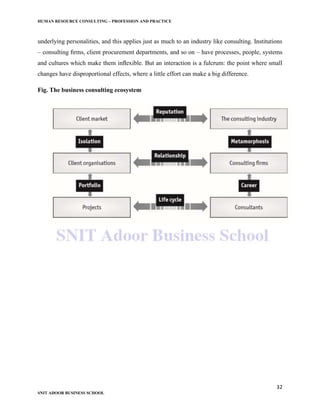
  • 98.
    HUMAN RESOURCE CONSULTING– PROFESSION AND PRACTICE 94 SNIT ADOOR BUSINESS SCHOOL  What are the successes? Challenges?  Are there any changes to the goals? (i.e. new priorities, revised timelines, etc.)  Development Goals  What is the status? On track? If not, why not?  What are the successes? Challenges?  Are there any changes to the goals? (i.e. revised timelines, new priorities etc.)  Performance Factors  What are the areas where the employee is performing well?  What areas show recent improvement?  What areas still need improvement?  What expectations need to be clarified?  Support/Resources  What additional support is needed? (From whom? By when?)  Key Messages  What key messages about the employee’s performance does he or she need to understand and leave with at the end of the meeting?  Agreements/Next Steps  Who is expected to do what, by when? 4.8.3 IMPLEMENTATION PHASE Project implementation (or project execution) is the phase where visions and plans become reality. This is the logical conclusion, after deciding, evaluating, visioning, planning, applying for funds and finding the financial resources of a project. Implementation phase means carrying out the activities described in your work plan. Objectives of the Implementation Phase  Putting the action plan into operation  Achieving tangible change and improvements  Ensuring that new infrastructure, new institutions and new resources are sustainable in every aspect  Ensuring that any unforeseen conflicts that might arise during this stage are resolved
  • 99.
    HUMAN RESOURCE CONSULTING– PROFESSION AND PRACTICE 95 SNIT ADOOR BUSINESS SCHOOL  Ensuring transparency with regard to finances 4.9 DISENGAGING  Those working internally are good at establishing effective working relationships with their clients.  Clients need to feel they can trust the consultant and the consultant needs to be accessible when needed  However, being too available and accessible can create client dependency.  Withdrawal and disengagement increases the risk of clients feeling vulnerable, particularly if they do not feel well prepared for their continuing role in implementing and supporting change.  It is also the case that the client can often perceive the consultant as integral to the system, and therefore not needing to leave.  Being clear about the boundaries of the piece of work and the time to withdraw will be essential if the internal consultant is to be able to manage the many conflicting priorities with which they will be presented.  Disengaging becomes much easier and clearer when the contracting process has been effective.  Whether this is done formally or informally if the consultant’s role and the client’s expectations about the outcomes for the piece of work have been clarified, the ending should feel both appropriate and timely.
  • 100.
    HUMAN RESOURCE CONSULTING– PROFESSION AND PRACTICE 96 SNIT ADOOR BUSINESS SCHOOL Specialty areas of HR Consulting The idea of HR consulting services is widely accepted all across the globe because of numerous benefits it provides to an organization. By choosing the right people for the organization, the company can focus more on their core roles. But, hiring the right people eats a lot of time, and that might distract you from your core motive. Here the HR consulting services comes into use. The HR consulting services understand your company’s motive, goals and objectives, and hire the right people according to your company culture. The business world has proudly accepted this idea and a majority of the companies now outsource the matters of human resource. Consulting Areas in HRM  Human Resource Planning – The purpose of HRP is is to make sure that the organization has the right number of people of the right profile at the right time. An HR consulting firm can provide the organization with a comprehensive HR assessment and planning to meet its future requirements in the most cost-effective and timely manner. HR planning process  Current HR Supply  Future HR Demand  Demand Forecast  HR sourcing strategy and implementation  Recruitment and Selection – Recruitment is the process of attracting applicants for jobs within the organization. Role of Consultant  Job description and the person required MODULE V Human Resources in Organization Consulting: Specialty areas of HR consulting; Outsourcing and HR – areas for outsourcing, readiness for outsourcing; HR Consulting firms in India and its future in India; HR Consultant Career graph.
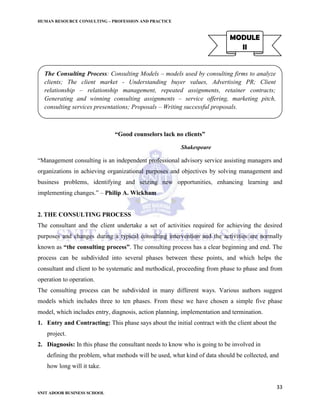
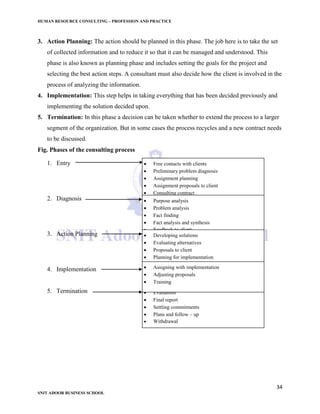
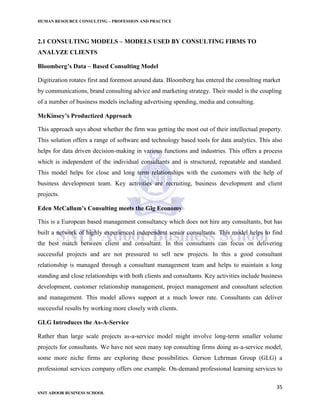
  • 101.
    HUMAN RESOURCE CONSULTING– PROFESSION AND PRACTICE 97 SNIT ADOOR BUSINESS SCHOOL  Methods of advertising the vacancy  Executive search Selection is the process of choosing the right person to the right job.  Remuneration – Consultants develops a salary system that works efficiently and fairly from the point of view of both the organization’s employees and management. This can be done by Job analysis, evaluation and building of a job structure. The consultant cannot see wage and salary problems as purely technical ones.  Motivation – Every organization aims to motivate its personal. This depends upon their achieved range of goals, which may include Societal, group, individual and organizational goal. An HRM consultant may be requested to assist in determining what motivational tools and strategies are to be used. They may include:  The enrichment of job content.  The improvement of overall organizational climate.  Reward Systems  HRD – Its main purpose is to help people in organizations to face the challenges created by technological and other changes, to adapt to new requirements, to develop skills, and to achieve the levels of performance needed to stay competitive. The HRD specialists makes the client aware of the complexity of human side of the enterprise, and of the need to consider all factors affecting motivation, behavior, interpersonal relations and performance of people in organizations. Other Areas Includes:  Retention  Termination  HR Audit  Human Capital Accounting  HRM  HRIS
  • 102.
    HUMAN RESOURCE CONSULTING– PROFESSION AND PRACTICE 98 SNIT ADOOR BUSINESS SCHOOL Outsourcing and HR - Areas of outsourcing Outsourcing is a business practice in which a company hires an individual or another company to perform tasks, handle operations or provide services that are either usually executed or had previously been done by the company's own employees. Companies often outsource as a way to improve efficiencies, lower costs and gain speed. Other benefits include:  Cost Savings  Payroll and Accounting  Global Talent  Risk Management  Efficiency  Employee Development  Help with Compliance  Reduce employment related expenses  Health insurance benefits HR Outsourcing HR outsourcing services are highly customized based on the client’s need. According to Lisa Fleming, PR Manager at Paychex, "The cost for fully outsourced HR services varies greatly and is typically customized based on the individual needs of the client. HR outsourcing gives businesses the option of delegating human resource related assignments such as benefits payroll, administration, training, recruiting and other employee management task to a team of smart HR professionals, instead of hiring internal staff. HR outsourcing is the most sustainable method to manage costs and to facilitate the organization to focus on core operations and strategic initiatives instead of wasting time in the routine transactional activities of HR management.
  • 103.
    HUMAN RESOURCE CONSULTING– PROFESSION AND PRACTICE 99 SNIT ADOOR BUSINESS SCHOOL Advantages  Impact Good or Bad – HR consultancy can have an important effect on your company, so always make sure that you choose someone whose impact is a positive one.  Cost Effective  Save Time Disadvantages  Morale – The consultant with low morale can often lead to less productivity.  Confidentiality – The deal should be strictly confidential.  Loss of Human Factor – When an organization takes the assistance of consulting firm loss of human factors normally happens. READINESS FOR OUTSOURCING  For employees Outsourcing is always a sensitive topic, hemce it should always get the support of employees.  It’s vital that you find the right company or individual to outsource to. Before you make a long term commitment, always do a trial run to make sure there is cohesiveness.  Expand what you outsource slowly. Always try to take a step by step approach before implementing a large scale strategy to outsource. This approach allows you to make adjustments, and scale up or back as required as your company evolves.  In order for outsourcing to work effectively, always be an active partner. You need to provide the outsourcing service provider with the resources and information to do the job correctly, you need to be responsive to their requests, and you need to help them help you.  Always be an open communicator. Always make sure to provide feedback and solicit feedback from your outsource partner. Keeping an open line of communication is vital to ensure everyone is on the same page and expectations are being met on both sides.
  • 104.
    HUMAN RESOURCE CONSULTING– PROFESSION AND PRACTICE 100 SNIT ADOOR BUSINESS SCHOOL HR Consulting firms in India and its future in India • Human resources consultants work to make sure that the company effectively uses its resources to achieve greater goals and improved efficiency. HR consultants are generally outsourced to help companies on a wide range of issues involving its workforce. HR consultants operate independently or through a consulting firm. Top HR consulting firms in India • ABC Consultants Pvt Ltd. • Quess Corp Ltd. ... • Career Net Technologies Pvt Ltd. ... • Innovsource Pvt Ltd. ... • IKYA General Staffing. ... • Kelly Services India Pvt Ltd. • Manpower Group Services India Pvt Ltd • Randstad India Pvt. Ltd • Team lease Services Ltd • Rites Ltd.  The Indian consulting began in the 1990s when C. K. Birla requested McKinsey to devise a turnaround project for Hindustan Motors. Soon, McKinsey opened an office, employing about 100 consultants in Delhi. According to an estimate, there are now over 10,000 small and big consulting firms in India, 6,000 of them in the four metros of Delhi, Mumbai, Kolkata and Chennai.  According to the Associated Chambers of Commerce and Industry, the Indian consulting industry is expected to record revenues of Rs. 27,000 crore by 2020. One estimate says that between 500 and 600 high-value consulting contracts, worth $250 million to $300 million, are awarded every year by Indian companies, including 30 or 40 projects worth over $2 million each.  As in many other sectors, low cost was the first major initial advantage of Indian consulting companies and consultants. But their major clients and their partners abroad have found that Indian consultants have other advantages, such as industriousness,
  • 105.
    HUMAN RESOURCE CONSULTING– PROFESSION AND PRACTICE 101 SNIT ADOOR BUSINESS SCHOOL willingness to learn, professionalism, and adaptability to technology. Their competitors have started to view them as worthy equals.  However, they suffer from shortcomings, too. Among them are poor brand equity, experience in foreign markets, ability to maintain quality, and low level of R&D. But they can overcome these difficulties and emerge more powerful in the global scenario if they adopt the best practices in the industry and improve their knowledge resources and data warehousing. Future of human resource consultancy firms 1. Cloud: • According to a 2016 KPMG survey, 42% of the companies are thinking about shifting to Cloud HR System. After a year of that news, many companies must have taken a step forward. The reason why such a huge amount of companies are changing the way their human resources works is because of the endless benefits cloud services. HR consulting firms would surely move towards cloud as entire HR industry is expected to grab this change. 2. A better level of recruitment: • As the job profiles are becoming more and more focused, the recruitment will be more centered towards skills. By far, companies have realized the exact nature of each and every job profile, hence the hr consulting firms can find the right candidates for the businesses. • With increasing use of Applicant Tracking System, the human resource consulting industry is more focused on better user experience. Not just for the applicants, but also for the HR consultants. 3. Outsourcing: • Sure, the human resource management is one of the most important parts of any business. But, maintaining & managing people, and activities of HR services can be tedious. That is the reason why HR consulting firms were born. The prime motive behind these top hr consulting firms is to load off some weight from your company, so they can focus more on your business.
  • 106.
    HUMAN RESOURCE CONSULTING– PROFESSION AND PRACTICE 102 SNIT ADOOR BUSINESS SCHOOL Impact of technology on HR services: 1. Remote working: • As the cloud has covered almost every company in one or another way, there is a fair chance of a majority of people working from home. In the future, we could see a possibility of employees working from remote locations, and running a business. The whole idea of virtual business is already widely accepted, and cloud technology has given it the needed wings. 2. Artificial Intelligence: • Giant companies are investing more in artificial intelligence or machine learning technology, these days. The prime goal is to reduce human efforts. But, as this technology will grow, there will be lesser people required, because machines will replace people with many repetitive jobs. With the intelligence growing in machines, there will be very few roles left for humans. HR Consultant Career graph Career: The sequence of employee related positions, activities, roles and experiences encountered by person over time. (Arnold, 1997) Career graph of the consultant refers to the growth of the employee in his organization. Career graph basically means the various positions an employee moves on one by one as he grows in an organization. The employee may move vertically most of the time but also move laterally or cross functionally to move to a different type of job role.
  • 107.
    HUMAN RESOURCE CONSULTING– PROFESSION AND PRACTICE 103 SNIT ADOOR BUSINESS SCHOOL Figure: Career Graph – an example
  • 108.
    HUMAN RESOURCE CONSULTING– PROFESSION AND PRACTICE 104 SNIT ADOOR BUSINESS SCHOOL REFERENCES  Kubr, M (ed.) (2002), Management consulting: A guide to the profession (fourth edition), Geneva, International Labour Office  Gilbert Toppin and Fiona Czerniawska (2005), Business Consulting: A Guide to How it Works and How to Make it Work, The Economist Newspaper Ltd.  Peter Block (2011), Flawless Consulting  smallbusiness.chron.com/advantages-outsourcing-hr-functions-21169  www.google.com  www.hrinasia.com/general/5-key-areas-wherein-hr-outsourcing-can-help-improve-bottom- lines  www.inc.com/hr-outsourcing/best-hr-outsourcing-for-small-business-in-2017  www.peocompare.com/human-resources-hr-outsourcing  www.peocompare.com/human-resources-hr-outsourcingwww.priorityhr.com/blog/entry/9- benefits-to-outsourcing-hr  www.renaissancewealth.net/overview-of-consulting-process