A P.PT PRESENATION
ON
TOPIC
HUMAN DEVELOPMENT REPORT
AND HUMAN DEVELOPMENT
INDEX
Human Development Index
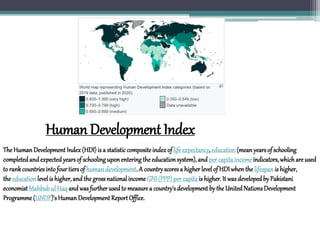
The Human Development Index (HDI) is a statisticcomposite indexof life expectancy,education(mean yearsof schooling
completedand expectedyearsof schooling uponentering the educationsystem),and per capitaincomeindicators,whichare used
to rankcountriesintofourtiersof human development.A countryscoresa higherlevel of HDI whenthe lifespan is higher,
the education level is higher,and the gross nationalincome GNI (PPP)per capitais higher.It wasdevelopedby Pakistani
economistMahbubul Haq and was further usedto measurea country'sdevelopment by the UnitedNationsDevelopment
Programme(UNDP)'sHumanDevelopment ReportOffice.
The 2010 Human Development Report introduced an Inequality-adjusted
Human Development Index (IHDI). While the simple HDI remains useful, it
stated that "the IHDI is the actual level of human development (accounting
for inequality), while the HDI can be viewed as an index of 'potential'
human development (or the maximum level of HDI) that could be achieved
if there were no inequality.
The index does not take into account several factors, such as the net wealth
per capita or the relative quality of goods in a country. This situation tends to
lower the ranking for some of the most advanced countries, such as
the G7 members and others.
The index is based on the human development approach, developed
by Mahbub ul Haq, anchored in Amartya Sen's work on human capabilities,
often framed in terms of whether people are able to "be" and "do" desirable
things in life. Examples include – being: well fed, sheltered, healthy; doing:
work, education, voting, participating in community life. The freedom of
choice is central – someone choosing to be hungry (e.g. when fasting for
religious reasons) is quite different from someone who is hungry because
they cannot afford to buy food, or because the country is in a famine.
Origins
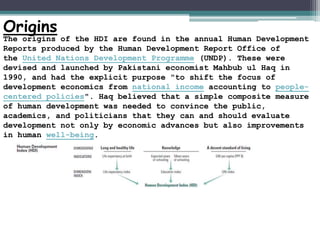
The origins of the HDI are found in the annual Human Development
Reports produced by the Human Development Report Office of
the United Nations Development Programme (UNDP). These were
devised and launched by Pakistani economist Mahbub ul Haq in
1990, and had the explicit purpose "to shift the focus of
development economics from national income accounting to people-
centered policies". Haq believed that a simple composite measure
of human development was needed to convince the public,
academics, and politicians that they can and should evaluate
development not only by economic advances but also improvements
in human well-being.
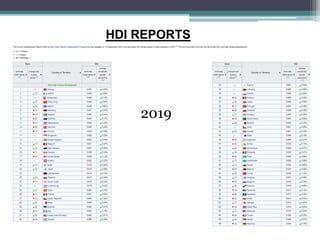
HDI REPORTS
2019
2020
Human Development Report
The Human Development Report (HDR) is an annual Human Development
Index report published by the Human Development Report Office of
the United Nations Development Programme (UNDP).[1]
The first HDR was launched in 1990 by the Pakistani economist Mahbub ul
Haq and Indian Nobel laureate Amartya Sen. Since then reports have been
released most years, and have explored different themes through the human
development approach, which places people at the center of the development
process.
The reports are ensured of editorial independence by the United Nations
General Assembly. They are seen as reports to UNDP, not of UNDP. This
allows each report greater freedom to explore ideas and constructively
challenge policies. Each report also presents an updated set of indices,
including the Human Development Index (HDI), which is a measure of average
achievement in the basic dimensions of human development across countries,
and a compendium of key development statistics relevant to the report
theme.
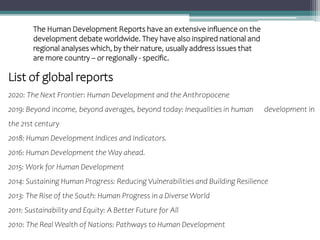
The Human Development Reports have an extensive influence on the
development debate worldwide. They have also inspired national and
regional analyses which, by their nature, usually address issues that
are more country – or regionally - specific.
List of global reports
2020: The Next Frontier: Human Development and the Anthropocene
2019: Beyond income, beyond averages, beyond today: Inequalities in human development in
the 21st century
2018: Human Development Indices and Indicators.
2016: Human Development the Way ahead.
2015: Work for Human Development
2014: Sustaining Human Progress: Reducing Vulnerabilities and Building Resilience
2013: The Rise of the South: Human Progress in a Diverse World
2011: Sustainability and Equity: A Better Future for All
2010: The Real Wealth of Nations: Pathways to Human Development
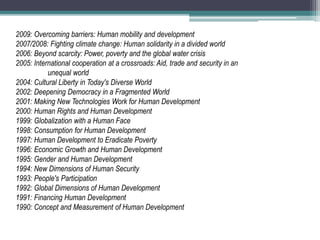
2009: Overcoming barriers: Human mobility and development
2007/2008: Fighting climate change: Human solidarity in a divided world
2006: Beyond scarcity: Power, poverty and the global water crisis
2005: International cooperation at a crossroads: Aid, trade and security in an
unequal world
2004: Cultural Liberty in Today's Diverse World
2002: Deepening Democracy in a Fragmented World
2001: Making New Technologies Work for Human Development
2000: Human Rights and Human Development
1999: Globalization with a Human Face
1998: Consumption for Human Development
1997: Human Development to Eradicate Poverty
1996: Economic Growth and Human Development
1995: Gender and Human Development
1994: New Dimensions of Human Security
1993: People's Participation
1992: Global Dimensions of Human Development
1991: Financing Human Development
1990: Concept and Measurement of Human Development
THANK YOU

HUMAN DEVELOPMENT REPORT AND HUMAN DEVELOPMENT INDEX

  • 1.
    A P.PT PRESENATION ON TOPIC HUMANDEVELOPMENT REPORT AND HUMAN DEVELOPMENT INDEX
  • 2.
    Human Development Index TheHuman Development Index (HDI) is a statisticcomposite indexof life expectancy,education(mean yearsof schooling completedand expectedyearsof schooling uponentering the educationsystem),and per capitaincomeindicators,whichare used to rankcountriesintofourtiersof human development.A countryscoresa higherlevel of HDI whenthe lifespan is higher, the education level is higher,and the gross nationalincome GNI (PPP)per capitais higher.It wasdevelopedby Pakistani economistMahbubul Haq and was further usedto measurea country'sdevelopment by the UnitedNationsDevelopment Programme(UNDP)'sHumanDevelopment ReportOffice.
  • 3.
    The 2010 HumanDevelopment Report introduced an Inequality-adjusted Human Development Index (IHDI). While the simple HDI remains useful, it stated that "the IHDI is the actual level of human development (accounting for inequality), while the HDI can be viewed as an index of 'potential' human development (or the maximum level of HDI) that could be achieved if there were no inequality. The index does not take into account several factors, such as the net wealth per capita or the relative quality of goods in a country. This situation tends to lower the ranking for some of the most advanced countries, such as the G7 members and others. The index is based on the human development approach, developed by Mahbub ul Haq, anchored in Amartya Sen's work on human capabilities, often framed in terms of whether people are able to "be" and "do" desirable things in life. Examples include – being: well fed, sheltered, healthy; doing: work, education, voting, participating in community life. The freedom of choice is central – someone choosing to be hungry (e.g. when fasting for religious reasons) is quite different from someone who is hungry because they cannot afford to buy food, or because the country is in a famine.
  • 4.
    Origins The origins ofthe HDI are found in the annual Human Development Reports produced by the Human Development Report Office of the United Nations Development Programme (UNDP). These were devised and launched by Pakistani economist Mahbub ul Haq in 1990, and had the explicit purpose "to shift the focus of development economics from national income accounting to people- centered policies". Haq believed that a simple composite measure of human development was needed to convince the public, academics, and politicians that they can and should evaluate development not only by economic advances but also improvements in human well-being.
  • 5.
  • 6.
  • 7.
    Human Development Report TheHuman Development Report (HDR) is an annual Human Development Index report published by the Human Development Report Office of the United Nations Development Programme (UNDP).[1] The first HDR was launched in 1990 by the Pakistani economist Mahbub ul Haq and Indian Nobel laureate Amartya Sen. Since then reports have been released most years, and have explored different themes through the human development approach, which places people at the center of the development process. The reports are ensured of editorial independence by the United Nations General Assembly. They are seen as reports to UNDP, not of UNDP. This allows each report greater freedom to explore ideas and constructively challenge policies. Each report also presents an updated set of indices, including the Human Development Index (HDI), which is a measure of average achievement in the basic dimensions of human development across countries, and a compendium of key development statistics relevant to the report theme.
  • 8.
    The Human DevelopmentReports have an extensive influence on the development debate worldwide. They have also inspired national and regional analyses which, by their nature, usually address issues that are more country – or regionally - specific. List of global reports 2020: The Next Frontier: Human Development and the Anthropocene 2019: Beyond income, beyond averages, beyond today: Inequalities in human development in the 21st century 2018: Human Development Indices and Indicators. 2016: Human Development the Way ahead. 2015: Work for Human Development 2014: Sustaining Human Progress: Reducing Vulnerabilities and Building Resilience 2013: The Rise of the South: Human Progress in a Diverse World 2011: Sustainability and Equity: A Better Future for All 2010: The Real Wealth of Nations: Pathways to Human Development
  • 9.
    2009: Overcoming barriers:Human mobility and development 2007/2008: Fighting climate change: Human solidarity in a divided world 2006: Beyond scarcity: Power, poverty and the global water crisis 2005: International cooperation at a crossroads: Aid, trade and security in an unequal world 2004: Cultural Liberty in Today's Diverse World 2002: Deepening Democracy in a Fragmented World 2001: Making New Technologies Work for Human Development 2000: Human Rights and Human Development 1999: Globalization with a Human Face 1998: Consumption for Human Development 1997: Human Development to Eradicate Poverty 1996: Economic Growth and Human Development 1995: Gender and Human Development 1994: New Dimensions of Human Security 1993: People's Participation 1992: Global Dimensions of Human Development 1991: Financing Human Development 1990: Concept and Measurement of Human Development
  • 10.