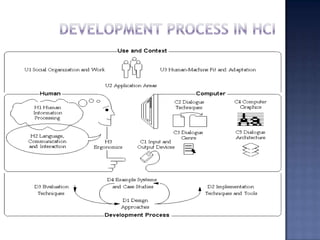
 Human:
The user of a software application or
hardware device
 Computer:
The physical device, artifact, or hardware
that provides some service to the human,
typically via a computer program
 Interaction:
The communication between the human and
the computer
 HCI is Human-Computer Interaction
 a discipline concerned with
 the design
 the evaluation
 the implementation
 of interactive computing systems for human use
and with
 the study of major phenomena surrounding them
ACM SIGCHI curricula
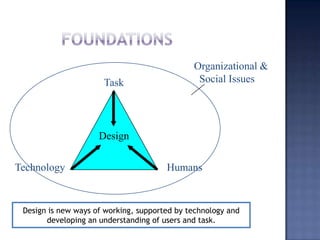
HumansTechnology
Task
Design
Organizational &
Social Issues
Design is new ways of working, supported by technology and
developing an understanding of users and task.
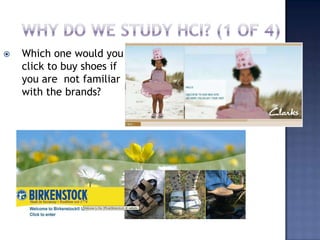
 Which one would you
click to buy shoes if
you are not familiar
with the brands?
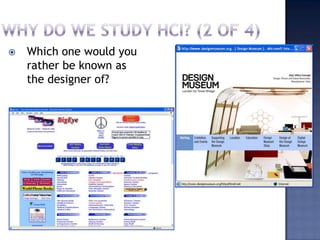
 Which one would you
rather be known as
the designer of?
 In the past, ‘normal’ users cannot use interactive
systems because designers are:
 Programmers who use computers every day.
 Mainly young males.
 Expert computer gamers.
 We want to design interactive systems that are:
 enjoyable to use, that do useful things and that
enhance the lives of the people that use them.
 accessible, usable and engaging.
►Engagement is concerned with all the qualities of
an experience that really pull people in
►A sense of immersion that one feels reading a good
book
►The challenge one feels when playing a good game
►The fascinating unfolding of a TV drama.
►Engagement is concerned with all the qualities of
the interactive experience that make it
memorable, satisfying, enjoyable and rewarding.
Know about people
 Sociology, anthropology, psychology, culture
Know about technologies
 Software, communications, materials, databases, et
c.
Know about activities and contexts
 Communities of practice, information
systems, organizations, knowledge management
Know about design
 Fashion, interior, information
design, architecture, product design
Human computer interaction

Human computer interaction

  • 2.
     Human: The userof a software application or hardware device  Computer: The physical device, artifact, or hardware that provides some service to the human, typically via a computer program  Interaction: The communication between the human and the computer
  • 3.
     HCI isHuman-Computer Interaction  a discipline concerned with  the design  the evaluation  the implementation  of interactive computing systems for human use and with  the study of major phenomena surrounding them ACM SIGCHI curricula
  • 4.
    HumansTechnology Task Design Organizational & Social Issues Designis new ways of working, supported by technology and developing an understanding of users and task.
  • 5.
     Which onewould you click to buy shoes if you are not familiar with the brands?
  • 6.
     Which onewould you rather be known as the designer of?
  • 7.
     In thepast, ‘normal’ users cannot use interactive systems because designers are:  Programmers who use computers every day.  Mainly young males.  Expert computer gamers.  We want to design interactive systems that are:  enjoyable to use, that do useful things and that enhance the lives of the people that use them.  accessible, usable and engaging.
  • 8.
    ►Engagement is concernedwith all the qualities of an experience that really pull people in ►A sense of immersion that one feels reading a good book ►The challenge one feels when playing a good game ►The fascinating unfolding of a TV drama. ►Engagement is concerned with all the qualities of the interactive experience that make it memorable, satisfying, enjoyable and rewarding.
  • 9.
    Know about people Sociology, anthropology, psychology, culture Know about technologies  Software, communications, materials, databases, et c. Know about activities and contexts  Communities of practice, information systems, organizations, knowledge management Know about design  Fashion, interior, information design, architecture, product design