Part B CSIT226/826 Group Project 5 Amigos
13/10/2018 Page 1 of 36
Letter of Transmittal
13/10/2018
Catherine Goard
University of Wollongong
Northfields Avenue
Keiraville, NSW 2500
Dear Catherine Goard,
We are submitting the proposal for a new property management system. The included report
documents and supports the implementation of a unified, modern system that would bring
benefit to property investors, property managers and tenants.
Questions related to this proposal should be directed towards the writers and researchers of
this document. We wish for this report to meet your expectations.
Sincerely,
Mashfique Alam, Gustavo Borromeo, Vignesh Lakshmanan, Blake Rogan and Lei Zhang
Part B CSIT226/826 Group Project 5 Amigos
13/10/2018 Page 2 of 36
A modern take on real-estate
property
DESTINY PROPERTY
MANAGEMENT
6056714 - Kazi Mashfique Alam
5430276 - Gustavo Borromeo
5852869 - Vignesh Lakshmanan
5735282 - Blake Rogan
5194945 - Lei Zhang
Part B CSIT226/826 Group Project 5 Amigos
13/10/2018 Page 3 of 36
1. Executive Summary
The aim of this report is to detail the implementation of blockchain technology and the Internet
of Things into property management.
 This document highlights issues that users are facing when interacting with other users
and includes potential solutions for these issues.
 The primary users include, property investors, property managers and tenants.
 The secondary users include the government, Amazon and utility companies.
 The government and tenants have moderate interest in this implementation while the
property investors, property managers, amazon and utility companies have high
interests in the success of the project.
 The government, property investors and property managers will have high influence
over the features to be included in this project. Amazon, tenants and utility companies
will have moderate influence over the project.
 The system research interview and surveys were conducted to increase stakeholder
interest and add important features to the project.
 The requirements section contains requests created by the users.
 The user persona describes the potential users involved in property management.
Part B CSIT226/826 Group Project 5 Amigos
13/10/2018 Page 4 of 36
Contents
1. Executive Summary .......................................................................................................... 3
3. Table of Figures................................................................................................................ 7
4. Introduction ....................................................................................................................... 8
4.1. Issues......................................................................................................................... 8
4.2. Solution ...................................................................................................................... 8
5. Business Domain.............................................................................................................. 9
5.1. Current Systems......................................................................................................... 9
5.1.1. Blockchain............................................................................................................ 9
5.1.2. Internet of Things ................................................................................................. 9
6. Stakeholder analysis....................................................................................................... 10
6.1. Primary users ........................................................................................................... 10
6.1.1. Rental property investor/owners/landlords.......................................................... 10
6.1.2. Property managers/agent................................................................................... 10
6.1.3. Tenants/Leasee ................................................................................................. 10
6.2. Secondary users....................................................................................................... 10
6.2.1. Utility companies................................................................................................ 10
6.2.2. Council/Government .......................................................................................... 10
6.2.3. Amazon Key and Echo....................................................................................... 10
7. System Research............................................................................................................ 12
7.1. Interview................................................................................................................... 12
7.1.1. Local council ...................................................................................................... 12
7.2. Survey ...................................................................................................................... 12
7.2.1. Property owner................................................................................................... 12
7.2.2. Property manager .............................................................................................. 13
7.2.3. Tenants.............................................................................................................. 13
7.2.5. Amazon.............................................................................................................. 13
8. Scenario[s] / Persona[s] .................................................................................................. 14
8.1. Personas .................................................................................................................. 14
8.1.1. Property Investor................................................................................................ 14
8.1.2. Tenant................................................................................................................ 14
8.1.3. Property Manager .............................................................................................. 14
8.1.4. Council............................................................................................................... 14
8.1.5. Utility companies................................................................................................ 14
Part B CSIT226/826 Group Project 5 Amigos
13/10/2018 Page 5 of 36
8.1.6. Amazon.............................................................................................................. 14
8.2. Scenarios ................................................................................................................. 15
8.2.1. Scenario A ......................................................................................................... 15
8.2.2. Scenario B ......................................................................................................... 15
9. Requirements.................................................................................................................. 16
9.1. User Stories.............................................................................................................. 16
9.1.1. Rental property investor/owners/landlords.......................................................... 16
9.1.2. Property managers/agent................................................................................... 16
9.1.3. Tenants/Leasee ................................................................................................. 16
9.1.4. Utility companies................................................................................................ 16
9.1.5. Council/Government .......................................................................................... 16
9.1.6. Amazon Delivery Service ................................................................................... 17
9.2. Dependencies .......................................................................................................... 17
9.2.1. Platform ............................................................................................................. 17
9.2.2. User ................................................................................................................... 17
9.2.3. Maintenance ...................................................................................................... 17
9.2.4. Functional .......................................................................................................... 17
10. Storyboard .................................................................................................................... 18
10.1. Use Case................................................................................................................ 18
10.2. User Interaction ...................................................................................................... 19
11. Iteration Designs ........................................................................................................... 20
11.1. Low Fidelity Designs............................................................................................... 20
11.1.1. Design A .......................................................................................................... 20
11.1.2. Design B .......................................................................................................... 23
11.2. High Fidelity Design................................................................................................ 27
12. Discussion..................................................................................................................... 30
13. Conclusion .................................................................................................................... 31
References ......................................................................................................................... 32
15. Glossary........................................................................................................................ 33
16. Appendices ................................................................................................................... 34
17. Style Guide ................................................................................................................... 34
17.1. Font........................................................................................................................ 34
17.2. Logo ....................................................................................................................... 34
17.3. Colour..................................................................................................................... 35
17.3.1. Icon.................................................................................................................. 35
17.3.2. Website/Application.......................................................................................... 35
Part B CSIT226/826 Group Project 5 Amigos
13/10/2018 Page 6 of 36
18. Member Breakdown of tasks......................................................................................... 36
Part B CSIT226/826 Group Project 5 Amigos
13/10/2018 Page 7 of 36
3. Table of Figures
Figure 1 SOURCE: JIM YOUNG, “BIOT—BUILDING INTERNET OF THINGS™,”
REALCOMM, JANUARY 23, 2014; DELOITTE CENTER FOR FINANCIAL SERVICES
ANALYSIS. (Kejriwal & Mahajan, 2016) ................................................................................ 9
Figure 2 Stakeholder diagram of power, influence and interest........................................... 11
Figure 3 storyboard outlining why a user will want to interact with the system..................... 19
Figure 4 flow chart of user interaction with the system ........................................................ 19
Figure 5 low-fi prototype 1: login screen.............................................................................. 20
Figure 6 low-fi prototype 1: account screen......................................................................... 21
Figure 7 low-fi prototype 1: properties screen ..................................................................... 21
Figure 8 low-fi prototype 1: tenants screen.......................................................................... 22
Figure 9 low-fi prototype 1: utilities screen .......................................................................... 22
Figure 10 low-fi prototype 1: security screen....................................................................... 23
Figure 11 low-fi prototype 1: settings screen....................................................................... 23
Figure 12 low-fi prototype 2: account screen....................................................................... 24
Figure 13 low-fi prototype 2: property screen ...................................................................... 24
Figure 14 low-fi prototype 2: property information screen.................................................... 25
Figure 15 low-fi prototype 2: tenant screen ......................................................................... 25
Figure 16 low-fi prototype 2: security screen....................................................................... 25
Figure 17 low-fi prototype 2: utilities screen ........................................................................ 26
Figure 18 low-fi prototype 2: settings screen....................................................................... 26
Figure 19 hi-fi prototype: user account screen .................................................................... 27
Figure 20 hi-fi prototype: properties screen......................................................................... 27
Figure 21 hi-fi prototype: tenants screen ............................................................................. 28
Figure 22 hi-fi prototype: utilities screen.............................................................................. 28
Figure 23 hi-fi prototype: security screen............................................................................. 29
Figure 24 outline of acceptable logo usages with primary colour scheme ........................... 34
Figure 25 colour schemes used with the logo ..................................................................... 35
Figure 26 colour schemes used for the website .................................................................. 35
Part B CSIT226/826 Group Project 5 Amigos
13/10/2018 Page 8 of 36
4. Introduction
4.1. Issues
Results in recently conducted surveys have shown little change in property management in
the past few decades. Tenants often have a layer of separation from the property owner when
a property manager is present. The primary goal of a property manager is to ensure both the
tenant and landlord are satisfied. This is typically performed by ensuring areas such as utility
usage, billing, property care and security are all maintained. These primary stakeholders hold
various documents including the utility bills, lease agreement and title to the land.
Titles of land and rental agreements in the majority of countries are still hardcopies. This poses
a flaw where property can be falsely transferred through forgery of the title.
Manual management of utility bills and rental payments by the property manager is a repetitive
and time-consuming process. A property manager would be able to manage extra properties
if this was to become more efficient.
4.2. Solution
In recent years, blockchain and the Internet of Things have been increasing in popularity.
Blockchain can be a great tool for preventing fraudulent alterations in past documents such
as titles of land whilst still maintaining transparency as public records. Each new update to the
decentralised system must be approved by specified servers/nodes that have previous
hashed data making virtually impossible to create a fraudulent transaction. The IoT is a suite
of technologies connecting devices and locations for instant data analysis in an intuitive
manner.
The addition of the Internet of Things has already greatly impacted convenience and security.
Amazon’s shipping service allows packages to be delivered inside a home when Remote
locking of doors ensure valuables can be kept safe even when away. Smart remote camera
systems can actively report foreign movement to the appropriate contacts, whether it be the
tenant, property manager, landlord or even the police. Utility companies would be able to set
up internet-based electricity, water, and gas meter readers for automatic billing. Combining
these features into a single package would decrease the load on property managers.
Property owners, property managers and tenants would greatly benefit from a new system.
Convenience, security and a flowing user interface that meet user expectations are
improvements over any current system on the market.
Part B CSIT226/826 Group Project 5 Amigos
13/10/2018 Page 9 of 36
5. Business Domain
5.1. Current Systems
5.1.1. Blockchain
Blockchain currently exists primarily in cryptocurrency. Its anonymity, transparency and
security are all desirable traits for investors. In the hopes to prevent forgery of land titles, the
Swedish Land Registry “Lantmäteriet” is currently the global leader in trialling the
implementation of blockchain. With multiple successful trial periods involving major
stakeholders such as banks, Svensk Fastighetsförmedling (online real estate search portal)
and ChromaWay (blockchain start-up), their tests have proven to be successful. They were
able to securely transfer titles online using the blockchain technology. Consultancy firm Kairos
Future claims the new system would reduce paperwork, speed up transactions and reduce
fraud, thus saving over one hundred million euros per year.
5.1.2. Internet of Things
The Internet of Things has been exponentially growing in both commercial and residential real
estate markets. It adds the benefit of monitoring various system statuses. The most common
IoT integration in residential homes is smart remote surveillance monitoring. IoT in commercial
buildings is much more common with entire system status monitoring becoming an increasing
standard. Figure 1 is a diagram displaying various IoT commercial integrations.
Figure 1 SOURCE: JIM YOUNG, “BIOT—BUILDING INTERNET OF THINGS™,” REALCOMM, JANUARY 23,
2014; DELOITTE CENTER FOR FINANCIAL SERVICES ANALYSIS. (Kejriwal & Mahajan, 2016)
Part B CSIT226/826 Group Project 5 Amigos
13/10/2018 Page 10 of 36
6. Stakeholder analysis
6.1. Primary users
6.1.1. Rental property investor/owners/landlords
The investor’s goal when purchasing a rental property is to receive a positive financial return.
They would receive most benefit from a fast and secure transaction system powered by
blockchain and maintenance of the property through the Internet of Things. This group of users
has high interest and moderate influence in this project.
6.1.2. Property managers/agent
A property manager is responsible for satisfactorily maintaining the lease on a property. Their
involvement usually involves locating a tenant, responding to reports created by the tenant
and maintaining utility bills on behalf of the property investor. A system with increased
efficiency for dealing with these will decrease the amount of time spent managing each
property. This will allow the property manager to manage a larger number of properties in the
same amount of time. This group of users has high interest and moderate influence in this
project.
6.1.3. Tenants/Leasee
A tenant is the customer to the property investor and manager. Depending on the rental
agreement, they could be responsible for paying for their utilities. Having an automated
system to monitor the property and do these tasks for them is of high interest. This group of
users has high interest and moderate influence in this project.
6.2. Secondary users
6.2.1. Utility companies
Utility companies provide the tenant with water, electricity and gas. Allowing for automatic
payments would decrease the number of late or missed payments. However, some profit
greatly on late payment fees and this can possibly decrease their profits. They would have
high interest and high influence as their system would have to adopt to the IoT standard.
6.2.2. Council/Government
The local council and government currently hold records for the land titles and would have
high interest and influence in the blockchain technology. They would also have moderate
interest in the IoT where information on security, fire safety and other building aspects can be
easily collated into a database for monitoring.
6.2.3. Amazon Key and Echo
Amazon’s IoT smart lock allows authorised remote unlocking of the front door for parcel
delivery and Echo for controlling other IoT enabled devices.
Part B CSIT226/826 Group Project 5 Amigos
13/10/2018 Page 11 of 36
Figure 2 Stakeholder diagram of power, influence and interest
Property investor
Property manager
Government
Tenant
Utility company
Amazon
Power/Influence
Interest
Low High
High
Part B CSIT226/826 Group Project 5 Amigos
13/10/2018 Page 12 of 36
7. System Research
In order to successfully meet the demands of the primary and secondary users of the
blockchain technology and Internet of Things implementation, direct contact must be made
with the users. This has been performed
7.1. Interview
An interview was used to gather information from the local council as a detailed response was
required from the small dataset
7.1.1. Local council
Question 1. What are your goals and requirements for this project?
Answer 1. We wish to have a simple management system where valuable documents
such as public property titles and lease agreements can be securely viewed without alteration.
The property resident, emergency services and insurance companies should be able to be
automatically alerted in the event of an emergency such as flooding or fire.
Question 2. What do you personally consider a success for this project?
Answer 2. We consider the project a success when the deliverables are completed within
the allocated budget.
Question 3. Why are you interested in this project?
Answer 3. We believe this is the best pathway towards the future of property management.
7.2. Survey
A survey was used to conduct research with the public. The ease of distribution allowed us
to retrieve valuable data from a large population with minimal effort.
7.2.1. Property owner
Question 1. On a scale of 1-10, how comfortable are you with the idea of your land titles being
secured online with blockchain? If below 5, explain.
Result 1. Those who were least comfortable (1-3) said they were uninformed about how
blockchain works. The average answer: 7
Question 2. On a scale of 1-10, how comfortable are you with enabling IoT devices throughout
your household? What would you change?
Result 2. The owners were very positive with the idea of turning their properties into
smart properties at a comfortability rating of 9. They especially liked the idea of remote security
and utility monitoring. Those with low ratings were sceptical about the security of the cameras,
where intruders could also possibly monitor the cameras and plan their raid.
Part B CSIT226/826 Group Project 5 Amigos
13/10/2018 Page 13 of 36
7.2.2. Property manager
Question 1. What features would create efficiency in your work cycle?
Result 1. The most time-consuming parts of a property managers’ duties involve processing
utility bills and sorting through lease agreements. If these can be made more efficient, it would
decrease work load and allow management of more properties.
Question 2. Can you re-order this list of features from highest to lowest priority/interest and
provide a rating from 1-10? Blockchain property titles/lease agreements, IoT security cameras,
IoT utility tracking, IoT automatic utility billing
Result 2. Most answers had different lists of priority. When the averages are taken, automatic
utility tracking proved to be the highest priority while the rest shared the same average score.
7.2.3. Tenants
Question 1. What features would you be most interested in?
Result 1. The consensus was that residential tenants are most interested in automatic billing
with prior alerts for both their utilities and lease payments. Other high interests were IoT
remote surveillance to monitor the property and remote door locking in the event that the doors
were left unlocked after leaving the property. Commercial properties were more interested in
the live utility usage to bring down their operational cost.
7.2.4. Utility Question 1. What are the advantages of introducing IoT devices throughout
commercial and residential properties?
Result 1. Utility companies were most excited about payments not being missed by an
automated system. Currently their highest losses are from non-payment
Question 2. What are your concerns with introducing IoT devices throughout commercial and
residential properties?
Result 2. Profits could possibly decrease with the elimination of late payment fees and
decreased utility usage since tenants become more aware of their usage.
7.2.5. Amazon
Question 1. How would you contribute to residential IoT?
Result 2: Implementation of Amazon Key will allow parcels to be safely delivered inside a
home when there is no one to accept it. Amazon Echo is an Alexa enabled device capable of
controlling IoT enabled devices such as the air conditioning unit, refrigerator and lightbulbs.
Part B CSIT226/826 Group Project 5 Amigos
13/10/2018 Page 14 of 36
8. Scenario[s] / Persona[s]
8.1. Personas
8.1.1. Property Investor
The property investors’ main goal is to turn a profit at the end of each lease term. Investors
can have different terms when dealing with a contract. Having the tenant pay for their own
utilities can simplify their payments.
8.1.2. Tenant
The tenant signs a contract to be able to utilize the investors’ property. Tenants often have
different requirements and usually converse with the property manager who is hired by the
investor.
8.1.3. Property Manager
The property manager coordinates between the investors’ requests and tenants’ requests.
Once these are considered, the management of utilities, billing and other extra features such
as IoT implementation can be commenced.
8.1.4. Council
The council approves renovations, alterations to land ownership and may oversee lease
agreements.
8.1.5. Utility companies
Utility companies provide the tenant with essential services such as water, electricity and gas.
Investors either pay for these utilities or allow the tenant to pay for them, reducing load on the
property manager.
8.1.6. Amazon
Amazon is a company that provides easy access to IoT enabled devices such as Amazon Key
and Echo.
Part B CSIT226/826 Group Project 5 Amigos
13/10/2018 Page 15 of 36
8.2. Scenarios
8.2.1. Scenario A
The following scenario is based on the functional aspect of this service.
Jack approached Destiny Property Management. He came to know that DPM uses smart
contracts in the blockchain technology to serve as an intermediate between the leasee and
the owner. Blockchain technology is a secure network in which fraud is unlikely to occur. This
is because every transaction in the blockchain is verified by millions of nodes present all over
the world. Moreover, transparency of the property documents is maintained between the end
to end users. This made Jack confident of his decision to rent with DPM.
8.2.2. Scenario B
The following scenario is based on the functional aspect of this service.
The property manager also showed Jack a few properties which uses Internet of Things. A
property with IoT can constantly monitor buildings and their surroundings, to learn and
automatically control temperature, humidity, air quality and lighting levels. As well as providing
real time security information.
Part B CSIT226/826 Group Project 5 Amigos
13/10/2018 Page 16 of 36
9. Requirements
For the project to be considered successful the following user stories and additional
dependencies must be met to a satisfactory level. In this instance a satisfactory level means
that a user is able to achieve the goals set out in the user stories and that the additional
dependencies are completed.
9.1. User Stories
9.1.1. Rental property investor/owners/landlords
As a rental property investor/owner/landlord I want to track client rental agreements so that I
know who is where and when.
As a rental property investor/owner/landlord I want to know the utility usage of each tenant so
that accurate rental fees can be determined.
As a rental property investor/owner/landlord I want to know which properties are performing
well and which ones are not so that an informed decision can be made to sell a property or
perform renovations, etc on an underperforming property.
9.1.2. Property managers/agent
As a property manager I want to ensure that tenants are aware of their contract conditions and
the owner is aware of who is on their properties.
As a property manager I want to be aware of rental prices so that I can inform potential tenants
and ensure that current tenants are paying the correct amount
9.1.3. Tenants/Leasee
As a tenant I want to know the terms of my contract so that I am aware of what I can and
cannot do, along with how long my lease period is.
As a tenant I want to know that my property is secure for the duration of my lease so that I feel
safe.
As a tenant I want to know my utility usage so that I can reduce the cost of my rent.
9.1.4. Utility companies
As utility company we want to easily monitor utility usage so that we can correctly bill the client.
9.1.5. Council/Government
As government body we want to easily monitor rental agreements to ensure that there are no
fraudulent practices.
Part B CSIT226/826 Group Project 5 Amigos
13/10/2018 Page 17 of 36
9.1.6. Amazon Delivery Service
As a member of ADS, we want to be able to easily deliver package to ensure an efficient
delivery service.
9.2. Dependencies
Dependencies include a strong reliable interaction and communication protocol between the
utility companies and the system, amazon delivery service.
The implemented system must also be relatively cheap to run, and service. It must also be
efficient to use.
9.2.1. Platform
The system must be available to a wide range of devices, screen sizes, and user abilities. As
such our system will be developed using the latest web technologies that can support a wide
variety of devices such as traditional web browsers and contemporary mobile web browsers
and mobile applications.
9.2.2. User
It must be easy for a new user to interact with the system and be easily accessible to a wide
user base. This will be achieved through strong accessibility support and the transition into a
WCAG2.0 Level AAA, and through continued user feedback and accessibility research
implementing a system that supports an even larger audience.
9.2.3. Maintenance
The system must be cheap and easy to maintain. This can be achieved by decoupling and
modularising the system to reduce the amount of strain on the system. Making it easy to
perform scheduled maintenance on smaller areas of the system instead of shutting the whole
system down.
9.2.4. Functional
The system must be able to perform a range of tasks quickly and efficiently. This system will
be using FURPS+ model to describe and analyse all requirements. The system will be tested
in aspect of functionality, usability, reliability, performance and supportability until it meets
all requirements.
Part B CSIT226/826 Group Project 5 Amigos
13/10/2018 Page 18 of 36
10. Storyboard
10.1. Use Case
Jack had some properties to be leased and
managed.
Jack searched for DPM on the internet
He learned that DPM uses blockchain
technology for smart contracts to serve as an
intermediatary between the leasee and the
owner
After that he made an appointment with
DPM to get more details on how he could
integrate their servicecs into his existing
properties
The property manager showed him a few
properies already using the system
The property manager told jack a property
with IoT can learn and automatically control
temperature, humidity, air quality and
lighting levels. As well as providing real time
security information
Part B CSIT226/826 Group Project 5 Amigos
13/10/2018 Page 19 of 36
This made jack confident of his decision to
manage all his properies through DPM
Figure 3 storyboard outlining why a user will want to interact with the system.
10.2. User Interaction
Figure 4 flow chart of user interaction with the system
Part B CSIT226/826 Group Project 5 Amigos
13/10/2018 Page 20 of 36
11. Iteration Designs
During the development of the system, a UI (user interface) will go through several iterations.
Often, the initial designs are low fidelity, allowing fast prototyping with less detail. Further into
the design process, high fidelity designs are created to best simulate the finished products.
11.1. Low Fidelity Designs
Low fidelity are extremely quick and cheap designs that give an idea of where items, buttons
and other UI elements are positioned. But do not necessarily describe how a will system
function.
11.1.1. Design A
Figure 5 is the login page. It allows the user to input their credentials and access their account.
Figure 5 low-fi prototype 1: login screen
Part B CSIT226/826 Group Project 5 Amigos
13/10/2018 Page 21 of 36
The navigation pane on the left allows the user to toggle through the different pages of DPM
after logging in. Figure 6 is the account details page. It shows the current details including
their profile picture. The page also allows the user to change their details.
Figure 6 low-fi prototype 1: account screen
Figure 7 is the properties page. It displays the properties being managed using DPM on the
left and the detailed view on the right.
Figure 7 low-fi prototype 1: properties screen
Part B CSIT226/826 Group Project 5 Amigos
13/10/2018 Page 22 of 36
Figure 8 is the tenants page. It displays the tenants currently occupying properties on the left
and a detailed panel on the right.
Figure 8 low-fi prototype 1: tenants screen
Figure 9 is the utilities page. It displays the utilities in grouped sections of all properties on the
left pane and detailed information on the right pane.
Figure 9 low-fi prototype 1: utilities screen
Part B CSIT226/826 Group Project 5 Amigos
13/10/2018 Page 23 of 36
Figure 10 is the security page. It displays the security status of the property on the left pane
and detailed information on the right pane. Details include alarm status and CCTV.
Figure 10 low-fi prototype 1: security screen
Figure 11 is the settings page.
Figure 11 low-fi prototype 1: settings screen
11.1.2. Design B
The second low fidelity prototype provides friendliness to universal devices by using large
menus and segregating the detailed information.
Part B CSIT226/826 Group Project 5 Amigos
13/10/2018 Page 24 of 36
Figure 12 is the user accounts page. It displays the details of the user such as the username
and email address. If the user owns a property in DPM, then the user’s property is listed in the
Property owned text box and if the user is a tenant, then the user’s house is listed in the Tenant
text box. The page also shows the profile picture of the user for easy identification.
Figure 12 low-fi prototype 2: account screen
Figure 13 is the Properties page. All the properties of DPM are listed in the form of tiles. This
reduces the use of navigation sliders and the user can locate any property in the page in a
short span of time. Each property’s photo is listed within a particular tile. In addition to this,
fewer information such as the lease start date, lease end date etc are also seen in the tile.
Figure 13 low-fi prototype 2: property screen
Part B CSIT226/826 Group Project 5 Amigos
13/10/2018 Page 25 of 36
Figure 14 is the property information screen when clicked and enlarged from the previous
page.
Figure 14 low-fi prototype 2: property information screen
Figure 15 is the tenants screen. This displays all the tenants under DPM. They are listed in
the form of tiles. Once clicked on a particular tenant, more information is available on that
tenant such as his location and contact details. A chat area is also available for the users to
chat with the tenant through our website.
Figure 15 low-fi prototype 2: tenant screen
Figure 16 shows our security page. The user can select the block and unit and check if the
alarm is active or not. 2 live camera view can also be seen which is installed in front of each
unit in the building.
Figure 16 low-fi prototype 2: security screen
Part B CSIT226/826 Group Project 5 Amigos
13/10/2018 Page 26 of 36
Figure 17 shows the utilities screen. All the contact information of the utilities such as gas,
water, internet and electricity are available in form a grid. It is also possible to view the bill
details.
Figure 17 low-fi prototype 2: utilities screen
Figure 18 shows the Settings page. It is possible for the user to edit their profile. Details such
as their email, phone number and fax can be modified.
Figure 18 low-fi prototype 2: settings screen
Part B CSIT226/826 Group Project 5 Amigos
13/10/2018 Page 27 of 36
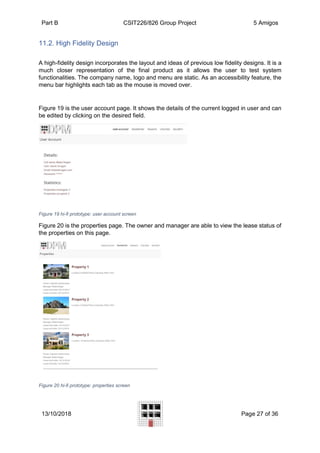
11.2. High Fidelity Design
A high-fidelity design incorporates the layout and ideas of previous low fidelity designs. It is a
much closer representation of the final product as it allows the user to test system
functionalities. The company name, logo and menu are static. As an accessibility feature, the
menu bar highlights each tab as the mouse is moved over.
Figure 19 is the user account page. It shows the details of the current logged in user and can
be edited by clicking on the desired field.
Figure 19 hi-fi prototype: user account screen
Figure 20 is the properties page. The owner and manager are able to view the lease status of
the properties on this page.
Figure 20 hi-fi prototype: properties screen
Part B CSIT226/826 Group Project 5 Amigos
13/10/2018 Page 28 of 36
Figure 21 is the tenants page. This is a two-column page with the selected tenant on the left,
showing their details while the other tenants are on the right with lesser detail.
Figure 21 hi-fi prototype: tenants screen
Figure 22 is the utilities page. This displays the current utilities being used by the tenant in a
vertical fashion. Details are not hidden as they can be missed, and late payments incur fees.
Figure 22 hi-fi prototype: utilities screen
Part B CSIT226/826 Group Project 5 Amigos
13/10/2018 Page 29 of 36
Figure 23 shows the security page. If a property has IoT enabled CCTV, they are available on
this page. The user can cycle through the different cameras using the navigation buttons under
each window.
Figure 23 hi-fi prototype: security screen
Part B CSIT226/826 Group Project 5 Amigos
13/10/2018 Page 30 of 36
12. Discussion
The Destiny Property Management System’s use of block chain (smart contracts)
technology and Internet of Things technology can greatly improve the company's work
efficiency and the security of client’s properties. This DPM system can limit the chance
of fraudulent activity and ensure that properties are managed fairly and that leases
know what is in their contract. IoT technologies help to increase property security.
Therefore, it can meet the all requirements of stakeholders. Such a contract allows
people to sell realties, exchange shares, money, documents or any proprietary. One
of the important features of smart contract implementation is that you won’t need to
use intermediary services such as brokers, notaries, agents etc to make a transaction
because smart contracts has Autonomy, Decentralization and Auto-sufficiency three
important features. At the same time, this management system also has the
intelligence and connectivity characteristics of Internet of Things. It enables network
accessibility and compatibility in the things.
There are many advantages of block chain (smart contracts) for the management of
property. These mainly include agent neutrality in signing deals, automation in signing
deals and time saving because it completely excludes human participation in
transactions and everything is done by the prescribed program code. This is very
important in preventing security issues because data in the decentralized registry
cannot be lost or easily hacked. It is highly precise because no mistakes can be made
due to the absence of hand-filled forms. However, there are also some weakness of
block chain (smart contracts) for the management of property, such as, it needs the
high-quality network speed, the huge cost of establishing the block chain management
system and immutable smart contracts mean that they can be changed (amended).
In addition, there are many advantages of Internet of Things for the management of
property. The DPM System can make full use of the characteristics of Internet of things
with huge data to analyse how properties are allocated and managed, the amount of
time saved in monitoring, and continual tracking of the situations of the properties.
However, there are also some disadvantages of Internet of Things for the
management of property, including, compared with traditional management system, it
may be complexity because it requires more complex systems to meet it, and the
compatibility is also an issue because there is no standard for tagging and monitoring.
Part B CSIT226/826 Group Project 5 Amigos
13/10/2018 Page 31 of 36
13. Conclusion
It is recommended that, by choosing the DPM system, you will be provided with a
modern and efficient management model and secure properties management solution.
The DPM system has been designed to increase the efficiency of properties
management organizations and protect the properties safety of clients and
organizations, thus limiting the risk of properties of clients and organizations.
The initial Low-Fidelity Design and High-Fidelity Design Choices have been provided
and the advantages and disadvantages of the DPM with the block chain (smart
contracts) Technology and the Internet of Things Technology has been discussed. In
addition, how the DPM system works has been explained. Going forward we hope that
the DPM System will facilitate excellent outcomes in managing and protecting the
security of properties of the clients and organizations.
Part B CSIT226/826 Group Project 5 Amigos
13/10/2018 Page 32 of 36
References
ChromaWay, 2018. Land Registry. [Online]
Available at: https://chromaway.com/landregistry/
[Accessed 14 6 2018].
Intel, 2015. Increase Property Owner Profitablitiy with the Internet of Things, US: Intel.
Kejriwal, S. & Mahajan, S., 2016. Smart buildings: How IoT technology aims to add value for
real estate companies, Sydney: Deloitte University Press.
Lantmäteriet, Telia Company, Chromaway och Kairos Future, 2017. Framtidens husköp i
blockkedjan, Sweden: Lantmäteriet, Telia Company, Chromaway och Kairos Future.
University of Sydney Buisness School, 2017. Sydney Business, Sydney: University of
Sydney Buisness School.
Wonder Unit, 2018. Storyboarder - The best and easiest way to storyboard. | Wonder Unit.
[Online]
Available at: https://wonderunit.com/storyboarder/
[Accessed 9 10 2018].
Part B CSIT226/826 Group Project 5 Amigos
13/10/2018 Page 33 of 36
15. Glossary
WORD MEANING
INTERNET OF THINGS Internet enabled devices such as door locks, lights, fridges,
windows and security systems (cameras, alarms, etc)
BLOCKCHAIN A contracts-based security system to ensure transparency and
validity of items. Such as money (cryptocurrency), parcel
delivery and property leasing
HVAC Heating, ventilation and air conditioning systems
STAKEHOLDER A party that has an interest in the system
ADS Amazon Delivery Service
INVESTOR A shareholder or owner of a property
TBC To be confirmed
CCTV Closed circuit television
HIG Human Interface Guidelines
WCAG2.0 LEVEL AAA Web Content Accessibility Guidelines version 2.0
Level AAA refers the certified level of accessibility that a system
supports.
FURPS+ F: functionality (does it do what it is meant to do)
U: usability (can it be used)
R: reliability (is it predictable and explainable)
P: performance (using minimal amount of resources (time,
power, etc)
S: supportability (how easy is it to keep running)
Part B CSIT226/826 Group Project 5 Amigos
13/10/2018 Page 34 of 36
16. Appendices
17. Style Guide
17.1. Font
Google NOTO font (https://www.google.com/get/noto/#sans-lgc-display) will be used in all
documents and interface designs except where it is in direct conflict with an interface guild line
outlined by a specific platform (e.g. Apple HIG)
Specifically:
Noto Sans Display Light will be used for body text
Noto Sans Display Medium will be used for headers
Noto Sans Display Extra Bold will be exclusively used for the logo
17.2. Logo
The following table describes how the logo can and cannot be used
Allowed Logo Styles Disallowed Logo Styles
No artistic styling
Picture effects: any
Light Screen artistic styling
Picture styles any
When the logo is to large for its area
use the small version
Resize the logo or crop
Figure 24 outline of acceptable logo usages with primary colour scheme
Part B CSIT226/826 Group Project 5 Amigos
13/10/2018 Page 35 of 36
17.3. Colour
17.3.1. Icon
Due to the system not yet being prototyped the following colours only apply to documentation
not code and are subject to change in Part B documentation when as part of the prototyping
an array of colour schemes will be tested along with system designs.
The following table describes the logo colours:
Background Windows and Text Door
Primary
RGB (255,255,255) RGB (0,0,0) RGB (121,58,58)
Figure 25 colour schemes used with the logo
The logo may also be subject to colour change if it is required to fit in with the design of the
system. In which case two logo styles will be used. One for the documentation as described
here and one for the system.
17.3.2. Website/Application
The application that will be developed will use the following colours
Background Text Links
Primary
RGB (255,255,255) RGB (121,58,58) RGB (0,0,0)
Figure 26 colour schemes used for the website
Part B CSIT226/826 Group Project 5 Amigos
13/10/2018 Page 36 of 36
18. Member Breakdown of tasks
 5430276 - Gustavo Borromeo
o Executive summary
o Introduction
o Business domain
o System Research
o Stakeholder analysis
o User personas
o Part A documentation
o Part B documentation
o Part C video
o Document formatting
 5852869 - Vignesh Lakshmanan
o System Research
o User scenarios
o Part A documentation
o Low-fi prototype and wireframe
o Low-fi description (Part B)
 5735282 - Blake Rogan
o System Research
o Style Guide
o Document Formatting
o User Stories
o Prototyping
o Wireframe
o Part A documentation
o Part B documentation
o Part C video (Low-fi audio recording)
 5194945 - Lei Zhang
o System Research
o Part A documentation
o Part B documentation
o Storyboards
o Requirements
o Discussion
o Conclusion
 6056714 - Kazi Mashfique Alam
o System Research

Human computer interaction

  • 1.
    Part B CSIT226/826Group Project 5 Amigos 13/10/2018 Page 1 of 36 Letter of Transmittal 13/10/2018 Catherine Goard University of Wollongong Northfields Avenue Keiraville, NSW 2500 Dear Catherine Goard, We are submitting the proposal for a new property management system. The included report documents and supports the implementation of a unified, modern system that would bring benefit to property investors, property managers and tenants. Questions related to this proposal should be directed towards the writers and researchers of this document. We wish for this report to meet your expectations. Sincerely, Mashfique Alam, Gustavo Borromeo, Vignesh Lakshmanan, Blake Rogan and Lei Zhang
  • 2.
    Part B CSIT226/826Group Project 5 Amigos 13/10/2018 Page 2 of 36 A modern take on real-estate property DESTINY PROPERTY MANAGEMENT 6056714 - Kazi Mashfique Alam 5430276 - Gustavo Borromeo 5852869 - Vignesh Lakshmanan 5735282 - Blake Rogan 5194945 - Lei Zhang
  • 3.
    Part B CSIT226/826Group Project 5 Amigos 13/10/2018 Page 3 of 36 1. Executive Summary The aim of this report is to detail the implementation of blockchain technology and the Internet of Things into property management.  This document highlights issues that users are facing when interacting with other users and includes potential solutions for these issues.  The primary users include, property investors, property managers and tenants.  The secondary users include the government, Amazon and utility companies.  The government and tenants have moderate interest in this implementation while the property investors, property managers, amazon and utility companies have high interests in the success of the project.  The government, property investors and property managers will have high influence over the features to be included in this project. Amazon, tenants and utility companies will have moderate influence over the project.  The system research interview and surveys were conducted to increase stakeholder interest and add important features to the project.  The requirements section contains requests created by the users.  The user persona describes the potential users involved in property management.
  • 4.
    Part B CSIT226/826Group Project 5 Amigos 13/10/2018 Page 4 of 36 Contents 1. Executive Summary .......................................................................................................... 3 3. Table of Figures................................................................................................................ 7 4. Introduction ....................................................................................................................... 8 4.1. Issues......................................................................................................................... 8 4.2. Solution ...................................................................................................................... 8 5. Business Domain.............................................................................................................. 9 5.1. Current Systems......................................................................................................... 9 5.1.1. Blockchain............................................................................................................ 9 5.1.2. Internet of Things ................................................................................................. 9 6. Stakeholder analysis....................................................................................................... 10 6.1. Primary users ........................................................................................................... 10 6.1.1. Rental property investor/owners/landlords.......................................................... 10 6.1.2. Property managers/agent................................................................................... 10 6.1.3. Tenants/Leasee ................................................................................................. 10 6.2. Secondary users....................................................................................................... 10 6.2.1. Utility companies................................................................................................ 10 6.2.2. Council/Government .......................................................................................... 10 6.2.3. Amazon Key and Echo....................................................................................... 10 7. System Research............................................................................................................ 12 7.1. Interview................................................................................................................... 12 7.1.1. Local council ...................................................................................................... 12 7.2. Survey ...................................................................................................................... 12 7.2.1. Property owner................................................................................................... 12 7.2.2. Property manager .............................................................................................. 13 7.2.3. Tenants.............................................................................................................. 13 7.2.5. Amazon.............................................................................................................. 13 8. Scenario[s] / Persona[s] .................................................................................................. 14 8.1. Personas .................................................................................................................. 14 8.1.1. Property Investor................................................................................................ 14 8.1.2. Tenant................................................................................................................ 14 8.1.3. Property Manager .............................................................................................. 14 8.1.4. Council............................................................................................................... 14 8.1.5. Utility companies................................................................................................ 14
  • 5.
    Part B CSIT226/826Group Project 5 Amigos 13/10/2018 Page 5 of 36 8.1.6. Amazon.............................................................................................................. 14 8.2. Scenarios ................................................................................................................. 15 8.2.1. Scenario A ......................................................................................................... 15 8.2.2. Scenario B ......................................................................................................... 15 9. Requirements.................................................................................................................. 16 9.1. User Stories.............................................................................................................. 16 9.1.1. Rental property investor/owners/landlords.......................................................... 16 9.1.2. Property managers/agent................................................................................... 16 9.1.3. Tenants/Leasee ................................................................................................. 16 9.1.4. Utility companies................................................................................................ 16 9.1.5. Council/Government .......................................................................................... 16 9.1.6. Amazon Delivery Service ................................................................................... 17 9.2. Dependencies .......................................................................................................... 17 9.2.1. Platform ............................................................................................................. 17 9.2.2. User ................................................................................................................... 17 9.2.3. Maintenance ...................................................................................................... 17 9.2.4. Functional .......................................................................................................... 17 10. Storyboard .................................................................................................................... 18 10.1. Use Case................................................................................................................ 18 10.2. User Interaction ...................................................................................................... 19 11. Iteration Designs ........................................................................................................... 20 11.1. Low Fidelity Designs............................................................................................... 20 11.1.1. Design A .......................................................................................................... 20 11.1.2. Design B .......................................................................................................... 23 11.2. High Fidelity Design................................................................................................ 27 12. Discussion..................................................................................................................... 30 13. Conclusion .................................................................................................................... 31 References ......................................................................................................................... 32 15. Glossary........................................................................................................................ 33 16. Appendices ................................................................................................................... 34 17. Style Guide ................................................................................................................... 34 17.1. Font........................................................................................................................ 34 17.2. Logo ....................................................................................................................... 34 17.3. Colour..................................................................................................................... 35 17.3.1. Icon.................................................................................................................. 35 17.3.2. Website/Application.......................................................................................... 35
  • 6.
    Part B CSIT226/826Group Project 5 Amigos 13/10/2018 Page 6 of 36 18. Member Breakdown of tasks......................................................................................... 36
  • 7.
    Part B CSIT226/826Group Project 5 Amigos 13/10/2018 Page 7 of 36 3. Table of Figures Figure 1 SOURCE: JIM YOUNG, “BIOT—BUILDING INTERNET OF THINGS™,” REALCOMM, JANUARY 23, 2014; DELOITTE CENTER FOR FINANCIAL SERVICES ANALYSIS. (Kejriwal & Mahajan, 2016) ................................................................................ 9 Figure 2 Stakeholder diagram of power, influence and interest........................................... 11 Figure 3 storyboard outlining why a user will want to interact with the system..................... 19 Figure 4 flow chart of user interaction with the system ........................................................ 19 Figure 5 low-fi prototype 1: login screen.............................................................................. 20 Figure 6 low-fi prototype 1: account screen......................................................................... 21 Figure 7 low-fi prototype 1: properties screen ..................................................................... 21 Figure 8 low-fi prototype 1: tenants screen.......................................................................... 22 Figure 9 low-fi prototype 1: utilities screen .......................................................................... 22 Figure 10 low-fi prototype 1: security screen....................................................................... 23 Figure 11 low-fi prototype 1: settings screen....................................................................... 23 Figure 12 low-fi prototype 2: account screen....................................................................... 24 Figure 13 low-fi prototype 2: property screen ...................................................................... 24 Figure 14 low-fi prototype 2: property information screen.................................................... 25 Figure 15 low-fi prototype 2: tenant screen ......................................................................... 25 Figure 16 low-fi prototype 2: security screen....................................................................... 25 Figure 17 low-fi prototype 2: utilities screen ........................................................................ 26 Figure 18 low-fi prototype 2: settings screen....................................................................... 26 Figure 19 hi-fi prototype: user account screen .................................................................... 27 Figure 20 hi-fi prototype: properties screen......................................................................... 27 Figure 21 hi-fi prototype: tenants screen ............................................................................. 28 Figure 22 hi-fi prototype: utilities screen.............................................................................. 28 Figure 23 hi-fi prototype: security screen............................................................................. 29 Figure 24 outline of acceptable logo usages with primary colour scheme ........................... 34 Figure 25 colour schemes used with the logo ..................................................................... 35 Figure 26 colour schemes used for the website .................................................................. 35
  • 8.
    Part B CSIT226/826Group Project 5 Amigos 13/10/2018 Page 8 of 36 4. Introduction 4.1. Issues Results in recently conducted surveys have shown little change in property management in the past few decades. Tenants often have a layer of separation from the property owner when a property manager is present. The primary goal of a property manager is to ensure both the tenant and landlord are satisfied. This is typically performed by ensuring areas such as utility usage, billing, property care and security are all maintained. These primary stakeholders hold various documents including the utility bills, lease agreement and title to the land. Titles of land and rental agreements in the majority of countries are still hardcopies. This poses a flaw where property can be falsely transferred through forgery of the title. Manual management of utility bills and rental payments by the property manager is a repetitive and time-consuming process. A property manager would be able to manage extra properties if this was to become more efficient. 4.2. Solution In recent years, blockchain and the Internet of Things have been increasing in popularity. Blockchain can be a great tool for preventing fraudulent alterations in past documents such as titles of land whilst still maintaining transparency as public records. Each new update to the decentralised system must be approved by specified servers/nodes that have previous hashed data making virtually impossible to create a fraudulent transaction. The IoT is a suite of technologies connecting devices and locations for instant data analysis in an intuitive manner. The addition of the Internet of Things has already greatly impacted convenience and security. Amazon’s shipping service allows packages to be delivered inside a home when Remote locking of doors ensure valuables can be kept safe even when away. Smart remote camera systems can actively report foreign movement to the appropriate contacts, whether it be the tenant, property manager, landlord or even the police. Utility companies would be able to set up internet-based electricity, water, and gas meter readers for automatic billing. Combining these features into a single package would decrease the load on property managers. Property owners, property managers and tenants would greatly benefit from a new system. Convenience, security and a flowing user interface that meet user expectations are improvements over any current system on the market.
  • 9.
    Part B CSIT226/826Group Project 5 Amigos 13/10/2018 Page 9 of 36 5. Business Domain 5.1. Current Systems 5.1.1. Blockchain Blockchain currently exists primarily in cryptocurrency. Its anonymity, transparency and security are all desirable traits for investors. In the hopes to prevent forgery of land titles, the Swedish Land Registry “Lantmäteriet” is currently the global leader in trialling the implementation of blockchain. With multiple successful trial periods involving major stakeholders such as banks, Svensk Fastighetsförmedling (online real estate search portal) and ChromaWay (blockchain start-up), their tests have proven to be successful. They were able to securely transfer titles online using the blockchain technology. Consultancy firm Kairos Future claims the new system would reduce paperwork, speed up transactions and reduce fraud, thus saving over one hundred million euros per year. 5.1.2. Internet of Things The Internet of Things has been exponentially growing in both commercial and residential real estate markets. It adds the benefit of monitoring various system statuses. The most common IoT integration in residential homes is smart remote surveillance monitoring. IoT in commercial buildings is much more common with entire system status monitoring becoming an increasing standard. Figure 1 is a diagram displaying various IoT commercial integrations. Figure 1 SOURCE: JIM YOUNG, “BIOT—BUILDING INTERNET OF THINGS™,” REALCOMM, JANUARY 23, 2014; DELOITTE CENTER FOR FINANCIAL SERVICES ANALYSIS. (Kejriwal & Mahajan, 2016)
  • 10.
    Part B CSIT226/826Group Project 5 Amigos 13/10/2018 Page 10 of 36 6. Stakeholder analysis 6.1. Primary users 6.1.1. Rental property investor/owners/landlords The investor’s goal when purchasing a rental property is to receive a positive financial return. They would receive most benefit from a fast and secure transaction system powered by blockchain and maintenance of the property through the Internet of Things. This group of users has high interest and moderate influence in this project. 6.1.2. Property managers/agent A property manager is responsible for satisfactorily maintaining the lease on a property. Their involvement usually involves locating a tenant, responding to reports created by the tenant and maintaining utility bills on behalf of the property investor. A system with increased efficiency for dealing with these will decrease the amount of time spent managing each property. This will allow the property manager to manage a larger number of properties in the same amount of time. This group of users has high interest and moderate influence in this project. 6.1.3. Tenants/Leasee A tenant is the customer to the property investor and manager. Depending on the rental agreement, they could be responsible for paying for their utilities. Having an automated system to monitor the property and do these tasks for them is of high interest. This group of users has high interest and moderate influence in this project. 6.2. Secondary users 6.2.1. Utility companies Utility companies provide the tenant with water, electricity and gas. Allowing for automatic payments would decrease the number of late or missed payments. However, some profit greatly on late payment fees and this can possibly decrease their profits. They would have high interest and high influence as their system would have to adopt to the IoT standard. 6.2.2. Council/Government The local council and government currently hold records for the land titles and would have high interest and influence in the blockchain technology. They would also have moderate interest in the IoT where information on security, fire safety and other building aspects can be easily collated into a database for monitoring. 6.2.3. Amazon Key and Echo Amazon’s IoT smart lock allows authorised remote unlocking of the front door for parcel delivery and Echo for controlling other IoT enabled devices.
  • 11.
    Part B CSIT226/826Group Project 5 Amigos 13/10/2018 Page 11 of 36 Figure 2 Stakeholder diagram of power, influence and interest Property investor Property manager Government Tenant Utility company Amazon Power/Influence Interest Low High High
  • 12.
    Part B CSIT226/826Group Project 5 Amigos 13/10/2018 Page 12 of 36 7. System Research In order to successfully meet the demands of the primary and secondary users of the blockchain technology and Internet of Things implementation, direct contact must be made with the users. This has been performed 7.1. Interview An interview was used to gather information from the local council as a detailed response was required from the small dataset 7.1.1. Local council Question 1. What are your goals and requirements for this project? Answer 1. We wish to have a simple management system where valuable documents such as public property titles and lease agreements can be securely viewed without alteration. The property resident, emergency services and insurance companies should be able to be automatically alerted in the event of an emergency such as flooding or fire. Question 2. What do you personally consider a success for this project? Answer 2. We consider the project a success when the deliverables are completed within the allocated budget. Question 3. Why are you interested in this project? Answer 3. We believe this is the best pathway towards the future of property management. 7.2. Survey A survey was used to conduct research with the public. The ease of distribution allowed us to retrieve valuable data from a large population with minimal effort. 7.2.1. Property owner Question 1. On a scale of 1-10, how comfortable are you with the idea of your land titles being secured online with blockchain? If below 5, explain. Result 1. Those who were least comfortable (1-3) said they were uninformed about how blockchain works. The average answer: 7 Question 2. On a scale of 1-10, how comfortable are you with enabling IoT devices throughout your household? What would you change? Result 2. The owners were very positive with the idea of turning their properties into smart properties at a comfortability rating of 9. They especially liked the idea of remote security and utility monitoring. Those with low ratings were sceptical about the security of the cameras, where intruders could also possibly monitor the cameras and plan their raid.
  • 13.
    Part B CSIT226/826Group Project 5 Amigos 13/10/2018 Page 13 of 36 7.2.2. Property manager Question 1. What features would create efficiency in your work cycle? Result 1. The most time-consuming parts of a property managers’ duties involve processing utility bills and sorting through lease agreements. If these can be made more efficient, it would decrease work load and allow management of more properties. Question 2. Can you re-order this list of features from highest to lowest priority/interest and provide a rating from 1-10? Blockchain property titles/lease agreements, IoT security cameras, IoT utility tracking, IoT automatic utility billing Result 2. Most answers had different lists of priority. When the averages are taken, automatic utility tracking proved to be the highest priority while the rest shared the same average score. 7.2.3. Tenants Question 1. What features would you be most interested in? Result 1. The consensus was that residential tenants are most interested in automatic billing with prior alerts for both their utilities and lease payments. Other high interests were IoT remote surveillance to monitor the property and remote door locking in the event that the doors were left unlocked after leaving the property. Commercial properties were more interested in the live utility usage to bring down their operational cost. 7.2.4. Utility Question 1. What are the advantages of introducing IoT devices throughout commercial and residential properties? Result 1. Utility companies were most excited about payments not being missed by an automated system. Currently their highest losses are from non-payment Question 2. What are your concerns with introducing IoT devices throughout commercial and residential properties? Result 2. Profits could possibly decrease with the elimination of late payment fees and decreased utility usage since tenants become more aware of their usage. 7.2.5. Amazon Question 1. How would you contribute to residential IoT? Result 2: Implementation of Amazon Key will allow parcels to be safely delivered inside a home when there is no one to accept it. Amazon Echo is an Alexa enabled device capable of controlling IoT enabled devices such as the air conditioning unit, refrigerator and lightbulbs.
  • 14.
    Part B CSIT226/826Group Project 5 Amigos 13/10/2018 Page 14 of 36 8. Scenario[s] / Persona[s] 8.1. Personas 8.1.1. Property Investor The property investors’ main goal is to turn a profit at the end of each lease term. Investors can have different terms when dealing with a contract. Having the tenant pay for their own utilities can simplify their payments. 8.1.2. Tenant The tenant signs a contract to be able to utilize the investors’ property. Tenants often have different requirements and usually converse with the property manager who is hired by the investor. 8.1.3. Property Manager The property manager coordinates between the investors’ requests and tenants’ requests. Once these are considered, the management of utilities, billing and other extra features such as IoT implementation can be commenced. 8.1.4. Council The council approves renovations, alterations to land ownership and may oversee lease agreements. 8.1.5. Utility companies Utility companies provide the tenant with essential services such as water, electricity and gas. Investors either pay for these utilities or allow the tenant to pay for them, reducing load on the property manager. 8.1.6. Amazon Amazon is a company that provides easy access to IoT enabled devices such as Amazon Key and Echo.
  • 15.
    Part B CSIT226/826Group Project 5 Amigos 13/10/2018 Page 15 of 36 8.2. Scenarios 8.2.1. Scenario A The following scenario is based on the functional aspect of this service. Jack approached Destiny Property Management. He came to know that DPM uses smart contracts in the blockchain technology to serve as an intermediate between the leasee and the owner. Blockchain technology is a secure network in which fraud is unlikely to occur. This is because every transaction in the blockchain is verified by millions of nodes present all over the world. Moreover, transparency of the property documents is maintained between the end to end users. This made Jack confident of his decision to rent with DPM. 8.2.2. Scenario B The following scenario is based on the functional aspect of this service. The property manager also showed Jack a few properties which uses Internet of Things. A property with IoT can constantly monitor buildings and their surroundings, to learn and automatically control temperature, humidity, air quality and lighting levels. As well as providing real time security information.
  • 16.
    Part B CSIT226/826Group Project 5 Amigos 13/10/2018 Page 16 of 36 9. Requirements For the project to be considered successful the following user stories and additional dependencies must be met to a satisfactory level. In this instance a satisfactory level means that a user is able to achieve the goals set out in the user stories and that the additional dependencies are completed. 9.1. User Stories 9.1.1. Rental property investor/owners/landlords As a rental property investor/owner/landlord I want to track client rental agreements so that I know who is where and when. As a rental property investor/owner/landlord I want to know the utility usage of each tenant so that accurate rental fees can be determined. As a rental property investor/owner/landlord I want to know which properties are performing well and which ones are not so that an informed decision can be made to sell a property or perform renovations, etc on an underperforming property. 9.1.2. Property managers/agent As a property manager I want to ensure that tenants are aware of their contract conditions and the owner is aware of who is on their properties. As a property manager I want to be aware of rental prices so that I can inform potential tenants and ensure that current tenants are paying the correct amount 9.1.3. Tenants/Leasee As a tenant I want to know the terms of my contract so that I am aware of what I can and cannot do, along with how long my lease period is. As a tenant I want to know that my property is secure for the duration of my lease so that I feel safe. As a tenant I want to know my utility usage so that I can reduce the cost of my rent. 9.1.4. Utility companies As utility company we want to easily monitor utility usage so that we can correctly bill the client. 9.1.5. Council/Government As government body we want to easily monitor rental agreements to ensure that there are no fraudulent practices.
  • 17.
    Part B CSIT226/826Group Project 5 Amigos 13/10/2018 Page 17 of 36 9.1.6. Amazon Delivery Service As a member of ADS, we want to be able to easily deliver package to ensure an efficient delivery service. 9.2. Dependencies Dependencies include a strong reliable interaction and communication protocol between the utility companies and the system, amazon delivery service. The implemented system must also be relatively cheap to run, and service. It must also be efficient to use. 9.2.1. Platform The system must be available to a wide range of devices, screen sizes, and user abilities. As such our system will be developed using the latest web technologies that can support a wide variety of devices such as traditional web browsers and contemporary mobile web browsers and mobile applications. 9.2.2. User It must be easy for a new user to interact with the system and be easily accessible to a wide user base. This will be achieved through strong accessibility support and the transition into a WCAG2.0 Level AAA, and through continued user feedback and accessibility research implementing a system that supports an even larger audience. 9.2.3. Maintenance The system must be cheap and easy to maintain. This can be achieved by decoupling and modularising the system to reduce the amount of strain on the system. Making it easy to perform scheduled maintenance on smaller areas of the system instead of shutting the whole system down. 9.2.4. Functional The system must be able to perform a range of tasks quickly and efficiently. This system will be using FURPS+ model to describe and analyse all requirements. The system will be tested in aspect of functionality, usability, reliability, performance and supportability until it meets all requirements.
  • 18.
    Part B CSIT226/826Group Project 5 Amigos 13/10/2018 Page 18 of 36 10. Storyboard 10.1. Use Case Jack had some properties to be leased and managed. Jack searched for DPM on the internet He learned that DPM uses blockchain technology for smart contracts to serve as an intermediatary between the leasee and the owner After that he made an appointment with DPM to get more details on how he could integrate their servicecs into his existing properties The property manager showed him a few properies already using the system The property manager told jack a property with IoT can learn and automatically control temperature, humidity, air quality and lighting levels. As well as providing real time security information
  • 19.
    Part B CSIT226/826Group Project 5 Amigos 13/10/2018 Page 19 of 36 This made jack confident of his decision to manage all his properies through DPM Figure 3 storyboard outlining why a user will want to interact with the system. 10.2. User Interaction Figure 4 flow chart of user interaction with the system
  • 20.
    Part B CSIT226/826Group Project 5 Amigos 13/10/2018 Page 20 of 36 11. Iteration Designs During the development of the system, a UI (user interface) will go through several iterations. Often, the initial designs are low fidelity, allowing fast prototyping with less detail. Further into the design process, high fidelity designs are created to best simulate the finished products. 11.1. Low Fidelity Designs Low fidelity are extremely quick and cheap designs that give an idea of where items, buttons and other UI elements are positioned. But do not necessarily describe how a will system function. 11.1.1. Design A Figure 5 is the login page. It allows the user to input their credentials and access their account. Figure 5 low-fi prototype 1: login screen
  • 21.
    Part B CSIT226/826Group Project 5 Amigos 13/10/2018 Page 21 of 36 The navigation pane on the left allows the user to toggle through the different pages of DPM after logging in. Figure 6 is the account details page. It shows the current details including their profile picture. The page also allows the user to change their details. Figure 6 low-fi prototype 1: account screen Figure 7 is the properties page. It displays the properties being managed using DPM on the left and the detailed view on the right. Figure 7 low-fi prototype 1: properties screen
  • 22.
    Part B CSIT226/826Group Project 5 Amigos 13/10/2018 Page 22 of 36 Figure 8 is the tenants page. It displays the tenants currently occupying properties on the left and a detailed panel on the right. Figure 8 low-fi prototype 1: tenants screen Figure 9 is the utilities page. It displays the utilities in grouped sections of all properties on the left pane and detailed information on the right pane. Figure 9 low-fi prototype 1: utilities screen
  • 23.
    Part B CSIT226/826Group Project 5 Amigos 13/10/2018 Page 23 of 36 Figure 10 is the security page. It displays the security status of the property on the left pane and detailed information on the right pane. Details include alarm status and CCTV. Figure 10 low-fi prototype 1: security screen Figure 11 is the settings page. Figure 11 low-fi prototype 1: settings screen 11.1.2. Design B The second low fidelity prototype provides friendliness to universal devices by using large menus and segregating the detailed information.
  • 24.
    Part B CSIT226/826Group Project 5 Amigos 13/10/2018 Page 24 of 36 Figure 12 is the user accounts page. It displays the details of the user such as the username and email address. If the user owns a property in DPM, then the user’s property is listed in the Property owned text box and if the user is a tenant, then the user’s house is listed in the Tenant text box. The page also shows the profile picture of the user for easy identification. Figure 12 low-fi prototype 2: account screen Figure 13 is the Properties page. All the properties of DPM are listed in the form of tiles. This reduces the use of navigation sliders and the user can locate any property in the page in a short span of time. Each property’s photo is listed within a particular tile. In addition to this, fewer information such as the lease start date, lease end date etc are also seen in the tile. Figure 13 low-fi prototype 2: property screen
  • 25.
    Part B CSIT226/826Group Project 5 Amigos 13/10/2018 Page 25 of 36 Figure 14 is the property information screen when clicked and enlarged from the previous page. Figure 14 low-fi prototype 2: property information screen Figure 15 is the tenants screen. This displays all the tenants under DPM. They are listed in the form of tiles. Once clicked on a particular tenant, more information is available on that tenant such as his location and contact details. A chat area is also available for the users to chat with the tenant through our website. Figure 15 low-fi prototype 2: tenant screen Figure 16 shows our security page. The user can select the block and unit and check if the alarm is active or not. 2 live camera view can also be seen which is installed in front of each unit in the building. Figure 16 low-fi prototype 2: security screen
  • 26.
    Part B CSIT226/826Group Project 5 Amigos 13/10/2018 Page 26 of 36 Figure 17 shows the utilities screen. All the contact information of the utilities such as gas, water, internet and electricity are available in form a grid. It is also possible to view the bill details. Figure 17 low-fi prototype 2: utilities screen Figure 18 shows the Settings page. It is possible for the user to edit their profile. Details such as their email, phone number and fax can be modified. Figure 18 low-fi prototype 2: settings screen
  • 27.
    Part B CSIT226/826Group Project 5 Amigos 13/10/2018 Page 27 of 36 11.2. High Fidelity Design A high-fidelity design incorporates the layout and ideas of previous low fidelity designs. It is a much closer representation of the final product as it allows the user to test system functionalities. The company name, logo and menu are static. As an accessibility feature, the menu bar highlights each tab as the mouse is moved over. Figure 19 is the user account page. It shows the details of the current logged in user and can be edited by clicking on the desired field. Figure 19 hi-fi prototype: user account screen Figure 20 is the properties page. The owner and manager are able to view the lease status of the properties on this page. Figure 20 hi-fi prototype: properties screen
  • 28.
    Part B CSIT226/826Group Project 5 Amigos 13/10/2018 Page 28 of 36 Figure 21 is the tenants page. This is a two-column page with the selected tenant on the left, showing their details while the other tenants are on the right with lesser detail. Figure 21 hi-fi prototype: tenants screen Figure 22 is the utilities page. This displays the current utilities being used by the tenant in a vertical fashion. Details are not hidden as they can be missed, and late payments incur fees. Figure 22 hi-fi prototype: utilities screen
  • 29.
    Part B CSIT226/826Group Project 5 Amigos 13/10/2018 Page 29 of 36 Figure 23 shows the security page. If a property has IoT enabled CCTV, they are available on this page. The user can cycle through the different cameras using the navigation buttons under each window. Figure 23 hi-fi prototype: security screen
  • 30.
    Part B CSIT226/826Group Project 5 Amigos 13/10/2018 Page 30 of 36 12. Discussion The Destiny Property Management System’s use of block chain (smart contracts) technology and Internet of Things technology can greatly improve the company's work efficiency and the security of client’s properties. This DPM system can limit the chance of fraudulent activity and ensure that properties are managed fairly and that leases know what is in their contract. IoT technologies help to increase property security. Therefore, it can meet the all requirements of stakeholders. Such a contract allows people to sell realties, exchange shares, money, documents or any proprietary. One of the important features of smart contract implementation is that you won’t need to use intermediary services such as brokers, notaries, agents etc to make a transaction because smart contracts has Autonomy, Decentralization and Auto-sufficiency three important features. At the same time, this management system also has the intelligence and connectivity characteristics of Internet of Things. It enables network accessibility and compatibility in the things. There are many advantages of block chain (smart contracts) for the management of property. These mainly include agent neutrality in signing deals, automation in signing deals and time saving because it completely excludes human participation in transactions and everything is done by the prescribed program code. This is very important in preventing security issues because data in the decentralized registry cannot be lost or easily hacked. It is highly precise because no mistakes can be made due to the absence of hand-filled forms. However, there are also some weakness of block chain (smart contracts) for the management of property, such as, it needs the high-quality network speed, the huge cost of establishing the block chain management system and immutable smart contracts mean that they can be changed (amended). In addition, there are many advantages of Internet of Things for the management of property. The DPM System can make full use of the characteristics of Internet of things with huge data to analyse how properties are allocated and managed, the amount of time saved in monitoring, and continual tracking of the situations of the properties. However, there are also some disadvantages of Internet of Things for the management of property, including, compared with traditional management system, it may be complexity because it requires more complex systems to meet it, and the compatibility is also an issue because there is no standard for tagging and monitoring.
  • 31.
    Part B CSIT226/826Group Project 5 Amigos 13/10/2018 Page 31 of 36 13. Conclusion It is recommended that, by choosing the DPM system, you will be provided with a modern and efficient management model and secure properties management solution. The DPM system has been designed to increase the efficiency of properties management organizations and protect the properties safety of clients and organizations, thus limiting the risk of properties of clients and organizations. The initial Low-Fidelity Design and High-Fidelity Design Choices have been provided and the advantages and disadvantages of the DPM with the block chain (smart contracts) Technology and the Internet of Things Technology has been discussed. In addition, how the DPM system works has been explained. Going forward we hope that the DPM System will facilitate excellent outcomes in managing and protecting the security of properties of the clients and organizations.
  • 32.
    Part B CSIT226/826Group Project 5 Amigos 13/10/2018 Page 32 of 36 References ChromaWay, 2018. Land Registry. [Online] Available at: https://chromaway.com/landregistry/ [Accessed 14 6 2018]. Intel, 2015. Increase Property Owner Profitablitiy with the Internet of Things, US: Intel. Kejriwal, S. & Mahajan, S., 2016. Smart buildings: How IoT technology aims to add value for real estate companies, Sydney: Deloitte University Press. Lantmäteriet, Telia Company, Chromaway och Kairos Future, 2017. Framtidens husköp i blockkedjan, Sweden: Lantmäteriet, Telia Company, Chromaway och Kairos Future. University of Sydney Buisness School, 2017. Sydney Business, Sydney: University of Sydney Buisness School. Wonder Unit, 2018. Storyboarder - The best and easiest way to storyboard. | Wonder Unit. [Online] Available at: https://wonderunit.com/storyboarder/ [Accessed 9 10 2018].
  • 33.
    Part B CSIT226/826Group Project 5 Amigos 13/10/2018 Page 33 of 36 15. Glossary WORD MEANING INTERNET OF THINGS Internet enabled devices such as door locks, lights, fridges, windows and security systems (cameras, alarms, etc) BLOCKCHAIN A contracts-based security system to ensure transparency and validity of items. Such as money (cryptocurrency), parcel delivery and property leasing HVAC Heating, ventilation and air conditioning systems STAKEHOLDER A party that has an interest in the system ADS Amazon Delivery Service INVESTOR A shareholder or owner of a property TBC To be confirmed CCTV Closed circuit television HIG Human Interface Guidelines WCAG2.0 LEVEL AAA Web Content Accessibility Guidelines version 2.0 Level AAA refers the certified level of accessibility that a system supports. FURPS+ F: functionality (does it do what it is meant to do) U: usability (can it be used) R: reliability (is it predictable and explainable) P: performance (using minimal amount of resources (time, power, etc) S: supportability (how easy is it to keep running)
  • 34.
    Part B CSIT226/826Group Project 5 Amigos 13/10/2018 Page 34 of 36 16. Appendices 17. Style Guide 17.1. Font Google NOTO font (https://www.google.com/get/noto/#sans-lgc-display) will be used in all documents and interface designs except where it is in direct conflict with an interface guild line outlined by a specific platform (e.g. Apple HIG) Specifically: Noto Sans Display Light will be used for body text Noto Sans Display Medium will be used for headers Noto Sans Display Extra Bold will be exclusively used for the logo 17.2. Logo The following table describes how the logo can and cannot be used Allowed Logo Styles Disallowed Logo Styles No artistic styling Picture effects: any Light Screen artistic styling Picture styles any When the logo is to large for its area use the small version Resize the logo or crop Figure 24 outline of acceptable logo usages with primary colour scheme
  • 35.
    Part B CSIT226/826Group Project 5 Amigos 13/10/2018 Page 35 of 36 17.3. Colour 17.3.1. Icon Due to the system not yet being prototyped the following colours only apply to documentation not code and are subject to change in Part B documentation when as part of the prototyping an array of colour schemes will be tested along with system designs. The following table describes the logo colours: Background Windows and Text Door Primary RGB (255,255,255) RGB (0,0,0) RGB (121,58,58) Figure 25 colour schemes used with the logo The logo may also be subject to colour change if it is required to fit in with the design of the system. In which case two logo styles will be used. One for the documentation as described here and one for the system. 17.3.2. Website/Application The application that will be developed will use the following colours Background Text Links Primary RGB (255,255,255) RGB (121,58,58) RGB (0,0,0) Figure 26 colour schemes used for the website
  • 36.
    Part B CSIT226/826Group Project 5 Amigos 13/10/2018 Page 36 of 36 18. Member Breakdown of tasks  5430276 - Gustavo Borromeo o Executive summary o Introduction o Business domain o System Research o Stakeholder analysis o User personas o Part A documentation o Part B documentation o Part C video o Document formatting  5852869 - Vignesh Lakshmanan o System Research o User scenarios o Part A documentation o Low-fi prototype and wireframe o Low-fi description (Part B)  5735282 - Blake Rogan o System Research o Style Guide o Document Formatting o User Stories o Prototyping o Wireframe o Part A documentation o Part B documentation o Part C video (Low-fi audio recording)  5194945 - Lei Zhang o System Research o Part A documentation o Part B documentation o Storyboards o Requirements o Discussion o Conclusion  6056714 - Kazi Mashfique Alam o System Research