
www.infosys.com/human-amplification
TELECOM AND COMMUNICATION
HUMAN AMPLIFICATION IN THE ENTERPRISE
THE RESEARCH
THE STUDY REVEALS
• Specific drivers of digital transformation for enterprises
• The facets of this transformation
• Expected and ensuing outcomes
• Role of Artificial Intelligence (AI)- supported activities
through the digital transformation journey
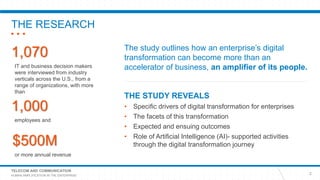
The study outlines how an enterprise’s digital
transformation can become more than an
accelerator of business, an amplifier of its people.
2
IT and business decision makers
were interviewed from industry
verticals across the U.S., from a
range of organizations, with more
than
1,070
employees and
1,000
or more annual revenue
$500M
TELECOM AND COMMUNICATION
HUMAN AMPLIFICATION IN THE ENTERPRISE
CURRENT STATE OF DIGITAL TRANSFORMATION
3
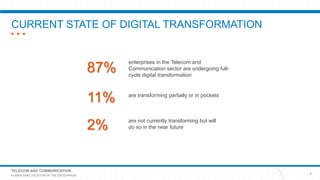
87%
enterprises in the Telecom and
Communication sector are undergoing full-
cycle digital transformation
11% are transforming partially or in pockets
2% are not currently transforming but will
do so in the near future
TELECOM AND COMMUNICATION
HUMAN AMPLIFICATION IN THE ENTERPRISE
KEY GOALS TO ACHIEVE WITH DIGITAL TRANSFORMATION
4
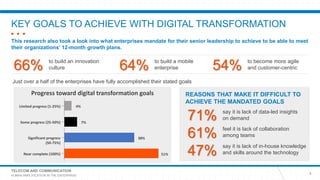
This research also took a look into what enterprises mandate for their senior leadership to achieve to be able to meet
their organizations’ 12-month growth plans.
REASONS THAT MAKE IT DIFFICULT TO
ACHIEVE THE MANDATED GOALS
say it is lack of data-led insights
on demand71%
feel it is lack of collaboration
among teams61%
say it is lack of in-house knowledge
and skills around the technology47%
Just over a half of the enterprises have fully accomplished their stated goals
to build an innovation
culture66% to build a mobile
enterprise64% to become more agile
and customer-centric54%
Progress toward digital transformation goals
Limited progress (1-25%)
Some progress (25-50%)
Significant progress
(50-75%)
Near complete (100%)
4%
7%
38%
51%
TELECOM AND COMMUNICATION
HUMAN AMPLIFICATION IN THE ENTERPRISE
ROLE OF AI
5
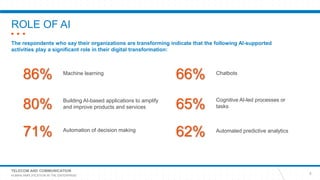
The respondents who say their organizations are transforming indicate that the following AI-supported
activities play a significant role in their digital transformation:
86% Machine learning
80% Building AI-based applications to amplify
and improve products and services
71% Automation of decision making
66% Chatbots
65% Cognitive AI-led processes or
tasks
62% Automated predictive analytics
TELECOM AND COMMUNICATION
HUMAN AMPLIFICATION IN THE ENTERPRISE
TRANSFORMATION PRIORITY 1 –AUTOMATION
6
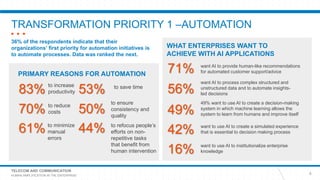
36% of the respondents indicate that their
organizations’ first priority for automation initiatives is
to automate processes. Data was ranked the next.
PRIMARY REASONS FOR AUTOMATION
to increase
productivity83%
to reduce
costs70%
to minimize
manual
errors
61%
WHAT ENTERPRISES WANT TO
ACHIEVE WITH AI APPLICATIONS
want AI to provide human-like recommendations
for automated customer support/advice71%
want AI to process complex structured and
unstructured data and to automate insights-
led decisions56%
49% want to use AI to create a decision-making
system in which machine learning allows the
system to learn from humans and improve itself49%
want to use AI to create a simulated experience
that is essential to decision making process42%
want to use AI to institutionalize enterprise
knowledge16%
to save time
53%
to ensure
consistency and
quality
50%
to refocus people’s
efforts on non-
repetitive tasks
that benefit from
human intervention
44%
TELECOM AND COMMUNICATION
HUMAN AMPLIFICATION IN THE ENTERPRISE
TRANSFORMATION PRIORITY 2 – INNOVATION
7
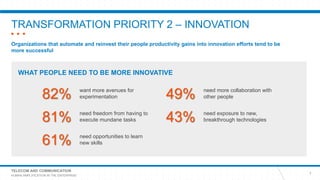
Organizations that automate and reinvest their people productivity gains into innovation efforts tend to be
more successful
WHAT PEOPLE NEED TO BE MORE INNOVATIVE
want more avenues for
experimentation82%
need freedom from having to
execute mundane tasks81%
need more collaboration with
other people49%
need exposure to new,
breakthrough technologies43%
need opportunities to learn
new skills61%
TELECOM AND COMMUNICATION
HUMAN AMPLIFICATION IN THE ENTERPRISE
TRANSFORMATION PRIORITY 3 – LEARNING
8
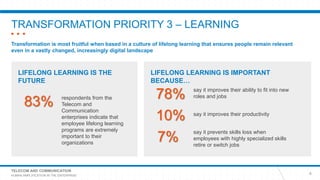
Transformation is most fruitful when based in a culture of lifelong learning that ensures people remain relevant
even in a vastly changed, increasingly digital landscape
LIFELONG LEARNING IS THE
FUTURE
respondents from the
Telecom and
Communication
enterprises indicate that
employee lifelong learning
programs are extremely
important to their
organizations
83%
LIFELONG LEARNING IS IMPORTANT
BECAUSE…
say it improves their ability to fit into new
roles and jobs78%
say it improves their productivity
10%
say it prevents skills loss when
employees with highly specialized skills
retire or switch jobs
7%
TELECOM AND COMMUNICATION
HUMAN AMPLIFICATION IN THE ENTERPRISE
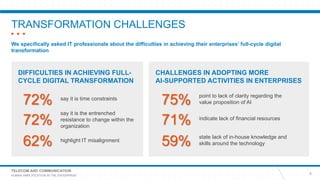
TRANSFORMATION CHALLENGES
9
We specifically asked IT professionals about the difficulties in achieving their enterprises’ full-cycle digital
transformation
DIFFICULTIES IN ACHIEVING FULL-
CYCLE DIGITAL TRANSFORMATION
say it is time constraints
72%
say it is the entrenched
resistance to change within the
organization
72%
highlight IT misalignment
62%
CHALLENGES IN ADOPTING MORE
AI-SUPPORTED ACTIVITIES IN ENTERPRISES
point to lack of clarity regarding the
value proposition of AI75%
indicate lack of financial resources
71%
state lack of in-house knowledge and
skills around the technology59%
Copyright © 2017 Infosys Limited
Infosys.com/human-amplification
to find out more about how you can accelerate your full-cycle digital
transformation with AI-driven applications.
Visit

Human Amplification In The Enterprise - Telecom and Communication

  • 1.
  • 2.
    TELECOM AND COMMUNICATION HUMANAMPLIFICATION IN THE ENTERPRISE THE RESEARCH THE STUDY REVEALS • Specific drivers of digital transformation for enterprises • The facets of this transformation • Expected and ensuing outcomes • Role of Artificial Intelligence (AI)- supported activities through the digital transformation journey The study outlines how an enterprise’s digital transformation can become more than an accelerator of business, an amplifier of its people. 2 IT and business decision makers were interviewed from industry verticals across the U.S., from a range of organizations, with more than 1,070 employees and 1,000 or more annual revenue $500M
  • 3.
    TELECOM AND COMMUNICATION HUMANAMPLIFICATION IN THE ENTERPRISE CURRENT STATE OF DIGITAL TRANSFORMATION 3 87% enterprises in the Telecom and Communication sector are undergoing full- cycle digital transformation 11% are transforming partially or in pockets 2% are not currently transforming but will do so in the near future
  • 4.
    TELECOM AND COMMUNICATION HUMANAMPLIFICATION IN THE ENTERPRISE KEY GOALS TO ACHIEVE WITH DIGITAL TRANSFORMATION 4 This research also took a look into what enterprises mandate for their senior leadership to achieve to be able to meet their organizations’ 12-month growth plans. REASONS THAT MAKE IT DIFFICULT TO ACHIEVE THE MANDATED GOALS say it is lack of data-led insights on demand71% feel it is lack of collaboration among teams61% say it is lack of in-house knowledge and skills around the technology47% Just over a half of the enterprises have fully accomplished their stated goals to build an innovation culture66% to build a mobile enterprise64% to become more agile and customer-centric54% Progress toward digital transformation goals Limited progress (1-25%) Some progress (25-50%) Significant progress (50-75%) Near complete (100%) 4% 7% 38% 51%
  • 5.
    TELECOM AND COMMUNICATION HUMANAMPLIFICATION IN THE ENTERPRISE ROLE OF AI 5 The respondents who say their organizations are transforming indicate that the following AI-supported activities play a significant role in their digital transformation: 86% Machine learning 80% Building AI-based applications to amplify and improve products and services 71% Automation of decision making 66% Chatbots 65% Cognitive AI-led processes or tasks 62% Automated predictive analytics
  • 6.
    TELECOM AND COMMUNICATION HUMANAMPLIFICATION IN THE ENTERPRISE TRANSFORMATION PRIORITY 1 –AUTOMATION 6 36% of the respondents indicate that their organizations’ first priority for automation initiatives is to automate processes. Data was ranked the next. PRIMARY REASONS FOR AUTOMATION to increase productivity83% to reduce costs70% to minimize manual errors 61% WHAT ENTERPRISES WANT TO ACHIEVE WITH AI APPLICATIONS want AI to provide human-like recommendations for automated customer support/advice71% want AI to process complex structured and unstructured data and to automate insights- led decisions56% 49% want to use AI to create a decision-making system in which machine learning allows the system to learn from humans and improve itself49% want to use AI to create a simulated experience that is essential to decision making process42% want to use AI to institutionalize enterprise knowledge16% to save time 53% to ensure consistency and quality 50% to refocus people’s efforts on non- repetitive tasks that benefit from human intervention 44%
  • 7.
    TELECOM AND COMMUNICATION HUMANAMPLIFICATION IN THE ENTERPRISE TRANSFORMATION PRIORITY 2 – INNOVATION 7 Organizations that automate and reinvest their people productivity gains into innovation efforts tend to be more successful WHAT PEOPLE NEED TO BE MORE INNOVATIVE want more avenues for experimentation82% need freedom from having to execute mundane tasks81% need more collaboration with other people49% need exposure to new, breakthrough technologies43% need opportunities to learn new skills61%
  • 8.
    TELECOM AND COMMUNICATION HUMANAMPLIFICATION IN THE ENTERPRISE TRANSFORMATION PRIORITY 3 – LEARNING 8 Transformation is most fruitful when based in a culture of lifelong learning that ensures people remain relevant even in a vastly changed, increasingly digital landscape LIFELONG LEARNING IS THE FUTURE respondents from the Telecom and Communication enterprises indicate that employee lifelong learning programs are extremely important to their organizations 83% LIFELONG LEARNING IS IMPORTANT BECAUSE… say it improves their ability to fit into new roles and jobs78% say it improves their productivity 10% say it prevents skills loss when employees with highly specialized skills retire or switch jobs 7%
  • 9.
    TELECOM AND COMMUNICATION HUMANAMPLIFICATION IN THE ENTERPRISE TRANSFORMATION CHALLENGES 9 We specifically asked IT professionals about the difficulties in achieving their enterprises’ full-cycle digital transformation DIFFICULTIES IN ACHIEVING FULL- CYCLE DIGITAL TRANSFORMATION say it is time constraints 72% say it is the entrenched resistance to change within the organization 72% highlight IT misalignment 62% CHALLENGES IN ADOPTING MORE AI-SUPPORTED ACTIVITIES IN ENTERPRISES point to lack of clarity regarding the value proposition of AI75% indicate lack of financial resources 71% state lack of in-house knowledge and skills around the technology59%
  • 10.
    Copyright © 2017Infosys Limited Infosys.com/human-amplification to find out more about how you can accelerate your full-cycle digital transformation with AI-driven applications. Visit