PROFESSIONAL COMPETENCY SELF-EVALUATIONS
Name _____________________________________________________ ID ________________________
Date: ______________________________ Course Name& Number (e.g. EDEC 253) _________________ PS/FE level (circleone) 1 2 3 4
KEEP THESEFORMS IN YOUR PROFESSIONAL PORTFOLIO. YOU WILL ADD TO THEMEACH YEAR.
1
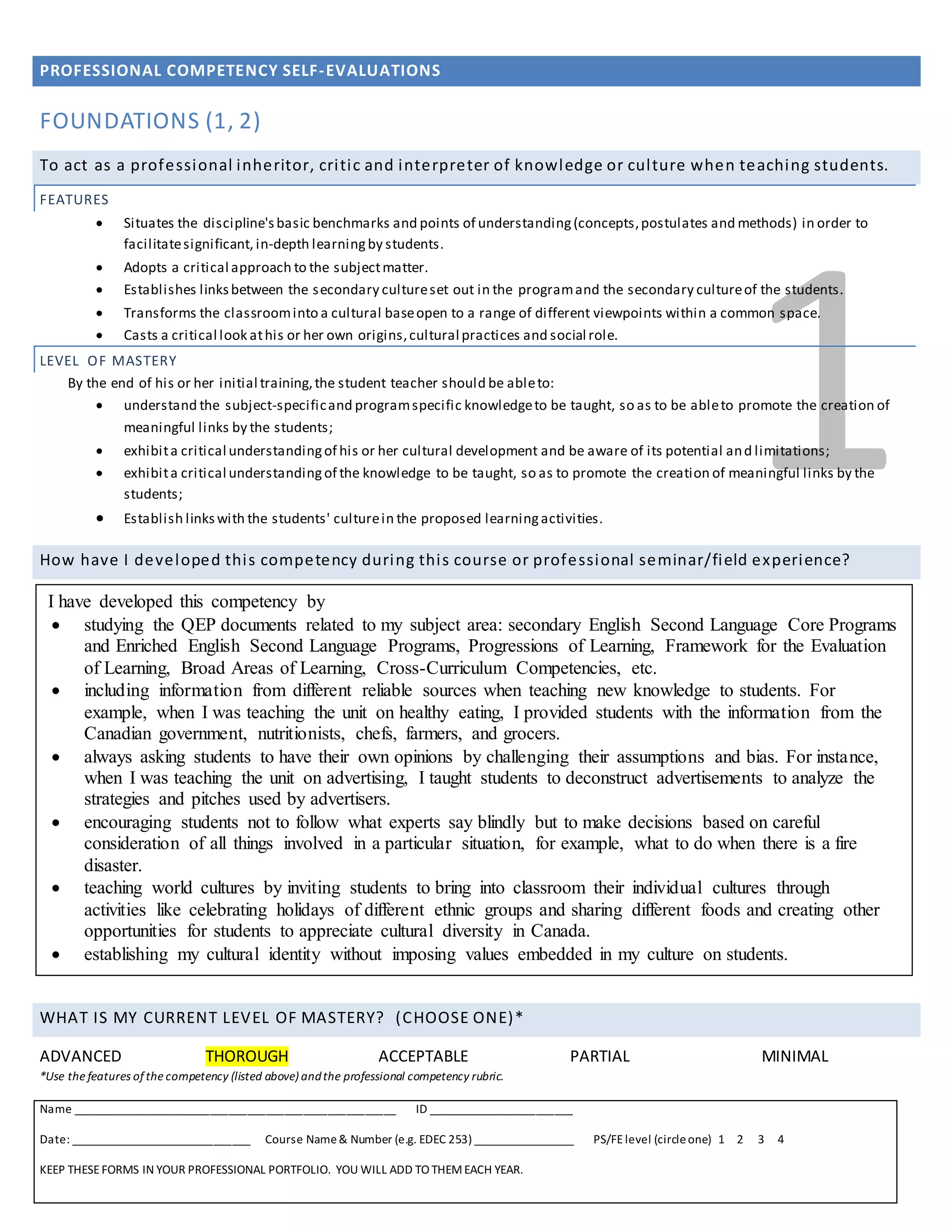
FOUNDATIONS (1, 2)
To act as a professional inheritor, critic and interpreter of knowledge or culture when teaching students.
FEATURES
 Situates the discipline'sbasic benchmarks and points of understanding(concepts,postulates and methods) in order to
facilitatesignificant, in-depth learningby students.
 Adopts a critical approach to the subjectmatter.
 Establishes linksbetween the secondary cultureset out in the programand the secondary cultureof the students.
 Transforms the classroominto a cultural baseopen to a range of different viewpoints within a common space.
 Casts a critical look athis or her own origins,cultural practices and social role.
LEVEL OF MASTERY
By the end of his or her initial training,the student teacher should be ableto:
 understand the subject-specificand programspecific knowledgeto be taught, so as to be ableto promote the creation of
meaningful links by the students;
 exhibita critical understandingof his or her cultural development and be aware of its potential and limitations;
 exhibita critical understandingof the knowledge to be taught, so as to promote the creation of meaningful links by the
students;
 Establish linkswith the students' culturein the proposed learningactivities.
How have I developed this competency during this course or professional seminar/field experience?
WHAT IS MY CURRENT LEVEL OF MASTERY? (CHOOSE ONE)*
ADVANCED THOROUGH ACCEPTABLE PARTIAL MINIMAL
*Use the features of the competency (listed above) andthe professional competency rubric.
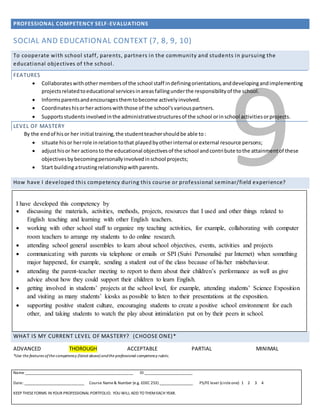
I have developed this competency by
 studying the QEP documents related to my subject area: secondary English Second Language Core Programs
and Enriched English Second Language Programs, Progressions of Learning, Framework for the Evaluation
of Learning, Broad Areas of Learning, Cross-Curriculum Competencies, etc.
 including information from different reliable sources when teaching new knowledge to students. For
example, when I was teaching the unit on healthy eating, I provided students with the information from the
Canadian government, nutritionists, chefs, farmers, and grocers.
 always asking students to have their own opinions by challenging their assumptions and bias. For instance,
when I was teaching the unit on advertising, I taught students to deconstruct advertisements to analyze the
strategies and pitches used by advertisers.
 encouraging students not to follow what experts say blindly but to make decisions based on careful
consideration of all things involved in a particular situation, for example, what to do when there is a fire
disaster.
 teaching world cultures by inviting students to bring into classroom their individual cultures through
activities like celebrating holidays of different ethnic groups and sharing different foods and creating other
opportunities for students to appreciate cultural diversity in Canada.
 establishing my cultural identity without imposing values embedded in my culture on students.
PROFESSIONAL COMPETENCY SELF-EVALUATIONS
Name _____________________________________________________ ID ________________________
Date: ______________________________ Course Name& Number (e.g. EDEC 253) _________________ PS/FE level (circleone) 1 2 3 4
KEEP THESEFORMS IN YOUR PROFESSIONAL PORTFOLIO. YOU WILL ADD TO THEMEACH YEAR.
2
FOUNDATIONS (1, 2)
To communicate clearly in the language of instruction, both orally and in writing, using correct grammar, in
various contexts related to teaching.
FEATURES
 Uses appropriate language whenspeakingto students,parentsandpeers.
 Observesrulesof grammarandstylisticswhenwritingtextsintendedforstudents,parentsorpeers.
 Is able totake upa position,supporthisorherideasandargue hisor hersubjectmatterina consistent,
effective,constructive andrespectful wayduringdiscussions.
 Communicatesideasconciselyusingprecisevocabularyandcorrectsyntax.
 Correctsthe mistakesstudentsmake whenspeakingandwriting.
 Constantlystrivestoimprove hisorherownoral and writtenlanguage skills.
LEVEL OF MASTERY
By the endof hisor her initial training,the studentteachershouldbe able to:
 masterthe rulesof oral and writtenexpressionsoasto be understoodbymostof the linguisticcommunity;
 Expresshimselforherself withthe ease,precision,efficiencyandaccuracyexpectedbysocietyof ateaching
professional.
How have I developed this competency during this course or professional seminar/field experience?
WHAT IS MY CURRENT LEVEL OF MASTERY? (CHOOSE ONE)*
ADVANCED THOROUGH ACCEPTABLE PARTIAL MINIMAL
*Use the features of the competency (listed above) andthe professional competency rubric.
I have developed this competency by
 making detailed lesson plans every day.
 thinking through and writing down oral instructions for each lesson when doing lesson planning.
 modifying my instructions after first time teaching to improve teaching for the next classes.
 modifying my instructions for students with special needs, for example, making instructions as concise as
possible, dividing long instructions into small parts.
 giving students’ corrective feedback on the mistakes they make in speaking and writing.
 looking up into dictionaries and using grammar books to develop accuracy of my instructions.
 visiting other teachers’ classes.
 taking notes of other teachers’ languages of organizing learning activities when doing observation.
 preparing my speeches before meeting parents.
 asking my colleagues to do proof reading of the emails that I write in French to parents.
 writing and editing my papers and assignments for McGill courses.
PROFESSIONAL COMPETENCY SELF-EVALUATIONS
Name _____________________________________________________ ID ________________________
Date: ______________________________ Course Name& Number (e.g. EDEC 253) _________________ PS/FE level (circleone) 1 2 3 4
KEEP THESEFORMS IN YOUR PROFESSIONAL PORTFOLIO. YOU WILL ADD TO THEMEACH YEAR.
3
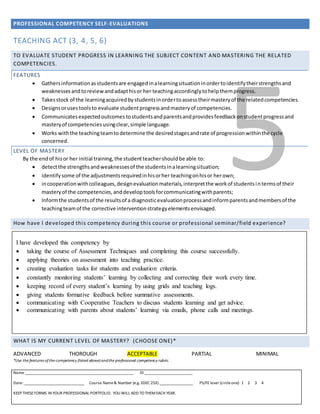
TEACHING ACT (3, 4, 5, 6)
To develop teaching/learning situations that are appropriate to the students concerned and the subject content
with a view to developing the competencies targeted in the programs of study.
FEATURES
 Basesthe selectionandcontentof teachingsequencesondatadrawnfromrecentdidactical andpedagogical
research.
 Selectsandinterpretssubject-specificknowledge intermsof the aims,competenciesandsubjectcontent
specifiedinthe programof study.
 Plansteachingandevaluationsequencestakingintoaccountthe logicof the contentto the taughtand the
developmentof learning.
 Takesintoaccount the prerequisites,conceptions,social differences(i.e.gender,ethnicorigin,socioeconomic
and cultural differences),needsandspecial interestsof the studentswhendevelopingteaching/learning
situations.
 Selectsdiverseinstructional approachesthatare suitedtothe developmentof the competenciestargetedinthe
programsof study.
 Anticipatesobstaclestolearningposedbythe contenttobe taught.
 Planslearningsituationsthatprovide opportunitiestoapplycompetenciesindifferentcontexts.
LEVEL OF MASTERY
By the endof hisor her initial training,the studentteachershouldbe able to:
 developappropriateandvariedteaching/learningsituationsinvolvingareasonable levelof complexitythat
enable studentstoprogressinthe developmentof theircompetencies;
 Buildthese activitiesintoalong-termplan.
How have I developed this competency during this course or professional seminar/field experience?
WHAT IS MY CURRENT LEVEL OF MASTERY? (CHOOSE ONE)*
ADVANCED THOROUGH ACCEPTABLE PARTIAL MINIMAL
*Use the features of the competency (listed above) andthe professional competency rubric.
I have developed this competency by
 constantly studying MELS documents: Quebec Education Program.
 focusing on studying the MELS documents in my subject area: Core English as a Second Language Program
and Enriched English as a Second Language Program as well as documents related to the English subject.
 using the above documents as guidelines when planning lessons.
 learning and practising how to create Learning and Evaluation Situations (LES) and Complex Task
 adopting Bloom’s Taxonomy
 focusing on developing students’ high levesl of understanding, skills and transferring of understanding
 always taking into consideration students’ interests, needs and abilities.

PROFESSIONAL COMPETENCY SELF-EVALUATIONS
Name _____________________________________________________ ID ________________________
Date: ______________________________ Course Name& Number (e.g. EDEC 253) _________________ PS/FE level (circleone) 1 2 3 4
KEEP THESEFORMS IN YOUR PROFESSIONAL PORTFOLIO. YOU WILL ADD TO THEMEACH YEAR.
4
TEACHING ACT (3, 4, 5, 6)
To pilot teaching/learning situations that are appropriate to the students concerned and to the subject
content with a view to developing the competencies targeted in the programs of study.
FEATURES
 Createsconditionsinwhichstudentscanengage inmeaningful problemsituations,tasksorprojects,basedon
theircognitive,emotional andsocial characteristics.
 Providesstudentswiththe resourcestheyneedtotake partin the learningsituations.
 Guidesstudentsinselecting,interpretingandunderstandingthe informationprovidedinthe variousresources
and inunderstandingthe elementsof aproblemsituation orthe requirementsof atask or project.
 Supportsstudentlearningbyaskingquestionsandprovidingfrequentandrelevantfeedbacktopromote the
integrationandtransferof learning.
 Encouragesteamwork.
LEVEL OF MASTERY
By the endof hisor her initial training,the studentteachershouldbe able to:
 guide students,throughappropriateinterventions,incarryingoutlearningtasks; leadthe studentstowork
togetherincooperation;
 Detectteaching/learningproblemsthatarise anduse the appropriate resourcestoremedythem.
How have I developed this competency during this course or professional seminar/field experience?
TEACHING ACT (3, 4, 5, 6)
WHAT IS MY CURRENT LEVEL OF MASTERY? (CHOOSE ONE)*
ADVANCED THOROUGH ACCEPTABLE PARTIAL MINIMAL
*Use the features of the competency (listed above) andthe professional competency rubric.
I have developed this competency by
 applying theories and techniques for teaching ESL that I have learnt from the Applied Teaching Methods
course to my teaching work, such as Nation’s principles of teaching ESL/EFL, and reflecting on their
effectiveness.
 always creating opportunities for students to interact with each other in the targeted language – English - in
meaningful ways through solving problems relevant to their lives such as how to deal with failure and how
to improve eating habits, telling personal stories, designing new sports to enrich school life, and so on.
 teaching students how to use dictionaries, concept map graphic organizers, online resources, etc.
 teaching students learning strategies such as adopting the writing process for written production, monitoring
their own learning by reflection and self-assessment, and planning for tasks and projects.
 scaffolding students’ learning process. For example, I learned to do the following things to guide students to
complete a project: presenting samples of the final product, dividing the learning process into several phases,
giving students specific work for each phase (for example, providing students with research questions at the
1st phase), offering feedback to each student along the way, providing tutorials for students who need extra
help, and setting up the environment to allow students’ final learning products to appear as realistic as
possible.
 adopting the cooperative learning structures to carry out learning activities.
PROFESSIONAL COMPETENCY SELF-EVALUATIONS
Name _____________________________________________________ ID ________________________
Date: ______________________________ Course Name& Number (e.g. EDEC 253) _________________ PS/FE level (circleone) 1 2 3 4
KEEP THESEFORMS IN YOUR PROFESSIONAL PORTFOLIO. YOU WILL ADD TO THEMEACH YEAR.
5
TEACHING ACT (3, 4, 5, 6)
TO EVALUATE STUDENT PROGRESS IN LEARNING THE SUBJECT CONTENT AND MASTERING THE RELATED
COMPETENCIES.
FEATURES
 Gathersinformationasstudentsare engagedinalearningsituationinordertoidentifytheirstrengthsand
weaknessesandtoreviewandadapthisor her teachingaccordinglytohelpthemprogress.
 Takesstock of the learningacquiredbystudentsinordertoassesstheirmasteryof the relatedcompetencies.
 Designsorusestoolsto evaluate studentprogressandmasteryof competencies.
 Communicatesexpectedoutcomestostudentsandparentsandprovidesfeedbackonstudentprogressand
masteryof competenciesusingclear,simple language.
 Works withthe teachingteamtodetermine the desiredstagesandrate of progressionwithinthe cycle
concerned.
LEVEL OF MASTERY
By the endof hisor her initial training,the studentteachershouldbe able to:
 detectthe strengthsandweaknessesof the studentsinalearningsituation;
 identifysome of the adjustmentsrequiredinhisorher teachingonhisor herown;
 incooperationwithcolleagues,designevaluationmaterials,interpretthe workof studentsintermsof their
masteryof the competencies,anddeveloptoolsforcommunicatingwithparents;
 Informthe studentsof the resultsof a diagnosticevaluationprocessandinformparentsandmembersof the
teachingteamof the corrective interventionstrategyelementsenvisaged.
How have I developed this competency during this course or professional seminar/field experience?
WHAT IS MY CURRENT LEVEL OF MASTERY? (CHOOSE ONE)*
ADVANCED THOROUGH ACCEPTABLE PARTIAL MINIMAL
*Use the features of the competency (listed above) andthe professional competency rubric.
I have developed this competency by
 taking the course of Assessment Techniques and completing this course successfully.
 applying theories on assessment into teaching practice.
 creating evaluation tasks for students and evaluation criteria.
 constantly monitoring students’ learning by collecting and correcting their work every time.
 keeping record of every student’s learning by using grids and teaching logs.
 giving students formative feedback before summative assessments.
 communicating with Cooperative Teachers to discuss students learning and get advice.
 communicating with parents about students’ learning via emails, phone calls and meetings.
Attach additionalsheets ifnecessary.
PROFESSIONAL COMPETENCY SELF-EVALUATIONS
Name _____________________________________________________ ID ________________________
Date: ______________________________ Course Name& Number (e.g. EDEC 253) _________________ PS/FE level (circleone) 1 2 3 4
KEEP THESEFORMS IN YOUR PROFESSIONAL PORTFOLIO. YOU WILL ADD TO THEMEACH YEAR.
6
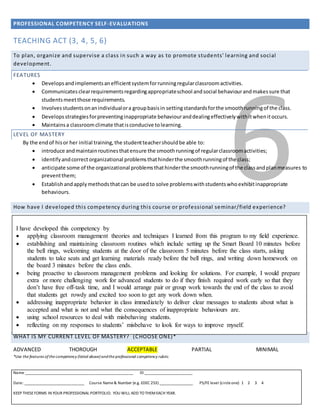
TEACHING ACT (3, 4, 5, 6)
To plan, organize and supervise a class in such a way as to promote students' learning and social
development.
FEATURES
 Developsandimplementsanefficientsystemforrunningregularclassroomactivities.
 Communicatesclearrequirementsregardingappropriateschool andsocial behaviourandmakessure that
studentsmeetthose requirements.
 Involvesstudentsonanindividualora groupbasisin settingstandardsforthe smoothrunningof the class.
 Developsstrategiesforpreventinginappropriate behaviouranddealingeffectivelywithitwhenitoccurs.
 Maintainsa classroomclimate thatisconducive tolearning.
LEVEL OF MASTERY
By the endof hisor her initial training,the studentteachershouldbe able to:
 introduce andmaintainroutinesthatensure the smoothrunningof regularclassroomactivities;
 identifyandcorrectorganizational problemsthathinderthe smoothrunningof the class;
 anticipate some of the organizational problemsthathinderthe smoothrunningof the classandplanmeasures to
preventthem;
 Establishandapplymethodsthatcan be usedto solve problemswithstudentswhoexhibitinappropriate
behaviours.
How have I developed this competency during this course or professional seminar/field experience?
WHAT IS MY CURRENT LEVEL OF MASTERY? (CHOOSE ONE)*
ADVANCED THOROUGH ACCEPTABLE PARTIAL MINIMAL
*Use the features of the competency (listed above) andthe professional competency rubric.
I have developed this competency by
 applying classroom management theories and techniques I learned from this program to my field experience.
 establishing and maintaining classroom routines which include setting up the Smart Board 10 minutes before
the bell rings, welcoming students at the door of the classroom 5 minutes before the class starts, asking
students to take seats and get learning materials ready before the bell rings, and writing down homework on
the board 3 minutes before the class ends.
 being proactive to classroom management problems and looking for solutions. For example, I would prepare
extra or more challenging work for advanced students to do if they finish required work early so that they
don’t have free off-task time, and I would arrange pair or group work towards the end of the class to avoid
that students get rowdy and excited too soon to get any work down when.
 addressing inappropriate behavior in class immediately to deliver clear messages to students about what is
accepted and what is not and what the consequences of inappropriate behaviours are.
 using school resources to deal with misbehaving students.
 reflecting on my responses to students’ misbehave to look for ways to improve myself.
PROFESSIONAL COMPETENCY SELF-EVALUATIONS
Name _____________________________________________________ ID ________________________
Date: ______________________________ Course Name& Number (e.g. EDEC 253) _________________ PS/FE level (circleone) 1 2 3 4
KEEP THESEFORMS IN YOUR PROFESSIONAL PORTFOLIO. YOU WILL ADD TO THEMEACH YEAR.
7
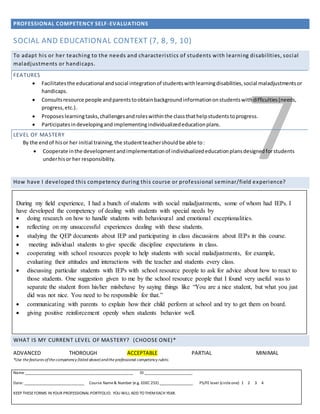
SOCIAL AND EDUCATIONAL CONTEXT (7, 8, 9, 10)
To adapt his or her teaching to the needs and characteristics of students with learning disabilities, social
maladjustments or handicaps.
FEATURES
 Facilitatesthe educational andsocial integrationof studentswithlearningdisabilities,social maladjustmentsor
handicaps.
 Consultsresource people andparentstoobtainbackgroundinformationonstudentswithdifficulties(needs,
progress,etc.).
 Proposeslearningtasks,challengesandroleswithinthe classthathelpstudentstoprogress.
 Participatesindevelopingandimplementingindividualizededucationplans.
LEVEL OF MASTERY
By the endof hisor her initial training,the studentteachershouldbe able to:
 Cooperate inthe developmentandimplementationof individualizededucationplansdesignedforstudents
underhisor her responsibility.
How have I developed this competency during this course or professional seminar/field experience?
WHAT IS MY CURRENT LEVEL OF MASTERY? (CHOOSE ONE)*
ADVANCED THOROUGH ACCEPTABLE PARTIAL MINIMAL
*Use the features of the competency (listed above) andthe professional competency rubric.
During my field experience, I had a bunch of students with social maladjustments, some of whom had IEPs. I
have developed the competency of dealing with students with special needs by
 doing research on how to handle students with behavioural and emotional exceptionalities.
 reflecting on my unsuccessful experiences dealing with these students.
 studying the QEP documents about IEP and participating in class discussions about IEPs in this course.
 meeting individual students to give specific discipline expectations in class.
 cooperating with school resources people to help students with social maladjustments, for example,
evaluating their attitudes and interactions with the teacher and students every class.
 discussing particular students with IEPs with school resource people to ask for advice about how to react to
those students. One suggestion given to me by the school resource people that I found very useful was to
separate the student from his/her misbehave by saying things like “You are a nice student, but what you just
did was not nice. You need to be responsible for that.”
 communicating with parents to explain how their child perform at school and try to get them on board.
 giving positive reinforcement openly when students behavior well.
PROFESSIONAL COMPETENCY SELF-EVALUATIONS
Name _____________________________________________________ ID ________________________
Date: ______________________________ Course Name& Number (e.g. EDEC 253) _________________ PS/FE level (circleone) 1 2 3 4
KEEP THESEFORMS IN YOUR PROFESSIONAL PORTFOLIO. YOU WILL ADD TO THEMEACH YEAR.
8
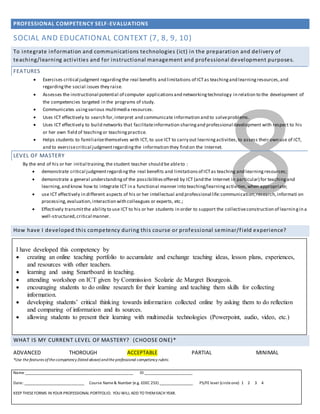
SOCIAL AND EDUCATIONAL CONTEXT (7, 8, 9, 10)
To integrate information and communications technologies (ict) in the preparation and delivery of
teaching/learning activities and for instructional management and professional development purposes.
FEATURES
 Exercises critical judgment regardingthe real benefits and limitations of ICTas teachingand learningresources,and
regardingthe social issues they raise.
 Assesses the instructional potential of computer applicationsand networkingtechnology in relation to the development of
the competencies targeted in the programs of study.
 Communicates usingvarious multimedia resources.
 Uses ICT effectively to search for,interpret and communicate information and to solveproblems.
 Uses ICT effectively to build networks that facilitateinformation sharingand professional development with respect to his
or her own field of teachingor teachingpractice.
 Helps students to familiarizethemselves with ICT, to use ICT to carry out learningactivities,to assess their own use of ICT,
and to exercisecritical judgmentregardingthe information they find on the Internet.
LEVEL OF MASTERY
By the end of his or her initial training,the student teacher should be ableto :
 demonstrate critical judgmentregardingthe real benefits and limitationsof ICTas teaching and learningresources;
 demonstrate a general understandingof the possibilitiesoffered by ICT (and the Internet in particular) for teachingand
learning,and know how to integrate ICT in a functional manner into teaching/learningactivities,when appropriate;
 use ICT effectively in different aspects of his or her intellectual and professional life:communication,research,informati on
processing,evaluation,interaction with colleagues or experts, etc.;
 Effectively transmitthe ability to use ICT to his or her students in order to support the collectiveconstruction of learningin a
well-structured,critical manner.
How have I developed this competency during this course or professional seminar/field experience?
WHAT IS MY CURRENT LEVEL OF MASTERY? (CHOOSE ONE)*
ADVANCED THOROUGH ACCEPTABLE PARTIAL MINIMAL
*Use the features of the competency (listed above) andthe professional competency rubric.
I have developed this competency by
 creating an online teaching portfolio to accumulate and exchange teaching ideas, lesson plans, experiences,
and resources with other teachers.
 learning and using Smartboard in teaching.
 attending workshop on ICT given by Commission Scolarie de Margret Bourgeois.
 encouraging students to do online research for their learning and teaching them skills for collecting
information.
 developing students’ critical thinking towards information collected online by asking them to do reflection
and comparing of information and its sources.
 allowing students to present their learning with multimedia technologies (Powerpoint, audio, video, etc.)
Attach additionalsheets ifnecessary.
PROFESSIONAL COMPETENCY SELF-EVALUATIONS
Name _____________________________________________________ ID ________________________
Date: ______________________________ Course Name& Number (e.g. EDEC 253) _________________ PS/FE level (circleone) 1 2 3 4
KEEP THESEFORMS IN YOUR PROFESSIONAL PORTFOLIO. YOU WILL ADD TO THEMEACH YEAR.
9
SOCIAL AND EDUCATIONAL CONTEXT (7, 8, 9, 10)
To cooperate with school staff, parents, partners in the community and students in pursuing the
educational objectives of the school.
FEATURES
 Collaborateswithothermembersof the school staff indefiningorientations,anddevelopingandimplementing
projectsrelatedtoeducational servicesinareasfallingunderthe responsibilityof the school.
 Informsparentsandencouragesthemtobecome activelyinvolved.
 Coordinateshisorheractionswiththose of the school'svariouspartners.
 Supportsstudentsinvolvedinthe administrativestructuresof the school orinschool activitiesorprojects.
LEVEL OF MASTERY
By the endof hisor her initial training,the studentteachershouldbe able to:
 situate hisor herrole inrelationtothat playedbyotherinternal orexternal resource persons;
 adjusthisor her actionsto the educational objectivesof the school andcontribute tothe attainmentof these
objectivesbybecomingpersonallyinvolvedinschool projects;
 Start buildingatrustingrelationshipwithparents.
How have I developed this competency during this course or professional seminar/field experience?
WHAT IS MY CURRENT LEVEL OF MASTERY? (CHOOSE ONE)*
ADVANCED THOROUGH ACCEPTABLE PARTIAL MINIMAL
*Use the features of the competency (listed above) andthe professional competency rubric.
I have developed this competency by
 discussing the materials, activities, methods, projects, resources that I used and other things related to
English teaching and learning with other English teachers.
 working with other school staff to organize my teaching activities, for example, collaborating with computer
room teachers to arrange my students to do online research.
 attending school general assembles to learn about school objectives, events, activities and projects
 communicating with parents via telephone or emails or SPI (Suivi Personalisé par Internet) when something
major happened, for example, sending a student out of the class because of his/her misbehaviour.
 attending the parent-teacher meeting to report to them about their children’s performance as well as give
advice about how they could support their children to learn English.
 getting involved in students’ projects at the school level, for example, attending students’ Science Exposition
and visiting as many students’ kiosks as possible to listen to their presentations at the exposition.
 supporting positive student culture, encouraging students to create a positive school environment for each
other, and taking students to watch the play about intimidation put on by their peers in school.
PROFESSIONAL COMPETENCY SELF-EVALUATIONS
Name _____________________________________________________ ID ________________________
Date: ______________________________ Course Name& Number (e.g. EDEC 253) _________________ PS/FE level (circleone) 1 2 3 4
KEEP THESEFORMS IN YOUR PROFESSIONAL PORTFOLIO. YOU WILL ADD TO THEMEACH YEAR.
10
SOCIAL AND EDUCATIONAL CONTEXT (7, 8, 9, 10)
To cooperate with members of the teaching team in carrying out tasks involving the development and
evaluation of the competencies targeted in the programs of study, taking into account the students
concerned.
FEATURES
 Recognizesinstanceswhere cooperationwithothermembersof the teachingteamisrequiredinordertodesign
or adapt teaching/learningsituations,toevaluatestudentlearningorto promote the masteryof competencies
by the endof the cycle.
 Developsandorganizesaprojectappropriate tothe objectivestobe attainedbythe teachingteam.
 Cooperatesinanactive,ongoingmannerwiththe teachingteamsworkingwiththe same students.
 Helpsbuildconsensus,whenrequired,amongmembersof the teachingteam.
LEVEL OF MASTERY
By the end of hisor her initial training,the studentteachershouldbe able to:
 contribute tothe work of the teachingteaminan effective manner;
 Provide constructive criticismandmake innovativesuggestionswithrespecttothe team'swork.
How have I developed this competency during this course or professional seminar/field experience?
WHAT IS MY CURRENT LEVEL OF MASTERY? (CHOOSE ONE)*
ADVANCED THOROUGH ACCEPTABLE PARTIAL MINIMAL
*Use the features of the competency (listed above) andthe professional competency rubric.
I have developed this competency by
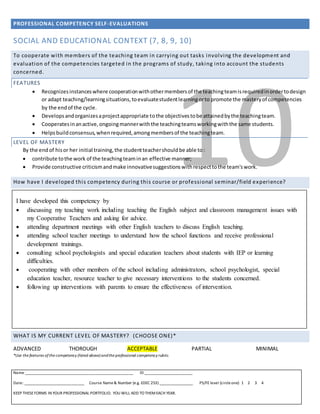
 discussing my teaching work including teaching the English subject and classroom management issues with
my Cooperative Teachers and asking for advice.
 attending department meetings with other English teachers to discuss English teaching.
 attending school teacher meetings to understand how the school functions and receive professional
development trainings.
 consulting school psychologists and special education teachers about students with IEP or learning
difficulties.
 cooperating with other members of the school including administrators, school psychologist, special
education teacher, resource teacher to give necessary interventions to the students concerned.
 following up interventions with parents to ensure the effectiveness of intervention.
PROFESSIONAL COMPETENCY SELF-EVALUATIONS
Name _____________________________________________________ ID ________________________
Date: ______________________________ Course Name& Number (e.g. EDEC 253) _________________ PS/FE level (circleone) 1 2 3 4
KEEP THESEFORMS IN YOUR PROFESSIONAL PORTFOLIO. YOU WILL ADD TO THEMEACH YEAR.
11
PROFESSIONAL IDENTITY (11, 12)
To engage in professional development individually and with others.
FEATURES
 Takesstock of hisor hercompetenciesandtakesstepstodevelopthemusingavailable resources.
 Discussesthe relevanceof hisorher pedagogical choiceswithhisorhercolleagues.
 Reflectsonhisor herpractice (reflective analysis)andmakesthe appropriate adjustments.
 Spearheadsprojectstosolve teachingproblems.
 Involvespeersinresearchrelatedtothe masteryof the competenciestargetedinthe programsof studyandto
the educational objectivesof the school.
LEVEL OF MASTERY
By the end of hisor her initial training,the studentteachershouldbe able to:
 identify,understandanduse availableresources(researchreportsandprofessional literature,pedagogical
networks,professional associations,databanks) relatedtoteaching;
 identifyhisorherstrengthsandlimitations,alongwithhisorherpersonal objectivesandthe meansof achieving
them;
 engage inrigorousreflexiveanalysisonspecificaspectsof hisorher teaching;
 Undertake researchprojectsrelatedtospecificaspectsof hisorher teaching.
How have I developed this competency during this course or professional seminar/field experience?
WHAT IS MY CURRENT LEVEL OF MASTERY? (CHOOSE ONE)*
ADVANCED THOROUGH ACCEPTABLE PARTIAL MINIMAL
*Use the features of the competency (listed above) andthe professional competency rubric.
I have developed this competency by
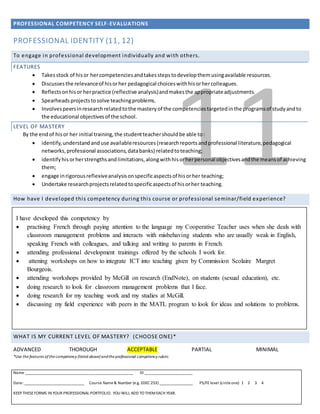
 practising French through paying attention to the language my Cooperative Teacher uses when she deals with
classroom management problems and interacts with misbehaving students who are usually weak in English,
speaking French with colleagues, and talking and writing to parents in French.
 attending professional development trainings offered by the schools I work for.
 attening workshops on how to integrate ICT into teaching given by Commission Scolaire Margret
Bourgeois.
 attending workshops provided by McGill on research (EndNote), on students (sexual education), etc.
 doing research to look for classroom management problems that I face.
 doing research for my teaching work and my studies at McGill.
 discussing my field experience with peers in the MATL program to look for ideas and solutions to problems.
PROFESSIONAL COMPETENCY SELF-EVALUATIONS
Name _____________________________________________________ ID ________________________
Date: ______________________________ Course Name& Number (e.g. EDEC 253) _________________ PS/FE level (circleone) 1 2 3 4
KEEP THESEFORMS IN YOUR PROFESSIONAL PORTFOLIO. YOU WILL ADD TO THEMEACH YEAR.
12
PROFESSIONAL IDENTITY (11, 12)
To demonstrate ethical and responsible professional behaviour in the performance of his or her duties.
FEATURES
 Understandsthe valuesunderlyinghisorherteaching.
 Manages hisor herclass ina democraticway.
 Providesstudentswithappropriateattentionandsupport.
 Justifieshisorherdecisionsconcerning the learningandeducationof studentstothe partiesconcerned.
 Respectsthe confidential nature of certainaspectsof hisorherwork.
 Avoidsanyformof discriminationtowardstudents,parentsorcolleagues.
 Situatesthe moral conflictsarisinginclasswithreference tothe majorschoolsof thought.
 Demonstratessoundjudgmentinusingthe legal andregulatoryframeworkgoverningthe teachingprofession.
LEVEL OF MASTERY
By the endof hisor her initial training,the studentteachershouldbe able to:
 demonstrate sufficientresponsibilityindealingswithstudentsthatone canrecommendwithnoreservations
that a class be entrustedtohisor hercare;
 Answertoothers for hisor heractionsby providingwell-foundedreasons.
How have I developed this competency during this course or professional seminar/field experience?
WHAT IS MY CURRENT LEVEL OF MASTERY? (CHOOSE ONE)*
ADVANCED THOROUGH ACCEPTABLE PARTIAL MINIMAL
*Use the features of the competency (listed above) andthe professional competency rubric.
I have developed this competency by
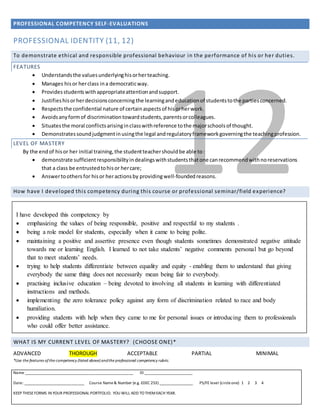
 emphasizing the values of being responsible, positive and respectful to my students .
 being a role model for students, especially when it came to being polite.
 maintaining a positive and assertive presence even though students sometimes demonstrated negative attitude
towards me or learning English. I learned to not take students’ negative comments personal but go beyond
that to meet students’ needs.
 trying to help students differentiate between equality and equity - enabling them to understand that giving
everybody the same thing does not necessarily mean being fair to everybody.
 practising inclusive education – being devoted to involving all students in learning with differentiated
instructions and methods.
 implementing the zero tolerance policy against any form of discrimination related to race and body
humiliation.
 providing students with help when they came to me for personal issues or introducing them to professionals
who could offer better assistance.

Hui ling 201512-professional competency-self_evaluation

  • 1.
    PROFESSIONAL COMPETENCY SELF-EVALUATIONS Name_____________________________________________________ ID ________________________ Date: ______________________________ Course Name& Number (e.g. EDEC 253) _________________ PS/FE level (circleone) 1 2 3 4 KEEP THESEFORMS IN YOUR PROFESSIONAL PORTFOLIO. YOU WILL ADD TO THEMEACH YEAR. 1 FOUNDATIONS (1, 2) To act as a professional inheritor, critic and interpreter of knowledge or culture when teaching students. FEATURES  Situates the discipline'sbasic benchmarks and points of understanding(concepts,postulates and methods) in order to facilitatesignificant, in-depth learningby students.  Adopts a critical approach to the subjectmatter.  Establishes linksbetween the secondary cultureset out in the programand the secondary cultureof the students.  Transforms the classroominto a cultural baseopen to a range of different viewpoints within a common space.  Casts a critical look athis or her own origins,cultural practices and social role. LEVEL OF MASTERY By the end of his or her initial training,the student teacher should be ableto:  understand the subject-specificand programspecific knowledgeto be taught, so as to be ableto promote the creation of meaningful links by the students;  exhibita critical understandingof his or her cultural development and be aware of its potential and limitations;  exhibita critical understandingof the knowledge to be taught, so as to promote the creation of meaningful links by the students;  Establish linkswith the students' culturein the proposed learningactivities. How have I developed this competency during this course or professional seminar/field experience? WHAT IS MY CURRENT LEVEL OF MASTERY? (CHOOSE ONE)* ADVANCED THOROUGH ACCEPTABLE PARTIAL MINIMAL *Use the features of the competency (listed above) andthe professional competency rubric. I have developed this competency by  studying the QEP documents related to my subject area: secondary English Second Language Core Programs and Enriched English Second Language Programs, Progressions of Learning, Framework for the Evaluation of Learning, Broad Areas of Learning, Cross-Curriculum Competencies, etc.  including information from different reliable sources when teaching new knowledge to students. For example, when I was teaching the unit on healthy eating, I provided students with the information from the Canadian government, nutritionists, chefs, farmers, and grocers.  always asking students to have their own opinions by challenging their assumptions and bias. For instance, when I was teaching the unit on advertising, I taught students to deconstruct advertisements to analyze the strategies and pitches used by advertisers.  encouraging students not to follow what experts say blindly but to make decisions based on careful consideration of all things involved in a particular situation, for example, what to do when there is a fire disaster.  teaching world cultures by inviting students to bring into classroom their individual cultures through activities like celebrating holidays of different ethnic groups and sharing different foods and creating other opportunities for students to appreciate cultural diversity in Canada.  establishing my cultural identity without imposing values embedded in my culture on students.
  • 2.
    PROFESSIONAL COMPETENCY SELF-EVALUATIONS Name_____________________________________________________ ID ________________________ Date: ______________________________ Course Name& Number (e.g. EDEC 253) _________________ PS/FE level (circleone) 1 2 3 4 KEEP THESEFORMS IN YOUR PROFESSIONAL PORTFOLIO. YOU WILL ADD TO THEMEACH YEAR. 2 FOUNDATIONS (1, 2) To communicate clearly in the language of instruction, both orally and in writing, using correct grammar, in various contexts related to teaching. FEATURES  Uses appropriate language whenspeakingto students,parentsandpeers.  Observesrulesof grammarandstylisticswhenwritingtextsintendedforstudents,parentsorpeers.  Is able totake upa position,supporthisorherideasandargue hisor hersubjectmatterina consistent, effective,constructive andrespectful wayduringdiscussions.  Communicatesideasconciselyusingprecisevocabularyandcorrectsyntax.  Correctsthe mistakesstudentsmake whenspeakingandwriting.  Constantlystrivestoimprove hisorherownoral and writtenlanguage skills. LEVEL OF MASTERY By the endof hisor her initial training,the studentteachershouldbe able to:  masterthe rulesof oral and writtenexpressionsoasto be understoodbymostof the linguisticcommunity;  Expresshimselforherself withthe ease,precision,efficiencyandaccuracyexpectedbysocietyof ateaching professional. How have I developed this competency during this course or professional seminar/field experience? WHAT IS MY CURRENT LEVEL OF MASTERY? (CHOOSE ONE)* ADVANCED THOROUGH ACCEPTABLE PARTIAL MINIMAL *Use the features of the competency (listed above) andthe professional competency rubric. I have developed this competency by  making detailed lesson plans every day.  thinking through and writing down oral instructions for each lesson when doing lesson planning.  modifying my instructions after first time teaching to improve teaching for the next classes.  modifying my instructions for students with special needs, for example, making instructions as concise as possible, dividing long instructions into small parts.  giving students’ corrective feedback on the mistakes they make in speaking and writing.  looking up into dictionaries and using grammar books to develop accuracy of my instructions.  visiting other teachers’ classes.  taking notes of other teachers’ languages of organizing learning activities when doing observation.  preparing my speeches before meeting parents.  asking my colleagues to do proof reading of the emails that I write in French to parents.  writing and editing my papers and assignments for McGill courses.
  • 3.
    PROFESSIONAL COMPETENCY SELF-EVALUATIONS Name_____________________________________________________ ID ________________________ Date: ______________________________ Course Name& Number (e.g. EDEC 253) _________________ PS/FE level (circleone) 1 2 3 4 KEEP THESEFORMS IN YOUR PROFESSIONAL PORTFOLIO. YOU WILL ADD TO THEMEACH YEAR. 3 TEACHING ACT (3, 4, 5, 6) To develop teaching/learning situations that are appropriate to the students concerned and the subject content with a view to developing the competencies targeted in the programs of study. FEATURES  Basesthe selectionandcontentof teachingsequencesondatadrawnfromrecentdidactical andpedagogical research.  Selectsandinterpretssubject-specificknowledge intermsof the aims,competenciesandsubjectcontent specifiedinthe programof study.  Plansteachingandevaluationsequencestakingintoaccountthe logicof the contentto the taughtand the developmentof learning.  Takesintoaccount the prerequisites,conceptions,social differences(i.e.gender,ethnicorigin,socioeconomic and cultural differences),needsandspecial interestsof the studentswhendevelopingteaching/learning situations.  Selectsdiverseinstructional approachesthatare suitedtothe developmentof the competenciestargetedinthe programsof study.  Anticipatesobstaclestolearningposedbythe contenttobe taught.  Planslearningsituationsthatprovide opportunitiestoapplycompetenciesindifferentcontexts. LEVEL OF MASTERY By the endof hisor her initial training,the studentteachershouldbe able to:  developappropriateandvariedteaching/learningsituationsinvolvingareasonable levelof complexitythat enable studentstoprogressinthe developmentof theircompetencies;  Buildthese activitiesintoalong-termplan. How have I developed this competency during this course or professional seminar/field experience? WHAT IS MY CURRENT LEVEL OF MASTERY? (CHOOSE ONE)* ADVANCED THOROUGH ACCEPTABLE PARTIAL MINIMAL *Use the features of the competency (listed above) andthe professional competency rubric. I have developed this competency by  constantly studying MELS documents: Quebec Education Program.  focusing on studying the MELS documents in my subject area: Core English as a Second Language Program and Enriched English as a Second Language Program as well as documents related to the English subject.  using the above documents as guidelines when planning lessons.  learning and practising how to create Learning and Evaluation Situations (LES) and Complex Task  adopting Bloom’s Taxonomy  focusing on developing students’ high levesl of understanding, skills and transferring of understanding  always taking into consideration students’ interests, needs and abilities. 
  • 4.
    PROFESSIONAL COMPETENCY SELF-EVALUATIONS Name_____________________________________________________ ID ________________________ Date: ______________________________ Course Name& Number (e.g. EDEC 253) _________________ PS/FE level (circleone) 1 2 3 4 KEEP THESEFORMS IN YOUR PROFESSIONAL PORTFOLIO. YOU WILL ADD TO THEMEACH YEAR. 4 TEACHING ACT (3, 4, 5, 6) To pilot teaching/learning situations that are appropriate to the students concerned and to the subject content with a view to developing the competencies targeted in the programs of study. FEATURES  Createsconditionsinwhichstudentscanengage inmeaningful problemsituations,tasksorprojects,basedon theircognitive,emotional andsocial characteristics.  Providesstudentswiththe resourcestheyneedtotake partin the learningsituations.  Guidesstudentsinselecting,interpretingandunderstandingthe informationprovidedinthe variousresources and inunderstandingthe elementsof aproblemsituation orthe requirementsof atask or project.  Supportsstudentlearningbyaskingquestionsandprovidingfrequentandrelevantfeedbacktopromote the integrationandtransferof learning.  Encouragesteamwork. LEVEL OF MASTERY By the endof hisor her initial training,the studentteachershouldbe able to:  guide students,throughappropriateinterventions,incarryingoutlearningtasks; leadthe studentstowork togetherincooperation;  Detectteaching/learningproblemsthatarise anduse the appropriate resourcestoremedythem. How have I developed this competency during this course or professional seminar/field experience? TEACHING ACT (3, 4, 5, 6) WHAT IS MY CURRENT LEVEL OF MASTERY? (CHOOSE ONE)* ADVANCED THOROUGH ACCEPTABLE PARTIAL MINIMAL *Use the features of the competency (listed above) andthe professional competency rubric. I have developed this competency by  applying theories and techniques for teaching ESL that I have learnt from the Applied Teaching Methods course to my teaching work, such as Nation’s principles of teaching ESL/EFL, and reflecting on their effectiveness.  always creating opportunities for students to interact with each other in the targeted language – English - in meaningful ways through solving problems relevant to their lives such as how to deal with failure and how to improve eating habits, telling personal stories, designing new sports to enrich school life, and so on.  teaching students how to use dictionaries, concept map graphic organizers, online resources, etc.  teaching students learning strategies such as adopting the writing process for written production, monitoring their own learning by reflection and self-assessment, and planning for tasks and projects.  scaffolding students’ learning process. For example, I learned to do the following things to guide students to complete a project: presenting samples of the final product, dividing the learning process into several phases, giving students specific work for each phase (for example, providing students with research questions at the 1st phase), offering feedback to each student along the way, providing tutorials for students who need extra help, and setting up the environment to allow students’ final learning products to appear as realistic as possible.  adopting the cooperative learning structures to carry out learning activities.
  • 5.
    PROFESSIONAL COMPETENCY SELF-EVALUATIONS Name_____________________________________________________ ID ________________________ Date: ______________________________ Course Name& Number (e.g. EDEC 253) _________________ PS/FE level (circleone) 1 2 3 4 KEEP THESEFORMS IN YOUR PROFESSIONAL PORTFOLIO. YOU WILL ADD TO THEMEACH YEAR. 5 TEACHING ACT (3, 4, 5, 6) TO EVALUATE STUDENT PROGRESS IN LEARNING THE SUBJECT CONTENT AND MASTERING THE RELATED COMPETENCIES. FEATURES  Gathersinformationasstudentsare engagedinalearningsituationinordertoidentifytheirstrengthsand weaknessesandtoreviewandadapthisor her teachingaccordinglytohelpthemprogress.  Takesstock of the learningacquiredbystudentsinordertoassesstheirmasteryof the relatedcompetencies.  Designsorusestoolsto evaluate studentprogressandmasteryof competencies.  Communicatesexpectedoutcomestostudentsandparentsandprovidesfeedbackonstudentprogressand masteryof competenciesusingclear,simple language.  Works withthe teachingteamtodetermine the desiredstagesandrate of progressionwithinthe cycle concerned. LEVEL OF MASTERY By the endof hisor her initial training,the studentteachershouldbe able to:  detectthe strengthsandweaknessesof the studentsinalearningsituation;  identifysome of the adjustmentsrequiredinhisorher teachingonhisor herown;  incooperationwithcolleagues,designevaluationmaterials,interpretthe workof studentsintermsof their masteryof the competencies,anddeveloptoolsforcommunicatingwithparents;  Informthe studentsof the resultsof a diagnosticevaluationprocessandinformparentsandmembersof the teachingteamof the corrective interventionstrategyelementsenvisaged. How have I developed this competency during this course or professional seminar/field experience? WHAT IS MY CURRENT LEVEL OF MASTERY? (CHOOSE ONE)* ADVANCED THOROUGH ACCEPTABLE PARTIAL MINIMAL *Use the features of the competency (listed above) andthe professional competency rubric. I have developed this competency by  taking the course of Assessment Techniques and completing this course successfully.  applying theories on assessment into teaching practice.  creating evaluation tasks for students and evaluation criteria.  constantly monitoring students’ learning by collecting and correcting their work every time.  keeping record of every student’s learning by using grids and teaching logs.  giving students formative feedback before summative assessments.  communicating with Cooperative Teachers to discuss students learning and get advice.  communicating with parents about students’ learning via emails, phone calls and meetings. Attach additionalsheets ifnecessary.
  • 6.
    PROFESSIONAL COMPETENCY SELF-EVALUATIONS Name_____________________________________________________ ID ________________________ Date: ______________________________ Course Name& Number (e.g. EDEC 253) _________________ PS/FE level (circleone) 1 2 3 4 KEEP THESEFORMS IN YOUR PROFESSIONAL PORTFOLIO. YOU WILL ADD TO THEMEACH YEAR. 6 TEACHING ACT (3, 4, 5, 6) To plan, organize and supervise a class in such a way as to promote students' learning and social development. FEATURES  Developsandimplementsanefficientsystemforrunningregularclassroomactivities.  Communicatesclearrequirementsregardingappropriateschool andsocial behaviourandmakessure that studentsmeetthose requirements.  Involvesstudentsonanindividualora groupbasisin settingstandardsforthe smoothrunningof the class.  Developsstrategiesforpreventinginappropriate behaviouranddealingeffectivelywithitwhenitoccurs.  Maintainsa classroomclimate thatisconducive tolearning. LEVEL OF MASTERY By the endof hisor her initial training,the studentteachershouldbe able to:  introduce andmaintainroutinesthatensure the smoothrunningof regularclassroomactivities;  identifyandcorrectorganizational problemsthathinderthe smoothrunningof the class;  anticipate some of the organizational problemsthathinderthe smoothrunningof the classandplanmeasures to preventthem;  Establishandapplymethodsthatcan be usedto solve problemswithstudentswhoexhibitinappropriate behaviours. How have I developed this competency during this course or professional seminar/field experience? WHAT IS MY CURRENT LEVEL OF MASTERY? (CHOOSE ONE)* ADVANCED THOROUGH ACCEPTABLE PARTIAL MINIMAL *Use the features of the competency (listed above) andthe professional competency rubric. I have developed this competency by  applying classroom management theories and techniques I learned from this program to my field experience.  establishing and maintaining classroom routines which include setting up the Smart Board 10 minutes before the bell rings, welcoming students at the door of the classroom 5 minutes before the class starts, asking students to take seats and get learning materials ready before the bell rings, and writing down homework on the board 3 minutes before the class ends.  being proactive to classroom management problems and looking for solutions. For example, I would prepare extra or more challenging work for advanced students to do if they finish required work early so that they don’t have free off-task time, and I would arrange pair or group work towards the end of the class to avoid that students get rowdy and excited too soon to get any work down when.  addressing inappropriate behavior in class immediately to deliver clear messages to students about what is accepted and what is not and what the consequences of inappropriate behaviours are.  using school resources to deal with misbehaving students.  reflecting on my responses to students’ misbehave to look for ways to improve myself.
  • 7.
    PROFESSIONAL COMPETENCY SELF-EVALUATIONS Name_____________________________________________________ ID ________________________ Date: ______________________________ Course Name& Number (e.g. EDEC 253) _________________ PS/FE level (circleone) 1 2 3 4 KEEP THESEFORMS IN YOUR PROFESSIONAL PORTFOLIO. YOU WILL ADD TO THEMEACH YEAR. 7 SOCIAL AND EDUCATIONAL CONTEXT (7, 8, 9, 10) To adapt his or her teaching to the needs and characteristics of students with learning disabilities, social maladjustments or handicaps. FEATURES  Facilitatesthe educational andsocial integrationof studentswithlearningdisabilities,social maladjustmentsor handicaps.  Consultsresource people andparentstoobtainbackgroundinformationonstudentswithdifficulties(needs, progress,etc.).  Proposeslearningtasks,challengesandroleswithinthe classthathelpstudentstoprogress.  Participatesindevelopingandimplementingindividualizededucationplans. LEVEL OF MASTERY By the endof hisor her initial training,the studentteachershouldbe able to:  Cooperate inthe developmentandimplementationof individualizededucationplansdesignedforstudents underhisor her responsibility. How have I developed this competency during this course or professional seminar/field experience? WHAT IS MY CURRENT LEVEL OF MASTERY? (CHOOSE ONE)* ADVANCED THOROUGH ACCEPTABLE PARTIAL MINIMAL *Use the features of the competency (listed above) andthe professional competency rubric. During my field experience, I had a bunch of students with social maladjustments, some of whom had IEPs. I have developed the competency of dealing with students with special needs by  doing research on how to handle students with behavioural and emotional exceptionalities.  reflecting on my unsuccessful experiences dealing with these students.  studying the QEP documents about IEP and participating in class discussions about IEPs in this course.  meeting individual students to give specific discipline expectations in class.  cooperating with school resources people to help students with social maladjustments, for example, evaluating their attitudes and interactions with the teacher and students every class.  discussing particular students with IEPs with school resource people to ask for advice about how to react to those students. One suggestion given to me by the school resource people that I found very useful was to separate the student from his/her misbehave by saying things like “You are a nice student, but what you just did was not nice. You need to be responsible for that.”  communicating with parents to explain how their child perform at school and try to get them on board.  giving positive reinforcement openly when students behavior well.
  • 8.
    PROFESSIONAL COMPETENCY SELF-EVALUATIONS Name_____________________________________________________ ID ________________________ Date: ______________________________ Course Name& Number (e.g. EDEC 253) _________________ PS/FE level (circleone) 1 2 3 4 KEEP THESEFORMS IN YOUR PROFESSIONAL PORTFOLIO. YOU WILL ADD TO THEMEACH YEAR. 8 SOCIAL AND EDUCATIONAL CONTEXT (7, 8, 9, 10) To integrate information and communications technologies (ict) in the preparation and delivery of teaching/learning activities and for instructional management and professional development purposes. FEATURES  Exercises critical judgment regardingthe real benefits and limitations of ICTas teachingand learningresources,and regardingthe social issues they raise.  Assesses the instructional potential of computer applicationsand networkingtechnology in relation to the development of the competencies targeted in the programs of study.  Communicates usingvarious multimedia resources.  Uses ICT effectively to search for,interpret and communicate information and to solveproblems.  Uses ICT effectively to build networks that facilitateinformation sharingand professional development with respect to his or her own field of teachingor teachingpractice.  Helps students to familiarizethemselves with ICT, to use ICT to carry out learningactivities,to assess their own use of ICT, and to exercisecritical judgmentregardingthe information they find on the Internet. LEVEL OF MASTERY By the end of his or her initial training,the student teacher should be ableto :  demonstrate critical judgmentregardingthe real benefits and limitationsof ICTas teaching and learningresources;  demonstrate a general understandingof the possibilitiesoffered by ICT (and the Internet in particular) for teachingand learning,and know how to integrate ICT in a functional manner into teaching/learningactivities,when appropriate;  use ICT effectively in different aspects of his or her intellectual and professional life:communication,research,informati on processing,evaluation,interaction with colleagues or experts, etc.;  Effectively transmitthe ability to use ICT to his or her students in order to support the collectiveconstruction of learningin a well-structured,critical manner. How have I developed this competency during this course or professional seminar/field experience? WHAT IS MY CURRENT LEVEL OF MASTERY? (CHOOSE ONE)* ADVANCED THOROUGH ACCEPTABLE PARTIAL MINIMAL *Use the features of the competency (listed above) andthe professional competency rubric. I have developed this competency by  creating an online teaching portfolio to accumulate and exchange teaching ideas, lesson plans, experiences, and resources with other teachers.  learning and using Smartboard in teaching.  attending workshop on ICT given by Commission Scolarie de Margret Bourgeois.  encouraging students to do online research for their learning and teaching them skills for collecting information.  developing students’ critical thinking towards information collected online by asking them to do reflection and comparing of information and its sources.  allowing students to present their learning with multimedia technologies (Powerpoint, audio, video, etc.) Attach additionalsheets ifnecessary.
  • 9.
    PROFESSIONAL COMPETENCY SELF-EVALUATIONS Name_____________________________________________________ ID ________________________ Date: ______________________________ Course Name& Number (e.g. EDEC 253) _________________ PS/FE level (circleone) 1 2 3 4 KEEP THESEFORMS IN YOUR PROFESSIONAL PORTFOLIO. YOU WILL ADD TO THEMEACH YEAR. 9 SOCIAL AND EDUCATIONAL CONTEXT (7, 8, 9, 10) To cooperate with school staff, parents, partners in the community and students in pursuing the educational objectives of the school. FEATURES  Collaborateswithothermembersof the school staff indefiningorientations,anddevelopingandimplementing projectsrelatedtoeducational servicesinareasfallingunderthe responsibilityof the school.  Informsparentsandencouragesthemtobecome activelyinvolved.  Coordinateshisorheractionswiththose of the school'svariouspartners.  Supportsstudentsinvolvedinthe administrativestructuresof the school orinschool activitiesorprojects. LEVEL OF MASTERY By the endof hisor her initial training,the studentteachershouldbe able to:  situate hisor herrole inrelationtothat playedbyotherinternal orexternal resource persons;  adjusthisor her actionsto the educational objectivesof the school andcontribute tothe attainmentof these objectivesbybecomingpersonallyinvolvedinschool projects;  Start buildingatrustingrelationshipwithparents. How have I developed this competency during this course or professional seminar/field experience? WHAT IS MY CURRENT LEVEL OF MASTERY? (CHOOSE ONE)* ADVANCED THOROUGH ACCEPTABLE PARTIAL MINIMAL *Use the features of the competency (listed above) andthe professional competency rubric. I have developed this competency by  discussing the materials, activities, methods, projects, resources that I used and other things related to English teaching and learning with other English teachers.  working with other school staff to organize my teaching activities, for example, collaborating with computer room teachers to arrange my students to do online research.  attending school general assembles to learn about school objectives, events, activities and projects  communicating with parents via telephone or emails or SPI (Suivi Personalisé par Internet) when something major happened, for example, sending a student out of the class because of his/her misbehaviour.  attending the parent-teacher meeting to report to them about their children’s performance as well as give advice about how they could support their children to learn English.  getting involved in students’ projects at the school level, for example, attending students’ Science Exposition and visiting as many students’ kiosks as possible to listen to their presentations at the exposition.  supporting positive student culture, encouraging students to create a positive school environment for each other, and taking students to watch the play about intimidation put on by their peers in school.
  • 10.
    PROFESSIONAL COMPETENCY SELF-EVALUATIONS Name_____________________________________________________ ID ________________________ Date: ______________________________ Course Name& Number (e.g. EDEC 253) _________________ PS/FE level (circleone) 1 2 3 4 KEEP THESEFORMS IN YOUR PROFESSIONAL PORTFOLIO. YOU WILL ADD TO THEMEACH YEAR. 10 SOCIAL AND EDUCATIONAL CONTEXT (7, 8, 9, 10) To cooperate with members of the teaching team in carrying out tasks involving the development and evaluation of the competencies targeted in the programs of study, taking into account the students concerned. FEATURES  Recognizesinstanceswhere cooperationwithothermembersof the teachingteamisrequiredinordertodesign or adapt teaching/learningsituations,toevaluatestudentlearningorto promote the masteryof competencies by the endof the cycle.  Developsandorganizesaprojectappropriate tothe objectivestobe attainedbythe teachingteam.  Cooperatesinanactive,ongoingmannerwiththe teachingteamsworkingwiththe same students.  Helpsbuildconsensus,whenrequired,amongmembersof the teachingteam. LEVEL OF MASTERY By the end of hisor her initial training,the studentteachershouldbe able to:  contribute tothe work of the teachingteaminan effective manner;  Provide constructive criticismandmake innovativesuggestionswithrespecttothe team'swork. How have I developed this competency during this course or professional seminar/field experience? WHAT IS MY CURRENT LEVEL OF MASTERY? (CHOOSE ONE)* ADVANCED THOROUGH ACCEPTABLE PARTIAL MINIMAL *Use the features of the competency (listed above) andthe professional competency rubric. I have developed this competency by  discussing my teaching work including teaching the English subject and classroom management issues with my Cooperative Teachers and asking for advice.  attending department meetings with other English teachers to discuss English teaching.  attending school teacher meetings to understand how the school functions and receive professional development trainings.  consulting school psychologists and special education teachers about students with IEP or learning difficulties.  cooperating with other members of the school including administrators, school psychologist, special education teacher, resource teacher to give necessary interventions to the students concerned.  following up interventions with parents to ensure the effectiveness of intervention.
  • 11.
    PROFESSIONAL COMPETENCY SELF-EVALUATIONS Name_____________________________________________________ ID ________________________ Date: ______________________________ Course Name& Number (e.g. EDEC 253) _________________ PS/FE level (circleone) 1 2 3 4 KEEP THESEFORMS IN YOUR PROFESSIONAL PORTFOLIO. YOU WILL ADD TO THEMEACH YEAR. 11 PROFESSIONAL IDENTITY (11, 12) To engage in professional development individually and with others. FEATURES  Takesstock of hisor hercompetenciesandtakesstepstodevelopthemusingavailable resources.  Discussesthe relevanceof hisorher pedagogical choiceswithhisorhercolleagues.  Reflectsonhisor herpractice (reflective analysis)andmakesthe appropriate adjustments.  Spearheadsprojectstosolve teachingproblems.  Involvespeersinresearchrelatedtothe masteryof the competenciestargetedinthe programsof studyandto the educational objectivesof the school. LEVEL OF MASTERY By the end of hisor her initial training,the studentteachershouldbe able to:  identify,understandanduse availableresources(researchreportsandprofessional literature,pedagogical networks,professional associations,databanks) relatedtoteaching;  identifyhisorherstrengthsandlimitations,alongwithhisorherpersonal objectivesandthe meansof achieving them;  engage inrigorousreflexiveanalysisonspecificaspectsof hisorher teaching;  Undertake researchprojectsrelatedtospecificaspectsof hisorher teaching. How have I developed this competency during this course or professional seminar/field experience? WHAT IS MY CURRENT LEVEL OF MASTERY? (CHOOSE ONE)* ADVANCED THOROUGH ACCEPTABLE PARTIAL MINIMAL *Use the features of the competency (listed above) andthe professional competency rubric. I have developed this competency by  practising French through paying attention to the language my Cooperative Teacher uses when she deals with classroom management problems and interacts with misbehaving students who are usually weak in English, speaking French with colleagues, and talking and writing to parents in French.  attending professional development trainings offered by the schools I work for.  attening workshops on how to integrate ICT into teaching given by Commission Scolaire Margret Bourgeois.  attending workshops provided by McGill on research (EndNote), on students (sexual education), etc.  doing research to look for classroom management problems that I face.  doing research for my teaching work and my studies at McGill.  discussing my field experience with peers in the MATL program to look for ideas and solutions to problems.
  • 12.
    PROFESSIONAL COMPETENCY SELF-EVALUATIONS Name_____________________________________________________ ID ________________________ Date: ______________________________ Course Name& Number (e.g. EDEC 253) _________________ PS/FE level (circleone) 1 2 3 4 KEEP THESEFORMS IN YOUR PROFESSIONAL PORTFOLIO. YOU WILL ADD TO THEMEACH YEAR. 12 PROFESSIONAL IDENTITY (11, 12) To demonstrate ethical and responsible professional behaviour in the performance of his or her duties. FEATURES  Understandsthe valuesunderlyinghisorherteaching.  Manages hisor herclass ina democraticway.  Providesstudentswithappropriateattentionandsupport.  Justifieshisorherdecisionsconcerning the learningandeducationof studentstothe partiesconcerned.  Respectsthe confidential nature of certainaspectsof hisorherwork.  Avoidsanyformof discriminationtowardstudents,parentsorcolleagues.  Situatesthe moral conflictsarisinginclasswithreference tothe majorschoolsof thought.  Demonstratessoundjudgmentinusingthe legal andregulatoryframeworkgoverningthe teachingprofession. LEVEL OF MASTERY By the endof hisor her initial training,the studentteachershouldbe able to:  demonstrate sufficientresponsibilityindealingswithstudentsthatone canrecommendwithnoreservations that a class be entrustedtohisor hercare;  Answertoothers for hisor heractionsby providingwell-foundedreasons. How have I developed this competency during this course or professional seminar/field experience? WHAT IS MY CURRENT LEVEL OF MASTERY? (CHOOSE ONE)* ADVANCED THOROUGH ACCEPTABLE PARTIAL MINIMAL *Use the features of the competency (listed above) andthe professional competency rubric. I have developed this competency by  emphasizing the values of being responsible, positive and respectful to my students .  being a role model for students, especially when it came to being polite.  maintaining a positive and assertive presence even though students sometimes demonstrated negative attitude towards me or learning English. I learned to not take students’ negative comments personal but go beyond that to meet students’ needs.  trying to help students differentiate between equality and equity - enabling them to understand that giving everybody the same thing does not necessarily mean being fair to everybody.  practising inclusive education – being devoted to involving all students in learning with differentiated instructions and methods.  implementing the zero tolerance policy against any form of discrimination related to race and body humiliation.  providing students with help when they came to me for personal issues or introducing them to professionals who could offer better assistance.