HTML5 and CSS3 Illustrated Introductory 2nd Edition Vodnik Solutions Manual
1.
Download the fullversion and explore a variety of test banks
or solution manuals at https://testbankmall.com
HTML5 and CSS3 Illustrated Introductory 2nd
Edition Vodnik Solutions Manual
_____ Tap the link below to start your download _____
https://testbankmall.com/product/html5-and-css3-illustrated-
introductory-2nd-edition-vodnik-solutions-manual/
Find test banks or solution manuals at testbankmall.com today!
2.
We have selectedsome products that you may be interested in
Click the link to download now or visit testbankmall.com
for more options!.
Solution Manual for HTML5 and CSS3, Illustrated Complete,
2nd Edition
https://testbankmall.com/product/solution-manual-for-html5-and-
css3-illustrated-complete-2nd-edition/
Test Bank for HTML5 and CSS3, Illustrated Complete, 2nd
Edition
https://testbankmall.com/product/test-bank-for-html5-and-
css3-illustrated-complete-2nd-edition/
New Perspectives on HTML5 CSS3 JavaScript 6th Edition
Carey Solutions Manual
https://testbankmall.com/product/new-perspectives-on-
html5-css3-javascript-6th-edition-carey-solutions-manual/
Test Bank for World Politics: Interests, Interactions,
Institutions (Fourth Edition) Fourth Edition
https://testbankmall.com/product/test-bank-for-world-politics-
interests-interactions-institutions-fourth-edition-fourth-edition/
3.
Test Bank forInterpersonal Communication 4th Edition By
Kory Floyd
https://testbankmall.com/product/test-bank-for-interpersonal-
communication-4th-edition-by-kory-floyd/
Solution Manual for Modern Semiconductor Devices for
Integrated Circuits Chenming C. Hu
https://testbankmall.com/product/solution-manual-for-modern-
semiconductor-devices-for-integrated-circuits-chenming-c-hu/
Test Bank for BUSN 11th Edition Marcella Kelly Chuck
Williams
https://testbankmall.com/product/test-bank-for-busn-11th-edition-
marcella-kelly-chuck-williams/
Test Bank for Conceptual Physical Science, 6th Edition by
Hewitt
https://testbankmall.com/product/test-bank-for-conceptual-physical-
science-6th-edition-by-hewitt/
Solution Manual for Cognitive Psychology: Connecting Mind,
Research, and Everyday Experience 5th Edition E. Bruce
Goldstein
https://testbankmall.com/product/solution-manual-for-cognitive-
psychology-connecting-mind-research-and-everyday-experience-5th-
edition-e-bruce-goldstein/
4.
Introduction to AbnormalChild and Adolescent Psychology
3rd Edition Weis Test Bank
https://testbankmall.com/product/introduction-to-abnormal-child-and-
adolescent-psychology-3rd-edition-weis-test-bank/
5.
HTML5 and CSS3Illustrated Introductory 2nd Edition Vodnik
Solutions Manual
Full download link at: https://testbankbell.com/product/html5-and-css3-
illustrated-introductory-2nd-edition-vodnik-solutions-manual/
PPT 1.1
6.
HTML5 and CSS3 – Illustrated 2nd
Ed. Instructor’s Manual: Unit B Page 2 of 13
U
U
Un
n
ni
i
it
t
t O
O
Ob
b
bj
jje
e
ec
c
ct
t
ti
i
iv
v
ve
e
es
s
s
Students will have mastered the material in Unit C when they can:
• Evaluate web accessibility standards
• Incorporate attributes
• Implement the div element
• Add HTML5 semantic elements
• Use special characters
2
2
28
8
8:
:: E
E
Ev
v
va
a
al
l
lu
u
ua
a
at
t
te
e
e W
W
We
e
eb
b
b A
A
Ac
c
cc
c
ce
e
es
s
ss
s
si
i
ib
b
bi
i
il
l
li
i
it
t
ty
y
y S
S
St
t
ta
a
an
n
nd
d
da
a
ar
r
rd
d
ds
s
s
LECTURE NOTES
• Specify the viewport
• Debug your HTML code
• Validate your HTML code
• Create an XHTML document
• Explain to students that a user agent is a program or device that interprets Web documents, such as
a browser or vocal page reader.
• Stress that although most users view Web pages using default settings and popular Web browsers,
some users, such as users with disabilities, may use custom browser settings or specialized software
or hardware to access Web pages.
• Note that although laws generally do not require mandatory accessibility standards for Web sites
that are not government owned, it is still recommended that Web pages have a high level of
accessibility in order to widen the potential audience.
• Point out that a commonly used reference for accessibility is the Web Content Accessibility
Guidelines (WCAG), and show examples of one or two guidelines included in it.
• Discuss accessibility goals and the audiences they may benefit.
• Explain the idea of a Web page being perceivable by all audiences and give examples of adaptations
designed to make the Web page perceivable to specific groups, such as visually impaired users.
TEACHER TIP
Students may be concerned about the difficulty of making a Web site accessible to all users, since
different users may need very different modifications in order to make a Web site accessible to
them. For example, using icons makes a Web page more accessible to people who do not speak the
language in which the page is written, but less accessible to people who are visually impaired.
Explain that it is important to identify the target audience of the Web site and make the Web site
accessible to that audience.
• Explain the idea of a Web page being operable by users. Give examples of modifications that can be
made to a Web page to make it more readily operable by users, such as limited requirement for use
of the mouse and the ability to make changes to automatic scrolling and refreshing rates.
• Note the importance of avoiding certain designs which may trigger unintended physical reactions,
such as elements known to cause seizures.
• Point out the importance of clearly indicating the navigation between pages within the Web site
and external Web pages.
• Explain that a Web page should be understandable; that is, the language in which the page is
written should be clearly indicated, and explanations should be included for specialized vocabulary.
Point out that if a user inputs information and makes an error, an explanation should be provided
on how the user can fix the error.
7.
HTML5 and CSS3 – Illustrated 2nd
Ed. Instructor’s Manual: Unit B Page 3 of 13
• In order for Web pages to be robust, or accessed by the widest variety of programs and devices, they
should be coded according to Web standards.
FIGURE: B-1
BOXES
1. Clues to Use: Understanding your role in web accessibility
In addition to Web developers’ work creating a site, other factors significantly influence Web
accessibility. The developers of user agents make decisions that affect how their software and devices
interact with Web content, which impacts whether users can access content in specific ways. In
addition, some Web content is produced using software that automates the Web development
process, and the accessibility choices of the makers of these packages affects the accessibility of the
content produced using them. Thus, while Web developers have a crucial role to play in building
and maintaining a Web that’s available to everyone, it can be useful to see your role as part of a
larger team and to recognize when you run against a limitation that can’t easily be fixed.
CLASSROOM ACTIVITIES
1. Critical Thinking: Have students assume that they are designing a Web site for a World War II
veterans’ organization. What special features will they include in the design of the Web site in order to
make it accessible to the veterans?
2. Group Activity: Divide the class into small groups. Provide a project plan for a specific Web site, and
ask each group to design a Web site that is accessible to individuals with different characteristics: hard
of hearing, children, elderly, and visually impaired. What aspects of the design are similar to all the
groups, and what aspects are different?
3
3
30
0
0:
:: I
I
In
n
nc
c
co
o
or
r
rp
p
po
o
or
r
ra
a
at
t
te
e
e A
A
At
t
tt
t
tr
r
ri
i
ib
b
bu
u
ut
t
te
e
es
s
s
LECTURE NOTES
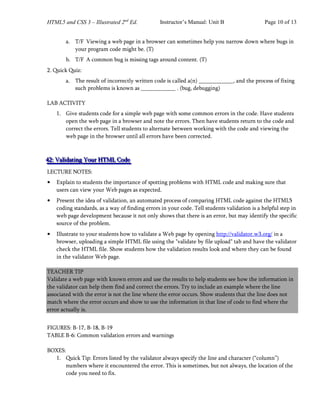
• Tell students that an attribute is additional code within an opening element tag that specifies
information about the element.
• Explain that many but not all HTML elements allow you to set attributes.
• Point out that to use an attribute you must provide two pieces of information: an attribute name
and the value you are assigning to the attribute.
• Use FIGURE B-3 to point out that an attribute is placed within an element’s opening tag and to
point out the syntax for an attribute: <element tag [space] attribute name [equal sign] “attribute
value”>
• Mention that the lang attribute specifies the language in which the document was written, and that
the value “en” specifies English as the language.
• Point out that the charset attribute specifies the character encoding, which is the system user agents
should employ to translate the electronic information representing the page into human-
recognizable symbols.
8.
HTML5 and CSS3 – Illustrated 2nd
Ed. Instructor’s Manual: Unit B Page 4 of 13
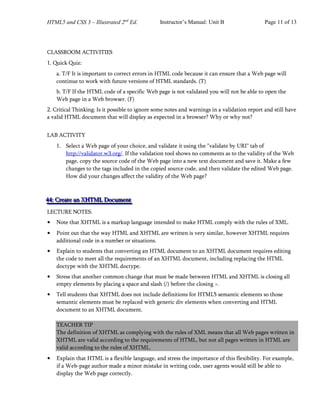
• Explain that, in general, meta elements and attributes added to the html element do not change
how a document is rendered.
TEACHER TIP
Use the figures to point out how the indenting helps make the code more readable. Explain that the
indenting is for cosmetic reasons only, that is, to help the developer quickly see the structure of the
document, but that the indenting has no impact on how the code appears when the page is rendered
in a browser.
FIGURES: B-2, B-3, B-4
TABLE B-1: Basic lang attribute values
BOXES
1. Quick Tip: For most editors, you press [Ctrl][Shift][S] (Win) or [command][shift][S] (Mac), type
the new filename, then press [Enter].
2. Trouble: Be sure to click in the <html> tag and not at the end of the DOCTYPE statement.
3. Trouble: Because some code editors indent automatically, you may not need to press [Spacebar]
to indent. Use the figures to check for and match indenting.
4. Quick Tip: The <meta> tag is a one-sided tag, so it does not require a closing tag.
CLASSROOM ACTIVITIES
1. Critical Thinking: Ask students to explain why it is so important to include the attributes added to
FIGURE B-3 and FIGURE B-4. Have students explain what they think would happen if those attributes
were omitted.
2. Quick Quiz:
a. The charset attribute specifies the . (character encoding)
b. T/F An attribute is additional code added between the opening and closing element tags.
(F)
c. T/F An attribute includes two parts: a name and a value. (T)
3
3
32
2
2:
:: I
I
Im
m
mp
p
pl
l
le
e
em
m
me
e
en
n
nt
t
t t
t
th
h
he
e
e d
d
di
i
iv
v
v E
E
El
l
le
e
em
m
me
e
en
n
nt
t
t
LECTURE NOTES
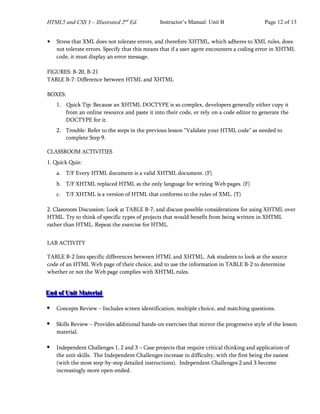
• Give an example of a situation in a web page when you might want to change the presentation of a
section of a Web page that is not itself a single HTML element, e.g., when putting a box around
your name, picture and e-mail address in your personal Web page.
• Show how you can use the div element to group multiple elements of different types (such as those
shown in your previous example) and how you can use this to assign CSS styles to a section of a
Web page.
• Use the figures to show how the div element is used to group an h2 head with its associated
paragraph.
9.
HTML5 and CSS3 – Illustrated 2nd
Ed. Instructor’s Manual: Unit B Page 5 of 13
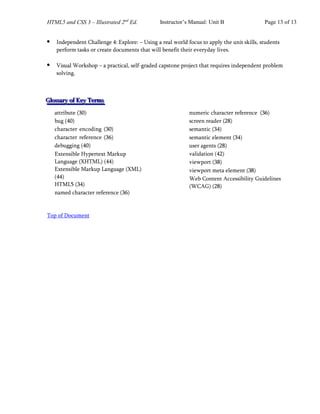
TEACHER TIP
Use the figures to point out how the indenting helps make the code more readable. Explain that the
indenting is for cosmetic reasons only, that is, to help the developer quickly see the structure of the
document, but that the indenting has no impact on how the code appears when the page is rendered
in a browser.
FIGURES: B-5, B-6
BOXES
1. Quick Tip: If your code editor indents new elements automatically, you may not need to press
[Spacebar] at all. Remember to compare your code to the figures to confirm indents.
2. Quick Tip: The h2 element marks a heading that’s at the second-highest heading level in the
document.
3. Clues to Use: Writing for the Web
Many users want a process of finding and consuming web content that is dynamic and fast-paced.
When you write content for the web, you should keep this in mind. Web content should generally
be brief and scannable. A user should be able to get the gist of what your page contains with a quick
glance. This allows users to quickly decide to stay on the page if the page contains the information
they’re looking for, or to navigate elsewhere and keep looking. You can make content scannable by
including a short, descriptive heading at the top, and by breaking the content itself into sections
with headings. After writing the actual content, it can be useful to revise it with the goal of
removing half the words. This helps focus your writing and reduces the content of your web page to
the essentials, which makes it easier for web users to scan and read.
After you publish content online, it’s crucial to keep it up to date—out of date information
makes your website’s content seem unreliable. You can minimize the amount of regular updating
you need to do by reducing or eliminating relative references to dates (such as “5 years ago” or “in
18 months”) or labeling specific dates as being in the future (such as “The building will be
completed in 2013.”)
CLASSROOM ACTIVITIES
1. Critical Thinking: What are the implications of including multiple div elements in a single Web page?
Is there any point in nesting div elements one inside the other in order to give different CSS styles to
different groups of elements? Consider these questions with respect to how to structure your web page.
2. Quick Quiz:
a. T/F The div element does not imply any semantic meaning to its contents. (T)
b. T/F A div element changes the appearance of the content it encloses when the code is
rendered in a browser. (F)
c. T/F The content you want marked by the div element should be included in the opening div
tag. (F)
d. T/F The div element is the parent of the elements it encloses. (T)
10.
HTML5 and CSS3 – Illustrated 2nd
Ed. Instructor’s Manual: Unit B Page 6 of 13
3
3
34
4
4:
:: A
A
Ad
d
dd
d
d H
H
HT
T
TM
M
ML
L
L5
5
5 S
S
Se
e
em
m
ma
a
an
n
nt
t
ti
i
ic
c
c E
E
El
l
le
e
em
m
me
e
en
n
nt
t
ts
s
s
LECTURE NOTES
• Explain that all HTML elements have semantic value, which means that HTML elements indicate
the meaning of their content.
• Point out that most HTML elements describe their contents semantically, e.g., h1 elements are
assumed to be headings.
• Tell students that, even though the div element has limited semantic value, HTML5 includes a
number of semantic elements that indicate the role of their content
• Be sure students understand that the reason it is important to use semantic elements is because
search engines use this information to provide search results, which makes it easier for people using
a search engine to find the web site.
• Point out that older versions of IE can’t interpret semantic elements, so students must include a
script element (which instructs older browsers how to interpret semantic elements) in the head
section. Explain that the script element references code in an external file that browsers use to help
them interpret the semantic elements.
• Mention that the script name is specified using the src attribute.
TEACHER TIP
Remind students that the div element is a generic element and does not imply any semantic
meaning. Explain that the div element is used to group content, but the div element does not
indicate any information about the content being grouped and so that is why it is considered to
have limited semantic value.
FIGURES: B-7, B-8
TABLE B-2: Selected HTML5 semantic elements
BOXES
1. Quick Tip: It’s often possible to mark up web page contents semantically in more than one way.
The choice of which elements to use can vary depending on the developer and the site.
2. Trouble: A warning about blocked content might open, depending on your browser settings. If
so, allow blocked content.
CLASSROOM ACTIVITIES
1. Critical Thinking: Look at any website, such as your school or company website. Point to different
content on the page and explain which semantic element you think is used to enclose that content.
Explain why. If you know how, view the code for the page and see if you were correct.
2. Quick Quiz:
a. T/F You use semantic elements to indicate the meaning of the content enclosed by those
semantic elements. (T)
11.
HTML5 and CSS3 – Illustrated 2nd
Ed. Instructor’s Manual: Unit B Page 7 of 13
b. T/F One of the most meaningful semantic elements you will use is the div element because
it is rich with semantic meaning. (F)
3
3
36
6
6:
:: U
U
Us
s
se
e
e S
S
Sp
p
pe
e
ec
c
ci
i
ia
a
al
l
l C
C
Ch
h
ha
a
ar
r
ra
a
ac
c
ct
t
te
e
er
r
rs
s
s
LECTURE NOTES
• Explain to students that although most Web page text is entered into an HTML document, some
characters may be misinterpreted by user agents as being computer instructions. These characters
include '<' and '>'.
• Introduce the concept of character references, which are specially formatted codes that represent
characters in the HTML document character set. Point out the syntax of character references always
begin with an ampersand (&) and end with a semicolon (;). The rest of the code consists of either a
pound symbol (#) followed by a numeric representation of the associated character or an English
language abbreviation for the associated character name.
• Explain that every character, not just those on the keyboard, has a number code, known as a
numeric character reference. Further explain that a few commonly used characters also have an
abbreviation-based character alternative, which is known as a named character reference.
• Point out that it is only important to use character references for a few specific characters. Use
TABLE B-3 as a guide to discussing these characters.
FIGURES: B-9, B-10
TABLE B-3: Important character references
BOXES:
1. Quick Tip: If you’re using a code editor, the character reference you type may appear as italic.
This will not affect the content when the page is rendered by your browser.
2. Clues to Use: Finding codes for other characters
UTF-8 is the most commonly used character encoding on the web today. This encoding
supports character references for thousands of characters. These symbols may include characters
in different writing systems and international currency symbols, as well as icons and pictograms
for a variety of themes. You can go to unicode.org/charts or fileformat.info to browse supported
characters by subject. Note that not all symbols are displayed in every browser or operating
system. This is because browsers and operating systems use different default fonts, and a given
font may contain character descriptions for some, but not all, UTF-8 characters. For this reason,
it’s important to test a page containing a less-common special character in all browsers that you
anticipate your audience will use to view the page. This lets you confirm that the character is
recognized and displayed when the page is rendered in a browser, or make adjustments if the
character is not recognized.
CLASSROOM ACTIVITIES
1. Quick Quiz:
a. T/F All characters on the keyboard have a numeric character reference. (T)
b. T/F All characters on the keyboard have an abbreviation-based character reference. (F)
12.
HTML5 and CSS3 – Illustrated 2nd
Ed. Instructor’s Manual: Unit B Page 8 of 13
c. T/F It is important to use character references for all non-alphanumeric characters. (F)
2. Quick Quiz: The symbol is used at the beginning of a character reference, and the symbol
is used at the end of a character reference. (&, ;)
LAB ACTIVITY
1. Give students text that includes multiple occurrences of the characters '<' and '>'. For example, you
can use a demo for an if-else clause in a programming language. Ask students to create a Web page in
which they enter the text directly, and another Web page in which they use character references for '<'
and '>', as well as any other relevant characters. What are the differences between the ways the two
Web pages are displayed? Have students discuss how the user agent interpreted the '<' and '>' characters
when they are typed directly without use of character references.
3
3
38
8
8:
:: S
S
Sp
p
pe
e
ec
c
ci
i
if
f
fy
y
y t
t
th
h
he
e
e v
v
vi
i
ie
e
ew
w
wp
p
po
o
or
r
rt
t
t
LECTURE NOTES:
• Point out to students that when a browser opens a web page on a mobile device, the browser needs
to figure out to display the page on the smaller screen.
• Explain that some web pages can scale to fit any browser, which makes the web page useable on any
device.
• Tell students that to instruct browsers to display a page at the width of the browser window
without zooming in, they change the viewport settings using a viewport meta element.
• Explain that the viewport is like looking through the web page through an imaginary window, set
to the size of the display on the device you want the page to appear.
• Be sure students understand the importance of the viewport meta element. Explain that zooming a
page can make the page content too small and so unreadable. By setting the viewport, the page is
displayed at a size that is appropriate for the device.
• Point out that as part of the viewport meta element, they use the content attribute, whose value
specifies one or more of the pairs of properties and values.
TEACHER TIP
Open a web page. Maximize the screen, then resize the screen until it is as small as it can be on the
device you are using. Ask students to notice if any of the web page features change as the page gets
smaller. Point out to students elements that might change, such as the nav bar (which might be
hidden in one icon), images (which might become stacked instead of side by side, and text (which
might be hidden from view if it is not essential to the meaning of the page).
FIGURES: B-11, B-12, B-13
TABLE B-4: viewport attribute properties
BOXES:
1. Trouble: Consult the documentation for your web server if necessary.
13.
HTML5 and CSS3 – Illustrated 2nd
Ed. Instructor’s Manual: Unit B Page 9 of 13
2. Quick Tip: Even though the meta element supports many content value options for viewport,
you usually only need to use the value that sets the width to device-width as you did in this
step.
CLASSROOM ACTIVITIES
1. Quick Quiz:
a. T/F A browser will automatically resize a web page to fit the display device. (F)
b. T/F The viewport meta element instructs the browser to assume that the width of the
content matches the width of the device. (T)
2. Quick Quiz: The viewport meta element uses the attribute. (content)
4
4
40
0
0:
:: D
D
De
e
eb
b
bu
u
ug
g
g y
y
yo
o
ou
u
ur
r
r H
H
HT
T
TM
M
ML
L
L C
C
Co
o
od
d
de
e
e
LECTURE NOTES:
• Explain to students that even the most careful developer writes code from time to time that doesn’t
work.
• Point out that a bug is a problem that results from code that is written incorrectly.
• Explain that the process of finding and fixing or removing a bug is known as debugging.
• Be sure students understand the importance of debugging their code before publishing their page.
Discuss that students should always test their web pages using more than one browser because
browsers do not always render the code the same way.
TEACHER TIP
Open the same web page using several different browsers. Have students point out differences they see
when they compare the web page in the different browsers. Be sure students understand that because a
web page looks awesome in one browser, it may not look the same way in a different browser. Explain
that viewing their web pages this way will help them debug the page for cross-browser issues.
FIGURES: B-14, B-15, B-16
TABLE B-5: Common bugs and causes
BOXES:
1. Trouble: If your page does not display as expected, be sure your correct code matches FIGURE
B-16.
CLASSROOM ACTIVITIES
1. Quick Quiz:
14.
HTML5 and CSS3 – Illustrated 2nd
Ed. Instructor’s Manual: Unit B Page 10 of 13
a. T/F Viewing a web page in a browser can sometimes help you narrow down where bugs in
your program code might be. (T)
b. T/F A common bug is missing tags around content. (T)
2. Quick Quiz:
a. The result of incorrectly written code is called a(n) _, and the process of fixing
such problems is known as . (bug, debugging)
LAB ACTIVITY
1. Give students code for a simple web page with some common errors in the code. Have students
open the web page in a browser and note the errors. Then have students return to the code and
correct the errors. Tell students to alternate between working with the code and viewing the
web page in the browser until all errors have been corrected.
4
4
42
2
2:
:: V
V
Va
a
al
l
li
i
id
d
da
a
at
t
ti
i
in
n
ng
g
g Y
Y
Yo
o
ou
u
ur
r
r H
H
HT
T
TM
M
ML
L
L C
C
Co
o
od
d
de
e
e
LECTURE NOTES:
• Explain to students the importance of spotting problems with HTML code and making sure that
users can view your Web pages as expected.
• Present the idea of validation, an automated process of comparing HTML code against the HTML5
coding standards, as a way of finding errors in your code. Tell students validation is a helpful step in
web page development because it not only shows that there is an error, but may identify the specific
source of the problem.
• Illustrate to your students how to validate a Web page by opening http://validator.w3.org/ in a
browser, uploading a simple HTML file using the "validate by file upload" tab and have the validator
check the HTML file. Show students how the validation results look and where they can be found
in the validator Web page.
TEACHER TIP
Validate a web page with known errors and use the results to help students see how the information in
the validator can help them find and correct the errors. Try to include an example where the line
associated with the error is not the line where the error occurs. Show students that the line does not
match where the error occurs and show to use the information in that line of code to find where the
error actually is.
FIGURES: B-17, B-18, B-19
TABLE B-6: Common validation errors and warnings
BOXES:
1. Quick Tip: Errors listed by the validator always specify the line and character (“column”)
numbers where it encountered the error. This is sometimes, but not always, the location of the
code you need to fix.
15.
HTML5 and CSS3 – Illustrated 2nd
Ed. Instructor’s Manual: Unit B Page 11 of 13
CLASSROOM ACTIVITIES
1. Quick Quiz:
a. T/F It is important to correct errors in HTML code because it can ensure that a Web page will
continue to work with future versions of HTML standards. (T)
b. T/F If the HTML code of a specific Web page is not validated you will not be able to open the
Web page in a Web browser. (F)
2. Critical Thinking: Is it possible to ignore some notes and warnings in a validation report and still have
a valid HTML document that will display as expected in a browser? Why or why not?
LAB ACTIVITY
1. Select a Web page of your choice, and validate it using the "validate by URI" tab of
http://validator.w3.org/. If the validation tool shows no comments as to the validity of the Web
page, copy the source code of the Web page into a new text document and save it. Make a few
changes to the tags included in the copied source code, and then validate the edited Web page.
How did your changes affect the validity of the Web page?
4
4
44
4
4:
:: C
C
Cr
r
re
e
ea
a
at
t
te
e
e a
a
an
n
n X
X
XH
H
HT
T
TM
M
ML
L
L D
D
Do
o
oc
c
cu
u
um
m
me
e
en
n
nt
t
t
LECTURE NOTES:
• Note that XHTML is a markup language intended to make HTML comply with the rules of XML.
• Point out that the way HTML and XHTML are written is very similar, however XHTML requires
additional code in a number or situations.
• Explain to students that converting an HTML document to an XHTML document requires editing
the code to meet all the requirements of an XHTML document, including replacing the HTML
doctype with the XHTML doctype.
• Stress that another common change that must be made between HTML and XHTML is closing all
empty elements by placing a space and slash (/) before the closing >.
• Tell students that XHTML does not include definitions for HTML5 semantic elements so those
semantic elements must be replaced with generic div elements when converting and HTML
document to an XHTML document.
TEACHER TIP
The definition of XHTML as complying with the rules of XML means that all Web pages written in
XHTML are valid according to the requirements of HTML, but not all pages written in HTML are
valid according to the rules of XHTML.
• Explain that HTML is a flexible language, and stress the importance of this flexibility. For example,
if a Web-page author made a minor mistake in writing code, user agents would still be able to
display the Web page correctly.
16.
HTML5 and CSS3 – Illustrated 2nd
Ed. Instructor’s Manual: Unit B Page 12 of 13
• Stress that XML does not tolerate errors, and therefore XHTML, which adheres to XML rules, does
not tolerate errors. Specify that this means that if a user agent encounters a coding error in XHTML
code, it must display an error message.
FIGURES: B-20, B-21
TABLE B-7: Difference between HTML and XHTML
BOXES:
1. Quick Tip: Because an XHTML DOCTYPE is so complex, developers generally either copy it
from an online resource and paste it into their code, or rely on a code editor to generate the
DOCTYPE for it.
2. Trouble: Refer to the steps in the previous lesson “Validate your HTML code” as needed to
complete Step 9.
CLASSROOM ACTIVITIES
1. Quick Quiz:
a. T/F Every HTML document is a valid XHTML document. (F)
b. T/F XHTML replaced HTML as the only language for writing Web pages. (F)
c. T/F XHTML is a version of HTML that conforms to the rules of XML. (T)
2. Classroom Discussion: Look at TABLE B-7, and discuss possible considerations for using XHTML over
HTML. Try to think of specific types of projects that would benefit from being written in XHTML
rather than HTML. Repeat the exercise for HTML.
LAB ACTIVITY
TABLE B-2 lists specific differences between HTML and XHTML. Ask students to look at the source
code of an HTML Web page of their choice, and to use the information in TABLE B-2 to determine
whether or not the Web page complies with XHTML rules.
E
E
En
n
nd
d
d o
o
of
f
f U
U
Un
n
ni
iit
t
t M
M
Ma
a
at
t
te
e
er
r
ri
iia
a
al
ll
•
• Concepts Review – Includes screen identification, multiple choice, and matching questions.
•
• Skills Review – Provides additional hands-on exercises that mirror the progressive style of the lesson
material.
•
• Independent Challenges 1, 2 and 3 – Case projects that require critical thinking and application of
the unit skills. The Independent Challenges increase in difficulty, with the first being the easiest
(with the most step-by-step detailed instructions). Independent Challenges 2 and 3 become
increasingly more open-ended.
17.
HTML5 and CSS3 – Illustrated 2nd
Ed. Instructor’s Manual: Unit B Page 13 of 13
•
• Independent Challenge 4: Explore: – Using a real world focus to apply the unit skills, students
perform tasks or create documents that will benefit their everyday lives.
•
• Visual Workshop – a practical, self-graded capstone project that requires independent problem
solving.
G
G
Gl
l
lo
o
os
s
ss
s
sa
a
ar
r
ry
y
y o
o
of
f
f K
K
Ke
e
ey
y
y T
T
Te
e
er
r
rm
m
ms
s
s
attribute (30)
bug (40)
character encoding (30)
character reference (36)
debugging (40)
Extensible Hypertext Markup
Language (XHTML) (44)
Extensible Markup Language (XML)
(44)
HTML5 (34)
named character reference (36)
numeric character reference (36)
screen reader (28)
semantic (34)
semantic element (34)
user agents (28)
validation (42)
viewport (38)
viewport meta element (38)
Web Content Accessibility Guidelines
(WCAG) (28)
Top of Document
18.
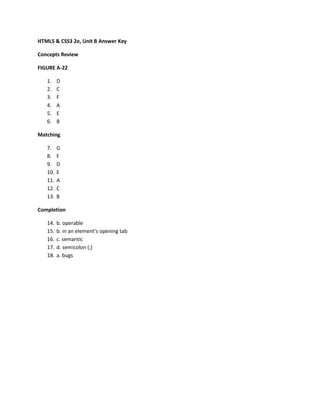
HTML5 & CSS32e, Unit B Answer Key
Concepts Review
FIGURE A-22
1. D
2. C
3. F
4. A
5. E
6. B
Matching
7. G
8. F
9. D
10. E
11. A
12. C
13. B
Completion
14. b. operable
15. b. in an element’s opening tab
16. c. semantic
17. d. semicolon (;)
18. a. bugs
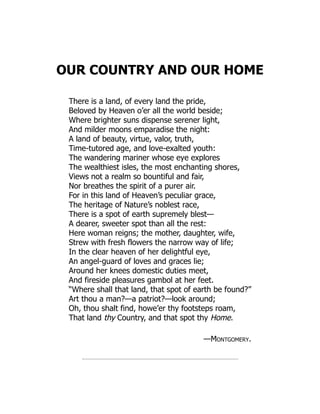
OUR COUNTRY ANDOUR HOME
There is a land, of every land the pride,
Beloved by Heaven o’er all the world beside;
Where brighter suns dispense serener light,
And milder moons emparadise the night:
A land of beauty, virtue, valor, truth,
Time-tutored age, and love-exalted youth:
The wandering mariner whose eye explores
The wealthiest isles, the most enchanting shores,
Views not a realm so bountiful and fair,
Nor breathes the spirit of a purer air.
For in this land of Heaven’s peculiar grace,
The heritage of Nature’s noblest race,
There is a spot of earth supremely blest—
A dearer, sweeter spot than all the rest:
Here woman reigns; the mother, daughter, wife,
Strew with fresh flowers the narrow way of life;
In the clear heaven of her delightful eye,
An angel-guard of loves and graces lie;
Around her knees domestic duties meet,
And fireside pleasures gambol at her feet.
“Where shall that land, that spot of earth be found?”
Art thou a man?—a patriot?—look around;
Oh, thou shalt find, howe’er thy footsteps roam,
That land thy Country, and that spot thy Home.
—Montgomery.
21.
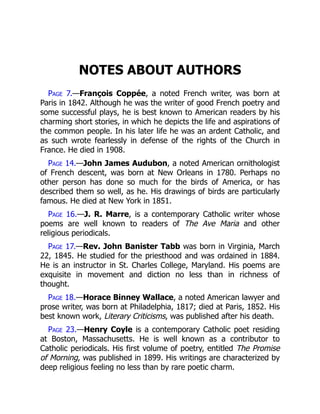
NOTES ABOUT AUTHORS
Page7.—François Coppée, a noted French writer, was born at
Paris in 1842. Although he was the writer of good French poetry and
some successful plays, he is best known to American readers by his
charming short stories, in which he depicts the life and aspirations of
the common people. In his later life he was an ardent Catholic, and
as such wrote fearlessly in defense of the rights of the Church in
France. He died in 1908.
Page 14.—John James Audubon, a noted American ornithologist
of French descent, was born at New Orleans in 1780. Perhaps no
other person has done so much for the birds of America, or has
described them so well, as he. His drawings of birds are particularly
famous. He died at New York in 1851.
Page 16.—J. R. Marre, is a contemporary Catholic writer whose
poems are well known to readers of The Ave Maria and other
religious periodicals.
Page 17.—Rev. John Banister Tabb was born in Virginia, March
22, 1845. He studied for the priesthood and was ordained in 1884.
He is an instructor in St. Charles College, Maryland. His poems are
exquisite in movement and diction no less than in richness of
thought.
Page 18.—Horace Binney Wallace, a noted American lawyer and
prose writer, was born at Philadelphia, 1817; died at Paris, 1852. His
best known work, Literary Criticisms, was published after his death.
Page 23.—Henry Coyle is a contemporary Catholic poet residing
at Boston, Massachusetts. He is well known as a contributor to
Catholic periodicals. His first volume of poetry, entitled The Promise
of Morning, was published in 1899. His writings are characterized by
deep religious feeling no less than by rare poetic charm.
22.
Page 24.—Miguel deSaavedra Cervantes, a celebrated Spanish
poet and novelist, was born near Madrid, 1547; died, 1616. His most
famous work is the romance entitled Don Quixote, which was first
printed in 1605. It has been translated into every language of
Europe.
Page 43.—John Henry, Cardinal Newman was born at London
in 1801. He was educated at a private school until he entered
Oxford, where he took his degree before he was twenty. In 1822 he
was elected Fellow in Oriel College. In 1845 he left the Church of
England for the Roman Catholic Church. He wrote many sermons,
treatises, and poems. In literary merit his work ranks very high. He
died in 1890.
Rev. Thomas Edward Bridgett, a noted priest and author, was
born at Derby, England, in 1829. He was the founder of the
Confraternity of the Holy Family for men, and much of his life was
devoted to missionary work. He was the author of numerous
religious and historical works, among which may be named, The
History of the Holy Eucharist, Life of the Blessed John Fisher,
Blunders and Forgeries, etc. Father Bridgett died at St. Mary’s
Clapham, England, in 1899.
Page 56.—William Cowper, a celebrated English poet, was born
in 1731. He attended Westminster school and afterwards studied
law. His most famous poems are The Task and the ballad John
Gilpin’s Ride. He died in 1800.
Page 58.—Rev. Frederick William Faber was born in Yorkshire,
England, in 1814. He was an eloquent preacher, a brilliant talker, and
had an unsurpassed power of gaining the love of all with whom he
came in contact. His hymns are well known, and sung throughout
the world. He founded a religious community which was afterwards
merged in the oratory of St. Philip Neri. He died in 1863.
Page 75.—John Greenleaf Whittier was born at Haverhill,
Massachusetts, 1807. At the age of eighteen he studied for two
years at an academy near his home. In 1829 he became the editor
23.
of a paperestablished at Boston to advocate protective tariff. He
was active in the cause of antislavery. He died in 1892.
Page 82.—Mary Lydia Bolles Branch was born at New London,
Connecticut, in 1840. She is best known as a writer of stories for
children.
Page 84.—John Burroughs was born in Roxbury, New York, in
1837. He was the son of a farmer, but received a good college
education. For eight or nine years he taught school, and then
became a journalist in New York city. From 1861 till 1873 he was a
clerk in the Treasury Department at Washington. He finally settled
on a farm at West Park, New York, giving his time to literature and
the observation of nature. His love of nature has inspired most of
what he has contributed to the literature of the world.
Page 96.—Aubrey de Vere, an Irish Catholic poet, was born in
1788. He belonged to a good family, and always had leisure to
cultivate a naturally refined taste. At first he wrote dramas, but later,
poems, especially sonnets. He was a true patriot, and pays many
tributes of love to his country in his historical themes. He died in
1846.
Page 97.—Sir Walter Scott was born at Edinburgh in 1771. His
delightful art of story telling, both in prose and poetry, has been
excelled by few. Among his most popular poems are The Lady of the
Lake and Marmion; among his most popular novels are Kenilworth,
Ivanhoe, The Talisman, and Old Mortality. He died in 1832.
Page 106.—Thomas Moore was born at Dublin, Ireland, in 1779;
died in 1852. He entered Trinity College, Dublin, at fifteen years of
age. He studied law, and in 1799 entered the Middle Temple,
London. In 1803 he received a government appointment to the
Bermuda Islands and traveled quite extensively in the United States.
Among English Catholic poets he holds a high rank.
Page 107.—Andrew Lang was born in Scotland in 1844; died at
London in 1912. He pursued many different lines of literary work,
24.
and was oneof the most versatile writers of modern times. The
number of volumes bearing his name as author is surprisingly large.
Page 114.—Lady Gregory is the daughter of Dudley Presse,
Deputy Lieutenant of Roxborough, County Galway, Ireland. She has
done very valuable service to literature in preserving and editing
many of the early Celtic legends. Some of her publications are: Poets
and Dreamers, Cuchullain of Muerthemme, and Gods and Fighting
Men.
Page 118.—Helen Hunt Jackson was born in 1831 at Amherst,
Massachusetts. In 1867 she wrote her first stories, and from that
time until her death books from the pen of H. H. were published
with frequency. She wrote verses, essays, sketches of travel,
children’s stories, novels, and tracts on questions of the day.
Page 120.—St. Ambrose or Ambrosius, one of the fathers of the
Latin Church, was born at Treves, A.D. 340; died, 397. He was the
champion of the Catholics against Arians and pagans; he became
Bishop of Milan in 374. He was the author of numerous hymns and
other religious works.
Page 121.—James Sheridan Knowles was born at Dublin,
Ireland, 1784. For a time he held a commission in the militia, but
became attracted to the stage and entered the dramatic profession.
He died in 1862.
Page 132.—Washington Irving was born in New York city, April
3, 1783; died, 1859. His early schooling was not very systematic.
When a young man he began the study of law, but never followed
the profession very steadily. He is the most popular of the American
writers of the early part of the nineteenth century.
Page 152.—Alfred Tennyson was born at Somersby, England, in
1809. He was educated at Cambridge, where he gained the
Chancellor’s medal for his poem Timbuctoo in blank verse. In 1830
he published his first volume of poems. Other poems followed
quickly and soon became popularly known. Tennyson’s poetry is
25.
distinguished by itsrare quality and delicate choice of language. He
was for many years poet laureate. He died in 1892.
Page 158.—Sister Mary Antonia is an occasional and highly
esteemed contributor of verse to current Catholic periodicals.
Page 161.—Miriam Coles Harris is a contemporary Catholic
writer whose works have attracted considerable attention. The
extract is from A Corner of Spain, published in 1896.
Page 166.—William Cullen Bryant, a famous American poet, was
born at Cummington, Massachusetts, November 3, 1794. He entered
Williams College at the age of sixteen, but at the end of two years
took honorable dismission and engaged in the study of law. He was
admitted to the bar in 1815; removed to New York in 1825; was
editor of the New York Review in the same year; and in 1826
became connected with the Evening Post, with which he continued
until his death, which occurred in 1878.
Page 170.—Conrad Von Bolanden is the pseudonym of a
contemporary German Catholic writer, Monsignor Joseph Bischoff,
who was born in August, 1828. He was made a Papal Chamberlain
to Pope Pius IX in recognition of the merits of his efforts in the field
of Catholic literature. He has written much, finding the motives of his
books in history and in the problems of social life.
Page 174.—Henry Wadsworth Longfellow is often called the
children’s poet, partly because of his love for children and partly
because of some poems written for children. He was born in
Portland, Maine, in 1807. From 1835 to 1854 he was professor of
modern languages at Harvard University. He died in 1882.
Page 178.—John Gilmary Shea, a brilliant Catholic writer, was
born at New York city, July 1824; died, 1892. He devoted most of his
time to literature instead of to the law, for which he was educated.
Perhaps no one has done more to preserve the history and language
of the aborigines of this country. History of the Catholic Missions
among the Indian Tribes of the United States, Early Voyages up and
26.
down the Mississippi,History of the Catholic Church in Colonial
Times, are some of his most popular works.
Page 186.—James Russell Lowell was born at Cambridge,
Massachusetts, February 22, 1819. He died in the same house in
which he was born, August 12, 1891. For many years he held the
chair of modern languages in Harvard University. He was a man who
represented American culture and letters at their best.
Page 188.—Mother Mary Loyola of the Bar Convent, York,
England, is a writer of more than ordinary power on the subjects
dearest to every true Catholic. Her book, Jesus of Nazareth, from
which our selection is taken, was written especially for American
children and is dedicated to them.
Page 196.—Francis Scott Key, author of “The Star-spangled
Banner,” was born in Frederick County, Maryland, in 1780. It was
during the British invasion in 1814, while he was detained on a
British man-of-war within sight of the bombardment of Fort
McHenry, that Key wrote this beautiful lyrical poem. He died at
Baltimore in 1843.
Page 214.—James Montgomery was a Scottish poet, born in
1776; died in 1854. His poems, once very popular, are now almost
forgotten.
27.
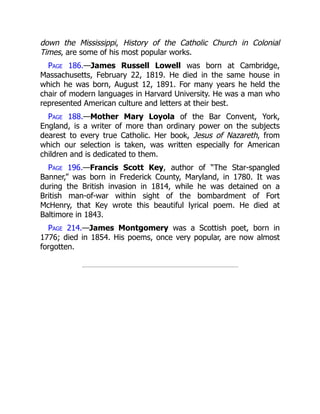
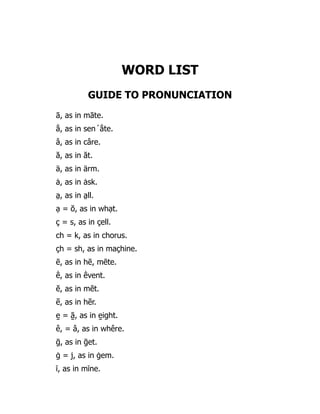
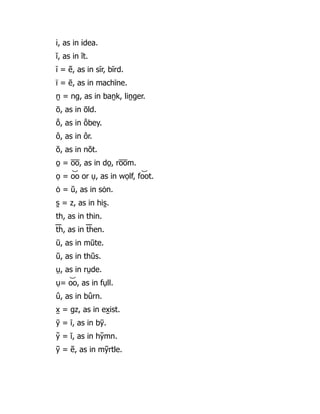
WORD LIST
GUIDE TOPRONUNCIATION
ā, as in māte.
ā̇ , as in sen´ā̇ te.
â, as in câre.
ă, as in ăt.
ä, as in ärm.
ȧ, as in ȧsk.
a̤ , as in a̤ ll.
ạ = ŏ, as in whạt.
ç = s, as in çell.
ch = k, as in chorus.
çh = sh, as in maçhine.
ē, as in hē, mēte.
ē̇ , as in ē̇ vent.
ĕ, as in mĕt.
ẽ, as in hẽr.
e̱ = ā̱ , as in e̱ ight.
ê, = â, as in whêre.
ḡ, as in ḡet.
ġ = j, as in ġem.
ī, as in mīne.
28.
i̇, as ini̇dea.
ĭ, as in ĭt.
ĩ = ẽ, as in sĩr, bĩrd.
ï = ē, as in machïne.
ṉ = ng, as in baṉk, liṉger.
ō, as in ōld.
ō̇ , as in ō̇ bey.
ô, as in ôr.
ŏ, as in nŏt.
o̤ = o̅ o̅ , as in do̤ , ro̅ o̅ m.
ọ = o͝ o or ụ, as in wọlf, fo͝ ot.
ȯ = ŭ, as in sȯn.
s̱ = z, as in his̱ .
th, as in thin.
t͞ h, as in t͞ hen.
ū, as in mūte.
ŭ, as in thŭs.
ṳ, as in rṳde.
ụ= o͝ o, as in fụll.
û, as in bûrn.
x̱ = gz, as in ex̱ ist.
ȳ = ī, as in bȳ.
y̆ = ĭ, as in hy̆ mn.
ỹ = ẽ, as in mỹrtle.
29.
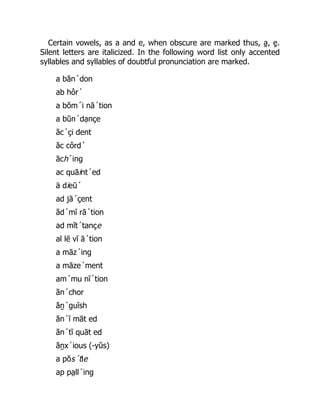
Certain vowels, asa and e, when obscure are marked thus, a̯ , e̯ .
Silent letters are italicized. In the following word list only accented
syllables and syllables of doubtful pronunciation are marked.
a băn´don
ab hôr´
a bŏm´i nā´tion
a bŭn´dạnçe
ăc´çi dent
ăc côrd´
āch´ing
ac quāint´ed
ä dieū´
ad jā´çent
ăd´mĭ rā´tion
ad mĭt´tançe
al lē vĭ ā´tion
a māz´ing
a māze´ment
am´mu nĭ´tion
ăn´chor
ăṉ´guĭsh
ăn´ĭ māt ed
ăn´tĭ quāt ed
ăṉx´ious (-yŭs)
a pŏs´tle
ap pa̤ ll´ing
30.
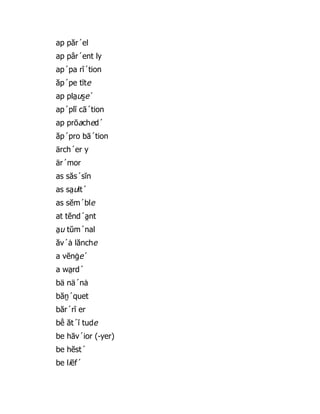
ap păr´el
ap pâr´ently
ap´pa rĭ´tion
ăp´pe tīte
ap pla̤ us̱ e´
ap´plĭ cā´tion
ap prōached´
ăp´pro bā´tion
ärch´er y
är´mor
as săs´sĭn
as sa̤ ult´
as sĕm´ble
at tĕnd´a̯ nt
a̤ u tŭm´nal
ăv´ȧ lănche
a vĕnġe´
a wa̤ rd´
bä nä´nȧ
băṉ´quet
băr´rĭ er
bē̇ ăt´ĭ tude
be hāv´ior (-yer)
be hĕst´
be liēf´
31.
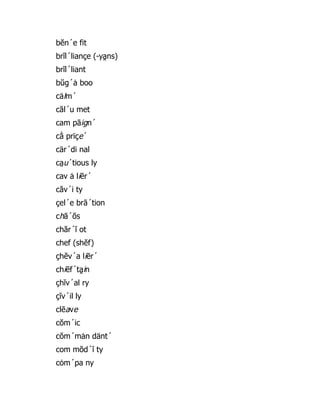
bĕn´e fit
brĭl´liançe (-ya̯ns)
brĭl´liant
bŭg´ȧ boo
cälm´
căl´u met
cam pāign´
cā̇ prïçe´
cär´di nal
ca̤ u´tious ly
cav ȧ liēr´
căv´i ty
çel´e brā´tion
chā´ŏs
chăr´ĭ ot
chef (shĕf)
çhĕv´a liēr´
chiēf´ta̯ in
çhĭv´al ry
çĭv´il ly
clēave
cŏm´ic
cŏm´mȧn dänt´
com mŏd´ĭ ty
cȯm´pa ny
32.
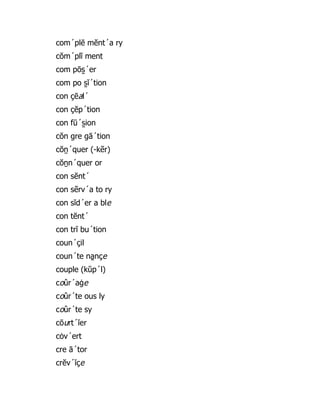
com´plē mĕnt´a ry
cŏm´plĭment
com pōs̱ ´er
com po s̱ ĭ´tion
con çēal´
con çĕp´tion
con fū´s̱ ion
cŏn gre gā´tion
cŏṉ´quer (-kẽr)
cŏṉn´quer or
con sĕnt´
con sẽrv´a to ry
con sĭd´er a ble
con tĕnt´
con trĭ bu´tion
coun´çil
coun´te na̯ nçe
couple (kŭp´l)
coûr´aġe
coûr´te ous ly
coûr´te sy
cōurt´ĭer
cȯv´ert
cre ā´tor
crĕv´ĭçe
33.
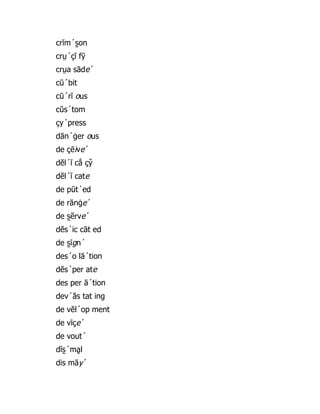
crĭm´s̱ on
crṳ´çĭ fȳ
crṳasāde´
cū´bit
cū´rĭ ous
cŭs´tom
çy´press
dān´ġer ous
de çēive´
dĕl´ĭ cā̇ çy̆
dĕl´ĭ cate
de pūt´ed
de rānġe´
de s̱ ẽrve´
dĕs´ic cāt ed
de s̱ īgn´
des´o lā´tion
dĕs´per ate
des per ā´tion
dev´ăs tat ing
de vĕl´op ment
de vīçe´
de vout´
dĭs̱ ´ma̯ l
dis māy´
34.
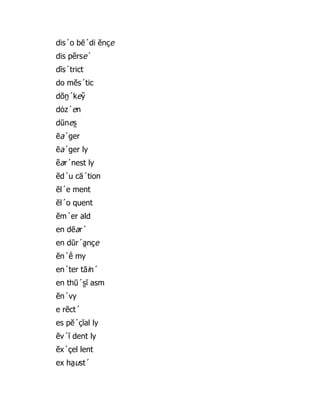
dis´o bē´di ĕnçe
dispẽrse´
dĭs´trict
do mĕs´tic
dŏṉ´key̆
dȯz´en
dūnes̱
ēa´ger
ēa´ger ly
ẽar´nest ly
ĕd´u cā´tion
ĕl´e ment
ĕl´o quent
ĕm´er ald
en dēar´
en dūr´a̯ nçe
ĕn´ē̇ my
en´ter tāin´
en thū´s̱ ĭ asm
ĕn´vy
e rĕct´
es pĕ´çĭal ly
ĕv´ĭ dent ly
ĕx´çel lent
ex ha̤ ust´
35.
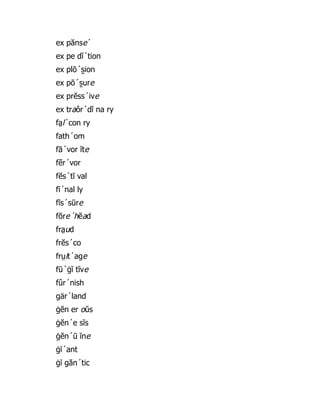
ex pănse´
ex pedĭ´tion
ex plō´s̱ ion
ex pō´s̱ ure
ex prĕss´ive
ex traôr´dĭ na ry
fa̤ l´con ry
fath´om
fā´vor ĭte
fẽr´vor
fĕs´tĭ val
fī´nal ly
fĭs´sūre
fŏre´hĕad
fra̤ ud
frĕs´co
frṳit´age
fū´ġĭ tĭve
fûr´nish
gär´land
ġĕn er oŭs
ġĕn´e sĭs
ġĕn´ū ĭne
ġī´ant
ġī găn´tic
36.
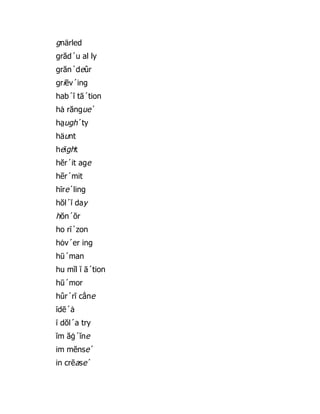
gnärled
grăd´u al ly
grăn´deûr
griēv´ing
hab´ĭtā´tion
hȧ răngue´
ha̤ ugh´ty
häunt
heīght
hĕr´it age
hẽr´mit
hīre´ling
hŏl´ĭ day
hŏn´ŏr
ho rī´zon
hȯv´er ing
hū´man
hu mĭl ĭ ā´tion
hū´mor
hûr´rĭ cā̇ ne
īdē´ȧ
ī dŏl´a try
ĭm ăġ´ĭne
im mĕnse´
in crēase´
37.
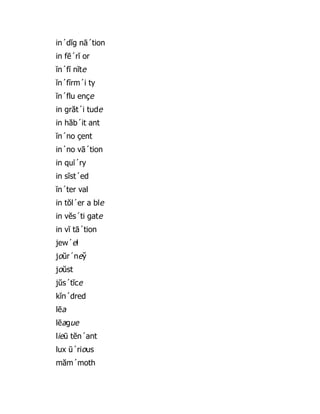
in´dĭg nā´tion
in fē´rĭor
ĭn´fĭ nĭte
ĭn´fĩrm´i ty
ĭn´flu ençe
in grăt´i tude
in hăb´it ant
ĭn´no çent
in´no vā´tion
in quī´ry
in sĭst´ed
ĭn´ter val
in tŏl´er a ble
in vĕs´ti gate
in vĭ tā´tion
jew´el
joŭr´ney̆
joŭst
jŭs´tĭce
kĭn´dred
lēa
lēague
lieū tĕn´ant
lux ū´rious
măm´moth
38.
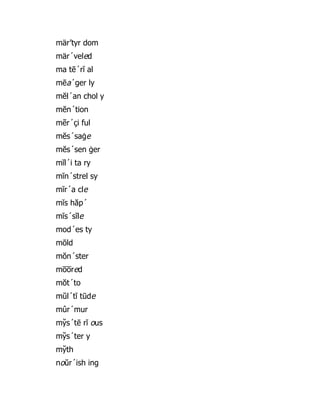
mär’tyr dom
mär´veled
ma tē´rĭal
mēa´ger ly
mĕl´an chol y
mĕn´tion
mẽr´çi ful
mĕs´saġe
mĕs´sen ġer
mĭl´i ta ry
mĭn´strel sy
mĭr´a cle
mĭs hăp´
mĭs´sĭle
mod´es ty
mōld
mŏn´ster
mo̅ o̅ red
mŏt´to
mŭl´tĭ tūde
mûr´mur
my̆ s´tē rĭ ous
my̆ s´ter y
my̆ th
noŭr´ish ing
39.
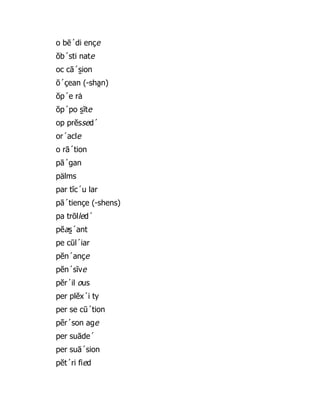
o bē´di ençe
ŏb´stinate
oc cā´s̱ ion
ō´çean (-sha̯ n)
ŏp´e rȧ
ŏp´po s̱ ĭte
op prĕssed´
or´acle
o rā´tion
pā´gan
pälms
par tĭc´u lar
pā´tiençe (-shens)
pa trōlled´
pĕas̱ ´ant
pe cūl´iar
pĕn´ançe
pĕn´sĭve
pĕr´il ous
per plĕx´i ty
per se cū´tion
pẽr´son age
per suāde´
per suā´sion
pĕt´ri fied
40.
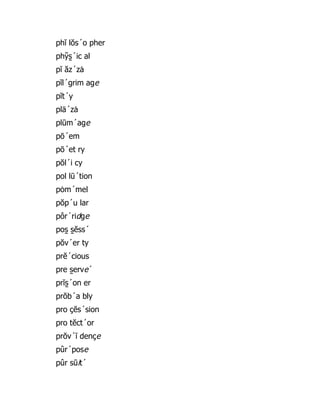
phĭ lŏs´o pher
phy̆s̱ ´ic al
pĭ ăz´zȧ
pĭl´grim age
pĭt´y
plä´zȧ
plūm´age
pō´em
pō´et ry
pŏl´i cy
pol lū´tion
pȯm´mel
pŏp´u lar
pôr´ridge
pos̱ s̱ ĕss´
pŏv´er ty
prĕ´cious
pre s̱ erve´
prĭs̱ ´on er
prŏb´a bly
pro çĕs´sion
pro tĕct´or
prŏv´ĭ dençe
pûr´pose
pûr sūit´
41.
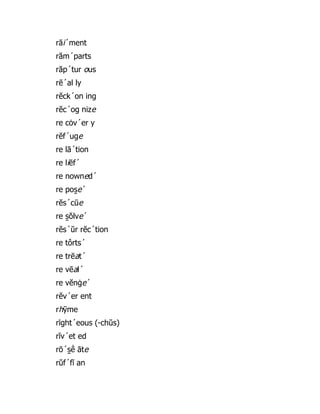
rāi´ment
răm´parts
răp´tur ous
rē´al ly
rĕck´oning
rĕc´og nize
re cȯv´er y
rĕf´uge
re lā´tion
re liēf´
re nowned´
re pos̱ e´
rĕs´cūe
re s̱ ŏlve´
rĕs´ŭr rĕc´tion
re tôrts´
re trēat´
re vēal´
re vĕnġe´
rĕv´er ent
rhȳme
rīght´eous (-chŭs)
rĭv´et ed
rō´s̱ ē̇ āte
rŭf´fĭ an
42.
săl´u ta´tion
sal vā´tion
sănc´tion
săt´isfy
săv´aġe
scăf´fold
scăr´çĭ ty
scâre´crow
scär´let
scēne
scĕnt´ed
sẽarch
sĕm´i cĩr´cle
sĕn´si tive
sĕp´a rat ed
shrewd
siēġe
sĭg´nal
sĭg´ni fy
sĭn´ew
skĕl´e ton
sleeve
snĭv´el ing
sō´cia ble
so´cia bĭl´ĭ ty
43.
sō´cial (-shal)
so ç´īety
so joûrn´er
so lĕm´nĭ ty
sŏl´emn ly
sŏl´ī tude
spĕ´cial
spē´cies (-shē̇ z)
spĕç´i men
spĕc´ter
sphēre
spĭr´it
spĭr´it u al
spŏn´sor
stĕad´ĭ ly
sŭb´stance
subtle (sŭt´l)
sŭd´den ly
sŭf fi´cien cy
sŭm´mit
sŭmp´tu ous
sŭs pĕct´
sy̆ m´pa thy̆
tăl´ent
tĕn´der ly
44.
tĕr´rā̇ çe
tĕr´ri fied
ter´ror
thē´ater
thē´o ry
thĩrst
thrŭsh
tŏr´rent
tôr´ture
to̤ ur´na ment
to̤ ur´ney
trăġ´e dy
trăġ´ic
trăṉ´quil
trăns pâr´ent
trĭ´bute
trĭp´le
tri´umph
tri ŭm´phant
tȳ´rant
un cĭv´il
un co̤ uth´
ûr´chin
ū´s̱ ū al
ŭt´ter ançe
Am´brōs̱ e
An´ġe lo
Anï´ta´
An´tĭ och
Ap´en nīnes̱
A rā´bĭ a̯
A´sĭȧ
As sĭ´sĭ
A̤ u gŭs´tĭne
A̤ u gŭs´tu̯ s
Āy´mer
Ben e dĭct´ĭne
Bẽr lĭn´
Blĕn´heim
Bo´he mond
Bŏn´ĭ fāçe
Bouillon (bo̅ o̅ yōṉ´)
Brĭt´ain
Brṳçe
Căl´va ry
Ca pẽr´na um
Cär rä´rä
Căth´bad
Çhĕv ȧ liēr´
Çhĕv´ĭ ot
47.
Clẽr´mont
Comyn (kŭm´in)
Cŏn´ehū bär
Cŏn´na̤ught
Cŏn´stan tĭ nō´ple
Cor o nä´rï
Cū´bȧ
Cuchulain (ko̅ o̅ ho̅ o̅ ´lin)
Cṳlāin
Da kō´tȧ
Da măs´cus
De troit´
Don Quixote (dŏn kehō´te)
Doŭg´las
Drĕs̱ ´den
Drṳ´ĭd
Dul çĭn´e a
E´bro
E´ġy̆ pt
E māin´
E´rin
Es´the̯ r
Eū´rope
Fẽr´gus
Flŏr´ence
48.
Fon tĭ nĕl´lȧ
Frăn´cis
Frĕd´erick
Frï´s̱ ĭ ȧ
Gā´brĭ el
Ġĕn´ō̇ ȧ
Ġĕn o ēs̱ e´
Gĕs´ler
Ghï bẽr´tï
Ġiō chï´no
Gŏd´frey̆
Grĕg´o ry
Häl´le̯
Han´del
Hel vĕl´ly̆ n
Hŭṉ´ gȧ ry
Ich´ȧ bŏd
In´dĭes̱
It´a ly
Je rṳ´sa lem
Joliet (zhō lyā´)
Jôr´da̯ n
Lē o närd´ō̇
Lē´vīte
Măç´e don
49.
Măl´a gȧ
Mär quette´(-kĕt)
Mĕc´cȧ
Me dï´nȧ
Mĕd´ĭ ter rā´ne an
Me nŏm´o nĭe
Mī´cha el
Mĭl´an
Mis´sis sĭp´pĭ
Mo hăm´med
Mŏs̱ lem
Mus tȧ´phȧ
Nĭch´o las
Nï´ña
Păl´es tīne
Pä´lōs
Păn´the on
Pe̱ ´rez (-āth)
Persia (pēr´shĭȧ)
Pe̱ ´sä rō
Piacenza (pē ä chĕn´zä)
Pil är´
Pĭn´ta
Po nē´mäh
Que bĕc´
50.
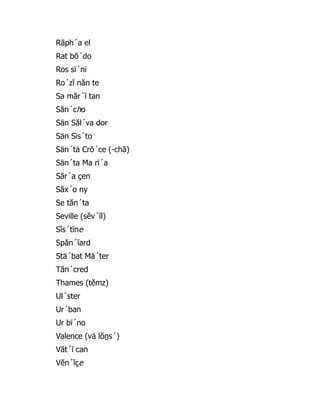
Rāph´a el
Rat bō´do
Rossï´nï
Ro´zĭ năn te
Sa măr´ĭ tan
Săn´cho
Sän Săl´va dor
Sän Sïs´to
Sän´tȧ Crō´ce (-chā)
Sän´ta Ma rï´a
Săr´a çen
Săx´o ny
Se tăn´ta
Seville (sĕv´ĭl)
Sĭs´tïne
Spăn´ĭard
Stä´bat Mä´ter
Tăn´cred
Thames (tĕmz)
Ul´ster
Ur´ban
Ur bï´no
Valence (vä lŏṉs´)
Văt´ĭ can
Vĕn´ĭçe
*** END OFTHE PROJECT GUTENBERG EBOOK STANDARD
CATHOLIC READERS BY GRADES: FIFTH YEAR ***
Updated editions will replace the previous one—the old editions
will be renamed.
Creating the works from print editions not protected by U.S.
copyright law means that no one owns a United States
copyright in these works, so the Foundation (and you!) can copy
and distribute it in the United States without permission and
without paying copyright royalties. Special rules, set forth in the
General Terms of Use part of this license, apply to copying and
distributing Project Gutenberg™ electronic works to protect the
PROJECT GUTENBERG™ concept and trademark. Project
Gutenberg is a registered trademark, and may not be used if
you charge for an eBook, except by following the terms of the
trademark license, including paying royalties for use of the
Project Gutenberg trademark. If you do not charge anything for
copies of this eBook, complying with the trademark license is
very easy. You may use this eBook for nearly any purpose such
as creation of derivative works, reports, performances and
research. Project Gutenberg eBooks may be modified and
printed and given away—you may do practically ANYTHING in
the United States with eBooks not protected by U.S. copyright
law. Redistribution is subject to the trademark license, especially
commercial redistribution.
START: FULL LICENSE
Welcome to ourwebsite – the perfect destination for book lovers and
knowledge seekers. We believe that every book holds a new world,
offering opportunities for learning, discovery, and personal growth.
That’s why we are dedicated to bringing you a diverse collection of
books, ranging from classic literature and specialized publications to
self-development guides and children's books.
More than just a book-buying platform, we strive to be a bridge
connecting you with timeless cultural and intellectual values. With an
elegant, user-friendly interface and a smart search system, you can
quickly find the books that best suit your interests. Additionally,
our special promotions and home delivery services help you save time
and fully enjoy the joy of reading.
Join us on a journey of knowledge exploration, passion nurturing, and
personal growth every day!
testbankmall.com



![HTML5 and CSS 3 – Illustrated 2nd
Ed. Instructor’s Manual: Unit B Page 3 of 13
• In order for Web pages to be robust, or accessed by the widest variety of programs and devices, they
should be coded according to Web standards.
FIGURE: B-1
BOXES
1. Clues to Use: Understanding your role in web accessibility
In addition to Web developers’ work creating a site, other factors significantly influence Web
accessibility. The developers of user agents make decisions that affect how their software and devices
interact with Web content, which impacts whether users can access content in specific ways. In
addition, some Web content is produced using software that automates the Web development
process, and the accessibility choices of the makers of these packages affects the accessibility of the
content produced using them. Thus, while Web developers have a crucial role to play in building
and maintaining a Web that’s available to everyone, it can be useful to see your role as part of a
larger team and to recognize when you run against a limitation that can’t easily be fixed.
CLASSROOM ACTIVITIES
1. Critical Thinking: Have students assume that they are designing a Web site for a World War II
veterans’ organization. What special features will they include in the design of the Web site in order to
make it accessible to the veterans?
2. Group Activity: Divide the class into small groups. Provide a project plan for a specific Web site, and
ask each group to design a Web site that is accessible to individuals with different characteristics: hard
of hearing, children, elderly, and visually impaired. What aspects of the design are similar to all the
groups, and what aspects are different?
3
3
30
0
0:
:: I
I
In
n
nc
c
co
o
or
r
rp
p
po
o
or
r
ra
a
at
t
te
e
e A
A
At
t
tt
t
tr
r
ri
i
ib
b
bu
u
ut
t
te
e
es
s
s
LECTURE NOTES
• Tell students that an attribute is additional code within an opening element tag that specifies
information about the element.
• Explain that many but not all HTML elements allow you to set attributes.
• Point out that to use an attribute you must provide two pieces of information: an attribute name
and the value you are assigning to the attribute.
• Use FIGURE B-3 to point out that an attribute is placed within an element’s opening tag and to
point out the syntax for an attribute: <element tag [space] attribute name [equal sign] “attribute
value”>
• Mention that the lang attribute specifies the language in which the document was written, and that
the value “en” specifies English as the language.
• Point out that the charset attribute specifies the character encoding, which is the system user agents
should employ to translate the electronic information representing the page into human-
recognizable symbols.](https://image.slidesharecdn.com/37765-250319033338-845a1f2f/85/HTML5-and-CSS3-Illustrated-Introductory-2nd-Edition-Vodnik-Solutions-Manual-7-320.jpg)
![HTML5 and CSS 3 – Illustrated 2nd
Ed. Instructor’s Manual: Unit B Page 4 of 13
• Explain that, in general, meta elements and attributes added to the html element do not change
how a document is rendered.
TEACHER TIP
Use the figures to point out how the indenting helps make the code more readable. Explain that the
indenting is for cosmetic reasons only, that is, to help the developer quickly see the structure of the
document, but that the indenting has no impact on how the code appears when the page is rendered
in a browser.
FIGURES: B-2, B-3, B-4
TABLE B-1: Basic lang attribute values
BOXES
1. Quick Tip: For most editors, you press [Ctrl][Shift][S] (Win) or [command][shift][S] (Mac), type
the new filename, then press [Enter].
2. Trouble: Be sure to click in the <html> tag and not at the end of the DOCTYPE statement.
3. Trouble: Because some code editors indent automatically, you may not need to press [Spacebar]
to indent. Use the figures to check for and match indenting.
4. Quick Tip: The <meta> tag is a one-sided tag, so it does not require a closing tag.
CLASSROOM ACTIVITIES
1. Critical Thinking: Ask students to explain why it is so important to include the attributes added to
FIGURE B-3 and FIGURE B-4. Have students explain what they think would happen if those attributes
were omitted.
2. Quick Quiz:
a. The charset attribute specifies the . (character encoding)
b. T/F An attribute is additional code added between the opening and closing element tags.
(F)
c. T/F An attribute includes two parts: a name and a value. (T)
3
3
32
2
2:
:: I
I
Im
m
mp
p
pl
l
le
e
em
m
me
e
en
n
nt
t
t t
t
th
h
he
e
e d
d
di
i
iv
v
v E
E
El
l
le
e
em
m
me
e
en
n
nt
t
t
LECTURE NOTES
• Give an example of a situation in a web page when you might want to change the presentation of a
section of a Web page that is not itself a single HTML element, e.g., when putting a box around
your name, picture and e-mail address in your personal Web page.
• Show how you can use the div element to group multiple elements of different types (such as those
shown in your previous example) and how you can use this to assign CSS styles to a section of a
Web page.
• Use the figures to show how the div element is used to group an h2 head with its associated
paragraph.](https://image.slidesharecdn.com/37765-250319033338-845a1f2f/85/HTML5-and-CSS3-Illustrated-Introductory-2nd-Edition-Vodnik-Solutions-Manual-8-320.jpg)
![HTML5 and CSS 3 – Illustrated 2nd
Ed. Instructor’s Manual: Unit B Page 5 of 13
TEACHER TIP
Use the figures to point out how the indenting helps make the code more readable. Explain that the
indenting is for cosmetic reasons only, that is, to help the developer quickly see the structure of the
document, but that the indenting has no impact on how the code appears when the page is rendered
in a browser.
FIGURES: B-5, B-6
BOXES
1. Quick Tip: If your code editor indents new elements automatically, you may not need to press
[Spacebar] at all. Remember to compare your code to the figures to confirm indents.
2. Quick Tip: The h2 element marks a heading that’s at the second-highest heading level in the
document.
3. Clues to Use: Writing for the Web
Many users want a process of finding and consuming web content that is dynamic and fast-paced.
When you write content for the web, you should keep this in mind. Web content should generally
be brief and scannable. A user should be able to get the gist of what your page contains with a quick
glance. This allows users to quickly decide to stay on the page if the page contains the information
they’re looking for, or to navigate elsewhere and keep looking. You can make content scannable by
including a short, descriptive heading at the top, and by breaking the content itself into sections
with headings. After writing the actual content, it can be useful to revise it with the goal of
removing half the words. This helps focus your writing and reduces the content of your web page to
the essentials, which makes it easier for web users to scan and read.
After you publish content online, it’s crucial to keep it up to date—out of date information
makes your website’s content seem unreliable. You can minimize the amount of regular updating
you need to do by reducing or eliminating relative references to dates (such as “5 years ago” or “in
18 months”) or labeling specific dates as being in the future (such as “The building will be
completed in 2013.”)
CLASSROOM ACTIVITIES
1. Critical Thinking: What are the implications of including multiple div elements in a single Web page?
Is there any point in nesting div elements one inside the other in order to give different CSS styles to
different groups of elements? Consider these questions with respect to how to structure your web page.
2. Quick Quiz:
a. T/F The div element does not imply any semantic meaning to its contents. (T)
b. T/F A div element changes the appearance of the content it encloses when the code is
rendered in a browser. (F)
c. T/F The content you want marked by the div element should be included in the opening div
tag. (F)
d. T/F The div element is the parent of the elements it encloses. (T)](https://image.slidesharecdn.com/37765-250319033338-845a1f2f/85/HTML5-and-CSS3-Illustrated-Introductory-2nd-Edition-Vodnik-Solutions-Manual-9-320.jpg)