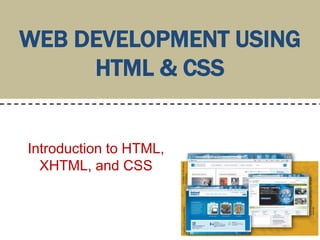
Introduction to HTML,
XHTML, and CSS
WEB DEVELOPMENT USING
HTML & CSS
Web Development, also known as
website development, refers to the task
associated with creating, building and
maintaining website and web application that
run online on a browser. It may, however, also
include web design, web programing and
database management.
Introduction to HTML, XHTML, and CSS 2
What is Web Development?
• Describe the Internet and its associated key terms
• Describe the World Wide Web and its associated key terms
• Define Hypertext Markup Language (HTML) and HTML5
standards used for Web development
• Discuss the use of Cascading Style Sheets (CSS) in Web
development
• Define the Document Object Model (DOM) and describe its
relationship to HTML
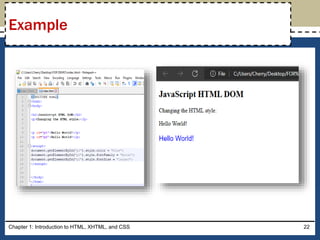
• Define Extensible Hypertext Markup Language (XHTML) and
describe its relationship to HTML
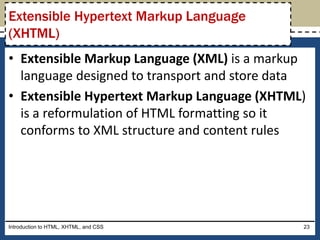
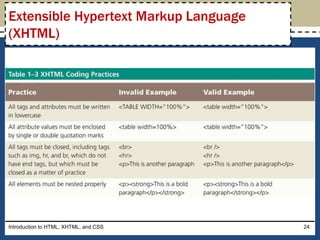
• Identify tools used to create HTML documents
Introduction to HTML, XHTML, and CSS 3
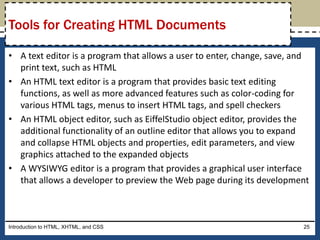
Chapter Objectives
• Describe the five phases of the Web development life
cycle
• Explain the importance of being an observant Web user
• Identify tools used to create HTML documents
• Discuss the importance of testing throughout the Web
development life cycle
• Explain the importance of being an observant Web user
Introduction to HTML, XHTML, and CSS 4
Chapter Objectives
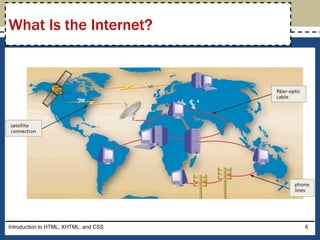
The Internet is a worldwide collection of computers
and computer networks that links billions of computers
used by businesses, government, educational institutions,
organizations, and individuals using modems, phone lines,
television cables, satellite links, fiber-optic connections, and
other communications devices and media.
Introduction to HTML, XHTML, and CSS 5
What Is the Internet?
Introduction to HTML, XHTML, and CSS 6
What Is the Internet?
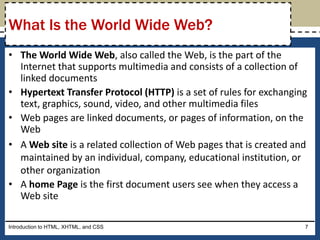
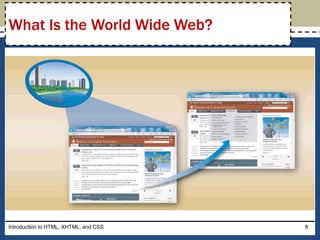
• The World Wide Web, also called the Web, is the part of the
Internet that supports multimedia and consists of a collection of
linked documents
• Hypertext Transfer Protocol (HTTP) is a set of rules for exchanging
text, graphics, sound, video, and other multimedia files
• Web pages are linked documents, or pages of information, on the
Web
• A Web site is a related collection of Web pages that is created and
maintained by an individual, company, educational institution, or
other organization
• A home Page is the first document users see when they access a
Web site
Introduction to HTML, XHTML, and CSS 7
What Is the World Wide Web?
Introduction to HTML, XHTML, and CSS 8
What Is the World Wide Web?
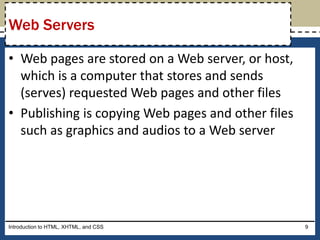
• Web pages are stored on a Web server, or host,
which is a computer that stores and sends
(serves) requested Web pages and other files
• Publishing is copying Web pages and other files
such as graphics and audios to a Web server
Introduction to HTML, XHTML, and CSS 9
Web Servers
Introduction to HTML, XHTML, and CSS 10
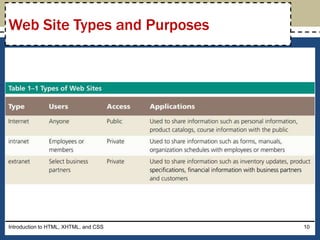
Web Site Types and Purposes
Introduction to HTML, XHTML, and CSS 11
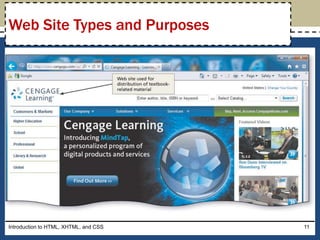
Web Site Types and Purposes
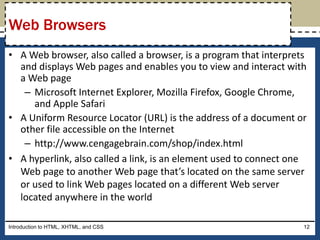
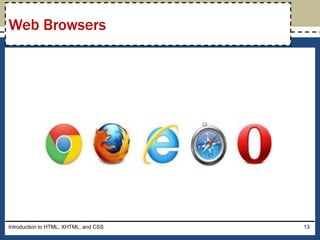
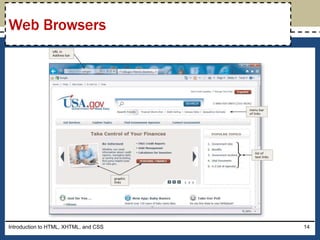
• A Web browser, also called a browser, is a program that interprets
and displays Web pages and enables you to view and interact with
a Web page
– Microsoft Internet Explorer, Mozilla Firefox, Google Chrome,
and Apple Safari
• A Uniform Resource Locator (URL) is the address of a document or
other file accessible on the Internet
– http://www.cengagebrain.com/shop/index.html
• A hyperlink, also called a link, is an element used to connect one
Web page to another Web page that’s located on the same server
or used to link Web pages located on a different Web server
located anywhere in the world
Introduction to HTML, XHTML, and CSS 12
Web Browsers
Introduction to HTML, XHTML, and CSS 13
Web Browsers
Introduction to HTML, XHTML, and CSS 14
Web Browsers
• Web pages are created using Hypertext Markup Language (HTML),
which is an authoring language used to create documents for the
World Wide Web
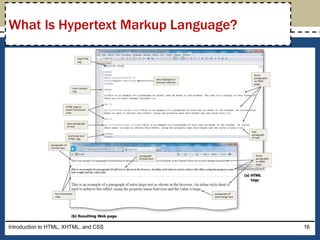
• HTML uses a set of special instructions called tags or markup to
define the structure and layout of a Web document and specify
how the page is displayed in a browser
• HTML is platform independent, meaning you can create, or code,
an HTML file on one type of computer and then use a browser on
another type of computer to view that file as a Web page
Introduction to HTML, XHTML, and CSS 15
What Is Hypertext Markup Language?
Introduction to HTML, XHTML, and CSS 16
What Is Hypertext Markup Language?
Introduction to HTML, XHTML, and CSS 17
HTML Elements
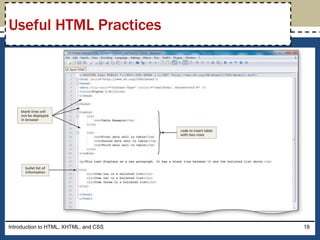
Introduction to HTML, XHTML, and CSS 18
Useful HTML Practices
• HTML has gone through several versions, each of
which expands the capabilities of HTML
• The most recent version of HTML is HTML5,
although most browsers still support HTML
versions 4.01, 3.2, and 2.0
Introduction to HTML, XHTML, and CSS 19
HTML Versions
• Cascading Style Sheets (CSS) allow you to specify
the style for an element within a single Web page
or throughout an entire Web site
Introduction to HTML, XHTML, and CSS 20
Cascading Style Sheets
• Document Object Model (DOM) describes a
combination of HTML tags, CSS, and a scripting
language such as JavaScript
• DOM allows a Web developer to add, delete, or
change an element or attribute. Web pages
enhanced with DOM can be more responsive to
visitor interaction than basic HTML Web pages
Introduction to HTML, XHTML, and CSS 21
Document Object Model (DOM)
Example
Chapter 1: Introduction to HTML, XHTML, and CSS 22
• Extensible Markup Language (XML) is a markup
language designed to transport and store data
• Extensible Hypertext Markup Language (XHTML)
is a reformulation of HTML formatting so it
conforms to XML structure and content rules
Introduction to HTML, XHTML, and CSS 23
Extensible Hypertext Markup Language
(XHTML)
Introduction to HTML, XHTML, and CSS 24
Extensible Hypertext Markup Language
(XHTML)
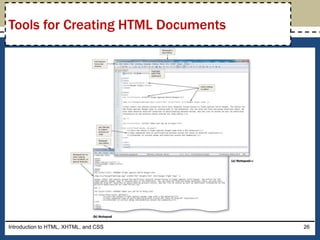
• A text editor is a program that allows a user to enter, change, save, and
print text, such as HTML
• An HTML text editor is a program that provides basic text editing
functions, as well as more advanced features such as color-coding for
various HTML tags, menus to insert HTML tags, and spell checkers
• An HTML object editor, such as EiffelStudio object editor, provides the
additional functionality of an outline editor that allows you to expand
and collapse HTML objects and properties, edit parameters, and view
graphics attached to the expanded objects
• A WYSIWYG editor is a program that provides a graphical user interface
that allows a developer to preview the Web page during its development
Introduction to HTML, XHTML, and CSS 25
Tools for Creating HTML Documents
Introduction to HTML, XHTML, and CSS 26
Tools for Creating HTML Documents
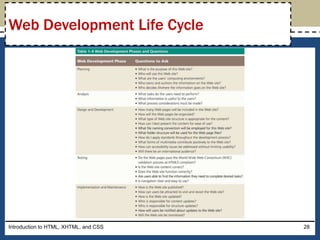
• Comprehensive planning and analysis will ensure
that developers will provide what users want.
• If you code your Web Pages without thorough
planning and analysis, you run the risk of missing
pertinent information.
• WDLC is a process that can be used for developing
web pages at any complexity level.
Introduction to HTML, XHTML, and CSS 27
Web Development Life Cycle
Introduction to HTML, XHTML, and CSS 28
Web Development Life Cycle
• Involves identifying the goals or purpose of the
Web site.
• Purpose
• Who will use
• Users’ computing environments
• Who owns and authors the information
• Who decides if/where the information goes on
the web site.
Introduction to HTML, XHTML, and CSS 29
Web Site Planning
• During the analysis phase, you make decisions
about the website content and functionality.
• Also important to consider the processes required
to support Web site features.
– Ex. If a user will be able to order products through the
website, then you need to define the process or
actions to be taken when an order is placed.
Introduction to HTML, XHTML, and CSS 30
Web Site analysis
• How to organize content
• Selecting the appropriate web site structure
• Determining how to use multimedia
• Addressing accessibility issues
• Design the site for ALL users
Introduction to HTML, XHTML, and CSS 31
Web site Design and Development
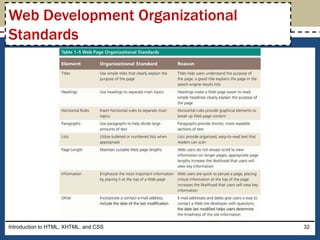
Introduction to HTML, XHTML, and CSS 32
Web Development Organizational
Standards
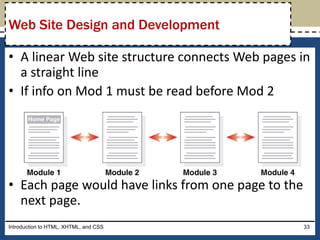
• A linear Web site structure connects Web pages in
a straight line
• If info on Mod 1 must be read before Mod 2
• Each page would have links from one page to the
next page.
Introduction to HTML, XHTML, and CSS 33
Web Site Design and Development
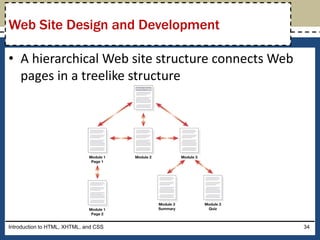
• A hierarchical Web site structure connects Web
pages in a treelike structure
Introduction to HTML, XHTML, and CSS 34
Web Site Design and Development
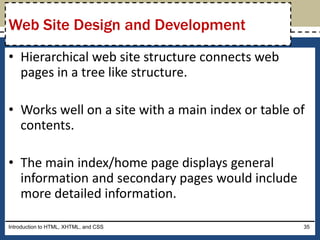
• Hierarchical web site structure connects web
pages in a tree like structure.
• Works well on a site with a main index or table of
contents.
• The main index/home page displays general
information and secondary pages would include
more detailed information.
Introduction to HTML, XHTML, and CSS 35
Web Site Design and Development
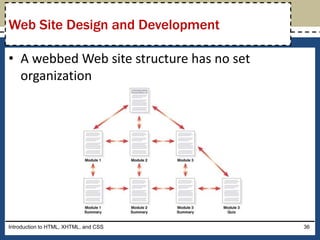
• A webbed Web site structure has no set
organization
Introduction to HTML, XHTML, and CSS 36
Web Site Design and Development
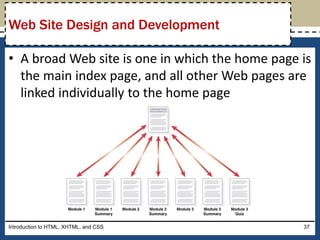
• A broad Web site is one in which the home page is
the main index page, and all other Web pages are
linked individually to the home page
Introduction to HTML, XHTML, and CSS 37
Web Site Design and Development
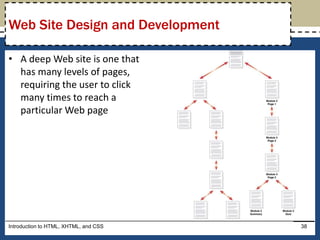
• A deep Web site is one that
has many levels of pages,
requiring the user to click
many times to reach a
particular Web page
38
Introduction to HTML, XHTML, and CSS
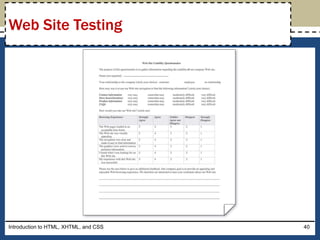
• Usability is the measure of how well a product, such as a Web site,
allows a user to accomplish his or her goals
• Usability testing is a method by which users of a Web site or other
product are asked to perform certain tasks in an effort to measure
the product’s ease-of-use and the user’s perception of the
experience
• Compatibility testing is done to verify that the Web site works with
a variety of browsers and browser versions
• Stress testing determines what happens on your Web site when
greater numbers of users access the site
Introduction to HTML, XHTML, and CSS 39
Web Site Testing
Introduction to HTML, XHTML, and CSS 40
Web Site Testing
1. Create your own website and research other resources for
your web designs.
Note:
Your assignment will be submitted tomorrow at 1:00
o’clock in the afternoon through my email address
cherrylim0431@gmail.com
Introduction to HTML, XHTML, and CSS 41
Assignment / Homework
Thank You!
42

HTML Demo.ppt

  • 1.
    Introduction to HTML, XHTML,and CSS WEB DEVELOPMENT USING HTML & CSS
  • 2.
    Web Development, alsoknown as website development, refers to the task associated with creating, building and maintaining website and web application that run online on a browser. It may, however, also include web design, web programing and database management. Introduction to HTML, XHTML, and CSS 2 What is Web Development?
  • 3.
    • Describe theInternet and its associated key terms • Describe the World Wide Web and its associated key terms • Define Hypertext Markup Language (HTML) and HTML5 standards used for Web development • Discuss the use of Cascading Style Sheets (CSS) in Web development • Define the Document Object Model (DOM) and describe its relationship to HTML • Define Extensible Hypertext Markup Language (XHTML) and describe its relationship to HTML • Identify tools used to create HTML documents Introduction to HTML, XHTML, and CSS 3 Chapter Objectives
  • 4.
    • Describe thefive phases of the Web development life cycle • Explain the importance of being an observant Web user • Identify tools used to create HTML documents • Discuss the importance of testing throughout the Web development life cycle • Explain the importance of being an observant Web user Introduction to HTML, XHTML, and CSS 4 Chapter Objectives
  • 5.
    The Internet isa worldwide collection of computers and computer networks that links billions of computers used by businesses, government, educational institutions, organizations, and individuals using modems, phone lines, television cables, satellite links, fiber-optic connections, and other communications devices and media. Introduction to HTML, XHTML, and CSS 5 What Is the Internet?
  • 6.
    Introduction to HTML,XHTML, and CSS 6 What Is the Internet?
  • 7.
    • The WorldWide Web, also called the Web, is the part of the Internet that supports multimedia and consists of a collection of linked documents • Hypertext Transfer Protocol (HTTP) is a set of rules for exchanging text, graphics, sound, video, and other multimedia files • Web pages are linked documents, or pages of information, on the Web • A Web site is a related collection of Web pages that is created and maintained by an individual, company, educational institution, or other organization • A home Page is the first document users see when they access a Web site Introduction to HTML, XHTML, and CSS 7 What Is the World Wide Web?
  • 8.
    Introduction to HTML,XHTML, and CSS 8 What Is the World Wide Web?
  • 9.
    • Web pagesare stored on a Web server, or host, which is a computer that stores and sends (serves) requested Web pages and other files • Publishing is copying Web pages and other files such as graphics and audios to a Web server Introduction to HTML, XHTML, and CSS 9 Web Servers
  • 10.
    Introduction to HTML,XHTML, and CSS 10 Web Site Types and Purposes
  • 11.
    Introduction to HTML,XHTML, and CSS 11 Web Site Types and Purposes
  • 12.
    • A Webbrowser, also called a browser, is a program that interprets and displays Web pages and enables you to view and interact with a Web page – Microsoft Internet Explorer, Mozilla Firefox, Google Chrome, and Apple Safari • A Uniform Resource Locator (URL) is the address of a document or other file accessible on the Internet – http://www.cengagebrain.com/shop/index.html • A hyperlink, also called a link, is an element used to connect one Web page to another Web page that’s located on the same server or used to link Web pages located on a different Web server located anywhere in the world Introduction to HTML, XHTML, and CSS 12 Web Browsers
  • 13.
    Introduction to HTML,XHTML, and CSS 13 Web Browsers
  • 14.
    Introduction to HTML,XHTML, and CSS 14 Web Browsers
  • 15.
    • Web pagesare created using Hypertext Markup Language (HTML), which is an authoring language used to create documents for the World Wide Web • HTML uses a set of special instructions called tags or markup to define the structure and layout of a Web document and specify how the page is displayed in a browser • HTML is platform independent, meaning you can create, or code, an HTML file on one type of computer and then use a browser on another type of computer to view that file as a Web page Introduction to HTML, XHTML, and CSS 15 What Is Hypertext Markup Language?
  • 16.
    Introduction to HTML,XHTML, and CSS 16 What Is Hypertext Markup Language?
  • 17.
    Introduction to HTML,XHTML, and CSS 17 HTML Elements
  • 18.
    Introduction to HTML,XHTML, and CSS 18 Useful HTML Practices
  • 19.
    • HTML hasgone through several versions, each of which expands the capabilities of HTML • The most recent version of HTML is HTML5, although most browsers still support HTML versions 4.01, 3.2, and 2.0 Introduction to HTML, XHTML, and CSS 19 HTML Versions
  • 20.
    • Cascading StyleSheets (CSS) allow you to specify the style for an element within a single Web page or throughout an entire Web site Introduction to HTML, XHTML, and CSS 20 Cascading Style Sheets
  • 21.
    • Document ObjectModel (DOM) describes a combination of HTML tags, CSS, and a scripting language such as JavaScript • DOM allows a Web developer to add, delete, or change an element or attribute. Web pages enhanced with DOM can be more responsive to visitor interaction than basic HTML Web pages Introduction to HTML, XHTML, and CSS 21 Document Object Model (DOM)
  • 22.
    Example Chapter 1: Introductionto HTML, XHTML, and CSS 22
  • 23.
    • Extensible MarkupLanguage (XML) is a markup language designed to transport and store data • Extensible Hypertext Markup Language (XHTML) is a reformulation of HTML formatting so it conforms to XML structure and content rules Introduction to HTML, XHTML, and CSS 23 Extensible Hypertext Markup Language (XHTML)
  • 24.
    Introduction to HTML,XHTML, and CSS 24 Extensible Hypertext Markup Language (XHTML)
  • 25.
    • A texteditor is a program that allows a user to enter, change, save, and print text, such as HTML • An HTML text editor is a program that provides basic text editing functions, as well as more advanced features such as color-coding for various HTML tags, menus to insert HTML tags, and spell checkers • An HTML object editor, such as EiffelStudio object editor, provides the additional functionality of an outline editor that allows you to expand and collapse HTML objects and properties, edit parameters, and view graphics attached to the expanded objects • A WYSIWYG editor is a program that provides a graphical user interface that allows a developer to preview the Web page during its development Introduction to HTML, XHTML, and CSS 25 Tools for Creating HTML Documents
  • 26.
    Introduction to HTML,XHTML, and CSS 26 Tools for Creating HTML Documents
  • 27.
    • Comprehensive planningand analysis will ensure that developers will provide what users want. • If you code your Web Pages without thorough planning and analysis, you run the risk of missing pertinent information. • WDLC is a process that can be used for developing web pages at any complexity level. Introduction to HTML, XHTML, and CSS 27 Web Development Life Cycle
  • 28.
    Introduction to HTML,XHTML, and CSS 28 Web Development Life Cycle
  • 29.
    • Involves identifyingthe goals or purpose of the Web site. • Purpose • Who will use • Users’ computing environments • Who owns and authors the information • Who decides if/where the information goes on the web site. Introduction to HTML, XHTML, and CSS 29 Web Site Planning
  • 30.
    • During theanalysis phase, you make decisions about the website content and functionality. • Also important to consider the processes required to support Web site features. – Ex. If a user will be able to order products through the website, then you need to define the process or actions to be taken when an order is placed. Introduction to HTML, XHTML, and CSS 30 Web Site analysis
  • 31.
    • How toorganize content • Selecting the appropriate web site structure • Determining how to use multimedia • Addressing accessibility issues • Design the site for ALL users Introduction to HTML, XHTML, and CSS 31 Web site Design and Development
  • 32.
    Introduction to HTML,XHTML, and CSS 32 Web Development Organizational Standards
  • 33.
    • A linearWeb site structure connects Web pages in a straight line • If info on Mod 1 must be read before Mod 2 • Each page would have links from one page to the next page. Introduction to HTML, XHTML, and CSS 33 Web Site Design and Development
  • 34.
    • A hierarchicalWeb site structure connects Web pages in a treelike structure Introduction to HTML, XHTML, and CSS 34 Web Site Design and Development
  • 35.
    • Hierarchical website structure connects web pages in a tree like structure. • Works well on a site with a main index or table of contents. • The main index/home page displays general information and secondary pages would include more detailed information. Introduction to HTML, XHTML, and CSS 35 Web Site Design and Development
  • 36.
    • A webbedWeb site structure has no set organization Introduction to HTML, XHTML, and CSS 36 Web Site Design and Development
  • 37.
    • A broadWeb site is one in which the home page is the main index page, and all other Web pages are linked individually to the home page Introduction to HTML, XHTML, and CSS 37 Web Site Design and Development
  • 38.
    Web Site Designand Development • A deep Web site is one that has many levels of pages, requiring the user to click many times to reach a particular Web page 38 Introduction to HTML, XHTML, and CSS
  • 39.
    • Usability isthe measure of how well a product, such as a Web site, allows a user to accomplish his or her goals • Usability testing is a method by which users of a Web site or other product are asked to perform certain tasks in an effort to measure the product’s ease-of-use and the user’s perception of the experience • Compatibility testing is done to verify that the Web site works with a variety of browsers and browser versions • Stress testing determines what happens on your Web site when greater numbers of users access the site Introduction to HTML, XHTML, and CSS 39 Web Site Testing
  • 40.
    Introduction to HTML,XHTML, and CSS 40 Web Site Testing
  • 41.
    1. Create yourown website and research other resources for your web designs. Note: Your assignment will be submitted tomorrow at 1:00 o’clock in the afternoon through my email address cherrylim0431@gmail.com Introduction to HTML, XHTML, and CSS 41 Assignment / Homework
  • 42.