GENERAL HEALTH, SAFETY &
ENVIRONMENT
COURSE
TITAN TEE CONSULT ISL
GHSE
INTRODUCTION.
Health, Safety and Environment involves
the study of scientific subject such as;
◦ Chemistry
◦ Physics
◦ Biology
◦ Engineering
◦ Psychology &
◦ Law.
2
Health, Safety and Environment issues
requires the following for full understanding
of its code of practice;
◦ Technical background to the issue and relevant
knowledge,
◦ Standards that may apply to the workplace and
to the specific health, Safety and Environment
issue under consideration.
◦ Possible strength
3
INTRODUCTORY DEFINITIONS
◦ Safety – is the absence of Risk of serious personal injury.
This implies that Safety is an act of being free from harm.
Staying out danger areas results in SAFETY.
◦ Health – is the totality of good physical, emotional &
mental state of an individual. This is not mere absence of
diseases. Health relates not only to physical ill health but
also to psychological ill health for instance exposure to
extreme stress can lead to nervous breakdown.
◦ Welfare – is access to basic facilities within workplace
such as toilet facailities, hand wash stations, changing
room/cloak room, rest room, canteen, drinking water and
basic first aid provision.
4
DEFINITIONS CONTD……..
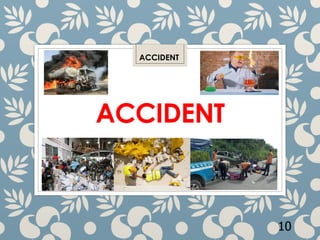
◦ Accident – is an unplanned, unwanted event/occurrence
that can lead to injury or damages/loss or both and sometimes
death.
◦ Nearmiss - is an unplanned, unwanted event/occurrence
that that had potential to lead to injury, damages/loss or even
death, {but did not actual do so}
◦ Dangerous Occurrence – is a specific/major event that
may require report to relevant authority by law.
◦ Hazard – is anything or something that has potential to cause
harm.
◦ Risk – is the likelihood that a hazard will cause harm, in
combination with the severity of injury, damage or loss that
might occur. Therefore;
Risk {R} = L X S, where; ‘L’ is the likelihood &
‘S’ is the Severity
5
RESPONSIBILITIES OF AN EMPLOYER
Employers has the mandatory duty by
law to provide the following;
1. Safe place of work.
2. Safe plant and Equipment.
3. Safe System of work.
4. Adequate training and Supervision.
5. Engauge Competent Employees.
6. Provision of Personal Protective Equipment {PPE} to all
Employees at no cost.
6
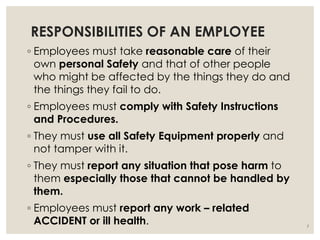
RESPONSIBILITIES OF AN EMPLOYEE
◦ Employees must take reasonable care of their
own personal Safety and that of other people
who might be affected by the things they do and
the things they fail to do.
◦ Employees must comply with Safety Instructions
and Procedures.
◦ They must use all Safety Equipment properly and
not tamper with it.
◦ They must report any situation that pose harm to
them especially those that cannot be handled by
them.
◦ Employees must report any work – related
ACCIDENT or ill health. 7
8
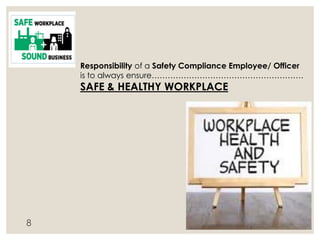
Responsibility of a Safety Compliance Employee/ Officer
is to always ensure…………………………………………………
SAFE & HEALTHY WORKPLACE
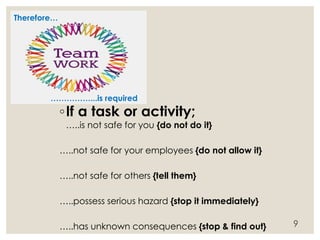
◦If a task or activity;
…..is not safe for you {do not do it}
…..not safe for your employees {do not allow it}
…..not safe for others {tell them}
…..possess serious hazard {stop it immediately}
…..has unknown consequences {stop & find out} 9
Therefore…
……………...is required
ACCIDENT
10
ACCIDENT
11
ACCIDENT
History of accident is dated back to 18th
Century when machine were invented.
Machines had dangerous moving parts, drive
belt, exposed cutting blades and
reciprocating shaft etc. including poor lighting
and ventilation in the rooms they were been
operated.
This situations produce injury, ill health,
damages and death to Employees.
Industrialactivitiesgenerally involve people,machine,materials,
chemicalsand the environment.
These element interact together duringoperationthereby having
adverseimpacton each other causingdamages and injury.
Remember;
Accident– is an unplanned,unwantedevent/occurrencethat can
lead to injury or damages/lossor both and sometimesdeath.
Usually the adverseimpacts are initiated by UnsafeAct and Unsafe
Condition.
Always rememberthat accidentare not made, they chiefly
causedby Unsafeact or unsafecondition.
12
ACCIDENT
13
ACCIDENT
The two major causes an accident are;
1. Unsafe Act &
2. Unsafe Condition.
Unsafe Act are action taken by someone
without due regard to personal safety and that
of his fellow or co employees and other person
around. These act are usually contrary to rules
and regulations or accepted standard practices
and procedures. They are illegal acts.
14
ACCIDENT
Unsafe Conditions are physical condition
attributable to physical and mechanical sources
within an environment which if left uncorrected
may lead to an accident. Such as workplace conditions or
equipment and materials condition that can cause accidents.
This are fundamental cause of numerous accidents
The existence of this condition has capacity to always cause
accident.
15
ACCIDENT
See attached…………
1. Examples of Unsafe Act
2. Examples of Unsafe Condition
3. Direct and indirect cost of an
accident
4. Accident ratio study
5. Accident prevention……4Es
ACCIDENT
INVESTIGATION &
REPORTING
16
Introduction
◦Accidents must be promptly
reported by the victim(s) or
witnesses as soon as they occur.
◦This is very important because when
they are reported, the machinery
for investigating is set in motion. The
information (lessons) gathered from
the investigation will provide useful
guides in preventing a recurrence
as against when they are not
reported.
17
◦Accident promptly reported by
the fastest means of
communication available will
receive immediate attention
enabling the facts about the
accident to be readily obtained.
This is a compliance with
Government Regulations, which
require notification of certain
accidents within 48 hours.
18
The three primary tasks of the
accident investigator are;
- to gather useful information,
- analyze the facts surrounding the
accident, and
- write the accident report.
◦ The intent of this discussion is to help you gain
the basic skills necessary to conduct an
effective accident investigation at your
workplace.
◦ Only experience will give you the expertise to
fine-tune those skills
19
Purpose Of Accident Investigation
◦Traditionally, accident investigation is
viewed by many employees as a fault
finding exercise. They regard it as an activity
to find out:
◦Whom to blame,
◦A scapegoat or someone to impose
sanctions on.
◦Such employees neither report accidents
nor co-operate during investigations. They
are the type who will always say “I don’t
know anything about the accident; I was
not there”. 2
0
Aims Of Sound Accident Investigation
◦To Prevent Recurrence
◦A thorough investigation will make
available the facts bearing on the
accident. These facts can be utilized
to prevent recurrence of the
accident.
◦To Determine Costs
◦The total loss incurred as a result of the
accident can be computed after a
detailed investigation. Such
computed cost can help
management appreciate and
willingly endorse programmes aimed
at improving safety awareness. 21
◦To Publicize Cause(s)
◦Publicity of cause(s) of accident
keeps personnel in other locations or
units of the company informed so that
they can take appropriate preventive
measures to avoid such incident(s).
◦Payment Of Compensation
◦Accident reporting and investigation
are essential in ensuring proper
medical attention and
documentation for purpose of
Workmen’s compensation claims.
22
◦ Legal Requirement
◦ Government Regulations such as the Factories Act
1990 and Mineral Oils (Safety) Regulations 1963
require that comprehensive reports be made of Oil
services and fatal accidents occurring during
company’s operations. A detailed investigation
must be carried out to ensure compliance with this
requirement.
◦ Compilation Of Data
◦ Accident investigation enables statistical data to be
compiled. Such data when analysed, indicate how
good or bad the safety performance of the
organization is. They indicate the problem areas,
thus enabling a determination of what needs to be
done to correct the bad situation.
2
3
Procedures For Accident
Investigation – The 6-step process
•Step 1 - Secure the accident scene
Your primary goal in this step is to
gather accident information that
can give critical clues into the
causes associated with the
accident. To do that you must
first secure the accident scene.
24
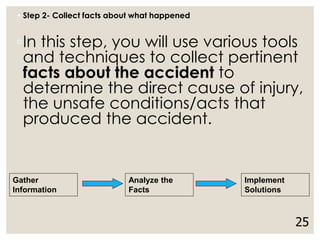
• Step 2- Collect facts about what happened
◦In this step, you will use various tools
and techniques to collect pertinent
facts about the accident to
determine the direct cause of injury,
the unsafe conditions/acts that
produced the accident.
25
Gather
Information
Analyze the
Facts
Implement
Solutions
• Step 3 - Develop the sequence of events
In this step, we take the information
gathered in step 2 to determine
the events prior to, during, and
after the accident. Once the
events are clearly understood, we
can then continue to examine
each event for hazardous
conditions and/or unsafe
behaviors.
26
◦Each event in the unplanned accident
process identifies one:
◦Actor - Individual or object
◦ An actor initiates a change by performing or
failing to perform an action.
◦ An actor may participate in the process or
merely observe the process.
◦Action – Behavior the actor
accomplishes
◦ Actions may or may not be observable.
◦ An action may describe something that is
done or not done.
27
Step 4 - Determine the causes
◦W. H. Heinrich's Domino Theory
◦"The occurrence of an injury
invariably results from a completed
sequence of factors, the last one of
these being the accident itself. The
accident in turn is invariably caused
or permitted directly by the unsafe
act of a person and/or a mechanical
or physical hazard."
◦ (W.H. Heinrich, Industrial Accident Prevention, 1931)
28
◦Multiple Cause Theory
◦Behind every accident there are
many contributing factors,
causes, and sub causes. These
factors combine in a random
fashion causing accidents.
◦We must find the fundamental
root causes and remove them to
prevent a recurrence.
◦ (Dan Petersen, Safety Management: A Human Approach)
29
◦Step 5 - Recommend corrective
actions & improvements
❑Engineering Controls - Remove or reduce
the hazard
◦ Eliminates or reduces the severity of the
hazard itself through initial design and
redesign, enclosure, substitution,
replacement and other engineering
changes.
◦ Major strengths: Eliminates the hazard itself.
Does not rely solely on human behavior for
effectiveness.
◦ Major weakness: May not be feasible if
controls present long-term financial hardship.
30
❑Management Controls - Remove or reduce
the exposure
◦ Reduce the duration, frequency, and severity
of exposure to hazards primarily through (1)
changes and work procedures and practices,
and (2) scheduling, job rotation, breaks.
◦ Major weakness: Relies on (1) appropriate
design and implementation of controls and (2)
appropriate employee behavior.
❑Personal protective equipment (PPE) - Put up a
barrier
◦ Equipment for personal use that presents a
barrier between worker and hazard.
◦ Major weakness: Relies on (1) appropriate
design and implementation of controls (2)
appropriate employee behavior.
31
•Step 6 - Write the report
❑ The primary reason accident
investigations fail to help
eliminate similar accidents is
that some report forms
unfortunately address only
correcting surface causes. Root
causes are often ignored. Let's
take a look at one format for
ensuring an effective report.
32
Accidents To Be Investigated
◦All accidents must be investigated
firstly by the Supervisor. These include:
◦“Near-miss”
◦Injury
◦Fatality
◦Property damage
◦In other cases, an investigation is
carried out by the safety department
(Safety Officer) or a multi-disciplinary
team of experts/specialists.
33
Pitfalls To Avoid During Investigation
DO NOT:
◦Put yourself in the role of a policeman.
◦Start off with a pencil and paper in
your hand.
◦Pin blame; this must be avoided
throughout the investigation.
◦Lead witness.
◦Ask closed-ended questions.
34
The report is an open document
until all actions are complete!
◦ When the accident investigator completes
the report, he or she will give it to someone
who must do something with it. That’s the job
of the decision-maker. For accident
investigation to be effective, management
must consider the findings and develop an
action plan for taking corrective action and
making system improvements. Finally,
periodic evaluation of the quality of accident
investigation and report is critical to
maintaining an effective program.
35
36
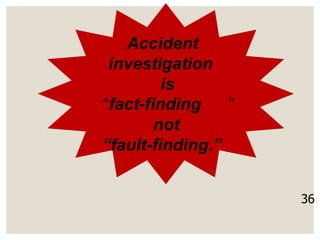
Accident
investigation
is
“fact-finding ”
not
“fault-finding.”
HEALTH, SAFETY &
ENVIRONMENT
MANAGEMENT SYSTEM
(HSE-MS)
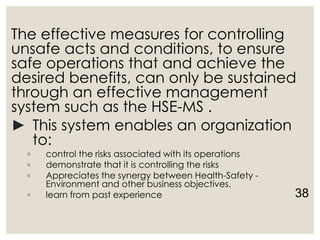
The effective measures for controlling
unsafe acts and conditions, to ensure
safe operations that and achieve the
desired benefits, can only be sustained
through an effective management
system such as the HSE-MS .
► This system enables an organization
to:
◦ control the risks associated with its operations
◦ demonstrate that it is controlling the risks
◦ Appreciates the synergy between Health-Safety -
Environment and other business objectives.
◦ learn from past experience 38
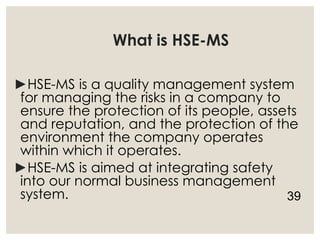
What is HSE-MS
►HSE-MS is a quality management system
for managing the risks in a company to
ensure the protection of its people, assets
and reputation, and the protection of the
environment the company operates
within which it operates.
►HSE-MS is aimed at integrating safety
into our normal business management
system. 39
Elements Of HSE-MS
► Due to the need to integrate safety into business
processes, HSE-MS has two additional elements
relative to the general elements in a business
system.
► Therefore, HSE-MS is made up of the following
elements:
◦ Leadership and commitment.
◦ Policy and strategic objectives.
◦ Organization, responsibilities, resources, standards
and documentation.
◦ Hazards and effects management.
◦ Planning and procedures.
◦ Implementation.
◦ Audit.
◦ Management Review.
40
Leadership And Commitment
►Management and supervision should be fully committed to HSE and
should be regarded so by all staff members and contractors.
►They should providing leading roles toward constant HSE improvement
through leadership and action planning.
►Management should regularly review the suitability and effectiveness of
the system.
41
Policy & Strategic Objectives
►Companies should have a written HSE
policy, covering the group policy elements as
a minimum.
►HSE objectives should be challenging,
understood by all and consistently
incorporated in policies.
►In setting objectives, management should
consider the overall risk level of its activities
and should identify those critical operations
which require a fully documented
demonstration that risks have been
managed.
42
Organization, Responsibilities, Resources,
Standards, And Documents
►– the organization and resources should be
adequate for its purposes.
►Responsibilities at all levels should be clearly
defined, communicated and understood.
►company personnel should be developed
following structured competency assessment
and training systems.
►Preparation, review and distribution of all
key reference documentation should be
adequately controlled. 43
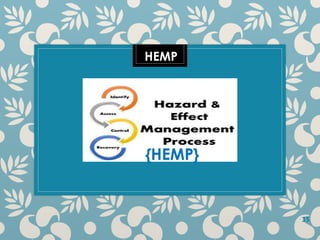
Hazards & Effects
Management Process (HEMP)
► The process for critical operations in a
company should include:
◦ An inventory of the major hazards (from activities,
materials, products and services) to the environment and
to the health and safety of people of; and
◦ An assessment of the related risks, implementation of
measures to control these risks and to recover in case of
control failure.
44
Planning and Procedures
►Adequate standards and procedures should
be in place and understood at the
appropriate organization levels.
►Preparation, review and distribution of all key
reference documents shall be adequately
controlled.
►HSE standards include: procedures and work
instructions; permit to work; concurrent
operations; contractor HSE; business cycle
and HSE planning.
►Emergency response procedures (including
medical emergencies) shall be regularly
tested.
45
Implementation & Monitoring
►Company should set HSE performance targets to
ensure the attainment of long-term goals of no
harm to people and no damage to the
environment.
►Performance indicators should be established,
monitored and results reported in a way that can
be externally verified.
►All HSE incidents and near misses with significant
actual or potential consequences should be
thoroughly investigated and reported. 46
Audit
►Audit program should be in place to
verify the effectiveness of the system.
►An audit program will include
internal and external audits, and
external certification. Audit follow up
should be timely, thorough and
auditable 47
Review
►There should be a functional
review program to assess the
suitability and effectiveness of
the HSE-MS.
►Implementations and the entire
system should be reviewed at
reasonable intervals 48
35
HEMP
{HEMP}
◦HEMP is a process for identifying
the hazards in an HSE critical
activity and the effect(s), with a
view to eliminating them or
controlling them to reduce the
effects to as low as reasonably
practicable (ALARP)
◦ It is a unique element of HSE-MS because of its central role in the
implementation of the system
50
Principles of HEMP
◦HEMP is based on 4 principles
◦Identify
◦Assess
◦Control
◦Recovery
51
◦An operation is broken down into
its component activities, those
activities that are identified to be
HSE critical are then subjected to
HEMP
◦The process involves identification
of the hazards, assessment of the
effects or risks and the provision of
control and recovery measures. 52
◦Controls measures prevents
accident, recovery measures
mitigate (reduce) the effect of
the accident and enable early
return to normal operations.
◦If recovery measures fail and
escalation occurs, emergency
procedures will be initiated.
53
HEMP - Procedures
1. Identify hazards and potential effects
2. Evaluate (Assess) effects of the identified
hazards against accepted screening criteria.
3. Record hazards and effects in any of the
following documents
• Hazard & Effect Register
• HSE-MS Activities Catalogue
• HSE Critical Operation Procedures
• HSE Activity Specification Sheet
• Manual of Permitted Operations
➢ These documents will be included in “Policy &
Strategic Objectives” and ‘Planning &
Procedures’ sections of HSE-MS 54
4. Compare the evaluated risks (effects) against HSE objectives and targets
for the project or operation.
5. Select, evaluate and implement appropriate measures to reduce or
eliminate risk or effects.
◦ Beside control and recovery measures, risk reduction measures also
include recovery preparedness measures, which address emergency
procedures.
55
HEMP - Implementation
HEMP can be implemented at any point in the life
cycle of an operation
◦ When planning the operation
◦ The focus is on identification and assessment of hazards and
effects that may be eliminated, avoided or mitigated.
◦ In the operational / maintenance phase
◦ Focus is on control of hazards and effects by procedures, and
the development / implementation of effective recovery
preparedness measures
◦ In the abandonment / decommissioning phase
◦ The focus is on safe clean up and rehabilitation.
NB: People involved in operational / maintenance
activities should always be at alert to identify
hazards, especially in non-routine operations. 56
HEALTH RISK
ASSESSMENT
◦Our health is constantly affected by
our activities and environment.
◦Considering the importance of good
health, we should guide against
negative influences on our health by
having a closer assessment of our
environment and activities as to
know the hazards inherent and
consider if we should take the risk of
continuing in that environment or
activity. 58
◦ Each occupation has its health hazard which affects
the workers health if not adequately protected.
◦ Life has no duplicate; it should be guided jealously.
◦ At work, we should ensure that our health is
protected and promoted by complementing the
efforts of the management to disclose
condition/situations that have potentials of causing
harm to our health.
◦ We should ascertain that our judgment of such
situations/conditions justifies our decision to either get
on with the job or not.
◦ The inevitable presence of hazard in all human
endeavour makes most situations accident prone.
Since human beings must function, virtually every
action taken by individuals possesses some level of
risk.
59
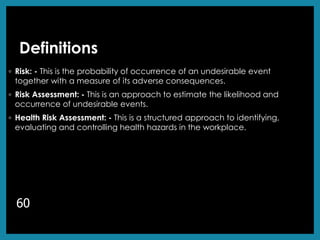
Definitions
◦ Risk: - This is the probability of occurrence of an undesirable event
together with a measure of its adverse consequences.
◦ Risk Assessment: - This is an approach to estimate the likelihood and
occurrence of undesirable events.
◦ Health Risk Assessment: - This is a structured approach to identifying,
evaluating and controlling health hazards in the workplace.
60
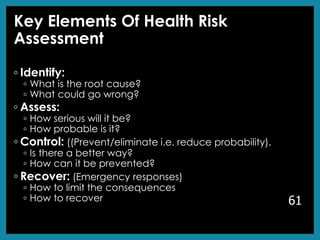
Key Elements Of Health Risk
Assessment
◦ Identify:
◦ What is the root cause?
◦ What could go wrong?
◦ Assess:
◦ How serious will it be?
◦ How probable is it?
◦ Control: ((Prevent/eliminate i.e. reduce probability).
◦ Is there a better way?
◦ How can it be prevented?
◦ Recover: (Emergency responses)
◦ How to limit the consequences
◦ How to recover 61
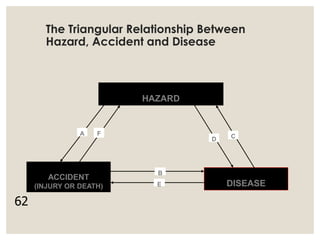
The Triangular Relationship Between
Hazard, Accident and Disease
62
HAZARD
ACCIDENT
(INJURY OR DEATH) DISEASE
A F
D C
B
E
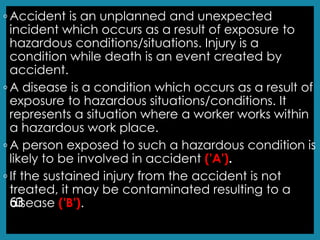
◦ Accident is an unplanned and unexpected
incident which occurs as a result of exposure to
hazardous conditions/situations. Injury is a
condition while death is an event created by
accident.
◦ A disease is a condition which occurs as a result of
exposure to hazardous situations/conditions. It
represents a situation where a worker works within
a hazardous work place.
◦ A person exposed to such a hazardous condition is
likely to be involved in accident ('A').
◦ If the sustained injury from the accident is not
treated, it may be contaminated resulting to a
disease ('B').
63
◦(C) shows a patient suffering from a disease
(e.g tuberculosis – communicable). Such
becomes hazardous as a result of the
effects and nature of the disease. The
patient might spread the disease to other
workers.
◦The materials and processes used in a
poorly guarded environment may release
dangerous disease (e.g. silicosis). (D).
◦(E) represents a situation in which a person
suffering from a disease like epilepsy
involves in an accident as a result of
epileptic attack while at work.
◦(F) represents an accident scene that
becomes hazardous as a result of delay in
clearing the scene.
64
Steps In Health Risk Assessment
1. Define management role and responsibility
◦Draw a Health Risk Assessment
Programme.
◦Ensure management involvement and
commitment by appointing a
management representative in the
team.
◦Allocate responsibilities to competent
persons with roles well defined
65
2. Define structure for implementation
◦ Break complex sites into Assessment Units for easy
management.
◦ Appoint operational staff and specialists as
members of Assessment Team. Each team should
have a competent leader who should report to the
management.
◦ Personnel in the Assessment Unit should be
assigned to common jobs, which have broadly
similar exposure profile.
◦ The Assessment Unit should identify the task
involved in a job and make inventory of the
hazardous aspects to which staff may be exposed
to.
◦ For cheap and effective assessment. use similar
operations for which hazard to health are similar
(Generic Approach).
66
3. Gather information on the following:
◦Agents and their harmful effects.
◦Nature and degree of exposure
◦Screening and performance criteria.
◦Exposure limits
◦Engineering control
◦Procedural control
◦For P. P. E.
◦For emergency (recovery)
67
4. Evaluate the risk to health
◦ Hazard Rating
◦ Slight injury illness
◦ Minor injury illness
◦ Major injury illness
◦ Permanent/total disability/fatality
◦ Multiple fatalities
◦ Exposure Rating
◦ Very low
◦ Low
◦ Medium
◦ High
◦ Very high
◦ Risk to Health
◦ Combine the hazard and exposure ratings to judge the risk
to health. The greater the population exposed, the greater
the likelihood that the ill-health effects will occur and hence
the risk.
68
5. Decide on remedial action
6. Record the health risk assessment
◦ A record of all Health Risk Assessment should be
kept.
◦ It should be retrievable.
◦ It should meet legal requirements.
◦ It should contain sufficient information to ensure future clarity.
◦ Record format should include:
◦ Job type details
◦ Task details
◦ Recommendations and Reviews
◦ Inform the staff.
69
7. Review the health risk
assessment
◦In order to ensure the continuing
validity of Health Risk Assessments and
on-going control of staff exposure to
hazardous agents, the Health risk
Assessment process should be subject
to planned reviews.
70
BENEFITS OF HEALTH RISK
ASSESSMENT
◦ Source of information for HSE-MS case
development.
◦ Enhancement of workers understanding of
the relationship between health and work.
◦ Monitoring the effectiveness of controls.
◦ Relevant legislation and standards are in
place.
◦ Effectiveness of health promotion campaign.
◦ Improvement objectives.
71
Thanks for listening
72

HSE course; HSE 1 & 2. Overview analysis

  • 1.
    GENERAL HEALTH, SAFETY& ENVIRONMENT COURSE TITAN TEE CONSULT ISL GHSE
  • 2.
    INTRODUCTION. Health, Safety andEnvironment involves the study of scientific subject such as; ◦ Chemistry ◦ Physics ◦ Biology ◦ Engineering ◦ Psychology & ◦ Law. 2
  • 3.
    Health, Safety andEnvironment issues requires the following for full understanding of its code of practice; ◦ Technical background to the issue and relevant knowledge, ◦ Standards that may apply to the workplace and to the specific health, Safety and Environment issue under consideration. ◦ Possible strength 3
  • 4.
    INTRODUCTORY DEFINITIONS ◦ Safety– is the absence of Risk of serious personal injury. This implies that Safety is an act of being free from harm. Staying out danger areas results in SAFETY. ◦ Health – is the totality of good physical, emotional & mental state of an individual. This is not mere absence of diseases. Health relates not only to physical ill health but also to psychological ill health for instance exposure to extreme stress can lead to nervous breakdown. ◦ Welfare – is access to basic facilities within workplace such as toilet facailities, hand wash stations, changing room/cloak room, rest room, canteen, drinking water and basic first aid provision. 4
  • 5.
    DEFINITIONS CONTD…….. ◦ Accident– is an unplanned, unwanted event/occurrence that can lead to injury or damages/loss or both and sometimes death. ◦ Nearmiss - is an unplanned, unwanted event/occurrence that that had potential to lead to injury, damages/loss or even death, {but did not actual do so} ◦ Dangerous Occurrence – is a specific/major event that may require report to relevant authority by law. ◦ Hazard – is anything or something that has potential to cause harm. ◦ Risk – is the likelihood that a hazard will cause harm, in combination with the severity of injury, damage or loss that might occur. Therefore; Risk {R} = L X S, where; ‘L’ is the likelihood & ‘S’ is the Severity 5
  • 6.
    RESPONSIBILITIES OF ANEMPLOYER Employers has the mandatory duty by law to provide the following; 1. Safe place of work. 2. Safe plant and Equipment. 3. Safe System of work. 4. Adequate training and Supervision. 5. Engauge Competent Employees. 6. Provision of Personal Protective Equipment {PPE} to all Employees at no cost. 6
  • 7.
    RESPONSIBILITIES OF ANEMPLOYEE ◦ Employees must take reasonable care of their own personal Safety and that of other people who might be affected by the things they do and the things they fail to do. ◦ Employees must comply with Safety Instructions and Procedures. ◦ They must use all Safety Equipment properly and not tamper with it. ◦ They must report any situation that pose harm to them especially those that cannot be handled by them. ◦ Employees must report any work – related ACCIDENT or ill health. 7
  • 8.
    8 Responsibility of aSafety Compliance Employee/ Officer is to always ensure………………………………………………… SAFE & HEALTHY WORKPLACE
  • 9.
    ◦If a taskor activity; …..is not safe for you {do not do it} …..not safe for your employees {do not allow it} …..not safe for others {tell them} …..possess serious hazard {stop it immediately} …..has unknown consequences {stop & find out} 9 Therefore… ……………...is required
  • 10.
  • 11.
    11 ACCIDENT History of accidentis dated back to 18th Century when machine were invented. Machines had dangerous moving parts, drive belt, exposed cutting blades and reciprocating shaft etc. including poor lighting and ventilation in the rooms they were been operated. This situations produce injury, ill health, damages and death to Employees.
  • 12.
    Industrialactivitiesgenerally involve people,machine,materials, chemicalsandthe environment. These element interact together duringoperationthereby having adverseimpacton each other causingdamages and injury. Remember; Accident– is an unplanned,unwantedevent/occurrencethat can lead to injury or damages/lossor both and sometimesdeath. Usually the adverseimpacts are initiated by UnsafeAct and Unsafe Condition. Always rememberthat accidentare not made, they chiefly causedby Unsafeact or unsafecondition. 12 ACCIDENT
  • 13.
    13 ACCIDENT The two majorcauses an accident are; 1. Unsafe Act & 2. Unsafe Condition. Unsafe Act are action taken by someone without due regard to personal safety and that of his fellow or co employees and other person around. These act are usually contrary to rules and regulations or accepted standard practices and procedures. They are illegal acts.
  • 14.
    14 ACCIDENT Unsafe Conditions arephysical condition attributable to physical and mechanical sources within an environment which if left uncorrected may lead to an accident. Such as workplace conditions or equipment and materials condition that can cause accidents. This are fundamental cause of numerous accidents The existence of this condition has capacity to always cause accident.
  • 15.
    15 ACCIDENT See attached………… 1. Examplesof Unsafe Act 2. Examples of Unsafe Condition 3. Direct and indirect cost of an accident 4. Accident ratio study 5. Accident prevention……4Es
  • 16.
  • 17.
    Introduction ◦Accidents must bepromptly reported by the victim(s) or witnesses as soon as they occur. ◦This is very important because when they are reported, the machinery for investigating is set in motion. The information (lessons) gathered from the investigation will provide useful guides in preventing a recurrence as against when they are not reported. 17
  • 18.
    ◦Accident promptly reportedby the fastest means of communication available will receive immediate attention enabling the facts about the accident to be readily obtained. This is a compliance with Government Regulations, which require notification of certain accidents within 48 hours. 18
  • 19.
    The three primarytasks of the accident investigator are; - to gather useful information, - analyze the facts surrounding the accident, and - write the accident report. ◦ The intent of this discussion is to help you gain the basic skills necessary to conduct an effective accident investigation at your workplace. ◦ Only experience will give you the expertise to fine-tune those skills 19
  • 20.
    Purpose Of AccidentInvestigation ◦Traditionally, accident investigation is viewed by many employees as a fault finding exercise. They regard it as an activity to find out: ◦Whom to blame, ◦A scapegoat or someone to impose sanctions on. ◦Such employees neither report accidents nor co-operate during investigations. They are the type who will always say “I don’t know anything about the accident; I was not there”. 2 0
  • 21.
    Aims Of SoundAccident Investigation ◦To Prevent Recurrence ◦A thorough investigation will make available the facts bearing on the accident. These facts can be utilized to prevent recurrence of the accident. ◦To Determine Costs ◦The total loss incurred as a result of the accident can be computed after a detailed investigation. Such computed cost can help management appreciate and willingly endorse programmes aimed at improving safety awareness. 21
  • 22.
    ◦To Publicize Cause(s) ◦Publicityof cause(s) of accident keeps personnel in other locations or units of the company informed so that they can take appropriate preventive measures to avoid such incident(s). ◦Payment Of Compensation ◦Accident reporting and investigation are essential in ensuring proper medical attention and documentation for purpose of Workmen’s compensation claims. 22
  • 23.
    ◦ Legal Requirement ◦Government Regulations such as the Factories Act 1990 and Mineral Oils (Safety) Regulations 1963 require that comprehensive reports be made of Oil services and fatal accidents occurring during company’s operations. A detailed investigation must be carried out to ensure compliance with this requirement. ◦ Compilation Of Data ◦ Accident investigation enables statistical data to be compiled. Such data when analysed, indicate how good or bad the safety performance of the organization is. They indicate the problem areas, thus enabling a determination of what needs to be done to correct the bad situation. 2 3
  • 24.
    Procedures For Accident Investigation– The 6-step process •Step 1 - Secure the accident scene Your primary goal in this step is to gather accident information that can give critical clues into the causes associated with the accident. To do that you must first secure the accident scene. 24
  • 25.
    • Step 2-Collect facts about what happened ◦In this step, you will use various tools and techniques to collect pertinent facts about the accident to determine the direct cause of injury, the unsafe conditions/acts that produced the accident. 25 Gather Information Analyze the Facts Implement Solutions
  • 26.
    • Step 3- Develop the sequence of events In this step, we take the information gathered in step 2 to determine the events prior to, during, and after the accident. Once the events are clearly understood, we can then continue to examine each event for hazardous conditions and/or unsafe behaviors. 26
  • 27.
    ◦Each event inthe unplanned accident process identifies one: ◦Actor - Individual or object ◦ An actor initiates a change by performing or failing to perform an action. ◦ An actor may participate in the process or merely observe the process. ◦Action – Behavior the actor accomplishes ◦ Actions may or may not be observable. ◦ An action may describe something that is done or not done. 27
  • 28.
    Step 4 -Determine the causes ◦W. H. Heinrich's Domino Theory ◦"The occurrence of an injury invariably results from a completed sequence of factors, the last one of these being the accident itself. The accident in turn is invariably caused or permitted directly by the unsafe act of a person and/or a mechanical or physical hazard." ◦ (W.H. Heinrich, Industrial Accident Prevention, 1931) 28
  • 29.
    ◦Multiple Cause Theory ◦Behindevery accident there are many contributing factors, causes, and sub causes. These factors combine in a random fashion causing accidents. ◦We must find the fundamental root causes and remove them to prevent a recurrence. ◦ (Dan Petersen, Safety Management: A Human Approach) 29
  • 30.
    ◦Step 5 -Recommend corrective actions & improvements ❑Engineering Controls - Remove or reduce the hazard ◦ Eliminates or reduces the severity of the hazard itself through initial design and redesign, enclosure, substitution, replacement and other engineering changes. ◦ Major strengths: Eliminates the hazard itself. Does not rely solely on human behavior for effectiveness. ◦ Major weakness: May not be feasible if controls present long-term financial hardship. 30
  • 31.
    ❑Management Controls -Remove or reduce the exposure ◦ Reduce the duration, frequency, and severity of exposure to hazards primarily through (1) changes and work procedures and practices, and (2) scheduling, job rotation, breaks. ◦ Major weakness: Relies on (1) appropriate design and implementation of controls and (2) appropriate employee behavior. ❑Personal protective equipment (PPE) - Put up a barrier ◦ Equipment for personal use that presents a barrier between worker and hazard. ◦ Major weakness: Relies on (1) appropriate design and implementation of controls (2) appropriate employee behavior. 31
  • 32.
    •Step 6 -Write the report ❑ The primary reason accident investigations fail to help eliminate similar accidents is that some report forms unfortunately address only correcting surface causes. Root causes are often ignored. Let's take a look at one format for ensuring an effective report. 32
  • 33.
    Accidents To BeInvestigated ◦All accidents must be investigated firstly by the Supervisor. These include: ◦“Near-miss” ◦Injury ◦Fatality ◦Property damage ◦In other cases, an investigation is carried out by the safety department (Safety Officer) or a multi-disciplinary team of experts/specialists. 33
  • 34.
    Pitfalls To AvoidDuring Investigation DO NOT: ◦Put yourself in the role of a policeman. ◦Start off with a pencil and paper in your hand. ◦Pin blame; this must be avoided throughout the investigation. ◦Lead witness. ◦Ask closed-ended questions. 34
  • 35.
    The report isan open document until all actions are complete! ◦ When the accident investigator completes the report, he or she will give it to someone who must do something with it. That’s the job of the decision-maker. For accident investigation to be effective, management must consider the findings and develop an action plan for taking corrective action and making system improvements. Finally, periodic evaluation of the quality of accident investigation and report is critical to maintaining an effective program. 35
  • 36.
  • 37.
  • 38.
    The effective measuresfor controlling unsafe acts and conditions, to ensure safe operations that and achieve the desired benefits, can only be sustained through an effective management system such as the HSE-MS . ► This system enables an organization to: ◦ control the risks associated with its operations ◦ demonstrate that it is controlling the risks ◦ Appreciates the synergy between Health-Safety - Environment and other business objectives. ◦ learn from past experience 38
  • 39.
    What is HSE-MS ►HSE-MSis a quality management system for managing the risks in a company to ensure the protection of its people, assets and reputation, and the protection of the environment the company operates within which it operates. ►HSE-MS is aimed at integrating safety into our normal business management system. 39
  • 40.
    Elements Of HSE-MS ►Due to the need to integrate safety into business processes, HSE-MS has two additional elements relative to the general elements in a business system. ► Therefore, HSE-MS is made up of the following elements: ◦ Leadership and commitment. ◦ Policy and strategic objectives. ◦ Organization, responsibilities, resources, standards and documentation. ◦ Hazards and effects management. ◦ Planning and procedures. ◦ Implementation. ◦ Audit. ◦ Management Review. 40
  • 41.
    Leadership And Commitment ►Managementand supervision should be fully committed to HSE and should be regarded so by all staff members and contractors. ►They should providing leading roles toward constant HSE improvement through leadership and action planning. ►Management should regularly review the suitability and effectiveness of the system. 41
  • 42.
    Policy & StrategicObjectives ►Companies should have a written HSE policy, covering the group policy elements as a minimum. ►HSE objectives should be challenging, understood by all and consistently incorporated in policies. ►In setting objectives, management should consider the overall risk level of its activities and should identify those critical operations which require a fully documented demonstration that risks have been managed. 42
  • 43.
    Organization, Responsibilities, Resources, Standards,And Documents ►– the organization and resources should be adequate for its purposes. ►Responsibilities at all levels should be clearly defined, communicated and understood. ►company personnel should be developed following structured competency assessment and training systems. ►Preparation, review and distribution of all key reference documentation should be adequately controlled. 43
  • 44.
    Hazards & Effects ManagementProcess (HEMP) ► The process for critical operations in a company should include: ◦ An inventory of the major hazards (from activities, materials, products and services) to the environment and to the health and safety of people of; and ◦ An assessment of the related risks, implementation of measures to control these risks and to recover in case of control failure. 44
  • 45.
    Planning and Procedures ►Adequatestandards and procedures should be in place and understood at the appropriate organization levels. ►Preparation, review and distribution of all key reference documents shall be adequately controlled. ►HSE standards include: procedures and work instructions; permit to work; concurrent operations; contractor HSE; business cycle and HSE planning. ►Emergency response procedures (including medical emergencies) shall be regularly tested. 45
  • 46.
    Implementation & Monitoring ►Companyshould set HSE performance targets to ensure the attainment of long-term goals of no harm to people and no damage to the environment. ►Performance indicators should be established, monitored and results reported in a way that can be externally verified. ►All HSE incidents and near misses with significant actual or potential consequences should be thoroughly investigated and reported. 46
  • 47.
    Audit ►Audit program shouldbe in place to verify the effectiveness of the system. ►An audit program will include internal and external audits, and external certification. Audit follow up should be timely, thorough and auditable 47
  • 48.
    Review ►There should bea functional review program to assess the suitability and effectiveness of the HSE-MS. ►Implementations and the entire system should be reviewed at reasonable intervals 48
  • 49.
  • 50.
    ◦HEMP is aprocess for identifying the hazards in an HSE critical activity and the effect(s), with a view to eliminating them or controlling them to reduce the effects to as low as reasonably practicable (ALARP) ◦ It is a unique element of HSE-MS because of its central role in the implementation of the system 50
  • 51.
    Principles of HEMP ◦HEMPis based on 4 principles ◦Identify ◦Assess ◦Control ◦Recovery 51
  • 52.
    ◦An operation isbroken down into its component activities, those activities that are identified to be HSE critical are then subjected to HEMP ◦The process involves identification of the hazards, assessment of the effects or risks and the provision of control and recovery measures. 52
  • 53.
    ◦Controls measures prevents accident,recovery measures mitigate (reduce) the effect of the accident and enable early return to normal operations. ◦If recovery measures fail and escalation occurs, emergency procedures will be initiated. 53
  • 54.
    HEMP - Procedures 1.Identify hazards and potential effects 2. Evaluate (Assess) effects of the identified hazards against accepted screening criteria. 3. Record hazards and effects in any of the following documents • Hazard & Effect Register • HSE-MS Activities Catalogue • HSE Critical Operation Procedures • HSE Activity Specification Sheet • Manual of Permitted Operations ➢ These documents will be included in “Policy & Strategic Objectives” and ‘Planning & Procedures’ sections of HSE-MS 54
  • 55.
    4. Compare theevaluated risks (effects) against HSE objectives and targets for the project or operation. 5. Select, evaluate and implement appropriate measures to reduce or eliminate risk or effects. ◦ Beside control and recovery measures, risk reduction measures also include recovery preparedness measures, which address emergency procedures. 55
  • 56.
    HEMP - Implementation HEMPcan be implemented at any point in the life cycle of an operation ◦ When planning the operation ◦ The focus is on identification and assessment of hazards and effects that may be eliminated, avoided or mitigated. ◦ In the operational / maintenance phase ◦ Focus is on control of hazards and effects by procedures, and the development / implementation of effective recovery preparedness measures ◦ In the abandonment / decommissioning phase ◦ The focus is on safe clean up and rehabilitation. NB: People involved in operational / maintenance activities should always be at alert to identify hazards, especially in non-routine operations. 56
  • 57.
  • 58.
    ◦Our health isconstantly affected by our activities and environment. ◦Considering the importance of good health, we should guide against negative influences on our health by having a closer assessment of our environment and activities as to know the hazards inherent and consider if we should take the risk of continuing in that environment or activity. 58
  • 59.
    ◦ Each occupationhas its health hazard which affects the workers health if not adequately protected. ◦ Life has no duplicate; it should be guided jealously. ◦ At work, we should ensure that our health is protected and promoted by complementing the efforts of the management to disclose condition/situations that have potentials of causing harm to our health. ◦ We should ascertain that our judgment of such situations/conditions justifies our decision to either get on with the job or not. ◦ The inevitable presence of hazard in all human endeavour makes most situations accident prone. Since human beings must function, virtually every action taken by individuals possesses some level of risk. 59
  • 60.
    Definitions ◦ Risk: -This is the probability of occurrence of an undesirable event together with a measure of its adverse consequences. ◦ Risk Assessment: - This is an approach to estimate the likelihood and occurrence of undesirable events. ◦ Health Risk Assessment: - This is a structured approach to identifying, evaluating and controlling health hazards in the workplace. 60
  • 61.
    Key Elements OfHealth Risk Assessment ◦ Identify: ◦ What is the root cause? ◦ What could go wrong? ◦ Assess: ◦ How serious will it be? ◦ How probable is it? ◦ Control: ((Prevent/eliminate i.e. reduce probability). ◦ Is there a better way? ◦ How can it be prevented? ◦ Recover: (Emergency responses) ◦ How to limit the consequences ◦ How to recover 61
  • 62.
    The Triangular RelationshipBetween Hazard, Accident and Disease 62 HAZARD ACCIDENT (INJURY OR DEATH) DISEASE A F D C B E
  • 63.
    ◦ Accident isan unplanned and unexpected incident which occurs as a result of exposure to hazardous conditions/situations. Injury is a condition while death is an event created by accident. ◦ A disease is a condition which occurs as a result of exposure to hazardous situations/conditions. It represents a situation where a worker works within a hazardous work place. ◦ A person exposed to such a hazardous condition is likely to be involved in accident ('A'). ◦ If the sustained injury from the accident is not treated, it may be contaminated resulting to a disease ('B'). 63
  • 64.
    ◦(C) shows apatient suffering from a disease (e.g tuberculosis – communicable). Such becomes hazardous as a result of the effects and nature of the disease. The patient might spread the disease to other workers. ◦The materials and processes used in a poorly guarded environment may release dangerous disease (e.g. silicosis). (D). ◦(E) represents a situation in which a person suffering from a disease like epilepsy involves in an accident as a result of epileptic attack while at work. ◦(F) represents an accident scene that becomes hazardous as a result of delay in clearing the scene. 64
  • 65.
    Steps In HealthRisk Assessment 1. Define management role and responsibility ◦Draw a Health Risk Assessment Programme. ◦Ensure management involvement and commitment by appointing a management representative in the team. ◦Allocate responsibilities to competent persons with roles well defined 65
  • 66.
    2. Define structurefor implementation ◦ Break complex sites into Assessment Units for easy management. ◦ Appoint operational staff and specialists as members of Assessment Team. Each team should have a competent leader who should report to the management. ◦ Personnel in the Assessment Unit should be assigned to common jobs, which have broadly similar exposure profile. ◦ The Assessment Unit should identify the task involved in a job and make inventory of the hazardous aspects to which staff may be exposed to. ◦ For cheap and effective assessment. use similar operations for which hazard to health are similar (Generic Approach). 66
  • 67.
    3. Gather informationon the following: ◦Agents and their harmful effects. ◦Nature and degree of exposure ◦Screening and performance criteria. ◦Exposure limits ◦Engineering control ◦Procedural control ◦For P. P. E. ◦For emergency (recovery) 67
  • 68.
    4. Evaluate therisk to health ◦ Hazard Rating ◦ Slight injury illness ◦ Minor injury illness ◦ Major injury illness ◦ Permanent/total disability/fatality ◦ Multiple fatalities ◦ Exposure Rating ◦ Very low ◦ Low ◦ Medium ◦ High ◦ Very high ◦ Risk to Health ◦ Combine the hazard and exposure ratings to judge the risk to health. The greater the population exposed, the greater the likelihood that the ill-health effects will occur and hence the risk. 68
  • 69.
    5. Decide onremedial action 6. Record the health risk assessment ◦ A record of all Health Risk Assessment should be kept. ◦ It should be retrievable. ◦ It should meet legal requirements. ◦ It should contain sufficient information to ensure future clarity. ◦ Record format should include: ◦ Job type details ◦ Task details ◦ Recommendations and Reviews ◦ Inform the staff. 69
  • 70.
    7. Review thehealth risk assessment ◦In order to ensure the continuing validity of Health Risk Assessments and on-going control of staff exposure to hazardous agents, the Health risk Assessment process should be subject to planned reviews. 70
  • 71.
    BENEFITS OF HEALTHRISK ASSESSMENT ◦ Source of information for HSE-MS case development. ◦ Enhancement of workers understanding of the relationship between health and work. ◦ Monitoring the effectiveness of controls. ◦ Relevant legislation and standards are in place. ◦ Effectiveness of health promotion campaign. ◦ Improvement objectives. 71
  • 72.