Conducted by PricewaterhouseCoopers
on behalf of the World Federation of
Personnel Management Associations
(WFPMA)
Survey of
Global HR
Challenges:
Yesterday,
today and
tomorrow*
Survey of Global HR Challenges: Yesterday, today and tomorrow 3
Contents
Foreword . . . . . . . . . . . . . . . . . . . . . . . . . . . . . . . . . . . . . . . . 4
Global results . . . . . . . . . . . . . . . . . . . . . . . . . . . . . . . . . . . 7
Africa results . . . . . . . . . . . . . . . . . . . . . . . . . . . . . . . . . . . 12
Asia Pacific results. . . . . . . . . . . . . . . . . . . . . . . . . . . . . 15
Europe results. . . . . . . . . . . . . . . . . . . . . . . . . . . . . . . . . . 18
North America results. . . . . . . . . . . . . . . . . . . . . . . . . . 21
South America results . . . . . . . . . . . . . . . . . . . . . . . . . 24
Conclusion . . . . . . . . . . . . . . . . . . . . . . . . . . . . . . . . . . . . . 27
Contact information. . . . . . . . . . . . . . . . . . . . . . . . . . . . 30
Foreword
To mark the 10th anniversary of its bi-
annual World Congress last year, the World
Federation of Personnel Management
Associations (WFPMA) commissioned a
survey, undertaken on its behalf by
PricewaterhouseCoopers (PwC), on the
current HR challenges faced by HR
professionals three years ago, what those
issues are today and what they believe
they will be three years from now.
The WFPMA:
The World Federation of Personnel Management
Associations is a global network of
professionals in Human Resources. Founded
in 1976, its mission is to aid the development
and improve the effectiveness of professional
people managers all over the world. The
continental federations making up the
membership include more than 70 national
personnel associations representing over
400,000 people management professionals.The
networking opportunities afforded by WFPMA
include a quarterly newsletter and periodic
research projects along with the international
World Congress held every two years.
The WFPMA has five main objectives:
1 To improve the quality and effectiveness
of professional people management, and
to demonstrate the importance of the HR
role in all employing organisations, both
public and private.
2 To stimulate and assist in the establishment
and development of regional and national
personnel management associations in those
parts of the world where a continental or
regional association does not exist.
3 To create and maintain contacts with all
WFPMA member associations as well as with
other organisations which have some activity
in the same or similar field.
4 To support or represent personnel
management associations in their contacts
with world organisations such as ILO,
UNESCO, the UN, etc.
5 To commission or undertake research which
will further broaden understanding of
personnel issues.
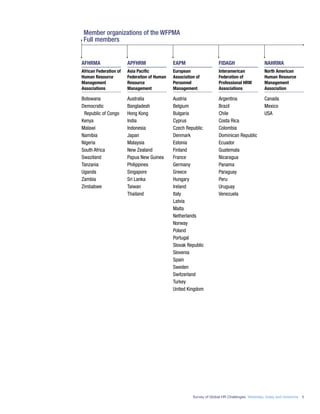
The graphic on the next page lists the regional
federations as well as which countries are
represented in these federations:
4 Survey of Global HR Challenges: Yesterday, today and tomorrow
Survey of Global HR Challenges: Yesterday, today and tomorrow 5
Member organizations of the WFPMA
Full members
AFHRMA
African Federation of
Human Resource
Management
Associations
Botswana
Democratic
Republic of Congo
Kenya
Malawi
Namibia
Nigeria
South Africa
Swaziland
Tanzania
Uganda
Zambia
Zimbabwe
APFHRM
Asia Pacific
Federation of Human
Resource
Management
Australia
Bangladesh
Hong Kong
India
Indonesia
Japan
Malaysia
New Zealand
Papua New Guinea
Philippines
Singapore
Sri Lanka
Taiwan
Thailand
EAPM
European
Association of
Personnel
Management
Austria
Belgium
Bulgaria
Cyprus
Czech Republic
Denmark
Estonia
Finland
France
Germany
Greece
Hungary
Ireland
Italy
Latvia
Malta
Netherlands
Norway
Poland
Portugal
Slovak Republic
Slovenia
Spain
Sweden
Switzerland
Turkey
United Kingdom
FIDAGH
Interamerican
Federation of
Professional HRM
Associations
Argentina
Brazil
Chile
Costa Rica
Colombia
Dominican Republic
Ecuador
Guatemala
Nicaragua
Panama
Paraguay
Peru
Uruguay
Venezuela
NAHRMA
North American
Human Resource
Management
Association
Canada
Mexico
USA
6 Survey of Global HR Challenges: Yesterday, today and tomorrow
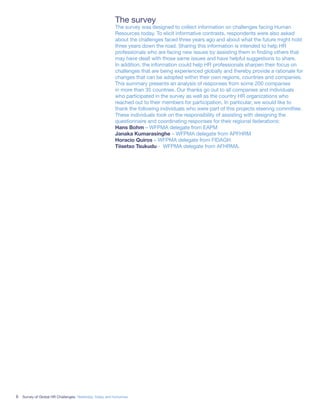
The survey
The survey was designed to collect information on challenges facing Human
Resources today. To elicit informative contrasts, respondents were also asked
about the challenges faced three years ago and about what the future might hold
three years down the road. Sharing this information is intended to help HR
professionals who are facing new issues by assisting them in finding others that
may have dealt with those same issues and have helpful suggestions to share.
In addition, the information could help HR professionals sharpen their focus on
challenges that are being experienced globally and thereby provide a rationale for
changes that can be adopted within their own regions, countries and companies.
This summary presents an analysis of responses from some 200 companies
in more than 35 countries. Our thanks go out to all companies and individuals
who participated in the survey as well as the country HR organizations who
reached out to their members for participation. In particular, we would like to
thank the following individuals who were part of this projects steering committee.
These individuals took on the responsibility of assisting with designing the
questionnaire and coordinating responses for their regional federations:
Hans Bohm – WFPMA delegate from EAPM
Janaka Kumarasinghe – WFPMA delegate from APFHRM
Horacio Quiros – WFPMA delegate from FIDAGH
Tiisetso Tsukudu - WFPMA delegate from AFHRMA.
Global results
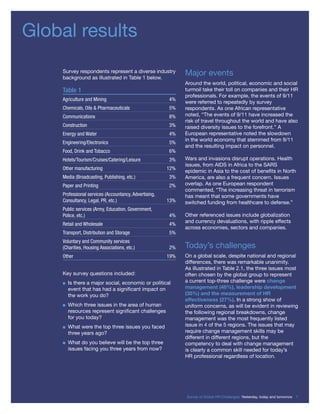
Survey respondents represent a diverse industry
background as illustrated in Table 1 below.
Table 1
Agriculture and Mining 4%
Chemicals, Oils & Pharmaceuticals 5%
Communications 8%
Construction 3%
Energy and Water 4%
Engineering/Electronics 5%
Food, Drink and Tobacco 6%
Hotels/Tourism/Cruises/Catering/Leisure 3%
Other manufacturing 12%
Media (Broadcasting, Publishing, etc.) 3%
Paper and Printing 2%
Professional services (Accountancy, Advertising,
Consultancy, Legal, PR, etc.) 13%
Public services (Army, Education, Government,
Police, etc.) 4%
Retail and Wholesale 4%
Transport, Distribution and Storage 5%
Voluntary and Community services
(Charities, Housing Associations, etc.) 2%
Other 19%
Key survey questions included:
■ Is there a major social, economic or political
event that has had a significant impact on
the work you do?
■ Which three issues in the area of human
resources represent significant challenges
for you today?
■ What were the top three issues you faced
three years ago?
■ What do you believe will be the top three
issues facing you three years from now?
Major events
Around the world, political, economic and social
turmoil take their toll on companies and their HR
professionals. For example, the events of 9/11
were referred to repeatedly by survey
respondents. As one African representative
noted, “The events of 9/11 have increased the
risk of travel throughout the world and have also
raised diversity issues to the forefront.” A
European representative noted the slowdown
in the world economy that stemmed from 9/11
and the resulting impact on personnel.
Wars and invasions disrupt operations. Health
issues, from AIDS in Africa to the SARS
epidemic in Asia to the cost of benefits in North
America, are also a frequent concern. Issues
overlap. As one European respondent
commented, “The increasing threat in terrorism
has meant that some governments have
switched funding from healthcare to defense.”
Other referenced issues include globalization
and currency devaluations, with ripple effects
across economies, sectors and companies.
Today’s challenges
On a global scale, despite national and regional
differences, there was remarkable unanimity.
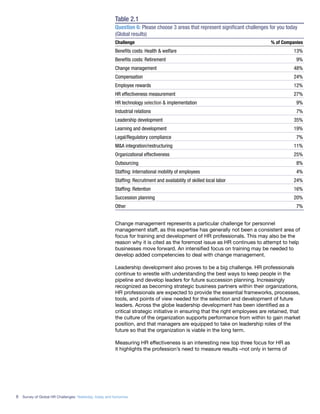
As illustrated in Table 2.1, the three issues most
often chosen by the global group to represent
a current top-three challenge were change
management (48%), leadership development
(35%) and the measurement of HR
effectiveness (27%). In a strong show of
uniform concerns, as will be evident in reviewing
the following regional breakdowns, change
management was the most frequently listed
issue in 4 of the 5 regions. The issues that may
require change management skills may be
different in different regions, but the
competency to deal with change management
is clearly a common skill needed for today’s
HR professional regardless of location.
Survey of Global HR Challenges: Yesterday, today and tomorrow 7
8 Survey of Global HR Challenges: Yesterday, today and tomorrow
Table 2.1
Question 6: Please choose 3 areas that represent significant challenges for you today
(Global results)
Challenge % of Companies
Benefits costs: Health & welfare 13%
Benefits costs: Retirement 9%
Change management 48%
Compensation 24%
Employee rewards 12%
HR effectiveness measurement 27%
HR technology selection & implementation 9%
Industrial relations 7%
Leadership development 35%
Learning and development 19%
Legal/Regulatory compliance 7%
M&A integration/restructuring 11%
Organizational effectiveness 25%
Outsourcing 8%
Staffing: International mobility of employees 4%
Staffing: Recruitment and availability of skilled local labor 24%
Staffing: Retention 16%
Succession planning 20%
Other 7%
Change management represents a particular challenge for personnel
management staff, as this expertise has generally not been a consistent area of
focus for training and development of HR professionals. This may also be the
reason why it is cited as the foremost issue as HR continues to attempt to help
businesses move forward. An intensified focus on training may be needed to
develop added competencies to deal with change management.
Leadership development also proves to be a big challenge. HR professionals
continue to wrestle with understanding the best ways to keep people in the
pipeline and develop leaders for future succession planning. Increasingly
recognized as becoming strategic business partners within their organizations,
HR professionals are expected to provide the essential frameworks, processes,
tools, and points of view needed for the selection and development of future
leaders. Across the globe leadership development has been identified as a
critical strategic initiative in ensuring that the right employees are retained, that
the culture of the organization supports performance from within to gain market
position, and that managers are equipped to take on leadership roles of the
future so that the organization is viable in the long term.
Measuring HR effectiveness is an interesting new top three focus for HR as
it highlights the profession’s need to measure results –not only in terms of
Survey of Global HR Challenges: Yesterday, today and tomorrow 9
transaction management but also in terms of driving the business. HR
professionals have been questioned in the past regarding their business
acumen. Utilizing metrics to determine effectiveness is the beginning of a shift
from perceiving HR’s role as purely an administrative function to viewing the HR
team as a true strategic partner within the organization. In fact, the next section
reports that survey participants believe a critical future issue for HR will be
organizational effectiveness – again supporting HR’s critical role as a strategic
partner to management.
Other important issues emerging from the survey include organizational
effectiveness, compensation, recruitment and availability of local labor,
succession planning and availability of local labor and learning and development.
Yesterday and tomorrow
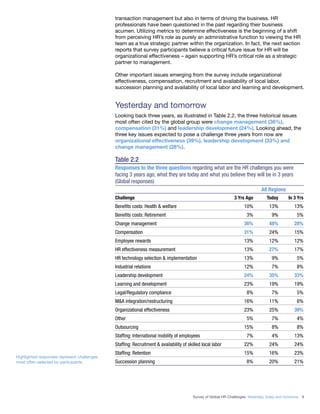
Looking back three years, as illustrated in Table 2.2, the three historical issues
most often cited by the global group were change management (36%),
compensation (31%) and leadership development (24%). Looking ahead, the
three key issues expected to pose a challenge three years from now are
organizational effectiveness (39%), leadership development (33%) and
change management (28%).
Table 2.2
Responses to the three questions regarding what are the HR challenges you were
facing 3 years ago, what they are today and what you believe they will be in 3 years
(Global responses)
All Regions
Challenge 3 Yrs Ago Today In 3 Yrs
Benefits costs: Health & welfare 10% 13% 13%
Benefits costs: Retirement 3% 9% 5%
Change management 36% 48% 28%
Compensation 31% 24% 15%
Employee rewards 13% 12% 12%
HR effectiveness measurement 13% 27% 17%
HR technology selection & implementation 13% 9% 5%
Industrial relations 12% 7% 8%
Leadership development 24% 35% 33%
Learning and development 23% 19% 19%
Legal/Regulatory compliance 8% 7% 5%
M&A integration/restructuring 16% 11% 6%
Organizational effectiveness 23% 25% 39%
Other 5% 7% 4%
Outsourcing 15% 8% 8%
Staffing: International mobility of employees 7% 4% 13%
Staffing: Recruitment & availability of skilled local labor 22% 24% 24%
Staffing: Retention 15% 16% 23%
Succession planning 8% 20% 21%
Highlighted responses represent challenges
most often selected by participants.
10 Survey of Global HR Challenges: Yesterday, today and tomorrow
Change management and leadership development were, are and will be
important issues for HR professionals. Compensation has moved down the list
of perceived challenges while organizational effectiveness is expected to play a
larger role in the years to come. Where HR departments have traditionally
focused on measuring their own effectiveness, there is an evolving recognition
that they can provide organizational value by measuring the effectiveness of the
entire business organization. The shift is significant as it represents movement
from simply counting the numbers hired to determining the ROI of collective and
individual hires on a long-term basis. Going beyond measuring turnover, this new
approach considers “bad” turnover and “good” turnover along with the overall
cost of replacement hires.
Compensation was one of the top three issues in 2001 because of factors
including mergers and acquisitions (and pay equity among new divisions), the
invention of new systems for human capital management (including stock option
plans), and global competition (in which attracting and retaining key employees
became increasingly important). While these factors remain important in 2004,
compensation has fallen to 5th place in the tier of challenging issues. The survey
respondents expect it to be in 9th place three years from now. Some key issues
surfacing in the survey’s look ahead include recruiting and availability of skilled
local labor, succession planning, learning and development, and the
measurement of HR effectiveness. In addition, outsourcing and cost of
retirement benefits were mentioned in many of the comments as a concern.
Time allocation
Another portion of the survey was devoted to the way HR professionals
spend their time. United States Academic David Ulrich has identified 5 distinct
roles for HR. Respondents were asked, “Of the total hours worked by your
HR Department, what percent of the total time would be allocated to each of
these roles (e.g., 20% of the overall departments time is spent as a strategic
business partner, etc.)?”
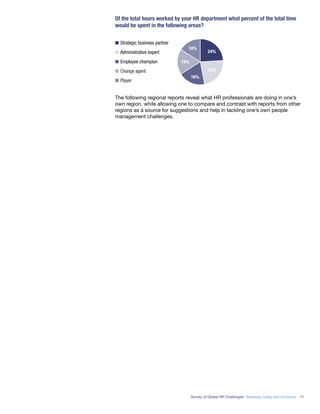
The answers portrayed significant change. As the graphic indicates, almost one-
quarter (24%) of total hours worked in 2004 were devoted to being a strategic
business partner in the organization. Dr. Ulrich defines the strategic business
partner as a partner with senior and line managers in strategy execution, helping
to move planning from the conference room to the marketplace. A bit less time
(23%) was spent in what may be perceived as the more “traditional” HR task of
administrative expert. This entails being expert in the way work is organized and
executed, delivering administrative efficiency to ensure that costs are reduced
while quality is maintained.
Only 16% of hours worked were spent as an employee champion, vigorously
representing their concerns to senior management and at the same time working
to increase employees’ commitment to the organization and their ability to
deliver results. Just under one-fifth of the hours (19%) were devoted to being
a change agent, shaping the processes and culture that together improve an
organization’s capacity for change. Finally, 18% of hours worked by HR
professionals were as what Dr. Ulrich calls a “player,” doing things that make
a difference by acting as a coach, architect, designer, facilitator and leader.
Survey of Global HR Challenges: Yesterday, today and tomorrow 11
Of the total hours worked by your HR department what percent of the total time
would be spent in the following areas?
■ Strategic business partner
■ Administrative expert
■ Employee champion
■ Change agent
■ Player
24%
18%
23%
16%
19%
The following regional reports reveal what HR professionals are doing in one’s
own region, while allowing one to compare and contrast with reports from other
regions as a source for suggestions and help in tackling one’s own people
management challenges.
Africa results Responses from the African Federation of
Human Resource Management Associations (AFHRMA) members
In answer to the survey question about the
impact of current events, HR professionals in
this region pointed to the AIDS epidemic, the
democratization and liberalization process
occurring in many countries and the turmoil
stemming from the political and economic
climates in this region. All of these events
impact the ability for organizations in this region
to source, engage and retain their workforces.
Today’s challenges
Africa is experiencing challenges in many
areas such that choosing the top three
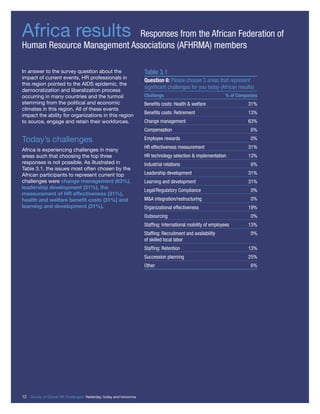
responses is not possible. As illustrated in
Table 3.1, the issues most often chosen by the
African participants to represent current top
challenges were change management (63%),
leadership development (31%), the
measurement of HR effectiveness (31%),
health and welfare benefit costs (31%) and
learning and development (31%).
Table 3.1
Question 6: Please choose 3 areas that represent
significant challenges for you today (African results)
Challenge % of Companies
Benefits costs: Health & welfare 31%
Benefits costs: Retirement 13%
Change management 63%
Compensation 6%
Employee rewards 0%
HR effectiveness measurement 31%
HR technology selection & implementation 13%
Industrial relations 6%
Leadership development 31%
Learning and development 31%
Legal/Regulatory Compliance 0%
M&A integration/restructuring 0%
Organizational effectiveness 19%
Outsourcing 0%
Staffing: International mobility of employees 13%
Staffing: Recruitment and availability 0%
of skilled local labor
Staffing: Retention 13%
Succession planning 25%
Other 6%
12 Survey of Global HR Challenges: Yesterday, today and tomorrow
Survey of Global HR Challenges: Yesterday, today and tomorrow 13
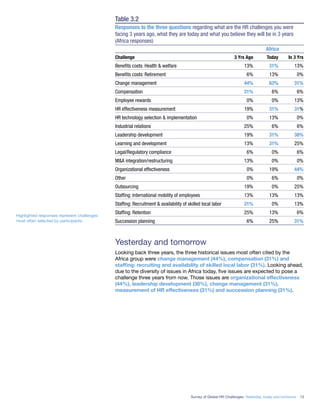
Table 3.2
Responses to the three questions regarding what are the HR challenges you were
facing 3 years ago, what they are today and what you believe they will be in 3 years
(Africa responses)
Africa
Challenge 3 Yrs Ago Today In 3 Yrs
Benefits costs: Health & welfare 13% 31% 13%
Benefits costs: Retirement 6% 13% 0%
Change management 44% 63% 31%
Compensation 31% 6% 6%
Employee rewards 0% 0% 13%
HR effectiveness measurement 19% 31% 31%
HR technology selection & implementation 0% 13% 0%
Industrial relations 25% 6% 6%
Leadership development 19% 31% 38%
Learning and development 13% 31% 25%
Legal/Regulatory compliance 6% 0% 6%
M&A integration/restructuring 13% 0% 0%
Organizational effectiveness 0% 19% 44%
Other 0% 6% 0%
Outsourcing 19% 0% 25%
Staffing: International mobility of employees 13% 13% 13%
Staffing: Recruitment & availability of skilled local labor 31% 0% 13%
Staffing: Retention 25% 13% 6%
Succession planning 6% 25% 31%
Yesterday and tomorrow
Looking back three years, the three historical issues most often cited by the
Africa group were change management (44%), compensation (31%) and
staffing: recruiting and availability of skilled local labor (31%). Looking ahead,
due to the diversity of issues in Africa today, five issues are expected to pose a
challenge three years from now. Those issues are organizational effectiveness
(44%), leadership development (38%), change management (31%),
measurement of HR effectiveness (31%) and succession planning (31%).
Highlighted responses represent challenges
most often selected by participants.
14 Survey of Global HR Challenges: Yesterday, today and tomorrow
Commentary
Comments from African representatives demonstrate the challenges presented
in the area of change management in a region of enormous cultural diversity. As
one representative notes, the key is “working with line managers across cultures
to challenge prevailing ‘authoritarian’ thinking, to [move toward] a climate which
promotes personal responsibility and freedom.” Another points out that
“managing diversity in the local context is [an] enormous [challenge] in a fast-
changing technological and economically liberalised environment.” Bureaucracy
can also be a problem, presenting “the need to consider doing things differently
in order to eliminate bottlenecks and red tape.” Looking forward, empowerment
of local managers is seen as a priority issue.
HR effectiveness presents a challenge when, in one representative’s words,
“line managers think performance management, job evaluation, monitoring
and evaluation [are] a waste of time. This attitude bogs down the efforts by
the HR team.” Or, as another puts it, “staff still have a negative view of HR,
look at it as bad news bearers.”
Leadership development is a key issue in a region with “high labor turnover” and
a “young and inexperienced work force.” This may be a particular challenge in a
region faced with the enormous impact of the AIDS virus and regional wars. Due
to the combination of a large proportion of the work force ailing and the
introduction of new industries and businesses which require local talent who are
currently not trained to meet those needs, there is a vacuum for HR professionals
to fill. AIDS is a social issue everywhere but it is hitting particularly hard on the
African continent. In fact, the cost of health and welfare benefits ranked very high
among current concerns in Africa, tying with HR effectiveness measurement and
learning and development as key issues, just below change management.
Asia Pacific results Responses from Asia Pacific
Federation of Human Resource Management (APFHRM) members
In answer to the survey question about the
impact of current events, HR professionals in
this region pointed to the events of 9/11, the
SARS epidemic, and the turmoil stemming
from the downturn in the economy. All of these
events affected travel within the region and,
as a result, adversely affected cash flow and
company operations.
Today’s challenges
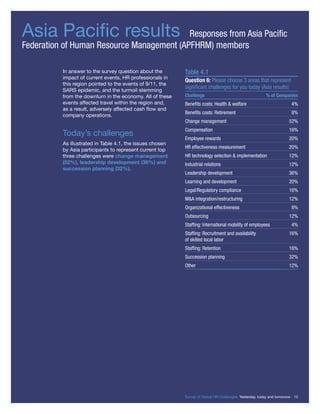
As illustrated in Table 4.1, the issues chosen
by Asia participants to represent current top
three challenges were change management
(52%), leadership development (36%) and
succession planning (32%).
Table 4.1
Question 6: Please choose 3 areas that represent
significant challenges for you today (Asia results)
Challenge % of Companies
Benefits costs: Health & welfare 4%
Benefits costs: Retirement 8%
Change management 52%
Compensation 16%
Employee rewards 20%
HR effectiveness measurement 20%
HR technology selection & implementation 12%
Industrial relations 12%
Leadership development 36%
Learning and development 20%
Legal/Regulatory compliance 16%
M&A integration/restructuring 12%
Organizational effectiveness 8%
Outsourcing 12%
Staffing: International mobility of employees 4%
Staffing: Recruitment and availability 16%
of skilled local labor
Staffing: Retention 16%
Succession planning 32%
Other 12%
Survey of Global HR Challenges: Yesterday, today and tomorrow 15
16 Survey of Global HR Challenges: Yesterday, today and tomorrow
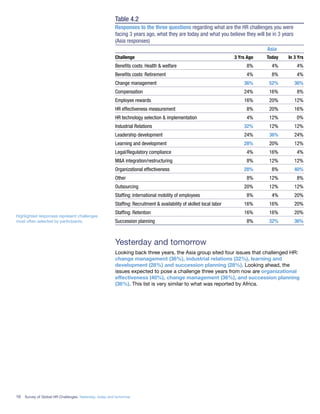
Table 4.2
Responses to the three questions regarding what are the HR challenges you were
facing 3 years ago, what they are today and what you believe they will be in 3 years
(Asia responses)
Asia
Challenge 3 Yrs Ago Today In 3 Yrs
Benefits costs: Health & welfare 8% 4% 4%
Benefits costs: Retirement 4% 8% 4%
Change management 36% 52% 36%
Compensation 24% 16% 8%
Employee rewards 16% 20% 12%
HR effectiveness measurement 8% 20% 16%
HR technology selection & implementation 4% 12% 0%
Industrial Relations 32% 12% 12%
Leadership development 24% 36% 24%
Learning and development 28% 20% 12%
Legal/Regulatory compliance 4% 16% 4%
M&A integration/restructuring 8% 12% 12%
Organizational effectiveness 28% 8% 40%
Other 8% 12% 8%
Outsourcing 20% 12% 12%
Staffing: International mobility of employees 8% 4% 20%
Staffing: Recruitment & availability of skilled local labor 16% 16% 20%
Staffing: Retention 16% 16% 20%
Succession planning 8% 32% 36%
Yesterday and tomorrow
Looking back three years, the Asia group sited four issues that challenged HR:
change management (36%), industrial relations (32%), learning and
development (28%) and succession planning (28%). Looking ahead, the
issues expected to pose a challenge three years from now are organizational
effectiveness (40%), change management (36%), and succession planning
(36%). This list is very similar to what was reported by Africa.
Highlighted responses represent challenges
most often selected by participants.
Survey of Global HR Challenges: Yesterday, today and tomorrow 17
Commentary
Although it “takes a considerable time to accept changes” and “many long-
service employees enjoy the status quo and are reluctant to make any
changes,” a significant issue exists today in “moving the business from a
product focus to a customer interface focus and more of a business planning
mentality.” Three years ago, business integration and consolidation was a
major challenge, both in the area of change management and in compensation,
as staff tried to ensure compensation equity between employees of the
acquired and the acquiring company.
Leadership development is clearly a “critical issue for on-going viability of
[the] corporation.” As part of this endeavour, HR professionals need to focus
on “developing supervisors into ‘people managers,’ not just technical
specialists,” a comment that was repeated as an issue for the years to come.
Another representative notes that “there are many tools for leadership
development. Finding the most appropriate tools is a challenge.” This challenge
can best be met by “gaining support from executives to develop leaders of
the future” and “engaging senior management in leadership development
philosophy and practice.”
Succession planning “will remain an issue as we look at gaps in the market,
gaps in the organization and how to shadow employees in key positions. The
aging workforce within the company is a key driver.” In fact, the aging workforce
was noted by many who chose succession planning as an issue due to the
“issues in retaining knowledge held by retiring workers, and ensuring sufficient
time to train successors.”
Staffing, including international mobility of employees, continues to be a critical
element as is noted in other regions.
HR effectiveness appears to be less of an issue in the Asia-Pacific region,
although one respondent comments that “to date, it has not been possible to
measure HR effectiveness in the workplace.” As illustrated in Table 4.2 although
HR effectiveness is not a top three challenge, its importance has more than
doubled in three years, suggesting that more attention is warranted in the future.
However, even with these challenges in Asia, two of the world’s most populated
nations, India and China, are receiving enormous economic benefit from
companies in other regions that are continuing to outsource their information
technology, customer service and manufacturing needs. Such global economic
realities, along with the political developments that influence them, require
decisive, ethical and visionary local leadership to quickly and effectively navigate
and manage change. HR professionals in Asia Pacific, as elsewhere, need to be
sensitive to external conditions as well as to their own organizational needs in
order to define and meet the leadership development goals of their organizations.
Europe results Responses from the European Association
of Personnel Management (EAPM) members
In Europe, the major event of the last few years
– in addition to 9/11 and the increasing threat/
impact of terrorism – is the growth of the
European Union. In Eastern Europe, one
respondent noted that “our young and good
workers are going to work for neighbors [as]
people feel more free to change their jobs.”
Today’s challenges
As illustrated in the Table 5.1, the issues chosen
by the European participants to represent
current top three challenges were change
management (48%), organizational
effectiveness (36%) and staffing: recruitment
and availability of local labor (34%).
Table 5.1
Question 6: Please choose 3 areas that represent
significant challenges for you today (Europe results)
Challenge % of Companies
Benefits costs: Health & welfare 5%
Benefits costs: Retirement 7%
Change management 48%
Compensation 30%
Employee rewards 11%
HR effectiveness measurement 23%
HR technology selection & implementation 11%
Industrial Relations 7%
Leadership development 20%
Learning and development 18%
Legal/Regulatory compliance 2%
M&A integration/restructuring 7%
Organizational effectiveness 36%
Outsourcing 4%
Staffing: International mobility of employees 5%
Staffing: Recruitment and availability 34%
of skilled local labor
Staffing: Retention 20%
Succession planning 16%
Other 5%
18 Survey of Global HR Challenges: Yesterday, today and tomorrow
Survey of Global HR Challenges: Yesterday, today and tomorrow 19
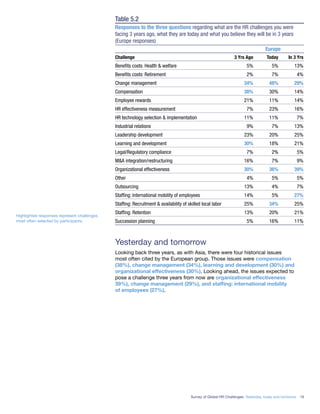
Table 5.2
Responses to the three questions regarding what are the HR challenges you were
facing 3 years ago, what they are today and what you believe they will be in 3 years
(Europe responses)
Europe
Challenge 3 Yrs Ago Today In 3 Yrs
Benefits costs: Health & welfare 5% 5% 13%
Benefits costs: Retirement 2% 7% 4%
Change management 34% 48% 29%
Compensation 38% 30% 14%
Employee rewards 21% 11% 14%
HR effectiveness measurement 7% 23% 16%
HR technology selection & implementation 11% 11% 7%
Industrial relations 9% 7% 13%
Leadership development 23% 20% 25%
Learning and development 30% 18% 21%
Legal/Regulatory compliance 7% 2% 5%
M&A integration/restructuring 16% 7% 9%
Organizational effectiveness 30% 36% 39%
Other 4% 5% 5%
Outsourcing 13% 4% 7%
Staffing: International mobility of employees 14% 5% 27%
Staffing: Recruitment & availability of skilled local labor 25% 34% 25%
Staffing: Retention 13% 20% 21%
Succession planning 5% 16% 11%
Yesterday and tomorrow
Looking back three years, as with Asia, there were four historical issues
most often cited by the European group. Those issues were compensation
(38%), change management (34%), learning and development (30%) and
organizational effectiveness (30%). Looking ahead, the issues expected to
pose a challenge three years from now are organizational effectiveness
39%), change management (29%), and staffing: international mobility
of employees (27%).
Highlighted responses represent challenges
most often selected by participants.
20 Survey of Global HR Challenges: Yesterday, today and tomorrow
Commentary
Rapid technological change is a current challenge facing HR professionals in the
area of change management. Other issues include globalization and the aging of
the work force. Three years ago, joining the European Union was a key issue for
the profession. The need to downsize the work force in response to the
downturn in the financial markets also presented a challenge with the conflicting
challenge of recruitment and availability of skilled local labor. Across the board,
three years from now, continuing technological change is seen as an issue
closely tied to the need for training in change management.
Although a challenge not unique to Europe, global expansion was noted in
many comments under a wide range of challenges. For example, change
management due to cross border activity was prevalent with one participant
commenting that “the continual drive to shape the organization appropriate to its
markets means a significant shift in mindset and skill set as the company strives
to balance growth in Asia with a balanced portfolio in Europe and America”.
Organizational effectiveness is also critical in this expansion mode to new
markets as “continued growth will require review of processes and procedures
to ensure success in international / new markets.” International mobility of
employees was noted as a top three issue of the future “ensuring international
growth of business”. This mobility is needed and as one participant commented
- “as there is lack of qualified personnel in the regions, we will move qualified
employees to new destinations.”
Leadership development is an ongoing issue, with a two-pronged focus:
motivating middle management while encouraging top management to abandon
a style perceived as authoritarian. In Eastern Europe three years ago, the biggest
challenge may have been moving from a planned economy to a free market
economy, necessitating new management philosophy and leadership. Looking
forward, as one respondent notes, there is “always a need to focus on
[leadership development] to remain competitive.”
Compensation and HR effectiveness measurement also scored high as current
issues of concern to European HR professionals. Measuring HR effectiveness
was not among the foremost issues three years ago but respondents were three
times as likely to choose this as an issue today. Three years from now,
measuring HR effectiveness falls behind organizational effectiveness as OE
generally includes some component of measurement.
North America results Responses from the
North American Human Resource Management Association (NAHRMA) members
Major events in North America include the attack
of 9/11, increasing terrorism and the resulting
downturn in the economy. In addition, the Free
Trade Agreement and global trade agreements
are challenges, as are the pace of technological
change and a very competitive marketplace.
Today’s challenges
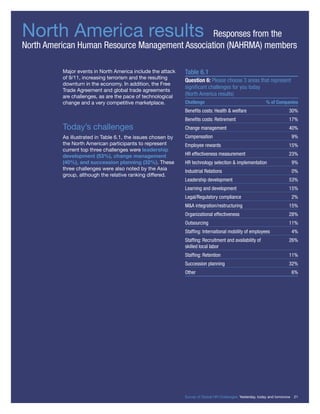
As illustrated in Table 6.1, the issues chosen by
the North American participants to represent
current top three challenges were leadership
development (53%), change management
(40%), and succession planning (32%). These
three challenges were also noted by the Asia
group, although the relative ranking differed.
Table 6.1
Question 6: Please choose 3 areas that represent
significant challenges for you today
(North America results)
Challenge % of Companies
Benefits costs: Health & welfare 30%
Benefits costs: Retirement 17%
Change management 40%
Compensation 9%
Employee rewards 15%
HR effectiveness measurement 23%
HR technology selection & implementation 9%
Industrial Relations 0%
Leadership development 53%
Learning and development 15%
Legal/Regulatory compliance 2%
M&A integration/restructuring 15%
Organizational effectiveness 28%
Outsourcing 11%
Staffing: International mobility of employees 4%
Staffing: Recruitment and availability of 26%
skilled local labor
Staffing: Retention 11%
Succession planning 32%
Other 6%
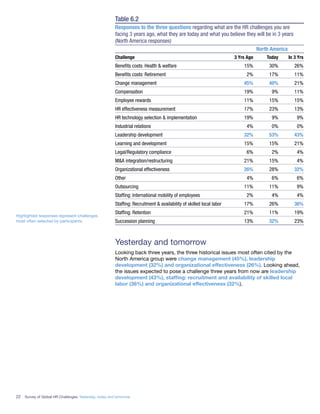
Survey of Global HR Challenges: Yesterday, today and tomorrow 21
22 Survey of Global HR Challenges: Yesterday, today and tomorrow
Table 6.2
Responses to the three questions regarding what are the HR challenges you are
facing 3 years ago, what they are today and what you believe they will be in 3 years
(North America responses)
North America
Challenge 3 Yrs Ago Today In 3 Yrs
Benefits costs: Health & welfare 15% 30% 26%
Benefits costs: Retirement 2% 17% 11%
Change management 45% 40% 21%
Compensation 19% 9% 11%
Employee rewards 11% 15% 15%
HR effectiveness measurement 17% 23% 13%
HR technology selection & implementation 19% 9% 9%
Industrial relations 4% 0% 0%
Leadership development 32% 53% 43%
Learning and development 15% 15% 21%
Legal/Regulatory compliance 6% 2% 4%
M&A integration/restructuring 21% 15% 4%
Organizational effectiveness 26% 28% 32%
Other 4% 6% 6%
Outsourcing 11% 11% 9%
Staffing: International mobility of employees 2% 4% 4%
Staffing: Recruitment & availability of skilled local labor 17% 26% 36%
Staffing: Retention 21% 11% 19%
Succession planning 13% 32% 23%
Yesterday and tomorrow
Looking back three years, the three historical issues most often cited by the
North America group were change management (45%), leadership
development (32%) and organizational effectiveness (26%). Looking ahead,
the issues expected to pose a challenge three years from now are leadership
development (43%), staffing: recruitment and availability of skilled local
labor (36%) and organizational effectiveness (32%).
Highlighted responses represent challenges
most often selected by participants.
Survey of Global HR Challenges: Yesterday, today and tomorrow 23
Commentary
North America is the single region where change management is not perceived
as the foremost challenge. Instead, leadership development takes first place.
Leadership development is seen, in one respondent’s words, as critical “to move
the company forward after financial restructuring.” Early retirement and an aging
work force make leadership training and development essential for any forward-
looking organization. Developing leadership competencies is viewed as critical in
an era of “rapid, sustained growth in many developing areas of the world.”
Furthermore, there is a greater focus on executive performance, corporate
governance, and performance of the board of directors as corporations navigate
the post-Enron, post-Sarbanes-Oxley environment.
Nonetheless, as elsewhere, change management is a major challenge for the
profession. Among the specific issues: consolidation and merging of markets
within an industry, collective bargaining, early retirement incentives and, in one
survey respondent’s words, “convincing some clients [that] critical organizational
changes are needed.” Three years ago, change management issues revolved
largely around downsizing, acquisitions, mergers and related structural matters.
“Restructuring” and “re-engineering” were the words of the day. Three years
from now, respondents anticipate “continued need to change [the] organization
to meet expansion challenges.”
As a top three challenge today, succession planning goes hand-in-hand with
leadership development and change management. As one respondent
commented, “Succession planning is a high priority because of wave of
retirements,” with one participant reporting 30% of their employees retiring
within the next 5 years. As noted by another, “In these volatile times, succession
planning, combined with leadership development, are key components to
building the foundation for current and future organizational performance.”
Three years ago, the concerns were similar, although one respondent
commented on the importance of “convincing leaders that there is a distinction
between leadership and management and [that] they should be spending most
of their time on the former rather than the latter.” Looking forward, respondents
agree that serious training is needed to develop the leaders that will be able to
sustain continued growth and restore confidence in organizational leadership.
Recruitment and availability of local skilled labor, which has been steadily
increasing in the list of challenges, moves up to second place three years to
come. The many comments around this challenge pointed to the aging
workforce as the primary concern.
Other issues of current concern to North American HR professionals are benefit
costs, organizational effectiveness and measurement of HR effectiveness.
South America results Responses from the
Interamerican Federation of Human Resource Management (FIDAGH)
Companies in many parts of South America
have confronted both political and economic
turmoil and instability in the last few years. As
one survey respondent noted, “Recent political
and economic-financial crisis… has put a lot of
strain on the Personnel Management function,
as it was necessary to adjust headcount, payroll
and benefit costs, with an obvious impact [on]
development.” Another said, “Economic default,
social and political crisis caused high inflation,
high unemployment, high intervention of
government in labor cost, forcing companies to
revise their structures, reduce staff and
benefits.” Currency devaluations, diminishing
rates of foreign investment, and high rates of
unemployment are all mentioned, along with the
Free Trade Agreements, PCAOB standards and
section 404 of Sarbanes-Oxley. And here, too,
the events of 9/11 played a role, with a “major
impact on tourism and, as a consequence, in
our job as we had to reorganize our structure.”
Today’s challenges
As with Africa, the summary results in more than
three top issues sited. As illustrated in table 7.1,
the issues chosen by the South America
participants to represent current top challenges
were change management (48%),
compensation (38%), measurement of HR
effectiveness (34%) and leadership
development (34%).
Table 7.1
Question 6: Please choose 3 areas that represent
significant challenges for you today
(South America results)
Challenge % of Companies
Benefits costs: Health & welfare 7%
Benefits costs: Retirement 3%
Change management 48%
Compensation 38%
Employee rewards 10%
HR effectiveness measurement 34%
HR technology selection & implementation 5%
Industrial relations 10%
Leadership development 34%
Learning and development 21%
Legal/Regulatory compliance 14%
M&A integration/restructuring 14%
Organizational effectiveness 21%
Outsourcing 10%
Staffing: International mobility of employees 2%
Staffing: Recruitment and availability of 22%
skilled local labor
Staffing: Retention 17%
Succession planning 9%
Other 9%
24 Survey of Global HR Challenges: Yesterday, today and tomorrow
Survey of Global HR Challenges: Yesterday, today and tomorrow 25
Highlighted responses represent challenges
most often selected by participants.
Table 7.2
Responses to the three questions regarding what are the HR challenges you are
facing 3 years ago, what they are today and what you believe they will be in 3 years
(South America responses)
South America
Challenge 3 Yrs Ago Today In 3 Yrs
Benefits costs: Health & welfare 12% 7% 9%
Benefits costs: Retirement 5% 3% 5%
Change management 29% 48% 28%
Compensation 38% 38% 26%
Employee rewards 9% 10% 9%
HR effectiveness measurement 16% 34% 17%
HR technology selection & implementation 17% 5% 5%
Industrial relations 9% 10% 9%
Leadership development 19% 34% 36%
Learning and development 22% 21% 17%
Legal/Regulatory compliance 12% 14% 7%
M&A integration/restructuring 16% 14% 3%
Organizational effectiveness 17% 21% 41%
Other 7% 9% 2%
Outsourcing 19% 10% 3%
Staffing: International mobility of employees 2% 2% 5%
Staffing: Recruitment & availability of skilled local labor 22% 22% 19%
Staffing: Retention 10% 17% 33%
Succession planning 9% 9% 21%
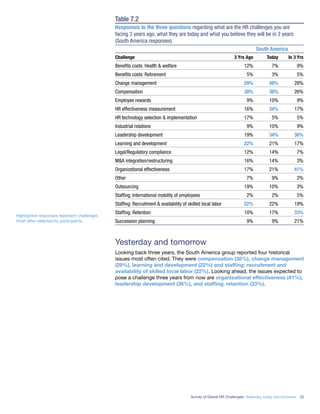
Yesterday and tomorrow
Looking back three years, the South America group reported four historical
issues most often cited. They were compensation (38%), change management
(29%), learning and development (22%) and staffing: recruitment and
availability of skilled local labor (22%). Looking ahead, the issues expected to
pose a challenge three years from now are organizational effectiveness (41%),
leadership development (36%), and staffing: retention (33%).
26 Survey of Global HR Challenges: Yesterday, today and tomorrow
Commentary
Diversity, a competitive environment, and intercultural pressures make change
management a vital issue in South America today. As one respondent noted,
change management is needed to “adjust rapidly to the changes imposed by
market globalization.”
As a result of the economic situation in South America and local labor laws,
compensation is also a top three issue. Many countries due to devaluation and
inflation are still trying to work out an equitable system with the current
economics. In addition, with the tax cost of cash compensation to both the
company and the employee, companies are trying to determine more effective
ways to provide incentive to their employees.
Finding “new ways to measure and improve our contribution to the business” is
at the core of HR effectiveness measurement, as there is “difficulty in effectively
showing the attainments [of HR professionals and their] real contribution to the
business.” The challenge as noted by one respondent was to “build consistent
indicators in a quickly changing environment.”
In addition, leadership development is especially critical in working with a young
labor force. As one respondent sums it up, “Our leadership in our market
depends on our managers developing leadership.”
Three years ago, in addition to the items mentioned above, staffing was a major
issue, particularly the recruitment and availability of skilled local labor including
international and retaining those people. Outsourcing was a cause for concern,
along with leadership development, organizational effectiveness, HR technology
and HR effectiveness measurement.
For the years to come, leadership and some area of staffing continue to be a
top three challenge. In addition to those mentioned earlier, there was also a
focus on change management, compensation, succession planning, recruitment,
HR effectiveness measurement, and learning and development. Succession
planning is a particular issue of growing concern. In summary, as one
respondent put it, “Organizations have to adapt to change more rapidly than
before, with the changes directed from HR.”
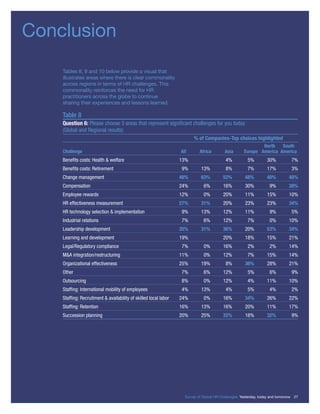
Conclusion
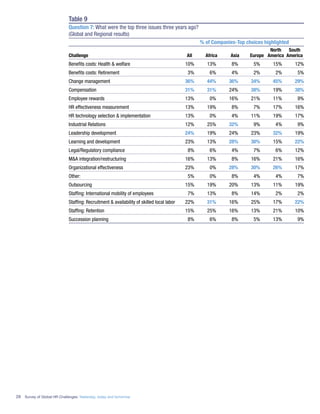
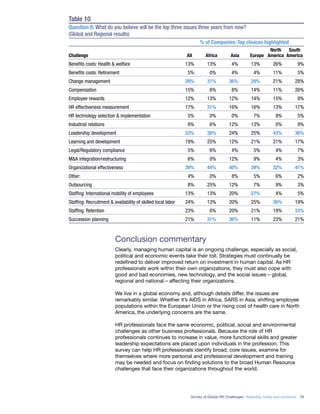
Tables 8, 9 and 10 below provide a visual that
illustrates areas where there is clear commonality
across regions in terms of HR challenges. This
commonality reinforces the need for HR
practitioners across the globe to continue
sharing their experiences and lessons learned.
Survey of Global HR Challenges: Yesterday, today and tomorrow 27
Table 8
Question 6: Please choose 3 areas that represent significant challenges for you today
(Global and Regional results)
% of Companies-Top choices highlighted
North South
Challenge All Africa Asia Europe America America
Benefits costs: Health & welfare 13% 31% 4% 5% 30% 7%
Benefits costs: Retirement 9% 13% 8% 7% 17% 3%
Change management 48% 63% 52% 48% 40% 48%
Compensation 24% 6% 16% 30% 9% 38%
Employee rewards 12% 0% 20% 11% 15% 10%
HR effectiveness measurement 27% 31% 20% 23% 23% 34%
HR technology selection & implementation 9% 13% 12% 11% 9% 5%
Industrial relations 7% 6% 12% 7% 0% 10%
Leadership development 35% 31% 36% 20% 53% 34%
Learning and development 19% 31% 20% 18% 15% 21%
Legal/Regulatory compliance 7% 0% 16% 2% 2% 14%
M&A integration/restructuring 11% 0% 12% 7% 15% 14%
Organizational effectiveness 25% 19% 8% 36% 28% 21%
Other 7% 6% 12% 5% 6% 9%
Outsourcing 8% 0% 12% 4% 11% 10%
Staffing: International mobility of employees 4% 13% 4% 5% 4% 2%
Staffing: Recruitment & availability of skilled local labor 24% 0% 16% 34% 26% 22%
Staffing: Retention 16% 13% 16% 20% 11% 17%
Succession planning 20% 25% 32% 16% 32% 9%
28 Survey of Global HR Challenges: Yesterday, today and tomorrow
Table 9
Question 7: What were the top three issues three years ago?
(Global and Regional results)
% of Companies-Top choices highlighted
North South
Challenge All Africa Asia Europe America America
Benefits costs: Health & welfare 10% 13% 8% 5% 15% 12%
Benefits costs: Retirement 3% 6% 4% 2% 2% 5%
Change management 36% 44% 36% 34% 45% 29%
Compensation 31% 31% 24% 38% 19% 38%
Employee rewards 13% 0% 16% 21% 11% 9%
HR effectiveness measurement 13% 19% 8% 7% 17% 16%
HR technology selection & implementation 13% 0% 4% 11% 19% 17%
Industrial Relations 12% 25% 32% 9% 4% 9%
Leadership development 24% 19% 24% 23% 32% 19%
Learning and development 23% 13% 28% 30% 15% 22%
Legal/Regulatory compliance 8% 6% 4% 7% 6% 12%
M&A integration/restructuring 16% 13% 8% 16% 21% 16%
Organizational effectiveness 23% 0% 28% 30% 26% 17%
Other: 5% 0% 8% 4% 4% 7%
Outsourcing 15% 19% 20% 13% 11% 19%
Staffing: International mobility of employees 7% 13% 8% 14% 2% 2%
Staffing: Recruitment & availability of skilled local labor 22% 31% 16% 25% 17% 22%
Staffing: Retention 15% 25% 16% 13% 21% 10%
Succession planning 8% 6% 8% 5% 13% 9%
Survey of Global HR Challenges: Yesterday, today and tomorrow 29
Conclusion commentary
Clearly, managing human capital is an ongoing challenge, especially as social,
political and economic events take their toll. Strategies must continually be
redefined to deliver improved return on investment in human capital. As HR
professionals work within their own organizations, they must also cope with
good and bad economies, new technology, and the social issues – global,
regional and national – affecting their organizations.
We live in a global economy and, although details differ, the issues are
remarkably similar. Whether it’s AIDS in Africa, SARS in Asia, shifting employee
populations within the European Union or the rising cost of health care in North
America, the underlying concerns are the same.
HR professionals face the same economic, political, social and environmental
challenges as other business professionals. Because the role of HR
professionals continues to increase in value, more functional skills and greater
leadership expectations are placed upon individuals in the profession. This
survey can help HR professionals identify broad, core issues, examine for
themselves where more personal and professional development and training
may be needed and focus on finding solutions to the broad Human Resource
challenges that face their organizations throughout the world.
Table 10
Question 8: What do you believe will be the top three issues three years from now?
(Global and Regional results)
% of Companies-Top choices highlighted
North South
Challenge All Africa Asia Europe America America
Benefits costs: Health & welfare 13% 13% 4% 13% 26% 9%
Benefits costs: Retirement 5% 0% 4% 4% 11% 5%
Change management 28% 31% 36% 29% 21% 28%
Compensation 15% 6% 8% 14% 11% 26%
Employee rewards 12% 13% 12% 14% 15% 9%
HR effectiveness measurement 17% 31% 16% 16% 13% 17%
HR technology selection & implementation 5% 0% 0% 7% 9% 5%
Industrial relations 8% 6% 12% 13% 0% 9%
Leadership development 33% 38% 24% 25% 43% 36%
Learning and development 19% 25% 12% 21% 21% 17%
Legal/Regulatory compliance 5% 6% 4% 5% 4% 7%
M&A integration/restructuring 6% 0% 12% 9% 4% 3%
Organizational effectiveness 39% 44% 40% 39% 32% 41%
Other: 4% 0% 8% 5% 6% 2%
Outsourcing 8% 25% 12% 7% 9% 3%
Staffing: International mobility of employees 13% 13% 20% 27% 4% 5%
Staffing: Recruitment & availability of skilled local labor 24% 13% 20% 25% 36% 19%
Staffing: Retention 23% 6% 20% 21% 19% 33%
Succession planning 21% 31% 36% 11% 23% 21%
Contact information
30 Survey of Global HR Challenges: Yesterday, today and tomorrow
For further information or any questions
regarding this survey, please contact:
Carolyn Gould
Principal, Human Resource Services
PricewaterhouseCoopers LLP
300 Madison Avenue
New York, NY 10017
646.471.5591
carolyn.gould@us.pwc.com
Contact Information for Continental Federations
of the WFPMA can be found at wfpma.com
www.pwc.com
NY-PD-06-0184/600075 © 2005 PricewaterhouseCoopers LLP. All rights reserved. “PricewaterhouseCoopers” refers to PricewaterhouseCoopers LLP
(a Delaware limited liability partnership) or, as the context requires, other member firms of PricewaterhouseCoopers International Limited, each of which is
a separate and independent legal entity. *connectedthinking is a trademark of PricewaterhouseCoopers LLP (US).

Hrglobalchallenges

  • 1.
    Conducted by PricewaterhouseCoopers onbehalf of the World Federation of Personnel Management Associations (WFPMA) Survey of Global HR Challenges: Yesterday, today and tomorrow*
  • 3.
    Survey of GlobalHR Challenges: Yesterday, today and tomorrow 3 Contents Foreword . . . . . . . . . . . . . . . . . . . . . . . . . . . . . . . . . . . . . . . . 4 Global results . . . . . . . . . . . . . . . . . . . . . . . . . . . . . . . . . . . 7 Africa results . . . . . . . . . . . . . . . . . . . . . . . . . . . . . . . . . . . 12 Asia Pacific results. . . . . . . . . . . . . . . . . . . . . . . . . . . . . 15 Europe results. . . . . . . . . . . . . . . . . . . . . . . . . . . . . . . . . . 18 North America results. . . . . . . . . . . . . . . . . . . . . . . . . . 21 South America results . . . . . . . . . . . . . . . . . . . . . . . . . 24 Conclusion . . . . . . . . . . . . . . . . . . . . . . . . . . . . . . . . . . . . . 27 Contact information. . . . . . . . . . . . . . . . . . . . . . . . . . . . 30
  • 4.
    Foreword To mark the10th anniversary of its bi- annual World Congress last year, the World Federation of Personnel Management Associations (WFPMA) commissioned a survey, undertaken on its behalf by PricewaterhouseCoopers (PwC), on the current HR challenges faced by HR professionals three years ago, what those issues are today and what they believe they will be three years from now. The WFPMA: The World Federation of Personnel Management Associations is a global network of professionals in Human Resources. Founded in 1976, its mission is to aid the development and improve the effectiveness of professional people managers all over the world. The continental federations making up the membership include more than 70 national personnel associations representing over 400,000 people management professionals.The networking opportunities afforded by WFPMA include a quarterly newsletter and periodic research projects along with the international World Congress held every two years. The WFPMA has five main objectives: 1 To improve the quality and effectiveness of professional people management, and to demonstrate the importance of the HR role in all employing organisations, both public and private. 2 To stimulate and assist in the establishment and development of regional and national personnel management associations in those parts of the world where a continental or regional association does not exist. 3 To create and maintain contacts with all WFPMA member associations as well as with other organisations which have some activity in the same or similar field. 4 To support or represent personnel management associations in their contacts with world organisations such as ILO, UNESCO, the UN, etc. 5 To commission or undertake research which will further broaden understanding of personnel issues. The graphic on the next page lists the regional federations as well as which countries are represented in these federations: 4 Survey of Global HR Challenges: Yesterday, today and tomorrow
  • 5.
    Survey of GlobalHR Challenges: Yesterday, today and tomorrow 5 Member organizations of the WFPMA Full members AFHRMA African Federation of Human Resource Management Associations Botswana Democratic Republic of Congo Kenya Malawi Namibia Nigeria South Africa Swaziland Tanzania Uganda Zambia Zimbabwe APFHRM Asia Pacific Federation of Human Resource Management Australia Bangladesh Hong Kong India Indonesia Japan Malaysia New Zealand Papua New Guinea Philippines Singapore Sri Lanka Taiwan Thailand EAPM European Association of Personnel Management Austria Belgium Bulgaria Cyprus Czech Republic Denmark Estonia Finland France Germany Greece Hungary Ireland Italy Latvia Malta Netherlands Norway Poland Portugal Slovak Republic Slovenia Spain Sweden Switzerland Turkey United Kingdom FIDAGH Interamerican Federation of Professional HRM Associations Argentina Brazil Chile Costa Rica Colombia Dominican Republic Ecuador Guatemala Nicaragua Panama Paraguay Peru Uruguay Venezuela NAHRMA North American Human Resource Management Association Canada Mexico USA
  • 6.
    6 Survey ofGlobal HR Challenges: Yesterday, today and tomorrow The survey The survey was designed to collect information on challenges facing Human Resources today. To elicit informative contrasts, respondents were also asked about the challenges faced three years ago and about what the future might hold three years down the road. Sharing this information is intended to help HR professionals who are facing new issues by assisting them in finding others that may have dealt with those same issues and have helpful suggestions to share. In addition, the information could help HR professionals sharpen their focus on challenges that are being experienced globally and thereby provide a rationale for changes that can be adopted within their own regions, countries and companies. This summary presents an analysis of responses from some 200 companies in more than 35 countries. Our thanks go out to all companies and individuals who participated in the survey as well as the country HR organizations who reached out to their members for participation. In particular, we would like to thank the following individuals who were part of this projects steering committee. These individuals took on the responsibility of assisting with designing the questionnaire and coordinating responses for their regional federations: Hans Bohm – WFPMA delegate from EAPM Janaka Kumarasinghe – WFPMA delegate from APFHRM Horacio Quiros – WFPMA delegate from FIDAGH Tiisetso Tsukudu - WFPMA delegate from AFHRMA.
  • 7.
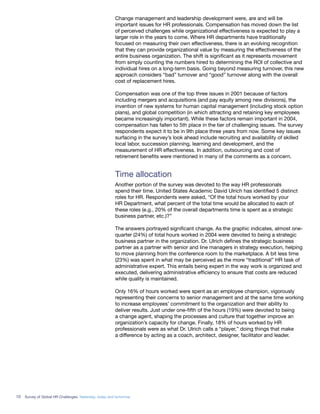
    Global results Survey respondentsrepresent a diverse industry background as illustrated in Table 1 below. Table 1 Agriculture and Mining 4% Chemicals, Oils & Pharmaceuticals 5% Communications 8% Construction 3% Energy and Water 4% Engineering/Electronics 5% Food, Drink and Tobacco 6% Hotels/Tourism/Cruises/Catering/Leisure 3% Other manufacturing 12% Media (Broadcasting, Publishing, etc.) 3% Paper and Printing 2% Professional services (Accountancy, Advertising, Consultancy, Legal, PR, etc.) 13% Public services (Army, Education, Government, Police, etc.) 4% Retail and Wholesale 4% Transport, Distribution and Storage 5% Voluntary and Community services (Charities, Housing Associations, etc.) 2% Other 19% Key survey questions included: ■ Is there a major social, economic or political event that has had a significant impact on the work you do? ■ Which three issues in the area of human resources represent significant challenges for you today? ■ What were the top three issues you faced three years ago? ■ What do you believe will be the top three issues facing you three years from now? Major events Around the world, political, economic and social turmoil take their toll on companies and their HR professionals. For example, the events of 9/11 were referred to repeatedly by survey respondents. As one African representative noted, “The events of 9/11 have increased the risk of travel throughout the world and have also raised diversity issues to the forefront.” A European representative noted the slowdown in the world economy that stemmed from 9/11 and the resulting impact on personnel. Wars and invasions disrupt operations. Health issues, from AIDS in Africa to the SARS epidemic in Asia to the cost of benefits in North America, are also a frequent concern. Issues overlap. As one European respondent commented, “The increasing threat in terrorism has meant that some governments have switched funding from healthcare to defense.” Other referenced issues include globalization and currency devaluations, with ripple effects across economies, sectors and companies. Today’s challenges On a global scale, despite national and regional differences, there was remarkable unanimity. As illustrated in Table 2.1, the three issues most often chosen by the global group to represent a current top-three challenge were change management (48%), leadership development (35%) and the measurement of HR effectiveness (27%). In a strong show of uniform concerns, as will be evident in reviewing the following regional breakdowns, change management was the most frequently listed issue in 4 of the 5 regions. The issues that may require change management skills may be different in different regions, but the competency to deal with change management is clearly a common skill needed for today’s HR professional regardless of location. Survey of Global HR Challenges: Yesterday, today and tomorrow 7
  • 8.
    8 Survey ofGlobal HR Challenges: Yesterday, today and tomorrow Table 2.1 Question 6: Please choose 3 areas that represent significant challenges for you today (Global results) Challenge % of Companies Benefits costs: Health & welfare 13% Benefits costs: Retirement 9% Change management 48% Compensation 24% Employee rewards 12% HR effectiveness measurement 27% HR technology selection & implementation 9% Industrial relations 7% Leadership development 35% Learning and development 19% Legal/Regulatory compliance 7% M&A integration/restructuring 11% Organizational effectiveness 25% Outsourcing 8% Staffing: International mobility of employees 4% Staffing: Recruitment and availability of skilled local labor 24% Staffing: Retention 16% Succession planning 20% Other 7% Change management represents a particular challenge for personnel management staff, as this expertise has generally not been a consistent area of focus for training and development of HR professionals. This may also be the reason why it is cited as the foremost issue as HR continues to attempt to help businesses move forward. An intensified focus on training may be needed to develop added competencies to deal with change management. Leadership development also proves to be a big challenge. HR professionals continue to wrestle with understanding the best ways to keep people in the pipeline and develop leaders for future succession planning. Increasingly recognized as becoming strategic business partners within their organizations, HR professionals are expected to provide the essential frameworks, processes, tools, and points of view needed for the selection and development of future leaders. Across the globe leadership development has been identified as a critical strategic initiative in ensuring that the right employees are retained, that the culture of the organization supports performance from within to gain market position, and that managers are equipped to take on leadership roles of the future so that the organization is viable in the long term. Measuring HR effectiveness is an interesting new top three focus for HR as it highlights the profession’s need to measure results –not only in terms of
  • 9.
    Survey of GlobalHR Challenges: Yesterday, today and tomorrow 9 transaction management but also in terms of driving the business. HR professionals have been questioned in the past regarding their business acumen. Utilizing metrics to determine effectiveness is the beginning of a shift from perceiving HR’s role as purely an administrative function to viewing the HR team as a true strategic partner within the organization. In fact, the next section reports that survey participants believe a critical future issue for HR will be organizational effectiveness – again supporting HR’s critical role as a strategic partner to management. Other important issues emerging from the survey include organizational effectiveness, compensation, recruitment and availability of local labor, succession planning and availability of local labor and learning and development. Yesterday and tomorrow Looking back three years, as illustrated in Table 2.2, the three historical issues most often cited by the global group were change management (36%), compensation (31%) and leadership development (24%). Looking ahead, the three key issues expected to pose a challenge three years from now are organizational effectiveness (39%), leadership development (33%) and change management (28%). Table 2.2 Responses to the three questions regarding what are the HR challenges you were facing 3 years ago, what they are today and what you believe they will be in 3 years (Global responses) All Regions Challenge 3 Yrs Ago Today In 3 Yrs Benefits costs: Health & welfare 10% 13% 13% Benefits costs: Retirement 3% 9% 5% Change management 36% 48% 28% Compensation 31% 24% 15% Employee rewards 13% 12% 12% HR effectiveness measurement 13% 27% 17% HR technology selection & implementation 13% 9% 5% Industrial relations 12% 7% 8% Leadership development 24% 35% 33% Learning and development 23% 19% 19% Legal/Regulatory compliance 8% 7% 5% M&A integration/restructuring 16% 11% 6% Organizational effectiveness 23% 25% 39% Other 5% 7% 4% Outsourcing 15% 8% 8% Staffing: International mobility of employees 7% 4% 13% Staffing: Recruitment & availability of skilled local labor 22% 24% 24% Staffing: Retention 15% 16% 23% Succession planning 8% 20% 21% Highlighted responses represent challenges most often selected by participants.
  • 10.
    10 Survey ofGlobal HR Challenges: Yesterday, today and tomorrow Change management and leadership development were, are and will be important issues for HR professionals. Compensation has moved down the list of perceived challenges while organizational effectiveness is expected to play a larger role in the years to come. Where HR departments have traditionally focused on measuring their own effectiveness, there is an evolving recognition that they can provide organizational value by measuring the effectiveness of the entire business organization. The shift is significant as it represents movement from simply counting the numbers hired to determining the ROI of collective and individual hires on a long-term basis. Going beyond measuring turnover, this new approach considers “bad” turnover and “good” turnover along with the overall cost of replacement hires. Compensation was one of the top three issues in 2001 because of factors including mergers and acquisitions (and pay equity among new divisions), the invention of new systems for human capital management (including stock option plans), and global competition (in which attracting and retaining key employees became increasingly important). While these factors remain important in 2004, compensation has fallen to 5th place in the tier of challenging issues. The survey respondents expect it to be in 9th place three years from now. Some key issues surfacing in the survey’s look ahead include recruiting and availability of skilled local labor, succession planning, learning and development, and the measurement of HR effectiveness. In addition, outsourcing and cost of retirement benefits were mentioned in many of the comments as a concern. Time allocation Another portion of the survey was devoted to the way HR professionals spend their time. United States Academic David Ulrich has identified 5 distinct roles for HR. Respondents were asked, “Of the total hours worked by your HR Department, what percent of the total time would be allocated to each of these roles (e.g., 20% of the overall departments time is spent as a strategic business partner, etc.)?” The answers portrayed significant change. As the graphic indicates, almost one- quarter (24%) of total hours worked in 2004 were devoted to being a strategic business partner in the organization. Dr. Ulrich defines the strategic business partner as a partner with senior and line managers in strategy execution, helping to move planning from the conference room to the marketplace. A bit less time (23%) was spent in what may be perceived as the more “traditional” HR task of administrative expert. This entails being expert in the way work is organized and executed, delivering administrative efficiency to ensure that costs are reduced while quality is maintained. Only 16% of hours worked were spent as an employee champion, vigorously representing their concerns to senior management and at the same time working to increase employees’ commitment to the organization and their ability to deliver results. Just under one-fifth of the hours (19%) were devoted to being a change agent, shaping the processes and culture that together improve an organization’s capacity for change. Finally, 18% of hours worked by HR professionals were as what Dr. Ulrich calls a “player,” doing things that make a difference by acting as a coach, architect, designer, facilitator and leader.
  • 11.
    Survey of GlobalHR Challenges: Yesterday, today and tomorrow 11 Of the total hours worked by your HR department what percent of the total time would be spent in the following areas? ■ Strategic business partner ■ Administrative expert ■ Employee champion ■ Change agent ■ Player 24% 18% 23% 16% 19% The following regional reports reveal what HR professionals are doing in one’s own region, while allowing one to compare and contrast with reports from other regions as a source for suggestions and help in tackling one’s own people management challenges.
  • 12.
    Africa results Responsesfrom the African Federation of Human Resource Management Associations (AFHRMA) members In answer to the survey question about the impact of current events, HR professionals in this region pointed to the AIDS epidemic, the democratization and liberalization process occurring in many countries and the turmoil stemming from the political and economic climates in this region. All of these events impact the ability for organizations in this region to source, engage and retain their workforces. Today’s challenges Africa is experiencing challenges in many areas such that choosing the top three responses is not possible. As illustrated in Table 3.1, the issues most often chosen by the African participants to represent current top challenges were change management (63%), leadership development (31%), the measurement of HR effectiveness (31%), health and welfare benefit costs (31%) and learning and development (31%). Table 3.1 Question 6: Please choose 3 areas that represent significant challenges for you today (African results) Challenge % of Companies Benefits costs: Health & welfare 31% Benefits costs: Retirement 13% Change management 63% Compensation 6% Employee rewards 0% HR effectiveness measurement 31% HR technology selection & implementation 13% Industrial relations 6% Leadership development 31% Learning and development 31% Legal/Regulatory Compliance 0% M&A integration/restructuring 0% Organizational effectiveness 19% Outsourcing 0% Staffing: International mobility of employees 13% Staffing: Recruitment and availability 0% of skilled local labor Staffing: Retention 13% Succession planning 25% Other 6% 12 Survey of Global HR Challenges: Yesterday, today and tomorrow
  • 13.
    Survey of GlobalHR Challenges: Yesterday, today and tomorrow 13 Table 3.2 Responses to the three questions regarding what are the HR challenges you were facing 3 years ago, what they are today and what you believe they will be in 3 years (Africa responses) Africa Challenge 3 Yrs Ago Today In 3 Yrs Benefits costs: Health & welfare 13% 31% 13% Benefits costs: Retirement 6% 13% 0% Change management 44% 63% 31% Compensation 31% 6% 6% Employee rewards 0% 0% 13% HR effectiveness measurement 19% 31% 31% HR technology selection & implementation 0% 13% 0% Industrial relations 25% 6% 6% Leadership development 19% 31% 38% Learning and development 13% 31% 25% Legal/Regulatory compliance 6% 0% 6% M&A integration/restructuring 13% 0% 0% Organizational effectiveness 0% 19% 44% Other 0% 6% 0% Outsourcing 19% 0% 25% Staffing: International mobility of employees 13% 13% 13% Staffing: Recruitment & availability of skilled local labor 31% 0% 13% Staffing: Retention 25% 13% 6% Succession planning 6% 25% 31% Yesterday and tomorrow Looking back three years, the three historical issues most often cited by the Africa group were change management (44%), compensation (31%) and staffing: recruiting and availability of skilled local labor (31%). Looking ahead, due to the diversity of issues in Africa today, five issues are expected to pose a challenge three years from now. Those issues are organizational effectiveness (44%), leadership development (38%), change management (31%), measurement of HR effectiveness (31%) and succession planning (31%). Highlighted responses represent challenges most often selected by participants.
  • 14.
    14 Survey ofGlobal HR Challenges: Yesterday, today and tomorrow Commentary Comments from African representatives demonstrate the challenges presented in the area of change management in a region of enormous cultural diversity. As one representative notes, the key is “working with line managers across cultures to challenge prevailing ‘authoritarian’ thinking, to [move toward] a climate which promotes personal responsibility and freedom.” Another points out that “managing diversity in the local context is [an] enormous [challenge] in a fast- changing technological and economically liberalised environment.” Bureaucracy can also be a problem, presenting “the need to consider doing things differently in order to eliminate bottlenecks and red tape.” Looking forward, empowerment of local managers is seen as a priority issue. HR effectiveness presents a challenge when, in one representative’s words, “line managers think performance management, job evaluation, monitoring and evaluation [are] a waste of time. This attitude bogs down the efforts by the HR team.” Or, as another puts it, “staff still have a negative view of HR, look at it as bad news bearers.” Leadership development is a key issue in a region with “high labor turnover” and a “young and inexperienced work force.” This may be a particular challenge in a region faced with the enormous impact of the AIDS virus and regional wars. Due to the combination of a large proportion of the work force ailing and the introduction of new industries and businesses which require local talent who are currently not trained to meet those needs, there is a vacuum for HR professionals to fill. AIDS is a social issue everywhere but it is hitting particularly hard on the African continent. In fact, the cost of health and welfare benefits ranked very high among current concerns in Africa, tying with HR effectiveness measurement and learning and development as key issues, just below change management.
  • 15.
    Asia Pacific resultsResponses from Asia Pacific Federation of Human Resource Management (APFHRM) members In answer to the survey question about the impact of current events, HR professionals in this region pointed to the events of 9/11, the SARS epidemic, and the turmoil stemming from the downturn in the economy. All of these events affected travel within the region and, as a result, adversely affected cash flow and company operations. Today’s challenges As illustrated in Table 4.1, the issues chosen by Asia participants to represent current top three challenges were change management (52%), leadership development (36%) and succession planning (32%). Table 4.1 Question 6: Please choose 3 areas that represent significant challenges for you today (Asia results) Challenge % of Companies Benefits costs: Health & welfare 4% Benefits costs: Retirement 8% Change management 52% Compensation 16% Employee rewards 20% HR effectiveness measurement 20% HR technology selection & implementation 12% Industrial relations 12% Leadership development 36% Learning and development 20% Legal/Regulatory compliance 16% M&A integration/restructuring 12% Organizational effectiveness 8% Outsourcing 12% Staffing: International mobility of employees 4% Staffing: Recruitment and availability 16% of skilled local labor Staffing: Retention 16% Succession planning 32% Other 12% Survey of Global HR Challenges: Yesterday, today and tomorrow 15
  • 16.
    16 Survey ofGlobal HR Challenges: Yesterday, today and tomorrow Table 4.2 Responses to the three questions regarding what are the HR challenges you were facing 3 years ago, what they are today and what you believe they will be in 3 years (Asia responses) Asia Challenge 3 Yrs Ago Today In 3 Yrs Benefits costs: Health & welfare 8% 4% 4% Benefits costs: Retirement 4% 8% 4% Change management 36% 52% 36% Compensation 24% 16% 8% Employee rewards 16% 20% 12% HR effectiveness measurement 8% 20% 16% HR technology selection & implementation 4% 12% 0% Industrial Relations 32% 12% 12% Leadership development 24% 36% 24% Learning and development 28% 20% 12% Legal/Regulatory compliance 4% 16% 4% M&A integration/restructuring 8% 12% 12% Organizational effectiveness 28% 8% 40% Other 8% 12% 8% Outsourcing 20% 12% 12% Staffing: International mobility of employees 8% 4% 20% Staffing: Recruitment & availability of skilled local labor 16% 16% 20% Staffing: Retention 16% 16% 20% Succession planning 8% 32% 36% Yesterday and tomorrow Looking back three years, the Asia group sited four issues that challenged HR: change management (36%), industrial relations (32%), learning and development (28%) and succession planning (28%). Looking ahead, the issues expected to pose a challenge three years from now are organizational effectiveness (40%), change management (36%), and succession planning (36%). This list is very similar to what was reported by Africa. Highlighted responses represent challenges most often selected by participants.
  • 17.
    Survey of GlobalHR Challenges: Yesterday, today and tomorrow 17 Commentary Although it “takes a considerable time to accept changes” and “many long- service employees enjoy the status quo and are reluctant to make any changes,” a significant issue exists today in “moving the business from a product focus to a customer interface focus and more of a business planning mentality.” Three years ago, business integration and consolidation was a major challenge, both in the area of change management and in compensation, as staff tried to ensure compensation equity between employees of the acquired and the acquiring company. Leadership development is clearly a “critical issue for on-going viability of [the] corporation.” As part of this endeavour, HR professionals need to focus on “developing supervisors into ‘people managers,’ not just technical specialists,” a comment that was repeated as an issue for the years to come. Another representative notes that “there are many tools for leadership development. Finding the most appropriate tools is a challenge.” This challenge can best be met by “gaining support from executives to develop leaders of the future” and “engaging senior management in leadership development philosophy and practice.” Succession planning “will remain an issue as we look at gaps in the market, gaps in the organization and how to shadow employees in key positions. The aging workforce within the company is a key driver.” In fact, the aging workforce was noted by many who chose succession planning as an issue due to the “issues in retaining knowledge held by retiring workers, and ensuring sufficient time to train successors.” Staffing, including international mobility of employees, continues to be a critical element as is noted in other regions. HR effectiveness appears to be less of an issue in the Asia-Pacific region, although one respondent comments that “to date, it has not been possible to measure HR effectiveness in the workplace.” As illustrated in Table 4.2 although HR effectiveness is not a top three challenge, its importance has more than doubled in three years, suggesting that more attention is warranted in the future. However, even with these challenges in Asia, two of the world’s most populated nations, India and China, are receiving enormous economic benefit from companies in other regions that are continuing to outsource their information technology, customer service and manufacturing needs. Such global economic realities, along with the political developments that influence them, require decisive, ethical and visionary local leadership to quickly and effectively navigate and manage change. HR professionals in Asia Pacific, as elsewhere, need to be sensitive to external conditions as well as to their own organizational needs in order to define and meet the leadership development goals of their organizations.
  • 18.
    Europe results Responsesfrom the European Association of Personnel Management (EAPM) members In Europe, the major event of the last few years – in addition to 9/11 and the increasing threat/ impact of terrorism – is the growth of the European Union. In Eastern Europe, one respondent noted that “our young and good workers are going to work for neighbors [as] people feel more free to change their jobs.” Today’s challenges As illustrated in the Table 5.1, the issues chosen by the European participants to represent current top three challenges were change management (48%), organizational effectiveness (36%) and staffing: recruitment and availability of local labor (34%). Table 5.1 Question 6: Please choose 3 areas that represent significant challenges for you today (Europe results) Challenge % of Companies Benefits costs: Health & welfare 5% Benefits costs: Retirement 7% Change management 48% Compensation 30% Employee rewards 11% HR effectiveness measurement 23% HR technology selection & implementation 11% Industrial Relations 7% Leadership development 20% Learning and development 18% Legal/Regulatory compliance 2% M&A integration/restructuring 7% Organizational effectiveness 36% Outsourcing 4% Staffing: International mobility of employees 5% Staffing: Recruitment and availability 34% of skilled local labor Staffing: Retention 20% Succession planning 16% Other 5% 18 Survey of Global HR Challenges: Yesterday, today and tomorrow
  • 19.
    Survey of GlobalHR Challenges: Yesterday, today and tomorrow 19 Table 5.2 Responses to the three questions regarding what are the HR challenges you were facing 3 years ago, what they are today and what you believe they will be in 3 years (Europe responses) Europe Challenge 3 Yrs Ago Today In 3 Yrs Benefits costs: Health & welfare 5% 5% 13% Benefits costs: Retirement 2% 7% 4% Change management 34% 48% 29% Compensation 38% 30% 14% Employee rewards 21% 11% 14% HR effectiveness measurement 7% 23% 16% HR technology selection & implementation 11% 11% 7% Industrial relations 9% 7% 13% Leadership development 23% 20% 25% Learning and development 30% 18% 21% Legal/Regulatory compliance 7% 2% 5% M&A integration/restructuring 16% 7% 9% Organizational effectiveness 30% 36% 39% Other 4% 5% 5% Outsourcing 13% 4% 7% Staffing: International mobility of employees 14% 5% 27% Staffing: Recruitment & availability of skilled local labor 25% 34% 25% Staffing: Retention 13% 20% 21% Succession planning 5% 16% 11% Yesterday and tomorrow Looking back three years, as with Asia, there were four historical issues most often cited by the European group. Those issues were compensation (38%), change management (34%), learning and development (30%) and organizational effectiveness (30%). Looking ahead, the issues expected to pose a challenge three years from now are organizational effectiveness 39%), change management (29%), and staffing: international mobility of employees (27%). Highlighted responses represent challenges most often selected by participants.
  • 20.
    20 Survey ofGlobal HR Challenges: Yesterday, today and tomorrow Commentary Rapid technological change is a current challenge facing HR professionals in the area of change management. Other issues include globalization and the aging of the work force. Three years ago, joining the European Union was a key issue for the profession. The need to downsize the work force in response to the downturn in the financial markets also presented a challenge with the conflicting challenge of recruitment and availability of skilled local labor. Across the board, three years from now, continuing technological change is seen as an issue closely tied to the need for training in change management. Although a challenge not unique to Europe, global expansion was noted in many comments under a wide range of challenges. For example, change management due to cross border activity was prevalent with one participant commenting that “the continual drive to shape the organization appropriate to its markets means a significant shift in mindset and skill set as the company strives to balance growth in Asia with a balanced portfolio in Europe and America”. Organizational effectiveness is also critical in this expansion mode to new markets as “continued growth will require review of processes and procedures to ensure success in international / new markets.” International mobility of employees was noted as a top three issue of the future “ensuring international growth of business”. This mobility is needed and as one participant commented - “as there is lack of qualified personnel in the regions, we will move qualified employees to new destinations.” Leadership development is an ongoing issue, with a two-pronged focus: motivating middle management while encouraging top management to abandon a style perceived as authoritarian. In Eastern Europe three years ago, the biggest challenge may have been moving from a planned economy to a free market economy, necessitating new management philosophy and leadership. Looking forward, as one respondent notes, there is “always a need to focus on [leadership development] to remain competitive.” Compensation and HR effectiveness measurement also scored high as current issues of concern to European HR professionals. Measuring HR effectiveness was not among the foremost issues three years ago but respondents were three times as likely to choose this as an issue today. Three years from now, measuring HR effectiveness falls behind organizational effectiveness as OE generally includes some component of measurement.
  • 21.
    North America resultsResponses from the North American Human Resource Management Association (NAHRMA) members Major events in North America include the attack of 9/11, increasing terrorism and the resulting downturn in the economy. In addition, the Free Trade Agreement and global trade agreements are challenges, as are the pace of technological change and a very competitive marketplace. Today’s challenges As illustrated in Table 6.1, the issues chosen by the North American participants to represent current top three challenges were leadership development (53%), change management (40%), and succession planning (32%). These three challenges were also noted by the Asia group, although the relative ranking differed. Table 6.1 Question 6: Please choose 3 areas that represent significant challenges for you today (North America results) Challenge % of Companies Benefits costs: Health & welfare 30% Benefits costs: Retirement 17% Change management 40% Compensation 9% Employee rewards 15% HR effectiveness measurement 23% HR technology selection & implementation 9% Industrial Relations 0% Leadership development 53% Learning and development 15% Legal/Regulatory compliance 2% M&A integration/restructuring 15% Organizational effectiveness 28% Outsourcing 11% Staffing: International mobility of employees 4% Staffing: Recruitment and availability of 26% skilled local labor Staffing: Retention 11% Succession planning 32% Other 6% Survey of Global HR Challenges: Yesterday, today and tomorrow 21
  • 22.
    22 Survey ofGlobal HR Challenges: Yesterday, today and tomorrow Table 6.2 Responses to the three questions regarding what are the HR challenges you are facing 3 years ago, what they are today and what you believe they will be in 3 years (North America responses) North America Challenge 3 Yrs Ago Today In 3 Yrs Benefits costs: Health & welfare 15% 30% 26% Benefits costs: Retirement 2% 17% 11% Change management 45% 40% 21% Compensation 19% 9% 11% Employee rewards 11% 15% 15% HR effectiveness measurement 17% 23% 13% HR technology selection & implementation 19% 9% 9% Industrial relations 4% 0% 0% Leadership development 32% 53% 43% Learning and development 15% 15% 21% Legal/Regulatory compliance 6% 2% 4% M&A integration/restructuring 21% 15% 4% Organizational effectiveness 26% 28% 32% Other 4% 6% 6% Outsourcing 11% 11% 9% Staffing: International mobility of employees 2% 4% 4% Staffing: Recruitment & availability of skilled local labor 17% 26% 36% Staffing: Retention 21% 11% 19% Succession planning 13% 32% 23% Yesterday and tomorrow Looking back three years, the three historical issues most often cited by the North America group were change management (45%), leadership development (32%) and organizational effectiveness (26%). Looking ahead, the issues expected to pose a challenge three years from now are leadership development (43%), staffing: recruitment and availability of skilled local labor (36%) and organizational effectiveness (32%). Highlighted responses represent challenges most often selected by participants.
  • 23.
    Survey of GlobalHR Challenges: Yesterday, today and tomorrow 23 Commentary North America is the single region where change management is not perceived as the foremost challenge. Instead, leadership development takes first place. Leadership development is seen, in one respondent’s words, as critical “to move the company forward after financial restructuring.” Early retirement and an aging work force make leadership training and development essential for any forward- looking organization. Developing leadership competencies is viewed as critical in an era of “rapid, sustained growth in many developing areas of the world.” Furthermore, there is a greater focus on executive performance, corporate governance, and performance of the board of directors as corporations navigate the post-Enron, post-Sarbanes-Oxley environment. Nonetheless, as elsewhere, change management is a major challenge for the profession. Among the specific issues: consolidation and merging of markets within an industry, collective bargaining, early retirement incentives and, in one survey respondent’s words, “convincing some clients [that] critical organizational changes are needed.” Three years ago, change management issues revolved largely around downsizing, acquisitions, mergers and related structural matters. “Restructuring” and “re-engineering” were the words of the day. Three years from now, respondents anticipate “continued need to change [the] organization to meet expansion challenges.” As a top three challenge today, succession planning goes hand-in-hand with leadership development and change management. As one respondent commented, “Succession planning is a high priority because of wave of retirements,” with one participant reporting 30% of their employees retiring within the next 5 years. As noted by another, “In these volatile times, succession planning, combined with leadership development, are key components to building the foundation for current and future organizational performance.” Three years ago, the concerns were similar, although one respondent commented on the importance of “convincing leaders that there is a distinction between leadership and management and [that] they should be spending most of their time on the former rather than the latter.” Looking forward, respondents agree that serious training is needed to develop the leaders that will be able to sustain continued growth and restore confidence in organizational leadership. Recruitment and availability of local skilled labor, which has been steadily increasing in the list of challenges, moves up to second place three years to come. The many comments around this challenge pointed to the aging workforce as the primary concern. Other issues of current concern to North American HR professionals are benefit costs, organizational effectiveness and measurement of HR effectiveness.
  • 24.
    South America resultsResponses from the Interamerican Federation of Human Resource Management (FIDAGH) Companies in many parts of South America have confronted both political and economic turmoil and instability in the last few years. As one survey respondent noted, “Recent political and economic-financial crisis… has put a lot of strain on the Personnel Management function, as it was necessary to adjust headcount, payroll and benefit costs, with an obvious impact [on] development.” Another said, “Economic default, social and political crisis caused high inflation, high unemployment, high intervention of government in labor cost, forcing companies to revise their structures, reduce staff and benefits.” Currency devaluations, diminishing rates of foreign investment, and high rates of unemployment are all mentioned, along with the Free Trade Agreements, PCAOB standards and section 404 of Sarbanes-Oxley. And here, too, the events of 9/11 played a role, with a “major impact on tourism and, as a consequence, in our job as we had to reorganize our structure.” Today’s challenges As with Africa, the summary results in more than three top issues sited. As illustrated in table 7.1, the issues chosen by the South America participants to represent current top challenges were change management (48%), compensation (38%), measurement of HR effectiveness (34%) and leadership development (34%). Table 7.1 Question 6: Please choose 3 areas that represent significant challenges for you today (South America results) Challenge % of Companies Benefits costs: Health & welfare 7% Benefits costs: Retirement 3% Change management 48% Compensation 38% Employee rewards 10% HR effectiveness measurement 34% HR technology selection & implementation 5% Industrial relations 10% Leadership development 34% Learning and development 21% Legal/Regulatory compliance 14% M&A integration/restructuring 14% Organizational effectiveness 21% Outsourcing 10% Staffing: International mobility of employees 2% Staffing: Recruitment and availability of 22% skilled local labor Staffing: Retention 17% Succession planning 9% Other 9% 24 Survey of Global HR Challenges: Yesterday, today and tomorrow
  • 25.
    Survey of GlobalHR Challenges: Yesterday, today and tomorrow 25 Highlighted responses represent challenges most often selected by participants. Table 7.2 Responses to the three questions regarding what are the HR challenges you are facing 3 years ago, what they are today and what you believe they will be in 3 years (South America responses) South America Challenge 3 Yrs Ago Today In 3 Yrs Benefits costs: Health & welfare 12% 7% 9% Benefits costs: Retirement 5% 3% 5% Change management 29% 48% 28% Compensation 38% 38% 26% Employee rewards 9% 10% 9% HR effectiveness measurement 16% 34% 17% HR technology selection & implementation 17% 5% 5% Industrial relations 9% 10% 9% Leadership development 19% 34% 36% Learning and development 22% 21% 17% Legal/Regulatory compliance 12% 14% 7% M&A integration/restructuring 16% 14% 3% Organizational effectiveness 17% 21% 41% Other 7% 9% 2% Outsourcing 19% 10% 3% Staffing: International mobility of employees 2% 2% 5% Staffing: Recruitment & availability of skilled local labor 22% 22% 19% Staffing: Retention 10% 17% 33% Succession planning 9% 9% 21% Yesterday and tomorrow Looking back three years, the South America group reported four historical issues most often cited. They were compensation (38%), change management (29%), learning and development (22%) and staffing: recruitment and availability of skilled local labor (22%). Looking ahead, the issues expected to pose a challenge three years from now are organizational effectiveness (41%), leadership development (36%), and staffing: retention (33%).
  • 26.
    26 Survey ofGlobal HR Challenges: Yesterday, today and tomorrow Commentary Diversity, a competitive environment, and intercultural pressures make change management a vital issue in South America today. As one respondent noted, change management is needed to “adjust rapidly to the changes imposed by market globalization.” As a result of the economic situation in South America and local labor laws, compensation is also a top three issue. Many countries due to devaluation and inflation are still trying to work out an equitable system with the current economics. In addition, with the tax cost of cash compensation to both the company and the employee, companies are trying to determine more effective ways to provide incentive to their employees. Finding “new ways to measure and improve our contribution to the business” is at the core of HR effectiveness measurement, as there is “difficulty in effectively showing the attainments [of HR professionals and their] real contribution to the business.” The challenge as noted by one respondent was to “build consistent indicators in a quickly changing environment.” In addition, leadership development is especially critical in working with a young labor force. As one respondent sums it up, “Our leadership in our market depends on our managers developing leadership.” Three years ago, in addition to the items mentioned above, staffing was a major issue, particularly the recruitment and availability of skilled local labor including international and retaining those people. Outsourcing was a cause for concern, along with leadership development, organizational effectiveness, HR technology and HR effectiveness measurement. For the years to come, leadership and some area of staffing continue to be a top three challenge. In addition to those mentioned earlier, there was also a focus on change management, compensation, succession planning, recruitment, HR effectiveness measurement, and learning and development. Succession planning is a particular issue of growing concern. In summary, as one respondent put it, “Organizations have to adapt to change more rapidly than before, with the changes directed from HR.”
  • 27.
    Conclusion Tables 8, 9and 10 below provide a visual that illustrates areas where there is clear commonality across regions in terms of HR challenges. This commonality reinforces the need for HR practitioners across the globe to continue sharing their experiences and lessons learned. Survey of Global HR Challenges: Yesterday, today and tomorrow 27 Table 8 Question 6: Please choose 3 areas that represent significant challenges for you today (Global and Regional results) % of Companies-Top choices highlighted North South Challenge All Africa Asia Europe America America Benefits costs: Health & welfare 13% 31% 4% 5% 30% 7% Benefits costs: Retirement 9% 13% 8% 7% 17% 3% Change management 48% 63% 52% 48% 40% 48% Compensation 24% 6% 16% 30% 9% 38% Employee rewards 12% 0% 20% 11% 15% 10% HR effectiveness measurement 27% 31% 20% 23% 23% 34% HR technology selection & implementation 9% 13% 12% 11% 9% 5% Industrial relations 7% 6% 12% 7% 0% 10% Leadership development 35% 31% 36% 20% 53% 34% Learning and development 19% 31% 20% 18% 15% 21% Legal/Regulatory compliance 7% 0% 16% 2% 2% 14% M&A integration/restructuring 11% 0% 12% 7% 15% 14% Organizational effectiveness 25% 19% 8% 36% 28% 21% Other 7% 6% 12% 5% 6% 9% Outsourcing 8% 0% 12% 4% 11% 10% Staffing: International mobility of employees 4% 13% 4% 5% 4% 2% Staffing: Recruitment & availability of skilled local labor 24% 0% 16% 34% 26% 22% Staffing: Retention 16% 13% 16% 20% 11% 17% Succession planning 20% 25% 32% 16% 32% 9%
  • 28.
    28 Survey ofGlobal HR Challenges: Yesterday, today and tomorrow Table 9 Question 7: What were the top three issues three years ago? (Global and Regional results) % of Companies-Top choices highlighted North South Challenge All Africa Asia Europe America America Benefits costs: Health & welfare 10% 13% 8% 5% 15% 12% Benefits costs: Retirement 3% 6% 4% 2% 2% 5% Change management 36% 44% 36% 34% 45% 29% Compensation 31% 31% 24% 38% 19% 38% Employee rewards 13% 0% 16% 21% 11% 9% HR effectiveness measurement 13% 19% 8% 7% 17% 16% HR technology selection & implementation 13% 0% 4% 11% 19% 17% Industrial Relations 12% 25% 32% 9% 4% 9% Leadership development 24% 19% 24% 23% 32% 19% Learning and development 23% 13% 28% 30% 15% 22% Legal/Regulatory compliance 8% 6% 4% 7% 6% 12% M&A integration/restructuring 16% 13% 8% 16% 21% 16% Organizational effectiveness 23% 0% 28% 30% 26% 17% Other: 5% 0% 8% 4% 4% 7% Outsourcing 15% 19% 20% 13% 11% 19% Staffing: International mobility of employees 7% 13% 8% 14% 2% 2% Staffing: Recruitment & availability of skilled local labor 22% 31% 16% 25% 17% 22% Staffing: Retention 15% 25% 16% 13% 21% 10% Succession planning 8% 6% 8% 5% 13% 9%
  • 29.
    Survey of GlobalHR Challenges: Yesterday, today and tomorrow 29 Conclusion commentary Clearly, managing human capital is an ongoing challenge, especially as social, political and economic events take their toll. Strategies must continually be redefined to deliver improved return on investment in human capital. As HR professionals work within their own organizations, they must also cope with good and bad economies, new technology, and the social issues – global, regional and national – affecting their organizations. We live in a global economy and, although details differ, the issues are remarkably similar. Whether it’s AIDS in Africa, SARS in Asia, shifting employee populations within the European Union or the rising cost of health care in North America, the underlying concerns are the same. HR professionals face the same economic, political, social and environmental challenges as other business professionals. Because the role of HR professionals continues to increase in value, more functional skills and greater leadership expectations are placed upon individuals in the profession. This survey can help HR professionals identify broad, core issues, examine for themselves where more personal and professional development and training may be needed and focus on finding solutions to the broad Human Resource challenges that face their organizations throughout the world. Table 10 Question 8: What do you believe will be the top three issues three years from now? (Global and Regional results) % of Companies-Top choices highlighted North South Challenge All Africa Asia Europe America America Benefits costs: Health & welfare 13% 13% 4% 13% 26% 9% Benefits costs: Retirement 5% 0% 4% 4% 11% 5% Change management 28% 31% 36% 29% 21% 28% Compensation 15% 6% 8% 14% 11% 26% Employee rewards 12% 13% 12% 14% 15% 9% HR effectiveness measurement 17% 31% 16% 16% 13% 17% HR technology selection & implementation 5% 0% 0% 7% 9% 5% Industrial relations 8% 6% 12% 13% 0% 9% Leadership development 33% 38% 24% 25% 43% 36% Learning and development 19% 25% 12% 21% 21% 17% Legal/Regulatory compliance 5% 6% 4% 5% 4% 7% M&A integration/restructuring 6% 0% 12% 9% 4% 3% Organizational effectiveness 39% 44% 40% 39% 32% 41% Other: 4% 0% 8% 5% 6% 2% Outsourcing 8% 25% 12% 7% 9% 3% Staffing: International mobility of employees 13% 13% 20% 27% 4% 5% Staffing: Recruitment & availability of skilled local labor 24% 13% 20% 25% 36% 19% Staffing: Retention 23% 6% 20% 21% 19% 33% Succession planning 21% 31% 36% 11% 23% 21%
  • 30.
    Contact information 30 Surveyof Global HR Challenges: Yesterday, today and tomorrow For further information or any questions regarding this survey, please contact: Carolyn Gould Principal, Human Resource Services PricewaterhouseCoopers LLP 300 Madison Avenue New York, NY 10017 646.471.5591 carolyn.gould@us.pwc.com Contact Information for Continental Federations of the WFPMA can be found at wfpma.com
  • 32.
    www.pwc.com NY-PD-06-0184/600075 © 2005PricewaterhouseCoopers LLP. All rights reserved. “PricewaterhouseCoopers” refers to PricewaterhouseCoopers LLP (a Delaware limited liability partnership) or, as the context requires, other member firms of PricewaterhouseCoopers International Limited, each of which is a separate and independent legal entity. *connectedthinking is a trademark of PricewaterhouseCoopers LLP (US).