Performance Evaluations
INDIVIDUAL & TEAM EVALUATIONS
AUTHORED BY:
CYNTHIA SMITH-WALKER
EMAIL: csmithw@wgu.edu
Preparing Performance Appraisals
for Optimal Results
Performance Appraisal:
 Identification of
Performance Problems
 Measure Employee
Performance
 Manage Employee
Performance
Administrative Purposes:
 Work Conditions
 Promotions
 Terminations
 Rewards
Developmental Purposes:
 Improvement of Skills
 Feedback
 Job Training
 Learning Opportunities
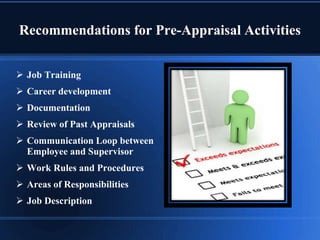
Recommendations for Pre-Appraisal Activities
 Job Training
 Career development
 Documentation
 Review of Past Appraisals
 Communication Loop between
Employee and Supervisor
 Work Rules and Procedures
 Areas of Responsibilities
 Job Description
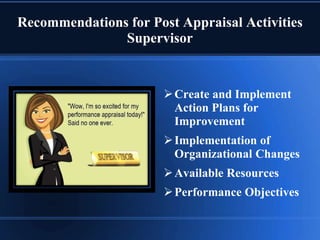
Recommendations for Post Appraisal Activities
Supervisor
Create and Implement
Action Plans for
Improvement
Implementation of
Organizational Changes
Available Resources
Performance Objectives
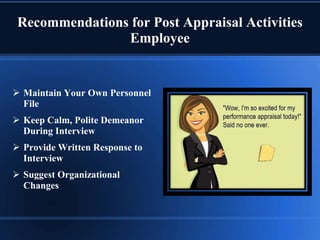
Recommendations for Post Appraisal Activities
Employee
 Maintain Your Own Personnel
File
 Keep Calm, Polite Demeanor
During Interview
 Provide Written Response to
Interview
 Suggest Organizational
Changes
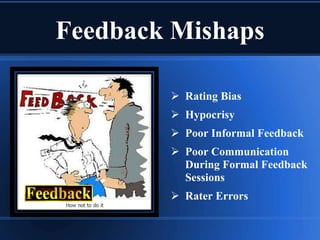
Feedback Mishaps
 Rating Bias
 Hypocrisy
 Poor Informal Feedback
 Poor Communication
During Formal Feedback
Sessions
 Rater Errors
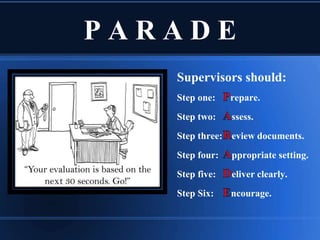
P A R A D E
Supervisors should:
Step one: repare.
Step two: ssess.
Step three: eview documents.
Step four: ppropriate setting.
Step five: eliver clearly.
Step Six: ncourage.
Step 1: Prepare
The critical step to success in any endeavor is preparation.
For instance, preparation means sitting down and writing
objectives for the performance period. Supervisors need to
make sure that employees understand what is expected
from them if they expect them to accomplish it. It is
necessary to obtain workers' input on their own goals if
supervisors desire to enhance their commitment in
accomplishing those objectives. Providing workers a
voice in their tasks, tends to increase their tenacity toward
their tasks.
Step 2: Assessment
An important responsibility for supervisors is providing timely feedback to employees. Performance
feedback provided instantly has proven to provide the best outcome. It is unfair and ineffective to tell
someone how they messed up, or how well they performed, long after the task is completed. Informing
employees promptly so that they can either address the issue or repeat the success is the best practice.
If the PA is the only time supervisors discuss how well employees are performing, and especially if workers
feel that this meeting has profound impact on their compensation, the interview takes on enormous
proportions. With all the tension in the room, how can it be a successful interchange? Many workers,
when asked what the annual interview reminded them of, responded, "A trip to the principal's office."
Continual communication is important to reduce the fear and anxiety associated with this interview for
supervisors and the employees.
When questioned what employees want from the PA interview, both supervisors and employees most often
answer, "No surprises." This is heard more frequently than hope for the highest rating. Employees
want to know how well they are performing. They do not desire to have it sprung on them at the PA
interview, when they no longer have the opportunity to produce positive outcomes. They desire to be
respected as partners throughout the PA process. Continual measurement and feedback is important to
eliminate surprises, which also decreases episodes of conflict. Surprises beget conflict. Communication
prevents them.
Step 3: Review
Prior to interviewing the worker, inspect all the documentation from the past
year. Take a gander at the goals that the supervisor and worker have
agreed to and documented since the last appraisal, including
commendations or letters received regarding the worker during the past
year.
Review all records from the meetings with management. Then produce the
first draft of the performance review. Some companies offer the worker
the opportunity for self-appraisals. When this is all completed, then the
supervisor and the worker should meet to go over the worker's
development before the actual interview. This keeps the worker involved
in the process and makes them feel that they are receiving a fair
assessment. It is another great technique for reducing or eliminating
surprises and conflict.
Step 4: Appropriate Setting
Supervisors should ensure they have an appropriate setting to deliver the PA and to conduct the
interview. The most commonly used location, a supervisor's office, is often the worst choice. It is
not perceived as a neutral meeting place (recall the principal's office analogy), and no matter how
much rapport-building the supervisor does or how long they have worked with the employee, it
remains the supervisor's “turf.”
A conference room is oftentimes the better choice. But there is room to be creative. The lunch room
may not seem like a very private place, but between meal-times, it could be used. Supervisors
want the setting to relax workers, not add to their anxiety. This is one reason to avoid restaurants.
Some supervisors decide to render appraisals over lunch, believing it would be an appropriate
method to reward the worker. However, eateries at lunch are far from private. Even workers who
expect positive reviews seldom feel hungry when this interview begins.
Think about conducting the interview in the worker's office, if it has a door. Meeting on neutral
ground, as opposed to the supervisor's office, also makes it easier to conclude the meeting.
Getting an employee out of the supervisor's office when the interview has concluded, particularly
if the employee believes there is additional matters to discuss, can become difficult. It tends to
reek of dismissal. This can undercut even the most positive of appraisals.
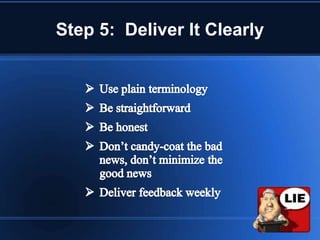
Step 5: Deliver It Clearly
Step 6: Encouragement
At the end of the PA interview, which also marks the
conclusion of one PA cycle and the beginning of the next,
the supervisor's duty is to energize the employee.
Supervisors should inspire the worker to continue doing
that which they do well and make improvements in the
areas where there is room for evolution. This is the best
method to making these interviews beneficial and up-beat.
When the employee's appraisal was not as great as they
may have desired, advise the worker that they are still
valued and that their development will be supported.
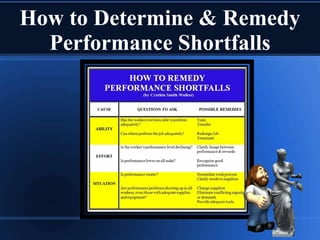
How to Determine & Remedy
Performance Shortfalls
Team Evaluations
TEAM APPRAISALS
 Assessment
 Strategy
 Differences
between Team &
Individual
Appraisals
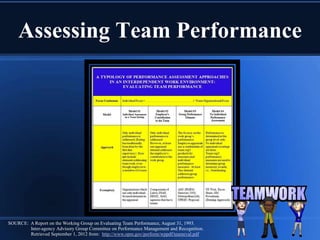
Assessing Team Performance
SOURCE: A Report on the Working Group on Evaluating Team Performance, August 31, 1993.
Inter-agency Advisory Group Committee on Performance Management and Recognition.
Retrieved September 1, 2012 from: http://www.opm.gov/perform/wppdf/teameval.pdf
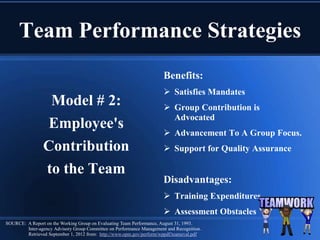
Team Performance Strategies
Model # 2:
Employee's
Contribution
to the Team
Benefits:
 Satisfies Mandates
 Group Contribution is
Advocated
 Advancement To A Group Focus.
 Support for Quality Assurance
Disadvantages:
 Training Expenditures
 Assessment Obstacles
SOURCE: A Report on the Working Group on Evaluating Team Performance, August 31, 1993.
Inter-agency Advisory Group Committee on Performance Management and Recognition.
Retrieved September 1, 2012 from: http://www.opm.gov/perform/wppdf/teameval.pdf
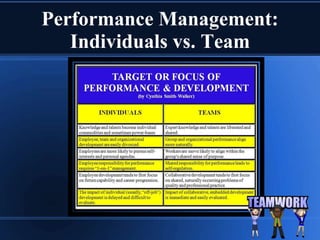
Performance Management:
Individuals vs. Team
Summary
 Key Points
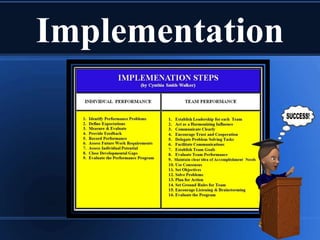
 Implementation
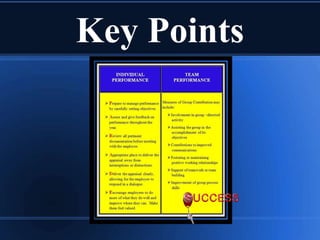
Key Points
Implementation
References
Please see presenter’s notes for
my list of References.
Animations purchased from
AnimationFactory.com
Questions
Should you have any questions or
comments you would like to discuss, please
contact me at: csmithw@wgu.edu
Thank you for viewing my presentation.

HR STRATEGIES: PERFORMANCE EVALUATIONS

  • 1.
    Performance Evaluations INDIVIDUAL &TEAM EVALUATIONS AUTHORED BY: CYNTHIA SMITH-WALKER EMAIL: csmithw@wgu.edu
  • 2.
    Preparing Performance Appraisals forOptimal Results Performance Appraisal:  Identification of Performance Problems  Measure Employee Performance  Manage Employee Performance Administrative Purposes:  Work Conditions  Promotions  Terminations  Rewards Developmental Purposes:  Improvement of Skills  Feedback  Job Training  Learning Opportunities
  • 3.
    Recommendations for Pre-AppraisalActivities  Job Training  Career development  Documentation  Review of Past Appraisals  Communication Loop between Employee and Supervisor  Work Rules and Procedures  Areas of Responsibilities  Job Description
  • 4.
    Recommendations for PostAppraisal Activities Supervisor Create and Implement Action Plans for Improvement Implementation of Organizational Changes Available Resources Performance Objectives
  • 5.
    Recommendations for PostAppraisal Activities Employee  Maintain Your Own Personnel File  Keep Calm, Polite Demeanor During Interview  Provide Written Response to Interview  Suggest Organizational Changes
  • 6.
    Feedback Mishaps  RatingBias  Hypocrisy  Poor Informal Feedback  Poor Communication During Formal Feedback Sessions  Rater Errors
  • 7.
    P A RA D E Supervisors should: Step one: repare. Step two: ssess. Step three: eview documents. Step four: ppropriate setting. Step five: eliver clearly. Step Six: ncourage.
  • 8.
    Step 1: Prepare Thecritical step to success in any endeavor is preparation. For instance, preparation means sitting down and writing objectives for the performance period. Supervisors need to make sure that employees understand what is expected from them if they expect them to accomplish it. It is necessary to obtain workers' input on their own goals if supervisors desire to enhance their commitment in accomplishing those objectives. Providing workers a voice in their tasks, tends to increase their tenacity toward their tasks.
  • 9.
    Step 2: Assessment Animportant responsibility for supervisors is providing timely feedback to employees. Performance feedback provided instantly has proven to provide the best outcome. It is unfair and ineffective to tell someone how they messed up, or how well they performed, long after the task is completed. Informing employees promptly so that they can either address the issue or repeat the success is the best practice. If the PA is the only time supervisors discuss how well employees are performing, and especially if workers feel that this meeting has profound impact on their compensation, the interview takes on enormous proportions. With all the tension in the room, how can it be a successful interchange? Many workers, when asked what the annual interview reminded them of, responded, "A trip to the principal's office." Continual communication is important to reduce the fear and anxiety associated with this interview for supervisors and the employees. When questioned what employees want from the PA interview, both supervisors and employees most often answer, "No surprises." This is heard more frequently than hope for the highest rating. Employees want to know how well they are performing. They do not desire to have it sprung on them at the PA interview, when they no longer have the opportunity to produce positive outcomes. They desire to be respected as partners throughout the PA process. Continual measurement and feedback is important to eliminate surprises, which also decreases episodes of conflict. Surprises beget conflict. Communication prevents them.
  • 10.
    Step 3: Review Priorto interviewing the worker, inspect all the documentation from the past year. Take a gander at the goals that the supervisor and worker have agreed to and documented since the last appraisal, including commendations or letters received regarding the worker during the past year. Review all records from the meetings with management. Then produce the first draft of the performance review. Some companies offer the worker the opportunity for self-appraisals. When this is all completed, then the supervisor and the worker should meet to go over the worker's development before the actual interview. This keeps the worker involved in the process and makes them feel that they are receiving a fair assessment. It is another great technique for reducing or eliminating surprises and conflict.
  • 11.
    Step 4: AppropriateSetting Supervisors should ensure they have an appropriate setting to deliver the PA and to conduct the interview. The most commonly used location, a supervisor's office, is often the worst choice. It is not perceived as a neutral meeting place (recall the principal's office analogy), and no matter how much rapport-building the supervisor does or how long they have worked with the employee, it remains the supervisor's “turf.” A conference room is oftentimes the better choice. But there is room to be creative. The lunch room may not seem like a very private place, but between meal-times, it could be used. Supervisors want the setting to relax workers, not add to their anxiety. This is one reason to avoid restaurants. Some supervisors decide to render appraisals over lunch, believing it would be an appropriate method to reward the worker. However, eateries at lunch are far from private. Even workers who expect positive reviews seldom feel hungry when this interview begins. Think about conducting the interview in the worker's office, if it has a door. Meeting on neutral ground, as opposed to the supervisor's office, also makes it easier to conclude the meeting. Getting an employee out of the supervisor's office when the interview has concluded, particularly if the employee believes there is additional matters to discuss, can become difficult. It tends to reek of dismissal. This can undercut even the most positive of appraisals.
  • 12.
    Step 5: DeliverIt Clearly
  • 13.
    Step 6: Encouragement Atthe end of the PA interview, which also marks the conclusion of one PA cycle and the beginning of the next, the supervisor's duty is to energize the employee. Supervisors should inspire the worker to continue doing that which they do well and make improvements in the areas where there is room for evolution. This is the best method to making these interviews beneficial and up-beat. When the employee's appraisal was not as great as they may have desired, advise the worker that they are still valued and that their development will be supported.
  • 14.
    How to Determine& Remedy Performance Shortfalls
  • 15.
    Team Evaluations TEAM APPRAISALS Assessment  Strategy  Differences between Team & Individual Appraisals
  • 16.
    Assessing Team Performance SOURCE:A Report on the Working Group on Evaluating Team Performance, August 31, 1993. Inter-agency Advisory Group Committee on Performance Management and Recognition. Retrieved September 1, 2012 from: http://www.opm.gov/perform/wppdf/teameval.pdf
  • 17.
    Team Performance Strategies Model# 2: Employee's Contribution to the Team Benefits:  Satisfies Mandates  Group Contribution is Advocated  Advancement To A Group Focus.  Support for Quality Assurance Disadvantages:  Training Expenditures  Assessment Obstacles SOURCE: A Report on the Working Group on Evaluating Team Performance, August 31, 1993. Inter-agency Advisory Group Committee on Performance Management and Recognition. Retrieved September 1, 2012 from: http://www.opm.gov/perform/wppdf/teameval.pdf
  • 18.
  • 19.
  • 20.
  • 21.
  • 22.
    References Please see presenter’snotes for my list of References. Animations purchased from AnimationFactory.com
  • 23.
    Questions Should you haveany questions or comments you would like to discuss, please contact me at: csmithw@wgu.edu Thank you for viewing my presentation.