Autism-friendly recruitment
and
Supporting Autistic staff
By Rhys Jones and Cath Leggett
What is Autistic Spectrum Disorder?
• Autistic Spectrum Disorder (ASD) is a lifelong developmental
disability that affects how people perceive the world and interact
with others
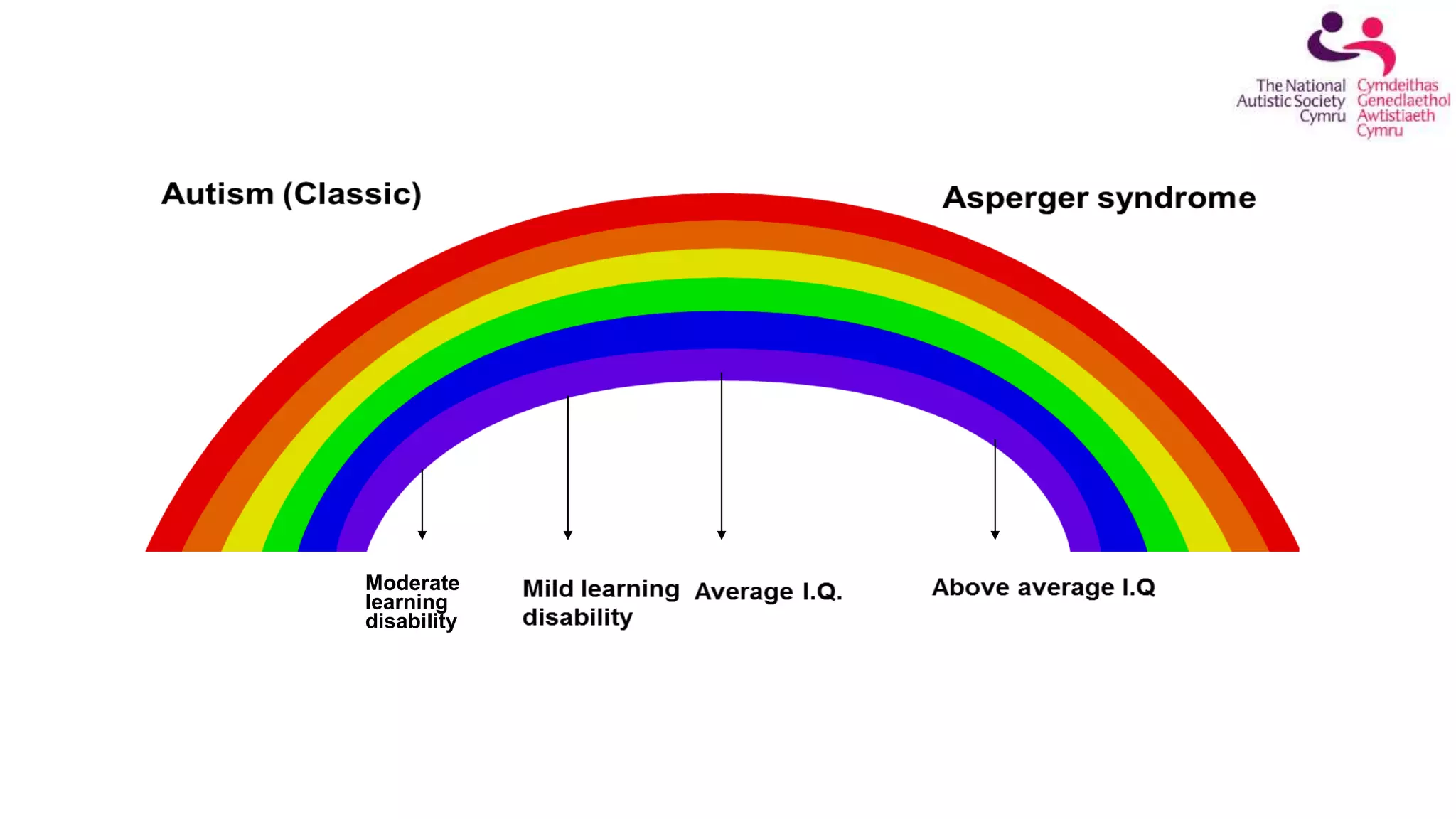
• All autistic people share certain difficulties but will be affected by
autism in different ways. Some also have learning difficulties and/or
mental health conditions, meaning people need different levels of
support
• Approximately 700,000 people in the UK (30,000 in Wales) are on
the spectrum
Moderate
learning
disability
Characteristics of ASD
• Social Communication and Interaction
• Repetitive Behaviour and Routines
• Sensory Sensitivity
• Highly Focused Interests
The Benefits of
Employing Autistic Adults
Autism and Employment Statistics
• Only 16% of adults on the spectrum are in full time paid employment,
with only 32% in some form of paid employment (NAS, 2017)
• 4 out of 10 people surveyed said they’d never had a job before while
77% of unemployed surveyed individuals stated they wanted to work
• 60% of employers surveyed stated they were concerned with regards
to how they would support an autistic employee and whether or not
they’d get it right
Why is the Interview Process Challenging?
• Interviews are not found to be autistically friendly, nor do employers
generally make the adjustments to help put more autistic people at
ease
• Only 11% of those who disclosed their diagnosis on application forms
were offered reasonable adjustments while only 3% were offered an
alternative interview process
• Information overload, triggers include sensory issues, communication
methods and time pressures
• Differences in non-verbal communication and a reliance by
interviewers on this body language
Film….Job interviews
• https://youtu.be/zLTf6YJOh1c
How Can Employers Adjust Their Assessment
Processes?
• Consider alternative methods of application and interview, for example,
tick box exercises in the application form and work trials for the interview
• Disclose questions or interview topics beforehand, allows time for
information to be processed and for sufficient answers to be prepared
• Low arousal environment (e.g. Interview to take place in a less busy part of
the office)
• Avoid Jargon where possible
• Most importantly, contact the candidate beforehand and discuss
reasonable adjustments. Equity, not equality.
Common Difficulties in the Workplace
• Unsuitable environment (e.g. Sitting colleague in high arousal part of
the office)
• Time Management/Prioritorising
• Social Aspects (e.g. Socialising with colleagues, unwritten rules, lack
of cultural awareness, lack of understanding from colleagues etc.)
• Clarity (Expectations and Instructions)
• Adjusting working hours
• Providing adapted equipment and environmental adaptations
• Providing written instructions for tasks
• Assistive resources (e.g. visual reminders/checklists/activity planners)
• Advanced notice of changes
• Support network
• Regular meetings with manager
• Buddy/mentor
• Workplace support from external specialist
• Adapted appraisal targets
• Training – accessible to the individual
• Adaptations to role
Some Common Reasonable Adjustments in the
Workplace…
Film… small adjustments which help
• https://youtu.be/bcMMW8Yjod8
Further Information
• Employment Training Service:
www.autism.org.uk/working-with/employment.aspx
training.enquiries@nas.org.uk
0141 285 7117
• Business Disability forum: www.businessdisabilityforum.org.uk

HR Insights, Disability Discrimination Law, National Autistic Society

  • 1.
    Autism-friendly recruitment and Supporting Autisticstaff By Rhys Jones and Cath Leggett
  • 2.
    What is AutisticSpectrum Disorder? • Autistic Spectrum Disorder (ASD) is a lifelong developmental disability that affects how people perceive the world and interact with others • All autistic people share certain difficulties but will be affected by autism in different ways. Some also have learning difficulties and/or mental health conditions, meaning people need different levels of support • Approximately 700,000 people in the UK (30,000 in Wales) are on the spectrum
  • 3.
  • 4.
    Characteristics of ASD •Social Communication and Interaction • Repetitive Behaviour and Routines • Sensory Sensitivity • Highly Focused Interests
  • 5.
  • 6.
    Autism and EmploymentStatistics • Only 16% of adults on the spectrum are in full time paid employment, with only 32% in some form of paid employment (NAS, 2017) • 4 out of 10 people surveyed said they’d never had a job before while 77% of unemployed surveyed individuals stated they wanted to work • 60% of employers surveyed stated they were concerned with regards to how they would support an autistic employee and whether or not they’d get it right
  • 7.
    Why is theInterview Process Challenging? • Interviews are not found to be autistically friendly, nor do employers generally make the adjustments to help put more autistic people at ease • Only 11% of those who disclosed their diagnosis on application forms were offered reasonable adjustments while only 3% were offered an alternative interview process • Information overload, triggers include sensory issues, communication methods and time pressures • Differences in non-verbal communication and a reliance by interviewers on this body language
  • 8.
  • 9.
    How Can EmployersAdjust Their Assessment Processes? • Consider alternative methods of application and interview, for example, tick box exercises in the application form and work trials for the interview • Disclose questions or interview topics beforehand, allows time for information to be processed and for sufficient answers to be prepared • Low arousal environment (e.g. Interview to take place in a less busy part of the office) • Avoid Jargon where possible • Most importantly, contact the candidate beforehand and discuss reasonable adjustments. Equity, not equality.
  • 10.
    Common Difficulties inthe Workplace • Unsuitable environment (e.g. Sitting colleague in high arousal part of the office) • Time Management/Prioritorising • Social Aspects (e.g. Socialising with colleagues, unwritten rules, lack of cultural awareness, lack of understanding from colleagues etc.) • Clarity (Expectations and Instructions)
  • 11.
    • Adjusting workinghours • Providing adapted equipment and environmental adaptations • Providing written instructions for tasks • Assistive resources (e.g. visual reminders/checklists/activity planners) • Advanced notice of changes • Support network • Regular meetings with manager • Buddy/mentor • Workplace support from external specialist • Adapted appraisal targets • Training – accessible to the individual • Adaptations to role Some Common Reasonable Adjustments in the Workplace…
  • 12.
    Film… small adjustmentswhich help • https://youtu.be/bcMMW8Yjod8
  • 13.
    Further Information • EmploymentTraining Service: www.autism.org.uk/working-with/employment.aspx training.enquiries@nas.org.uk 0141 285 7117 • Business Disability forum: www.businessdisabilityforum.org.uk