Compelling HR Stories
we’ve helped our clients tell
Succession Management
A multi-national telecoms company had been using the traditional opinion-based succession management process to
identify possible successors for key positions through out the business, but research showed that these identified
succesors were appointed in less than 1 in 14 cases (7%).
Most often successors identified as “Ready Now” were not appointed due to “lack of readiness” and external
appointments were made in 1 in 4 cases.
So how was readiness mis-identified in so many cases?
The process of estimating readiness is a complex one. Because it is trying to calculate an “Estimated Time of Arrival”
(ETA) for a specific person and a specific position it relies on accurately estimating two variables. The “distance”, or
gap, between the person and the target position, and the “speed”, or rate at which the person can adapt and learn.
When readiness is estimated with an opinion, too many data points, and their relation to one another, are ignored or
disregarded. Past performance is frequently seen as a predictor of future performance, even when the conditions under
which the person will operate are significantly different.
By using analytics to identify and collect all the relevant data points for “distance” and “speed”, we were able to create
an algorithm that more accurately predicts the timeframe for readiness.
Moving beyond “Ready Now” and “Ready Later”
Digital Transformation
As a multi-national banking group, there was little choice but to embark on a journey towards the increased growth and
cost savings promised by “going digital”. A world of changing interactivity, increased mobility and insightful analytics.
But what may appear to be purely technology-driven, has far greater implications for culture, capabilities and talent.
The speed of technological change far outstrips the rate at which people can change.
Developing a talent strategy to manage the digital transformation needed to answer these 5 questions.
Challenge 1: How will the digital strategy change the demands of each person’s current role?
Challenge 2: How well does each individual match their new digital role?
Challenge 3: Should we develop for this role, or redeploy the person to a role with a better fit?
Challenge 4: Where is the best opportunity for deployment?
Challenge 5: How do we connect people with the relevant developmenal resources?
Youlab was used to profile 15,000 individuals in 7 countries and created the analytics to answer these 5 high value
questions.
A bankers journey to the digital age
Predictive PerformanceAnalytics
A mid-sized communications company that had relied on managers to provide informal performance feedback realized
that the quality and consistency of that feedback was significantly different. They wanted to implement a performance
process but were well aware of the generally perceived ineffectiveness of performance processes.
The challenge was to implement a process that was easy to use, but most importantly, could be both backward
(evaluation of past performance) and forward (predictive of future performance) looking.
The company decided that 4 criteria should be used to evaluate the fit of any process or system.
1. Does it clearly communicate expectations? We created a process that prioritized and customized a limited set of
performance dimensions to ensure consistency, but provide flexibility (see what these were in the case study)
2. Does it effectively motivate people to achieve their goals? We designed an incentive process that tapped into the
psychology of reward, was perceived as transparent and fair, and linked to company results.
3. Does it accurately predict success/failure? We used machine learning to predict performance with a correlation of
0.6 (for comparison, EQ only has a correlation of 0.24 to 0.3 with job performance)
4. Does it improve the quality of the conversation? We provided everyone with the Youlab application that identifies
potential problem areas and provides immediate advice to the individual and the manager.
Stacking the odds in your favor
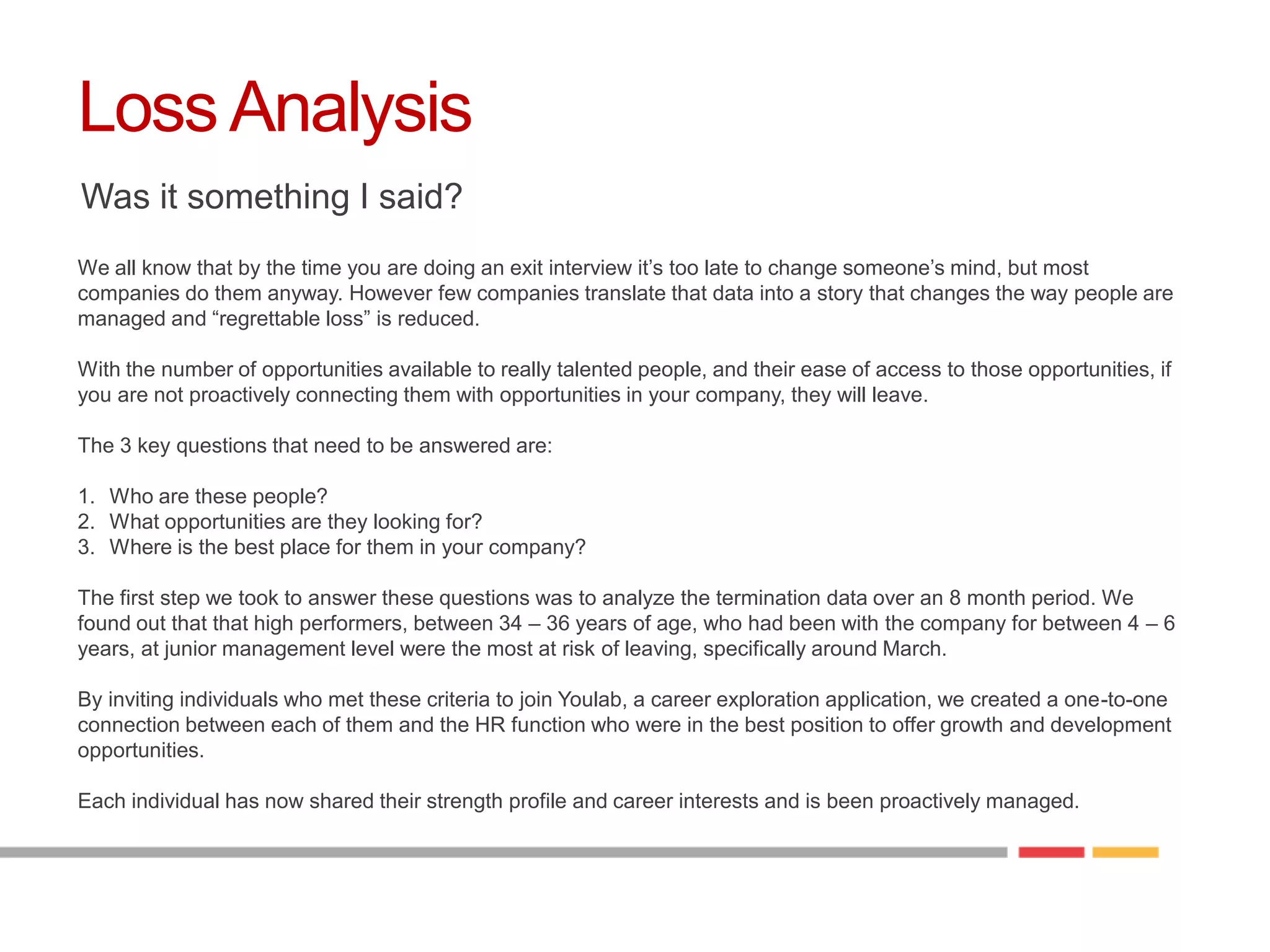
LossAnalysis
We all know that by the time you are doing an exit interview it’s too late to change someone’s mind, but most
companies do them anyway. However few companies translate that data into a story that changes the way people are
managed and “regrettable loss” is reduced.
With the number of opportunities available to really talented people, and their ease of access to those opportunities, if
you are not proactively connecting them with opportunities in your company, they will leave.
The 3 key questions that need to be answered are:
1. Who are these people?
2. What opportunities are they looking for?
3. Where is the best place for them in your company?
The first step we took to answer these questions was to analyze the termination data over an 8 month period. We
found out that that high performers, between 34 – 36 years of age, who had been with the company for between 4 – 6
years, at junior management level were the most at risk of leaving, specifically around March.
By inviting individuals who met these criteria to join Youlab, a career exploration application, we created a one-to-one
connection between each of them and the HR function who were in the best position to offer growth and development
opportunities.
Each individual has now shared their strength profile and career interests and is been proactively managed.
Was it something I said?
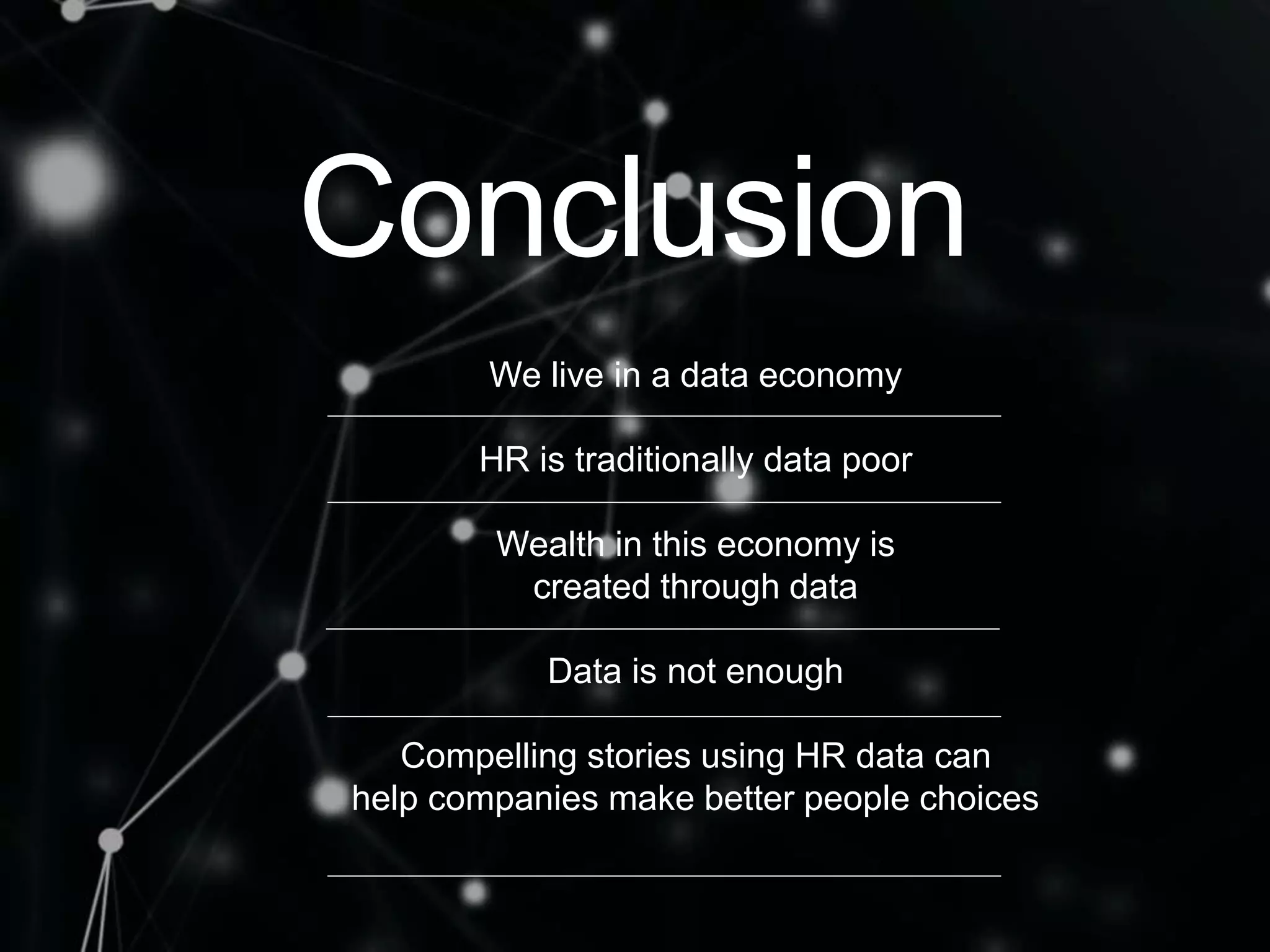
Conclusion
We live in a data economy
HR is traditionally data poor
Wealth in this economy is
created through data
Data is not enough
Compelling stories using HR data can
help companies make better people choices
info@peopletreegroup.com
www.peopletreegroup.com
+1 786 245 5258
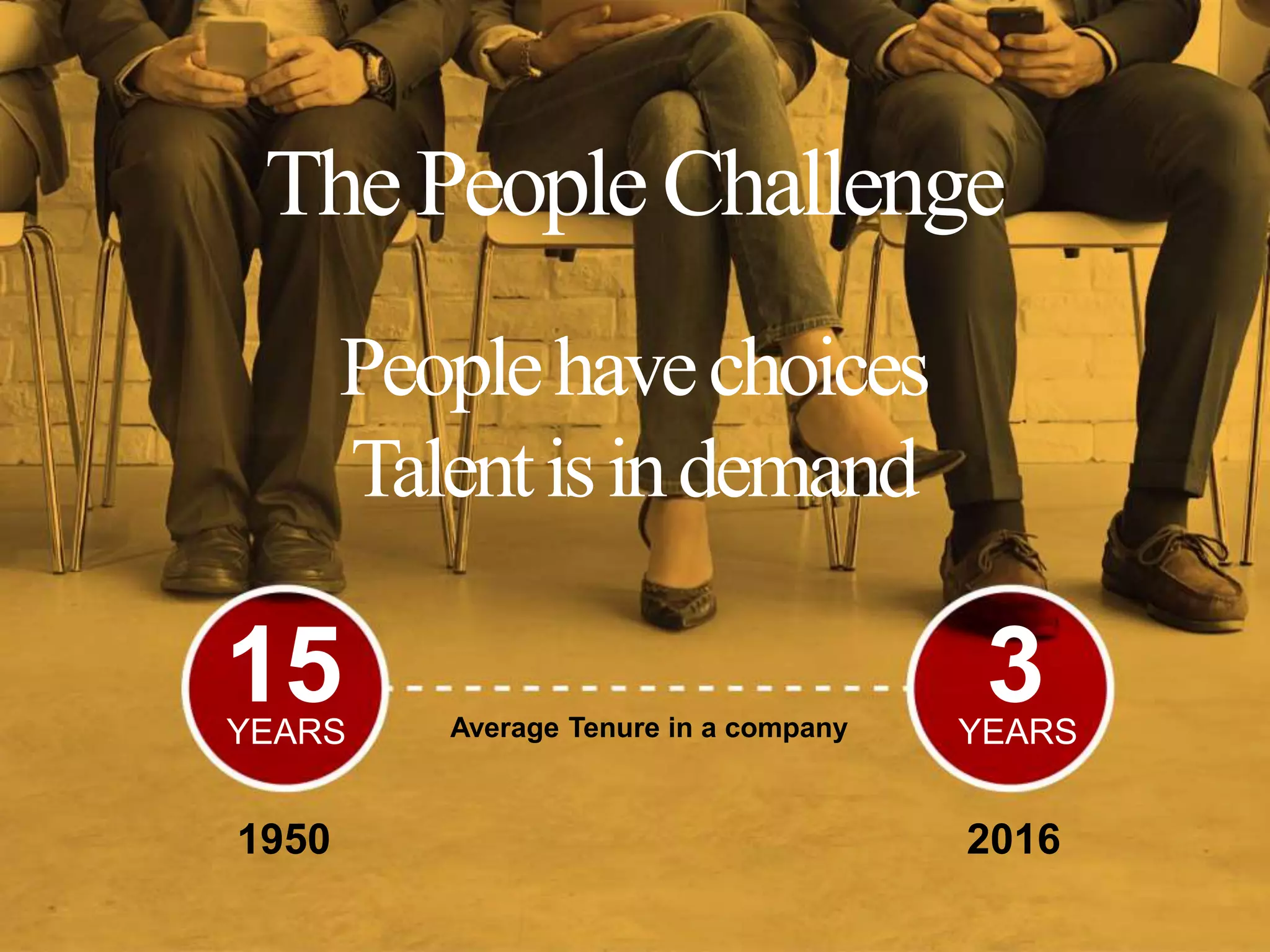
ThePeopleChallenge
Peoplehavechoices
Talentisindemand
20161950
YEARS
3YEARS
15 Average Tenure in a company
People who can’t move don’t
People who can move will ……unless
People who can’t move don’t
People who can move will ……unless
How many of your employees have LinkedIn profiles?
Weproactivelyconnectthem
withnewopportunities
The traditional succession
management process
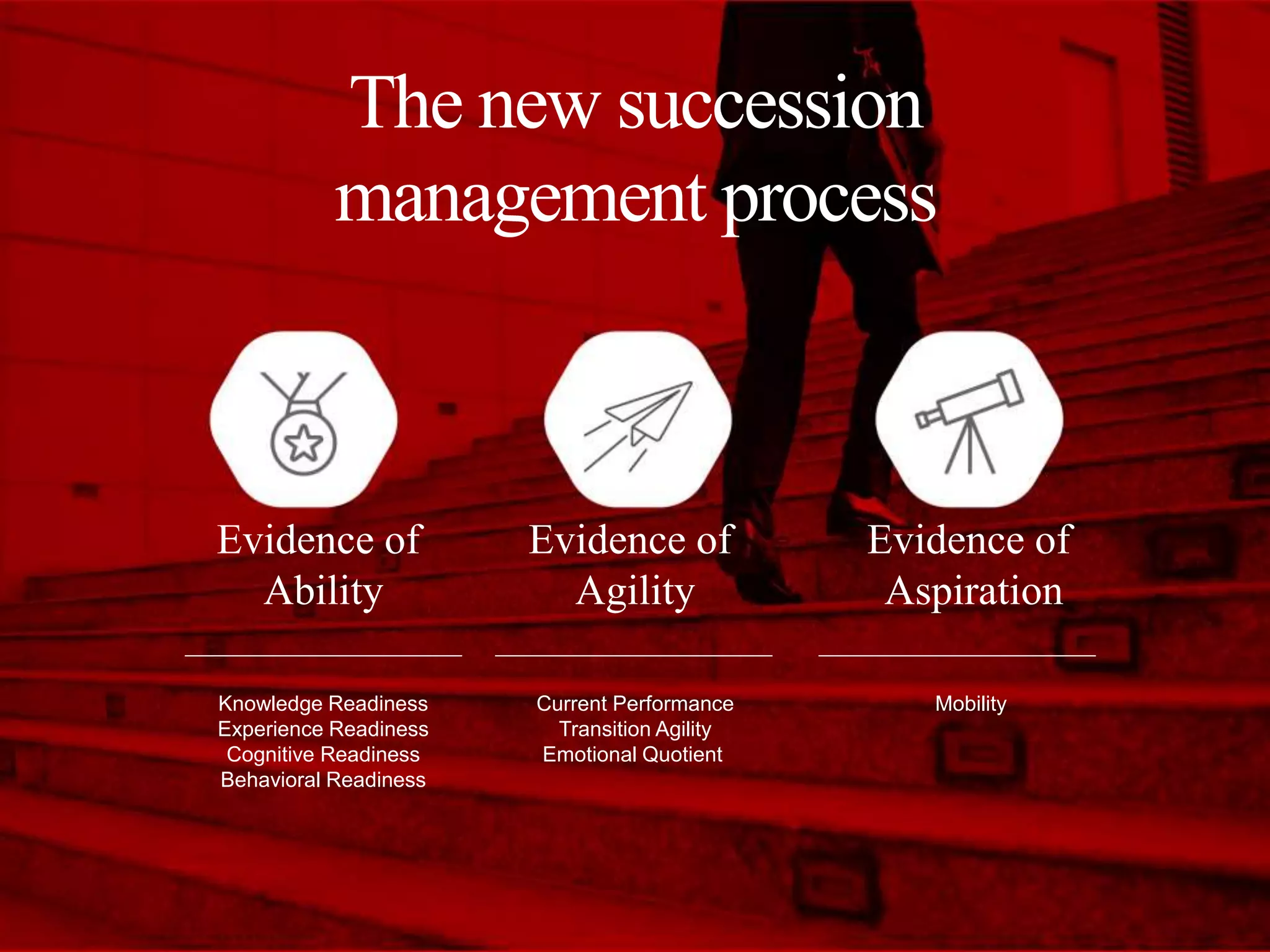
The new succession
management process
Evidence of
Agility
Current Performance
Transition Agility
Emotional Quotient
Evidence of
Ability
Knowledge Readiness
Experience Readiness
Cognitive Readiness
Behavioral Readiness
Evidence of
Aspiration
Mobility

HR in the Data Economy

  • 1.
    Compelling HR Stories we’vehelped our clients tell
  • 2.
    Succession Management A multi-nationaltelecoms company had been using the traditional opinion-based succession management process to identify possible successors for key positions through out the business, but research showed that these identified succesors were appointed in less than 1 in 14 cases (7%). Most often successors identified as “Ready Now” were not appointed due to “lack of readiness” and external appointments were made in 1 in 4 cases. So how was readiness mis-identified in so many cases? The process of estimating readiness is a complex one. Because it is trying to calculate an “Estimated Time of Arrival” (ETA) for a specific person and a specific position it relies on accurately estimating two variables. The “distance”, or gap, between the person and the target position, and the “speed”, or rate at which the person can adapt and learn. When readiness is estimated with an opinion, too many data points, and their relation to one another, are ignored or disregarded. Past performance is frequently seen as a predictor of future performance, even when the conditions under which the person will operate are significantly different. By using analytics to identify and collect all the relevant data points for “distance” and “speed”, we were able to create an algorithm that more accurately predicts the timeframe for readiness. Moving beyond “Ready Now” and “Ready Later”
  • 3.
    Digital Transformation As amulti-national banking group, there was little choice but to embark on a journey towards the increased growth and cost savings promised by “going digital”. A world of changing interactivity, increased mobility and insightful analytics. But what may appear to be purely technology-driven, has far greater implications for culture, capabilities and talent. The speed of technological change far outstrips the rate at which people can change. Developing a talent strategy to manage the digital transformation needed to answer these 5 questions. Challenge 1: How will the digital strategy change the demands of each person’s current role? Challenge 2: How well does each individual match their new digital role? Challenge 3: Should we develop for this role, or redeploy the person to a role with a better fit? Challenge 4: Where is the best opportunity for deployment? Challenge 5: How do we connect people with the relevant developmenal resources? Youlab was used to profile 15,000 individuals in 7 countries and created the analytics to answer these 5 high value questions. A bankers journey to the digital age
  • 4.
    Predictive PerformanceAnalytics A mid-sizedcommunications company that had relied on managers to provide informal performance feedback realized that the quality and consistency of that feedback was significantly different. They wanted to implement a performance process but were well aware of the generally perceived ineffectiveness of performance processes. The challenge was to implement a process that was easy to use, but most importantly, could be both backward (evaluation of past performance) and forward (predictive of future performance) looking. The company decided that 4 criteria should be used to evaluate the fit of any process or system. 1. Does it clearly communicate expectations? We created a process that prioritized and customized a limited set of performance dimensions to ensure consistency, but provide flexibility (see what these were in the case study) 2. Does it effectively motivate people to achieve their goals? We designed an incentive process that tapped into the psychology of reward, was perceived as transparent and fair, and linked to company results. 3. Does it accurately predict success/failure? We used machine learning to predict performance with a correlation of 0.6 (for comparison, EQ only has a correlation of 0.24 to 0.3 with job performance) 4. Does it improve the quality of the conversation? We provided everyone with the Youlab application that identifies potential problem areas and provides immediate advice to the individual and the manager. Stacking the odds in your favor
  • 5.
    LossAnalysis We all knowthat by the time you are doing an exit interview it’s too late to change someone’s mind, but most companies do them anyway. However few companies translate that data into a story that changes the way people are managed and “regrettable loss” is reduced. With the number of opportunities available to really talented people, and their ease of access to those opportunities, if you are not proactively connecting them with opportunities in your company, they will leave. The 3 key questions that need to be answered are: 1. Who are these people? 2. What opportunities are they looking for? 3. Where is the best place for them in your company? The first step we took to answer these questions was to analyze the termination data over an 8 month period. We found out that that high performers, between 34 – 36 years of age, who had been with the company for between 4 – 6 years, at junior management level were the most at risk of leaving, specifically around March. By inviting individuals who met these criteria to join Youlab, a career exploration application, we created a one-to-one connection between each of them and the HR function who were in the best position to offer growth and development opportunities. Each individual has now shared their strength profile and career interests and is been proactively managed. Was it something I said?
  • 6.
    Conclusion We live ina data economy HR is traditionally data poor Wealth in this economy is created through data Data is not enough Compelling stories using HR data can help companies make better people choices
  • 7.
  • 8.
  • 9.
    People who can’tmove don’t People who can move will ……unless
  • 10.
    People who can’tmove don’t People who can move will ……unless How many of your employees have LinkedIn profiles? Weproactivelyconnectthem withnewopportunities
  • 11.
  • 12.
    The new succession managementprocess Evidence of Agility Current Performance Transition Agility Emotional Quotient Evidence of Ability Knowledge Readiness Experience Readiness Cognitive Readiness Behavioral Readiness Evidence of Aspiration Mobility