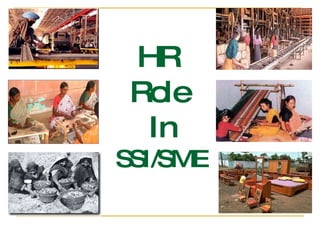
HR  Role  In SSI/SME
HRM is concerned with the ‘people’ dimension of management. Since every organization is made up of people, acquiring their services, developing their skills, motivating them to high levels of performance, and ensuring that they continue to maintain their commitment to the organization are essential to achieving organizational objectives. So Human Resource Management has become a a very important practice in today’s world. Human Resource Management
All the human aspects mentioned previously  are true regardless of the type of organization government, business, health, education, recreation, or social action. Because till the time we have to deal with Human beings no body can deny the importance of HRM.  Getting and keeping good people is critical to the success of every organization, whether profit or non profit, public or private and similarly large or small scale industry.  Importance of HRM
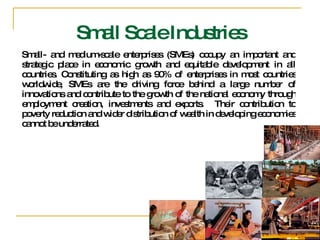
Small- and medium-scale enterprises (SMEs) occupy an important and strategic place in economic growth and equitable development in all countries. Constituting as high as 90% of enterprises in most countries worldwide, SMEs are the driving force behind a large number of innovations and contribute to the growth of the national economy through employment creation, investments and exports.  Their contribution to poverty reduction and wider distribution of wealth in developing economies cannot be underrated.  Small Scale Industries
An industrial undertaking in which investment in fixed assets in plant and machinery whether held on ownership terms or on lease or on hire does not exceed Rs. 10 million  or 1 crores. Small Scale Industries
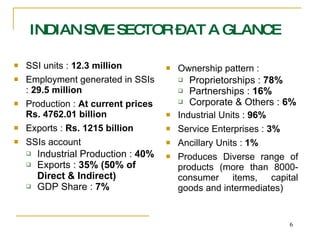
SSI units :  12.3 million Employment generated in SSIs :  29.5 million Production :  At current prices Rs. 4762.01 billion Exports :  Rs. 1215 billion SSIs account  Industrial Production :  40% Exports :  35% (50% of Direct & Indirect) GDP Share :  7% Ownership pattern :  Proprietorships :  78%  Partnerships :  16% Corporate & Others :  6% Industrial Units :  96% Service Enterprises :  3% Ancillary Units :  1%  Produces Diverse range of products (more than 8000- consumer items, capital goods and intermediates) INDIAN SME SECTOR – AT A GLANCE
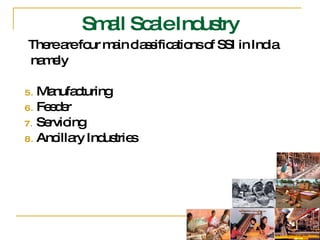
There are four main classifications of SSI in India  namely Manufacturing Feeder Servicing Ancillary Industries  Small Scale Industry
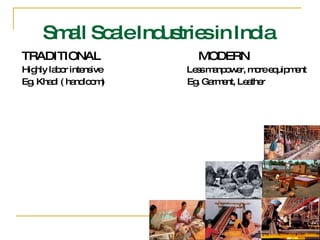
TRADITIONAL  MODERN Highly labor intensive  Less manpower, more equipment Eg. Khadi ( handloom)  Eg. Garment, Leather  Small Scale Industries in India
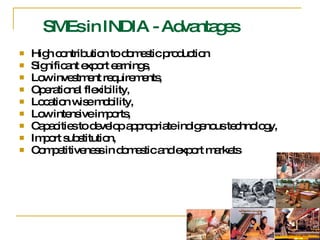
SMEs in INDIA - Advantages High contribution to domestic production Significant export earnings, Low investment requirements,  Operational flexibility,  Location wise mobility,  Low intensive imports,  Capacities to develop appropriate indigenous technology,  Import substitution,  Competitiveness in domestic and export markets
SMEs in INDIA - Limitations low capital base,  concentration of management functions in one/ two persons,  inadequate exposure to international environment,  inadequate R&D and lack of professionalism  Limitation accessing technology  maintaining competitiveness.  Poor adaptability to changing trade trends; Desire to avoid risk; emphasis only on production  Non-availability of  technically trained human resources
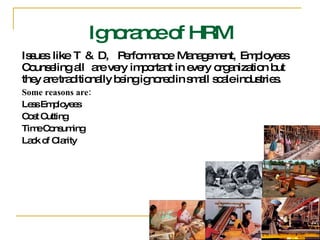
Issues like T & D,  Performance Management, Employees Counseling all  are very important in every organization but  they are traditionally being ignored in small scale industries. Some reasons are:  Less Employees Cost Cutting Time Consuming Lack of Clarity  Ignorance of HRM
Role of HRD To enable SMEs overcome the above problems and enhance their access to new technologies for increasing their competitiveness in the international market, it is imperative to give them a conducive environment, which includes  formulation of appropriate national policies and programmes, building up technological capacity, knowledge flows and technology databases and finally, R&D and inter-firm linkages. Networking  offers an important route for individual SMEs to address their problems as well as to improve their competitive position. Evidence from developing and developed countries shows that networking is more likely when enterprises operate in proximity and share business interests such as markets for products, infrastructure needs or challenging external competition. Within such groups or clusters, enterprises’ joint initiatives are stronger, because of the critical mass of interested parties, more cost-effective due to shared fixed costs and easy coordination with proximity fostering mutual knowledge and trust.
HRM is a process of four functions – ACQUSITION  – getting people DEVELOPMENT  – preparing them MOTIVATION  – activating them MAINTENANCE  – keeping them HRM in SSI
ACQUISITION FUNCTION The acquisition begins with planning.  This includes the estimating of demands and supply of labour. This also includes the recruitment, selection, and socialization of employees.
DEVELOPMENT Function  The development functions can be viewed along three dimensions. The first is  employee training , which emphasizes skill development and the changing of attitudes among workers. The second is  management development , which concerns itself primarily with knowledge acquisitions and the enhancement of an executive’s conceptual abilities. The third  is  career development , which is the continual effort to match long term individual and organizational needs.
MOTIVATION FUNCTION The motivation function begins with the recognition that individuals are unique and that motivation techniques must reflect the needs of each individual.  Within the motivation function, job satisfaction, performing appraisal, behavioral and structural techniques for stimulating worker performance, the importance of linking rewards to performance, compensation and benefits administration, and how to handle problem employees are reviewed.
MAINTENANCE Function The final function is maintenance.  Maintenance function is concerned with providing those working  conditions that employees believe are necessary in order to maintain their commitment to the organization.
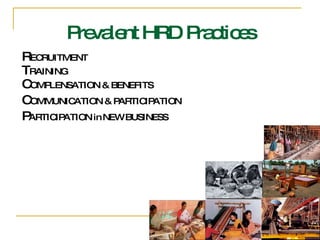
R ECRUITMENT T RAINING C OMPLENSATION & BENEFITS C OMMUNICATION & PARTICIPATION P ARTICIPATION in NEW BUSINESS Prevalent HRD Practices
T ECHNOLOGY in TRAINING N ETWORKING M ANAGEMETN & DEVELOPMENT PROGRAMS W OMEN ENTREPRENURSHIP New Practices
THANK YOU
An effort by: N IKITA JAI N MBA – FT 3 rd  Semester IMS

Hr In Ssi

  • 1.
    HR Role In SSI/SME
  • 2.
    HRM is concernedwith the ‘people’ dimension of management. Since every organization is made up of people, acquiring their services, developing their skills, motivating them to high levels of performance, and ensuring that they continue to maintain their commitment to the organization are essential to achieving organizational objectives. So Human Resource Management has become a a very important practice in today’s world. Human Resource Management
  • 3.
    All the humanaspects mentioned previously are true regardless of the type of organization government, business, health, education, recreation, or social action. Because till the time we have to deal with Human beings no body can deny the importance of HRM. Getting and keeping good people is critical to the success of every organization, whether profit or non profit, public or private and similarly large or small scale industry. Importance of HRM
  • 4.
    Small- and medium-scaleenterprises (SMEs) occupy an important and strategic place in economic growth and equitable development in all countries. Constituting as high as 90% of enterprises in most countries worldwide, SMEs are the driving force behind a large number of innovations and contribute to the growth of the national economy through employment creation, investments and exports. Their contribution to poverty reduction and wider distribution of wealth in developing economies cannot be underrated. Small Scale Industries
  • 5.
    An industrial undertakingin which investment in fixed assets in plant and machinery whether held on ownership terms or on lease or on hire does not exceed Rs. 10 million or 1 crores. Small Scale Industries
  • 6.
    SSI units : 12.3 million Employment generated in SSIs : 29.5 million Production : At current prices Rs. 4762.01 billion Exports : Rs. 1215 billion SSIs account Industrial Production : 40% Exports : 35% (50% of Direct & Indirect) GDP Share : 7% Ownership pattern : Proprietorships : 78% Partnerships : 16% Corporate & Others : 6% Industrial Units : 96% Service Enterprises : 3% Ancillary Units : 1% Produces Diverse range of products (more than 8000- consumer items, capital goods and intermediates) INDIAN SME SECTOR – AT A GLANCE
  • 7.
    There are fourmain classifications of SSI in India namely Manufacturing Feeder Servicing Ancillary Industries Small Scale Industry
  • 8.
    TRADITIONAL MODERNHighly labor intensive Less manpower, more equipment Eg. Khadi ( handloom) Eg. Garment, Leather Small Scale Industries in India
  • 9.
    SMEs in INDIA- Advantages High contribution to domestic production Significant export earnings, Low investment requirements, Operational flexibility, Location wise mobility, Low intensive imports, Capacities to develop appropriate indigenous technology, Import substitution, Competitiveness in domestic and export markets
  • 10.
    SMEs in INDIA- Limitations low capital base, concentration of management functions in one/ two persons, inadequate exposure to international environment, inadequate R&D and lack of professionalism Limitation accessing technology maintaining competitiveness. Poor adaptability to changing trade trends; Desire to avoid risk; emphasis only on production Non-availability of technically trained human resources
  • 11.
    Issues like T& D, Performance Management, Employees Counseling all are very important in every organization but they are traditionally being ignored in small scale industries. Some reasons are: Less Employees Cost Cutting Time Consuming Lack of Clarity Ignorance of HRM
  • 12.
    Role of HRDTo enable SMEs overcome the above problems and enhance their access to new technologies for increasing their competitiveness in the international market, it is imperative to give them a conducive environment, which includes formulation of appropriate national policies and programmes, building up technological capacity, knowledge flows and technology databases and finally, R&D and inter-firm linkages. Networking offers an important route for individual SMEs to address their problems as well as to improve their competitive position. Evidence from developing and developed countries shows that networking is more likely when enterprises operate in proximity and share business interests such as markets for products, infrastructure needs or challenging external competition. Within such groups or clusters, enterprises’ joint initiatives are stronger, because of the critical mass of interested parties, more cost-effective due to shared fixed costs and easy coordination with proximity fostering mutual knowledge and trust.
  • 13.
    HRM is aprocess of four functions – ACQUSITION – getting people DEVELOPMENT – preparing them MOTIVATION – activating them MAINTENANCE – keeping them HRM in SSI
  • 14.
    ACQUISITION FUNCTION Theacquisition begins with planning. This includes the estimating of demands and supply of labour. This also includes the recruitment, selection, and socialization of employees.
  • 15.
    DEVELOPMENT Function The development functions can be viewed along three dimensions. The first is employee training , which emphasizes skill development and the changing of attitudes among workers. The second is management development , which concerns itself primarily with knowledge acquisitions and the enhancement of an executive’s conceptual abilities. The third is career development , which is the continual effort to match long term individual and organizational needs.
  • 16.
    MOTIVATION FUNCTION Themotivation function begins with the recognition that individuals are unique and that motivation techniques must reflect the needs of each individual. Within the motivation function, job satisfaction, performing appraisal, behavioral and structural techniques for stimulating worker performance, the importance of linking rewards to performance, compensation and benefits administration, and how to handle problem employees are reviewed.
  • 17.
    MAINTENANCE Function Thefinal function is maintenance. Maintenance function is concerned with providing those working conditions that employees believe are necessary in order to maintain their commitment to the organization.
  • 18.
    R ECRUITMENT TRAINING C OMPLENSATION & BENEFITS C OMMUNICATION & PARTICIPATION P ARTICIPATION in NEW BUSINESS Prevalent HRD Practices
  • 19.
    T ECHNOLOGY inTRAINING N ETWORKING M ANAGEMETN & DEVELOPMENT PROGRAMS W OMEN ENTREPRENURSHIP New Practices
  • 20.
  • 21.
    An effort by:N IKITA JAI N MBA – FT 3 rd Semester IMS