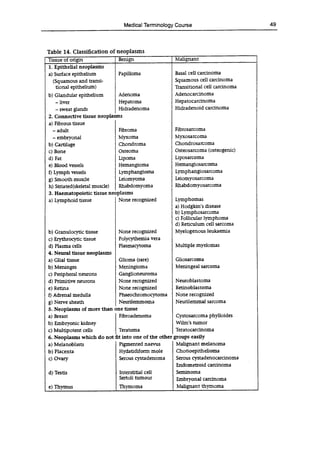
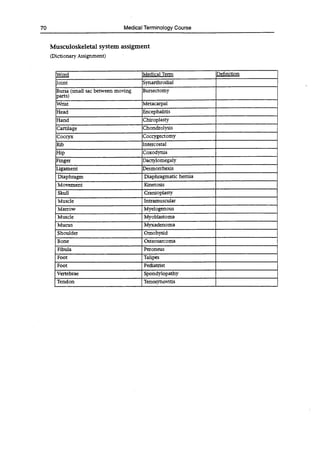
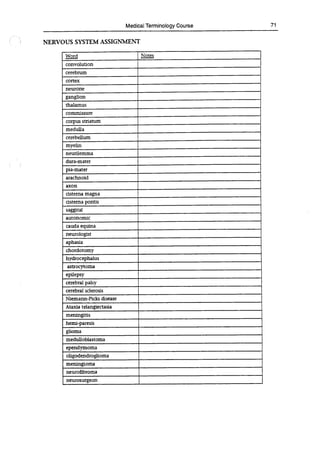
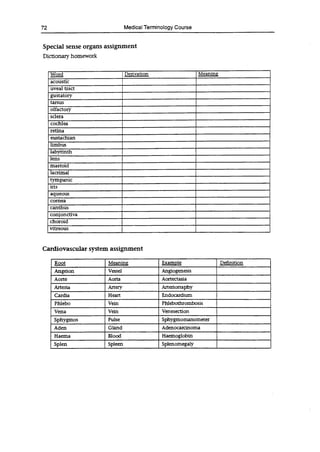
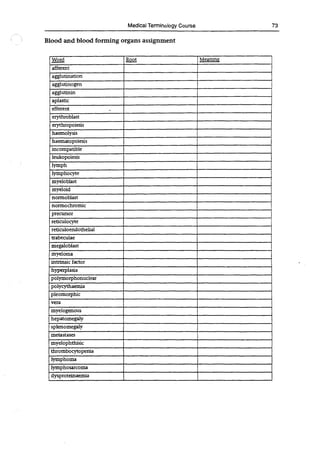
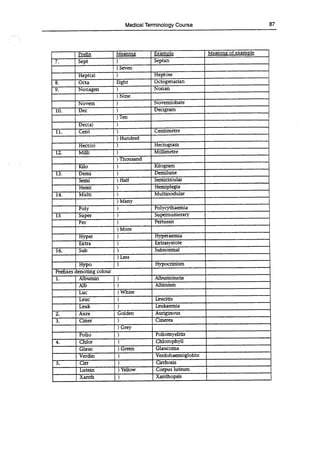
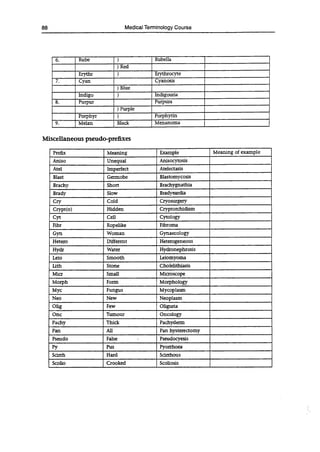
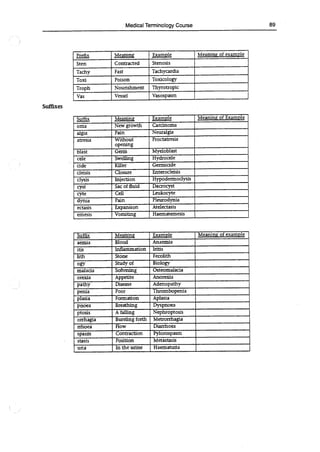
Medical Terminology Course
Margaret Boyd*
This section comprises the edited notes for a course in medical terminology given at the DL
W.W. Cross Cancer Institute, Edmonton, Canada.
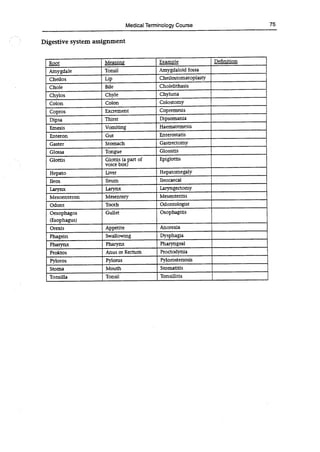
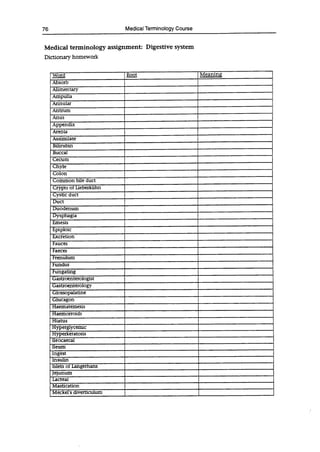
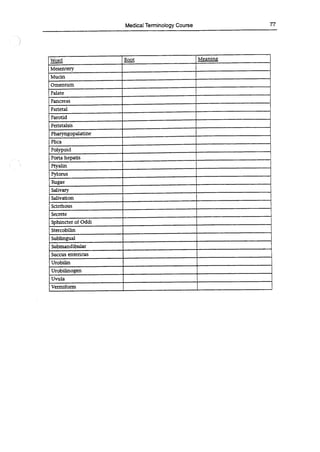
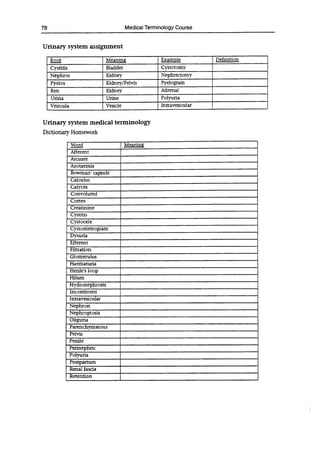
The glossary and assignment exercises will be found in subsections 18 and 19 respectively.
Acknowledgements
The writer thanks the Administration of the Provincial Cancer Hospitals Board, Edmonton,
Alberta, Canada, for their cooperation in allowing time off for the staff to attend the initial
courses, as well as for the clerical assistance, especially in the preparation of the revised series.
The clerical work was carried out by Ms. Linda Cousins.
The revision of a series of lecture notes, used some years previously, necessitated the search of
many well-known reference books to determine the source of material, and where possible,
authors were given credit.
The work was organized from existing sources and from the writer's personal experience. Many
medical works have been consulted and heavy reliance has been placed on Dorland's Illustrated
Medical Dictionary and Tabe?s Cyclopedic Medical Dictionary. Other books which have been
consulted rather extensively are The Standard Nomenclature of Diseases and Operations, pub-
lished by the American Medical Association, and Essentials of Pathology by DL Hj. Van Peenen.
All reference material is listed in the bibliography and in footnotes.
The writer, Margaret L. Boyd, Reg. N., B.Sc.N., M.H.S.A., was the first Director of Nursing for the
Provincial Cancer Hospitals Board, including the Dr. W.W. Cross Cancer Institute, from the years
1968-1972. Leaving to complete her post-graduate education, she subsequently was employed by
the Misericordia Hospital, Edmonton, Alberta as the Assistant Executive Director, Patient Care
Services. Retirement from that position in March, 1975 made possible the completion of this
revised material.
* @1976 Unpublished copyright material, printed with permission from the author.
2 Medical Terminology Course
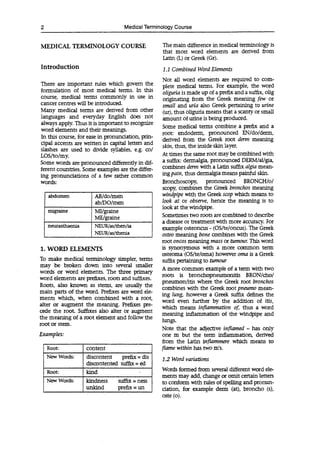
MEDICAL TERMINOLOGY COURSE
Introduction
There are important rules which govern the
formulation of most medical terms. In this
course, medical terms commonly in use in
cancer centres will be introduced.
Many medical terms are derived from other
languages and everyday English does not
always apply. Thus it is important to recognize
word elements and their meanings.
In this course, for ease in pronunciation, prin-
cipal accents are written in capital letters and
slashes are used to divide syllables, e.g. col
LOS/to/my.
Some words are pronounced differently in dif-
ferent countries. Some examples are the differ-
ing pronunciations of a few rather common
words:
abdomen AB/do/men
ab/DO/men
migraine MI/graine
ME/graine
neurasthaenia NEUR/as/then/ia
NEUR/as/thenia
1. WORD ELEMENTS
To make medical terminology simpler, terms
may be broken down into several smaller
words or word elements. The three primary
word elements are prefixes, roots and suffixes.
Roots, also known as stems, are usually the
main parts of the word. Prefixes are word ele-
ments which, when combined with a root,
alter or augment the meaning. Prefixes pre-
cede the root. Suffixes also alter or augment
the meaning of a root element and follow the
root or stem.
Examples:
Root: content
New Words: discontent prefix = dis
discontented suffix = ed
Root: kind
New Words: kindness
unkind
suffix = ness
prefix = un
The main difference in medical terminology is
that most word elements are derived from
Latin (L) or Greek (Gr).
1.1 Combined Word Elements
Not all word elements are required to com-
plete medical terms. For example, the word
oliguria is made up of a prefix and a suffix, olig
originating from the Greek meaning few or
small and uria also Greek pertaining to urine
(ur), thus oliguria means that a scanty or small
amount of urine is being produced.
Some medical terms combine a prefix and a
root: endoderm, pronounced EN/do/derm,
derived from the Greek root derin meaning
skin, thus, the inside skin layer.
At times the same root may be combined with
a suffix: dermalgia, pronounced DERM/al/gia,
combines demi with a Latin suffix algia mean-
ing pain, thus dermalgia means painful skin.
Bronchoscopy, pronounced BRONCHIo/
scopy, combines the Greek bronchos meaning
windpipe with the Greek scop which means to
look at or observe, hence the meaning is to
look at the windpipe.
Sometimes two roots are combined to describe
a disease or treatment with more accuracy. For
example osteoncus - (OS/te/oncus). The Greek
osteo meaning bone combines with the Greek
root oncos meaning mass or tumour. This word
is synonymous with a more common term
osteoma (OS/te/oma) however orna is a Greek
suffix pertaining to tumour
A more common example of a term with two
roots is bronchopneumonith BRON/cho/
pneurnon/itis where the Greek root bronchos
combines with the Greek root pneumo mean-
ing lung, however a Greek suffix defines the
word even further by the addition of iris,
which means inflammation of thus a word
meaning inflammation of the windpipe and
lungs.
Note that the adjective inflamed - has only
one m but the term inflammation, derived
from the Latin inflammere which means to
flame within has two m's.
1.2 Word variations
Words formed from several different word ele-
ments may add, change or omit certain letters
to conform with rules of spelling and pronun-
ciation, for example demi (at), broncho (s),
oste (o).
Medical Terminology Course
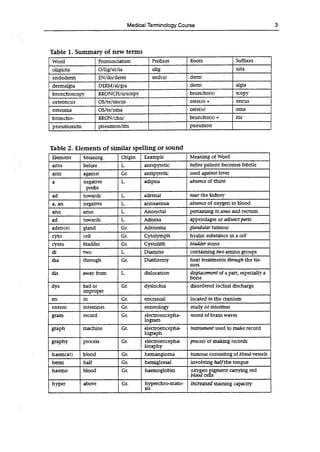
Table 1. Summary of new terms
Word Pronunciation Prefixes Roots Suffixes
oliguria O/lig/ur/ia olig uria
endoderm EN/do/derm end(o) derm
derrnalgia DERM/al/gia derm algia
bronchoscopy BRONCHIo/scopy broncho(s) scopy
osteonctis OS/te/ oncus oste(o) + oncus
osteoma OS/te/orna oste(o) orna
broncho- BRON/cho/ broncho(s) + itis
pneumonitis pneumon/itis pneurnon
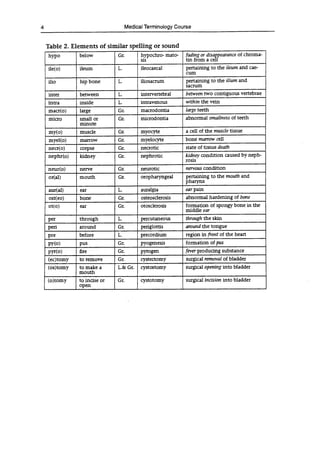
Table 2. Elements of similar spelling or sound
Element Meaning Origin Example Meaning of Word
ante before L. antepyretic before patient becomes febrile
anti against Gr. antipyretic used against fever
a negative L.
prefix
adipsia absence of thirst
ad towards L. adrenal near the kidney
a, an negative L. arioxaemia absence of oxygen in blood
ano anus L. Anorectal pertaining to anus and rectum
ad towards L. Adriexa appendages or adjunct parts
aden(o) gland Gr. Adenoma glandular tumour
cyto cell Gr. Cytolymph hyalin substance in a cell
cysto bladder Gr. Cystolith bladderstone
di two L. Diamine containing two amino groups
dia through Gr. Diathermy heat treatments through the tis-
sues
dis away from L. dislocation displacement of a part, especially a
bone
dys bad or Gr.
improper
dyslochia disordered lochial discharge
en in Gr. encranial located in the cranium
entero intestines Gr. enterology study of intestines
gram record Gr. electroencepha-
logram
record of brain waves
graph machine Gr. electroencepha-
lograph
instrument used to make record
graphy process Gr. electroencepha-
loraphy
process of making records
haem(at) blood Gr. hemangioma tumour consisting of blood vessels
hemi half Gr. henuglossal involving half the tongue
haemo blood Gr. haemoglobin oxygenpigment carrying red
blood cells
hyper above Gr. hyperchro-mato-
sis
increased staining capacity
Medical Terminology Course
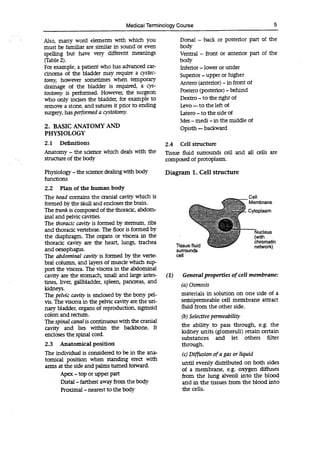
Table 2. Elements of similar spelling or sound
hypo below Gr. hypochro- mato-
sis
fading or disappearance of chroma-
tin from a cell
ile(o) ileum L. ileocaecal pertaining to the ileum and cae-
cum
illo hip bone L. iiosacrum pertaining to the ilium and
sacrum
inter between L. intervertebral between two contiguous vertebrae
intra inside L. intravenous within the vein
macr(o) large Gr. macrodontia large teeth
micro small or
minute
Gr. microdontia abnormal smallness of teeth
my(o) muscle Gr. myocyte a cell of the muscle tissue
myel(o) marrow Gr. myelocyte bone marrow cell
necr(o) corpse Gr. necrotic state of tissue death
nephr(o) kidney Gr. nephrotic kidney condition caused by neph-
rosis
neur(o) nerve Gr. neurotic nervous condition
or(al) mouth Gr. oropharyngeal pertaining to the mouth and
pharynx
aur(al) ear L. auralgia ear pain
ost(eo) bone Gr. osteoscierosis abnormal hardening of bone
ot(o) ear Gr. otosclerosis formation of spongy bone in the
middle ear
per through L. percutaneous through the skin
peri around Gr. periglottis around the tongue
pre before L. precordium region in front of the heart
py(o) pus Gr. pyogenesis formation of pus
pyr(o) fire Gr. pyrogen fever producing substance
(ec)tomy to remove Gr. cystectomy surgical removal of bladder
(os)tomy to make a
mouth
L.& Gr. cystostomy surgical opening into bladder
(o)tomy to incise or
open
Gr. cystotomy surgical incision into bladder
Medical Terminology Course 5
Also, many word elements with which you
must be familiar are similar in sound or even
spelling but have very different meanings
(Table 2).
For example, a patient who has advanced car-
cinoma of the bladder may require a cystec-
tomy, however sometimes when temporary
drainage of the bladder is required, a cys-
tostomy is performed. However, the surgeon
who only incises the bladder, for example to
remove a stone, and sutures it prior to ending
surgery, has performed a cystotomy.
2. BASIC ANATOMY AND
PHYSIOLOGY
2.1 Definitions
Anatomy - the science which deals with the
structure of the body
Physiology-the science dealing with body
functions
2.2 Plan of the human body
The head contains the cranial cavity which is
formed by the skull and encloses the brain.
The trunk is composed of the thoracic, abdom-
inal and pelvic cavities.
The thoracic cavity is formed by sternum, ribs
and thoracic vertebrae. The floor is formed by
the diaphragm. The organs or viscera in the
thoracic cavity are the heart, lungs, trachea
and oesophagus.
The abdominal cavity is formed by the verte-
bral column, and layers of muscle which sup-
port the viscera. The viscera in the abdominal
cavity are the stomach, small and large intes-
tines, liver, gallbladder, spleen, pancreas, and
kidneys.
The pelvic cavity is enclosed by the bony pel-
vis. The viscera in the pelvic cavity are the uri-
nary bladder, organs of reproduction, sigmoid
colon and rectum.
The spinal canal is continuous with the cranial
cavity and lies within the backbone. It
encloses the spinal cord.
2.3 Anatomical position
The individual is considered to be in the ana-
tomical position when standing erect with
arms at the side and palms turned forward.
Apex-top or upper part
Distal-farthest away from the body
Proximal -nearest to the body
Dorsal - back or posterior part of the
body
Ventral - front or anterior part of the
body
Inferior -lower or under
Superior -upper or higher
Antero (anterior) -in front of
Postero (posterior) -behind
Dextro -to the right of
Levo -to the left of
Latero -to the side of
Mes —medi —in the middle of
Opisth -backward
2.4 Cell structure
Tissue fluid surrounds cell and all cells are
composed of protoplasm.
Diagram 1. Cell structure
Cell
Membrane
Cytoplasm
(1) General properties of cell membrane:
(a)Osmosis
materials in solution on one side of a
semipermeable cell membrane attract
fluid from the other side.
(b)Selective permeability
the ability to pass through, e.g. the
kidney units (glomeruli) retain certain
substances and let others filter
through.
(c)Diffusion of a gas or liquid
until evenly distributed on both sides
of a membrane, e.g. oxygen diffuses
from the lung alveoli into the blood
and in the tissues from the blood into
the cells.
Tissue fluid
surrounds
cell
Nucleus
(with
chromatin
network)
6 Medical Terminology Course
(2) Process of living cells
Metabolism - the sum of all physical
and chemical changes that take place
within an organism.
(a)Catabolism -breaking up
(b)Anabolism -building up
(3) Functions of specialized body cells
(a) Secretion
the production of substances from
materials in the blood, e.g. glandular
cells in the stomach secrete digestive
enzymes.
(c) Contractility
changing in response to nervous stimu-
lation, e.g. muscle cells contract and
relax.
(c) Conduction
transfer of an impulse, e.g. nerve cells.
The all or none law. A stimulus to a
nerve or muscle causes it to respond to
its greatest extent or not at all. Impulses
all travel at the same rate but nerves
only respond to a threshold stimulus.
2.5 Water
Approximately 66% of the body is water,
which is contained:
(1) within the cells
(2) surrounding the cells (tissue fluid)
(3) in blood vessels (principal component
of blood).
Water has several functions in the body. It is
used:
(1) asa solvent
(2) for ionisation of adds, bases and salts
(3) to absorb heat and therefore to regulate
temperature
(4) as a vehicle; permitting exchange,
excretion, and secretion through cell
membranes.
2.6 Electrolytes
Electrolytes are chemicals which carry electri-
cal impulses. Water and electrolyte balance is
important. For example, on a hot day we per-
spire and deplete the salts in our body. The
water depletion causes us to feel thirsty, but if
we fail to replace the salt also, in severe dz-
cumstances, illness (heat stroke) due to salt
loss may occur.
2.7 Tissues
When groups of cells (cyto) become special-
ized in the work they perform in the body,
they are called tissues.
There are five main types of tissue:
(1) Epithelial tissue covers the surface of the
body and lines cavities. Examples are
the skin and lining of the thoracic and
abdominal cavities, the pleura and peri-
toneum. Epithelial cells are packed
closely together with little space
between.
(2) Connective tissue supports, anchors and
holds other tissues together. Examples
are ligaments, tendons, cartilage, bone
and fat.
(3) Muscular tissue possesses the ability to
contract.
There are three types of muscle tissue:
(a) skeletal (voluntary)
(b) smooth (involuntary)
(c) cardiac (heart)
(4) Nerve tissue receives and cames sensa-
tions to and from the brain and spinal
cord from various parts of the body.
(5) Vascular tissue carries food and oxygen
to cells, removes waste, and fights infec-
tion. Blood and lymph make up vascu-
lar tissues.
Fat, known as adipose tissue, is a con-
nective tissue which:
(1) serves as a covering under the skin,
cushioning and protecting parts
exposed to pressure.
(2) being a non-conductor of heat, prevents
too rapid heat loss through the skin.
(3) supports and protects various organs,
for example, the eyes and kidneys.
(4) fills up space in the tissues affording
support to delicate structures such as
blood vessels and nerves.
(5) constitutes an important reserve of food
when needed by the body. Bears hiber-
nating can survive only if they have a
sufficient fat reserve to last through the
period of hibernation.
STRATUM CORN EL3M
ST. GRANULOSUM
MALPIGHIAN
LAYER
EPIDERMIS
DERMIS
Diagram 2. The Skin
H YPODERMIS
Medical Terminology Course 7
2.8 Organs
Different kinds of tissue form organs (viscera).
For example, the stomach is an organ com-
posed of epithelial, connective, muscular,
nerve and vascular tissues. Every organ has
some special function to perform, working in
co-ordination with other organs.
Groups of organs which act together are called
systems. There are nine primary body systems:
integumentary, endocrine, musculo-skeletal,
respiratory, circulatory, digestive, nervous, un-
nary, and reproductive.
3. INTEGUMENTARY SYSTEM
The integumentary system consists of the skin
and mucous membranes. The word integu-
mentary is derived from a prefix and a root.
The prefix "in" means just that, and the root
from the Latin word tegere means to cover.
3.1 Epidermis
The epidermis is the thin outer protective
layer, however on the soles of the feet or the
palms of the hands, the epidermis is thick The
epidermis can be divided into four layers. The
stratum cornewn is composed of keratinized
cells with no visible nucleus. The stratum luci-
dum is composed of flattened cells and nuclei
are not visible. Where hair is present, there is a
thin stratum corneum and the stratum luci-
dum is usually absent.
In the third layer, or stratum granuloswn, gran-
nies and nuclei can be seen in the cytoplasm.
The innermost layer, known as the stratumgeT-
minathwn or Maiphigian layer is the part of
the skin where new cells are germinated.
Young cells which are pigmented contain mel-
anin which protects the underlying tissues.
3.2 Dermis
The dermis beneath the epidermis is made up
of dense, irregular connective tissue, with
dense bundles of fibrous tissue between the
cells. In the dermis are found sweat glands,
blood and lymph vessels, nerves and nerve
endings, hair follicles and sebaceous (sebum =
tallow) glands. (Diagram 2).
3.3 Sweat glands
Sweat glands are small tubes that run spirally
to the surface of the skin from a coiled end
deep in the dermis.The opening on the skin is
called a pore. Surrounding the end are capil-
laries from which the gland removes water
and waste products. These are forced out on
the surface of the skin to form perspiration (L.
per = through + spirare, to breathe). Normally
the amount perspired in twenty-four hours is
approximately one litre.
The sweat glands help to regulate body tem-
perature. When the water on the skin evapo-
rates, heat is lost from the body.
3.4 Hair
Hair is distributed over most of the body with
the exception of the palms of the hands and
the soles of the feet. Hairs have their roots in
hair follicles. These follicles widen at the base
to enclose a capillary tuft which provides
nourishment for the growth of hair. If the fol-
licle is damaged, the patient may suffer from
alopecia, AL/o/pe/shia (Gr.) or a loss of hair;
this may be generalized following some can-
cer chemotherapy or localized following
radiotherapy.
The hair follicle is placed obliquely to the skin
and a small muscle (the arrector muscle) is
8 Medical Terminology Course
fastened to the side causing it to stand up in Eczema
cold or fright. The portion of the hair extend- irregular, dry, itchy and scaly patches
ing above the skin surface is called the shaft. of the skin.
3.5 Sebaceous glands Erosion
The oil or sebaceous glands are small sacs with dead epidermis (e = Out) (rodere = to
ducts which usually empty into the hair folli- gnaw)
des, although some open directly on the skin Erysipelas
surface. The sebaceous glands secrete an oil
which lubricates the skin and keeps it soft and (erythro = red) (pella = skin), infection
pliable and makes the hair glossy, within the skin.
3.6 Nails Excoriation
Nails are tightly packed cells of the epidermis (ex = out) (corium = skin) the skin
that protect the finger and toe tips and help in breaks out in a rash.
handling and picking up objects. Fissure
3.7 Functions of skin (L. fissura) ulcer or crack-like sore.
(1) Forms a protective covering over the Furuncle
body. (L. furunculus) a boil.
(2) Eliminates waste products from the Gangrene
body in the form of perspiration.
(3) Helps to regulate body temperature (the death of tissue caused by interference
evaporation of perspiration) wiule lay- with blood supply. Associated with
ers of fat serve as insulation diabetes and circulatory disorders.
(4) Provides us with the sensation of touch Macule
because of the nerve endings in the der- (L macula = spot)
ff115.
Mycosis
3.8 Signs, symptoms and diseases of the (mykes = fungus) (osis = condition of)
integumentary system fungal infection of skin or other fis-
Acne vulgaris sues.
simple acne (vulgaris =simple). Papule
Carbuncle elevated spot (from L. papula = pim-
(L. Carbunculus = little coal) painful pie).
local inflammation of the skin with Paronychia
formation of pus. (Gr. para = beside) (Gr. onyx = claw)
Cicatrix infection of marginal structures about
scar left by healed wound. the nail.
Contact dermatitis Pediculosis
inflammation of the skin caused by caused by animal parasites called pedi-
external irritants such as poison cull or lice in the hair, body or pubic
cosmetics, detergents, sprays, etc. region. Their eggs or flits appear as
white specs on hairs.
Decubitus ulcers
Pruritis
(decumbero = to lie down) ulcers due
to poor circulation (L. prurire = to itch) (itching) a symp-
tom of some general disease condi-
Dermatophytosis fions.
athlete's foot (tinea pedis), a fungus Psoriasis
infection.
(Gr.) a chronic disease characterized
Dermoid CYStS by eruptions in circular patches coy-
benign tissue in a cyst in the skin. ered with dry, silvery scales.
Medical Terminology Course 9
Scabies 4.2 Functions of the bones or skeleton
(L. scabere = to scratch) due to micro- The skeleton:
scopic parasites (Acarus scabei) that (1) gives general shape and proportion to
burrow under the outer layer of the the body;
skin. (2) provides attachment for muscles and
Steatoma forms levers on which the muscles act
(Gr. steat = fat + oma = tumour) "wen' to move the body;
or sebaceous cyst. (3) forms cavities for the protection of vital
Urticaria
organs.
Bones are not always hard. Some originate as
(L. urtica = nettles) hives, oedematous cartilage and then become hard. Bones are
raised pinkish areas that itch. usually completely hardened by about twenty
Varicella years of age through the deposit of calcium
chicken pox (L. varicella = a tiny spot).
and phosphorus from food. Some remain as
cartilage, however, for example, the end of the
Variola nose, the ears and the anterior part of the ribs
smallpox (L. variola = a small spot). attached to the sternum.
Vesicle 4.3 Joints
elevated lesion with fluid (L. vesica = a Where two bones glide over one another in
bladder). semi-attachment, joints (arthro) are formed.
Where the surfaces of the ends of the bones
come together they are covered with a thin
4. THE SKELETAL SYSTEM layer of cartilage. Between them layers of
The skeleton consists of a number of bones, fibrous tissue called ligaments are formed.
held together by bands or ligaments to form Inside, the cells of the lining of the joint give
joints, which allow movement between them. out a small amount of slippery fluid (synovial
fluid) which keeps them lubricated and allows
free movement. Joints have:
4.1 Structure of bones (1) no movement, for example, the flat
The periosteum is a membrane that covers bones of the skull;
every pone. It contains blood vessels which (2) slight movement, for example, the bod-
carry nutrients to the bone cells. In the long ies of the vertebrae;
bones of the extremities the shaft or diaphysis
(3) free movement, for example, the joints
is the hard compact portion, the epiphysis or at the shoulder and hip.
end is spongelike and covered by a shell or
harder bone and the metaphysis or growing
Ties of freely movable joints
portion lies between them. The diaphysis and
epiphysis do not fuse until growth has ceased. (1) Ball and socket
Bone cells multiply rapidly in early years but A joint in which a rounded head is
later on only dead cells are replaced or injured received into a cup-like socket, for
ones are repaired. Bones get harder and more example, the shoulder joint, formed
brittle with age. Bones differ in size and shape. by the head of the humerus and the
Long bones give support, flat bones provide glenoid cavity of the scapula.
protection for delicate organs and irregular (2) Hinge
bones allow for more motion. The outer por-
Movement is permitted in one plane
tion of bones is hard, however the hollow
only, for example, the knee or elbow
inner part is filled with soft marrow (Gr. myelo
= marrow). Yellow marrow is found in long
jO]1
bones, whereas red marrow is found in the (3) Pivot
end of long bones as well as in ribs and bodies One bone rotates around another
of the vertebrae. The latter is responsible for which remains stationary, for example,
the manufacture of red blood cells, some of the first cervical vertebra pivots on the
the white blood cells and platelets. second.
10 Medica' Terminology Course
(4) Gliding
The articulating surface of one bone
slides on that of another to a limited
extent, for example, joints between the
carpal and tarsal bones.
4.4 Kinds of movement
(1) Flexion
A limb is flexed when it is bent, for
example, bending the arm at the elbow.
(2) Extension
A limb is extended when it is straight-
ened out, for example straightening the
arm at the elbow.
(3) Abduction
Movement away from the midline, for
example, raising the arm from the side.
(4) Adduction
Movement toward the midline, for
example, lowering the raised arm to the
side.
(5) Circumduction
Circular movement in which the bone
outlines a cone, for example, swinging
the arms.
(6) Rotation
The turning of bones on their axes, for
example, rotation of the atlas (1st verte-
bra) on the axis (2nd vertebra) to turn
the head.
(7) Supination
Moving to the supine position with the
arms hanging down and the palms fac-
ing forward.
(8) Pronation
Moving to the prone position with the
arms hanging down and the palms fac-
ing backwards.
(9) Eversion
The sole of the foot faces outward.
4.5 The skull
The skull consists of the bones of the cranium
and of the face. They fit together to form a
cavity for the protection of the brain. The
skull is made up of twenty-two bones closely
fitted together without movable joints, with
the exception of the lower jaw or mandible.
This is attached to the skull by a hinge joint
on either side that permits movement of the
mandible up and down. The upper jaw is
called the maxilla. It is firmly attached and
does not move. The facial bones form the eye
sockets and the nasal and oral cavities.
Bones of the cranium
Two parietal bones, one occipital
bone, and one frontal bone form a
covering for the brain. Two temporal
bones contain the ear cavities, the
organs of balance, and the mastoid
cells. One sphenoid bone is located in
the centre and forms the base of the
skull. One ethmoid bone is found in
the roof of the nasal cavity.
Bones of the face
Two nasal bones form the upper part
of the bridge of the nose. One vomer
bone divides the nasal cavity. Two
inferior turbinate bones in the nostrils
form the outer walls of the nasal cav-
ity. Two lacrimal bones form a small
part of the medial wall of the eye
orbit. Two zygomatic or malar bones
form the prominence of the cheek.
Two palatine bones form the roof of
the mouth. Two maxillae form the
upper jaws and one mandible forms
the lower jaw.
Sinuses
Four pairs of cavities in the cranial
bones make the skull lighter and
return the sound of the voice. Named
after the bones in which they lie,
there are 2 frontal sinuses, 2 maxillary
sinuses, 2 ethmoid sinuses, and 2
sphenoid sinuses.
Sinusitis
The effect of swollen epithelial tissue
which blocks drainage channels and
thereby prevents normal secretions in
the sinuses
4.6 Vertebral or spinal column
The thirty-three bones comprising the spinal
column are called vertebrae. These are divided
into five groups according to their distinguish-
ing characteristics.
(1) Cervical vertebrae (7 in number)
The first, called the atlas, forms a joint
with the base of the skull and permits
the nodding movement; the second
called the axis permits the side to side
movement of the head.
Medical Terminology Course
(2) Thoracic vertebrae (12 in number)
The twelve pairs of ribs are attached to
these.
(3) Lumbar vertebrae (5 in number)
These are large vertebrae that allow free
movement to the spinal column.
(4) The sacrum
The sacrum is a single wedge-shaped
bone consisting of five vertebrae fused
together. It is situated between the two
pelvic bones and forms part of the pel-
vic girdle.
(5) The coccyx
Situated below the sacrum consists of
four small bones fused together.
Functions of the spine:
- forms the central support for the
body.
- ensures flexibility of the trunk,
- protects the spinal cord,
- absorbs shock,
- provides attachment for the ribs,
- supports the weight of the trunk
and transmits it to the lower limbs,
- forms a strong posterior boundary
for the thorax and abdomen and
helps to maintain erect posture.
The spine normally curves anteriorly
and posteriorly. (Diagram 3).
Diagram 3. Curves of the spine
Cervical
thoraoc -abnormal
curvature of the thoracic
"—spine is known as kyphosis
lumbar -abnormal curvature of the
lumbar spine is known as lordosls
Diagram 4. Vertebra
Spinous process
Articula and
Surface
Spinalcanal
Tranverse
process
of vertebrae
.
,~),Body
The flat part of the body of the vertebra bears most of
the weight. An arch is formed, providing an opening or
spinal canal throughwhich the spinal cord passes
(Diag. 4).
Fingerlike extensions called transverse process serve
to anchor tendons and ligaments.
Intervertebral discs are plates of cartilage between the
vertebrae which make the joints flexible and help to
break the shock of any sudden force.
4.7 Ribs and Sternum
There are twelve ribs on each side connected
in pairs to the thoracic vertebrae behind and,
with the exception of the last two pairs, to the
sternum (breast bone) in front. The ribs are
not bony throughout their entire length, but
at a short distance from the front, cartilage
takes the place of bone. The upper seven pairs
are called true ribs and are attached by their
cartilage directly to the sternum. The lower
five pairs are called false ribs. The upper three
pairs of false ribs are attached by their cartilage
to the rib directly above and thence to the
sternum. The last two pairs are unattached to
the sternum and are called floating ribs.
The sternum is a long flat, dagger-shaped
bone with the point downwards. Three parts
make up the sternum, known as the manu-
brium, body and xiphoid process.
4.8 Bones
(1) Bones of the upper extremities
11
The scapulae or shoulder blades are
two large flat, triangular bones lying
upon the ribs posteriorly. A promi-
nent ridge or spine at the back forms
an attachment for back and arm mus-
cles. At the outer and upper part the
glenoid cavity receives the rounded
head of the humerus.
12 Medical Terminology Course
The clavicles are two slender bones The tibia and fibula are parallel bones
which extend horizontally across the of the lower leg. The tibia or shin bone
upper part of the thorax above the extends from the knee to the ankle
first ribs. They articulate with the medially. The fibula extends from the
scapulae and sternum, knee to the ankle laterally.
The humerus is the bone of the upper The seven tarsal bones comprise the
arm. It consists of a shaft and two ankle and are united by ligaments.
enlarged ends. The proximal end is They are larger and more irregular
the smooth rounded head which fits than the carpal bones. The largest is
into the glenoid cavity of the scapula. the heel bone or calcaneus.
The distal end has bone surface which The metatarsals are five long bones
articulates with the ulna to form the that comprise the foot.
elbow joint.
The tarsals join the metatarsals to
The radius and ulna are parallel bones form two arches - longitudinal and
located in the forearm. The radius metatarsal.
extends from the elbow to the wrist
on the lateral side. The ulna extends The phalanges in the toes resemble
from the elbow to the wrist on the those in the hand both in number and
medial side. The radius articulates general arrangement.
with the ulna just below the elbow.
The carpal bones comprise the wrist, 5. MUSCULAR SYSTEM
made up of eight bones arranged in
two rows of four. 5.1 Introduction
The phalanges are the finger bones.
Three phalanges comprise the fingers,
and two the thumbs.
(2) Bones of the lower extremities
The pelvis is formed by six bones, two
ilia, two ischia and two pubic. One of
each form two large flat irregular
bones (the innominate) that become
one when adulthood is reached
which, together with the sacrum, con-
stitute the pelvic girdle.
There is a hollow on the outer side of
each inriominate bone which forms
the acetabulum, a socket to articulate
with the upper end of the femur.
The femur is the bone of the thigh. It
extends from the acetabulum to the
knee. It is the longest and strongest
bone of the body. Proximally the
smooth rounded head fits into the
acetabulum. The neck of the femur is
a weak point. It joins the head to the
shaft. The distal end of the femur has
two bony masses by means of which it
articulates with the tibia and patella
and forms the knee joint.
The patella is a small flat triangular
bone placed in front of the knee joint
which it serves to protect.
The appearance of human muscular tissue is
roughly comparable to the lean of butcher's
meat. Muscle cells are arranged in fine elastic
threads or fibres, wrapped together in bundles.
Several bundles make a muscle. Every muscle
is covered by a sheath, the ends of which form
tendons attached to bones.
Muscles are attached to bones at the point that
will give best leverage. Muscles tend to work in
pairs; for some movements groups of muscles
are used. Each muscle is connected to the cen-
tral nervous system by a motor nervewhich car-
ries messages from the brain, causing the
muscle to contract.
Bursae are small sacs lined with syn-
ovial membrane and are found wher-
ever pressure is exerted by ligaments
over moving parts (singular noun -
bursa).
5.2 Functions of muscles
(1) The maintenance of erect posture and
holding the head, body and extremities
in a variety of positions.
(2) Movements and locomotion, to secure
food and shelter and communicate by
speech.
(3) An elastic support for certain organs, for
example, the floor of the pelvis is sup-
port for the pelvic contents.
Medical Terminology Course 13
5.3 Kinds of muscles
(1) Voluntary muscles are under the control
of the will and are capable of rapid and
complicated movements; for example,
walking, talking, or swallowing.
(2) Sphincters are special voluntary muscles
which guard body openings.
(3) Involuntary muscles are not under the
control of will and are capable of slow
and mechanical movement only. They
are found in the walls of blood vessels
and in most of the internal organs. Car-
diac muscle is found only in the heart
and is a special form of involuntary
muscle. The working of the involuntary
muscles is controlled by a special set of
nerves known as the autonomic nervous
system.
5.4 Some important muscles
There are 325 muscles in the body - we will
consider only a few groups.
(1) The diaphragm lies between abdominal
and chest cavities. Contraction and
relaxation is part of the respiratory
mechanism.
(2) The intercostal muscles are found
between the ribs. They assist the respira-
(a) the internal oblique muscle -
ascending;
(b) the external oblique muscle -
descending;
(c) the transversus abdominus - across
the abdomen;
(d) the rectus abdominus muscle -ver-
tically.
A hernia is a protrusion of a portion of
the contents of a body cavity. There
are weak places where herniae may
occur. These are places where blood
vessels and other structures normally
extend through the muscles.
The inguinal ring, femoral ring, and
umbilicus are common sites.
(4) The pectoralis muscles, major and
minor are large anterior chest muscles
(L. pectus = breast). The pectoralis
major is a large triangular muscle
extending to the humerus which draws
the arm forward and downward. The
pectoralis minor, beneath the pectoralis
major extends to the scapula, lowers it,
and depresses the shoulder.
Both of these muscles are removed
during a radical mastectomy. The
mastectomy patient must learn exer-
cises to accommodate the loss of the
pectoral muscles.
(5) The serratus anterior (L. serratus =
toothed) are the anterior chest muscles
arising from the ribs by separate slips.
Inserting into the scapula, the muscles
elevate the ribs and assist in breathing.
The serratus anterior also rotates the
scapula.
(6) The large muscles of the shoulder, pos-
terior chest and back are the trapezius
and the latissimus dorsi. When the tra-
pezius contracts, the head is drawn back
and to the side and the scapula is
rotated. The latissimus dorsi originating
in the thoracic, lumbar and sacral verte-
brae and the iliac crest insert into the
groove below the biceps on the
humerus for adduction and rotation of
the arm.
The paired gluteal muscles form the
buttocks (Gr. gloutos = buttock) and are
called the gluteus maximus, medius
and minimus. These muscles insert into
the greater trochanter of the femur per-
mining thigh movement.
(8) Major muscles associated with the ante-
rior aspect of the thigh are the quadri-
ceps femoris (L quadri = four + ceps
from caput = head, thus a four headed
muscle) originating in the iscbial tuber-
osity on the pelvis and inserting into
the femur. The quadriceps causes exten-
sion of the leg.
(9) In the posterior part of the thigh are the
hamstring muscles, including thegTaci-
lis, sartorius, biceps femoris, and semi-
tendinous muscles which cause flexion
of the thigh.
When the sartorius contracts it allows
the legs to flex and cross. It is thus
named the tailor's muscle (L sartor =
tory process.
(3) The abdominal muscles are flat bands
which stretch from rib to pelvis and (7)
support the abdominal organs. There
are four sets of abdominal muscles:
14 Medical Terminology Course
tailor). The sartorius is the longest mus-
de in the body.
The grads flexes and adducts the leg
and adducts the thigh. Originating on
the pelvis, it inserts into the medial sur-
face of the shaft of the tibia.
(10) Large muscles of the lower leg and foot
The tibialis anterior elevates and flexes
the foot. Originating in the upper tibia,
it inserts in the ankle and foot bones.
The calf of the leg contains the gastroc-
neinius, the largest muscle which
extends the foot and helps to flex the
knee or the thigh. Originating on the
femur, this muscle inserts by the Achil-
les tendon into the calcaneus.
Other muscles in the calf of the leg are
the soleus and peroneus longus. The
soleus (L solea = sole of foot) extends
and rotates the foot. It inserts along
with the gastrocnemius into the Achil-
les tendon. The peroneus longus
extends, abducts and everts the foot.
(11) Large muscles of the shoulder and arm
The deltoid muscle (shaped like the
Greek letter delta) which moves the
upper arm outwards from the body, rais-
ing and rotating the arm has its origin
in the clavicle and scapula. It is inserted
into the shaft of the humerus.
The biceps flexes and supinates the arm.
It has two sources of origin, the short
head rising from the coracoid process of
the scapula and the long head from the
scapula above the glenoid fossa. Inser-
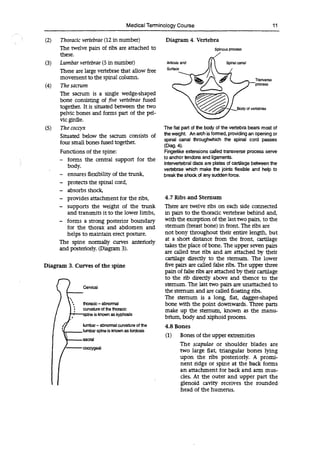
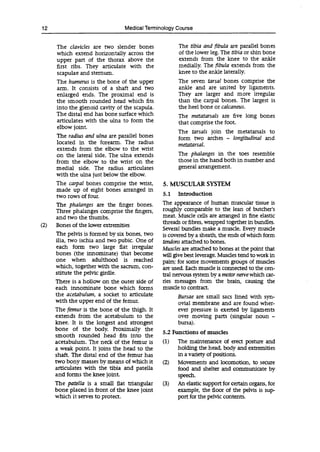
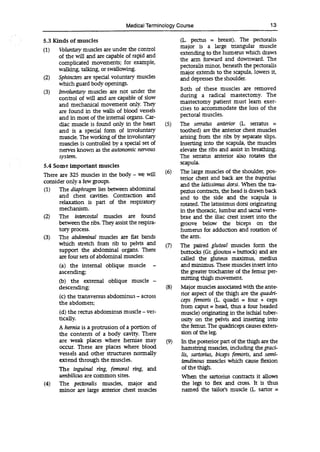
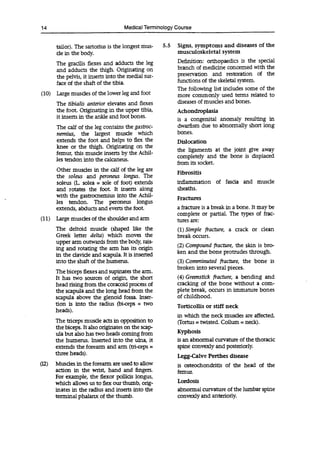
tion is into the radius (bi-ceps = two
heads).
The triceps muscle acts in opposition to
the biceps. It also originates on the scap-
ula but also has two heads coming from
the humerus. Inserted into the ulna, it
extends the forearm and arm (tri-ceps =
three heads).
(12) Muscles in the forearm are used to allow
action in the wrist, hand and fingers.
For example, the flexor poilas longus,
which allows us to flex our thumb, orig-
inates in the radius and inserts into the
terminal phalanx of the thumb.
5.5 Signs, symptoms and diseases of the
musculoskeletal system
Definition: orthopaedics is the special
branch of medicine concerned with the
preservation and restoration of the
functions of the skeletal system.
The following list includes some of the
more commonly used tenus related to
diseases of muscles and bones.
Achondroplasia
is a congenital anomaly resulting in
dwarfism due to abnormally short long
bones.
Dislocation
the ligaments at the joint give away
completely and the bone is displaced
from its socket.
Fibrositis
inflammation of fascia and muscle
sheaths.
Fractures
a fracture is a break in a bone. It may be
complete or partial. The types of frac-
tures are:
(1)Simple fracture, a crack or clean
break occurs.
(2)Compound fracture, the skin is bro-
ken and the bone protrudes through.
(3)Comminuted fracture, the bone is
broken into several pieces.
(4)Greenstick fracture, a bending and
cracking of the bone without a com-
plete break, occurs in immature bones
of childhood.
Torticollis or stiff neck
in which the neck muscles are affected.
(Tortus = twisted. Collum = neck).
Kyphosis
is an abnormal curvature of the thoracic
spine convexly and posteriorly.
Legg-Calve Perthes disease
is osteochondritis of the head of the
femur.
Lordosis
abnormal curvature of the lumbar spine
convexly and anteriorly.
Medical Terminology Course 15
Myasthenia gravis lower lumbar vertebrae, usually on the
is exhibited by rapid fatigue of muscles sacrum with pelvic deformity.
without pain. Sprains
Myositis the ligaments that support joints are
is inflammation of muscles, stretched or
Osteitis deformans
(Pagets disease) the enlargement and
distortion of bones in older age.
Osteitis fibrosa cystica
(von Recklinghausen's disease) - bony
manifestation caused by hyperparathy-
roidism.
Osteoarthritis
Hypertropic or degenerative arthritis. A
disease of older people resulting in grad-
uai wearing out of the joint.
Osteochondritis
inflammation of bones and cartilage.
Osteomalacia
softening of the bones.
Osteomyelitis
inflammation of bone caused by a pyo-
genic (pusforming) organism. It is most
common among children.
Paralysis
the control of muscles by the nervous
system has been affected. Paralysed
muscles gradually atrophy.
Rheumatoid arthritis
a chronic disease affecting many joints
which results in deformity. It is com-
monly diagnosed between 20 and 50
years of age.
Rickets
the bone hardening process does not
proceed normally because of a lack of
Vitamin D. The bones get out of shape
when weight bearing, and finally
harden in the deformed state.
Scoliosis
an S-shaped abnormal lateral curvature
of the spine.
Spondylolisthesis
spondylos = vertebrae, olithesis = for-
ward slipping, a forward slipping of the
Tenosynovitis
inflammation of a tendon sheath.
6. THE NERVOUS SYSTEM
6.1 Introduction
The nervous system is the system which pro-
vides the integration and control of body pro-
cesses. It consists of the brain and spinal cord,
linked to the peripheral part connected with
tissues and organs.
Sensory nerve fibres carry messages from tis-
sues and organs to the brain and spinal cord.
Motor nerve fibres carry messages to tissues
and organs, from the brain and spinal cord.
6.2 Cerebrum
The cerebrum is the largest part of the human
brain. It is made up of two cerebral hemi-
spheres (hemi = half) each of which is divided
into lobes. The folds on the surface of the
brain are known as convolutions. Grey matter
forms the outer layer, or cerebral cortex. It con-
tains the cell bodies or neurons. The inner
white matter is made up of nerve fibres.
The anterior commissure is made up of nerve
fibres linking the two cerebral hemispheres.
Deep in the substance of the cerebral hemi-
spheres there are additional masses of gray
matter which, together with the cerebrum,
form the forebrain:
(1) the basal ganglia, concerned with the
modification and coordination of vol-
untary muscle movement;
(2) the thalamus, an important relay centre
for sensory fibres on their way to the
cerebral cortex; crude sensation and
pain may be felt here;
(3) the hypothalamus, contains the centres
for the autonomic nervous system.
6.3 The midbrain
The midbrain receives impulses from the eye
and ear. It serves as a centre for visual and
auditory reflexes. Cranial nerves Ill and 1V
stem from the midbrain. The grey matter of
the midbrain consists of the bodies of the lIIrd
and lVth cranial nerves, and the red nucleus.
16 Medical Terminology Course
The midbrain controls skilled muscular move-
ments. The white matter of the midbrain car-
nes sensory and motor fibres, linking the red
nucleus with the forebrain, the hindbrain and
the spinal cord.
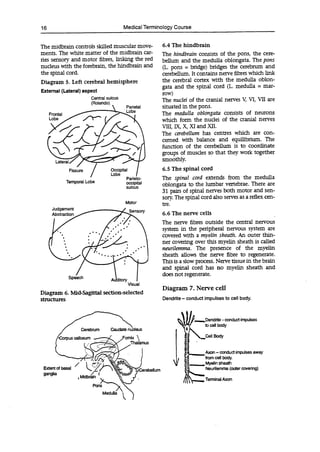
Diagram 5. Left cerebral hemisphere
External (Lateral) aspect
Central sulcus
(Rolando)
Parietal
Frontal
Lobe
Lobe
1
7-
1
) '
LateralZ ,/s.n____ S
Fissure
/
ccIPital /
Parieto-
Temporal Lobe occipital
sulcus
Motor
Judgement Sensory
Abstraction
Speech
A itory
Visual
Diagram 6. Mid-Sagittal section-selected
structures
6.4 The hindbrain
The hindbrain consists of the pons, the cere-
bellum and the medulla oblongata. The pons
(L. pons = bridge) bridges the cerebrum and
cerebellum. It contains nerve fibres which link
the cerebral cortex with the medulla oblon-
gata and the spinal cord (L. medulla = mar-
row)
The nuclei of the cranial nerves V, VI, VII are
situated in the pons.
The medulla oblongata consists of neurons
which form the nuclei of the cranial nerves
VIII, IX, X, XI and XII.
The cerebellum has centres which are con-
cerned with balance and equilibrium. The
function of the cerebellum is to coordinate
groups of muscles so that they work together
smoothly.
6.5 The spinal cord
The spinal cord extends from the medulla
oblongata to the lumbar vertebrae. There are
31 pairs of spinal nerves both motor and sen-
sory. The spinal cord also serves as a reflex cen-
tre.
6.6 The nerve cells
The nerve fibres outside the central nervous
system in the peripheral nervous system are
covered with a myelin sheath. An outer thin-
ner covering over this myelin sheath is called
neuTilemma. The presence of the myelin
sheath allows the nerve fibre to regenerate.
This is a slow process. Nerve tissue in the brain
and spinal cord has no myelin sheath and
does not regenerate.
Diagram 7. Nerve cell
Dendrite — conduct impulses to cell body.
Cerebrum Caudate
callosum _—, 5c
Extent of basai
/
ganglia
Midbrain
Pons
Medulla
ux 
Thalamus
 _..enirite — conduct impulses
to cell body
_Cell Body
Axon —conduct impulses away
I, from cell body
Myelin sheath
Neurilemma (outer covering)
f
TerminaiAxon
Medical Terminology Course 17
6.7 Meninges
Three membranes comprise the meninges. The
dura mater is a thick tough membrane lining
the skull. The pia mater is a thin tissue cover-
ing the outermost layer of brain. The arachnoid
mater lies between the two; it is a thin cover-
ing and contains the blood vessels.
6.8 Cerebrospinal fluid
The cerebrospinal fluid is produced by the
choroid plexus of the two lateral and 3rd and
4th ventricles. It flows from the lateral ventri-
cles through the foramen of Monro to the
third ventricle. From the third ventricle it
flows through the aqueduct of Sylvius to the
fourth ventricle. Leaving the fourth ventricle,
it bathes the brain and spinal cord in the sub-
ara chnoid space between the aracimoid and
pia mater. It is absorbed by the great venous
durai sinuses, especially the superior saggital
sinus.
6.9 The cranial nerves
The cranial nerves carry impulses to or from
the brain.
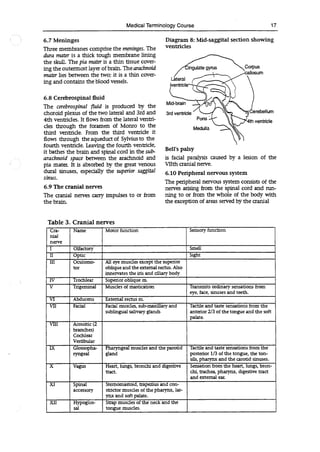
Diagram 8: Mid-saggital section showing
ventricles
gyrus 'NCorpus
Mid-brain
3rd ventricle7k
!
Pons
Medulla
ventricle
Bell's palsy
is facial paralysis caused by a lesion of the
With cranial nerve.
6.10 Peripheral nervous system
The peripheral nervous system consists of the
nerves arising from the spinal cord and run-
ning to or from the whole of the body with
the exception of areas served by the cranial
Table 3. Cranial nerves
Cra- Name Motor function Sensory function
niai
nerve
I Olfactory Smell
II Optic Sight
III Oculomo- All eye muscles except the superior
tor oblique and the external rectus. Also
innervates the iris and diary body
IV Trochlear Superior oblique m.
V Trigeminal Muscles of mastication Transmits ordinary sensations from
eye, face, sinuses and teeth.
VI Abducens External rectus m.
VII Facial Facial muscles, sub-maxillary and Tactile and taste sensations from the
sublingual salivary glands anterior 2/3 of the tongue and the soft
palate.
VIII Acoustic (2
branches)
Cochlear
Vestibular
LX Glossopha- Pharyngeal muscles and the parotid Tactile and taste sensations from the
ryngeal gland posterior 1/3 of the tongue, the ton-
sils, pharynx and the carotid sinuses.
X Vagus Heart, lungs, bronchi and digestive Sensation from the heart, lungs, bron-
tract. chi, trachea, pharynx, digestive tract
and external eat
XI Spinal Sternomastoid, trapezius and con-
accessory sthctor muscles of the pharynx, lar-
_______ ynx and soft palate.
XII Hypoglos- Strap muscles of the neck and the
sal I tongue muscles.
18 Medical Terminology Course
nerves and the autonomic nervous system.
Peripheral nerves are connected to the spinal
cord by two roots: the anterior or motor root
and the posterior or sensory root (Diagram 9).
Diagram 9: The Peripheral nerve
Nerve ganglion
Posterior
root
Anteriôr root
The peripheral nervous system is responsible
for the innervation of all voluntary muscles
(except those controlled by cranial nerves)
and the transmission of sensory impulses from
the whole of the body (with the exception of
the face).
It is largely under conscious (cerebral) control.
Division, injury or disease of peripheral nerves
thus usually results in both sensory and motor
loss. However, as already indicated, eventual
recovery is possible providing the nerve is
largely intact or the ends of the divided nerve
are placed dose together.
6.11 Autonomic nervous system
The autonomic nervous system controls and
regulates the action of glands, the heart and
smooth muscle tissue, for example, smooth
muscle in the intestines and blood vessel
walls.
Autonomic nerves arise at different central
nervous system, ranging from the vagus (Xth
cranial parasympathetic nerve) to the sacral
area of the spinal cord. The autonomic nerves
arising from the spinal cord comprise the sym-
pathetic system.
The sympathetic and parasympathetic nerves
counterbalance one another.
7. THE SPECIAL SENSE ORGANS
7.1 The ear
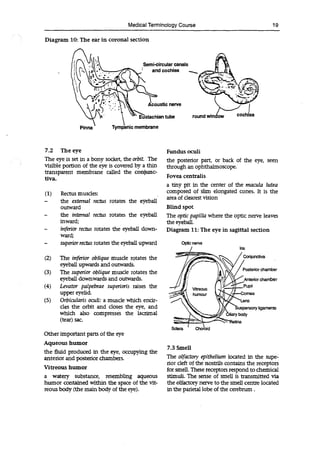
The ear has two main functions, those of hear-
ing and equilibrium (or balance). There are
three parts to the ear: the external ear, the
middle ear and the inner ear. Each of the three
parts serves a definitive function in hearing;
however, the inner also functions in balance.
The external ear
The pinna (L. pinna = wing) is made up of car-
tilage covered by skin. It collects the sound
which is transmitted through the auditory
canal, leading to the tympanic membrane or
eardrum, (Gr. tympanon = drum). The audi-
tory canal contains hairs and ceruminous
(wax) glands.
The middle ear
The middle ear lies in a cavity in the temporal
bone. It is connected with the nasopharynx
by the Eustachian tube, which opens upon
swallowing to allow air to enter the middle
ear, thus equalizing pressure on both sides of
the tympanic membrane.
There are three small bones in the middle ear
called auditory ossides which are connected
to form a small lever between the tympanic
membrane and the oval window (fenestra
cochlea).
The auditory ossides are named according to
their shapes -the malleus, (Latin = hammer),
the incus (Latin = anvil), and the stapes (Latin
= stirrup). Two small muscles, the tensor tym-
pani connected to the malleus and the stape-
thus connected to the stapes, contract as a
protective mechanism during excessively loud
noise.
Sound vibrations set the tympanic membrane
in motion and move the ossides. This ampli-
fies and transmits the sound across the middle
ear so that the foot plate of the stapes moves
backwards and forwards in the oval window
which is in contact with the cochlear fluid, in
which vibrations are established. These vibra-
tions stimulate receptors in the Organ of
Corti, and nerve impulses are sent to the
sound centre in the brain.
The inner ear
The cochlea (Gr. Kochlias = a spiral) is the
hearing part of the inner ear. It is a spiral canal
containing a receptor for hearing called the
Organ of Corti to which is attached the
cochlear branch of the auditory nerve, it has
hair cells which pick up impulses transmitted
from the middle ear.
The semicircular canals form the organ of bal-
ance. The superior, posterior and lateral semi-
circular canals each connect by an ampulla (L.
ampulla = a jug) to the utricle (L utriculus = a
small sac), from which impulses travel to the
brain by the vestibular branch of the VUth cra-
nial nerve.
Medical Terminology Course
Diagram 10: The ear in coronal section
Semi-circular canals
and cochlea
coustic nerve
-- stachian tube round nthL
Pinna Tympanic membrane
19
7.2 The eye
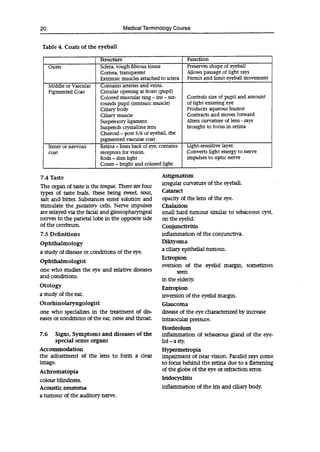
The eye is set in a bony socket, the orbit The
visible portion of the eye is covered by a thin
transparent membrane called the conjunc-
tiva.
(1) Rectus muscles:
- the external rectus rotates the eyeball
outward
- the internal rectus rotates the eyeball
inward;
- inferior rectus rotates the eyeball down-
ward;
- superior rectus rotates the eyeball upward
(2) The inferior oblique muscle rotates the
eyeball upwards and outwards.
(3) The superior oblique muscle rotates the
eyeball downwards and outwards.
(4) Levator palpebrae superioris raises the
upper eyelid.
(5) Orbicularis oculi: a muscle which encir-
cles the orbit and doses the eye, and
which also compresses the lacrimal
(tear) sac.
Other important parts of the eye
Aqueous humor
the fluid produced in the eye, occupying the
anterior and posterior chambers.
Vitreous humor
a watery substance, resembling aqueous
humor contained within the space of the vit-
reous body (the main body of the eye).
Fundus oculi
the posterior part, or back of the eye, seen
through an ophthalmoscope.
Fovea centralis
a tiny pit in the center of the macula lutea
composed of slim elongated cones. It is the
area of dearest vision
Blind spot
The optic papilla where the optic nerve leaves
the eyeball.
Diagram 11: The eye in sagittal section
Optic nerve
Iris
/ civa
' Posterior chamber
"Anterior chamber
Vitreous
_Pupil
humour -Cornea
'Lens
uspensory ligaments
body
Sciera
7.3 Smell
The olfactory epithelium located in the supe-
rior deft of the nostrils contains the receptors
for smell. These receptors respond to chemical
stimuli. The sense of smell is transmitted via
the olfactory nerve to the smell centre located
in the parietal lobe of the cerebrum.
20 Medical Terminology Course
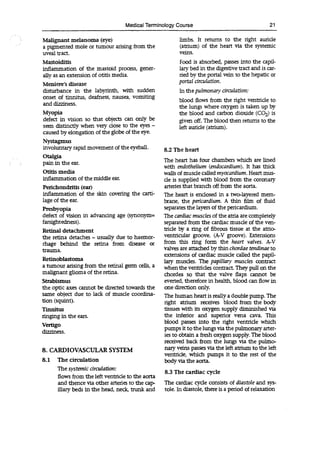
Table 4. Coats of the eyeball
Structure Function
Outer Sciera, tough fibrous tissue Preserves shape of eyeball
Cornea, transparent Allows passage of light rays
Extrinsic muscles attached to sclera Permit and limit eyeball movement
Middle or Vascular Contains arteries and veins.
Pigmented Coat Circular opening at front (pupil)
Colored muscular ring-iris-sur- Controls size of pupil and amount
rounds pupil (intrinsic muscle) of light entering eye
Ciliary body Produces aqueous humor
Chary muscle Contracts and moves forward
Suspensory ligament Alters curvature of lens - rays
Suspends crystalline lens brought to focus in retina
Choroid -post 5/6 of eyeball, the
pigmented vascular coat
Inner or nervous Retina -lines back of eye, contains Light-sensitive layer.
coat receptors for vision. Converts light energy to nerve
Rods-dim light impulses to optic nerve
Cones-bright and colored light
7.4 Taste
The organ of taste is the tongue. There are four
types of taste buds, these being sweet, sour,
salt and bitter. Substances enter solution and
stimulate the gustatory cells. Nerve impulses
are relayed via the facial and glossopharyngeal
nerves to the parietal lobe in the opposite side
of the cerebrum.
7.5 Definitions
Ophthalmology
a study of disease or conditions of the eye.
Ophthalmologist
one who studies the eye and relative diseases
and conditions.
Otology
a study of the ear.
Otorhinolaryngologist
one who specializes in the treatment of dis-
eases or conditions of the ear, nose and throat.
7.6 Signs, Symptoms and diseases of the
special sense organs
Accommodation
the adjustment of the lens to form a clear
image.
Achromatopia
colour blindness.
Acoustic neuroma
a tumour of the auditory nerve.
Astigmatism
irregular curvature of the eyeball.
Cataract
opacity of the lens of the eye.
Chalazion
small hard tumour similar to sebaceous cyst,
on the eyelid.
Conjunctivitis
inflammation of the conjunctiva.
Diktyoma
a ciliary epithelial tumour.
Ectropion
eversion of the eyelid margin, sometimes
seen
in the elderly.
Entropion
inversion of the eyelid margin.
Glaucoma
disease of the eye characterized by increase
intraocular pressure.
Hordeolum
inflammation of sebaceous gland of the eye-
lid -a sty.
Hypermetropia
impairment of near vision. Parallel rays come
to focus behind the retina due to a flattening
of the globe of the eye or refraction error.
Iridocyclitis
inflammation of the iris and ciliary body.
Medical Terminology Course 21
Malignant melanoma (eye)
a pigmented mole or tumour arising from the
uveal tract.
Mastoiditis
inflammation of the mastoid process, gener-
ally as an extension of otitis media.
Meniere's disease
disturbance in the labyrinth, with sudden
onset of tinnitus, deafness, nausea, vomiting
and dizziness.
Myopia
defect in vision so that objects can only be
seen distinctly when very close to the eyes -
caused by elongation of the globe of the eye.
Nystagmus
involuntary rapid movement of the eyeball.
Otalgia
pain in the ear.
Otitis media
inflammation of the middle ear.
Perichondritis (ear)
inflammation of the skin covering the carti-
lage of the ear.
Presbyopia
defect of vision in advancing age (synonym=
farsightedness).
Retinal detachment
the retina detaches - usually due to haemor-
rhage behind the retina from disease or
trauma.
Retinoblastoma
a tumour arising from the retinal germ cells, a
malignant glioma of the retina.
Strabismus
the optic axes cannot be directed towards the
same object due to lack of muscle coordina-
tion (squint).
Tinnitus
ringing in the ears.
Vertigo
dizziness.
8. CARDIOVASCULAR SYSTEM
8.1 The circulation
The systemic circulation:
flows from the left ventricle to the aorta
and thence via other arteries to the cap-
illary beds in the head, neck, trunk and
limbs. It returns to the right auricle
(atrium) of the heart via the systemic
veins.
Food is absorbed, passes into the capil-
lary bed in the digestive tract and is car-
ried by the portal vein to the hepatic or
portal circulation.
In the pulmonary circulation:
blood flows from the right ventricle to
the lungs where oxygen is taken up by
the blood and carbon dioxide (CO2) is
given off. The blood then returns to the
left auricle (atrium).
8.2 The heart
The heart has four chambers which are lined
with endothelium (endocardium). It has thick
walls of muscle called myocardium. Heart mus-
cle is supplied with blood from the coronary
arteries that branch off from the aorta.
The heart is enclosed in a two-layered mem-
brane, the pericardium. A thin film of fluid
separates the layers of the pericardium.
The cardiac muscles of the atria are completely
separated from the cardiac muscle of the ven-
tricle by a ring of fibrous tissue at the atrio-
ventricular groove. (A-V groove). Extensions
from this ring form the heart valves. AN
valves are attached by thin chordae tendinae to
extensions of cardiac muscle called the papil-
lary muscles. The papillary muscles contract
when the ventricles contract. They pull on the
chordea so that the valve flaps cannot be
everted, therefore in health, blood can flow in
one direction only.
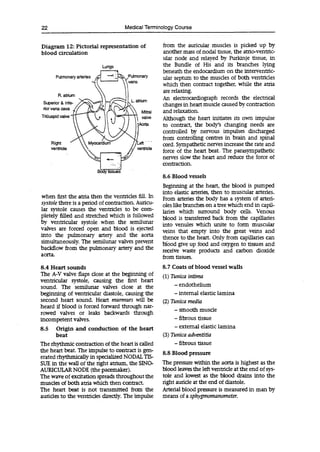
The human heart is really a double pump. The
right atrium receives blood from the body
tissues with its oxygen supply diminished via
the inferior and superior vena cava. This
blood passes into the right ventricle which
pumps it to the lungs via the pulmonary arter-
ies to obtain a fresh oxygen supply. The blood
received back from the lungs via the pulmo-
nary veins passes via the left atrium to the left
ventricle, which pumps it to the rest of the
body via the aorta.
8.3 The cardiac cycle
The cardiac cycle consists of diastole and sys-
tole. In diastole, there is a period of relaxation
22 Medical Terminology Course
Diagram 12: Pictorial representation of
blood circulation
Lungs
Pulmonary arteries
veins
R. atrium
Superior & infe- L. atrium
nor vena cava i W
.J"'4
~ valve
Triuspid valve J'~
Mitral
Right

 Myocardiuni //Left
ventricle Al ventricle
when first the atria then the ventricles fill. In
systole there is a period of contraction. Auricu-
lar systole causes the ventricles to be com-
pletely filled and stretched which is followed
by ventricular systole when the semilunar
valves are forced open and blood is ejected
into the pulmonary artery and the aorta
simultaneously. The semilunar valves prevent
backflow from the pulmonary artery and the
aorta.
8.4 Heart sounds
The A-V valve flaps dose at the beginning of
ventricular systole, causing the first heart
sound. The semilunar valves close at the
beginning of ventricular diastole, causing the
second heart sound. Heart murmurs will be
heard if blood is forced forward through nar-
rowed valves or leaks backwards through
incompetent valves.
8.5 Origin and conduction of the heart
beat
The rhythmic contraction of the heart is called
the heart beat. The impulse to contract is gen-
erated rhythmicallyinspecialized NODAL TIS-
SUE in the wall of the right atrium, the SINO-
AURICULAR NODE (the pacemaker).
The wave of excitation spreads throughout the
muscles of both atria which then contract.
The heart beat is not transmitted from the
auricles to the ventricles directly. The impulse
from the auricular muscles is picked up by
another mass of nodal tissue, the atrio-ventric-
ular node and relayed by Purkinje tissue, in
the Bundle of His and its branches lying
beneath the endocardium on the interventric-
ular septum to the muscles of both ventricles
which then contract together, while the atria
are relaxing.
An electrocardiograph records the electrical
changes in heart muscle caused by contraction
and relaxation.
Although the heart initiates its own impulse
to contract, the body's changing needs are
controlled by nervous impulses discharged
from controlling centres in brain and spinal
cord. Sympathetic nerves increase the rate and
force of the heart beat. The parasympathetic
nerves slow the heart and reduce the force of
contraction.
8.6 Blood vessels
Beginning at the heart, the blood is pumped
into elastic arteries, then to muscular arteries.
From arteries the body has a system of arteri-
oles like branches on a tree which end in capil-
laries which surround body cells. Venous
blood is transferred back from the capillaries
into venules which unite to form muscular
veins that empty into the great veins and
thence to the heart. Only from capillaries can
blood give up food and oxygen to tissues and
receive waste products and carbon dioxide
from tissues.
8.7 Coats of blood vessel walls
(1)Tunica intima
-endothelium
-internal elastic lamina
(2)Tunica media
-smooth muscle
- fibrous tissue
-external elastic lamina
(3)Tunica adventitia
- fibrous tissue
8.8 Blood pressure
The pressure within the aorta is highest as the
blood leaves the left ventricle at the end of sys-
tole and lowest as the blood drains into the
right auricle at the end of diastole.
Arterial blood pressure is measured in man by
means of a sphygmomanometer.
Medical Terminology Course 23
8.9 The pulse
As blood is pumped from the heart during sys-
tole, the distention and increase in pressure
which starts in the aorta passes along the
whole arterial system as a wave - the pulse
wave.
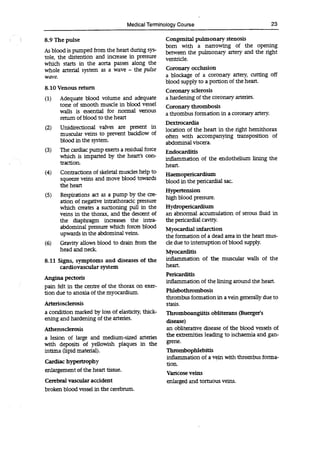
8.10 Venous return
(1) Adequate blood volume and adequate
tone of smooth muscle in blood vessel
walls is essential for normal venous
return of blood to the heart
(2) Unidirectional valves are present in
muscular veins to prevent backflow of
blood in the system.
(3) The cardiac pump exerts a residual force
which is imparted by the heart's con-
traction.
(4) Contractions of skeletal muscles help to
squeeze veins and move blood towards
the heart
(5) Respirations act as a pump by the cre-
ation of negative intrathoracic pressure
which creates a suctioning pull in the
veins in the thorax, and the descent of
the diaphragm increases the intra-
abdominal pressure which forces blood
upwards in the abdominal veins.
(6) Gravity allows blood to drain from the
head and neck.
8.11 Signs, symptoms and diseases of the
cardiovascular system
Angina pectoris
pain felt in the centre of the thorax on exer-
tion due to anoxia of the myocardium.
Arteriosclerosis
a condition marked by loss of elasticity, thick-
ening and hardening of the arteries.
Atherosclerosis
a lesion of large and medium-sized arteries
with deposits of yellowish plaques in the
intima (lipid material).
Cardiac hypertrophy
enlargement of the heart tissue.
Cerebral vascular accident
broken blood vessel in the cerebrum.
Congenital pulmonary stenosis
born with a narrowing of the opening
between the pulmonary artery and the right
ventricle.
Coronary occlusion
a blockage of a coronary artery, cutting off
blood supply to a portion of the heart.
Coronary sclerosis
a hardening of the coronary arteries.
Coronary thrombosis
a thrombus formation in a coronary artery.
Dextrocardia
location of the heart in the right hemithorax
often with accompanying transposition of
abdominal viscera.
Endocarditis
inflammation of the endothelium lining the
heart.
Haemopericardiuxn
blood in the pericardial sac.
Hypertension
high blood pressure.
Hydropericardium
an abnormal accumulation of serous fluid in
the pericardial cavity.
Myocardial infarction
the formation of a dead area in the heart mus-
de due to interruption of blood supply.
Myocarditis
inflammation of the muscular walls of the
heart.
Pericarditis
inflammation of the lining around the heart.
Phlebothrombosis
thrombus formation in a vein generally due to
stasis.
Thromboangiltis obliterans (Buerger's
disease)
an obliterative disease of the blood vessels of
the extremities leading to ischaemia and gan-
grene.
Thrombophiebitis
inflammation of a vein with thrombus forma-
tion.
Varicose veins
enlarged and tortuous veins.
24 Medical Terminology Course
9. BLOOD AND THE BLOOD-
FORMING ORGANS
9.1 Composition of the blood
In the adult, the average amount of blood is 5
litres or approximately 7.7% of the body
weight. The blood plasma comprises approxi-
mately 55% of the blood. It is almost clear, a
straw-coloured fluid of which approximately
90% is water (Table 5).
9.2 Cells in the blood
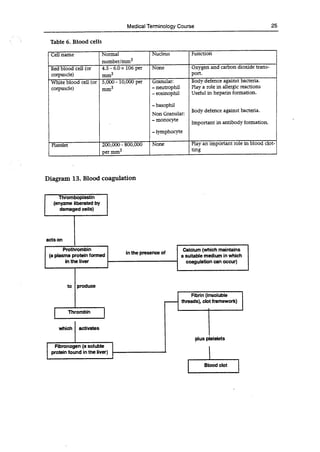
There are three main types of blood cells, red
blood cells, white blood cells and platelets
(Table 6).
9.3 Blood coagulation
Blood does not normally clot Within healthy
blood vessels. When vascular tissues are
damaged, blood undergoes a series of
changes which result in clot formation:
The platelets cling to the intersections of the
fibrin threads. Adhesions form, the clot
shrinks with the expression of serum.
9.4 Haematopoiesis -blood formation
Various substances taken in the diet (includ-
ing iron and other minerals, vitamin B12
and protein) are absorbed (vitamin B12 only
in the presence of an intrinsic factor
secreted by the gastric mucosa) and taken to
the liver. Here vitamin B12 is stored and
released to the general circulation as
required as a haematopoietic factor which
stimulates the production of red cells (erytbro-
poiesis) in the red bone marrow.Other factors
necessary for erythropoiesis include iron, and
thyroid hormone. The red cells circulate for
120 days and are then broken down (proba-
bly in the spleen) to release iron for further
use. Haemoglobin without iron is excreted as
bile pigments via the liver.
The various mechanisms responsible for
producing white blood cells (except lym-
phocytes) in the red bone marrow are less
well understood.
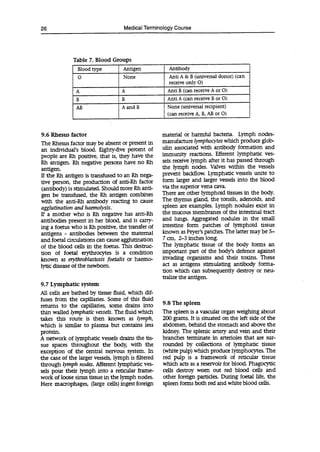
9.5 Blood groups
Present in the plasma of some individuals are
antibodies which can cause agglutination (the
clumping together) and subsequent haemoly-
sis (breakdown) of the red blood cells received
in blood transfusions.
When such reactions occur, the bloods are
said to be incompatible. Clumps of cells may
block small blood vessels in the lungs or brain
causing serious complications. Haemolysis
may result in the passage of haemoglobin via
the kidneys into the urine, and may lead to
kidney failure and death.
The type of antigen present in the red blood
cells of the donor's blood, which reacts with
the antibodies in the plasma of the recipient
help to identify four blood groups (Table 7)
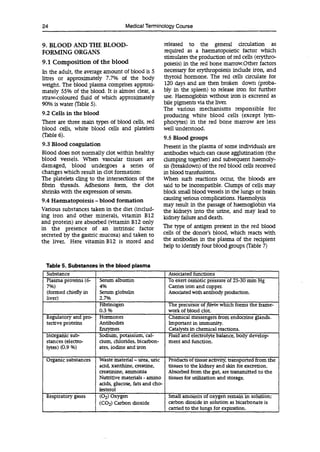
Table 5. Substances in the blood plasma
Substance Associated functions
Plasma proteins (6- Serum albumin To exert osmotic pressure of 25-30 mm I-1g
7%) 4% Carries iron and copper.
(formed chiefly in Serum globulin Associated with antibody production.
liver) 2.7%
Fibrinogen The precursor of fibrin which forms the frame-
0.3% work of blood clot.
Regulatory and pro- Hormones Chemical messengers from endocrine glands.
tective proteins Antibodies Important in immunity.
Enzymes Catalysts in chemical reactions.
Inorganic sub- Sodium, potassium, cal- Fluid and electrolyte balance, body develop-
stances (electro- cium, chlorides, bicarbon- ment and function.
lytes) (0.9 %) ates, iodine and iron
Organic substances Waste material-urea, uric Products of tissue activity, transported from the
acid, xanthine, creatine, tissues to the kidney and skin for excretion.
creatinine, ammonia Absorbed from the gut, are transmitted to the
Nutritive materials - amino tissues for utilization and storage.
acids, glucose, fats and cho-
lesterol
Respiratory gases (02) Oxygen Small amounts of oxygen remain in solution;
(CO2) Carbon dioxide carbon dioxide in solution as bicarbonate is
carried to the lungs for expiration.
Medical Terminology Course 25
Table 6. Blood cells
Cell naine Normal Nucleus Function
number/mm3
Red blood cell (or 4.5 - 6.0 x 10⁶ per None Oxygen and carbon dioxide trans-
corpuscle) mm3 port.
White blood cell (or 5,000 - 10,000 per Granular: Body defence against bacteria.
corpuscle) MM3 -neutrophil Play a role in allergic reactions
-eosinophil Useful in heparin formation.
-basophil
Non Granular:
Body defence against bacteria.
-monocyte Important in antibody formation.
-lymphocyte
Platelet 200,000 - 800,000 None Play an important role in blood clot-
per mm3 I ting
Diagram 13. Blood coagulation
(enyzme liberated by
damaged cells)
acts on
Prothrombin
(a plasma protein formed
in the liver
In the presence of
Calcium (which maintains
a suitable medium in which
coagulation can occur)
to Iproduce
Fibrin (insoluble
threads), clot framework)
Thrombin
which I activates
plus platelets
Fibronogen (a soluble
protein found in the liver)
Blood clot
26 Medical Terminology Course
Table 7. Blood Groups
Blood type Antigen Antibody
O None Anti A & B (universal donor) (can
receive only O)
A A Anti B (can receive A or O)
B B Anti A (can receive B or O)
AB A and B None (universal recipient)
(can receive A, B, AB or O)
9.6 Rhesus factor
The Rhesus factor may be absent or present in
an individual's blood. Eighty-five percent of
people are Rh positive, that is, they have the
Rh antigen. Rh negative persons have no Rh
antigen.
If the Rh antigen is transfused to an Rh nega-
tive person, the production of anti-Rh factor
(antibody) is stimulated. Should more Rh anti-
gen be transfused, the Rh antigen combines
with the anti-Rh antibody reacting to cause
agglutination and haemolysis.
If a mother who is Rh negative has anti-Rh
antibodies present in her blood, and is carry-
ing a foetus who is Rh positive, the transfer of
antigens - antibodies between the maternal
and foetal circulations can cause agglutination
of the blood cells in the foetus. This destruc-
tion of foetal erythrocytes is a condition
known as ei-
ythroblastosis foetalis or haemo-
lytic disease of the newborn.
9.7 Lymphatic system
All cells are bathed by tissue fluid, which dif-
fuses from the capillaries. Some of this fluid
returns to the capillaries, some drains into
thin walled lymphatic vessels. The fluid which
takes this route is then known as lymph,
which is similar to plasma but contains less
protein.
A network of lymphatic vessels drains the tis-
sue spaces throughout the body, with the
exception of the central nervous system. In
the case of the larger vessels, lymph is filtered
through lymph nodes. Afferent lymphatic ves-
sels pour their lymph into a reticular frame-
work of loose sinus tissue in the lymph nodes.
Here macrophages, (large cells) ingest foreign
material or harmful bacteria. Lymph nodes.-
manufacture lymphocytes which produce glob-
ulin associated with antibody formation and
immunity reactions. Efferent lymphatic ves-
sels receive lymph after it has passed through
the lymph nodes. Valves within the vessels
prevent backflow. Lymphatic vessels unite to
form larger and larger vessels into the blood
via the superior vena cava.
There are other lymphoid tissues in the body.
The thymus gland, the tonsils, adenoids, and
spleen are examples. Lymph nodules exist in
the mucous membranes of the intestinal tract
and lungs. Aggregated nodules in the small
intestine form patches of lymphoid tissue
known as Peyer's patches. The latter may be 5-
7 cm, 2-3 inches long.
The lymphatic tissue of the body forms an
important part of the body's defence against
invading organisms and their toxins. These
act as antigens stimulating antibody forma-
tion which can subsequently destroy or neu-
tralize the antigen.
9.8 The spleen
The spleen is a vascular organ weighing about
200 grams. it is situated on the left side of the
abdomen, behind the stomach and above the
kidney. The splenic artery and vein and their
branches terminate in arterioles that are sur-
rounded by collections of lymphatic tissue
(white pulp) which produce lymphocytes. The
red pulp is a framework of reticular tissue
which acts as a reservoir for blood. Phagocytic
cells destroy worn out red blood cells and
other foreign particles. During foetal life, the
spleen forms both red and white blood cells.
Medical Terminology Course 27
9.9 Signs, symptoms, diseases of the haemocbromatosis
haematopoietic system deposition of haemosiderin in paren-
(1) Anaemia chymal cells;
Anaemia is a decrease in the amount of
haemosiderosis
circulating red blood cells and/or the
total red blood cell haemoglobin. (Nor- iron found in macrophages, due to
mal = 14-15 g per 100 ml of blood), blood transfusion and increased
Microcytic - hypochromlc anaemia - haemolysis.
occurs if iron stores are inadequate, also
(2) Myeloproliferative disorders
seen in chronic blood loss anaemia.
Macrocytic anaemia Agranulocytosis is caused by toxins or
an arrest in the formation of mature red poisons. Thrombocytopenia (a de-
blood cells, accompanied by megalo- crease in the number of circulating
blasts (large and nucleated) found platelets) accompanies bone marrow
mainly in bone marrow, caused by defi- depression and a decrease in polymor-
dencies of dietary protein, folic add, phonuciear cells is noted.
vitamin B12 and/or the intrinsic factor. Polycythaemia vera involves bone
Pernicious anaemia marrow proliferation with an increase
a form of macrocytic anaemia caused by in the production of red cells, white
lack of intrinsic factor. It is macrocytic, cells and platelets causing increased
hypercbromic with some megaloblasts, blood volume, increased blood viscosity
with a high degree of anisocytosis and and may lead to heart failure.
poikilocytosis. It is accompanied by Leukaemia involves the overproduc-
bone marrow hyperplasia. tion and liberation of neoplastic white
Normochromic-normocytic cells; if monocytes, monocytic leu-
anaemias kaemia, if lymphocytes, lymphatic leu-
are secondary to other diseases, for kaemia; if polymorphonudear ele-
example, chronic renal disease, or can ments, myeloid leukaemia.
occur if the erythropoietic tissue in the leukaemia may be acute or chronic.
bone marrow is crowded out, either by Monocyticleukaemia is generally acute.
fibrosis (myelofibrosis), or bone forma-
tion (osteosderosis), or metastatic can- Acute leukaemia is commonly lym-
cer. It also occurs in diseases of the phoblastic in childhood and myeloge-
haemopoietic system such as lympho- nous in young adults. The precursor
mas or multiple myeloma. cells are primitive cells called blasts.
Aplastic anaemia Chronic myelogenous leukaemia
is a complete failure of the bone mar- The predominant immature neoplastic
row to undergo erytiiropoiesis. it is usu- white cell is the myelocyte. It mainly
ally accompanied by leucopenia.
affects patients between 25 and 60 years
cause may be drug toxicity. of age. The spleen characteristically is
Haemolytic anaemia greatly enlarged.
involves lysis of normal red cells due to
antibodies, drugs or poisons, or as a sec-
ondary result of other conditions, such Cells present in the peripheral blood are
as lymphoma, lupus erythematosus, or largely mature lymphocytes. The dis-
chronic lymphocytic leukemia. ease generally occurs in older people,
Words to Note: 55-80 years of age. Lymphocyte infiltra-
acytosis lion may be found in all viscera but
especially in bone marrow, liver, spleen
cells vary markedly in size; and lymph nodes. Lymph nodes are
pOikilOcytOSis enlarged as are the liver and spleen
cells vary markedly in shape; (hepatosplenomegaly)
28 Medical Terminology Course
(3) Reficuloendothelial malignancies
Giant follicular lymphoma
confined to lymph nodes and spleen,
causing enlargement, with compres-
sion but not obliteration of the sinuso-
ids and reticuloendothelial stroma. The
capsule of the lymph node is not usu-
ally invaded.
Lymphosarcomas
are primary malignant lesions of lym-
phatic tissue, lymph nodes and spleen.
Neoplastic cells are not usually found in
peripheral blood smears.
Lymphocytic lymphosarcoma
the entire lymph node, follicle and
stroma, is replaced by a dense mass of
lymphocytes which appear normal. The
capsule is invaded with spread to neigh-
bouring fat and other viscera, especially
the liver and bone marrow.
Lymphoblastic lymphosarcoma
the lymphocytes are enlarged, with
primitive nuclei, an increased amount
of cytoplasm and invasion is aggressive.
Reticulum cell sarcoma
here, mesenchymal cells with abundant
cytoplasm and indented nuclei spread
rapidly to all body organs.
Although still used in the ICD, the
terms lymphosarcoma and reticulo-sar-
coma are increasingly becoming obso-
lete, being replaced by the generic term
Non-Hodgkin lymphoma.
Within this grouping various types are
distinguished according to the predomi-
nant histological cell type:
Lymphocytic - well differentiated
Lymphocytic - poorly differentiated
Histiocytic
Mixed lymphocytic and histiocytic
Each type is further divided into Nodu-
lar and Diffuse categories. All nodular
types have a relatively good prognosis,
as does the diffuse lymphocytic well dif-
ferentiated type.
Hodgkin's disease
differs from the other lymphomas in
that the infiltrate is pleomorphic, that is,
it contains cells of many different types,
and occurs in younger age groups.
Multiple myeloma
is a malignancy of the bone marrow
where abnormal plasma cells (myeloma
cells) occur sometimes in many small
areas throughout the marrow (ribs, ver-
tebrae, skull). Myeloma causes dyspro-
teinaemia which can be diagnosed by a
test for Bence Jones protein in the urine
and myeloma proteins in the blood.
10. RESPIRATORY SYSTEM
10.1 Introduction
All living cells must obtain oxygen and dis-
pose of carbon dioxide. There are two different
types of respiration, internal and external.
Internal or cellular respiration is the exchange
of gases between the tissue cells and their fluid
environment. External respiration is the
exchange of gases between the lung alveoli
(singular -alveolus) and the external environ-
ment. This is accomplished by the respiratory
system.
The respiratory passages comprise the nose,
larynx, trachea and bronchi.
The lungs are housed in the thoracic cage to
which the respiratory muscles the intercostals,
and the diaphragm are connected.
10.2 Transportation of respiratory gases
Oxygen in a small amount remains in solu-
tion in the blood plasma. A large amount of
oxygen enters into loose chemical combina-
tion with the haemoglobin in the red blood
cells. Carbon dioxide also exists in small
amounts in solution in plasma, mostly as
bicarbonate and a small amount is linked to
the haemoglobin in red blood cells.
10.3 Pulmonary circulation
The blood lacking its full amount of oxygen
and containing an excess of carbon dioxide is
pumped into the pulmonary artery. From the
pulmonary artery, the blood enters the right
or left lung and eventually enters a capillary
which lies adjacent to an air sac (alveolus).
Here by perfusion the blood becomes satu-
rated with oxygen from the air in the alveolus
and gives off excess carbon dioxide. It then
leaves the capillary, and progresses through
larger veins until it enters one of the four large
pulmonary veins which carry blood to the left
atrium. It will be noted that the pulmonary
veins and venules are the only veins which
carry oxygenated blood.
Medical Terminology Course 29
10.4 Air pathways passes into the trachea, is called the
glottis. When the cords are slack, there
(1) The nose is a wide slit; in quiet respirations, air
The entry to the nose is called the nares, moves in and out soundlessly. When
or nasal orifices, the cords are taut, the slit is narrowed
The nasal septum forms the medial wall so that sound is produced when air is
and is composed of the vomer bone, the expelled from the lungs.
perpendicular plate of the ethmoid and The mouth, nose, sinuses, throat and
cartilage, chest act as resonators; they affect the
The lateral walls of the nasal cavities are quality and volume of speech while the
formed by three turbinates or conchae lips, tongue and teeth convert the
which project into the nasal cavity. The sounds into speech.
lateral space below each concha is called The muscles of the larynx are supplied
a meatus. The superior and medial con- by two pairs of nerves, both branches of
chae are part of the ethmoid bone. Four the vagus (Xth cranial nerve), called the
pairs of paranasal sinuses and two naso- superior laryngeal and recurrent or infe-
lacnmal ducts open into the lateral wall. nor laryngeal nerves. The recurrent
The olfactory mucosa provides the sense laryngeal nerve lies very close to the
of smell and is situated in the roof of inferior thyroid arteries. Nerve damage
the nasal cavity, during thyroid surgery can result in
The mucous membrane lining the nasal
speech impairment.
cavities serves to warm, moisten and . (4) The trachea
ter the air we breathe. The trachea, approximately 11 an, 4.5
(2) The pharynx inches long, is located in the lower part
of the neck and the upper part of the
There are three parts of the pharynx, thorax, anterior to the oesophagus. It is
the nasopharynx, the oropharynx and protected by cartilage in the shape of
the laryngopharynx. The Eustachian incomplete rings.
tube from the middle ear enters the
(5) The bronchi and alveoli
nasopharynx. The oropharynx lies pos-
tenor to the oral cavity. The The main bronchi branch inferiorly
gopharynx connects with the larynx, or from the trachea, one entering each
voice box. lung. Overlapping plates of cartilage
(3) The larynx
give support to the bronchi. Each bron-
chus branches into smaller tubes called
The larynx is a cartilaginous bow-like bronchioli and finally ends in the ter-
structure located in the neck. Posterior minai bronchioles. The respiratory
to the thyroid gland is the thyroid Cart- bronchioles branch into alveolar ducts
lage. The cricoid cartilage which 15 which lead to the alveolar sacs, where
shaped like a signet ring, with the broad respiration takes place. The alveoli are
part lying posteriorly is inferior to the part of the lung tissue.
thyroid cartilage. The epiglottis is a leaf-
like structure located at the entrance of 10.5 The lungs and pleura
the larynx, which doses off the The lungs differ in shape; the right lung
entrance on swallowing. Two arytenoid has three lobes, the left has two lobes.
cartilages, shaped like small pyramids Each lung has an apex, a base, a costal
facilitate speech. Two other small paired surface and a mediastinal surface. on
cartilages, associated with the arytenoid the mediastinal surface, there is an
cartilages are named the cuneiform and opening called a hilus through which
the comiculate cartilages, pass the blood vessels, bronchi, nerves
Vocal cords lie between the thyroid and and lymphatics. These structures are
arytenoid cartilages. The arytenoid bound together with connective tissue
Wages move to separate or approximate and are called the root of the lung.
the vocal cords. The opening between Apart from the blood vessels responsi-
the vocal cords, through which air ble for transporting gases to and from
30 Medical Terminology Course
the lung, the lung tissue also requires a Bronchiectasis
blood supply. The blood vessels supply- destructive dilation of bronchi secreting
ing lung tissue are the bronchial arteries large amounts of pus.
which branch off from the aorta carry-
Bronchitis
ing oxygenated blood, via the root of
the lung. The bronchial veins drain into inflammation of the bronchial mucous
the innominate and axygos veins and membrane.
eventually back to the superior vena Bronchogemc carcinoma
cava, malignancy believed to arise from bron-
The pleural cavity is made up of two chiai epithelial tissue and synonymous
layers; it is a potential space only. The with carcinoma of lung.
visceral layer of the pleura is the outer- Common cold
most covering of the lung and it reflects
synonymous with coryza - an acute
to adhere to the innermost part of the catarrhal inflammation of the nasal
chest wall and diaphragm where it is mucous membranes.
called the parietal (L paries = wall)
pleura. The entire pleural cavity con- Croup
tains only a small amount of serous a disease characterized by suffocative
fluid for lubrication purposes in health. and difficult breathing, laryngeal spasm
10.6 Nerve control of the respiratory
and sometimes membrane formation.
system Dyspnoea
The lungs are innervated by the auto-
difficulty in breathing.
nomic nervous system. Parasympa- Emphysema
thetic fibres cause constriction of overdistention of alveoli and smaller
smooth muscle tissue, while sympa- bronchial tubes with air. Results in dys-
thetic fibres cause dilation. pnoea, cough, expectoration character-
In normal breathing, the respiratory ized by short inspiration, prolonged
rate and rhythm are influenced rhyth- expiration.
mically by the Hering-Breuer reflex with- Empyema
out any conscious muscular exertion. pus in the pleural cavity.
The most important factor which regu- Epist xis
lates the activity of the respiratory cen-
nosebleed.
tre is the level of carbon dioxide in the
blood. An increase in the level will stim- Hamartoma
ulate the respiratory rate; a decrease in a benign tumour due to new growth of
in the blood will depress the respi- blood vessels, may be found as a symp-
ratory centre in the medulla. tomless coin lesion in the lung.
10.7 Signs, symptoms and diseases of the Hay fever
respiratory system an allergic disease of mucous passages of
Anthracosis
the nose and upper air passages induced
by external irritation.
a condition of the lungs due to coal dust Influenza
inhalation.
acute infection often involving catarrh
Asthma of the respiratory tract.
paroxysmal dyspnoea accompanied by Laryngitis
adventitious sounds caused by spasm of inflammation of the larynx with apho-
the bronchial tubes or swollen mucous nia.
membranes.
Lobar pneumonia
Atelectasis inflammation of lungs involving spe-
lack of air in the lungs. cific lobes.
Medical Terminology Course 31
Pleurisy
inflammation of the pleura (synonym -
pleuritis).
Pneumoconiosis
a condition of the lung due to inhala-
tion of dust particles (Gr. pneumon
conis (dust)+ osis (disease)).
Pneumonia
inflammation of the lungs with exudate
into the lung tissue.
Pneumothorax
a collection of air or gas in the pleural
cavity.
Pneumonitis
inflammation of the lung.
Rhinitis
inflammation of the nasal mucosa (GL
rhin = nose).
Siderosis
disease of the lungs caused by inhala-
tion of metallic dust (Gr. sidero = iron or
steel)
Silicosis
a condition caused by the inhalation of
small particles of stone or stone dust (L.
silic = flint).
Sinusitis
inflammation of the accessory nasal
sinuses.
Tonsillitis
(L tonsilla = almond)-inflammation of
the faudal tonsils.
Tracheo-oesophageal fistula
abnormal opening between the trachea
and oesophagus.
Tuberculosis
a specific inflammatory disease caused
by the tubercle bacillus characterized by
caseous granulomatous infiltration.
Wegener's granulomatosis
11. DIGESTIVE SYSTEM
11.1 Introduction
This chapter deals with the alimentary canal
and its associated glands. The function of the
digestive system is to:
- ingest food and fluids;
- secrete enzymes which break large mol-
ecules into simpler units;
- digest or condense food by chemical
and mechanical means;
- absorb soluble substances and water
into the circulatory system;
- reject undigested particles (excretion).
11.2 The mouth
The roof of the mouth is formed by the hard
palate and the soft palate which end in the
uvula, a small soft structure hanging from the
free edge of the soft palate, in the midline
above the root of the tongue. Upon swallow-
ing, it prevents food or fluid from refluxing
into the nasal cavity.
The tongue is a muscular organ. The surface of
the tongue has tiny projections called papillae
which contain nerve endings for taste sensa-
tion. The frenulum is a fold of mucous mem-
brane which attaches the underside of the
tongue to the floor of the mouth.
The mouth is kept moist by secretions from
the salivary glands, the parotid, submandibu-
lar, and sublingual glands.
The fauces are arches on each side where the
mouth meets the pharynx. The two arches are
the glossopalatine arch anteriorly and the
pharyngopalatine arch posteriorly, known as
the tonsillar fauces.
Digestion in the mouth involves both
mechanical and chemical processes. Mastica-
tion is under voluntary control, salivation is
controlled by the autonomic nervous system.
Saliva consists of ptyalin, water, and mucin.
Ptyalin is an enzyme which begins the process
of splitting starch from dextrose to maltose (a
simple sugar). Mucin is a thick secretion
which lubricates the food and helps swallow-
ing.
11.3 The oesophagus
involves bronchi, trachea, nasophar- The oesophagus is a muscular tube about 25
ynx and lung-causing dissolution and an in length, which conveys food and fluid to
necrosis of vessels, alveoli and bronchi, the stomach.
severe pneumonitis, haemoptysis and There are four layers comprising the oesopha-
death. gus. The inner mucosal lining is stratified
32 Medical Terminology Course
squamous epithelium. The submucosal layer
contains glands which secrete lubricant. The
muscle coats of the oesophagus consist of an
inner circular and an outer longitudinal coat.
The upper 1/3 of the oesophagus has striated
skeletal muscle. The middle 1/3 is mixed skele-
tal and smooth muscle, while the lower one
third is smooth muscle. The outermost coat of
the oesophagus is made up of connective tis-
sue. Except during the passage of food, the
oesophagus is flattened and closed.
The cardiac sphincter separates the oesophagus
and the stomach.
11.4 The stomach
The lesser curvature is located superiorly; the
greater curvature, on the inferior surface; the
fundus extends above the oesophagogastric
junction; the body is the largest part of the
stomach and pyloric portion is the narrow
part which connects with the duodenum at
the pyloric sphincter. The mucosal lining has
special glands for the secretion of gastric
juices. The outer wall of the stomach has three
smooth muscle coats, longitudinal (outer), cir-
cular (medial) and oblique (internal).
The functions of the stomach are to:
(1) Absorb water, alcohol and glucose into
the blood stream;
(2) Secrete gastric enzymes - for example;
rennin to clot milk; lipase to initiate the
splitting of fats; pepsinogen, which in
the presence of hydrochloric acid forms
pepsin to begin protein breakdown;
(3) To secrete hydrochloric acid (HC1)
which kills bacteria and changes some
minerals to salts which are suitable for
absorption in the intestine (example,
calcium and iron);
(4) The gastric mucosa also produces the
intrinsic factor which is necessary for
the absorption of vitamin B12;
(5) The pyloric glands secrete an alkaline
mucus to neutralize the HC1.
(6) The strong muscular action of the stom-
ach chums the food into a semi-liquid
substance and forces it through the
pyloric sphincter into the duodenum.
11.5 The pancreas
The pancreas is a large gland lying across the
posterior abdominal wall. It has two types of
secretions, enzymic and hormonal. It is com-
posed of the head, body and tail. The head of
the pancreas is cradled in the curve of the
duodenum.
The exocrine duct from the pancreas joins
with the common bile duct to form the
ampulla of Vatei- which empties into the
duodenum through the sphincter of Oddi.
The exocrine or pancreatic enzymes serve to:
a) neutralize acid from the stomach (water
and alkaline salts);
b) split fats (lipase);
C) split starch to maltose (amylose):
d) split proteins (trypsinogen plus enter-
okinase; produces tiypsin for this pur-
pose);
e) complete protein digestion (peptidase).
The endocrine or internal secretions are
produced by the islets of Langerhans.
The hormones insulin and glucagon are
absorbed by capillaries which carry
these hormones to the blood stream for
systemic circulation.
11.6 The liver and gallbladder
The liver is situated in the upper right quad-
rant of the abdominal cavity, directly under
the diaphragm. It consists of four lobes, the
right, left, quadrate and quadrangular. A fis-
sure of the liver, known as the porta hepatis
permits hepatic arteries, the portai vein, the
hepatic duct, nerves and lymphatics to enter
and leave the liver.
The gallbladder is a pear-shaped hollow organ,
approximately 2.5 cm, 1 inch in diameter and
5 cm, 2 inches long. It consists of fundus,
body and a cystic duct which joins with the
hepatic duct to form the common bile duct. It
is composed of inner mucosa, smooth muscle
and an outer layer of connective tissue.
Bile is secreted continuously by the liver. It is
stored and concentrated in the gallbladder
and periodically, following the ingestion of
fat, the gallbladder contracts discharging bile
into the duodenum to aid fat digestion. Bile
acts to emulsify fats, to activate the pancreatic
enzyme lipase and to promote the fat absorp-
tion.
Some bile pigments are reabsorbed from the
digestive tract to be recycled as bile. Some bile
pigments enter the general circulation and are
transformed to urobilinogen and urobilin and
are subsequently excreted in the urine. Sterco-.
bun gives the faeces its brown pigmentation.
Clay coloured stools are an indication of bil-
iary obstruction.
Medical Terminology Course 33
11.7 The small intestine
The small intestine is a long muscular tube
approximately 6 m, twenty feet long, com-
prising the duodenum 25-30 an, 10-12
inches, the jejunum, approximately 2.4 m, 8
feet, and the ileum approximately 3.6 m, 12
feet.
Four layers comprise the small intestine. The
outer serous coat of peritoneum is a delicate
membrane, the mesentery which suspends the
intestines to the posterior abdominal wall. The
mesentery carries the mesenteric arteries and
veins as well as lymphatic vessels which
empty into mesenteric lymph nodes, then
into the thoracic duct. The muscular coat con-
sists of circular and longitudinal smooth mus-
des which cause peristalsis by segmental
contraction. The submucous layer contains
blood vessels and fibrous tissue. The mucous
coat is characterized by villi which provide an
enormous absorptive surface. The crypts of
Lieberkuhn secrete an alkaline enzyme known
as succus entericus.
In the small intestine, amino acids, sugars,
minerals, glycerol, some fatty adds and vita-
mins are absorbed. Glycerides and some fatty
adds and fat-soluble vitamins are absorbed
into the lacteals. Digestion and absorption of
food are usually complete by the time the resi-
due reaches the ileocaecal valve.
11.8 The large intestine
The large intestine is approximately 1.8 m, six
feet, in length. It comprises the caecum,
appendix, ascending colon, transverse colon,
descending colon and sigmoid colon.
The outer serous coat consists of peritoneum
which carnes blood and lymph vessels and
nerves. There are two muscular coats. The cir-
cular limer muscular coat covers the entire
length of the colon; the longitudinal coat con-
sists of three bands of muscle tissue. The sub-
mucous coat lies between the muscular and
mucous layer. The mucous membrane of the
colon is epithelial tissue supplied with numer-
ous capillaries for the absorption of water.
Goblet cells secrete mucus.
The main function of the colon is to absorb
water and salts thereby conserving the body's
fluids and drying the faeces to a normal con-
sistency. Faeces are stored in the sigmoid
colon until defecation.
11.9 The rectum and anus
The rectum is a pouch with transverse folds
while the anus has longitudinal folds. There
are two anal sphincters, the internal sphincter
consisting of smooth muscle, while the exter-
nal sphincter consists of voluntary muscle.
11.10 The peritoneum
The peritoneum covers the viscera, known as
visceral peritoneum, and lines the abdominal
cavity known as parietal peritoneum.
The greater omentum hangs from the greater
curvature of the stomach like an apron. The
lesser omentum is a double fold of peritoneum
which connects the lesser curvature of the
stomach to the surface of the liver.
Diagram 14. The digestive system
Mouth Salivary glands
Tongue ge. Pharynx
Liver ILOesohagus
- Fundii
nis
Gallbladder
J Stomach
Duodenum
Common bile ducL-
Transverse colon
Descending
Ascending colon Desce
on
Ileum ::~
(M)~ ~
colon
Rectum
11.11 Signs, symptoms, conditions and
diseases of the digestive system
(1) Oral cavity:
Herpes simplex fever
blisters in the skin about the lips.
Leukoplakia
hyperkeratosis with epithelial atrophy,
found on mucosa of gums, tongue and
inner cheek
Mucoepidermoid carcinoma
salivary gland neoplasm, contains
masses of mucus.
34 Medical Terminology Course
Parotid gland tumour
usually mixed tumours, dense masses of
small cells interspersed with mucus,
which can be cartilaginous and later
may calcify. May recur or spread.
Periodontitis
chronic inflammation of the gums.
Peritonsifiar abscess
an abscess in the connective tissue of
the tonsil.
Pyorrhea alveolaris
a purulent inflammation of the dental
periosteum.
Squamous cell carcinoma
invades locally and metastasizes to
lymph nodes, common in lips, tongue
and oral cavity.
Tonsillitis
inflammation of the tonsil(s).
Vincent's stomatitis
inflammation of the oral mucosa with
large ragged superficial ulcers (synonym
- Vincent's angina).
(2) Oesophagus:
Oesophageal varices
varicose veins that may cause haemate-
mesis.
Functional dysphagia
difficulty in swallowing without obvi-
ous cause.
Squamous cell carcinoma
obstructs the oesophagus causing dys-
phagia. Local growth involves the medi-
astinum.
(3) Stomach:
Adenocarcinoma stomach
often presents as an ulcer with a hard,
rolled, firm white edge - infiltrates -
may involve the muscle wall.
Dyspepsia
indigestion.
Gastric polyp
large projection overgrown with epithe-
lium arranged around stalk which car-
ries blood vessels and lymphatics - may
be premalignant.
Gastritis
inflammation of the stomach, acute or
chronic.
Leiomyoma
benign tumour of muscle layer of stom-
ach.
Leiomyosarcoma
may arise from leiomyoma, well differ-
entiated - metastasizes late.
Pectic ulcer
a localized ulcer of the visceral mucosa
which may cause bleeding (haemateme-
sis) or perforation.
(4) Pancreas:
Adenocarcinoma pancreas
a mucus-producing tumour often with
recognizable glands.
Cystic fibrosis
generalized abnormality of the secreting
glands such as those that manufacture
mucus and sweat. The pancreas and
lungs are involved. The mucus is thick
and sticky and the sweat glands have a
high concentration of salt. When the
lungs are affected, bronchitis occurs,
resulting in persistent cough, wheez-
ing, dyspnoea, and emphysema. When
the pancreas is affected there is marked
disturbance of the bowel, and glandular
cells lining other organs may be
affected.
Diabetes
a disease where the islets of Langerhans
in the pancreas fail to produce sufficient
insulin.
Islet cell adenoma
causes oversecretion of gastrin. Most are
benign, however some are invasive and
metastasize.
Pancreatitis
acute inflammation of the pancreas.
(5) Liver and gallbladder:
Acute catarrhal jaundice
synonymous with infectious hepatitis.
Cholangitis
inflammation of the common bile duct.
Cholecystitis
inflammation of the gallbladder.
Medical Terminology Course 35
Cholelithiasis Paralytic ileus
presence of stones in the gallbladder. complete absence of peristaltic motility.
Cirrhosis of liver Parasitic diseases
fibrosis of the liver, common infestations such as the pin-
Hepatoma
worm, Trichinella spiralis (from pork),
beef tapeworms (Taenia saginata) or
primary tumour of the liver, pork tapeworm (Taenia solium).
Hepatitis Peritonitis
inflammation of the liver. Different inflammation of the peritoneum may
types include infectious hepatitis, serum be caused by rupture of an abdominal
hepatitis. organ.
Jaundice Regional enteritis
yellow skin and sclera due to liver cell or Crohn's disease -necrosis and ulcer-
changes and obstruction causing bile ation, usually involving the ileum, but
pigment, bilirubin, to be diffused into it may spread to the jejunum or colon.
the blood. Marked scarring may cause partial
Obstructive biliary disease bowel obstruction.
may be due to intrahepatic or extrahe- Steatorrhoea
patic obstruction to bile flow, fatty stools.
Portal hypertension Volvulus
increased blood pressure in the portal a twisting of the mesentery causing
venous system, a complication of cii' obstruction of the blood supply and
rhosis of the liver, mechanical blockage of the lumen of
(6) Small intestine: the intestine.
Adenocarcinoma (7) Large intestine:
rare, but if they occur, are usually poly- Adenocarcinoma of colon
poid or fungating lesions in the duode- epithelial in origin, involving the cae-
cum, sigmoid and rectum predomi-
Bacterial enteritis nantly.
inflammation of the intestine caused by Adenomatous polyp
bacteria, such as Escherichia coli or Shi-
usually benign, and isolated.
gella.
Coeliac disease
Appendicitis
a juvenile form of idiopathic sprue.
inflammation of the appendix.
Duodenal ulcer
Carcinoid tumour of appendix
a peptic ulcer of the duodenum.
usually benign-adenocarcinoma of the
appendix is rare, colloid in nature. If it
Enteritis ruptures, the peritoneal cavity is filled
any inflammatory condition of the with jelly-like substance (pseudomyx-
small intestine, orna peiitonei).
Idiopathic sprue Diverticulosis
atrophy of the intestinal vil, usually in outpouching of mucosa from the
the jejunum, with thinning mucosa - lumen due to defective musculature
causes malabsorption syndrome. (diverticulitis) with subsequent inflam-
Obstruction mation.
of the intestine causes distention of the Familial polyposis
visais above the lesion and collapse dis- large numbers of polyps throughout the
tal to the lesion. Peristalsis and vomit- lumen of the colon, premalignant in
ing are stimulated. nature, genetic in origin.
Cortex
36 Medical Terminology Course
(8)
(9)
Infarction
death of part of the colon due to
obstruction of the blood supply to the
area.
Ulcerative colitis
an ulcerative disease of the colon char-
acterized by violent diarrhoeic episodes
with blood and mucus in the watery
stool - a premalignant condition.
Anus:
Imperforate anus
congenital absence of an anal orifice.
Haemorrhoids
varicose veins of the anus.
Squamous cell carcinoma
may develop from the squamous epi-
thelium of the rectum.
Mesentery:
Fat necrosis
benign inflammatory condition - small
numerous white lesions in mesentery.
Panniculitis
(L pannus = cloth) inflammation of the
fatty portion of the panniculus adipo-
sus, the superficial fasciae with fat in its
areolar substance.
12. URINARY SYSTEM
12.1 Introduction
The urinary system, consisting of two kidneys,
two ureters, a urinary bladder and a urethra, is
part of the excretory system of the body,
which also includes the respiratory; integu-
mentary and digestive systems.
12.2 The kidney
The kidneys excrete waste products of metabo-
lism and toxic substances from the body. They
help maintain the fluid and electrolyte bal-
ance.
Each kidney is located laterally to the spinal
column, in the upper part of the abdomen.
They are retroperitoneal, embedded in a mass
of fatty tissue, which is surrounded by a
fibrous covering called renal fascia.
Diagram 15: The kidney
RnI rith irnn
Calyx M
Pelvis
Urete
lia
Diagram 16: Nephron unit
Efferent
arteriole
Afferent
arteriole j -
CS
triter-lobular artery
Cortical
nephron
Thick loop of
Inter-lobar
artery
vein
Vasa Recta
Thin loop of
Henle
Diic of
Bellini
Medical Terminology Course 37
(1) The renal circulation
Approximately 25% of the output from
the left ventricle is distributed, in each
cardiac cycle, to the kidneys for filtra-
don. The renal artery which branches
from the aorta after several subdivisions
(Diagram 16) end in a cluster of capillar-
ies to form theglomerulus. All the glom-
eruli lie in the kidney cortex.
The glomerulus is surrounded by a
dosed end of a long tortuous renal
tubule, the nephron. This dosed end is
named Bowman's capsule.
Blood leaving the glomerulus flows to a
secondary capillary network around the
tubules of its own nephron before
draining into a vein.
(2) The nephron
The nephron (Diagram 16) or renal
tubule, consists of Bowman's capsule,
the proximal convoluted tubule, a loop
called "Henle's loop", the distal convo-
luted tubule and the collecting tubules
which empty into the renal pelvis at the
calyx of the kidney.
The kidney has approximately one mil-
lion nephrons.
(3) Formation of urine
Through the capillaries of the glomeruli
approximately 120 ml of water and salts
are filtered from the blood each minute.
Cells and plasma proteins are too large
to pass through the capillary mem-
branes into the renal tubule in a healthy
nephron.
The filtrate contains glucose, salt, urea,
uric acid, potassium, phosphates, sul-
fates, etc. in approximately the same
proportions as blood plasma. However,
the body must retain certain of these
substances for fluid and electrolyte bal-
ance. Thus, as the filtrate passes along
the tubule of the nephron, the filtrate is
concentrated and essential substances
are returned to the circulation via the
second capillary network which sur-
rounds the tubule.
Most of the water is reabsorbed into the
proximal convoluted tubules. Essential or
"high threshold" substances are also
reabsorbed here, including glucose,
sodium chloride and amino acids,
unless their concentration in the body
is too high.
"Medium threshold" substances such as
potassium may be reabsorbed but may
be secreted in the distal convoluted
tubule. Additional water is reabsorbed
in the distal convoluted tubule and
partly in the collecting tubules.
The urine passes out through the col-
lecting tubules at a rate of approxi-
mately 1.0 ml per minute, so that in
health we excrete about 1.5 litres of
urine per day.
12.3 The ureters
Each kidney is connected to the urinary blad-
der by a ureter. These muscular tubes are
about ten inches (25 cm) in length, beginning
at the renal pelvis.
The wall of the ureter has three layers, an
outer fibrous coat, a middle smooth muscle
layer which propels urine along the ureter and
an inner mucous membrane.
12.4 The urinary bladder
The urinary bladder is a hollow muscular
organ which serves as a reservoir for urine. It
lies in the pelvis behind the pubic bone.
Three openings mark off a triangular area.
These are the two ureters and the urethra. The
trigone is smooth, even when the bladder is
empty and the remainder of the smooth mus-
cle is in folds.
The bladder has three layers, with the excep-
tion of the superior and posterior aspects
which are covered by peritoneum. These are a
fibrous outer layer, a smooth muscle layer and a
mucous membrane lining the cavity. The
adult urinary bladder has a capacity of 300-
350 ml.
12.5 The urethra
The urethra is a membranous tube which con-
veys urine to the exterior.
The proximal end consists of a circular
smooth muscle known as the internal sphinc-
ter. It is controlled by the autonomic nervous
system. The external sphincter is a circular stri-
ated muscle which is under voluntary control.
Female urethra
The female urethra is approximately 4-5 an,
1.5-2 inches long, the external sphincter
being located midway in the urethra.
38 Medical Terminology Course
Male urethra
The male urethra has three parts. The prostatic
part which passes through the prostate gland
is approximately 2.5 an, one inch, long, the
membranous part, which comprises the exter-
nal muscular section, approximately 2.5 cm, 1
inch long and the penile part, 10-15 cm, 4-6
inches long.
12.6 Some constituents of urine
Urea
a nitrogenous waste product of protein metab-
olism, urea is formed in the liver and enters
the kidneys through the blood stream.
Uric acid
is formed from the breakdown of nucleopro-
teins.
Creatinine
is a nitrogenous waste product derived from
the breakdown of body tissues, the amount in
the urine is not influenced by the amount of
dietary protein.
Ammonia
as sodium is removed from the filtrate back
into the blood stream ammonia is formed.
Salts
the amount of salt excreted depends on the
amounts ingested in the diet.
12.7 Common tests - urinary system
(1) Urinalysis
chemical or microscopical analysis of
urine.
(2) CystomeUography
the graphic recording of the pressure
exerted at varying degrees of filling of
the urinary bladder.
(3) Cystoscopy
direct visual examination of the urinary
tract with an endoscope (Cysto + sko-
pein (Gr.) = to examine).
(4) Intravenous pyelogram
dye is injected into the blood stream.
This dye is excreted by the kidneys. X-
rays of the kidney and ureter are taken
following the injection of dye.
(5) Retrograde pyelogram
here the contrast media (dye) is injected
into the renal pelvis via the ureter, prior
to roentgenography.
12.8 Signs, symptoms, conditions and
diseases of the urinary tract
Acute oliguria
Damage to the nepbron resulting in anuria
and rapidly developing uraemia. It may be
caused by poisons or incompatible blood
transfusions, and is also seen in traumatic
shock.
Acute urethritis
May be of venereal origin formation - may
cause stricture formation
Congenital anomalies
Kidneys may be absent, have double ureters,
fused ureters or none, or placed ectopicaily in
the abdominal cavity or pelvis.
Cystitis
Inflammation of the urinary bladder may be
due to infection, trauma or urethral obstruc-
tion.
Glomerulonephritis
Lesions in the glomeruli with nephritis. Symp-
toms and signs: haematuria, headache, dys-
uria, lethargy, hypertension, and periorbital
oedema. (May be acute or chronic in nature).
Haematuria
Blood in the urine.
Hydronephrosis
A collection of urine in the renal pelvis owing
to obstructed outflow.
Incontinence -(urinary)
Loss of sphincter control due to cerebral or
spinal lesions.
Malignant tumours of the kidney
(1) Adenocarcinoma
spreads commonly to lung and bones.
May be cured by early resection. May
also be called hypemephroma as its
structure may resemble that of the corti-
cal tissue of the adrenal gland.
Transitional cell carcinomas of the pel-
vis also occur.
(2) Wilms' tumour or embryoma (Infancy).
Nephrolithiasis
Stone formation which may be due to endo-
crine abnormalities or following pyelonephri-
ris. When the stone fills the renal pelvis and
projects into the calyces, it is known as a stag-
horn calculus.
Medical Terminology Course
Nephroptosis
Prolapse or downward kidney displacement.
Perinephric abscess
An abscess in the tissue immediately sur-
rounding the kidney.
Polycystic kidney disease
Numerous cysts form in the kidney, exerting
pressure on normal tissue, causing atrophy
and loss of function in the affected area.
Pyelonephritis
(Gr. pyelo = pelvis + nephros = kidney + itis =
inflammation). Inflammation of the kidney
substance and pelvis, acute or chronic.
Renal calculi
Stone in the kidney causing paroxysmal renal
colic.
Primary -without inflammation prior to for-
mation.
Secondary - developing alkaline urine due to
inflammation. (Syn. nephrolithiasis).
Transitional cell carcinoma
Common neoplasm of bladder. May also
occur in the ureter with obstruction of urinary
flow causing hydronephrosis and uraemia.
Occasionally occurs in the renal pelvis.
Uraemia
A toxic condition due to urinary constituents
in the blood, due to suppression or deficient
excretion of urine for any cause.
Urinary retention
Failure to expel urine from the bladder.
Urinary suppression
Failure of the kidneys to produce urine.
13. REPRODUCTIVE SYSTEM
13.1 Introduction
Living things perpetuate their species by
reproduction. The asexual method is not a
common process in organisms. Certain very
primitive forms of life multiply by this
method which is also known as fission.
In humans, as in all higher forms of life, the
sexual method or union of two sex cells
(known as gametes) is the method of repro-
duction. The male and female gametes are
symbolically designated as male, or female.
These gametes are produced in gonads. The
union of the male sperm with the female
ovum is known as fertilization. Other func-
tions of the gonads are to produce the male
and female sex characteristics, such as voice,
shape, bone structure, distribution of body
hair, etc.
13.2 The male reproductive system
The testis
The testes are two oval glands which produce
large numbers of spermatozoa. They are sus-
pended below the groin in a sac of skin and
muscle called the scrotum.
They also produce the male sex hormone. The
sperm is a microscopic cell with a whip-like
tail and it swims very rapidly in the semen.
Millions of sperm are found in one drop of
seminal fluid.
The epididymis
The epididymis is the tube along which the
sperm cells travel from the testes. This tube is
20 feet (6 metres) long but very tiny. It lies
coiled along the top and the side of the testis.
The seminal duct (vas deferens)
The seminal duct leads from the epididymis.
The seminal duct passes through the inguinal
canal into the abdominal cavity and contin-
ues over the top and down the posterior sur-
face of the bladder.
The seminal vesicles
The seminal vesicles are pouches which
secrete fluid and also store spermatozoa. The
ducts which lead from them join the seminal
ducts and pass through the prostate.
The prostate gland
The prostate is a musculo-glandular organ
about the shape and size of a horse chestnut.
It lies just below the urinary bladder. The pros-
tate produces a secretion which is added to
the seminal fluid. This increases the motility
of the sperm. As the duct leaves the prostate
gland, it joins the urethra from the bladder.
An enlarged prostate presses on the urethra,
stopping a normal flow of urine.
The bulbourethral (or Cowper's) glands
The bulbourethral glands which lie just distal
to the prostate add a thin lubricant viscid
secretion.
The penis
The penis is a cylindrical shaped organ located
externally. it is made up of cavernous tissue
with cavern-like spaces. During sexual excite-
40 Medical Terminology Course
ment blood fills these spaces, changing the
soft, limp penis to an enlarged rigid organ.
The foreskin (prepuce)
At the end of the penis is a fold of loose skin
which forms the foreskin or prepuce. Circum-
cision, or cutting away of the foreskin, is fre-
quently performed on babies to prevent
infection or irritation.
13.3 The female reproductive system
External genitalia
The external genitals or vulvar parts comprise
the:
(a) Mons pubis, which is a prominence of
fibrous and adipose tissue located in
front of the symphysis pubis. It is
enclosed by skin. At puberty, a thick
growth of hair covers the mons pubis.
(b) Labia majora, which are two liplike
folds of skin extending down from the
mons pubis towards the anus;
(c) Labia minora, which are two thin hair-
less liplike folds found between the
labia majora;
(d) Clitoris, which is a small organ (a ves-
tige of the male penis) covered by
mucous membrane. It is located at the
upper junction of the outer and inner
labia;
(e) Vestibule, which is the triangular-like
flat space enclosed by the labia minora.
The vaginal orifice is found in the lower
part of the vestibule, while the urethral
orifice lies directly superior to the vagi-
nal orifice;
(f) Hymen, which is a thin fold of mucous
membrane which usually closes the
vaginal orifice in a virgin. It varies
greatly in shape and extent and is
largely obliterated by sexual intercourse
or childbirth;
(g) Perineum, which is the tissue situated
between the vaginal orifice and the
anus.
The internal genitals are:
The vagina
The vagina is a flattened tube about 3 inches
(8 cm) long. It opens into the vulva externally.
At its upper end, the cervix or lower portion of
the uterus projects into it. The inner surface of
the vagina is moistened by a fluid which is
secreted from glands within the walls. The
vagina has three functions. These are to:
(a) receive the male organ during inter-
course;
(b) serve as an outlet for uterine secretions;
(c) form part of the birth canal through
which the baby passes during normal
delivery
The uterus
The uterus is a hollow, pear-shaped muscular
organ about three inches (8 cm) long, located
in the centre of the pelvic cavity, posterior to
the bladder and anterior to the rectum. It has
three parts, the fundus, the body and the neck
(cervix). During pregnancy, it expands many
times its original size. Lined by a specialized
mucous membrane called the endometrium,
the uterus functions to protect and nourish
the growing foetus and to expel the foetus at
the time of delivery.
Strong ligaments hold the uterus in position.
These are two broad ligaments, two cardinal
ligaments as well as one anterior and one pos-
terior ligament.
The ovary
The ovaries are two greyish white puckered
glands about the size of an almond, which lie
one on either side of the pelvic cavity, just
below the brim of the pelvis. Their functions
are to:
(a) produce female germ cells: (the ova, sin-
gular = ovum);
(b) secrete hormones that help regulate
reproduction;
(c) produce female sex hormones for the
development of female characteristics.
There are many ova in various stages of
development in the ovaries and one
ovum is usually discharged every 28
days from the menarche (11-14 years)
to the menopause. The ovaries consist
of connective tissue covered with a spe-
cialized epithelium in which are embed-
ded thousands of Graafian follicles. The
Graafian follicle matures to produce an
ovum. Upon maturation the Graafian
follicle ruptures, discharging the ovum
into the pelvic cavity. This act is called
ovulation.
Medical Terminology Course 41
The fallopian tubes
The fallopian tubes are two thin muscular
tubes which open into the uterus at its upper
corners. At the proximal end, the tubes have
hairlike projections (fimbria) which open into
the pelvic cavity near the ovaries. The func-
tion of the fallopian tubes is to carry the ova
from the ovaries to the uterus. Fertilization
normally takes place within these tubes.
13.4 Signs, Symptoms, Conditions and
Diseases of the Reproductive System
Balanitis is an inflammation of glans
penis.
Carcinoma of the cervix is usually
squamous cell. The symptoms are leuk-
orrhoea and vaginal spotting or bleed-
ing.
Carcinoma in situ of the cervix is a
pre-invasive stage of the natural history
of carcinoma of the cervix detected by
the pap smear.
Chancre is the primary lesion of syphi-
lis.
Chorionepithelioma (endometrium)
is malignant, actively invading tropho-
blasts.
Congenital anomalies in the lower uri-
nary tract are epispadias, hypospadias
and congenital vulvular stricture.
Cryptorchism is a developmental
defect characterized by failure of the tes-
tis to descend into the scrotum.
Cystocele is a pouch-like protrusion of
the bladder wall towards the vaginal ori-
fice.
Dilatation and curettage of the uterus
is usually done for diagnostic purposes,
or incomplete abortion or retained
products of conception.
Ectopic pregnancy is an extra-uterine
pregnancy, often occurring in the Fallo-
pian tube (ectopic from the Greek ekto-
pos or displaced).
Endometriosis is a seeding of perito-
neum with tissue which more or less
resembles endometrium, the symp-
toms tend to be cyclic paralleling men-
strual periods.
Endometritis is an inflammation of the
endometrium usually associated with
inflammation of the Fallopian tubes
and referred to as pelvic inflammatory
disease, (P.I.D.). It may be due to gonor-
rhoea or post abortal infection.
Epididymitis is an inflammation of the
epididynïis.
Fibroadenoma of breast is a benign
tumour, usually occurring in young
women. it is firm and relatively mobile
on palpation (breast mouse).
Fibrocystic disease of the breast is the
development of cystic spaces character-
ized by an overgrowth of fibrous tissue.
Fibroid tumours of the uterus arise
from muscle tissue.
Gynaecomastia is excessive develop-
ment of the (male) mammary glands.
Gynaecologist is a physician who spe-
cializes in treatment of the genital tract
in women.
Gynaecology is a branch of medicine
concerned with the genital tact in
women.
Hydatidiform mole is a hydropic
degeneration of the placenta which
turns into grape-like fluid filled vesicles.
Hydrocele is a collection of fluid in the
sac surrounding the testis.
Leiomyoma is a tumour of the muscu-
lar wall of the uterus, usually benign,
but can become malignant (leiomyosar-
coma).
Mastitis is inflammation of breast fis-
sue.
Orchitis is inflammation of a testis.
Ovarian cysts are usually simple and
benign (though they may reach a large
size).
Special types are:
(a) Serous c-
ystadenoma - approximately 1/3
are malignant, seeding onto the perito-
neal surface causing ascites.
(b) Pseudomucinous cystadenoma - secretes
a jelly like material into the perito-
neum.
Ovarian carcinoma
The dassification is complex, terms
used include serous, mucinous, endo-
metrioid, dear cell, epithelial and
undifferentiated.
Phimosis (phimos = a muzzle) is the
tightening of the foreskin so that it can-
not be drawn back over the glans penis.
42 Medical Terminology Course
Prostatic hypertrophy is benign hyper-
plasia -proliferation of prostatic stoma
and glands encroaches on the bladder
neck and urethra. If severe, urinary
retention results.
Prostatitis is inflammation of the pros-
tate gland.
Rectocele. The rectum pouches
upward, pushing the vaginal wall in
front of it.
Salpingitis is acute inflammation of the
fallopian tubes.
Spermatocele is cystic dilatation of epi-
didymis.
Sterility is the inability to procreate.
Testicular neoplasms
(a) Seminoma
(b)
already been described in sub-section 11.5,
while the endocrine functions of the ovaries
and testis were described in section 13.
14.2 The pituitary gland
The pituitary gland is controlled by the thala-
mus. Located at the base of the brain behind
the eyes, it is the size of a pea but controls all
secretions of hormones within the body. The
pituitary gland has two lobes. Each lobe has
definite functions.
The functions of the anterior lobe are to pro-
duce:
(a) adrenocorticotrophic hormone (ACTH)
(b) thyroid stimulating hormone MH)
(c) parathyroid stimulating hormone
(d) gonad stimulating hormones
(e) follicular stimulating hormones
Embryonal carcinoma - often a mixed (f) luteinizing hormone
lesion, spreads early. (g) somatotrophic hormone (STH)
(c) Choriocarcinoma -highly malignant.
(d) Teratoma -contains diverse tissues.
Uterine bleeding
(a) Menorrhagia .- excessive uterine bleed-
ing.
(b) Metrorrhagia - uterine bleeding occur-
ring at irregular intervals.
(c) MenometTorrhagia -excessive menses at
irregular intervals.
(d) Amenorrhoea -lack of menses
Vaginitis is inflammation of the vagina.
General causes include gonorrhoea, Tri-
chomonas vaginalis, and Candida
albicans (common in diabetes and preg-
nancy).
Varicocele is varicosities of the sper-
matic vein.
Vulvitis is inflammation of the vulva.
14. THE ENDOCRINE SYSTEM
14.1 Introduction
The endocrine system is a series of ductless
glands which manufacture an internal secre-
tion. These internal secretions (or hormones)
are absorbed directly by the blood stream.
There are eight important glands or groupings
in the body, each with its own distinct func-
tion but all bearing an inter-relationship with
each other.
The islets of Langerhans of the pancreas are
part of the endocrine system. They have
The function of the posterior lobe is to pro-
duce:
(a) pitocin (pituitrin) and also
(b) provide an antidiuretic function
4.3 The thyroid gland
The thyroid gland, shaped like a bow necktie,
is located over the larynx and on either side of
the trachea. It produces the hormone thyroxin
which helps control the rate of body metabo-
lism. Iodine is required to produce thyroxin.
Hypothyroidism is caused by insufficient thy-
roxin in the body. In childhood, the condition
is known as cretinism; in the adult as myxe-
dema.
Hyperthyroidism is caused by the overproduc-
tion of thyroxin. Symptoms of hyperthyroid-
ism are overactivity and underweight.
14.4 The parathyroid glands
There are four parathyroid glands located inti-
mately posterior to the thyroid gland; there is,
however, little correlation between their func-
tions. Each parathyroid is about the size of a
grain of rice.
Their function is to secrete a hormone, par-
athormone, which maintains the calcium
level in the body at a normal level of 9-11
mg%.
In the kidney, parathormone controls the
excretion of phosphorus. In bone, parathor-
mone mobilizes calcium and phosphorus. It
Medical Terminology Course 43
can also increase the absorption of calcium
from the intestinal tract.
An excess of parathormone causes Von Reck-
linghausen s disease (osteitis flbrosa cystica)
when calcium and other salt is taken from the
bones. Pathological fractures may result.
14.5 The pineal gland
The pineal gland is located in the brain. Its
function is unknown.
14.6 The adrenal glands
There are two adrenal glands, the size of the
last digit of the little finger, located at the
upper poles of the kidneys (ad-renal).
The adrenal medulla produces adrenaline, a
stress hormone used in emergency situations.
The adrenal cortex produces cortisone which
regulates salts in the body, and aldosterone
which promotes sodium retention and potas-
sium loss in the urine. The adrenal cortex also
produces male and female hormones.
14.7 Other hormones
The stomach wall secretes a hormone called
gastrin which stimulates the blood vessels and
secretions of the stomach glands.
The upper part of the small intestine secretes a
hormone called seci-etin which stimulates the
pancreas and causes the gall bladder to con-
tract.
The placenta produces chorionotrophic hor-
mones which help to maintain pregnancy.
14.8 Endocrine tumours
Tumours of the endocrine glands, if well dif-
ferentiated, may produce hormones which
may be effective, tend to be unregulated, and
may or may not be excessive. Benign tumours
are more likely to be functional than malig-
nant. Tumour size does not necessarily dictate
the degree of functional activity.
14.9 Signs, symptoms, conditions and
diseases of the endocrine system
Acromegaly
(Gr. akron = extremity; megale = great) - a con-
dition characterized by hyperplasia of the
extremities: the nose, jaws, fingers and toes.
Adenomas of anterior pituitary
(a) acidophilic - increased STH (soma-
totrophic hormone) produces giantism
or acromegaly;
(b) basophilic - increased ACTH produc-
tion, cause of Cushing's syndrome, q.v.;
(c) chromophobe - inactive tumour of
pituitary.
Adenomatous goitre
enlargement of the thyroid caused by ade-
noma.
Addison's disease
caused by hypofunction of the adrenal glands,
characterized by bronze-like pigmentation of
the skin, weakness progressing to prostration,
anaemia, hypotension.
Aldosteronism
caused by adrenal cortical adenoma with an
increase in the amount of aldosterone, result-
ing in electrolyte and fluid imbalance.
Athyreosis
the absence or inadequate functioning of the
thyroid gland; (a - neg. + thyroid = thyroid +
osis).
Craniopharyngioma
(Ratlike's pouch tumour) - a tumour arising
from the cell rests derived from the hypophy-
seal stalk.
Cretinism
congenital lack of thyroxin.
Cushing's syndrome
hypertrophy of basophil cells in the anterior
pituitary, marked by adiposity of face, neck
and trunk, kyphosis, amenorrhoea (in
females), impotence (in males), dusky com-
plexion, hypertension, polycythaemia and
muscle weakness.
Diabetes insipidus
a posterior pituitary disorder due to a decrease
in antidiuretic hormone (ADH). Polydipsia
and polyuria are symptoms.
Follicular carcinoma of the thyroid
malignant cystlike tumour of thyroid gland,
filled with a colloid substance.
Fröhlich's syndrome
(dystrophia adiposogenitalis) defective geni-
tal development related to tumours of the
anterior pituitary.
Gigantism
excessive size and stature, due to hyperpitu-
itarism.
44 Medical Terminology Course
Goitre
an enlargement of the thyroid gland.
Hypoparathyroidism
a condition produced by defective action of
the parathyroids or their removal; disturbed
calcium metabolism, fall in serum calcium
resulting in tetany.
Hashimoto's thyroiditis
(synonym = struma lymphomatosa) a progres-
sive disease of the thyroid gland with replace-
ment by lymphoid and fibrous tissue.
latrogenic Cushing's disease
caused by the administration of corticoster-
oids.
Myxoedema
caused by hypothyroidism; (Gr. myxa =
mucus; iodema = swelling) - a condition char-
acterized by a dry waxy type of swelling and
distinctive facial changes, i.e. swollen lips and
thickened nose.
Phaeochromocytoma
a small vascular tumour of adrenal medulla
associated with hypertension.
Simmond's disease (panhypopituitarism)
a condition characterized by decreased
growth, decreased basal metabolic rate, loss of
libido and sexual infantilism, caused by non-
functioning of the anterior pituitary - prema-
ture senility - also known as hypophysial
cachexia.
Thyroiditis
inflammation of the thyroid gland.
15. PHARMACOLOGY
15.1 Classification of medications
Medication is one of the most effective meth-
ods of treating many diseases. Drugs act in two
basic ways:
(1) They may destroy or render harmless
cells that are normally not part of the
body, either derived from normal body
constituents or external microorgan-
isms, which enter the body and cause
disease. Drugs acting in this way tend to
be called chemotherapeutic drugs.
(2) They may act on cells that are normally
part of the body and stimulate or
depress normal body functions in such
a way that the nature or course of the
disease is altered. These drugs are called
"pharrnacodynarnic drugs".
Drugs are used in all types of medical care and
are commonly grouped according to the dis-
ease or symptom they treat or the body func-
tion they effect. It is important that you are
familiar with the most common groups of
medications. However, some drugs because
they affect different parts of the body, or dif-
ferent functions, can be used to treat a num-
ber of different diseases. The charts on the
next few pages describe the major drug catego-
ries for treating non-cancer diseases. They are
not complete lists of categories, nor do they
include all the possible uses for each drug.
15.2 Chemotherapeutic drugs
The term chemotherapy can be particularly
confusing to a records officer in a cancer
clinic, as in general medical practice it is used
to define a group of drugs used to treat micro-
organisms causing disease. The same term
"chemotherapy" is used for the groups of
drugs that are used in anti-cancer chemother-
apy, and to avoid confusion the words "anti-
cancer" should as far as possible always be used
to distinguish these drugs. A list of such drugs
used for cancer is given in Appendix 2.1 (Ch.
2). In this section only chemotherapy used to
treat other diseases is considered. Micro-organ-
isms are by definition too small to be seen
without a microscope, and include viruses,
bacteria, fungi, protozoa, rickettsiae and spiro-
chetes. Many of these can be destroyed by
drugs. The most common groups of chemo-
therapeutic drugs are as follows:
(a) Antiseptics: these are chemical agents
that inhibit growth and development of
micro-organisms, but do not necessarily
kill them. The term is usually restricted
to chemical agents used outside the
body and examples are: mercurochrome
and boric acid.
(b) Disinfectants: these are chemical
agents that kill harmful micro-organ-
isms; again these are generally used out-
side the body. Examples include:
phenol, formaldehyde and alcohol.
(c) Antibiotics: these are chemical sub-
stances produced by micro-organisms
that prevent the growth of, or destroy,
other micro-organisms. Examples
Medical Terminology Course iR
15.3 Pharmacodynamic drugs
Diseases may be caused by the malfunction of
an organ or a body part. Pharmacodynarnic
drugs serve either to depress specific body
functions or to stimulate them. The tables
that follow list drugs commonly used for vari-
ous conditions of different body systems.
15.4 Names of drugs
The chemical name is a precise description of
the chemical constitution of a drug.
The generic name is usually proposed by the
company that has developed the drug. It is
include: penicillin, streptomycin, eryth-
romycin, the tetracyclines and ampidil-
lin.
(d) Sulfonamides: these are chemical sub-
stances that weaken susceptible bacte-
ria. They are commonly called "sulfa
drugs." Examples include: sulfadiazine
and sulfisoxazole.
(e) Tuberculostatics: these are drugs that
inhibit the growth of tuberde bacteria.
Examples include: isoniazid, paraami-
nosalicylic add (PAS) and ethionamide.
Table 8. Drugs that affect the nervous system
Category Comment Examples
Stimulants Used to counteract depression Amphetamines
Analgesics Given for relief of pain without
loss of consciousness
1.Narcotic analgesics Habit-forming analgesics Morphine, Codeine, Demerol
Darvon
2.Non-narcotic analgesics Not usually habit-forming; no
important action outside analgesia Aspirin, ACC's, ASA
3.Analgesic-antipyretics In addition to pain-relieving
this group reduces fever
Hypnotics and sedatives
vous system.
Hypnotics produce sleep; when
used in smaller doses they are
called sedatives.
1.Barbiturates
Exert a depressant effect on the ner-
Can produce addiction Phenobarbital, secobarbital,
pentobarbital
2.Non-barbiturate Paraldehyde, chloral hydrate
hypnotics
Tranquilizers Do not produce stupor even in Reserpine, Thorazine Mep-
large doses robamate
Anaesthetics
1.General Produces loss of sensation, accom- Nitrous oxide, cyclopropane
panied by loss of consciousness
2.Basal Used as an adjunct to inhalation Sodium pentothal
anaesthesia or alone for minor pro-
cedures
3.Local Novocain, xylocaine
Medical Terminology Course
Table 9. Drugs that affect the endocrine system
Category Comment Examples
Insulins Used in treating diabetes mellitus Regular Insulin,Protamine
Zinc Insulin (PZI), Isophane
Insulin (NPH)
Oral hypoglycaemics Chemicals taken by mouth to Orinase, Diabenese, DBI
lower the blood sugar
Corticosteroids Used in inflammatory conditions Cortisone, Hydrocortisone,
Prednisone
Table 10. Drugs that affect the respiratory system
Category Comment Examples
Antitussives Given to relieve cough Codeine
Expectorants Aid in the expulsion of sputum Potassium iodine
Table 11. Drugs that affect the gastrointestinal system
Category Comment Examples
Antacids Counteract the acidity of the
gastric contents
Amphojel, Gelusil
Antiemetics Stops vomiting and relieves
nausea
Compazine, Dramamine
Cathartics Aid in the production of a Milk of Magnesia,
bowel movement Castor Oil, Cascara Sagrada
Antidiarrheals Cause reduction in bowel
movements
Paregoric
Antispasmodics Relieves spasms of the digestive
tract
Lomotil
Table 12. Drugs that affect the circulatory system
Category Comment Examples
Cardiotonics Improves the tone of myocar-
dium
Digoxin
Diuretics Increase the flow of urine Diuril
Vasoconstrictors Increase the tone of blood yes-
sels
Adrenalin
Vasodilators Dilate the blood vessels Nitroglycerin, apresoLine
Anticoagulants Inhibit blood dotting Heparin, dicumarol
Medical Terminology Course 47
Table 13. Pharmaceutic abbreviations
Name Abbreviation Naine Abbreviation
Ampules Amp. Oil 01.
Capsules Caps. Ointment Ung.
Compound Comp. Pills Pu.
Elixir Elix. Powder Pulv.
Emulsion Emul. Solution Sol.
Enteric-coated E.C. Spansules Spans.
Extract Ext. Suppository Supp.
Fluid extract Fldext. Syrup Syr.
Liniment Lin. Tablets Tab.
Liquid Liq. Tincture Tr., Tinct.
Lotion Lot. Troches, lozenges Troch.
Mixture I Mit.
then processed through the World Health
Organization. Many hospitals require their
pharmacies to label all medications with their
generic name. It is never capitalized.
The trade or brand name is the special name
given to a drug by each company manufactur-
ing it.
Most pharmaceutical preparations are indi-
cated by an abbreviation
16 PATHOLOGY
16.1 Introduction
Pathology is the branch of medicine con-
cerned with the study of changes in cell struc-
ture and function as a result of disease.
Causes of disease usually fail under one of two
general headings:
Predisposing causes;
2. Specific or immediate causes.
i.e. a weak and malnourished person
will more readily succumb to pneumo-
ma than one who is healthy and able to
resist an invasion of bacteria; in this
case the state of health was a predispos-
ing cause, the bacteria the immediate
cause.
16.2 The body's response to injury
Inflammation, the most common of all body
reactions to injury, is a local reaction of body
cells.
Injury may be produced by trauma, foreign
bodies, chemicals, electricity, heat, cold,
pathogenic micro-organisms or pathogens,
radiation.
In a simple inflammatory process such as a
surgical incision, the blood supply to the area
is increased. White blood cells and serum
leave the blood stream and suround the
injured part. When no pathogens are present
inflammation subsides; the white blood cells
devour dead cells (phagocytosis) and return to
the blood stream. Excess fluid is reabsorbed,
the wound edges grow together and healing
occurs.
When inflammation is caused by pathogenic
organisms, the same defensive reaction starts.
After leaving the blood steam, the leukocytes
(white blood cells) try to kill invading organ-
isms. Antitoxins and antibodies are two
important immune substances which are car-
ried to the area by the blood. If immune sub-
stances and leukocytes are strong enough to
kill the organisms, inflammation begins to
disappear. When the body's resistance is too
weak, or the pathogens are too virulent, many
tissue cells or leukocytes are killed. A collec-
tion of dead tissue cells, bacteria and dead
white cells is called pus. The process of pus
48 Medical Terminology Course
formation is called suppuration. The body
attempts to build a wall of white blood cells
and tissue around the pus. This collection of
pus surrounded by a wall is known as an
abscess or a boil. Infectious particles which
escape are picked up by the lymphatic system.
When these reach the lymph nodes, special-
ized cells within the nodes try to render the
bacteria harmless.
Local symptoms of inflammation are redness
and swelling due to the increased blood sup-
ply plus heat and pain.
General symptoms of inflammation are fever,
increased pulse and respiration rate, headache,
dry skin, flushed cheeks, increased white
blood cell count and malaise.
16.3 Specific causes of disease
Congenital: congenital diseases result
from an abnormal development during
foetal life and are apparent at birth or
soon thereafter.
Injuries to tissues: physical injury is
known as trauma. Chemical injuries are
detrimental to the body's cells and tis-
sues.
Parasites: are organisms which live in
or on another animal, depending on
the host for nourishment.
Deficiency diseases: result from inade-
quate intake of essential nutrients or
from the body's failure to properly uti-
lize essential nutrients. The most com-
mon are vitamin deficiencies e.g.
scurvy, rickets, pellagra.
Degenerative diseases: are due to dete-
rioration in the function of organs from
atrophy or even necrosis (death of tis-
sues). The term is usually restricted to
diseases of old age for which no specific
cause has been determined, for example
arterial disease such as hardening of the
arteries (arteriosclerosis).
Infection: bacteria and viruses are the
most common causative agents in
infections. Bacteria are microorgan-
isms, tiny living bodies visible only
through a microscope. Micro-organisms
capable of producing disease in humans
are called pathogens. Those which are
usually not harmful to cells and tissues
are called nonpathogenic organisms.
Pathogenic bacteria are divided into
groups according to their shape:
a) Cocci (round) e.g. streptococcus, sta-
phylococcus, pneumococcus;
b) Bacilli (rod-shaped) e.g. shigella, Escher-
ichia coli, pseudomonas, Salmonella
typhi;
C) Spirochetes (spiral or corkscrew) - syphi-
lis.
The manner in which bacteria arrange
themselves is also a means of classifying
them. Some grow in pairs (diplococci);
some in chains (streptococci); and some
in dusters (staphylococci).
Some bacteria produce toxins which are
poisonous substances.
Viruses are extremely small, living
pathogenic organisms. An electron
microscope is usually required to see
them. Virus-caused diseases can spread
very rapidly and produce epidemics.
Examples of virus infections which
affect the skin are smallpox, measles,
and chickenpox. Poliomyelitis, rabies
and encephalitis (sleeping sickness) are
virus-caused diseases which affect the
central nervous system. Viruses attack
the respiratory system. They produce
the common cold, influenza and viral
pneumonia.
Allergies are reactions employing
defense mechanisms closely related to
immunity.
Neoplasms are literally new growths.
They may be benign or malignant.
Benign neoplasms should not be
thought of as completely harmless.
They may grow so large as to cause
damage to nearby tissues and organs.
Malignant growths are referred to as
cancers. The cells of a malignant growth
interfere with and sometimes destroy
the cells of normal tissue; they may
spread to other parts of the body from
their original site as a "metastasis".
Tumour classification (Table 14)
A carcinoma is a malignant change of
epithelial cells located in the skin,
mucous and serous membranes; for
example, adenocarcinoma.
A sarcoma is a cancer of connective tis-
sue, e.g. bone cartilage, fat, tendons. For
example, an osteosarcoma is a malig-
nancy of the bone. A liposarcoma is a
malignancy of fatty tissue.
49
Medical Terminology Course
Table 14. Classification of neoplasms
Tissue of origin Benign - - Malignant
1. Epithelial neoplasms
a)Surface epithelium Papilloma Basal cell carcinoma
(Squamous and transi- Squamous cell carcinoma
tional epithelium) Transitional cell carcinoma
b) Glandular epithelium Adenoma Adenocarcinoma
-liver Hepatoma Hepatocarcinoma
-sweat glands Hidradenoma Hidradenoid carcinoma
2. Connective tissue neoplasms
a) Fibrous tissue
-adult Fibroma Fibrosarcoma
-embryonal Myxoma Myxosarcoma
b) Cartilage Chondroma Chondrosarcoma
c)Bone Osteoma Osteosarcoma (osteogenic)
d) Fat Lipoma Liposarcoma
e) Blood vessels Hemangioma Hemangiosarcoma
f)Lymph vessels Lymphangioma Lymphangiosarcoma
g)Smooth muscle Lelomyoma Leiomyosarcoma
h) Striated(skeletal muscle) Rhabdoinyoma Ithabdomyosarcoma
3. Haematopoietic tissue neoplasms
a) Lymphoid tissue None recognized Lymphomas
a)Hodgkin's disease
b) Lymphosarcoma
c)Follicular lymphoma
d) Reticulum cell sarcoma
b) Granulocytic tissue None recognized Myelogenous leukaemia
c) Erythrocytic tissue Polycythernia vera
d) Plasma cells Plasmacytoma Multiple myelomas
4. Neural tissue neoplasms
a) Guai tissue Glioma (rare) Gliosarcoma
b) Meninges Meningioma Meningeal sarcoma
c) Peripheral neurons Ganglioneuroma
d) Primitive neurons None recognized Neuroblastoma
e) Retina None recognized Retinoblastoma
f)Adrenal medulla Phaeochromocytoma None recognized
g) Nerve sheath Neurileinmoma Neurilemmal sarcoma
5. Neoplasms of more than one tissue
a) Breast Fibroadenoma Cystosarcoma phylloides
b) Embryonic kidney Wilm's tumor
c) Multipotent cells Teratoma Teratocarcinoma
6. Neoplasms which do not fit into one of the other groups easily
a) Melanoblasts Pigmented naevus Malignant melanoma
b) Placenta Hydatidiform mole Chorioepithelioma
c)Ovary Serous cystadenoma Serous cystadenocarcinoma
Endometroid carcinoma
d) Testis Interstitial cell Seminoma
Sertoli tumour Embryonal carcinoma
e) Thymus Thymoma Malignant thymoma
50 Medical Terminology Course
The type of cell of a tumour is also
important. Anaplasia is the loss of nor-
mal cellular differentiation or organiza-
tion. Desmoplasia means that excessive
fibrous tissue formation is present in the
tumour stroma. Metaplasia indicates a
change in the type of adult cell to one
not normally present in a tissue. Dys-
plasia is an abnormal, atypical cellular
proliferation which is not a tumour.
Malignant tumours are further classified
according to their cellular grade.
Tumours are often graded numerically
into five grades, the lowest number
implying the lowest degree of malig-
nancy.
Mitosis
Normal cells usually exhibit less than one
mitosis per thousand cells, whereas malignan-
cies may have as many as twenty mitotic cells
per thousand cells.
Metastases
Usually routes of spread of tumour cells are via
lymphatic and blood vessels as emboli, via
serous cavities (pleura and peritoneum), or
through the spinal fluid.
Tumour cells may lodge in lymph nodes and
grow in the regional node, invading the pulp
and stoma.
When transported by the blood stream, cells
from an organ which normally drain into the
portal vein system tend to lodge in the liver,
whereas cells from organs which drain into
systemic veins usually cause secondary lung
metastases. However malignant cells seem to
be able to pass through the lungs, thus
metastases commonly occur in the brain,
bones and also in the liver from tumours
draining into systemic veins (presumably via
the hepatic artery).
Vascularity is an important factor in the ability
of a tumour to metastasize.
16.4 Common symptoms of illness
Temperature: Fever is elevated temperature, a
defence reaction of the body during an infec-
tion.
Pulse: The pulse beat differs in individuals
depending upon age, activity and the need of
the body cells for oxygen. It increases in fever.
A notable increase in the rate of the heart beat
is called tachycardia. A slowing of the pulse
rate is known as bradycardia (below 60 beats
per minute).
Respiration: Dyspnoea (difficult breathing)
may be accompanied by cyanosis, a bluish tint
to the skin, most noticeable around the lips
and fingernails. Apnoea is the absence of respi-
rations. Orthopnoea is a symptom where the
patient cannot breath except in the upright
position.
Oedema: (Edema) is a swelling of a part of the
body due to a collection of excess fluid in tis-
sues.
Pulmonary oedema: results from a collection of
fluid within the lungs.
Dehydration: Drying up of the cells due to an
excessive loss of fluids.
Nausea: Is a feeling of discomfort in the stom-
ach region with an urge to vomit. Extreme
nausea is usually accompanied by emesis
(vomiting).
Diarrhoea: Is the passing of frequent or watery
stools or both.
Convulsions: May appear in many diseases
especially with extremely high temperatures
in childhood.
16.5 Clinical laboratories
NOTE: The normal levels given in this section
may differ from those in your own laboratory.
Please check your own laboratory normal lev-
els and amend accordingly.
1. Urine
- Routine urinalysis
- Colour
- Characteristics - amount, odour,
transparency
- Reaction (pH)
- Specific gravity (sp. gr.) 1.015-
1.025
- Proteins (albumin)
- Sugar - glucose
- Acetone
- Diacetic acid
- Microscope (Micro) for
- Red blood cells (RBC)
- White blood cells(WBC)
- Bacteria (Bact.)
- Crystals - XIs (Amorphous)
- Casts
Medical Terminology Course 51
Table 15a. Clinical analysis: urine
Examination Abbreviation Normal
Ammonia NH3 20-70 meqILI24 h
Catecholamines
Culture and sensitivity C & S
Haemoglobin Hgb Negative
Porphyrins Under 100 g
Urea 10-15g.
Urobilinogen Less than 4.0 mg/24 h
17-Ketogenic steroids 5-15 mg/24 h
1 7-Ketosteroids Men: 8-25 mg/24 h
Women: 5-18 mg/24 h
2. Blood
Table 15b. Clinical analysis: blood
Examination Abbreviation Normal
Erythrocytes RBC Eryths 4,500,000-5,000,000/cu mm
Leukocytes WBC Leukos 5,000-10,000/cu mm
Differential count:
Myelocytes Myelos Negative
Lymphocytes Lymphos 25-33%
Monocytes Monos 2-6%
Neutrophils Neutros 60-70%
Eosinophils Los 1-3%
Basophils Basos 0.5-1%
Reticulocytes Retics 0.5-1.5% RBC
Platelets 150,000-400,000/cu mm
Haemoglobin Fib Hgb Male: 14-17 g
Female: 12-15 g
Haemnatocrit Hct Male: 40-54%
Female: 35-45%
Acid phosphatase 0-2 UI/100 mi
Alkaline phosphatase 50 I.U.
Plasma proteins:
Albumin - globulin ratio AG ratio 4:3
Albumin 4 g/100 ml
Globulin 3 g/1 00 ml
Total proteins 7g/100ml
Amylase Less than 50 u/100 ml
Anti streptolysin titre AST 150 u/mi serum
Bilirubin 0.5-1.5 mg%
Bleeding time 1-3 min
Blood urea nitrogen BUN 10-20 mg%
Bromsuiphalein BSP 45 min retention less than 5%
Calcium Serum Ca. 10 mg%
Electrolytes:
Total CO2 CO2 24-26 meq/L
52 Medical Terminology Course
Table 15b. Clinical analysis: blood
Examination Abbreviation Normal
Chlorides Cl 95-105 meq/L
Potassium K 3.5-5.5 meq/L
Sodium Na 140 meq/L
Cholesterol (varies with age) 150-250 mg%
Circulation time (arm-tongue) 9-16s
Creatinine 1.0-2.0 mg%
Erythrocyte sedimentation rate ESR (Wintrobe) Male: 10 mm/h
Female: 15 mm/h
Fasting blood sugar FBS 80-105 mg%
Glucose tolerance test
(at 1-1+ and 2 h) 160 140 120 mg%
Lee White clotting time 6-10 min
Phosphorus 3.5 pg%
Protein bound iodine PBI 4-8 p.gm%
Prothrombin time 12-15 sec
Serum glutamic oxalacetic
transaminase
SGOT 40 units
Creatinine clearance 95-105 ml/min/1.73 cu mm
Uric acid 4-6 mg%
Venereal disease research labo-
ratory (Wasserman)
VDRL Negative
Lactodehydrogenase LDH 160 I.U.
Cortisol -8:00 a.m.
-8:00 p.m.
16-32 g%
8-16 pg %
3. Miscellaneous specimens
Table 15c. Clinical analysis: miscellaneous specimens
Examination Abbreviation Normal
Stool:
Culture and sensitivity C & S Up to 5 g/24 h
Fat 0&P Uptol+
Guaiac -
Mucus -
Ova and parasites
Gastric analysis:
Guaiac Negative
Sputum:
Culture and sensitivity C & S Negative
Vomitus:
Guaiac Negative
Cerebrospinal fluid:
Protein CFS 15-45 mg%
Glucose 40-60 mg%
Cells Up to 5/cu mm
Pressure 150-250 mm H20
Culture Negative
Medical Terminology Course 53
17 SURGICAL PROCEDURES
17.1 Incision
Incision -cutting into
(o)tomy tomos -cutting
(o)stomy stoma -mouth
centese kentesis -puncture
(1) Otomy-to cut into
(a)Exploratory
Laparotomy (lapara - the flank),
- opening the peritoneal cavity for
exploratory purposes
(b)Removal of foreign bodies
Accidental
Therapeutic
Pathological - e.g. removal of calculi
(c)Division for investigation
Transection of muscle - tendons- nerves
(d)Discission
Needling of lens
(e)Decompression
Craniotomy
(t) Re-opening
Examples of otomy procedures:
Choledochotomy
incision of the common bile duct
Chordotomy
division of tracts of the spinal cord
Craniotomy
procedure on the cranium in which the skull
is opened
Cystotomy (suprapubic)
cutting into the bladder by an incision just
above the pubic symphysis
Enterotomy
opening the small intestine for exploration
Episiotomy
incision of the perineum for obstetrical pur-
poses
Lithotomy
removal of a stone by cutting into an organ
Nephrolithotomy
incision of the kidney to remove a renal calcu-
lus osteotomy cutting of a bone
Pyelolithotomy
removal of a calculus from the renal pelvis
Pyloromyotomy
(Ramstedt procedure, Fredet-Ramstedt proce-
dure) - operation (for congenital stenosis of
pylorus) in which the thickened pylorus is
incised: down to the mucosa
Thoracotomy
incision through the chest wall
Tracheotomy
formation of an artificial opening into trachea
(2) Ostomy-to cut to form an opening
Examples of ostomy procedures:
Cholecystogastrostomy
anastomosis between the gallbladder and the
stomach to relieve obstruction to the flow of
bile
Cholecystojejunostomy
anastomosis between the gallbladder and the
jejunum
Cholecystostomy
incision to drain the gallbladder
Choledochostomy
formation of an opening in the common bile
duct
Colostomy
establishment of an artificial opening into the
colon, e.g. colostomy, transverse - bringing a
loop of the transverse colon onto the abdomi-
nal wall, and making an opening in this loop
Enterostomy
artificial formation of a permanent opening
into the small intestine (either an ileostomy
or a jejunostomy)
Gastroenterostomy
creation of an opening between the stomach
and intestines
Gastrojejunostomy
an anastomosis between the stomach and the
jejunum
54 Medical Terminology Course
Gastrostomy
an opening in the stomach for the introduc-
tion of food
Jejunostomy
insertion of a tube into the jejunum
Nephrostomy
drainage of the renal pelvis through the kid-
ney substance
Oesophagogastrostomy
an anastomosis between the oesophagus and
the stomach
(3) Centesis -puncture or aspiration
(a)Aspiration - of free fluid
(b)Puncture - thoracentesis, paracentesis
(c)Trephination - of cornea
Examples of centesis procedures:
Cul-de-sac aspiration
drainage of an abscess in the posterior cul-de-
sac through the vagina
Paracentesis
puncture of a cavity for drainage, e.g. paracen-
tesis abdominis
Thoracentesis
tapping through the chest wall for the
removal of fluids
17.2 Excision
Suffixes:
ectomy Gr. ektome a cutting out
exerese Gr. exairesis removal
(1) Ectomy - to cut out
(a) Partial, Subtotal
(j) Resection - subtotal gastrectomy
(ii) Biopsy - bios - life - opsis -
vision
(iii) Guttering - of bone
(iv) Saucerization - of bone
(y) Curettage - curette - spoon-
shaped instrument
(b) Complete, Total
(j) Radical excision Mastectomy
radix - root
(ii) Obliteration Varicose veins
obliterare-to efface (close lumen)
(iii) Avulsion of fingernail,
avellere - to tear away scalp
(iv) Extraction of cataract
trahere - to draw
(y) Enucleation whole cleaning
nucleus -nux (nut) shelling out eye
(vi) Evisceration (eye) (leaving
sciera)
viscera -bowels -
insides
(vii) Epilation-pilus-hair
(viii) Ablation Ab - from of a tumour
latus detached
Examples ofectomy procedures:
Abdominoaortic aneurysm resection
ligation and resection of an aneurysm of the
abdominal aorta; a Teflon graft is inserted.
Abdominoperineal resection
resection of the rectum and anus, with forma-
tion of a permanent colostomy.
Adenoidectomy
removal of adenoid tissue.
Colectomy
left (Mikulicz procedure)
removal of a portion of the colon in a multi-
ple-stage operation with resection of tumour.
partial (with end-to-end anastomosis)
resection of a segment of the colon with direct
suture of the two ends.
right
a) ileocolostomy, end-to-side anastomosis
- resection of terminal ileum and
ascending colon with anastomosis
between them
b) Side-to-side anastomosis
the stumps of the terminal ileum and
transverse colon are dosed
Dilation and curettage
dilating or stretching the cervical canal for the
purposes of exploration and scraping the uter-
ine cavity with a curette.
Embolectomy
removal of a blood clot from an artery.
Medical Terminology Course 55
Enucleation
removal of an organ, tumour, or other body
completely.
Evisceration
removal of the viscera or the contents of a cav-
ity.
Fistulectomy
excision of a fistula.
Gastrectomy, subtotal
removal of a large part of the stomach.
Gastrectomy, total
removal of all of the stomach.
Haemorrhoidectomy
excision of haemorrhoids.
Hydrocelectomy
operation for the removal of a hydrocele.
Hysterectomy, complete, and bilateral saip-
ingo-oophorectomy
removal of the entire uterus, cervix, tubes and
ovaries.
Hysterectomy
a) abdominal - removal of the uterus
through an abdominal incision.
b) complete (or total) - removal of the
body and cervix of the uterus
C) Porro -subtotal hysterectomy following
caesarean section.
d) subtotal or supracervical - removal of
the uterus, leaving the cervix uteri in
place.
e) vaginal -removal of the uterus through
the vagina.
Laminectomy
removal of the posterior arches of the verte-
brae in order to expose the spinal cord.
Lobectomy
excision of one or more lobes of the lung.
Mastectomy, radical
removal of a breast, all of the axillary con-
tents, the pectorails minor and major muscles.
Mastectomy, simple
removal of a breast without the pectoral mus-
des.
Mastoidectomy, radical
removal of the infected bone of the mastoid
process.
Nephrectomy
removal of a kidney.
Nephrectomy, partial
removal of part of a kidney.
Nephrectomy, transperitoneal
removal of kidney through an abdominal
incision.
Oophorectomy
removal of an ovary.
Oophorectomy, partial
removal of part of an ovary.
Orchectomy, Orchidectomy, Orchiectomy
removal of testicle.
Pelvic exenteration
removal of all pelvic viscera, hysterectomy,
cystectomy with colostomy, and ureteral
transplant.
Pilonidal cyst, excision of
removal of a pilonidal cyst (a cyst containing
hairs behind the anus).
Pneumonectomy
removal of an entire lung.
Prostatectomy, perineal
removal of the prostate through a perineal
incision.
Prostatectomy, retropubic
removal of the prostate anteriorly without
going through the bladder.
Prostatectomy, suprapubic
removal of prostate above the pubis and
through the urinary bladder.
Prostatectomy (transurethral resection)
removal of obstructing tissue in small portions
by means of an electrotome introduced into
the urethra.
Salpingectomy
removal of a fallopian tube.
Salpingo-oophorectomy
removal of a tube and ovary.
56 Medical Terminology Course
Saphenous vein, excision of
ligation and excision of the saphenous vein.
Sequestrectomy
excision of a necrosed piece of bone.
Splenectomy
excision of the spleen.
Sympathectomy
transection of the sympathetic nervous path-
ways.
Thyroidectomy, partial
removal of a part of the thyroid gland.
Thyroidectomy, total
removal of the thyroid gland.
Tonsillectomy
removal of the tonsils.
Varicocele, excision of
excision of varicose veins of the spermatic
cord.
17.3 Exeresis
To strip out. Example of exeresis procedures:
Neuroexeresis
operation of tearing out of a nerve; synonym
= neurexairesis
17.4 Amputation
Amputation
cutting off
Disarticulation
at a joint
Dismemberment
through a bone
Examples of amputation procedures:
amputation
of an extremity
Circumcision
removal of the prepuce or foreskin.
Hallux valgus
removal of the large bunion over the proximal
great toe joint.
17.5 Introduction
Intro = within, ducere = to draw or lead
1) Injections
serum, air, radio-opaque substance, dye
(jacere = to throw).
2) Transfusion
whole blood, plasma, serum (fundare =
to pour).
3) Implantation
radon.
4) Insertions
radium, wire, nails, pins, tampons, cath-
eters, tubing, drains.
Examples of introduction procedures:
Myelography
a gas or a radiopaque liquid is injected into the
subarachnoid space, usually in the lumbar
area.
Pneurnoencephalography
visualization of the brain after injection of air
or gases into the ventricles (Ventriculography).
Retrograde aortography
insertion of dye through a catheter intoab-
dominai aorta via the femoral artery.
Pneumothorax artificial
introduction of air into the pleural cavity to
produce pulmonary collapse.
17.6 Endoscopy
Endo = inside, scopy = to examine
Examples of endoscopy procedures:
Cystoscopy
direct visual examination of the interior of un-
nary bladder through a cystoscope.
Cystoscopy and retrograde pyelography
cystoscopy and radiography of the renal pelvis
and ureter through dye introduced into cathe-
ters in the ureter.
Laryngoscopy
examination of the interior of the larynx.
Medical Terminology Course 57
Oesophagoscopy
direct visualization of the oesophagus through
the oesophagoscope.
Others include:
Bronchoscopy, Gastroscopy, Otoscopy, Perito-
neoscopy, Proctoscopy, Rhinoscopy, Thoracos-
copy, Tracheoscopy, Urethroscopy.
17.7 Repair
Repair (plastics - to form)
Plasty Ostomy Desis Pexy
(form) (a mouth) (a binding) (a fixing)
(1) Plasty- a repair or reform
Ostomy -anastomosis - gastroenterostomy
Desis - fusion - of a joint - arthrodesis - stabi-
lization
Pexy - fixation - gastropexy - suspension -
hysteropexy
Examples of repair procedures:
Anastomosis
joining of two ends of small intestine; three
methods: end-to-end, end-to-side lateral.
Colpoperineoplasty
repair of the perineum and posterior vaginal
wall.
Colpoplasty
anterior repair of the anterior vaginal wall.
Grafts, skin
skin which is detached from its original posi-
tion and transplanted to another part of the
body.
(a) Thin grafts
Thin split graft (OUier-Thiersch).
(b) Thick grafts
Multiple small grafts, pinch graft, thick
split graft, full thickness graft, or pedun-
culated flap grafts.
Manchester procedure
anterior-posterior vaginal repair and cervical
amputation.
Pyloroplasty
surgical repair of the pylorus.
Salpingoplasty and implantation
re-establishment of the patency of the fallo-
pian tubes.
Tracheloplasty
repair of the cervix in which there is lacera-
tion or erosion
(2) Desis
Example: Epiphysiodesis
repair of epiphysial separation due to injury.
Fusion operation of the knee
arthrodesis planned to induce body ankylosis.
Fusion operation of the spine
arthrodesis to unite several vertebrae.
(3)Pexy
Examples:
Hysteropexy
suspension of the uterus to correct displace-
ment.
Nephropexy
fixation of the kidney.
Orchiopexy, Orchidopexy, Orchiorrhaphy
suturing of an undescended testicle in the
scrotum.
17.8 Destruction
breaking down
Clasis - fracturing and refracturing - osteo-
clasis
Tripsy -crushing - neurotripsy
Lysis -to free - from adhesions - enterolysis
Also:
Cauterization
sealing off bleeding points by heat.
Fulguration
destruction of ulcerated tissue by electricity.
Debridement
cleaning out dirty wounds and lacerations.
Diathermy
heating cells of tissues to point of destruction.
Example of destruction procedures:
Phrenic nerve operation
when the phrenic nerves are divided, crushed,
or injected paralysis of the corresponding side
of the diaphragm is produced.
17.9 Suturing
(Gr. rhaphe -a seam)
58 Medical Terminology Course
Colporrhaphy, anterior
repair of the anterior vaginal wall.
Colporrhaphy, posterior
repair of the posterior vaginal wall.
Colpotomy, posterior
drainage of an abscess through the vagina.
Herniorrhaphy
repair of a hernia.
Perineorrhaphy
stitching of the perineum.
Saphenous vein, high ligation of
ligation of the saphenous vein in the groin for
varicosities of the saphenous system.
Trachelorrhaphy
stitching of a tom cervix uteri.
17.10 Manipulation
Manipulation (handling)
Tasis a stretching
Diagram 17. Abdominal regions
Right hypo- - Epigasftic region .J- Left hypo..
chondriac -. - chondriac
region
/ ._.._ I region
Right
Umbilical region
ft lumbar
lumbar region
Iliac Left iliac region
IRIght
gion region
l'regi
.
1 11 1
Diagram 18. Usual abdominal incisions
Ectasia ek -out, tasis -stretched
Tasis -of muscle- myotasis
Ectasia - dilatation - gastrectasis
Closed reduction
Subcostai
Transverse
McBumey
Paramedian
Epigasthc
midline with
lateral
extension
Pararectus
Midline
application of plaster cast
Medical Terminology Course
18 GLOSSARY
18.1 Introduction
The following list of word elements is
arranged alphabetically. A hyphen preceding a
word element denotes a suffix. A more com-
plete listing can be found in Dorland's ifius-
trated Medical Dictionary(1).
Pronounce each word as if you were learning a
new language.
(1) Dorland's Illustrated Medical Dictionary,
(London: W.B. Saunders Company, 1988)
18.2 Elements
Word Element Refers to or Means Example
A-, AN- without, lack of,
absent, deficient
aseptic
anoxia
a/SEP/tic
an/OX/ia
AB-, ABS- from, away abduction ab/DUCT/ion
absent ABS/ent
AD- near, toward adnexia adINEX/ia
ADENO gland adenoma ad/en/O/ma
AERO air aerobic aer/O/bic
ALB white albuminuria al/BU/min/UR/ia
-ALGIA, pain
-ALGESIA
neuralgia neur/AL/gia
AMBI- both ambiopia amfbi/OP/ia
ANGIO vessel (blood or
lymph)
angiography an/gi/OG/raphy
ANO anus anoscopy A/no/scopy
ANTE- before antepartum an/te/PART/um
ANTI- against antibiotic an/ti/BI/ /tic
ARTERIO artery arteriogram ar/ter/i/O/gram
ARTHRO joint arthrodesis arlthro/DE/sis
-ASTHENIA weakness neurasthenia neur/as/THE/nia
AUTO- self autogenous au/TO/genbous
BI- two, twice bipolar BI/po/lar
BRADY- slow bradylexia brad/yILEX/ia
BRONCHO bronchus bronchogenic bron/CHO/genhic
CARDIO heart pericardium per/i/CAR/di/um
-CELE tumour, swelling,
hernia, sac
hydrocele HYD/ro/cele
-CENTESIS puncture paracentesis par/a/cenTrElsis
-CEPHALO head hydrocephalic hy/droICEPH/allic
CHOLE gall cholelithotomy chol/e/lith/O/tomy
CHOLECYSTO gallbladder cholecystostomy choleXcys/tost/o/my
CHOLEDOCHO common bile duct choledochotomy chol/E/doch/o/tomy
CHONDRO cartilage chondrosarcoma chon/DRO/sarc/oma
-CIDE kill germicidal GERM/i/Cl/dal
CIRCUM- around circumorescent cir/CUM/cre/scent
-CISE cut incise in/CISE
COLO colon colectorny co/LECT/om/y
29 Medical Terminology Course
Word Element Refers to or Means Example
COLPO vagina colpodynia col/POldylnia
CONTRA against contraindicant con/tra/IN/di/cant
COSTO rib costochondral COS/toICHONIdral
CRANIO skull cranium CRA/ni/um
CYANO blue cyanosis cy/an/OS/is
CYSTO urinary bladder cystometrogram CYS/to/MET/ro!
gram
CYTO cell leukocyte LEUK/o/cyte
DE. down, from debrider de/BREDE
DENTI tooth dentist DEN/tist
DERMO
DERMATO
skin dermatologist derm/aITOL/o/gist
Dl- two diatomic di/a/TOM/ic
DIA- through, between,
across
diaphragm di/a/PHRAGM
DIS- apart dislocate dis/lo/CATE
DYS. painful, difficult,
disordered
dysphagia dys/PHAG/ia
ECFO- outer, on the outside ectoderm ecITO/derm
-ECTOMY surgical removal laminectomy lam/in/ECT/o/my
-EMESIS vomiting hyperemesis hy/per/em/E/sis
-EMIA blood anemia an/E/mi/a
ENCEPHALO brain encephalitis en/ceph/a/LI!tis
ENDO- within, inner, on the
inside
endoderm EN/do/derm
ENTERO intestine gastroenterostomy gas/tro/EN/ter/ os!
tomy
EPI above, over epichondyle ep/i/CHON/dyle
ERYTHRO red erythrocyte er/yth/RO/cyte
-AESTHESIA sensation anaesthesia an/aes/THE/ si/a
EX. out extropion ex/TRO/pion
FEBR fever febrile FEB/rile
FIBRO connective tissue fibrocystic FI/bro/cyst/ic
GASTRO stomach gastrectomy gas/TRECT/o/my
-GENE, -GENIC production, origin osteogenic os/TEO/gen/ic
GLOSSO tongue glossitis gl/oss/I/tis
GLUCO,GLYCO sugar, sweet glycolysis GLY/co/ly/sis
-GRAM record pneumsencephalo-
gram
Pneum/o/en/CEPH/
a/b/gram
-GRAPH machine electrocardiograph e/lec/tro/CARD/ i/o!
graph
-GRAPHY practice, process lymphography lymph/OG/ra/phy
Medical Terminology Course 61
Word Element Refers to or Means Example
GYNAE woman gynaecological gy/nae/COL/o/gi/cal
HAEMA, HAE- blood
MATO, HAEMO
haematocrit haemJat/O/crit
HEMI- half hemiparesis hem/i/PAR/e/sis
1-IEPA, HEPATO liver hepatitis hep/a/T1/tis
HERNI rupture hemiorrhaphy her/ni/ORRH/a/phy
HISTO tissue histology his/TOL/o/gy
HYDRO- water hydrocele hy/dro/CELE
-MANIA insanity kleptomaniac klep/to/MAN/iac
MAST breast mastitis mas/TI/tis
MEGA- large megacolon MEG/a/CO/ion
MEN month menstrual men/stru/AL
MESO middle mesoderm MES/o/derm
-METRE measure kilometer kil/OM/e/ter
METRO uterus metroptosis met/rop,TO/sis
MICRO- small microphage MIC/ro/phage
MONO- single, one mononuclear MON/o/nucflear
MUCO mucous membrane mucinoid mu/cm/OlD
MYELO spinal cord, bone
marrow
myeloblast my/el/o/BLAST
MYO muscle myoblastoma my/Ofblast/O/ma
NARCO sleep narcolepsy nar/CO/lep/sy
NASO nose nasopharyngeal nas/o/PHA/ryn/geal
NECRO death necrosis NEC!ros/is
NEO- new neoplastic NE/o/plas/tic
NEPHRO kidney nephrosis ne/PHRO/sis
NEURO nerve neurology neu/ROL/o/gy
NON no, not nonantigenic non/AN/ti/gen/ic
HYPER- over, above,
increased, excessive
hyperthyroid hy/per/THY/roid
HYPO- under, beneath,
decreased
hypothyroid hy/po/THY/roid
HYSTER uterus hysterotomy hys/ter/OT/o/my
-IASIS condition of nephrolithiasis neph/RO/lith/I/a/sis
ICTERO jaundice icterus index IC/ter/us in/DEX
ILEO ileum (part of small
intestine)
ileostomy il/e/OS/tom/y
ILIO ilium (bone) iliococcygeal i/i/o/COCC/y/gea
INTER- between interstitial inter/STIT/ial
INTRA- within intravenous in/trafVEN/ous
-1TIS inflammation of gastritis gastfRi/tis
LAPARO abdomen laparoscopy la/par/O/scop/y
-LEPSY seizure, convulse epilepsy EP/illep/sy
62 Medical Terminology Course
Word element Refers to or means Example
LEUKO white leukoplakia leu/k0IPLAK/ia
LIPO fat liposarcoma lip/O/sarlcolma
LITH stone, calculus ureterolithiasis ur/E/ter/o/lith/i/a/sis
-LYSIS loosen, dissolve hemolysis hem/OL/y/sis
MACRO- large, long macrophage MAC/ro/phage
MAL- bad,poor, disor-
dered
malodorous mal/O/dor/ous
OCULO eye oculomotor 0/cu/lo/mo/tor
-OLOGY study of gerontology GER/ont/OL/o/gy
-OMA tumour myoma my/O/ma
OOPHOR ovary oophoritis oo/phor/I/tis
OPHTHALMO eye ophthalmologist oph/THAL/mol/o/gist
-OPIA vision myopia my/O/pi/a
ORCHI testicle orchidectomy ORCH/i/dec/tom/y
-ORRAPHY to repair a defect colporrhaphy colp/OR/raph/y
ORTHO- straight orthodontist orth/o/DONT/ist
-OSCOPY look into, see panendoscopy pan/en/DOS/co/py
-OSIS condition of cirrhosis cirrh/O/sis
OSTEO bone osteotomy os/te/O/to/my
-OSTOMY surgical opening cecostomy cec/ost/o/my
OTO ear otolaryngology OT/o/lar/nyg/O/log/y
-OTOMY incision, surgical
cutting
cystotomy cyst/OTto/my
PARA- alongside of pararenal par/a/RENtal
PATH disease pathogenic pa/THO/gen/ic
PED (Latin) foot pedalgia PED/al/gia
PED (Greek) child pediatrician pe/di/AT/ric/ian
-PENIA too few thrombocytopenia thromfbo/cyt/o/PEN/
i/a
PERT around, covering periosteum pe/ri/OS/te/um
-PEXY to sew up in posi-
tion
orchidopexy OR/chid/O/pex/y
PHARYNGO throat pharyngitis pha/RYN/gi/tis
PHLEBO vein phlebotomy phie/BO/to/my
-PHOBIA fear, dead claustrophobia claus/tro/PHOfbi/a
-PLASTY operative revision mammoplasty MA1vIM/o/plas/ty
PLEGIA paralysis hemiplegia hem/i/PLE/gi/a OR
hem/i/PLA/gia
Medical Terminology Course 63
Word element Refers to or means Example
-PNEA breathing dyspnoea dys/p/NE/a (p silent)
PNEUMO air, lungs pneumothorax pneu/MO/thor/ax
POLY- much, many polycythaemia po/ly/cy/THE/mia
POST- after postoperative post/OP/er/a/tive
PROCTO rectum proctoscope proc/TO/scope
PRE- before prevention pre/VEN/tion
-PTOSIS falling nephroptosis nephIROP/to/sis
-PYELO pelvis of kidney pyelonephrosis py/el/o/neph/RO/sis
PYO pus pyodermia py/o/DERM/ia
PYRO heat, temperature antipyretic an/ti/PY/ret/ic
RENAL kidney adrenal ad/REN/al
RETRO behind, backward retroperitoneal ret/ro/PER/i/tonleal
-RHAGE haemorrhage, flow haemorrhagic HEM/or/rhag/ic
-RHoEA flow dysmenorrhoea dysIMEN/orrh/ea
RHINO nose rhinoplasty rhiINO/plas/ty
SALPINGO oviduct salpmgogram sal/pin/GO/gram
SEMI- half semilunate sem/i/LUN/ate
SEPTIC poison, infection antiseptic an/ti/SEP/tic
STOMATO mouth enterostomal en/terfO/STO/mal
SUB- under subnormal subfNOR/mal
SUPER above supraclavicular su/pra/CLAV/ic/ul/ar
-THERAPY treatment radiotherapy RA/dio/THER/a/py
-THERMY heat thermometer then MO/meter
THORACO chest thoracentesis thor/a/CENT/e/sis
THROMBO clot throinbophiebitis throm/BO/phleb/i/tis
THYRO thyroid gland thyrotoxicosis thyfRO/tox/i/cos/is
TRANS- across Iransabdominal trans/ab/DOM/in/al
URO urine urology UR/o/lo/gy
-URIA, -URIC condition of, pres-
ence in urine
albuminuria ALtbum/in/ur/ia
UNI one unilateral 1 u/ni/LATter/al
VASO blood vessel vasodilator vasJo/DI/lat/or
64 Medical Terminology Course
19 ASSIGNMENTS FOR MEDICAL TERMINOLOGY COURSE
Using your glossary or a medical dictionary, break the following words down into prefixes, roots
and suffixes, and write the meaning of the word:
Prefix Root Suffix Meaning
1.antenatal
antepartum
antipyretic
ante mortem
antibiotic
antihistimine
antidote
anticoagulant
2.adenectomy
adenocarcinoma
adrenaline
adermia
anaerobe
amenorhoea
anaemia
analgesia
anaesthesia
angioma
anoxia
anovesical
asepsis
3.cytology
cytodde
cytolysis
cystocele
cystoplasty
cystitis
4. diacidic
diataxia
diathermy
diuretic
Medical Terminology Course 65
Prefix Root Suffix Meaning
5. dysmenorrhoea
dysuria
dysarthria
dyspnoea
disarticulate
disinfect
dislocate
6.endocrariial
endoderm
enterolith
enteropathy
encapsulate
engorgement
environment
enthermic
7.haemoglobin
haemolith
haematuria
haematemesis
hemiopia
haemialgia
8. hypertension
hyperventilate
hyperthermia
hypotension
hypoventilate
hypothermia
hypodermic
9. lIeus
ileitis
ileostomy
ilium
ioinguinal
iliac crest
99 Medical Terminology Course
Prefix Root Suffix Meaning
10.intervaginal
interrenal
intertubular
intraabdominal
intracranial
intrathoracic
11.macrodactyly
macropodia
macroglossia
macrycyte
microdactyly
microcyte
microlith
microorganism
microscope
12.myelocele
myeloma
myelocyte
myoma
myocele
myocarditis
13.necropsy
necrotomy
nephrotis
nephrolith
neuritis
neuroma
14.otitis
otolith
otogenous
osteitis
osteoma
osteopathy
15.perfusion
perception
pericardium
Medical Terminology Course 67
Prefix Root Suffix Meaning
perirenal
periangitis
peridontal
precordial
precancerous
16. pyonephrosis
pyoderma
pyomethtis
pyrotoxin
pyrometer
Integumentary system assignment
Root Meaning Medical term Meaning of term
Cutis Skin Subcutaneous
Derma Skin Epidermis
Diaphoreo Perspiration Diaphoretic
Onychia Nail Paionychia
Papilla Nipple Papillary
Pilus Hair Depilation
Trichos Hair Trichophobia
Skeletal system assignment
On Diagram 19 label the following:
Joints: Ball and socket joint, hinge joint, pivot joint.
Bones: Parietal Clavicle
Occipital Humerus
Frontal Radius
Temporal Ulna
Mandible Carpus
Cervical vertebrae Metacarpus
Thoracic vertebrae Patella
Lumbar vertebrae Tibia
Sacrum Fibula
Ilium Tarsus
Ischium Calcaneus
Scapula
Because all physicans rely heavily on accuracy and baseline data, a sound knowledge of radiolog-
ical terminology is essential. The dictionary homework relative to the skeletal system is therefore
lengthy, however, time spent in becoming familiar with the words will be well worth the effort
68 Medical Terminology Course
Diagram 19: The skeleton
Medical Terminology Course RE
Dictionary homework
Words to note: Pertaining to appendicular
skeleton
Acromion -
Appendicular -
Astragalus -
Capitate -
Cephalad -
Condyle -
Coracoid -
Coronoid -
Cuneiform -
Ensiform -
Gladiolus -
Hamate -
Lunate -
Manubriurn -
Meniscus -
Navicular -
Nucleus pulposus -
Obturator -
Olecranon -
Pisiform -
Plantai -
Popliteal -
Scaphoid -
Sesamoid -
Styloid -
Talus—
Trapezium -
Triquetrum -
Trochanter -
Tuberosity -
Unciform -
Volai -
Xiphoid -
Words to note: pertaining to skull
Acoustic -
Ala (Alea) -
Apophysis -
Asterion -
Basalis -
Bregma -
Canthus -
Carotid -
Choana -
Clinoid -
Cornu -
Coronal -
Cribriform -
Crista Gaul -
Glabella -
Hyoid -
Hypophysis -
Infundibulum -
Lambdoid -
Opisthion -
Palpebral -
Petrous -
Pterion -
Pterygoid -
Ramus -
Stephanion -
Styloid -
Vomer -
Zygomatic -
Words to note: pertaining to vertebral col-
umn and thoracic cage
Bifid -
Cornu -
Epistropheus -
Homologous -
Imbricate -
Lamina -
Odontoid -
Piriforrnis-
Scalene -
Sulcus -
70 Medical Terminology Course
Musculoskeletal system assigment
(Dictionary Assignment)
Word Medical Term Definition
oint Synarthrodial
Bursa (small sac between moving
parts)
Bursectomy
Wrist Metacarpal
Head Encephalitis
Hand Chiroplasty
Cartilage Chondrolysis
Coccyx Coccygectomy
Rib Intercostal
Hip Coxodynia
Finger Dactylomegaly
Ligament Desmorrhexis
Diaphragm Diaphragmatic hernia
Movement Kinetosis
Skull Cranioplasty
Muscle Intramuscular
Marrow Myelogenous
Muscle Myoblastoma
Mucus Myxadenoma
Shoulder Omohysid
Bone Osteosarcorna
Fibula Peroneus
Foot Talipes
Foot Pediatrist
Vertebrae Spondylopathy
Tendon Tenosynovitis
Medical Terminology Course 71
NERVOUS SYSTEM ASSIGNMENT
Word Notes
convolution
cerebrum
cortex
neurone
ganglion
thalamus
commissure
corpus striatum
medulla
cerebellum
myelin
neurilernmna
dura-mater
pia-mater
arachnoid
axon
cisterna magna
cistema pontis
saggital
autonomic
cauda equina
neurologist
aphasia
chordotomy
hydrocephalus
astrocytoma
epilepsy
cerebral palsy
cerebral sclerosis
Niemann-Picks disease
Ataxia telangiectasia
meningitis
hemi-paresis
glioma
medulloblastoma
ependymoma
oligodendroglioma
memngioma
neurofibroma
neurosurgeon
72 Medical Terminology Course
Special sense organs assignment
Dictionary homework
Word Derivation Meaning
acoustic
uveal tract
gustatory
tarsus
olfactory
sciera
cochlea
retina
eustachian
limbus
labyrinth
lens
mastoid
lacrimal
tympanic
iris
aqueous
cornea
canthus
conj onctiva
choroid
vitreous
Cardiovascular system assignment
Root Meaning Example Definition
Angelon Vessel Angiogenesis
Aorte Aorta Aortectasia
Arteria Artery Arteriorraphy
Cardia Heart Endocardium
Phlebo Vein Phlebothrombosis
Vena Vein Venesection
Sphygmos Puise Sphygmomanometer
Aden Gland Adenocarcinoma
Haema Blood Haemoglobin
Splen Spleen Spienomegaly
Medical Terminology Course 73
-- Blood and blood forming organs assignment
Word Root Meaning
afferent
agglutination
agglutinogen
agglutinin
aplastic
efferent
erythroblast
erytbiopoiesis
haemolysis
haematopoiesis
incompatible
leukopoiesis
lymph
lymphocyte
myeloblast
myeloid
normoblast
normochromic
precursor
reticulocyte
reticuloendothelial
trabeculae
megaloblast
myeloma
intrinsic factor
hyperplasia
polymorphonudear
polycythaemia
pleomorphic
vera
myelogenous
hepatomegaly
splenomegaly
metastases
myelophthisic
thrombocytopenia
lymphoma
lymphosarcoma
dysproteinaemia
74 Medical Terminology Course
Respiratory system assignment
Root Meaning Example Definition
Bronch Bronchus Bronchoscopy
Pectus Chest Pectus excavatum
Phren Diaphragm Phrenicectomy
Pneumon Lung Pneumonitis
Rhin Nose Rhinostenosis
Thorax Chest Thoracotomy
Trachea Windpipe Tracheoplasty
Dictionary homework
Word Meaning
alveolus
aphonia
arytenoid
bronchiole
bronchus
caseous
catarrh
concha
corniculate
coryza
cricoid
cuneiform
dyspnoea
epiglottis
epistaxis
glottis
haemoptysis
hilus
larynx
lung
meatus
mediastinal
nares
nasolacrimal
olfactory
osmosis
pharynx
pleura
septum
sinus
trachea
turbinates
Medical Terminology Course 75
- Digestive system assignment
Root Meaning Example Definition
Amygdale Tonsil Amygdaioid fossa
Cheios Lip Cheilostomatoplasty
Choie Bile Cholelithasis
Chylos Chyle Chyluria
Colon Colon Colostomy
Copros Excrement Copremesis
Dipsa Thirst Dipsomania
Emesis Vomiting Haematemesis
Enteron Gut Enterostatis
Gaster Stomach GasUectomy
Glossa Tongue Glossitis
Glottis Glottis (a part of
voice box)
Epiglottis
Hepato Liver Hepatomegaly
Ileos Ileum Ileocaecal
Larynx Larynx Laryngectomy
Mesoenteron Mesentery Mesenteritis
Odont Tooth Odontologist
Oesophagos Gullet
(Esophagus)
Osophagitis
Orexis Appetite Anorexia
Phagein Swallowing Dysphagia
Pharynx Pharynx Pharyngeal
Proktos Anus or Rectum Proctodynia
Pyloros Pylorus Pylorostenosis
Stoma Mouth Stomatitis
Tonsila Tonsil Tonsillitis
76 Medical Terminology Course
Medical terminology assignment: Digestive system
Dictionary homework
Word R -
Meani ng
Absorb
Alimentary
Ampulla
Annular
Antrum
Anus
Appendix
Areola
Assimilate
Biirubm
Buccal
Cecum
Chyle
Colon
Common bile duct
Crypts of Lieberkühn
Cystic duct
Duct
Duodenum
Dysphagia
Emesis
Epiploic
Excretion
Fauces
Faeces
Freriulum
Fundus
Fungating
Gastroenterologist
Gastroenterology
Glossopalatine
Glucagon
I-iaematemnesis
Haemorroids
Hiatus
Hyperglycemic
Hyperkeratosis
lleocaecal
Ileum
Ingest
Insulin
Islets of Langerhans
jejunum
Lacteal
Mastication
Meckels diverticulum
Medical Terminology Course 77
Word 22 Meaning
Mesentery
Mucin
Omentum
Palate
Pancreas
Parietal
Parotid
Peristalsis
Pharyngopalatine
Plica
Polypoid
Porta hepatis
Ptyalin
Pylorus
Rugae
Salivary
Salivation
Scirrhous
Secrete
Sphincter of Oddi
Stercobilin
Sublingual
Submandibular
Succus entericus
Urobilin
Urobilinogen
Uvula
Vermiform
78 Medical Terminology Course
Urinary system assignment
Root Meaning Example - Definition
Cystitis Bladder Cystotomy
Nephros Kidney Nephrectomy
Pyelos Kidney/Pelvis Pyelogram
Ren Kidney Adrenal
Urina Urine 1 Polyuria
Vesicula Vesicle I Intravesicular
Urinary system medical terminology
Dictionary Homework
Word Meaning
Afferent
Arcuate
Azotaemia
Bowman capsule
Calculus
Calyces
Convoluted
Cortex
Creatinine
Cystitis
Cystocele
Cystometrogram
Dysuna
Efferent
Filtration
Glomerulus
Haematuna
Henles loop
Hilum
Hydronephrosis
Incontinent
Intravesicular
Nephron
Nephroptosis
Oliguria
Parenchymatous
Pelvis
Penile
Perinephric
Polyuria
Postpartum
Renal fascia
Retention
Medical Terminology Course 79
Meaning
Word
Retrograde
Retroperitoneal
Suppression
Synthesis
Transitional
Trigone
Urea
Uraemia
Ureter
Urethra
Venereal
Vesical
Void
Reproductive system assignment
Root Meaning Example Definition
Colpos Vagina Colpomyomotomy
Didyrnoi Epididymis (small
body lying above tes-
tes)
Epididymitis
Genos Genesis Genetics
Hymen Hymen Hymenectomy
Hystera Womb/Uterus Hysteromyoma.
Kleitoris Clitoris Clitoriditis
Metra Womb/Uterus Metrorrhagia
Oophoreiri Ovary Oophorectomy
Orchis Testicle Orchidectomy
Salpinx Fallopian tube Salpingectomy
Sperma Semen Spermicide
Uterus Uterus Uteropexy I
80 Medical Terminology Course
Reproductive system medical terminology
Dictionary homework
Word Meaning
abortion
amenorrhoea
amitosis
areola
atrophicus
bulbouretral
cavernous
cervix uteri
clitoris
corpora cavernosa
corpus luteum
dysmenorrhoea
ectopic pregnancy
endometrium
epididymis
estrogen
fertilization
fimbria
foreskin
gamete
gonad
Graafian follicle
hymen
hyperplastic
inguinal
labia
lactation
menorrhagia
menopause
menstruation
metrorrhagia
mons pubis
myometrium
nulliparous
ostium abdominale
ovary
oviduct
ovulation
ovum
parainetrium
penis
perineum
prepuce
progesterone
prostate
Medical Terminology Course 81
Word Meaning
puberty
scrotum
semen
seminal vesical
spermatozoa
testis
tunica vaginalis
uterus
vagina
vas deferens
vestibule
vulva
zygote
Endocrine system assignment
Root Meaning Example Definition
Carotis Carotid Carotid gland
Gone Gonad Gonadotrophic
Pinea Pineal Pmealopathy
Pituita Pituitory Pituitrin
Thymos Thymus Thymectomy
Thyreos Thyroid Thyroadenitis
Galact Milk Galactemia
Mamma Breast Mammary gland
Mastos Breast Mastitis
Thel Nipple Thelalgia
Endocrine system medical terminology
Dictionary Homework
Word .9221L
s Meaning
androgen
cachexia
cell rests
chromaffin
cortex
diabetes
endocrinology
estrogen
exophthahnos
gastrin
82 Medical Terminology Course
Word Root(s Meaning
glucosuria
gonad
glycosuria
hormone
hypophyseal
hypotension
iatrogenic
insular
intracranial
libido
medulla
morbid
myxoedematous
parenchyma
placenta
polydipsia
polyphagia
prostration
secretion
somatotrophic
testosterone
tetarly
thyroxin
vascular
Pathology assignment
Dictionary homework
Signs and symptomsMeaning
Cephalalgia
Diplopia
Tmnitus
Epistaxis
Rhinorrhoea
Dyspnoea
Haemoptysis
Palpitation
Oedema
Syncope
Dysphagia
Aerophagia
Borborygmus
Nausea
Haematemesis
Jaundice
Constipation
Medical Terminology Course 83
Signs and symptoms Meaning
Diarrhoea
Pruritis
Frequency
Tenesmus
Incontinence
Enuresis
Nocturia
Polyuria
Dysuria
Haematuria
Impotence
Amenorrhoea
Dysmenorrhoea
Metrorrhagia
Paraesthesia
Skin eruptions
maculai
papular
desquamating
Pigmentation
Petechiae
Telangiectasia
Atheroma
Cicatrix
Verrucae (Verruca)
Naevi (Naevus)
Hirsute
Alopecia
Cerumen
Auricular tophi
Ptyalism
Gingivitis
Pyorrhoea
Parulis
Stridor
Aphonia
Bruit
Gynaecomastia
Tachypnoea
Bradypnoea
Dyspnoea
Orthopoea
Apnoea
Ascultation
Raies
Bradycardia
Tachycardia
Aneurysm
84 Medical Terminology Course
Signs and symptoms Meaning
Pulse
-dorsalis pedis
- posterior tibial
Condylomata
Introitus
Retroversion
Retroflexion
Ankylosis
Crepitus
Flaccid
Spastic
Romberg test
Crernasteric
Euphoria
Necropsy
Oncology
Forensic medicine
Idiopathic etiology
Degeneration
Infiltration
Amyloidosis
Metastatic calcification
Calcinosis
Ochronosis
Melanomata
Porphyrins
Hyperaemia
Pyknosis
Karyorrhexis
Karyolysis
Caseation
Rubor
Calor
Dolor
Intermitotic
Postmitotic
Aplasia
Hypoplasia
Atrophy
Metaplasia
Dyplasia
Hyperplasia
Hypertrophy
Neoplasia
Carcinogen
Papilloma
Anaplasia
Medical Terminology Course 85
REVIEW MEDICAL TERMINOLOGY ASSIGNMENT
Prefixes which indicate location, direction and tendency
Prefix Meaning Example Meaning of example
1. Ab ) Abduction
Apo )From, away
from
Apoplexy
De ) Detract
2. Ad To, near,
toward
Adrenal
3. Arnbi Both Ambidextrous
4. Amphi ) Arnpitheatre
) On both
sides
Ampho ) Ainphogenic
5. Ana Up, apart,
across
Anabolism
6. Ante ) Antenatal
Pre )Before Precancerous
Pro ) Prognosis
7. Anti ) Antispasmodic
Contra )Against Contraindication
Counter ) Counterbalance
8. Cata )Down Catabolism
9. Circum ) Circumference
)Around
Peri Pericardium
10. Co ) Co-ordination
Corn ) Compound
Con )With,
together
Congenital
Sym ) Symbiosis
Syn ) Synarthrosis
11. Dia ) Diaphoresis
Per )Through Percutaneous
Trans ) Transhepatic
12. Di ) Diarthrosis
Apart from
Dis ) Disarticulation
13. E ) Enucleate
Ec )Out from Eczema
Ex ) Exhale
14. Ect ) Ectopic
Exo )Outside Exogenous
Extra ) Extravasation
15. Em ) Empyema
En ) Encapsulated
In
1m ) Impacted
In ) Inspiration
86 Medical Terminology Course
Prefix Meaning Example Meaning of example
16. End ) Endocardium
Ento ) Within Entopic
Intra. ) Intravenous
17. Epi Upon Epicondyle
18. Infra ) Inframamary
Hypo ) Under Hypodermic
Sub ) Subelavian
19. inter Between Intercostal
20. Intro into Introduction
21. Meta Change Metaplasia
22. Para Beside Paranasal
23. Post After Postoperative
24. Re Again Recurrence
25. Retro ) Retroflexion
Backward
Re ) Relapse
26. Super ) Superimpose
Above
Supra ) Suprapubic
27. Ultra Excessive Ultrasonic
Negative prefixes
1. A ) Apnoea
Without
An ) Anaesthetic
2. 1m ) Immature
Not
In ) Incurable
Pseudoprefixes denoting number and measurement
1. Uni ) Unilateral
One
Mono ) Monocyte
2. Bi ) Bifocal
Bin ) Two Binocular
Di ) Dichromatic
3. Ter ) Tertiary
Three
Tri ) Trigone
4. Quadra ) Quadriceps
)Four
Tetra Tetragenous
5. Quinque ) Quintuplet
Five
Pent(a) Pentose
6. Sex ) Sextipara
)Six
_____ Hex(a) ) Hexadactylism
Medical Terminology Course 87
Prefix Meaning Example Meaning of example
7. Sept ) Septan
Seven
Hept(a) ) Heptose
8. Octa Eight Octogenarian
9. Nonagen ) Nonan
Nine
Novem ) Novemiobate
10. Dec ) Decigram
Ten
Dec(a)
11. Cent ) Centimetre
Hundred
Hect(o) ) Hectogram
12. Milli ) Millimetre
Thousand
Kilo ) Kilogram
13. Demi ) Demilune
Semi ) Half Semicircular
Hemi ) Hemiplegia
14. Multi ) Multinodular
Many
Poly ) Polycythaemia
15 Super ) Supernumerary
Per ) Pertussis
More
Hyper ) Hyperaemia
Extra ) Extrasystole
16. Sub ) Subnormal
Less
Hypo ) Hypocrinism
Prefixes denoting colour
1. Albumin ) Albuminuria
Alb ) Albinism
Luc ) White
Leuc ) Leucitis
Leuk ) Leukaemia
2. Aure Golden Auriginous
3. Cmer ) Cinerea
Grey
Polio ) Poliomyelitis
4. Chlor ) Chlorophyll
Glauc ) Green Glaucoma
Verdin ) Verdohaemoglobin
S. Cirr I ) Cirrhosis
Lutein ) Yellow Corpus luteum
Xanth ) Xanthopsis
88 Medical Terminology Course
6. Rube ) Rubella
Red
Erythr ) Erythrocyte
7. Cyan Cyanosis
Blue
Indigo ) Indigouria
8. Purpur Purpura
Purple
______ Porphyr ) Porphyrin
9. Melan Black Menanoma
Miscellaneous pseudo-prefixes
Prefix Meaning Example Meaning of example
Aniso Unequal Anisocytosis
Ate! Imperfect Atelectasis
Blast Germobe Blastomycosis
Brachy Short Brachygnathia
Brady Slow Bradyeardia
Cry Cold Cryosurgery
Crypt(o) Hidden Cryptorchidism
Cyt Cell Cytology
Fibr Ropelike Fibroma
Gyn Woman Gynaecology
Hetero Different Heterogeneous
Hydr Water Hydronephrosis
Leio Smooth Leiomyoma
Lith Stone Cholelithiasis
Micr Small Microscope
Morph Form Morphology
Myc Fungus Mycoplasm
Neo New Neoplasm
011g Few Oliguiia
Onc Tumour Oncology
Pachy Thick Pachyderm
Pan All Pan hysterectomy
Pseudo False . Pseudocyesis
Py Pus Pyorrhoea
Sciirh Hard Scirrhous
Scoho Crooked Scoliosis
Medical Terminology Course 89
Prefix Meaning Example Meaning of example
Sten Contracted Stenosis
Tachy Fast Tachycardia
Toxi Poison Toxicology
Troph Thyrotropic
Vas Nourishmen4Vasospasm
Vessel
Suffixes
Suffix Meaning Example Meaning of Example
orna New growth Carcinoma
algia Pain Neuralgia
atresia Without
opening
Proctatresia
blast Germ Myeloblast
cele Swelling Hydrocele
dde Killer Germicide
cleisis Closure Enterocleisis
clysis Injection Hypodermoclysis
cyst Sac of fluid Dacrocyst
cyte Cell Leukocyte
dynia Pain Pleurodynia
ectasis Expansion Atelectasis
emesis Vomiting Haematernesis
Suffix Meaning Example Meaning of example
aemia Blood Anaemia
iris Inflammation Iritis
lith Stone Fecolith
ogy Study of Biology
malacia Softening Osteomalacia
orexia Appetite Anorexia
pathy Disease Adenopathy
penia Poor Thrombopenia
plasia Formation Aplasia
pnoea Breathing Dyspnoea
ptosis A falling Nephroptosis
orrhagia Bursting forth Metrorrhagia
rrhoea Flow Diarrhoea
spasm Contraction Pylorospasm
stasis Position Metastasis
uria In the urine I Haematuria
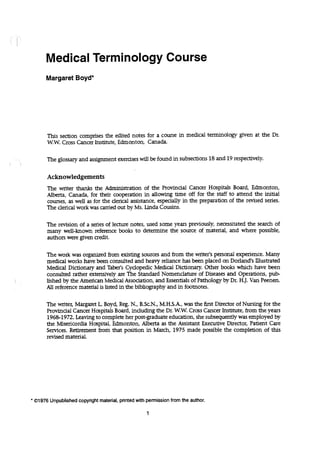
IARC_Technical_Report_No10-9.pdf eyes is

  • 1.
    Medical Terminology Course MargaretBoyd* This section comprises the edited notes for a course in medical terminology given at the DL W.W. Cross Cancer Institute, Edmonton, Canada. The glossary and assignment exercises will be found in subsections 18 and 19 respectively. Acknowledgements The writer thanks the Administration of the Provincial Cancer Hospitals Board, Edmonton, Alberta, Canada, for their cooperation in allowing time off for the staff to attend the initial courses, as well as for the clerical assistance, especially in the preparation of the revised series. The clerical work was carried out by Ms. Linda Cousins. The revision of a series of lecture notes, used some years previously, necessitated the search of many well-known reference books to determine the source of material, and where possible, authors were given credit. The work was organized from existing sources and from the writer's personal experience. Many medical works have been consulted and heavy reliance has been placed on Dorland's Illustrated Medical Dictionary and Tabe?s Cyclopedic Medical Dictionary. Other books which have been consulted rather extensively are The Standard Nomenclature of Diseases and Operations, pub- lished by the American Medical Association, and Essentials of Pathology by DL Hj. Van Peenen. All reference material is listed in the bibliography and in footnotes. The writer, Margaret L. Boyd, Reg. N., B.Sc.N., M.H.S.A., was the first Director of Nursing for the Provincial Cancer Hospitals Board, including the Dr. W.W. Cross Cancer Institute, from the years 1968-1972. Leaving to complete her post-graduate education, she subsequently was employed by the Misericordia Hospital, Edmonton, Alberta as the Assistant Executive Director, Patient Care Services. Retirement from that position in March, 1975 made possible the completion of this revised material. * @1976 Unpublished copyright material, printed with permission from the author.
  • 2.
    2 Medical TerminologyCourse MEDICAL TERMINOLOGY COURSE Introduction There are important rules which govern the formulation of most medical terms. In this course, medical terms commonly in use in cancer centres will be introduced. Many medical terms are derived from other languages and everyday English does not always apply. Thus it is important to recognize word elements and their meanings. In this course, for ease in pronunciation, prin- cipal accents are written in capital letters and slashes are used to divide syllables, e.g. col LOS/to/my. Some words are pronounced differently in dif- ferent countries. Some examples are the differ- ing pronunciations of a few rather common words: abdomen AB/do/men ab/DO/men migraine MI/graine ME/graine neurasthaenia NEUR/as/then/ia NEUR/as/thenia 1. WORD ELEMENTS To make medical terminology simpler, terms may be broken down into several smaller words or word elements. The three primary word elements are prefixes, roots and suffixes. Roots, also known as stems, are usually the main parts of the word. Prefixes are word ele- ments which, when combined with a root, alter or augment the meaning. Prefixes pre- cede the root. Suffixes also alter or augment the meaning of a root element and follow the root or stem. Examples: Root: content New Words: discontent prefix = dis discontented suffix = ed Root: kind New Words: kindness unkind suffix = ness prefix = un The main difference in medical terminology is that most word elements are derived from Latin (L) or Greek (Gr). 1.1 Combined Word Elements Not all word elements are required to com- plete medical terms. For example, the word oliguria is made up of a prefix and a suffix, olig originating from the Greek meaning few or small and uria also Greek pertaining to urine (ur), thus oliguria means that a scanty or small amount of urine is being produced. Some medical terms combine a prefix and a root: endoderm, pronounced EN/do/derm, derived from the Greek root derin meaning skin, thus, the inside skin layer. At times the same root may be combined with a suffix: dermalgia, pronounced DERM/al/gia, combines demi with a Latin suffix algia mean- ing pain, thus dermalgia means painful skin. Bronchoscopy, pronounced BRONCHIo/ scopy, combines the Greek bronchos meaning windpipe with the Greek scop which means to look at or observe, hence the meaning is to look at the windpipe. Sometimes two roots are combined to describe a disease or treatment with more accuracy. For example osteoncus - (OS/te/oncus). The Greek osteo meaning bone combines with the Greek root oncos meaning mass or tumour. This word is synonymous with a more common term osteoma (OS/te/oma) however orna is a Greek suffix pertaining to tumour A more common example of a term with two roots is bronchopneumonith BRON/cho/ pneurnon/itis where the Greek root bronchos combines with the Greek root pneumo mean- ing lung, however a Greek suffix defines the word even further by the addition of iris, which means inflammation of thus a word meaning inflammation of the windpipe and lungs. Note that the adjective inflamed - has only one m but the term inflammation, derived from the Latin inflammere which means to flame within has two m's. 1.2 Word variations Words formed from several different word ele- ments may add, change or omit certain letters to conform with rules of spelling and pronun- ciation, for example demi (at), broncho (s), oste (o).
  • 3.
    Medical Terminology Course Table1. Summary of new terms Word Pronunciation Prefixes Roots Suffixes oliguria O/lig/ur/ia olig uria endoderm EN/do/derm end(o) derm derrnalgia DERM/al/gia derm algia bronchoscopy BRONCHIo/scopy broncho(s) scopy osteonctis OS/te/ oncus oste(o) + oncus osteoma OS/te/orna oste(o) orna broncho- BRON/cho/ broncho(s) + itis pneumonitis pneumon/itis pneurnon Table 2. Elements of similar spelling or sound Element Meaning Origin Example Meaning of Word ante before L. antepyretic before patient becomes febrile anti against Gr. antipyretic used against fever a negative L. prefix adipsia absence of thirst ad towards L. adrenal near the kidney a, an negative L. arioxaemia absence of oxygen in blood ano anus L. Anorectal pertaining to anus and rectum ad towards L. Adriexa appendages or adjunct parts aden(o) gland Gr. Adenoma glandular tumour cyto cell Gr. Cytolymph hyalin substance in a cell cysto bladder Gr. Cystolith bladderstone di two L. Diamine containing two amino groups dia through Gr. Diathermy heat treatments through the tis- sues dis away from L. dislocation displacement of a part, especially a bone dys bad or Gr. improper dyslochia disordered lochial discharge en in Gr. encranial located in the cranium entero intestines Gr. enterology study of intestines gram record Gr. electroencepha- logram record of brain waves graph machine Gr. electroencepha- lograph instrument used to make record graphy process Gr. electroencepha- loraphy process of making records haem(at) blood Gr. hemangioma tumour consisting of blood vessels hemi half Gr. henuglossal involving half the tongue haemo blood Gr. haemoglobin oxygenpigment carrying red blood cells hyper above Gr. hyperchro-mato- sis increased staining capacity
  • 4.
    Medical Terminology Course Table2. Elements of similar spelling or sound hypo below Gr. hypochro- mato- sis fading or disappearance of chroma- tin from a cell ile(o) ileum L. ileocaecal pertaining to the ileum and cae- cum illo hip bone L. iiosacrum pertaining to the ilium and sacrum inter between L. intervertebral between two contiguous vertebrae intra inside L. intravenous within the vein macr(o) large Gr. macrodontia large teeth micro small or minute Gr. microdontia abnormal smallness of teeth my(o) muscle Gr. myocyte a cell of the muscle tissue myel(o) marrow Gr. myelocyte bone marrow cell necr(o) corpse Gr. necrotic state of tissue death nephr(o) kidney Gr. nephrotic kidney condition caused by neph- rosis neur(o) nerve Gr. neurotic nervous condition or(al) mouth Gr. oropharyngeal pertaining to the mouth and pharynx aur(al) ear L. auralgia ear pain ost(eo) bone Gr. osteoscierosis abnormal hardening of bone ot(o) ear Gr. otosclerosis formation of spongy bone in the middle ear per through L. percutaneous through the skin peri around Gr. periglottis around the tongue pre before L. precordium region in front of the heart py(o) pus Gr. pyogenesis formation of pus pyr(o) fire Gr. pyrogen fever producing substance (ec)tomy to remove Gr. cystectomy surgical removal of bladder (os)tomy to make a mouth L.& Gr. cystostomy surgical opening into bladder (o)tomy to incise or open Gr. cystotomy surgical incision into bladder
  • 5.
    Medical Terminology Course5 Also, many word elements with which you must be familiar are similar in sound or even spelling but have very different meanings (Table 2). For example, a patient who has advanced car- cinoma of the bladder may require a cystec- tomy, however sometimes when temporary drainage of the bladder is required, a cys- tostomy is performed. However, the surgeon who only incises the bladder, for example to remove a stone, and sutures it prior to ending surgery, has performed a cystotomy. 2. BASIC ANATOMY AND PHYSIOLOGY 2.1 Definitions Anatomy - the science which deals with the structure of the body Physiology-the science dealing with body functions 2.2 Plan of the human body The head contains the cranial cavity which is formed by the skull and encloses the brain. The trunk is composed of the thoracic, abdom- inal and pelvic cavities. The thoracic cavity is formed by sternum, ribs and thoracic vertebrae. The floor is formed by the diaphragm. The organs or viscera in the thoracic cavity are the heart, lungs, trachea and oesophagus. The abdominal cavity is formed by the verte- bral column, and layers of muscle which sup- port the viscera. The viscera in the abdominal cavity are the stomach, small and large intes- tines, liver, gallbladder, spleen, pancreas, and kidneys. The pelvic cavity is enclosed by the bony pel- vis. The viscera in the pelvic cavity are the uri- nary bladder, organs of reproduction, sigmoid colon and rectum. The spinal canal is continuous with the cranial cavity and lies within the backbone. It encloses the spinal cord. 2.3 Anatomical position The individual is considered to be in the ana- tomical position when standing erect with arms at the side and palms turned forward. Apex-top or upper part Distal-farthest away from the body Proximal -nearest to the body Dorsal - back or posterior part of the body Ventral - front or anterior part of the body Inferior -lower or under Superior -upper or higher Antero (anterior) -in front of Postero (posterior) -behind Dextro -to the right of Levo -to the left of Latero -to the side of Mes —medi —in the middle of Opisth -backward 2.4 Cell structure Tissue fluid surrounds cell and all cells are composed of protoplasm. Diagram 1. Cell structure Cell Membrane Cytoplasm (1) General properties of cell membrane: (a)Osmosis materials in solution on one side of a semipermeable cell membrane attract fluid from the other side. (b)Selective permeability the ability to pass through, e.g. the kidney units (glomeruli) retain certain substances and let others filter through. (c)Diffusion of a gas or liquid until evenly distributed on both sides of a membrane, e.g. oxygen diffuses from the lung alveoli into the blood and in the tissues from the blood into the cells. Tissue fluid surrounds cell Nucleus (with chromatin network)
  • 6.
    6 Medical TerminologyCourse (2) Process of living cells Metabolism - the sum of all physical and chemical changes that take place within an organism. (a)Catabolism -breaking up (b)Anabolism -building up (3) Functions of specialized body cells (a) Secretion the production of substances from materials in the blood, e.g. glandular cells in the stomach secrete digestive enzymes. (c) Contractility changing in response to nervous stimu- lation, e.g. muscle cells contract and relax. (c) Conduction transfer of an impulse, e.g. nerve cells. The all or none law. A stimulus to a nerve or muscle causes it to respond to its greatest extent or not at all. Impulses all travel at the same rate but nerves only respond to a threshold stimulus. 2.5 Water Approximately 66% of the body is water, which is contained: (1) within the cells (2) surrounding the cells (tissue fluid) (3) in blood vessels (principal component of blood). Water has several functions in the body. It is used: (1) asa solvent (2) for ionisation of adds, bases and salts (3) to absorb heat and therefore to regulate temperature (4) as a vehicle; permitting exchange, excretion, and secretion through cell membranes. 2.6 Electrolytes Electrolytes are chemicals which carry electri- cal impulses. Water and electrolyte balance is important. For example, on a hot day we per- spire and deplete the salts in our body. The water depletion causes us to feel thirsty, but if we fail to replace the salt also, in severe dz- cumstances, illness (heat stroke) due to salt loss may occur. 2.7 Tissues When groups of cells (cyto) become special- ized in the work they perform in the body, they are called tissues. There are five main types of tissue: (1) Epithelial tissue covers the surface of the body and lines cavities. Examples are the skin and lining of the thoracic and abdominal cavities, the pleura and peri- toneum. Epithelial cells are packed closely together with little space between. (2) Connective tissue supports, anchors and holds other tissues together. Examples are ligaments, tendons, cartilage, bone and fat. (3) Muscular tissue possesses the ability to contract. There are three types of muscle tissue: (a) skeletal (voluntary) (b) smooth (involuntary) (c) cardiac (heart) (4) Nerve tissue receives and cames sensa- tions to and from the brain and spinal cord from various parts of the body. (5) Vascular tissue carries food and oxygen to cells, removes waste, and fights infec- tion. Blood and lymph make up vascu- lar tissues. Fat, known as adipose tissue, is a con- nective tissue which: (1) serves as a covering under the skin, cushioning and protecting parts exposed to pressure. (2) being a non-conductor of heat, prevents too rapid heat loss through the skin. (3) supports and protects various organs, for example, the eyes and kidneys. (4) fills up space in the tissues affording support to delicate structures such as blood vessels and nerves. (5) constitutes an important reserve of food when needed by the body. Bears hiber- nating can survive only if they have a sufficient fat reserve to last through the period of hibernation.
  • 7.
    STRATUM CORN EL3M ST.GRANULOSUM MALPIGHIAN LAYER EPIDERMIS DERMIS Diagram 2. The Skin H YPODERMIS Medical Terminology Course 7 2.8 Organs Different kinds of tissue form organs (viscera). For example, the stomach is an organ com- posed of epithelial, connective, muscular, nerve and vascular tissues. Every organ has some special function to perform, working in co-ordination with other organs. Groups of organs which act together are called systems. There are nine primary body systems: integumentary, endocrine, musculo-skeletal, respiratory, circulatory, digestive, nervous, un- nary, and reproductive. 3. INTEGUMENTARY SYSTEM The integumentary system consists of the skin and mucous membranes. The word integu- mentary is derived from a prefix and a root. The prefix "in" means just that, and the root from the Latin word tegere means to cover. 3.1 Epidermis The epidermis is the thin outer protective layer, however on the soles of the feet or the palms of the hands, the epidermis is thick The epidermis can be divided into four layers. The stratum cornewn is composed of keratinized cells with no visible nucleus. The stratum luci- dum is composed of flattened cells and nuclei are not visible. Where hair is present, there is a thin stratum corneum and the stratum luci- dum is usually absent. In the third layer, or stratum granuloswn, gran- nies and nuclei can be seen in the cytoplasm. The innermost layer, known as the stratumgeT- minathwn or Maiphigian layer is the part of the skin where new cells are germinated. Young cells which are pigmented contain mel- anin which protects the underlying tissues. 3.2 Dermis The dermis beneath the epidermis is made up of dense, irregular connective tissue, with dense bundles of fibrous tissue between the cells. In the dermis are found sweat glands, blood and lymph vessels, nerves and nerve endings, hair follicles and sebaceous (sebum = tallow) glands. (Diagram 2). 3.3 Sweat glands Sweat glands are small tubes that run spirally to the surface of the skin from a coiled end deep in the dermis.The opening on the skin is called a pore. Surrounding the end are capil- laries from which the gland removes water and waste products. These are forced out on the surface of the skin to form perspiration (L. per = through + spirare, to breathe). Normally the amount perspired in twenty-four hours is approximately one litre. The sweat glands help to regulate body tem- perature. When the water on the skin evapo- rates, heat is lost from the body. 3.4 Hair Hair is distributed over most of the body with the exception of the palms of the hands and the soles of the feet. Hairs have their roots in hair follicles. These follicles widen at the base to enclose a capillary tuft which provides nourishment for the growth of hair. If the fol- licle is damaged, the patient may suffer from alopecia, AL/o/pe/shia (Gr.) or a loss of hair; this may be generalized following some can- cer chemotherapy or localized following radiotherapy. The hair follicle is placed obliquely to the skin and a small muscle (the arrector muscle) is
  • 8.
    8 Medical TerminologyCourse fastened to the side causing it to stand up in Eczema cold or fright. The portion of the hair extend- irregular, dry, itchy and scaly patches ing above the skin surface is called the shaft. of the skin. 3.5 Sebaceous glands Erosion The oil or sebaceous glands are small sacs with dead epidermis (e = Out) (rodere = to ducts which usually empty into the hair folli- gnaw) des, although some open directly on the skin Erysipelas surface. The sebaceous glands secrete an oil which lubricates the skin and keeps it soft and (erythro = red) (pella = skin), infection pliable and makes the hair glossy, within the skin. 3.6 Nails Excoriation Nails are tightly packed cells of the epidermis (ex = out) (corium = skin) the skin that protect the finger and toe tips and help in breaks out in a rash. handling and picking up objects. Fissure 3.7 Functions of skin (L. fissura) ulcer or crack-like sore. (1) Forms a protective covering over the Furuncle body. (L. furunculus) a boil. (2) Eliminates waste products from the Gangrene body in the form of perspiration. (3) Helps to regulate body temperature (the death of tissue caused by interference evaporation of perspiration) wiule lay- with blood supply. Associated with ers of fat serve as insulation diabetes and circulatory disorders. (4) Provides us with the sensation of touch Macule because of the nerve endings in the der- (L macula = spot) ff115. Mycosis 3.8 Signs, symptoms and diseases of the (mykes = fungus) (osis = condition of) integumentary system fungal infection of skin or other fis- Acne vulgaris sues. simple acne (vulgaris =simple). Papule Carbuncle elevated spot (from L. papula = pim- (L. Carbunculus = little coal) painful pie). local inflammation of the skin with Paronychia formation of pus. (Gr. para = beside) (Gr. onyx = claw) Cicatrix infection of marginal structures about scar left by healed wound. the nail. Contact dermatitis Pediculosis inflammation of the skin caused by caused by animal parasites called pedi- external irritants such as poison cull or lice in the hair, body or pubic cosmetics, detergents, sprays, etc. region. Their eggs or flits appear as white specs on hairs. Decubitus ulcers Pruritis (decumbero = to lie down) ulcers due to poor circulation (L. prurire = to itch) (itching) a symp- tom of some general disease condi- Dermatophytosis fions. athlete's foot (tinea pedis), a fungus Psoriasis infection. (Gr.) a chronic disease characterized Dermoid CYStS by eruptions in circular patches coy- benign tissue in a cyst in the skin. ered with dry, silvery scales.
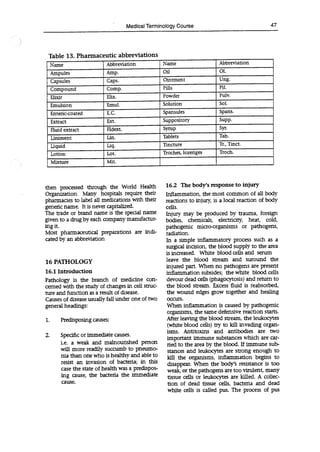
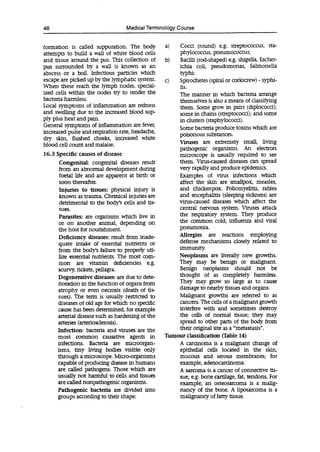
  • 9.
    Medical Terminology Course9 Scabies 4.2 Functions of the bones or skeleton (L. scabere = to scratch) due to micro- The skeleton: scopic parasites (Acarus scabei) that (1) gives general shape and proportion to burrow under the outer layer of the the body; skin. (2) provides attachment for muscles and Steatoma forms levers on which the muscles act (Gr. steat = fat + oma = tumour) "wen' to move the body; or sebaceous cyst. (3) forms cavities for the protection of vital Urticaria organs. Bones are not always hard. Some originate as (L. urtica = nettles) hives, oedematous cartilage and then become hard. Bones are raised pinkish areas that itch. usually completely hardened by about twenty Varicella years of age through the deposit of calcium chicken pox (L. varicella = a tiny spot). and phosphorus from food. Some remain as cartilage, however, for example, the end of the Variola nose, the ears and the anterior part of the ribs smallpox (L. variola = a small spot). attached to the sternum. Vesicle 4.3 Joints elevated lesion with fluid (L. vesica = a Where two bones glide over one another in bladder). semi-attachment, joints (arthro) are formed. Where the surfaces of the ends of the bones come together they are covered with a thin 4. THE SKELETAL SYSTEM layer of cartilage. Between them layers of The skeleton consists of a number of bones, fibrous tissue called ligaments are formed. held together by bands or ligaments to form Inside, the cells of the lining of the joint give joints, which allow movement between them. out a small amount of slippery fluid (synovial fluid) which keeps them lubricated and allows free movement. Joints have: 4.1 Structure of bones (1) no movement, for example, the flat The periosteum is a membrane that covers bones of the skull; every pone. It contains blood vessels which (2) slight movement, for example, the bod- carry nutrients to the bone cells. In the long ies of the vertebrae; bones of the extremities the shaft or diaphysis (3) free movement, for example, the joints is the hard compact portion, the epiphysis or at the shoulder and hip. end is spongelike and covered by a shell or harder bone and the metaphysis or growing Ties of freely movable joints portion lies between them. The diaphysis and epiphysis do not fuse until growth has ceased. (1) Ball and socket Bone cells multiply rapidly in early years but A joint in which a rounded head is later on only dead cells are replaced or injured received into a cup-like socket, for ones are repaired. Bones get harder and more example, the shoulder joint, formed brittle with age. Bones differ in size and shape. by the head of the humerus and the Long bones give support, flat bones provide glenoid cavity of the scapula. protection for delicate organs and irregular (2) Hinge bones allow for more motion. The outer por- Movement is permitted in one plane tion of bones is hard, however the hollow only, for example, the knee or elbow inner part is filled with soft marrow (Gr. myelo = marrow). Yellow marrow is found in long jO]1 bones, whereas red marrow is found in the (3) Pivot end of long bones as well as in ribs and bodies One bone rotates around another of the vertebrae. The latter is responsible for which remains stationary, for example, the manufacture of red blood cells, some of the first cervical vertebra pivots on the the white blood cells and platelets. second.
  • 10.
    10 Medica' TerminologyCourse (4) Gliding The articulating surface of one bone slides on that of another to a limited extent, for example, joints between the carpal and tarsal bones. 4.4 Kinds of movement (1) Flexion A limb is flexed when it is bent, for example, bending the arm at the elbow. (2) Extension A limb is extended when it is straight- ened out, for example straightening the arm at the elbow. (3) Abduction Movement away from the midline, for example, raising the arm from the side. (4) Adduction Movement toward the midline, for example, lowering the raised arm to the side. (5) Circumduction Circular movement in which the bone outlines a cone, for example, swinging the arms. (6) Rotation The turning of bones on their axes, for example, rotation of the atlas (1st verte- bra) on the axis (2nd vertebra) to turn the head. (7) Supination Moving to the supine position with the arms hanging down and the palms fac- ing forward. (8) Pronation Moving to the prone position with the arms hanging down and the palms fac- ing backwards. (9) Eversion The sole of the foot faces outward. 4.5 The skull The skull consists of the bones of the cranium and of the face. They fit together to form a cavity for the protection of the brain. The skull is made up of twenty-two bones closely fitted together without movable joints, with the exception of the lower jaw or mandible. This is attached to the skull by a hinge joint on either side that permits movement of the mandible up and down. The upper jaw is called the maxilla. It is firmly attached and does not move. The facial bones form the eye sockets and the nasal and oral cavities. Bones of the cranium Two parietal bones, one occipital bone, and one frontal bone form a covering for the brain. Two temporal bones contain the ear cavities, the organs of balance, and the mastoid cells. One sphenoid bone is located in the centre and forms the base of the skull. One ethmoid bone is found in the roof of the nasal cavity. Bones of the face Two nasal bones form the upper part of the bridge of the nose. One vomer bone divides the nasal cavity. Two inferior turbinate bones in the nostrils form the outer walls of the nasal cav- ity. Two lacrimal bones form a small part of the medial wall of the eye orbit. Two zygomatic or malar bones form the prominence of the cheek. Two palatine bones form the roof of the mouth. Two maxillae form the upper jaws and one mandible forms the lower jaw. Sinuses Four pairs of cavities in the cranial bones make the skull lighter and return the sound of the voice. Named after the bones in which they lie, there are 2 frontal sinuses, 2 maxillary sinuses, 2 ethmoid sinuses, and 2 sphenoid sinuses. Sinusitis The effect of swollen epithelial tissue which blocks drainage channels and thereby prevents normal secretions in the sinuses 4.6 Vertebral or spinal column The thirty-three bones comprising the spinal column are called vertebrae. These are divided into five groups according to their distinguish- ing characteristics. (1) Cervical vertebrae (7 in number) The first, called the atlas, forms a joint with the base of the skull and permits the nodding movement; the second called the axis permits the side to side movement of the head.
  • 11.
    Medical Terminology Course (2)Thoracic vertebrae (12 in number) The twelve pairs of ribs are attached to these. (3) Lumbar vertebrae (5 in number) These are large vertebrae that allow free movement to the spinal column. (4) The sacrum The sacrum is a single wedge-shaped bone consisting of five vertebrae fused together. It is situated between the two pelvic bones and forms part of the pel- vic girdle. (5) The coccyx Situated below the sacrum consists of four small bones fused together. Functions of the spine: - forms the central support for the body. - ensures flexibility of the trunk, - protects the spinal cord, - absorbs shock, - provides attachment for the ribs, - supports the weight of the trunk and transmits it to the lower limbs, - forms a strong posterior boundary for the thorax and abdomen and helps to maintain erect posture. The spine normally curves anteriorly and posteriorly. (Diagram 3). Diagram 3. Curves of the spine Cervical thoraoc -abnormal curvature of the thoracic "—spine is known as kyphosis lumbar -abnormal curvature of the lumbar spine is known as lordosls Diagram 4. Vertebra Spinous process Articula and Surface Spinalcanal Tranverse process of vertebrae . ,~),Body The flat part of the body of the vertebra bears most of the weight. An arch is formed, providing an opening or spinal canal throughwhich the spinal cord passes (Diag. 4). Fingerlike extensions called transverse process serve to anchor tendons and ligaments. Intervertebral discs are plates of cartilage between the vertebrae which make the joints flexible and help to break the shock of any sudden force. 4.7 Ribs and Sternum There are twelve ribs on each side connected in pairs to the thoracic vertebrae behind and, with the exception of the last two pairs, to the sternum (breast bone) in front. The ribs are not bony throughout their entire length, but at a short distance from the front, cartilage takes the place of bone. The upper seven pairs are called true ribs and are attached by their cartilage directly to the sternum. The lower five pairs are called false ribs. The upper three pairs of false ribs are attached by their cartilage to the rib directly above and thence to the sternum. The last two pairs are unattached to the sternum and are called floating ribs. The sternum is a long flat, dagger-shaped bone with the point downwards. Three parts make up the sternum, known as the manu- brium, body and xiphoid process. 4.8 Bones (1) Bones of the upper extremities 11 The scapulae or shoulder blades are two large flat, triangular bones lying upon the ribs posteriorly. A promi- nent ridge or spine at the back forms an attachment for back and arm mus- cles. At the outer and upper part the glenoid cavity receives the rounded head of the humerus.
  • 12.
    12 Medical TerminologyCourse The clavicles are two slender bones The tibia and fibula are parallel bones which extend horizontally across the of the lower leg. The tibia or shin bone upper part of the thorax above the extends from the knee to the ankle first ribs. They articulate with the medially. The fibula extends from the scapulae and sternum, knee to the ankle laterally. The humerus is the bone of the upper The seven tarsal bones comprise the arm. It consists of a shaft and two ankle and are united by ligaments. enlarged ends. The proximal end is They are larger and more irregular the smooth rounded head which fits than the carpal bones. The largest is into the glenoid cavity of the scapula. the heel bone or calcaneus. The distal end has bone surface which The metatarsals are five long bones articulates with the ulna to form the that comprise the foot. elbow joint. The tarsals join the metatarsals to The radius and ulna are parallel bones form two arches - longitudinal and located in the forearm. The radius metatarsal. extends from the elbow to the wrist on the lateral side. The ulna extends The phalanges in the toes resemble from the elbow to the wrist on the those in the hand both in number and medial side. The radius articulates general arrangement. with the ulna just below the elbow. The carpal bones comprise the wrist, 5. MUSCULAR SYSTEM made up of eight bones arranged in two rows of four. 5.1 Introduction The phalanges are the finger bones. Three phalanges comprise the fingers, and two the thumbs. (2) Bones of the lower extremities The pelvis is formed by six bones, two ilia, two ischia and two pubic. One of each form two large flat irregular bones (the innominate) that become one when adulthood is reached which, together with the sacrum, con- stitute the pelvic girdle. There is a hollow on the outer side of each inriominate bone which forms the acetabulum, a socket to articulate with the upper end of the femur. The femur is the bone of the thigh. It extends from the acetabulum to the knee. It is the longest and strongest bone of the body. Proximally the smooth rounded head fits into the acetabulum. The neck of the femur is a weak point. It joins the head to the shaft. The distal end of the femur has two bony masses by means of which it articulates with the tibia and patella and forms the knee joint. The patella is a small flat triangular bone placed in front of the knee joint which it serves to protect. The appearance of human muscular tissue is roughly comparable to the lean of butcher's meat. Muscle cells are arranged in fine elastic threads or fibres, wrapped together in bundles. Several bundles make a muscle. Every muscle is covered by a sheath, the ends of which form tendons attached to bones. Muscles are attached to bones at the point that will give best leverage. Muscles tend to work in pairs; for some movements groups of muscles are used. Each muscle is connected to the cen- tral nervous system by a motor nervewhich car- ries messages from the brain, causing the muscle to contract. Bursae are small sacs lined with syn- ovial membrane and are found wher- ever pressure is exerted by ligaments over moving parts (singular noun - bursa). 5.2 Functions of muscles (1) The maintenance of erect posture and holding the head, body and extremities in a variety of positions. (2) Movements and locomotion, to secure food and shelter and communicate by speech. (3) An elastic support for certain organs, for example, the floor of the pelvis is sup- port for the pelvic contents.
  • 13.
    Medical Terminology Course13 5.3 Kinds of muscles (1) Voluntary muscles are under the control of the will and are capable of rapid and complicated movements; for example, walking, talking, or swallowing. (2) Sphincters are special voluntary muscles which guard body openings. (3) Involuntary muscles are not under the control of will and are capable of slow and mechanical movement only. They are found in the walls of blood vessels and in most of the internal organs. Car- diac muscle is found only in the heart and is a special form of involuntary muscle. The working of the involuntary muscles is controlled by a special set of nerves known as the autonomic nervous system. 5.4 Some important muscles There are 325 muscles in the body - we will consider only a few groups. (1) The diaphragm lies between abdominal and chest cavities. Contraction and relaxation is part of the respiratory mechanism. (2) The intercostal muscles are found between the ribs. They assist the respira- (a) the internal oblique muscle - ascending; (b) the external oblique muscle - descending; (c) the transversus abdominus - across the abdomen; (d) the rectus abdominus muscle -ver- tically. A hernia is a protrusion of a portion of the contents of a body cavity. There are weak places where herniae may occur. These are places where blood vessels and other structures normally extend through the muscles. The inguinal ring, femoral ring, and umbilicus are common sites. (4) The pectoralis muscles, major and minor are large anterior chest muscles (L. pectus = breast). The pectoralis major is a large triangular muscle extending to the humerus which draws the arm forward and downward. The pectoralis minor, beneath the pectoralis major extends to the scapula, lowers it, and depresses the shoulder. Both of these muscles are removed during a radical mastectomy. The mastectomy patient must learn exer- cises to accommodate the loss of the pectoral muscles. (5) The serratus anterior (L. serratus = toothed) are the anterior chest muscles arising from the ribs by separate slips. Inserting into the scapula, the muscles elevate the ribs and assist in breathing. The serratus anterior also rotates the scapula. (6) The large muscles of the shoulder, pos- terior chest and back are the trapezius and the latissimus dorsi. When the tra- pezius contracts, the head is drawn back and to the side and the scapula is rotated. The latissimus dorsi originating in the thoracic, lumbar and sacral verte- brae and the iliac crest insert into the groove below the biceps on the humerus for adduction and rotation of the arm. The paired gluteal muscles form the buttocks (Gr. gloutos = buttock) and are called the gluteus maximus, medius and minimus. These muscles insert into the greater trochanter of the femur per- mining thigh movement. (8) Major muscles associated with the ante- rior aspect of the thigh are the quadri- ceps femoris (L quadri = four + ceps from caput = head, thus a four headed muscle) originating in the iscbial tuber- osity on the pelvis and inserting into the femur. The quadriceps causes exten- sion of the leg. (9) In the posterior part of the thigh are the hamstring muscles, including thegTaci- lis, sartorius, biceps femoris, and semi- tendinous muscles which cause flexion of the thigh. When the sartorius contracts it allows the legs to flex and cross. It is thus named the tailor's muscle (L sartor = tory process. (3) The abdominal muscles are flat bands which stretch from rib to pelvis and (7) support the abdominal organs. There are four sets of abdominal muscles:
  • 14.
    14 Medical TerminologyCourse tailor). The sartorius is the longest mus- de in the body. The grads flexes and adducts the leg and adducts the thigh. Originating on the pelvis, it inserts into the medial sur- face of the shaft of the tibia. (10) Large muscles of the lower leg and foot The tibialis anterior elevates and flexes the foot. Originating in the upper tibia, it inserts in the ankle and foot bones. The calf of the leg contains the gastroc- neinius, the largest muscle which extends the foot and helps to flex the knee or the thigh. Originating on the femur, this muscle inserts by the Achil- les tendon into the calcaneus. Other muscles in the calf of the leg are the soleus and peroneus longus. The soleus (L solea = sole of foot) extends and rotates the foot. It inserts along with the gastrocnemius into the Achil- les tendon. The peroneus longus extends, abducts and everts the foot. (11) Large muscles of the shoulder and arm The deltoid muscle (shaped like the Greek letter delta) which moves the upper arm outwards from the body, rais- ing and rotating the arm has its origin in the clavicle and scapula. It is inserted into the shaft of the humerus. The biceps flexes and supinates the arm. It has two sources of origin, the short head rising from the coracoid process of the scapula and the long head from the scapula above the glenoid fossa. Inser- tion is into the radius (bi-ceps = two heads). The triceps muscle acts in opposition to the biceps. It also originates on the scap- ula but also has two heads coming from the humerus. Inserted into the ulna, it extends the forearm and arm (tri-ceps = three heads). (12) Muscles in the forearm are used to allow action in the wrist, hand and fingers. For example, the flexor poilas longus, which allows us to flex our thumb, orig- inates in the radius and inserts into the terminal phalanx of the thumb. 5.5 Signs, symptoms and diseases of the musculoskeletal system Definition: orthopaedics is the special branch of medicine concerned with the preservation and restoration of the functions of the skeletal system. The following list includes some of the more commonly used tenus related to diseases of muscles and bones. Achondroplasia is a congenital anomaly resulting in dwarfism due to abnormally short long bones. Dislocation the ligaments at the joint give away completely and the bone is displaced from its socket. Fibrositis inflammation of fascia and muscle sheaths. Fractures a fracture is a break in a bone. It may be complete or partial. The types of frac- tures are: (1)Simple fracture, a crack or clean break occurs. (2)Compound fracture, the skin is bro- ken and the bone protrudes through. (3)Comminuted fracture, the bone is broken into several pieces. (4)Greenstick fracture, a bending and cracking of the bone without a com- plete break, occurs in immature bones of childhood. Torticollis or stiff neck in which the neck muscles are affected. (Tortus = twisted. Collum = neck). Kyphosis is an abnormal curvature of the thoracic spine convexly and posteriorly. Legg-Calve Perthes disease is osteochondritis of the head of the femur. Lordosis abnormal curvature of the lumbar spine convexly and anteriorly.
  • 15.
    Medical Terminology Course15 Myasthenia gravis lower lumbar vertebrae, usually on the is exhibited by rapid fatigue of muscles sacrum with pelvic deformity. without pain. Sprains Myositis the ligaments that support joints are is inflammation of muscles, stretched or Osteitis deformans (Pagets disease) the enlargement and distortion of bones in older age. Osteitis fibrosa cystica (von Recklinghausen's disease) - bony manifestation caused by hyperparathy- roidism. Osteoarthritis Hypertropic or degenerative arthritis. A disease of older people resulting in grad- uai wearing out of the joint. Osteochondritis inflammation of bones and cartilage. Osteomalacia softening of the bones. Osteomyelitis inflammation of bone caused by a pyo- genic (pusforming) organism. It is most common among children. Paralysis the control of muscles by the nervous system has been affected. Paralysed muscles gradually atrophy. Rheumatoid arthritis a chronic disease affecting many joints which results in deformity. It is com- monly diagnosed between 20 and 50 years of age. Rickets the bone hardening process does not proceed normally because of a lack of Vitamin D. The bones get out of shape when weight bearing, and finally harden in the deformed state. Scoliosis an S-shaped abnormal lateral curvature of the spine. Spondylolisthesis spondylos = vertebrae, olithesis = for- ward slipping, a forward slipping of the Tenosynovitis inflammation of a tendon sheath. 6. THE NERVOUS SYSTEM 6.1 Introduction The nervous system is the system which pro- vides the integration and control of body pro- cesses. It consists of the brain and spinal cord, linked to the peripheral part connected with tissues and organs. Sensory nerve fibres carry messages from tis- sues and organs to the brain and spinal cord. Motor nerve fibres carry messages to tissues and organs, from the brain and spinal cord. 6.2 Cerebrum The cerebrum is the largest part of the human brain. It is made up of two cerebral hemi- spheres (hemi = half) each of which is divided into lobes. The folds on the surface of the brain are known as convolutions. Grey matter forms the outer layer, or cerebral cortex. It con- tains the cell bodies or neurons. The inner white matter is made up of nerve fibres. The anterior commissure is made up of nerve fibres linking the two cerebral hemispheres. Deep in the substance of the cerebral hemi- spheres there are additional masses of gray matter which, together with the cerebrum, form the forebrain: (1) the basal ganglia, concerned with the modification and coordination of vol- untary muscle movement; (2) the thalamus, an important relay centre for sensory fibres on their way to the cerebral cortex; crude sensation and pain may be felt here; (3) the hypothalamus, contains the centres for the autonomic nervous system. 6.3 The midbrain The midbrain receives impulses from the eye and ear. It serves as a centre for visual and auditory reflexes. Cranial nerves Ill and 1V stem from the midbrain. The grey matter of the midbrain consists of the bodies of the lIIrd and lVth cranial nerves, and the red nucleus.
  • 16.
    16 Medical TerminologyCourse The midbrain controls skilled muscular move- ments. The white matter of the midbrain car- nes sensory and motor fibres, linking the red nucleus with the forebrain, the hindbrain and the spinal cord. Diagram 5. Left cerebral hemisphere External (Lateral) aspect Central sulcus (Rolando) Parietal Frontal Lobe Lobe 1 7- 1 ) ' LateralZ ,/s.n____ S Fissure / ccIPital / Parieto- Temporal Lobe occipital sulcus Motor Judgement Sensory Abstraction Speech A itory Visual Diagram 6. Mid-Sagittal section-selected structures 6.4 The hindbrain The hindbrain consists of the pons, the cere- bellum and the medulla oblongata. The pons (L. pons = bridge) bridges the cerebrum and cerebellum. It contains nerve fibres which link the cerebral cortex with the medulla oblon- gata and the spinal cord (L. medulla = mar- row) The nuclei of the cranial nerves V, VI, VII are situated in the pons. The medulla oblongata consists of neurons which form the nuclei of the cranial nerves VIII, IX, X, XI and XII. The cerebellum has centres which are con- cerned with balance and equilibrium. The function of the cerebellum is to coordinate groups of muscles so that they work together smoothly. 6.5 The spinal cord The spinal cord extends from the medulla oblongata to the lumbar vertebrae. There are 31 pairs of spinal nerves both motor and sen- sory. The spinal cord also serves as a reflex cen- tre. 6.6 The nerve cells The nerve fibres outside the central nervous system in the peripheral nervous system are covered with a myelin sheath. An outer thin- ner covering over this myelin sheath is called neuTilemma. The presence of the myelin sheath allows the nerve fibre to regenerate. This is a slow process. Nerve tissue in the brain and spinal cord has no myelin sheath and does not regenerate. Diagram 7. Nerve cell Dendrite — conduct impulses to cell body. Cerebrum Caudate callosum _—, 5c Extent of basai / ganglia Midbrain Pons Medulla ux Thalamus _..enirite — conduct impulses to cell body _Cell Body Axon —conduct impulses away I, from cell body Myelin sheath Neurilemma (outer covering) f TerminaiAxon
  • 17.
    Medical Terminology Course17 6.7 Meninges Three membranes comprise the meninges. The dura mater is a thick tough membrane lining the skull. The pia mater is a thin tissue cover- ing the outermost layer of brain. The arachnoid mater lies between the two; it is a thin cover- ing and contains the blood vessels. 6.8 Cerebrospinal fluid The cerebrospinal fluid is produced by the choroid plexus of the two lateral and 3rd and 4th ventricles. It flows from the lateral ventri- cles through the foramen of Monro to the third ventricle. From the third ventricle it flows through the aqueduct of Sylvius to the fourth ventricle. Leaving the fourth ventricle, it bathes the brain and spinal cord in the sub- ara chnoid space between the aracimoid and pia mater. It is absorbed by the great venous durai sinuses, especially the superior saggital sinus. 6.9 The cranial nerves The cranial nerves carry impulses to or from the brain. Diagram 8: Mid-saggital section showing ventricles gyrus 'NCorpus Mid-brain 3rd ventricle7k ! Pons Medulla ventricle Bell's palsy is facial paralysis caused by a lesion of the With cranial nerve. 6.10 Peripheral nervous system The peripheral nervous system consists of the nerves arising from the spinal cord and run- ning to or from the whole of the body with the exception of areas served by the cranial Table 3. Cranial nerves Cra- Name Motor function Sensory function niai nerve I Olfactory Smell II Optic Sight III Oculomo- All eye muscles except the superior tor oblique and the external rectus. Also innervates the iris and diary body IV Trochlear Superior oblique m. V Trigeminal Muscles of mastication Transmits ordinary sensations from eye, face, sinuses and teeth. VI Abducens External rectus m. VII Facial Facial muscles, sub-maxillary and Tactile and taste sensations from the sublingual salivary glands anterior 2/3 of the tongue and the soft palate. VIII Acoustic (2 branches) Cochlear Vestibular LX Glossopha- Pharyngeal muscles and the parotid Tactile and taste sensations from the ryngeal gland posterior 1/3 of the tongue, the ton- sils, pharynx and the carotid sinuses. X Vagus Heart, lungs, bronchi and digestive Sensation from the heart, lungs, bron- tract. chi, trachea, pharynx, digestive tract and external eat XI Spinal Sternomastoid, trapezius and con- accessory sthctor muscles of the pharynx, lar- _______ ynx and soft palate. XII Hypoglos- Strap muscles of the neck and the sal I tongue muscles.
  • 18.
    18 Medical TerminologyCourse nerves and the autonomic nervous system. Peripheral nerves are connected to the spinal cord by two roots: the anterior or motor root and the posterior or sensory root (Diagram 9). Diagram 9: The Peripheral nerve Nerve ganglion Posterior root Anteriôr root The peripheral nervous system is responsible for the innervation of all voluntary muscles (except those controlled by cranial nerves) and the transmission of sensory impulses from the whole of the body (with the exception of the face). It is largely under conscious (cerebral) control. Division, injury or disease of peripheral nerves thus usually results in both sensory and motor loss. However, as already indicated, eventual recovery is possible providing the nerve is largely intact or the ends of the divided nerve are placed dose together. 6.11 Autonomic nervous system The autonomic nervous system controls and regulates the action of glands, the heart and smooth muscle tissue, for example, smooth muscle in the intestines and blood vessel walls. Autonomic nerves arise at different central nervous system, ranging from the vagus (Xth cranial parasympathetic nerve) to the sacral area of the spinal cord. The autonomic nerves arising from the spinal cord comprise the sym- pathetic system. The sympathetic and parasympathetic nerves counterbalance one another. 7. THE SPECIAL SENSE ORGANS 7.1 The ear The ear has two main functions, those of hear- ing and equilibrium (or balance). There are three parts to the ear: the external ear, the middle ear and the inner ear. Each of the three parts serves a definitive function in hearing; however, the inner also functions in balance. The external ear The pinna (L. pinna = wing) is made up of car- tilage covered by skin. It collects the sound which is transmitted through the auditory canal, leading to the tympanic membrane or eardrum, (Gr. tympanon = drum). The audi- tory canal contains hairs and ceruminous (wax) glands. The middle ear The middle ear lies in a cavity in the temporal bone. It is connected with the nasopharynx by the Eustachian tube, which opens upon swallowing to allow air to enter the middle ear, thus equalizing pressure on both sides of the tympanic membrane. There are three small bones in the middle ear called auditory ossides which are connected to form a small lever between the tympanic membrane and the oval window (fenestra cochlea). The auditory ossides are named according to their shapes -the malleus, (Latin = hammer), the incus (Latin = anvil), and the stapes (Latin = stirrup). Two small muscles, the tensor tym- pani connected to the malleus and the stape- thus connected to the stapes, contract as a protective mechanism during excessively loud noise. Sound vibrations set the tympanic membrane in motion and move the ossides. This ampli- fies and transmits the sound across the middle ear so that the foot plate of the stapes moves backwards and forwards in the oval window which is in contact with the cochlear fluid, in which vibrations are established. These vibra- tions stimulate receptors in the Organ of Corti, and nerve impulses are sent to the sound centre in the brain. The inner ear The cochlea (Gr. Kochlias = a spiral) is the hearing part of the inner ear. It is a spiral canal containing a receptor for hearing called the Organ of Corti to which is attached the cochlear branch of the auditory nerve, it has hair cells which pick up impulses transmitted from the middle ear. The semicircular canals form the organ of bal- ance. The superior, posterior and lateral semi- circular canals each connect by an ampulla (L. ampulla = a jug) to the utricle (L utriculus = a small sac), from which impulses travel to the brain by the vestibular branch of the VUth cra- nial nerve.
  • 19.
    Medical Terminology Course Diagram10: The ear in coronal section Semi-circular canals and cochlea coustic nerve -- stachian tube round nthL Pinna Tympanic membrane 19 7.2 The eye The eye is set in a bony socket, the orbit The visible portion of the eye is covered by a thin transparent membrane called the conjunc- tiva. (1) Rectus muscles: - the external rectus rotates the eyeball outward - the internal rectus rotates the eyeball inward; - inferior rectus rotates the eyeball down- ward; - superior rectus rotates the eyeball upward (2) The inferior oblique muscle rotates the eyeball upwards and outwards. (3) The superior oblique muscle rotates the eyeball downwards and outwards. (4) Levator palpebrae superioris raises the upper eyelid. (5) Orbicularis oculi: a muscle which encir- cles the orbit and doses the eye, and which also compresses the lacrimal (tear) sac. Other important parts of the eye Aqueous humor the fluid produced in the eye, occupying the anterior and posterior chambers. Vitreous humor a watery substance, resembling aqueous humor contained within the space of the vit- reous body (the main body of the eye). Fundus oculi the posterior part, or back of the eye, seen through an ophthalmoscope. Fovea centralis a tiny pit in the center of the macula lutea composed of slim elongated cones. It is the area of dearest vision Blind spot The optic papilla where the optic nerve leaves the eyeball. Diagram 11: The eye in sagittal section Optic nerve Iris / civa ' Posterior chamber "Anterior chamber Vitreous _Pupil humour -Cornea 'Lens uspensory ligaments body Sciera 7.3 Smell The olfactory epithelium located in the supe- rior deft of the nostrils contains the receptors for smell. These receptors respond to chemical stimuli. The sense of smell is transmitted via the olfactory nerve to the smell centre located in the parietal lobe of the cerebrum.
  • 20.
    20 Medical TerminologyCourse Table 4. Coats of the eyeball Structure Function Outer Sciera, tough fibrous tissue Preserves shape of eyeball Cornea, transparent Allows passage of light rays Extrinsic muscles attached to sclera Permit and limit eyeball movement Middle or Vascular Contains arteries and veins. Pigmented Coat Circular opening at front (pupil) Colored muscular ring-iris-sur- Controls size of pupil and amount rounds pupil (intrinsic muscle) of light entering eye Ciliary body Produces aqueous humor Chary muscle Contracts and moves forward Suspensory ligament Alters curvature of lens - rays Suspends crystalline lens brought to focus in retina Choroid -post 5/6 of eyeball, the pigmented vascular coat Inner or nervous Retina -lines back of eye, contains Light-sensitive layer. coat receptors for vision. Converts light energy to nerve Rods-dim light impulses to optic nerve Cones-bright and colored light 7.4 Taste The organ of taste is the tongue. There are four types of taste buds, these being sweet, sour, salt and bitter. Substances enter solution and stimulate the gustatory cells. Nerve impulses are relayed via the facial and glossopharyngeal nerves to the parietal lobe in the opposite side of the cerebrum. 7.5 Definitions Ophthalmology a study of disease or conditions of the eye. Ophthalmologist one who studies the eye and relative diseases and conditions. Otology a study of the ear. Otorhinolaryngologist one who specializes in the treatment of dis- eases or conditions of the ear, nose and throat. 7.6 Signs, Symptoms and diseases of the special sense organs Accommodation the adjustment of the lens to form a clear image. Achromatopia colour blindness. Acoustic neuroma a tumour of the auditory nerve. Astigmatism irregular curvature of the eyeball. Cataract opacity of the lens of the eye. Chalazion small hard tumour similar to sebaceous cyst, on the eyelid. Conjunctivitis inflammation of the conjunctiva. Diktyoma a ciliary epithelial tumour. Ectropion eversion of the eyelid margin, sometimes seen in the elderly. Entropion inversion of the eyelid margin. Glaucoma disease of the eye characterized by increase intraocular pressure. Hordeolum inflammation of sebaceous gland of the eye- lid -a sty. Hypermetropia impairment of near vision. Parallel rays come to focus behind the retina due to a flattening of the globe of the eye or refraction error. Iridocyclitis inflammation of the iris and ciliary body.
  • 21.
    Medical Terminology Course21 Malignant melanoma (eye) a pigmented mole or tumour arising from the uveal tract. Mastoiditis inflammation of the mastoid process, gener- ally as an extension of otitis media. Meniere's disease disturbance in the labyrinth, with sudden onset of tinnitus, deafness, nausea, vomiting and dizziness. Myopia defect in vision so that objects can only be seen distinctly when very close to the eyes - caused by elongation of the globe of the eye. Nystagmus involuntary rapid movement of the eyeball. Otalgia pain in the ear. Otitis media inflammation of the middle ear. Perichondritis (ear) inflammation of the skin covering the carti- lage of the ear. Presbyopia defect of vision in advancing age (synonym= farsightedness). Retinal detachment the retina detaches - usually due to haemor- rhage behind the retina from disease or trauma. Retinoblastoma a tumour arising from the retinal germ cells, a malignant glioma of the retina. Strabismus the optic axes cannot be directed towards the same object due to lack of muscle coordina- tion (squint). Tinnitus ringing in the ears. Vertigo dizziness. 8. CARDIOVASCULAR SYSTEM 8.1 The circulation The systemic circulation: flows from the left ventricle to the aorta and thence via other arteries to the cap- illary beds in the head, neck, trunk and limbs. It returns to the right auricle (atrium) of the heart via the systemic veins. Food is absorbed, passes into the capil- lary bed in the digestive tract and is car- ried by the portal vein to the hepatic or portal circulation. In the pulmonary circulation: blood flows from the right ventricle to the lungs where oxygen is taken up by the blood and carbon dioxide (CO2) is given off. The blood then returns to the left auricle (atrium). 8.2 The heart The heart has four chambers which are lined with endothelium (endocardium). It has thick walls of muscle called myocardium. Heart mus- cle is supplied with blood from the coronary arteries that branch off from the aorta. The heart is enclosed in a two-layered mem- brane, the pericardium. A thin film of fluid separates the layers of the pericardium. The cardiac muscles of the atria are completely separated from the cardiac muscle of the ven- tricle by a ring of fibrous tissue at the atrio- ventricular groove. (A-V groove). Extensions from this ring form the heart valves. AN valves are attached by thin chordae tendinae to extensions of cardiac muscle called the papil- lary muscles. The papillary muscles contract when the ventricles contract. They pull on the chordea so that the valve flaps cannot be everted, therefore in health, blood can flow in one direction only. The human heart is really a double pump. The right atrium receives blood from the body tissues with its oxygen supply diminished via the inferior and superior vena cava. This blood passes into the right ventricle which pumps it to the lungs via the pulmonary arter- ies to obtain a fresh oxygen supply. The blood received back from the lungs via the pulmo- nary veins passes via the left atrium to the left ventricle, which pumps it to the rest of the body via the aorta. 8.3 The cardiac cycle The cardiac cycle consists of diastole and sys- tole. In diastole, there is a period of relaxation
  • 22.
    22 Medical TerminologyCourse Diagram 12: Pictorial representation of blood circulation Lungs Pulmonary arteries veins R. atrium Superior & infe- L. atrium nor vena cava i W .J"'4 ~ valve Triuspid valve J'~ Mitral Right Myocardiuni //Left ventricle Al ventricle when first the atria then the ventricles fill. In systole there is a period of contraction. Auricu- lar systole causes the ventricles to be com- pletely filled and stretched which is followed by ventricular systole when the semilunar valves are forced open and blood is ejected into the pulmonary artery and the aorta simultaneously. The semilunar valves prevent backflow from the pulmonary artery and the aorta. 8.4 Heart sounds The A-V valve flaps dose at the beginning of ventricular systole, causing the first heart sound. The semilunar valves close at the beginning of ventricular diastole, causing the second heart sound. Heart murmurs will be heard if blood is forced forward through nar- rowed valves or leaks backwards through incompetent valves. 8.5 Origin and conduction of the heart beat The rhythmic contraction of the heart is called the heart beat. The impulse to contract is gen- erated rhythmicallyinspecialized NODAL TIS- SUE in the wall of the right atrium, the SINO- AURICULAR NODE (the pacemaker). The wave of excitation spreads throughout the muscles of both atria which then contract. The heart beat is not transmitted from the auricles to the ventricles directly. The impulse from the auricular muscles is picked up by another mass of nodal tissue, the atrio-ventric- ular node and relayed by Purkinje tissue, in the Bundle of His and its branches lying beneath the endocardium on the interventric- ular septum to the muscles of both ventricles which then contract together, while the atria are relaxing. An electrocardiograph records the electrical changes in heart muscle caused by contraction and relaxation. Although the heart initiates its own impulse to contract, the body's changing needs are controlled by nervous impulses discharged from controlling centres in brain and spinal cord. Sympathetic nerves increase the rate and force of the heart beat. The parasympathetic nerves slow the heart and reduce the force of contraction. 8.6 Blood vessels Beginning at the heart, the blood is pumped into elastic arteries, then to muscular arteries. From arteries the body has a system of arteri- oles like branches on a tree which end in capil- laries which surround body cells. Venous blood is transferred back from the capillaries into venules which unite to form muscular veins that empty into the great veins and thence to the heart. Only from capillaries can blood give up food and oxygen to tissues and receive waste products and carbon dioxide from tissues. 8.7 Coats of blood vessel walls (1)Tunica intima -endothelium -internal elastic lamina (2)Tunica media -smooth muscle - fibrous tissue -external elastic lamina (3)Tunica adventitia - fibrous tissue 8.8 Blood pressure The pressure within the aorta is highest as the blood leaves the left ventricle at the end of sys- tole and lowest as the blood drains into the right auricle at the end of diastole. Arterial blood pressure is measured in man by means of a sphygmomanometer.
  • 23.
    Medical Terminology Course23 8.9 The pulse As blood is pumped from the heart during sys- tole, the distention and increase in pressure which starts in the aorta passes along the whole arterial system as a wave - the pulse wave. 8.10 Venous return (1) Adequate blood volume and adequate tone of smooth muscle in blood vessel walls is essential for normal venous return of blood to the heart (2) Unidirectional valves are present in muscular veins to prevent backflow of blood in the system. (3) The cardiac pump exerts a residual force which is imparted by the heart's con- traction. (4) Contractions of skeletal muscles help to squeeze veins and move blood towards the heart (5) Respirations act as a pump by the cre- ation of negative intrathoracic pressure which creates a suctioning pull in the veins in the thorax, and the descent of the diaphragm increases the intra- abdominal pressure which forces blood upwards in the abdominal veins. (6) Gravity allows blood to drain from the head and neck. 8.11 Signs, symptoms and diseases of the cardiovascular system Angina pectoris pain felt in the centre of the thorax on exer- tion due to anoxia of the myocardium. Arteriosclerosis a condition marked by loss of elasticity, thick- ening and hardening of the arteries. Atherosclerosis a lesion of large and medium-sized arteries with deposits of yellowish plaques in the intima (lipid material). Cardiac hypertrophy enlargement of the heart tissue. Cerebral vascular accident broken blood vessel in the cerebrum. Congenital pulmonary stenosis born with a narrowing of the opening between the pulmonary artery and the right ventricle. Coronary occlusion a blockage of a coronary artery, cutting off blood supply to a portion of the heart. Coronary sclerosis a hardening of the coronary arteries. Coronary thrombosis a thrombus formation in a coronary artery. Dextrocardia location of the heart in the right hemithorax often with accompanying transposition of abdominal viscera. Endocarditis inflammation of the endothelium lining the heart. Haemopericardiuxn blood in the pericardial sac. Hypertension high blood pressure. Hydropericardium an abnormal accumulation of serous fluid in the pericardial cavity. Myocardial infarction the formation of a dead area in the heart mus- de due to interruption of blood supply. Myocarditis inflammation of the muscular walls of the heart. Pericarditis inflammation of the lining around the heart. Phlebothrombosis thrombus formation in a vein generally due to stasis. Thromboangiltis obliterans (Buerger's disease) an obliterative disease of the blood vessels of the extremities leading to ischaemia and gan- grene. Thrombophiebitis inflammation of a vein with thrombus forma- tion. Varicose veins enlarged and tortuous veins.
  • 24.
    24 Medical TerminologyCourse 9. BLOOD AND THE BLOOD- FORMING ORGANS 9.1 Composition of the blood In the adult, the average amount of blood is 5 litres or approximately 7.7% of the body weight. The blood plasma comprises approxi- mately 55% of the blood. It is almost clear, a straw-coloured fluid of which approximately 90% is water (Table 5). 9.2 Cells in the blood There are three main types of blood cells, red blood cells, white blood cells and platelets (Table 6). 9.3 Blood coagulation Blood does not normally clot Within healthy blood vessels. When vascular tissues are damaged, blood undergoes a series of changes which result in clot formation: The platelets cling to the intersections of the fibrin threads. Adhesions form, the clot shrinks with the expression of serum. 9.4 Haematopoiesis -blood formation Various substances taken in the diet (includ- ing iron and other minerals, vitamin B12 and protein) are absorbed (vitamin B12 only in the presence of an intrinsic factor secreted by the gastric mucosa) and taken to the liver. Here vitamin B12 is stored and released to the general circulation as required as a haematopoietic factor which stimulates the production of red cells (erytbro- poiesis) in the red bone marrow.Other factors necessary for erythropoiesis include iron, and thyroid hormone. The red cells circulate for 120 days and are then broken down (proba- bly in the spleen) to release iron for further use. Haemoglobin without iron is excreted as bile pigments via the liver. The various mechanisms responsible for producing white blood cells (except lym- phocytes) in the red bone marrow are less well understood. 9.5 Blood groups Present in the plasma of some individuals are antibodies which can cause agglutination (the clumping together) and subsequent haemoly- sis (breakdown) of the red blood cells received in blood transfusions. When such reactions occur, the bloods are said to be incompatible. Clumps of cells may block small blood vessels in the lungs or brain causing serious complications. Haemolysis may result in the passage of haemoglobin via the kidneys into the urine, and may lead to kidney failure and death. The type of antigen present in the red blood cells of the donor's blood, which reacts with the antibodies in the plasma of the recipient help to identify four blood groups (Table 7) Table 5. Substances in the blood plasma Substance Associated functions Plasma proteins (6- Serum albumin To exert osmotic pressure of 25-30 mm I-1g 7%) 4% Carries iron and copper. (formed chiefly in Serum globulin Associated with antibody production. liver) 2.7% Fibrinogen The precursor of fibrin which forms the frame- 0.3% work of blood clot. Regulatory and pro- Hormones Chemical messengers from endocrine glands. tective proteins Antibodies Important in immunity. Enzymes Catalysts in chemical reactions. Inorganic sub- Sodium, potassium, cal- Fluid and electrolyte balance, body develop- stances (electro- cium, chlorides, bicarbon- ment and function. lytes) (0.9 %) ates, iodine and iron Organic substances Waste material-urea, uric Products of tissue activity, transported from the acid, xanthine, creatine, tissues to the kidney and skin for excretion. creatinine, ammonia Absorbed from the gut, are transmitted to the Nutritive materials - amino tissues for utilization and storage. acids, glucose, fats and cho- lesterol Respiratory gases (02) Oxygen Small amounts of oxygen remain in solution; (CO2) Carbon dioxide carbon dioxide in solution as bicarbonate is carried to the lungs for expiration.
  • 25.
    Medical Terminology Course25 Table 6. Blood cells Cell naine Normal Nucleus Function number/mm3 Red blood cell (or 4.5 - 6.0 x 10⁶ per None Oxygen and carbon dioxide trans- corpuscle) mm3 port. White blood cell (or 5,000 - 10,000 per Granular: Body defence against bacteria. corpuscle) MM3 -neutrophil Play a role in allergic reactions -eosinophil Useful in heparin formation. -basophil Non Granular: Body defence against bacteria. -monocyte Important in antibody formation. -lymphocyte Platelet 200,000 - 800,000 None Play an important role in blood clot- per mm3 I ting Diagram 13. Blood coagulation (enyzme liberated by damaged cells) acts on Prothrombin (a plasma protein formed in the liver In the presence of Calcium (which maintains a suitable medium in which coagulation can occur) to Iproduce Fibrin (insoluble threads), clot framework) Thrombin which I activates plus platelets Fibronogen (a soluble protein found in the liver) Blood clot
  • 26.
    26 Medical TerminologyCourse Table 7. Blood Groups Blood type Antigen Antibody O None Anti A & B (universal donor) (can receive only O) A A Anti B (can receive A or O) B B Anti A (can receive B or O) AB A and B None (universal recipient) (can receive A, B, AB or O) 9.6 Rhesus factor The Rhesus factor may be absent or present in an individual's blood. Eighty-five percent of people are Rh positive, that is, they have the Rh antigen. Rh negative persons have no Rh antigen. If the Rh antigen is transfused to an Rh nega- tive person, the production of anti-Rh factor (antibody) is stimulated. Should more Rh anti- gen be transfused, the Rh antigen combines with the anti-Rh antibody reacting to cause agglutination and haemolysis. If a mother who is Rh negative has anti-Rh antibodies present in her blood, and is carry- ing a foetus who is Rh positive, the transfer of antigens - antibodies between the maternal and foetal circulations can cause agglutination of the blood cells in the foetus. This destruc- tion of foetal erythrocytes is a condition known as ei- ythroblastosis foetalis or haemo- lytic disease of the newborn. 9.7 Lymphatic system All cells are bathed by tissue fluid, which dif- fuses from the capillaries. Some of this fluid returns to the capillaries, some drains into thin walled lymphatic vessels. The fluid which takes this route is then known as lymph, which is similar to plasma but contains less protein. A network of lymphatic vessels drains the tis- sue spaces throughout the body, with the exception of the central nervous system. In the case of the larger vessels, lymph is filtered through lymph nodes. Afferent lymphatic ves- sels pour their lymph into a reticular frame- work of loose sinus tissue in the lymph nodes. Here macrophages, (large cells) ingest foreign material or harmful bacteria. Lymph nodes.- manufacture lymphocytes which produce glob- ulin associated with antibody formation and immunity reactions. Efferent lymphatic ves- sels receive lymph after it has passed through the lymph nodes. Valves within the vessels prevent backflow. Lymphatic vessels unite to form larger and larger vessels into the blood via the superior vena cava. There are other lymphoid tissues in the body. The thymus gland, the tonsils, adenoids, and spleen are examples. Lymph nodules exist in the mucous membranes of the intestinal tract and lungs. Aggregated nodules in the small intestine form patches of lymphoid tissue known as Peyer's patches. The latter may be 5- 7 cm, 2-3 inches long. The lymphatic tissue of the body forms an important part of the body's defence against invading organisms and their toxins. These act as antigens stimulating antibody forma- tion which can subsequently destroy or neu- tralize the antigen. 9.8 The spleen The spleen is a vascular organ weighing about 200 grams. it is situated on the left side of the abdomen, behind the stomach and above the kidney. The splenic artery and vein and their branches terminate in arterioles that are sur- rounded by collections of lymphatic tissue (white pulp) which produce lymphocytes. The red pulp is a framework of reticular tissue which acts as a reservoir for blood. Phagocytic cells destroy worn out red blood cells and other foreign particles. During foetal life, the spleen forms both red and white blood cells.
  • 27.
    Medical Terminology Course27 9.9 Signs, symptoms, diseases of the haemocbromatosis haematopoietic system deposition of haemosiderin in paren- (1) Anaemia chymal cells; Anaemia is a decrease in the amount of haemosiderosis circulating red blood cells and/or the total red blood cell haemoglobin. (Nor- iron found in macrophages, due to mal = 14-15 g per 100 ml of blood), blood transfusion and increased Microcytic - hypochromlc anaemia - haemolysis. occurs if iron stores are inadequate, also (2) Myeloproliferative disorders seen in chronic blood loss anaemia. Macrocytic anaemia Agranulocytosis is caused by toxins or an arrest in the formation of mature red poisons. Thrombocytopenia (a de- blood cells, accompanied by megalo- crease in the number of circulating blasts (large and nucleated) found platelets) accompanies bone marrow mainly in bone marrow, caused by defi- depression and a decrease in polymor- dencies of dietary protein, folic add, phonuciear cells is noted. vitamin B12 and/or the intrinsic factor. Polycythaemia vera involves bone Pernicious anaemia marrow proliferation with an increase a form of macrocytic anaemia caused by in the production of red cells, white lack of intrinsic factor. It is macrocytic, cells and platelets causing increased hypercbromic with some megaloblasts, blood volume, increased blood viscosity with a high degree of anisocytosis and and may lead to heart failure. poikilocytosis. It is accompanied by Leukaemia involves the overproduc- bone marrow hyperplasia. tion and liberation of neoplastic white Normochromic-normocytic cells; if monocytes, monocytic leu- anaemias kaemia, if lymphocytes, lymphatic leu- are secondary to other diseases, for kaemia; if polymorphonudear ele- example, chronic renal disease, or can ments, myeloid leukaemia. occur if the erythropoietic tissue in the leukaemia may be acute or chronic. bone marrow is crowded out, either by Monocyticleukaemia is generally acute. fibrosis (myelofibrosis), or bone forma- tion (osteosderosis), or metastatic can- Acute leukaemia is commonly lym- cer. It also occurs in diseases of the phoblastic in childhood and myeloge- haemopoietic system such as lympho- nous in young adults. The precursor mas or multiple myeloma. cells are primitive cells called blasts. Aplastic anaemia Chronic myelogenous leukaemia is a complete failure of the bone mar- The predominant immature neoplastic row to undergo erytiiropoiesis. it is usu- white cell is the myelocyte. It mainly ally accompanied by leucopenia. affects patients between 25 and 60 years cause may be drug toxicity. of age. The spleen characteristically is Haemolytic anaemia greatly enlarged. involves lysis of normal red cells due to antibodies, drugs or poisons, or as a sec- ondary result of other conditions, such Cells present in the peripheral blood are as lymphoma, lupus erythematosus, or largely mature lymphocytes. The dis- chronic lymphocytic leukemia. ease generally occurs in older people, Words to Note: 55-80 years of age. Lymphocyte infiltra- acytosis lion may be found in all viscera but especially in bone marrow, liver, spleen cells vary markedly in size; and lymph nodes. Lymph nodes are pOikilOcytOSis enlarged as are the liver and spleen cells vary markedly in shape; (hepatosplenomegaly)
  • 28.
    28 Medical TerminologyCourse (3) Reficuloendothelial malignancies Giant follicular lymphoma confined to lymph nodes and spleen, causing enlargement, with compres- sion but not obliteration of the sinuso- ids and reticuloendothelial stroma. The capsule of the lymph node is not usu- ally invaded. Lymphosarcomas are primary malignant lesions of lym- phatic tissue, lymph nodes and spleen. Neoplastic cells are not usually found in peripheral blood smears. Lymphocytic lymphosarcoma the entire lymph node, follicle and stroma, is replaced by a dense mass of lymphocytes which appear normal. The capsule is invaded with spread to neigh- bouring fat and other viscera, especially the liver and bone marrow. Lymphoblastic lymphosarcoma the lymphocytes are enlarged, with primitive nuclei, an increased amount of cytoplasm and invasion is aggressive. Reticulum cell sarcoma here, mesenchymal cells with abundant cytoplasm and indented nuclei spread rapidly to all body organs. Although still used in the ICD, the terms lymphosarcoma and reticulo-sar- coma are increasingly becoming obso- lete, being replaced by the generic term Non-Hodgkin lymphoma. Within this grouping various types are distinguished according to the predomi- nant histological cell type: Lymphocytic - well differentiated Lymphocytic - poorly differentiated Histiocytic Mixed lymphocytic and histiocytic Each type is further divided into Nodu- lar and Diffuse categories. All nodular types have a relatively good prognosis, as does the diffuse lymphocytic well dif- ferentiated type. Hodgkin's disease differs from the other lymphomas in that the infiltrate is pleomorphic, that is, it contains cells of many different types, and occurs in younger age groups. Multiple myeloma is a malignancy of the bone marrow where abnormal plasma cells (myeloma cells) occur sometimes in many small areas throughout the marrow (ribs, ver- tebrae, skull). Myeloma causes dyspro- teinaemia which can be diagnosed by a test for Bence Jones protein in the urine and myeloma proteins in the blood. 10. RESPIRATORY SYSTEM 10.1 Introduction All living cells must obtain oxygen and dis- pose of carbon dioxide. There are two different types of respiration, internal and external. Internal or cellular respiration is the exchange of gases between the tissue cells and their fluid environment. External respiration is the exchange of gases between the lung alveoli (singular -alveolus) and the external environ- ment. This is accomplished by the respiratory system. The respiratory passages comprise the nose, larynx, trachea and bronchi. The lungs are housed in the thoracic cage to which the respiratory muscles the intercostals, and the diaphragm are connected. 10.2 Transportation of respiratory gases Oxygen in a small amount remains in solu- tion in the blood plasma. A large amount of oxygen enters into loose chemical combina- tion with the haemoglobin in the red blood cells. Carbon dioxide also exists in small amounts in solution in plasma, mostly as bicarbonate and a small amount is linked to the haemoglobin in red blood cells. 10.3 Pulmonary circulation The blood lacking its full amount of oxygen and containing an excess of carbon dioxide is pumped into the pulmonary artery. From the pulmonary artery, the blood enters the right or left lung and eventually enters a capillary which lies adjacent to an air sac (alveolus). Here by perfusion the blood becomes satu- rated with oxygen from the air in the alveolus and gives off excess carbon dioxide. It then leaves the capillary, and progresses through larger veins until it enters one of the four large pulmonary veins which carry blood to the left atrium. It will be noted that the pulmonary veins and venules are the only veins which carry oxygenated blood.
  • 29.
    Medical Terminology Course29 10.4 Air pathways passes into the trachea, is called the glottis. When the cords are slack, there (1) The nose is a wide slit; in quiet respirations, air The entry to the nose is called the nares, moves in and out soundlessly. When or nasal orifices, the cords are taut, the slit is narrowed The nasal septum forms the medial wall so that sound is produced when air is and is composed of the vomer bone, the expelled from the lungs. perpendicular plate of the ethmoid and The mouth, nose, sinuses, throat and cartilage, chest act as resonators; they affect the The lateral walls of the nasal cavities are quality and volume of speech while the formed by three turbinates or conchae lips, tongue and teeth convert the which project into the nasal cavity. The sounds into speech. lateral space below each concha is called The muscles of the larynx are supplied a meatus. The superior and medial con- by two pairs of nerves, both branches of chae are part of the ethmoid bone. Four the vagus (Xth cranial nerve), called the pairs of paranasal sinuses and two naso- superior laryngeal and recurrent or infe- lacnmal ducts open into the lateral wall. nor laryngeal nerves. The recurrent The olfactory mucosa provides the sense laryngeal nerve lies very close to the of smell and is situated in the roof of inferior thyroid arteries. Nerve damage the nasal cavity, during thyroid surgery can result in The mucous membrane lining the nasal speech impairment. cavities serves to warm, moisten and . (4) The trachea ter the air we breathe. The trachea, approximately 11 an, 4.5 (2) The pharynx inches long, is located in the lower part of the neck and the upper part of the There are three parts of the pharynx, thorax, anterior to the oesophagus. It is the nasopharynx, the oropharynx and protected by cartilage in the shape of the laryngopharynx. The Eustachian incomplete rings. tube from the middle ear enters the (5) The bronchi and alveoli nasopharynx. The oropharynx lies pos- tenor to the oral cavity. The The main bronchi branch inferiorly gopharynx connects with the larynx, or from the trachea, one entering each voice box. lung. Overlapping plates of cartilage (3) The larynx give support to the bronchi. Each bron- chus branches into smaller tubes called The larynx is a cartilaginous bow-like bronchioli and finally ends in the ter- structure located in the neck. Posterior minai bronchioles. The respiratory to the thyroid gland is the thyroid Cart- bronchioles branch into alveolar ducts lage. The cricoid cartilage which 15 which lead to the alveolar sacs, where shaped like a signet ring, with the broad respiration takes place. The alveoli are part lying posteriorly is inferior to the part of the lung tissue. thyroid cartilage. The epiglottis is a leaf- like structure located at the entrance of 10.5 The lungs and pleura the larynx, which doses off the The lungs differ in shape; the right lung entrance on swallowing. Two arytenoid has three lobes, the left has two lobes. cartilages, shaped like small pyramids Each lung has an apex, a base, a costal facilitate speech. Two other small paired surface and a mediastinal surface. on cartilages, associated with the arytenoid the mediastinal surface, there is an cartilages are named the cuneiform and opening called a hilus through which the comiculate cartilages, pass the blood vessels, bronchi, nerves Vocal cords lie between the thyroid and and lymphatics. These structures are arytenoid cartilages. The arytenoid bound together with connective tissue Wages move to separate or approximate and are called the root of the lung. the vocal cords. The opening between Apart from the blood vessels responsi- the vocal cords, through which air ble for transporting gases to and from
  • 30.
    30 Medical TerminologyCourse the lung, the lung tissue also requires a Bronchiectasis blood supply. The blood vessels supply- destructive dilation of bronchi secreting ing lung tissue are the bronchial arteries large amounts of pus. which branch off from the aorta carry- Bronchitis ing oxygenated blood, via the root of the lung. The bronchial veins drain into inflammation of the bronchial mucous the innominate and axygos veins and membrane. eventually back to the superior vena Bronchogemc carcinoma cava, malignancy believed to arise from bron- The pleural cavity is made up of two chiai epithelial tissue and synonymous layers; it is a potential space only. The with carcinoma of lung. visceral layer of the pleura is the outer- Common cold most covering of the lung and it reflects synonymous with coryza - an acute to adhere to the innermost part of the catarrhal inflammation of the nasal chest wall and diaphragm where it is mucous membranes. called the parietal (L paries = wall) pleura. The entire pleural cavity con- Croup tains only a small amount of serous a disease characterized by suffocative fluid for lubrication purposes in health. and difficult breathing, laryngeal spasm 10.6 Nerve control of the respiratory and sometimes membrane formation. system Dyspnoea The lungs are innervated by the auto- difficulty in breathing. nomic nervous system. Parasympa- Emphysema thetic fibres cause constriction of overdistention of alveoli and smaller smooth muscle tissue, while sympa- bronchial tubes with air. Results in dys- thetic fibres cause dilation. pnoea, cough, expectoration character- In normal breathing, the respiratory ized by short inspiration, prolonged rate and rhythm are influenced rhyth- expiration. mically by the Hering-Breuer reflex with- Empyema out any conscious muscular exertion. pus in the pleural cavity. The most important factor which regu- Epist xis lates the activity of the respiratory cen- nosebleed. tre is the level of carbon dioxide in the blood. An increase in the level will stim- Hamartoma ulate the respiratory rate; a decrease in a benign tumour due to new growth of in the blood will depress the respi- blood vessels, may be found as a symp- ratory centre in the medulla. tomless coin lesion in the lung. 10.7 Signs, symptoms and diseases of the Hay fever respiratory system an allergic disease of mucous passages of Anthracosis the nose and upper air passages induced by external irritation. a condition of the lungs due to coal dust Influenza inhalation. acute infection often involving catarrh Asthma of the respiratory tract. paroxysmal dyspnoea accompanied by Laryngitis adventitious sounds caused by spasm of inflammation of the larynx with apho- the bronchial tubes or swollen mucous nia. membranes. Lobar pneumonia Atelectasis inflammation of lungs involving spe- lack of air in the lungs. cific lobes.
  • 31.
    Medical Terminology Course31 Pleurisy inflammation of the pleura (synonym - pleuritis). Pneumoconiosis a condition of the lung due to inhala- tion of dust particles (Gr. pneumon conis (dust)+ osis (disease)). Pneumonia inflammation of the lungs with exudate into the lung tissue. Pneumothorax a collection of air or gas in the pleural cavity. Pneumonitis inflammation of the lung. Rhinitis inflammation of the nasal mucosa (GL rhin = nose). Siderosis disease of the lungs caused by inhala- tion of metallic dust (Gr. sidero = iron or steel) Silicosis a condition caused by the inhalation of small particles of stone or stone dust (L. silic = flint). Sinusitis inflammation of the accessory nasal sinuses. Tonsillitis (L tonsilla = almond)-inflammation of the faudal tonsils. Tracheo-oesophageal fistula abnormal opening between the trachea and oesophagus. Tuberculosis a specific inflammatory disease caused by the tubercle bacillus characterized by caseous granulomatous infiltration. Wegener's granulomatosis 11. DIGESTIVE SYSTEM 11.1 Introduction This chapter deals with the alimentary canal and its associated glands. The function of the digestive system is to: - ingest food and fluids; - secrete enzymes which break large mol- ecules into simpler units; - digest or condense food by chemical and mechanical means; - absorb soluble substances and water into the circulatory system; - reject undigested particles (excretion). 11.2 The mouth The roof of the mouth is formed by the hard palate and the soft palate which end in the uvula, a small soft structure hanging from the free edge of the soft palate, in the midline above the root of the tongue. Upon swallow- ing, it prevents food or fluid from refluxing into the nasal cavity. The tongue is a muscular organ. The surface of the tongue has tiny projections called papillae which contain nerve endings for taste sensa- tion. The frenulum is a fold of mucous mem- brane which attaches the underside of the tongue to the floor of the mouth. The mouth is kept moist by secretions from the salivary glands, the parotid, submandibu- lar, and sublingual glands. The fauces are arches on each side where the mouth meets the pharynx. The two arches are the glossopalatine arch anteriorly and the pharyngopalatine arch posteriorly, known as the tonsillar fauces. Digestion in the mouth involves both mechanical and chemical processes. Mastica- tion is under voluntary control, salivation is controlled by the autonomic nervous system. Saliva consists of ptyalin, water, and mucin. Ptyalin is an enzyme which begins the process of splitting starch from dextrose to maltose (a simple sugar). Mucin is a thick secretion which lubricates the food and helps swallow- ing. 11.3 The oesophagus involves bronchi, trachea, nasophar- The oesophagus is a muscular tube about 25 ynx and lung-causing dissolution and an in length, which conveys food and fluid to necrosis of vessels, alveoli and bronchi, the stomach. severe pneumonitis, haemoptysis and There are four layers comprising the oesopha- death. gus. The inner mucosal lining is stratified
  • 32.
    32 Medical TerminologyCourse squamous epithelium. The submucosal layer contains glands which secrete lubricant. The muscle coats of the oesophagus consist of an inner circular and an outer longitudinal coat. The upper 1/3 of the oesophagus has striated skeletal muscle. The middle 1/3 is mixed skele- tal and smooth muscle, while the lower one third is smooth muscle. The outermost coat of the oesophagus is made up of connective tis- sue. Except during the passage of food, the oesophagus is flattened and closed. The cardiac sphincter separates the oesophagus and the stomach. 11.4 The stomach The lesser curvature is located superiorly; the greater curvature, on the inferior surface; the fundus extends above the oesophagogastric junction; the body is the largest part of the stomach and pyloric portion is the narrow part which connects with the duodenum at the pyloric sphincter. The mucosal lining has special glands for the secretion of gastric juices. The outer wall of the stomach has three smooth muscle coats, longitudinal (outer), cir- cular (medial) and oblique (internal). The functions of the stomach are to: (1) Absorb water, alcohol and glucose into the blood stream; (2) Secrete gastric enzymes - for example; rennin to clot milk; lipase to initiate the splitting of fats; pepsinogen, which in the presence of hydrochloric acid forms pepsin to begin protein breakdown; (3) To secrete hydrochloric acid (HC1) which kills bacteria and changes some minerals to salts which are suitable for absorption in the intestine (example, calcium and iron); (4) The gastric mucosa also produces the intrinsic factor which is necessary for the absorption of vitamin B12; (5) The pyloric glands secrete an alkaline mucus to neutralize the HC1. (6) The strong muscular action of the stom- ach chums the food into a semi-liquid substance and forces it through the pyloric sphincter into the duodenum. 11.5 The pancreas The pancreas is a large gland lying across the posterior abdominal wall. It has two types of secretions, enzymic and hormonal. It is com- posed of the head, body and tail. The head of the pancreas is cradled in the curve of the duodenum. The exocrine duct from the pancreas joins with the common bile duct to form the ampulla of Vatei- which empties into the duodenum through the sphincter of Oddi. The exocrine or pancreatic enzymes serve to: a) neutralize acid from the stomach (water and alkaline salts); b) split fats (lipase); C) split starch to maltose (amylose): d) split proteins (trypsinogen plus enter- okinase; produces tiypsin for this pur- pose); e) complete protein digestion (peptidase). The endocrine or internal secretions are produced by the islets of Langerhans. The hormones insulin and glucagon are absorbed by capillaries which carry these hormones to the blood stream for systemic circulation. 11.6 The liver and gallbladder The liver is situated in the upper right quad- rant of the abdominal cavity, directly under the diaphragm. It consists of four lobes, the right, left, quadrate and quadrangular. A fis- sure of the liver, known as the porta hepatis permits hepatic arteries, the portai vein, the hepatic duct, nerves and lymphatics to enter and leave the liver. The gallbladder is a pear-shaped hollow organ, approximately 2.5 cm, 1 inch in diameter and 5 cm, 2 inches long. It consists of fundus, body and a cystic duct which joins with the hepatic duct to form the common bile duct. It is composed of inner mucosa, smooth muscle and an outer layer of connective tissue. Bile is secreted continuously by the liver. It is stored and concentrated in the gallbladder and periodically, following the ingestion of fat, the gallbladder contracts discharging bile into the duodenum to aid fat digestion. Bile acts to emulsify fats, to activate the pancreatic enzyme lipase and to promote the fat absorp- tion. Some bile pigments are reabsorbed from the digestive tract to be recycled as bile. Some bile pigments enter the general circulation and are transformed to urobilinogen and urobilin and are subsequently excreted in the urine. Sterco-. bun gives the faeces its brown pigmentation. Clay coloured stools are an indication of bil- iary obstruction.
  • 33.
    Medical Terminology Course33 11.7 The small intestine The small intestine is a long muscular tube approximately 6 m, twenty feet long, com- prising the duodenum 25-30 an, 10-12 inches, the jejunum, approximately 2.4 m, 8 feet, and the ileum approximately 3.6 m, 12 feet. Four layers comprise the small intestine. The outer serous coat of peritoneum is a delicate membrane, the mesentery which suspends the intestines to the posterior abdominal wall. The mesentery carries the mesenteric arteries and veins as well as lymphatic vessels which empty into mesenteric lymph nodes, then into the thoracic duct. The muscular coat con- sists of circular and longitudinal smooth mus- des which cause peristalsis by segmental contraction. The submucous layer contains blood vessels and fibrous tissue. The mucous coat is characterized by villi which provide an enormous absorptive surface. The crypts of Lieberkuhn secrete an alkaline enzyme known as succus entericus. In the small intestine, amino acids, sugars, minerals, glycerol, some fatty adds and vita- mins are absorbed. Glycerides and some fatty adds and fat-soluble vitamins are absorbed into the lacteals. Digestion and absorption of food are usually complete by the time the resi- due reaches the ileocaecal valve. 11.8 The large intestine The large intestine is approximately 1.8 m, six feet, in length. It comprises the caecum, appendix, ascending colon, transverse colon, descending colon and sigmoid colon. The outer serous coat consists of peritoneum which carnes blood and lymph vessels and nerves. There are two muscular coats. The cir- cular limer muscular coat covers the entire length of the colon; the longitudinal coat con- sists of three bands of muscle tissue. The sub- mucous coat lies between the muscular and mucous layer. The mucous membrane of the colon is epithelial tissue supplied with numer- ous capillaries for the absorption of water. Goblet cells secrete mucus. The main function of the colon is to absorb water and salts thereby conserving the body's fluids and drying the faeces to a normal con- sistency. Faeces are stored in the sigmoid colon until defecation. 11.9 The rectum and anus The rectum is a pouch with transverse folds while the anus has longitudinal folds. There are two anal sphincters, the internal sphincter consisting of smooth muscle, while the exter- nal sphincter consists of voluntary muscle. 11.10 The peritoneum The peritoneum covers the viscera, known as visceral peritoneum, and lines the abdominal cavity known as parietal peritoneum. The greater omentum hangs from the greater curvature of the stomach like an apron. The lesser omentum is a double fold of peritoneum which connects the lesser curvature of the stomach to the surface of the liver. Diagram 14. The digestive system Mouth Salivary glands Tongue ge. Pharynx Liver ILOesohagus - Fundii nis Gallbladder J Stomach Duodenum Common bile ducL- Transverse colon Descending Ascending colon Desce on Ileum ::~ (M)~ ~ colon Rectum 11.11 Signs, symptoms, conditions and diseases of the digestive system (1) Oral cavity: Herpes simplex fever blisters in the skin about the lips. Leukoplakia hyperkeratosis with epithelial atrophy, found on mucosa of gums, tongue and inner cheek Mucoepidermoid carcinoma salivary gland neoplasm, contains masses of mucus.
  • 34.
    34 Medical TerminologyCourse Parotid gland tumour usually mixed tumours, dense masses of small cells interspersed with mucus, which can be cartilaginous and later may calcify. May recur or spread. Periodontitis chronic inflammation of the gums. Peritonsifiar abscess an abscess in the connective tissue of the tonsil. Pyorrhea alveolaris a purulent inflammation of the dental periosteum. Squamous cell carcinoma invades locally and metastasizes to lymph nodes, common in lips, tongue and oral cavity. Tonsillitis inflammation of the tonsil(s). Vincent's stomatitis inflammation of the oral mucosa with large ragged superficial ulcers (synonym - Vincent's angina). (2) Oesophagus: Oesophageal varices varicose veins that may cause haemate- mesis. Functional dysphagia difficulty in swallowing without obvi- ous cause. Squamous cell carcinoma obstructs the oesophagus causing dys- phagia. Local growth involves the medi- astinum. (3) Stomach: Adenocarcinoma stomach often presents as an ulcer with a hard, rolled, firm white edge - infiltrates - may involve the muscle wall. Dyspepsia indigestion. Gastric polyp large projection overgrown with epithe- lium arranged around stalk which car- ries blood vessels and lymphatics - may be premalignant. Gastritis inflammation of the stomach, acute or chronic. Leiomyoma benign tumour of muscle layer of stom- ach. Leiomyosarcoma may arise from leiomyoma, well differ- entiated - metastasizes late. Pectic ulcer a localized ulcer of the visceral mucosa which may cause bleeding (haemateme- sis) or perforation. (4) Pancreas: Adenocarcinoma pancreas a mucus-producing tumour often with recognizable glands. Cystic fibrosis generalized abnormality of the secreting glands such as those that manufacture mucus and sweat. The pancreas and lungs are involved. The mucus is thick and sticky and the sweat glands have a high concentration of salt. When the lungs are affected, bronchitis occurs, resulting in persistent cough, wheez- ing, dyspnoea, and emphysema. When the pancreas is affected there is marked disturbance of the bowel, and glandular cells lining other organs may be affected. Diabetes a disease where the islets of Langerhans in the pancreas fail to produce sufficient insulin. Islet cell adenoma causes oversecretion of gastrin. Most are benign, however some are invasive and metastasize. Pancreatitis acute inflammation of the pancreas. (5) Liver and gallbladder: Acute catarrhal jaundice synonymous with infectious hepatitis. Cholangitis inflammation of the common bile duct. Cholecystitis inflammation of the gallbladder.
  • 35.
    Medical Terminology Course35 Cholelithiasis Paralytic ileus presence of stones in the gallbladder. complete absence of peristaltic motility. Cirrhosis of liver Parasitic diseases fibrosis of the liver, common infestations such as the pin- Hepatoma worm, Trichinella spiralis (from pork), beef tapeworms (Taenia saginata) or primary tumour of the liver, pork tapeworm (Taenia solium). Hepatitis Peritonitis inflammation of the liver. Different inflammation of the peritoneum may types include infectious hepatitis, serum be caused by rupture of an abdominal hepatitis. organ. Jaundice Regional enteritis yellow skin and sclera due to liver cell or Crohn's disease -necrosis and ulcer- changes and obstruction causing bile ation, usually involving the ileum, but pigment, bilirubin, to be diffused into it may spread to the jejunum or colon. the blood. Marked scarring may cause partial Obstructive biliary disease bowel obstruction. may be due to intrahepatic or extrahe- Steatorrhoea patic obstruction to bile flow, fatty stools. Portal hypertension Volvulus increased blood pressure in the portal a twisting of the mesentery causing venous system, a complication of cii' obstruction of the blood supply and rhosis of the liver, mechanical blockage of the lumen of (6) Small intestine: the intestine. Adenocarcinoma (7) Large intestine: rare, but if they occur, are usually poly- Adenocarcinoma of colon poid or fungating lesions in the duode- epithelial in origin, involving the cae- cum, sigmoid and rectum predomi- Bacterial enteritis nantly. inflammation of the intestine caused by Adenomatous polyp bacteria, such as Escherichia coli or Shi- usually benign, and isolated. gella. Coeliac disease Appendicitis a juvenile form of idiopathic sprue. inflammation of the appendix. Duodenal ulcer Carcinoid tumour of appendix a peptic ulcer of the duodenum. usually benign-adenocarcinoma of the appendix is rare, colloid in nature. If it Enteritis ruptures, the peritoneal cavity is filled any inflammatory condition of the with jelly-like substance (pseudomyx- small intestine, orna peiitonei). Idiopathic sprue Diverticulosis atrophy of the intestinal vil, usually in outpouching of mucosa from the the jejunum, with thinning mucosa - lumen due to defective musculature causes malabsorption syndrome. (diverticulitis) with subsequent inflam- Obstruction mation. of the intestine causes distention of the Familial polyposis visais above the lesion and collapse dis- large numbers of polyps throughout the tal to the lesion. Peristalsis and vomit- lumen of the colon, premalignant in ing are stimulated. nature, genetic in origin.
  • 36.
    Cortex 36 Medical TerminologyCourse (8) (9) Infarction death of part of the colon due to obstruction of the blood supply to the area. Ulcerative colitis an ulcerative disease of the colon char- acterized by violent diarrhoeic episodes with blood and mucus in the watery stool - a premalignant condition. Anus: Imperforate anus congenital absence of an anal orifice. Haemorrhoids varicose veins of the anus. Squamous cell carcinoma may develop from the squamous epi- thelium of the rectum. Mesentery: Fat necrosis benign inflammatory condition - small numerous white lesions in mesentery. Panniculitis (L pannus = cloth) inflammation of the fatty portion of the panniculus adipo- sus, the superficial fasciae with fat in its areolar substance. 12. URINARY SYSTEM 12.1 Introduction The urinary system, consisting of two kidneys, two ureters, a urinary bladder and a urethra, is part of the excretory system of the body, which also includes the respiratory; integu- mentary and digestive systems. 12.2 The kidney The kidneys excrete waste products of metabo- lism and toxic substances from the body. They help maintain the fluid and electrolyte bal- ance. Each kidney is located laterally to the spinal column, in the upper part of the abdomen. They are retroperitoneal, embedded in a mass of fatty tissue, which is surrounded by a fibrous covering called renal fascia. Diagram 15: The kidney RnI rith irnn Calyx M Pelvis Urete lia Diagram 16: Nephron unit Efferent arteriole Afferent arteriole j - CS triter-lobular artery Cortical nephron Thick loop of Inter-lobar artery vein Vasa Recta Thin loop of Henle Diic of Bellini
  • 37.
    Medical Terminology Course37 (1) The renal circulation Approximately 25% of the output from the left ventricle is distributed, in each cardiac cycle, to the kidneys for filtra- don. The renal artery which branches from the aorta after several subdivisions (Diagram 16) end in a cluster of capillar- ies to form theglomerulus. All the glom- eruli lie in the kidney cortex. The glomerulus is surrounded by a dosed end of a long tortuous renal tubule, the nephron. This dosed end is named Bowman's capsule. Blood leaving the glomerulus flows to a secondary capillary network around the tubules of its own nephron before draining into a vein. (2) The nephron The nephron (Diagram 16) or renal tubule, consists of Bowman's capsule, the proximal convoluted tubule, a loop called "Henle's loop", the distal convo- luted tubule and the collecting tubules which empty into the renal pelvis at the calyx of the kidney. The kidney has approximately one mil- lion nephrons. (3) Formation of urine Through the capillaries of the glomeruli approximately 120 ml of water and salts are filtered from the blood each minute. Cells and plasma proteins are too large to pass through the capillary mem- branes into the renal tubule in a healthy nephron. The filtrate contains glucose, salt, urea, uric acid, potassium, phosphates, sul- fates, etc. in approximately the same proportions as blood plasma. However, the body must retain certain of these substances for fluid and electrolyte bal- ance. Thus, as the filtrate passes along the tubule of the nephron, the filtrate is concentrated and essential substances are returned to the circulation via the second capillary network which sur- rounds the tubule. Most of the water is reabsorbed into the proximal convoluted tubules. Essential or "high threshold" substances are also reabsorbed here, including glucose, sodium chloride and amino acids, unless their concentration in the body is too high. "Medium threshold" substances such as potassium may be reabsorbed but may be secreted in the distal convoluted tubule. Additional water is reabsorbed in the distal convoluted tubule and partly in the collecting tubules. The urine passes out through the col- lecting tubules at a rate of approxi- mately 1.0 ml per minute, so that in health we excrete about 1.5 litres of urine per day. 12.3 The ureters Each kidney is connected to the urinary blad- der by a ureter. These muscular tubes are about ten inches (25 cm) in length, beginning at the renal pelvis. The wall of the ureter has three layers, an outer fibrous coat, a middle smooth muscle layer which propels urine along the ureter and an inner mucous membrane. 12.4 The urinary bladder The urinary bladder is a hollow muscular organ which serves as a reservoir for urine. It lies in the pelvis behind the pubic bone. Three openings mark off a triangular area. These are the two ureters and the urethra. The trigone is smooth, even when the bladder is empty and the remainder of the smooth mus- cle is in folds. The bladder has three layers, with the excep- tion of the superior and posterior aspects which are covered by peritoneum. These are a fibrous outer layer, a smooth muscle layer and a mucous membrane lining the cavity. The adult urinary bladder has a capacity of 300- 350 ml. 12.5 The urethra The urethra is a membranous tube which con- veys urine to the exterior. The proximal end consists of a circular smooth muscle known as the internal sphinc- ter. It is controlled by the autonomic nervous system. The external sphincter is a circular stri- ated muscle which is under voluntary control. Female urethra The female urethra is approximately 4-5 an, 1.5-2 inches long, the external sphincter being located midway in the urethra.
  • 38.
    38 Medical TerminologyCourse Male urethra The male urethra has three parts. The prostatic part which passes through the prostate gland is approximately 2.5 an, one inch, long, the membranous part, which comprises the exter- nal muscular section, approximately 2.5 cm, 1 inch long and the penile part, 10-15 cm, 4-6 inches long. 12.6 Some constituents of urine Urea a nitrogenous waste product of protein metab- olism, urea is formed in the liver and enters the kidneys through the blood stream. Uric acid is formed from the breakdown of nucleopro- teins. Creatinine is a nitrogenous waste product derived from the breakdown of body tissues, the amount in the urine is not influenced by the amount of dietary protein. Ammonia as sodium is removed from the filtrate back into the blood stream ammonia is formed. Salts the amount of salt excreted depends on the amounts ingested in the diet. 12.7 Common tests - urinary system (1) Urinalysis chemical or microscopical analysis of urine. (2) CystomeUography the graphic recording of the pressure exerted at varying degrees of filling of the urinary bladder. (3) Cystoscopy direct visual examination of the urinary tract with an endoscope (Cysto + sko- pein (Gr.) = to examine). (4) Intravenous pyelogram dye is injected into the blood stream. This dye is excreted by the kidneys. X- rays of the kidney and ureter are taken following the injection of dye. (5) Retrograde pyelogram here the contrast media (dye) is injected into the renal pelvis via the ureter, prior to roentgenography. 12.8 Signs, symptoms, conditions and diseases of the urinary tract Acute oliguria Damage to the nepbron resulting in anuria and rapidly developing uraemia. It may be caused by poisons or incompatible blood transfusions, and is also seen in traumatic shock. Acute urethritis May be of venereal origin formation - may cause stricture formation Congenital anomalies Kidneys may be absent, have double ureters, fused ureters or none, or placed ectopicaily in the abdominal cavity or pelvis. Cystitis Inflammation of the urinary bladder may be due to infection, trauma or urethral obstruc- tion. Glomerulonephritis Lesions in the glomeruli with nephritis. Symp- toms and signs: haematuria, headache, dys- uria, lethargy, hypertension, and periorbital oedema. (May be acute or chronic in nature). Haematuria Blood in the urine. Hydronephrosis A collection of urine in the renal pelvis owing to obstructed outflow. Incontinence -(urinary) Loss of sphincter control due to cerebral or spinal lesions. Malignant tumours of the kidney (1) Adenocarcinoma spreads commonly to lung and bones. May be cured by early resection. May also be called hypemephroma as its structure may resemble that of the corti- cal tissue of the adrenal gland. Transitional cell carcinomas of the pel- vis also occur. (2) Wilms' tumour or embryoma (Infancy). Nephrolithiasis Stone formation which may be due to endo- crine abnormalities or following pyelonephri- ris. When the stone fills the renal pelvis and projects into the calyces, it is known as a stag- horn calculus.
  • 39.
    Medical Terminology Course Nephroptosis Prolapseor downward kidney displacement. Perinephric abscess An abscess in the tissue immediately sur- rounding the kidney. Polycystic kidney disease Numerous cysts form in the kidney, exerting pressure on normal tissue, causing atrophy and loss of function in the affected area. Pyelonephritis (Gr. pyelo = pelvis + nephros = kidney + itis = inflammation). Inflammation of the kidney substance and pelvis, acute or chronic. Renal calculi Stone in the kidney causing paroxysmal renal colic. Primary -without inflammation prior to for- mation. Secondary - developing alkaline urine due to inflammation. (Syn. nephrolithiasis). Transitional cell carcinoma Common neoplasm of bladder. May also occur in the ureter with obstruction of urinary flow causing hydronephrosis and uraemia. Occasionally occurs in the renal pelvis. Uraemia A toxic condition due to urinary constituents in the blood, due to suppression or deficient excretion of urine for any cause. Urinary retention Failure to expel urine from the bladder. Urinary suppression Failure of the kidneys to produce urine. 13. REPRODUCTIVE SYSTEM 13.1 Introduction Living things perpetuate their species by reproduction. The asexual method is not a common process in organisms. Certain very primitive forms of life multiply by this method which is also known as fission. In humans, as in all higher forms of life, the sexual method or union of two sex cells (known as gametes) is the method of repro- duction. The male and female gametes are symbolically designated as male, or female. These gametes are produced in gonads. The union of the male sperm with the female ovum is known as fertilization. Other func- tions of the gonads are to produce the male and female sex characteristics, such as voice, shape, bone structure, distribution of body hair, etc. 13.2 The male reproductive system The testis The testes are two oval glands which produce large numbers of spermatozoa. They are sus- pended below the groin in a sac of skin and muscle called the scrotum. They also produce the male sex hormone. The sperm is a microscopic cell with a whip-like tail and it swims very rapidly in the semen. Millions of sperm are found in one drop of seminal fluid. The epididymis The epididymis is the tube along which the sperm cells travel from the testes. This tube is 20 feet (6 metres) long but very tiny. It lies coiled along the top and the side of the testis. The seminal duct (vas deferens) The seminal duct leads from the epididymis. The seminal duct passes through the inguinal canal into the abdominal cavity and contin- ues over the top and down the posterior sur- face of the bladder. The seminal vesicles The seminal vesicles are pouches which secrete fluid and also store spermatozoa. The ducts which lead from them join the seminal ducts and pass through the prostate. The prostate gland The prostate is a musculo-glandular organ about the shape and size of a horse chestnut. It lies just below the urinary bladder. The pros- tate produces a secretion which is added to the seminal fluid. This increases the motility of the sperm. As the duct leaves the prostate gland, it joins the urethra from the bladder. An enlarged prostate presses on the urethra, stopping a normal flow of urine. The bulbourethral (or Cowper's) glands The bulbourethral glands which lie just distal to the prostate add a thin lubricant viscid secretion. The penis The penis is a cylindrical shaped organ located externally. it is made up of cavernous tissue with cavern-like spaces. During sexual excite-
  • 40.
    40 Medical TerminologyCourse ment blood fills these spaces, changing the soft, limp penis to an enlarged rigid organ. The foreskin (prepuce) At the end of the penis is a fold of loose skin which forms the foreskin or prepuce. Circum- cision, or cutting away of the foreskin, is fre- quently performed on babies to prevent infection or irritation. 13.3 The female reproductive system External genitalia The external genitals or vulvar parts comprise the: (a) Mons pubis, which is a prominence of fibrous and adipose tissue located in front of the symphysis pubis. It is enclosed by skin. At puberty, a thick growth of hair covers the mons pubis. (b) Labia majora, which are two liplike folds of skin extending down from the mons pubis towards the anus; (c) Labia minora, which are two thin hair- less liplike folds found between the labia majora; (d) Clitoris, which is a small organ (a ves- tige of the male penis) covered by mucous membrane. It is located at the upper junction of the outer and inner labia; (e) Vestibule, which is the triangular-like flat space enclosed by the labia minora. The vaginal orifice is found in the lower part of the vestibule, while the urethral orifice lies directly superior to the vagi- nal orifice; (f) Hymen, which is a thin fold of mucous membrane which usually closes the vaginal orifice in a virgin. It varies greatly in shape and extent and is largely obliterated by sexual intercourse or childbirth; (g) Perineum, which is the tissue situated between the vaginal orifice and the anus. The internal genitals are: The vagina The vagina is a flattened tube about 3 inches (8 cm) long. It opens into the vulva externally. At its upper end, the cervix or lower portion of the uterus projects into it. The inner surface of the vagina is moistened by a fluid which is secreted from glands within the walls. The vagina has three functions. These are to: (a) receive the male organ during inter- course; (b) serve as an outlet for uterine secretions; (c) form part of the birth canal through which the baby passes during normal delivery The uterus The uterus is a hollow, pear-shaped muscular organ about three inches (8 cm) long, located in the centre of the pelvic cavity, posterior to the bladder and anterior to the rectum. It has three parts, the fundus, the body and the neck (cervix). During pregnancy, it expands many times its original size. Lined by a specialized mucous membrane called the endometrium, the uterus functions to protect and nourish the growing foetus and to expel the foetus at the time of delivery. Strong ligaments hold the uterus in position. These are two broad ligaments, two cardinal ligaments as well as one anterior and one pos- terior ligament. The ovary The ovaries are two greyish white puckered glands about the size of an almond, which lie one on either side of the pelvic cavity, just below the brim of the pelvis. Their functions are to: (a) produce female germ cells: (the ova, sin- gular = ovum); (b) secrete hormones that help regulate reproduction; (c) produce female sex hormones for the development of female characteristics. There are many ova in various stages of development in the ovaries and one ovum is usually discharged every 28 days from the menarche (11-14 years) to the menopause. The ovaries consist of connective tissue covered with a spe- cialized epithelium in which are embed- ded thousands of Graafian follicles. The Graafian follicle matures to produce an ovum. Upon maturation the Graafian follicle ruptures, discharging the ovum into the pelvic cavity. This act is called ovulation.
  • 41.
    Medical Terminology Course41 The fallopian tubes The fallopian tubes are two thin muscular tubes which open into the uterus at its upper corners. At the proximal end, the tubes have hairlike projections (fimbria) which open into the pelvic cavity near the ovaries. The func- tion of the fallopian tubes is to carry the ova from the ovaries to the uterus. Fertilization normally takes place within these tubes. 13.4 Signs, Symptoms, Conditions and Diseases of the Reproductive System Balanitis is an inflammation of glans penis. Carcinoma of the cervix is usually squamous cell. The symptoms are leuk- orrhoea and vaginal spotting or bleed- ing. Carcinoma in situ of the cervix is a pre-invasive stage of the natural history of carcinoma of the cervix detected by the pap smear. Chancre is the primary lesion of syphi- lis. Chorionepithelioma (endometrium) is malignant, actively invading tropho- blasts. Congenital anomalies in the lower uri- nary tract are epispadias, hypospadias and congenital vulvular stricture. Cryptorchism is a developmental defect characterized by failure of the tes- tis to descend into the scrotum. Cystocele is a pouch-like protrusion of the bladder wall towards the vaginal ori- fice. Dilatation and curettage of the uterus is usually done for diagnostic purposes, or incomplete abortion or retained products of conception. Ectopic pregnancy is an extra-uterine pregnancy, often occurring in the Fallo- pian tube (ectopic from the Greek ekto- pos or displaced). Endometriosis is a seeding of perito- neum with tissue which more or less resembles endometrium, the symp- toms tend to be cyclic paralleling men- strual periods. Endometritis is an inflammation of the endometrium usually associated with inflammation of the Fallopian tubes and referred to as pelvic inflammatory disease, (P.I.D.). It may be due to gonor- rhoea or post abortal infection. Epididymitis is an inflammation of the epididynïis. Fibroadenoma of breast is a benign tumour, usually occurring in young women. it is firm and relatively mobile on palpation (breast mouse). Fibrocystic disease of the breast is the development of cystic spaces character- ized by an overgrowth of fibrous tissue. Fibroid tumours of the uterus arise from muscle tissue. Gynaecomastia is excessive develop- ment of the (male) mammary glands. Gynaecologist is a physician who spe- cializes in treatment of the genital tract in women. Gynaecology is a branch of medicine concerned with the genital tact in women. Hydatidiform mole is a hydropic degeneration of the placenta which turns into grape-like fluid filled vesicles. Hydrocele is a collection of fluid in the sac surrounding the testis. Leiomyoma is a tumour of the muscu- lar wall of the uterus, usually benign, but can become malignant (leiomyosar- coma). Mastitis is inflammation of breast fis- sue. Orchitis is inflammation of a testis. Ovarian cysts are usually simple and benign (though they may reach a large size). Special types are: (a) Serous c- ystadenoma - approximately 1/3 are malignant, seeding onto the perito- neal surface causing ascites. (b) Pseudomucinous cystadenoma - secretes a jelly like material into the perito- neum. Ovarian carcinoma The dassification is complex, terms used include serous, mucinous, endo- metrioid, dear cell, epithelial and undifferentiated. Phimosis (phimos = a muzzle) is the tightening of the foreskin so that it can- not be drawn back over the glans penis.
  • 42.
    42 Medical TerminologyCourse Prostatic hypertrophy is benign hyper- plasia -proliferation of prostatic stoma and glands encroaches on the bladder neck and urethra. If severe, urinary retention results. Prostatitis is inflammation of the pros- tate gland. Rectocele. The rectum pouches upward, pushing the vaginal wall in front of it. Salpingitis is acute inflammation of the fallopian tubes. Spermatocele is cystic dilatation of epi- didymis. Sterility is the inability to procreate. Testicular neoplasms (a) Seminoma (b) already been described in sub-section 11.5, while the endocrine functions of the ovaries and testis were described in section 13. 14.2 The pituitary gland The pituitary gland is controlled by the thala- mus. Located at the base of the brain behind the eyes, it is the size of a pea but controls all secretions of hormones within the body. The pituitary gland has two lobes. Each lobe has definite functions. The functions of the anterior lobe are to pro- duce: (a) adrenocorticotrophic hormone (ACTH) (b) thyroid stimulating hormone MH) (c) parathyroid stimulating hormone (d) gonad stimulating hormones (e) follicular stimulating hormones Embryonal carcinoma - often a mixed (f) luteinizing hormone lesion, spreads early. (g) somatotrophic hormone (STH) (c) Choriocarcinoma -highly malignant. (d) Teratoma -contains diverse tissues. Uterine bleeding (a) Menorrhagia .- excessive uterine bleed- ing. (b) Metrorrhagia - uterine bleeding occur- ring at irregular intervals. (c) MenometTorrhagia -excessive menses at irregular intervals. (d) Amenorrhoea -lack of menses Vaginitis is inflammation of the vagina. General causes include gonorrhoea, Tri- chomonas vaginalis, and Candida albicans (common in diabetes and preg- nancy). Varicocele is varicosities of the sper- matic vein. Vulvitis is inflammation of the vulva. 14. THE ENDOCRINE SYSTEM 14.1 Introduction The endocrine system is a series of ductless glands which manufacture an internal secre- tion. These internal secretions (or hormones) are absorbed directly by the blood stream. There are eight important glands or groupings in the body, each with its own distinct func- tion but all bearing an inter-relationship with each other. The islets of Langerhans of the pancreas are part of the endocrine system. They have The function of the posterior lobe is to pro- duce: (a) pitocin (pituitrin) and also (b) provide an antidiuretic function 4.3 The thyroid gland The thyroid gland, shaped like a bow necktie, is located over the larynx and on either side of the trachea. It produces the hormone thyroxin which helps control the rate of body metabo- lism. Iodine is required to produce thyroxin. Hypothyroidism is caused by insufficient thy- roxin in the body. In childhood, the condition is known as cretinism; in the adult as myxe- dema. Hyperthyroidism is caused by the overproduc- tion of thyroxin. Symptoms of hyperthyroid- ism are overactivity and underweight. 14.4 The parathyroid glands There are four parathyroid glands located inti- mately posterior to the thyroid gland; there is, however, little correlation between their func- tions. Each parathyroid is about the size of a grain of rice. Their function is to secrete a hormone, par- athormone, which maintains the calcium level in the body at a normal level of 9-11 mg%. In the kidney, parathormone controls the excretion of phosphorus. In bone, parathor- mone mobilizes calcium and phosphorus. It
  • 43.
    Medical Terminology Course43 can also increase the absorption of calcium from the intestinal tract. An excess of parathormone causes Von Reck- linghausen s disease (osteitis flbrosa cystica) when calcium and other salt is taken from the bones. Pathological fractures may result. 14.5 The pineal gland The pineal gland is located in the brain. Its function is unknown. 14.6 The adrenal glands There are two adrenal glands, the size of the last digit of the little finger, located at the upper poles of the kidneys (ad-renal). The adrenal medulla produces adrenaline, a stress hormone used in emergency situations. The adrenal cortex produces cortisone which regulates salts in the body, and aldosterone which promotes sodium retention and potas- sium loss in the urine. The adrenal cortex also produces male and female hormones. 14.7 Other hormones The stomach wall secretes a hormone called gastrin which stimulates the blood vessels and secretions of the stomach glands. The upper part of the small intestine secretes a hormone called seci-etin which stimulates the pancreas and causes the gall bladder to con- tract. The placenta produces chorionotrophic hor- mones which help to maintain pregnancy. 14.8 Endocrine tumours Tumours of the endocrine glands, if well dif- ferentiated, may produce hormones which may be effective, tend to be unregulated, and may or may not be excessive. Benign tumours are more likely to be functional than malig- nant. Tumour size does not necessarily dictate the degree of functional activity. 14.9 Signs, symptoms, conditions and diseases of the endocrine system Acromegaly (Gr. akron = extremity; megale = great) - a con- dition characterized by hyperplasia of the extremities: the nose, jaws, fingers and toes. Adenomas of anterior pituitary (a) acidophilic - increased STH (soma- totrophic hormone) produces giantism or acromegaly; (b) basophilic - increased ACTH produc- tion, cause of Cushing's syndrome, q.v.; (c) chromophobe - inactive tumour of pituitary. Adenomatous goitre enlargement of the thyroid caused by ade- noma. Addison's disease caused by hypofunction of the adrenal glands, characterized by bronze-like pigmentation of the skin, weakness progressing to prostration, anaemia, hypotension. Aldosteronism caused by adrenal cortical adenoma with an increase in the amount of aldosterone, result- ing in electrolyte and fluid imbalance. Athyreosis the absence or inadequate functioning of the thyroid gland; (a - neg. + thyroid = thyroid + osis). Craniopharyngioma (Ratlike's pouch tumour) - a tumour arising from the cell rests derived from the hypophy- seal stalk. Cretinism congenital lack of thyroxin. Cushing's syndrome hypertrophy of basophil cells in the anterior pituitary, marked by adiposity of face, neck and trunk, kyphosis, amenorrhoea (in females), impotence (in males), dusky com- plexion, hypertension, polycythaemia and muscle weakness. Diabetes insipidus a posterior pituitary disorder due to a decrease in antidiuretic hormone (ADH). Polydipsia and polyuria are symptoms. Follicular carcinoma of the thyroid malignant cystlike tumour of thyroid gland, filled with a colloid substance. Fröhlich's syndrome (dystrophia adiposogenitalis) defective geni- tal development related to tumours of the anterior pituitary. Gigantism excessive size and stature, due to hyperpitu- itarism.
  • 44.
    44 Medical TerminologyCourse Goitre an enlargement of the thyroid gland. Hypoparathyroidism a condition produced by defective action of the parathyroids or their removal; disturbed calcium metabolism, fall in serum calcium resulting in tetany. Hashimoto's thyroiditis (synonym = struma lymphomatosa) a progres- sive disease of the thyroid gland with replace- ment by lymphoid and fibrous tissue. latrogenic Cushing's disease caused by the administration of corticoster- oids. Myxoedema caused by hypothyroidism; (Gr. myxa = mucus; iodema = swelling) - a condition char- acterized by a dry waxy type of swelling and distinctive facial changes, i.e. swollen lips and thickened nose. Phaeochromocytoma a small vascular tumour of adrenal medulla associated with hypertension. Simmond's disease (panhypopituitarism) a condition characterized by decreased growth, decreased basal metabolic rate, loss of libido and sexual infantilism, caused by non- functioning of the anterior pituitary - prema- ture senility - also known as hypophysial cachexia. Thyroiditis inflammation of the thyroid gland. 15. PHARMACOLOGY 15.1 Classification of medications Medication is one of the most effective meth- ods of treating many diseases. Drugs act in two basic ways: (1) They may destroy or render harmless cells that are normally not part of the body, either derived from normal body constituents or external microorgan- isms, which enter the body and cause disease. Drugs acting in this way tend to be called chemotherapeutic drugs. (2) They may act on cells that are normally part of the body and stimulate or depress normal body functions in such a way that the nature or course of the disease is altered. These drugs are called "pharrnacodynarnic drugs". Drugs are used in all types of medical care and are commonly grouped according to the dis- ease or symptom they treat or the body func- tion they effect. It is important that you are familiar with the most common groups of medications. However, some drugs because they affect different parts of the body, or dif- ferent functions, can be used to treat a num- ber of different diseases. The charts on the next few pages describe the major drug catego- ries for treating non-cancer diseases. They are not complete lists of categories, nor do they include all the possible uses for each drug. 15.2 Chemotherapeutic drugs The term chemotherapy can be particularly confusing to a records officer in a cancer clinic, as in general medical practice it is used to define a group of drugs used to treat micro- organisms causing disease. The same term "chemotherapy" is used for the groups of drugs that are used in anti-cancer chemother- apy, and to avoid confusion the words "anti- cancer" should as far as possible always be used to distinguish these drugs. A list of such drugs used for cancer is given in Appendix 2.1 (Ch. 2). In this section only chemotherapy used to treat other diseases is considered. Micro-organ- isms are by definition too small to be seen without a microscope, and include viruses, bacteria, fungi, protozoa, rickettsiae and spiro- chetes. Many of these can be destroyed by drugs. The most common groups of chemo- therapeutic drugs are as follows: (a) Antiseptics: these are chemical agents that inhibit growth and development of micro-organisms, but do not necessarily kill them. The term is usually restricted to chemical agents used outside the body and examples are: mercurochrome and boric acid. (b) Disinfectants: these are chemical agents that kill harmful micro-organ- isms; again these are generally used out- side the body. Examples include: phenol, formaldehyde and alcohol. (c) Antibiotics: these are chemical sub- stances produced by micro-organisms that prevent the growth of, or destroy, other micro-organisms. Examples
  • 45.
    Medical Terminology CourseiR 15.3 Pharmacodynamic drugs Diseases may be caused by the malfunction of an organ or a body part. Pharmacodynarnic drugs serve either to depress specific body functions or to stimulate them. The tables that follow list drugs commonly used for vari- ous conditions of different body systems. 15.4 Names of drugs The chemical name is a precise description of the chemical constitution of a drug. The generic name is usually proposed by the company that has developed the drug. It is include: penicillin, streptomycin, eryth- romycin, the tetracyclines and ampidil- lin. (d) Sulfonamides: these are chemical sub- stances that weaken susceptible bacte- ria. They are commonly called "sulfa drugs." Examples include: sulfadiazine and sulfisoxazole. (e) Tuberculostatics: these are drugs that inhibit the growth of tuberde bacteria. Examples include: isoniazid, paraami- nosalicylic add (PAS) and ethionamide. Table 8. Drugs that affect the nervous system Category Comment Examples Stimulants Used to counteract depression Amphetamines Analgesics Given for relief of pain without loss of consciousness 1.Narcotic analgesics Habit-forming analgesics Morphine, Codeine, Demerol Darvon 2.Non-narcotic analgesics Not usually habit-forming; no important action outside analgesia Aspirin, ACC's, ASA 3.Analgesic-antipyretics In addition to pain-relieving this group reduces fever Hypnotics and sedatives vous system. Hypnotics produce sleep; when used in smaller doses they are called sedatives. 1.Barbiturates Exert a depressant effect on the ner- Can produce addiction Phenobarbital, secobarbital, pentobarbital 2.Non-barbiturate Paraldehyde, chloral hydrate hypnotics Tranquilizers Do not produce stupor even in Reserpine, Thorazine Mep- large doses robamate Anaesthetics 1.General Produces loss of sensation, accom- Nitrous oxide, cyclopropane panied by loss of consciousness 2.Basal Used as an adjunct to inhalation Sodium pentothal anaesthesia or alone for minor pro- cedures 3.Local Novocain, xylocaine
  • 46.
    Medical Terminology Course Table9. Drugs that affect the endocrine system Category Comment Examples Insulins Used in treating diabetes mellitus Regular Insulin,Protamine Zinc Insulin (PZI), Isophane Insulin (NPH) Oral hypoglycaemics Chemicals taken by mouth to Orinase, Diabenese, DBI lower the blood sugar Corticosteroids Used in inflammatory conditions Cortisone, Hydrocortisone, Prednisone Table 10. Drugs that affect the respiratory system Category Comment Examples Antitussives Given to relieve cough Codeine Expectorants Aid in the expulsion of sputum Potassium iodine Table 11. Drugs that affect the gastrointestinal system Category Comment Examples Antacids Counteract the acidity of the gastric contents Amphojel, Gelusil Antiemetics Stops vomiting and relieves nausea Compazine, Dramamine Cathartics Aid in the production of a Milk of Magnesia, bowel movement Castor Oil, Cascara Sagrada Antidiarrheals Cause reduction in bowel movements Paregoric Antispasmodics Relieves spasms of the digestive tract Lomotil Table 12. Drugs that affect the circulatory system Category Comment Examples Cardiotonics Improves the tone of myocar- dium Digoxin Diuretics Increase the flow of urine Diuril Vasoconstrictors Increase the tone of blood yes- sels Adrenalin Vasodilators Dilate the blood vessels Nitroglycerin, apresoLine Anticoagulants Inhibit blood dotting Heparin, dicumarol
  • 47.
    Medical Terminology Course47 Table 13. Pharmaceutic abbreviations Name Abbreviation Naine Abbreviation Ampules Amp. Oil 01. Capsules Caps. Ointment Ung. Compound Comp. Pills Pu. Elixir Elix. Powder Pulv. Emulsion Emul. Solution Sol. Enteric-coated E.C. Spansules Spans. Extract Ext. Suppository Supp. Fluid extract Fldext. Syrup Syr. Liniment Lin. Tablets Tab. Liquid Liq. Tincture Tr., Tinct. Lotion Lot. Troches, lozenges Troch. Mixture I Mit. then processed through the World Health Organization. Many hospitals require their pharmacies to label all medications with their generic name. It is never capitalized. The trade or brand name is the special name given to a drug by each company manufactur- ing it. Most pharmaceutical preparations are indi- cated by an abbreviation 16 PATHOLOGY 16.1 Introduction Pathology is the branch of medicine con- cerned with the study of changes in cell struc- ture and function as a result of disease. Causes of disease usually fail under one of two general headings: Predisposing causes; 2. Specific or immediate causes. i.e. a weak and malnourished person will more readily succumb to pneumo- ma than one who is healthy and able to resist an invasion of bacteria; in this case the state of health was a predispos- ing cause, the bacteria the immediate cause. 16.2 The body's response to injury Inflammation, the most common of all body reactions to injury, is a local reaction of body cells. Injury may be produced by trauma, foreign bodies, chemicals, electricity, heat, cold, pathogenic micro-organisms or pathogens, radiation. In a simple inflammatory process such as a surgical incision, the blood supply to the area is increased. White blood cells and serum leave the blood stream and suround the injured part. When no pathogens are present inflammation subsides; the white blood cells devour dead cells (phagocytosis) and return to the blood stream. Excess fluid is reabsorbed, the wound edges grow together and healing occurs. When inflammation is caused by pathogenic organisms, the same defensive reaction starts. After leaving the blood steam, the leukocytes (white blood cells) try to kill invading organ- isms. Antitoxins and antibodies are two important immune substances which are car- ried to the area by the blood. If immune sub- stances and leukocytes are strong enough to kill the organisms, inflammation begins to disappear. When the body's resistance is too weak, or the pathogens are too virulent, many tissue cells or leukocytes are killed. A collec- tion of dead tissue cells, bacteria and dead white cells is called pus. The process of pus
  • 48.
    48 Medical TerminologyCourse formation is called suppuration. The body attempts to build a wall of white blood cells and tissue around the pus. This collection of pus surrounded by a wall is known as an abscess or a boil. Infectious particles which escape are picked up by the lymphatic system. When these reach the lymph nodes, special- ized cells within the nodes try to render the bacteria harmless. Local symptoms of inflammation are redness and swelling due to the increased blood sup- ply plus heat and pain. General symptoms of inflammation are fever, increased pulse and respiration rate, headache, dry skin, flushed cheeks, increased white blood cell count and malaise. 16.3 Specific causes of disease Congenital: congenital diseases result from an abnormal development during foetal life and are apparent at birth or soon thereafter. Injuries to tissues: physical injury is known as trauma. Chemical injuries are detrimental to the body's cells and tis- sues. Parasites: are organisms which live in or on another animal, depending on the host for nourishment. Deficiency diseases: result from inade- quate intake of essential nutrients or from the body's failure to properly uti- lize essential nutrients. The most com- mon are vitamin deficiencies e.g. scurvy, rickets, pellagra. Degenerative diseases: are due to dete- rioration in the function of organs from atrophy or even necrosis (death of tis- sues). The term is usually restricted to diseases of old age for which no specific cause has been determined, for example arterial disease such as hardening of the arteries (arteriosclerosis). Infection: bacteria and viruses are the most common causative agents in infections. Bacteria are microorgan- isms, tiny living bodies visible only through a microscope. Micro-organisms capable of producing disease in humans are called pathogens. Those which are usually not harmful to cells and tissues are called nonpathogenic organisms. Pathogenic bacteria are divided into groups according to their shape: a) Cocci (round) e.g. streptococcus, sta- phylococcus, pneumococcus; b) Bacilli (rod-shaped) e.g. shigella, Escher- ichia coli, pseudomonas, Salmonella typhi; C) Spirochetes (spiral or corkscrew) - syphi- lis. The manner in which bacteria arrange themselves is also a means of classifying them. Some grow in pairs (diplococci); some in chains (streptococci); and some in dusters (staphylococci). Some bacteria produce toxins which are poisonous substances. Viruses are extremely small, living pathogenic organisms. An electron microscope is usually required to see them. Virus-caused diseases can spread very rapidly and produce epidemics. Examples of virus infections which affect the skin are smallpox, measles, and chickenpox. Poliomyelitis, rabies and encephalitis (sleeping sickness) are virus-caused diseases which affect the central nervous system. Viruses attack the respiratory system. They produce the common cold, influenza and viral pneumonia. Allergies are reactions employing defense mechanisms closely related to immunity. Neoplasms are literally new growths. They may be benign or malignant. Benign neoplasms should not be thought of as completely harmless. They may grow so large as to cause damage to nearby tissues and organs. Malignant growths are referred to as cancers. The cells of a malignant growth interfere with and sometimes destroy the cells of normal tissue; they may spread to other parts of the body from their original site as a "metastasis". Tumour classification (Table 14) A carcinoma is a malignant change of epithelial cells located in the skin, mucous and serous membranes; for example, adenocarcinoma. A sarcoma is a cancer of connective tis- sue, e.g. bone cartilage, fat, tendons. For example, an osteosarcoma is a malig- nancy of the bone. A liposarcoma is a malignancy of fatty tissue.
  • 49.
    49 Medical Terminology Course Table14. Classification of neoplasms Tissue of origin Benign - - Malignant 1. Epithelial neoplasms a)Surface epithelium Papilloma Basal cell carcinoma (Squamous and transi- Squamous cell carcinoma tional epithelium) Transitional cell carcinoma b) Glandular epithelium Adenoma Adenocarcinoma -liver Hepatoma Hepatocarcinoma -sweat glands Hidradenoma Hidradenoid carcinoma 2. Connective tissue neoplasms a) Fibrous tissue -adult Fibroma Fibrosarcoma -embryonal Myxoma Myxosarcoma b) Cartilage Chondroma Chondrosarcoma c)Bone Osteoma Osteosarcoma (osteogenic) d) Fat Lipoma Liposarcoma e) Blood vessels Hemangioma Hemangiosarcoma f)Lymph vessels Lymphangioma Lymphangiosarcoma g)Smooth muscle Lelomyoma Leiomyosarcoma h) Striated(skeletal muscle) Rhabdoinyoma Ithabdomyosarcoma 3. Haematopoietic tissue neoplasms a) Lymphoid tissue None recognized Lymphomas a)Hodgkin's disease b) Lymphosarcoma c)Follicular lymphoma d) Reticulum cell sarcoma b) Granulocytic tissue None recognized Myelogenous leukaemia c) Erythrocytic tissue Polycythernia vera d) Plasma cells Plasmacytoma Multiple myelomas 4. Neural tissue neoplasms a) Guai tissue Glioma (rare) Gliosarcoma b) Meninges Meningioma Meningeal sarcoma c) Peripheral neurons Ganglioneuroma d) Primitive neurons None recognized Neuroblastoma e) Retina None recognized Retinoblastoma f)Adrenal medulla Phaeochromocytoma None recognized g) Nerve sheath Neurileinmoma Neurilemmal sarcoma 5. Neoplasms of more than one tissue a) Breast Fibroadenoma Cystosarcoma phylloides b) Embryonic kidney Wilm's tumor c) Multipotent cells Teratoma Teratocarcinoma 6. Neoplasms which do not fit into one of the other groups easily a) Melanoblasts Pigmented naevus Malignant melanoma b) Placenta Hydatidiform mole Chorioepithelioma c)Ovary Serous cystadenoma Serous cystadenocarcinoma Endometroid carcinoma d) Testis Interstitial cell Seminoma Sertoli tumour Embryonal carcinoma e) Thymus Thymoma Malignant thymoma
  • 50.
    50 Medical TerminologyCourse The type of cell of a tumour is also important. Anaplasia is the loss of nor- mal cellular differentiation or organiza- tion. Desmoplasia means that excessive fibrous tissue formation is present in the tumour stroma. Metaplasia indicates a change in the type of adult cell to one not normally present in a tissue. Dys- plasia is an abnormal, atypical cellular proliferation which is not a tumour. Malignant tumours are further classified according to their cellular grade. Tumours are often graded numerically into five grades, the lowest number implying the lowest degree of malig- nancy. Mitosis Normal cells usually exhibit less than one mitosis per thousand cells, whereas malignan- cies may have as many as twenty mitotic cells per thousand cells. Metastases Usually routes of spread of tumour cells are via lymphatic and blood vessels as emboli, via serous cavities (pleura and peritoneum), or through the spinal fluid. Tumour cells may lodge in lymph nodes and grow in the regional node, invading the pulp and stoma. When transported by the blood stream, cells from an organ which normally drain into the portal vein system tend to lodge in the liver, whereas cells from organs which drain into systemic veins usually cause secondary lung metastases. However malignant cells seem to be able to pass through the lungs, thus metastases commonly occur in the brain, bones and also in the liver from tumours draining into systemic veins (presumably via the hepatic artery). Vascularity is an important factor in the ability of a tumour to metastasize. 16.4 Common symptoms of illness Temperature: Fever is elevated temperature, a defence reaction of the body during an infec- tion. Pulse: The pulse beat differs in individuals depending upon age, activity and the need of the body cells for oxygen. It increases in fever. A notable increase in the rate of the heart beat is called tachycardia. A slowing of the pulse rate is known as bradycardia (below 60 beats per minute). Respiration: Dyspnoea (difficult breathing) may be accompanied by cyanosis, a bluish tint to the skin, most noticeable around the lips and fingernails. Apnoea is the absence of respi- rations. Orthopnoea is a symptom where the patient cannot breath except in the upright position. Oedema: (Edema) is a swelling of a part of the body due to a collection of excess fluid in tis- sues. Pulmonary oedema: results from a collection of fluid within the lungs. Dehydration: Drying up of the cells due to an excessive loss of fluids. Nausea: Is a feeling of discomfort in the stom- ach region with an urge to vomit. Extreme nausea is usually accompanied by emesis (vomiting). Diarrhoea: Is the passing of frequent or watery stools or both. Convulsions: May appear in many diseases especially with extremely high temperatures in childhood. 16.5 Clinical laboratories NOTE: The normal levels given in this section may differ from those in your own laboratory. Please check your own laboratory normal lev- els and amend accordingly. 1. Urine - Routine urinalysis - Colour - Characteristics - amount, odour, transparency - Reaction (pH) - Specific gravity (sp. gr.) 1.015- 1.025 - Proteins (albumin) - Sugar - glucose - Acetone - Diacetic acid - Microscope (Micro) for - Red blood cells (RBC) - White blood cells(WBC) - Bacteria (Bact.) - Crystals - XIs (Amorphous) - Casts
  • 51.
    Medical Terminology Course51 Table 15a. Clinical analysis: urine Examination Abbreviation Normal Ammonia NH3 20-70 meqILI24 h Catecholamines Culture and sensitivity C & S Haemoglobin Hgb Negative Porphyrins Under 100 g Urea 10-15g. Urobilinogen Less than 4.0 mg/24 h 17-Ketogenic steroids 5-15 mg/24 h 1 7-Ketosteroids Men: 8-25 mg/24 h Women: 5-18 mg/24 h 2. Blood Table 15b. Clinical analysis: blood Examination Abbreviation Normal Erythrocytes RBC Eryths 4,500,000-5,000,000/cu mm Leukocytes WBC Leukos 5,000-10,000/cu mm Differential count: Myelocytes Myelos Negative Lymphocytes Lymphos 25-33% Monocytes Monos 2-6% Neutrophils Neutros 60-70% Eosinophils Los 1-3% Basophils Basos 0.5-1% Reticulocytes Retics 0.5-1.5% RBC Platelets 150,000-400,000/cu mm Haemoglobin Fib Hgb Male: 14-17 g Female: 12-15 g Haemnatocrit Hct Male: 40-54% Female: 35-45% Acid phosphatase 0-2 UI/100 mi Alkaline phosphatase 50 I.U. Plasma proteins: Albumin - globulin ratio AG ratio 4:3 Albumin 4 g/100 ml Globulin 3 g/1 00 ml Total proteins 7g/100ml Amylase Less than 50 u/100 ml Anti streptolysin titre AST 150 u/mi serum Bilirubin 0.5-1.5 mg% Bleeding time 1-3 min Blood urea nitrogen BUN 10-20 mg% Bromsuiphalein BSP 45 min retention less than 5% Calcium Serum Ca. 10 mg% Electrolytes: Total CO2 CO2 24-26 meq/L
  • 52.
    52 Medical TerminologyCourse Table 15b. Clinical analysis: blood Examination Abbreviation Normal Chlorides Cl 95-105 meq/L Potassium K 3.5-5.5 meq/L Sodium Na 140 meq/L Cholesterol (varies with age) 150-250 mg% Circulation time (arm-tongue) 9-16s Creatinine 1.0-2.0 mg% Erythrocyte sedimentation rate ESR (Wintrobe) Male: 10 mm/h Female: 15 mm/h Fasting blood sugar FBS 80-105 mg% Glucose tolerance test (at 1-1+ and 2 h) 160 140 120 mg% Lee White clotting time 6-10 min Phosphorus 3.5 pg% Protein bound iodine PBI 4-8 p.gm% Prothrombin time 12-15 sec Serum glutamic oxalacetic transaminase SGOT 40 units Creatinine clearance 95-105 ml/min/1.73 cu mm Uric acid 4-6 mg% Venereal disease research labo- ratory (Wasserman) VDRL Negative Lactodehydrogenase LDH 160 I.U. Cortisol -8:00 a.m. -8:00 p.m. 16-32 g% 8-16 pg % 3. Miscellaneous specimens Table 15c. Clinical analysis: miscellaneous specimens Examination Abbreviation Normal Stool: Culture and sensitivity C & S Up to 5 g/24 h Fat 0&P Uptol+ Guaiac - Mucus - Ova and parasites Gastric analysis: Guaiac Negative Sputum: Culture and sensitivity C & S Negative Vomitus: Guaiac Negative Cerebrospinal fluid: Protein CFS 15-45 mg% Glucose 40-60 mg% Cells Up to 5/cu mm Pressure 150-250 mm H20 Culture Negative
  • 53.
    Medical Terminology Course53 17 SURGICAL PROCEDURES 17.1 Incision Incision -cutting into (o)tomy tomos -cutting (o)stomy stoma -mouth centese kentesis -puncture (1) Otomy-to cut into (a)Exploratory Laparotomy (lapara - the flank), - opening the peritoneal cavity for exploratory purposes (b)Removal of foreign bodies Accidental Therapeutic Pathological - e.g. removal of calculi (c)Division for investigation Transection of muscle - tendons- nerves (d)Discission Needling of lens (e)Decompression Craniotomy (t) Re-opening Examples of otomy procedures: Choledochotomy incision of the common bile duct Chordotomy division of tracts of the spinal cord Craniotomy procedure on the cranium in which the skull is opened Cystotomy (suprapubic) cutting into the bladder by an incision just above the pubic symphysis Enterotomy opening the small intestine for exploration Episiotomy incision of the perineum for obstetrical pur- poses Lithotomy removal of a stone by cutting into an organ Nephrolithotomy incision of the kidney to remove a renal calcu- lus osteotomy cutting of a bone Pyelolithotomy removal of a calculus from the renal pelvis Pyloromyotomy (Ramstedt procedure, Fredet-Ramstedt proce- dure) - operation (for congenital stenosis of pylorus) in which the thickened pylorus is incised: down to the mucosa Thoracotomy incision through the chest wall Tracheotomy formation of an artificial opening into trachea (2) Ostomy-to cut to form an opening Examples of ostomy procedures: Cholecystogastrostomy anastomosis between the gallbladder and the stomach to relieve obstruction to the flow of bile Cholecystojejunostomy anastomosis between the gallbladder and the jejunum Cholecystostomy incision to drain the gallbladder Choledochostomy formation of an opening in the common bile duct Colostomy establishment of an artificial opening into the colon, e.g. colostomy, transverse - bringing a loop of the transverse colon onto the abdomi- nal wall, and making an opening in this loop Enterostomy artificial formation of a permanent opening into the small intestine (either an ileostomy or a jejunostomy) Gastroenterostomy creation of an opening between the stomach and intestines Gastrojejunostomy an anastomosis between the stomach and the jejunum
  • 54.
    54 Medical TerminologyCourse Gastrostomy an opening in the stomach for the introduc- tion of food Jejunostomy insertion of a tube into the jejunum Nephrostomy drainage of the renal pelvis through the kid- ney substance Oesophagogastrostomy an anastomosis between the oesophagus and the stomach (3) Centesis -puncture or aspiration (a)Aspiration - of free fluid (b)Puncture - thoracentesis, paracentesis (c)Trephination - of cornea Examples of centesis procedures: Cul-de-sac aspiration drainage of an abscess in the posterior cul-de- sac through the vagina Paracentesis puncture of a cavity for drainage, e.g. paracen- tesis abdominis Thoracentesis tapping through the chest wall for the removal of fluids 17.2 Excision Suffixes: ectomy Gr. ektome a cutting out exerese Gr. exairesis removal (1) Ectomy - to cut out (a) Partial, Subtotal (j) Resection - subtotal gastrectomy (ii) Biopsy - bios - life - opsis - vision (iii) Guttering - of bone (iv) Saucerization - of bone (y) Curettage - curette - spoon- shaped instrument (b) Complete, Total (j) Radical excision Mastectomy radix - root (ii) Obliteration Varicose veins obliterare-to efface (close lumen) (iii) Avulsion of fingernail, avellere - to tear away scalp (iv) Extraction of cataract trahere - to draw (y) Enucleation whole cleaning nucleus -nux (nut) shelling out eye (vi) Evisceration (eye) (leaving sciera) viscera -bowels - insides (vii) Epilation-pilus-hair (viii) Ablation Ab - from of a tumour latus detached Examples ofectomy procedures: Abdominoaortic aneurysm resection ligation and resection of an aneurysm of the abdominal aorta; a Teflon graft is inserted. Abdominoperineal resection resection of the rectum and anus, with forma- tion of a permanent colostomy. Adenoidectomy removal of adenoid tissue. Colectomy left (Mikulicz procedure) removal of a portion of the colon in a multi- ple-stage operation with resection of tumour. partial (with end-to-end anastomosis) resection of a segment of the colon with direct suture of the two ends. right a) ileocolostomy, end-to-side anastomosis - resection of terminal ileum and ascending colon with anastomosis between them b) Side-to-side anastomosis the stumps of the terminal ileum and transverse colon are dosed Dilation and curettage dilating or stretching the cervical canal for the purposes of exploration and scraping the uter- ine cavity with a curette. Embolectomy removal of a blood clot from an artery.
  • 55.
    Medical Terminology Course55 Enucleation removal of an organ, tumour, or other body completely. Evisceration removal of the viscera or the contents of a cav- ity. Fistulectomy excision of a fistula. Gastrectomy, subtotal removal of a large part of the stomach. Gastrectomy, total removal of all of the stomach. Haemorrhoidectomy excision of haemorrhoids. Hydrocelectomy operation for the removal of a hydrocele. Hysterectomy, complete, and bilateral saip- ingo-oophorectomy removal of the entire uterus, cervix, tubes and ovaries. Hysterectomy a) abdominal - removal of the uterus through an abdominal incision. b) complete (or total) - removal of the body and cervix of the uterus C) Porro -subtotal hysterectomy following caesarean section. d) subtotal or supracervical - removal of the uterus, leaving the cervix uteri in place. e) vaginal -removal of the uterus through the vagina. Laminectomy removal of the posterior arches of the verte- brae in order to expose the spinal cord. Lobectomy excision of one or more lobes of the lung. Mastectomy, radical removal of a breast, all of the axillary con- tents, the pectorails minor and major muscles. Mastectomy, simple removal of a breast without the pectoral mus- des. Mastoidectomy, radical removal of the infected bone of the mastoid process. Nephrectomy removal of a kidney. Nephrectomy, partial removal of part of a kidney. Nephrectomy, transperitoneal removal of kidney through an abdominal incision. Oophorectomy removal of an ovary. Oophorectomy, partial removal of part of an ovary. Orchectomy, Orchidectomy, Orchiectomy removal of testicle. Pelvic exenteration removal of all pelvic viscera, hysterectomy, cystectomy with colostomy, and ureteral transplant. Pilonidal cyst, excision of removal of a pilonidal cyst (a cyst containing hairs behind the anus). Pneumonectomy removal of an entire lung. Prostatectomy, perineal removal of the prostate through a perineal incision. Prostatectomy, retropubic removal of the prostate anteriorly without going through the bladder. Prostatectomy, suprapubic removal of prostate above the pubis and through the urinary bladder. Prostatectomy (transurethral resection) removal of obstructing tissue in small portions by means of an electrotome introduced into the urethra. Salpingectomy removal of a fallopian tube. Salpingo-oophorectomy removal of a tube and ovary.
  • 56.
    56 Medical TerminologyCourse Saphenous vein, excision of ligation and excision of the saphenous vein. Sequestrectomy excision of a necrosed piece of bone. Splenectomy excision of the spleen. Sympathectomy transection of the sympathetic nervous path- ways. Thyroidectomy, partial removal of a part of the thyroid gland. Thyroidectomy, total removal of the thyroid gland. Tonsillectomy removal of the tonsils. Varicocele, excision of excision of varicose veins of the spermatic cord. 17.3 Exeresis To strip out. Example of exeresis procedures: Neuroexeresis operation of tearing out of a nerve; synonym = neurexairesis 17.4 Amputation Amputation cutting off Disarticulation at a joint Dismemberment through a bone Examples of amputation procedures: amputation of an extremity Circumcision removal of the prepuce or foreskin. Hallux valgus removal of the large bunion over the proximal great toe joint. 17.5 Introduction Intro = within, ducere = to draw or lead 1) Injections serum, air, radio-opaque substance, dye (jacere = to throw). 2) Transfusion whole blood, plasma, serum (fundare = to pour). 3) Implantation radon. 4) Insertions radium, wire, nails, pins, tampons, cath- eters, tubing, drains. Examples of introduction procedures: Myelography a gas or a radiopaque liquid is injected into the subarachnoid space, usually in the lumbar area. Pneurnoencephalography visualization of the brain after injection of air or gases into the ventricles (Ventriculography). Retrograde aortography insertion of dye through a catheter intoab- dominai aorta via the femoral artery. Pneumothorax artificial introduction of air into the pleural cavity to produce pulmonary collapse. 17.6 Endoscopy Endo = inside, scopy = to examine Examples of endoscopy procedures: Cystoscopy direct visual examination of the interior of un- nary bladder through a cystoscope. Cystoscopy and retrograde pyelography cystoscopy and radiography of the renal pelvis and ureter through dye introduced into cathe- ters in the ureter. Laryngoscopy examination of the interior of the larynx.
  • 57.
    Medical Terminology Course57 Oesophagoscopy direct visualization of the oesophagus through the oesophagoscope. Others include: Bronchoscopy, Gastroscopy, Otoscopy, Perito- neoscopy, Proctoscopy, Rhinoscopy, Thoracos- copy, Tracheoscopy, Urethroscopy. 17.7 Repair Repair (plastics - to form) Plasty Ostomy Desis Pexy (form) (a mouth) (a binding) (a fixing) (1) Plasty- a repair or reform Ostomy -anastomosis - gastroenterostomy Desis - fusion - of a joint - arthrodesis - stabi- lization Pexy - fixation - gastropexy - suspension - hysteropexy Examples of repair procedures: Anastomosis joining of two ends of small intestine; three methods: end-to-end, end-to-side lateral. Colpoperineoplasty repair of the perineum and posterior vaginal wall. Colpoplasty anterior repair of the anterior vaginal wall. Grafts, skin skin which is detached from its original posi- tion and transplanted to another part of the body. (a) Thin grafts Thin split graft (OUier-Thiersch). (b) Thick grafts Multiple small grafts, pinch graft, thick split graft, full thickness graft, or pedun- culated flap grafts. Manchester procedure anterior-posterior vaginal repair and cervical amputation. Pyloroplasty surgical repair of the pylorus. Salpingoplasty and implantation re-establishment of the patency of the fallo- pian tubes. Tracheloplasty repair of the cervix in which there is lacera- tion or erosion (2) Desis Example: Epiphysiodesis repair of epiphysial separation due to injury. Fusion operation of the knee arthrodesis planned to induce body ankylosis. Fusion operation of the spine arthrodesis to unite several vertebrae. (3)Pexy Examples: Hysteropexy suspension of the uterus to correct displace- ment. Nephropexy fixation of the kidney. Orchiopexy, Orchidopexy, Orchiorrhaphy suturing of an undescended testicle in the scrotum. 17.8 Destruction breaking down Clasis - fracturing and refracturing - osteo- clasis Tripsy -crushing - neurotripsy Lysis -to free - from adhesions - enterolysis Also: Cauterization sealing off bleeding points by heat. Fulguration destruction of ulcerated tissue by electricity. Debridement cleaning out dirty wounds and lacerations. Diathermy heating cells of tissues to point of destruction. Example of destruction procedures: Phrenic nerve operation when the phrenic nerves are divided, crushed, or injected paralysis of the corresponding side of the diaphragm is produced. 17.9 Suturing (Gr. rhaphe -a seam)
  • 58.
    58 Medical TerminologyCourse Colporrhaphy, anterior repair of the anterior vaginal wall. Colporrhaphy, posterior repair of the posterior vaginal wall. Colpotomy, posterior drainage of an abscess through the vagina. Herniorrhaphy repair of a hernia. Perineorrhaphy stitching of the perineum. Saphenous vein, high ligation of ligation of the saphenous vein in the groin for varicosities of the saphenous system. Trachelorrhaphy stitching of a tom cervix uteri. 17.10 Manipulation Manipulation (handling) Tasis a stretching Diagram 17. Abdominal regions Right hypo- - Epigasftic region .J- Left hypo.. chondriac -. - chondriac region / ._.._ I region Right Umbilical region ft lumbar lumbar region Iliac Left iliac region IRIght gion region l'regi . 1 11 1 Diagram 18. Usual abdominal incisions Ectasia ek -out, tasis -stretched Tasis -of muscle- myotasis Ectasia - dilatation - gastrectasis Closed reduction Subcostai Transverse McBumey Paramedian Epigasthc midline with lateral extension Pararectus Midline application of plaster cast
  • 59.
    Medical Terminology Course 18GLOSSARY 18.1 Introduction The following list of word elements is arranged alphabetically. A hyphen preceding a word element denotes a suffix. A more com- plete listing can be found in Dorland's ifius- trated Medical Dictionary(1). Pronounce each word as if you were learning a new language. (1) Dorland's Illustrated Medical Dictionary, (London: W.B. Saunders Company, 1988) 18.2 Elements Word Element Refers to or Means Example A-, AN- without, lack of, absent, deficient aseptic anoxia a/SEP/tic an/OX/ia AB-, ABS- from, away abduction ab/DUCT/ion absent ABS/ent AD- near, toward adnexia adINEX/ia ADENO gland adenoma ad/en/O/ma AERO air aerobic aer/O/bic ALB white albuminuria al/BU/min/UR/ia -ALGIA, pain -ALGESIA neuralgia neur/AL/gia AMBI- both ambiopia amfbi/OP/ia ANGIO vessel (blood or lymph) angiography an/gi/OG/raphy ANO anus anoscopy A/no/scopy ANTE- before antepartum an/te/PART/um ANTI- against antibiotic an/ti/BI/ /tic ARTERIO artery arteriogram ar/ter/i/O/gram ARTHRO joint arthrodesis arlthro/DE/sis -ASTHENIA weakness neurasthenia neur/as/THE/nia AUTO- self autogenous au/TO/genbous BI- two, twice bipolar BI/po/lar BRADY- slow bradylexia brad/yILEX/ia BRONCHO bronchus bronchogenic bron/CHO/genhic CARDIO heart pericardium per/i/CAR/di/um -CELE tumour, swelling, hernia, sac hydrocele HYD/ro/cele -CENTESIS puncture paracentesis par/a/cenTrElsis -CEPHALO head hydrocephalic hy/droICEPH/allic CHOLE gall cholelithotomy chol/e/lith/O/tomy CHOLECYSTO gallbladder cholecystostomy choleXcys/tost/o/my CHOLEDOCHO common bile duct choledochotomy chol/E/doch/o/tomy CHONDRO cartilage chondrosarcoma chon/DRO/sarc/oma -CIDE kill germicidal GERM/i/Cl/dal CIRCUM- around circumorescent cir/CUM/cre/scent -CISE cut incise in/CISE COLO colon colectorny co/LECT/om/y
  • 60.
    29 Medical TerminologyCourse Word Element Refers to or Means Example COLPO vagina colpodynia col/POldylnia CONTRA against contraindicant con/tra/IN/di/cant COSTO rib costochondral COS/toICHONIdral CRANIO skull cranium CRA/ni/um CYANO blue cyanosis cy/an/OS/is CYSTO urinary bladder cystometrogram CYS/to/MET/ro! gram CYTO cell leukocyte LEUK/o/cyte DE. down, from debrider de/BREDE DENTI tooth dentist DEN/tist DERMO DERMATO skin dermatologist derm/aITOL/o/gist Dl- two diatomic di/a/TOM/ic DIA- through, between, across diaphragm di/a/PHRAGM DIS- apart dislocate dis/lo/CATE DYS. painful, difficult, disordered dysphagia dys/PHAG/ia ECFO- outer, on the outside ectoderm ecITO/derm -ECTOMY surgical removal laminectomy lam/in/ECT/o/my -EMESIS vomiting hyperemesis hy/per/em/E/sis -EMIA blood anemia an/E/mi/a ENCEPHALO brain encephalitis en/ceph/a/LI!tis ENDO- within, inner, on the inside endoderm EN/do/derm ENTERO intestine gastroenterostomy gas/tro/EN/ter/ os! tomy EPI above, over epichondyle ep/i/CHON/dyle ERYTHRO red erythrocyte er/yth/RO/cyte -AESTHESIA sensation anaesthesia an/aes/THE/ si/a EX. out extropion ex/TRO/pion FEBR fever febrile FEB/rile FIBRO connective tissue fibrocystic FI/bro/cyst/ic GASTRO stomach gastrectomy gas/TRECT/o/my -GENE, -GENIC production, origin osteogenic os/TEO/gen/ic GLOSSO tongue glossitis gl/oss/I/tis GLUCO,GLYCO sugar, sweet glycolysis GLY/co/ly/sis -GRAM record pneumsencephalo- gram Pneum/o/en/CEPH/ a/b/gram -GRAPH machine electrocardiograph e/lec/tro/CARD/ i/o! graph -GRAPHY practice, process lymphography lymph/OG/ra/phy
  • 61.
    Medical Terminology Course61 Word Element Refers to or Means Example GYNAE woman gynaecological gy/nae/COL/o/gi/cal HAEMA, HAE- blood MATO, HAEMO haematocrit haemJat/O/crit HEMI- half hemiparesis hem/i/PAR/e/sis 1-IEPA, HEPATO liver hepatitis hep/a/T1/tis HERNI rupture hemiorrhaphy her/ni/ORRH/a/phy HISTO tissue histology his/TOL/o/gy HYDRO- water hydrocele hy/dro/CELE -MANIA insanity kleptomaniac klep/to/MAN/iac MAST breast mastitis mas/TI/tis MEGA- large megacolon MEG/a/CO/ion MEN month menstrual men/stru/AL MESO middle mesoderm MES/o/derm -METRE measure kilometer kil/OM/e/ter METRO uterus metroptosis met/rop,TO/sis MICRO- small microphage MIC/ro/phage MONO- single, one mononuclear MON/o/nucflear MUCO mucous membrane mucinoid mu/cm/OlD MYELO spinal cord, bone marrow myeloblast my/el/o/BLAST MYO muscle myoblastoma my/Ofblast/O/ma NARCO sleep narcolepsy nar/CO/lep/sy NASO nose nasopharyngeal nas/o/PHA/ryn/geal NECRO death necrosis NEC!ros/is NEO- new neoplastic NE/o/plas/tic NEPHRO kidney nephrosis ne/PHRO/sis NEURO nerve neurology neu/ROL/o/gy NON no, not nonantigenic non/AN/ti/gen/ic HYPER- over, above, increased, excessive hyperthyroid hy/per/THY/roid HYPO- under, beneath, decreased hypothyroid hy/po/THY/roid HYSTER uterus hysterotomy hys/ter/OT/o/my -IASIS condition of nephrolithiasis neph/RO/lith/I/a/sis ICTERO jaundice icterus index IC/ter/us in/DEX ILEO ileum (part of small intestine) ileostomy il/e/OS/tom/y ILIO ilium (bone) iliococcygeal i/i/o/COCC/y/gea INTER- between interstitial inter/STIT/ial INTRA- within intravenous in/trafVEN/ous -1TIS inflammation of gastritis gastfRi/tis LAPARO abdomen laparoscopy la/par/O/scop/y -LEPSY seizure, convulse epilepsy EP/illep/sy
  • 62.
    62 Medical TerminologyCourse Word element Refers to or means Example LEUKO white leukoplakia leu/k0IPLAK/ia LIPO fat liposarcoma lip/O/sarlcolma LITH stone, calculus ureterolithiasis ur/E/ter/o/lith/i/a/sis -LYSIS loosen, dissolve hemolysis hem/OL/y/sis MACRO- large, long macrophage MAC/ro/phage MAL- bad,poor, disor- dered malodorous mal/O/dor/ous OCULO eye oculomotor 0/cu/lo/mo/tor -OLOGY study of gerontology GER/ont/OL/o/gy -OMA tumour myoma my/O/ma OOPHOR ovary oophoritis oo/phor/I/tis OPHTHALMO eye ophthalmologist oph/THAL/mol/o/gist -OPIA vision myopia my/O/pi/a ORCHI testicle orchidectomy ORCH/i/dec/tom/y -ORRAPHY to repair a defect colporrhaphy colp/OR/raph/y ORTHO- straight orthodontist orth/o/DONT/ist -OSCOPY look into, see panendoscopy pan/en/DOS/co/py -OSIS condition of cirrhosis cirrh/O/sis OSTEO bone osteotomy os/te/O/to/my -OSTOMY surgical opening cecostomy cec/ost/o/my OTO ear otolaryngology OT/o/lar/nyg/O/log/y -OTOMY incision, surgical cutting cystotomy cyst/OTto/my PARA- alongside of pararenal par/a/RENtal PATH disease pathogenic pa/THO/gen/ic PED (Latin) foot pedalgia PED/al/gia PED (Greek) child pediatrician pe/di/AT/ric/ian -PENIA too few thrombocytopenia thromfbo/cyt/o/PEN/ i/a PERT around, covering periosteum pe/ri/OS/te/um -PEXY to sew up in posi- tion orchidopexy OR/chid/O/pex/y PHARYNGO throat pharyngitis pha/RYN/gi/tis PHLEBO vein phlebotomy phie/BO/to/my -PHOBIA fear, dead claustrophobia claus/tro/PHOfbi/a -PLASTY operative revision mammoplasty MA1vIM/o/plas/ty PLEGIA paralysis hemiplegia hem/i/PLE/gi/a OR hem/i/PLA/gia
  • 63.
    Medical Terminology Course63 Word element Refers to or means Example -PNEA breathing dyspnoea dys/p/NE/a (p silent) PNEUMO air, lungs pneumothorax pneu/MO/thor/ax POLY- much, many polycythaemia po/ly/cy/THE/mia POST- after postoperative post/OP/er/a/tive PROCTO rectum proctoscope proc/TO/scope PRE- before prevention pre/VEN/tion -PTOSIS falling nephroptosis nephIROP/to/sis -PYELO pelvis of kidney pyelonephrosis py/el/o/neph/RO/sis PYO pus pyodermia py/o/DERM/ia PYRO heat, temperature antipyretic an/ti/PY/ret/ic RENAL kidney adrenal ad/REN/al RETRO behind, backward retroperitoneal ret/ro/PER/i/tonleal -RHAGE haemorrhage, flow haemorrhagic HEM/or/rhag/ic -RHoEA flow dysmenorrhoea dysIMEN/orrh/ea RHINO nose rhinoplasty rhiINO/plas/ty SALPINGO oviduct salpmgogram sal/pin/GO/gram SEMI- half semilunate sem/i/LUN/ate SEPTIC poison, infection antiseptic an/ti/SEP/tic STOMATO mouth enterostomal en/terfO/STO/mal SUB- under subnormal subfNOR/mal SUPER above supraclavicular su/pra/CLAV/ic/ul/ar -THERAPY treatment radiotherapy RA/dio/THER/a/py -THERMY heat thermometer then MO/meter THORACO chest thoracentesis thor/a/CENT/e/sis THROMBO clot throinbophiebitis throm/BO/phleb/i/tis THYRO thyroid gland thyrotoxicosis thyfRO/tox/i/cos/is TRANS- across Iransabdominal trans/ab/DOM/in/al URO urine urology UR/o/lo/gy -URIA, -URIC condition of, pres- ence in urine albuminuria ALtbum/in/ur/ia UNI one unilateral 1 u/ni/LATter/al VASO blood vessel vasodilator vasJo/DI/lat/or
  • 64.
    64 Medical TerminologyCourse 19 ASSIGNMENTS FOR MEDICAL TERMINOLOGY COURSE Using your glossary or a medical dictionary, break the following words down into prefixes, roots and suffixes, and write the meaning of the word: Prefix Root Suffix Meaning 1.antenatal antepartum antipyretic ante mortem antibiotic antihistimine antidote anticoagulant 2.adenectomy adenocarcinoma adrenaline adermia anaerobe amenorhoea anaemia analgesia anaesthesia angioma anoxia anovesical asepsis 3.cytology cytodde cytolysis cystocele cystoplasty cystitis 4. diacidic diataxia diathermy diuretic
  • 65.
    Medical Terminology Course65 Prefix Root Suffix Meaning 5. dysmenorrhoea dysuria dysarthria dyspnoea disarticulate disinfect dislocate 6.endocrariial endoderm enterolith enteropathy encapsulate engorgement environment enthermic 7.haemoglobin haemolith haematuria haematemesis hemiopia haemialgia 8. hypertension hyperventilate hyperthermia hypotension hypoventilate hypothermia hypodermic 9. lIeus ileitis ileostomy ilium ioinguinal iliac crest
  • 66.
    99 Medical TerminologyCourse Prefix Root Suffix Meaning 10.intervaginal interrenal intertubular intraabdominal intracranial intrathoracic 11.macrodactyly macropodia macroglossia macrycyte microdactyly microcyte microlith microorganism microscope 12.myelocele myeloma myelocyte myoma myocele myocarditis 13.necropsy necrotomy nephrotis nephrolith neuritis neuroma 14.otitis otolith otogenous osteitis osteoma osteopathy 15.perfusion perception pericardium
  • 67.
    Medical Terminology Course67 Prefix Root Suffix Meaning perirenal periangitis peridontal precordial precancerous 16. pyonephrosis pyoderma pyomethtis pyrotoxin pyrometer Integumentary system assignment Root Meaning Medical term Meaning of term Cutis Skin Subcutaneous Derma Skin Epidermis Diaphoreo Perspiration Diaphoretic Onychia Nail Paionychia Papilla Nipple Papillary Pilus Hair Depilation Trichos Hair Trichophobia Skeletal system assignment On Diagram 19 label the following: Joints: Ball and socket joint, hinge joint, pivot joint. Bones: Parietal Clavicle Occipital Humerus Frontal Radius Temporal Ulna Mandible Carpus Cervical vertebrae Metacarpus Thoracic vertebrae Patella Lumbar vertebrae Tibia Sacrum Fibula Ilium Tarsus Ischium Calcaneus Scapula Because all physicans rely heavily on accuracy and baseline data, a sound knowledge of radiolog- ical terminology is essential. The dictionary homework relative to the skeletal system is therefore lengthy, however, time spent in becoming familiar with the words will be well worth the effort
  • 68.
    68 Medical TerminologyCourse Diagram 19: The skeleton
  • 69.
    Medical Terminology CourseRE Dictionary homework Words to note: Pertaining to appendicular skeleton Acromion - Appendicular - Astragalus - Capitate - Cephalad - Condyle - Coracoid - Coronoid - Cuneiform - Ensiform - Gladiolus - Hamate - Lunate - Manubriurn - Meniscus - Navicular - Nucleus pulposus - Obturator - Olecranon - Pisiform - Plantai - Popliteal - Scaphoid - Sesamoid - Styloid - Talus— Trapezium - Triquetrum - Trochanter - Tuberosity - Unciform - Volai - Xiphoid - Words to note: pertaining to skull Acoustic - Ala (Alea) - Apophysis - Asterion - Basalis - Bregma - Canthus - Carotid - Choana - Clinoid - Cornu - Coronal - Cribriform - Crista Gaul - Glabella - Hyoid - Hypophysis - Infundibulum - Lambdoid - Opisthion - Palpebral - Petrous - Pterion - Pterygoid - Ramus - Stephanion - Styloid - Vomer - Zygomatic - Words to note: pertaining to vertebral col- umn and thoracic cage Bifid - Cornu - Epistropheus - Homologous - Imbricate - Lamina - Odontoid - Piriforrnis- Scalene - Sulcus -
  • 70.
    70 Medical TerminologyCourse Musculoskeletal system assigment (Dictionary Assignment) Word Medical Term Definition oint Synarthrodial Bursa (small sac between moving parts) Bursectomy Wrist Metacarpal Head Encephalitis Hand Chiroplasty Cartilage Chondrolysis Coccyx Coccygectomy Rib Intercostal Hip Coxodynia Finger Dactylomegaly Ligament Desmorrhexis Diaphragm Diaphragmatic hernia Movement Kinetosis Skull Cranioplasty Muscle Intramuscular Marrow Myelogenous Muscle Myoblastoma Mucus Myxadenoma Shoulder Omohysid Bone Osteosarcorna Fibula Peroneus Foot Talipes Foot Pediatrist Vertebrae Spondylopathy Tendon Tenosynovitis
  • 71.
    Medical Terminology Course71 NERVOUS SYSTEM ASSIGNMENT Word Notes convolution cerebrum cortex neurone ganglion thalamus commissure corpus striatum medulla cerebellum myelin neurilernmna dura-mater pia-mater arachnoid axon cisterna magna cistema pontis saggital autonomic cauda equina neurologist aphasia chordotomy hydrocephalus astrocytoma epilepsy cerebral palsy cerebral sclerosis Niemann-Picks disease Ataxia telangiectasia meningitis hemi-paresis glioma medulloblastoma ependymoma oligodendroglioma memngioma neurofibroma neurosurgeon
  • 72.
    72 Medical TerminologyCourse Special sense organs assignment Dictionary homework Word Derivation Meaning acoustic uveal tract gustatory tarsus olfactory sciera cochlea retina eustachian limbus labyrinth lens mastoid lacrimal tympanic iris aqueous cornea canthus conj onctiva choroid vitreous Cardiovascular system assignment Root Meaning Example Definition Angelon Vessel Angiogenesis Aorte Aorta Aortectasia Arteria Artery Arteriorraphy Cardia Heart Endocardium Phlebo Vein Phlebothrombosis Vena Vein Venesection Sphygmos Puise Sphygmomanometer Aden Gland Adenocarcinoma Haema Blood Haemoglobin Splen Spleen Spienomegaly
  • 73.
    Medical Terminology Course73 -- Blood and blood forming organs assignment Word Root Meaning afferent agglutination agglutinogen agglutinin aplastic efferent erythroblast erytbiopoiesis haemolysis haematopoiesis incompatible leukopoiesis lymph lymphocyte myeloblast myeloid normoblast normochromic precursor reticulocyte reticuloendothelial trabeculae megaloblast myeloma intrinsic factor hyperplasia polymorphonudear polycythaemia pleomorphic vera myelogenous hepatomegaly splenomegaly metastases myelophthisic thrombocytopenia lymphoma lymphosarcoma dysproteinaemia
  • 74.
    74 Medical TerminologyCourse Respiratory system assignment Root Meaning Example Definition Bronch Bronchus Bronchoscopy Pectus Chest Pectus excavatum Phren Diaphragm Phrenicectomy Pneumon Lung Pneumonitis Rhin Nose Rhinostenosis Thorax Chest Thoracotomy Trachea Windpipe Tracheoplasty Dictionary homework Word Meaning alveolus aphonia arytenoid bronchiole bronchus caseous catarrh concha corniculate coryza cricoid cuneiform dyspnoea epiglottis epistaxis glottis haemoptysis hilus larynx lung meatus mediastinal nares nasolacrimal olfactory osmosis pharynx pleura septum sinus trachea turbinates
  • 75.
    Medical Terminology Course75 - Digestive system assignment Root Meaning Example Definition Amygdale Tonsil Amygdaioid fossa Cheios Lip Cheilostomatoplasty Choie Bile Cholelithasis Chylos Chyle Chyluria Colon Colon Colostomy Copros Excrement Copremesis Dipsa Thirst Dipsomania Emesis Vomiting Haematemesis Enteron Gut Enterostatis Gaster Stomach GasUectomy Glossa Tongue Glossitis Glottis Glottis (a part of voice box) Epiglottis Hepato Liver Hepatomegaly Ileos Ileum Ileocaecal Larynx Larynx Laryngectomy Mesoenteron Mesentery Mesenteritis Odont Tooth Odontologist Oesophagos Gullet (Esophagus) Osophagitis Orexis Appetite Anorexia Phagein Swallowing Dysphagia Pharynx Pharynx Pharyngeal Proktos Anus or Rectum Proctodynia Pyloros Pylorus Pylorostenosis Stoma Mouth Stomatitis Tonsila Tonsil Tonsillitis
  • 76.
    76 Medical TerminologyCourse Medical terminology assignment: Digestive system Dictionary homework Word R - Meani ng Absorb Alimentary Ampulla Annular Antrum Anus Appendix Areola Assimilate Biirubm Buccal Cecum Chyle Colon Common bile duct Crypts of Lieberkühn Cystic duct Duct Duodenum Dysphagia Emesis Epiploic Excretion Fauces Faeces Freriulum Fundus Fungating Gastroenterologist Gastroenterology Glossopalatine Glucagon I-iaematemnesis Haemorroids Hiatus Hyperglycemic Hyperkeratosis lleocaecal Ileum Ingest Insulin Islets of Langerhans jejunum Lacteal Mastication Meckels diverticulum
  • 77.
    Medical Terminology Course77 Word 22 Meaning Mesentery Mucin Omentum Palate Pancreas Parietal Parotid Peristalsis Pharyngopalatine Plica Polypoid Porta hepatis Ptyalin Pylorus Rugae Salivary Salivation Scirrhous Secrete Sphincter of Oddi Stercobilin Sublingual Submandibular Succus entericus Urobilin Urobilinogen Uvula Vermiform
  • 78.
    78 Medical TerminologyCourse Urinary system assignment Root Meaning Example - Definition Cystitis Bladder Cystotomy Nephros Kidney Nephrectomy Pyelos Kidney/Pelvis Pyelogram Ren Kidney Adrenal Urina Urine 1 Polyuria Vesicula Vesicle I Intravesicular Urinary system medical terminology Dictionary Homework Word Meaning Afferent Arcuate Azotaemia Bowman capsule Calculus Calyces Convoluted Cortex Creatinine Cystitis Cystocele Cystometrogram Dysuna Efferent Filtration Glomerulus Haematuna Henles loop Hilum Hydronephrosis Incontinent Intravesicular Nephron Nephroptosis Oliguria Parenchymatous Pelvis Penile Perinephric Polyuria Postpartum Renal fascia Retention
  • 79.
    Medical Terminology Course79 Meaning Word Retrograde Retroperitoneal Suppression Synthesis Transitional Trigone Urea Uraemia Ureter Urethra Venereal Vesical Void Reproductive system assignment Root Meaning Example Definition Colpos Vagina Colpomyomotomy Didyrnoi Epididymis (small body lying above tes- tes) Epididymitis Genos Genesis Genetics Hymen Hymen Hymenectomy Hystera Womb/Uterus Hysteromyoma. Kleitoris Clitoris Clitoriditis Metra Womb/Uterus Metrorrhagia Oophoreiri Ovary Oophorectomy Orchis Testicle Orchidectomy Salpinx Fallopian tube Salpingectomy Sperma Semen Spermicide Uterus Uterus Uteropexy I
  • 80.
    80 Medical TerminologyCourse Reproductive system medical terminology Dictionary homework Word Meaning abortion amenorrhoea amitosis areola atrophicus bulbouretral cavernous cervix uteri clitoris corpora cavernosa corpus luteum dysmenorrhoea ectopic pregnancy endometrium epididymis estrogen fertilization fimbria foreskin gamete gonad Graafian follicle hymen hyperplastic inguinal labia lactation menorrhagia menopause menstruation metrorrhagia mons pubis myometrium nulliparous ostium abdominale ovary oviduct ovulation ovum parainetrium penis perineum prepuce progesterone prostate
  • 81.
    Medical Terminology Course81 Word Meaning puberty scrotum semen seminal vesical spermatozoa testis tunica vaginalis uterus vagina vas deferens vestibule vulva zygote Endocrine system assignment Root Meaning Example Definition Carotis Carotid Carotid gland Gone Gonad Gonadotrophic Pinea Pineal Pmealopathy Pituita Pituitory Pituitrin Thymos Thymus Thymectomy Thyreos Thyroid Thyroadenitis Galact Milk Galactemia Mamma Breast Mammary gland Mastos Breast Mastitis Thel Nipple Thelalgia Endocrine system medical terminology Dictionary Homework Word .9221L s Meaning androgen cachexia cell rests chromaffin cortex diabetes endocrinology estrogen exophthahnos gastrin
  • 82.
    82 Medical TerminologyCourse Word Root(s Meaning glucosuria gonad glycosuria hormone hypophyseal hypotension iatrogenic insular intracranial libido medulla morbid myxoedematous parenchyma placenta polydipsia polyphagia prostration secretion somatotrophic testosterone tetarly thyroxin vascular Pathology assignment Dictionary homework Signs and symptomsMeaning Cephalalgia Diplopia Tmnitus Epistaxis Rhinorrhoea Dyspnoea Haemoptysis Palpitation Oedema Syncope Dysphagia Aerophagia Borborygmus Nausea Haematemesis Jaundice Constipation
  • 83.
    Medical Terminology Course83 Signs and symptoms Meaning Diarrhoea Pruritis Frequency Tenesmus Incontinence Enuresis Nocturia Polyuria Dysuria Haematuria Impotence Amenorrhoea Dysmenorrhoea Metrorrhagia Paraesthesia Skin eruptions maculai papular desquamating Pigmentation Petechiae Telangiectasia Atheroma Cicatrix Verrucae (Verruca) Naevi (Naevus) Hirsute Alopecia Cerumen Auricular tophi Ptyalism Gingivitis Pyorrhoea Parulis Stridor Aphonia Bruit Gynaecomastia Tachypnoea Bradypnoea Dyspnoea Orthopoea Apnoea Ascultation Raies Bradycardia Tachycardia Aneurysm
  • 84.
    84 Medical TerminologyCourse Signs and symptoms Meaning Pulse -dorsalis pedis - posterior tibial Condylomata Introitus Retroversion Retroflexion Ankylosis Crepitus Flaccid Spastic Romberg test Crernasteric Euphoria Necropsy Oncology Forensic medicine Idiopathic etiology Degeneration Infiltration Amyloidosis Metastatic calcification Calcinosis Ochronosis Melanomata Porphyrins Hyperaemia Pyknosis Karyorrhexis Karyolysis Caseation Rubor Calor Dolor Intermitotic Postmitotic Aplasia Hypoplasia Atrophy Metaplasia Dyplasia Hyperplasia Hypertrophy Neoplasia Carcinogen Papilloma Anaplasia
  • 85.
    Medical Terminology Course85 REVIEW MEDICAL TERMINOLOGY ASSIGNMENT Prefixes which indicate location, direction and tendency Prefix Meaning Example Meaning of example 1. Ab ) Abduction Apo )From, away from Apoplexy De ) Detract 2. Ad To, near, toward Adrenal 3. Arnbi Both Ambidextrous 4. Amphi ) Arnpitheatre ) On both sides Ampho ) Ainphogenic 5. Ana Up, apart, across Anabolism 6. Ante ) Antenatal Pre )Before Precancerous Pro ) Prognosis 7. Anti ) Antispasmodic Contra )Against Contraindication Counter ) Counterbalance 8. Cata )Down Catabolism 9. Circum ) Circumference )Around Peri Pericardium 10. Co ) Co-ordination Corn ) Compound Con )With, together Congenital Sym ) Symbiosis Syn ) Synarthrosis 11. Dia ) Diaphoresis Per )Through Percutaneous Trans ) Transhepatic 12. Di ) Diarthrosis Apart from Dis ) Disarticulation 13. E ) Enucleate Ec )Out from Eczema Ex ) Exhale 14. Ect ) Ectopic Exo )Outside Exogenous Extra ) Extravasation 15. Em ) Empyema En ) Encapsulated In 1m ) Impacted In ) Inspiration
  • 86.
    86 Medical TerminologyCourse Prefix Meaning Example Meaning of example 16. End ) Endocardium Ento ) Within Entopic Intra. ) Intravenous 17. Epi Upon Epicondyle 18. Infra ) Inframamary Hypo ) Under Hypodermic Sub ) Subelavian 19. inter Between Intercostal 20. Intro into Introduction 21. Meta Change Metaplasia 22. Para Beside Paranasal 23. Post After Postoperative 24. Re Again Recurrence 25. Retro ) Retroflexion Backward Re ) Relapse 26. Super ) Superimpose Above Supra ) Suprapubic 27. Ultra Excessive Ultrasonic Negative prefixes 1. A ) Apnoea Without An ) Anaesthetic 2. 1m ) Immature Not In ) Incurable Pseudoprefixes denoting number and measurement 1. Uni ) Unilateral One Mono ) Monocyte 2. Bi ) Bifocal Bin ) Two Binocular Di ) Dichromatic 3. Ter ) Tertiary Three Tri ) Trigone 4. Quadra ) Quadriceps )Four Tetra Tetragenous 5. Quinque ) Quintuplet Five Pent(a) Pentose 6. Sex ) Sextipara )Six _____ Hex(a) ) Hexadactylism
  • 87.
    Medical Terminology Course87 Prefix Meaning Example Meaning of example 7. Sept ) Septan Seven Hept(a) ) Heptose 8. Octa Eight Octogenarian 9. Nonagen ) Nonan Nine Novem ) Novemiobate 10. Dec ) Decigram Ten Dec(a) 11. Cent ) Centimetre Hundred Hect(o) ) Hectogram 12. Milli ) Millimetre Thousand Kilo ) Kilogram 13. Demi ) Demilune Semi ) Half Semicircular Hemi ) Hemiplegia 14. Multi ) Multinodular Many Poly ) Polycythaemia 15 Super ) Supernumerary Per ) Pertussis More Hyper ) Hyperaemia Extra ) Extrasystole 16. Sub ) Subnormal Less Hypo ) Hypocrinism Prefixes denoting colour 1. Albumin ) Albuminuria Alb ) Albinism Luc ) White Leuc ) Leucitis Leuk ) Leukaemia 2. Aure Golden Auriginous 3. Cmer ) Cinerea Grey Polio ) Poliomyelitis 4. Chlor ) Chlorophyll Glauc ) Green Glaucoma Verdin ) Verdohaemoglobin S. Cirr I ) Cirrhosis Lutein ) Yellow Corpus luteum Xanth ) Xanthopsis
  • 88.
    88 Medical TerminologyCourse 6. Rube ) Rubella Red Erythr ) Erythrocyte 7. Cyan Cyanosis Blue Indigo ) Indigouria 8. Purpur Purpura Purple ______ Porphyr ) Porphyrin 9. Melan Black Menanoma Miscellaneous pseudo-prefixes Prefix Meaning Example Meaning of example Aniso Unequal Anisocytosis Ate! Imperfect Atelectasis Blast Germobe Blastomycosis Brachy Short Brachygnathia Brady Slow Bradyeardia Cry Cold Cryosurgery Crypt(o) Hidden Cryptorchidism Cyt Cell Cytology Fibr Ropelike Fibroma Gyn Woman Gynaecology Hetero Different Heterogeneous Hydr Water Hydronephrosis Leio Smooth Leiomyoma Lith Stone Cholelithiasis Micr Small Microscope Morph Form Morphology Myc Fungus Mycoplasm Neo New Neoplasm 011g Few Oliguiia Onc Tumour Oncology Pachy Thick Pachyderm Pan All Pan hysterectomy Pseudo False . Pseudocyesis Py Pus Pyorrhoea Sciirh Hard Scirrhous Scoho Crooked Scoliosis
  • 89.
    Medical Terminology Course89 Prefix Meaning Example Meaning of example Sten Contracted Stenosis Tachy Fast Tachycardia Toxi Poison Toxicology Troph Thyrotropic Vas Nourishmen4Vasospasm Vessel Suffixes Suffix Meaning Example Meaning of Example orna New growth Carcinoma algia Pain Neuralgia atresia Without opening Proctatresia blast Germ Myeloblast cele Swelling Hydrocele dde Killer Germicide cleisis Closure Enterocleisis clysis Injection Hypodermoclysis cyst Sac of fluid Dacrocyst cyte Cell Leukocyte dynia Pain Pleurodynia ectasis Expansion Atelectasis emesis Vomiting Haematernesis Suffix Meaning Example Meaning of example aemia Blood Anaemia iris Inflammation Iritis lith Stone Fecolith ogy Study of Biology malacia Softening Osteomalacia orexia Appetite Anorexia pathy Disease Adenopathy penia Poor Thrombopenia plasia Formation Aplasia pnoea Breathing Dyspnoea ptosis A falling Nephroptosis orrhagia Bursting forth Metrorrhagia rrhoea Flow Diarrhoea spasm Contraction Pylorospasm stasis Position Metastasis uria In the urine I Haematuria