From Background to Objectives: How to Write an
Introduction for Your Research Article
Prepared by : Associate Prof. Dr Khushhal Farooqi
2023
Kandahar University
Publication Committee
12/21/2023 Kandahar University Publication Committee 2
12/21/2023 Kandahar University Publication Committee 3
Table of Contents:
Types of Research Articles
Sections in Original Research Articles
Components of an Introduction Section
Example Introduction on Social Media and Mental Health
Another Example Introduction on Renewable Energy Adoption
Reference
By the end of this presentation
Participants are expected to:
Kandahar
University
Publication
Committee
12/21/2023 4
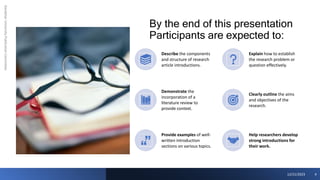
Describe the components
and structure of research
article introductions.
Explain how to establish
the research problem or
question effectively.
Demonstrate the
incorporation of a
literature review to
provide context.
Clearly outline the aims
and objectives of the
research.
Provide examples of well-
written introduction
sections on various topics.
Help researchers develop
strong introductions for
their work.
12/21/2023 Kandahar University Publication Committee 5
12/21/2023 Kandahar University Publication Committee 6
There are several types of articles that can be published in the field of
medicine, including:
• 1- ORIGINAL RESEARCH ARTICLES,
• 2-CASE REPORTS/CASE SERIES, AND
• 3- REVIEWS.
The structure of a scientific manuscript typically includes:
• An abstract,
• Introduction,
• Methods,
• Results,
• Discussion,
• Conclusion and
• References.
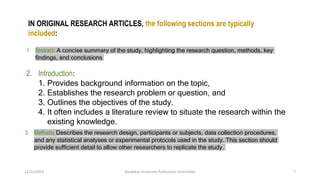
IN ORIGINAL RESEARCH ARTICLES, the following sections are typically
included:
1. Abstract: A concise summary of the study, highlighting the research question, methods, key
findings, and conclusions
2. Introduction:
1. Provides background information on the topic,
2. Establishes the research problem or question, and
3. Outlines the objectives of the study.
4. It often includes a literature review to situate the research within the
existing knowledge.
3. Methods: Describes the research design, participants or subjects, data collection procedures,
and any statistical analyses or experimental protocols used in the study. This section should
provide sufficient detail to allow other researchers to replicate the study.
12/21/2023 Kandahar University Publication Committee 7
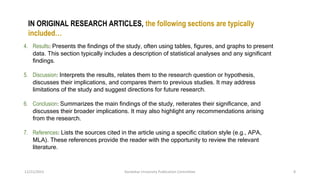
4. Results: Presents the findings of the study, often using tables, figures, and graphs to present
data. This section typically includes a description of statistical analyses and any significant
findings.
5. Discussion: Interprets the results, relates them to the research question or hypothesis,
discusses their implications, and compares them to previous studies. It may address
limitations of the study and suggest directions for future research.
6. Conclusion: Summarizes the main findings of the study, reiterates their significance, and
discusses their broader implications. It may also highlight any recommendations arising
from the research.
7. References: Lists the sources cited in the article using a specific citation style (e.g., APA,
MLA). These references provide the reader with the opportunity to review the relevant
literature.
12/21/2023 Kandahar University Publication Committee 8
IN ORIGINAL RESEARCH ARTICLES, the following sections are typically
included…
The introduction section of a research article can be subdivided into the following components:
Background Information: This part provides contextual information about the topic under
investigation. It introduces the broader field of study and highlights its significance. It may include
a brief historical overview, key concepts, or relevant theories.
Research Problem or Research Question: This component identifies the specific research problem or
research question that the study aims to address. It defines the gap in knowledge or the issue
that the research intends to explore or resolve. It should be clearly stated and focused.
Literature Review: This section critically examines the existing body of literature relevant to the
research question. It summarizes and synthesizes previous studies, theories, and concepts
related to the topic. The literature review establishes the current state of knowledge, identifies
gaps or controversies, and justifies the need for the present study.
Objectives or Research Aims: This part outlines the specific objectives or research aims of the
study. It articulates what the researchers intend to achieve through their investigation. The
objectives should be clearly stated and aligned with the research problem or question.
12/21/2023 Kandahar University Publication Committee 9
Example of an introduction section for a research article on the topic of THE
IMPACT OF SOCIAL MEDIA ON MENTAL HEALTH
AMONG ADOLESCENTS
12/21/2023 Kandahar University Publication Committee 10
Introduction
Background Information:
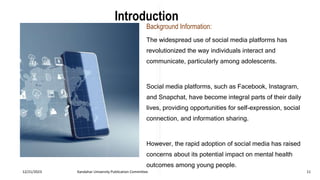
The widespread use of social media platforms has
revolutionized the way individuals interact and
communicate, particularly among adolescents.
Social media platforms, such as Facebook, Instagram,
and Snapchat, have become integral parts of their daily
lives, providing opportunities for self-expression, social
connection, and information sharing.
However, the rapid adoption of social media has raised
concerns about its potential impact on mental health
outcomes among young people.
12/21/2023 Kandahar University Publication Committee 11
Research Problem or Research Question:
Despite the increasing popularity of social media, there is a lack of comprehensive
understanding regarding its influence on the mental well-being of adolescents. The
emergence of this research problem stems from the need to explore the potential risks
and benefits associated with social media use among this vulnerable population.
Specifically, this study aims to investigate the relationship between social media use and
mental health outcomes among adolescents
Introduction
12/21/2023 Kandahar University Publication Committee 12
Literature Review:
Previous research has highlighted the potential impacts of social media on adolescent
mental health. Several studies have reported associations between excessive social
media use and increased levels of anxiety, depression, and body image
dissatisfaction among adolescents (Smith et al., 2018; Jones et al., 2020). However,
conflicting findings exist, with some studies suggesting positive outcomes, such as
enhanced social support and self-esteem among adolescents who engage with social
media positively (Wang et al., 2019; Brown et al., 2021).
Understanding these divergent findings and identifying the underlying mechanisms
involved are crucial for developing effective interventions and strategies to promote
positive mental health outcomes.
Introduction
12/21/2023 Kandahar University Publication Committee 13
Objectives or Research Aims:
The main objectives of this study are twofold.
First, we aim to examine the relationship between social media use and mental health
outcomes, including anxiety, depression, and body image dissatisfaction, among a sample of
adolescents aged 13 to 17 years.
Second, we seek to explore potential mediators that may influence this relationship, such as
online social support, self-esteem, and cyberbullying experiences.
By achieving these objectives, we aim to provide valuable insights into the complex interplay
between social media use and mental health outcomes among adolescents.
Introduction
12/21/2023 Kandahar University Publication Committee 14
12/21/2023 Kandahar University Publication Committee 15
In this example,
• The introduction section begins with background information
that introduces the topic of social media and its prevalence
among adolescents.
• It then establishes the research problem or question,
which is the lack of comprehensive understanding of the
impact of social media on adolescent mental health.
• The literature review provides a summary of previous
research findings and identifies the existing knowledge
gaps.
• Finally, the research objectives or aims are clearly stated,
outlining the specific goals of the study.
Another example of an introduction
section for a research article on the topic
of Renewable energy adoption in rural
communities:
12/21/2023 Kandahar University Publication Committee 16
Introduction
1.Background Information:
Access to reliable and sustainable energy sources is essential for economic
development, social well-being, and environmental sustainability. In rural
communities, however, energy access remains a significant challenge, with many
regions relying heavily on fossil fuels or traditional biomass for their energy needs.
This reliance not only limits economic opportunities but also contributes to
environmental degradation and health hazards. In recent years, renewable energy
technologies, such as solar and wind power, have emerged as promising
alternatives that can address these challenges by providing clean and affordable
energy solutions to rural communities.
12/21/2023 Kandahar University Publication Committee 17
Research Problem or Research Question:
Despite the potential benefits of renewable energy adoption in rural areas, the factors
influencing the uptake and successful implementation of these technologies remain
poorly understood. This research problem stems from the need to identify the barriers
and drivers that shape the decision-making process of rural communities regarding
renewable energy adoption. Specifically, this study aims to investigate the socio-
economic, technological, and policy factors that influence the acceptance and utilization
of renewable energy systems in rural communities.
Introduction
12/21/2023 Kandahar University Publication Committee 18
Literature Review:
Existing literature has explored various aspects of renewable energy adoption, but there is a
particular gap in understanding the unique challenges faced by rural communities.
Socio-economic factors (income, education, community engagement) shape attitudes towards
renewable energy (Baker et al., 2017; Singh et al., 2019).
Technological factors (resource availability, infrastructure, appropriateness) influence
adoption.(Gupta et al., 2018; Liang et al., 2020).
Policy frameworks and support mechanisms impact the success of renewable energy projects in
rural areas (Rathmann et al., 2016; Sovacool et al., 2018).
Understanding these factors and their interplay is vital for the successful implementation of
renewable energy projects in rural communities.
Introduction
12/21/2023 Kandahar University Publication Committee 19
Objectives or Research Aims:
Objective 1: Identify socio-economic factors influencing rural communities' decision-
making on renewable energy adoption (income, education, community engagement,
awareness).
Objective 2: Assess technological and infrastructural considerations for feasible utilization
of renewable energy in rural areas.
Objective 3: Analyze the role of policy frameworks and support mechanisms in facilitating
or hindering renewable energy adoption.
By achieving these objectives, we aim to Provide insights and recommendations to inform
policy and practice for widespread renewable energy adoption in rural communities.
12/21/2023 Kandahar University Publication Committee 20
Introduction
In this example,
1. the introduction section begins with background information highlighting the
importance of energy access in rural communities and the potential of
renewable energy technologies.
2. It then establishes the research problem or question, which is the lack of
understanding regarding the factors influencing renewable energy adoption in
rural areas.
3. The literature review provides a summary of previous research findings,
focusing on the socio-economic, technological, and policy factors related to
renewable energy adoption.
4. Finally, the research objectives or aims are clearly stated, outlining the specific
goals of the study.
12/21/2023 Kandahar University Publication Committee 21
In conclusion
Key Research Questions
• What is the significance of filling this
identified gap?
• What necessitated this study to address a
particular scientific knowledge gap?
12/21/2023 Kandahar University Publication Committee 22
12/21/2023 Kandahar University Publication Committee 23
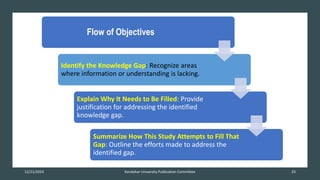
Flow of Objectives
Identify the Knowledge Gap: Recognize areas
where information or understanding is lacking.
Explain Why It Needs to Be Filled: Provide
justification for addressing the identified
knowledge gap.
Summarize How This Study Attempts to Fill That
Gap: Outline the efforts made to address the
identified gap.
• Use the active voice when possible: For example, instead of writing “Meditation is
practiced by many people around the world,” you could write “Many people
practice meditation around the world.”
12/21/2023 Kandahar University Publication Committee 24
Tips for writing an introduction:
• Be concise: “Meditation is a technique that involves focusing one’s attention on a single object,
thought, or sensation, and it has been shown to have a number of positive effects on the mind and body,”
you could write “Meditation, a technique of focused attention, benefits the mind and body.”
• Avoid overusing first-person pronouns: For example, instead of writing “In this essay, I
will discuss the benefits of meditation,” you could write “This essay discusses the benefits of meditation.”
• Organize your thoughts from broad to specific: For example, you could start with
“Meditation is a practice that has been around for thousands of years and has gained popularity in recent
decades.” Then you could narrow it down to “Meditation improves mental health, physical well-being, and
academic performance.”
• Use strong verbs: For example, instead of writing “Meditation can help people deal with stress,”
you could write “Meditation reduces stress.”
12/21/2023 Kandahar University Publication Committee 25
1.Introductions - UNC Writing Center
2.How to Write an Engaging Introduction for Academic Papers
3.Your introduction: first impressions count! [5/8]
Reference
12/21/2023 Kandahar University Publication Committee 26

How to Write an Introduction for Your Research Article.pptx

  • 1.
    From Background toObjectives: How to Write an Introduction for Your Research Article Prepared by : Associate Prof. Dr Khushhal Farooqi 2023 Kandahar University Publication Committee
  • 2.
    12/21/2023 Kandahar UniversityPublication Committee 2
  • 3.
    12/21/2023 Kandahar UniversityPublication Committee 3 Table of Contents: Types of Research Articles Sections in Original Research Articles Components of an Introduction Section Example Introduction on Social Media and Mental Health Another Example Introduction on Renewable Energy Adoption Reference
  • 4.
    By the endof this presentation Participants are expected to: Kandahar University Publication Committee 12/21/2023 4 Describe the components and structure of research article introductions. Explain how to establish the research problem or question effectively. Demonstrate the incorporation of a literature review to provide context. Clearly outline the aims and objectives of the research. Provide examples of well- written introduction sections on various topics. Help researchers develop strong introductions for their work.
  • 5.
    12/21/2023 Kandahar UniversityPublication Committee 5
  • 6.
    12/21/2023 Kandahar UniversityPublication Committee 6 There are several types of articles that can be published in the field of medicine, including: • 1- ORIGINAL RESEARCH ARTICLES, • 2-CASE REPORTS/CASE SERIES, AND • 3- REVIEWS. The structure of a scientific manuscript typically includes: • An abstract, • Introduction, • Methods, • Results, • Discussion, • Conclusion and • References.
  • 7.
    IN ORIGINAL RESEARCHARTICLES, the following sections are typically included: 1. Abstract: A concise summary of the study, highlighting the research question, methods, key findings, and conclusions 2. Introduction: 1. Provides background information on the topic, 2. Establishes the research problem or question, and 3. Outlines the objectives of the study. 4. It often includes a literature review to situate the research within the existing knowledge. 3. Methods: Describes the research design, participants or subjects, data collection procedures, and any statistical analyses or experimental protocols used in the study. This section should provide sufficient detail to allow other researchers to replicate the study. 12/21/2023 Kandahar University Publication Committee 7
  • 8.
    4. Results: Presentsthe findings of the study, often using tables, figures, and graphs to present data. This section typically includes a description of statistical analyses and any significant findings. 5. Discussion: Interprets the results, relates them to the research question or hypothesis, discusses their implications, and compares them to previous studies. It may address limitations of the study and suggest directions for future research. 6. Conclusion: Summarizes the main findings of the study, reiterates their significance, and discusses their broader implications. It may also highlight any recommendations arising from the research. 7. References: Lists the sources cited in the article using a specific citation style (e.g., APA, MLA). These references provide the reader with the opportunity to review the relevant literature. 12/21/2023 Kandahar University Publication Committee 8 IN ORIGINAL RESEARCH ARTICLES, the following sections are typically included…
  • 9.
    The introduction sectionof a research article can be subdivided into the following components: Background Information: This part provides contextual information about the topic under investigation. It introduces the broader field of study and highlights its significance. It may include a brief historical overview, key concepts, or relevant theories. Research Problem or Research Question: This component identifies the specific research problem or research question that the study aims to address. It defines the gap in knowledge or the issue that the research intends to explore or resolve. It should be clearly stated and focused. Literature Review: This section critically examines the existing body of literature relevant to the research question. It summarizes and synthesizes previous studies, theories, and concepts related to the topic. The literature review establishes the current state of knowledge, identifies gaps or controversies, and justifies the need for the present study. Objectives or Research Aims: This part outlines the specific objectives or research aims of the study. It articulates what the researchers intend to achieve through their investigation. The objectives should be clearly stated and aligned with the research problem or question. 12/21/2023 Kandahar University Publication Committee 9
  • 10.
    Example of anintroduction section for a research article on the topic of THE IMPACT OF SOCIAL MEDIA ON MENTAL HEALTH AMONG ADOLESCENTS 12/21/2023 Kandahar University Publication Committee 10
  • 11.
    Introduction Background Information: The widespreaduse of social media platforms has revolutionized the way individuals interact and communicate, particularly among adolescents. Social media platforms, such as Facebook, Instagram, and Snapchat, have become integral parts of their daily lives, providing opportunities for self-expression, social connection, and information sharing. However, the rapid adoption of social media has raised concerns about its potential impact on mental health outcomes among young people. 12/21/2023 Kandahar University Publication Committee 11
  • 12.
    Research Problem orResearch Question: Despite the increasing popularity of social media, there is a lack of comprehensive understanding regarding its influence on the mental well-being of adolescents. The emergence of this research problem stems from the need to explore the potential risks and benefits associated with social media use among this vulnerable population. Specifically, this study aims to investigate the relationship between social media use and mental health outcomes among adolescents Introduction 12/21/2023 Kandahar University Publication Committee 12
  • 13.
    Literature Review: Previous researchhas highlighted the potential impacts of social media on adolescent mental health. Several studies have reported associations between excessive social media use and increased levels of anxiety, depression, and body image dissatisfaction among adolescents (Smith et al., 2018; Jones et al., 2020). However, conflicting findings exist, with some studies suggesting positive outcomes, such as enhanced social support and self-esteem among adolescents who engage with social media positively (Wang et al., 2019; Brown et al., 2021). Understanding these divergent findings and identifying the underlying mechanisms involved are crucial for developing effective interventions and strategies to promote positive mental health outcomes. Introduction 12/21/2023 Kandahar University Publication Committee 13
  • 14.
    Objectives or ResearchAims: The main objectives of this study are twofold. First, we aim to examine the relationship between social media use and mental health outcomes, including anxiety, depression, and body image dissatisfaction, among a sample of adolescents aged 13 to 17 years. Second, we seek to explore potential mediators that may influence this relationship, such as online social support, self-esteem, and cyberbullying experiences. By achieving these objectives, we aim to provide valuable insights into the complex interplay between social media use and mental health outcomes among adolescents. Introduction 12/21/2023 Kandahar University Publication Committee 14
  • 15.
    12/21/2023 Kandahar UniversityPublication Committee 15 In this example, • The introduction section begins with background information that introduces the topic of social media and its prevalence among adolescents. • It then establishes the research problem or question, which is the lack of comprehensive understanding of the impact of social media on adolescent mental health. • The literature review provides a summary of previous research findings and identifies the existing knowledge gaps. • Finally, the research objectives or aims are clearly stated, outlining the specific goals of the study.
  • 16.
    Another example ofan introduction section for a research article on the topic of Renewable energy adoption in rural communities: 12/21/2023 Kandahar University Publication Committee 16
  • 17.
    Introduction 1.Background Information: Access toreliable and sustainable energy sources is essential for economic development, social well-being, and environmental sustainability. In rural communities, however, energy access remains a significant challenge, with many regions relying heavily on fossil fuels or traditional biomass for their energy needs. This reliance not only limits economic opportunities but also contributes to environmental degradation and health hazards. In recent years, renewable energy technologies, such as solar and wind power, have emerged as promising alternatives that can address these challenges by providing clean and affordable energy solutions to rural communities. 12/21/2023 Kandahar University Publication Committee 17
  • 18.
    Research Problem orResearch Question: Despite the potential benefits of renewable energy adoption in rural areas, the factors influencing the uptake and successful implementation of these technologies remain poorly understood. This research problem stems from the need to identify the barriers and drivers that shape the decision-making process of rural communities regarding renewable energy adoption. Specifically, this study aims to investigate the socio- economic, technological, and policy factors that influence the acceptance and utilization of renewable energy systems in rural communities. Introduction 12/21/2023 Kandahar University Publication Committee 18
  • 19.
    Literature Review: Existing literaturehas explored various aspects of renewable energy adoption, but there is a particular gap in understanding the unique challenges faced by rural communities. Socio-economic factors (income, education, community engagement) shape attitudes towards renewable energy (Baker et al., 2017; Singh et al., 2019). Technological factors (resource availability, infrastructure, appropriateness) influence adoption.(Gupta et al., 2018; Liang et al., 2020). Policy frameworks and support mechanisms impact the success of renewable energy projects in rural areas (Rathmann et al., 2016; Sovacool et al., 2018). Understanding these factors and their interplay is vital for the successful implementation of renewable energy projects in rural communities. Introduction 12/21/2023 Kandahar University Publication Committee 19
  • 20.
    Objectives or ResearchAims: Objective 1: Identify socio-economic factors influencing rural communities' decision- making on renewable energy adoption (income, education, community engagement, awareness). Objective 2: Assess technological and infrastructural considerations for feasible utilization of renewable energy in rural areas. Objective 3: Analyze the role of policy frameworks and support mechanisms in facilitating or hindering renewable energy adoption. By achieving these objectives, we aim to Provide insights and recommendations to inform policy and practice for widespread renewable energy adoption in rural communities. 12/21/2023 Kandahar University Publication Committee 20 Introduction
  • 21.
    In this example, 1.the introduction section begins with background information highlighting the importance of energy access in rural communities and the potential of renewable energy technologies. 2. It then establishes the research problem or question, which is the lack of understanding regarding the factors influencing renewable energy adoption in rural areas. 3. The literature review provides a summary of previous research findings, focusing on the socio-economic, technological, and policy factors related to renewable energy adoption. 4. Finally, the research objectives or aims are clearly stated, outlining the specific goals of the study. 12/21/2023 Kandahar University Publication Committee 21
  • 22.
    In conclusion Key ResearchQuestions • What is the significance of filling this identified gap? • What necessitated this study to address a particular scientific knowledge gap? 12/21/2023 Kandahar University Publication Committee 22
  • 23.
    12/21/2023 Kandahar UniversityPublication Committee 23 Flow of Objectives Identify the Knowledge Gap: Recognize areas where information or understanding is lacking. Explain Why It Needs to Be Filled: Provide justification for addressing the identified knowledge gap. Summarize How This Study Attempts to Fill That Gap: Outline the efforts made to address the identified gap.
  • 24.
    • Use theactive voice when possible: For example, instead of writing “Meditation is practiced by many people around the world,” you could write “Many people practice meditation around the world.” 12/21/2023 Kandahar University Publication Committee 24 Tips for writing an introduction: • Be concise: “Meditation is a technique that involves focusing one’s attention on a single object, thought, or sensation, and it has been shown to have a number of positive effects on the mind and body,” you could write “Meditation, a technique of focused attention, benefits the mind and body.” • Avoid overusing first-person pronouns: For example, instead of writing “In this essay, I will discuss the benefits of meditation,” you could write “This essay discusses the benefits of meditation.” • Organize your thoughts from broad to specific: For example, you could start with “Meditation is a practice that has been around for thousands of years and has gained popularity in recent decades.” Then you could narrow it down to “Meditation improves mental health, physical well-being, and academic performance.” • Use strong verbs: For example, instead of writing “Meditation can help people deal with stress,” you could write “Meditation reduces stress.”
  • 25.
    12/21/2023 Kandahar UniversityPublication Committee 25 1.Introductions - UNC Writing Center 2.How to Write an Engaging Introduction for Academic Papers 3.Your introduction: first impressions count! [5/8] Reference
  • 26.
    12/21/2023 Kandahar UniversityPublication Committee 26

Editor's Notes

  • #2 Kandahar University Publication Committee
  • #16 concl
  • #21 Objectives or Research Aims: The main objectives of this study are twofold. First, we aim to identify the socio-economic factors that influence the decision-making process of rural communities regarding renewable energy adoption. This includes examining the role of income levels, education, community engagement, and awareness in shaping attitudes and behaviors towards renewable energy. Second, we seek to assess the technological and infrastructural considerations that impact the feasibility and utilization of renewable energy systems in rural areas. Additionally, we aim to analyze the role of policy frameworks and support mechanisms in facilitating or impeding renewable energy adoption. By achieving these objectives, we aim to provide insights and recommendations that can inform policy and practice, promoting the widespread adoption of renewable energy in rural communities.
  • #26 Reference