How to get press coverage PR and press releases © Kati Price Design Communications 2011
What is a press release? © Kati Price Design Communications 2011
What about the content?... © Kati Price Design Communications 2011 Is your news news?  What’s your angle? What’s your hook?
Format © Kati Price Design Communications 2011
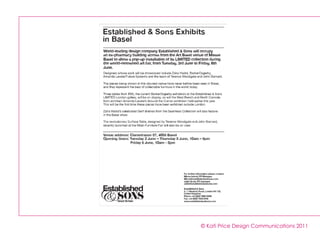
© Kati Price Design Communications 2011
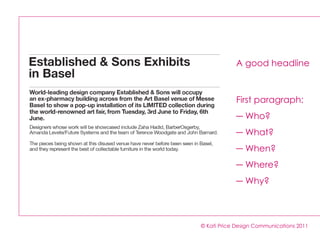
© Kati Price Design Communications 2011 A good headline First paragraph:  Who? What? When? Where?  Why?
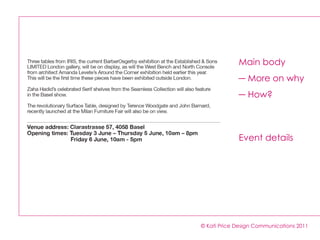
© Kati Price Design Communications 2011 Main body  More on why How? Event details
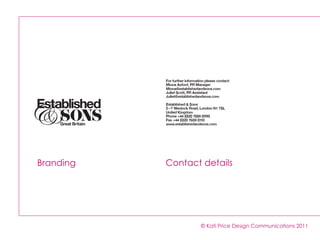
© Kati Price Design Communications 2011 Branding Contact details
© Kati Price Design Communications 2011 Other features of a press release... Date of release and embargo (if relevant) Close: ‘Ends’ sometimes used and in US ### Notes to Editors: include your company boilerplate
Style and tone © Kati Price Design Communications 2011 Write in the third-person  Use the active  - not passive - voice Use strong verbs  Make sure your claims are true Don’t advertise!  Economy of words  Write for the media
How does it all work? © Kati Price Design Communications 2011
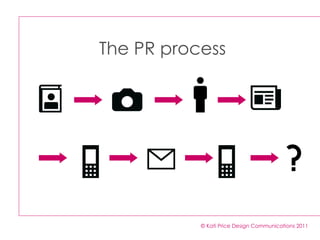
© Kati Price Design Communications 2011 The PR process
Why doesn’t it work? © Kati Price Design Communications 2011
© Kati Price Design Communications 2011 When it’s not news... Crap headline Poor writing and bad grammar Bad sales pitch Full of pseudo-academic or technical gobbledegook Bad images
"Some are born great, some achieve greatness, and some hire public relations officers."    Daniel J. Boorstin (Historian and  Pulitzer-prize winning author)   © Kati Price Design Communications 2009
Thank   you © Kati Price Design Communications 2009

How to Write a Press Release

  • 1.
    How to getpress coverage PR and press releases © Kati Price Design Communications 2011
  • 2.
    What is apress release? © Kati Price Design Communications 2011
  • 3.
    What about thecontent?... © Kati Price Design Communications 2011 Is your news news? What’s your angle? What’s your hook?
  • 4.
    Format © KatiPrice Design Communications 2011
  • 5.
    © Kati PriceDesign Communications 2011
  • 6.
    © Kati PriceDesign Communications 2011 A good headline First paragraph: Who? What? When? Where? Why?
  • 7.
    © Kati PriceDesign Communications 2011 Main body More on why How? Event details
  • 8.
    © Kati PriceDesign Communications 2011 Branding Contact details
  • 9.
    © Kati PriceDesign Communications 2011 Other features of a press release... Date of release and embargo (if relevant) Close: ‘Ends’ sometimes used and in US ### Notes to Editors: include your company boilerplate
  • 10.
    Style and tone© Kati Price Design Communications 2011 Write in the third-person Use the active - not passive - voice Use strong verbs Make sure your claims are true Don’t advertise! Economy of words Write for the media
  • 11.
    How does itall work? © Kati Price Design Communications 2011
  • 12.
    © Kati PriceDesign Communications 2011 The PR process
  • 13.
    Why doesn’t itwork? © Kati Price Design Communications 2011
  • 14.
    © Kati PriceDesign Communications 2011 When it’s not news... Crap headline Poor writing and bad grammar Bad sales pitch Full of pseudo-academic or technical gobbledegook Bad images
  • 15.
    "Some are borngreat, some achieve greatness, and some hire public relations officers."  Daniel J. Boorstin (Historian and  Pulitzer-prize winning author) © Kati Price Design Communications 2009
  • 16.
    Thank you © Kati Price Design Communications 2009

Editor's Notes

  • #3 What is its function in getting press? Content - What information they should content they should contain etc. Form - what does it look like. Usually a side or so of A4 Style - (inc tone)
  • #4 What makes ‘news’? Think about your audience. Will someone else find your story interesting? If your product or event is noteworthy or unusual in some way, this will generally mean it is newsworthy too. Pick an angle or hook. A good story angle must have the following three attributes: It must be the most important fact in your story; it must be timely and must be unique, newsworthy or contrary to industry norms and trends. This story angle must be presented in the first paragraph as well as the headline of your press release. A good story angle: is the most important fact in your story is timely is unique, newsworthy or contrary to industry norms and trends. Use the story angle in the first paragraph as well as the headline of your press release. Try to make your press release timely by tying your news to current events or topical issues if possible. Consider local angles. Local newspapers and radio stations are always keen to hear about local people who have done interesting things.
  • #5 What is its function in getting press? Form - what does it look like. Usually a side or so of A4 Content - What information they should content they should contain etc. Style - (inc tone)
  • #6 Form
  • #13 Lead times - When to send them (lead times of publications as well as at what point you should send personally – i.e. product launches, shows) In reference to a show, when should you start to contact the press? Who to target What is PR / role of PR agency
  • #14 Bit of process – new diag Lead times Who to target
  • #16 The above tips are not meant to be an exhaustive guide to writing a good press release and doing your own pr. But, they should help you get started. Remember that practice makes perfect and the best way to learn how to write an effective press release, is to observe how news is reported in the press and media.