SEMINAR ON:
1
WHAT IS GOOGLE WEB RANGER PROGRAMME?
 “Web Rangers equips students to become
ambassadors who will promote safe and
responsible use of the web in their schools.”
 Web Rangers provide training to help teens
create their cyber safety campaign to
enable themselves and their peers think
about their online behavior and how to keep
each other safe online.
2
CONTENTS:
1. Become an online sleuth.
2. Manage your digital foot prints
3. Cyber Bully
4. Scams
3
CHAPTER 1:-
BECOME AN ONLINE SLEUTH
 Investigate source.
 Who holds the copy right?
 What do they want you to
believe?
 Don’t be fooled by cool and
professional looking websites.
 Compare source of Information.
4
BECOME AN ONLINE SLEUTH
 Everyone’s face is hidden.
 Unless you know your
friend’s costume (Online
name), you don’t know if you
are talking to your friend or
someone you don’t know.
 Any stranger can pretend to
be a friend and you have no
way of knowing who they are
because they are behind the
mask of the computer
5
IDENTIFY FAKE PHOTO #1
6
IDENTIFY FAKE PHOTO #2
7
IDENTIFY FAKE PHOTO #3
8
IDENTIFY FAKE PHOTO #4
9
IDENTIFY FAKE PHOTO #5
10
CHAPTER 2:-
MANAGE YOUR DIGITAL FOOTPRINTS
 Think before you share.
 What you share can take on a
life of its own
 1 Share X 2.4 Billion People =?
11
STEPS TO SAFETY
 Search your name and evaluate your
reputation.
 Keep personal information private.
(User Id, Bank A/c No… etc.)
 Keep Granma Rule when posting
anything online.
12
PROTECT YOUR STUFF
 Use strong password.
 Never share your password.
 Lock your device / screen after use.
 Logout in proper way (Especially form public
computers)
 Know and use your settings. (Smartphone/
Computer)
 Use strict privacy settings. (Protect your mobile/
computer from Spyware)
 Use Incognito Mode when using a public computer.
13
TRACING DIGITAL FOOTPRINTS:
14
OPENING INCOGNITO MODE
(PRIVATE WINDOW)
15
PASSWORD :
 Use 8+ Characters.
 Mix letters, Numbers, and symbols.
 Use different passwords for different websites.
(Never use same password for every account)
 Use 2 step verification.
 Use complicated pattern lock for your smart phone
16
CHAPTER 3:-
CYBER BULLYING
The use of Internet to
bully (Hurt) a person,
typically by sending
messages of an
intimidating or
threatening nature.
17
INCASE OF BULLY:
Block and report
bully
Don’t respond or
retaliate
Reach out for help
Be civil and never bully.
Be a up stander not a by stander.
18
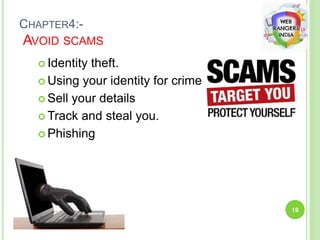
CHAPTER4:-
AVOID SCAMS
 Identity theft.
 Using your identity for crime
 Sell your details
 Track and steal you.
 Phishing
19
PHISHING
The luring of an internet
user to reveal personal
details (like passwords and
credit card information) on
a fake web page or e-mail.
20
PHISHING
21
TIPS:
 Don’t respond to suspicious posts/ e-mail.
 Don’t respond to request for your password.
 Ask parents.
22
QUIZ TIME: #1
If someone online tells you they are in
6th grade and their name is Katie, they
are probably how old?
 There’s no way to tell!
 12
 13
 35 23
QUIZ TIME: #2
 If you have been talking on the Internet to a
person for a long time, and they want to meet,
which is okay to do?
a) Meet them, as long as you bring a friend.
b) Ask your parent or guardian first and have
them go with you.
c) Meet them without asking elders.
d) Tell someone where you will be before you
go.
24
QUIZ TIME: #3
If someone online sends you a
message that is mean or makes you
feel uncomfortable, you should:
 Tell a responsible adult
 Erase them from your friends list.
 Delete the message.
 Insult them back
25
QUIZ TIME: #4
Which password is best to have??
a) soniyamol
b) Abcdef
c) 50niy@m0l
d) 9895646594
26
QUIZ TIME : #5
While surfing the Internet, you get an
error message from your Internet
provider, and it says it will delete your
account unless you type in your
password again, should you send the
information?
a. Yes.
b. No. 27
QUIZ TIME : #6
An example of cyber bullying is:
a) Posting your own information on the
internet.
b) Spreading rumors about someone
through e-mails or social network
sites.
c) Creating Facebook/ twitter account.
d) Responding to a harassing e-mail
28
QUIZ TIME : #7
 . When you are filling out forms or surveys
online, you should:
a) Answer all the questions truthfully.
b) Before you answer any questions, you should
get your parents' approval.
c) Make up funny answers to all the questions.
29
QUIZ TIME : #8
 When you get an email or instant message from
people you don't know, you should:
a) Ignore it and put it in your trash folder.
b) Respond with a polite how-do-you-do.
c) Forward the message to your best friends
30
QUIZ TIME : #9
 3. When someone asks for personal information
like phone numbers or addresses online, you
should:
a) Give the information to anyone who asks because it's
the polite thing to do.
b) Post the information on any public Web site like
MySpace, so anyone can find it.
c) Never give out personal information online in
emails or instant messages because you never
know who you are really communicating with. 31
QUIZ TIME : #10
 When you are making up a user name for email
and instant messaging, you should:
a) Always use your real name.
b) Use a name that does NOT reveal your true
identity.
c) Use a name that gives good clues about who you
really are.
32
QUIZ TIME :#11
Identify this person :
33
QUIZ TIME : #12
Who is the IB (information and broadcasting) minister
?
o Narendra modhi
o Manohar Parrikar
o Smriti Irani
o Arun Jaitley
34
WHAT IS YOUR DUTY?
Follow the safety guidelines
Practice it properly
Educate your friends and family.
Write an article to publish in the school
magazine, local news papers etc.
35
TIME
36
37

How to use internet safely

  • 1.
  • 2.
    WHAT IS GOOGLEWEB RANGER PROGRAMME?  “Web Rangers equips students to become ambassadors who will promote safe and responsible use of the web in their schools.”  Web Rangers provide training to help teens create their cyber safety campaign to enable themselves and their peers think about their online behavior and how to keep each other safe online. 2
  • 3.
    CONTENTS: 1. Become anonline sleuth. 2. Manage your digital foot prints 3. Cyber Bully 4. Scams 3
  • 4.
    CHAPTER 1:- BECOME ANONLINE SLEUTH  Investigate source.  Who holds the copy right?  What do they want you to believe?  Don’t be fooled by cool and professional looking websites.  Compare source of Information. 4
  • 5.
    BECOME AN ONLINESLEUTH  Everyone’s face is hidden.  Unless you know your friend’s costume (Online name), you don’t know if you are talking to your friend or someone you don’t know.  Any stranger can pretend to be a friend and you have no way of knowing who they are because they are behind the mask of the computer 5
  • 6.
  • 7.
  • 8.
  • 9.
  • 10.
  • 11.
    CHAPTER 2:- MANAGE YOURDIGITAL FOOTPRINTS  Think before you share.  What you share can take on a life of its own  1 Share X 2.4 Billion People =? 11
  • 12.
    STEPS TO SAFETY Search your name and evaluate your reputation.  Keep personal information private. (User Id, Bank A/c No… etc.)  Keep Granma Rule when posting anything online. 12
  • 13.
    PROTECT YOUR STUFF Use strong password.  Never share your password.  Lock your device / screen after use.  Logout in proper way (Especially form public computers)  Know and use your settings. (Smartphone/ Computer)  Use strict privacy settings. (Protect your mobile/ computer from Spyware)  Use Incognito Mode when using a public computer. 13
  • 14.
  • 15.
  • 16.
    PASSWORD :  Use8+ Characters.  Mix letters, Numbers, and symbols.  Use different passwords for different websites. (Never use same password for every account)  Use 2 step verification.  Use complicated pattern lock for your smart phone 16
  • 17.
    CHAPTER 3:- CYBER BULLYING Theuse of Internet to bully (Hurt) a person, typically by sending messages of an intimidating or threatening nature. 17
  • 18.
    INCASE OF BULLY: Blockand report bully Don’t respond or retaliate Reach out for help Be civil and never bully. Be a up stander not a by stander. 18
  • 19.
    CHAPTER4:- AVOID SCAMS  Identitytheft.  Using your identity for crime  Sell your details  Track and steal you.  Phishing 19
  • 20.
    PHISHING The luring ofan internet user to reveal personal details (like passwords and credit card information) on a fake web page or e-mail. 20
  • 21.
  • 22.
    TIPS:  Don’t respondto suspicious posts/ e-mail.  Don’t respond to request for your password.  Ask parents. 22
  • 23.
    QUIZ TIME: #1 Ifsomeone online tells you they are in 6th grade and their name is Katie, they are probably how old?  There’s no way to tell!  12  13  35 23
  • 24.
    QUIZ TIME: #2 If you have been talking on the Internet to a person for a long time, and they want to meet, which is okay to do? a) Meet them, as long as you bring a friend. b) Ask your parent or guardian first and have them go with you. c) Meet them without asking elders. d) Tell someone where you will be before you go. 24
  • 25.
    QUIZ TIME: #3 Ifsomeone online sends you a message that is mean or makes you feel uncomfortable, you should:  Tell a responsible adult  Erase them from your friends list.  Delete the message.  Insult them back 25
  • 26.
    QUIZ TIME: #4 Whichpassword is best to have?? a) soniyamol b) Abcdef c) 50niy@m0l d) 9895646594 26
  • 27.
    QUIZ TIME :#5 While surfing the Internet, you get an error message from your Internet provider, and it says it will delete your account unless you type in your password again, should you send the information? a. Yes. b. No. 27
  • 28.
    QUIZ TIME :#6 An example of cyber bullying is: a) Posting your own information on the internet. b) Spreading rumors about someone through e-mails or social network sites. c) Creating Facebook/ twitter account. d) Responding to a harassing e-mail 28
  • 29.
    QUIZ TIME :#7  . When you are filling out forms or surveys online, you should: a) Answer all the questions truthfully. b) Before you answer any questions, you should get your parents' approval. c) Make up funny answers to all the questions. 29
  • 30.
    QUIZ TIME :#8  When you get an email or instant message from people you don't know, you should: a) Ignore it and put it in your trash folder. b) Respond with a polite how-do-you-do. c) Forward the message to your best friends 30
  • 31.
    QUIZ TIME :#9  3. When someone asks for personal information like phone numbers or addresses online, you should: a) Give the information to anyone who asks because it's the polite thing to do. b) Post the information on any public Web site like MySpace, so anyone can find it. c) Never give out personal information online in emails or instant messages because you never know who you are really communicating with. 31
  • 32.
    QUIZ TIME :#10  When you are making up a user name for email and instant messaging, you should: a) Always use your real name. b) Use a name that does NOT reveal your true identity. c) Use a name that gives good clues about who you really are. 32
  • 33.
    QUIZ TIME :#11 Identifythis person : 33
  • 34.
    QUIZ TIME :#12 Who is the IB (information and broadcasting) minister ? o Narendra modhi o Manohar Parrikar o Smriti Irani o Arun Jaitley 34
  • 35.
    WHAT IS YOURDUTY? Follow the safety guidelines Practice it properly Educate your friends and family. Write an article to publish in the school magazine, local news papers etc. 35
  • 36.
  • 37.