how to think clearly
           about (cyber) security
                    @alecmuffett
                 www.alecmuffett.com

                 green lane security
               www.greenlanesecurity.com
                                                      v2.0
@alecmuffett                       www.greenlanesecurity.com
how to think clearly about
                        security


@alecmuffett                       www.greenlanesecurity.com
how to think clearly about
                     cybersecurity


@alecmuffett                      www.greenlanesecurity.com
why cybersecurity is rubbish


@alecmuffett                        www.greenlanesecurity.com
...a bit too polemical?


@alecmuffett                     www.greenlanesecurity.com
thesis:


@alecmuffett             www.greenlanesecurity.com
1
           there is a word cybersecurity


@alecmuffett                    www.greenlanesecurity.com
2
           this word is both a metaphor
          and a model for thinking about
           the challenges of information
               and network security


@alecmuffett                   www.greenlanesecurity.com
3
 this model, with perhaps one exception,
 is unsuited to describe the challenges of
     information and network security


@alecmuffett                www.greenlanesecurity.com
4
       this model has been adopted by
       state actors as key to discussion
        and/or strategic consideration
     of information and network security


@alecmuffett                 www.greenlanesecurity.com
5
       strategy based upon this model
    tends to be misconceived, expensive,
          and of an illiberal nature


@alecmuffett                www.greenlanesecurity.com
6
   unless diluted with other perspectives,
           this model is a lever for
          increased state control of
      information and network security
  that will harm the evolution of the field

@alecmuffett                 www.greenlanesecurity.com
end thesis


@alecmuffett                www.greenlanesecurity.com
thesis defence


@alecmuffett                www.greenlanesecurity.com
1
       cybersecurity: what does it mean?


@alecmuffett                  www.greenlanesecurity.com
@alecmuffett   www.greenlanesecurity.com
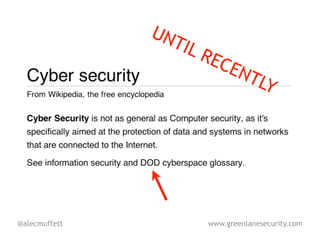
UN
                    TIL
                        R   ECE
                               N   TLY


@alecmuffett            www.greenlanesecurity.com
a long time ago in a novel far far away...


@alecmuffett                 www.greenlanesecurity.com
http://en.wikipedia.org/wiki/File:Neuromancer_(Book).jpg


@alecmuffett
www.greenlanesecurity.com
cyberspace


@alecmuffett                www.greenlanesecurity.com
not cybernetic


@alecmuffett                www.greenlanesecurity.com
http://en.wikipedia.org/wiki/File:Sixmilliondollar1.jpg


@alecmuffett
www.greenlanesecurity.com
virtual reality,
               a real virtuality


@alecmuffett                   www.greenlanesecurity.com
hackers movie


                @alecmuffett   www.greenlanesecurity.com
http://en.wikipedia.org/wiki/File:Tron_poster.jpg


@alecmuffett
www.greenlanesecurity.com
http://en.wikipedia.org/wiki/Internet-related_prefixes


@alecmuffett
                                                    cyber-prefix


www.greenlanesecurity.com
cyberpunk


@alecmuffett               www.greenlanesecurity.com
http://en.wikipedia.org/wiki/File:Wargames.jpg


@alecmuffett
www.greenlanesecurity.com
http://en.wikipedia.org/wiki/File:Hackersposter.jpg


@alecmuffett
www.greenlanesecurity.com
http://en.wikipedia.org/wiki/File:The_Matrix_Poster.jpg


@alecmuffett
www.greenlanesecurity.com
hollywood bandwagon


@alecmuffett                  www.greenlanesecurity.com
cyber-everything!


@alecmuffett                  www.greenlanesecurity.com
cybercrime


@alecmuffett                www.greenlanesecurity.com
cybercriminals


@alecmuffett                www.greenlanesecurity.com
cybersex


@alecmuffett              www.greenlanesecurity.com
cyberchildren
               “digital natives”


@alecmuffett                  www.greenlanesecurity.com
cyberbullying


@alecmuffett                   www.greenlanesecurity.com
cyberterrorists


@alecmuffett                 www.greenlanesecurity.com
cyberattacks


@alecmuffett                  www.greenlanesecurity.com
cyberwarfare


@alecmuffett                  www.greenlanesecurity.com
cyberweapons


@alecmuffett                  www.greenlanesecurity.com
cyberspies


@alecmuffett                www.greenlanesecurity.com
cyberespionage


@alecmuffett                www.greenlanesecurity.com
...and so forth


@alecmuffett                 www.greenlanesecurity.com
AN OBSERVATION


@alecmuffett                www.greenlanesecurity.com
word prefixes ...


@alecmuffett                  www.greenlanesecurity.com
digital, virtual = interesting, virtuous


@alecmuffett                  www.greenlanesecurity.com
virtual reality


@alecmuffett                     www.greenlanesecurity.com
e-something = dull


@alecmuffett                  www.greenlanesecurity.com
e-mail


@alecmuffett            www.greenlanesecurity.com
iSomething


@alecmuffett                www.greenlanesecurity.com
iPrefer this logo


@alecmuffett                  www.greenlanesecurity.com
cyber = bad/profane?


@alecmuffett                   www.greenlanesecurity.com
are we meant or predisposed
                to dislike ‘cyber’ ?


@alecmuffett                   www.greenlanesecurity.com
* “information superhighway”
                was always boring


@alecmuffett                  www.greenlanesecurity.com
pop(@stack);


@alecmuffett              www.greenlanesecurity.com
2
          what model does it represent?


@alecmuffett                   www.greenlanesecurity.com
not cyber-space


@alecmuffett                 www.greenlanesecurity.com
but cyber-space


@alecmuffett                 www.greenlanesecurity.com
a near-tangible virtual world


@alecmuffett                        www.greenlanesecurity.com
described as a space


@alecmuffett                   www.greenlanesecurity.com
people meet in a space


@alecmuffett                    www.greenlanesecurity.com
battles are fought in a space


@alecmuffett                    www.greenlanesecurity.com
wars are waged in a space


@alecmuffett                      www.greenlanesecurity.com
humans understand space


@alecmuffett                    www.greenlanesecurity.com
underlying assumption is that
  cyberspace is sufficiently like realspace
    and much the same rules can apply


@alecmuffett                 www.greenlanesecurity.com
alas...


@alecmuffett             www.greenlanesecurity.com
3
  the model is a mostly-bad fit to reality?


@alecmuffett                 www.greenlanesecurity.com
cyberspace is not like realspace


@alecmuffett                    www.greenlanesecurity.com
example 1: theft


@alecmuffett                 www.greenlanesecurity.com
cyberspace theft is not commutative


@alecmuffett                www.greenlanesecurity.com
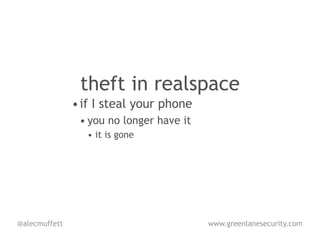
theft in realspace
               • if I steal your phone
                • you no longer have it
                 • it is gone


@alecmuffett                              www.greenlanesecurity.com
theft in cyberspace
               • if I steal your data
                • you still have it
                  • unless I also destroy your copies
                   • assuming you haven’t backed-up your data
                • you no longer have secrecy
                  • not the same as “loss”


@alecmuffett                                     www.greenlanesecurity.com
later debate:
           is intellectual property theft
            actually theft (ie: crime) ...


@alecmuffett                      www.greenlanesecurity.com
... or is it like copyright infringement
          and/or patent infringement
               (ie: typically a tort)?


@alecmuffett                   www.greenlanesecurity.com
(ask a lawyer. pay him.)


@alecmuffett                      www.greenlanesecurity.com
example 2: cybersize


@alecmuffett                   www.greenlanesecurity.com
“An area of Internet the size of Wales
       is dedicated to cybercrime!”


@alecmuffett                 www.greenlanesecurity.com
social media as a country: Twitter


@alecmuffett                   www.greenlanesecurity.com
@AlecMuffett
               ~ 1,662 followers


@alecmuffett                  www.greenlanesecurity.com
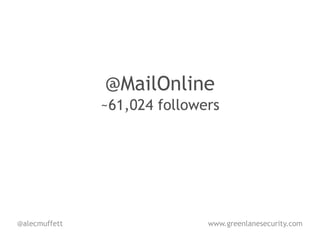
@MailOnline
               ~61,024 followers


@alecmuffett                  www.greenlanesecurity.com
@GuardianNews
               ~321,287 followers


@alecmuffett                  www.greenlanesecurity.com
Can a case for newspaper regulation
   to be applied to newspaper twitterers?


@alecmuffett                www.greenlanesecurity.com
@StephenFry
               ~3,965,799 followers


@alecmuffett                   www.greenlanesecurity.com
Why regulate newspapers & journalists
               on Twitter,
      yet not regulate Stephen Fry?


@alecmuffett               www.greenlanesecurity.com
answer:


@alecmuffett             www.greenlanesecurity.com
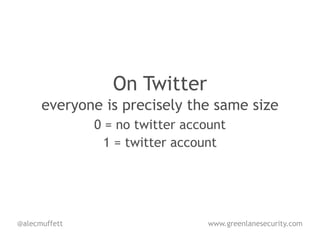
On Twitter
      everyone is precisely the same size
               0 = no twitter account
                 1 = twitter account


@alecmuffett                      www.greenlanesecurity.com
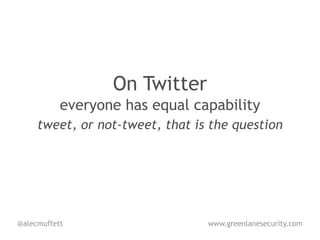
On Twitter
           everyone has equal capability
     tweet, or not-tweet, that is the question


@alecmuffett                     www.greenlanesecurity.com
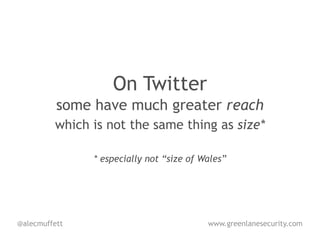
On Twitter
          some have much greater reach
         which is not the same thing as size*

               * especially not “size of Wales”


@alecmuffett                              www.greenlanesecurity.com
a maths/compsci analogy:


@alecmuffett                     www.greenlanesecurity.com
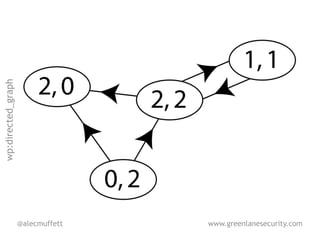
wp:directed_graph


                    @alecmuffett   www.greenlanesecurity.com
graph theory →
               euclidean geometry →
                      twitter


@alecmuffett                   www.greenlanesecurity.com
a node/vertex/twitterer is a point
          - ie: of zero dimension -
   hence all twitterers are the same size


@alecmuffett                 www.greenlanesecurity.com
a line/edge/follow is that
       which joins two nodes/twitterers


@alecmuffett                 www.greenlanesecurity.com
the degree of a twitterer
          is the number of followers,
       the number of people with whom
               you communicate


@alecmuffett                www.greenlanesecurity.com
the only metrics on twitter
               • volume
                • number of tweets
               • indegree
                • number of followers
               • outdegree
                • number of people you follow


@alecmuffett                            www.greenlanesecurity.com
so which of these three metrics
          should trigger state regulation
               of your twitterfeed?


@alecmuffett                    www.greenlanesecurity.com
regulation?


@alecmuffett                 www.greenlanesecurity.com
if none, perhaps regulation should
     pertain to the author & his message
           rather than the medium


@alecmuffett                 www.greenlanesecurity.com
if the medium is irrelevant and open,
   why discuss regulation of the medium
          rather than of its users?


@alecmuffett                www.greenlanesecurity.com
example 3: sovereignty


@alecmuffett                    www.greenlanesecurity.com
“Where are the boundaries of
  British (or American, etc) Cyberspace?”


@alecmuffett                www.greenlanesecurity.com
(we will return to this)


@alecmuffett                      www.greenlanesecurity.com
precis
       society is still adjusting to the net


@alecmuffett                     www.greenlanesecurity.com
4
      what model has the state adopted?


@alecmuffett                 www.greenlanesecurity.com
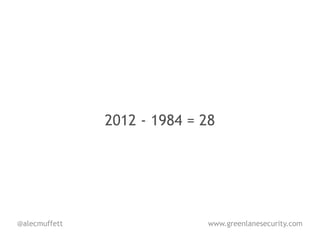
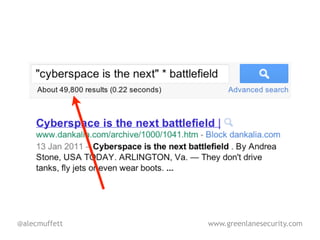
2012 - 1984 = 28


@alecmuffett                  www.greenlanesecurity.com
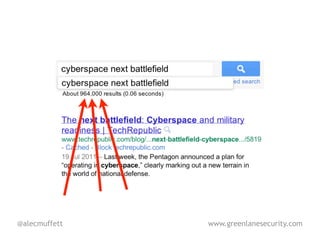
@alecmuffett   www.greenlanesecurity.com
if it is a place, it can be policed


@alecmuffett                     www.greenlanesecurity.com
if it is a theatre, war can be prosecuted


@alecmuffett                www.greenlanesecurity.com
EXPERIMENT


@alecmuffett                www.greenlanesecurity.com
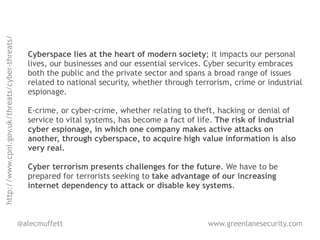
http://www.cpni.gov.uk/threats/cyber-threats/


                                                  Cyberspace lies at the heart of modern society; it impacts our personal
                                                  lives, our businesses and our essential services. Cyber security embraces
                                                  both the public and the private sector and spans a broad range of issues
                                                  related to national security, whether through terrorism, crime or industrial
                                                  espionage.

                                                  E-crime, or cyber-crime, whether relating to theft, hacking or denial of
                                                  service to vital systems, has become a fact of life. The risk of industrial
                                                  cyber espionage, in which one company makes active attacks on
                                                  another, through cyberspace, to acquire high value information is also
                                                  very real.

                                                  Cyber terrorism presents challenges for the future. We have to be
                                                  prepared for terrorists seeking to take advantage of our increasing
                                                  internet dependency to attack or disable key systems.


                                                @alecmuffett                                        www.greenlanesecurity.com
posit:
               internet → communications


@alecmuffett                     www.greenlanesecurity.com
replace:
          cyberspace → telephoneworld
                 cyber → phone


@alecmuffett                 www.greenlanesecurity.com
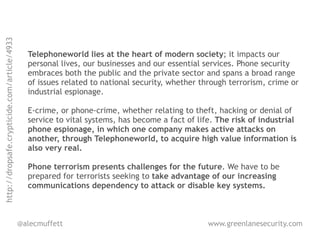
http://dropsafe.crypticide.com/article/4933


                                                Telephoneworld lies at the heart of modern society; it impacts our
                                                personal lives, our businesses and our essential services. Phone security
                                                embraces both the public and the private sector and spans a broad range
                                                of issues related to national security, whether through terrorism, crime or
                                                industrial espionage.

                                                E-crime, or phone-crime, whether relating to theft, hacking or denial of
                                                service to vital systems, has become a fact of life. The risk of industrial
                                                phone espionage, in which one company makes active attacks on
                                                another, through Telephoneworld, to acquire high value information is
                                                also very real.

                                                Phone terrorism presents challenges for the future. We have to be
                                                prepared for terrorists seeking to take advantage of our increasing
                                                communications dependency to attack or disable key systems.


                                              @alecmuffett                                        www.greenlanesecurity.com
The UK must control master
           Telephoneworld! Cyberspace!
                  the Internet!


@alecmuffett                  www.greenlanesecurity.com
If cyberspace is communication...


@alecmuffett                  www.greenlanesecurity.com
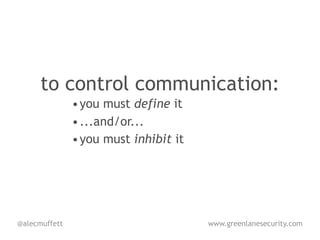
to control communication:
               • you must define it
               • ...and/or...
               • you must inhibit it


@alecmuffett                           www.greenlanesecurity.com
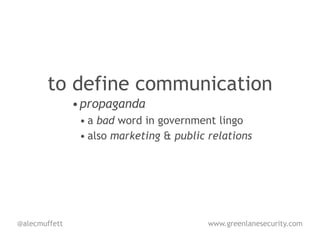
to define communication
               • propaganda
                • a bad word in government lingo
                • also marketing & public relations


@alecmuffett                              www.greenlanesecurity.com
to inhibit communication
               • censorship
                • likewise a bad word


@alecmuffett                            www.greenlanesecurity.com
it’s safest for government to pretend
           that cyberspace is a space
             filled with bad people


@alecmuffett                 www.greenlanesecurity.com
metaphor drives perception


@alecmuffett                      www.greenlanesecurity.com
land → army


@alecmuffett                 www.greenlanesecurity.com
sea → navy


@alecmuffett                www.greenlanesecurity.com
sky → air force


@alecmuffett                 www.greenlanesecurity.com
cyberspace → currently up for grabs


@alecmuffett                www.greenlanesecurity.com
to achieve mastery
   the internet must be widely perceived
      as a space which can be policed,
       as a battleground in which war
            may be prosecuted...


@alecmuffett                www.greenlanesecurity.com
...but (first) what are its boundaries?


@alecmuffett                   www.greenlanesecurity.com
“Where are the boundaries of
            British (etc) Cyberspace?”


@alecmuffett                   www.greenlanesecurity.com
depends on what you mean by:
               “Boundary”
                “British”


@alecmuffett                www.greenlanesecurity.com
is British Cyberspace the union of
   every Briton’s ability to communicate?


@alecmuffett                 www.greenlanesecurity.com
...then Stephen Fry is very large indeed.


@alecmuffett                www.greenlanesecurity.com
is cyberspace the boundary of storage
        of every and all Britons’ data?


@alecmuffett                www.greenlanesecurity.com
...then British Cyberspace extends into
  GMail and Facebook servers in the USA.


@alecmuffett                www.greenlanesecurity.com
is British Cyberspace the sum over
     digital/cyberactivities of all Britons?


@alecmuffett                    www.greenlanesecurity.com
...then the state seeks to limit
        legal (or, currently non-criminal)
          activities and reduce liberties
                of only its citizenry


@alecmuffett                    www.greenlanesecurity.com
Government is curiously unwilling
     to clarify the matter of boundaries.


@alecmuffett                  www.greenlanesecurity.com
5

“...expensive, misconceived, illiberal...”


@alecmuffett                www.greenlanesecurity.com
example quotes:


@alecmuffett                www.greenlanesecurity.com
http://goo.gl/MXCsG - computerworld


                                         The cost of cybercrime to the global
                                         economy is estimated at $1 trillion
                                       [US General Keith] Alexander stated and
                                       malware is being introduced at a rate of
                                               55,000 pieces per day,
                                                  or one per second.


                                      @alecmuffett               www.greenlanesecurity.com
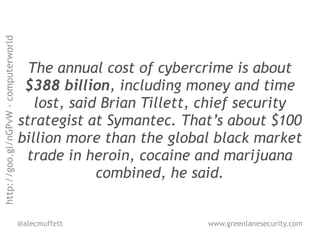
http://goo.gl/nGPvW - computerworld


                                        The annual cost of cybercrime is about
                                       $388 billion, including money and time
                                         lost, said Brian Tillett, chief security
                                      strategist at Symantec. That’s about $100
                                      billion more than the global black market
                                       trade in heroin, cocaine and marijuana
                                                   combined, he said.


                                      @alecmuffett                www.greenlanesecurity.com
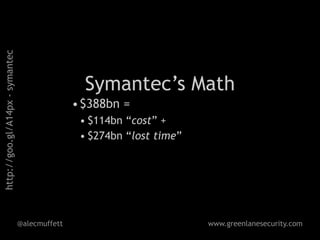
http://goo.gl/A14px - symantec


                                                  Symantec’s Math
                                                • $388bn =
                                                 • $114bn “cost” +
                                                 • $274bn “lost time”


                                 @alecmuffett                           www.greenlanesecurity.com
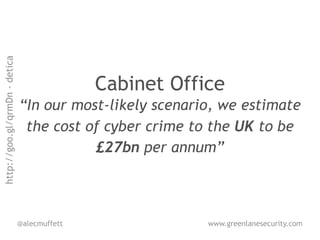
http://goo.gl/qrmDn - detica


                                              Cabinet Office
                               “In our most-likely scenario, we estimate
                                the cost of cyber crime to the UK to be
                                          £27bn per annum”


                               @alecmuffett               www.greenlanesecurity.com
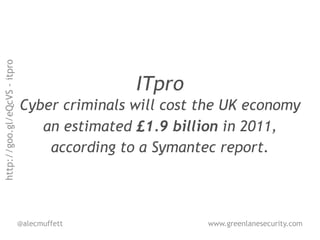
http://goo.gl/eQcVS - itpro


                                              ITpro
                              Cyber criminals will cost the UK economy
                                 an estimated £1.9 billion in 2011,
                                  according to a Symantec report.


                              @alecmuffett              www.greenlanesecurity.com
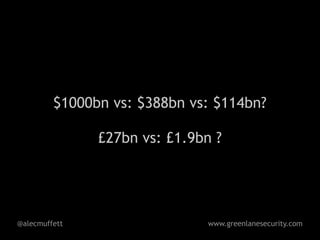
$1000bn vs: $388bn vs: $114bn?

               £27bn vs: £1.9bn ?


@alecmuffett                   www.greenlanesecurity.com
wtf?


@alecmuffett          www.greenlanesecurity.com
http://goo.gl/AJMMX - cabinet office


                                       @alecmuffett   www.greenlanesecurity.com
“the £27bn report”


@alecmuffett                  www.greenlanesecurity.com
http://goo.gl/vKk3S - detica


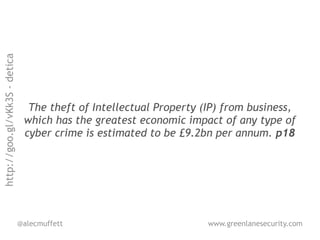
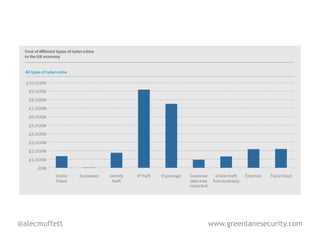
                                 The theft of Intellectual Property (IP) from business,
                                which has the greatest economic impact of any type of
                                cyber crime is estimated to be £9.2bn per annum. p18


                               @alecmuffett                          www.greenlanesecurity.com
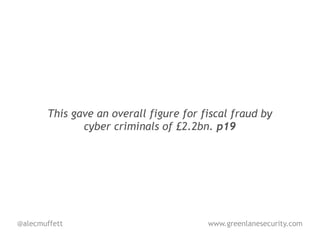
This gave an overall figure for fiscal fraud by
              cyber criminals of £2.2bn. p19


@alecmuffett                            www.greenlanesecurity.com
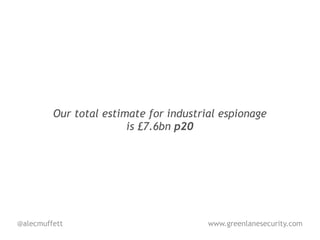
Our total estimate for industrial espionage
                        is £7.6bn p20


@alecmuffett                            www.greenlanesecurity.com
Overall, we estimate the most likely impact
   [of online theft is] £1.3bn per annum, with the best
           and worst case estimates £1.0bn and
                 £2.7bn respectively. p21


@alecmuffett                          www.greenlanesecurity.com
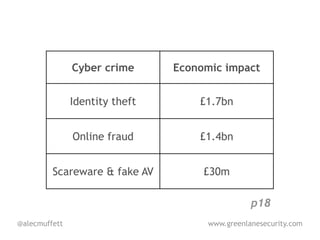
Cyber crime      Economic impact


               Identity theft       £1.7bn


               Online fraud         £1.4bn


         Scareware & fake AV         £30m

                                                 p18
@alecmuffett                          www.greenlanesecurity.com
@alecmuffett   www.greenlanesecurity.com
but...


@alecmuffett            www.greenlanesecurity.com
“The proportion of IP actually stolen
 cannot at present be measured with any
       degree of confidence” p16


@alecmuffett               www.greenlanesecurity.com
“It is very hard to determine
 what proportion of industrial espionage
       is due to cyber crime” p16


@alecmuffett               www.greenlanesecurity.com
“Our assessments are necessarily based
on assumptions and informed judgements
     rather than specific examples of
 cybercrime, or from data of a classified
   or commercially sensitive origin” p5


@alecmuffett               www.greenlanesecurity.com
also, do you remember...


@alecmuffett                     www.greenlanesecurity.com
US: “malware is being introduced
     at a rate of 55,000 pieces per day”


@alecmuffett                 www.greenlanesecurity.com
The UK version is...


@alecmuffett                    www.greenlanesecurity.com
http://goo.gl/YwjT0


                        You just have to look at some of the figures, in
                       fact over 50%, just about 51% of the malicious
                      software threats that have been ever identified,
                                   were identified in 2009.

                                     Theresa May, Today Programme, Oct 2010


                      @alecmuffett                                 www.greenlanesecurity.com
http://goo.gl/vK331


                                            Symantec
                                        “Global Internet
                                     Security Threat Report
                                       - Trends for 2009”


                      @alecmuffett                    www.greenlanesecurity.com
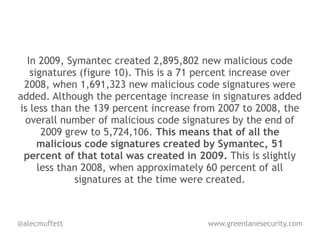
In 2009, Symantec created 2,895,802 new malicious code
   signatures (figure 10). This is a 71 percent increase over
 2008, when 1,691,323 new malicious code signatures were
added. Although the percentage increase in signatures added
is less than the 139 percent increase from 2007 to 2008, the
 overall number of malicious code signatures by the end of
      2009 grew to 5,724,106. This means that of all the
     malicious code signatures created by Symantec, 51
 percent of that total was created in 2009. This is slightly
     less than 2008, when approximately 60 percent of all
             signatures at the time were created.


@alecmuffett                            www.greenlanesecurity.com
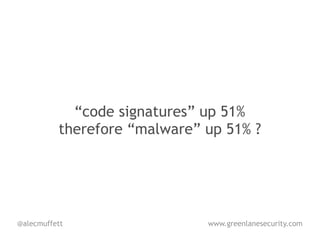
“code signatures” up 51%
          therefore “malware” up 51% ?


@alecmuffett                  www.greenlanesecurity.com
it doesn’t work like that.


@alecmuffett                       www.greenlanesecurity.com
(hint: “polymorphic” malware)


@alecmuffett                   www.greenlanesecurity.com
So: 55,000/day ?


@alecmuffett                 www.greenlanesecurity.com
http://goo.gl/M09Ik


                                     McAfee Threat Report:
                                      Fourth Quarter 2010


                      @alecmuffett                    www.greenlanesecurity.com
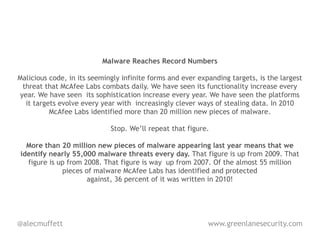
Malware Reaches Record Numbers

Malicious code, in its seemingly infinite forms and ever expanding targets, is the largest
 threat that McAfee Labs combats daily. We have seen its functionality increase every
year. We have seen its sophistication increase every year. We have seen the platforms
  it targets evolve every year with increasingly clever ways of stealing data. In 2010
          McAfee Labs identified more than 20 million new pieces of malware.

                             Stop. We’ll repeat that figure.

  More than 20 million new pieces of malware appearing last year means that we
identify nearly 55,000 malware threats every day. That figure is up from 2009. That
  figure is up from 2008. That figure is way up from 2007. Of the almost 55 million
             pieces of malware McAfee Labs has identified and protected
                     against, 36 percent of it was written in 2010!


@alecmuffett                                                www.greenlanesecurity.com
politicians & generals are using
            glossy marketing reports
                to bolster strategy?


@alecmuffett                    www.greenlanesecurity.com
UK Government response ?


@alecmuffett                     www.greenlanesecurity.com
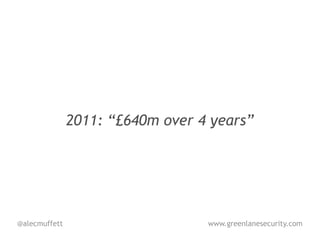
2011: “£640m over 4 years”


@alecmuffett                      www.greenlanesecurity.com
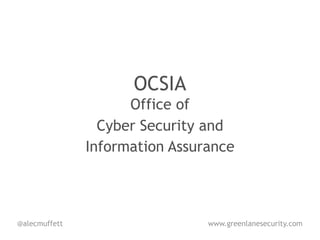
OCSIA
                     Office of
                 Cyber Security and
               Information Assurance


@alecmuffett                    www.greenlanesecurity.com
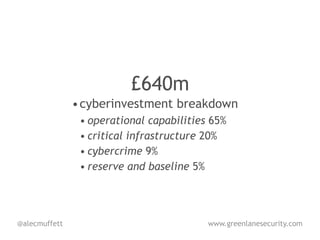
£640m
               • cyberinvestment breakdown
                • operational capabilities 65%
                • critical infrastructure 20%
                • cybercrime 9%
                • reserve and baseline 5%


@alecmuffett                              www.greenlanesecurity.com
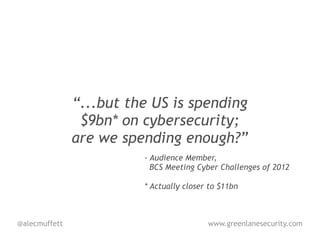
“...but the US is spending
                $9bn* on cybersecurity;
               are we spending enough?”
                         - Audience Member,
                           BCS Meeting Cyber Challenges of 2012

                         * Actually closer to $11bn


@alecmuffett                              www.greenlanesecurity.com
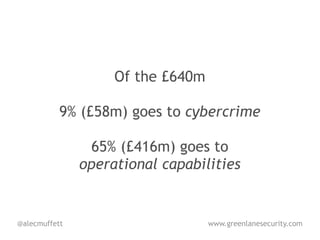
Of the £640m

           9% (£58m) goes to cybercrime

                65% (£416m) goes to
               operational capabilities


@alecmuffett                       www.greenlanesecurity.com
do the proportions reflect
                 the perceived threats?


@alecmuffett                       www.greenlanesecurity.com
6
 harmful to evolution of network security


@alecmuffett                www.greenlanesecurity.com
there is clearly some reality
                     to cybersecurity


@alecmuffett                        www.greenlanesecurity.com
CNI: Critical National Infrastructure


@alecmuffett                  www.greenlanesecurity.com
CNI Events


@alecmuffett                www.greenlanesecurity.com
1941: Battle of the Atlantic


@alecmuffett                        www.greenlanesecurity.com
1943: Dambusters


@alecmuffett                 www.greenlanesecurity.com
Gulf Wars: Iraq Power Stations


@alecmuffett                    www.greenlanesecurity.com
...pursuant to an invasion, or
             with a kinetic component


@alecmuffett                     www.greenlanesecurity.com
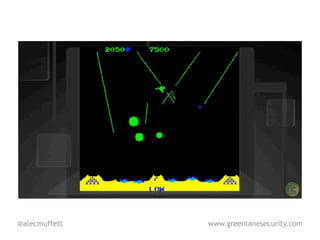
“The Enemy will crash our systems
             and then bomb us”


@alecmuffett                 www.greenlanesecurity.com
@alecmuffett   www.greenlanesecurity.com
Maybe-CNI Events
               • 2007: Estonia
                • no banks, services, food
               • 2009: Russia/Ukraine Gas
                • people freezing


@alecmuffett                                 www.greenlanesecurity.com
Non-CNI Events
               • 2011: Aurora/GMail
                • espionage
                 • who died?
                 • what service was lost?
                 • where did a bomb go off?


@alecmuffett                                  www.greenlanesecurity.com
Nonetheless there is clearly
           some risk of being blindsided


@alecmuffett                    www.greenlanesecurity.com
there is land-war


@alecmuffett                  www.greenlanesecurity.com
there is sea-war


@alecmuffett                  www.greenlanesecurity.com
there is air-war


@alecmuffett                  www.greenlanesecurity.com
so there is cyber-war...
   but it should not dominate all strategy


@alecmuffett                 www.greenlanesecurity.com
compare: air supremacy


@alecmuffett                    www.greenlanesecurity.com
military cybersecurity?


@alecmuffett                     www.greenlanesecurity.com
You might ask:
          where’s the harm in overall
        cyberspace/security philosophy?


@alecmuffett                  www.greenlanesecurity.com
If not to the exclusion of all others?


@alecmuffett                   www.greenlanesecurity.com
1) expansion of the state


@alecmuffett                      www.greenlanesecurity.com
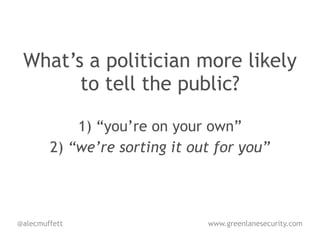
What’s a politician more likely
       to tell the public?

            1) “you’re on your own”
        2) “we’re sorting it out for you”


@alecmuffett                   www.greenlanesecurity.com
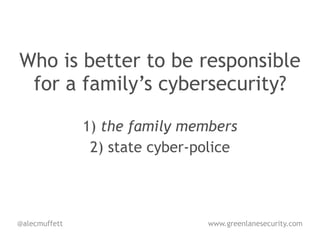
Who is better to be responsible
 for a family’s cybersecurity?

               1) the family members
                2) state cyber-police


@alecmuffett                    www.greenlanesecurity.com
2) interference in evolution/education


@alecmuffett                 www.greenlanesecurity.com
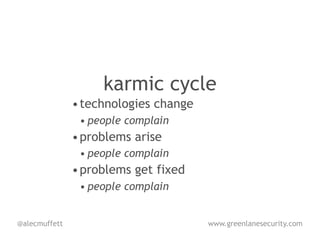
karmic cycle
               • technologies change
                • people complain
               • problems arise
                • people complain
               • problems get fixed
                • people complain


@alecmuffett                           www.greenlanesecurity.com
people always complain,
                but they use and learn.


@alecmuffett                     www.greenlanesecurity.com
3) tunnel vision


@alecmuffett                  www.greenlanesecurity.com
eg: an alternative spending model


@alecmuffett                  www.greenlanesecurity.com
...it’s actually a terrible idea -
         do not share this with people...


@alecmuffett                     www.greenlanesecurity.com
if we’re worried about viruses...


@alecmuffett                   www.greenlanesecurity.com
why not make anti-virus/anti-malware
          available on the NHS?


@alecmuffett              www.greenlanesecurity.com
free at the point of use


@alecmuffett                      www.greenlanesecurity.com
distributed to all citizens


@alecmuffett                        www.greenlanesecurity.com
pick what is suitable for your needs


@alecmuffett                   www.greenlanesecurity.com
run “flu jab”-like information campaigns


@alecmuffett                www.greenlanesecurity.com
no huge centralised IT project


@alecmuffett                    www.greenlanesecurity.com
a great idea,
             to the extent limited by
          bureaucracy, goals and targets


@alecmuffett                   www.greenlanesecurity.com
ie: this specific idea would be doomed...


@alecmuffett                www.greenlanesecurity.com
...and any Government project
      to lead security would be likewise?


@alecmuffett                  www.greenlanesecurity.com
But if you could address security
    efficiently, in a distributed manner...


@alecmuffett                   www.greenlanesecurity.com
then why instead spend
               taxpayer money centrally?


@alecmuffett                      www.greenlanesecurity.com
Perhaps cybersecurity isn’t actually
        about protecting the public?


@alecmuffett                  www.greenlanesecurity.com
Perhaps it’s about Government spending?


@alecmuffett               www.greenlanesecurity.com
But that would mean it’s rubbish.


@alecmuffett                  www.greenlanesecurity.com
QED


@alecmuffett         www.greenlanesecurity.com
discuss?


@alecmuffett              www.greenlanesecurity.com
@alecmuffett


@alecmuffett                  www.greenlanesecurity.com

How To Think Clearly About Cybersecurity v2

  • 1.
    how to thinkclearly about (cyber) security @alecmuffett www.alecmuffett.com green lane security www.greenlanesecurity.com v2.0 @alecmuffett www.greenlanesecurity.com
  • 2.
    how to thinkclearly about security @alecmuffett www.greenlanesecurity.com
  • 3.
    how to thinkclearly about cybersecurity @alecmuffett www.greenlanesecurity.com
  • 4.
    why cybersecurity isrubbish @alecmuffett www.greenlanesecurity.com
  • 5.
    ...a bit toopolemical? @alecmuffett www.greenlanesecurity.com
  • 6.
    thesis: @alecmuffett www.greenlanesecurity.com
  • 7.
    1 there is a word cybersecurity @alecmuffett www.greenlanesecurity.com
  • 8.
    2 this word is both a metaphor and a model for thinking about the challenges of information and network security @alecmuffett www.greenlanesecurity.com
  • 9.
    3 this model,with perhaps one exception, is unsuited to describe the challenges of information and network security @alecmuffett www.greenlanesecurity.com
  • 10.
    4 this model has been adopted by state actors as key to discussion and/or strategic consideration of information and network security @alecmuffett www.greenlanesecurity.com
  • 11.
    5 strategy based upon this model tends to be misconceived, expensive, and of an illiberal nature @alecmuffett www.greenlanesecurity.com
  • 12.
    6 unless diluted with other perspectives, this model is a lever for increased state control of information and network security that will harm the evolution of the field @alecmuffett www.greenlanesecurity.com
  • 13.
    end thesis @alecmuffett www.greenlanesecurity.com
  • 14.
    thesis defence @alecmuffett www.greenlanesecurity.com
  • 15.
    1 cybersecurity: what does it mean? @alecmuffett www.greenlanesecurity.com
  • 16.
    @alecmuffett www.greenlanesecurity.com
  • 17.
    UN TIL R ECE N TLY @alecmuffett www.greenlanesecurity.com
  • 18.
    a long timeago in a novel far far away... @alecmuffett www.greenlanesecurity.com
  • 19.
  • 20.
    cyberspace @alecmuffett www.greenlanesecurity.com
  • 21.
    not cybernetic @alecmuffett www.greenlanesecurity.com
  • 22.
  • 23.
    virtual reality, a real virtuality @alecmuffett www.greenlanesecurity.com
  • 24.
    hackers movie @alecmuffett www.greenlanesecurity.com
  • 25.
  • 26.
  • 27.
    cyberpunk @alecmuffett www.greenlanesecurity.com
  • 28.
  • 29.
  • 30.
  • 31.
    hollywood bandwagon @alecmuffett www.greenlanesecurity.com
  • 32.
    cyber-everything! @alecmuffett www.greenlanesecurity.com
  • 33.
    cybercrime @alecmuffett www.greenlanesecurity.com
  • 34.
    cybercriminals @alecmuffett www.greenlanesecurity.com
  • 35.
    cybersex @alecmuffett www.greenlanesecurity.com
  • 36.
    cyberchildren “digital natives” @alecmuffett www.greenlanesecurity.com
  • 37.
    cyberbullying @alecmuffett www.greenlanesecurity.com
  • 38.
    cyberterrorists @alecmuffett www.greenlanesecurity.com
  • 39.
    cyberattacks @alecmuffett www.greenlanesecurity.com
  • 40.
    cyberwarfare @alecmuffett www.greenlanesecurity.com
  • 41.
    cyberweapons @alecmuffett www.greenlanesecurity.com
  • 42.
    cyberspies @alecmuffett www.greenlanesecurity.com
  • 43.
    cyberespionage @alecmuffett www.greenlanesecurity.com
  • 44.
    ...and so forth @alecmuffett www.greenlanesecurity.com
  • 45.
    AN OBSERVATION @alecmuffett www.greenlanesecurity.com
  • 46.
    word prefixes ... @alecmuffett www.greenlanesecurity.com
  • 47.
    digital, virtual =interesting, virtuous @alecmuffett www.greenlanesecurity.com
  • 48.
    virtual reality @alecmuffett www.greenlanesecurity.com
  • 49.
    e-something = dull @alecmuffett www.greenlanesecurity.com
  • 50.
    e-mail @alecmuffett www.greenlanesecurity.com
  • 51.
    iSomething @alecmuffett www.greenlanesecurity.com
  • 52.
    iPrefer this logo @alecmuffett www.greenlanesecurity.com
  • 53.
    cyber = bad/profane? @alecmuffett www.greenlanesecurity.com
  • 54.
    are we meantor predisposed to dislike ‘cyber’ ? @alecmuffett www.greenlanesecurity.com
  • 55.
    * “information superhighway” was always boring @alecmuffett www.greenlanesecurity.com
  • 56.
    pop(@stack); @alecmuffett www.greenlanesecurity.com
  • 57.
    2 what model does it represent? @alecmuffett www.greenlanesecurity.com
  • 58.
    not cyber-space @alecmuffett www.greenlanesecurity.com
  • 59.
    but cyber-space @alecmuffett www.greenlanesecurity.com
  • 60.
    a near-tangible virtualworld @alecmuffett www.greenlanesecurity.com
  • 61.
    described as aspace @alecmuffett www.greenlanesecurity.com
  • 62.
    people meet ina space @alecmuffett www.greenlanesecurity.com
  • 63.
    battles are foughtin a space @alecmuffett www.greenlanesecurity.com
  • 64.
    wars are wagedin a space @alecmuffett www.greenlanesecurity.com
  • 65.
    humans understand space @alecmuffett www.greenlanesecurity.com
  • 66.
    underlying assumption isthat cyberspace is sufficiently like realspace and much the same rules can apply @alecmuffett www.greenlanesecurity.com
  • 67.
    alas... @alecmuffett www.greenlanesecurity.com
  • 68.
    3 themodel is a mostly-bad fit to reality? @alecmuffett www.greenlanesecurity.com
  • 69.
    cyberspace is notlike realspace @alecmuffett www.greenlanesecurity.com
  • 70.
    example 1: theft @alecmuffett www.greenlanesecurity.com
  • 71.
    cyberspace theft isnot commutative @alecmuffett www.greenlanesecurity.com
  • 72.
    theft in realspace • if I steal your phone • you no longer have it • it is gone @alecmuffett www.greenlanesecurity.com
  • 73.
    theft in cyberspace • if I steal your data • you still have it • unless I also destroy your copies • assuming you haven’t backed-up your data • you no longer have secrecy • not the same as “loss” @alecmuffett www.greenlanesecurity.com
  • 74.
    later debate: is intellectual property theft actually theft (ie: crime) ... @alecmuffett www.greenlanesecurity.com
  • 75.
    ... or isit like copyright infringement and/or patent infringement (ie: typically a tort)? @alecmuffett www.greenlanesecurity.com
  • 76.
    (ask a lawyer.pay him.) @alecmuffett www.greenlanesecurity.com
  • 77.
    example 2: cybersize @alecmuffett www.greenlanesecurity.com
  • 78.
    “An area ofInternet the size of Wales is dedicated to cybercrime!” @alecmuffett www.greenlanesecurity.com
  • 79.
    social media asa country: Twitter @alecmuffett www.greenlanesecurity.com
  • 80.
    @AlecMuffett ~ 1,662 followers @alecmuffett www.greenlanesecurity.com
  • 81.
    @MailOnline ~61,024 followers @alecmuffett www.greenlanesecurity.com
  • 82.
    @GuardianNews ~321,287 followers @alecmuffett www.greenlanesecurity.com
  • 83.
    Can a casefor newspaper regulation to be applied to newspaper twitterers? @alecmuffett www.greenlanesecurity.com
  • 84.
    @StephenFry ~3,965,799 followers @alecmuffett www.greenlanesecurity.com
  • 85.
    Why regulate newspapers& journalists on Twitter, yet not regulate Stephen Fry? @alecmuffett www.greenlanesecurity.com
  • 86.
    answer: @alecmuffett www.greenlanesecurity.com
  • 87.
    On Twitter everyone is precisely the same size 0 = no twitter account 1 = twitter account @alecmuffett www.greenlanesecurity.com
  • 88.
    On Twitter everyone has equal capability tweet, or not-tweet, that is the question @alecmuffett www.greenlanesecurity.com
  • 89.
    On Twitter some have much greater reach which is not the same thing as size* * especially not “size of Wales” @alecmuffett www.greenlanesecurity.com
  • 90.
    a maths/compsci analogy: @alecmuffett www.greenlanesecurity.com
  • 91.
    wp:directed_graph @alecmuffett www.greenlanesecurity.com
  • 92.
    graph theory → euclidean geometry → twitter @alecmuffett www.greenlanesecurity.com
  • 93.
    a node/vertex/twitterer isa point - ie: of zero dimension - hence all twitterers are the same size @alecmuffett www.greenlanesecurity.com
  • 94.
    a line/edge/follow isthat which joins two nodes/twitterers @alecmuffett www.greenlanesecurity.com
  • 95.
    the degree ofa twitterer is the number of followers, the number of people with whom you communicate @alecmuffett www.greenlanesecurity.com
  • 96.
    the only metricson twitter • volume • number of tweets • indegree • number of followers • outdegree • number of people you follow @alecmuffett www.greenlanesecurity.com
  • 97.
    so which ofthese three metrics should trigger state regulation of your twitterfeed? @alecmuffett www.greenlanesecurity.com
  • 98.
    regulation? @alecmuffett www.greenlanesecurity.com
  • 99.
    if none, perhapsregulation should pertain to the author & his message rather than the medium @alecmuffett www.greenlanesecurity.com
  • 100.
    if the mediumis irrelevant and open, why discuss regulation of the medium rather than of its users? @alecmuffett www.greenlanesecurity.com
  • 101.
    example 3: sovereignty @alecmuffett www.greenlanesecurity.com
  • 102.
    “Where are theboundaries of British (or American, etc) Cyberspace?” @alecmuffett www.greenlanesecurity.com
  • 103.
    (we will returnto this) @alecmuffett www.greenlanesecurity.com
  • 104.
    precis society is still adjusting to the net @alecmuffett www.greenlanesecurity.com
  • 105.
    4 what model has the state adopted? @alecmuffett www.greenlanesecurity.com
  • 106.
    2012 - 1984= 28 @alecmuffett www.greenlanesecurity.com
  • 107.
    @alecmuffett www.greenlanesecurity.com
  • 108.
    @alecmuffett www.greenlanesecurity.com
  • 109.
    if it isa place, it can be policed @alecmuffett www.greenlanesecurity.com
  • 110.
    if it isa theatre, war can be prosecuted @alecmuffett www.greenlanesecurity.com
  • 111.
    EXPERIMENT @alecmuffett www.greenlanesecurity.com
  • 112.
    http://www.cpni.gov.uk/threats/cyber-threats/ Cyberspace lies at the heart of modern society; it impacts our personal lives, our businesses and our essential services. Cyber security embraces both the public and the private sector and spans a broad range of issues related to national security, whether through terrorism, crime or industrial espionage. E-crime, or cyber-crime, whether relating to theft, hacking or denial of service to vital systems, has become a fact of life. The risk of industrial cyber espionage, in which one company makes active attacks on another, through cyberspace, to acquire high value information is also very real. Cyber terrorism presents challenges for the future. We have to be prepared for terrorists seeking to take advantage of our increasing internet dependency to attack or disable key systems. @alecmuffett www.greenlanesecurity.com
  • 113.
    posit: internet → communications @alecmuffett www.greenlanesecurity.com
  • 114.
    replace: cyberspace → telephoneworld cyber → phone @alecmuffett www.greenlanesecurity.com
  • 115.
    http://dropsafe.crypticide.com/article/4933 Telephoneworld lies at the heart of modern society; it impacts our personal lives, our businesses and our essential services. Phone security embraces both the public and the private sector and spans a broad range of issues related to national security, whether through terrorism, crime or industrial espionage. E-crime, or phone-crime, whether relating to theft, hacking or denial of service to vital systems, has become a fact of life. The risk of industrial phone espionage, in which one company makes active attacks on another, through Telephoneworld, to acquire high value information is also very real. Phone terrorism presents challenges for the future. We have to be prepared for terrorists seeking to take advantage of our increasing communications dependency to attack or disable key systems. @alecmuffett www.greenlanesecurity.com
  • 116.
    The UK mustcontrol master Telephoneworld! Cyberspace! the Internet! @alecmuffett www.greenlanesecurity.com
  • 117.
    If cyberspace iscommunication... @alecmuffett www.greenlanesecurity.com
  • 118.
    to control communication: • you must define it • ...and/or... • you must inhibit it @alecmuffett www.greenlanesecurity.com
  • 119.
    to define communication • propaganda • a bad word in government lingo • also marketing & public relations @alecmuffett www.greenlanesecurity.com
  • 120.
    to inhibit communication • censorship • likewise a bad word @alecmuffett www.greenlanesecurity.com
  • 121.
    it’s safest forgovernment to pretend that cyberspace is a space filled with bad people @alecmuffett www.greenlanesecurity.com
  • 122.
    metaphor drives perception @alecmuffett www.greenlanesecurity.com
  • 123.
    land → army @alecmuffett www.greenlanesecurity.com
  • 124.
    sea → navy @alecmuffett www.greenlanesecurity.com
  • 125.
    sky → airforce @alecmuffett www.greenlanesecurity.com
  • 126.
    cyberspace → currentlyup for grabs @alecmuffett www.greenlanesecurity.com
  • 127.
    to achieve mastery the internet must be widely perceived as a space which can be policed, as a battleground in which war may be prosecuted... @alecmuffett www.greenlanesecurity.com
  • 128.
    ...but (first) whatare its boundaries? @alecmuffett www.greenlanesecurity.com
  • 129.
    “Where are theboundaries of British (etc) Cyberspace?” @alecmuffett www.greenlanesecurity.com
  • 130.
    depends on whatyou mean by: “Boundary” “British” @alecmuffett www.greenlanesecurity.com
  • 131.
    is British Cyberspacethe union of every Briton’s ability to communicate? @alecmuffett www.greenlanesecurity.com
  • 132.
    ...then Stephen Fryis very large indeed. @alecmuffett www.greenlanesecurity.com
  • 133.
    is cyberspace theboundary of storage of every and all Britons’ data? @alecmuffett www.greenlanesecurity.com
  • 134.
    ...then British Cyberspaceextends into GMail and Facebook servers in the USA. @alecmuffett www.greenlanesecurity.com
  • 135.
    is British Cyberspacethe sum over digital/cyberactivities of all Britons? @alecmuffett www.greenlanesecurity.com
  • 136.
    ...then the stateseeks to limit legal (or, currently non-criminal) activities and reduce liberties of only its citizenry @alecmuffett www.greenlanesecurity.com
  • 137.
    Government is curiouslyunwilling to clarify the matter of boundaries. @alecmuffett www.greenlanesecurity.com
  • 138.
  • 139.
    example quotes: @alecmuffett www.greenlanesecurity.com
  • 140.
    http://goo.gl/MXCsG - computerworld The cost of cybercrime to the global economy is estimated at $1 trillion [US General Keith] Alexander stated and malware is being introduced at a rate of 55,000 pieces per day, or one per second. @alecmuffett www.greenlanesecurity.com
  • 141.
    http://goo.gl/nGPvW - computerworld The annual cost of cybercrime is about $388 billion, including money and time lost, said Brian Tillett, chief security strategist at Symantec. That’s about $100 billion more than the global black market trade in heroin, cocaine and marijuana combined, he said. @alecmuffett www.greenlanesecurity.com
  • 142.
    http://goo.gl/A14px - symantec Symantec’s Math • $388bn = • $114bn “cost” + • $274bn “lost time” @alecmuffett www.greenlanesecurity.com
  • 143.
    http://goo.gl/qrmDn - detica Cabinet Office “In our most-likely scenario, we estimate the cost of cyber crime to the UK to be £27bn per annum” @alecmuffett www.greenlanesecurity.com
  • 144.
    http://goo.gl/eQcVS - itpro ITpro Cyber criminals will cost the UK economy an estimated £1.9 billion in 2011, according to a Symantec report. @alecmuffett www.greenlanesecurity.com
  • 145.
    $1000bn vs: $388bnvs: $114bn? £27bn vs: £1.9bn ? @alecmuffett www.greenlanesecurity.com
  • 146.
    wtf? @alecmuffett www.greenlanesecurity.com
  • 147.
    http://goo.gl/AJMMX - cabinetoffice @alecmuffett www.greenlanesecurity.com
  • 148.
    “the £27bn report” @alecmuffett www.greenlanesecurity.com
  • 149.
    http://goo.gl/vKk3S - detica The theft of Intellectual Property (IP) from business, which has the greatest economic impact of any type of cyber crime is estimated to be £9.2bn per annum. p18 @alecmuffett www.greenlanesecurity.com
  • 150.
    This gave anoverall figure for fiscal fraud by cyber criminals of £2.2bn. p19 @alecmuffett www.greenlanesecurity.com
  • 151.
    Our total estimatefor industrial espionage is £7.6bn p20 @alecmuffett www.greenlanesecurity.com
  • 152.
    Overall, we estimatethe most likely impact [of online theft is] £1.3bn per annum, with the best and worst case estimates £1.0bn and £2.7bn respectively. p21 @alecmuffett www.greenlanesecurity.com
  • 153.
    Cyber crime Economic impact Identity theft £1.7bn Online fraud £1.4bn Scareware & fake AV £30m p18 @alecmuffett www.greenlanesecurity.com
  • 154.
    @alecmuffett www.greenlanesecurity.com
  • 155.
    but... @alecmuffett www.greenlanesecurity.com
  • 156.
    “The proportion ofIP actually stolen cannot at present be measured with any degree of confidence” p16 @alecmuffett www.greenlanesecurity.com
  • 157.
    “It is veryhard to determine what proportion of industrial espionage is due to cyber crime” p16 @alecmuffett www.greenlanesecurity.com
  • 158.
    “Our assessments arenecessarily based on assumptions and informed judgements rather than specific examples of cybercrime, or from data of a classified or commercially sensitive origin” p5 @alecmuffett www.greenlanesecurity.com
  • 159.
    also, do youremember... @alecmuffett www.greenlanesecurity.com
  • 160.
    US: “malware isbeing introduced at a rate of 55,000 pieces per day” @alecmuffett www.greenlanesecurity.com
  • 161.
    The UK versionis... @alecmuffett www.greenlanesecurity.com
  • 162.
    http://goo.gl/YwjT0 You just have to look at some of the figures, in fact over 50%, just about 51% of the malicious software threats that have been ever identified, were identified in 2009. Theresa May, Today Programme, Oct 2010 @alecmuffett www.greenlanesecurity.com
  • 163.
    http://goo.gl/vK331 Symantec “Global Internet Security Threat Report - Trends for 2009” @alecmuffett www.greenlanesecurity.com
  • 164.
    In 2009, Symanteccreated 2,895,802 new malicious code signatures (figure 10). This is a 71 percent increase over 2008, when 1,691,323 new malicious code signatures were added. Although the percentage increase in signatures added is less than the 139 percent increase from 2007 to 2008, the overall number of malicious code signatures by the end of 2009 grew to 5,724,106. This means that of all the malicious code signatures created by Symantec, 51 percent of that total was created in 2009. This is slightly less than 2008, when approximately 60 percent of all signatures at the time were created. @alecmuffett www.greenlanesecurity.com
  • 165.
    “code signatures” up51% therefore “malware” up 51% ? @alecmuffett www.greenlanesecurity.com
  • 166.
    it doesn’t worklike that. @alecmuffett www.greenlanesecurity.com
  • 167.
  • 168.
    So: 55,000/day ? @alecmuffett www.greenlanesecurity.com
  • 169.
    http://goo.gl/M09Ik McAfee Threat Report: Fourth Quarter 2010 @alecmuffett www.greenlanesecurity.com
  • 170.
    Malware Reaches RecordNumbers Malicious code, in its seemingly infinite forms and ever expanding targets, is the largest threat that McAfee Labs combats daily. We have seen its functionality increase every year. We have seen its sophistication increase every year. We have seen the platforms it targets evolve every year with increasingly clever ways of stealing data. In 2010 McAfee Labs identified more than 20 million new pieces of malware. Stop. We’ll repeat that figure. More than 20 million new pieces of malware appearing last year means that we identify nearly 55,000 malware threats every day. That figure is up from 2009. That figure is up from 2008. That figure is way up from 2007. Of the almost 55 million pieces of malware McAfee Labs has identified and protected against, 36 percent of it was written in 2010! @alecmuffett www.greenlanesecurity.com
  • 171.
    politicians & generalsare using glossy marketing reports to bolster strategy? @alecmuffett www.greenlanesecurity.com
  • 172.
    UK Government response? @alecmuffett www.greenlanesecurity.com
  • 173.
    2011: “£640m over4 years” @alecmuffett www.greenlanesecurity.com
  • 174.
    OCSIA Office of Cyber Security and Information Assurance @alecmuffett www.greenlanesecurity.com
  • 175.
    £640m • cyberinvestment breakdown • operational capabilities 65% • critical infrastructure 20% • cybercrime 9% • reserve and baseline 5% @alecmuffett www.greenlanesecurity.com
  • 176.
    “...but the USis spending $9bn* on cybersecurity; are we spending enough?” - Audience Member, BCS Meeting Cyber Challenges of 2012 * Actually closer to $11bn @alecmuffett www.greenlanesecurity.com
  • 177.
    Of the £640m 9% (£58m) goes to cybercrime 65% (£416m) goes to operational capabilities @alecmuffett www.greenlanesecurity.com
  • 178.
    do the proportionsreflect the perceived threats? @alecmuffett www.greenlanesecurity.com
  • 179.
    6 harmful toevolution of network security @alecmuffett www.greenlanesecurity.com
  • 180.
    there is clearlysome reality to cybersecurity @alecmuffett www.greenlanesecurity.com
  • 181.
    CNI: Critical NationalInfrastructure @alecmuffett www.greenlanesecurity.com
  • 182.
    CNI Events @alecmuffett www.greenlanesecurity.com
  • 183.
    1941: Battle ofthe Atlantic @alecmuffett www.greenlanesecurity.com
  • 184.
    1943: Dambusters @alecmuffett www.greenlanesecurity.com
  • 185.
    Gulf Wars: IraqPower Stations @alecmuffett www.greenlanesecurity.com
  • 186.
    ...pursuant to aninvasion, or with a kinetic component @alecmuffett www.greenlanesecurity.com
  • 187.
    “The Enemy willcrash our systems and then bomb us” @alecmuffett www.greenlanesecurity.com
  • 188.
    @alecmuffett www.greenlanesecurity.com
  • 189.
    Maybe-CNI Events • 2007: Estonia • no banks, services, food • 2009: Russia/Ukraine Gas • people freezing @alecmuffett www.greenlanesecurity.com
  • 190.
    Non-CNI Events • 2011: Aurora/GMail • espionage • who died? • what service was lost? • where did a bomb go off? @alecmuffett www.greenlanesecurity.com
  • 191.
    Nonetheless there isclearly some risk of being blindsided @alecmuffett www.greenlanesecurity.com
  • 192.
    there is land-war @alecmuffett www.greenlanesecurity.com
  • 193.
    there is sea-war @alecmuffett www.greenlanesecurity.com
  • 194.
    there is air-war @alecmuffett www.greenlanesecurity.com
  • 195.
    so there iscyber-war... but it should not dominate all strategy @alecmuffett www.greenlanesecurity.com
  • 196.
    compare: air supremacy @alecmuffett www.greenlanesecurity.com
  • 197.
    military cybersecurity? @alecmuffett www.greenlanesecurity.com
  • 198.
    You might ask: where’s the harm in overall cyberspace/security philosophy? @alecmuffett www.greenlanesecurity.com
  • 199.
    If not tothe exclusion of all others? @alecmuffett www.greenlanesecurity.com
  • 200.
    1) expansion ofthe state @alecmuffett www.greenlanesecurity.com
  • 201.
    What’s a politicianmore likely to tell the public? 1) “you’re on your own” 2) “we’re sorting it out for you” @alecmuffett www.greenlanesecurity.com
  • 202.
    Who is betterto be responsible for a family’s cybersecurity? 1) the family members 2) state cyber-police @alecmuffett www.greenlanesecurity.com
  • 203.
    2) interference inevolution/education @alecmuffett www.greenlanesecurity.com
  • 204.
    karmic cycle • technologies change • people complain • problems arise • people complain • problems get fixed • people complain @alecmuffett www.greenlanesecurity.com
  • 205.
    people always complain, but they use and learn. @alecmuffett www.greenlanesecurity.com
  • 206.
    3) tunnel vision @alecmuffett www.greenlanesecurity.com
  • 207.
    eg: an alternativespending model @alecmuffett www.greenlanesecurity.com
  • 208.
    ...it’s actually aterrible idea - do not share this with people... @alecmuffett www.greenlanesecurity.com
  • 209.
    if we’re worriedabout viruses... @alecmuffett www.greenlanesecurity.com
  • 210.
    why not makeanti-virus/anti-malware available on the NHS? @alecmuffett www.greenlanesecurity.com
  • 211.
    free at thepoint of use @alecmuffett www.greenlanesecurity.com
  • 212.
    distributed to allcitizens @alecmuffett www.greenlanesecurity.com
  • 213.
    pick what issuitable for your needs @alecmuffett www.greenlanesecurity.com
  • 214.
    run “flu jab”-likeinformation campaigns @alecmuffett www.greenlanesecurity.com
  • 215.
    no huge centralisedIT project @alecmuffett www.greenlanesecurity.com
  • 216.
    a great idea, to the extent limited by bureaucracy, goals and targets @alecmuffett www.greenlanesecurity.com
  • 217.
    ie: this specificidea would be doomed... @alecmuffett www.greenlanesecurity.com
  • 218.
    ...and any Governmentproject to lead security would be likewise? @alecmuffett www.greenlanesecurity.com
  • 219.
    But if youcould address security efficiently, in a distributed manner... @alecmuffett www.greenlanesecurity.com
  • 220.
    then why insteadspend taxpayer money centrally? @alecmuffett www.greenlanesecurity.com
  • 221.
    Perhaps cybersecurity isn’tactually about protecting the public? @alecmuffett www.greenlanesecurity.com
  • 222.
    Perhaps it’s aboutGovernment spending? @alecmuffett www.greenlanesecurity.com
  • 223.
    But that wouldmean it’s rubbish. @alecmuffett www.greenlanesecurity.com
  • 224.
    QED @alecmuffett www.greenlanesecurity.com
  • 225.
    discuss? @alecmuffett www.greenlanesecurity.com
  • 226.
    @alecmuffett @alecmuffett www.greenlanesecurity.com