How to Serve Blockchain Data With AWS Lambda
August 17, 2018
2
Assumptions For Time
•Familiar with Blockchains such as
Bitcoin

•Familiar with AWS

•Familiar with Relational and NoSQL
Databases
3
Don’t worry
There is a blog post
https://verypossible.com/blog/how-to-serve-blockchain-data-on-the-web
4
Block Chains are Different
• Data Retrieval via Remote Procedure Calls (RPC)

• Setup and maintain server

• Different from RESTful APIs and managed databases
5
• Unspent Transaction Output (UTXO) Model

• Bitcoin

• No accounts, senders, receivers, etc. Only transactions

• Transactions are formed of inputs and outputs

• Inputs for a transaction are the output of a previous
transaction

• Account Model

• Ethereum

• Accounts can have their own signature verification algorithm

• Allows for Decentralized Apps (dapps)
Transaction Data Structure
6
UTXO Explained By Example
• Alice needs to pay Bob for renting his car

• Both have public/private encryption key pair for signing transactions

• Alice has unspent Bitcoin from Dan

• Alice has 0.25 Bitcoin

• Alice owes Bob 0.1 Bitcoin
7
• Alice signs her UTXO from Dan to prove ownership

• This is the input to the new transaction

• Bob receives 0.1 Bitcoin for the car rental

• Bob can now use this to pay someone else

• Alice receives 0.15 Bitcoin

• This output gives Alice change for paying Bob

• The whole transaction had to be signed
Transferring the Funds
8
The Transaction
{
"version": 1,
"locktime": 0,
"vin": [
{
"txid": "7957a35fe64f80d234d76d83a2a8f1a0d8149a41d81de548f0a65a8a999f6f18",
"vout": 0,
"scriptSig" : “3045022100884d142d86652a3f47ba…[ALL] 0484ecc0d46f1918b30928fa0e4ed99f16a0fb4f…”,
"sequence": 4294967295
}
],
"vout": [
{
"value": 0.15000000,
"scriptPubKey": "OP_DUP OP_HASH160 ab68025513c3dbd2f7b92a94e0581f5d50f654e7 OP_EQUALVERIFY OP_CHECKSIG"
},
{
"value": 0.10000000,
"scriptPubKey": "OP_DUP OP_HASH160 7f9b1a7fb68d60c536c2fd8aeaa53a8f3cc025a8 OP_EQUALVERIFY OP_CHECKSIG",
}
]
}
9
Remote Procedure Calls (RPC)
• Execute code that is not a part of your program

• Requires the application to be running

• Need to maintain a server to retrieve data
10
• Need to download entire chain on first boot

• For our project and chain this took about 30 minutes

• Need to configure indexes

• Each node has to sync

• Need to protect against catastrophic failure
Standing Up the Blockchain
11
What Documentation?
• Bitcoin and Ethereum have good documentation

• Forked chains, like QTUM, have poor documentation

• Will have to search more for correct documentation
Investing in Mining Operation with Automated Distributions
Recently we were tasked with building an investment management platform for a
cryptocurrency mining service. Clients would send funds to the investment address
and would receive a portion of mining rewards. The system needed to accept
investments from multiple addresses for one client, show them a balance of their
entire investment, allocate a portion of mining rewards to their account, and graph
the balance growth over time. We needed to initially support a web interface and
later support a native mobile application with wallet integration for easier
investment. As always, the service needed the ability to scale to demand and be
highly available.

TheUseCase
12
13
The Architecture
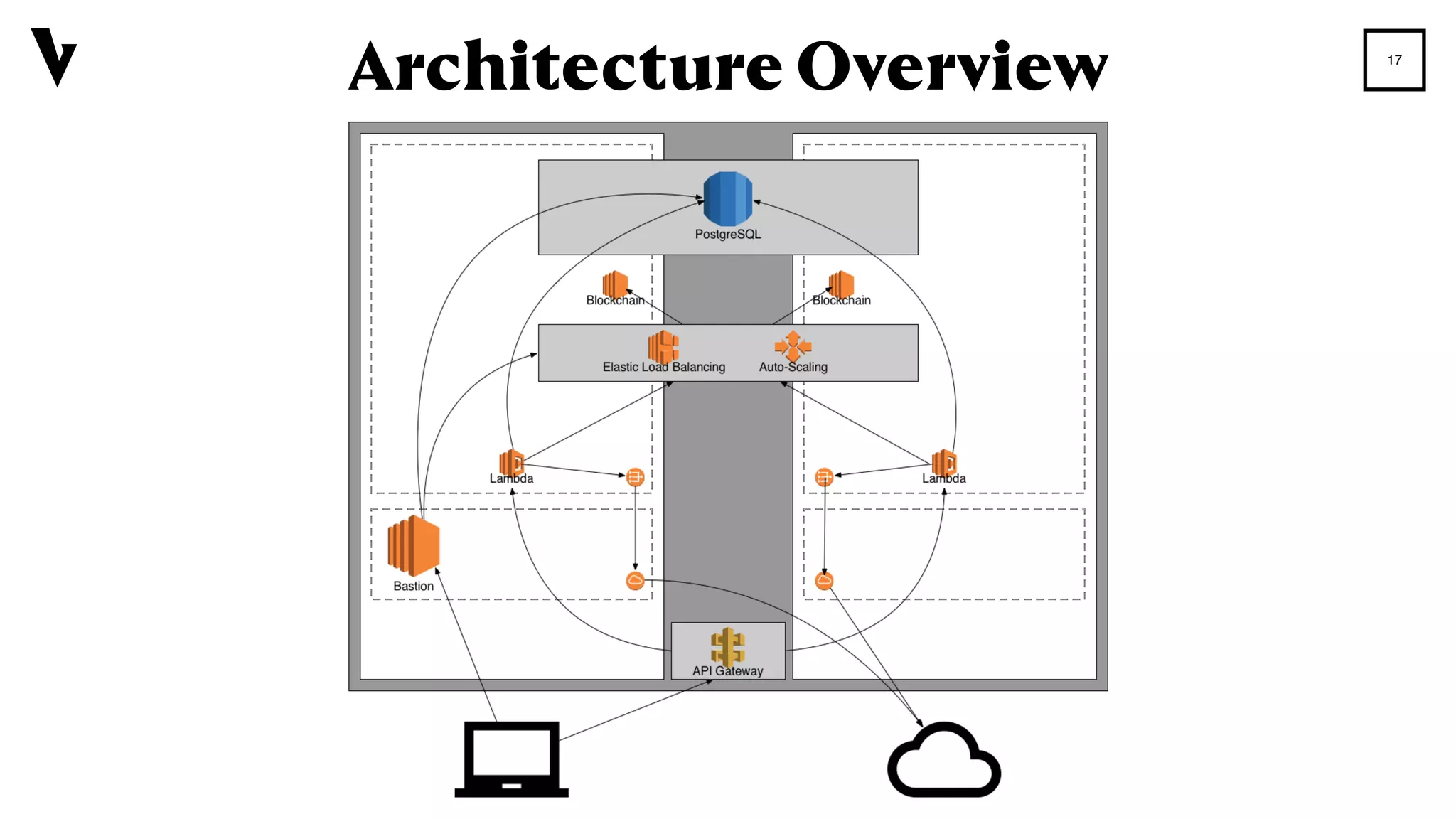
• Serverless API on Lambda written in Python

• PostgreSQL database managed by RDS

• React SPA Deployed to S3 with CloudFront Distribution
14
• Two EC2 instances

• Load Balancer with Auto Scaling Group

• EBS-backed AMI
Adding the Blockchain
15
Automate Everything!
• Packer to create AMI for Blockchain Nodes

• CloudFormation

• Stacker to setup entire infrastructure

• EC2 instances

• Load Balancer with Auto Scaling Groups

• Database with RDS

• Virtual Private Cloud (VPC) for networking

• Serverless to deploy Lambda Functions
16
• Automated testing using CircleCI

• Deployment executes only for Master

• Deploy Lambda Functions

• Execute Database Migrations
Ship It
17
Architecture Overview
18
Lessons Learned
• Lambda is powerful but can be painful in development

• No hot reloading

• Cannot test entire stack locally because of dependency 

on API Gateway

• Debugging is difficult

• CloudWatch logs leave much to be desired

• Lambda Cold Starts
19
• Each Engineer deployed their own Lambda functions

• Only functions that were updated were deployed

• Still had issues with only using one database
How We Reacted
20
Show me the Data
• Connect to the node using python-bitcoinrpc
21
Requesting Data
from bitcoinrpc.authproxy import AuthServiceProxy, JSONRPCException
import json
# rpc_user and rpc_password are set in the bitcoin.conf file
rpc = AuthServiceProxy("http://%s:%s@127.0.0.1:8332"%(rpc_user, rpc_password))
payload = {
'addresses': ['INSERT ADDRESS HERE'],
'start': STARTING BLOCK,
'end': ENDING BLOCK,
}
deltas = rpc.getaddressdeltas(json.dumps(payload))
print(deltas)
22
The Result
[
{
"satoshis": 1,
"txid": "TRANSACTION ID",
"index": 2,
"blockindex": 236,
"height": 220151,
"address": "INSERT ADDRESS HERE"
},
{
"satoshis": 30000,
"txid": "TRANSACTION ID",
"index": 0,
"blockindex": 165,
"height": 228208,
"address": "INSERT ADDRESS HERE"
}
]
Thank You
https://verypossible.com/blog/how-to-serve-blockchain-data-on-the-web

How to Serve Blockchain Data with AWS Lambda

  • 1.
    How to ServeBlockchain Data With AWS Lambda August 17, 2018
  • 2.
    2 Assumptions For Time •Familiarwith Blockchains such as Bitcoin •Familiar with AWS •Familiar with Relational and NoSQL Databases
  • 3.
    3 Don’t worry There isa blog post https://verypossible.com/blog/how-to-serve-blockchain-data-on-the-web
  • 4.
    4 Block Chains areDifferent • Data Retrieval via Remote Procedure Calls (RPC) • Setup and maintain server • Different from RESTful APIs and managed databases
  • 5.
    5 • Unspent TransactionOutput (UTXO) Model • Bitcoin • No accounts, senders, receivers, etc. Only transactions • Transactions are formed of inputs and outputs • Inputs for a transaction are the output of a previous transaction • Account Model • Ethereum • Accounts can have their own signature verification algorithm • Allows for Decentralized Apps (dapps) Transaction Data Structure
  • 6.
    6 UTXO Explained ByExample • Alice needs to pay Bob for renting his car • Both have public/private encryption key pair for signing transactions • Alice has unspent Bitcoin from Dan • Alice has 0.25 Bitcoin • Alice owes Bob 0.1 Bitcoin
  • 7.
    7 • Alice signsher UTXO from Dan to prove ownership • This is the input to the new transaction • Bob receives 0.1 Bitcoin for the car rental • Bob can now use this to pay someone else • Alice receives 0.15 Bitcoin • This output gives Alice change for paying Bob • The whole transaction had to be signed Transferring the Funds
  • 8.
    8 The Transaction { "version": 1, "locktime":0, "vin": [ { "txid": "7957a35fe64f80d234d76d83a2a8f1a0d8149a41d81de548f0a65a8a999f6f18", "vout": 0, "scriptSig" : “3045022100884d142d86652a3f47ba…[ALL] 0484ecc0d46f1918b30928fa0e4ed99f16a0fb4f…”, "sequence": 4294967295 } ], "vout": [ { "value": 0.15000000, "scriptPubKey": "OP_DUP OP_HASH160 ab68025513c3dbd2f7b92a94e0581f5d50f654e7 OP_EQUALVERIFY OP_CHECKSIG" }, { "value": 0.10000000, "scriptPubKey": "OP_DUP OP_HASH160 7f9b1a7fb68d60c536c2fd8aeaa53a8f3cc025a8 OP_EQUALVERIFY OP_CHECKSIG", } ] }
  • 9.
    9 Remote Procedure Calls(RPC) • Execute code that is not a part of your program • Requires the application to be running • Need to maintain a server to retrieve data
  • 10.
    10 • Need todownload entire chain on first boot • For our project and chain this took about 30 minutes • Need to configure indexes • Each node has to sync • Need to protect against catastrophic failure Standing Up the Blockchain
  • 11.
    11 What Documentation? • Bitcoinand Ethereum have good documentation • Forked chains, like QTUM, have poor documentation • Will have to search more for correct documentation
  • 12.
    Investing in MiningOperation with Automated Distributions Recently we were tasked with building an investment management platform for a cryptocurrency mining service. Clients would send funds to the investment address and would receive a portion of mining rewards. The system needed to accept investments from multiple addresses for one client, show them a balance of their entire investment, allocate a portion of mining rewards to their account, and graph the balance growth over time. We needed to initially support a web interface and later support a native mobile application with wallet integration for easier investment. As always, the service needed the ability to scale to demand and be highly available. TheUseCase 12
  • 13.
    13 The Architecture • ServerlessAPI on Lambda written in Python • PostgreSQL database managed by RDS • React SPA Deployed to S3 with CloudFront Distribution
  • 14.
    14 • Two EC2instances • Load Balancer with Auto Scaling Group • EBS-backed AMI Adding the Blockchain
  • 15.
    15 Automate Everything! • Packerto create AMI for Blockchain Nodes • CloudFormation • Stacker to setup entire infrastructure • EC2 instances • Load Balancer with Auto Scaling Groups • Database with RDS • Virtual Private Cloud (VPC) for networking • Serverless to deploy Lambda Functions
  • 16.
    16 • Automated testingusing CircleCI • Deployment executes only for Master • Deploy Lambda Functions • Execute Database Migrations Ship It
  • 17.
  • 18.
    18 Lessons Learned • Lambdais powerful but can be painful in development • No hot reloading • Cannot test entire stack locally because of dependency 
 on API Gateway • Debugging is difficult • CloudWatch logs leave much to be desired • Lambda Cold Starts
  • 19.
    19 • Each Engineerdeployed their own Lambda functions • Only functions that were updated were deployed • Still had issues with only using one database How We Reacted
  • 20.
    20 Show me theData • Connect to the node using python-bitcoinrpc
  • 21.
    21 Requesting Data from bitcoinrpc.authproxyimport AuthServiceProxy, JSONRPCException import json # rpc_user and rpc_password are set in the bitcoin.conf file rpc = AuthServiceProxy("http://%s:%s@127.0.0.1:8332"%(rpc_user, rpc_password)) payload = { 'addresses': ['INSERT ADDRESS HERE'], 'start': STARTING BLOCK, 'end': ENDING BLOCK, } deltas = rpc.getaddressdeltas(json.dumps(payload)) print(deltas)
  • 22.
    22 The Result [ { "satoshis": 1, "txid":"TRANSACTION ID", "index": 2, "blockindex": 236, "height": 220151, "address": "INSERT ADDRESS HERE" }, { "satoshis": 30000, "txid": "TRANSACTION ID", "index": 0, "blockindex": 165, "height": 228208, "address": "INSERT ADDRESS HERE" } ]
  • 23.