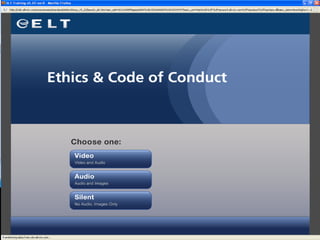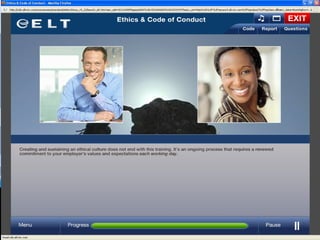
2011 Ethics and Compliance Training: A Guided Tour of  ELT’s Ethics and Code of Conduct Online Compliance Course
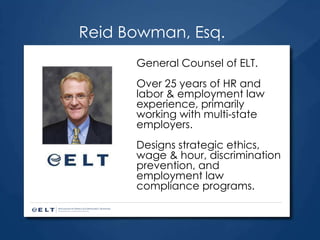
Reid Bowman, Esq. General Counsel of ELT.  Over 25 years of HR and labor & employment law experience, primarily working with multi-state employers. Designs strategic ethics, wage & hour, discrimination prevention, and employment law compliance programs.
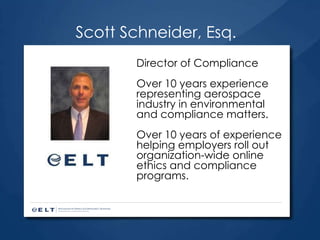
Scott Schneider, Esq. Director of Compliance  Over 10 years experience representing aerospace industry in environmental and compliance matters. Over 10 years of experience helping employers roll out organization-wide online ethics and compliance programs.
Legal Requirements for Ethics & Code of Conduct Training Translating the legal requirements: a demonstration of ELT’s Ethics & Code of Conduct Training course  Ethics & Code of Conduct Best Practices Agenda
A Question for You? Which best describes your organization’s ethics training efforts: Not thinking about it yet In the process of reviewing options We’ve selected a resource but are waiting to implement Already started training
Legal Requirements  for Ethics & Code of Conduct Training
Laws that Mandate Training key drivers for training: The Sarbanes-Oxley Act of 2002 (SOX). The 2004 Federal Sentencing Guidelines Amendments (FSGs). 2007 & 2008 amendments to the Federal Acquisition Regulations (FAR).   Code distribution is not enough. 3
The Federal Sentencing Guidelines Rules that set out a uniform sentencing  policy for defendants . U.S. SENTENCING GUIDELINES, § 8B2.1 introductory Committee.  What? Who? How? Why?
The Federal Sentencing Guidelines All organizations,  whether privately or publicly held Must provide all employees and managers with  effective  and “ periodic ” ethics and legal compliance training. Quality matters. Training must be ongoing. 2004 Amendments to Federal Sentencing Guidelines What? Who? How? Why?
The Federal Sentencing Guidelines Training audience is  broad Must Train  members of the governing authority, high-level personnel, substantial authority personnel, the organization's employees, and, as appropriate, the organization's agents . Across the organization What? Who? How? Why?
The Federal Sentencing Guidelines The Guidelines specifically  reference the need to conduct   “effective training programs ."  Distributing a Code of Conduct  is  not  enough . What? Who? How? Why?
The Federal Sentencing Guidelines “ The potential fine range … can be significantly reduced  –  in some cases up to 95%  – if an organization can demonstrate that it had put in place an effective compliance and ethics program.”   UNITED STATES SENTENCING COMM.,  AN OVERVIEW OF THE ORGANIZATION  GUIDELINES (2004). What? Who? How? Why?
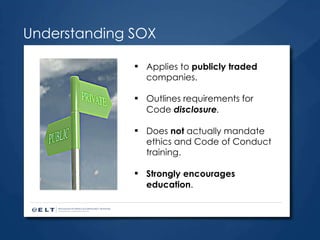
Understanding SOX Applies to  publicly traded  companies. Outlines requirements for Code  disclosure . Does  not  actually mandate ethics and Code of Conduct training. Strongly encourages education .
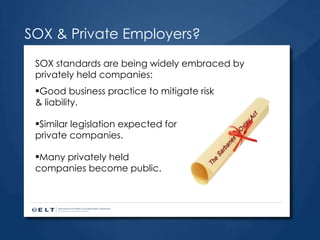
SOX & Private Employers? SOX standards are being widely embraced by privately held companies: Good business practice to mitigate risk  & liability. Similar legislation expected for  private companies. Many privately held  companies become public.
Apply to contracts  worth $5 million or more  and which require at least 120 days to perform. Must develop a written Code of Ethics and Business Conduct within 30 days of the contract award;  and  Must promote compliance within 90 days after the award  by establishing an employee ethics and compliance training program.   The Federal Acquisition Regulations 2007 and 2008 Amendments to FAR
The Federal Acquisition Regulations Must  train everyone  – not just the people actually involved in executing the government contract. Requirement flows through to  subcontractors. Requires broad-based Code training  – not just on the regulations or how to do business with the government. Training must be  “ongoing.” 2007 and 2008 Amendments to FAR
So what does this really mean? Basically…  FSG requirements now applied to government contractors through amendments to  FAR
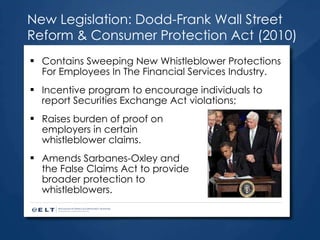
New Legislation: Dodd-Frank Wall Street Reform & Consumer Protection Act (2010) Contains Sweeping New Whistleblower Protections For Employees In The Financial Services Industry.  Incentive program to encourage individuals to report Securities Exchange Act violations;  Raises burden of proof on  employers in certain  whistleblower claims.  Amends Sarbanes-Oxley and  the False Claims Act to provide  broader protection to  whistleblowers.
+  Demonstration
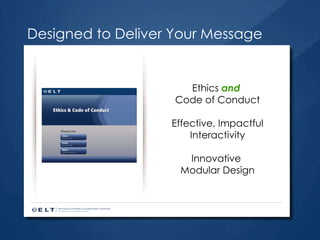
Designed to Deliver Your Message Ethics  and   Code of Conduct Effective, Impactful Interactivity Innovative  Modular Design
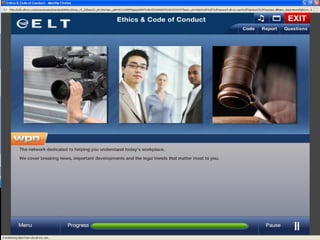
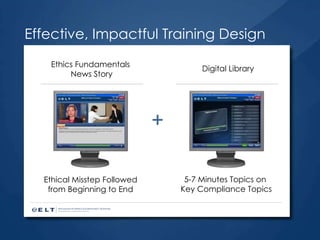
Effective, Impactful Training Design Ethics Fundamentals  News Story Digital Library 5-7 Minutes Topics on  Key Compliance Topics + Ethical Misstep Followed from Beginning to End
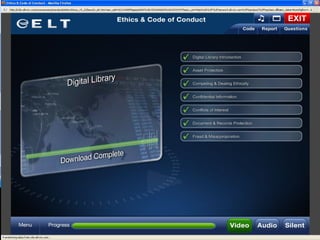
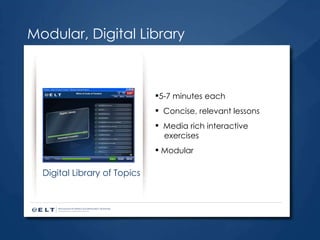
Modular, Digital Library 5-7 minutes each Concise, relevant lessons Media rich interactive    exercises Modular  Digital Library of Topics
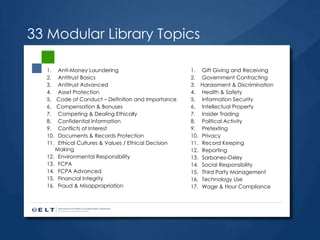
33 Modular Library Topics Anti-Money Laundering Antitrust Basics Antitrust Advanced Asset Protection Code of Conduct – Definition and Importance Compensation & Bonuses Competing & Dealing Ethically Confidential Information Conflicts of Interest Documents & Records Protection Ethical Cultures & Values / Ethical Decision Making Environmental Responsibility FCPA  FCPA Advanced Financial Integrity  Fraud & Misappropriation  Gift Giving and Receiving Government Contracting Harassment & Discrimination  Health & Safety Information Security Intellectual Property Insider Trading Political Activity Pretexting Privacy Record Keeping Reporting Sarbanes-Oxley  Social Responsibility Third Party Management Technology Use Wage & Hour Compliance
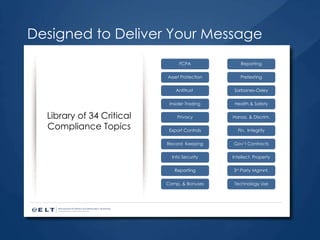
Designed to Deliver Your Message Library of 34 Critical Compliance Topics FCPA Insider Trading Export Controls Info Security Reporting Comp. & Bonuses Reporting Sarbanes-Oxley Health & Safety Harass. & Discrim. Fin.  Integrity Gov’t Contracts Intellect. Property Asset Protection Antitrust  Privacy Record  Keeping Pretexting 3 rd  Party Mgmnt. Technology Use
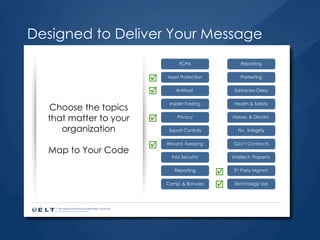
Designed to Deliver Your Message Choose the topics that matter to your organization Map to Your Code Asset Protection Antitrust  Privacy Record  Keeping 3 rd  Party Mgmnt. Technology Use       FCPA Insider Trading Export Controls Info Security Reporting Comp. & Bonuses Reporting Sarbanes-Oxley Health & Safety Harass. & Discrim. Fin.  Integrity Gov’t Contracts Intellect. Property Pretexting
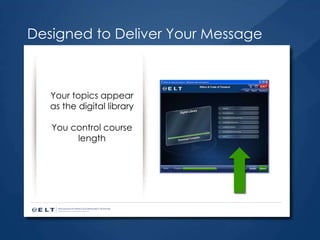
Designed to Deliver Your Message Your topics appear as the digital library You control course length
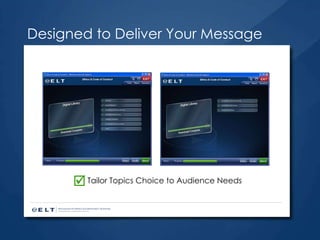
Designed to Deliver Your Message Tailor Topics Choice to Audience Needs 
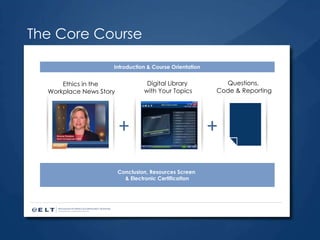
The Core Course + + Ethics in the  Workplace News Story Digital Library  with Your Topics Questions,  Code & Reporting Introduction & Course Orientation Conclusion, Resources Screen  & Electronic Certification
Ethics and Code Best Practices
Strategies for Success Secure  high level sponsorship:  HR, Legal, Employee Relations, Risk Management, IT. Carefully manage the “buy in” process; designate a  clear project owner. Mandate  the training with a top down directive.
Carefully manage the  customization  process – balancing the “wish list” against time, expense and viability. Set  clear goals and metrics   for: Completion rates. Employee feedback. Reduced claims & liability. Behavior change.  Strategies for Success
Implement Effective Training:  Invest in a focused set of quality courses you can really use. Strategies for Success
A Question for You? If your organization may be interested in  purchasing  ELT’s online training solutions, and you would like an  ELT Sales Executive  to follow up with you… Type "YES" in the box below.
Interested in our solutions?   [email_address] www.elt-inc.com  │ 877.358.4621    Additional substantive questions?   [email_address] [email_address]


How To Provide Superior Ethics Training

  • 1.
    2011 Ethics andCompliance Training: A Guided Tour of ELT’s Ethics and Code of Conduct Online Compliance Course
  • 2.
    Reid Bowman, Esq.General Counsel of ELT. Over 25 years of HR and labor & employment law experience, primarily working with multi-state employers. Designs strategic ethics, wage & hour, discrimination prevention, and employment law compliance programs.
  • 3.
    Scott Schneider, Esq.Director of Compliance Over 10 years experience representing aerospace industry in environmental and compliance matters. Over 10 years of experience helping employers roll out organization-wide online ethics and compliance programs.
  • 4.
    Legal Requirements forEthics & Code of Conduct Training Translating the legal requirements: a demonstration of ELT’s Ethics & Code of Conduct Training course Ethics & Code of Conduct Best Practices Agenda
  • 5.
    A Question forYou? Which best describes your organization’s ethics training efforts: Not thinking about it yet In the process of reviewing options We’ve selected a resource but are waiting to implement Already started training
  • 6.
    Legal Requirements for Ethics & Code of Conduct Training
  • 7.
    Laws that MandateTraining key drivers for training: The Sarbanes-Oxley Act of 2002 (SOX). The 2004 Federal Sentencing Guidelines Amendments (FSGs). 2007 & 2008 amendments to the Federal Acquisition Regulations (FAR). Code distribution is not enough. 3
  • 8.
    The Federal SentencingGuidelines Rules that set out a uniform sentencing policy for defendants . U.S. SENTENCING GUIDELINES, § 8B2.1 introductory Committee. What? Who? How? Why?
  • 9.
    The Federal SentencingGuidelines All organizations, whether privately or publicly held Must provide all employees and managers with effective and “ periodic ” ethics and legal compliance training. Quality matters. Training must be ongoing. 2004 Amendments to Federal Sentencing Guidelines What? Who? How? Why?
  • 10.
    The Federal SentencingGuidelines Training audience is broad Must Train members of the governing authority, high-level personnel, substantial authority personnel, the organization's employees, and, as appropriate, the organization's agents . Across the organization What? Who? How? Why?
  • 11.
    The Federal SentencingGuidelines The Guidelines specifically reference the need to conduct “effective training programs ." Distributing a Code of Conduct is not enough . What? Who? How? Why?
  • 12.
    The Federal SentencingGuidelines “ The potential fine range … can be significantly reduced – in some cases up to 95% – if an organization can demonstrate that it had put in place an effective compliance and ethics program.” UNITED STATES SENTENCING COMM., AN OVERVIEW OF THE ORGANIZATION GUIDELINES (2004). What? Who? How? Why?
  • 13.
    Understanding SOX Appliesto publicly traded companies. Outlines requirements for Code disclosure . Does not actually mandate ethics and Code of Conduct training. Strongly encourages education .
  • 14.
    SOX & PrivateEmployers? SOX standards are being widely embraced by privately held companies: Good business practice to mitigate risk & liability. Similar legislation expected for private companies. Many privately held companies become public.
  • 15.
    Apply to contracts worth $5 million or more and which require at least 120 days to perform. Must develop a written Code of Ethics and Business Conduct within 30 days of the contract award; and Must promote compliance within 90 days after the award by establishing an employee ethics and compliance training program. The Federal Acquisition Regulations 2007 and 2008 Amendments to FAR
  • 16.
    The Federal AcquisitionRegulations Must train everyone – not just the people actually involved in executing the government contract. Requirement flows through to subcontractors. Requires broad-based Code training – not just on the regulations or how to do business with the government. Training must be “ongoing.” 2007 and 2008 Amendments to FAR
  • 17.
    So what doesthis really mean? Basically… FSG requirements now applied to government contractors through amendments to FAR
  • 18.
    New Legislation: Dodd-FrankWall Street Reform & Consumer Protection Act (2010) Contains Sweeping New Whistleblower Protections For Employees In The Financial Services Industry. Incentive program to encourage individuals to report Securities Exchange Act violations; Raises burden of proof on employers in certain whistleblower claims. Amends Sarbanes-Oxley and the False Claims Act to provide broader protection to whistleblowers.
  • 19.
  • 20.
    Designed to DeliverYour Message Ethics and Code of Conduct Effective, Impactful Interactivity Innovative Modular Design
  • 21.
    Effective, Impactful TrainingDesign Ethics Fundamentals News Story Digital Library 5-7 Minutes Topics on Key Compliance Topics + Ethical Misstep Followed from Beginning to End
  • 22.
    Modular, Digital Library5-7 minutes each Concise, relevant lessons Media rich interactive exercises Modular Digital Library of Topics
  • 23.
    33 Modular LibraryTopics Anti-Money Laundering Antitrust Basics Antitrust Advanced Asset Protection Code of Conduct – Definition and Importance Compensation & Bonuses Competing & Dealing Ethically Confidential Information Conflicts of Interest Documents & Records Protection Ethical Cultures & Values / Ethical Decision Making Environmental Responsibility FCPA FCPA Advanced Financial Integrity Fraud & Misappropriation Gift Giving and Receiving Government Contracting Harassment & Discrimination Health & Safety Information Security Intellectual Property Insider Trading Political Activity Pretexting Privacy Record Keeping Reporting Sarbanes-Oxley Social Responsibility Third Party Management Technology Use Wage & Hour Compliance
  • 24.
    Designed to DeliverYour Message Library of 34 Critical Compliance Topics FCPA Insider Trading Export Controls Info Security Reporting Comp. & Bonuses Reporting Sarbanes-Oxley Health & Safety Harass. & Discrim. Fin. Integrity Gov’t Contracts Intellect. Property Asset Protection Antitrust Privacy Record Keeping Pretexting 3 rd Party Mgmnt. Technology Use
  • 25.
    Designed to DeliverYour Message Choose the topics that matter to your organization Map to Your Code Asset Protection Antitrust Privacy Record Keeping 3 rd Party Mgmnt. Technology Use       FCPA Insider Trading Export Controls Info Security Reporting Comp. & Bonuses Reporting Sarbanes-Oxley Health & Safety Harass. & Discrim. Fin. Integrity Gov’t Contracts Intellect. Property Pretexting
  • 26.
    Designed to DeliverYour Message Your topics appear as the digital library You control course length
  • 27.
    Designed to DeliverYour Message Tailor Topics Choice to Audience Needs 
  • 28.
    The Core Course+ + Ethics in the Workplace News Story Digital Library with Your Topics Questions, Code & Reporting Introduction & Course Orientation Conclusion, Resources Screen & Electronic Certification
  • 29.
    Ethics and CodeBest Practices
  • 30.
    Strategies for SuccessSecure high level sponsorship: HR, Legal, Employee Relations, Risk Management, IT. Carefully manage the “buy in” process; designate a clear project owner. Mandate the training with a top down directive.
  • 31.
    Carefully manage the customization process – balancing the “wish list” against time, expense and viability. Set clear goals and metrics for: Completion rates. Employee feedback. Reduced claims & liability. Behavior change. Strategies for Success
  • 32.
    Implement Effective Training: Invest in a focused set of quality courses you can really use. Strategies for Success
  • 33.
    A Question forYou? If your organization may be interested in purchasing ELT’s online training solutions, and you would like an ELT Sales Executive to follow up with you… Type "YES" in the box below.
  • 34.
    Interested in oursolutions? [email_address] www.elt-inc.com │ 877.358.4621 Additional substantive questions? [email_address] [email_address]
  • 35.
  • 36.
  • 37.
  • 38.
  • 39.

Editor's Notes

  • #15 While the Sarbanes-Oxley Act applies to publicly traded companies, the rules and guidelines that it established are being widely adopted by privately held companies for three reasons: Sarbanes-Oxley standards make for good business practice, adding value beyond simple "check the box" compliance. Many of the Sarbanes-Oxley requirements, can help to substantially mitigate risk and liability for privately held organizations; Sarbanes-Oxley type legislation is expected in the near future for privately held organizations. Leading employers are recognizing the opportunity to stay ahead of the compliance curve; and Many private companies become public companies!
  • #19 On July 21, 2010, President Obama signed into law the Dodd-Frank Wall Street Reform and Consumer Protection Act (Dodd-Frank Act) and its sweeping financial regulatory reforms. Included among the provisions is a new whistleblower program which provides substantial cash rewards for whistleblowers who voluntarily provide information to the Securities and Exchange Commission (SEC) leading to the successful prosecution of securities law violations. Whistleblowers who report securities violations, including violations of the Foreign Corrupt Practices Act (FCPA), that result in monetary sanctions greater than $1 million, may receive between 10 and 30 percent of the total recovery. The whistleblower provision also provides anti-retaliation protections, which permit civil causes of action for wrongful termination, suspension, harassment, or other discrimination because of the whistleblower’s reporting to the SEC. If successful, an anti-retaliation claim can result in reinstatement of seniority, two times the amount of back pay otherwise owed with interest, and compensation for litigation costs, expert witness fees and reasonable attorney’s fees. It is more important than ever that your organization should maintain effective internal reporting systems that offer employees an effective avenue by which to report their complaints to reduce the risk of employees reporting merely suspicious activity to the DOJ/SEC rather than through your internal complaint procedures, Employees should know where to go and who to report to reporting procedures, and made confident that their concerns will be taken seriously and adequately investigated.
  • #21 This course is brand new, just released. It uses an entirely new modular design and all new content. We are very excited to show it to you.
  • #22 Now lets turn our attention to the course itself. The Course features two different, but complimentary learning experiences. It starts with a News Story, very much in the style of CNN or Fox News or 60 Minutes. This part of the course features digital video and follows an individual managers as she makes an ethical misstep. We see how the misstep develops and the consequences for her, her fellow employees and the organization. The second part of the course is called the Digital Library. This part of the course is modular and presents learners with concise 5-7 minutes training topics – and as we will see – we give you the ability to choose which topics go into the course.
  • #23 Now on the Digital Library. This part of the course presents 5-7 minute topics on a variety of key compliance topics. These are designed to give your learners a basic understanding of the compliance topics and why they matter to the learner and your organization. The best part though is that this part of the course is totally modular. We created a library of 33 of these topics and allow you to pick and choose which are included in the course.
  • #24 Here we see the topics in the library. As you can see, they cover virtually all of the key compliance challenges organizations like yours face. Let me show you how the Digital Library works.
  • #25 Here we see a portion of the library for illustration. The library works like a menu.
  • #26 You tell us which topics you want to include in the course. If Antitrust is important to your organization, include it. If FCPA is not important, do not include it.
  • #27 We take the topics you select and we place in the Digital Library portion of the course. This means your learners will see only the topics you select.
  • #28 Finally, you can also change the topics over time – to address new compliance challenges as they emerge. You can also create different course versions. Here the course version on the left presents more topics – perhaps appropriate for your managers. The version on the right presents a smaller number of topics – perhaps appropriate for employees. You can see the flexibility in this course.
  • #29 Here you can see a schematic of the course’s architecture from 10,000 feet.
  • #31 E&COC training impacts the entire organization, in every way. To be successful, everyone must be “on board” Managing “buy in” can be difficult and tedious. One central project owner is essential. This is typically legal. A top down directive correlates directly with higher completion rates and better feedback on the training. (With e-learning, a custom, multi-media introduction is very powerful to communicate the directive.) Training on the Code should not be optional. Completion rates are abysmal for optional training – particularly optional compliance training. (ELT has statistics that validate this explicitly based on our 500+ clients and 1,000,000+ learners.) Having the training be optional also sends the wrong message about the importance of adherence to the Code.