How to improve
the quality of your application
A practical guide for developers
Wednesday 20th February 2019, JHUG Meetup Athens / Greece
Ioannis Kolaxis – Software Engineer / Senior Expert
1
@IoannisKolaxis
• Are you working for a software product, where …?
• New features take too much time to be implemented
• Customers keep complaining about bugs
Software quality issues
2
@IoannisKolaxis
• Can you improve the quality of your software?
• How?
What can you do?
3
@IoannisKolaxis
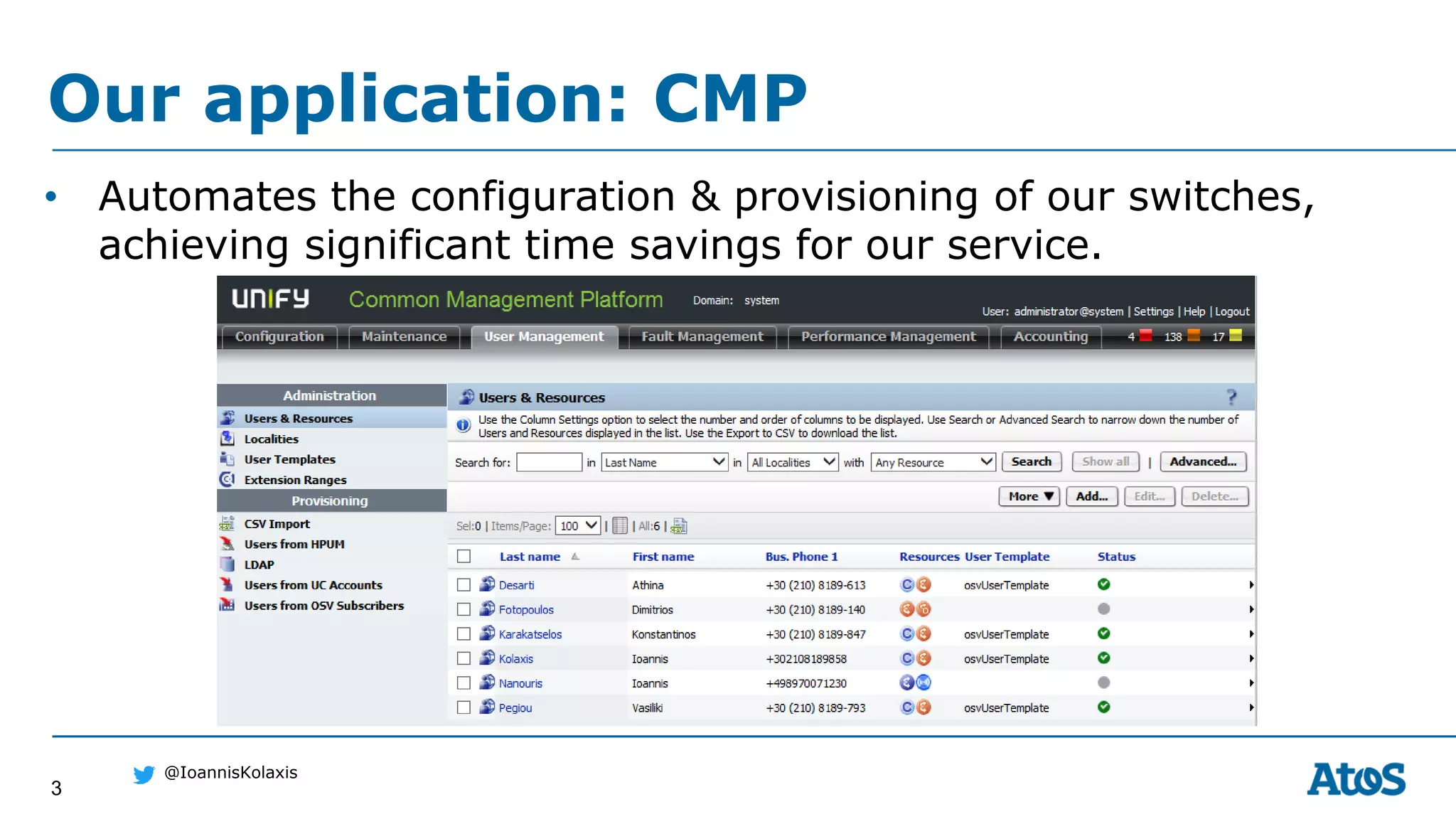
Our application: CMP
• Automates the configuration & provisioning of our switches,
achieving significant time savings for our service.
4
@IoannisKolaxis
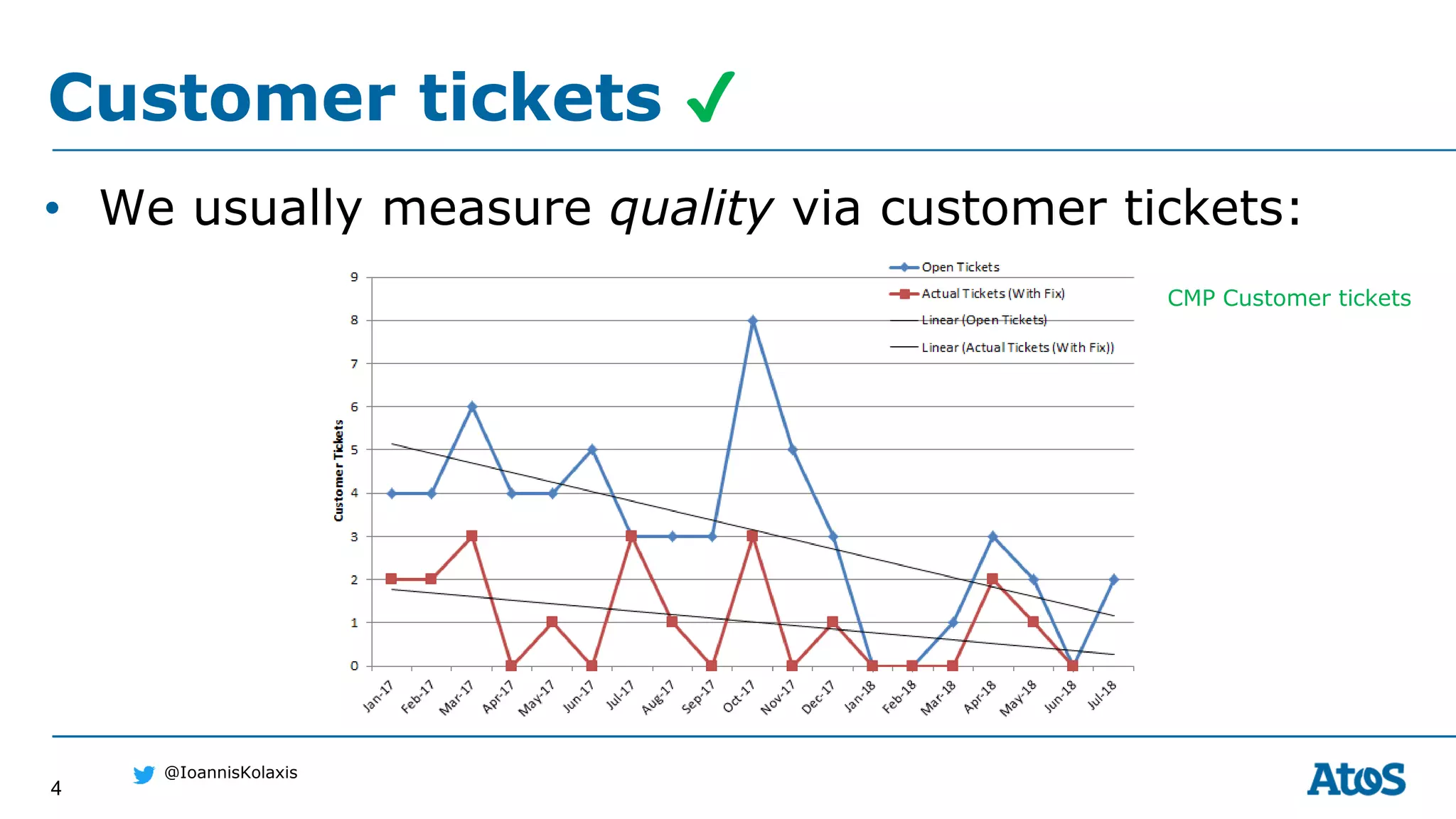
Customer tickets ✔
• We usually measure quality via customer tickets:
CMP Customer tickets
5
@IoannisKolaxis
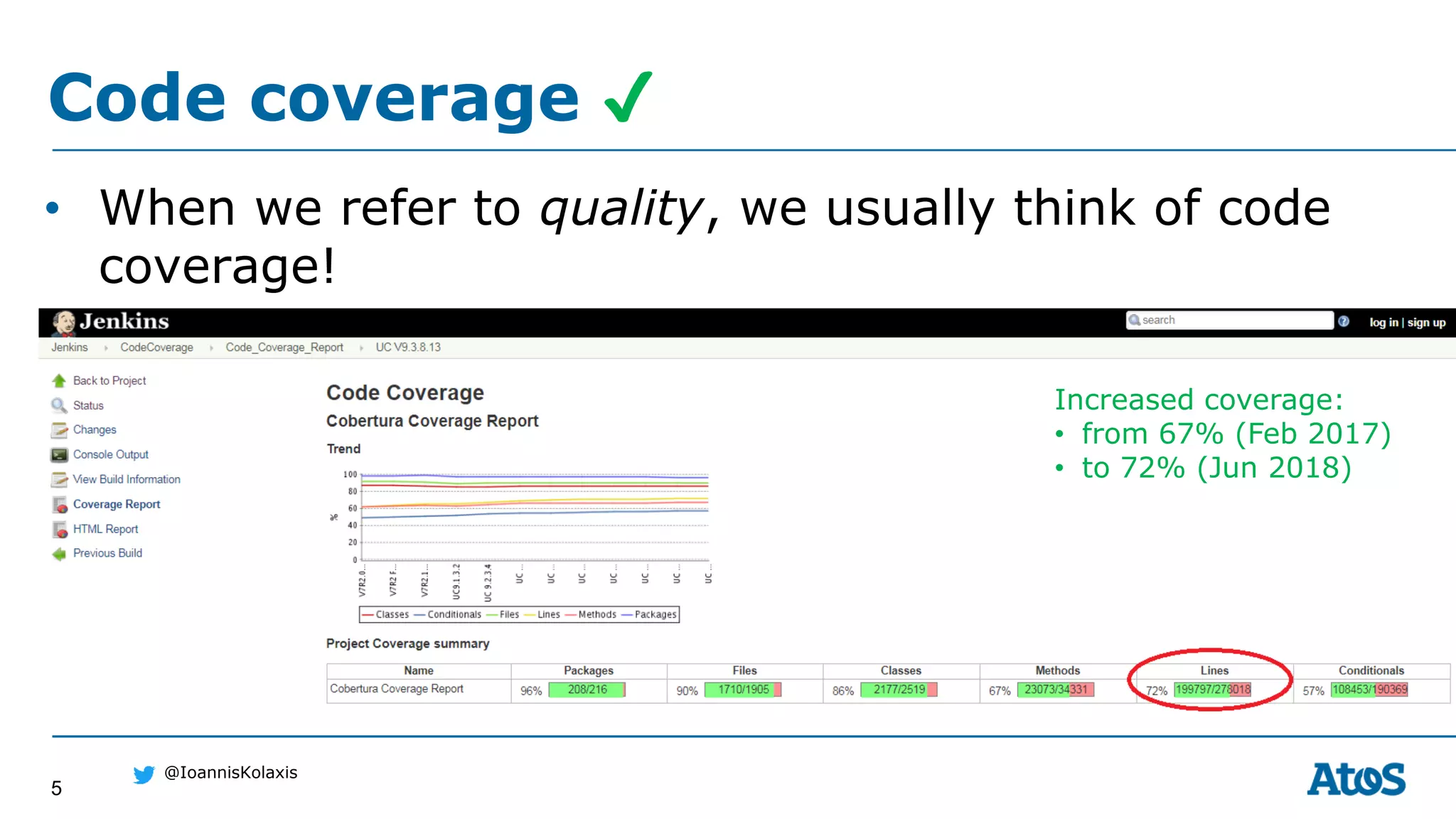
Code coverage ✔
• When we refer to quality, we usually think of code
coverage!
Increased coverage:
• from 67% (Feb 2017)
• to 72% (Jun 2018)
6
@IoannisKolaxis
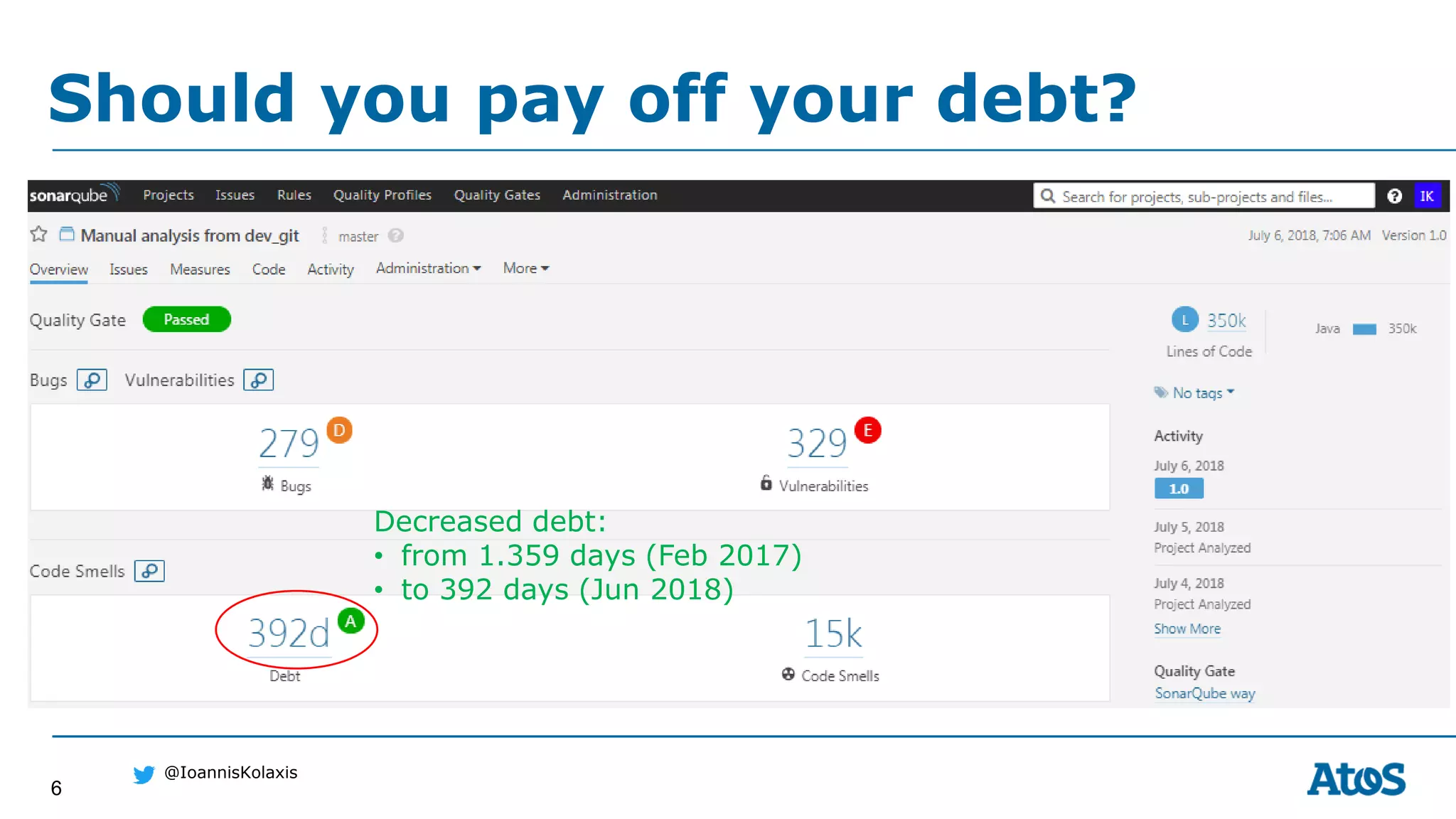
Should you pay off your debt?
Decreased debt:
• from 1.359 days (Feb 2017)
• to 392 days (Jun 2018)
7
@IoannisKolaxis
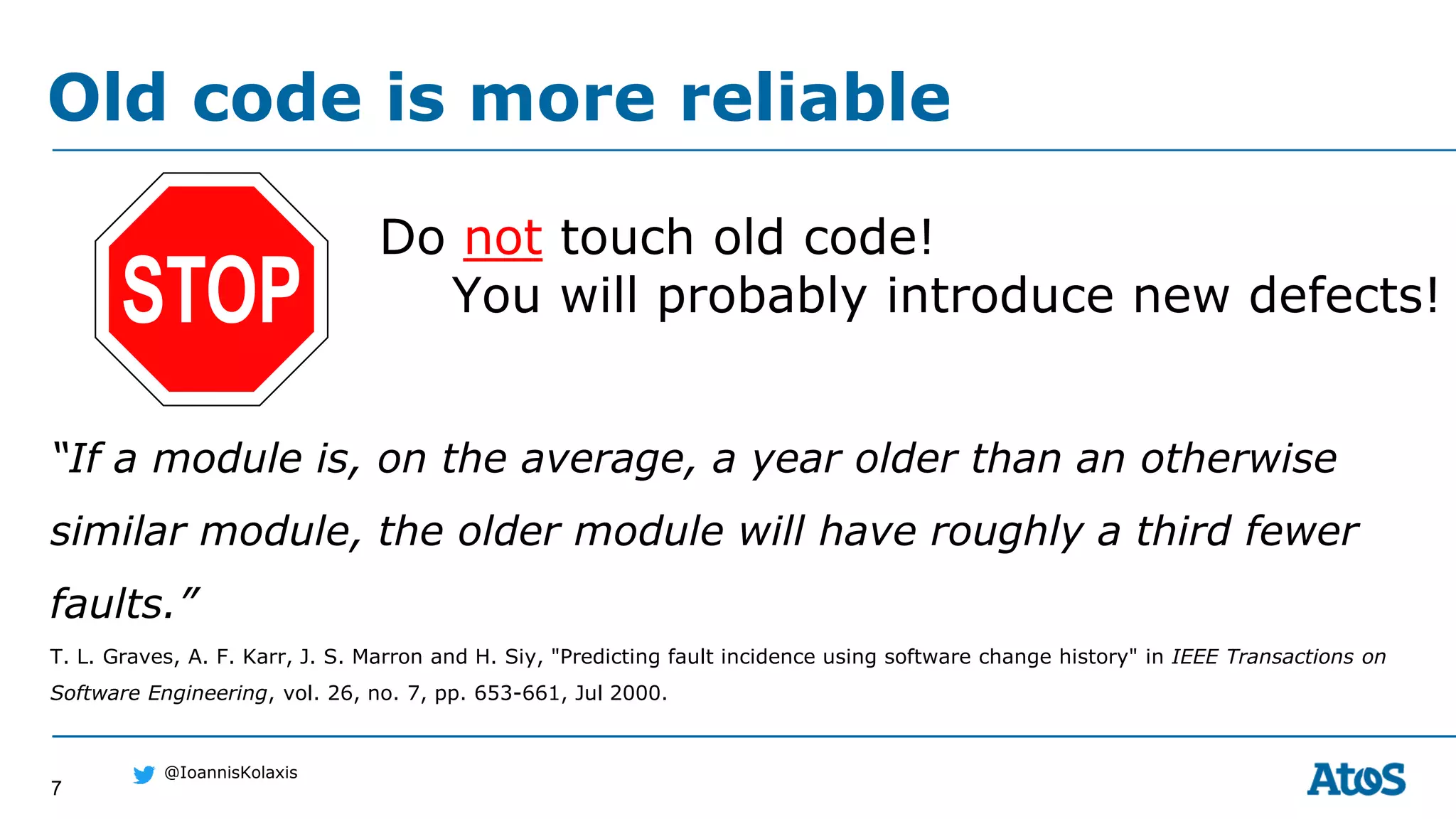
Do not touch old code!
You will probably introduce new defects!
Old code is more reliable
“If a module is, on the average, a year older than an otherwise
similar module, the older module will have roughly a third fewer
faults.”
T. L. Graves, A. F. Karr, J. S. Marron and H. Siy, "Predicting fault incidence using software change history" in IEEE Transactions on
Software Engineering, vol. 26, no. 7, pp. 653-661, Jul 2000.
8
@IoannisKolaxis
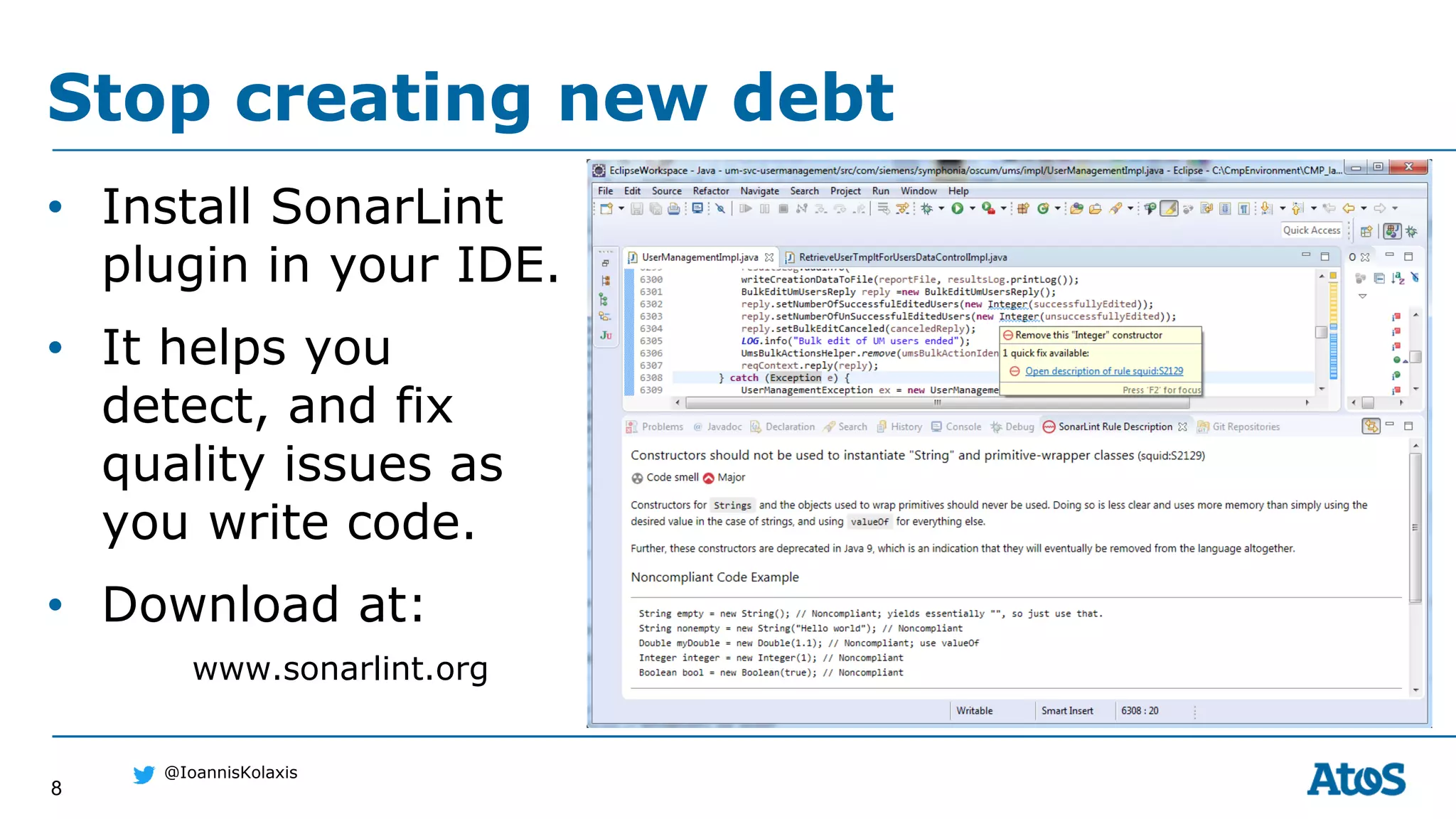
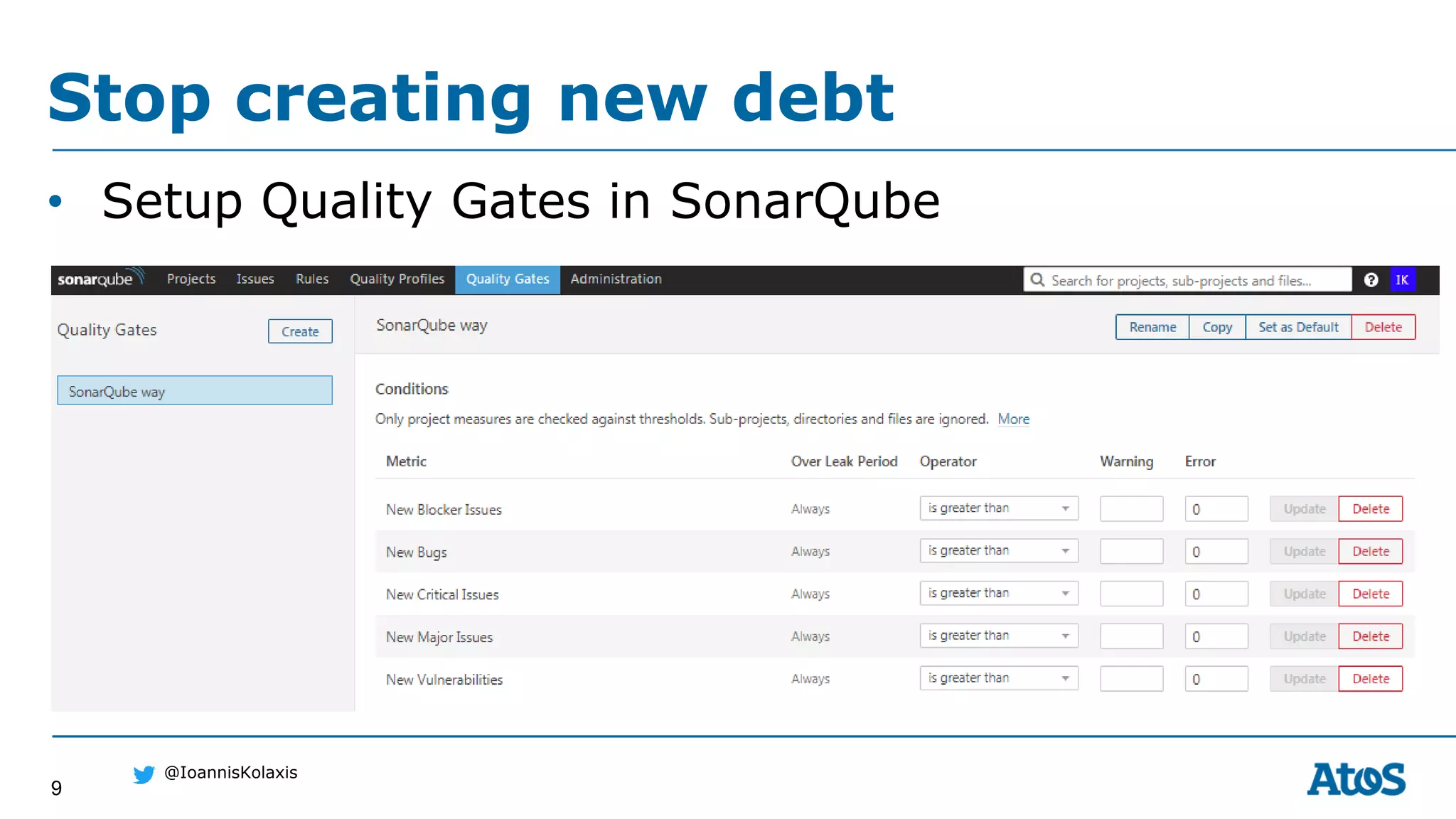
Stop creating new debt
• Install SonarLint
plugin in your IDE.
• It helps you
detect, and fix
quality issues as
you write code.
• Download at:
www.sonarlint.org
9
@IoannisKolaxis
Stop creating new debt
• Setup Quality Gates in SonarQube
10
@IoannisKolaxis
• As a developer, where do you spend most of your time?
A. Reading existing code,
B. Writing new code,
C. Waiting for a full build to complete,
D.Other
Quiz
11
@IoannisKolaxis
• As a developer, where do you spend most of your time?
A. Reading existing code,
B. Writing new code,
C. Waiting for a full build to complete,
D.Other
Quiz
12
@IoannisKolaxis
Which parts of your code
do you read most often?
Just think …
13
@IoannisKolaxis
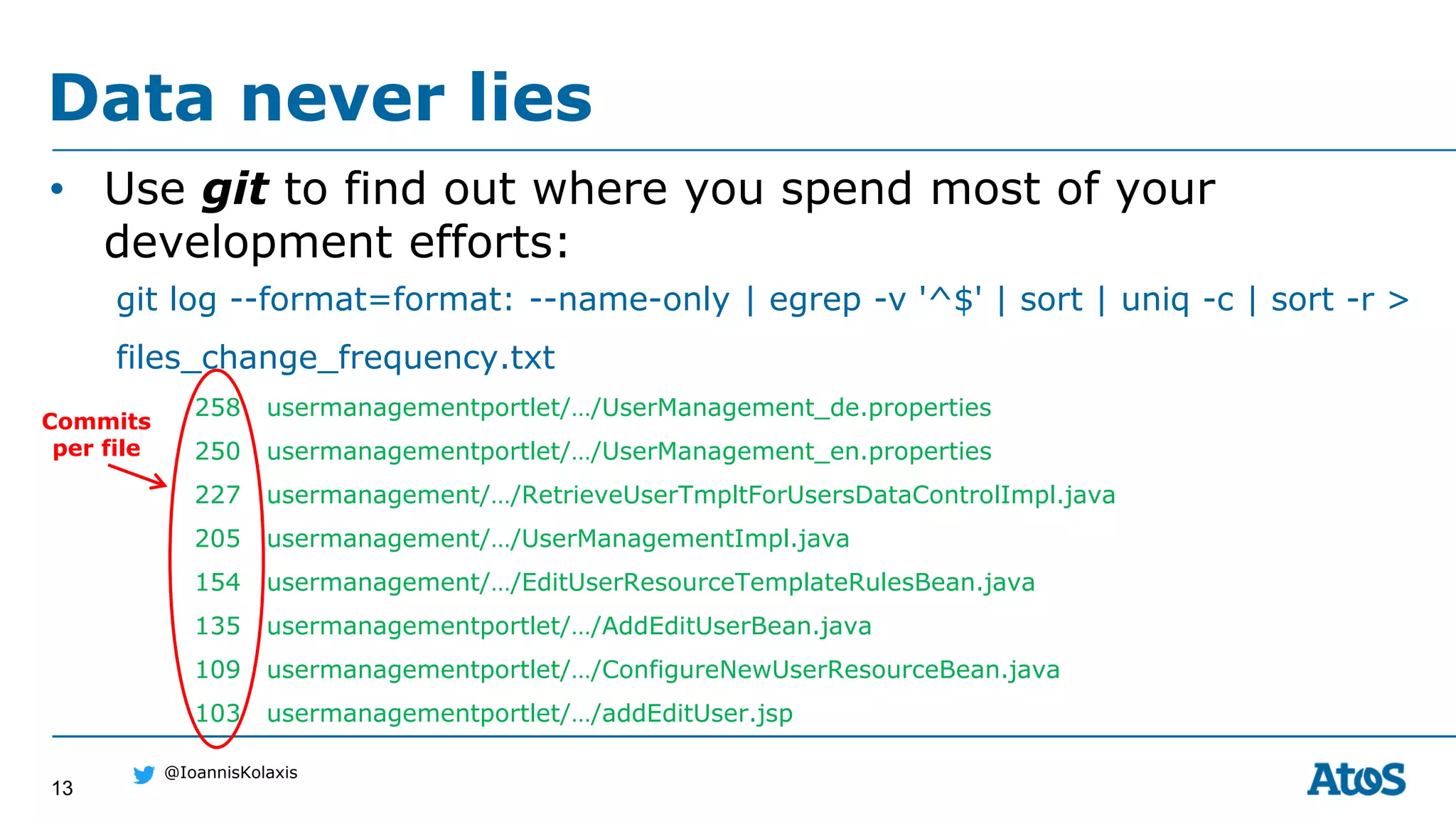
• Use git to find out where you spend most of your
development efforts:
git log --format=format: --name-only | egrep -v '^$' | sort | uniq -c | sort -r >
files_change_frequency.txt
258 usermanagementportlet/…/UserManagement_de.properties
250 usermanagementportlet/…/UserManagement_en.properties
227 usermanagement/…/RetrieveUserTmpltForUsersDataControlImpl.java
205 usermanagement/…/UserManagementImpl.java
154 usermanagement/…/EditUserResourceTemplateRulesBean.java
135 usermanagementportlet/…/AddEditUserBean.java
109 usermanagementportlet/…/ConfigureNewUserResourceBean.java
103 usermanagementportlet/…/addEditUser.jsp
Data never lies
Commits
per file
14
@IoannisKolaxis
The pattern
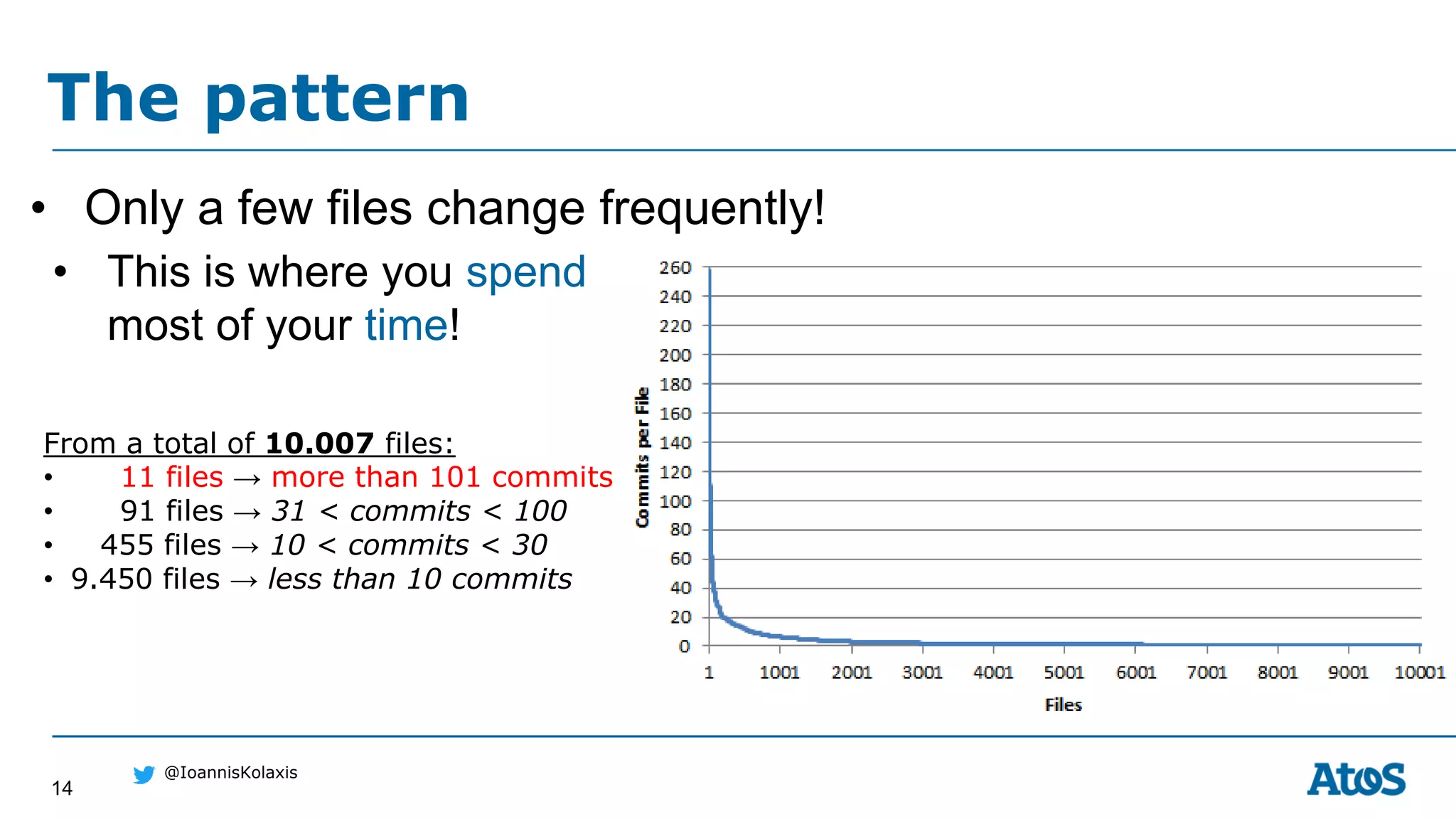
From a total of 10.007 files:
• 11 files → more than 101 commits
• 91 files → 31 < commits < 100
• 455 files → 10 < commits < 30
• 9.450 files → less than 10 commits
• Only a few files change frequently!
• This is where you spend
most of your time!
15
@IoannisKolaxis
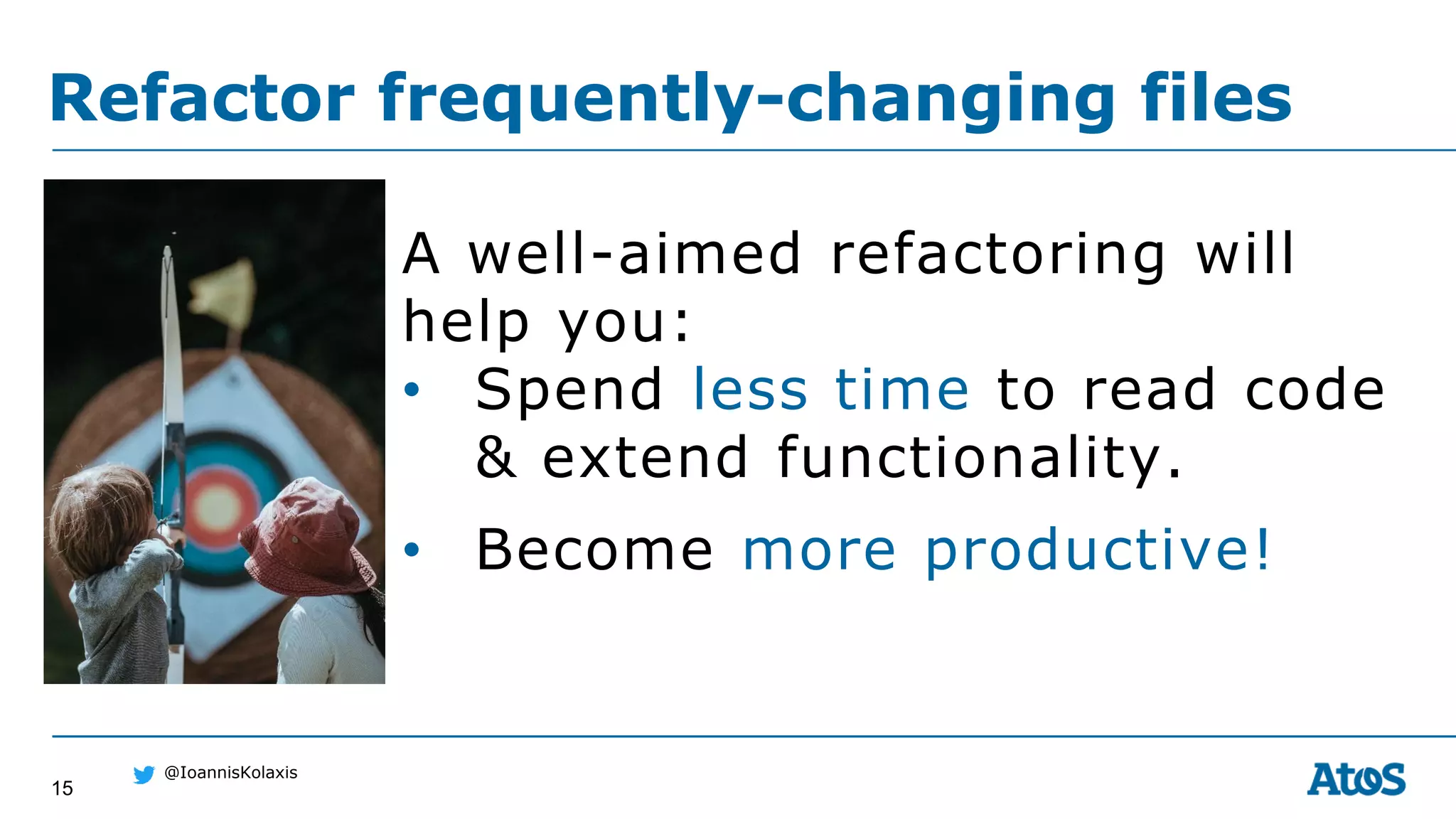
A well-aimed refactoring will
help you:
• Spend less time to read code
& extend functionality.
• Become more productive!
Refactor frequently-changing files
16
@IoannisKolaxis
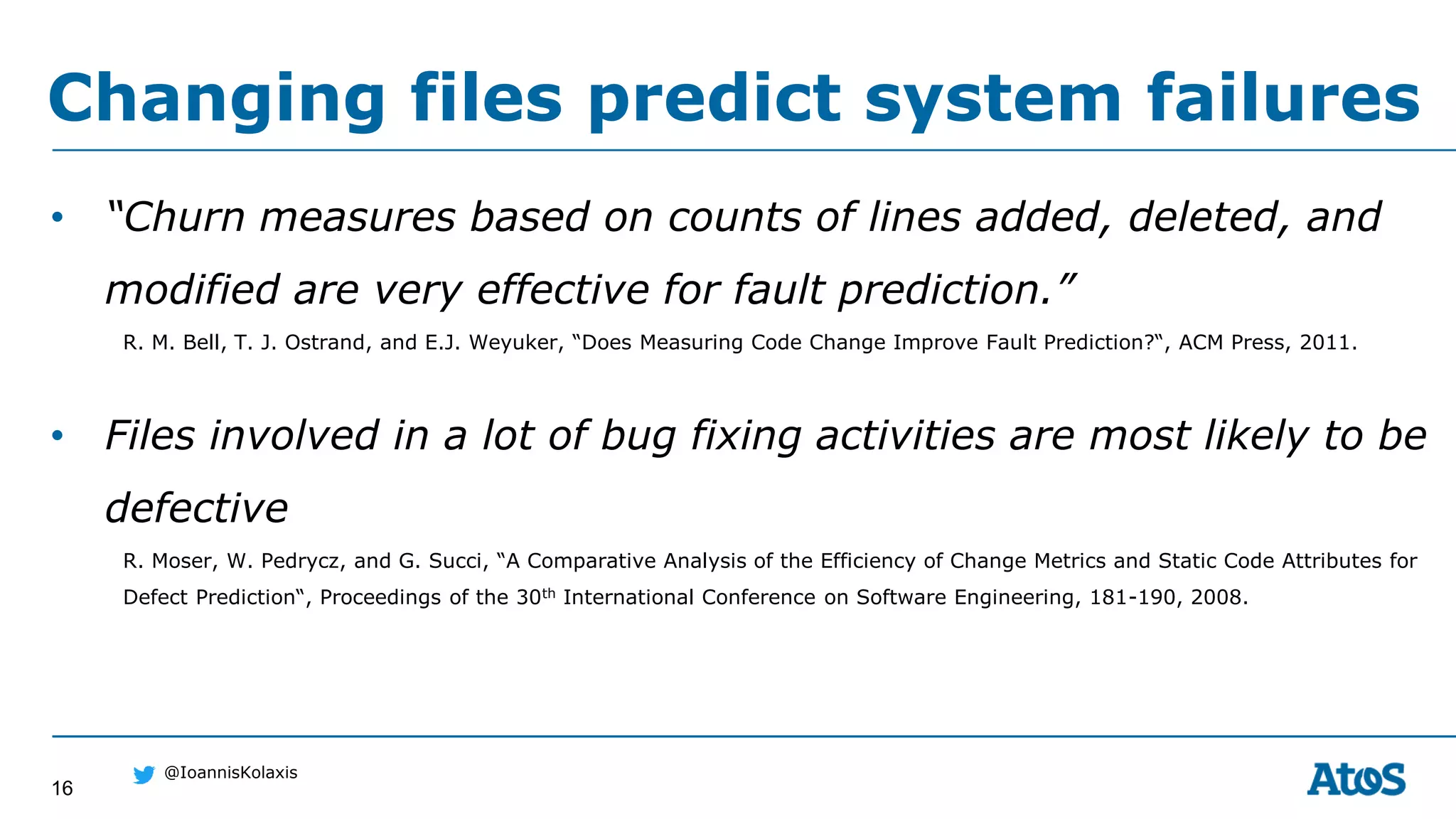
• “Churn measures based on counts of lines added, deleted, and
modified are very effective for fault prediction.”
R. M. Bell, T. J. Ostrand, and E.J. Weyuker, “Does Measuring Code Change Improve Fault Prediction?“, ACM Press, 2011.
• Files involved in a lot of bug fixing activities are most likely to be
defective
R. Moser, W. Pedrycz, and G. Succi, “A Comparative Analysis of the Efficiency of Change Metrics and Static Code Attributes for
Defect Prediction“, Proceedings of the 30th International Conference on Software Engineering, 181-190, 2008.
Changing files predict system failures
17
@IoannisKolaxis
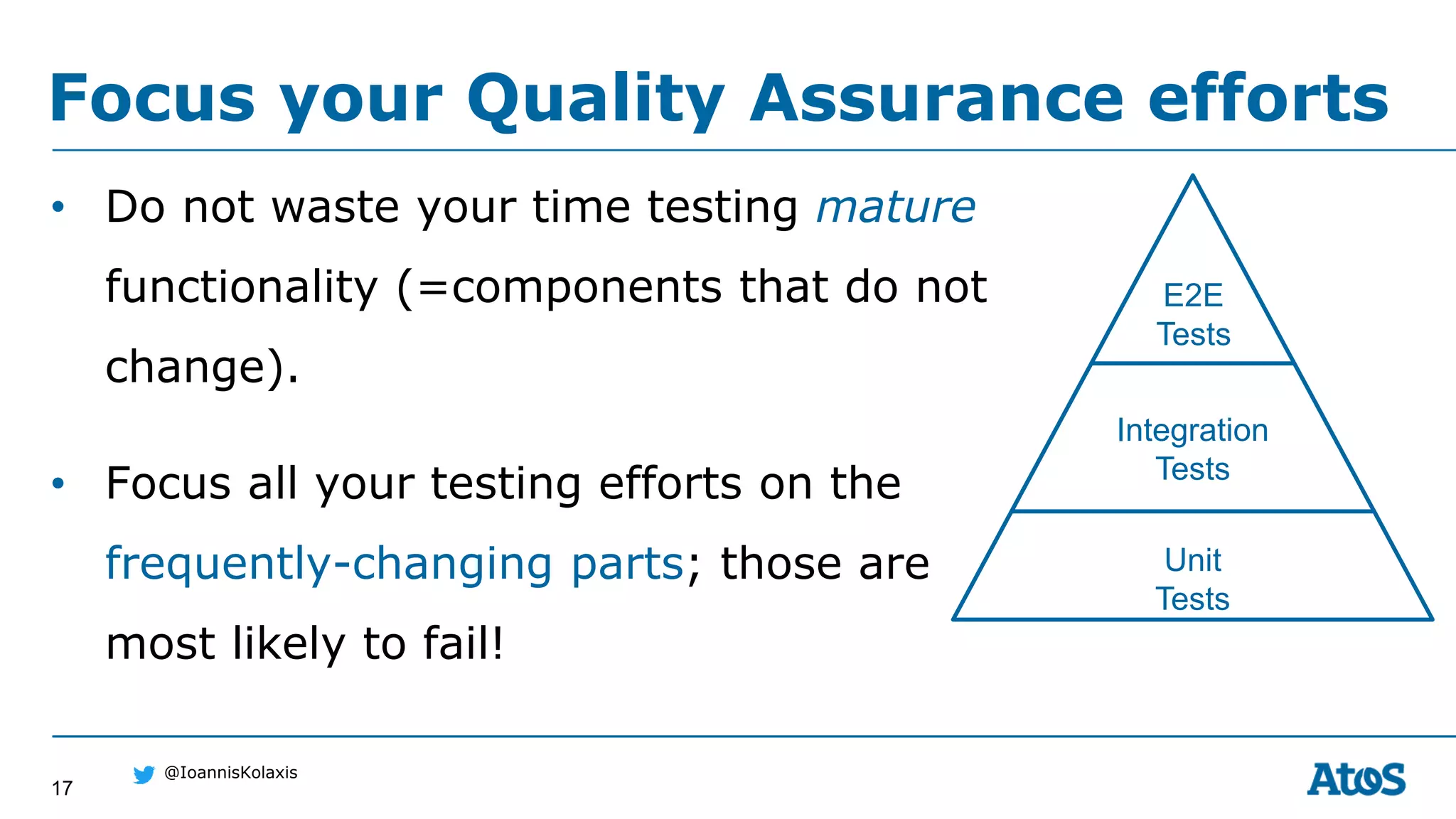
• Do not waste your time testing mature
functionality (=components that do not
change).
• Focus all your testing efforts on the
frequently-changing parts; those are
most likely to fail!
Focus your Quality Assurance efforts
Unit
Tests
Integration
Tests
E2E
Tests
18
@IoannisKolaxis
What is the coverage of
your new/changing code?
Ask the right questions
19
@IoannisKolaxis
• Files not changed in the past years → stable
components → mature features
• Is every mature feature still used by your customers?
• If a feature is not used, then delete its code!
• Else, extract stable features in separate libraries.
Identify stable components
20
@IoannisKolaxis
• Save time from your builds.
• Achieve faster onboarding of
new developers, by:
Go faster with deleted/extracted code
• Focusing only on actively developed code.
• Not having to familiarize with old/stable code.
21
@IoannisKolaxis
• Gain more insight, by measuring code
complexity for each one of the
frequently changing files.
• Language-neutral metrics for code
complexity:
• Number of lines
• Number of tabs
Measure code complexity
22
@IoannisKolaxis
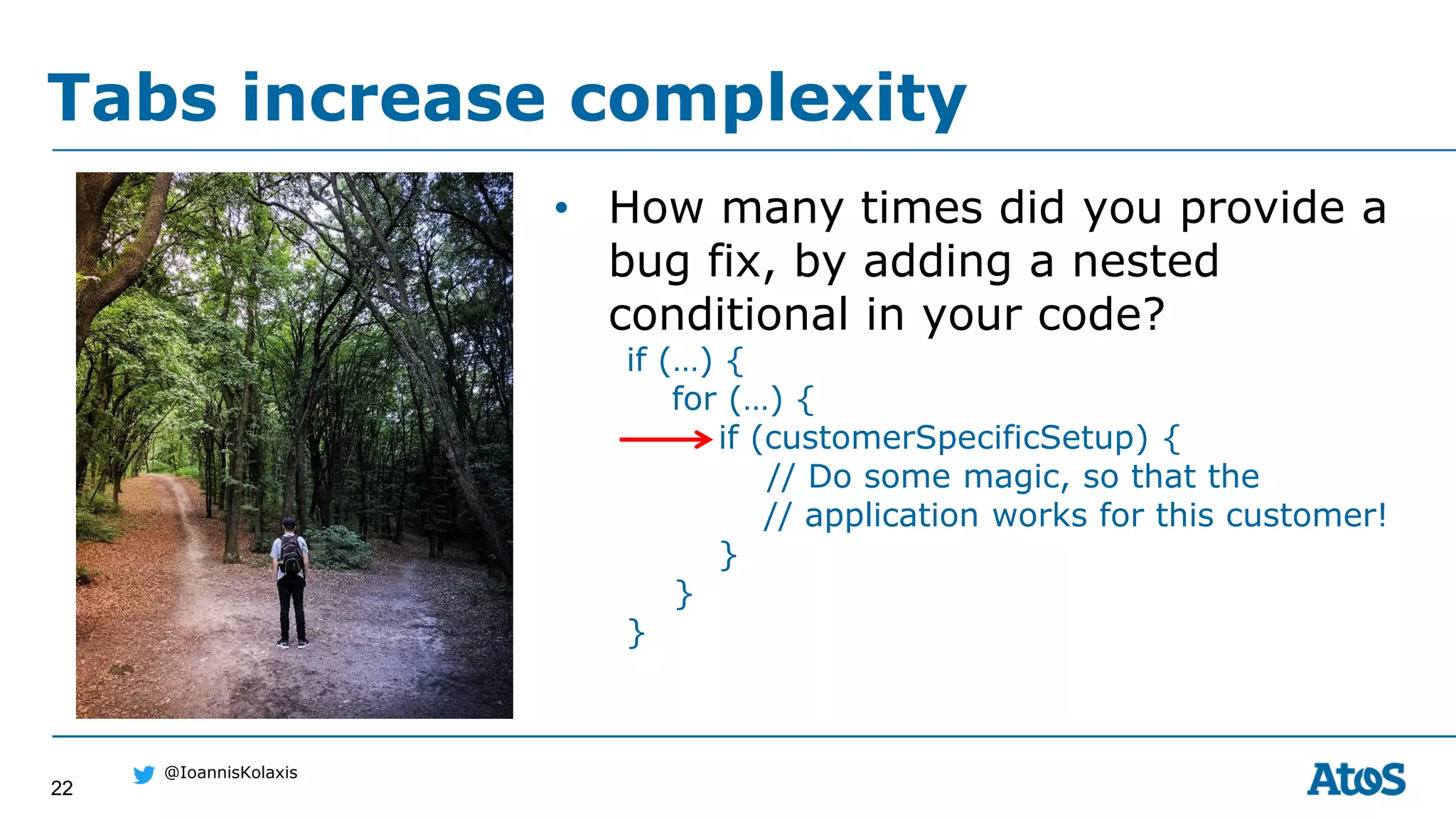
• How many times did you provide a
bug fix, by adding a nested
conditional in your code?
if (…) {
for (…) {
if (customerSpecificSetup) {
// Do some magic, so that the
// application works for this customer!
}
}
}
Tabs increase complexity
23
@IoannisKolaxis
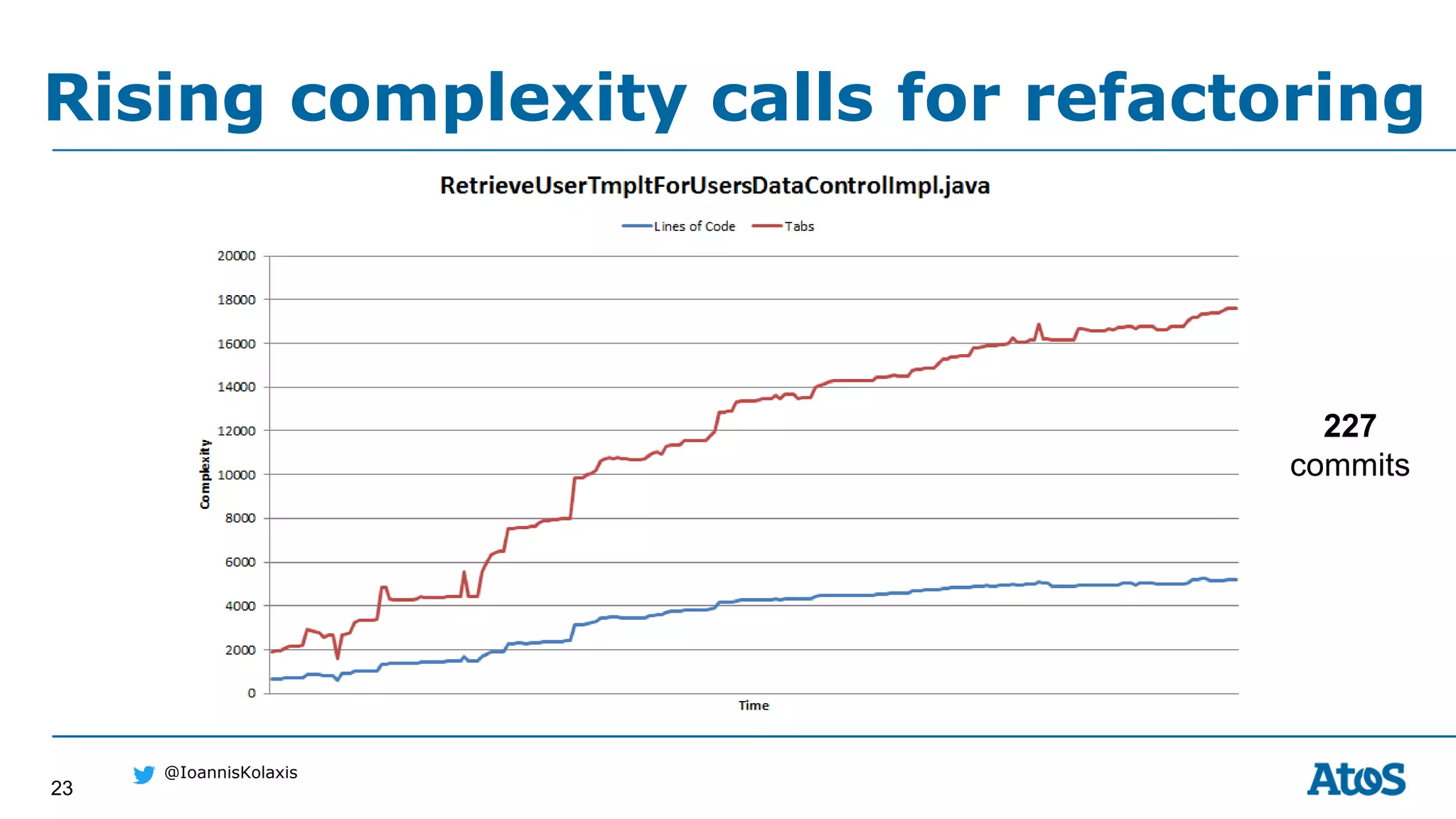
Rising complexity calls for refactoring
227
commits
24
@IoannisKolaxis
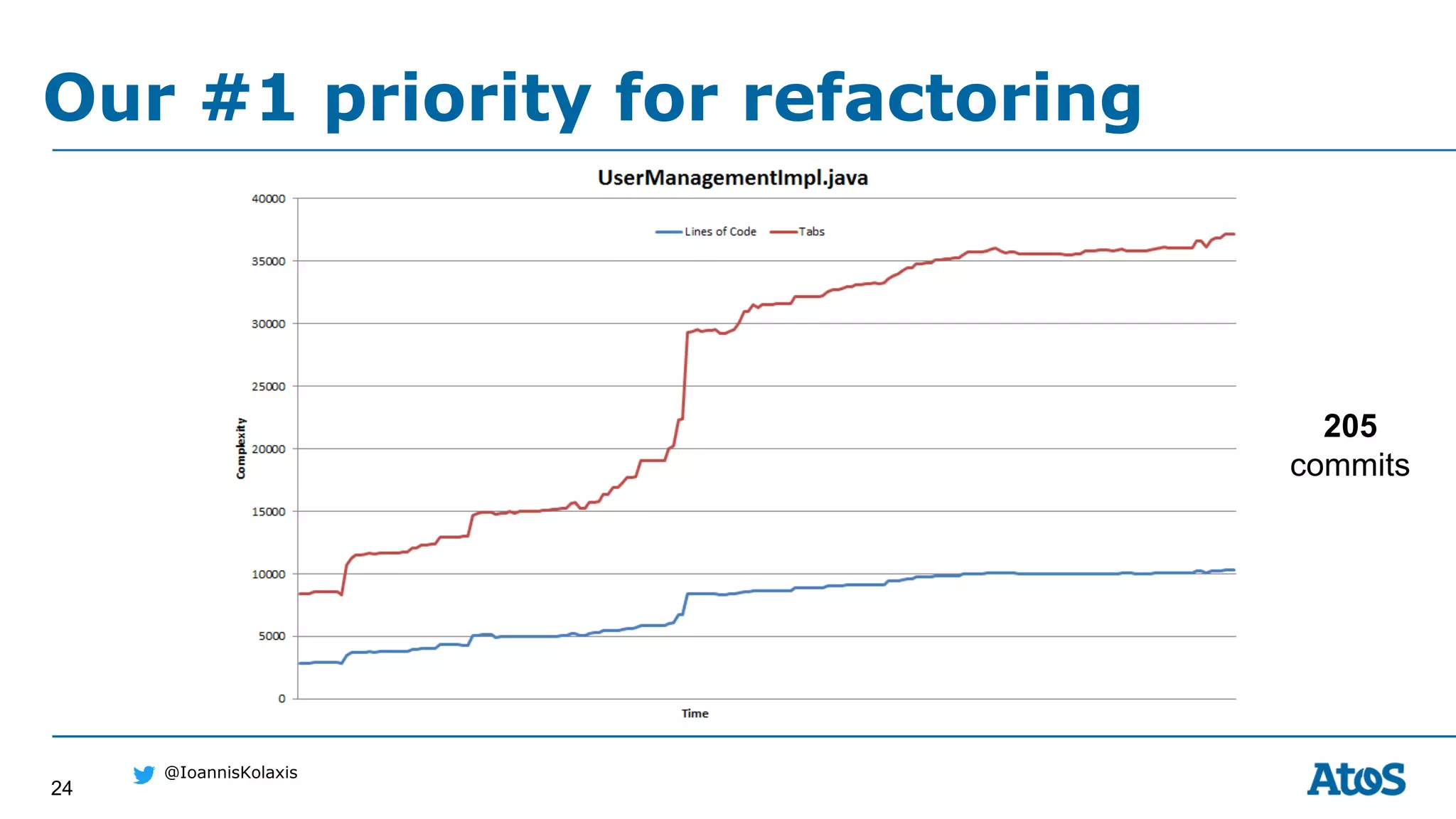
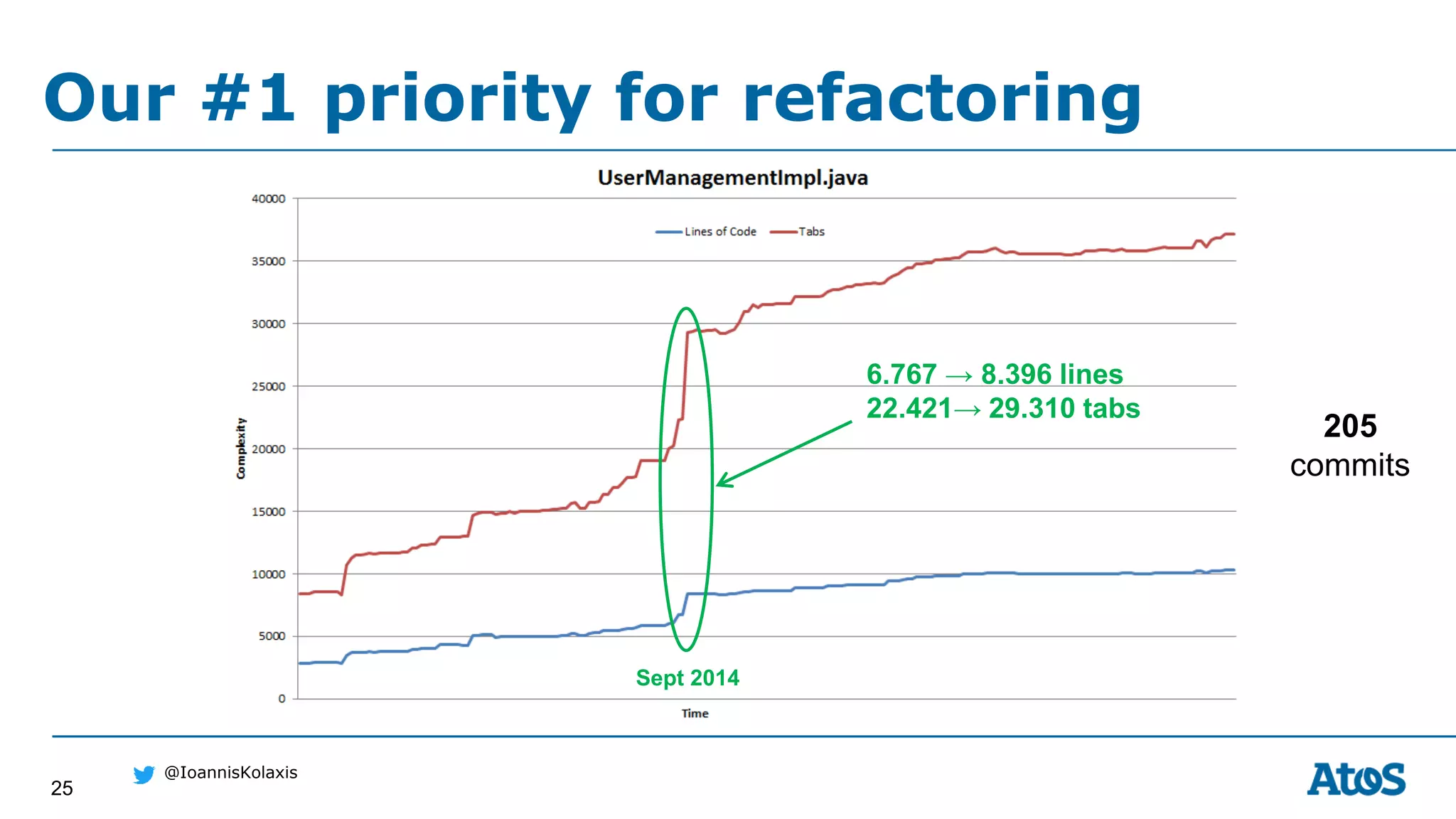
Our #1 priority for refactoring
205
commits
25
@IoannisKolaxis
Our #1 priority for refactoring
6.767 → 8.396 lines
22.421→ 29.310 tabs
Sept 2014
205
commits
26
@IoannisKolaxis
• The identified files are being changed by many developers
in parallel.
• Is it feasible to perform refactoring on a private branch?
• Can we afford to stop development, while someone works
for a long time on refactoring the identified files?
Refactor frequently changing files
27
@IoannisKolaxis
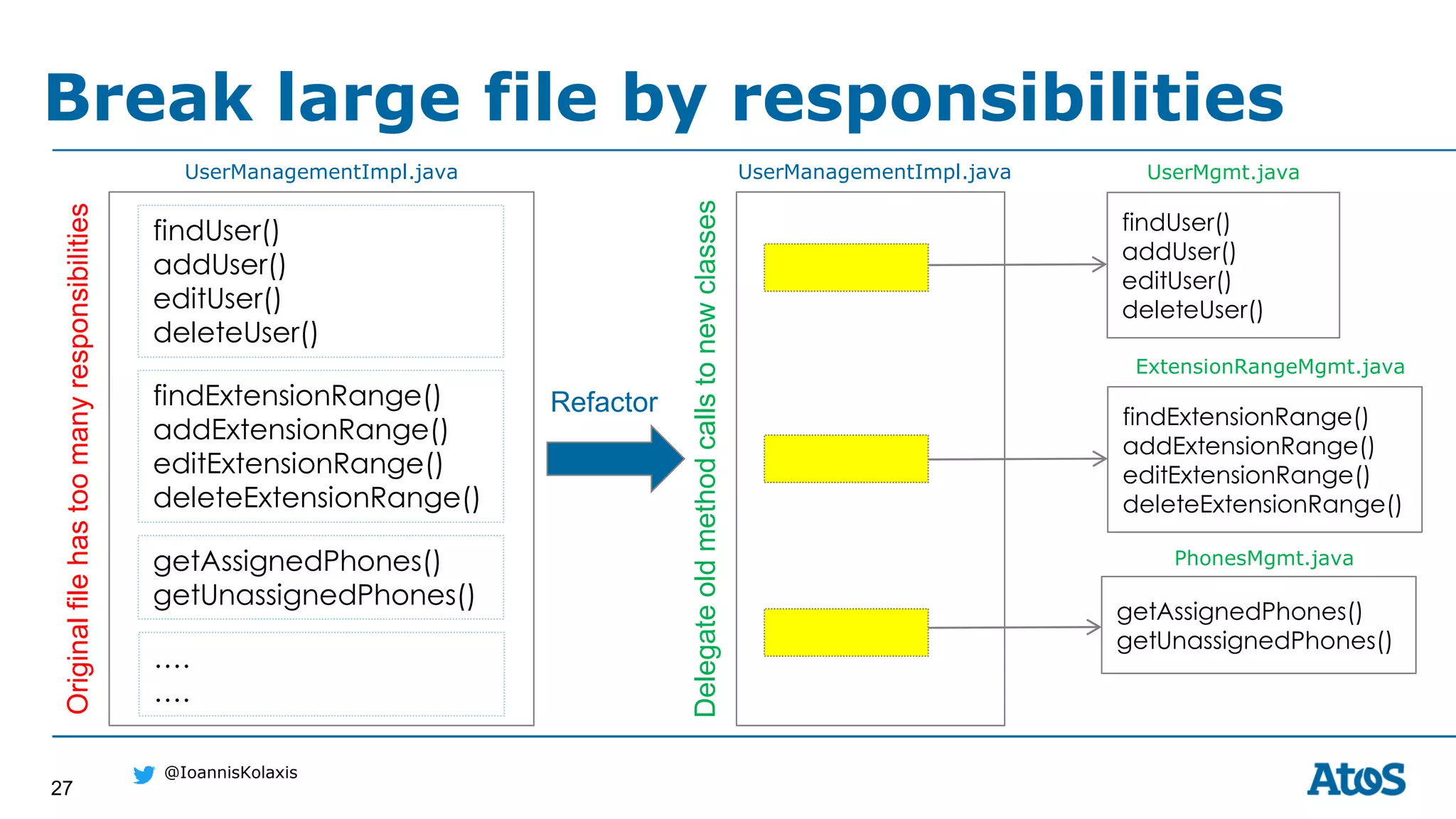
Break large file by responsibilities
findUser()
addUser()
editUser()
deleteUser()
findExtensionRange()
addExtensionRange()
editExtensionRange()
deleteExtensionRange()
getAssignedPhones()
getUnassignedPhones()
UserManagementImpl.java
….
….
Originalfilehastoomanyresponsibilities
UserManagementImpl.java
Delegateoldmethodcallstonewclasses
findUser()
addUser()
editUser()
deleteUser()()
UserMgmt.java
Refactor findExtensionRange()
addExtensionRange()
editExtensionRange()
deleteExtensionRange()
ExtensionRangeMgmt.java
getAssignedPhones()
getUnassignedPhones()
PhonesMgmt.java
28
@IoannisKolaxis
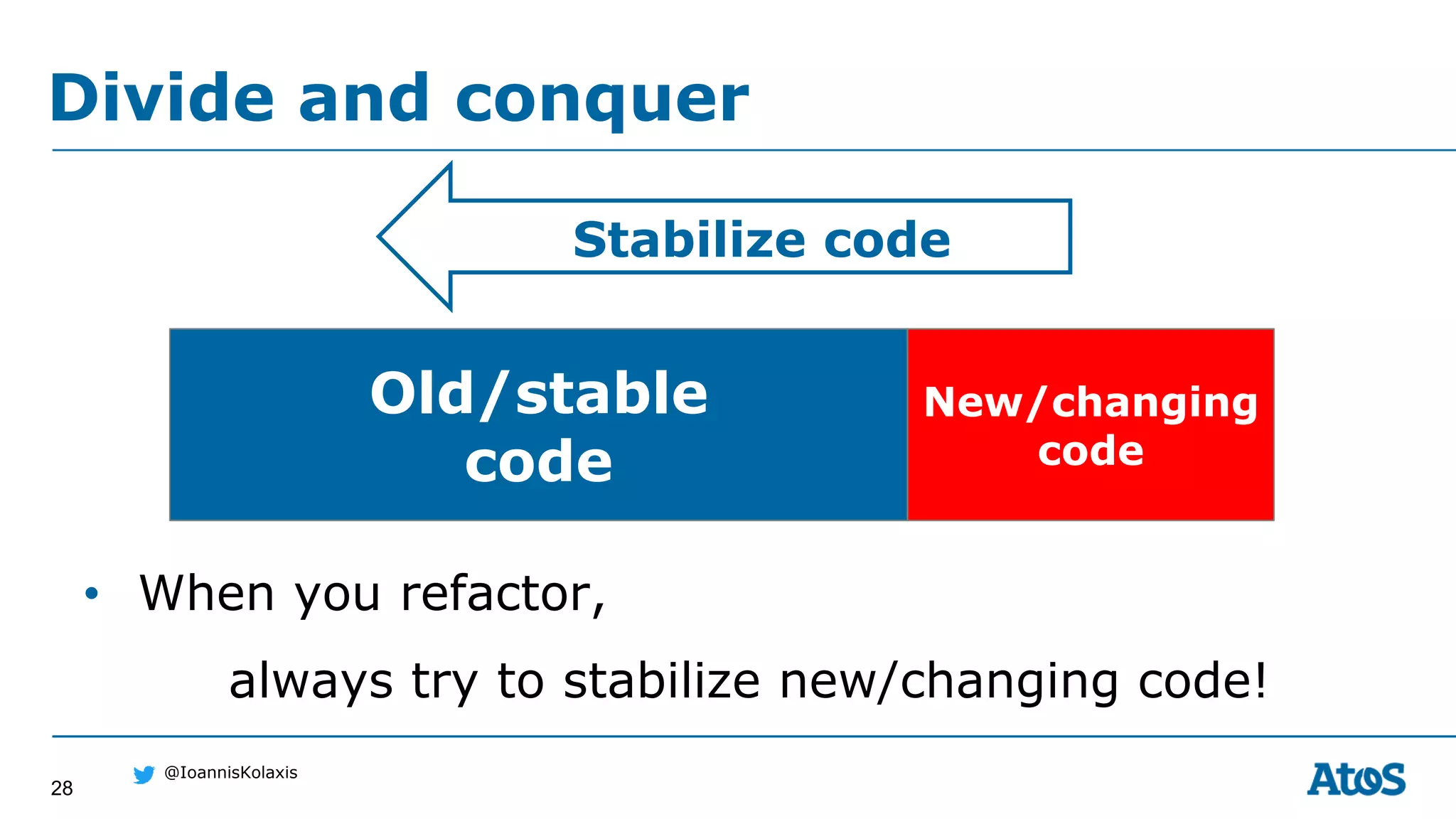
Divide and conquer
Old/stable
code
New/changing
code
Stabilize code
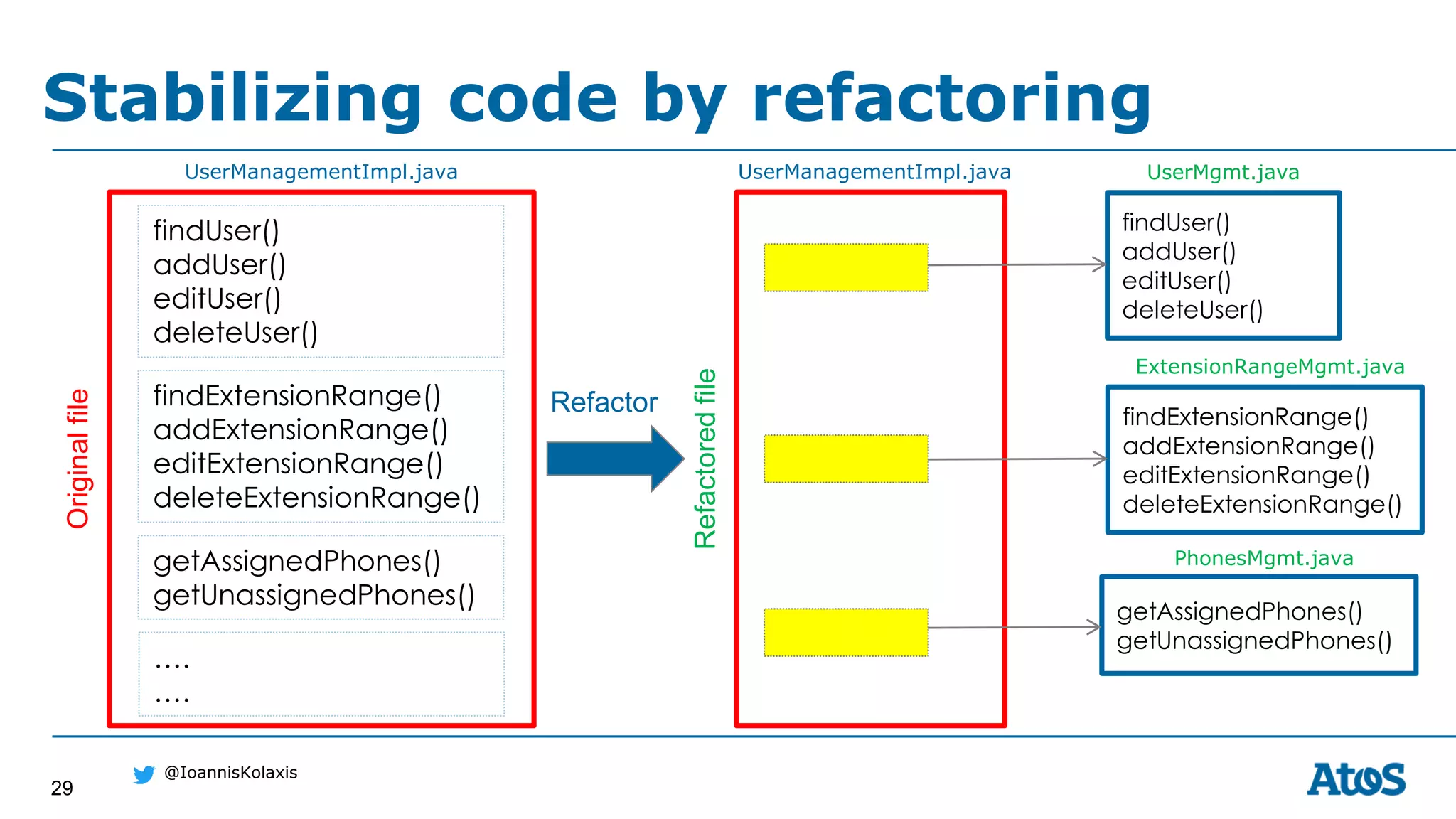
• When you refactor,
always try to stabilize new/changing code!
29
@IoannisKolaxis
Stabilizing code by refactoring
findUser()
addUser()
editUser()
deleteUser()
findExtensionRange()
addExtensionRange()
editExtensionRange()
deleteExtensionRange()
getAssignedPhones()
getUnassignedPhones()
UserManagementImpl.java
….
….
Originalfile
UserManagementImpl.java
Refactoredfile
findUser()
addUser()
editUser()
deleteUser()()
UserMgmt.java
Refactor findExtensionRange()
addExtensionRange()
editExtensionRange()
deleteExtensionRange()
ExtensionRangeMgmt.java
getAssignedPhones()
getUnassignedPhones()
PhonesMgmt.java
30
@IoannisKolaxis
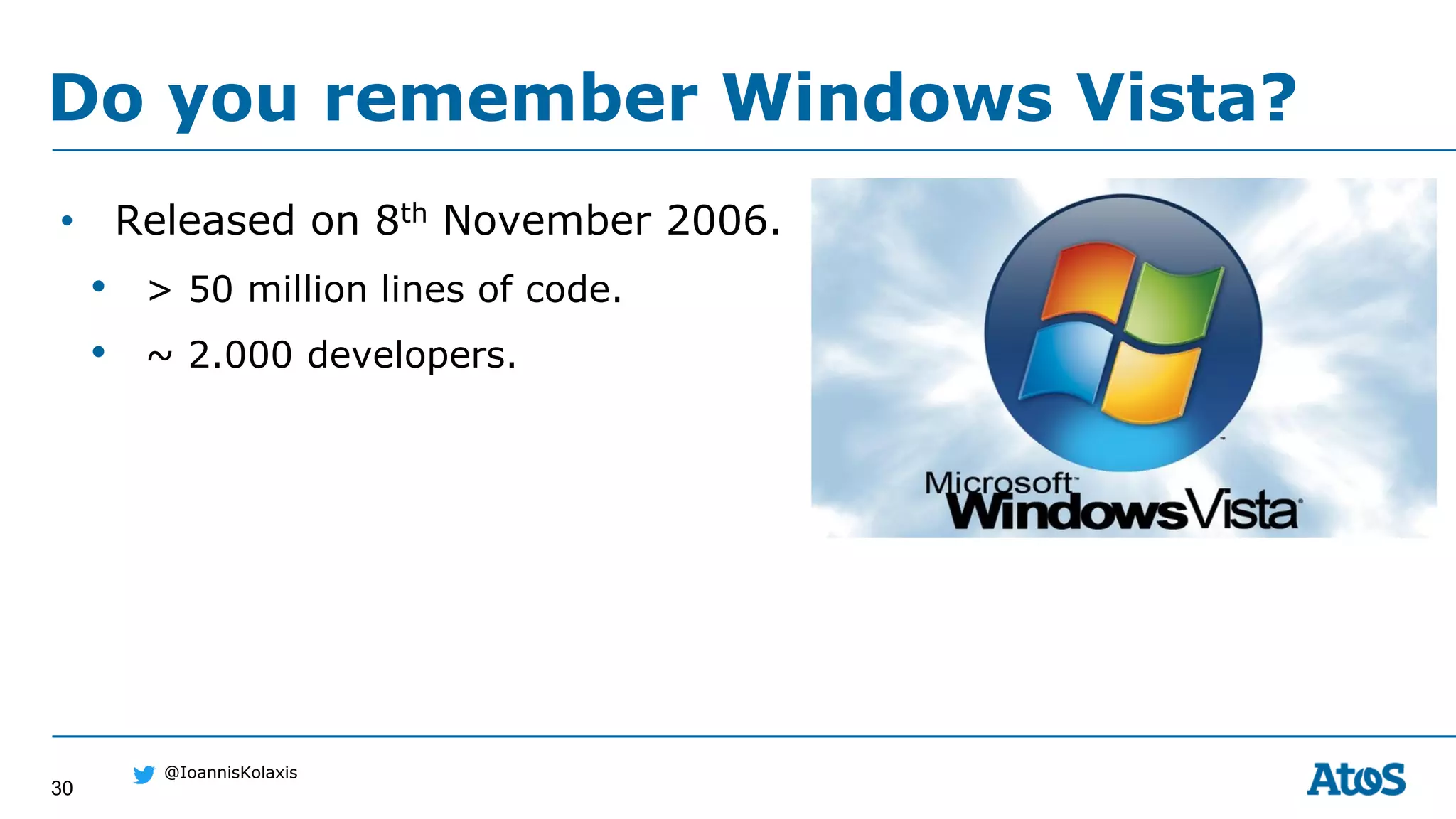
• Released on 8th November 2006.
• > 50 million lines of code.
• ~ 2.000 developers.
Do you remember Windows Vista?
31
@IoannisKolaxis
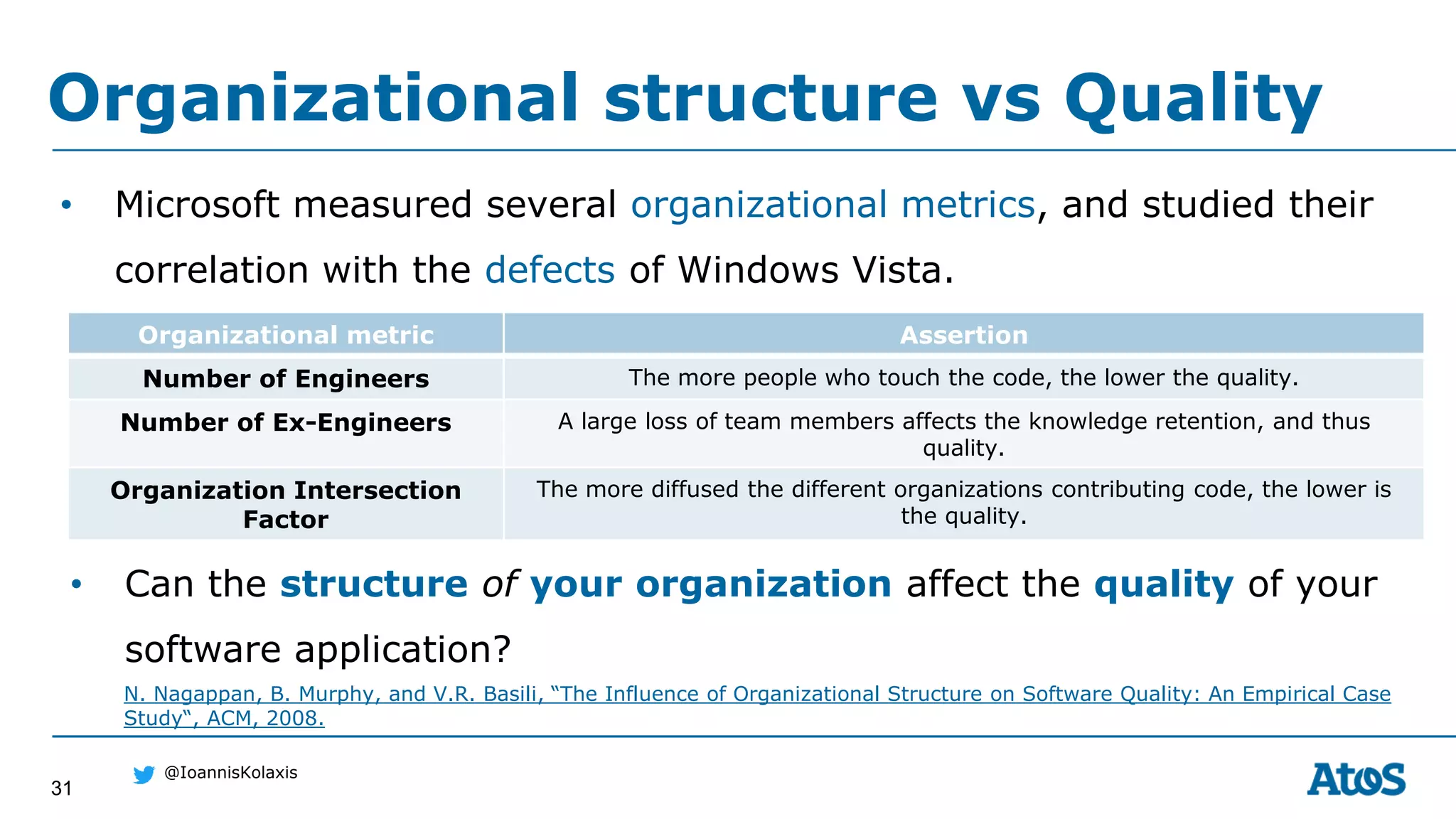
• Microsoft measured several organizational metrics, and studied their
correlation with the defects of Windows Vista.
Organizational structure vs Quality
Organizational metric Assertion
Number of Engineers The more people who touch the code, the lower the quality.
Number of Ex-Engineers A large loss of team members affects the knowledge retention, and thus
quality.
Organization Intersection
Factor
The more diffused the different organizations contributing code, the lower is
the quality.
N. Nagappan, B. Murphy, and V.R. Basili, “The Influence of Organizational Structure on Software Quality: An Empirical Case
Study“, ACM, 2008.
• Can the structure of your organization affect the quality of your
software application?
32
@IoannisKolaxis
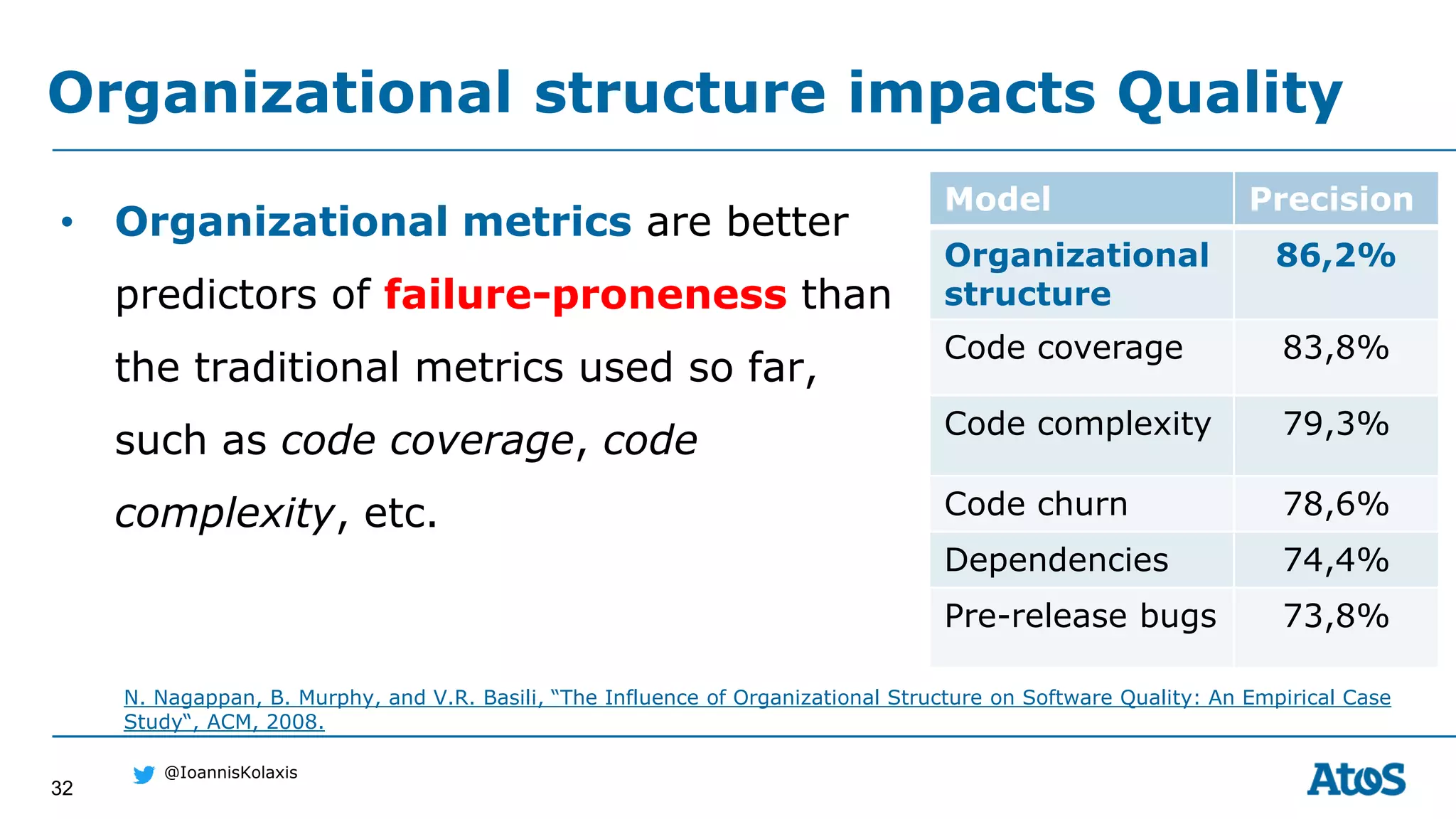
• Organizational metrics are better
predictors of failure-proneness than
the traditional metrics used so far,
such as code coverage, code
complexity, etc.
Organizational structure impacts Quality
Model Precision
Organizational
structure
86,2%
Code coverage 83,8%
Code complexity 79,3%
Code churn 78,6%
Dependencies 74,4%
Pre-release bugs 73,8%
N. Nagappan, B. Murphy, and V.R. Basili, “The Influence of Organizational Structure on Software Quality: An Empirical Case
Study“, ACM, 2008.
33
@IoannisKolaxis
• In another research, focused on Windows 7, Microsoft
distinguished between the following kinds of developers,
depending on their commits for a given component:
• Owner: has the most commits to that component.
• Major contributor: has more than 5% of total commits.
• Minor contributor: has less than 5% of total commits.
More organizational metrics
C.Bird, N. Nagappan, B. Murphy, H. Gall, and P. Devanbu, “Don’t Touch My Code! Examining the Effects of Code Ownership on
Software Quality“, ACM, 2011.
34
@IoannisKolaxis
• The researchers concluded that:
• “The number of minor contributors has a strong positive
relationship with both pre- and post-release failures …”
• “Higher levels of ownership for the top contributor to a
component results in fewer failures when controlling for the
same metrics, but the effect is smaller than the number of
minor contributors”
Effects of minor contributors
C.Bird, N. Nagappan, B. Murphy, H. Gall, and P. Devanbu, “Don’t Touch My Code! Examining the Effects of Code Ownership on
Software Quality“, ACM, 2011.
35
@IoannisKolaxis
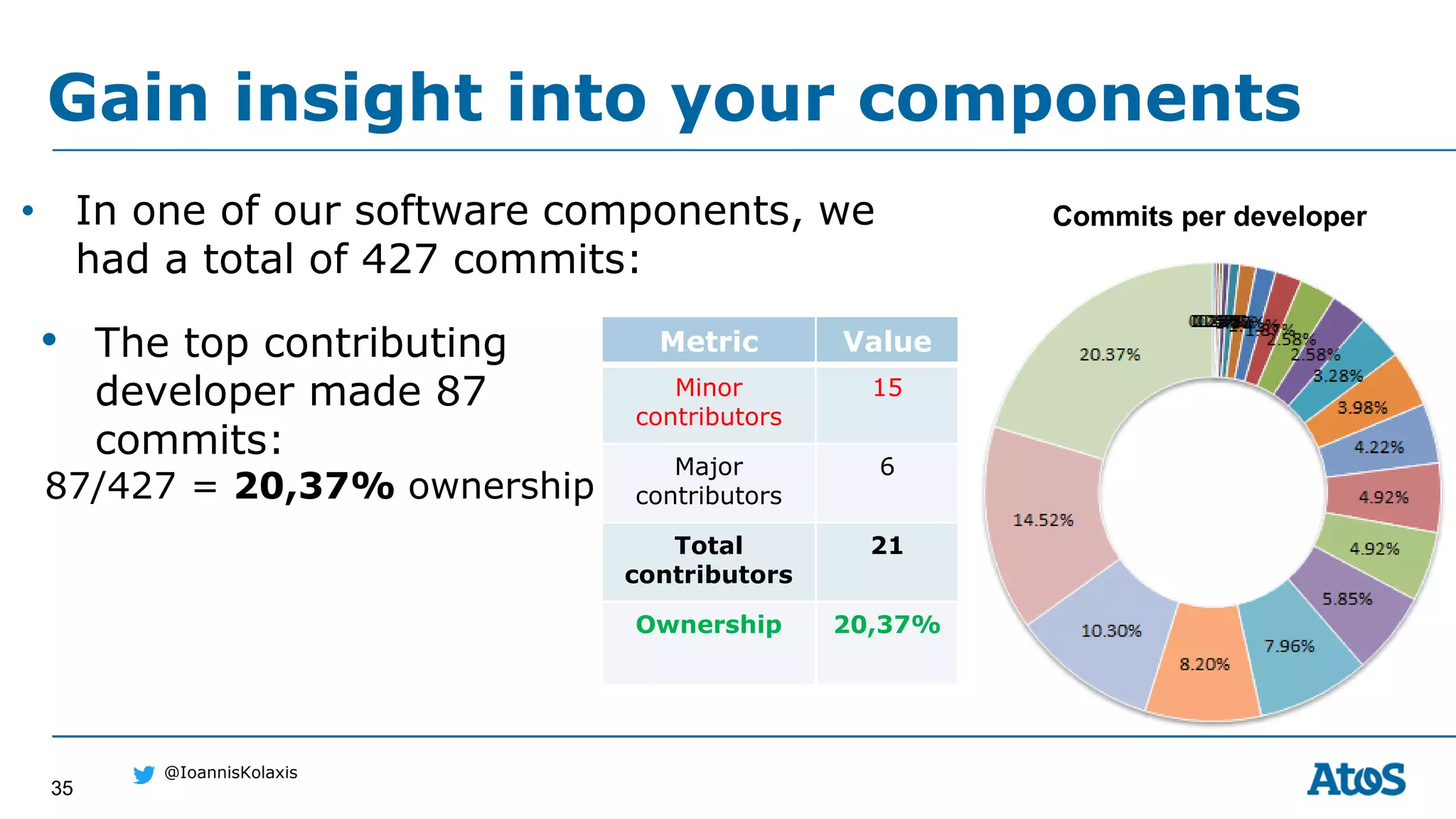
• In one of our software components, we
had a total of 427 commits:
Gain insight into your components
Commits per developer
Metric Value
Minor
contributors
15
Major
contributors
6
Total
contributors
21
Ownership 20,37%
• The top contributing
developer made 87
commits:
87/427 = 20,37% ownership
36
@IoannisKolaxis
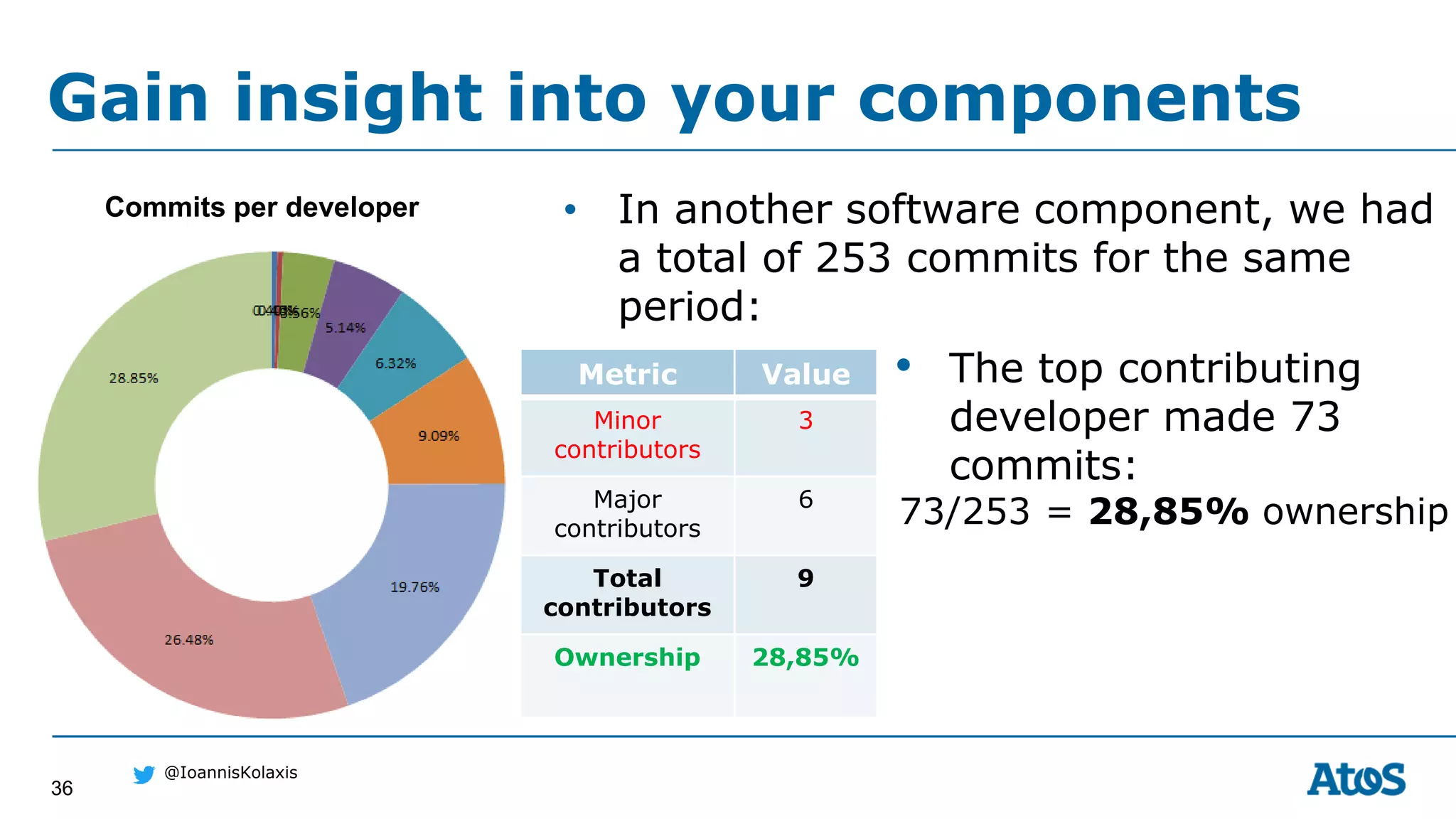
• In another software component, we had
a total of 253 commits for the same
period:
Gain insight into your components
Commits per developer
Metric Value
Minor
contributors
3
Major
contributors
6
Total
contributors
9
Ownership 28,85%
• The top contributing
developer made 73
commits:
73/253 = 28,85% ownership
37
@IoannisKolaxis
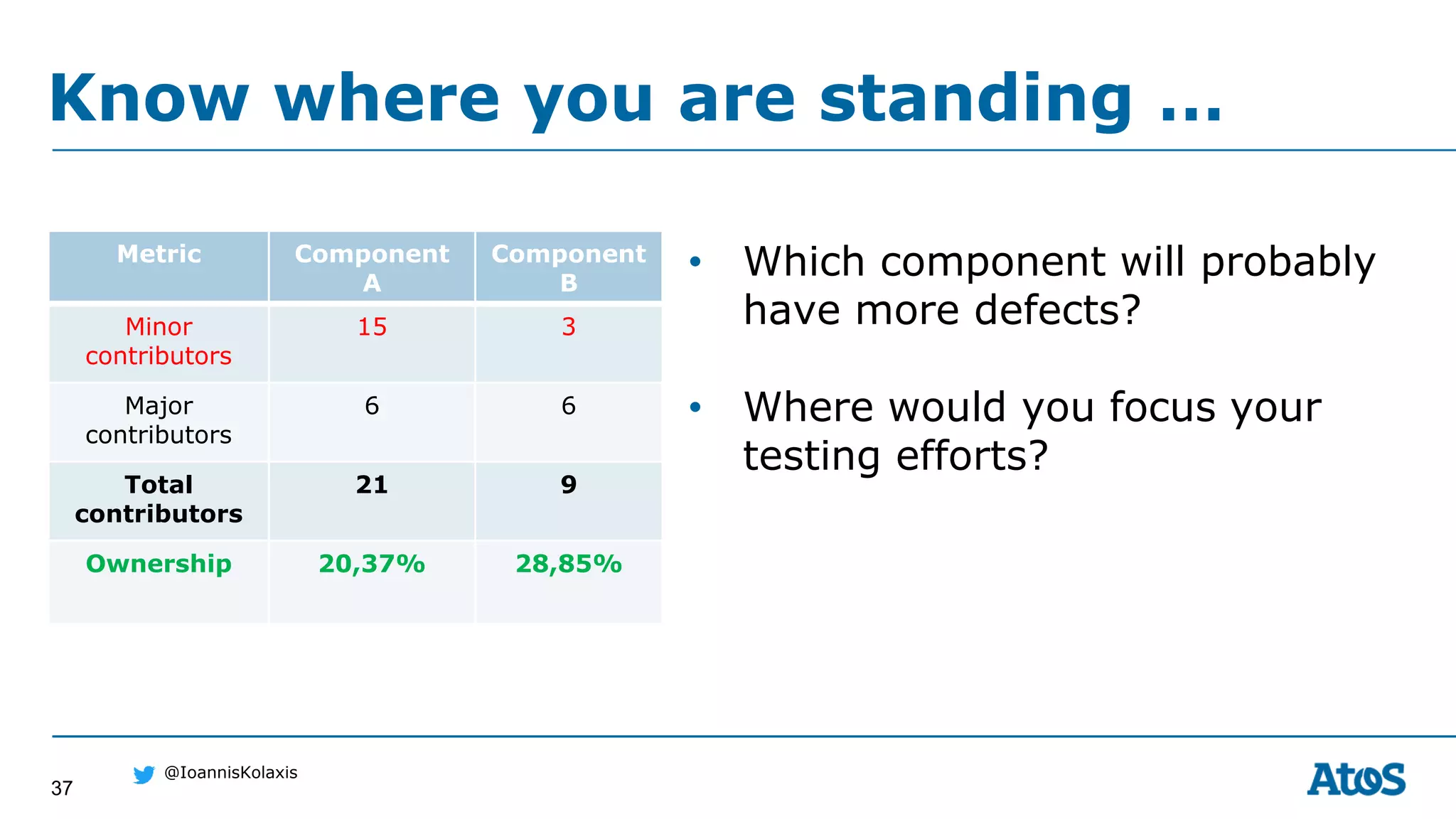
• Which component will probably
have more defects?
• Where would you focus your
testing efforts?
Know where you are standing …
Metric Component
A
Component
B
Minor
contributors
15 3
Major
contributors
6 6
Total
contributors
21 9
Ownership 20,37% 28,85%
38
@IoannisKolaxis
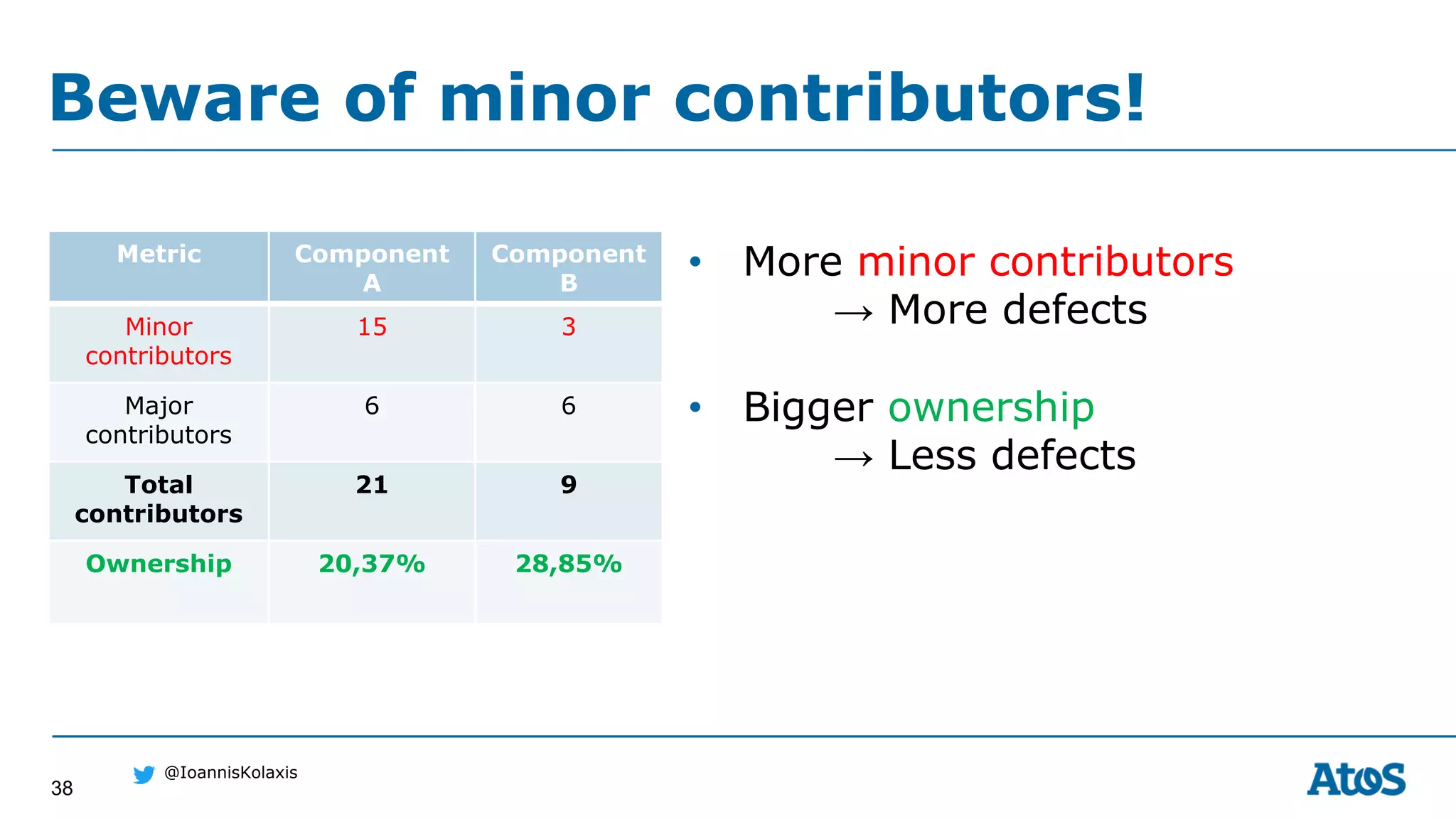
• More minor contributors
→ More defects
• Bigger ownership
→ Less defects
Beware of minor contributors!
Metric Component
A
Component
B
Minor
contributors
15 3
Major
contributors
6 6
Total
contributors
21 9
Ownership 20,37% 28,85%
39
@IoannisKolaxis
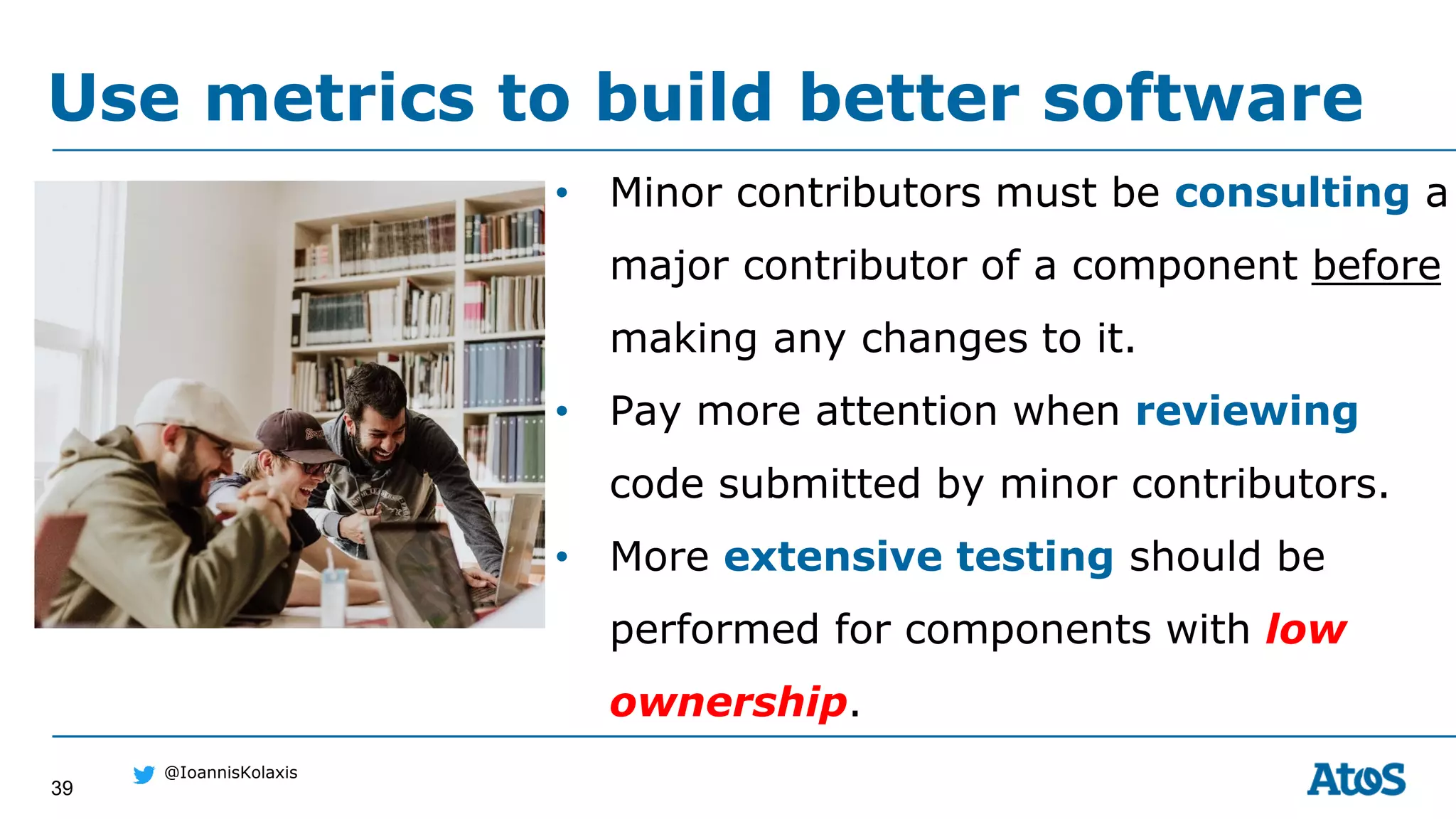
• Minor contributors must be consulting a
major contributor of a component before
making any changes to it.
• Pay more attention when reviewing
code submitted by minor contributors.
• More extensive testing should be
performed for components with low
ownership.
Use metrics to build better software
40
@IoannisKolaxis
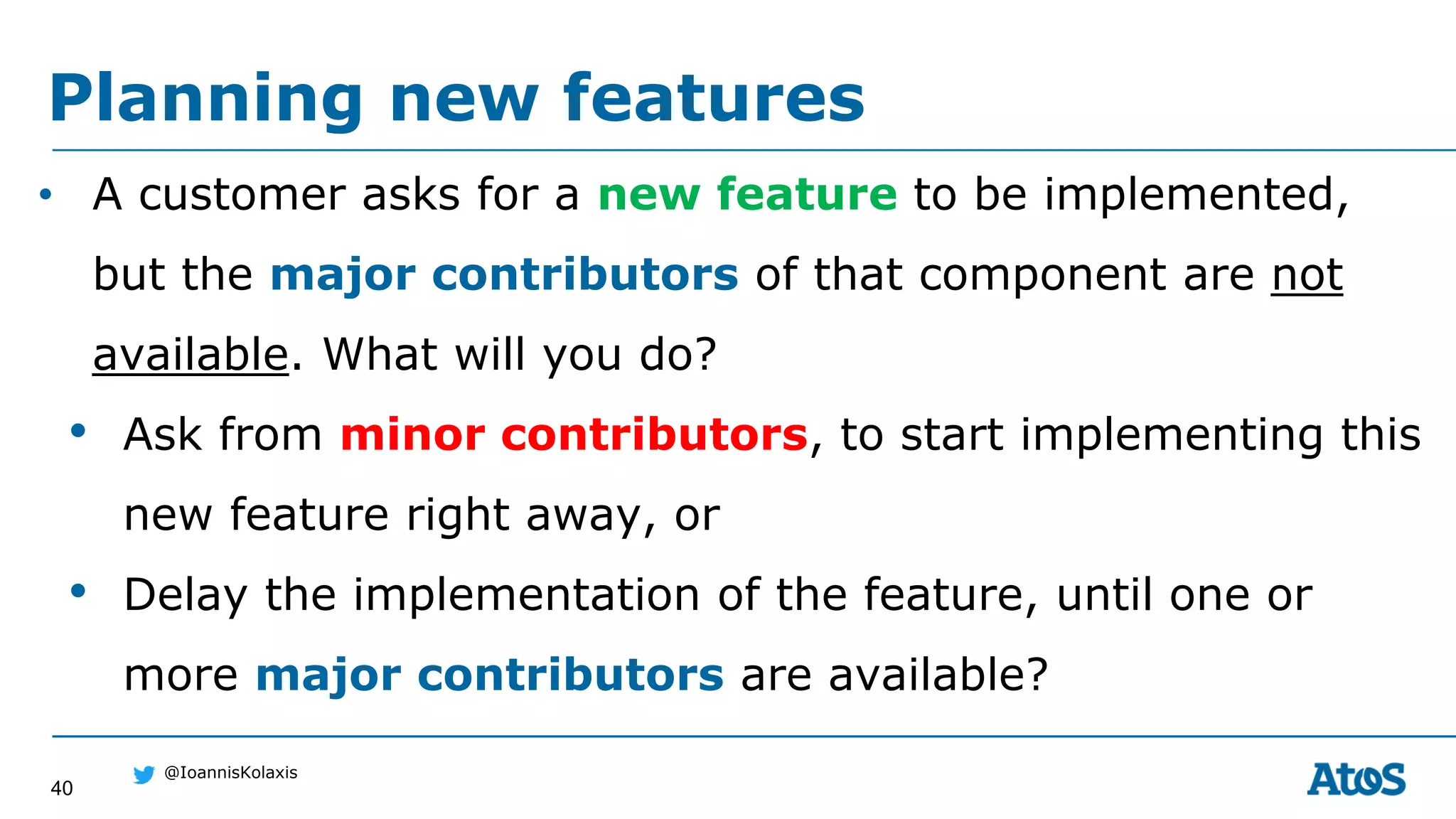
• A customer asks for a new feature to be implemented,
but the major contributors of that component are not
available. What will you do?
• Ask from minor contributors, to start implementing this
new feature right away, or
• Delay the implementation of the feature, until one or
more major contributors are available?
Planning new features
41
@IoannisKolaxis
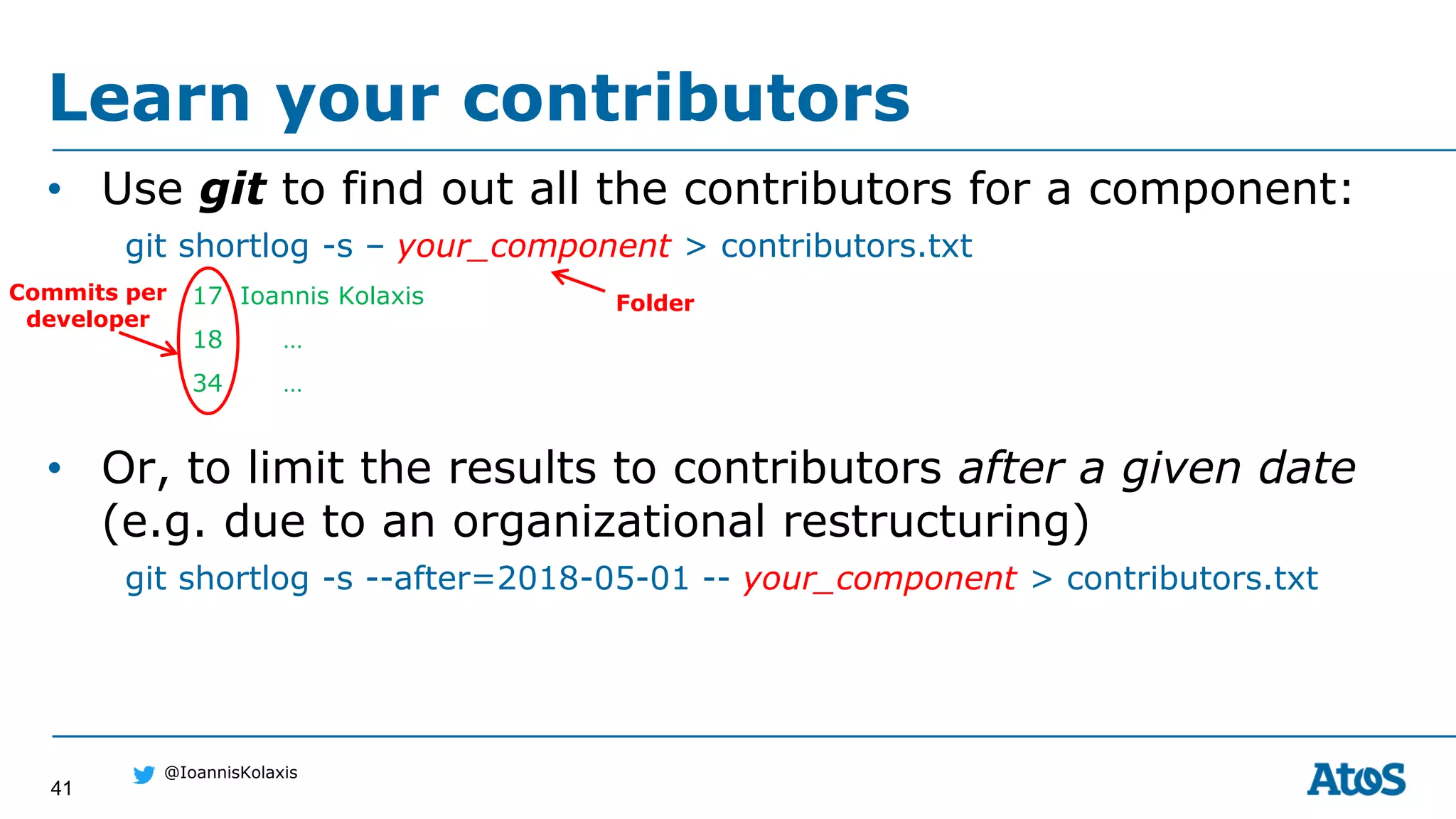
• Use git to find out all the contributors for a component:
git shortlog -s – your_component > contributors.txt
17 Ioannis Kolaxis
18 …
34 …
• Or, to limit the results to contributors after a given date
(e.g. due to an organizational restructuring)
git shortlog -s --after=2018-05-01 -- your_component > contributors.txt
Learn your contributors
Commits per
developer
Folder
42
@IoannisKolaxis
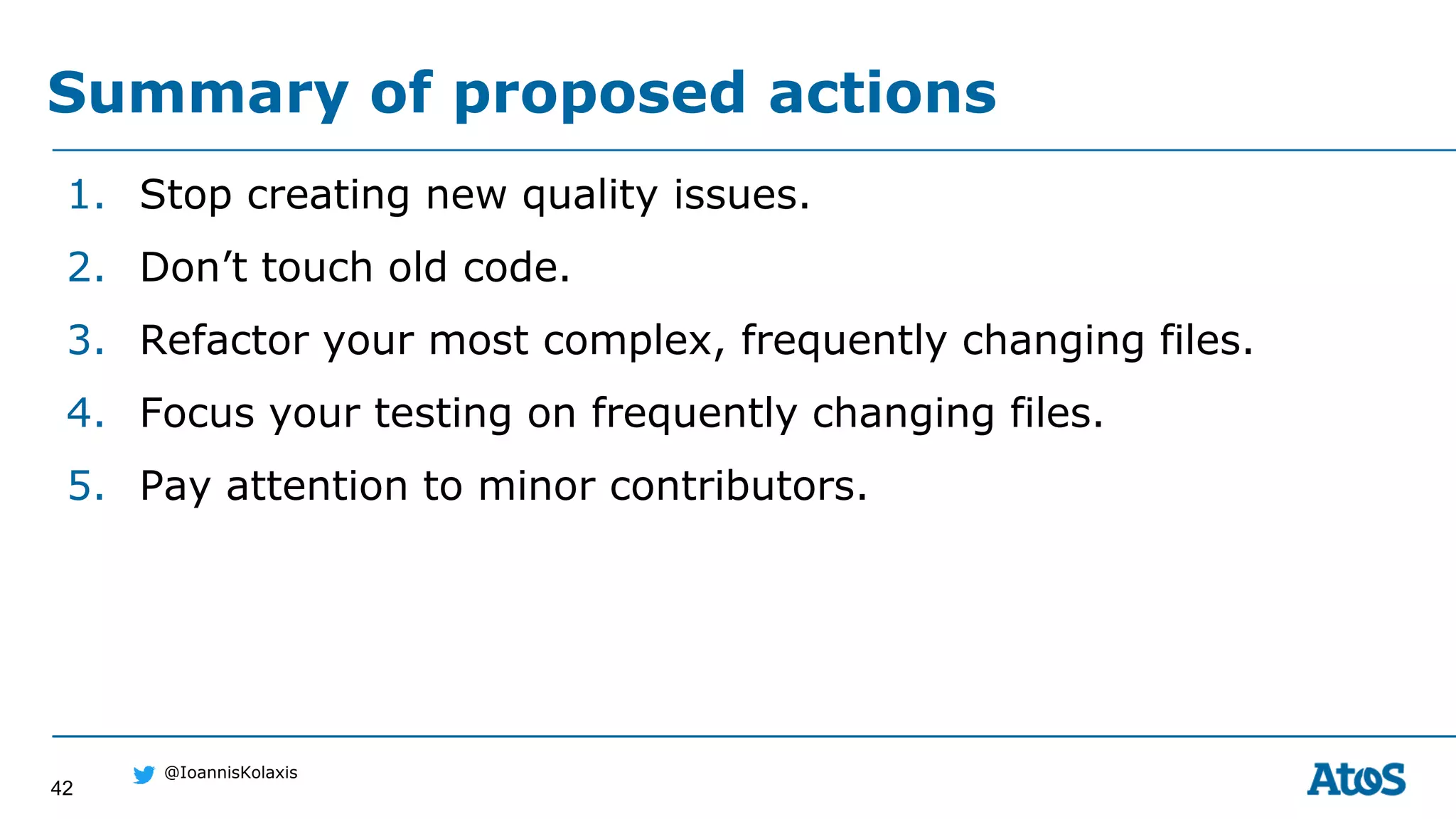
1. Stop creating new quality issues.
2. Don’t touch old code.
3. Refactor your most complex, frequently changing files.
4. Focus your testing on frequently changing files.
5. Pay attention to minor contributors.
Summary of proposed actions
Atos, the Atos logo, Atos Codex, Atos Consulting, Atos Worldgrid, Worldline, BlueKiwi, Bull, Canopy the
Open Cloud Company, Unify, Yunano, Zero Email, Zero Email Certified and The Zero Email Company are
registered trademarks of the Atos group. June 2016. © 2016 Atos. Confidential information owned by
Atos, to be used by the recipient only. This document, or any part of it, may not be reproduced, copied,
circulated and/or distributed nor quoted without prior written approval from Atos.
Thank you!
Email : ioannis.kolaxis@atos.net
Twitter : @IoannisKolaxis

How to improve the quality of your application

  • 1.
    How to improve thequality of your application A practical guide for developers Wednesday 20th February 2019, JHUG Meetup Athens / Greece Ioannis Kolaxis – Software Engineer / Senior Expert
  • 2.
    1 @IoannisKolaxis • Are youworking for a software product, where …? • New features take too much time to be implemented • Customers keep complaining about bugs Software quality issues
  • 3.
    2 @IoannisKolaxis • Can youimprove the quality of your software? • How? What can you do?
  • 4.
    3 @IoannisKolaxis Our application: CMP •Automates the configuration & provisioning of our switches, achieving significant time savings for our service.
  • 5.
    4 @IoannisKolaxis Customer tickets ✔ •We usually measure quality via customer tickets: CMP Customer tickets
  • 6.
    5 @IoannisKolaxis Code coverage ✔ •When we refer to quality, we usually think of code coverage! Increased coverage: • from 67% (Feb 2017) • to 72% (Jun 2018)
  • 7.
    6 @IoannisKolaxis Should you payoff your debt? Decreased debt: • from 1.359 days (Feb 2017) • to 392 days (Jun 2018)
  • 8.
    7 @IoannisKolaxis Do not touchold code! You will probably introduce new defects! Old code is more reliable “If a module is, on the average, a year older than an otherwise similar module, the older module will have roughly a third fewer faults.” T. L. Graves, A. F. Karr, J. S. Marron and H. Siy, "Predicting fault incidence using software change history" in IEEE Transactions on Software Engineering, vol. 26, no. 7, pp. 653-661, Jul 2000.
  • 9.
    8 @IoannisKolaxis Stop creating newdebt • Install SonarLint plugin in your IDE. • It helps you detect, and fix quality issues as you write code. • Download at: www.sonarlint.org
  • 10.
    9 @IoannisKolaxis Stop creating newdebt • Setup Quality Gates in SonarQube
  • 11.
    10 @IoannisKolaxis • As adeveloper, where do you spend most of your time? A. Reading existing code, B. Writing new code, C. Waiting for a full build to complete, D.Other Quiz
  • 12.
    11 @IoannisKolaxis • As adeveloper, where do you spend most of your time? A. Reading existing code, B. Writing new code, C. Waiting for a full build to complete, D.Other Quiz
  • 13.
    12 @IoannisKolaxis Which parts ofyour code do you read most often? Just think …
  • 14.
    13 @IoannisKolaxis • Use gitto find out where you spend most of your development efforts: git log --format=format: --name-only | egrep -v '^$' | sort | uniq -c | sort -r > files_change_frequency.txt 258 usermanagementportlet/…/UserManagement_de.properties 250 usermanagementportlet/…/UserManagement_en.properties 227 usermanagement/…/RetrieveUserTmpltForUsersDataControlImpl.java 205 usermanagement/…/UserManagementImpl.java 154 usermanagement/…/EditUserResourceTemplateRulesBean.java 135 usermanagementportlet/…/AddEditUserBean.java 109 usermanagementportlet/…/ConfigureNewUserResourceBean.java 103 usermanagementportlet/…/addEditUser.jsp Data never lies Commits per file
  • 15.
    14 @IoannisKolaxis The pattern From atotal of 10.007 files: • 11 files → more than 101 commits • 91 files → 31 < commits < 100 • 455 files → 10 < commits < 30 • 9.450 files → less than 10 commits • Only a few files change frequently! • This is where you spend most of your time!
  • 16.
    15 @IoannisKolaxis A well-aimed refactoringwill help you: • Spend less time to read code & extend functionality. • Become more productive! Refactor frequently-changing files
  • 17.
    16 @IoannisKolaxis • “Churn measuresbased on counts of lines added, deleted, and modified are very effective for fault prediction.” R. M. Bell, T. J. Ostrand, and E.J. Weyuker, “Does Measuring Code Change Improve Fault Prediction?“, ACM Press, 2011. • Files involved in a lot of bug fixing activities are most likely to be defective R. Moser, W. Pedrycz, and G. Succi, “A Comparative Analysis of the Efficiency of Change Metrics and Static Code Attributes for Defect Prediction“, Proceedings of the 30th International Conference on Software Engineering, 181-190, 2008. Changing files predict system failures
  • 18.
    17 @IoannisKolaxis • Do notwaste your time testing mature functionality (=components that do not change). • Focus all your testing efforts on the frequently-changing parts; those are most likely to fail! Focus your Quality Assurance efforts Unit Tests Integration Tests E2E Tests
  • 19.
    18 @IoannisKolaxis What is thecoverage of your new/changing code? Ask the right questions
  • 20.
    19 @IoannisKolaxis • Files notchanged in the past years → stable components → mature features • Is every mature feature still used by your customers? • If a feature is not used, then delete its code! • Else, extract stable features in separate libraries. Identify stable components
  • 21.
    20 @IoannisKolaxis • Save timefrom your builds. • Achieve faster onboarding of new developers, by: Go faster with deleted/extracted code • Focusing only on actively developed code. • Not having to familiarize with old/stable code.
  • 22.
    21 @IoannisKolaxis • Gain moreinsight, by measuring code complexity for each one of the frequently changing files. • Language-neutral metrics for code complexity: • Number of lines • Number of tabs Measure code complexity
  • 23.
    22 @IoannisKolaxis • How manytimes did you provide a bug fix, by adding a nested conditional in your code? if (…) { for (…) { if (customerSpecificSetup) { // Do some magic, so that the // application works for this customer! } } } Tabs increase complexity
  • 24.
    23 @IoannisKolaxis Rising complexity callsfor refactoring 227 commits
  • 25.
    24 @IoannisKolaxis Our #1 priorityfor refactoring 205 commits
  • 26.
    25 @IoannisKolaxis Our #1 priorityfor refactoring 6.767 → 8.396 lines 22.421→ 29.310 tabs Sept 2014 205 commits
  • 27.
    26 @IoannisKolaxis • The identifiedfiles are being changed by many developers in parallel. • Is it feasible to perform refactoring on a private branch? • Can we afford to stop development, while someone works for a long time on refactoring the identified files? Refactor frequently changing files
  • 28.
    27 @IoannisKolaxis Break large fileby responsibilities findUser() addUser() editUser() deleteUser() findExtensionRange() addExtensionRange() editExtensionRange() deleteExtensionRange() getAssignedPhones() getUnassignedPhones() UserManagementImpl.java …. …. Originalfilehastoomanyresponsibilities UserManagementImpl.java Delegateoldmethodcallstonewclasses findUser() addUser() editUser() deleteUser()() UserMgmt.java Refactor findExtensionRange() addExtensionRange() editExtensionRange() deleteExtensionRange() ExtensionRangeMgmt.java getAssignedPhones() getUnassignedPhones() PhonesMgmt.java
  • 29.
    28 @IoannisKolaxis Divide and conquer Old/stable code New/changing code Stabilizecode • When you refactor, always try to stabilize new/changing code!
  • 30.
    29 @IoannisKolaxis Stabilizing code byrefactoring findUser() addUser() editUser() deleteUser() findExtensionRange() addExtensionRange() editExtensionRange() deleteExtensionRange() getAssignedPhones() getUnassignedPhones() UserManagementImpl.java …. …. Originalfile UserManagementImpl.java Refactoredfile findUser() addUser() editUser() deleteUser()() UserMgmt.java Refactor findExtensionRange() addExtensionRange() editExtensionRange() deleteExtensionRange() ExtensionRangeMgmt.java getAssignedPhones() getUnassignedPhones() PhonesMgmt.java
  • 31.
    30 @IoannisKolaxis • Released on8th November 2006. • > 50 million lines of code. • ~ 2.000 developers. Do you remember Windows Vista?
  • 32.
    31 @IoannisKolaxis • Microsoft measuredseveral organizational metrics, and studied their correlation with the defects of Windows Vista. Organizational structure vs Quality Organizational metric Assertion Number of Engineers The more people who touch the code, the lower the quality. Number of Ex-Engineers A large loss of team members affects the knowledge retention, and thus quality. Organization Intersection Factor The more diffused the different organizations contributing code, the lower is the quality. N. Nagappan, B. Murphy, and V.R. Basili, “The Influence of Organizational Structure on Software Quality: An Empirical Case Study“, ACM, 2008. • Can the structure of your organization affect the quality of your software application?
  • 33.
    32 @IoannisKolaxis • Organizational metricsare better predictors of failure-proneness than the traditional metrics used so far, such as code coverage, code complexity, etc. Organizational structure impacts Quality Model Precision Organizational structure 86,2% Code coverage 83,8% Code complexity 79,3% Code churn 78,6% Dependencies 74,4% Pre-release bugs 73,8% N. Nagappan, B. Murphy, and V.R. Basili, “The Influence of Organizational Structure on Software Quality: An Empirical Case Study“, ACM, 2008.
  • 34.
    33 @IoannisKolaxis • In anotherresearch, focused on Windows 7, Microsoft distinguished between the following kinds of developers, depending on their commits for a given component: • Owner: has the most commits to that component. • Major contributor: has more than 5% of total commits. • Minor contributor: has less than 5% of total commits. More organizational metrics C.Bird, N. Nagappan, B. Murphy, H. Gall, and P. Devanbu, “Don’t Touch My Code! Examining the Effects of Code Ownership on Software Quality“, ACM, 2011.
  • 35.
    34 @IoannisKolaxis • The researchersconcluded that: • “The number of minor contributors has a strong positive relationship with both pre- and post-release failures …” • “Higher levels of ownership for the top contributor to a component results in fewer failures when controlling for the same metrics, but the effect is smaller than the number of minor contributors” Effects of minor contributors C.Bird, N. Nagappan, B. Murphy, H. Gall, and P. Devanbu, “Don’t Touch My Code! Examining the Effects of Code Ownership on Software Quality“, ACM, 2011.
  • 36.
    35 @IoannisKolaxis • In oneof our software components, we had a total of 427 commits: Gain insight into your components Commits per developer Metric Value Minor contributors 15 Major contributors 6 Total contributors 21 Ownership 20,37% • The top contributing developer made 87 commits: 87/427 = 20,37% ownership
  • 37.
    36 @IoannisKolaxis • In anothersoftware component, we had a total of 253 commits for the same period: Gain insight into your components Commits per developer Metric Value Minor contributors 3 Major contributors 6 Total contributors 9 Ownership 28,85% • The top contributing developer made 73 commits: 73/253 = 28,85% ownership
  • 38.
    37 @IoannisKolaxis • Which componentwill probably have more defects? • Where would you focus your testing efforts? Know where you are standing … Metric Component A Component B Minor contributors 15 3 Major contributors 6 6 Total contributors 21 9 Ownership 20,37% 28,85%
  • 39.
    38 @IoannisKolaxis • More minorcontributors → More defects • Bigger ownership → Less defects Beware of minor contributors! Metric Component A Component B Minor contributors 15 3 Major contributors 6 6 Total contributors 21 9 Ownership 20,37% 28,85%
  • 40.
    39 @IoannisKolaxis • Minor contributorsmust be consulting a major contributor of a component before making any changes to it. • Pay more attention when reviewing code submitted by minor contributors. • More extensive testing should be performed for components with low ownership. Use metrics to build better software
  • 41.
    40 @IoannisKolaxis • A customerasks for a new feature to be implemented, but the major contributors of that component are not available. What will you do? • Ask from minor contributors, to start implementing this new feature right away, or • Delay the implementation of the feature, until one or more major contributors are available? Planning new features
  • 42.
    41 @IoannisKolaxis • Use gitto find out all the contributors for a component: git shortlog -s – your_component > contributors.txt 17 Ioannis Kolaxis 18 … 34 … • Or, to limit the results to contributors after a given date (e.g. due to an organizational restructuring) git shortlog -s --after=2018-05-01 -- your_component > contributors.txt Learn your contributors Commits per developer Folder
  • 43.
    42 @IoannisKolaxis 1. Stop creatingnew quality issues. 2. Don’t touch old code. 3. Refactor your most complex, frequently changing files. 4. Focus your testing on frequently changing files. 5. Pay attention to minor contributors. Summary of proposed actions
  • 44.
    Atos, the Atoslogo, Atos Codex, Atos Consulting, Atos Worldgrid, Worldline, BlueKiwi, Bull, Canopy the Open Cloud Company, Unify, Yunano, Zero Email, Zero Email Certified and The Zero Email Company are registered trademarks of the Atos group. June 2016. © 2016 Atos. Confidential information owned by Atos, to be used by the recipient only. This document, or any part of it, may not be reproduced, copied, circulated and/or distributed nor quoted without prior written approval from Atos. Thank you! Email : ioannis.kolaxis@atos.net Twitter : @IoannisKolaxis