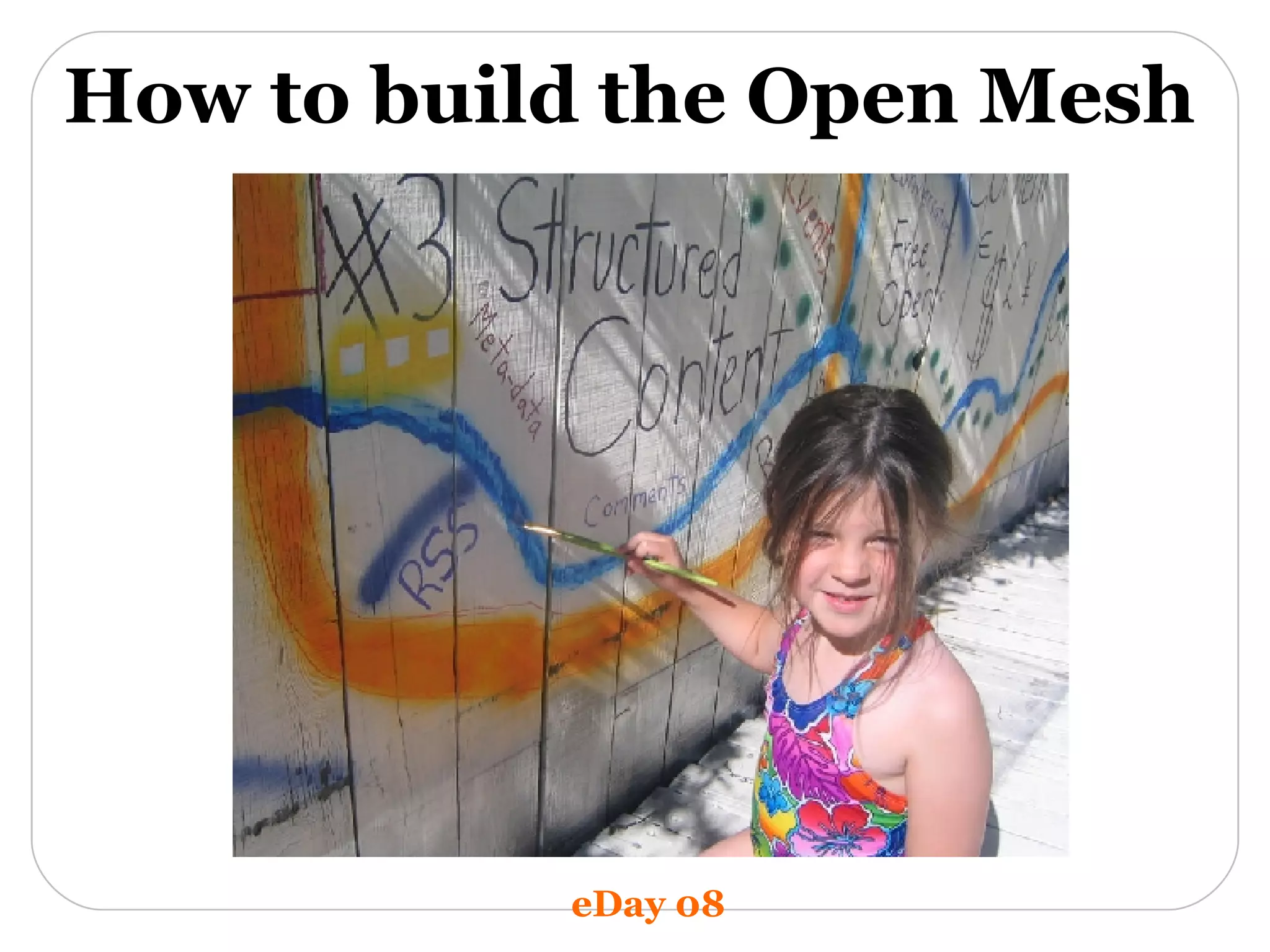

How to build the Open Mesh eDay 08
My name is Marc…. Happy to be back in Holland Our platform is called PeopleAggregator I’ve written this book  “How to build the Open Mesh” And we’re planning on  building some new kind  of tools
Two constituents for this treatise Practitioners  build systems, portals, web sites, applications, dashboards, web services Creating their own solution Want to be a compatible puzzle piece in the mesh Marketers  need to describe what’s going on Educate, facilitate conversations, proselytize Digitize their brand, market their product or services Form alliances, find revenue streams
Open is the New Black Do you think MySpace would have opened up – if Facebook didn’t do it first? Who would have thought that Microsoft would open up – or produce Live Mesh? Y! OS is actually very well architected, now they just have to execute! In exchange for not letting us at the data, Google is trying to grab Open leadership
Act pragmatic, but dream like a visionary
All of life is a compromise Who’d have thought we’d be this far along? Proprietary formats versus Open standards Centralized versus Distributed Keeping up with the Joneses BigCos versus small Independents Many forced to take VC money, no alternative to funding
 
We’ll be living in a distributed world Widgets, OpenSocial and Facebook apps International, not just English Everything in the Cloud Long Tail publishing and sales Work at Home, virtual offices, outsourcing Global economy
 
Everything is a URL in the Cloud A Person is a URL A Group is a URL A Conversation is a URL A Media item is a URL An Event is a URL A Post (of every kind) is a URL Meta-data and structured content make things smart
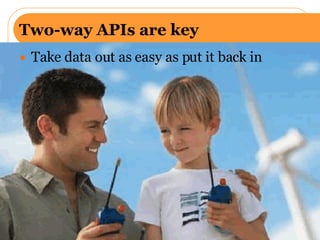
Two-way APIs are key Take data out as easy as put it back in
Access controls and privacy What if I don’t WANT to be part of the mesh? Control who sees: My profile My social graph My content What I am doing  Where I am Establish trust
 
Open Standards are our Infrastructure RSS  = subscription format Atom  = subscription and publishing protocols XMPP  = real-time transport OpenID  = who I am oAuth  = who gets access to what I have OpenSocial  = lots of social functions Portable Contacts  = accessing contact lists Microformats  = reviews, ID, events, friends, place FOAF  = rdf schema
 
Our Infrastructure Redundant – rely upon no one vendor Show Context and State Underlying ID layer Shared Knowledge bases
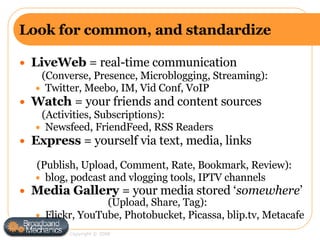
Look for common, and standardize LiveWeb  = real-time communication  (Converse, Presence, Microblogging, Streaming): Twitter, Meebo, IM, Vid Conf, VoIP  Watch  =   your friends and content sources   (Activities, Subscriptions): Newsfeed, FriendFeed, RSS Readers Express  = yourself via text, media, links  (Publish, Upload, Comment, Rate, Bookmark, Review): blog, podcast and vlogging tools, IPTV channels Media Gallery  = your media stored ‘ somewhere ’   (Upload, Share, Tag): Flickr, YouTube, Photobucket, Picassa, blip.tv, Metacafe
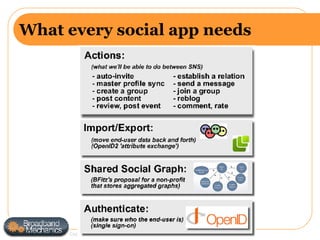
What every social app needs
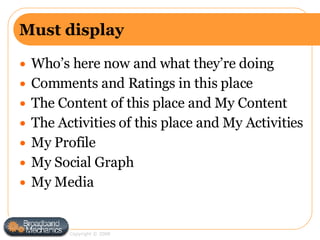
Must display Who’s here now and what they’re doing Comments and Ratings in this place The Content of this place and My Content The Activities of this place and My Activities My Profile My Social Graph My Media
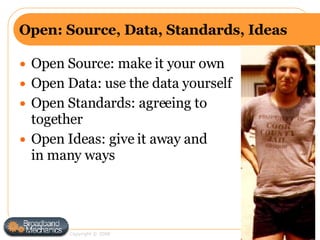
Open: Source, Data, Standards, Ideas Open Source: make it your own Open Data: use the data yourself Open Standards: agreeing to  work together Open Ideas: give it away and  benefit in many ways
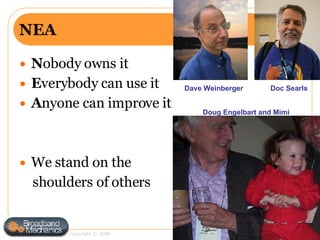
NEA N obody owns it E verybody can use it A nyone can improve it We stand on the shoulders of others Doc Searls Dave Weinberger Doug Engelbart and Mimi
Work with others, form alliances We need to show that open can benefit vendors – as well as end-users Alliances of non-overlapping agendi Competition means something different – when we live in the shadows of behemoths We must live off the crumbs they leave behind, while keeping our heads up high
Figuring out how it’ll unfold Pure chaos We’ll be explaining and translating for years to come No one set of standards or approach Lots of different kinds of platforms Early adopters will lead the way Adhere to our principles: “ Bill of Rights for Users of Social Media”
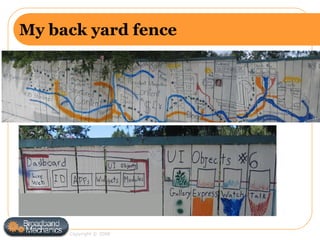
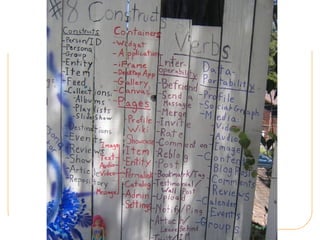
My back yard fence
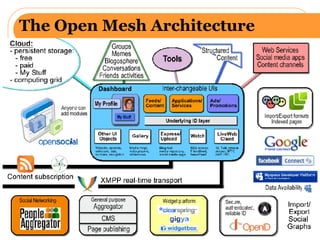
The Open Mesh Architecture
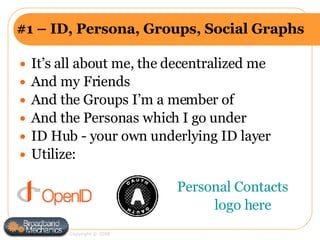
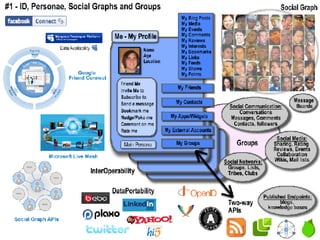
#1 – ID, Persona, Groups, Social Graphs It’s all about me, the decentralized me And my Friends And the Groups I’m a member of And the Personas which I go under ID Hub - your own underlying ID layer Utilize:  Personal Contacts   logo here
 
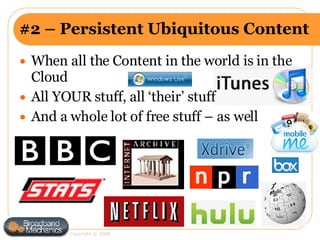
When all the Content in the world is in the Cloud  All YOUR stuff, all ‘their’ stuff And a whole lot of free stuff – as well #2 – Persistent Ubiquitous Content
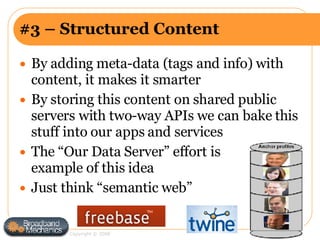
By adding meta-data (tags and info) with content, it makes it smarter By storing this content on shared public servers with two-way APIs we can bake this stuff into our apps and services The “Our Data Server” effort is  an example of this idea Just think “semantic web” #3 – Structured Content
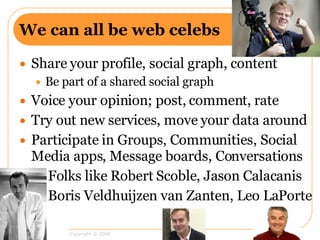
We can all be web celebs Share your profile, social graph, content Be part of a shared social graph Voice your opinion; post, comment, rate Try out new services, move your data around Participate in Groups, Communities, Social Media apps, Message boards, Conversations Folks like Robert Scoble, Jason Calacanis Boris Veldhuijzen van Zanten, Leo LaPorte
We can all have our own platforms Be your own Brand Use widgets to spread yourself around the web Aggregate and Watch your friends, Collect your Content, Connect to others, always try out the latest thing, find your voice Play with the BigCos, run promotions, cut deals Support Open Standards And collectively we’ll all make the open mesh happen
Collective “We” is constantly evolving Buzzword du jours : Social Networking Citizen Journalism Shared Galleries Crowdsourcing UGC Twittering IPTV channels Narrowcast shows That’s why we need to invite our friends into new services Cause we want to try out these new things Be part of the Community Commons
So I’m proposing…. The “ Our Data Server ” effort Our Data will be a simple service that stores and aggregates one’s social graph in a public place and allows fans to sign up, rate, leave comments, etc. Our Data will be used by Celebs to ‘invite’ their social graph into new services NOT controlled by a particular platform Early example of how the  open mesh  can evolve and prosper
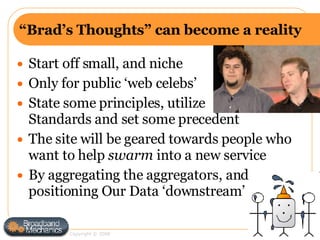
“ Brad’s Thoughts” can become a reality Start off small, and niche Only for public ‘web celebs’ State some principles, utilize  Open Standards and set some precedent The site will be geared towards people who want to help  swarm  into a new service By aggregating the aggregators, and positioning Our Data ‘downstream’
Have to keep in mind – it’s “Our Data” I’m in charge of my data You’re in charge of your data And we together share “Our Data” Without that model in mind, we won’t be able to work together equally or fairly Or safely And maintain privacy
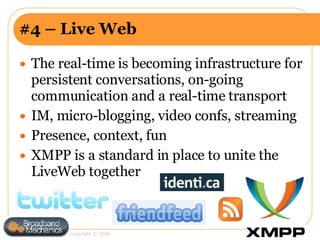
The real-time is becoming infrastructure for persistent conversations, on-going communication and a real-time transport IM, micro-blogging, video confs, streaming Presence, context, fun XMPP is a standard in place to unite the LiveWeb together #4 – Live Web
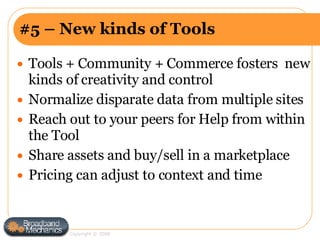
Tools + Community + Commerce fosters  new kinds of creativity and control Normalize disparate data from multiple sites Reach out to your peers for Help from within the Tool Share assets and buy/sell in a marketplace Pricing can adjust to context and time #5 – New kinds of Tools
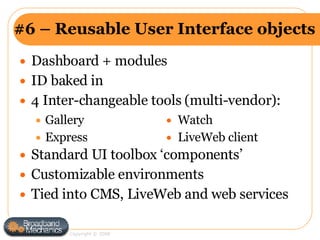
Dashboard + modules ID baked in 4 Inter-changeable tools (multi-vendor): Standard UI toolbox ‘components’ Customizable environments Tied into CMS, LiveWeb and web services #6 – Reusable User Interface objects Gallery Express Watch LiveWeb client
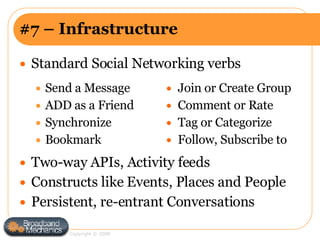
Standard Social Networking verbs Two-way APIs, Activity feeds Constructs like Events, Places and People Persistent, re-entrant Conversations #7 – Infrastructure Send a Message ADD as a Friend Synchronize Bookmark Join or Create Group Comment or Rate Tag or Categorize Follow, Subscribe to
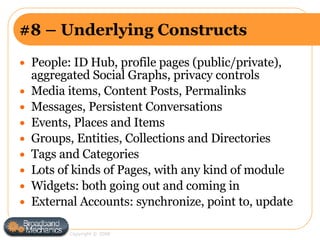
#8 – Underlying Constructs People: ID Hub, profile pages (public/private), aggregated Social Graphs, privacy controls Media items, Content Posts, Permalinks Messages, Persistent Conversations Events, Places and Items Groups, Entities, Collections and Directories Tags and Categories Lots of kinds of Pages, with any kind of module Widgets: both going out and coming in External Accounts: synchronize, point to, update
 
Everybody has to make a living, so we need APIs and infrastructure to monetize  Buying and selling all sorts of things Matching user profiles to…… Auctions, Listings, Transactions Monetize our attention VRM  – vendor relationship marketing #9 – Marketplace
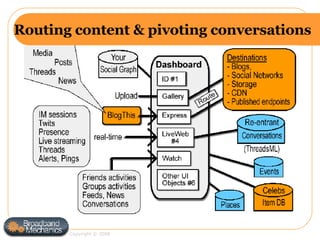
Identity oriented Content oriented Leverage real-time transport Mesh architecture Microcontent publish/subscribe Route posts to your preferred tool Master list of destinations and services #10 – Standards
I’m also proposing 2 new standards ReDirectThis Enables a universal ‘BlogThis’ button Route the post to your preferred tool OutputThis Manage a list of all the destinations and endpoints you’d like to publish to, route to, interact with, etc. No one owns the list Access the list from with your Express and Gallery tools
Routing content & pivoting conversations
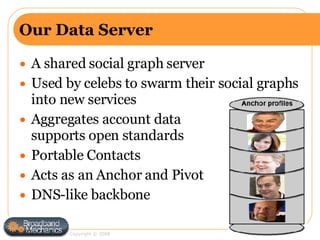
Our Data Server A shared social graph server Used by celebs to swarm their social graphs into new services Aggregates account data  and supports open standards Portable Contacts Acts as an Anchor and Pivot DNS-like backbone
DNS-like backbone Imagine if there were 100 Twitters, Identi.ca, Pownce, Jaiku and Plurk And your account (and your followers) could aggregate across all the different instances No one vendor would dominate or control This approach should be taken for ALL infrastructure in the open mesh!
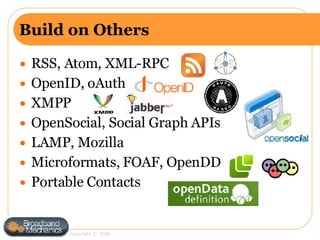
Build on Others RSS, Atom, XML-RPC OpenID, oAuth XMPP OpenSocial, Social Graph APIs LAMP, Mozilla Microformats, FOAF, OpenDD Portable Contacts
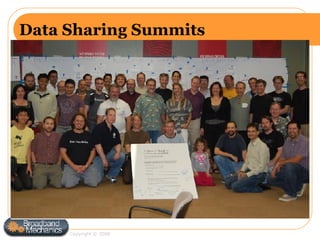
Data Sharing Summits
How can we all contribute to help build? Each platform should mesh with all the other meshed platforms (eco-systems) The chaos of multiple markets, dimensions and platforms necessitates the open mesh We’re all the glue between the colliding BigCo tectonic plates This strategy plays well around the world Each personal mesh will mesh into all other meshes, have their own knowledge base(s)
Conclusion Compelling User experiences is  what it’s all about Our Data  is for web celebs Underlying ID layers is where to connect to Persistent  Conversations  will arise Social features  will be in all software The  Cloud ,  persistent  and  structured content  will enable new experiences
PeopleAggregator  is the reference design Source code available Free to non-profits and government agencies Enterprise license available (with support) Also available via a ‘ PayAsYouGo ’ license Starting at $2,500 No support We also offer SaaS packages Can move to a license deal at any time Consulting, custom work available
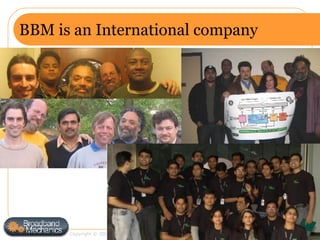
BBM is an International company

How to build the Open Mesh

  • 1.
    How to buildthe Open Mesh eDay 08
  • 2.
    My name isMarc…. Happy to be back in Holland Our platform is called PeopleAggregator I’ve written this book “How to build the Open Mesh” And we’re planning on building some new kind of tools
  • 3.
    Two constituents forthis treatise Practitioners build systems, portals, web sites, applications, dashboards, web services Creating their own solution Want to be a compatible puzzle piece in the mesh Marketers need to describe what’s going on Educate, facilitate conversations, proselytize Digitize their brand, market their product or services Form alliances, find revenue streams
  • 4.
    Open is theNew Black Do you think MySpace would have opened up – if Facebook didn’t do it first? Who would have thought that Microsoft would open up – or produce Live Mesh? Y! OS is actually very well architected, now they just have to execute! In exchange for not letting us at the data, Google is trying to grab Open leadership
  • 5.
    Act pragmatic, butdream like a visionary
  • 6.
    All of lifeis a compromise Who’d have thought we’d be this far along? Proprietary formats versus Open standards Centralized versus Distributed Keeping up with the Joneses BigCos versus small Independents Many forced to take VC money, no alternative to funding
  • 7.
  • 8.
    We’ll be livingin a distributed world Widgets, OpenSocial and Facebook apps International, not just English Everything in the Cloud Long Tail publishing and sales Work at Home, virtual offices, outsourcing Global economy
  • 9.
  • 10.
    Everything is aURL in the Cloud A Person is a URL A Group is a URL A Conversation is a URL A Media item is a URL An Event is a URL A Post (of every kind) is a URL Meta-data and structured content make things smart
  • 11.
    Two-way APIs arekey Take data out as easy as put it back in
  • 12.
    Access controls andprivacy What if I don’t WANT to be part of the mesh? Control who sees: My profile My social graph My content What I am doing Where I am Establish trust
  • 13.
  • 14.
    Open Standards areour Infrastructure RSS = subscription format Atom = subscription and publishing protocols XMPP = real-time transport OpenID = who I am oAuth = who gets access to what I have OpenSocial = lots of social functions Portable Contacts = accessing contact lists Microformats = reviews, ID, events, friends, place FOAF = rdf schema
  • 15.
  • 16.
    Our Infrastructure Redundant– rely upon no one vendor Show Context and State Underlying ID layer Shared Knowledge bases
  • 17.
    Look for common,and standardize LiveWeb = real-time communication (Converse, Presence, Microblogging, Streaming): Twitter, Meebo, IM, Vid Conf, VoIP Watch = your friends and content sources (Activities, Subscriptions): Newsfeed, FriendFeed, RSS Readers Express = yourself via text, media, links (Publish, Upload, Comment, Rate, Bookmark, Review): blog, podcast and vlogging tools, IPTV channels Media Gallery = your media stored ‘ somewhere ’ (Upload, Share, Tag): Flickr, YouTube, Photobucket, Picassa, blip.tv, Metacafe
  • 18.
  • 19.
    Must display Who’shere now and what they’re doing Comments and Ratings in this place The Content of this place and My Content The Activities of this place and My Activities My Profile My Social Graph My Media
  • 20.
    Open: Source, Data,Standards, Ideas Open Source: make it your own Open Data: use the data yourself Open Standards: agreeing to work together Open Ideas: give it away and benefit in many ways
  • 21.
    NEA N obodyowns it E verybody can use it A nyone can improve it We stand on the shoulders of others Doc Searls Dave Weinberger Doug Engelbart and Mimi
  • 22.
    Work with others,form alliances We need to show that open can benefit vendors – as well as end-users Alliances of non-overlapping agendi Competition means something different – when we live in the shadows of behemoths We must live off the crumbs they leave behind, while keeping our heads up high
  • 23.
    Figuring out howit’ll unfold Pure chaos We’ll be explaining and translating for years to come No one set of standards or approach Lots of different kinds of platforms Early adopters will lead the way Adhere to our principles: “ Bill of Rights for Users of Social Media”
  • 24.
  • 25.
    The Open MeshArchitecture
  • 26.
    #1 – ID,Persona, Groups, Social Graphs It’s all about me, the decentralized me And my Friends And the Groups I’m a member of And the Personas which I go under ID Hub - your own underlying ID layer Utilize: Personal Contacts logo here
  • 27.
  • 28.
    When all theContent in the world is in the Cloud All YOUR stuff, all ‘their’ stuff And a whole lot of free stuff – as well #2 – Persistent Ubiquitous Content
  • 29.
    By adding meta-data(tags and info) with content, it makes it smarter By storing this content on shared public servers with two-way APIs we can bake this stuff into our apps and services The “Our Data Server” effort is an example of this idea Just think “semantic web” #3 – Structured Content
  • 30.
    We can allbe web celebs Share your profile, social graph, content Be part of a shared social graph Voice your opinion; post, comment, rate Try out new services, move your data around Participate in Groups, Communities, Social Media apps, Message boards, Conversations Folks like Robert Scoble, Jason Calacanis Boris Veldhuijzen van Zanten, Leo LaPorte
  • 31.
    We can allhave our own platforms Be your own Brand Use widgets to spread yourself around the web Aggregate and Watch your friends, Collect your Content, Connect to others, always try out the latest thing, find your voice Play with the BigCos, run promotions, cut deals Support Open Standards And collectively we’ll all make the open mesh happen
  • 32.
    Collective “We” isconstantly evolving Buzzword du jours : Social Networking Citizen Journalism Shared Galleries Crowdsourcing UGC Twittering IPTV channels Narrowcast shows That’s why we need to invite our friends into new services Cause we want to try out these new things Be part of the Community Commons
  • 33.
    So I’m proposing….The “ Our Data Server ” effort Our Data will be a simple service that stores and aggregates one’s social graph in a public place and allows fans to sign up, rate, leave comments, etc. Our Data will be used by Celebs to ‘invite’ their social graph into new services NOT controlled by a particular platform Early example of how the open mesh can evolve and prosper
  • 34.
    “ Brad’s Thoughts”can become a reality Start off small, and niche Only for public ‘web celebs’ State some principles, utilize Open Standards and set some precedent The site will be geared towards people who want to help swarm into a new service By aggregating the aggregators, and positioning Our Data ‘downstream’
  • 35.
    Have to keepin mind – it’s “Our Data” I’m in charge of my data You’re in charge of your data And we together share “Our Data” Without that model in mind, we won’t be able to work together equally or fairly Or safely And maintain privacy
  • 36.
    The real-time isbecoming infrastructure for persistent conversations, on-going communication and a real-time transport IM, micro-blogging, video confs, streaming Presence, context, fun XMPP is a standard in place to unite the LiveWeb together #4 – Live Web
  • 37.
    Tools + Community+ Commerce fosters new kinds of creativity and control Normalize disparate data from multiple sites Reach out to your peers for Help from within the Tool Share assets and buy/sell in a marketplace Pricing can adjust to context and time #5 – New kinds of Tools
  • 38.
    Dashboard + modulesID baked in 4 Inter-changeable tools (multi-vendor): Standard UI toolbox ‘components’ Customizable environments Tied into CMS, LiveWeb and web services #6 – Reusable User Interface objects Gallery Express Watch LiveWeb client
  • 39.
    Standard Social Networkingverbs Two-way APIs, Activity feeds Constructs like Events, Places and People Persistent, re-entrant Conversations #7 – Infrastructure Send a Message ADD as a Friend Synchronize Bookmark Join or Create Group Comment or Rate Tag or Categorize Follow, Subscribe to
  • 40.
    #8 – UnderlyingConstructs People: ID Hub, profile pages (public/private), aggregated Social Graphs, privacy controls Media items, Content Posts, Permalinks Messages, Persistent Conversations Events, Places and Items Groups, Entities, Collections and Directories Tags and Categories Lots of kinds of Pages, with any kind of module Widgets: both going out and coming in External Accounts: synchronize, point to, update
  • 41.
  • 42.
    Everybody has tomake a living, so we need APIs and infrastructure to monetize Buying and selling all sorts of things Matching user profiles to…… Auctions, Listings, Transactions Monetize our attention VRM – vendor relationship marketing #9 – Marketplace
  • 43.
    Identity oriented Contentoriented Leverage real-time transport Mesh architecture Microcontent publish/subscribe Route posts to your preferred tool Master list of destinations and services #10 – Standards
  • 44.
    I’m also proposing2 new standards ReDirectThis Enables a universal ‘BlogThis’ button Route the post to your preferred tool OutputThis Manage a list of all the destinations and endpoints you’d like to publish to, route to, interact with, etc. No one owns the list Access the list from with your Express and Gallery tools
  • 45.
    Routing content &pivoting conversations
  • 46.
    Our Data ServerA shared social graph server Used by celebs to swarm their social graphs into new services Aggregates account data and supports open standards Portable Contacts Acts as an Anchor and Pivot DNS-like backbone
  • 47.
    DNS-like backbone Imagineif there were 100 Twitters, Identi.ca, Pownce, Jaiku and Plurk And your account (and your followers) could aggregate across all the different instances No one vendor would dominate or control This approach should be taken for ALL infrastructure in the open mesh!
  • 48.
    Build on OthersRSS, Atom, XML-RPC OpenID, oAuth XMPP OpenSocial, Social Graph APIs LAMP, Mozilla Microformats, FOAF, OpenDD Portable Contacts
  • 49.
  • 50.
    How can weall contribute to help build? Each platform should mesh with all the other meshed platforms (eco-systems) The chaos of multiple markets, dimensions and platforms necessitates the open mesh We’re all the glue between the colliding BigCo tectonic plates This strategy plays well around the world Each personal mesh will mesh into all other meshes, have their own knowledge base(s)
  • 51.
    Conclusion Compelling Userexperiences is what it’s all about Our Data is for web celebs Underlying ID layers is where to connect to Persistent Conversations will arise Social features will be in all software The Cloud , persistent and structured content will enable new experiences
  • 52.
    PeopleAggregator isthe reference design Source code available Free to non-profits and government agencies Enterprise license available (with support) Also available via a ‘ PayAsYouGo ’ license Starting at $2,500 No support We also offer SaaS packages Can move to a license deal at any time Consulting, custom work available
  • 53.
    BBM is anInternational company

Editor's Notes

  • #2 Intro rap – why did I write the book, what are the conditions and market factors which forced me to play my hand?